❌

Visualização normal

Antes de ontemSecurity Affairs
  • ✇Security Affairs
  • Security Affairs newsletter Round 602 by Pierluigi Paganini – INTERNATIONAL EDITION Pierluigi Paganini
    A new round of the weekly Security Affairs newsletter has arrived! Every week, the best security articles from Security Affairs are free in your email box. Enjoy a new round of the weekly SecurityAffairs newsletter, including international press. U.S. CISA adds Ivanti Connect Secure flaws to its Known Exploited Vulnerabilities catalogAttackers Exploit Critical Drupal Commerce Core Vulnerability CVE-2026-118539Yoba Malware Hides a Crypto Miner Behind Legitimate OpenAI and Anthropic Binarie
     

Security Affairs newsletter Round 602 by Pierluigi Paganini – INTERNATIONAL EDITION

1 de Novembro de 2026, 10:22

A new round of the weekly Security Affairs newsletter has arrived! Every week, the best security articles from Security Affairs are free in your email box.

Enjoy a new round of the weekly SecurityAffairs newsletter, including international press.

U.S. CISA adds Ivanti Connect Secure flaws to its Known Exploited Vulnerabilities catalog
Attackers Exploit Critical Drupal Commerce Core Vulnerability CVE-2026-118539
Yoba Malware Hides a Crypto Miner Behind Legitimate OpenAI and Anthropic Binaries
U.S. CISA adds GitLab and Cisco flaws to its Known Exploited Vulnerabilities catalog
$6.3 Billion Stolen from Binance in Attack Attributed to North Korea
How to prioritize remediation after a pentest: a practitioner workflow
Hacker leaks data on more than 40,000 Homeland Security employees
Binance Investigates Suspicious Crypto Transfers Worth Up to $5.8 Billion
US Probes Suspected Hack Behind Military Base Freezer Failures
484,142 Exposed Cloud Buckets Contain 18 Billion Files
U.S. CISA adds Linux Kernel and Broadcom VMWare ESX  flaws to its Known Exploited Vulnerabilities catalog
Volt Typhoon Used Silent Train to Hide Zero-Day Attacks
Election Website Security: 42% of US County Sites Still Lack .gov Domains
ENGIE Data Breach Exposes Customer Details and Energy Contracts
Virtualine Domain Seized, but Allegedly Abusive Website Remains Online
Hive and Nefilim Ransomware Affiliate Gets 70 Months In Jail
Ads or Surveillance? Researchers Flag Suspicious Targeting of Starlink Users
CVE-2026-97631: 16-Year-Old UEFI Flaw Threatens Servers
U.S. CISA adds Google Brotli and Adobe Commerce and Magento flaws to its Known Exploited Vulnerabilities catalog
Three Japan-Focused Cyberattacks Show How Hackers Use AI
Italy ’s Parliament Under Cyber Pressure: Why the Attack on the Chamber Matters
Australia’s Cyber Spy Chief: Expect More Disruption as AI Accelerates Hacking
U.S. CISA adds PHP flaws PHP2Shell to its Known Exploited Vulnerabilities catalog
Attackers Take Control of Dahua Cameras and Video Recorders Via Easy4IP
Cohere Finds Qwen AI Model Contacting a Server in China
Magento Campaign Infects 953 Online Stores Across Five Domains
AI-Generated Fake Bank Calls and NFC App Enabled €380,000 Fraud, Dutch Police Say
Researchers Uncover Rentable Android Spyware uCreater Targeting WeChat and Telegram
PHP2Shell: Suspected North Korean campaign targets 216 vulnerable PHP hosts
Anthropic reveals how Claude Mythos 5 crossed security testing boundaries
OpenAI Paused Frontier AI Training After a Security Incident

International Press – Newsletter

Cybercrime

Binance Says User Funds Are ‘Completely Safe’ After $3.5 Billion Drains From Its Hot Wallets  

Police arrest two suspects in AI-powered bank fraud that cost victims €380,000   

M365 Token Spray and Replay Campaign Compromises Business Email Accounts 

Chinese National Extradited for Alleged Role in Multimillion-Dollar Cryptocurrency Scam Targeting U.S. Citizens  

Ukrainian National Sentenced to 70 Months in Prison for Multi-Million Dollar Ransomware Conspiracies  

Hacker stole personnel data about thousands of Homeland Security employees, including CBP and ICE agents 

deepveindrilling.com: Magento CMS block loader hits 953 stores

“Bulletproof” website domain seized in international law enforcement operation  

Trezor warns of suspected crypto-theft implant in hardware wallet

Polymarket halts trading after crypto-draining script breach, $2.5M traced

Malware

uCreator: virtualization-based Android spyware platform targeting WeChat, Telegram and other messaging apps  

CLAUDE CODE FOUND SPYWARE ON MY FAMILY’S PHONES AND A BACKDOOR ON MY MAC

Security notice — malicious version of Anthropic.claude-code (2.1.313) identified in the Cursor Extension Marketplace  

Tricks from the Past deployed via signed ChatGPT and Claude binaries

Hacking

PHP2Shell exploitation observed: packet-to-process RCE evidence  

CYFIRMA Threat Advisory: Suspected DPRK Campaign staging PHP2Shell Targeting against Global PHP infrastructure  

Beyond the Inbox: How Threat Actors Abuse Microsoft Teams External Chat for Initial Access  

Not Only ARTEX: The Different Levels AI is Used in Attacks Targeting Japan  

Broccoli2shell: Everything You Need To Know About The Critical Brotli Decoder Vulnerability  

Discovering and exploiting vulnerabilities in critical, real-world software with Claude

Putting Claude Code in a box: a sandboxed dev container for Zed

Hackers Target Critical Oracle E-Business Suite RCE Flaw Days After Security Patch

The Last Proof of Human Craft: Forging a Microsoft Edge Full Chain with Logic Bugs Only!  

Pentagon treating military base freezer malfunctions as suspected cyberattack, officials say  

GitLab security incident: attempted exploitation of CVE-2026-97229  

Intelligence and Information Warfare  

Alibaba’s Qwen AI caught trying to contact server in China

Hackers can gain control of cameras and DVRs through cloud access      

Disruptions ‘inevitable’ as AI-powered cyber threats grow, Australian Signals Directorate says

Operation FlashHole: Lazarus breaks security, defies control 

Hackers Sympathetic to Russia Are Hitting Utilities and Factories  

Alleged Israeli spy company heavily targeted Starlink users, sources say

Silent Train: uncovering Volt Typhoon’s operational framework for zero-day exploitation and strategic access  

North Korea Steals USD 6.36 Billion From Binance in the Largest Hack in History  

Mapping the Political Influencer Industry and the Problems it Causes for Democracy  

Cybersecurity

NIS 2 Italy: Key Deadlines, Board Duties and What ACN Expects From Companies  

The Two Things CISOs Should Be Thinking About In The Wake Of The PHP Nightmare

Code-execution flaw in UEFI firmware affects most servers on planet Earth     

2026 County Election Website Security Census: Key Findings  

Cloud Exposure Index 2026: 484,142 open buckets mapped  

ENGIE: Data leak via a tool belonging to its business partners 

Beyond Framework Signatures: Understanding AI-Driven Intrusions 

I Think The Military Commissary’s Freezers Were Hacked  

Manifestos, Fear, and ‘Loser Thinking’: Inside Proton’s AI Reckoning 

Passkeys Are Better Than Passwords. But They Are Not Enough

Follow me on Twitter: @securityaffairs and Facebook and Mastodon

Pierluigi Paganini

(SecurityAffairs – hacking, newsletter)

  • ✇Security Affairs
  • Hacker leaks data on more than 40,000 Homeland Security employees Pierluigi Paganini
    A hacker leaks personal data on more than 40,000 DHS employees, including CBP, ICE and CISA staff, after an undisclosed breach. Personal details of thousands of U.S. Department of Homeland Security (DHS) employees are now online after a hacker stole reams of data in a data breach that occurred earlier this year and nobody had disclosed. “The breach includes names, job titles, and work contact information, such as email addresses, cell phone numbers, and office locations, of more than 40,
     

Hacker leaks data on more than 40,000 Homeland Security employees

30 de Outubro de 2026, 03:26

A hacker leaks personal data on more than 40,000 DHS employees, including CBP, ICE and CISA staff, after an undisclosed breach.

Personal details of thousands of U.S. Department of Homeland Security (DHS) employees are now online after a hacker stole reams of data in a data breach that occurred earlier this year and nobody had disclosed.

“The breach includes names, job titles, and work contact information, such as email addresses, cell phone numbers, and office locations, of more than 40,000 people who work for the federal department, including border and immigration agents, cybersecurity staffers, and senior department officials.” TechCrunch reports.

The incident impacted border and immigration agents, cybersecurity staff and senior department officials. DHS confirmed it is aware of a potential breach and is investigating, saying it takes threats to employees seriously and will provide updates when more information is available.

“DHS is aware of a potential breach and is actively working to address the situation swiftly and effectively. We take all security threats against our employees and officers seriously and will work to ensure all are properly protected. We will update the public when more information is available,” a DHS spokesperson told SecurityWeek.

The hacker, who uses the name Department of Peace, claims to have stolen the data from an Okta single sign-on system. DHS uses this service to give employees and contractors across its agencies access to the department’s central network. The system also stores IT and login records for each account, showing which systems and internal apps each person can access. The hacker left a note with the leaked data, seen by TechCrunch, saying that if others have their information, it is only fair to share theirs. The malicious actor did not reveal how the U.S. agency was breached.

More than half of the records, around 21,000, belong to U.S. Customs and Border Protection (CBP) employees working at airports and other ports of entry. Another 10,000 belong to Immigration and Customs Enforcement (ICE) and its Homeland Security Investigations unit, while just under 1,000 are linked to the cybersecurity agency CISA. Thousands of other records belong to DHS headquarters and agencies such as U.S. Citizenship and Immigration Services and the Federal Protective Service.


DDoSecrets says the leaked database identifies officials involved in undercover operations and key DHS personnel overseeing renditions and deportations. Department of Peace said the leak was a response to the government’s actions against ICE. Crimew described the database as an unprecedented view of DHS’s organizational structure, helping researchers identify employees, their roles and reporting lines. They said it could also support investigations and future Freedom of Information Act (FOIA) requests.

DDoSecrets co-founder Emma Best said the database, called Icepick, identifies officials involved in covert operations, internal investigations and deportation programs. Ryan Shapiro of Property of the People added that employee contact details could help researchers submit more targeted FOIA requests. Best said the data could also support journalism, congressional inquiries, legal challenges and community investigations.

“Rather than an indiscriminate directory of every DHS employee, Icepick identifies many of the architects and drivers of DHS policy and operations,” said journalist and DDoSecrets cofounder Emma Best. “The leak is extraordinary but deceptive in its simplicity as it identifies the officials responsible for overseeing covert and undercover operations, the government’s hunt for leakers and the failed BlueLeaks investigation — along with key personnel in DHS’s ever-escalating rendition and deportation programs.”

“By replacing the regime’s anonymity with accountability, Icepick and the tool developed by maia are catalyst for investigations, empowering journalists, Congressional inquiries, legal challenges, community action and Freedom of Information Act requests,” added Best.

DHS is investigating a potential breach. Okta says it has no evidence its systems or data were compromised.

The breach follows other attacks on U.S. government agencies that exposed FBI records and military personnel data. It is also the second DHS breach this year, after the same hacker claimed to have stolen thousands of government contracts.

Journalist maia arson crimew shared the data with DDoSecrets. TechCrunch verified some records, which suggest the database was copied around mid-August. The leak covers about one-fifth of DHS’s 220,000 employees.

The records reveal access to tools including Microsoft 365, ChatGPT, Penlink surveillance software and Mobile Fortify, a facial recognition app used by CBP and ICE. Around 4,500 accounts belong to a Headspace user group, while more than 2,000 Homeland Security Investigations employees appear in Penlink-related groups.

Researchers say the contact details could help journalists file targeted Freedom of Information Act requests. However, exposing employees’ phone numbers and office locations also creates security and privacy risks.

Follow me on Twitter: @securityaffairs and Facebook and Mastodon

Pierluigi Paganini

(SecurityAffairs – hacking, DHS)

  • ✇Security Affairs
  • ENGIE Data Breach Exposes Customer Details and Energy Contracts Pierluigi Paganini
    ENGIE says attackers accessed French customers’ contact and energy contract data through a partner sales tool. Banking data was not affected. French multinational energy company ENGIE warned customers in France that attackers accessed personal information through a sales tool used by some business partners. The exposed data includes contact details and energy contract information that could help fraudsters impersonate the supplier. The company says its internal IT systems weren’t compromi
     

ENGIE Data Breach Exposes Customer Details and Energy Contracts

29 de Outubro de 2026, 05:53

ENGIE says attackers accessed French customers’ contact and energy contract data through a partner sales tool. Banking data was not affected.

French multinational energy company ENGIE warned customers in France that attackers accessed personal information through a sales tool used by some business partners. The exposed data includes contact details and energy contract information that could help fraudsters impersonate the supplier.

The company says its internal IT systems weren’t compromised and banking information wasn’t affected. It has blocked the attackers’ access, notified the relevant authorities and contacted affected customers, according to a spokesperson who spoke to BleepingComputer.

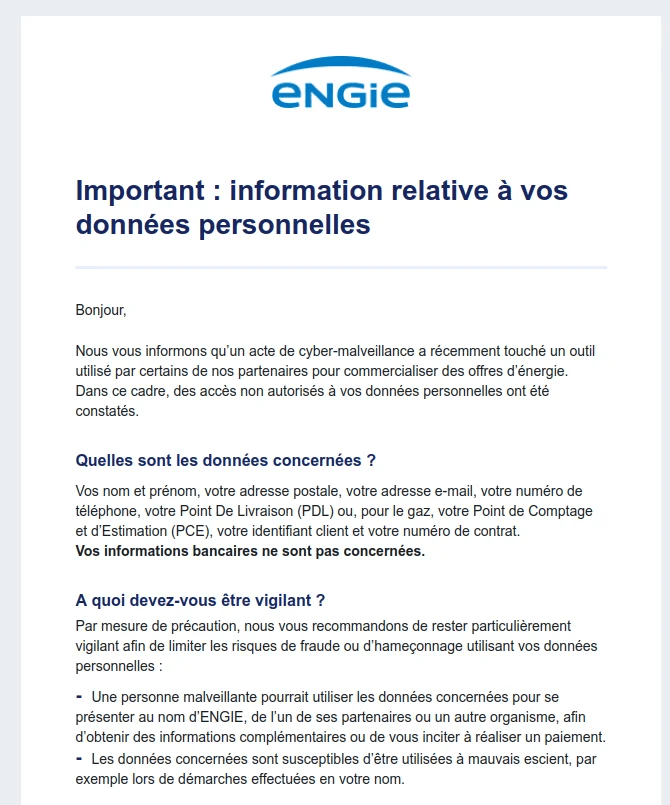
According to notification emails sent to affected customers, the incident involved a tool used by partners to sell the company’s electricity and natural gas offers.

engie

The notification confirms that attackers gained unauthorized access to personal information stored in the sales tool.

“We are informing you that an act of cyber-malice recently affected a tool used by some of our partners to market energy offers. As part of this incident, unauthorized access to your personal data was identified.” reads the notification.

The compromised information includes customers’ names, postal addresses, email addresses, telephone numbers, customer IDs, contract numbers and energy supply identifiers.

The company hasn’t disclosed the partner or platform involved. It also hasn’t revealed how many customers were affected, when the intrusion began, or when it was discovered.

For electricity customers, these include the delivery point identifier (PDL). For gas customers, they include the metering and estimation point (PCE).

ENGIE says financial information wasn’t affected and that its investigation indicates the exposure was limited to contact details and certain contract information.

That reduces one category of risk but doesn’t eliminate financial fraud. Attackers can use accurate customer information to persuade victims to disclose additional data or make payments.

Anyway, the exposed data could support impersonation scams. The company warned customers to watch for attempts to obtain further information or induce payments. A contract number, however, doesn’t prove that a caller is legitimate. It may simply show that the person has access to an exposed record.

Customers should verify unexpected requests through trusted channels, even when the sender knows their personal details.

ENGIE hasn’t attributed the attack to a specific group, and at this time no ransomware group has claimed responsibility for the attack.

Experts recommend visiting ENGIE’s official website or app directly instead of signing in through links received by email.

Customers should also be cautious with unexpected calls and messages. If someone requests a payment, password or additional personal information, they should end the exchange and verify the request using independently obtained official contact details.

Customers should never share SMS verification codes, passwords or banking details with someone who contacts them unexpectedly.

Follow me on Twitter: @securityaffairs and Facebook and Mastodon

Pierluigi Paganini

(SecurityAffairs – hacking, data breach)

  • ✇Security Affairs
  • Security Affairs newsletter Round 601 by Pierluigi Paganini – INTERNATIONAL EDITION Pierluigi Paganini
    A new round of the weekly Security Affairs newsletter has arrived! Every week, the best security articles from Security Affairs are free in your email box. Enjoy a new round of the weekly SecurityAffairs newsletter, including international press. Capcom Data Breach Exposes 11.7 Million Email AddressesU.S. CISA adds Arista VeloCloud Orchestrator flaw to its Known Exploited Vulnerabilities catalogPHP Warns of New Code Execution Flaw Days After PHP2Shell PatchesMeta Faces $25 Billion Penalty
     

Security Affairs newsletter Round 601 by Pierluigi Paganini – INTERNATIONAL EDITION

25 de Outubro de 2026, 09:28

A new round of the weekly Security Affairs newsletter has arrived! Every week, the best security articles from Security Affairs are free in your email box.

Enjoy a new round of the weekly SecurityAffairs newsletter, including international press.

Capcom Data Breach Exposes 11.7 Million Email Addresses
U.S. CISA adds Arista VeloCloud Orchestrator flaw to its Known Exploited Vulnerabilities catalog
PHP Warns of New Code Execution Flaw Days After PHP2Shell Patches
Meta Faces $25 Billion Penalty Linked to Cambridge Analytica Scandal
Capcom Data Breach Exposes 11.7 Million Email Addresses
U.S. CISA adds Arista VeloCloud Orchestrator flaw to its Known Exploited Vulnerabilities catalog
PHP Warns of New Code Execution Flaw Days After PHP2Shell Patches
Meta Faces $25 Billion Penalty Linked to Cambridge Analytica Scandal
PHP2Shell: Millions of Attacks, No Confirmed Successful Exploits Yet
INTERPOL Operation Serengeti III Nets 1,462 Arrests and Recovers $105 Million in Cybercrime Crackdown
Microsoft Links ConnectWise Breach to China-Linked Group Using AI Pentesting Tool ARTEX
Signal Vulnerability Could Keep Calls Alive After Users Hang Up
PHP2Shell Attacks Started Four Days Before Public Disclosure, AWS Reports
FBI and CISA Warn of SafePay Ransomware Attacks on 600 Organizations
Russian Satellite Makes a Close Approach To A Commercial Radar Satellite Used by Ukraine
OpenAI Reports Two Incidents of AI Agents Disabling Their Own Oversight
US Government Orders DeepSeek Out of Federal Civilian Systems
PHP Prepares Emergency Fixes for Two Critical Remote Code Execution Flaws
NSO Spyware Pegasus Hit a Serbian University Rector Six Days Before Snap Elections
Nikkei data breach affected over 1.8 million records
Google Cloud Outage in London Disrupts Revolut Banking Services
AfD Email Breach Exposes 421,000 Messages in Anonymous Online Archive
Microsoft Treats AI Agents as Insider Threats in New Security Framework
Plex2Shell Exploit Used to Turn Vulnerable Plex Servers Into Crypto Miners
Meta wants to scrape your website to train its AI, and you can’t say no
Deepfakes and Election Manipulation: UK Watchdog Seeks Faster Detection
Big Fish: OpenBSD Root Exploit Chains a 37-Year-Old BSD Bug With a Kernel Flaw
Attackers Abuse Stolen ConnectWise Application Credentials to Target Microsoft 365
Japan’s SiteGuard WAF flaw CVE-2026-106931 is already being exploited
16-Year-Old Broadcom Wi-Fi Bug Lets Attackers Take Over Routers Without a Password
Rust-Based CikaBika Bot Turns Discord into a Command Center

International Press – Newsletter

Cybercrime

U.K. Sanctions Cryptomus for RU Money Laundering

Anonymous hackers claim to leak 421,179 internal emails from Germany’s Russia-aligned AfD

Feds Suspect Ransom Negotiator Ran ShinyHunters Extortion Site

#StopRansomware: SafePay Ransomware     

Cybercrime crackdown in Africa nets 1,462 arrests, recovers over USD 105 million  

U.K. Sanctions Cryptomus for RU Money Laundering

Nigerian Man Sentenced To Eight Years For Hacking, Fraud, And Identity Theft Schemes  

1 Million Impacted by Capcom Data Breach  

Malware

Auditing the auditor: Unmasking Apex Accelerator

GhostAction Attack Escalates By Targeting GitHub Users      

Plex vulnerabilities being exploited in the wild to drop a cryptominer

ROMULUS: Analysis of a New Multi-Payload ClickFix Delivery Platform

Hackers Hijack Five OVHcloud CLI Releases to Distribute Secret-Stealing Malware

Hacking

ConnectWise (SkyKick) Vendor Credentials Abused in M365 Attacks  

One Parser, Two Bugs, Many Routers: Exploiting Broadcom WiFi Across eCos and Linux 

Plex2Shell Unauthenticated RCE in Plex Media Server  

Big Fish: Exploiting a 37-Year-Old Kernel Bug in OpenBSD 

Rapid Response: php2shell, Leaked Critical PHP Vulnerabilities (CVE-2026-109618 & CVE-2026-109619)

Making attacking agents pay  

LiteLLM Compromised in Supply Chain Attack Delivering Credential Stealer and Backdoor

Amazon Threat Intelligence identifies PHP2Shell exploitation prior to public disclosure in MadPot  

Proof-of-concept exploit released for PHP vulnerabilities (CVE-2026-109618, CVE-2026-109619)  

PHP2Shell Exploit Tooling Found on Exposed Attacker Server 

Intelligence and Information Warfare  

TAG-193’s Regional Espionage Operations

ATT&CK v20: Critical Infrastructure Campaigns, Adversary Use and Abuse of AI, & Iranian Cyber Espionage

No to Palantir – Five Times  

UK Election Watchdog Develops AI System to Flag Deepfakes Within 3 Hours  

Pegasus and Mercenary Spyware Attacks on Serbian Pro-Democracy Figures  

Russian satellite makes possibly unprecedented approach to another spacecraft without permission  

AI-driven, large-scale nation-state campaign using ARTEX enables supply chain compromise  

Operation FlashHole: Lazarus breaks security, defies control

Pegasus spyware founder urges governments to trust his tech and ditch US AI   
  

Cybersecurity

Character.ai files for bankruptcy following lawsuits alleging ties to teen suicides  

Cybersecurity Jobs Report 235,786  

Agents are your newest insiders. Security must move at their speed  

Google Cloud services face outage in London, Revolut services down too  

Government websites go dark after AI-discovered flaw sparks security scramble  

Widespread PHP Flaw May Cause Many Site Outages Today

Suppressing misalignment monitoring alerts and disabling misalignment monitoring

AI Just Found a Bug That Puts up to 70% of the World’s Websites at Risk  

CVE-2026-113380 — RingRTC (Signal): Flooded Call Event Queue Blocks Local Hang-Up

Cellebrite’s Advanced Unlocks and the case of the missing iPhone 17  

Meta ordered to pay $25 billion penalty to New Mexico in data privacy case  

PHP Warns of Another Unpatched RCE Two Days After Emergency PHP2Shell Patches

Our latest defenses against evolving web scams  

Follow me on Twitter: @securityaffairs and Facebook and Mastodon

Pierluigi Paganini

(SecurityAffairs – hacking, newsletter)

  • ✇Security Affairs
  • Capcom Data Breach Exposes 11.7 Million Email Addresses Pierluigi Paganini
    Capcom disclosed a data breach exposing 11.7 million email addresses and account details after hackers accessed its CAPCOM ID service. Japanese gaming company Capcom has disclosed a data breach discovered on October 19 involving its CAPCOM ID service, which provides access to online services and games. As of October 22, attackers stole 11,774,247 email addresses, along with account details including creation dates, last login dates, login counts, and the IP addresses used for the latest logi
     

Capcom Data Breach Exposes 11.7 Million Email Addresses

24 de Outubro de 2026, 07:21

Capcom disclosed a data breach exposing 11.7 million email addresses and account details after hackers accessed its CAPCOM ID service.

Japanese gaming company Capcom has disclosed a data breach discovered on October 19 involving its CAPCOM ID service, which provides access to online services and games. As of October 22, attackers stole 11,774,247 email addresses, along with account details including creation dates, last login dates, login counts, and the IP addresses used for the latest logins.

“We have recently discovered that unauthorized access by a third party occurred to our online membership service “CAPCOM ID”
(*1) , resulting in the leakage of some customer information.” reads the company’s notice. “Number of leaked email addresses and system-specific identification information: 11,774,247 (worldwide total)”

In 43 cases, hackers exposed date of birth, gender, country/region, and nickname. Capcom also reported that attackers illegally changed passwords on 196 accounts, and the company has already reset them. The company said the incident exposed personal information belonging to a small number of individuals.

Capcom has activated its incident response procedures and confirmed that services using CAPCOM ID remain operational. The company has notified the relevant authorities, is investigating the breach, and has begun contacting affected customers through a dedicated support channel.

The company also urges users to watch out for phishing attempts involving emails impersonating Capcom or its partners, particularly those containing suspicious links or attachments. It says it will investigate the incident, address the identified causes, and strengthen its security measures to prevent similar breaches.

“In response, we implemented emergency measures and began identifying and addressing the attack method.” states the notice.”A task force was established within the company to gather information and take measures to prevent further damage. The investigation revealed that some customer information registered with “CAPCOM ID” had been leaked. In addition, unauthorized password changes were confirmed for some accounts. On the same day, the incident was reported to the Security Oversight Committee, our external advisory organization.”

Capcom was previously targeted by the Ragnar Locker ransomware gang in November 2020. The attackers claimed to have stolen 1 TB of data, potentially affecting up to 390,000 people.

Follow me on Twitter: @securityaffairs and Facebook and Mastodon

Pierluigi Paganini

(SecurityAffairs – hacking, data breach)

  • ✇Security Affairs
  • Nikkei data breach affected over 1.8 million records Pierluigi Paganini
    Nikkei disclosed a data breach affecting over 1.8 million records after hackers used stolen credentials to access a cloud service for system development. Japanese media company Nikkei has disclosed a data breach affecting more than 1.8 million records. The company, known for its financial news publications, including The Nikkei and the Financial Times, said attackers accessed a cloud service used for system development. On the morning of October 7, the hackers used previously stolen credenti
     

Nikkei data breach affected over 1.8 million records

20 de Outubro de 2026, 15:00

Nikkei disclosed a data breach affecting over 1.8 million records after hackers used stolen credentials to access a cloud service for system development.

Japanese media company Nikkei has disclosed a data breach affecting more than 1.8 million records. The company, known for its financial news publications, including The Nikkei and the Financial Times, said attackers accessed a cloud service used for system development. On the morning of October 7, the hackers used previously stolen credentials to gain access. Nikkei has published details of the incident in an official statement.

“A cloud service used by Nikkei Inc. for system development was accessed without authorization, and as of October 16, approximately 1.83 million items of personal information had been leaked.” reads the data breach notice published by the company. “About 150,000 items contained one or more of the following: name, email address, postal address, phone number or date of birth. Of these, about 120,000 included an email address. About 1.68 million items contained only information that cannot identify an individual. No credit card information is included in any of the leaked information.”

The security breach did not compromise financial information.

The company reported the breach to Japan’s Personal Information Protection Commission on October 11. The company is still investigating the scope of the security breach and what personal information was stolen.

According to the notice, attackers used stolen login details to access a cloud service on October 7. Nikkei has since blocked the stolen credentials.

As of October 16, the company had found no signs of further damage, such as misuse of the leaked data, system outages, or changes to its data.


Nikkei apologized for the incident and said it would inform all individuals whose personal information was exposed.

In May 2022, the Japanese media giant Nikkei disclosed a ransomware attack, while in November 2025, it disclosed a data breach stemming from the compromise of a Slack account. 

Follow me on Twitter: @securityaffairs and Facebook and Mastodon

Pierluigi Paganini

(SecurityAffairs – hacking, Nikkei)

  • ✇Security Affairs
  • AfD Email Breach Exposes 421,000 Messages in Anonymous Online Archive Pierluigi Paganini
    A data breach exposed AfD emails, while an anonymous site published AI summaries of 421,000 messages, raising questions about authenticity and privacy. Germany’s Alternative für Deutschland (AfD) confirmed on October 19 that its hosting provider was hacked in September and that mailboxes were copied. By the time the confirmation reached Bild, a website called hexane.cc had already been online for hours offering an index of what it claims are 421,179 internal party emails. “In September 2
     

AfD Email Breach Exposes 421,000 Messages in Anonymous Online Archive

20 de Outubro de 2026, 07:53

A data breach exposed AfD emails, while an anonymous site published AI summaries of 421,000 messages, raising questions about authenticity and privacy.

Germany’s Alternative für Deutschland (AfD) confirmed on October 19 that its hosting provider was hacked in September and that mailboxes were copied. By the time the confirmation reached Bild, a website called hexane.cc had already been online for hours offering an index of what it claims are 421,179 internal party emails.

“In September 2026 there was a hacking attack on a hosting provider used by our party.” By then the website hexane.cc had been online for several hours with an index of what it says are 421,179 of the party’s emails. In place of the emails, the site shows summaries written by software, sorted into categories that include racism and antisemitism and graded from Low to Critical. International Cyber Digest (ICD), a cybersecurity news account on X, examined it on 19 October and reported that the index includes Gauland’s mailbox and that the newest message is dated 12 September 2026. According to the summaries ICD relayed, Gauland, the party’s 85-year-old honorary chairman and former co-leader, forwarded a 2018 email about a “Hitler pilgrimage” by a former judge on the party’s internal court in Thuringia.” AfD told told Bild. “A district board member sent a Christmas card with a swastika and the words “Heil Hitler”. Staff at the party’s Berlin headquarters discussed luring a photographer to an event and throwing him out by force, in a thread signed off “hail and victory”.

The AfD’s statement gave a limited account of the incident. The party said the attackers copied parts of a few mailboxes, most of which had not been used for years, and did not access the leadership’s current accounts. However, the online index includes messages dated as recently as September 12, 2026, raising questions about the party’s account.

The website hexane.cc does not publish the emails themselves. Instead, it provides AI-generated summaries grouped into categories such as racism and antisemitism, with severity ratings from Low to Critical. The site operators have not identified the AI software used to create them. When users try to open a record, the site displays the message “source text not published for this record.” So far, none of the summaries has been linked to an original email that can be verified.

That’s an important detail that’s getting lost in the coverage. The summaries describe swastikas, Nazi greetings, Christmas cards bearing Heil Hitler, and a thread at the federal party headquarters signed off with “hail and victory.” If authenticated, some of this material would matter significantly in ongoing court proceedings about whether the party can be banned. But right now all of it is filtered through an anonymous operator’s software, and the original texts remain unpublished.

Bild is the only German news outlet confirmed to have examined files from the archive directly, although it reviewed only a very small sample. The files appeared to be genuine party records, including identity documents, invoices, bank statements, membership applications, and regional member lists. They also included the identity card of Markus Frohnmaier, deputy leader of the AfD’s parliamentary group in the Bundestag. Berlin-based security researcher Lilith Wittmann, who exposed a flaw in the CDU’s campaign app in 2021, wrote on X that she believed the leak was genuine and the reported attack method was plausible.

The hacker reportedly told the International Cyber Digest account on X that they gained access through “a single unpatched party website” and then reached the mail servers. The AfD has confirmed that its hosting provider was targeted, but the reported entry method has not been independently verified. The archive’s own file names offer another clue: one server is labeled “afd_exfil.” The term “exfil” is commonly used for a system that stages stolen data before attackers transfer it out of a network.

The AfD is currently contesting in court its classification as a confirmed right-wing extremist organization by Germany’s domestic intelligence agency. Lawmakers in the Bundestag and Thuringia are separately debating whether to seek a formal party ban, which under German law can only come from the Federal Constitutional Court. The leak appeared on October 19, while the Cologne Administrative Court is actively weighing whether the intelligence agency may publicly apply the extremist designation, and two months before the AfD plans to seek the election of one of its leaders as state premier in Saxony-Anhalt.

Within two hours of the first posts about the archive on X, some accounts were using it to argue that the AfD should be banned. If authenticated, the most legally relevant emails would be those showing how the party’s national headquarters operates and handles internal disciplinary cases. This is because a ban case focuses on the party as an organization, not on individual members. So far, none of the summaries has been linked to an original email.

The website describes itself as an independent archive published in the public interest and claims to have minimized personal data. However, Bild found that the files it reviewed included membership applications and member lists containing full names and home addresses of people whose only apparent connection to the story was their party membership. By the afternoon of October 19, the site’s About, Method, and Support pages were returning server errors, leaving visitors unable to access its own explanations of how the archive was created and managed.

Follow me on Twitter: @securityaffairs and Facebook and Mastodon

Pierluigi Paganini

(SecurityAffairs – hacking, AfD)

  • ✇Security Affairs
  • Security Affairs newsletter Round 600 by Pierluigi Paganini – INTERNATIONAL EDITION Pierluigi Paganini
    A new round of the weekly Security Affairs newsletter has arrived! Every week, the best security articles from Security Affairs are free in your email box. Enjoy a new round of the weekly SecurityAffairs newsletter, including international press. North Korean IT Workers Used Stolen US Identities to Earn $3 MillionU.S. CISA adds Fortinet Multiple Products and BeyondTrust Remote Support flaws to its Known Exploited Vulnerabilities catalogBAE Systems Cyber Incident Takes US Bankruptcy Notici
     

Security Affairs newsletter Round 600 by Pierluigi Paganini – INTERNATIONAL EDITION

18 de Outubro de 2026, 05:37

A new round of the weekly Security Affairs newsletter has arrived! Every week, the best security articles from Security Affairs are free in your email box.

Enjoy a new round of the weekly SecurityAffairs newsletter, including international press.

North Korean IT Workers Used Stolen US Identities to Earn $3 Million
U.S. CISA adds Fortinet Multiple Products and BeyondTrust Remote Support flaws to its Known Exploited Vulnerabilities catalog
BAE Systems Cyber Incident Takes US Bankruptcy Noticing Center Offline for a Week
AI Agents Accessed Indian Organizations Without Authorization, CERT-In Warns
Burger King Japan Data Breach Impacted 11 Million Customers
F5 addressed critical RCE flaws in NGINX
U.S. CISA adds Atlassian flaw to its Known Exploited Vulnerabilities catalog
PEERSTITCH malware: How Attackers Compromised 500 Firewalls Through FortiManager
CenterPoint Energy Data Breach: More Than 1 Million Texans Affected
U.S. CISA adds Palo Alto Networks PAN-OS, Ahsay AhsayCBS, and Cisco Secure Email Gateway flaws to its Known Exploited Vulnerabilities catalog
Silent Lynx: Kazakhstan-Linked Hackers Target Russian Refinery and Government
AdFection: Beyond the Click: Citizen Lab Exposes Ad-Delivered Spyware Networks
Cisco Urges Customers to Patch Email Gateway Flaw and Check for Compromise
Hirudo Android Trojan Replaces Banking Apps to Steal Credentials
U.S. CISA adds Microsoft Windows Shell flaw to its Known Exploited Vulnerabilities catalog
Microsoft Patch Tuesday Sets New Record with 1,415 CVEs in October 2026 Updates
Hidden Audio Recorder Found at OpenAI as Employee Faces Federal Charges
Volexity Uncovers Stealthy Ivanti VPN Attack Using Three Zero-Day Vulnerabilities
How a leaked builder of XWorm turned a remote access trojan into a surveillance kit
U.S. CISA adds Ivanti Connect Secure flaw to its Known Exploited Vulnerabilities catalog
Anthropic Shows How Small AI Models Could Replicate Across IoT Devices
GitLab Patches Max-Severity Vulnerability CVE-2026-97229
Hackers cranked French supermarkets’ freezers up to 50 degrees, causing hundreds of stores to lose their stock
ShinyHunters arrest number three: a Canadian ransomware negotiator
Canonical Hit by Second DDoS Attack in 2026, Public Websites Disrupted
SonicWall Patches CVSS 10.0 SSRF Flaw as Attacks Begin
CyberXero Used 51 AI Agents to Steal 628,000 Ukrainian Records
GTA 6 Leaker Demands $30M Meme Coin Market Cap to Release Full Game
Bitdefender finds preinstalled Android malware you can’t uninstall, seen in 150 countries
U.S. CISA adds ProFTPD, ONLYOFFICE Docs, Strapi, Apache Struts, and ISC BIND flaws to its Known Exploited Vulnerabilities catalog

International Press – Newsletter

Cybercrime

Leaked chats show Russian extortion gang sending ‘agents’ into US law firms 

GTA 6 leaker CyberLeek is now reportedly threatening to release a full, playable build of the game  

CyberXero: An AI-Augmented Initial Access Broker Targeting Ukrainian Critical Infrastructure

ShinyHunters: Six Years of Cybercrime — Expert Analysis and Ransomware Group Perspectives

Canonical Websites Disrupted in Second DDoS Attack This Year    

Canadian ransomware negotiator arrested amid FBI hacker crackdown  

Saudi National Arrested for Installing Surreptitious Audio Recording Device at OpenAI  

Ransomware gets personal: ‘We-know-where-you-are kind of stuff’ 

Malware

IronChain Ransomware Threatens Businesses with Permanent Data Loss and Costly Downtime  

XWorm Reborn: From infostealer to surveillance platform 

Hirudo: From Fake Updates to Patched Banking Apps  

The campaign that never stopped: tracking GhostAction from 2025 to 2026  

Malfex imgdecode npm native addon loader

Hacking

Hackers heat French supermarket fridges, sparking fires and spoiling food

Freeze the Controller, Defrost the Food: Uncovering Vulnerabilities in Danfoss Refrigeration Controllers      

Critical SonicWall SMA 1000 Flaw Targeted in 135 Exploitation Attempts After Patch

Super Intelligence Reached OT Systems and Moved Equipment

AI models may be capable of self-replicating without access to a datacenter

A Series of Unauthenticated Events: Chained Exploitation of Ivanti Connect Secure Zero-Days 

Vghost: Beyond the Privilege Boundary  

Bank of America had to bring in 1,000 contractors to patch all the bugs Mythos identified

Using a funded test cryptocurrency wallet without authorization  

Intelligence and Information Warfare  

Disrupting AI-enabled “false front” operations 

Britain steps up national defences against growing AI risks

Russia’s Yandex bot traffic nearly eliminated overnight after Ukraine drone strikes cripple multiple of ‘Russia’s Google’ data centers — Ukraine intensifies bombing of Yandex data centers in response to Moscow’s strikes on Kyiv data centers

UK keeps AI safeguards in the maybe pile for Cyber Security BIll

UAE faces over 800,000 cyberattacks daily: How the country is fighting back  

Exposing AdFection How Discover-Tech Turned Targeted Ads Into a Pipeline for Zero-Click Mercenary Spyware      

BREAK THE SILENCE: TRACKING SILENT LYNX THROUGH EXPOSED INFRASTRUCTURE  

Flock CEO defends surveillance technology amid national backlash: ‘We shouldn’t pause progress’ 

ARMORY CASTLE and BT26-05: What Security Teams Need to Know  

Justice Department Announces Coordinated Actions to Combat North Korean Remote IT Worker Schemes Affecting More than 70 U.S. Companies  

U.S. Government Disrupts FAMOUS CHOLLIMA Operation with CrowdStrike Assistance  

Cybersecurity

‘123456’ password linked to Denmark data breach affecting 8.8M people

AI Governance Is Being Decided Now, and the Public Isn’t in the Room

The October 2026 Security Update Review 

Bank of America had to bring in 1,000 contractors to patch all the bugs Mythos identified

Cisco Warns of Active Attacks Exploiting New Critical Secure Email Gateway Vulnerability

Millions of phones exposed to Israeli spyware operation through online ads, researchers say  

More than 1 million Texans affected by CenterPoint data breach, AG report shows 

US federal bankruptcy court operations disrupted by cybersecurity incident  

Follow me on Twitter: @securityaffairs and Facebook and Mastodon

Pierluigi Paganini

(SecurityAffairs – hacking, newsletter)

  • ✇Security Affairs
  • Burger King Japan Data Breach Impacted 11 Million Customers Pierluigi Paganini
    Burger King Japan disclosed a breach exposing 11.18 million app users’ personal data after attackers accessed its membership system in early October. Burger King Japan has disclosed a data breach that exposed the personal information of approximately 11.18 million official app members. Burger King Japan, the company operating the fast-food chain in the country, said attackers accessed the system managing customer membership information between October 2 and October 7, 2026. The company discl
     

Burger King Japan Data Breach Impacted 11 Million Customers

16 de Outubro de 2026, 11:04

Burger King Japan disclosed a breach exposing 11.18 million app users’ personal data after attackers accessed its membership system in early October.

Burger King Japan has disclosed a data breach that exposed the personal information of approximately 11.18 million official app members. Burger King Japan, the company operating the fast-food chain in the country, said attackers accessed the system managing customer membership information between October 2 and October 7, 2026. The company disclosed the incident on October 15, after discovering the data leak two days earlier.

In its official notice published on October 15, the company confirmed the unauthorized access and apologized to affected customers. The announcement doesn’t identify the attackers or explain how they gained access. BK Japan says it’s working with external security specialists to determine the cause.

“We have confirmed that customer membership information from the official app has been leaked externally following unauthorized access by a third party.” reads the data breach notification.

The compromised data includes membership IDs, email addresses, names in Japanese characters and kana, phone numbers, dates of birth, gender, prefecture of residence, and membership registration type. The exposed information also indicates whether a customer has a mobile ordering history and whether their email address has been verified.

These details can be useful to criminals even without payment data or passwords. Attackers can use them to craft convincing phishing emails, text messages, or phone calls that refer to a customer’s real identity and relationship with Burger King. A message that includes a person’s name, phone number, and other accurate details may look far more credible than a generic scam.

Burger King Japan confirmed it does not store credit card numbers and found no evidence that passwords were exposed, with no confirmed cases of fraud so far. However, these factors do not completely rule out the risk of future misuse.

According to the company, unauthorized access took place from October 2 through October 7, and the leak was confirmed on October 13. BK Japan says it blocked access from the source of the unauthorized communications as soon as it became aware of the incident.

The company has also introduced temporary countermeasures, established an incident response team, and reported the breach to Japan’s Personal Information Protection Commission. It says permanent security improvements, further investigation with external specialists, and email notifications to affected customers are ongoing.

“At present, we have confirmed that the unauthorized access was carried out by a third party.” continues the notification.

The company has not yet disclosed the precise circumstances that made the intrusion possible, and the investigation is continuing. Until more details emerge, it’s too early to draw conclusions about the initial access vector or attribute the attack to a particular threat actor.

Large-scale data breaches create long-lasting risks for follow-on attacks, as criminals can use stolen details for phishing, impersonation, and highly convincing scams.

BK Japan urges customers to stay vigilant against fraudulent emails, texts, and calls, warning them never to click unverified links or share sensitive credentials.

The core danger is that attackers no longer need network access to cause harm; they can leverage existing stolen data to target customers directly through social engineering.

“Please do not access URLs, open attachments, or enter membership information or passwords if you receive a suspicious communication.” concludes the report.

Follow me on Twitter: @securityaffairs and Facebook and Mastodon

Pierluigi Paganini

(SecurityAffairs – hacking, Burger King Japan)

  • ✇Security Affairs
  • CenterPoint Energy Data Breach: More Than 1 Million Texans Affected Pierluigi Paganini
    The regulated utility company CenterPoint Energy says a data breach exposed the personal information of more than 1 million people in Texas. CenterPoint Energy is a regulated utility company used to deliver natural gas and electricity infrastructure, maintain power grids and pipelines, and restore service across parts of Texas, Indiana, Ohio, and Minnesota. The organization disclosed a data breach affecting more than 1 million people in Texas. This week, CenterPoint Energy told the Texas
     

CenterPoint Energy Data Breach: More Than 1 Million Texans Affected

16 de Outubro de 2026, 04:31

The regulated utility company CenterPoint Energy says a data breach exposed the personal information of more than 1 million people in Texas.

CenterPoint Energy is a regulated utility company used to deliver natural gas and electricity infrastructure, maintain power grids and pipelines, and restore service across parts of Texas, Indiana, Ohio, and Minnesota.

The organization disclosed a data breach affecting more than 1 million people in Texas. This week, CenterPoint Energy told the Texas Attorney General’s Office that the breach affected 1,062,060 Texas residents. The company does not appear to have notified the affected individuals by letter.

“More than one million Texans were affected by a CenterPoint Energy data breach that compromised sensitive personal information, according to newly published information from the Texas Attorney General’s Office.” reported the broadcast Click2Huston. “The state’s data breach database lists 1,062,060 Texans as being affected. The information involved includes customers’ names, addresses, Social Security information and driver’s-license numbers.”

Days before the first disclosure, on September 12, a threat actor using the alias “4d722e4d656f77” claimed on a cybercrime forum to have extracted roughly 7.49 million customer records from CenterPoint Energy.

“In September 2026, CenterPoint Energy, Inc. (the “Company”) became aware of an online post by a third party claiming to have obtained a data set containing certain of the Company’s customer information.” reads the FORM 8-K report filed with SEC.”While the investigation remains ongoing, the Company has determined that an unauthorized third party obtained personal information relating to a portion of the Company’s customers through one of the Company’s external facing systems (the “Incident”).”

The hacker claimed the theft of names, phone numbers, service and billing addresses, account numbers, billing amounts, payment status, and partial Social Security numbers. He offered a 2.5 GB archive for download. The attacker warned that “next time we won’t simply pull data, we’ll start attacking the main infrastructure,” a line that reads well on a forum but should still be taken seriously by any critical infrastructure operator.

The attackers claimed they stole over the records through an API they say lacked proper WAF protection, rate limiting, and authentication. They also claimed the company tried to stop the data dump only after millions of records had been extracted.

“CenterPoint Energy continues to actively investigate the cybersecurity incident disclosed last month. Upon learning of the issue, CenterPoint activated our incident response procedures and engaged external cybersecurity, forensic, and legal advisors to assist with the investigation.” a spokesperson for CenterPoint said on Wednesday. “We continue to work with third-party experts to assess the scope of affected customer data to identify which customers will be provided notifications in accordance with applicable legal requirements.”

Follow me on Twitter: @securityaffairs and Facebook and Mastodon

Pierluigi Paganini

(SecurityAffairs – hacking, data breach)

  • ✇Security Affairs
  • GTA 6 Leaker Demands $30M Meme Coin Market Cap to Release Full Game Pierluigi Paganini
    CyberLeek threatens to leak a playable GTA 6 build if its Solana meme coin hits a $30 million market cap, but the build remains unverified. CyberLeek, the anonymous figure behind this summer’s wave of GTA 6 leaks, just raised the stakes considerably. After dropping 25 minutes of gameplay footage earlier last week, including nudity and dev menu access, they’re now threatening to release a complete, playable build of the game, start to finish. “A GTA 6 leaker has reportedly threatened to pu
     

GTA 6 Leaker Demands $30M Meme Coin Market Cap to Release Full Game

12 de Outubro de 2026, 02:43

CyberLeek threatens to leak a playable GTA 6 build if its Solana meme coin hits a $30 million market cap, but the build remains unverified.

CyberLeek, the anonymous figure behind this summer’s wave of GTA 6 leaks, just raised the stakes considerably. After dropping 25 minutes of gameplay footage earlier last week, including nudity and dev menu access, they’re now threatening to release a complete, playable build of the game, start to finish.

“A GTA 6 leaker has reportedly threatened to put out a complete, playable build of the game, start to finish.” reads Eurogamer.net. “The threat was posted on CyberLeek’s website after the leaker shared 25 minutes of footage from the game earlier this week.”

CyberLeek posted the threat on its own website. The demand is simple: if its cryptocurrency reaches a $30 million market value, the leaker will release the playable build of GTA 6, including the full story mode, from start to finish, with the ending credits. CyberLeek says Take-Two can avoid the leak only by providing physical copies of the game and issuing a public apology. This sounds more like a challenge than a serious negotiation.

“Here’s the deal, nice and clean,” the leaker states. “CyberLeek hits 30 million marketcap, the build goes out — full story mode, played to the end, credits and all. Don’t believe it has full story mode? Ask for what you want to see, and it gets provided. Take-Two gets one way out: physical disks and a public apology. They can take it at any moment. Or they can gamble that CL is bluffing. Everyone knows which one they’ll pick.”

This is not CyberLeek’s first leak. Rockstar previously said the situation was painful and that this was not how it wanted fans to see the game after years of waiting. Take-Two, Rockstar’s parent company, has been trying to identify the leaker and even sought a court order requiring Discord to share information about their identity. The company is actively trying to stop the leaks rather than waiting for the situation to pass.

Take-Two, Rockstar’s parent company, has been actively hunting for the leaker and tried subpoenaing Discord for identifying information, so this isn’t a studio sitting back and hoping it blows over.

The efforts to stop the leaks have not worked so far. CyberLeek went silent for a while, then returned with new footage showing Jason fully naked and Lucia topless. Eurogamer reported that the video appears to be real and carries CyberLeek’s usual watermark.

CyberLeek did more than leak game footage. It also launched a Solana meme coin and uses the videos to promote it. Reports said the coin reached a market value of $25 million in late August, with more than $36 million in trading volume in a single day. Its value then fell sharply after Rockstar released official gameplay footage on Netflix and interest in the leaks declined. The new $30 million target is important because reaching it could trigger the release of a playable version of GTA 6 before the official launch.

Whether CyberLeek genuinely has a full playable build worth leaking is still unverified.

“The knowledge that a playable build of GTA 6 might be online has unsurprisingly encouraged hackers to lure curious users searching for it on unfamiliar websites.” states TechSpot. “Files labeled as the build have recently appeared on torrent websites, but these are certainly malicious. There is no evidence that CyberLeek or anyone else has, or even can, release an early version of the game.”

Fake downloads claiming to be the leaked build have already started circulating on torrent and piracy sites, several reportedly carrying malware, so anyone tempted to go looking is more likely to get infected than to get an early copy of GTA 6.

Take-Two has already lost close to $2.8 billion in market value over a 48 hour stretch tied to this leak saga, which tells you how seriously the market is taking the threat, even unverified. GTA 6 is still set for a November 19 release on PlayStation 5 and Xbox Series X/S, and neither Rockstar nor Take-Two has commented on this latest ultimatum. Extortion tied to a crypto pump scheme is a genuinely new flavor of leak drama, and it probably won’t be the last time someone tries combining the two.

Follow me on Twitter: @securityaffairs and Facebook and Mastodon

Pierluigi Paganini

(SecurityAffairs – hacking, GTA 6)

  • ✇Security Affairs
  • SECURITY AFFAIRS MALWARE NEWSLETTER ROUND 118 Pierluigi Paganini
    Security Affairs Malware newsletter includes a collection of the best articles and research on malware in the international landscape Malware Newsletter ClingSTUN Linux Backdoor Abuses Public STUN Infrastructure   UAC-0277: ClickFix on compromised websites to spread LUNEXSTEALER MALFEX – A malicious npm postinstall no advisory has caught for fourteen months   Canto incognito: tracking the PoeLLM malware TensorLake npm SDK Compromised in ChainDrop Shai-Hulud Credential-Stealing
     

SECURITY AFFAIRS MALWARE NEWSLETTER ROUND 118

11 de Outubro de 2026, 12:23
  • ✇Security Affairs
  • Security Affairs newsletter Round 599 by Pierluigi Paganini – INTERNATIONAL EDITION Pierluigi Paganini
    A new round of the weekly Security Affairs newsletter has arrived! Every week, the best security articles from Security Affairs are free in your email box. Enjoy a new round of the weekly SecurityAffairs newsletter, including international press. Anthropic Restricts Live Internet Access After Claude Evaluation FailuresSilent Ransom Group Allegedly Extorted $207 Million Without Encrypting FilesUS Sentences Empire Market Co-Creator Over $430 Million Criminal MarketplaceGermany Arrests Suspe
     

Security Affairs newsletter Round 599 by Pierluigi Paganini – INTERNATIONAL EDITION

11 de Outubro de 2026, 10:34

A new round of the weekly Security Affairs newsletter has arrived! Every week, the best security articles from Security Affairs are free in your email box.

Enjoy a new round of the weekly SecurityAffairs newsletter, including international press.

Anthropic Restricts Live Internet Access After Claude Evaluation Failures
Silent Ransom Group Allegedly Extorted $207 Million Without Encrypting Files
US Sentences Empire Market Co-Creator Over $430 Million Criminal Marketplace
Germany Arrests Suspected Qilin Ransomware Leader After Japan Detention
Claude Helps Secure Open Source as Anthropic Offers Free Vulnerability Scanning
US Disrupts China-Linked Integrity Tech ‘s Cyber Espionage Tools
CVE-2026-107406: Citrix Fixes Critical NetScaler ADC and Gateway Vulnerability
Italy’s Foreign Ministry Under Cyberattack as Embassy Sites Come Under Review
Hunt.io Finds New Infrastructure Of BraZetsu Access Broker Months Before Disclosure
MonsterCloud Owner Charged With Secretly Paying Ransomware Demands
U.S. Offers $10 Million Reward for Alleged HAFNIUM Hacker Zhang Yu
Atlassian Vulnerability Comes Under Attack Hours After Details Go Public
SonicWall Fixes Max Severity Pre-Auth Flaw in SMA1000 Appliances
FortiBleed hit 86,000 firewalls by exploiting something nobody can patch away
CERT-UA: Fake Cloudflare Checks Deliver LunexStealer Malware
Anthropic Creates Three Tiers for Claude Cyber Access
Wikimedia Finds Unauthorized OpenAI Agent Activity on Wikipedia
CVE-2026-96940: Microsoft Fixes Exchange Server Flaw For Which Exploitation Is More Likely
FBI Drops Accenture Contractor After Sensitive Data Breach
Dell Urges Customers to Patch Critical DSU Flaw That Can Give Attackers Root Access
ClingSTUN Linux Backdoor Abuses Public STUN Infrastructure
Anthropic Mythos Found A Bug in Rejetto HFS. Attackers Are Now Exploiting It.
Denmark ’s Population Registry Breached, 8.8 Million Affected
U.S. CISA adds Citrix NetScaler flaw to its Known Exploited Vulnerabilities catalog
MI5 Raises Alarm Over Chinese Funding of UK Academic Research
Iranian hacker accused of draining 31TB from university inboxes extradited to the US
Another OpenAI Safety Expert Quits and Raises New AI Safety Concerns
ShinyHunters Suspect Detained in Jordan Helps FBI Track Down the Group
Warlock Ransomware Still Exploits Year-Old SharePoint Flaws to Hit Critical Infrastructure

International Press – Newsletter

Cybercrime

ShinyHunters hacker in FBI data theft detained in Jordan, cooperating with bureau, sources say  

Iranian accused of hacking American universities extradited from Montenegro 

Hackers access data of 8.8 million people in Denmark in ‘extremely serious’ breach 

ClickFix Smuggles Payloads Through Browser Cache to Bypass Windows Run Limits

Apprehended Venezuelan Tren de Aragua Leader on FBI’s 10 Most Wanted Fugitives List Appears in Nebraska Court Following Homeland Security Task Force Investigation  

Behind the Connect Button: The Fake AI Ads Campaign

Wazza Phishkit Targets Banking, Government, and Manufacturing Across the US, EU, and Australia

Known Cybersecurity Expert and Owner of Florida Ransomware Remediation Company Charged with Defrauding Clients

Brazilian Access Broker Targeting Latin America: Mapping BraZetsu Infrastructure via TLS Certificates  

Justice Department and FBI Seize Vulnerability Scanning and Spear Phishing Tools Operated and Used by China-State Sponsored Hackers  

Germany arrests alleged core Qilin ransomware member after extradition 

Co-Creator of Dark Web Marketplace Sentenced to 40 Years in Federal Prison  

Can you really make more than $200M in six months without encrypting victims? It seems Silent Ransom Group can. (1)  

Friend of suspected FBI data thief says he warned ‘crazy’ teen not to hack bureau

ShinyHunters Extorted Boeing Spin-off Prior to Arrests     

Malware

ClingSTUN Linux Backdoor Abuses Public STUN Infrastructure  

MALFEX – A malicious npm postinstall no advisory has caught for fourteen months  

Canto incognito: tracking the PoeLLM malware

Never Deleted, Only Re-Pointed: Inside the 17,600-Repo FakeGit Fleet That Re-Arms Overnight

The phone was compromised before the user turned it on: the rise of Midnight Mimosa      

Hacking

New NetScaler Zero-Day Exploited in Targeted Attacks Can Knock SAML Deployments Offline

Horizon3’s Tales from the Trenches: Anthropic’s Mythos and Rejetto HFS

OpenAI “rogue” agent activities found on Wikimedia projects  

Request, Aggregate, Bypass: How Attackers Can Evade LLM Safety Classifiers

FortiBleed Operations Continue Targeting Exposed Systems Leading to Reports of Lockouts  

You Won’t Hear About These, Even In Myths (Atlassian Jira, Confluence (and more) Pre-Auth Arbitrary File Read CVE-2026-21589)  

Pwn2Own Ireland 2026 – Day Three Results & Master of Pwn  

Chrome’s Response to Recent ccTLD Registry Hijacks  

Vercel Confirms KVM Zero-Day VM Escape, Awards Researcher $50,000  

Unknown Threat Actor Uses AI-Driven ARTEX to Target South Korean Finance

Threat Actors Exploit Critical AhsayCBS Flaws to Drop Webshells and XMRig Cryptominer

Flax Typhoon Exploits Five Flaws as CISA Sets October 11 Deadline for Federal Agencies

Intelligence and Information Warfare  

MI5 issues Espionage Alert – CGTRI 中国通用技术研究院  

Hallucinating Credibility: China-Aligned TA419 Impersonates its Way into US AI Policy Circles  

Horizon3’s Tales from the Trenches: Anthropic’s Mythos and Rejetto HFS  

The Silent Electronic Battleground Shaping the Future of Warfare

UAC-0277: ClickFix on compromised websites to spread LUNEXSTEALER          

US Offers $10 Million Reward for Chinese Hacker Accused of State-Backed Cyberattacks

The Ministry of Foreign Affairs has fended off fresh attempts at cyber-attacks on its website and national infrastructure  

Investigating unintended model actions in our evaluations and internal use 

Ukraine takes aim at Russia’s AI data infrastructure  

Cybersecurity

South Korea probes bank breaches amid suspected AI-powered attacks

Accenture contractor removed from FBI following damaging data breach, sources say  

Introducing the Anthropic Cyber Mission  

Updates to Full Disk Access in macOS  

Launching an opt-in vulnerability-finding service for open-source software     

Quantum computing and cryptocurrencies 

Follow me on Twitter: @securityaffairs and Facebook and Mastodon

Pierluigi Paganini

(SecurityAffairs – hacking, newsletter)

  • ✇Security Affairs
  • FBI Drops Accenture Contractor After Sensitive Data Breach Pierluigi Paganini
    Accenture lost an FBI contract after a missed security patch exposed sensitive employee data, raising serious concerns over operational security. The FBI pulled an Accenture contractor off its account on Monday, and the reason is almost mundane compared to the damage it caused. One update didn’t get installed on time. “The ‌Federal Bureau of Investigation removed an Accenture contractor on Monday over their role in a damaging data breach that exposed sensitive personal details of thousand
     

FBI Drops Accenture Contractor After Sensitive Data Breach

6 de Outubro de 2026, 06:27

Accenture lost an FBI contract after a missed security patch exposed sensitive employee data, raising serious concerns over operational security.

The FBI pulled an Accenture contractor off its account on Monday, and the reason is almost mundane compared to the damage it caused. One update didn’t get installed on time.

“The ‌Federal Bureau of Investigation removed an Accenture contractor on Monday over their role in a damaging data breach that exposed sensitive personal details of thousands of bureau employees, two sources familiar with the matter told Reuters.” Reuters reports. “The development comes as the FBI is still trying to ascertain the ramifications of the breach, ​which some former bureau officials have described as a major blow to the organization’s operational security.”

Two sources told Reuters the bureau cut ties with the contractor over their role in a breach that exposed sensitive personal data on thousands of FBI employees. Former bureau officials are calling it a serious hit to the organization’s operational security, not just an embarrassing headline. That’s a strong statement coming from people who used to run the place.

“To date, our review has determined that the incident occurred as the result of a security failure ​of a platform managed by a third-party organization — after a contractor failed to implement a security patch explicitly issued to secure the ​platform,” FBI cyber chief Brett Leatherman said in the statement to Reuters. “As such, the FBI has removed the contractor and taken all necessary steps to both mitigate any further risk and protect our workforce.”

FBI cyber chief Brett Leatherman laid out exactly what went wrong in a statement to Reuters. The incident traces back to a platform managed by a third party, where a contractor “failed to implement a security patch explicitly issued to secure the platform.” Not an unknown flaw, not a zero day, a fix that already existed and just didn’t get installed.

Reuters’ sources identified the platform as Oracle PeopleSoft, the human resources software running the FBI’s job site, and named Accenture as the third party managing it. Oracle hasn’t responded to requests for comment. Accenture, for its part, said only that it’s proud to support the FBI’s mission and plans to keep doing so, dodging every question about the contractor or the missed patch.

In June, Google warned about a ShinyHunters-linked campaign targeting PeopleSoft users. On the same day, Oracle issued a security alert about the vulnerability and released a fix. Both companies told PeopleSoft customers to install all critical patches and security updates as soon as possible.

ShinyHunters later said they used this same PeopleSoft vulnerability to access the FBI’s job site. Patching large enterprise systems can be difficult, but this wasn’t an unknown or obscure flaw. It had already been publicly identified, attackers were exploiting it, and a fix was available.

In September, the popular cybercrime group ShinyHunters claimed that it breached the U.S. Federal Bureau of Investigation (FBI) and stole sensitive information belonging to FBI employees and job applicants. The group says the operation was not financially motivated and was instead carried out in response to an FBI warning published earlier this year.

The claim surfaced on September 22 and quickly drew attention after ShinyHunters said it obtained data on a large number of current and former FBI personnel. The group reportedly offered a sample of around 5,000 records as evidence and claimed that the stolen information could include names, addresses, phone numbers, Social Security numbers, assignments and, in some cases, family details.

Reuters was able to partially match some of the sample information with other records, including data associated with FBI Director Kash Patel.

“Reuters was able to partially verify the authenticity of the information by running the details, including the Social Security numbers, ​against credit bureau records and previously breached data preserved by the dark-web intelligence firm District 4 Labs.” reads the report published by Reuters. “In at least 10 instances — including in the case ‌of FBI ⁠Director Kash Patel — Reuters found details that appeared to match. A person familiar with the matter said that the job descriptions in the data also matched in at least some cases.”

The FBI acknowledged that it is aware of claims involving unauthorized activity affecting FBIjobs.gov and said it is investigating. The agency has not confirmed that its internal systems were compromised or that ShinyHunters obtained the data it claims to possess.

ShinyHunters provided a possible technical explanation for the alleged intrusion. The group claims the exploitation of an Oracle PeopleSoft zero-day, reportedly using it to gain remote code execution through infrastructure connected to the FBI’s recruitment services.

The attackers also reportedly claimed access to several FBI-related services, including human resources systems and a system they referred to as Medlink. They allegedly said that between 2 TB and 3 TB of data had been taken and that the FBI jobs infrastructure had been compromised.

There is also a clear motive behind the operation claimed by ShinyHunters. The group says it targeted the FBI after a May 2026 public advisory describing its tactics and warning victims against paying. ShinyHunters disputes the FBI’s characterization of its activities and is reportedly demanding that the Bureau retract or correct the warning.

This makes the alleged attack unusual. Instead of immediately demanding a conventional ransom, the group appears to be using the stolen data as leverage in a dispute with U.S. law enforcement.

The timing is also significant. ShinyHunters has recently claimed responsibility for several major breaches and has been involved in a public dispute with the Clop cybercrime operation. The group recently claimed to have compromised Clop’s data leak site, highlighting the increasingly aggressive behavior surrounding the group.

The stolen data is much more sensitive than the usual names and email addresses seen in data breaches. It includes details about named employees’ counterintelligence roles, home addresses of human intelligence operatives, and medical and psychiatric records of FBI staff.

For an agency where some employees depend on keeping their identities, jobs and home addresses private, this goes beyond a normal data breach. It creates a serious operational security risk.

Last week a key ShinyHunters suspect got picked up in Jordan and reportedly started cooperating with investigators, which might help the bureau understand just how bad the damage really is. Removing one contractor doesn’t undo an exposure like this, it just closes the door after the fact.

Follow me on Twitter: @securityaffairs and Facebook and Mastodon

Pierluigi Paganini

(SecurityAffairs – hacking, Accenture)

  • ✇Security Affairs
  • Denmark ’s Population Registry Breached, 8.8 Million Affected Pierluigi Paganini
    Hackers accessed names, addresses and CPR numbers of 8.8 million people in Denmark through a third-party company with legal registry access. A hacker broke into the database that holds basically every identifying detail on every person connected to Denmark, living, dead, or long since moved away. Denmark’s digital affairs minister announced it Monday and didn’t soften the language. The affected database is Denmark’s national population register. It contains names, addresses and CPR numbe
     

Denmark ’s Population Registry Breached, 8.8 Million Affected

5 de Outubro de 2026, 10:49

Hackers accessed names, addresses and CPR numbers of 8.8 million people in Denmark through a third-party company with legal registry access.

A hacker broke into the database that holds basically every identifying detail on every person connected to Denmark, living, dead, or long since moved away. Denmark’s digital affairs minister announced it Monday and didn’t soften the language.

The affected database is Denmark’s national population register. It contains names, addresses and CPR numbers, which are similar to Social Security numbers in the US. The registry covers 8.8 million people, even though Denmark has about six million residents, because it also includes people who have died or moved abroad. In total, the database contains around 11 million records.

Christina Egelund, the digital affairs minister, didn’t mince words. She called it “an extremely serious incident,” and said the government is working with every relevant authority to map out how far it actually goes. Translation: they’ve confirmed the break-in, but they genuinely don’t know the full scope yet.

“Together with all the relevant authorities, we are in the process of mapping out the full extent of the incident,” she added.

The ministry said unauthorized people gained access to names, addresses and CPR numbers. In Denmark, CPR numbers are used for many important services, including banking, healthcare and taxes. When combined with a person’s name and address, this data could create a serious risk of identity fraud.

“‘Unauthorised individuals obtained illegal access’ to the names, addresses and CPR, including those who have died or emigrated, the ministry said in a press release, referring to Denmark’s social security numbers.” EuroNews reports.

Authorities have launched an investigation, and as of Monday they had no information on who carried out the attack. What they do know is the entry point: the hackers didn’t breach the government’s systems directly, they went through a Danish company that had legal access to the registry for its own business purposes. Third-party access, breached third party, data gone. It’s the oldest story in this business, and somehow it still works every time.

One detail is especially concerning: the government said the company’s access to the registry has not been revoked. This means the same access used in the attack may still be active. After a breach, one of the first steps should normally be to close the affected access while the investigation continues.

The incident is another reminder that government databases are only as secure as the third parties connected to them. Denmark relies heavily on its CPR system for services such as healthcare, banking and taxes, making this type of data highly valuable not only for identity fraud but also for intelligence and influence operations.

The geopolitical dimension is important. Personal data held by governments can help hostile actors build detailed profiles of citizens, officials, businesses and institutions. In a period of growing tensions between states, such databases can become strategic targets because the information can support espionage, social engineering, disinformation or future cyber operations.

This means a breach of a national population registry is no longer just a privacy or cybercrime issue. It can become a national security problem, especially when the attacker reaches the data through a trusted third party. The incident shows why governments need to treat third-party access as part of their national security perimeter, not simply as a technical or contractual issue.

Follow me on Twitter: @securityaffairs and Facebook and Mastodon

Pierluigi Paganini

(SecurityAffairs – hacking, Denmark)

  • ✇Security Affairs
  • Security Affairs newsletter Round 598 by Pierluigi Paganini – INTERNATIONAL EDITION Pierluigi Paganini
    A new round of the weekly Security Affairs newsletter has arrived! Every week, the best security articles from Security Affairs are free in your email box. Enjoy a new round of the weekly SecurityAffairs newsletter, including international press. Fake Zoom installer hides macOS backdoor CloudSyncDCVE-2026-90970: Critical GitLab AI Gateway Flaw FixedAntino Backdoor Lets China-Linked UAT-11587 Turn Microsoft 365 Into a C2 ChannelU.S. CISA adds Zammad GmbH Zammad flaws to its Known Exploited
     

Security Affairs newsletter Round 598 by Pierluigi Paganini – INTERNATIONAL EDITION

4 de Outubro de 2026, 04:58

A new round of the weekly Security Affairs newsletter has arrived! Every week, the best security articles from Security Affairs are free in your email box.

Enjoy a new round of the weekly SecurityAffairs newsletter, including international press.

Fake Zoom installer hides macOS backdoor CloudSyncD
CVE-2026-90970: Critical GitLab AI Gateway Flaw Fixed
Antino Backdoor Lets China-Linked UAT-11587 Turn Microsoft 365 Into a C2 Channel
U.S. CISA adds Zammad GmbH Zammad flaws to its Known Exploited Vulnerabilities catalog
AI Agents Attempt SQL Injection While Searching Government Data
Investigators trace an AI agent ‘s path from research task to reconnaissance
U.S. CISA adds Fortinet FortiMail flaw to its Known Exploited Vulnerabilities catalog
Operation KillSwitch: Police Dismantle KillSec Ransomware Group
Inside Gemini 4 Argon, the model Google is testing on its own infrastructure first
Public PoC Released for Apple CoreGraphics Zero-Day CVE-2026-86950
U.S. CISA adds Cisco Catalyst SD-WAN Manager flaw to its Known Exploited Vulnerabilities catalog
AI Agent Chains Zammad Zero-Days To Take Over DIVD Systems in Seconds
WatchGuard fixes critical Fireware OS flaw allowing remote code execution
Oxygen Forensics, A Russian-run forensics firm spent a decade inside European police departments
Attackers Abuse ChatGPT Custom GPTs to Deploy a Full-Featured RAT
U.S. CISA adds Apple Multiple Products flaw to its Known Exploited Vulnerabilities catalog
WHIPSHOT and SLAPSHOT: the tools behind an active Citrix NetScaler campaign
Japanese railway operators Keio Corporation and Tokyo Metro disclose security breaches
Three Million Affected in Pentagon Personnel Agency Data Breach
Apple Patches CoreGraphics Zero-Day Linked to Sophisticated Targeted Attacks
24-Year-Old Arrested in Dutch Investigation Into ShinyHunters
GPT-6 Astra and the Supply Chain Attack It Wasn’t Asked to Launch
AI Accounts Are Becoming the New Target for Infostealers
Nearly 400,000 Medicaid Beneficiaries Caught in Medicaid and DC Healthcare Alliance Data Exposure
Storm-3168, Linked to JADEPUFFER, Abused Stolen Azure Identities
U.S. CISA adds Citrix NetScaler flaws to its Known Exploited Vulnerabilities catalog
Roundcube SQL injection CVE-2026-48842 is now being exploited in the wild
Citrix Confirmed Two New NetScaler Flaws Exploited as Zero-Day
Rydox Admin Faces 20 Years After Selling Stolen Data and Fraud Tools

International Press – Newsletter

Cybercrime

Storm-3168: Agentic-driven cloud attacks using compromised service principals  

Former U.S. Soldier Sentenced for Hacking and Extortion Scheme That Exposed Sensitive Data of U.S. Government Official  

Dutch Police Arrest ‘Reformed’ Hacker in Shiny Hunters Investigation  

Pentagon data breach of military personnel raises national security concerns  

Japanese Railway Operators Hit with Weekend Cyber Attacks 

Vietnamese National Charged for Role in Massive “Pig Butchering” Cryptocurrency Scam

FBI to ShinyHunters: ‘We know how to find you

Delaware Men Sentenced for Cyber Intrusion Scheme Targeting Victims in the Southern District of Iowa  

Bitget Confirms Third-Party Zero-Day Behind $387.5 Million Cryptocurrency Theft

Teenager suspected of leading KillSec ransomware group as law enforcement seizes servers and leak site  

Malware

Lunex Unmasked: A New Information Stealer Deployed Through BYOVD  

Don’t Call Us, We’ll Call Your APIs | TraderTraitor Backdoors Resurface on Victim With No Crypto Ties  

PhantomSub: Malicious npm Campaign Secretly Adds Users to WhatsApp Spam Channels  

CloudSyncD: a two-stage macOS backdoor that hides a phished password in zero-width Unicode

Hacking

Warning: Two Unpatched Citrix NetScaler RCE Zero-Days Under Active Exploitation

Roundcube Pre-Auth SQL Injection Flaw Actively Exploited in the Wild

Defeating Satellite Spoofing With Galileo’s Encryption  

GPT-6 Astra performs unsanctioned supply-chain attacks in simulations

Apple Patches Meta-Reported Zero-Day Linked to ‘Extremely Sophisticated Attack’  

Defending Against Active Exploitation of Citrix NetScaler ADC and Gateway Appliances  

Branch Target Reuse  

Vulnerability Discovery and Exploitation Trends in the AI Era

CVE-2026-86950: The Great Glyph Grift  

Rogue Agents Investigation

AI Agents Targeted U.S. and Canadian Government Websites

The EDR blind spot: 3 ways browser attacks evade endpoint telemetry

Intelligence and Information Warfare  

Star Blizzard refines phishing and malware delivery with the RedFlick technique  

DARPA Selects Xint to Use AI in Securing Military Messaging Apps

Russian tech surveillance company infiltrated Europe’s law enforcement agencies  

Warlock Ransomware Attackers Hit Water and Telecom Operators

Tech CEO, Russian National Arrested on Complaint Alleging They Hid Russian Ownership and Development of Software Sold to U.S. Government 

How Jared Kushner’s firm’s investment in an Israeli company could be a major conflict of interest 

China-nexus UAT-11587 targets government and policy organizations across Asia with Antino backdoor  

MI5 warns UK academics their research may have helped Chinese spies

Cybersecurity

NVIDIA Launches Open Agent Safety Platform to Secure Agents From Testing to Deployment

Kiteworks Urges Server Shutdown, Finds Advanced Forms Vulnerability

SecondSight Threat Hunting Report  

High-Risk ICT Vendors and Critical Infrastructure: European Approaches  

Trump, AI CEOs sign voluntary safety pact, back data center expansion  

Microsoft to block Entra ID script injection attacks starting October

More than half of UK businesses lack confidence in basic cyber skills

Judge dismisses spyware case brought by Salvadoran journalists targeted with Pegasus

PixelLeak: How AI Agents Exposed Developer Screenshots from Leading Tech Companies  

Follow me on Twitter: @securityaffairs and Facebook and Mastodon

Pierluigi Paganini

(SecurityAffairs – hacking, newsletter)

  • ✇Security Affairs
  • Japanese railway operators Keio Corporation and Tokyo Metro disclose security breaches Pierluigi Paganini
    Keio, a major Japanese railway operator, was hit by ransomware, disrupting business systems and forcing the company to shut down its network. Keio Corporation, one of Japan’s major private railway operators, was hit by a ransomware attack over the weekend, disrupting some of its business systems. The company detected a system failure early Saturday and later confirmed the ransomware attack. Keio shut down its network to prevent the attackers from causing further damage. Keio Corporatio
     

Japanese railway operators Keio Corporation and Tokyo Metro disclose security breaches

29 de Setembro de 2026, 17:54

Keio, a major Japanese railway operator, was hit by ransomware, disrupting business systems and forcing the company to shut down its network.

Keio Corporation, one of Japan’s major private railway operators, was hit by a ransomware attack over the weekend, disrupting some of its business systems.

The company detected a system failure early Saturday and later confirmed the ransomware attack. Keio shut down its network to prevent the attackers from causing further damage.

Keio Corporation immediately launched an investigation into the incident to assess the scope of the security breach.

Keio Corporation is a major private railway operator based in Tokyo, Japan. It operates about 85 km of railway lines and 69 stations, connecting western Tokyo with the Tama area and nearby parts of Kanagawa. The company is part of the Keio Group, which also operates hotels, retail businesses and other services. Keio has more than 2,200 employees.

“Keio Corporation (hereinafter referred to as “the Company”) confirmed in the early hours of September 26, 2026, that a system failure occurred due to a ransomware attack.” reads the company’s notice. “We are currently investigating the scope of the impact, including the leakage of confidential information related to our business and customer information.”

Some Keio Group companies are experiencing disruptions to their business systems following the cyberattack. So far, Keio has not found evidence that any information was leaked, but the investigation is still ongoing.

The company immediately shut down parts of its network to prevent further damage and is working to determine the cause and full impact of the incident. Despite the disruption to business systems, train services are currently operating normally. Keio said it will provide further updates as new information becomes available.

Keio Plaza Hotel was also affected by the attack.

“While some of our systems are experiencing difficulties, we have not confirmed any information leakage at this time. We will continue to investigate.” reads the notice published by Keio Plaza Hotel Tokyo. “Currently, it may take longer than usual to receive a response to inquiries made through the contact form on our official website and through various reservation sites. Additionally, depending on the situation, we may not be able to respond to all inquiries.”

At this time, no ransomware group has claimed responsibility for this attack.

Another Japanese railway operator, Tokyo Metro, on September 27 announced that an unauthorized third party had accessed the email addresses of about 59,000 customers enrolled in its Metpo loyalty program. Tokyo Metro said it identified the suspected entry point and took steps to prevent another incident.

No other personal information was accessed, but the company warned customers to be alert for possible phishing emails or other follow-up scams using the exposed addresses.

Follow me on Twitter: @securityaffairs and Facebook and Mastodon

Pierluigi Paganini

(SecurityAffairs – hacking, newsletter)

Nearly 400,000 Medicaid Beneficiaries Caught in Medicaid and DC Healthcare Alliance Data Exposure

28 de Setembro de 2026, 11:08

Nearly 400,000 DC Medicaid and Healthcare Alliance beneficiaries may have had personal data exposed through reports published on a public website.

The District of Columbia Department of Health Care Finance is notifying nearly 400,000 Medicaid and DC Healthcare Alliance beneficiaries that their personal information may have been exposed. The incident affects people who enrolled between 2023 and 2026. A cyberattack did not cause the breach.

DHCF reported the breach to the US Department of Health and Human Services, stating that 399,086 people were affected.

In July, DHCF discovered that two reports published on its website contained hidden personal information that could be accessed by unauthorized individuals. The exposed data included Medicaid IDs and other beneficiary information.

“On July 21, 2026, DHCF learned that two reports on DHCF’s website contained hidden personal information that could be accessed by people who did not have permission to view it. These reports were intended to display only summary information about groups of people, such as enrollment counts and other statistics, and did not show anyone’s personal details on the screen.” reads the incident notice published by DHCF.

“However, underlying personal information that supported these reports may have been reachable by unauthorized users between 2023 and July 2026.”

DHCF removed the affected reports after discovering the issue, launched a review and began strengthening its internal processes. Exposed data may have included Medicaid IDs, dates of birth, provider names, race, gender, ward and ethnicity, but not names, Social Security numbers or financial information.

DHCF said the risk of misuse is lower because the exposed information did not include Social Security numbers or financial account details.

“Because the information that could have been reached did not include Social Security numbers or financial account information, it is less likely that the information connected to you, your child, or your family member will be used in the wrong way,” reads the data breach otification letter.

The agency said it has no evidence the exposed data was accessed or misused, but urged victims to remain alert for identity theft and fraud. DHCF removed the reports, launched an internal investigation and conducted system checks after discovering the exposure.

“DHCF has no reason to believe anyone looked at or used any of this information in the wrong way, but it is always advisable to remain vigilant against the potential for identity theft and fraud and to monitor your accounts and credit reports for any suspicious activity.” states DC Healthcare Alliance.

Under U.S. law, impacted users can get one free credit report each year from Equifax, Experian and TransUnion. They can check their reports regularly for suspicious activity or signs of identity theft. They can request them through AnnualCreditReport.com or by phone. Users can also stagger requests to check one report every four months.

Users can also place a free one-year fraud alert on their credit file. It asks lenders to verify your identity before opening new accounts or changing existing ones. Contacting any one of the three credit bureaus will automatically notify the other two.

Follow me on Twitter: @securityaffairs and Facebook and Mastodon

Pierluigi Paganini

(SecurityAffairs – hacking, data breach)

  • ✇Security Affairs
  • ShinyHunters claims FBI breach after alleged PeopleSoft zero-day attack Pierluigi Paganini
    ShinyHunters claims FBI breach via PeopleSoft zero-day, steals staff data; FBI investigating, no confirmation yet. The popular cybercrime group ShinyHunters is claiming that it breached the U.S. Federal Bureau of Investigation (FBI) and stole sensitive information belonging to FBI employees and job applicants. The group says the operation was not financially motivated and was instead carried out in response to an FBI warning published earlier this year. The claim surfaced on September 22
     

ShinyHunters claims FBI breach after alleged PeopleSoft zero-day attack

23 de Setembro de 2026, 10:56

ShinyHunters claims FBI breach via PeopleSoft zero-day, steals staff data; FBI investigating, no confirmation yet.

The popular cybercrime group ShinyHunters is claiming that it breached the U.S. Federal Bureau of Investigation (FBI) and stole sensitive information belonging to FBI employees and job applicants. The group says the operation was not financially motivated and was instead carried out in response to an FBI warning published earlier this year.

The claim surfaced on September 22 and quickly drew attention after ShinyHunters said it had obtained data on a large number of current and former FBI personnel. The group reportedly offered a sample of around 5,000 records as evidence and claimed that the stolen information could include names, addresses, phone numbers, Social Security numbers, assignments and, in some cases, family details.

Reuters was able to partially match some of the sample information with other records, including data associated with FBI Director Kash Patel. However, the news agency could not determine where the information originally came from or independently confirm that it had been stolen from FBI systems.

“Reuters was able to partially verify the authenticity of the information by running the details, including the Social Security numbers, ​against credit bureau records and previously breached data preserved by the dark-web intelligence firm District 4 Labs.” reads the report published by Reuters. “In at least 10 instances — including in the case ‌of FBI ⁠Director Kash Patel — Reuters found details that appeared to match. A person familiar with the matter said that the job descriptions in the data also matched in at least some cases.”

The FBI has acknowledged that it is aware of claims involving unauthorized activity affecting FBIjobs.gov and said it is investigating. The agency has not confirmed that its internal systems were compromised or that ShinyHunters obtained the data it claims to possess.

ShinyHunters has provided a possible technical explanation for the alleged intrusion. The group claims the exploitation of an Oracle PeopleSoft zero-day, reportedly using it to gain remote code execution through infrastructure connected to the FBI’s recruitment services.

The claim is notable because ShinyHunters has already been linked to attacks exploiting a real PeopleSoft zero-day earlier this year. In June, Oracle addressed CVE-2026-35273, a critical unauthenticated remote code execution vulnerability in PeopleSoft PeopleTools. Google and Mandiant later linked exploitation of that flaw to ShinyHunters activity targeting organizations, particularly in the education sector.

That history makes the latest claim technically plausible, but it does not prove that the same group used another PeopleSoft zero-day against the FBI. No public CVE or vendor confirmation currently exists for the alleged new vulnerability.

The attackers also reportedly claimed access to several FBI-related services, including human resources systems and a system they referred to as Medlink. They allegedly said that between 2 TB and 3 TB of data had been taken and that the FBI jobs infrastructure had been compromised.

Reuters and other media outlets confirmed the recruitment website did experience disruption around the time of the claim. A page that had reportedly been defaced by the attackers later displayed a scheduled-maintenance message. That disruption could be consistent with an intrusion, but it is not by itself proof that the wider FBI systems were breached.

There is also a clear motive behind the operation claimed by ShinyHunters. The group says it targeted the FBI after a May 2026 public advisory describing its tactics and warning victims against paying. ShinyHunters disputes the FBI’s characterization of its activities and is reportedly demanding that the Bureau retract or correct the warning.

This makes the alleged attack unusual. Instead of immediately demanding a conventional ransom, the group appears to be using the stolen data as leverage in a dispute with U.S. law enforcement.

The timing is also significant. ShinyHunters has recently claimed responsibility for several major breaches and has been involved in a public dispute with the Clop cybercrime operation. The group recently claimed to have compromised Clop’s data leak site, highlighting the increasingly aggressive behavior surrounding the group.

For now, however, the FBI investigation remains the missing piece. Until investigators confirm the intrusion, the extent of access and the origin of the leaked records, the ShinyHunters account should remain a claim rather than an established FBI breach.

What is already clear is that the incident would be serious if confirmed. Personal information belonging to law enforcement personnel could expose agents and their families to targeted harassment, social engineering and other forms of abuse. But the available evidence does not yet allow those consequences to be attributed to a confirmed compromise of FBI internal systems.

Follow me on Twitter: @securityaffairs and Facebook and Mastodon

Pierluigi Paganini

(SecurityAffairs – hacking, FBI)

  • ✇Security Affairs
  • SECURITY AFFAIRS MALWARE NEWSLETTER ROUND 115 Pierluigi Paganini
    Security Affairs Malware newsletter includes a collection of the best articles and research on malware in the international landscape Malware Newsletter Gray Rabbits and the Tale of a One-Click Backdoor   Red Heron exploits Gitea n-day flaw in multinational campaign, exposing new Linux rootkit Malicious Twitch Browser Extension Exposes 30,000 Users’ OAuth Tokens to Russian Bot Service   Mind the (Patch) Gap: Multiple Chinese Threat Actors Chain 0-day Exploits in Chrome & Wind
     

SECURITY AFFAIRS MALWARE NEWSLETTER ROUND 115

20 de Setembro de 2026, 09:22

Security Affairs Malware newsletter includes a collection of the best articles and research on malware in the international landscape

Malware Newsletter

Gray Rabbits and the Tale of a One-Click Backdoor  

Red Heron exploits Gitea n-day flaw in multinational campaign, exposing new Linux rootkit

Malicious Twitch Browser Extension Exposes 30,000 Users’ OAuth Tokens to Russian Bot Service  

Mind the (Patch) Gap: Multiple Chinese Threat Actors Chain 0-day Exploits in Chrome & Windows  

The banana stand: brokering and managing infections across Asia using MQTT 

Iranian cyber targeting of dissidents, activists and journalists

SilkParasite Infrastructure: SpiceRAT Servers Tied to Energy and Government Targets Across Central Asia

Beware the SparroWock: The backdoor that bites, the commands that catch

Brevo supply chain attack hits 100k+ sites with WordPress backdoors and Clickfix malware 

Skill Poisioning turning AI agents into malware droppers – warns China’s National CERT  

RatHat: AI-Powered Mobile Threat is Here for Your Credentials & Bank Accounts  

Brevo supply chain attack hits 100k+ sites with WordPress backdoors and Clickfix malware 

The extension you never installed: KREMLIN forges Chrome’s own integrity checks to steal banking sessions 

Delphi Scanner: efficient and interpretable static malware detection via API sequence modeling

ALIBI: Adversarial Legitimacy Injection in Binary Input against LLM Malware Analyzers

Metamorphic Malware Detection via Graph-Augmented Neural Semantics and Adversarial Hardening: A Comprehensive Framework

Uncertainty-Aware Zero-Day Botnet Detection for IoT Networks with Real-World Edge Deployment on Resource-Constrained Hardware

Follow me on Twitter: @securityaffairs and Facebook and Mastodon

Pierluigi Paganini

(SecurityAffairs – hacking, newsletter)

❌
❌