
Visualização normal

Antes de ontemSecurity Affairs

FBI Seizes China-Linked Hacking Platforms QScan and QTRouter Used Against Critical Infrastructure

26 de Agosto de 2026, 14:33

FBI seizes QScan and QTRouter, China-linked platforms used to hide intrusions and target U.S. critical infrastructure.

The U.S. Department of Justice and the FBI have seized two platforms, QScan and QTRouter, used by a China-linked group to hide cyberattacks and target critical infrastructure. The operation matters because it shows how state-backed actors no longer need to build every part of an attack from scratch: they can rely on shared scanning tools, compromised devices, commercial proxy services, and rented servers.

U.S. authorities attribute the activity to a group known as QTFY, which they say operated through the China-based company Nanjing Xinjiuwei Network Technology Company. According to the Justice Department, the group offered hacking services to paying clients that included China’s Ministry of State Security and the People’s Liberation Army.

“The Justice Department and FBI announced court-authorized domain seizures today to deny malicious cyber actors access to two complementary hacking platforms known as “QScan” and “QTRouter,” used to target U.S. critical infrastructure and other sensitive networks. As described in court documents unsealed in the Southern District of California, a People’s Republic of China (PRC) state-sponsored group known as “QTFY,” employed by China-based Nanjing Xinjiuwei Network Technology Company (南京鑫玖维网络科技有限公司), created and operated QScan and QTRouter.” reads the press release published by DoJ.

According to the Justice Department, QTFY targeted NASA, the Federal Reserve, the Departments of Energy, Justice, and Health and Human Services, the National Institutes of Health, and the U.S. Senate. Those are not random targets caught in a broad scan.

QScan and QTRouter had different jobs. QScan searched the internet for vulnerable devices and automatically infected thousands of exposed Internet of Things devices. Those compromised routers, cameras, appliances, and other connected systems were then added to QTRouter, a proxy network used to route malicious traffic through systems located outside China.

That approach makes attribution and blocking harder. A victim may see an attack coming from what appears to be a local router, a legitimate commercial proxy, or a virtual private server rented in another country. Blocking traffic by country or IP address becomes far less useful when the attacker is borrowing the identity and location of other people’s devices.

“QScan scans and automatically infects thousands of “internet-of-things” (IoT) devices worldwide, which are then added to the QTRouter network of QTFY-controlled devices. QTRouter consists of these compromised IoT devices, as well as commercial proxy service devices and leased virtual private servers.” continues DoJ. “QTRouter then serves as an “obfuscation network” – meaning it allows QTFY and other malicious cyber actors to conceal the PRC-origin of their computer intrusion activities because the malicious communications appear to originate from computers (such as those compromised by QScan) that are outside of the PRC and may even be local to the targeted networks.”

The government did not merely take down a website. The seized domains were hard-coded into QScan and QTRouter and used for core functions such as authentication and command-and-control communication. By taking control of those domains through a court order, the FBI made the malware platforms unable to operate as intended.

This is a useful example of technical disruption rather than simple attribution. Publicly naming a group matters, but it does not stop an operator who already has access to vulnerable devices and a working relay network. Taking away the infrastructure they need to manage that network is more disruptive, at least until they rebuild it.

“Because the seized domains were hard-coded into both the QScan and QTRouter malware and used for essential tasks such as communication and authentication, the court-authorized seizures made QScan and QTRouter inoperable.” DoJ states.

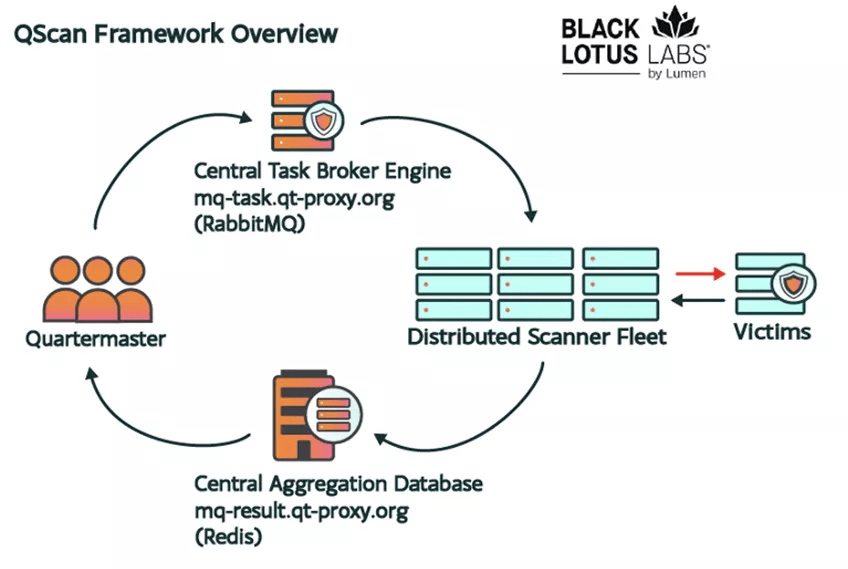
The broader operation looks like an industrial service model. QTFY allegedly used QScan to map targets, identify weaknesses, and compromise devices; it then used QTRouter and other proxy layers to hide where the activity actually came from. Lumen’s Black Lotus Labs described the group as a “digital quartermaster,” meaning it supplied infrastructure and services that could support multiple operations at the same time.

“To support its primary objectives, the quartermaster runs a secondary, completely decoupled target profiling utility called “QScan.” While the core proxy network focuses on managing stateful session paths, the QScan framework operates as the front-end scout.” reads a report published by Lumen. “The operations of this quartermaster demonstrate the high degree of industrialization occurring within China-nexus cyber operations. By shifting away from fragmented, ad hoc setups and toward shared multi-tenant utility networks, state-sponsored actors can execute complex campaigns with a high degree of anonymity and speed, and at a global scale.”
The group reportedly exploited both old and newly disclosed vulnerabilities in widely deployed products, including Fortinet SSL-VPN, Citrix ADC, Microsoft Exchange, F5 BIG-IP, Apache Log4j, Atlassian Confluence, Check Point gateways, CrushFTP, Ivanti appliances, and BeyondTrust Remote Support. This is not a reminder that organisations need magic detection. It is a reminder that old vulnerabilities remain useful because somebody, somewhere, will still leave them unpatched.

The attack chain also included web shells, remote-access trojans, stolen or legitimate credentials, and compromised IoT devices used as nearby relay points. That combination allows an attacker to blend into normal-looking traffic and avoids the obvious infrastructure that defenders have learned to block. A hostile connection that looks like a local consumer router is still hostile; it just has better camouflage.

This seizure follows earlier FBI actions against China-linked botnets. In 2025, the FBI removed PlugX malware from more than 4,000 infected U.S. computers linked to Mustang Panda. In 2024, it disrupted a botnet of hundreds of thousands of IoT devices associated with Flax Typhoon, while in 2023 it acted against a Volt Typhoon botnet used to conceal activity targeting U.S. and foreign critical infrastructure.

“For defenders, the operational lesson is straightforward. Inventory internet-facing assets, patch known vulnerabilities quickly, remove unsupported devices, monitor unusual outbound proxy traffic, and do not assume that an IP address tells you who is behind an attack. The same applies to IoT equipment: a router, camera, network appliance, or smart device left exposed and unmanaged can become part of someone else’s attack platform.

“This disruption announced today is among a series of court-authorized technical operations against indiscriminate hacking activities by the PRC.” concludes DoJ.

Follow me on Twitter: @securityaffairs and Facebook and Mastodon

Pierluigi Paganini

(SecurityAffairs – hacking, QTRouter)

  • ✇Security Affairs
  • FBI: TeamPCP Compromised Dev Tools to Steal Cloud Credentials Pierluigi Paganini
    FBI says TeamPCP poisoned trusted developer tools to steal cloud credentials, spread malware through software updates, and extort victims. On July 2, 2026, the FBI published a FLASH alert identifying the criminal group called TeamPCP and detailing how it compromised widely used developer and security tools to steal credentials from victim environments at scale. The targets weren’t end users. They were the tools developers trust every day inside their build pipelines. TeamPCP is behind mul
     

FBI: TeamPCP Compromised Dev Tools to Steal Cloud Credentials

4 de Julho de 2026, 04:55

FBI says TeamPCP poisoned trusted developer tools to steal cloud credentials, spread malware through software updates, and extort victims.

On July 2, 2026, the FBI published a FLASH alert identifying the criminal group called TeamPCP and detailing how it compromised widely used developer and security tools to steal credentials from victim environments at scale. The targets weren’t end users. They were the tools developers trust every day inside their build pipelines.

TeamPCP is behind multiple supply chain attacks, in the past, they targeted PyPI packages and NPM repositories, and most recently the “Mini Shai-Hulud” campaign also caught two OpenAI employees. The pattern is consistent: go after the tools developers trust, poison the supply chain, and let the downstream damage multiply.

TeamPCP’s method was straightforward and effective: inject malicious code into legitimate software packages, push the trojanized versions through normal distribution channels, and wait for CI/CD pipelines to pull them in automatically. The modified tools installed credential-stealing malware and persistent backdoors without any visible sign that anything had changed.

“TeamPCP actors have conducted large-scale software supply chain compromises by targeting widely used developers and security tools, gaining access to victim environments and extracting sensitive data, including but not limited to cloud access tokens, SSH keys, and Kubernetes secrets.” FBI’s FLASH states.

The confirmed list of modified tools includes Trivy, a widely used container vulnerability scanner; KICS, a static analysis tool for infrastructure-as-code; LiteLLM, a popular library for routing requests across AI model APIs; and the Telnyx Python SDK.

These aren’t niche utilities. They’re commonly integrated into enterprise CI/CD pipelines, cloud infrastructure workflows, and security scanning processes. Hitting them means hitting a large number of organizations simultaneously through a single poisoned update.

The group also deployed four distinct malware families. CanisterWorm harvested cloud access tokens, credentials, and API keys for AWS, GCP, and Azure. SANDCLOCK extracted AWS credentials, Kubernetes ServiceAccount tokens, local environment variables, and cryptocurrency wallet data. Mini Shai-Hulud was a self-replicating worm designed to spread across both npm and PyPI registries. Miasma was a variant of Mini Shai-Hulud that propagated across those same open-source registries while harvesting credentials and poisoning configuration files.

The worm component is the part that deserves particular attention. Mini Shai-Hulud and its Miasma variant didn’t just infect the initial target and stop. They spread across open-source package registries autonomously, harvesting credentials and poisoning configuration files as they went. The FBI confirmed two GitHub repository names used for exfiltration: tpcp-docs and docs-tpcp. If either of those repository names appears in your GitHub organization, the worm created it using stolen credentials.

“By weaponizing these supply chain entry points, the threat actors were able to introduce malicious code into victim environments at scale. TeamPCP has also engaged in extortion and collaboration with cyber actors from other threat actor groups, including publishing victim names on a public leak site and threatening disclosure of stolen data.” states the alert.

The FBI warns that credentials and data stolen in this campaign should be considered permanently compromised, as they could be reused by TeamPCP or affiliated threat actors in future attacks, even months or years after the initial breach.

“Organizations impacted by this campaign should treat exfiltrated data and credentials as a persistent risk, as affiliated threat actors are likely to weaponize them long after the initial compromise.” concludes the alert.

That’s not a hypothetical. It means credentials stolen in this campaign may surface in attacks months or years from now, even after the immediate incident is closed.

How they got into npm accounts?

One technique the FBI specifically flags is worth calling out: TeamPCP exploited npm package maintainer accounts by targeting stale or expired recovery email domains. If a developer registered an npm account years ago with a work email that’s since been decommissioned, the domain may be available for registration. Whoever registers it can use the password reset flow to take over the npm account and publish malicious versions of whatever packages that maintainer owns. It’s an old technique, and it still works because nobody audits their old recovery emails.

The four CVEs associated with this campaign are CVE-2026-33634, CVE-2026-48027, CVE-2026-45321, and CVE-2025-55182. Six IP addresses appear in the indicators: 83.142.209.11, 45.148.10.212, 83.142.209.194, 83.142.209.203, 94.154.172.43, and 67.217.57.240. The indicator set also includes 27 file hashes and a set of domains including checkmarx[.]zone, models.litellm[.]cloud, git-tanstack[.]com, and recv.hackmoltrepeat[.]com, among others. The indicators in this alert are derived from Palo Alto Unit 42’s technical research into the campaign.

The FBI’s recommendations focus on the specific mechanisms TeamPCP exploited. Pin GitHub Actions workflows to verified commit SHA hashes rather than floating version tags, since floating tags can be redirected to point at malicious commits without changing the reference in your workflow file. Rotate all CI/CD secrets, publishing tokens, and cloud credentials that were accessible during the campaign’s active window. Enforce least-privilege permissions on CI/CD service accounts and scope registry publishing tokens to prevent them from being used across repositories.

Require phishing-resistant MFA on all accounts with code repository or package registry publishing access. Enforce a minimum package age threshold of at least seven days across package installation environments, which gives the community time to detect and report malicious versions before they propagate widely. Audit npm maintainer accounts for stale or expired recovery email domains. Implement runtime behavioral monitoring on CI/CD pipeline runners to catch unexpected outbound network connections.

On credential hygiene specifically: store secrets in dedicated encrypted secret managers, not in code or configuration files; prefer temporary credentials over static ones; rotate everything immediately after any suspected compromise; and scan repositories and logs for exposed secrets with automated tooling.

“TeamPCP has also engaged in extortion and collaboration with cyber actors from other threat actor groups, including publishing victim names on a public leak site and threatening disclosure of stolen data.” The FLASH concludes.

That collaboration angle means the stolen data has already been shared beyond the original group.

Organizations that believe they’ve been hit should report to their local FBI field office or to IC3 at ic3.gov, and should retain CI/CD pipeline logs, network logs, affected package names and versions, any exposed credentials, and any extortion communications they’ve received.

Follow me on Twitter: @securityaffairs and Facebook and Mastodon

Pierluigi Paganini

(SecurityAffairs – hacking, TeamPCP)

  • ✇Security Affairs
  • SSU and FBI Uncover Russian Cyber Espionage Operation Against Officials and Military Personnel Pierluigi Paganini
    Ukraine’s SSU and the FBI Just Confirmed Russian Intelligence Has Been Systematically Hacking Messenger Accounts for Years. The Security Service of Ukraine (SSU), working jointly with the FBI, has formally exposed a sustained Russian intelligence campaign targeting the messaging accounts of government officials, military personnel, politicians, and activists across Ukraine, Europe, and the United States. The operation is ongoing. The goal isn’t disruption; it’s intelligence collection.
     

SSU and FBI Uncover Russian Cyber Espionage Operation Against Officials and Military Personnel

29 de Junho de 2026, 05:57

Ukraine’s SSU and the FBI Just Confirmed Russian Intelligence Has Been Systematically Hacking Messenger Accounts for Years.

The Security Service of Ukraine (SSU), working jointly with the FBI, has formally exposed a sustained Russian intelligence campaign targeting the messaging accounts of government officials, military personnel, politicians, and activists across Ukraine, Europe, and the United States.

The operation is ongoing. The goal isn’t disruption; it’s intelligence collection.

“Cyber ​​experts of the Security Service of Ukraine together with the Federal Bureau of Investigation exposed Russian special services in systematic cyberattacks on messengers of officials, military personnel, politicians and activists from Ukraine, Europe and the USA.” read the alert by SSU.

“The purpose of these ‘hacks’ is to gain access to sensitive information of a military, political and economic nature that was exchanged between users, as well as to steal their personal data.”

The attack method is low-tech by design. Operators send SMS messages impersonating platform support bots, asking targets to hand over account credentials, confirmation codes, PINs, or account recovery keys. The SBU notes that these messages tend to arrive in the morning hours, when targets are physically and emotionally less guarded. Timing is a social engineering choice, not an accident.

The scope is broader than most people assume.

“The SBU emphasizes that Russian special services and hackers associated with them attack not only organizations, officials or public figures, but also personal accounts of Ukrainians.” continues the alert.

This isn’t a targeted elite program. It’s a mass collection operation with a tiered approach: high-value targets get more sophisticated techniques, ordinary citizens get the SMS impersonation play. The SBU didn’t attribute the campaign to a specific group by name, but prior reporting from Google, the FBI, and CISA ties similar activity to clusters tracked as UNC5792 and UNC4221, both linked to FSB operations, as well as Star Blizzard.

The FBI’s June 26 advisory added a new technique to what the March warning described. Russian operators have evolved from chasing one-time verification codes to specifically targeting Signal Backup Recovery Keys, which unlock an account’s entire message history and remain valid even if the user creates a new account with the same phone number afterward. This is a meaningful escalation: a stolen verification code expires, a stolen Recovery Key doesn’t.

QR codes are another active vector the SBU specifically calls out. Scanning a QR code received from an unknown bot or user can silently link the attacker’s device to the victim’s account, a technique Google’s Threat Intelligence Group documented against Signal’s linked-devices feature in early 2025.

“Russian hackers use a variety of tools and methods for such cyberattacks. For example, to extract passwords to an account, the enemy most often uses SMS messages on behalf of ‘support teams.'” states SSU.

The variety matters: blocking one delivery mechanism doesn’t stop the campaign, because the operators rotate techniques and targeting lists continuously.

The SBU’s practical guidance covers the basics that still fail most users in practice. Check active sessions in your messenger regularly and end anything you don’t recognize. Enable two-factor authentication with a complex alphanumeric PIN, not a four-digit code. Never provide confirmation codes, PINs, passwords, or recovery keys to anyone, regardless of how legitimate the request appears. Don’t scan QR codes from unknown sources. Don’t follow suspicious links even from accounts you know, because that account may already be compromised. Anyone who receives a suspicious message in a messenger can report it to the SBU’s Cybersecurity Situation Center at incident@dis.gov.ua.

Last week, the FBI and CISA updated their March 2026 warning about Russian intelligence phishing campaigns, and the new advisory adds a detail that wasn’t in the original: the operators have shifted their primary objective from stealing verification codes to stealing Signal Backup Recovery Keys.

Follow me on Twitter: @securityaffairs and Facebook and Mastodon

Pierluigi Paganini

(SecurityAffairs – hacking, Ukraine)

❌
❌