❌

Visualização normal

Antes de ontemSecurity Affairs
  • ✇Security Affairs
  • U.S. Offers $10 Million Reward for Alleged HAFNIUM Hacker Zhang Yu Pierluigi Paganini
    The U.S. offers $10M for Zhang Yu, accused of helping run HAFNIUM attacks that compromised thousands of organizations worldwide. The U.S. State Department is offering a $10 million reward for information leading to the arrest of Zhang Yu. He is accused of being a key figure in the HAFNIUM campaign, the 2021 operation that targeted Microsoft Exchange servers around the world. Zhang is a director at Shanghai Firetech Information Science and Technology, a company that U.S. authorities say al
     

U.S. Offers $10 Million Reward for Alleged HAFNIUM Hacker Zhang Yu

8 de Outubro de 2026, 07:11

The U.S. offers $10M for Zhang Yu, accused of helping run HAFNIUM attacks that compromised thousands of organizations worldwide.

The U.S. State Department is offering a $10 million reward for information leading to the arrest of Zhang Yu. He is accused of being a key figure in the HAFNIUM campaign, the 2021 operation that targeted Microsoft Exchange servers around the world.

Zhang is a director at Shanghai Firetech Information Science and Technology, a company that U.S. authorities say also carried out hacking operations for the Chinese government. According to the indictment, Zhang supervised Firetech employees involved in cyberattacks and worked directly with another accused hacker, Xu Zewei.

U.S. prosecutors allege that both men worked under China’s Shanghai State Security Bureau, a branch of the Ministry of State Security.

“Rewards for Justice (RFJ) is offering a reward of up to $10 million for information leading to the identification or location of any person who, while acting at the direction or under the control of a foreign government, participates in malicious cyber activities against U.S. critical infrastructure in violation of the Computer Fraud and Abuse Act.” reads the announcement published by the State Department. “Under this reward offer, RFJ seeks information on Zhang Yu, a Chinese national and director at Shanghai Firetech Information Science and Technology Company, Ltd. working at the behest of the People’s Republic of China (PRC) Ministry of State Security (MSS) Shanghai State Security Bureau (SSSB).” 

U.S. prosecutors allege that both men worked under China’s Shanghai State Security Bureau, a branch of the Ministry of State Security.

The indictment covers two distinct hacking campaigns. The first, in early 2020, hit U.S. universities and scientists working on COVID-19 vaccines and treatments. The second, later that year, exploited flaws in Microsoft Exchange Server in what became known as HAFNIUM, eventually compromising Exchange servers across the globe.

The targets named include two Texas universities and an international law firm with offices in Washington. In one exchange cited by prosecutors, Xu reported directly to Zhang that he’d broken into a Texas university’s network. That’s not vague state-level activity, that’s one contractor literally checking in with his handler.

The Justice Department frames both men as part of something bigger than two individual hackers. Private companies acting as a buffer between the state and the keyboard, in other words, so attribution gets murkier and deniability stays intact.

“Starting in early 2020, Zhang and his partner Xu Zewei, then a general manager at Shanghai Powerock Network Co. Ltd., gained unauthorized access to COVID-19 research conducted by U.S.-based universities and leading immunologists and virologists to steal sensitive information.” continues the announcement. “The following year, Zhang and Xu exploited vulnerabilities in computers running Microsoft Exchange Server, a computer program involved in the storage and retrieval of e-mails. Those intrusions were part of mass intrusion campaign, publicly known as HAFNIUM, which compromised thousands of computers worldwide.”

The scale of HAFNIUM backs up why anyone would pay $10 million for a tip. The FBI puts the total at more than 12,700 compromised U.S. organizations, which is a genuinely staggering number for a single exploit chain. Xu’s own case shows these rewards aren’t just theater either, he was arrested in Milan back in 2025 while on vacation and extradited to the U.S. this past April.

Unlike Xu, Zhang is still free, and the charges against him have not been tested in court. Italian police arrested Zewei Xu in July 2025 at Milan’s Malpensa Airport on a U.S. warrant. Xu was arrested at Malpensa Airport on July 3rd after arriving on a flight from China. Authorities accused the man of cyberespionage, U.S. authorities linked him to the China-nexus group Hafnium (aka Silk Typhoon), which carried out attacks against U.S. government, including the US Treasury.

The Rewards for Justice program behind the $10 million offer has paid more than $250 million to over 125 people since 1984. Rewards for Justice (RFJ) is a U.S. Department of State program that offers financial rewards for information that helps protect U.S. national security. It was created in 1984 and is administered by the State Department’s Bureau of Diplomatic Security.

Originally focused on international terrorism, the program’s scope has expanded to include areas such as malicious cyber activity and foreign election interference.

Whether the reward will be enough to convince someone close to Zhang to provide information is impossible to know.

Follow me on Twitter: @securityaffairs and Facebook and Mastodon

Pierluigi Paganini

(SecurityAffairs – hacking, HAFNIUM)
  • ✇Security Affairs
  • EvilTokens made phishing-as-a-service look easy. Then it got taken down Pierluigi Paganini
    Microsoft, Coinbase and law enforcement took down EvilTokens, a phishing kit that compromised 12,000 inboxes through device-code phishing and AI. EvilTokens showed up in February 2026 and moved fast. Within months it had compromised more than 12,000 inboxes across over 10,000 organizations. Microsoft says the EvilTokens platform, operated by Storm-2992, is a phishing-as-a-service kit sold to cybercriminals through Telegram. The service costs $1,500 upfront and $500 per month, with additio
     

EvilTokens made phishing-as-a-service look easy. Then it got taken down

23 de Setembro de 2026, 08:00

Microsoft, Coinbase and law enforcement took down EvilTokens, a phishing kit that compromised 12,000 inboxes through device-code phishing and AI.

EvilTokens showed up in February 2026 and moved fast. Within months it had compromised more than 12,000 inboxes across over 10,000 organizations.

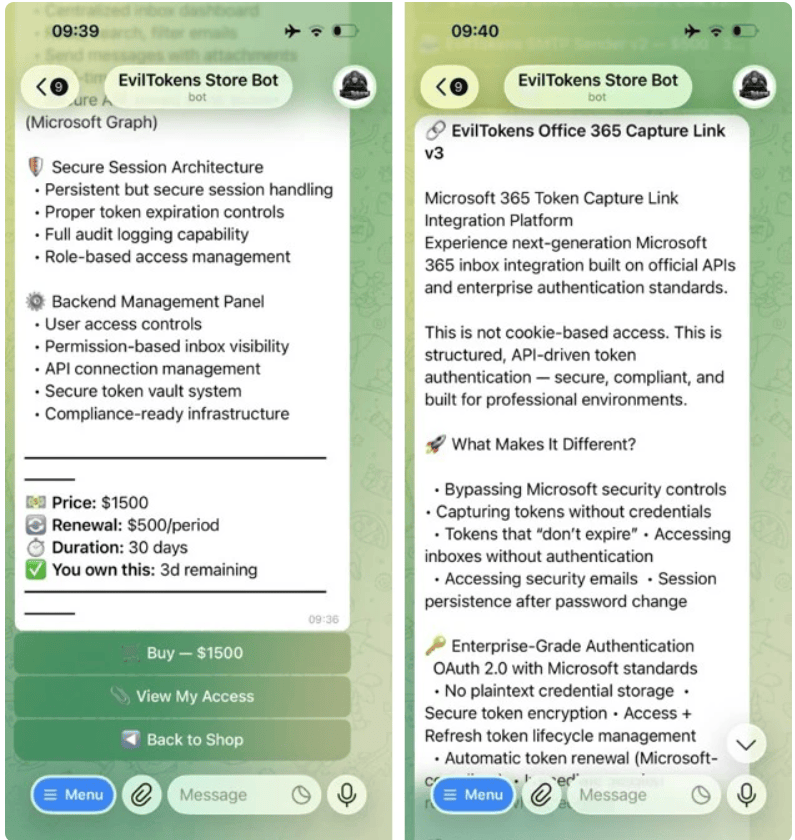
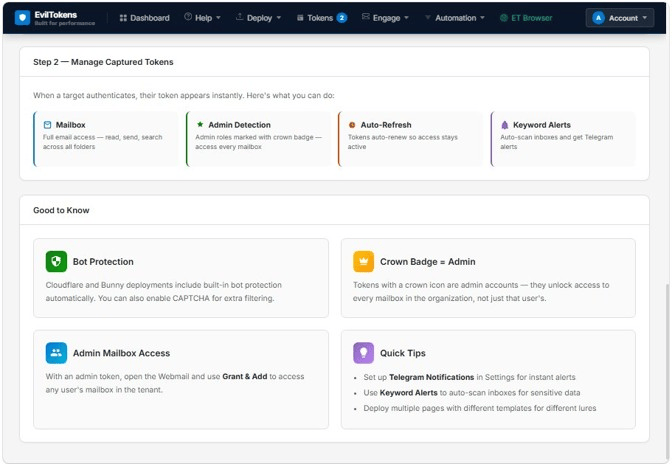
Microsoft says the EvilTokens platform, operated by Storm-2992, is a phishing-as-a-service kit sold to cybercriminals through Telegram. The service costs $1,500 upfront and $500 per month, with additional tools available for extra fees. Its control panel lets customers build and manage phishing campaigns, customize landing pages, configure domains, track victims, and manage stolen authentication tokens.

The platform includes 44 themes and uses AI to create targeted phishing emails based on a victim’s role. Lures can impersonate Microsoft services, document signing platforms, cloud providers, payment systems, and other business services.

What made EvilTokens different wasn’t the phishing itself, it was the AI wrapped around it. Once a mailbox was open, an AI assistant sifted through the contents, mapped who controlled payments, and flagged the accounts worth targeting. A task that used to take a skilled operator hours now took the platform seconds, which meant far less skilled criminals could run campaigns that used to require real expertise.

“Post-compromise, EvilTokens enabled threat actors to utilize AI assistants to sift through victim mailbox activity and engineer a phishing message based on the accessible email content. EvilTokens also allowed threat actors to conduct Microsoft Graph reconnaissance to map organizational structure and permissions, enabling continued access and potential lateral movement while tokens remain valid.” reads the report published by Microsoft. “While token-targeting phishing is not new, it has become far more common and industrialized over the last several years as organizations adopted multifactor authentication (MFA).”

The technique at the core of it is called device code phishing, and it’s worth understanding because it doesn’t touch your password at all. Device code sign-in exists for things like smart TVs and conference room devices that can’t handle a normal login screen. You get a short code on the device, then type it into a browser somewhere else to finish signing in.

“Device code phishing occurs when threat actors insert themselves into this process. Instead of a legitimate device requesting access, the threat actor initiates the flow and provides the user with a code through a phishing lure.” states Micorsoft. “When the user enters the code, they unknowingly authorize the threat actor’s session, granting access to the account without exposing credentials.”

That gap between devices is exactly what gets abused. A fake email, styled as an invoice or a DocuSign request, sends the victim to a page that’s quietly requested a real Microsoft device code behind the scenes. The victim sees the code, gets told to enter it on Microsoft’s actual login page to “verify their identity,” and does exactly that.

Below is the description provided by Coinbase of the attack on Microsoft’s device code login flow:

  • The attacker’s access tokens survived password resets. Attackers registered devices in Entra ID for persistent access, created hidden inbox rules to suppress alerts and delete evidence, then impersonated finance staff, vendors, or executives inside live payment threads to redirect payments, including cryptocurrency.
  • Victims received convincing, AI-generated emails styled as invoices, shared documents, or voicemail notifications, with malicious links embedded.
  • The links led to fake Microsoft or DocuSign pages displaying a code and instructing victims to enter it on Microsoft’s real website to “verify their identity.” Doing so authorized the attacker’s session. Because authentication happened on Microsoft’s legitimate infrastructure, MFA was bypassed entirely.

The victim’s own MFA never gets a chance to fire, because the attacker’s session is the one that gets approved, not theirs. No password stolen, no suspicious login flagged, just a normal-looking authentication that happened to authorize the wrong person.

From there the kit did the boring but effective part. Attackers registered new devices to keep access alive past a password reset, built hidden inbox rules to bury their tracks, and then slid into ongoing email threads to redirect payments, sometimes in cryptocurrency, sometimes straight to a bank account.

Taking it down needed more than one company. Microsoft’s Digital Crimes Unit led the legal side, seizing 50 websites and disabling over 175 domains tied to the operation. Coinbase, Cloudflare, Health-ISAC, OpenAI, Railway, SpyCloud, and Shadowserver all contributed pieces, and the mix says something about how these takedowns actually work now: it’s rarely just the software vendor.

Coinbase’s part is the one worth lingering on, because it’s the least obvious. EvilTokens sold its kits for crypto and moved the proceeds through the Tron blockchain, so Coinbase’s Global Intelligence team followed the money instead of the malware. They traced roughly $1.1 million in revenue across four addresses, found over 1,000 deposits from more than 700 separate wallets, and mapped the full path from payment to cash-out.

That money trail is what led to a name, and the name led to an arrest. On September 11, London’s Metropolitan Police picked up the operator, seizing devices and evidence for examination. One detail from the investigation lands somewhere between alarming and funny: parts of the platform itself were reportedly “vibe coded,” meaning the criminals used AI to help build their own criminal tooling. The irony writes itself.

For anyone defending a network against this, the practical response comes down to a few habits worth making automatic. Treat any device code you didn’t request yourself as an immediate red flag, since no legitimate service asks you to “verify” anything by entering a code it sent you. Verify payment changes through a phone call to a known number, not through the email thread where the request showed up, and push toward passkeys or hardware keys wherever the option exists.

Follow me on Twitter: @securityaffairs and Facebook and Mastodon

Pierluigi Paganini

(SecurityAffairs – hacking, phishing)

  • ✇Security Affairs
  • UK Police Data Faces Long-Standing Microsoft Cloud Security Concerns Pierluigi Paganini
    A 2017 UK assessment warned that police data on Microsoft Azure could face foreign access risks. The risks may still exist. A Guardian investigation has surfaced a 2017 document signed off by then City of London police commissioner Ian Dyson, who also held the title of senior information risk owner for the entire country. That document reviewed 15 risks tied to moving police data onto Microsoft Azure. The files in question include criminal records, victim statements, internal emails, informa
     

UK Police Data Faces Long-Standing Microsoft Cloud Security Concerns

21 de Setembro de 2026, 04:28

A 2017 UK assessment warned that police data on Microsoft Azure could face foreign access risks. The risks may still exist.

A Guardian investigation has surfaced a 2017 document signed off by then City of London police commissioner Ian Dyson, who also held the title of senior information risk owner for the entire country. That document reviewed 15 risks tied to moving police data onto Microsoft Azure. The files in question include criminal records, victim statements, internal emails, information from more than 40 UK police forces, and some material exceeding standard “official” classification, meaning it may sit at “secret” or “top secret” level.

The assessment was clear. It said Microsoft software had vulnerabilities that could eventually be exploited by cybercriminals and other attackers. It also pointed to a more specific and worrying risk: “US government insiders.”

“In doing so, officers accepted that “US government insiders” would be able to see the data, and that it could be “transmitted worldwide”, with “the extent of this … unknown”. According to five specialists who reviewed the Guardian’s findings, the risks identified in that document persist today. Almost every UK police force now depends on Microsoft Azure, and the UK government spends at least £1.9bn on Microsoft software each year.”” states The Guardian.

“There is a risk of compromise of sensitive data shared by, or taken from, Microsoft by the US government being released by US government insider attackers.” reads the document.

This wasn’t a general concern. It was a specific threat identified eight years ago by the official responsible for data-handling standards in British policing. Five experts who reviewed the same assessment for The Guardian said the risks are still relevant today.

The proposed protections were fairly simple: use Microsoft’s built-in encryption, keep servers updated and let individual police chiefs decide whether to use the service. But experts interviewed by The Guardian, including Microsoft engineers, said encryption does not prevent Microsoft employees from accessing the data. They also said it would not necessarily prevent the US government from obtaining it.

Which is exactly the geography problem Dave Michels, a researcher at Queen Mary University of London’s Cloud Legal Project, pointed to. Microsoft’s cloud infrastructure spans over 100 countries, and pieces of a single file can end up stored across several of them, Sweden to Ethiopia, for instance. Microsoft has started offering EU customers assurances that data stays within European borders, but Michels called the whole focus on data location somewhat beside the point, since the people who can access the data matter more than the servers holding it.

Legally, the situation becomes more complicated. Under the US CLOUD Act, American authorities can require US-based companies to provide data they control, even when that data is stored outside the United States. In some cases, companies can also be prevented from telling the customer about the request.

Microsoft, Amazon and Google have said they would challenge such requests when possible. But, as international law professor Douwe Korff pointed out:

“The risk is obvious, even though the providers of the cloud and the government both have an interest in talking it down” Douwe Korff, professor of international law told The Guardian.

Which brings us to the part that reads like a contradiction under pressure. Police officials told the Guardian the data stays in the UK and that Microsoft can’t share it without permission. Microsoft, meanwhile, told Police Scotland back in 2023 that data can leave the UK and that it cannot guarantee data sovereignty. Those two statements aren’t compatible, and nobody seems eager to reconcile them out loud.

Every single UK police force has now put its data, wholly or partly, on Microsoft’s cloud, despite all of this being on record since 2017. One former senior policing source summed up the current state of visibility pretty starkly:

“All the security guys I worked with when this policy came in expected a big breach by now, and we know it will take that to change the police’s position.” a source told The Guardian. “The truth is, however, the level of logging and information in the cloud systems would not necessarily tell us if there was a problem. We really don’t know if the data has been breached or not.”

That’s the key point. It’s not saying, “we checked and everything is fine,” or “there has been no incident.” It’s saying that the available logs and monitoring might not detect a breach even if one happened.

For anyone responsible for sensitive data in a large cloud environment, that’s an important warning. In a security assessment, saying “we would probably know if something went wrong” isn’t enough without evidence that the monitoring can actually detect it.

Follow me on Twitter: @securityaffairs and Facebook and Mastodon

Pierluigi Paganini

(SecurityAffairs – hacking, Microsoft Azure)

Non-Zero-Day VPN Flaw Left Japan ‘s Government Shared Network Platform Exposed: 246,000 Records at Risk

15 de Setembro de 2026, 04:19

Japan ‘s Digital Agency disclosed a VPN breach exposing 246,000 government employee records across 23 ministries. Detected June 25, publicly disclosed September 11.

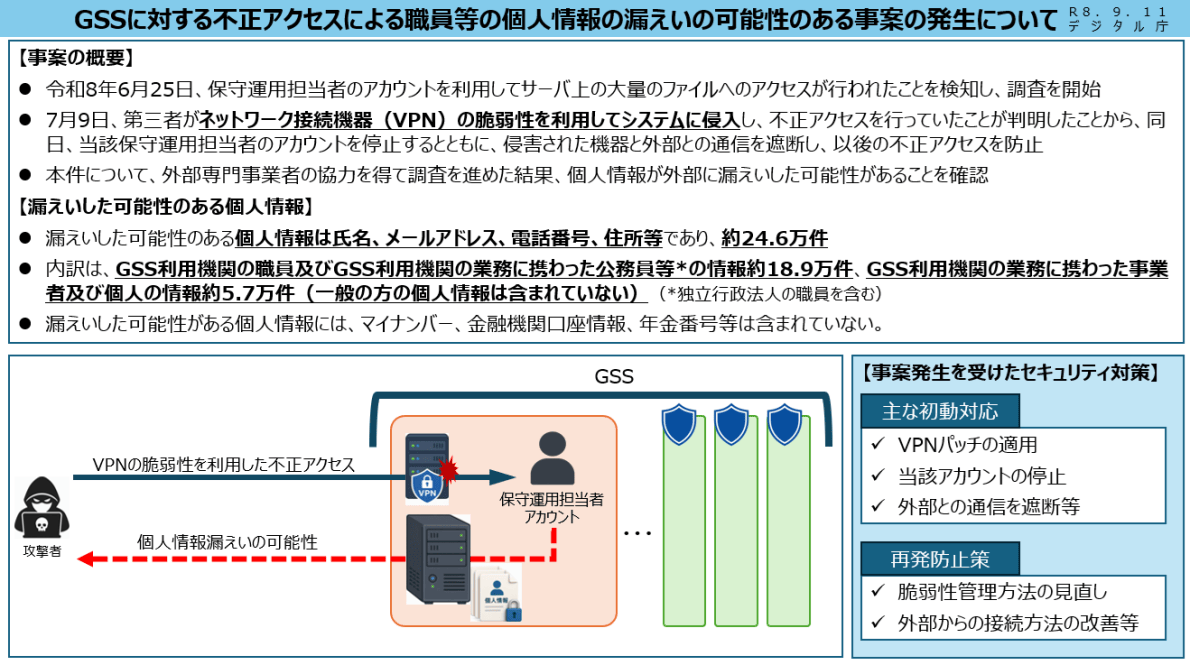
Japan ‘s Digital Agency disclosed that attackers exploited a vulnerability in a VPN device to access its Government Solution Service (GSS), potentially leaking personal information belonging to approximately 246,000 government employees, public officials, and contractors. The breach was detected on June 25 and confirmed as a VPN exploitation on July 9, meaning the public disclosure came 78 days after the initial detection and 63 days after the intrusion method was identified.

“It has come to our attention that, due to unauthorized external access, some files containing personal information handled on the Government Solution Service (GSS), operated by the Digital Agency, may have been leaked to an external party.” reads the advisory. “We have confirmed that the personal information that may have been leaked pertains to employees of various ministries and agencies that use GSS (hereinafter referred to as “GSS user organizations”) and those involved in their work, and does not include personal information of the general public.”

GSS connects 23 Japanese ministries and agencies through shared IT infrastructure. A breach of this platform could potentially affect many government organizations at once.

The attack followed a straightforward path. An outsider exploited a vulnerability in a VPN device that serves the GSS network, accessed the system using a maintenance and operations staff member’s account, and browsed a large number of files on the server. The agency detected the unusual activity on June 25, confirmed the VPN exploitation on July 9, then suspended the maintenance account and cut off external communications from the compromised hardware the same day. A subsequent investigation with external security specialists confirmed that files containing personal information may have been exfiltrated.

“On June 25, 2026, we detected that a large number of files on the server had been accessed using the account of a maintenance and operations staff member, and we began an investigation. On July 9, it was discovered that a third party had exploited a vulnerability in the network connection device (VPN) to infiltrate the system and gain unauthorized access. On the same day, we suspended the maintenance and operations staff member’s account and cut off communication between the compromised equipment and the outside world to prevent further unauthorized access.” continues the report.”As a result of our investigation with the cooperation of an external expert company, we have confirmed that there is a possibility that personal information may have been leaked to an external party.”

The potentially exposed data breaks down to roughly 236,000 names, 231,000 email addresses, 94,000 phone numbers, and approximately 1,000 physical addresses. Of the 246,000 total records, about 189,000 belong to employees of GSS-using organizations and public officials involved in their work, including staff at independent administrative agencies. The remaining 57,000 records relate to businesses and individuals contracted to support those organizations. The data doesn’t include My Number identification numbers, financial institution account numbers, or pension numbers.

The VPN flaw was rated medium severity and wasn’t a zero-day. A patch was already available when attackers exploited it, but the agency hasn’t revealed the VPN product or the flaw.

Japan’s privacy regulator was notified on July 15, six days after the attack was confirmed. The Digital Agency said the delay came from the difficulty of tracing the attack, assessing the affected data, and identifying those involved.

The incident also shows the risk of leaving a known, patchable flaw unaddressed on infrastructure shared by 23 ministries.

No confirmed misuse of the exposed data has been reported. However, the leaked names, email addresses and phone numbers could enable targeted phishing and social engineering, including scams impersonating Japan’s Digital Agency. The agency will contact affected people directly and warns that it will never request passwords or payments by email or phone.

The breach is one in a series of significant cybersecurity incidents affecting Japanese institutions. NISC, Japan’s National Cyber Incident Readiness and Strategy Center, disclosed a breach in 2023 that affected its email system. Japan Aerospace Exploration Agency (JAXA) reported unauthorized access to its systems in 2024. The pattern points to systemic challenges in patching and access management across Japan’s public sector infrastructure rather than isolated failures.

The Digital Agency’s planned remediation includes improved vulnerability management and changes to external connection methods, which are the right responses to the immediate incident. Whether they address the underlying governance question is harder to assess from the public advisory alone.

Follow me on Twitter: @securityaffairs and Facebook and Mastodon

Pierluigi Paganini

(SecurityAffairs – hacking, newsletter)

❌
❌