❌

Visualização normal

Antes de ontemSecurity Affairs
  • ✇Security Affairs
  • North Korean IT Workers Used Stolen US Identities to Earn $3 Million Pierluigi Paganini
    The FBI raided 40 Texas homes over a North Korean scheme that used fake IT workers to target 70 US companies and generate $3 million. The Justice Department (DoJ) announced coordinated enforcement actions this week targeting North Korea’s long-running scheme to place fake IT workers inside American companies. Two US nationals were arrested, 14 people charged across two separate indictments, and the FBI searched more than 40 residences in Texas, seizing approximately 187 laptops and KVM switc
     

North Korean IT Workers Used Stolen US Identities to Earn $3 Million

17 de Outubro de 2026, 13:29

The FBI raided 40 Texas homes over a North Korean scheme that used fake IT workers to target 70 US companies and generate $3 million.

The Justice Department (DoJ) announced coordinated enforcement actions this week targeting North Korea’s long-running scheme to place fake IT workers inside American companies. Two US nationals were arrested, 14 people charged across two separate indictments, and the FBI searched more than 40 residences in Texas, seizing approximately 187 laptops and KVM switch devices.

The Texas operation, called Operation Lonestar Roundup, ran between September 21 and 25. The seized devices are the same laptops American companies shipped to their newly hired remote employees, not knowing those IT workers were North Korean intelligence agents using stolen US identities.

“Today the Department of Justice announced coordinated actions against the Democratic People’s Republic of North Korea (DPRK) government’s schemes to fund its regime through remote information technology (IT) work for U.S. companies.” states DoJ. “These actions include an indictment, two arrests, searches of multiple known or suspected “laptop farms” in Texas pursuant to “Operation Lonestar Roundup,” and the seizure of approximately 187 computer devices used by DPRK IT workers.”

The scheme was simple. North Korean IT workers applied for remote jobs using stolen or fake identities. They used VPNs and proxy servers to make it look like they were working from the United States. American helpers received the laptops provided by employers and installed remote access software so the North Korean workers could use them. These helpers were paid for their role, while the money earned from the jobs was sent back to North Korea through accounts controlled by the regime.

According to an indictment from the Northern District of Ohio, the scheme ran from 2019 to mid-2025 and targeted more than 70 US companies across 17 states. The companies operated in sectors including healthcare, communications, cybersecurity support, retail, and manufacturing.

“In total, the scheme impacted more than 70 U.S. company employers and generated approximately $3 million in revenue for IT workers.” SoJ states.”The revenue is believed to have been sent to sanctioned entities controlled by the DPRK. Victim employers included companies in the health care, communications, cyber support, retail, and manufacturing sectors across Ohio, sixteen additional states, and the District of Columbia.”

The North Korean IT workers earned about $3 million, which prosecutors believe was sent to North Korean entities subject to international sanctions.

The authorities warn the scheme is evolving in response to better detection.

“Increasingly, North Korean IT workers are turning to recruiting American facilitators to counter improved private sector detections and law enforcement actions.” states DoJ. “These workers are hiring facilitators to complete a wider variety of tasks, and in some cases subcontracting entire jobs to third-party foreign nationals. “

That’s not just using Americans as props. It’s actively outsourcing parts of the operation to people inside the US, which makes attribution harder and interception more complicated.

Some IT workers are now subcontracting entire jobs to third-party foreign nationals. Others are hiring facilitators to handle a wider range of tasks beyond just managing the laptops. CrowdStrike, which helped the FBI investigate, tracks the group behind this operation as Famous Chollima and describes the laptop farm infrastructure as vital to overcoming the physical and legal barriers of operating from outside the US.

“These laptop farms enabled FAMOUS CHOLLIMA operatives to pose as legitimate remote workers and siphon illicit wages back to their regime while maintaining persistent access to victim organizations. Working alongside the FBI, CrowdStrike’s threat intelligence into the adversary and their operations, and technical analysis helped make these disruptions possible.” states CrowdStrike.

“This operation marks the beginning of a broader U.S. law enforcement effort to dismantle FAMOUS CHOLLIMA’s U.S. infrastructure. CrowdStrike’s Counter Adversary Operations team intends to remain an integral part of that effort.”

The FBI’s separate public service announcement puts the operation in broader context: “thousands of North Korean state-controlled IT workers” are currently embedded at Western companies, posing what the agency calls a significant national security and intellectual property theft insider threat. North Korean IT workers have individually earned up to $300,000 per year under these schemes, and the collective revenue is measured in hundreds of millions annually, flowing directly to designated entities including the North Korean Ministry of Defense.

This is the fifth round of enforcement actions announced since June 2025 under the DOJ’s DPRK RevGen Domestic Enabler Initiative (June 2025, November 2025, April 2026, and May 2026). The initiative targets people in the United States who help North Korean IT workers carry out these schemes.

According to CrowdStrike, North Korean hackers were responsible for about half of all documented hands-on cyber intrusions over the past year. The regime is also targeting cryptocurrency exchanges and open-source software projects. In 2025 alone, North Korean attackers stole at least $2 billion in cryptocurrency.

The DOJ released a list of email addresses used in these operations, including accounts like randyryang@gmail.com and dev.jerryyang@gmail.com, which companies can add to their screening indicators. The FBI’s public service announcement includes detailed mitigation guidance on spotting DPRK IT worker applications. The red flags are consistent: inconsistencies in work history, reluctance to appear on video, requests to redirect laptop deliveries, and payment accounts that route through intermediaries.

“Threats posed by nation-states like North Korea are a stark reminder that our adversaries will go to great measures to exploit our nation’s economic strength to further and fuel their own nefarious agendas,” said U.S. Attorney David M. Toepfer for the Northern District of Ohio. “We are thankful to FBI Cleveland for their incredible work and persistence to put a stop to these bad actors. These charges serve as an urgent alert to all U.S. companies to remain vigilant in their hiring practices.”

Follow me on Twitter: @securityaffairs and Facebook and Mastodon

Pierluigi Paganini

(SecurityAffairs – hacking, IT workers)

  • ✇Security Affairs
  • Contagious Interview: 30,000 devices infected by a fake job interview Pierluigi Paganini
    North Korea-linked WaterPlum runs the Contagious Interview campaign, infecting over 30,000 devices using a fake job interview. On September 18, Japan’s National Police Agency, the FBI, the US Department of Defense’s Cyber Crime Center, and intelligence agencies from Australia and Germany published a joint advisory about a group called WaterPlum, better known as Contagious Interview. The name says it all. The job interview is the infection vector. The numbers in the advisory are hard to sh
     

Contagious Interview: 30,000 devices infected by a fake job interview

22 de Setembro de 2026, 03:44

North Korea-linked WaterPlum runs the Contagious Interview campaign, infecting over 30,000 devices using a fake job interview.

On September 18, Japan’s National Police Agency, the FBI, the US Department of Defense’s Cyber Crime Center, and intelligence agencies from Australia and Germany published a joint advisory about a group called WaterPlum, better known as Contagious Interview. The name says it all. The job interview is the infection vector.

The numbers in the advisory are hard to shrug off. At least 30,000 devices infected across more than 100 countries, funds or credentials stolen from over 7,000 cryptocurrency wallets, and a total of 1.7 billion yen, roughly $10.71 million, funneled back to North Korea. The victims are almost always the same type: freelance developers and specialists in blockchain and Web3 work.

Japan’s NPA and the FBI assess that both WaterPlum operators and some North Korean IT workers report to the same place, the 313 General Bureau of the Munitions Industry Department, under the Workers’ Party’s Central Committee. That’s not a loose affiliation. It’s an org chart.

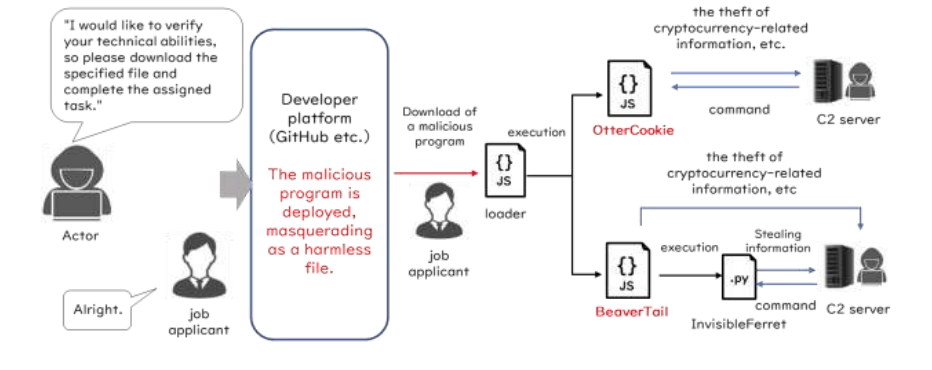
The trap itself is almost embarrassingly simple. WaterPlum actors pose as recruiters or hiring managers, often impersonating real AI, crypto, or NFT companies, and reach out on social media, job boards, and freelance platforms. Candidates get invited to a technical interview, then told to download a file to complete a coding test or fix a supposed bug on the video call.

“WaterPlum actors pose as prospective employers to target software developers and IT professionals worldwide under the pretext of attractive job opportunities. They often impersonate legitimate Artificial Intelligence (AI), cryptocurrency, or Non-Fungible Token (NFT) companies and have also used recruiting services.” reads the joint advisory. “WaterPlum actors have infected at least 30,000 devices in more than 100 countries and exfiltrated funds or account credentials from over 7,000 cryptocurrency wallets. WaterPlum actors have transferred 1.7 billion Japanese yen (JPY) (equivalent to 10.71 million USD) of cryptocurrency assets to the Democratic People’s Republic of Korea (DPRK).”

That file is never what it claims to be. The advisory names five malware families riding inside these downloads, BeaverTail, InvisibleFerret, OtterCookie, OtterCandy, and StoatWaffle, each doing its own piece of the job: one steals browser credentials, another opens a backdoor, another sets up a remote access trojan to move deeper into the machine. Once inside, the goal is straightforward: drain the wallet, then look for whatever else might be worth stealing.

What happens next goes beyond one stolen wallet. The report notes that a successful infection can give WaterPlum a way into the victim’s employer, opening the door to espionage, stolen source code, and further movement inside a company’s systems. Stolen ID photos get reused too, letting North Korean IT workers impersonate the victim to land more paying contracts elsewhere.

That last part connects to a separate but related scheme covered in the same advisory: North Korean IT workers using so-called “laptop farms.” These are physical locations, often just someone’s house, where a local facilitator plugs in company-issued laptops and lets a North Korean worker operate them remotely over VPN. The worker gets a Western-looking identity and a legitimate-sounding job. The facilitator gets a cut.

“Beyond immediate credential theft, successful infections provide WaterPlum actors opportunities to infiltrate organizations employing targeted developers, enabling espionage, intellectual property theft, and additional lateral movement in corporate environments. Stolen ID images can also be used by North Korean IT workers to impersonate victims and generate foreign currency.” continues the report. “Other sensitive data targeted for exfiltration includes:

  • Authentication data stored in web browsers (ID, password, etc.);
  • Clipboard information, key-logs (recorded keystrokes), screenshots;
  • Cryptocurrency-wallet data (private key, seed phrase, etc.); and
  • Any files or data of interest to the actors on a PC or in shared folders (ID pictures of driver’s licenses, passports, etc.)”

Here’s a simpler and more natural version, while keeping the same details:

Japan says this is no longer just a theoretical threat. Authorities have already shut down the country’s first known “laptop farm,” run by a local facilitator who had moved several hundred million yen in cryptocurrency out of Japan. In the US, the FBI says it continues to prosecute people who help North Korean IT workers operate this way, across several states and under different charges.

The advisory also describes a case involving a Japanese crypto exchange that spotted one of these applicants in May 2025. His resume listed an unusually wide range of skills across more than a dozen technologies. He claimed to be Malaysian, raised in Finland, and fluent in Malay and Chinese, but struggled with basic English questions that did not fit his claimed background. The company rejected him, avoiding any damage.

Other red flags recruiters have picked up on read like a checklist for a bad Zoom call: the applicant glancing sideways as if reading a script, background voices that shouldn’t be there, video that keeps freezing at convenient moments, a firm preference for getting paid in crypto, sometimes to someone else’s account entirely.

Not every North Korean IT worker sticks to quiet fraud, either. One extorted a client over a payment dispute and leaked the company’s proprietary code online out of spite. Another, hired for basic website maintenance, defaced the site and knocked it offline instead. Petty, but the effect on the client was anything but.

The advisory draws one more thread together: WaterPlum’s cyberattack operators and North Korea’s IT worker network aren’t running in parallel. They’ve been caught using the same IP addresses to access laptop farms, register on freelance platforms, and apply for that same crypto exchange job. Same infrastructure, two revenue streams, one regime cashing the checks.

“The techniques described in this advisory are only examples; actors continuously evolve and refine their methods.” concludes the advisory. “Stay informed by monitoring alerts from domestic and international security agencies and by reviewing reports published by security vendors.”

Follow me on Twitter: @securityaffairs and Facebook and Mastodon

Pierluigi Paganini

(SecurityAffairs – Contagious Interview, WaterPlum)

❌
❌