❌

Visualização normal

Antes de ontemSecurity Affairs
  • ✇Security Affairs
  • Three Japan-Focused Cyberattacks Show How Hackers Use AI Pierluigi Paganini
    Three Japan-focused cyberattacks show how AI helps hackers scale operations, while exploiting old systems and weak security remains key. In autumn 2026, Japanese companies and other organizations reported a series of data leaks involving their web systems. On October 9, Japan’s National Cybersecurity Office issued a warning to businesses, while the head of the ruling party’s cybersecurity team described cyberspace as being in a “state of emergency.” Researchers at Trend Micro studied thre
     

Three Japan-Focused Cyberattacks Show How Hackers Use AI

28 de Outubro de 2026, 05:34

Three Japan-focused cyberattacks show how AI helps hackers scale operations, while exploiting old systems and weak security remains key.

In autumn 2026, Japanese companies and other organizations reported a series of data leaks involving their web systems. On October 9, Japan’s National Cybersecurity Office issued a warning to businesses, while the head of the ruling party’s cybersecurity team described cyberspace as being in a “state of emergency.”

Researchers at Trend Micro studied three attack infrastructures to understand how hackers use AI. Their findings show three different approaches, ranging from limited AI assistance to systems that use AI agents to manage almost an entire attack.

The researchers looked at files that attackers left on servers anyone could reach. These included attack scripts, lists of targets, logs, and records of commands. The files showed attacks on organizations in Japan and other countries.

But the researchers could not see the victims’ own logs or network records. So they could not confirm every break-in, measure the full damage, or say who was behind it.

Attackers also like to claim more success than they really had. The researchers only counted a result as real when the evidence backed it up.

The three cases show that AI does not play the same role in every cyberattack.

“The cases differ along two dimensions: how much of the attack AI handled and how confidently we can establish its involvement.” reads the report. “Case A used AI to drive the entire workflow, which we confirmed. Case B was human-led, with confirmed AI assistance in planning and tool development. Case C showed high-confidence indications of AI use in a limited role, such as tool development. All three were active in 2026, and much of the activity preceded the previously published ARTEX reports.”

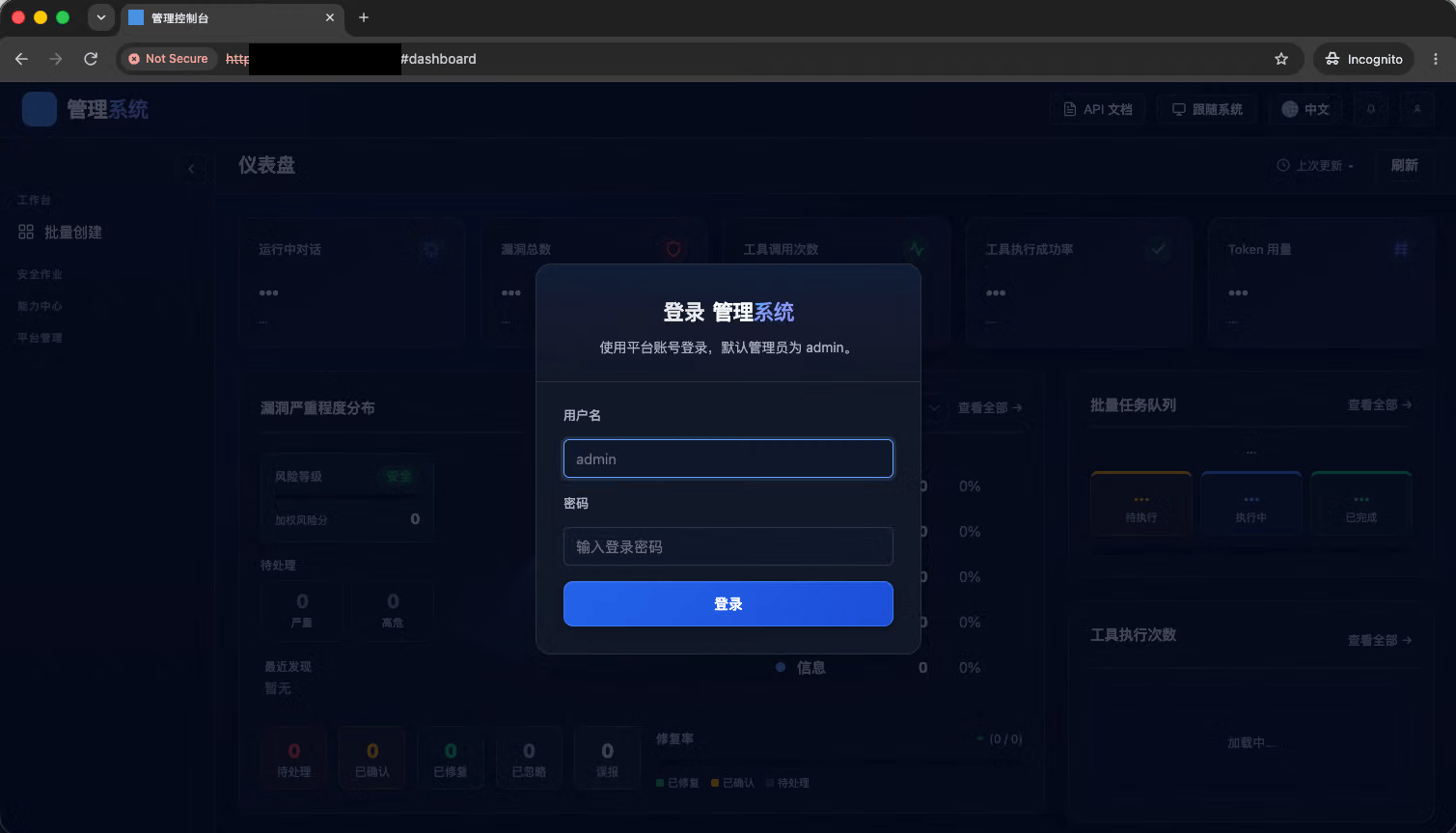
Case A: AI agents managed the attack workflow. The researchers confirmed the use of CyberStrikeAI, an open-source penetration-testing platform built around AI agents. It handled reconnaissance, vulnerability checks, exploitation, data theft and reporting as part of a repeatable process.

The platform split tasks among multiple AI agents. One record mentioned a credential-search agent in a system that used 44 agents. The platform could also generate Japanese content, including forms and fake login pages.

Researchers identified at least 19 target organizations, including at least 16 in Japan. The system worked on several targets at once and kept traffic to each organization relatively low. This made the activity harder to detect by checking the logs of a single victim.

Despite this automation, the platform rarely gained deep access to target systems. In many cases, it had no active session or web shell and showed no evidence of stolen data. The clearest intrusion started through an administration page that was publicly accessible on an old web system. The attackers did not need to exploit a newly discovered vulnerability.

Case B: A human attacker used AI to plan and build tools. In this case, the operator made the main decisions but used a large language model to speed up planning and tool development. The researchers found an attack plan written by an LLM that targeted services providing AI and GPU resources.

The attacker presented requests as authorized security testing to get around the model’s safety limits. The researchers say this was a false claim, although they did not publish the exact method.

The attacker also targeted AI infrastructure, including platforms for AI workflows, data processing and model inference. The researchers believe the goal may have been to gain access to computing resources that could be used to run AI models cheaply.

Some intrusions had serious consequences. In one case, the attacker gained control across several systems, including an FTP service, a database, an administrator account, a web shell and SSH access. The attacker also restored backdoors after they had been removed.

In another case, a geographic information system server was exposed with default credentials. This provided access to hundreds of thousands of land and business records, as well as Windows credentials and email data. The evidence confirmed that information was downloaded.

However, the researchers found no evidence that AI carried out these attacks independently. It helped the operator plan and build tools, while the actual work relied mainly on scripts, existing software and human decisions.

Case C: AI played a limited role. Here, the operator appears to have used AI mainly to develop tools and scripts. The researchers found no evidence that it was involved in planning or managing the wider operation. They rated AI involvement as highly likely, but not confirmed, because they found no direct evidence such as prompts or API keys.

The operator ran at least six campaigns in 2026, targeting exposed VPN devices and Oracle WebLogic servers. The targets included devices from Cisco, Citrix, F5 and Yamaha.

In attacks against Yamaha RTX1210 routers, the operator did not exploit a product vulnerability. Instead, the attacker used credentials found in configuration files. These credentials provided direct access to internal corporate networks.

The researchers also found signs that AI may have helped write some commands and scripts. These included unusually structured comments and emoji used as status markers. Such clues can support an assessment, but they cannot prove AI use on their own.

Japan was the main target in all three operations, but attackers also targeted other countries and regions. All three used Simplified Chinese, but this does not prove they came from the same group or location.

“Simplified Chinese was the working language in all three infrastructures. Japan was the largest target country, although the operators also pursued nearby countries and regions. Entry points were exposed legacy systems or weaknesses left in default configurations.” concludes the report. “Target selection was opportunistic across industries: the operators sought systems that were easy to attack from outside and acted on what they found.”
The main difference was how AI was used. In one case, AI agents managed much of the attack and worked on many targets at once. In another, AI helped a human plan attacks and build tools. In the third, AI was mainly used to develop tools.

AI helped make attacks faster and easier to scale, but attackers still exploited familiar weaknesses, such as outdated web systems, exposed admin pages, default passwords and poorly secured network devices. Researchers also found that AI tools sometimes reported planned actions as successful, making it essential to verify their results.

AI can also help defenders discover vulnerabilities. However, researchers found no evidence that these three operations used AI-discovered zero-day flaws. Their attacks relied on known vulnerabilities and poor security settings.

The report identifies six main priorities for defenders:

  • Review public-facing systems. Identify old web applications and update them or isolate them if they cannot be secured.
  • Protect administration pages. Check that management interfaces are not exposed to the internet without a clear need and strong access controls.
  • Secure VPNs and network devices. Review configurations, remove default credentials and check for reused passwords.
  • Protect internal AI services. Include AI workflows, inference services and GPU systems in asset inventories, and check whether they are exposed.
  • Improve monitoring. Look for low-volume attacks spread across many targets, which may be difficult to spot in the logs of a single organization.
  • Prepare for AI misuse. Organizations that use LLMs for work should train staff to recognize requests that falsely claim to be authorized security testing.

These security weaknesses existed long before AI became widely available. AI simply helps attackers find and exploit them faster and across more systems.

The time between discovering a vulnerability and using it in an attack may also become shorter. Organizations should install security updates quickly and apply temporary protections when patches are not available.

Researchers still don’t know who was behind the three operations, whether they were connected or how much damage they caused. Further reports may provide more answers.

“The attackers’ identities, whether the three cases share an operator, the full scale of the damage, and the AI models used remain unresolved. Our observations come from attacker-side files and still require confirmation from the affected organizations.” concludes the report. “We are considering further technical reporting on individual cases: AI-driven activity in Case A, AI assistance in Case B, and limited AI assistance in Case C. We will also continue working with the relevant organizations.”

The main lesson is clear: AI can make cyberattacks faster and larger, but the basic security priorities remain the same. Organizations must identify systems exposed to the internet, strengthen access controls and detect suspicious activity before attackers turn a simple weakness into a serious breach.

Follow me on Twitter: @securityaffairs and Facebook and Mastodon

Pierluigi Paganini

(SecurityAffairs – hacking, Italy)

  • ✇Security Affairs
  • Burger King Japan Data Breach Impacted 11 Million Customers Pierluigi Paganini
    Burger King Japan disclosed a breach exposing 11.18 million app users’ personal data after attackers accessed its membership system in early October. Burger King Japan has disclosed a data breach that exposed the personal information of approximately 11.18 million official app members. Burger King Japan, the company operating the fast-food chain in the country, said attackers accessed the system managing customer membership information between October 2 and October 7, 2026. The company discl
     

Burger King Japan Data Breach Impacted 11 Million Customers

16 de Outubro de 2026, 11:04

Burger King Japan disclosed a breach exposing 11.18 million app users’ personal data after attackers accessed its membership system in early October.

Burger King Japan has disclosed a data breach that exposed the personal information of approximately 11.18 million official app members. Burger King Japan, the company operating the fast-food chain in the country, said attackers accessed the system managing customer membership information between October 2 and October 7, 2026. The company disclosed the incident on October 15, after discovering the data leak two days earlier.

In its official notice published on October 15, the company confirmed the unauthorized access and apologized to affected customers. The announcement doesn’t identify the attackers or explain how they gained access. BK Japan says it’s working with external security specialists to determine the cause.

“We have confirmed that customer membership information from the official app has been leaked externally following unauthorized access by a third party.” reads the data breach notification.

The compromised data includes membership IDs, email addresses, names in Japanese characters and kana, phone numbers, dates of birth, gender, prefecture of residence, and membership registration type. The exposed information also indicates whether a customer has a mobile ordering history and whether their email address has been verified.

These details can be useful to criminals even without payment data or passwords. Attackers can use them to craft convincing phishing emails, text messages, or phone calls that refer to a customer’s real identity and relationship with Burger King. A message that includes a person’s name, phone number, and other accurate details may look far more credible than a generic scam.

Burger King Japan confirmed it does not store credit card numbers and found no evidence that passwords were exposed, with no confirmed cases of fraud so far. However, these factors do not completely rule out the risk of future misuse.

According to the company, unauthorized access took place from October 2 through October 7, and the leak was confirmed on October 13. BK Japan says it blocked access from the source of the unauthorized communications as soon as it became aware of the incident.

The company has also introduced temporary countermeasures, established an incident response team, and reported the breach to Japan’s Personal Information Protection Commission. It says permanent security improvements, further investigation with external specialists, and email notifications to affected customers are ongoing.

“At present, we have confirmed that the unauthorized access was carried out by a third party.” continues the notification.

The company has not yet disclosed the precise circumstances that made the intrusion possible, and the investigation is continuing. Until more details emerge, it’s too early to draw conclusions about the initial access vector or attribute the attack to a particular threat actor.

Large-scale data breaches create long-lasting risks for follow-on attacks, as criminals can use stolen details for phishing, impersonation, and highly convincing scams.

BK Japan urges customers to stay vigilant against fraudulent emails, texts, and calls, warning them never to click unverified links or share sensitive credentials.

The core danger is that attackers no longer need network access to cause harm; they can leverage existing stolen data to target customers directly through social engineering.

“Please do not access URLs, open attachments, or enter membership information or passwords if you receive a suspicious communication.” concludes the report.

Follow me on Twitter: @securityaffairs and Facebook and Mastodon

Pierluigi Paganini

(SecurityAffairs – hacking, Burger King Japan)

Non-Zero-Day VPN Flaw Left Japan ‘s Government Shared Network Platform Exposed: 246,000 Records at Risk

15 de Setembro de 2026, 04:19

Japan ‘s Digital Agency disclosed a VPN breach exposing 246,000 government employee records across 23 ministries. Detected June 25, publicly disclosed September 11.

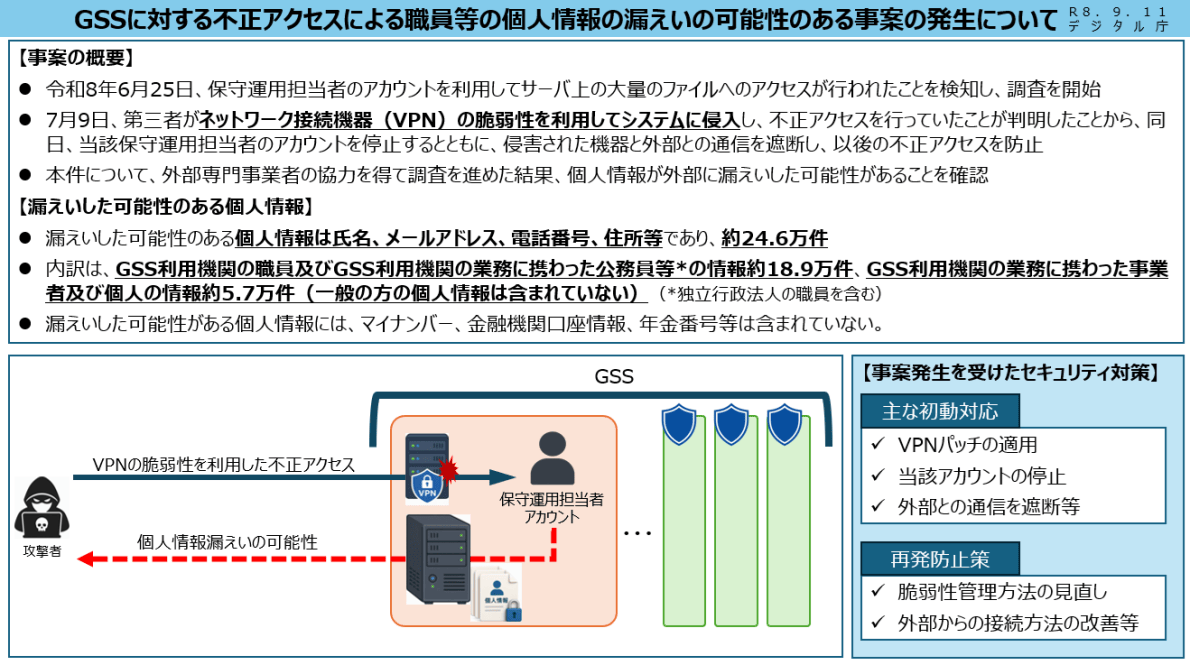
Japan ‘s Digital Agency disclosed that attackers exploited a vulnerability in a VPN device to access its Government Solution Service (GSS), potentially leaking personal information belonging to approximately 246,000 government employees, public officials, and contractors. The breach was detected on June 25 and confirmed as a VPN exploitation on July 9, meaning the public disclosure came 78 days after the initial detection and 63 days after the intrusion method was identified.

“It has come to our attention that, due to unauthorized external access, some files containing personal information handled on the Government Solution Service (GSS), operated by the Digital Agency, may have been leaked to an external party.” reads the advisory. “We have confirmed that the personal information that may have been leaked pertains to employees of various ministries and agencies that use GSS (hereinafter referred to as “GSS user organizations”) and those involved in their work, and does not include personal information of the general public.”

GSS connects 23 Japanese ministries and agencies through shared IT infrastructure. A breach of this platform could potentially affect many government organizations at once.

The attack followed a straightforward path. An outsider exploited a vulnerability in a VPN device that serves the GSS network, accessed the system using a maintenance and operations staff member’s account, and browsed a large number of files on the server. The agency detected the unusual activity on June 25, confirmed the VPN exploitation on July 9, then suspended the maintenance account and cut off external communications from the compromised hardware the same day. A subsequent investigation with external security specialists confirmed that files containing personal information may have been exfiltrated.

“On June 25, 2026, we detected that a large number of files on the server had been accessed using the account of a maintenance and operations staff member, and we began an investigation. On July 9, it was discovered that a third party had exploited a vulnerability in the network connection device (VPN) to infiltrate the system and gain unauthorized access. On the same day, we suspended the maintenance and operations staff member’s account and cut off communication between the compromised equipment and the outside world to prevent further unauthorized access.” continues the report.”As a result of our investigation with the cooperation of an external expert company, we have confirmed that there is a possibility that personal information may have been leaked to an external party.”

The potentially exposed data breaks down to roughly 236,000 names, 231,000 email addresses, 94,000 phone numbers, and approximately 1,000 physical addresses. Of the 246,000 total records, about 189,000 belong to employees of GSS-using organizations and public officials involved in their work, including staff at independent administrative agencies. The remaining 57,000 records relate to businesses and individuals contracted to support those organizations. The data doesn’t include My Number identification numbers, financial institution account numbers, or pension numbers.

The VPN flaw was rated medium severity and wasn’t a zero-day. A patch was already available when attackers exploited it, but the agency hasn’t revealed the VPN product or the flaw.

Japan’s privacy regulator was notified on July 15, six days after the attack was confirmed. The Digital Agency said the delay came from the difficulty of tracing the attack, assessing the affected data, and identifying those involved.

The incident also shows the risk of leaving a known, patchable flaw unaddressed on infrastructure shared by 23 ministries.

No confirmed misuse of the exposed data has been reported. However, the leaked names, email addresses and phone numbers could enable targeted phishing and social engineering, including scams impersonating Japan’s Digital Agency. The agency will contact affected people directly and warns that it will never request passwords or payments by email or phone.

The breach is one in a series of significant cybersecurity incidents affecting Japanese institutions. NISC, Japan’s National Cyber Incident Readiness and Strategy Center, disclosed a breach in 2023 that affected its email system. Japan Aerospace Exploration Agency (JAXA) reported unauthorized access to its systems in 2024. The pattern points to systemic challenges in patching and access management across Japan’s public sector infrastructure rather than isolated failures.

The Digital Agency’s planned remediation includes improved vulnerability management and changes to external connection methods, which are the right responses to the immediate incident. Whether they address the underlying governance question is harder to assess from the public advisory alone.

Follow me on Twitter: @securityaffairs and Facebook and Mastodon

Pierluigi Paganini

(SecurityAffairs – hacking, newsletter)

❌
❌