❌

Visualização normal

Ontem — 8 de Novembro de 2026Security Affairs
  • ✇Security Affairs
  • Inside ARTEX: AI Hacking Tools, Exposed Servers and South Korean Bank Breaches Pierluigi Paganini
    Hunt.io traced ARTEX servers and AI-powered hacking tools used in breaches affecting seven South Korean financial institutions. Between late September and early October 2026, seven South Korean financial institutions had data breached through internet-facing systems. About 66,000 to 67,000 people and around 2,200 corporations were affected, and personal, employment, income and loan data was exposed. Hunt.io dug into the infrastructure behind the campaign, and its findings add a lot to what C
     

Inside ARTEX: AI Hacking Tools, Exposed Servers and South Korean Bank Breaches

7 de Novembro de 2026, 16:56

Hunt.io traced ARTEX servers and AI-powered hacking tools used in breaches affecting seven South Korean financial institutions.

Between late September and early October 2026, seven South Korean financial institutions had data breached through internet-facing systems. About 66,000 to 67,000 people and around 2,200 corporations were affected, and personal, employment, income and loan data was exposed. Hunt.io dug into the infrastructure behind the campaign, and its findings add a lot to what CrowdStrike and Genians already published.

CrowdStrike reported on October 7 and Genians Security Center on October 12, and both pointed to ARTEX, an open-source autonomous penetration testing framework developed in China and licensed under AGPL-3.0. CrowdStrike assessed with moderate confidence that a single Chinese-speaking individual motivated by money ran it, and not an established threat group. DeepSeek v4.1 Flash was the main model, with GLM 5.3 and Grok 4.6 as backups, reached partly through a reseller domain, xcai[.]pro.

The public indicators were a server at 38.244.50[.]120, which hosted the ARTEX console, plus a Hong Kong address and nine proxies. Genians said the ARTEX GitHub repository and Docker image were removed on October 11, though forks and mirrors remain.

“CrowdStrike assessed with moderate confidence that the operator was a single Chinese-speaking individual motivated by financial gain rather than an established threat group.” reads the report published by Hunt.io. “The infrastructure reportedly accessed these services in part through the reseller domain xcai[.]pro. Both reports described a two-server configuration, consisting of a Hong Kong-based IP address used as primary infrastructure and 38.244.50[.]120, which hosted the ARTEX console.”

Hunt.io notified the relevant national CERT before publishing, and says the report holds no personal records or credentials.

The company’s own scanning showed 38.244.50[.]120 sits on Cogent’s network in Los Angeles, with 15 open ports. The ARTEX login page, with a Chinese title meaning “autonomous penetration testing console”, appears on ports 443 and 8090. Other services include a Gemini2API admin console and a Tinyproxy server.

Searching its AttackCapture platform for that address, Hunt.io found another open directory at 23.248.226[.]250, a jump server in Hong Kong on AS138415. It held 42 files in 2 subdirectories, 105 MB in all, and the platform had logged warnings on September 5, September 26 and October 5. A file in it names 38.244.50[.]120 as the jump host, and its own comment tells the operator never to paste the credentials into a session. It sat in an open directory.

Three scripts back up the link. They keep reverse SSH tunnels alive, run a local relay, and copy files to the jump host, one tunnel is named grok2api, and the credentials file also holds keys for Zhipu AI’s GLM models, an OpenAI-compatible relay and a proxy service. That explains how several language models ran in one campaign.

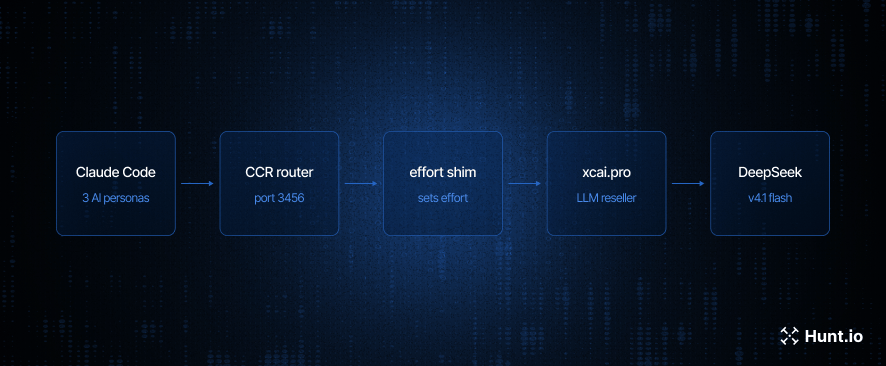
The AI setup is the most striking part. A state file shows the harness is Claude Code itself, version 2.1.221, started 510 times since August 4, but it isn’t talking to Anthropic. A small proxy, ds-models-shim.py, fixes a compatibility problem by faking a model list and sending requests to DeepSeek, and another, xcai-effort-shim.py, adds a reasoning setting because the DeepSeek backend otherwise skips its reasoning step. The route runs from Claude Code through Claude Code Router, an open-source project, to xcai and then to DeepSeek.

“A small local proxy, ds-models-shim.py, addresses a compatibility issue: the official /v1/models endpoint returns a 404 response when queried against a non-Anthropic backend, preventing Claude Code from discovering the available models. The shim intercepts that specific request and returns a locally defined model list containing deepseek-v4-pro and deepseek-flash. All other requests are forwarded to api.deepseek.com/anthropic.” states the report.
The same file counts 19 custom skills, reusable instruction sets for the agent, with 147 recorded uses. They cover code audit, reconnaissance, web injection, WAF bypass testing, authentication testing, Telegram Mini Apps, APK download and decompiling, cloud phone control and payment logic testing. Next to the payment skill sat three self-registered test accounts with tokens for a cash-in deposit API, dated September 12, and a comment calls them an authorized, self-built test. The setup fits testing for insecure direct object reference flaws, a technique CrowdStrike and Genians described against Korean loan and inquiry services.

The directory also held supporting tools. A script queried FOFA, a Chinese asset search engine like Shodan, through a third-party API, and a comment says the primary membership had expired and a backup key was in use. Proxy scripts enumerated a rotating proxy service at 154.201.79[.]246:443, where 79 unique exit IPs showed up among the first 100 identities tested.

A separate directory at 23.248.226[.]250:8001 held a small staged setup for JNDI and LDAP exploitation, retrieved on October 5 at 03:42 UTC. It confirms command execution through a DNS callback, and one script lets web and LDAP traffic share a single port. Hunt.io’s analysis describes the tooling without publishing steps to reproduce it.

Other recovered files include tools aimed at a cryptocurrency exchange’s admin session and withdrawals, Linux privilege escalation exploits, iOS probe source code and Android kernel and firmware utilities. Hunt.io says their connection to the Korean breaches isn’t confirmed.

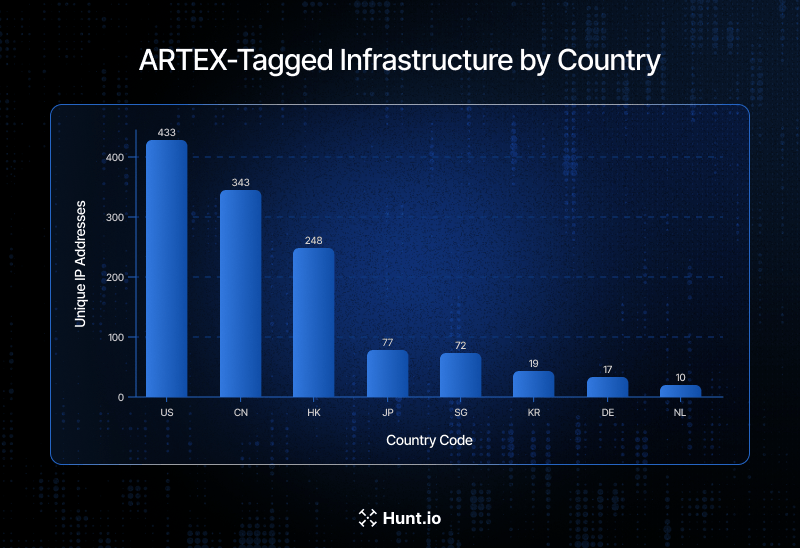
Hunt.io then showed how to hunt ARTEX servers. Searching for an ARTEX certificate issuer returned 19 IP addresses, and searching its malware classification returned 1,303 addresses across 30 countries, led by the United States, China and Hong Kong. Those figures show where addresses are registered, not where the operator sits.

“The result returned 19 distinct IP addresses, including 38.244.50[.]120. This method is precise but limited to hosts that expose a matching certificate. Systems using a different certificate will not appear in these results.” continues the report.

Matching the console’s page title returned about 1,300 IPs, and a looser search found 21 title strings, 19 of them likely ARTEX consoles, in English, Chinese, Korean, Japanese, Russian, Portuguese and Vietnamese.
A malware-name search in AttackCapture gave 280 results with open directories. One at 130.94.31[.]86:18888 in Seoul held two small scripts, and another at 156.251.11[.]39 held an SMB reconnaissance toolkit whose test script writes a file named artex_probe_11876.txt.

More hosts held exploitation kits for DedeCMS and FangCMS, a CAPTCHA bypass suite, a RuoYi and Spring administrative console exploit and CAPTCHA-based login automation. Together they show the framework attracting many operators.

For defenders, the advice is plain. Remove public access and put administration behind VPNs or allowlists, and reset SSH passwords and rotate API keys, proxy credentials and tokens that exposed files may have revealed. Patch internet-facing services, watch for unexpected LDAP and JNDI activity, DNS callbacks and remote script downloads, and store secrets in a managed vault with least-privilege permissions. Also restrict access to model gateways, watch their requests, and enforce compliance rules on managed phones. Hunt.io’s lesson is that an investigation shouldn’t stop at the first list of indicators, because

The company also published indicators of compromise in its analysis.

“The findings highlight risks associated with exposed administrative services, reusable credentials, remote access tunnels, proxy infrastructure, and exploitation tooling.” concludes the report.

Follow me on Twitter: @securityaffairs and Facebook and Mastodon

Pierluigi Paganini

(SecurityAffairs – hacking, ARTEX)

Antes de ontemSecurity Affairs
  • ✇Security Affairs
  • Binance Hack: How Fake Job Interviews and AI Abuse Led to a $6.34 Billion Attack Pierluigi Paganini
    Binance reveals how fake job interviews, malware and internal AI abuse enabled attackers to steal $6.34 billion. The Binance security incident on October 29 shows how a fake recruitment process can become the entry point to critical financial infrastructure. The attackers combined social engineering, compromised developer tools, stolen credentials and abuse of an internal AI application to reach the cryptocurrency exchange’s wallet signing systems. “Woah – so the Binance hack was indeed v
     

Binance Hack: How Fake Job Interviews and AI Abuse Led to a $6.34 Billion Attack

3 de Novembro de 2026, 16:44

Binance reveals how fake job interviews, malware and internal AI abuse enabled attackers to steal $6.34 billion.

The Binance security incident on October 29 shows how a fake recruitment process can become the entry point to critical financial infrastructure. The attackers combined social engineering, compromised developer tools, stolen credentials and abuse of an internal AI application to reach the cryptocurrency exchange’s wallet signing systems.

“Woah – so the Binance hack was indeed via a dodgy job interview for one of its developers who was tricked into downloading malware as part of the “interview” – costing the company >$3bn…” the popular best seller author and cybercrime expert Geoff White wrote on LinkedIn. “Worth noting:
– The 2016 hack of Bangladesh Bank also attributed to North Korea’s Lazarus Group of hackers was via a job application
– The 2022 theft of $625m from video game Axie Infinity happened via offering an employee a juicy job offer
RECRUITMENT IS RISK. If you’re not educating employees on this, start now…
– The 2024 heist of $1.5b from Bybit relied on tricking an employee of its supplier into downloading a dodgy share trading app onto the work machine (so not using a recruitment lure, but still deceiving a target into downloading malware)”

In its initial findings and response update, published on November 3, Binance described the operation as a “sophisticated, multi-stage campaign.” The company estimates that approximately $6.34 billion in digital assets were affected. The FBI attributed the incident to the North Korea-linked APT “TraderTraitor,” also tracked as Lazarus Group and APT38.

“Our current investigation indicates that this was a sophisticated, multi-stage campaign. It was not a single isolated breach or a simple phishing incident.” reads the update published by the crypto firm. “The attackers combined a range of techniques, including social engineering by fake recruitment interviews, malicious software downloads, compromised internal AI tooling, endpoint compromise, and an advanced transaction-authorisation method.”

The operation began months before the theft. In June 2026, an engineer from Binance’s Wallet DevOps team downloaded a tampered Homebrew installation while searching online for a popular AI coding tool. Binance detected the suspicious activity, replaced the device and rotated the associated credentials, but information about the engineer’s role and colleagues had already been exposed.

The attackers then targeted another software engineer through a legitimate job-hunting platform. In September, someone posing as a Project Director arranged two interviews: first with an HR representative, then with someone claiming to be the CEO of a fictitious company. During the first video interview, the supposed HR representative shared a social media account containing personal photos and videos to establish credibility.

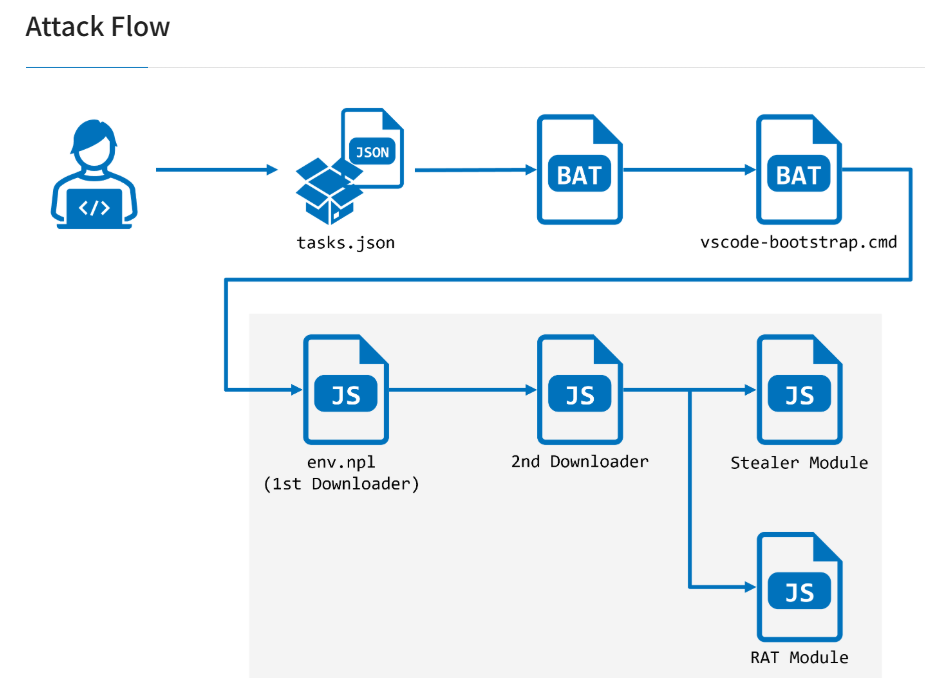
At the end of the second interview, the engineer was asked to download a technical assignment containing a malicious code repository onto his work computer. The malware executed during setup, replacing a legitimate development tool component with a malicious version. It used obfuscation to evade detection, executed commands and established communication with an attacker-controlled server. Binance said its endpoint security tools didn’t detect the malware at the time.

“The second interview was conducted in a popular social chat app, near the end of the interview, Engineer B was instructed to download an “assignment” containing a malicious code repository onto his work computer.” states the firm. “The repository contained malicious code that executed during the setup process, initiating a series of unauthorized activities.”

The compromise then moved beyond the affected workstation. On October 20, attackers used the compromised computer to abuse an internal AI tool and gain access to the systems of two other employees, including the Wallet DevOps engineer initially targeted in June. They discovered that his computer contained a token with container deployment permissions.

This is one of the more significant aspects of the incident. The report doesn’t identify a vulnerability in the AI model itself. Instead, it shows how an internal application can become an attack pivot when an adversary gains access to a compromised employee’s environment and the permissions available to that user.

“The attacker leveraged the compromised computer of engineer B and used an internal AI tool to gain control over the Wallet DevOps Engineer A and another Wallet Software Engineer C.” states the report. “The attacker soon discovered Wallet DevOps Engineer A had a container deployment permission token on his computer.”

On October 29, the attackers used stolen credentials to access another engineer’s computer, deploy a container and execute a malicious script. This gave them access to Binance’s internal wallet signing service, allowing them to initiate transactions outside the normal withdrawal process.

The transfers involved several blockchain networks. Five Binance hot wallets sent 233.46 million XRP to an attacker-controlled address, while other transfers involved approximately 970,500 SOL, 44.2 million OP and 18,270 BTC.

The attackers also exploited Ethereum’s EIP-7702 authorization mechanism to grant a malicious smart contract partial execution rights over a Binance hot wallet.

“EIP-7702 allows an account to delegate certain execution rights to a smart contract without exposing the private key. In this case, the attacker used that mechanism to give an attacker-controlled smart contract partial execution rights over a Binance hot wallet.” the company states.

Suspending withdrawals wasn’t enough to stop the transfers because the malicious authorizations already existed on-chain and operated independently of Binance’s normal withdrawal infrastructure.

Binance had to develop a specific procedure to revoke them. The use of Multi-Party Computation (MPC) meant there was no single private key that could immediately invalidate the unauthorized permissions. The final unauthorized transfer, involving 2,961.9 ETH, was finalized at 23:56 UTC. Binance cleared the malicious authorization at 00:10 UTC on October 30.

The company estimates that approximately $6.34 billion in assets were affected, of which around $2.85 billion had been frozen or intercepted as of its November 3 update. Binance says it will absorb the financial impact and has already replenished 98% of the affected token assets, based on figures reported on October 31.

The exchange has rebuilt the affected wallet infrastructure and internal AI tool, replaced compromised devices, revoked associated credentials and tokens, and strengthened endpoint monitoring and wallet-service controls. It is also engaging independent cybersecurity firms to review the incident.

The attack highlights the need to treat recruitment processes, developer workstations and internal AI applications as part of the corporate attack surface. Technical assignments should run in isolated environments, deployment credentials should be short-lived and tightly restricted, and internal AI tools should never inherit unnecessary access to sensitive systems.

Binance also said its security team had detected and prevented 57 suspected North Korea-linked cyber threat cases during 2026. These included fake job interviews, malicious developer tools, compromised software packages and browser extensions, fake video-conferencing applications and campaigns designed to steal credentials or deploy remote-access malware.

The incident is another reminder that attackers don’t always need to break directly into critical infrastructure. Sometimes, compromising the people and tools that manage it is enough.

“We are sharing this initial report because security improves when the industry learns together.” concludes the update.

In September, Japan’s National Police Agency, the FBI, the US Department of Defense’s Cyber Crime Center, and intelligence agencies from Australia and Germany published a joint advisory about a group called WaterPlum, better known as Contagious Interview. The name says it all. The job interview is the infection vector.

The numbers in the advisory are hard to shrug off. At least 30,000 devices infected across more than 100 countries, funds or credentials stolen from over 7,000 cryptocurrency wallets, and a total of 1.7 billion yen, roughly $10.71 million, funneled back to North Korea. The victims are almost always the same type: freelance developers and specialists in blockchain and Web3 work.

Japan’s NPA and the FBI assess that both WaterPlum operators and some North Korean IT workers report to the same place, the 313 General Bureau of the Munitions Industry Department, under the Workers’ Party’s Central Committee. That’s not a loose affiliation. It’s an org chart.

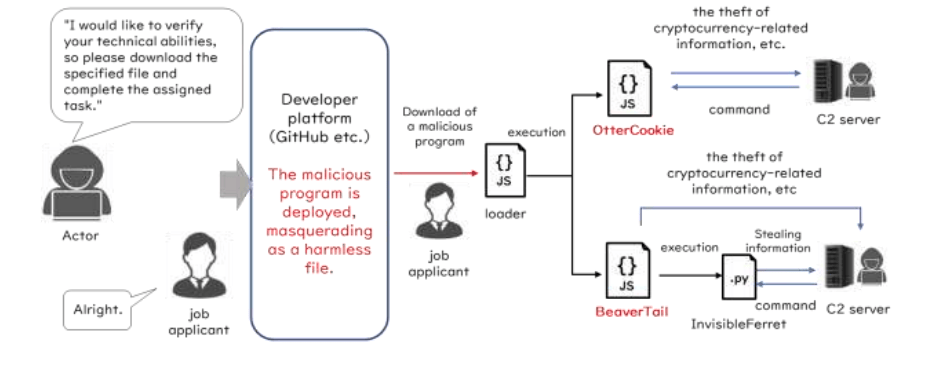
The trap itself is almost embarrassingly simple. WaterPlum actors pose as recruiters or hiring managers, often impersonating real AI, crypto, or NFT companies, and reach out on social media, job boards, and freelance platforms. Candidates get invited to a technical interview, then told to download a file to complete a coding test or fix a supposed bug on the video call.

Follow me on Twitter: @securityaffairs and Facebook and Mastodon

Pierluigi Paganini

(SecurityAffairs – hacking, Binance)

  • ✇Security Affairs
  • FBI Blames North Korea for $6 Billion Binance Crypto Theft Pierluigi Paganini
    The FBI blames North Korea for stealing $6 billion from Binance and urges crypto firms to block transactions linked to the stolen funds. The FBI has named North Korea as the party behind the theft of more than $6 billion in virtual assets from the crypto exchange Binance, on or about October 29, 2026. The bureau published its findings in a public alert. The FBI specifically blames the North Korea-linked APT “TraderTraitor,” also tracked as Lazarus Group and APT38. Binance hasn’t named a c
     

FBI Blames North Korea for $6 Billion Binance Crypto Theft

1 de Novembro de 2026, 16:23

The FBI blames North Korea for stealing $6 billion from Binance and urges crypto firms to block transactions linked to the stolen funds.

The FBI has named North Korea as the party behind the theft of more than $6 billion in virtual assets from the crypto exchange Binance, on or about October 29, 2026. The bureau published its findings in a public alert. The FBI specifically blames the North Korea-linked APT “TraderTraitor,” also tracked as Lazarus Group and APT38.

Binance hasn’t named a culprit, but the blockchain analysis firm TRM has. It was the first to attribute the attack to TraderTraitor, and Chainalysis also said it’s highly confident in that finding.

“The Federal Bureau of Investigation (FBI) is releasing information advising the Democratic People’s Republic of Korea (North Korea) was responsible for the theft of more than $6 billion USD in virtual assets from cryptocurrency exchange Binance, on or about October 29, 2026. The FBI refers to this specific North Korean malicious cyber activity as “TraderTraitor.”” reads the FBI’s statement.

“The FBI, together with partners at the USSS and IRS-CI, has observed TraderTraitor actors converting stolen assets primarily into Ethereum (ETH). It is expected these assets will then be further laundered by converting them using DeFi and instant swap services as they prepare them for further laundering stages.”

Attackers used access from an engineer’s laptop to reach a service container and send unauthorized withdrawal requests. Binance says it has found no evidence that attackers stole any wallet private keys.

The FBI, along with the U.S. Secret Service (USSS) and IRS Criminal Investigation (IRS-CI), has spotted TraderTraitor actors turning the stolen assets mostly into Ethereum (ETH). The agencies expect the next step to be more laundering, by swapping the funds through DeFi and instant swap services as the actors prepare them for later stages. Instant swap services are aptly named.

The alert is aimed at private companies as well as law enforcement agencies. The FBI, USSS and IRS-CI are asking several types of businesses to help stop the money laundering. These include THORNode operators, who support the THORChain network, RPC node operators, who provide apps with access to blockchains, instant crypto exchanges, DeFi platforms, blockchain analytics companies and other crypto service providers.

The request is clear: these companies should block any transactions involving the wallet addresses used by TraderTraitor, including funds that can be traced back to them. According to the FBI, these addresses have received stolen funds and are controlled by North Korean attackers or are closely linked to them. The full list of addresses is included in the alert.

If you run any of these services, the first job is to check your blocklists against that list. The second is to look at transaction flows that touch those addresses indirectly, since the FBI says to block anything “derived from” them, not just direct transfers. Blockchain analytics firms are named for a reason, because tracing derived funds is their work.

The FBI says it’s committed to protecting the virtual asset community by identifying, mitigating and disrupting North Korea’s illicit cybercrime and virtual asset theft.

“The FBI maintains its commitment to protecting the virtual asset community by identifying, mitigating, and disrupting North Korea’s illicit cybercrime and virtual asset theft activities.” concludes the report. “If you have any information to provide, please contact your local FBI field office or FBI’s Internet Crime Complaint Center at ic3.gov.”

TRM says the attacker moved about $6.36 billion out of Binance wallets on ten blockchains on October 29, most of it in roughly 20 minutes starting at 20:05 UTC. That makes it the largest crypto theft on record, about four times the $1.5 billion Bybit hack of February 2025.

“On October 29, 2026, an attacker moved approximately USD 6.36 billion out of Binance wallets on ten blockchains, most of it in about 20 minutes starting at 20:05 UTC. That makes this the largest crypto theft on record, about four times the USD 1.5 billion Bybit hack of February 2025. Binance has confirmed a security incident and suspended withdrawals on several networks.” TRM said. “TRM attributes the attack to TraderTraitor, North Korea’s elite hacking unit, based on robust on and off-chain intelligence. We make this judgment with high confidence. TRM is tracking the funds and alerting partners through the Beacon Network.”

Freezing the money only went partway. Tether, Circle, Ripple and World Liberty Financial froze about $2.67 billion in stablecoins, and Arbitrum’s Security Council froze 8,426 ETH and 74.6 million ARB, for roughly $2.7 billion in all. But the attacker raced the freezes by selling USDT to market makers and borrowing ETH against USDT on Aave. It now holds more than 420,000 ETH and 18,270 BTC, about $2.4 billion beyond any issuer’s reach.

The early freeze numbers were messy too, Tether and Circle froze approximately $1.79 billion in stablecoins associated with the suspicious transfers in the initial reports. Those amounts describe different moments, and you shouldn’t add them without checking whether they cover distinct assets. A freeze works on tokens that have an issuer to call, and Ether and Bitcoin don’t.

Below is the link to my interview regarding the Binance case for Italian state television.

https://www.youtube.com/watch?v=DtvhBA9TdPo

Follow me on Twitter: @securityaffairs and Facebook and Mastodon

Pierluigi Paganini

(SecurityAffairs – hacking, Binance)

  • ✇Security Affairs
  • $6.3 Billion Stolen from Binance in Attack Attributed to North Korea Pierluigi Paganini
    Binance links a $6.3 billion crypto theft to a compromised DevOps laptop, with North Korean hackers blamed by blockchain analysts. Binance was investigating suspicious transfers that early estimates put at up to $5.8 billion. A day later, multiple media outlets reported that the largest cryptocurrency exchange had linked the theft of about $6.3 billion to a DevOps engineer’s compromised laptop. Billions had moved out of wallets linked to the exchange. According to The Block, blockchain a
     

$6.3 Billion Stolen from Binance in Attack Attributed to North Korea

30 de Outubro de 2026, 15:50

Binance links a $6.3 billion crypto theft to a compromised DevOps laptop, with North Korean hackers blamed by blockchain analysts.

Binance was investigating suspicious transfers that early estimates put at up to $5.8 billion. A day later, multiple media outlets reported that the largest cryptocurrency exchange had linked the theft of about $6.3 billion to a DevOps engineer’s compromised laptop. Billions had moved out of wallets linked to the exchange.

According to The Block, blockchain analyst Spreek identified approximately $3.55 billion in incoming transfers to an initially unidentified wallet.

“Onchain data flagged by analyst Spreek shows about $3.55 billion in incoming transfers to the unlabeled wallet, with nearly $900 million subsequently moved across other wallets.” The Block reports. “Conor Grogan, a senior director and product leader at Coinbase, says the amount is up to $5.8 billion.”

Coinbase executive Conor Grogan initially estimated that the total value of the movements could reach $5.8 billion.

Those figures came from blockchain tracking and differing estimates, so they didn’t necessarily show the amount stolen.

Binance pointed out that customer funds were safe, while co-founder Changpeng Zhao, widely known as CZ, said the activity appeared to be a hack. Zhao no longer manages Binance’s platform, but said he expected customers’ funds to be fully covered.

The company said its user funds were “completely safe.”

“Our teams are aware of reports of a potential security issue and are actively investigating. User funds are completely safe. Our security teams are reviewing all relevant information with urgency, and we will provide updates through official Binance channels as soon as we have verified information.” the company states. “Users should remain cautious of scams and should not trust unofficial links, messages, or requests for account information.”

That assurance is important, but it doesn’t replace a technical explanation of how the transfers occurred or independent confirmation of the final impact.

“Our initial investigation suggests this security incident may have started with a compromised DevOps engineer’s laptop. That gave an attacker access to a service container, where they submitted unauthorized withdrawal transactions.” Binance Co-CEO Richard Teng explained.

“To be clear: the attacker did not simply use one engineer’s permissions, and this was not a single “one-click” action. It involved a more complex attack process. Our investigation has not attributed responsibility to any individual.”

I want to speak to you directly about what happened.

Bottom line – your money is safe, and we're covering every loss.

Our initial investigation suggests this security incident may have started with a compromised DevOps engineer's laptop. That gave an attacker access to a…

— Richard Teng (@_RichardTeng) October 30, 2026

Attackers used access from an engineer’s laptop to reach a service container and send unauthorized withdrawal requests. Binance says it has found no evidence that attackers stole any wallet private keys.

Binance also said it had found “additional points of breach” and was still investigating. Co-CEO Richard Teng said the investigation had not identified anyone responsible. After the attack, Binance suspended deposits and withdrawals to carry out security checks, cancelled the permissions linked to the affected address, and began working with blockchain analysis firms and law enforcement to track the stolen funds.

Binance says it will cover all losses using its SAFU fund and its own money, and that customer funds are safe. The company also plans to publish an updated Proof of Reserves once it has completed the recovery work. This commitment does not replace a detailed technical explanation or independent confirmation of the full impact of the attack.

Binance hasn’t named a culprit, but the blockchain analysis firm TRM has. It attributes the attack to TraderTraitor, a North Korean state-backed unit also tracked as Lazarus Group and APT38, and Chainalysis says it’s highly confident in that finding.

Our investigators observed funds stolen by DPRK in last month's Bitget exploit commingling with funds stolen from Binance.

We have a high degree of confidence that DPRK is responsible for the $6.4 billion hack of Binance. https://t.co/xj9dQYcbKr

— Chainalysis (@chainalysis) October 30, 2026

TRM says the attacker moved about $6.36 billion out of Binance wallets on ten blockchains on October 29, most of it in roughly 20 minutes starting at 20:05 UTC. That makes it the largest crypto theft on record, about four times the $1.5 billion Bybit hack of February 2025.

“On October 29, 2026, an attacker moved approximately USD 6.36 billion out of Binance wallets on ten blockchains, most of it in about 20 minutes starting at 20:05 UTC. That makes this the largest crypto theft on record, about four times the USD 1.5 billion Bybit hack of February 2025. Binance has confirmed a security incident and suspended withdrawals on several networks.” TRM said. “TRM attributes the attack to TraderTraitor, North Korea’s elite hacking unit, based on robust on and off-chain intelligence. We make this judgment with high confidence. TRM is tracking the funds and alerting partners through the Beacon Network.”

Freezing the money only went partway. Tether, Circle, Ripple and World Liberty Financial froze about $2.67 billion in stablecoins, and Arbitrum’s Security Council froze 8,426 ETH and 74.6 million ARB, for roughly $2.7 billion in all. But the attacker raced the freezes by selling USDT to market makers and borrowing ETH against USDT on Aave. It now holds more than 420,000 ETH and 18,270 BTC, about $2.4 billion beyond any issuer’s reach.

The early freeze numbers were messy too, Tether and Circle froze approximately $1.79 billion in stablecoins associated with the suspicious transfers in the initial reports. Those amounts describe different moments, and you shouldn’t add them without checking whether they cover distinct assets. A freeze works on tokens that have an issuer to call, and Ether and Bitcoin don’t.

Hot wallets help explain how this type of theft can happen. They store cryptocurrency in systems connected to the internet, allowing exchanges to process withdrawals quickly. But this also makes strong security controls essential. Investigators still need to determine who initiated the transfers, whether they were authorized, whether attackers gained control of the wallets, and whose funds were stolen.

Binance co-founder Changpeng Zhao, who no longer runs the company, said the activity looked like a hack and expected customers to be fully compensated. Large transfers alone do not prove a cyberattack, but the findings that emerged later provided strong evidence of a breach.

Customers also need to be careful. Attackers often exploit the confusion after a major incident by spreading fake announcements, pretending to be support staff, and directing users to fraudulent websites. Use only Binance’s official channels, avoid unexpected links, and never share passwords, authentication codes, or wallet recovery phrases in response to unsolicited messages. Security teams should also watch for phishing emails that use the incident to pressure employees into verifying their accounts.

The lesson goes beyond Binance. A public blockchain records every transaction, but it cannot show who authorized it or how attackers gained access. Blockchain transparency does not guarantee operational security.

Follow me on Twitter: @securityaffairs and Facebook and Mastodon

Pierluigi Paganini

(SecurityAffairs – hacking, Binance)

  • ✇Security Affairs
  • PHP2Shell: Suspected North Korean campaign targets 216 vulnerable PHP hosts Pierluigi Paganini
    Cyfirma links PHP2Shell scans of 216 vulnerable hosts to a suspected North Korean campaign using AI to rank public exploits. On October 21, PHP released emergency patches for two critical vulnerabilities, CVE-2026-109618 and CVE-2026-109619, both rated 9.2 on the CVSS scale. The flaws affect all PHP versions that handle web requests. The vulnerable code dates back to PHP 5.4, released in 2012, and resides in the PHP engine itself rather than in individual applications. Attackers can exploit
     

PHP2Shell: Suspected North Korean campaign targets 216 vulnerable PHP hosts

26 de Outubro de 2026, 06:58

Cyfirma links PHP2Shell scans of 216 vulnerable hosts to a suspected North Korean campaign using AI to rank public exploits.

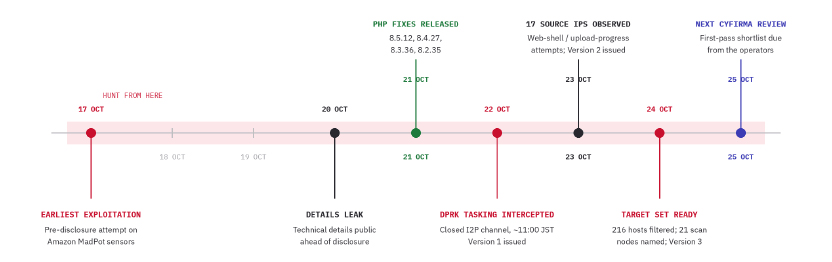
On October 21, PHP released emergency patches for two critical vulnerabilities, CVE-2026-109618 and CVE-2026-109619, both rated 9.2 on the CVSS scale. The flaws affect all PHP versions that handle web requests. The vulnerable code dates back to PHP 5.4, released in 2012, and resides in the PHP engine itself rather than in individual applications. Attackers can exploit the flaws to execute code remotely by sending specially crafted HTTP requests, without authentication.

Exploitation attempts increased rapidly after the vulnerabilities became public. Cloudflare researchers reported tens of thousands of attempts within the first 45 minutes, hundreds of thousands in just two hours, and millions by October 22.

Cyfirma reported that a group of North Korea-linked group has identified 216 hosts that may still be vulnerable to PHP2Shell. The operators communicate through a private I2P channel that Cyfirma has monitored since October 22. On October 24, they reported that 216 hosts appeared to be unpatched or only partly protected, earlier than Cyfirma expected.

They are checking the systems from 21 compromised machines. At the time Cyfirma captured the conversation, the operators had already checked about one-third of the targets.

“Two handles active since March 2026, coordinating in a closed I2P channel; staging infrastructure shared in-channel.” states the cybersecurity firm. “Target set and scan nodes. “On 24 October the operators reported 216 unpatched or partially mitigated hosts and named 21 scan nodes; the same addresses were seen performing web-shell tooling and upload-progress session-poisoning attempts.”

The scanning is slow on purpose. Volume stays low, the machines rotate, and any node that shows filtering or rate limiting gets pulled and never reused. That’s why a rate-based alert will probably stay quiet.

Who’s behind it? Cyfirma assesses with moderate confidence a link to the Lazarus family of North Korean groups, based on language, operating style and old habits with PHP web shells and hijacked web servers. It has no shared malware or infrastructure to point to yet, and it admits that a Korean-speaking criminal crew without state backing would fit the same facts. Its confidence in the campaign itself is high.

Government agencies and banks come first. Next in line are logistics, ports, airports and aviation, manufacturing, and online transaction and trading platforms. The countries named are the US, Japan, South Korea, Thailand, Indonesia, Australia, Taiwan, India, Singapore, the UAE, Saudi Arabia and the EU.

Cyfirma has not named any victims or seen the full list of targeted systems. The operators have not announced when they plan to launch attacks, and the researchers have not confirmed that this group has compromised systems on a large scale. Cyfirma gives the campaign an imminence score of 78 out of 100. The operators plan to check all 216 hosts, select the most promising targets, and decide which publicly available exploits to adapt.

The group does not appear to be developing new exploits. Instead, its members use a local AI model to rank public exploit repositories, then test the results manually in a lab. Cyfirma believes this approach could help attackers turn newly disclosed vulnerabilities into working attacks more quickly. However, researchers warn that some proof-of-concept exploits shared online are fake and may contain malware, so downloading and running them can be dangerous.

Technical details leaked on October 20, ahead of coordinated disclosure, and the PHP project shipped fixes on October 21. Apache mod_php with default settings and prefork is the confirmed worst case for 109618, with full unauthenticated code execution. For 109619, PHP-FPM is validated through the upload-progress path.

One correction matters for your temporary controls. Early coverage tied the session upload-progress field to 109618, but PHP’s advisories put it under 109619 only. Disabling upload progress does nothing for 109618, so the two bugs need different stopgaps.

Triggering the bug is easy, but reliable code execution isn’t. The attacker has to land a follow-up request on the same worker and shape heap data into the freed space, otherwise the worker crashes or answers normally. VulnCheck reports working code execution on x86-64 with ASLR enabled against PHP 8.4.10 to 8.4.26, while ARM64 only leaks memory so far.

Short of code execution, attackers have already shown worker crashes, arbitrary file reads through OPcache and a leak of about 67 KB of process memory. The fixed releases are PHP 8.5.12, 8.4.27, 8.3.36 and 8.2.35. PHP 8.1, 8.0 and 7.4 get only minimal backports, and vendors such as cPanel EasyApache, CloudLinux, TuxCare and Plesk carry their own builds, so confirm coverage with yours.

Anything from PHP 5.4 to 7.3 has no fix, so migrate or isolate it. Restart every worker after patching, because a reload that keeps old workers alive leaves the stale state in place. Isolate anything internet-facing that you can’t patch within hours, starting with Apache mod_php.

If you suspect a host is compromised, capture memory and logs before you patch, since a restart destroys the CVE-2026-109619 state. Then rebuild the host from a trusted image and rotate every secret the PHP worker could reach. Hunt back to October 17, the earliest known exploitation, and use long time windows.

The strongest single signal is a PHP or web server process spawning something it never normally spawns. Application logs will usually show nothing, because the bug fires before application code runs. Look for odd multipart POSTs to endpoints that never take uploads, bursts of worker crashes and memory errors, new PHP files in web roots, and new cron jobs, local users or SSH keys.

Cyfirma includes Sigma, Splunk and YARA content, though it says the YARA set hasn’t been tested on real application code yet. It also lists 21 scan-node addresses, 17 source addresses from October 23 and 15 staging addresses, all defanged. Some scan nodes are described as compromised and may belong to victims, so hunt for prior contact before assuming who owns them.

If you can’t patch yet, the advisory suggests limits such as a low post_max_size and disabling session upload progress for 109619. Cyfirma is clear that none of it replaces patching. The operators’ own selection rule is the most useful detail in the whole advisory, because they dropped every host that showed a fixed version or sat behind heavy filtering. That makes a current version string a cheap filter against you, and for once being boring pays off.

“Hosts still bannering older PHP are the ones the operators kept.” Cyfirma states.

Follow me on Twitter: @securityaffairs and Facebook and Mastodon

Pierluigi Paganini

(SecurityAffairs – hacking, PHP2Shell)

  • ✇Security Affairs
  • North Korean IT Workers Used Stolen US Identities to Earn $3 Million Pierluigi Paganini
    The FBI raided 40 Texas homes over a North Korean scheme that used fake IT workers to target 70 US companies and generate $3 million. The Justice Department (DoJ) announced coordinated enforcement actions this week targeting North Korea’s long-running scheme to place fake IT workers inside American companies. Two US nationals were arrested, 14 people charged across two separate indictments, and the FBI searched more than 40 residences in Texas, seizing approximately 187 laptops and KVM switc
     

North Korean IT Workers Used Stolen US Identities to Earn $3 Million

17 de Outubro de 2026, 13:29

The FBI raided 40 Texas homes over a North Korean scheme that used fake IT workers to target 70 US companies and generate $3 million.

The Justice Department (DoJ) announced coordinated enforcement actions this week targeting North Korea’s long-running scheme to place fake IT workers inside American companies. Two US nationals were arrested, 14 people charged across two separate indictments, and the FBI searched more than 40 residences in Texas, seizing approximately 187 laptops and KVM switch devices.

The Texas operation, called Operation Lonestar Roundup, ran between September 21 and 25. The seized devices are the same laptops American companies shipped to their newly hired remote employees, not knowing those IT workers were North Korean intelligence agents using stolen US identities.

“Today the Department of Justice announced coordinated actions against the Democratic People’s Republic of North Korea (DPRK) government’s schemes to fund its regime through remote information technology (IT) work for U.S. companies.” states DoJ. “These actions include an indictment, two arrests, searches of multiple known or suspected “laptop farms” in Texas pursuant to “Operation Lonestar Roundup,” and the seizure of approximately 187 computer devices used by DPRK IT workers.”

The scheme was simple. North Korean IT workers applied for remote jobs using stolen or fake identities. They used VPNs and proxy servers to make it look like they were working from the United States. American helpers received the laptops provided by employers and installed remote access software so the North Korean workers could use them. These helpers were paid for their role, while the money earned from the jobs was sent back to North Korea through accounts controlled by the regime.

According to an indictment from the Northern District of Ohio, the scheme ran from 2019 to mid-2025 and targeted more than 70 US companies across 17 states. The companies operated in sectors including healthcare, communications, cybersecurity support, retail, and manufacturing.

“In total, the scheme impacted more than 70 U.S. company employers and generated approximately $3 million in revenue for IT workers.” SoJ states.”The revenue is believed to have been sent to sanctioned entities controlled by the DPRK. Victim employers included companies in the health care, communications, cyber support, retail, and manufacturing sectors across Ohio, sixteen additional states, and the District of Columbia.”

The North Korean IT workers earned about $3 million, which prosecutors believe was sent to North Korean entities subject to international sanctions.

The authorities warn the scheme is evolving in response to better detection.

“Increasingly, North Korean IT workers are turning to recruiting American facilitators to counter improved private sector detections and law enforcement actions.” states DoJ. “These workers are hiring facilitators to complete a wider variety of tasks, and in some cases subcontracting entire jobs to third-party foreign nationals. “

That’s not just using Americans as props. It’s actively outsourcing parts of the operation to people inside the US, which makes attribution harder and interception more complicated.

Some IT workers are now subcontracting entire jobs to third-party foreign nationals. Others are hiring facilitators to handle a wider range of tasks beyond just managing the laptops. CrowdStrike, which helped the FBI investigate, tracks the group behind this operation as Famous Chollima and describes the laptop farm infrastructure as vital to overcoming the physical and legal barriers of operating from outside the US.

“These laptop farms enabled FAMOUS CHOLLIMA operatives to pose as legitimate remote workers and siphon illicit wages back to their regime while maintaining persistent access to victim organizations. Working alongside the FBI, CrowdStrike’s threat intelligence into the adversary and their operations, and technical analysis helped make these disruptions possible.” states CrowdStrike.

“This operation marks the beginning of a broader U.S. law enforcement effort to dismantle FAMOUS CHOLLIMA’s U.S. infrastructure. CrowdStrike’s Counter Adversary Operations team intends to remain an integral part of that effort.”

The FBI’s separate public service announcement puts the operation in broader context: “thousands of North Korean state-controlled IT workers” are currently embedded at Western companies, posing what the agency calls a significant national security and intellectual property theft insider threat. North Korean IT workers have individually earned up to $300,000 per year under these schemes, and the collective revenue is measured in hundreds of millions annually, flowing directly to designated entities including the North Korean Ministry of Defense.

This is the fifth round of enforcement actions announced since June 2025 under the DOJ’s DPRK RevGen Domestic Enabler Initiative (June 2025, November 2025, April 2026, and May 2026). The initiative targets people in the United States who help North Korean IT workers carry out these schemes.

According to CrowdStrike, North Korean hackers were responsible for about half of all documented hands-on cyber intrusions over the past year. The regime is also targeting cryptocurrency exchanges and open-source software projects. In 2025 alone, North Korean attackers stole at least $2 billion in cryptocurrency.

The DOJ released a list of email addresses used in these operations, including accounts like randyryang@gmail.com and dev.jerryyang@gmail.com, which companies can add to their screening indicators. The FBI’s public service announcement includes detailed mitigation guidance on spotting DPRK IT worker applications. The red flags are consistent: inconsistencies in work history, reluctance to appear on video, requests to redirect laptop deliveries, and payment accounts that route through intermediaries.

“Threats posed by nation-states like North Korea are a stark reminder that our adversaries will go to great measures to exploit our nation’s economic strength to further and fuel their own nefarious agendas,” said U.S. Attorney David M. Toepfer for the Northern District of Ohio. “We are thankful to FBI Cleveland for their incredible work and persistence to put a stop to these bad actors. These charges serve as an urgent alert to all U.S. companies to remain vigilant in their hiring practices.”

Follow me on Twitter: @securityaffairs and Facebook and Mastodon

Pierluigi Paganini

(SecurityAffairs – hacking, IT workers)

  • ✇Security Affairs
  • AI-Driven tool ARTEX used in attacks against South Korean Banks Pierluigi Paganini
    CrowdStrike analyzes open directories left by an attacker who used the ARTEX AI pentest tool and LLMs to breach South Korean financial firms. CrowdStrike published a research on a campaign against South Korean financial organizations that ran from late September to early October 2026 and ended with stolen data. The attacker left their working notes where anyone could read them. Open directories on servers controlled by the attacker exposed Claude Code session histories, ARTEX configuratio
     

AI-Driven tool ARTEX used in attacks against South Korean Banks

9 de Outubro de 2026, 04:53

CrowdStrike analyzes open directories left by an attacker who used the ARTEX AI pentest tool and LLMs to breach South Korean financial firms.

CrowdStrike published a research on a campaign against South Korean financial organizations that ran from late September to early October 2026 and ended with stolen data. The attacker left their working notes where anyone could read them.

Open directories on servers controlled by the attacker exposed Claude Code session histories, ARTEX configuration files, and Claude memory files. Researchers could see how the operator worked, prompt by prompt. That is rare, and it makes this report particularly interesting.

“Analysis of threat actor-controlled open directories uncovered Claude Code session histories, ARTEX configuration files, and Claude memory files, providing direct insight into the threat actor’s operational methodology and tooling.” reads the report published by CrowdStrike. “The use of agentic AI tooling alongside traditional offensive capabilities highlights the continued evolution CrowdStrike has observed in adversarial tradecraft.”

ARTEX is a recently released open-source tool from China that allows AI agents to run penetration tests on their own. The attacker combined it with large language models. CrowdStrike has not linked the activity to a specific group, but it has moderate confidence that the operator is Chinese-speaking and financially motivated, based on the tool used and the Chinese-language prompts.

Industry reports describe several South Korean financial organizations breached since late September. At one bank, the attacker reportedly got into a loan progress inquiry service used by financial brokers. At another, they compromised an employee mobile work-support system. Nobody has confirmed how many organizations were hit.

Investigators connected the dots through overlapping IP addresses and references to the string ARTEX in HTML files on a server the attacker reportedly controlled. One address, 38.244.50[.]120, hosted an ARTEX instance and an open directory. Inside sat a Claude Code markdown file with a Chinese-language pentesting prompt that told the model how to run its tests.

“The IP address 38.244.50[.]120 was associated with the activity described and hosted an ARTEX instance and open directory containing a Claude Code markdown document at http[:]//38.244.50[.]120:18899/.claude/CLAUDE.md.” continues the report. “The markdown document contained a Chinese-language pentesting prompt that specified how the LLM should conduct pentesting activities.”

That file also pointed to a Hong Kong IP address, and that server held more open directories with session histories, configuration files and memory files. The files show the operator going after Korean financial targets with ARTEX and LLMs across those weeks, and the targets match the ones in industry reporting.

The sessions reveal a two-server setup. The Hong Kong address is the attacker’s main infrastructure, and 38.244.50[.]120 runs the ARTEX instance likely behind the Korean attacks. DeepSeek v4.1-flash served as the main model, with GLM-5.3 from Zhipu AI and Grok 4.6 added for extra sessions. The operator probably reached DeepSeek through a reseller, xcai[.]pro, and used nine proxy addresses that CrowdStrike lists in its report.

“Analysis of Claude Code sessions showed the threat actor also used the following proxy IP addresses during the ARTEX-related activity:

  • 101.53.80[.]20
  • 205.214.59[.]31
  • 124.155.252[.]63
  • 154.201.79[.]246
  • 23.248.249[.]90
  • 23.158.220[.]98
  • 103.248.148[.]84
  • 203.160.133[.]172
  • 209.209.85[.]38

In addition to conducting ARTEX-related operations, the threat actor asked Claude where threat actors typically sell Korean data breach information and asked Claude for assistance in finding Korean Telegram data sales groups.” reads the report.

Exfiltration was only the first step. The stolen data was already being prepared for sale.

In one session, the user asked Claude to write a security researcher résumé with bullet points describing the ARTEX results. The prompt also included personal details. The same Telegram username appeared in sessions involving a Telegram-based NFT gift marketplace and the targeting of what may have been a Chinese payment platform. CrowdStrike says the details likely belong to the operator, but it cannot confirm the link. Given that uncertainty, those details should not be included in a news article.

According to The Hacker News, ARTEX’s developer, Autumn-27, has since closed the source and stopped updates, saying the tool was built for learning and research and that the attacks have nothing to do with the project. Copies already in circulation don’t disappear with a license change.

CrowdStrike says this activity shows how AI tooling can let a financially motivated actor run several intrusions in a short time.

“The use of agentic AI tooling alongside traditional offensive capabilities highlights the continued evolution observed by CrowdStrike in adversarial tradecraft. This activity demonstrates how AI tooling can enable a financially motivated threat actor to conduct multiple intrusions within a short time span.” concludes the report. “CrowdStrike Intelligence assesses that adversaries will likely continue to experiment with implementing AI tooling in their operations to enhance their operational tempo and capabilities.”

Follow me on Twitter: @securityaffairs and Facebook and Mastodon

Pierluigi Paganini

(SecurityAffairs – hacking, ARTEX)
  • ✇Security Affairs
  • Cryptocurrency exchange Bitget Says North Korea-Linked Hackers Stole $351.6 Million Pierluigi Paganini
    Bitget says suspected North Korea-linked actors stole $351.6M from hot and warm wallets. Withdrawals were suspended while Mandiant investigates. Cryptocurrency exchange Bitget says suspected North Korea-linked threat actors stole $351.6 million from a limited number of hot and warm wallets. The company detected unauthorized transfers on September 24 and temporarily suspended withdrawals. At 18:31 UTC on September 24, 2026, Bitget’s security systems identified unauthorized transfers invo
     

Cryptocurrency exchange Bitget Says North Korea-Linked Hackers Stole $351.6 Million

25 de Setembro de 2026, 15:02

Bitget says suspected North Korea-linked actors stole $351.6M from hot and warm wallets. Withdrawals were suspended while Mandiant investigates.

Cryptocurrency exchange Bitget says suspected North Korea-linked threat actors stole $351.6 million from a limited number of hot and warm wallets. The company detected unauthorized transfers on September 24 and temporarily suspended withdrawals.

At 18:31 UTC on September 24, 2026, Bitget’s security systems identified unauthorized transfers involving a limited number of hot wallets.

Our security team immediately activated emergency response procedures and began a full investigation.

Based on our current assessment,… https://t.co/7xF5xW0JQ1

— Bitget (@bitget) September 24, 2026

Bitget said customer balances, cold wallets and most platform assets remain secure. Mandiant and SlowMist are investigating the incident, while deposits and trading continue normally.

“We are currently working with independent third-party experts Mandiant and SlowMist for a full investigation. Our first priority is our users. User balances remain intact, and Bitget’s User Protection Fund covers the impact on this platform-wide incident.” the company added. “Bitget Wallet operates as a self-custodial wallet on a completely separate and independent infrastructure from Bitget Exchange and was not affected by this incident. Bitget Wallet users’ assets remain onchain under users’ control and remain unaffected.”

[UPDATES] We are currently working with independent third-party experts Mandiant and SlowMist for a full investigation.

Our first priority is our users. User balances remain intact, and Bitget's User Protection Fund covers the impact on this platform-wide incident.

Bitget…

— Bitget (@bitget) September 25, 2026

Bitget CEO Gracy Chen said the security breach affected ETH, XRP, BNB, AVAX, USDT and USDC across several blockchains. The attacker reportedly compromised a backend wallet system, spoofed transaction data and bypassed the authorization process to move funds. Bitget said affected blockchain foundations were contacted and some have frozen hacker wallets.

“We have contacted the foundations of all affected chains, and some foundations have confirmed the freezing of hacker wallet addresses,” Chen explained. “Based on IP behavior patterns and on-chain analysis, the attack method in this incident is highly consistent with known patterns of North Korean hacker organizations.”

Here is what we can confirm at this stage:

On the attack:
Our security team has made initial progress in tracing the source. The attacker compromised a critical backend system within our wallet infrastructure, used it to spoof transaction data, and triggered our authorization… https://t.co/5nINjwbXpC

— Gracy Chen @Bitget (@GracyBitget) September 25, 2026

Bitget is a cryptocurrency exchange and Web3 company founded in 2018. It provides services for buying, selling and trading digital assets, including spot and futures trading, copy trading and other financial products. The company has expanded beyond crypto into traditional markets and now describes itself as a “Universal Exchange.” Bitget says it serves more than 120 million users in over 150 countries and regions.

The attribution to North Korea-linked threat actors doesn’t surprise. According to Chainalysis, North Korean hackers stole at least $2.02 billion in cryptocurrency in 2025, bringing the estimated total stolen by DPRK-linked actors to $6.75 billion.

The thefts increasingly target crypto exchanges and other digital-asset services, with attackers using techniques ranging from sophisticated cyber intrusions to fake IT-worker identities.

Follow me on Twitter: @securityaffairs and Facebook and Mastodon

Pierluigi Paganini

(SecurityAffairs – hacking, Bitget)

  • ✇Security Affairs
  • Contagious Interview: 30,000 devices infected by a fake job interview Pierluigi Paganini
    North Korea-linked WaterPlum runs the Contagious Interview campaign, infecting over 30,000 devices using a fake job interview. On September 18, Japan’s National Police Agency, the FBI, the US Department of Defense’s Cyber Crime Center, and intelligence agencies from Australia and Germany published a joint advisory about a group called WaterPlum, better known as Contagious Interview. The name says it all. The job interview is the infection vector. The numbers in the advisory are hard to sh
     

Contagious Interview: 30,000 devices infected by a fake job interview

22 de Setembro de 2026, 03:44

North Korea-linked WaterPlum runs the Contagious Interview campaign, infecting over 30,000 devices using a fake job interview.

On September 18, Japan’s National Police Agency, the FBI, the US Department of Defense’s Cyber Crime Center, and intelligence agencies from Australia and Germany published a joint advisory about a group called WaterPlum, better known as Contagious Interview. The name says it all. The job interview is the infection vector.

The numbers in the advisory are hard to shrug off. At least 30,000 devices infected across more than 100 countries, funds or credentials stolen from over 7,000 cryptocurrency wallets, and a total of 1.7 billion yen, roughly $10.71 million, funneled back to North Korea. The victims are almost always the same type: freelance developers and specialists in blockchain and Web3 work.

Japan’s NPA and the FBI assess that both WaterPlum operators and some North Korean IT workers report to the same place, the 313 General Bureau of the Munitions Industry Department, under the Workers’ Party’s Central Committee. That’s not a loose affiliation. It’s an org chart.

The trap itself is almost embarrassingly simple. WaterPlum actors pose as recruiters or hiring managers, often impersonating real AI, crypto, or NFT companies, and reach out on social media, job boards, and freelance platforms. Candidates get invited to a technical interview, then told to download a file to complete a coding test or fix a supposed bug on the video call.

“WaterPlum actors pose as prospective employers to target software developers and IT professionals worldwide under the pretext of attractive job opportunities. They often impersonate legitimate Artificial Intelligence (AI), cryptocurrency, or Non-Fungible Token (NFT) companies and have also used recruiting services.” reads the joint advisory. “WaterPlum actors have infected at least 30,000 devices in more than 100 countries and exfiltrated funds or account credentials from over 7,000 cryptocurrency wallets. WaterPlum actors have transferred 1.7 billion Japanese yen (JPY) (equivalent to 10.71 million USD) of cryptocurrency assets to the Democratic People’s Republic of Korea (DPRK).”

That file is never what it claims to be. The advisory names five malware families riding inside these downloads, BeaverTail, InvisibleFerret, OtterCookie, OtterCandy, and StoatWaffle, each doing its own piece of the job: one steals browser credentials, another opens a backdoor, another sets up a remote access trojan to move deeper into the machine. Once inside, the goal is straightforward: drain the wallet, then look for whatever else might be worth stealing.

What happens next goes beyond one stolen wallet. The report notes that a successful infection can give WaterPlum a way into the victim’s employer, opening the door to espionage, stolen source code, and further movement inside a company’s systems. Stolen ID photos get reused too, letting North Korean IT workers impersonate the victim to land more paying contracts elsewhere.

That last part connects to a separate but related scheme covered in the same advisory: North Korean IT workers using so-called “laptop farms.” These are physical locations, often just someone’s house, where a local facilitator plugs in company-issued laptops and lets a North Korean worker operate them remotely over VPN. The worker gets a Western-looking identity and a legitimate-sounding job. The facilitator gets a cut.

“Beyond immediate credential theft, successful infections provide WaterPlum actors opportunities to infiltrate organizations employing targeted developers, enabling espionage, intellectual property theft, and additional lateral movement in corporate environments. Stolen ID images can also be used by North Korean IT workers to impersonate victims and generate foreign currency.” continues the report. “Other sensitive data targeted for exfiltration includes:

  • Authentication data stored in web browsers (ID, password, etc.);
  • Clipboard information, key-logs (recorded keystrokes), screenshots;
  • Cryptocurrency-wallet data (private key, seed phrase, etc.); and
  • Any files or data of interest to the actors on a PC or in shared folders (ID pictures of driver’s licenses, passports, etc.)”

Here’s a simpler and more natural version, while keeping the same details:

Japan says this is no longer just a theoretical threat. Authorities have already shut down the country’s first known “laptop farm,” run by a local facilitator who had moved several hundred million yen in cryptocurrency out of Japan. In the US, the FBI says it continues to prosecute people who help North Korean IT workers operate this way, across several states and under different charges.

The advisory also describes a case involving a Japanese crypto exchange that spotted one of these applicants in May 2025. His resume listed an unusually wide range of skills across more than a dozen technologies. He claimed to be Malaysian, raised in Finland, and fluent in Malay and Chinese, but struggled with basic English questions that did not fit his claimed background. The company rejected him, avoiding any damage.

Other red flags recruiters have picked up on read like a checklist for a bad Zoom call: the applicant glancing sideways as if reading a script, background voices that shouldn’t be there, video that keeps freezing at convenient moments, a firm preference for getting paid in crypto, sometimes to someone else’s account entirely.

Not every North Korean IT worker sticks to quiet fraud, either. One extorted a client over a payment dispute and leaked the company’s proprietary code online out of spite. Another, hired for basic website maintenance, defaced the site and knocked it offline instead. Petty, but the effect on the client was anything but.

The advisory draws one more thread together: WaterPlum’s cyberattack operators and North Korea’s IT worker network aren’t running in parallel. They’ve been caught using the same IP addresses to access laptop farms, register on freelance platforms, and apply for that same crypto exchange job. Same infrastructure, two revenue streams, one regime cashing the checks.

“The techniques described in this advisory are only examples; actors continuously evolve and refine their methods.” concludes the advisory. “Stay informed by monitoring alerts from domestic and international security agencies and by reviewing reports published by security vendors.”

Follow me on Twitter: @securityaffairs and Facebook and Mastodon

Pierluigi Paganini

(SecurityAffairs – Contagious Interview, WaterPlum)

  • ✇Security Affairs
  • North Korea-linked Hackers Hide a Backdoor Inside HAProxy Pierluigi Paganini
    North Korea-linked hackers hid a backdoor inside HAProxy, masking C2 traffic and stealing data while keeping the load balancer working normally. North Korean-linked hackers found a genuinely clever hiding spot for their malware: inside the actual source code of HAProxy, the load balancing software running at the edge of two South Korean companies’ networks. Rapid7’s research documents a previously undocumented Linux toolkit hitting South Korea’s automotive and media sectors, and the depth of
     

North Korea-linked Hackers Hide a Backdoor Inside HAProxy

8 de Setembro de 2026, 06:11

North Korea-linked hackers hid a backdoor inside HAProxy, masking C2 traffic and stealing data while keeping the load balancer working normally.

North Korean-linked hackers found a genuinely clever hiding spot for their malware: inside the actual source code of HAProxy, the load balancing software running at the edge of two South Korean companies’ networks. Rapid7’s research documents a previously undocumented Linux toolkit hitting South Korea’s automotive and media sectors, and the depth of integration here goes well beyond a typical backdoor bolted onto a system.

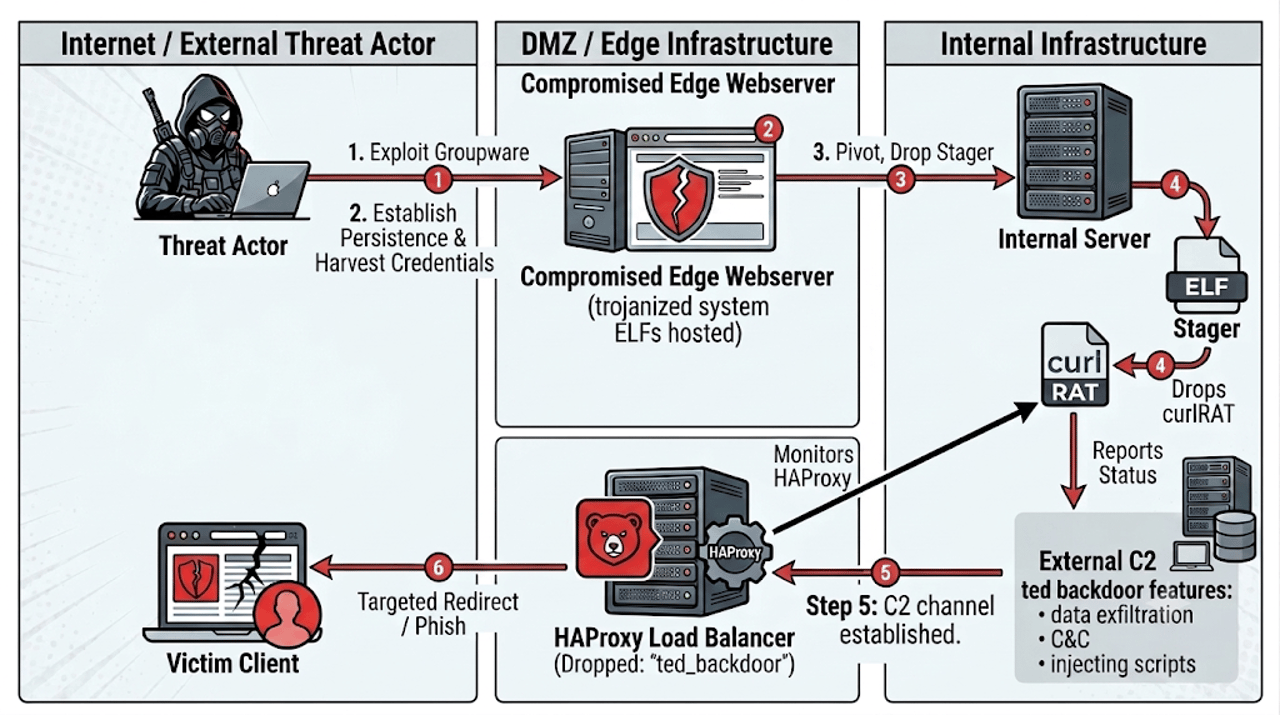
“A new Linux toolkit, identified by Rapid7 Labs, has been targeting organizations across South Korea’s automotive and media industries with minimal detection. The campaign made use of a HAProxy instance named “ted backdoor”, alongside trojanized versions of crond, agetty, atd, sshd, and polkitd.” reads the report published by Rapid7. “This previously undocumented framework enabled threat actors to execute remote commands on compromised servers, inject malicious scripts into web traffic, perform credential harvesting, and engage in long-term surveillance.”

The implant, which Rapid7 calls the “ted backdoor” based on debug strings the attackers left behind, isn’t a separate process running alongside HAProxy. It’s compiled directly into HAProxy’s own source code as a custom plugin, using the software’s native filter API, internal memory management, and event scheduler to intercept HTTP traffic while completely legitimate load balancing keeps running normally on top of it.

“The standout feature of this toolkit is its depth of integration with the target environment. The ted backdoor is compiled as part of the victim’s existing HAProxy version 2.8.12.” continues the report. “It uses its native filter API, internal memory pools, event scheduler, and process management infrastructure to intercept traffic and hide from monitoring, while genuine load balancing traffic operates as expected.”

Rapid7 explains, which is really the whole thesis of why this backdoor is so hard to spot: it’s not an addition to the software, it’s woven into it.

The backdoor receives commands through a surprisingly simple trick. The attackers send a request for a fake image at /favorite_list_2x_m500_ico.jpg. This switches the HAProxy filter into command-and-control mode.

The malware then saves the command in a named pipe and removes traces of the request from HAProxy’s internal counters. It also clears the forwarding buffers, so the request never reaches the backend server. The command ends at the load balancer, leaving nothing in the application logs to show that it happened.

This ability to erase its own traces makes the backdoor very different from a normal web shell. The C2 requests never reach the backend server and are also removed from HAProxy’s statistics.

As a result, neither the application logs nor HAProxy’s connection logs show that the attack happened. A security team checking the logs could find nothing suspicious because the backdoor has already erased the evidence.

Beyond remote command execution, the backdoor can quietly inject malicious scripts or entirely swap out page content for specific victims matched by IP address, browser fingerprint, or even a hidden authentication credential smuggled inside the Accept-Language header, effectively turning a company’s own load balancer into a watering hole against its own visitors. It also hooks response bodies carefully enough to hide the size difference caused by injected content, stripping the header that would let a browser notice the byte-range mismatch. That’s a level of protocol-level care that suggests real HAProxy internals expertise, not a quick copy-paste job.

The main backdoor also comes with a separate toolkit that modifies common Linux system daemons such as crond, agetty, atd, and sshd. These programs continue to work normally but also carry malicious features.

One component acts as an SSH keylogger. It captures passwords that administrators enter in plain text and quietly records them. Another tool, called curlRAT, contacts a remote server every 12 hours by default, or every 30 seconds when the attacker enables its fast-poll mode.

curlRAT also checks whether the system runs inside a virtual machine. If it does not find the expected signs, it refuses to run. This behavior suggests the attackers designed the malware to avoid sandboxes and other analysis environments.

Attribution here sits at medium confidence, and Rapid7 is upfront about the limits of what the evidence actually shows. The targeting pattern, simple XOR-based encryption, a custom substitution cipher, and command-server infrastructure already linked to APT37 by other threat intelligence feeds all point toward North Korean state involvement, with some technical overlap also drawing comparisons to a concurrent Lazarus Group campaign against South Korean media sites.

“Further evidence is necessary to make a more definitive assessment. Moreover, the presence of ngx_* prefixed routines within the ted backdoor suggest code reused from an nginx backdoor. The ngx_* prefixed routines were observed during the latest Funnull campaign, where (similar to our case) a custom nginx filter was registered to hook HTTP traffic, and simple XOR encryption was applied to the configuration file.” Rapid7 states. “However, other than a similar naming convention, no significant code-level overlaps exist to support a stronger linkage.”

If your organization runs HAProxy, or really any edge component handling SSL termination and traffic routing, the practical lesson here is uncomfortable but simple: that software deserves the same scrutiny as your actual application servers, not less. The Hacker News confirmed in early September that the specific command domains used in this campaign have already gone dark, returning no DNS records at all, which is useful for reviewing historical logs but does nothing to stop whatever comes next from the same operators. Checking a load balancer’s own logs isn’t enough anymore when the backdoor’s entire design goal is making sure those logs never see it in the first place.

“ted backdoor and curlRAT were designed to persist during long-term espionage operations with the ability to steal cookie sessions, credentials, redirect selected users, conduct drive-by download attacks, and hide evidence of the tampered page to a specific range of IPs to evade detection.” concludes the report. “Defenders should treat any edge component managing user traffic, SSL, or runtime modules with the same strict security standards as their main application servers. Relying on the component’s own logs is not enough; securing these systems requires independent network correlation, memory behavioral analysis, and binary integrity checks.”

Follow me on Twitter: @securityaffairs and Facebook and Mastodon

Pierluigi Paganini

(SecurityAffairs – hacking, North Korea)

❌
❌