❌

Visualização normal

Antes de ontemSecurity Affairs
  • ✇Security Affairs
  • Russian APT29 Targets Mobile Users with Watering Hole Attacks Pierluigi Paganini
    Russia-linked group APT29 targeted iOS and Android users through hijacked websites and a compromised analytics service. Sekoia says a large-scale watering hole campaign is going after iOS and Android users, and it links the campaign to APT29 (aka SVR group, Cozy Bear, Nobelium, BlueBravo, Midnight Blizzard, and The Dukes), the Russian group tied to the SVR foreign intelligence service. A watering hole is a site that attackers poison so visitors infect themselves. Sekoia found the campaig
     

Russian APT29 Targets Mobile Users with Watering Hole Attacks

5 de Novembro de 2026, 07:00

Russia-linked group APT29 targeted iOS and Android users through hijacked websites and a compromised analytics service.

Sekoia says a large-scale watering hole campaign is going after iOS and Android users, and it links the campaign to APT29 (aka SVR group, Cozy Bear, Nobelium, BlueBravo, Midnight Blizzard, and The Dukes), the Russian group tied to the SVR foreign intelligence service. A watering hole is a site that attackers poison so visitors infect themselves.

Sekoia found the campaign in mid-October 2026. It involved hacked or cloned high-profile websites in the US, Ukraine, the Czech Republic and Bulgaria. There’s also a supply-chain attack on a Ukrainian web analytics service, Plerdy, loaded by thousands of websites, most of them Ukrainian.

The attackers used three different methods to reach victims, but all led to the same malicious payload. They injected JavaScript into hacked websites, created fake websites that copied legitimate ones and secretly added malicious code, and compromised the Plerdy analytics service to infect websites using its script.
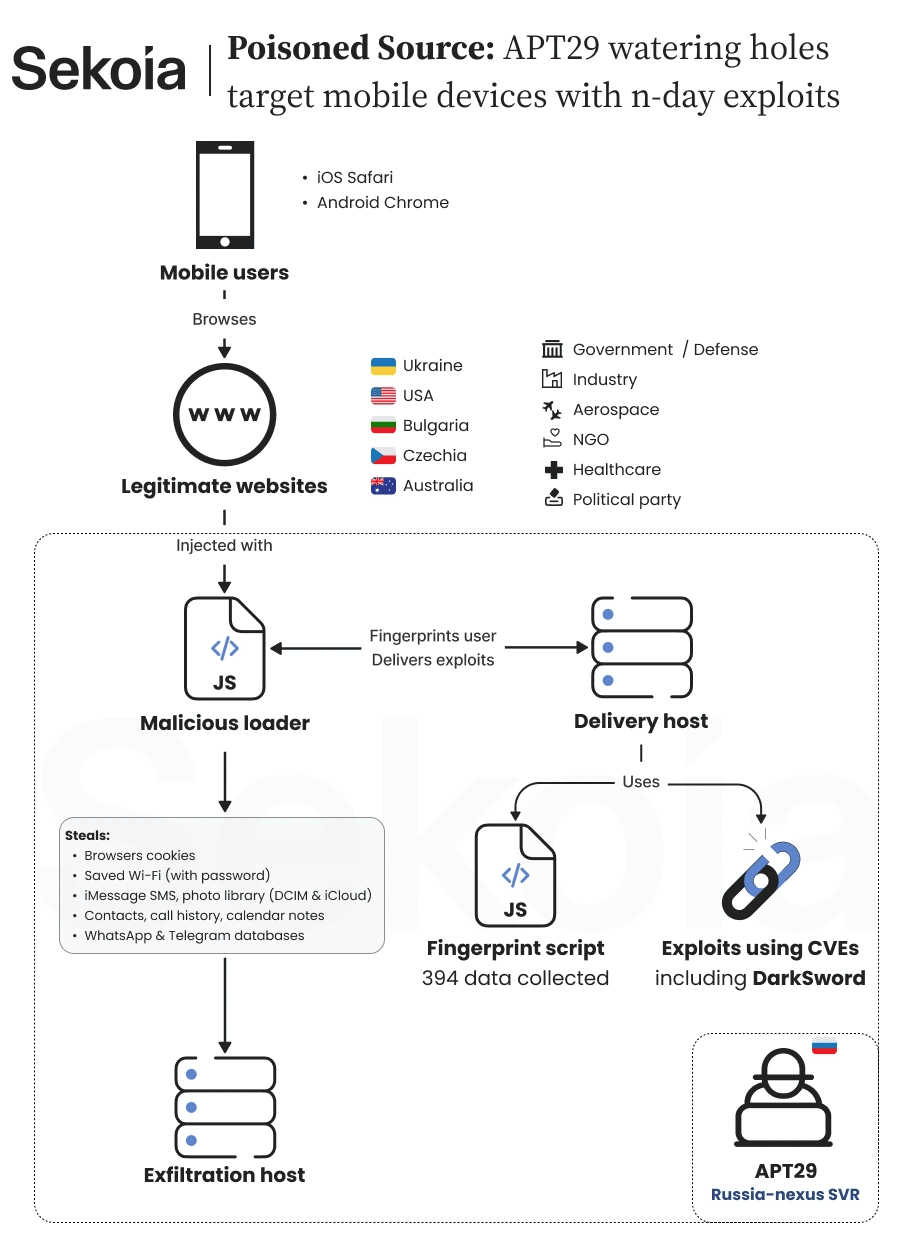
APT29 Watering Hole

Sekoia first spotted the campaign on the website of a Ukrainian gas production company. Other compromised sites included a major US chemical industry association, a European far-right political party and a Bulgarian website linked to the military. In the Bulgarian case, attackers modified an existing JavaScript library without changing the website’s visible pages. Researchers found no clear pattern in the targeted organizations, although they believe some websites may have been selected to reach specific individuals.

Sekoia also identified two fake websites designed to impersonate legitimate services. One copied America250, the US initiative marking the country’s 250th anniversary, while another reproduced the website of Raffles London at The OWO, a luxury hotel close to the UK Ministry of Defence and Downing Street.

“The second website, theowo[.]club, now offline, acted as a reverse proxy for the website of Raffles London at The OWO, a prestigious luxury hotel housed in the historic Old War Office building.” reads the report published by Sekoia. “The hotel’s location is particularly noteworthy because of its proximity to some of the United Kingdom’s most sensitive government institutions, including the Ministry of Defence and 10 Downing Street, the official residence and office of the British Prime Minister.”

The hotel connection is particularly interesting because Ukrainian President Volodymyr Zelensky reportedly stayed there during a visit to London on October 14. Sekoia believes the fake website may have been used to target diplomatic delegations through spear-phishing, but stresses that this remains an unconfirmed possibility.

Between August 27 and September 3, 2026, the attackers compromised the Plerdy tracker at a.plerdy[.]com. For a week, visitors loaded both Plerdy’s script and the attackers’ profiling script. Several affected sites relate to the military and military recruitment, including army, special forces and military equipment websites.

“Between 27 August and 3 September 2026, the intrusion set compromised the Ukrainian Plerdy analytics tracker hosted under the domain a.plerdy[.]com, which is loaded by thousands of websites, the large majority of them Ukrainian.” reads the report. “It remains unclear whether the attackers intended to target visitors to specific websites or sought to compromise as many unpatched mobile devices as possible, indiscriminately exfiltrating data before selectively identifying and exploiting information of interest.”

Sekoia can’t say whether the aim was specific visitors or as many unpatched phones as possible, with the sorting done later. It also considers that the attackers may have used Plerdy after failing to inject code directly into Ukrainian high-value sites that relied on it. The Plerdy payload pointed to a load-balancing domain that sent traffic across several delivery servers.

The profiling script, which the attackers call UltimateFingerprinter, is attached to a minified AngularJS library that makes up 98 percent of a 2.3 MB file. Sekoia thinks that bulk might stop analysis by large language models, or make the script look legitimate. The script runs 61 collectors that build 394 fields, then sends them to a server that decides whether to answer with exploit code.

Strangely, almost none of that data matters. Only implausible screen sizes, like 99999, or a device reporting zero touch points block delivery. Sekoia doesn’t know why the attackers collect so much and sees no sign the data was used later.

Sekoia pulled three exploit chains from the delivery server. Class A hits iOS 16.7 and steals cookies. Class B hits iOS 18.5 and takes full device data. Class C hits Android Chrome versions 139 to 145, minus 143 for reasons Sekoia can’t explain, and steals Chrome cookies and Wi-Fi passwords.

“During the investigation, we tested different browser profiles against the fingerprinting endpoint at static[.]flux-telemetry[.]com in order to retrieve the exploits served to visitors.” states the report. “This allowed us to retrieve three complete exploit chains (afternamed A, B and C), along with their final payloads, targeting both Android and iOS. Here is a summary of what we found:”

Class B is DarkSword, which Sekoia describes as a suspected iOS exploit kit from a commercial surveillance vendor, uploaded to VirusTotal in September 2026. It takes text messages and iMessages, Mail indexes, voicemail, WhatsApp and Telegram databases, Keychain passwords and tokens, account credentials and Wi-Fi keys. It also takes contacts, call history, calendar, notes, Safari history and cookies, location caches, Health data, photos and iCloud Drive.

The Android payload, which Sekoia calls AndroSnitch, collects Chrome cookies, saved logins and history, plus Wi-Fi settings. It stops on one phone model, the Samsung Galaxy S25 Ultra. It resembles a 2024 payload that Google TAG documented, called AndroSnatch, but the sample is too small to prove lineage. The iOS cookie chains set a marker cookie meant to block reinfection for a day, but a coding mistake makes it expire in a minute.

All stolen data goes to ad.starx-net[.]com:8881/telemetry/v12. None of the chains persist on the device. All of them rely on known flaws, and none uses a zero-day.

For attribution, Sekoia has several threads. A CERT said a compromised site’s backend files held traces matching a private report on a 2025 APT29 watering hole campaign, and Google TAG said the framework resembles an APT29 campaign against Mongolian government websites in 2024. Victims also skew to Europe and the US with a focus on Ukraine, infrastructure sits across multiple hosters, and a hacked Czech far-right site fits APT29’s record of targeting European political parties. It rates the link moderate to high confidence, and it’s coordinating with the CERTs of affected countries.

The campaign shows how exploit kits move down the market. Sekoia says state-backed groups keep reusing frameworks from commercial surveillance vendors such as DarkSword, and that packaged exploit chains lower the cost and skill needed for advanced mobile attacks. It expects such reuse to become more frequent.

The good news is that Sekoia’s attackers don’t have fresh tricks. Every flaw was fixed by its vendor before the campaign began, and none works against fully updated devices.

“None of them contain zero-days or work against fully updated devices. Each flaw was resolved by the respective vendor before this campaign began. This operation targets unpatched devices using n-days; a user running an up-to-date operating system is safe from these attacks.” concludes the report.

“This watering hole campaign, which we assess with moderate to high confidence to be linked to APT29, combines multiple web delivery vectors with n-day mobile exploit chains targeting Android and iOS devices. Across the directly compromised websites, no single sectoral targeting pattern emerges from our analysis. While the victimology shows a focus on Ukraine and the United States, the inclusion of unrelated entities such as an Australian medical clinic complicates a broad strategic interpretation. However, we assess that these websites may have been selected to profile and infect specific individuals of interest based on targeting intelligence to which we do not have visibility. The operators adapted by deploying Adversary-in-the-Middle-ish to intercept visitors associated with diplomatic or high-profile events.”

Follow me on Twitter: @securityaffairs and Facebook and Mastodon

Pierluigi Paganini

(SecurityAffairs – hacking, APT29)
  • ✇Security Affairs
  • FBI Blames North Korea for $6 Billion Binance Crypto Theft Pierluigi Paganini
    The FBI blames North Korea for stealing $6 billion from Binance and urges crypto firms to block transactions linked to the stolen funds. The FBI has named North Korea as the party behind the theft of more than $6 billion in virtual assets from the crypto exchange Binance, on or about October 29, 2026. The bureau published its findings in a public alert. The FBI specifically blames the North Korea-linked APT “TraderTraitor,” also tracked as Lazarus Group and APT38. Binance hasn’t named a c
     

FBI Blames North Korea for $6 Billion Binance Crypto Theft

1 de Novembro de 2026, 16:23

The FBI blames North Korea for stealing $6 billion from Binance and urges crypto firms to block transactions linked to the stolen funds.

The FBI has named North Korea as the party behind the theft of more than $6 billion in virtual assets from the crypto exchange Binance, on or about October 29, 2026. The bureau published its findings in a public alert. The FBI specifically blames the North Korea-linked APT “TraderTraitor,” also tracked as Lazarus Group and APT38.

Binance hasn’t named a culprit, but the blockchain analysis firm TRM has. It was the first to attribute the attack to TraderTraitor, and Chainalysis also said it’s highly confident in that finding.

“The Federal Bureau of Investigation (FBI) is releasing information advising the Democratic People’s Republic of Korea (North Korea) was responsible for the theft of more than $6 billion USD in virtual assets from cryptocurrency exchange Binance, on or about October 29, 2026. The FBI refers to this specific North Korean malicious cyber activity as “TraderTraitor.”” reads the FBI’s statement.

“The FBI, together with partners at the USSS and IRS-CI, has observed TraderTraitor actors converting stolen assets primarily into Ethereum (ETH). It is expected these assets will then be further laundered by converting them using DeFi and instant swap services as they prepare them for further laundering stages.”

Attackers used access from an engineer’s laptop to reach a service container and send unauthorized withdrawal requests. Binance says it has found no evidence that attackers stole any wallet private keys.

The FBI, along with the U.S. Secret Service (USSS) and IRS Criminal Investigation (IRS-CI), has spotted TraderTraitor actors turning the stolen assets mostly into Ethereum (ETH). The agencies expect the next step to be more laundering, by swapping the funds through DeFi and instant swap services as the actors prepare them for later stages. Instant swap services are aptly named.

The alert is aimed at private companies as well as law enforcement agencies. The FBI, USSS and IRS-CI are asking several types of businesses to help stop the money laundering. These include THORNode operators, who support the THORChain network, RPC node operators, who provide apps with access to blockchains, instant crypto exchanges, DeFi platforms, blockchain analytics companies and other crypto service providers.

The request is clear: these companies should block any transactions involving the wallet addresses used by TraderTraitor, including funds that can be traced back to them. According to the FBI, these addresses have received stolen funds and are controlled by North Korean attackers or are closely linked to them. The full list of addresses is included in the alert.

If you run any of these services, the first job is to check your blocklists against that list. The second is to look at transaction flows that touch those addresses indirectly, since the FBI says to block anything “derived from” them, not just direct transfers. Blockchain analytics firms are named for a reason, because tracing derived funds is their work.

The FBI says it’s committed to protecting the virtual asset community by identifying, mitigating and disrupting North Korea’s illicit cybercrime and virtual asset theft.

“The FBI maintains its commitment to protecting the virtual asset community by identifying, mitigating, and disrupting North Korea’s illicit cybercrime and virtual asset theft activities.” concludes the report. “If you have any information to provide, please contact your local FBI field office or FBI’s Internet Crime Complaint Center at ic3.gov.”

TRM says the attacker moved about $6.36 billion out of Binance wallets on ten blockchains on October 29, most of it in roughly 20 minutes starting at 20:05 UTC. That makes it the largest crypto theft on record, about four times the $1.5 billion Bybit hack of February 2025.

“On October 29, 2026, an attacker moved approximately USD 6.36 billion out of Binance wallets on ten blockchains, most of it in about 20 minutes starting at 20:05 UTC. That makes this the largest crypto theft on record, about four times the USD 1.5 billion Bybit hack of February 2025. Binance has confirmed a security incident and suspended withdrawals on several networks.” TRM said. “TRM attributes the attack to TraderTraitor, North Korea’s elite hacking unit, based on robust on and off-chain intelligence. We make this judgment with high confidence. TRM is tracking the funds and alerting partners through the Beacon Network.”

Freezing the money only went partway. Tether, Circle, Ripple and World Liberty Financial froze about $2.67 billion in stablecoins, and Arbitrum’s Security Council froze 8,426 ETH and 74.6 million ARB, for roughly $2.7 billion in all. But the attacker raced the freezes by selling USDT to market makers and borrowing ETH against USDT on Aave. It now holds more than 420,000 ETH and 18,270 BTC, about $2.4 billion beyond any issuer’s reach.

The early freeze numbers were messy too, Tether and Circle froze approximately $1.79 billion in stablecoins associated with the suspicious transfers in the initial reports. Those amounts describe different moments, and you shouldn’t add them without checking whether they cover distinct assets. A freeze works on tokens that have an issuer to call, and Ether and Bitcoin don’t.

Below is the link to my interview regarding the Binance case for Italian state television.

https://www.youtube.com/watch?v=DtvhBA9TdPo

Follow me on Twitter: @securityaffairs and Facebook and Mastodon

Pierluigi Paganini

(SecurityAffairs – hacking, Binance)

  • ✇Security Affairs
  • Volt Typhoon Used Silent Train to Hide Zero-Day Attacks Pierluigi Paganini
    Volt Typhoon used disposable relay chains to hide zero-day attacks on critical systems. Lumen linked Silent Train to at least four zero-days. Lumen’s Black Lotus Labs has spent three years tracking a covert network it calls Silent Train, which it ties to Volt Typhoon, the China-linked APT group. The cybersecurity firm says the network hid exploitation of software flaws the vendors didn’t know about yet. Black Lotus sent hundreds of victim notifications along the way, and the investigations t
     

Volt Typhoon Used Silent Train to Hide Zero-Day Attacks

29 de Outubro de 2026, 07:34

Volt Typhoon used disposable relay chains to hide zero-day attacks on critical systems. Lumen linked Silent Train to at least four zero-days.

Lumen’s Black Lotus Labs has spent three years tracking a covert network it calls Silent Train, which it ties to Volt Typhoon, the China-linked APT group. The cybersecurity firm says the network hid exploitation of software flaws the vendors didn’t know about yet. Black Lotus sent hundreds of victim notifications along the way, and the investigations that followed revealed the exploitation of at least four confirmed zero-days and one likely.

“Volt Typhoon’s Silent Train is a covert network designed to gain and maintain access to the technologies businesses rely on to manage devices, networks and critical operations.” reads the report published by Lumen. “Black Lotus Labs® tracked how the group used rapidly changing chains of compromised infrastructure to conceal its activity while exploiting previously unknown vulnerabilities in centralized management platforms.”

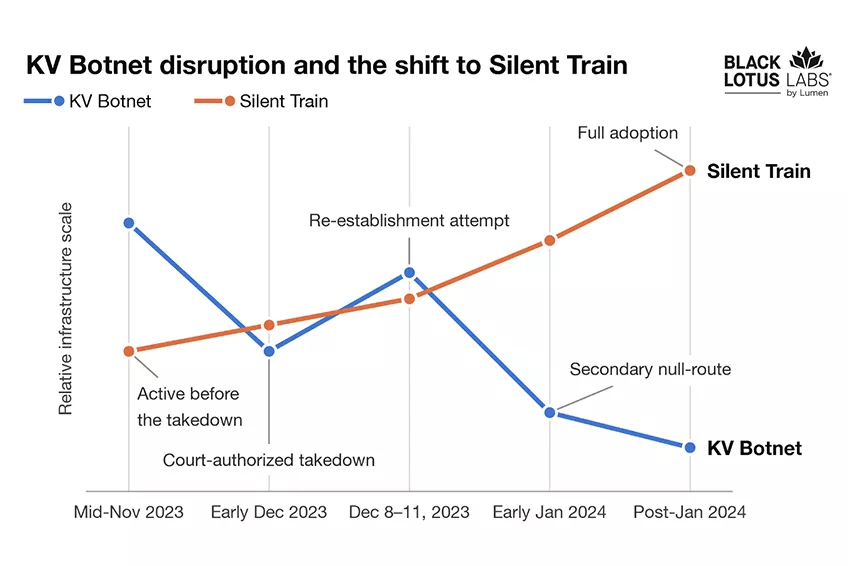
Silent Train first showed up in November 2023, shortly before the first takedown of the KV-botnet, Volt Typhoon’s earlier network of hijacked routers. Activity rose after the second disruption. The group dropped persistent infrastructure and moved to disposable chains of compromised devices that it could rebuild whenever it wanted.

Each session began on a rented server outside the United States. It then passed through another server and compromised small-office routers, home devices and IoT equipment in other countries. Finally, the traffic passed through a compromised device in the U.S., close to the target. This helped the attackers make their activity look like normal local traffic and bypass location-based blocks and IP reputation filters. On average, the chains passed through about four devices before reaching a U.S. IP address. Some used as many as six.

Lumen identified more than 27 types of devices used in the network, including TP-Link routers and Fortinet appliances. Some of these devices had no known vulnerabilities, suggesting that Volt Typhoon may have used previously unknown exploits to compromise them and create relay points.

“We observed more than 27 device classes exploited and used in Silent Train operations, ranging from SOHO and IoT devices like TP-Link routers and Netgear Orbi devices to enterprise platforms like Fortinet appliances and CyberPanel servers.” the report continues. “Some relay device types lack known vulnerabilities, suggesting Volt Typhoon leveraged undisclosed zero-day exploits to set up a single relay in a four-to-six hop chain and indicating a willingness to commit significant resources to protecting future access capabilities.”

The attackers exploited exposed web interfaces and installed only the tools needed to connect the devices through SSH. These included temporary SSH services, keys, configuration files and tools already available on the systems. At the end of each session, they removed all traces of their activity and dismantled the relay chain. Sessions lasted about four hours on average, although some lasted only minutes. The attackers could also build a new chain in less than two minutes, suggesting that they had partly automated the process.

The group worked with strict discipline. New device types arrived about one per quarter, and about one per month during the 2023 and 2024 build-out, always tested outside the U.S. first. Roles never changed: Intelbras modems served only as overseas relays, Netgear Orbi devices only as the U.S. hops facing victims, and the server providers stayed separated by layer too.

By early 2025, enterprise platforms like Fortinet, Cisco, PRTG, Mirth Connect and CyberPanel joined as final hops. They stayed up one to three months and supported several intrusions. The group also added reverse tunnels using the open-source proxies Chisel and FRP, and the old and new methods ran in parallel.

Volt Typhoon used Silent Train only during key stages of its attacks, including exploiting vulnerabilities, stealing credentials and data, and maintaining access to compromised systems. Each session targeted between one and five victims, often just one organization. The activity was carried out by human operators, mainly from Monday to Friday, between 9 a.m. and 10 p.m. China Standard Time. The group also paused operations for several weeks around Chinese New Year.

The group targeted tools used to manage endpoints and networks, as well as SD-WAN systems and other control platforms. These systems can manage hundreds or thousands of devices, allowing attackers to reach many systems without moving through the network in the usual way. This approach also helped them leave fewer traces. After the attacks, investigators found webshells running in memory, stolen credentials, misuse of built-in features such as remote file transfers, and deleted logs.

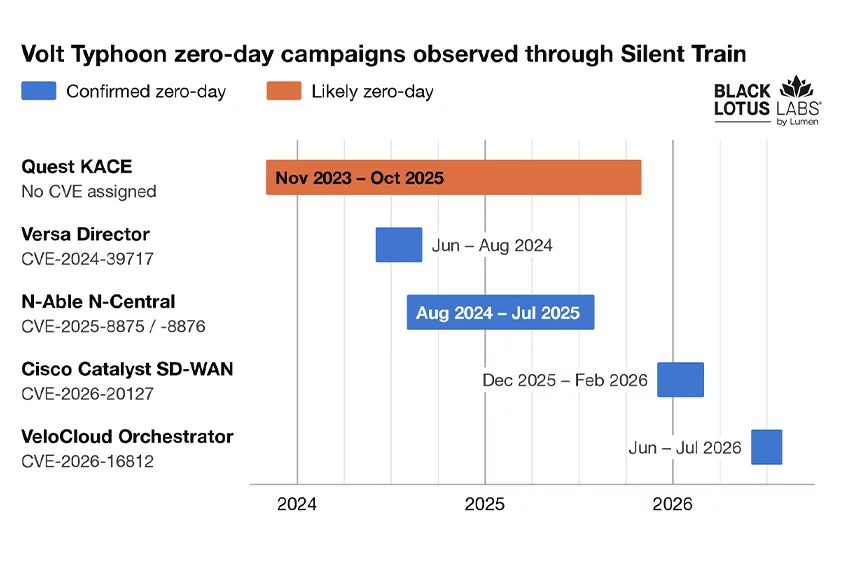
The four confirmed zero-day campaigns hit Versa Director in 2024, N-able N-central through CVE-2025-8875 and CVE-2025-8876, Cisco Catalyst SD-WAN through CVE-2026-20127, and VeloCloud Orchestrator through CVE-2026-16812. The Cisco bug is a CVSS 10.0 flaw, and the group kept exploiting it well after Cisco disclosed it in February 2026. In the Versa case, the group used an in-memory JAR webshell to limit forensic evidence and reach downstream customers.

The likely fifth is Quest KACE. The campaign hit more than 30 victims and faded after Quest’s October 2025 security updates.

“The campaign affected more than 30 victims, followed vendor remediation timelines and declined after Quest’s October 2025 security updates.” the report states. “Despite limited forensic evidence, the available data supports a moderate-confidence assessment that Volt Typhoon exploited a zero-day vulnerability.”

The actor stayed on the KACE server and used its admin features to take credentials.

Victims include telecoms, government agencies, defense contractors, satellite and emergency communications, universities with ROTC programs, managed service and IT firms, and critical infrastructure such as water, energy, transportation, maritime, rail and aviation. What they share is access to bigger networks or customers. Hawaii, California and Texas were the top locations for several years. Lumen can’t say why, but the pattern fits pre-positioning for a crisis in the Indo-Pacific.

“For enterprise leaders, the lesson is clear: systems with broad administrative reach can become high-value gateways to the entire organization and its customers. Reducing internet exposure, accelerating patching, strengthening access controls and preserving security telemetry are essential to detecting threats earlier and limiting their impact.” Lumen concludes.

Follow me on Twitter: @securityaffairs and Facebook and Mastodon

Pierluigi Paganini

(SecurityAffairs – hacking, China)

  • ✇Security Affairs
  • PHP2Shell: Suspected North Korean campaign targets 216 vulnerable PHP hosts Pierluigi Paganini
    Cyfirma links PHP2Shell scans of 216 vulnerable hosts to a suspected North Korean campaign using AI to rank public exploits. On October 21, PHP released emergency patches for two critical vulnerabilities, CVE-2026-109618 and CVE-2026-109619, both rated 9.2 on the CVSS scale. The flaws affect all PHP versions that handle web requests. The vulnerable code dates back to PHP 5.4, released in 2012, and resides in the PHP engine itself rather than in individual applications. Attackers can exploit
     

PHP2Shell: Suspected North Korean campaign targets 216 vulnerable PHP hosts

26 de Outubro de 2026, 06:58

Cyfirma links PHP2Shell scans of 216 vulnerable hosts to a suspected North Korean campaign using AI to rank public exploits.

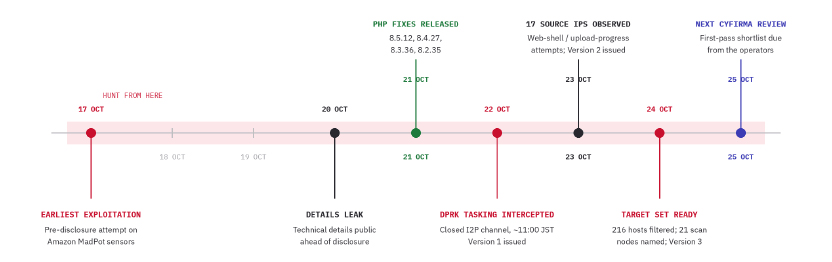
On October 21, PHP released emergency patches for two critical vulnerabilities, CVE-2026-109618 and CVE-2026-109619, both rated 9.2 on the CVSS scale. The flaws affect all PHP versions that handle web requests. The vulnerable code dates back to PHP 5.4, released in 2012, and resides in the PHP engine itself rather than in individual applications. Attackers can exploit the flaws to execute code remotely by sending specially crafted HTTP requests, without authentication.

Exploitation attempts increased rapidly after the vulnerabilities became public. Cloudflare researchers reported tens of thousands of attempts within the first 45 minutes, hundreds of thousands in just two hours, and millions by October 22.

Cyfirma reported that a group of North Korea-linked group has identified 216 hosts that may still be vulnerable to PHP2Shell. The operators communicate through a private I2P channel that Cyfirma has monitored since October 22. On October 24, they reported that 216 hosts appeared to be unpatched or only partly protected, earlier than Cyfirma expected.

They are checking the systems from 21 compromised machines. At the time Cyfirma captured the conversation, the operators had already checked about one-third of the targets.

“Two handles active since March 2026, coordinating in a closed I2P channel; staging infrastructure shared in-channel.” states the cybersecurity firm. “Target set and scan nodes. “On 24 October the operators reported 216 unpatched or partially mitigated hosts and named 21 scan nodes; the same addresses were seen performing web-shell tooling and upload-progress session-poisoning attempts.”

The scanning is slow on purpose. Volume stays low, the machines rotate, and any node that shows filtering or rate limiting gets pulled and never reused. That’s why a rate-based alert will probably stay quiet.

Who’s behind it? Cyfirma assesses with moderate confidence a link to the Lazarus family of North Korean groups, based on language, operating style and old habits with PHP web shells and hijacked web servers. It has no shared malware or infrastructure to point to yet, and it admits that a Korean-speaking criminal crew without state backing would fit the same facts. Its confidence in the campaign itself is high.

Government agencies and banks come first. Next in line are logistics, ports, airports and aviation, manufacturing, and online transaction and trading platforms. The countries named are the US, Japan, South Korea, Thailand, Indonesia, Australia, Taiwan, India, Singapore, the UAE, Saudi Arabia and the EU.

Cyfirma has not named any victims or seen the full list of targeted systems. The operators have not announced when they plan to launch attacks, and the researchers have not confirmed that this group has compromised systems on a large scale. Cyfirma gives the campaign an imminence score of 78 out of 100. The operators plan to check all 216 hosts, select the most promising targets, and decide which publicly available exploits to adapt.

The group does not appear to be developing new exploits. Instead, its members use a local AI model to rank public exploit repositories, then test the results manually in a lab. Cyfirma believes this approach could help attackers turn newly disclosed vulnerabilities into working attacks more quickly. However, researchers warn that some proof-of-concept exploits shared online are fake and may contain malware, so downloading and running them can be dangerous.

Technical details leaked on October 20, ahead of coordinated disclosure, and the PHP project shipped fixes on October 21. Apache mod_php with default settings and prefork is the confirmed worst case for 109618, with full unauthenticated code execution. For 109619, PHP-FPM is validated through the upload-progress path.

One correction matters for your temporary controls. Early coverage tied the session upload-progress field to 109618, but PHP’s advisories put it under 109619 only. Disabling upload progress does nothing for 109618, so the two bugs need different stopgaps.

Triggering the bug is easy, but reliable code execution isn’t. The attacker has to land a follow-up request on the same worker and shape heap data into the freed space, otherwise the worker crashes or answers normally. VulnCheck reports working code execution on x86-64 with ASLR enabled against PHP 8.4.10 to 8.4.26, while ARM64 only leaks memory so far.

Short of code execution, attackers have already shown worker crashes, arbitrary file reads through OPcache and a leak of about 67 KB of process memory. The fixed releases are PHP 8.5.12, 8.4.27, 8.3.36 and 8.2.35. PHP 8.1, 8.0 and 7.4 get only minimal backports, and vendors such as cPanel EasyApache, CloudLinux, TuxCare and Plesk carry their own builds, so confirm coverage with yours.

Anything from PHP 5.4 to 7.3 has no fix, so migrate or isolate it. Restart every worker after patching, because a reload that keeps old workers alive leaves the stale state in place. Isolate anything internet-facing that you can’t patch within hours, starting with Apache mod_php.

If you suspect a host is compromised, capture memory and logs before you patch, since a restart destroys the CVE-2026-109619 state. Then rebuild the host from a trusted image and rotate every secret the PHP worker could reach. Hunt back to October 17, the earliest known exploitation, and use long time windows.

The strongest single signal is a PHP or web server process spawning something it never normally spawns. Application logs will usually show nothing, because the bug fires before application code runs. Look for odd multipart POSTs to endpoints that never take uploads, bursts of worker crashes and memory errors, new PHP files in web roots, and new cron jobs, local users or SSH keys.

Cyfirma includes Sigma, Splunk and YARA content, though it says the YARA set hasn’t been tested on real application code yet. It also lists 21 scan-node addresses, 17 source addresses from October 23 and 15 staging addresses, all defanged. Some scan nodes are described as compromised and may belong to victims, so hunt for prior contact before assuming who owns them.

If you can’t patch yet, the advisory suggests limits such as a low post_max_size and disabling session upload progress for 109619. Cyfirma is clear that none of it replaces patching. The operators’ own selection rule is the most useful detail in the whole advisory, because they dropped every host that showed a fixed version or sat behind heavy filtering. That makes a current version string a cheap filter against you, and for once being boring pays off.

“Hosts still bannering older PHP are the ones the operators kept.” Cyfirma states.

Follow me on Twitter: @securityaffairs and Facebook and Mastodon

Pierluigi Paganini

(SecurityAffairs – hacking, PHP2Shell)

  • ✇Security Affairs
  • Microsoft Links ConnectWise Breach to China-Linked Group Using AI Pentesting Tool ARTEX Pierluigi Paganini
    China-linked Storm-0940 used AI tool ARTEX to target 2,250 Microsoft 365 tenants, exploiting stolen ConnectWise credentials at machine speed. Microsoft published a detailed technical report naming Storm-0940, a China state-aligned group, as the actor behind the ConnectWise Cloud Backup supply chain compromise. The group used ARTEX, an open-source AI-driven penetration testing framework, to run attacks at machine speed against hundreds of organizations across aerospace, defense, energy, finan
     

Microsoft Links ConnectWise Breach to China-Linked Group Using AI Pentesting Tool ARTEX

22 de Outubro de 2026, 17:47

China-linked Storm-0940 used AI tool ARTEX to target 2,250 Microsoft 365 tenants, exploiting stolen ConnectWise credentials at machine speed.

Microsoft published a detailed technical report naming Storm-0940, a China state-aligned group, as the actor behind the ConnectWise Cloud Backup supply chain compromise. The group used ARTEX, an open-source AI-driven penetration testing framework, to run attacks at machine speed against hundreds of organizations across aerospace, defense, energy, financial services, government, manufacturing, and more.

“Several of these Storm-0940 ARTEX-driven attacks have resulted in the actor obtaining privileged access to an organization’s cloud infrastructure – including multiple instances where the time from initial targeting to privileged access was less than 3 hours.” reads the report. “Microsoft assesses that Storm-0940 was responsible for the recently disclosed ConnectWise supply chain compromise of a multi-tenant application.”

Storm-0940 has been active since 2021 and has historically relied on password spraying and OAuth application abuse to get into Microsoft 365 environments. Adding ARTEX changed the scale of what they could do. In some attacks, the time between initial targeting and achieving privileged cloud access was under three hours.

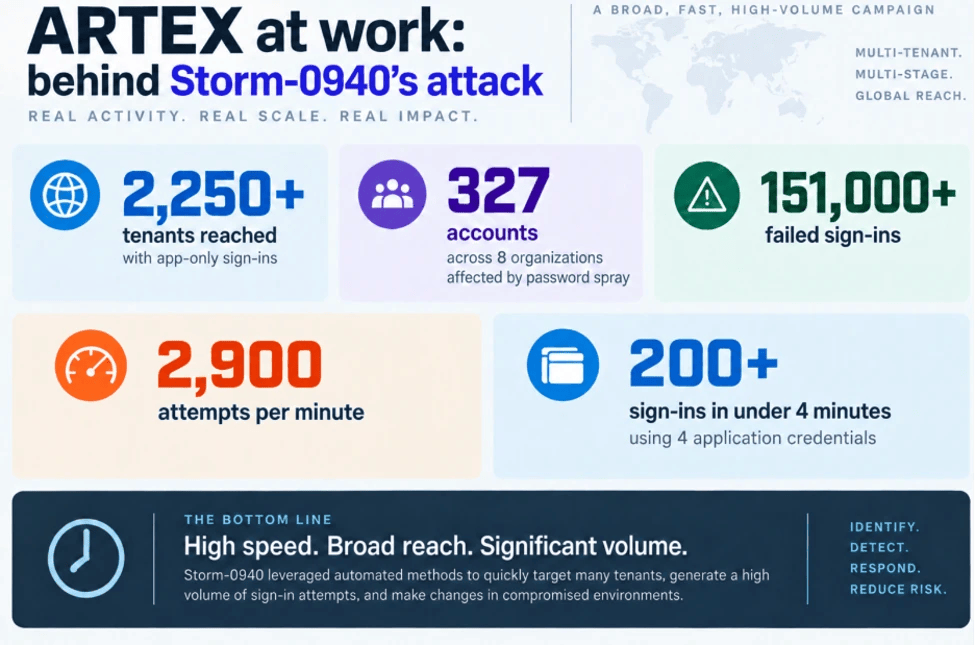
Before obtaining the ConnectWise credentials, Storm-0940 launched a password spraying attack between October 10 and 14. The attack came from the IP address 144.172.64[.]99. Microsoft recorded more than 151,000 failed login attempts against 327 accounts at eight organizations. Activity peaked on October 11, with 2,900 failed attempts per minute. Forty-eight accounts each received more than 1,000 failed attempts. None of these attempts succeeded.

The situation changed on October 15, one day after the ConnectWise breach became public. The AI agents stopped trying passwords and switched to a different attack method. By then, Storm-0940 had obtained the credentials of several ConnectWise cloud application accounts. The agents used these credentials to log directly into customer Microsoft 365 environments.

“Storm-0940’s use of ARTEX accelerated the speed of compromised application abuse to authenticate to Microsoft 365 customer environments through applications that had already been granted access.” Microsoft continues. “This allowed the threat actor to operate without requiring an interactive user sign-in. “

The agents used applications that already had permission to access their targets. This allowed the attackers to enter customer environments without requiring users to sign in interactively.

In a subset of environments where authentication succeeded, the agents didn’t stop there. They moved into Microsoft Graph and ran directory reconnaissance, modified application credentials to establish persistence, and attempted changes to identities, groups, and privileged roles. Microsoft identified multiple customer environments with evidence of this follow-on activity.

The persistence mechanism is the part defenders need to act on now, even if they’ve already disabled the ConnectWise connections.

“These changes can remain active as a backdoor even after the original compromised application is mediated.” says the IT giant.

An attacker who added their own credentials to a trusted application before you revoked access still has a working key. Reviewing all service principal credential additions since at least October 1 is the right starting point, not October 15 when the public breach was announced.

ARTEX is not a tool used only by Storm-0940. Microsoft says threat actors in several regions have used the same framework. Originally open-source, ARTEX was written in Go and can use different AI models to plan and carry out tasks. Researchers at Zscaler and Recorded Future also found a Chinese-speaking group using it to target South Korean financial institutions. The setup used DeepSeek, GLM, and Grok as coordinated AI agents, with GLM checking DeepSeek’s work. After these attacks became public, the project went closed-source. However, anyone who already has a copy can still use it.

The speed point is what Microsoft keeps coming back to in its report. Agents don’t take weekends, don’t sleep, and can run multiple attack paths simultaneously.

“This activity demonstrates how threat actors are integrating agentic AI into existing offensive security workflows and allows them to scale their operations exponentially.” Microsoft concludes. “Agents are not constrained by factors affecting humans – they can work around the clock, on weekends, and on holidays and attempt multiple breach paths simultaneously enabling significantly reduced time from selecting a target to achieving objectives, increasing the speed and impact of complex attacks like supply chain compromises.”

When Storm-0940 had valid application credentials, they didn’t have to iterate slowly. They hit 2,250 tenants with 2,900 sign-in attempts per minute, a pace at which manual detection and response simply can’t keep up.

Follow me on Twitter: @securityaffairs and Facebook and Mastodon

Pierluigi Paganini

(SecurityAffairs – hacking, ARTEX)

  • ✇Security Affairs
  • North Korean IT Workers Used Stolen US Identities to Earn $3 Million Pierluigi Paganini
    The FBI raided 40 Texas homes over a North Korean scheme that used fake IT workers to target 70 US companies and generate $3 million. The Justice Department (DoJ) announced coordinated enforcement actions this week targeting North Korea’s long-running scheme to place fake IT workers inside American companies. Two US nationals were arrested, 14 people charged across two separate indictments, and the FBI searched more than 40 residences in Texas, seizing approximately 187 laptops and KVM switc
     

North Korean IT Workers Used Stolen US Identities to Earn $3 Million

17 de Outubro de 2026, 13:29

The FBI raided 40 Texas homes over a North Korean scheme that used fake IT workers to target 70 US companies and generate $3 million.

The Justice Department (DoJ) announced coordinated enforcement actions this week targeting North Korea’s long-running scheme to place fake IT workers inside American companies. Two US nationals were arrested, 14 people charged across two separate indictments, and the FBI searched more than 40 residences in Texas, seizing approximately 187 laptops and KVM switch devices.

The Texas operation, called Operation Lonestar Roundup, ran between September 21 and 25. The seized devices are the same laptops American companies shipped to their newly hired remote employees, not knowing those IT workers were North Korean intelligence agents using stolen US identities.

“Today the Department of Justice announced coordinated actions against the Democratic People’s Republic of North Korea (DPRK) government’s schemes to fund its regime through remote information technology (IT) work for U.S. companies.” states DoJ. “These actions include an indictment, two arrests, searches of multiple known or suspected “laptop farms” in Texas pursuant to “Operation Lonestar Roundup,” and the seizure of approximately 187 computer devices used by DPRK IT workers.”

The scheme was simple. North Korean IT workers applied for remote jobs using stolen or fake identities. They used VPNs and proxy servers to make it look like they were working from the United States. American helpers received the laptops provided by employers and installed remote access software so the North Korean workers could use them. These helpers were paid for their role, while the money earned from the jobs was sent back to North Korea through accounts controlled by the regime.

According to an indictment from the Northern District of Ohio, the scheme ran from 2019 to mid-2025 and targeted more than 70 US companies across 17 states. The companies operated in sectors including healthcare, communications, cybersecurity support, retail, and manufacturing.

“In total, the scheme impacted more than 70 U.S. company employers and generated approximately $3 million in revenue for IT workers.” SoJ states.”The revenue is believed to have been sent to sanctioned entities controlled by the DPRK. Victim employers included companies in the health care, communications, cyber support, retail, and manufacturing sectors across Ohio, sixteen additional states, and the District of Columbia.”

The North Korean IT workers earned about $3 million, which prosecutors believe was sent to North Korean entities subject to international sanctions.

The authorities warn the scheme is evolving in response to better detection.

“Increasingly, North Korean IT workers are turning to recruiting American facilitators to counter improved private sector detections and law enforcement actions.” states DoJ. “These workers are hiring facilitators to complete a wider variety of tasks, and in some cases subcontracting entire jobs to third-party foreign nationals. “

That’s not just using Americans as props. It’s actively outsourcing parts of the operation to people inside the US, which makes attribution harder and interception more complicated.

Some IT workers are now subcontracting entire jobs to third-party foreign nationals. Others are hiring facilitators to handle a wider range of tasks beyond just managing the laptops. CrowdStrike, which helped the FBI investigate, tracks the group behind this operation as Famous Chollima and describes the laptop farm infrastructure as vital to overcoming the physical and legal barriers of operating from outside the US.

“These laptop farms enabled FAMOUS CHOLLIMA operatives to pose as legitimate remote workers and siphon illicit wages back to their regime while maintaining persistent access to victim organizations. Working alongside the FBI, CrowdStrike’s threat intelligence into the adversary and their operations, and technical analysis helped make these disruptions possible.” states CrowdStrike.

“This operation marks the beginning of a broader U.S. law enforcement effort to dismantle FAMOUS CHOLLIMA’s U.S. infrastructure. CrowdStrike’s Counter Adversary Operations team intends to remain an integral part of that effort.”

The FBI’s separate public service announcement puts the operation in broader context: “thousands of North Korean state-controlled IT workers” are currently embedded at Western companies, posing what the agency calls a significant national security and intellectual property theft insider threat. North Korean IT workers have individually earned up to $300,000 per year under these schemes, and the collective revenue is measured in hundreds of millions annually, flowing directly to designated entities including the North Korean Ministry of Defense.

This is the fifth round of enforcement actions announced since June 2025 under the DOJ’s DPRK RevGen Domestic Enabler Initiative (June 2025, November 2025, April 2026, and May 2026). The initiative targets people in the United States who help North Korean IT workers carry out these schemes.

According to CrowdStrike, North Korean hackers were responsible for about half of all documented hands-on cyber intrusions over the past year. The regime is also targeting cryptocurrency exchanges and open-source software projects. In 2025 alone, North Korean attackers stole at least $2 billion in cryptocurrency.

The DOJ released a list of email addresses used in these operations, including accounts like randyryang@gmail.com and dev.jerryyang@gmail.com, which companies can add to their screening indicators. The FBI’s public service announcement includes detailed mitigation guidance on spotting DPRK IT worker applications. The red flags are consistent: inconsistencies in work history, reluctance to appear on video, requests to redirect laptop deliveries, and payment accounts that route through intermediaries.

“Threats posed by nation-states like North Korea are a stark reminder that our adversaries will go to great measures to exploit our nation’s economic strength to further and fuel their own nefarious agendas,” said U.S. Attorney David M. Toepfer for the Northern District of Ohio. “We are thankful to FBI Cleveland for their incredible work and persistence to put a stop to these bad actors. These charges serve as an urgent alert to all U.S. companies to remain vigilant in their hiring practices.”

Follow me on Twitter: @securityaffairs and Facebook and Mastodon

Pierluigi Paganini

(SecurityAffairs – hacking, IT workers)

  • ✇Security Affairs
  • Silent Lynx: Kazakhstan-Linked Hackers Target Russian Refinery and Government Pierluigi Paganini
    Silent Lynx, a group likely based in Kazakhstan, targets Russian energy and government entities in espionage campaigns across Central Asia. Researchers from Cisco Talos and Recorded Future published a detailed paper on a threat actor they call Silent Lynx (aka UAT-6275, TAG-193), a Kazakhstan nexus group conducting espionage across Central Asia. The targets include the Orsk Oil Refinery in southern Russia, about 25 kilometers from the Kazakhstan border, and the government of Nizhny Novgo
     

Silent Lynx: Kazakhstan-Linked Hackers Target Russian Refinery and Government

15 de Outubro de 2026, 15:33

Silent Lynx, a group likely based in Kazakhstan, targets Russian energy and government entities in espionage campaigns across Central Asia.

Researchers from Cisco Talos and Recorded Future published a detailed paper on a threat actor they call Silent Lynx (aka UAT-6275, TAG-193), a Kazakhstan nexus group conducting espionage across Central Asia.


The targets include the Orsk Oil Refinery in southern Russia, about 25 kilometers from the Kazakhstan border, and the government of Nizhny Novgorod, a major city about 425 kilometers east of Moscow. The city lies where the Volga and Oka rivers meet, an important waterway system connected to the Caspian Sea. This target may be significant because Kazakhstan depends on the Caspian basin.

The group has been running targeted intrusion campaigns against government bodies, diplomatic missions and civil society organizations across Central Asia since at least 2024.

“Silent Lynx (overlapping with activity tracked as UAT-6275 by Cisco Talos and as TAG-193 by Recorded Future) is a persistent threat actor that has conducted targeted intrusion campaigns against government ministries, diplomatic missions and civil society organizations across Central Asia since at least 2024.” the paper states. “The group maintains a strong focus on high-value public sector organizations in the Commonwealth of Independent States (CIS), frequently leveraging spear-phishing campaigns conducted through compromised government email accounts and malware staging through trusted public services such as GitHub to increase credibility and infection success rates.”

The group overlaps significantly with clusters previously documented under names like YoroTrooper, ShadowSilk, and Hydra Saiga, all pointing at the same underlying activity.

The toolkit is deliberately lightweight: PowerShell-based reverse shells, proprietary shells written in C++, C#, and Go, commodity tunneling tools, and spear phishing emails sent through compromised government email accounts in Tajikistan and Kyrgyzstan to add credibility. GitHub, Telegram, and hijacked legitimate servers all serve as staging platforms. Nothing about it is technically flashy, which is part of why the group has stayed active for years without much public attention.

The researchers found links that go beyond technical evidence. In March 2026, a Tajik government agency contacted a Silent Lynx server, shortly after Kazakhstan’s lower house of parliament ratified a Treaty on Allied Relations with Tajikistan. In early April, a Belarusian government entity appeared on the same infrastructure, about a week before Kazakhstan’s president met with the Belarusian foreign minister in Astana. These links do not prove the reasons behind the activity, but the researchers highlight them in their paper, and they are difficult to ignore.

The connection to the Orsk refinery also has a clear context. A Ukrainian drone attack in August forced the refinery to shut down for months. Russia had already asked Kazakhstan to help make up for the resulting loss of refining capacity. If a Kazakhstan-linked actor was collecting intelligence on Russian energy infrastructure at that time, it could have been assessing the economic impact or trying to understand how the disruption might affect Kazakhstan’s own export pipelines. The researchers stress that they do not have enough evidence to identify a specific motive. However, they present the facts and let readers draw their own conclusions.

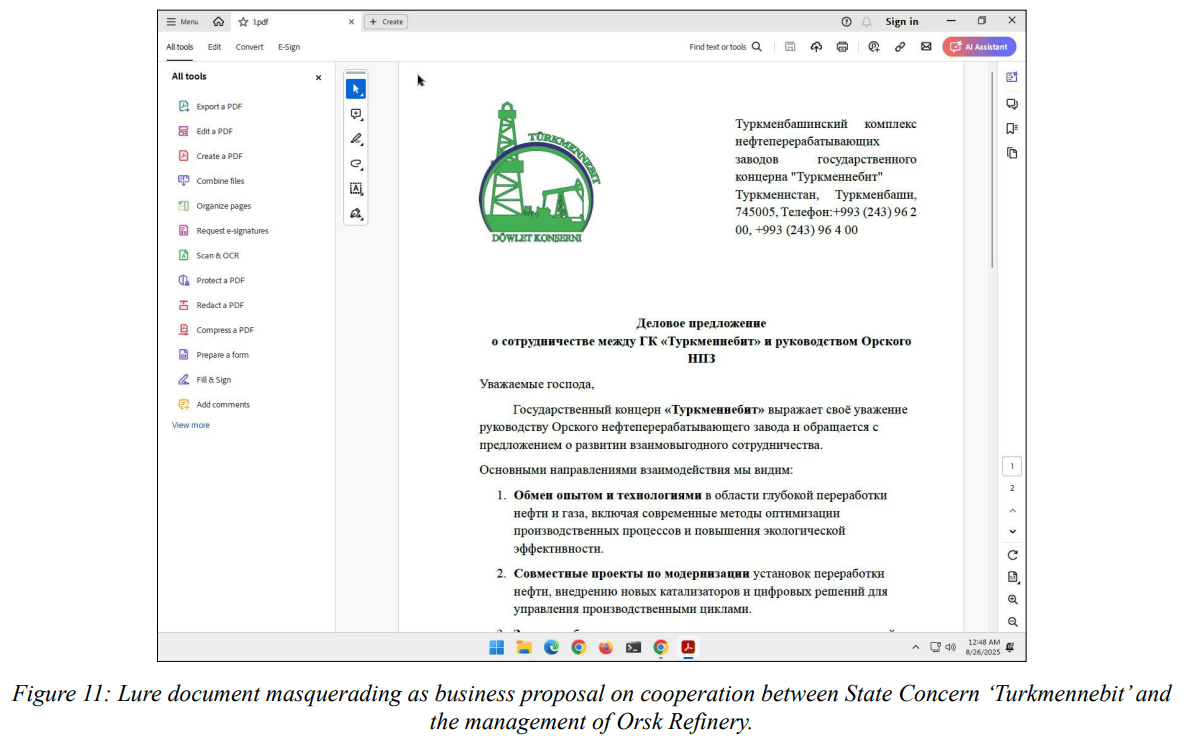
“A sample compiled in August 2025 was observed using a document titled Деловое предложение о сотрудничестве между ГК «Туркменнебит» и руководством Орского НПЗ (translated: Business proposal on cooperation between State Concern ‘Turkmennebit’ and the management of Orsk Refinery) (see Figure 11). We assess that this sample may be targeting Russia’s critical energy infrastructure, given the close integration of the Russian BREAK THE SILENCE: TRACKING SILENT LYNX THROUGH EXPOSED INFRASTRUCTURE SHEN & VÖGELE 10 VIRUS BULLETIN CONFERENCE OCTOBER 2026 and Kazakh energy sectors.” continues the report. “The document outlines proposals for developing mutually beneficial cooperation, with a particular focus on the exchange of expertise, technologies, and industry best practices. It is worth noting that the author of this PDF file is ‘pickle rick’ and the document was created just one hour after the payload was compiled. The name ‘pickle’ is aligned with the name ‘pickl’ we observed in the PickleShell PDB string3.”

SILENT LYNX

What gave the group away wasn’t a sophisticated interception, it was their own operational sloppiness. They left open directories exposed on public servers containing live tooling, staged payloads, and one very incriminating shell command history showing keyboard input typed in Latin with a Russian keyboard layout active, so “whoami” came out as “црщфьш.” GitHub commit timestamps across 77 commits fit working hours in Astana, Kazakhstan, at 95 percent, compared to only 51 percent if you plot them against Moscow time. Administration connections to Silent Lynx servers came from ProtonVPN egress IPs geolocated to Kazakhstan, exclusively on weekdays between 7 AM and noon local time.

The group’s servers were also being reached from those VPN addresses, which Proton typically assigns based on geographic proximity. Two malware samples were uploaded to VirusTotal from Kazakhstan within minutes of compilation, which is classic anti-detection testing behavior and points to the operator location directly.

“We identified several additional indicators that strengthen the assessment of a Kazakhstan-based origin. The first derives from what appears to be malware detection-testing activity conducted through VirusTotal.” continues the report. “Two samples showed this pattern: an early Chvost sample12 was uploaded to VirusTotal only 86 seconds after compilation, while a second sample13 was uploaded approximately four minutes after compilation. Both samples were uploaded from Kazakhstan, and the same uploaders had submitted additional tools that were later observed in Silent Lynx campaigns.”

A researcher at Johns Hopkins School of Advanced International Studies told Reuters that the case highlights an important point: cyber espionage is no longer the domain of a few major powers. Smaller countries are also developing their capabilities and running long-term operations against neighboring states, often driven by serious geopolitical interests.

Silent Lynx is also becoming more technically advanced. In April 2026, the group used an exploit for the first time to deliver malware. It abused a WinRAR path traversal flaw (CVE-2025-8088) to place malicious files directly in the Windows Startup folder, without requiring victims to enable macros. The group also stored a public proof of concept for a FortiWeb authentication bypass vulnerability on its own command-and-control (C2) server. Researchers have also found signs of growing interest in Linux systems. After relying mainly on social engineering for two years, Silent Lynx appears to be building a more advanced set of attack tools.

Full joint Virus Bulletin paper with full indicators of compromise, malware hashes, and infrastructure details is available here.

Follow me on Twitter: @securityaffairs and Facebook and Mastodon

Pierluigi Paganini

(SecurityAffairs – hacking, SILENT LYNX)

  • ✇Security Affairs
  • U.S. Offers $10 Million Reward for Alleged HAFNIUM Hacker Zhang Yu Pierluigi Paganini
    The U.S. offers $10M for Zhang Yu, accused of helping run HAFNIUM attacks that compromised thousands of organizations worldwide. The U.S. State Department is offering a $10 million reward for information leading to the arrest of Zhang Yu. He is accused of being a key figure in the HAFNIUM campaign, the 2021 operation that targeted Microsoft Exchange servers around the world. Zhang is a director at Shanghai Firetech Information Science and Technology, a company that U.S. authorities say al
     

U.S. Offers $10 Million Reward for Alleged HAFNIUM Hacker Zhang Yu

8 de Outubro de 2026, 07:11

The U.S. offers $10M for Zhang Yu, accused of helping run HAFNIUM attacks that compromised thousands of organizations worldwide.

The U.S. State Department is offering a $10 million reward for information leading to the arrest of Zhang Yu. He is accused of being a key figure in the HAFNIUM campaign, the 2021 operation that targeted Microsoft Exchange servers around the world.

Zhang is a director at Shanghai Firetech Information Science and Technology, a company that U.S. authorities say also carried out hacking operations for the Chinese government. According to the indictment, Zhang supervised Firetech employees involved in cyberattacks and worked directly with another accused hacker, Xu Zewei.

U.S. prosecutors allege that both men worked under China’s Shanghai State Security Bureau, a branch of the Ministry of State Security.

“Rewards for Justice (RFJ) is offering a reward of up to $10 million for information leading to the identification or location of any person who, while acting at the direction or under the control of a foreign government, participates in malicious cyber activities against U.S. critical infrastructure in violation of the Computer Fraud and Abuse Act.” reads the announcement published by the State Department. “Under this reward offer, RFJ seeks information on Zhang Yu, a Chinese national and director at Shanghai Firetech Information Science and Technology Company, Ltd. working at the behest of the People’s Republic of China (PRC) Ministry of State Security (MSS) Shanghai State Security Bureau (SSSB).” 

U.S. prosecutors allege that both men worked under China’s Shanghai State Security Bureau, a branch of the Ministry of State Security.

The indictment covers two distinct hacking campaigns. The first, in early 2020, hit U.S. universities and scientists working on COVID-19 vaccines and treatments. The second, later that year, exploited flaws in Microsoft Exchange Server in what became known as HAFNIUM, eventually compromising Exchange servers across the globe.

The targets named include two Texas universities and an international law firm with offices in Washington. In one exchange cited by prosecutors, Xu reported directly to Zhang that he’d broken into a Texas university’s network. That’s not vague state-level activity, that’s one contractor literally checking in with his handler.

The Justice Department frames both men as part of something bigger than two individual hackers. Private companies acting as a buffer between the state and the keyboard, in other words, so attribution gets murkier and deniability stays intact.

“Starting in early 2020, Zhang and his partner Xu Zewei, then a general manager at Shanghai Powerock Network Co. Ltd., gained unauthorized access to COVID-19 research conducted by U.S.-based universities and leading immunologists and virologists to steal sensitive information.” continues the announcement. “The following year, Zhang and Xu exploited vulnerabilities in computers running Microsoft Exchange Server, a computer program involved in the storage and retrieval of e-mails. Those intrusions were part of mass intrusion campaign, publicly known as HAFNIUM, which compromised thousands of computers worldwide.”

The scale of HAFNIUM backs up why anyone would pay $10 million for a tip. The FBI puts the total at more than 12,700 compromised U.S. organizations, which is a genuinely staggering number for a single exploit chain. Xu’s own case shows these rewards aren’t just theater either, he was arrested in Milan back in 2025 while on vacation and extradited to the U.S. this past April.

Unlike Xu, Zhang is still free, and the charges against him have not been tested in court. Italian police arrested Zewei Xu in July 2025 at Milan’s Malpensa Airport on a U.S. warrant. Xu was arrested at Malpensa Airport on July 3rd after arriving on a flight from China. Authorities accused the man of cyberespionage, U.S. authorities linked him to the China-nexus group Hafnium (aka Silk Typhoon), which carried out attacks against U.S. government, including the US Treasury.

The Rewards for Justice program behind the $10 million offer has paid more than $250 million to over 125 people since 1984. Rewards for Justice (RFJ) is a U.S. Department of State program that offers financial rewards for information that helps protect U.S. national security. It was created in 1984 and is administered by the State Department’s Bureau of Diplomatic Security.

Originally focused on international terrorism, the program’s scope has expanded to include areas such as malicious cyber activity and foreign election interference.

Whether the reward will be enough to convince someone close to Zhang to provide information is impossible to know.

Follow me on Twitter: @securityaffairs and Facebook and Mastodon

Pierluigi Paganini

(SecurityAffairs – hacking, HAFNIUM)

  • ✇Security Affairs
  • Warlock Ransomware Still Exploits Year-Old SharePoint Flaws to Hit Critical Infrastructure Pierluigi Paganini
    Warlock ransomware continues to exploit unpatched SharePoint flaws to breach water utilities, telecoms, governments, and universities worldwide. Warlock ransomware made headlines back in mid-2025 for exploiting a chain of SharePoint zero-days collectively dubbed ToolShell. More than a year later, the same group is still using that door, and it’s still getting in. Symantec tracks the group behind Warlock as Longlegs, also known as Storm-2603, and ties it back to older China-nexus clusters
     

Warlock Ransomware Still Exploits Year-Old SharePoint Flaws to Hit Critical Infrastructure

4 de Outubro de 2026, 04:49

Warlock ransomware continues to exploit unpatched SharePoint flaws to breach water utilities, telecoms, governments, and universities worldwide.

Warlock ransomware made headlines back in mid-2025 for exploiting a chain of SharePoint zero-days collectively dubbed ToolShell. More than a year later, the same group is still using that door, and it’s still getting in.

Symantec tracks the group behind Warlock as Longlegs, also known as Storm-2603, and ties it back to older China-nexus clusters called CL-CRI-1040, CamoFei, and ChamelGang. In the past two months alone, Longlegs hit at least four organizations: a water utility, a telecom provider, a regional government body, and a university. All four sit in Portuguese or Spanish speaking countries, spread across Europe, Africa, and Latin America.

Warlock has already targeted organizations in the US, Brazil, India, Russia, Taiwan, and Japan, so the group is not focused on one specific region. The recent attacks on Portuguese- and Spanish-speaking countries could simply mean the attackers are looking for exposed and unpatched SharePoint servers wherever they can find them. They could also be working from a specific target list. Either way, targeting a water utility and a telecom company within a few weeks is something defenders should take seriously.

SharePoint is still the main entry point. Longlegs places a webshell in the LAYOUTS directory and designs it to work across different SharePoint versions. The attackers then steal the server’s ASP.NET machine keys and use them to create a signed payload that can execute code inside the SharePoint application. The technique is effective, but it depends on finding SharePoint servers that have not been properly patched.

Once they get inside, the attackers use DLL sideloading to run additional payloads. They download these files from legitimate hosting services such as catbox.moe and wasabisys.com, which helps the traffic blend in with normal activity.

Before deploying the ransomware, Longlegs also uses a signed but vulnerable driver called K7RKScan to disable security software. This is a common “bring your own vulnerable driver” technique. The attackers have also installed Visual Studio Code’s tunneling feature as a service, giving them remote access that can look like normal developer activity.

“The group continues to favor SharePoint-related vulnerabilities to gain initial access to targeted organizations.” states the report. “Longlegs abuses a vulnerable, signed driver (K7RKScan) to disable security software before deploying ransomware, and has also been observed abusing Visual Studio Code’s tunneling feature for covert remote access.”

Symantec’s report traces a full attack against a critical infrastructure operator starting July 22, 2026, when the webshell first landed on a SharePoint server. Two days later the attackers ran basic recon commands, deleted some staging files, and dropped a pair of DLL sideloading tools. A few days after that, they pinged a Burp Collaborator subdomain baked with the target’s own domain name, which is a scanner’s way of confirming its injected code actually ran.

By July 28 the real exploitation began, using a deserialization gadget to turn a forged, signed payload into code execution inside SharePoint. The attackers then pulled three separate installer packages from two different hosting services within ninety minutes, suggesting they had backups ready in case one path got blocked.

“Two different public hosting services and three distinct package names within the space of ninety minutes suggests the attackers had more than one payload ready to go and were not relying on a single point of delivery.” continues the report. “The intrusion then broadened from the two initial SharePoint servers to the wider domain. Later that day and into the next (July 29) the attackers repeatedly added a domain account named SPSEPRDSetup to the local Administrators group on three further hosts (Computer 3, Computer 4, and Computer 5):”

They spread out to more hosts by adding a fake-sounding admin account named SPSEPRDSetup, a decent bit of social camouflage since SharePoint really does create accounts with that kind of prefix.

On July 31, the attackers deployed a tool designed to disable antivirus and EDR across the network in a short period.

“In one intrusion against a critical infrastructure operator, the attackers pushed a tool designed to disable security software to at least 40 hosts within about two hours, then deployed Warlock on at least 33 hosts by staging it in the domain’s SYSVOL share, where ordinary domain replication delivered it to machines.” Symantec states.

Warlock ransomware was then deployed almost immediately after the security tools were disabled. This was not a slow attack. The attackers moved quickly from disabling protection to encrypting systems.

The attackers also used the domain’s SYSVOL share to distribute the ransomware. SYSVOL is automatically replicated across domain controllers, making it an effective way to spread files across a Windows domain. Symantec found that the ransomware was delivered through normal domain replication traffic, with three systems capturing dfsrs.exe, the Windows service responsible for that replication, delivering the malicious files.

The lesson here isn’t subtle. ToolShell and its related SharePoint flaws are still a working way into a network more than a year after they first made news, and that only holds true because some organizations haven’t patched or mitigated them yet. If you’re running on-premises SharePoint Server and haven’t checked it against CISA’s July 2026 advisory, that’s worth doing before your Monday coffee gets cold.

“Longlegs’ continued activity, more than a year after Warlock ransomware first came to prominence, shows that exploitation of ToolShell and other related-SharePoint vulnerabilities remains a viable initial access route for attackers SharePoint deployments that have not been patched or otherwise mitigated.” concludes the report. “The apparent recent focus on Portuguese- and Spanish-speaking countries suggests either an opportunistic targeting pattern driven by exposed, vulnerable SharePoint servers, or a more deliberate tasking. The inclusion of critical infrastructure operators among the victims is a reminder of the potential real-world consequences of ransomware attacks that succeed against essential services.”

Follow me on Twitter: @securityaffairs and Facebook and Mastodon

Pierluigi Paganini

(SecurityAffairs – hacking, Warlock ransomware)

  • ✇Security Affairs
  • Antino Backdoor Lets China-Linked UAT-11587 Turn Microsoft 365 Into a C2 Channel Pierluigi Paganini
    Cisco Talos details UAT-11587, a China-linked group using the Antino backdoor and Microsoft 365 as cover to spy on Asian governments. Cisco Talos has been tracking a cluster of espionage activity since September 2025 that it calls UAT-11587, and by July 2026 the group had hit at least 16 government and policy organizations across eight Asian countries. The toolset includes a previously undocumented backdoor Talos named Antino, and the thing that makes it worth paying attention to isn’t how i
     

Antino Backdoor Lets China-Linked UAT-11587 Turn Microsoft 365 Into a C2 Channel

3 de Outubro de 2026, 06:26

Cisco Talos details UAT-11587, a China-linked group using the Antino backdoor and Microsoft 365 as cover to spy on Asian governments.

Cisco Talos has been tracking a cluster of espionage activity since September 2025 that it calls UAT-11587, and by July 2026 the group had hit at least 16 government and policy organizations across eight Asian countries. The toolset includes a previously undocumented backdoor Talos named Antino, and the thing that makes it worth paying attention to isn’t how it gets in. It’s where it hides once it’s there.

Antino is written in Rust and works on both 32-bit and 64-bit versions of Windows. It supports the usual backdoor features, including shell and PowerShell access, file transfers, in-memory shellcode execution and persistence.

“Antino is a Rust-compiled Windows backdoor that supports host reconnaissance, shell and PowerShell execution, file transfer, in-memory shellcode loading and persistence. Its native command-and-control channel operates exclusively through Microsoft 365, using Microsoft Graph to interact with Outlook and OneDrive.” reads the report published by Talos.

None of these features are particularly new. What makes Antino different is how it communicates: instead of using its own command-and-control server, it uses Microsoft Graph to read commands from an Outlook mailbox and send stolen files to OneDrive. This allows its traffic to blend in with normal Microsoft 365 activity.

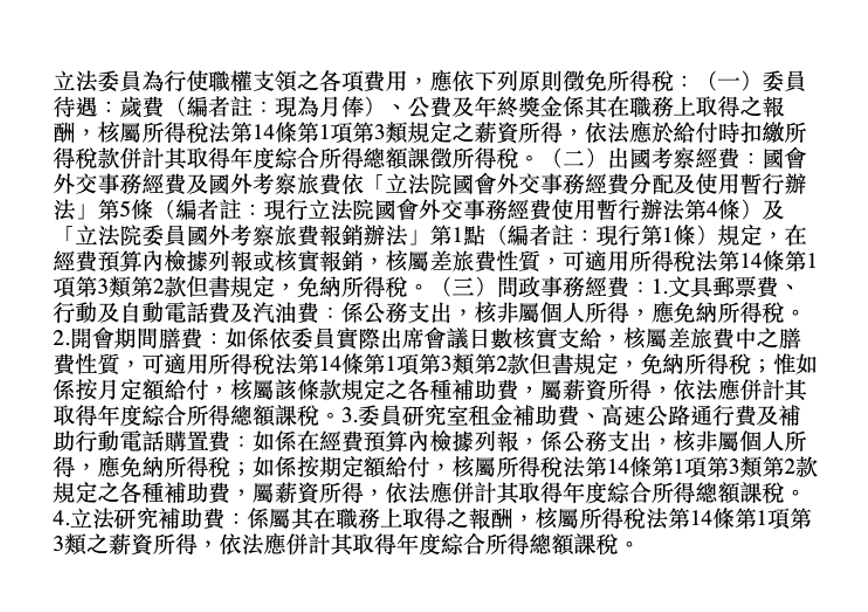
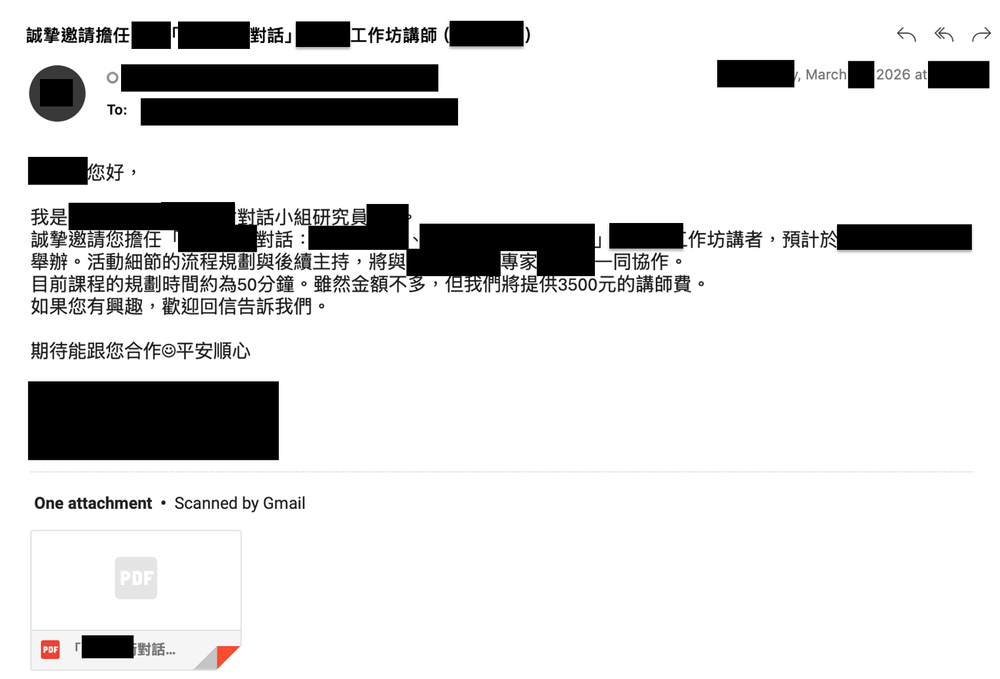
The attack starts in a more traditional way, with a convincing phishing email. UAT-11587 created highly targeted documents that suggest the attackers had researched their victims, including a fake workshop document about Taiwan’s information warfare and a document that closely copied a real Taiwan Ministry of Finance ruling about tax treatment for legislators.

“The document exactly reproduces a public Taiwan Ministry of Finance ruling to make the decoy appear credible.” conctinues the report. “Its subject strongly suggests that it was prepared for members of Taiwan’s public sector.”

In another case, the attackers reused a real Associated Press story about alleged Russian offers to the US over Venezuela. Matching malware samples appeared on VirusTotal two days after the original article was published.

The delivery trick is a simple but effective email spoofing technique that takes advantage of a gap many people overlook. The attackers sent the email through a legitimate provider, using one domain as the technical sender, while the visible From address showed the organization they were impersonating. SPF passed because the real sending domain was authorized, but DMARC detected the mismatch and failed. That still wasn’t enough to block the message. The impersonated domain had a DMARC policy set to monitoring rather than rejection, so the failed email still reached the inbox.

The Gmail trick is even more interesting. The attackers recreated Gmail’s normal attachment preview card almost pixel by pixel using images embedded in the email’s HTML. They then made the fake preview a link to a page controlled by the attackers. Open the email in Gmail and it looks just like the real thing because Gmail simply renders the HTML it receives. There is no exploit here. It’s just a very convincing copy of something users already trust.

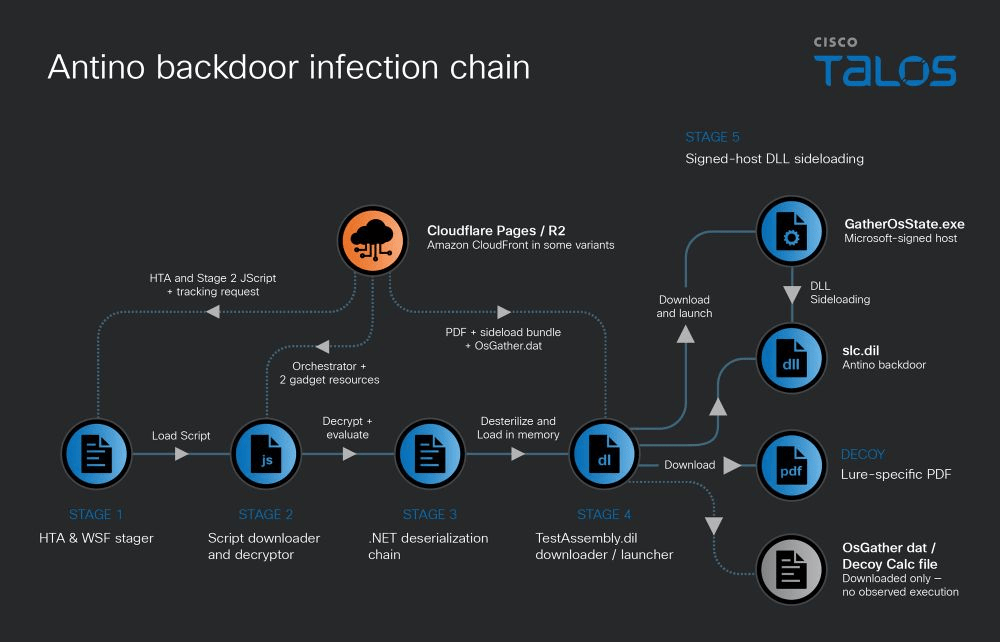
From that click, a five-stage chain kicks in, leaning on legitimate-looking HTA files, Windows Script Host, and a scripted .NET deserialization trick that abuses a known gadget chain to load malicious code inside a trusted process. The final stage sideloads Antino through a signed Microsoft diagnostic binary, meaning the thing dropping the backdoor onto disk is a tool Windows itself trusts by default. Cloudflare Pages, R2, and Amazon CloudFront carried almost every stage of this, which kept the traffic blending into ordinary HTTPS the whole way through.

Once Antino is running, it checks its Outlook mailbox for new commands every ten seconds. The commands and results are sent as structured JSON hidden inside specially formatted email subjects.

“The Antino backdoor receives commands through email messages. The implant actively pulls commands from the threat actor’s Outlook mailbox folder every 10 seconds. The protocol uses two message types: command emails contain tasking from the controller, while response emails contain the implant’s results.” states Talos. “Command messages are identified by the subject prefix command_req_[session_id] and responses by command_res_[session_id], as indicated in the HTTP GET request sent by Antino: “

A separate system is used to upload stolen files to one OneDrive folder and download attacker tools from another. Even the naming makes the attacker’s perspective clear: “uploads” are files sent to the victim, while “downloads” are files pulled back from the victim.

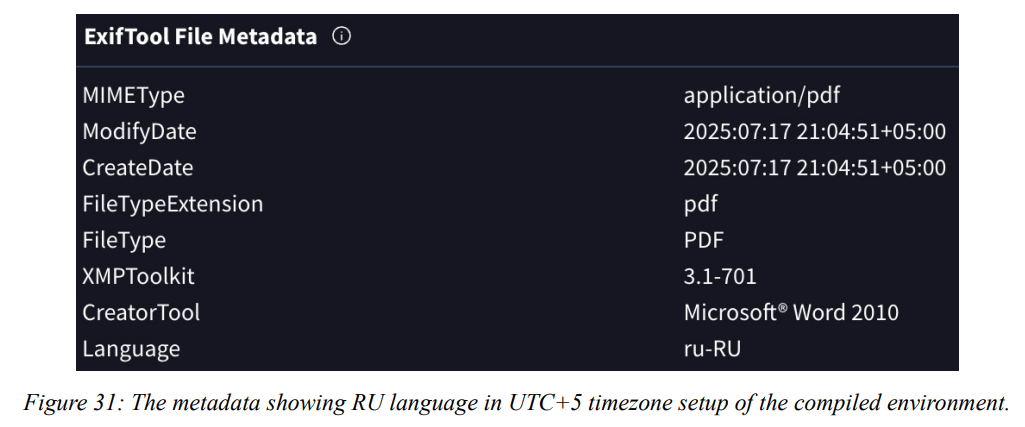
The attribution case leans on accumulated small details rather than any single smoking gun, which is honestly how these assessments should work. Decoy document metadata carries Simplified Chinese language tags and a UTC+8 timestamp, a combination more consistent with mainland China than Taiwan or Hong Kong, where Traditional Chinese dominates. Separately, ten different Antino builds reference a Rust package mirror built specifically to speed up dependency downloads inside mainland China, the kind of tooling choice a developer picks for convenience, not for disguise.

The victim list reads like a checklist of what an intelligence service would actually want: defense ministries, legislatures, foreign affairs offices, border and interior security agencies, plus the think tanks and civil society groups that tend to know things governments care about early. Around 350 compromised endpoints turned up across eight countries, with the largest single wave, roughly 57 new endpoints, hitting India over two days in June. That’s not noise. That’s a deliberate and sustained collection effort.

“Based on the development, preparation-environment, and targeting indicators detailed in this report, Talos assesses with high confidence that UAT-11587 is China-nexus.” the report concludes.

Follow me on Twitter: @securityaffairs and Facebook and Mastodon

Pierluigi Paganini

(SecurityAffairs – hacking, Antino backdoor)

  • ✇Security Affairs
  • Cryptocurrency exchange Bitget Says North Korea-Linked Hackers Stole $351.6 Million Pierluigi Paganini
    Bitget says suspected North Korea-linked actors stole $351.6M from hot and warm wallets. Withdrawals were suspended while Mandiant investigates. Cryptocurrency exchange Bitget says suspected North Korea-linked threat actors stole $351.6 million from a limited number of hot and warm wallets. The company detected unauthorized transfers on September 24 and temporarily suspended withdrawals. At 18:31 UTC on September 24, 2026, Bitget’s security systems identified unauthorized transfers invo
     

Cryptocurrency exchange Bitget Says North Korea-Linked Hackers Stole $351.6 Million

25 de Setembro de 2026, 15:02

Bitget says suspected North Korea-linked actors stole $351.6M from hot and warm wallets. Withdrawals were suspended while Mandiant investigates.

Cryptocurrency exchange Bitget says suspected North Korea-linked threat actors stole $351.6 million from a limited number of hot and warm wallets. The company detected unauthorized transfers on September 24 and temporarily suspended withdrawals.

At 18:31 UTC on September 24, 2026, Bitget’s security systems identified unauthorized transfers involving a limited number of hot wallets.

Our security team immediately activated emergency response procedures and began a full investigation.

Based on our current assessment,… https://t.co/7xF5xW0JQ1

— Bitget (@bitget) September 24, 2026

Bitget said customer balances, cold wallets and most platform assets remain secure. Mandiant and SlowMist are investigating the incident, while deposits and trading continue normally.

“We are currently working with independent third-party experts Mandiant and SlowMist for a full investigation. Our first priority is our users. User balances remain intact, and Bitget’s User Protection Fund covers the impact on this platform-wide incident.” the company added. “Bitget Wallet operates as a self-custodial wallet on a completely separate and independent infrastructure from Bitget Exchange and was not affected by this incident. Bitget Wallet users’ assets remain onchain under users’ control and remain unaffected.”

[UPDATES] We are currently working with independent third-party experts Mandiant and SlowMist for a full investigation.

Our first priority is our users. User balances remain intact, and Bitget's User Protection Fund covers the impact on this platform-wide incident.

Bitget…

— Bitget (@bitget) September 25, 2026

Bitget CEO Gracy Chen said the security breach affected ETH, XRP, BNB, AVAX, USDT and USDC across several blockchains. The attacker reportedly compromised a backend wallet system, spoofed transaction data and bypassed the authorization process to move funds. Bitget said affected blockchain foundations were contacted and some have frozen hacker wallets.

“We have contacted the foundations of all affected chains, and some foundations have confirmed the freezing of hacker wallet addresses,” Chen explained. “Based on IP behavior patterns and on-chain analysis, the attack method in this incident is highly consistent with known patterns of North Korean hacker organizations.”

Here is what we can confirm at this stage:

On the attack:
Our security team has made initial progress in tracing the source. The attacker compromised a critical backend system within our wallet infrastructure, used it to spoof transaction data, and triggered our authorization… https://t.co/5nINjwbXpC

— Gracy Chen @Bitget (@GracyBitget) September 25, 2026

Bitget is a cryptocurrency exchange and Web3 company founded in 2018. It provides services for buying, selling and trading digital assets, including spot and futures trading, copy trading and other financial products. The company has expanded beyond crypto into traditional markets and now describes itself as a “Universal Exchange.” Bitget says it serves more than 120 million users in over 150 countries and regions.

The attribution to North Korea-linked threat actors doesn’t surprise. According to Chainalysis, North Korean hackers stole at least $2.02 billion in cryptocurrency in 2025, bringing the estimated total stolen by DPRK-linked actors to $6.75 billion.

The thefts increasingly target crypto exchanges and other digital-asset services, with attackers using techniques ranging from sophisticated cyber intrusions to fake IT-worker identities.

Follow me on Twitter: @securityaffairs and Facebook and Mastodon

Pierluigi Paganini

(SecurityAffairs – hacking, Bitget)

  • ✇Security Affairs
  • SilkParasite Infrastructure Links SpiceRAT to Central Asian Targets Pierluigi Paganini
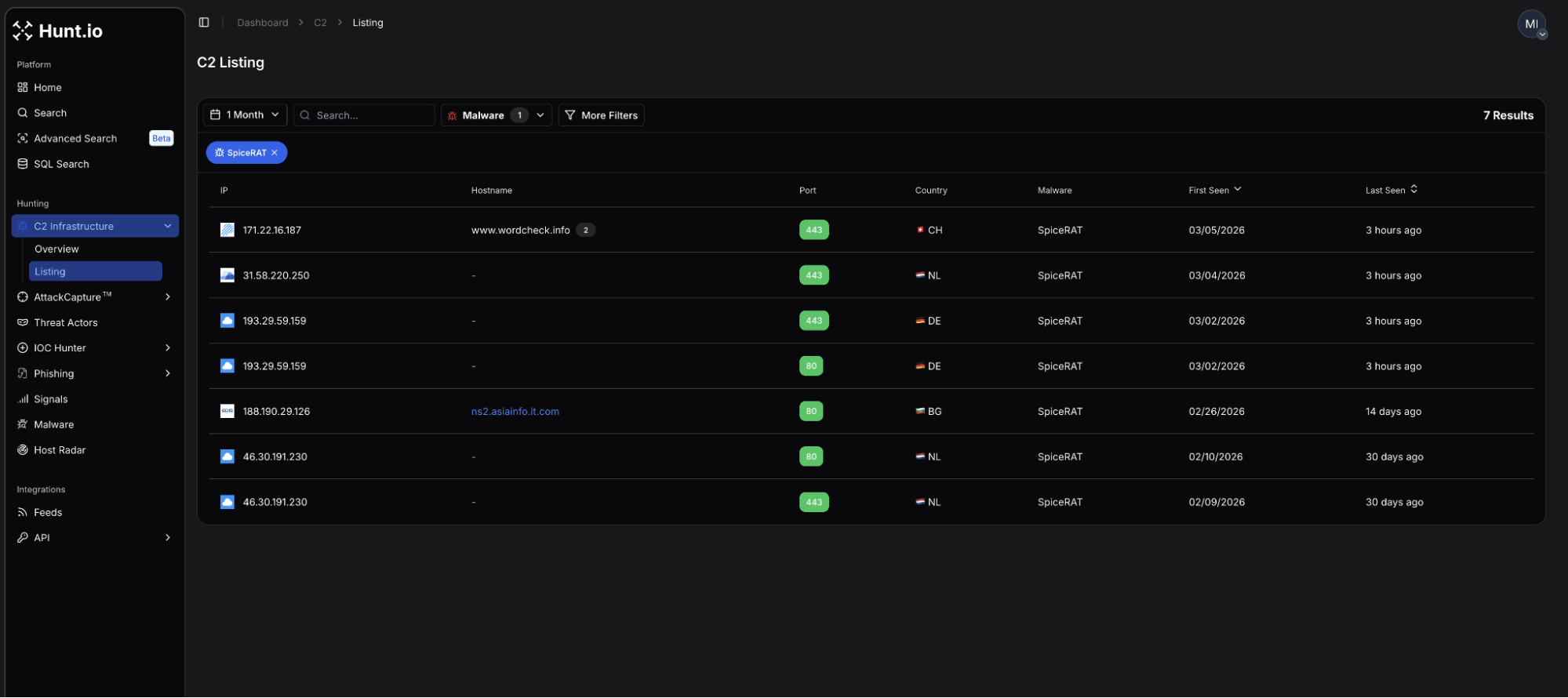
    Hunt.io links SpiceRAT, NodeEdgeRAT and NomadRAT to a four-year SilkParasite campaign targeting governments and critical sectors in Central Asia. Hunt.io and researcher Guy Yasur have traced a tight cluster of SpiceRAT command‑and‑control servers that predate and extend Bitdefender’s August 2026 SilkParasite report. The work doesn’t dissect malware samples; it maps the network side of the operation with enough precision to tie three of SilkParasite’s seven RAT families (SpiceRAT, NodeEdgeRAT
     

SilkParasite Infrastructure Links SpiceRAT to Central Asian Targets

17 de Setembro de 2026, 11:16

Hunt.io links SpiceRAT, NodeEdgeRAT and NomadRAT to a four-year SilkParasite campaign targeting governments and critical sectors in Central Asia.

Hunt.io and researcher Guy Yasur have traced a tight cluster of SpiceRAT command‑and‑control servers that predate and extend Bitdefender’s August 2026 SilkParasite report. The work doesn’t dissect malware samples; it maps the network side of the operation with enough precision to tie three of SilkParasite’s seven RAT families (SpiceRAT, NodeEdgeRAT, and NomadRAT) through shared certificates, domains, and hosting patterns.

“Shared parent domains and an identical TLS certificate connect this infrastructure to hosts Bitdefender attributed to SpiceRAT, NodeEdgeRAT, and NomadRAT, three of the seven malware families documented in the SilkParasite report.” reads the report published by Hunt.io.

“The certificate imitating the Uzbekistan railway entity was issued by TLC, a certificate authority wholly funded by CAICT, a Chinese state research institute under the Ministry of Industry and Information Technology.”

In March 2026, Hunt.io identified five SpiceRAT command-and-control servers hosted by different providers and in different countries. Researchers linked them through several common elements, including the same hostnames, TLS certificates, and a cloned webpage used as the default page.

Instead of focusing only on the malware itself, this approach looks at the infrastructure behind it. Shared certificates or identical webpage hashes can provide strong and practical indicators that defenders can use to identify other servers linked to the campaign.

One certificate in particular stands out. It impersonates Uzbekistan’s state railway authority (azure.uzrailwaystax[.]com) and was issued by TLC DV TLS CA, a CA wholly funded by CAICT, a Chinese state research institute under the Ministry of Industry and Information Technology. The issuer alone isn’t an indicator—nearly 3,000 servers host TLC certificates—but a domain‑validated cert spoofing a Central Asian state entity from a China‑based CA does suggest a deliberate procurement channel.

Requests to ns2.asiainfo.it[.]com on 188.190.29[.]126 returned a full copy of RTX Corporation’s homepage, complete with navigation, subsidiary links, and a stock ticker. The page contained no malicious code and wasn’t unique to that server, but its reuse across the cluster made it a powerful fingerprint.

“Hunt.io’s C2 Infrastructure module tracks servers matching detection signatures for known malware families, including SpiceRAT. In mid-March 2026, we observed a cluster of five active SpiceRAT servers: 46.30.191[.]230, 188.190.29[.]126, 193.29.59[.]159, 31.58.220[.]250, and 171.22.16[.]187. The five were active together in mid-March 2026, across multiple hosting providers and countries.” continues the report.

A HuntSQL query on the page’s SHA‑256 hash returned exactly 13 hosts; three were already in Bitdefender’s SpiceRAT list, two more matched Hunt.io’s SpiceRAT signature, and the remaining eight extended the footprint through shared nginx versions and the same static page.

Why RTX? The report offers two plausible explanations: the page rendered cleanly and was grabbed as a convenient template, or it reflects shared tooling where the clone functions as a default deployment asset. Either way, for defenders it’s a low‑noise, high‑precision signature: byte‑for‑byte identical wherever it lands.

Bitdefender’s SilkParasite report treated several RAT families as distinct, but Hunt.io’s network view shows they share parent domains and certificates. For example, help.hoster‑kg[.]com (on 193.29.58[.]192) presented the same railway‑spoofing certificate, while Bitdefender attributed evo.hoster‑kg[.]com to NodeEdgeRAT; the two are linked through shared registration of hoster‑kg[.]com, not a shared server. Similarly, kg.tdtu[.]org shares a parent domain with mineconom.tdtu[.]org, a NomadRAT C2 indicator in the SilkParasite report.

This doesn’t prove a single operator, but it does show a support function or toolset shared across the campaign. From a detection standpoint, it means pivoting on domains, certificates, and hosting profiles can surface nodes that sample‑based analysis would miss.

The cluster’s domains don’t just look governmental; they spoof specific ministries and state enterprises. Examples include help.galkynysh[.]net (Galkynysh gas field, Turkmenistan), tmgaz‑server[.]com (Türkmengaz), tm‑mfa[.]com (Turkmenistan’s Ministry of Foreign Affairs), and tojiktelecomtj[.]com (Tojiktelecom, Tajikistan). Additional domains impersonate Turkmen energy (sanly.oilgas‑tm[.]com), Uzbek administration (azure.adm‑devon[.]com), and even the Kyrgyz president’s residence (data.yntymak‑ordo[.]com).

Bitdefender’s targeting came from lures and infection telemetry; Hunt.io’s infrastructure analysis names the same sectors with concrete entities. Passive DNS and subdomain enumeration push the timeline back to mid‑2022, suggesting this isn’t a new campaign with a fresh brand—it’s a longer‑running operation now labeled SilkParasite.

SilkParasite overlaps with FamousSparrow, a suspected China‑nexus actor previously seen targeting hotels, governments, and international organizations. The infrastructure also mirrors IndigoZebra (Speccom), documented by Check Point in 2021 as targeting Central Asian ministries with similar domain patterns (mail, service, help) and overlapping naming conventions. These parallels don’t settle attribution, but they do reinforce a consistent operational style across China‑nexus activity in Central Asia.

If you’re responsible for OT/ICS, telecom, or government networks in the region, start by checking your edge and DMZ for the indicators below, especially the RTX page hash and the railway‑spoofing certificate. Monitor for high‑numbered RDP‑over‑TLS ports (64350, 64330, 65535, 65111) on the ASNs most prevalent in the cluster, and watch for domains impersonating local hosting providers or state entities. The original Hunt.io post includes the full IoC tables and HuntSQL queries; linking to it is essential for precise awareness and for teams that want to reproduce the pivots.

“The targeting picture that emerges from this infrastructure, named ministries and state enterprises across five Central Asian countries dating back to at least mid-2022 suggests SilkParasite is a more recent label for an operation with much longer and wider footprint.” concludes the report. “Organizations in the affected sectors and regions can make use of the above indicators and observations to assess their own exposure.”

Follow me on Twitter: @securityaffairs and Facebook and Mastodon

Pierluigi Paganini

(SecurityAffairs – hacking, SilkParasite)

  • ✇Security Affairs
  • Chosen Brick, Iran’s Surveillance Malware Pierluigi Paganini
    UK, US, and Dutch agencies expose Chosen Brick, Iranian malware used to track and harass dissidents, journalists, and activists via Telegram. The UK, the US, and the Netherlands published a joint advisory warning about a Windows malware family, dubbed Chosen Brick, that Iran’s intelligence services use to track down dissidents, journalists, and activists, and the stakes for the people on the receiving end go well beyond a locked file server. “CHOSEN BRICK is a malware family that has been
     

Chosen Brick, Iran’s Surveillance Malware

17 de Setembro de 2026, 04:25

UK, US, and Dutch agencies expose Chosen Brick, Iranian malware used to track and harass dissidents, journalists, and activists via Telegram.

The UK, the US, and the Netherlands published a joint advisory warning about a Windows malware family, dubbed Chosen Brick, that Iran’s intelligence services use to track down dissidents, journalists, and activists, and the stakes for the people on the receiving end go well beyond a locked file server.

“CHOSEN BRICK is a malware family that has been used to target individuals around the world including in the UK, US and the Netherlands from at least 2025. CHOSEN BRICK enables Iranian state cyber actors to collect information on a target’s contacts, emails and social media messages, which could enable tracking of their movements.” reads the advisory. “Iran almost certainly uses cyber activity to support the repression of individuals who are seen as a threat to the regime, such as dissidents, activists and journalists.”

The advisory was issued jointly by the UK’s National Cyber Security Centre, the FBI, and the Netherlands’ AIVD. The three agencies gave a name to malware activity that security researchers had already been tracking under different names.

This is not the first time Iranian state-linked actors have used Telegram-based malware against the Iranian diaspora. In March, the FBI reported that Iranian actors had been using Telegram as command infrastructure to target dissidents, with activity dating back to late 2023. The latest advisory adds a formal name, a joint attribution, and a more detailed look at how the malware operates.

Iran has repeatedly used cyber operations to target people it considers a threat to the regime, including dissidents, activists and journalists. Iranian intelligence services have also been linked to plots involving the kidnapping or killing of perceived opponents abroad. For victims of CHOSEN BRICK, the risk may extend beyond cyber intrusion.

Personal information belonging to some victims has reportedly appeared on pro-Iranian leak sites, potentially exposing them to further harassment, intimidation or physical threats. The publication of such data could increase the risks faced by individuals already targeted by Iranian actors.

” In some cases, the Iranian intelligence services have plotted to kidnap or conduct lethal operations against individuals internationally, who they perceive as enemies of the regime.” continues the advisory.

Stolen personal data from CHOSEN BRICK victims has also shown up on pro-Iranian leak sites, turned into a harassment tool rather than just an intelligence asset.

That combination changes the calculus for defenders. A compromised laptop is normally a data problem. Here, it can become a physical safety problem for the person who owns it.

The attack starts on a messaging app, not an email inbox. Operators build rapport with a target over WhatsApp or Telegram first, sometimes for a while, before ever sending a file.

Iranian cyber actors first contacted targets through social messaging apps, spending time building trust before attempting to deliver malware. Their social engineering was tailored to each victim and relied on detailed information gathered during prior research.

In some cases, the attackers pretended to be someone the target already knew, making the approach appear legitimate. In others, they posed as technical support staff from the messaging platform. This combination of reconnaissance, impersonation and trusted communication channels helped make the malicious messages more convincing and increased the chances of successful infection.

“Iranian cyber actors engaged with targets via social messaging applications to build rapport prior to attempting to deliver the malware. The nature of the social engineering varies between targets and uses extensive target knowledge from research conducted in preparation (T1589).” the agencies state. “The actor often purports to be an individual previously known to the target or technical support from the social messaging platform (T1566.003).”

The lure files themselves are dressed up as things a target would plausibly want to open: fake installers for Pictory, RunwayML, Norton Antivirus, Telegram itself, Adobe Flash Player, or KeePass. Other versions arrive disguised as MRI scan results, which is a particularly grim way to earn someone’s click. Whatever the disguise, the file shows a convincing decoy screen while the real payload installs quietly in the background.

The attackers also have a backup plan. They usually target a victim’s work device first, but if the initial attempt fails or they think they may be detected, they try to move the attack to a personal device. They may ask the victim to open the file on their own phone or computer, bypassing the security controls protecting the work device.

A company can tightly secure an employee’s work laptop, but it has much less control over the personal devices they use every day.

Whatever the file is supposed to contain, it shows the victim a realistic-looking screen related to the topic, helping the attackers maintain the deception. In the background, the file downloads and runs the main malware component, which the NCSC tracks as CHOSEN BRICK. This gives the attackers control over the compromised device. So far, all observed attacks have targeted Windows systems.

Corporate IT can lock down a work laptop all it wants. It has no say over the phone in someone’s pocket.

CHOSEN BRICK has only ever been seen hitting Windows machines. It sets up persistence through a registry Run key so it survives a reboot, and it tries to add its own exclusions to Microsoft Defender to keep from getting flagged.

The malware uses Telegram for command and control, with each infected device linked to its own Telegram bot ID. This keeps victims separated and makes investigations more difficult. Newer versions also use HTTPS or SOCKS5 proxies, adding another layer between the malware and network monitoring.

The malware sends stolen data through Telegram bots and cloud storage services such as VultrObjects and StorjShare. It can also download and install additional malware when attackers want more access.

“Files and collected data are exfiltrated through a combination of the Telegram bot (T1041) and through the use of cloud object stores such as VultrObjects and StorjShare (T1567.002). Recent variations in this malware family include the use of HTTPS/SOCKS5 proxies to obscure the use of Telegram bots (T1090.002).” states the report. “If the malware is instructed by the cyber actor to download additional malware it is written to disk in a configurable location.”

The new payload is saved using the same persistence method as the main malware. One sample used the path C:\Windows \SysWOW64, with an unusual space after “Windows.”

The unusual space after “Windows” creates a non-standard folder path that is not normally found on Windows systems. According to the NCSC, the attackers deliberately created this location to deploy their malware. It is a small but effective trick: the path looks legitimate at first glance, but it can bypass security rules or allowlists that only recognize standard Windows folders.

Once running, CHOSEN BRICK can collect a wide range of data, including screenshots, microphone audio, WhatsApp and Telegram chats stored in browsers, emails and system information. It can also delete files and even wipe the entire system. So far, researchers have not seen it spread laterally on its own. However, because it can download and run additional payloads, attackers could manually expand their access if a compromised device is considered valuable.

The malware also has two distinctive fingerprints. Researchers repeatedly found the mutex names “ytyjyujyu” and “noi672pp434awkc12f” in samples. These unusual strings could help security teams identify CHOSEN BRICK during threat hunting.

In March, the FBI also published a FLASH notice focused specifically on how Iranian state-backed actors lean on Telegram as C2 infrastructure, which pairs well with the NCSC’s broader writeup.

If you’re hunting for this on your own network, a few domains are worth flagging when they show up unexpectedly in DNS or proxy logs: api.telegram.org, backblazeb2.com, vultrobjects.com, storjshare.io, iproyal.com, and lightningproxies.net. None of these are malicious on their own, which is exactly why the malware picked them. It’s the context that matters, not the domain name.

On the registry side, check HKCU\Software\Microsoft\Windows\CurrentVersion\Run for anything unfamiliar. Previously observed malicious entries used value names like “SMQDService” and “winappx,” though the advisory is careful to note these names will change and shouldn’t be treated as fixed indicators.

The recommended defenses are straightforward. Users should avoid installing software from links or attachments, keep applications updated, use active antivirus protection, and take SmartScreen warnings seriously. Organizations should also use phishing-resistant MFA, application allowlisting, email security and endpoint monitoring, while checking the published indicators against their own logs.

One important point concerns personal devices. Attackers may switch to a victim’s phone when security controls block access to a work laptop. Organizations protecting high-risk users, including journalists, activists and NGO workers, should therefore also provide security guidance for personal devices. Protecting only the corporate laptop may leave the device attackers target next exposed.

Follow me on Twitter: @securityaffairs and Facebook and Mastodon

Pierluigi Paganini

(SecurityAffairs – hacking, Chosen Brick)

  • ✇Security Affairs
  • One Exploit Chain, Two Espionage Campaigns: Chrome and Windows Under Fire Pierluigi Paganini
    Two China-linked groups ran identical Chrome/Windows zero-day exploits against NGOs, before Chrome’s patch shipped, deploying different backdoors each. Two China-linked threat actors used the same Chrome/Windows zero-day against NGOs starting September 1, 2026, Volexity’s new report lays out the whole chain in detail. On September 1, Volexity detected a spear-phishing campaign by UTA0560 targeting several NGOs. The emails sent victims to a legitimate US university website, which had a cro
     

One Exploit Chain, Two Espionage Campaigns: Chrome and Windows Under Fire

15 de Setembro de 2026, 07:17

Two China-linked groups ran identical Chrome/Windows zero-day exploits against NGOs, before Chrome’s patch shipped, deploying different backdoors each.

Two China-linked threat actors used the same Chrome/Windows zero-day against NGOs starting September 1, 2026, Volexity’s new report lays out the whole chain in detail.

On September 1, Volexity detected a spear-phishing campaign by UTA0560 targeting several NGOs. The emails sent victims to a legitimate US university website, which had a cross-site scripting flaw that attackers used to redirect visitors to their own servers.

The victims were then exposed to a multi-stage attack using a Chrome zero-day CVE-2026-85046. Volexity later found JungleBamboo (also known as APT31, Violet Typhoon, or TA412) using the same exploit chain against different targets. The code was the same, but the infrastructure and final malware were different.

“The exploit first gains arbitrary read/write within the V8 sandbox through the Type confusion vulnerability (CVE-2026-85046), then combines a separate WebAssembly defect to escape the V8 sandbox (CVE-2026-87491). It then exploits a third vulnerability in the Windows kernel (CVE-2026-85880) to escape Chrome’s sandboxed renderer process and inject code into the Chrome browser process.” reads the report published by Volexity. “From there, exploit-chain users can deploy a payload of their choice. Volexity observed two distinct clusters of activity using the exploit chain to deliver different payloads:

  • UTA0560 downloaded and deployed the GRIMWEDGE JScript backdoor providing host reconnaissance, file and process management, command execution, and payload delivery capabilities.
  • JungleBamboo deployed SUPERSTOMP, a loader that installed the LONGTALE credential-stealing Chrome extension.”

Victims only saw an image of a donation form made to look like it belonged to the targeted organization. In reality, the page was there to steal, not collect, donations.

The core Chrome flaw, CVE-2026-85046, was reported to the Chromium project by a private researcher on August 4, 2026. A fix landed in the open-source Chromium codebase not long after. Google Chrome itself, though, hadn’t shipped that fix yet when the phishing started.

” This created an unusual patch gap: The vulnerability was known and fixed upstream, making it an N-day at the Chromium source level, but there was no patch release for Google Chrome users.” continues the report. “Therefore, the exploit was effectively a zero-day against Google Chrome.”

Someone was watching the Chromium source repository closely enough to catch a fix before most users ever got it, and turned it into a working exploit within weeks. Volexity researchers found byte-for-byte identical shellcode across both campaigns. UTA0560 and JungleBamboo weren’t independently reinventing the same exploit; they were running the same one.

The exploit page was far more sophisticated than it first appeared. It accepted 13 URL parameters to support testing, breakpoints, telemetry, and controlled rollouts.

That level of preparation doesn’t look like a quick attack put together on the fly. It suggests the attackers had built a proper development and testing framework, which was either left in place or deliberately used in the live campaign.

Once code execution lands, the two operators split. UTA0560 used its access to drop a custom loader chain ending in GRIMWEDGE, a JScript backdoor running entirely in memory inside msiexec.exe. It’s compact, under 250 lines, but it covers the basics: file operations, process management, command execution, and file upload.

JungleBamboo took a different route. It deployed a loader Volexity calls SUPERSTOMP, which installs a malicious Chrome extension named LONGTALE. The extension masquerades as a Google Gemini assistant and logs every keystroke, steals cookies and session tokens, and takes screenshots when it spots keywords supplied by its command server.

LONGTALE has no remote code execution command at all. It doesn’t need one. Volexity assesses the credential and session theft alone gave JungleBamboo everything it needed, and extensions like this tend to slip past detection more easily than a standalone executable.

Chrome has spent the last year hardening exactly the kind of tampering SUPERSTOMP relies on. Per-preference encrypted hashes arrived in November 2025, and a full-profile integrity check followed in June 2026. SUPERSTOMP still gets through, by stripping the new hashes, forging the older legacy HMAC values Chrome still accepts as a fallback, and letting Chrome’s own migration logic re-authenticate the tampered profile as legitimate.

“Chrome enables this legacy fallback method by default in its releases as of September 8, 2026; only compiling Chromium from source disables it.” Volexity states. “This technique was added to one of the most popular GitHub repositories relating to silent installation of Chrome extensions on August 6, 2026.”

Worth noting: this exact technique showed up in a popular GitHub repository for silent Chrome extension installs on August 6, 2026, weeks before JungleBamboo’s campaign. The line between public research and operational tradecraft keeps getting shorter.

The attribution work here is tidy. UTA0560’s link to its March 2026 campaigns rests on three points: the same phishing sender address, the same hosting IP for its exploit infrastructure, and a per-host beacon naming scheme that mirrors what UTA0560 used six months earlier.

“Volexity assesses with low confidence that the exploit chain may have been sold, or otherwise provided, to different end-users in China, hence the near-simultaneous campaigns conducted by separate threat actors using distinct post-exploitation malware. Volexity assesses with medium confidence that the short time window offered by the Chrome patch delay necessitated that these threat actors reuse the core exploit code without modification.” states the report. “Furthermore, the payloads used by each threat actor were compiled using different toolsets, suggesting entirely different development environments preferred by each malware developer.”

Proofpoint reported similar findings around the same time. It calls the exploit kit BlueMoon and says JungleBamboo first used it on August 28, several days before Volexity detected the campaign.

Proofpoint identified four different groups using the same code within about two weeks. One, tracked as UNK_LateNight, targeted US aerospace companies with the ShadowPad backdoor. Another, UNK_DoubleCheck, targeted a manufacturing company in Vietnam.

Proofpoint also found an interesting clue about how the exploit may have been developed. Some code artifacts suggest the attackers could have used AI during development. There’s no proof of that, but the diagnostic logs, handover notes, and debugging comments look unusual for a professionally developed exploit.

Google patched CVE-2026-85046 in the Stable Channel update on September 3, moving users to Chrome 152.0.7977.82 or .83, alongside eleven other fixes. CISA added the flaw to its Known Exploited Vulnerabilities catalog the next day, with a September 18 deadline for federal systems to remediate. If your fleet hasn’t relaunched Chrome since early September, it’s worth checking the version number rather than assuming the auto-update did its job.

Volexity’s closing point is the one to actually remember here, and it’s not really about UTA0560 or JungleBamboo specifically.

“As large language models become more popular and effective for rapid vulnerability research and exploit development, Volexity assesses with high confidence that patch-gap vulnerabilities present an even greater risk, as they create an additional time window for threat actors to conduct exploitation campaigns.” concludes the report.

Follow me on Twitter: @securityaffairs and Facebook and Mastodon

Pierluigi Paganini

(SecurityAffairs – hacking, Chrome)

  • ✇Security Affairs
  • Four Nation-State Actors Used the Same Chrome Zero-Day Exploit Kit Within 12 Days Pierluigi Paganini
    Four espionage groups used the BlueMoon Chrome+Windows exploit kit within 12 days. Researchers suspect AI development. Proofpoint published a detailed analysis of a Chrome-and-Windows exploit kit it tracks as BlueMoon that four nation-state actors adopted within roughly two weeks of the first observed use. Google’s Threat Intelligence Group, Microsoft’s MSTIC, and Volexity all contributed to the investigation. “Proofpoint identified four espionage-motivated threat actors employing a new e
     

Four Nation-State Actors Used the Same Chrome Zero-Day Exploit Kit Within 12 Days

10 de Setembro de 2026, 02:35

Four espionage groups used the BlueMoon Chrome+Windows exploit kit within 12 days. Researchers suspect AI development.

Proofpoint published a detailed analysis of a Chrome-and-Windows exploit kit it tracks as BlueMoon that four nation-state actors adopted within roughly two weeks of the first observed use. Google’s Threat Intelligence Group, Microsoft’s MSTIC, and Volexity all contributed to the investigation.

“Proofpoint identified four espionage-motivated threat actors employing a new exploit kit that chains multiple Chrome browser and Microsoft Windows vulnerabilities. Proofpoint is tracking the exploit kit used in this activity as BlueMoon.” reads the report published by Proofpoint. “The first observed cluster using the BlueMoon exploit kit was the China-aligned threat actor TA412 (JungleBamboo, Violet Typhoon, APT31, TIDE CASTLE) on 28 August 2026. Within days, several other espionage-motivated clusters began using BlueMoon, the majority of which have a suspected China nexus. However, BlueMoon may not be exclusive to China-aligned actors, as some usage remains unattributed and there are also potentially more actors using the exploit kit.”

BlueMoon chains three vulnerabilities. CVE-2026-85046 is a type-confusion bug in Chrome’s V8 JavaScript engine that abuses an optimization flaw in the TurboFan JIT compiler: by mutating an array mid-sort, an attacker gets the ability to read object memory addresses and forge fake object pointers, building toward arbitrary read and write inside V8’s heap. A V8 sandbox escape (no CVE assigned, Chrome doesn’t issue CVEs for sandbox escapes) then overwrites WebAssembly compiled function bodies with attacker shellcode from memory. CVE-2026-85880, a Windows kernel local privilege escalation using ALPC and Windows Notification Facility mechanisms, completes the chain and elevates the attacker from the browser’s sandboxed renderer to a position where they can inject code into Chrome’s parent process and run arbitrary commands.

“Both V8 vulnerabilities were “patch-gap” zero-days at the time of the observed activity. In other words, while they were known vulnerabilities already fixed in public upstream Chromium source code, they remained unpatched in the latest stable releases of Chrome and Chromium-based browsers available to the public.” continues the report. “It is likely that the exploit kit developer used these publicly available Chromium patches to weaponize the browser exploit chain.”

The fix for CVE-2026-85046 was committed to the Chromium source tree on August 7, almost four weeks before it rolled into the stable Chrome release on September 3. That gap is what made rapid weaponization possible: the patch itself is a public document describing exactly what was wrong.

The kit also bears visible signs of how it was made.

“Although no single artifact conclusively confirms AI-assisted development of BlueMoon, Proofpoint identified several indicators consistent with this hypothesis, including extensive diagnostic logging capabilities, a referenced markdown handover document, and detailed comments documenting successive debugging iterations and implementation decisions.” states the report. “Furthermore, the exploit chain’s default configuration reflects a departure from the level of operational security and technical tradecraft typically associated with browser exploit chains. For example, by default, successful exploitation simply results in a curl command that downloads an actor-provided executable to disk and executes it. “

The comments in the kit ask testers to “please send the full log back.” It also refers to a markdown handover file, docs/v8-ctf-chrome-stage4-handover.md, which could be used to pass context between AI agent sessions. The kit repeatedly mentions Google’s V8CTF vulnerability bounty program. Proofpoint says this could mean the V8 bugs were developed through that program, or that the developers used the V8CTF context to get around AI safety restrictions while creating the exploit. The researchers cannot confirm which explanation is correct.

The default post-exploitation step is another important clue. The kit includes a complete Chrome exploit chain that can escape the V8 sandbox and gain higher privileges on Windows. Its default payload uses curl to download an executable into %TEMP% and run it. Endpoint security tools would likely detect this activity quickly. This suggests the developers focused on releasing the exploit before the September 3 Chrome patch rather than making it difficult to detect.

The first confirmed use was TA412 (aka APT31, Violet Typhoon, and JungleBamboo) a China-nexus APT linked to the Ministry of State Security’s Hubei State Security Department and indicted by the US government in 2024 for economic espionage. Starting August 28, TA412 targeted US NGOs, mining companies, and physical commodity trading firms using phishing emails that posed as university students seeking internships or as outreach related to the Association for Asian Studies conference. Clicking the link loaded BlueMoon silently, then redirected the browser to a legitimate site while exploitation ran in the background.

TA412’s post-exploitation payload was GemStone, a malicious browser extension that masquerades as an “AI-powered browsing companion by Google Gemini.” It installs into Chrome, Edge, Brave, and Vivaldi by bypassing the browser’s Secure Preferences protection mechanism using the same HMAC computation method the browser itself uses to validate extensions.

GemStone accepts commands to capture keystrokes, cookies, screenshots, local and session storage, and browsing history, and can inject arbitrary HTTP requests from the browser’s own context. It runs its C2 through a Cloudflare Worker domain. Proofpoint has the full command table in the report.

On September 2, UNK_LateNight, a second suspected China-aligned cluster, began targeting US aerospace and defense companies with fake RFQ and procurement inquiry emails. The payload was ShadowPad, the modular backdoor extensively used by Chinese state groups, delivered through a DLL sideloading chain that creates a scheduled task named “EdgeCore_AutoUpdate” for persistence and unhooks 20 network monitoring functions to reduce visibility. The same day, UNK_DoubleCheck targeted a Vietnamese manufacturing company from a compromised Southeast Asian government email address with a vaccination appointment lure. Its payload downloaded a Rust-based loader from Cloudflare R2 that staged a second DLL sideloading chain for C2.

Since September 3, UNK_QuietRacket has targeted government, consulting, and financial organizations in Indonesia and Singapore with conference-themed lures. Its C2 uses Google’s DNS-over-HTTPS service to resolve addresses through TXT records, then decrypts them with ChaCha20 before reaching Cloudflare Workers. DoH hides the DNS activity among normal encrypted traffic, making the C2 harder to detect.

CVE-2026-85880, the Windows LPE component of the chain, is the same vulnerability Microsoft patched as an actively exploited zero-day in September 2026 Patch Tuesday. The Windows LPE only targets older builds, including Windows 10 through 22H2, Windows Server 2019 and 2022, and Windows 11 21H2. Its compilation timestamp is from 2025, suggesting it was a pre-existing capability packaged into BlueMoon rather than written for this campaign.

Defenders running those builds who haven’t applied September patches should treat this as urgent regardless of whether they’re a BlueMoon target.

“A fully weaponized Chrome exploit chain has historically been a high-value, rare capability. BlueMoon was developed, deployed rapidly, and shared across multiple threat actors within days in a manner that had high detection signals. This may reflect a reduced cost and barrier to entry for this class of capability, as AI agents increasingly enable threat actor exploit development. This is particularly relevant for open source codebases, such as Chromium, where upstream patches are publicly accessible prior to downstream consumers of the codebase applying the patch. This creates a window for threat actors to attempt to rapidly reverse engineer patches and develop exploits ahead of downstream stable releases.” concludes the report. “The majority of observed BlueMoon usage is assessed to be China-aligned espionage-motivated activity, although there is not sufficient evidence to attribute BlueMoon usage exclusively to China-aligned threat actors at the time of writing.” 

Follow me on Twitter: @securityaffairs and Facebook and Mastodon

Pierluigi Paganini

(SecurityAffairs – hacking, BlueMoon)

  • ✇Security Affairs
  • North Korea-linked Hackers Hide a Backdoor Inside HAProxy Pierluigi Paganini
    North Korea-linked hackers hid a backdoor inside HAProxy, masking C2 traffic and stealing data while keeping the load balancer working normally. North Korean-linked hackers found a genuinely clever hiding spot for their malware: inside the actual source code of HAProxy, the load balancing software running at the edge of two South Korean companies’ networks. Rapid7’s research documents a previously undocumented Linux toolkit hitting South Korea’s automotive and media sectors, and the depth of
     

North Korea-linked Hackers Hide a Backdoor Inside HAProxy

8 de Setembro de 2026, 06:11

North Korea-linked hackers hid a backdoor inside HAProxy, masking C2 traffic and stealing data while keeping the load balancer working normally.

North Korean-linked hackers found a genuinely clever hiding spot for their malware: inside the actual source code of HAProxy, the load balancing software running at the edge of two South Korean companies’ networks. Rapid7’s research documents a previously undocumented Linux toolkit hitting South Korea’s automotive and media sectors, and the depth of integration here goes well beyond a typical backdoor bolted onto a system.

“A new Linux toolkit, identified by Rapid7 Labs, has been targeting organizations across South Korea’s automotive and media industries with minimal detection. The campaign made use of a HAProxy instance named “ted backdoor”, alongside trojanized versions of crond, agetty, atd, sshd, and polkitd.” reads the report published by Rapid7. “This previously undocumented framework enabled threat actors to execute remote commands on compromised servers, inject malicious scripts into web traffic, perform credential harvesting, and engage in long-term surveillance.”

The implant, which Rapid7 calls the “ted backdoor” based on debug strings the attackers left behind, isn’t a separate process running alongside HAProxy. It’s compiled directly into HAProxy’s own source code as a custom plugin, using the software’s native filter API, internal memory management, and event scheduler to intercept HTTP traffic while completely legitimate load balancing keeps running normally on top of it.

“The standout feature of this toolkit is its depth of integration with the target environment. The ted backdoor is compiled as part of the victim’s existing HAProxy version 2.8.12.” continues the report. “It uses its native filter API, internal memory pools, event scheduler, and process management infrastructure to intercept traffic and hide from monitoring, while genuine load balancing traffic operates as expected.”

Rapid7 explains, which is really the whole thesis of why this backdoor is so hard to spot: it’s not an addition to the software, it’s woven into it.

The backdoor receives commands through a surprisingly simple trick. The attackers send a request for a fake image at /favorite_list_2x_m500_ico.jpg. This switches the HAProxy filter into command-and-control mode.

The malware then saves the command in a named pipe and removes traces of the request from HAProxy’s internal counters. It also clears the forwarding buffers, so the request never reaches the backend server. The command ends at the load balancer, leaving nothing in the application logs to show that it happened.

This ability to erase its own traces makes the backdoor very different from a normal web shell. The C2 requests never reach the backend server and are also removed from HAProxy’s statistics.

As a result, neither the application logs nor HAProxy’s connection logs show that the attack happened. A security team checking the logs could find nothing suspicious because the backdoor has already erased the evidence.

Beyond remote command execution, the backdoor can quietly inject malicious scripts or entirely swap out page content for specific victims matched by IP address, browser fingerprint, or even a hidden authentication credential smuggled inside the Accept-Language header, effectively turning a company’s own load balancer into a watering hole against its own visitors. It also hooks response bodies carefully enough to hide the size difference caused by injected content, stripping the header that would let a browser notice the byte-range mismatch. That’s a level of protocol-level care that suggests real HAProxy internals expertise, not a quick copy-paste job.

The main backdoor also comes with a separate toolkit that modifies common Linux system daemons such as crond, agetty, atd, and sshd. These programs continue to work normally but also carry malicious features.

One component acts as an SSH keylogger. It captures passwords that administrators enter in plain text and quietly records them. Another tool, called curlRAT, contacts a remote server every 12 hours by default, or every 30 seconds when the attacker enables its fast-poll mode.

curlRAT also checks whether the system runs inside a virtual machine. If it does not find the expected signs, it refuses to run. This behavior suggests the attackers designed the malware to avoid sandboxes and other analysis environments.

Attribution here sits at medium confidence, and Rapid7 is upfront about the limits of what the evidence actually shows. The targeting pattern, simple XOR-based encryption, a custom substitution cipher, and command-server infrastructure already linked to APT37 by other threat intelligence feeds all point toward North Korean state involvement, with some technical overlap also drawing comparisons to a concurrent Lazarus Group campaign against South Korean media sites.

“Further evidence is necessary to make a more definitive assessment. Moreover, the presence of ngx_* prefixed routines within the ted backdoor suggest code reused from an nginx backdoor. The ngx_* prefixed routines were observed during the latest Funnull campaign, where (similar to our case) a custom nginx filter was registered to hook HTTP traffic, and simple XOR encryption was applied to the configuration file.” Rapid7 states. “However, other than a similar naming convention, no significant code-level overlaps exist to support a stronger linkage.”

If your organization runs HAProxy, or really any edge component handling SSL termination and traffic routing, the practical lesson here is uncomfortable but simple: that software deserves the same scrutiny as your actual application servers, not less. The Hacker News confirmed in early September that the specific command domains used in this campaign have already gone dark, returning no DNS records at all, which is useful for reviewing historical logs but does nothing to stop whatever comes next from the same operators. Checking a load balancer’s own logs isn’t enough anymore when the backdoor’s entire design goal is making sure those logs never see it in the first place.

“ted backdoor and curlRAT were designed to persist during long-term espionage operations with the ability to steal cookie sessions, credentials, redirect selected users, conduct drive-by download attacks, and hide evidence of the tampered page to a specific range of IPs to evade detection.” concludes the report. “Defenders should treat any edge component managing user traffic, SSL, or runtime modules with the same strict security standards as their main application servers. Relying on the component’s own logs is not enough; securing these systems requires independent network correlation, memory behavioral analysis, and binary integrity checks.”

Follow me on Twitter: @securityaffairs and Facebook and Mastodon

Pierluigi Paganini

(SecurityAffairs – hacking, North Korea)

❌
❌