❌

Visualização normal

Ontem — 8 de Novembro de 2026Security Affairs
  • ✇Security Affairs
  • Attackers Exploit Third-Party Provider to Raid French Bank Crédit Mutuel Arkéa Pierluigi Paganini
    French Bank Crédit Mutuel Arkéa says hackers exploited a service provider to steal up to $133 million using the bank’s own account. French cooperative bank Crédit Mutuel Arkéa was hit by a cyberattack that let attackers make fraudulent transactions of up to $133 million, forcing it to suspend certain systems. Crédit Mutuel Arkéa is a major French cooperative banking and insurance group headquartered in Brest, Brittany, France. The bank says the attacker used its own account to send transa
     

Attackers Exploit Third-Party Provider to Raid French Bank Crédit Mutuel Arkéa

8 de Novembro de 2026, 07:25

French Bank Crédit Mutuel Arkéa says hackers exploited a service provider to steal up to $133 million using the bank’s own account.

French cooperative bank Crédit Mutuel Arkéa was hit by a cyberattack that let attackers make fraudulent transactions of up to $133 million, forcing it to suspend certain systems. Crédit Mutuel Arkéa is a major French cooperative banking and insurance group headquartered in Brest, Brittany, France.

The bank says the attacker used its own account to send transactions to other banking organizations, and that customer assets weren’t affected.

“French lender Credit Mutuel Arkea said on Thursday hackers had stolen around €100 million ($112.61 million) in a cyber heist and it was working to try to recover the money, in a rare case of cybercriminals successfully stealing from a mainstream bank.” Reuters states.

Blockchain researcher ZachXBT first warned of a large unauthorized withdrawal from multiple centralized exchange accounts a day earlier. He said the attacker may have stolen up to 118 million euros ($133 million) and withdrawn it as the USDC and USDT stablecoins.

“Over the past 24 hours the illicit actor has been aggressively swapping USDC for ETH, transferring to instant exchanges (WellWallet, Kyrrex, etc), converting to XMR via Wagyu, and bridging across multiple chains.” ZachXBT wrote.

“While the illicit actor remains unidentified, I can say with a high degree of confidence it is NOT Lazarus Group based on multiple laundering indicators.”

The attacker remains unidentified, but ZachXBT believes it is highly unlikely to be Lazarus Group, based on money-laundering patterns.

According to BleepingComputer, the expert pointed out that the lack of public disclosure allowed attackers to launder $30 million by November 3, potentially preventing EU authorities from freezing the funds. The Paris prosecutor’s cybercrime unit opened an investigation after receiving a complaint from Crédit Mutuel Arkéa, with France’s cybercrime police leading the probe.

Arkéa disclosed the incident on November 4, saying it was contained, customer assets were unaffected and some transfers had been delayed. Attackers reportedly accessed the bank through a service provider’s platform, not Fortuneo, and used Arkéa’s own account to move funds through other banks and convert them into cryptocurrency. The bank also warned customers about increased phishing risks.

“Crédit Mutuel Arkéa announces that it has been the target of an attack that enabled the execution of fraudulent transactions.” reads the notice published by the bank. “Upon detecting this attack, and in accordance with standard procedures, the Group contacted the relevant regulatory and supervisory authorities to inform them of the situation.” “This incident is now closed and fully under control. Operations are gradually resuming this morning, following thorough verification by the Group and its subsidiaries and the implementation of enhanced security measures.”


Crédit Mutuel Arkéa says customer assets were unaffected, although some transfers were delayed. The bank maintains its financial stability, warns of possible phishing attempts and urges customers not to share sensitive information. Its teams are assessing the incident and strengthening security measures, with further updates expected.

Arkéa did not confirm ZachXBT’s reported figure but acknowledged significant losses and said some funds were blocked. The bank ruled out internal human error, described the incident as a sophisticated attack and is working with law enforcement to identify the attackers and establish how the breach occurred.

When the FAQ asked whether 118 million euros had been stolen, Arkéa wouldn’t give a number: We do not confirm this information and can only validate the order of magnitude.

Follow me on Twitter: @securityaffairs and Facebook and Mastodon

Pierluigi Paganini

(SecurityAffairs – hacking, Crédit Mutuel Arkéa)

Antes de ontemSecurity Affairs
  • ✇Security Affairs
  • Google Cloud Outage in London Disrupts Revolut Banking Services Pierluigi Paganini
    Google Cloud’s London outage disrupted Revolut payments and ATM withdrawals, while ING Germany reported online banking issues. Multiple Google Cloud services went offline in the London region this morning, according to Google’s status page, and the disruption didn’t stay contained to infrastructure dashboards. BREAKING: Revolut's app and cards have stopped working across Europe.Google Cloud's London region is affected by network failures. Revolut, and many other services, runs on Googl
     

Google Cloud Outage in London Disrupts Revolut Banking Services

20 de Outubro de 2026, 12:45

Google Cloud’s London outage disrupted Revolut payments and ATM withdrawals, while ING Germany reported online banking issues.

Multiple Google Cloud services went offline in the London region this morning, according to Google’s status page, and the disruption didn’t stay contained to infrastructure dashboards.

‼ BREAKING: Revolut's app and cards have stopped working across Europe.
Google Cloud's London region is affected by network failures. Revolut, and many other services, runs on Google Cloud.

Revolut says money and data are safe but has not named a cause. pic.twitter.com/kyxOMlVaak

— International Cyber Digest (@IntCyberDigest) October 20, 2026

British digital bank Revolut reported a widespread service outage at roughly the same time, and a person familiar with the matter told Reuters the two events were directly connected.

“Multiple Google Cloud services ​experienced disruptions in the company’s London ‌region on Tuesday, according to its service status page, while British digital bank ​Revolut also reported a service outage.” Reuters states, “A ​person familiar with the matter told ⁠Reuters that Revolut’s service outage ​was related to the Google Cloud service ​disruption.”

The outage affected Google’s europe-west2 data center, its main facility in London. Google’s engineering team said they were investigating the problem. Alphabet did not immediately respond to Reuters’ request for more information. This is common during an ongoing incident, but it leaves customers unsure when their cards will work again.

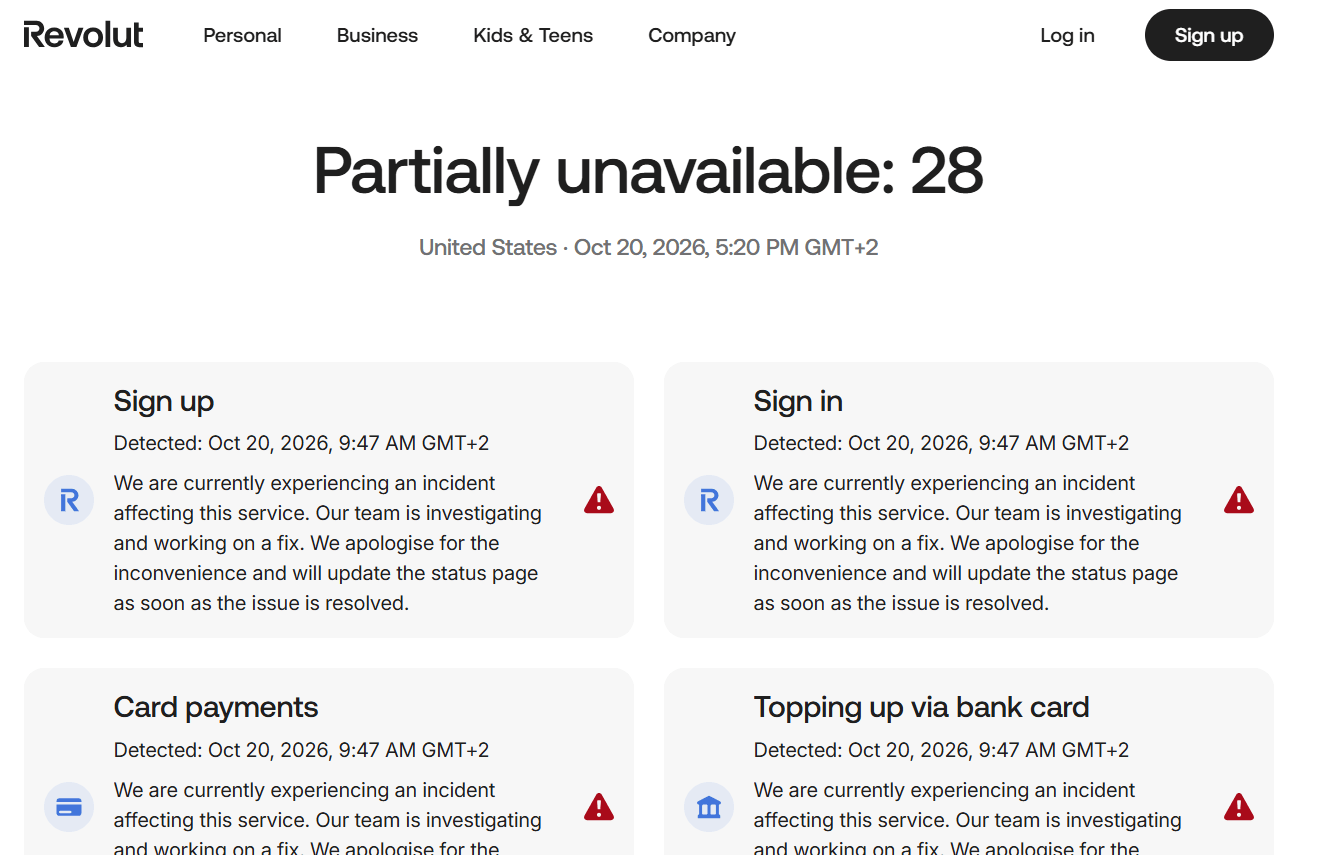
Revolut’s own status page showed most services as unavailable or partially unavailable, including card payments and ATM withdrawals. For a bank that exists entirely as an app with no physical branches to fall back on, that’s not a minor inconvenience.

“We are currently experiencing a service disruption affecting multiple services. We can confirm that all our customers’ money and data are safe. We’ve been working to fix the issue since it was identified this morning and apologise to anyone affected and for any inconvenience.” the financial company wrote on X.

We are currently experiencing a service disruption affecting multiple services. We can confirm that all our customers’ money and data are safe. We’ve been working to fix the issue since it was identified this morning and apologise to anyone affected and for any inconvenience…

— Revolut (@Revolut) October 20, 2026

That last sentence is the right thing to say, and it’s also exactly what every bank says during an outage regardless of whether the underlying cause is confirmed. Money and data being safe is a different question from whether you can pay for your coffee.

ING Germany also reported problems on Tuesday. Customers had trouble logging into online banking and the mobile app because of a technical issue. Reuters did not link these problems to the Google Cloud outage, and ING has not explained the cause. Two major financial services companies experiencing problems on the same morning could be a coincidence. However, it also raises questions about how much European banks depend on a small number of cloud providers.

Google Cloud’s europe-west2 region in London supports many UK and European fintech services. Revolut alone serves tens of millions of customers across Europe. When a major data center goes down, the impact can quickly reach customers, preventing them from paying or accessing banking services before the cause is fully understood.

Follow me on Twitter: @securityaffairs and Facebook and Mastodon

Pierluigi Paganini

(SecurityAffairs – hacking, Revolut)

  • ✇Security Affairs
  • Hirudo Android Trojan Replaces Banking Apps to Steal Credentials Pierluigi Paganini
    Android trojan Hirudo replaces genuine banking apps with modified versions to steal credentials and bypass security checks, enabling financial fraud. ThreatFabric researchers detailed a new Android banking trojan called Hirudo that takes a genuinely different approach to defeating banking security. Instead of throwing a fake login screen over the real app, it uninstalls the real app and puts a modified copy in its place. “What sets it apart is the lengths its operators go to once a bank
     

Hirudo Android Trojan Replaces Banking Apps to Steal Credentials

15 de Outubro de 2026, 03:06

Android trojan Hirudo replaces genuine banking apps with modified versions to steal credentials and bypass security checks, enabling financial fraud.

ThreatFabric researchers detailed a new Android banking trojan called Hirudo that takes a genuinely different approach to defeating banking security. Instead of throwing a fake login screen over the real app, it uninstalls the real app and puts a modified copy in its place.

“What sets it apart is the lengths its operators go to once a bank is in their sights: rather than overlaying a fake screen on top of the genuine banking app, Hirudo attempts to replace the banking app itself with a modified copy that quietly disables the bank’s own security checks from the inside.” reads the analysis published by ThreatFabric.

Eight Indonesian banking apps from seven banks already have specially designed replacements ready. The malware’s credential-stealing code also targets users in Indonesia, China, India, Mexico, Morocco, and Thailand.

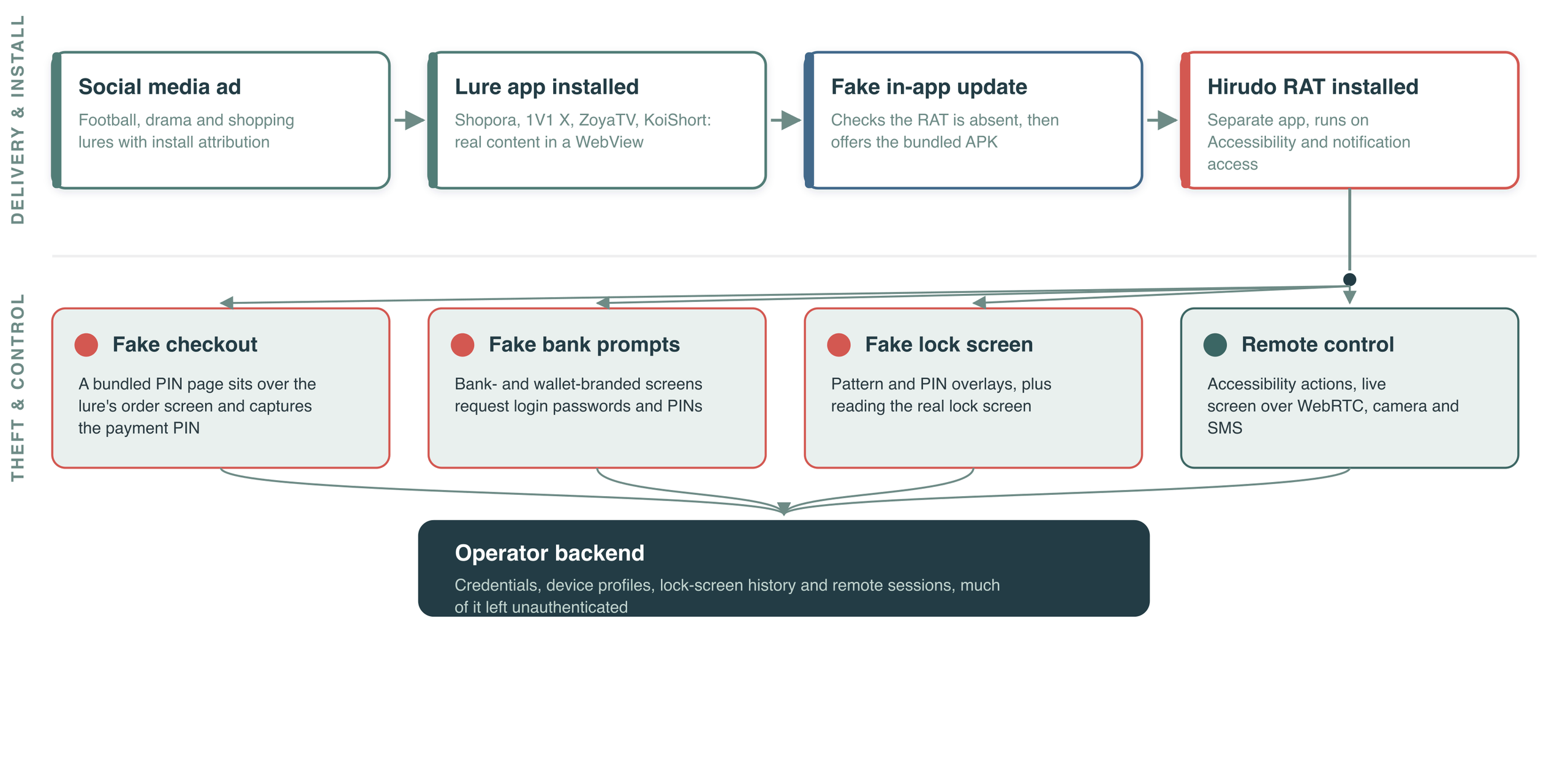
Hirudo is delivered as a second app hidden inside a convincing dropper. The dropper looks like a legitimate shopping app, short drama platform, or adult video service. It loads real content through a WebView to make the app look genuine. If it detects a banking app on the device and finds that Hirudo is not yet installed, it displays a fake in-app update prompt.

One dropper analysed by researchers goes a step further. During installation, it creates a deliberately broken VPN connection that cuts off the device’s internet access while Hirudo is installed. This does not fully bypass Google Play Protect, but ThreatFabric believes the technique is designed to weaken online reputation checks and code analysis while the malicious APK is being installed. Hirudo is then installed as a separate app from the dropper. Before it can carry out its malicious activities, it must obtain its own Accessibility and notification permissions.

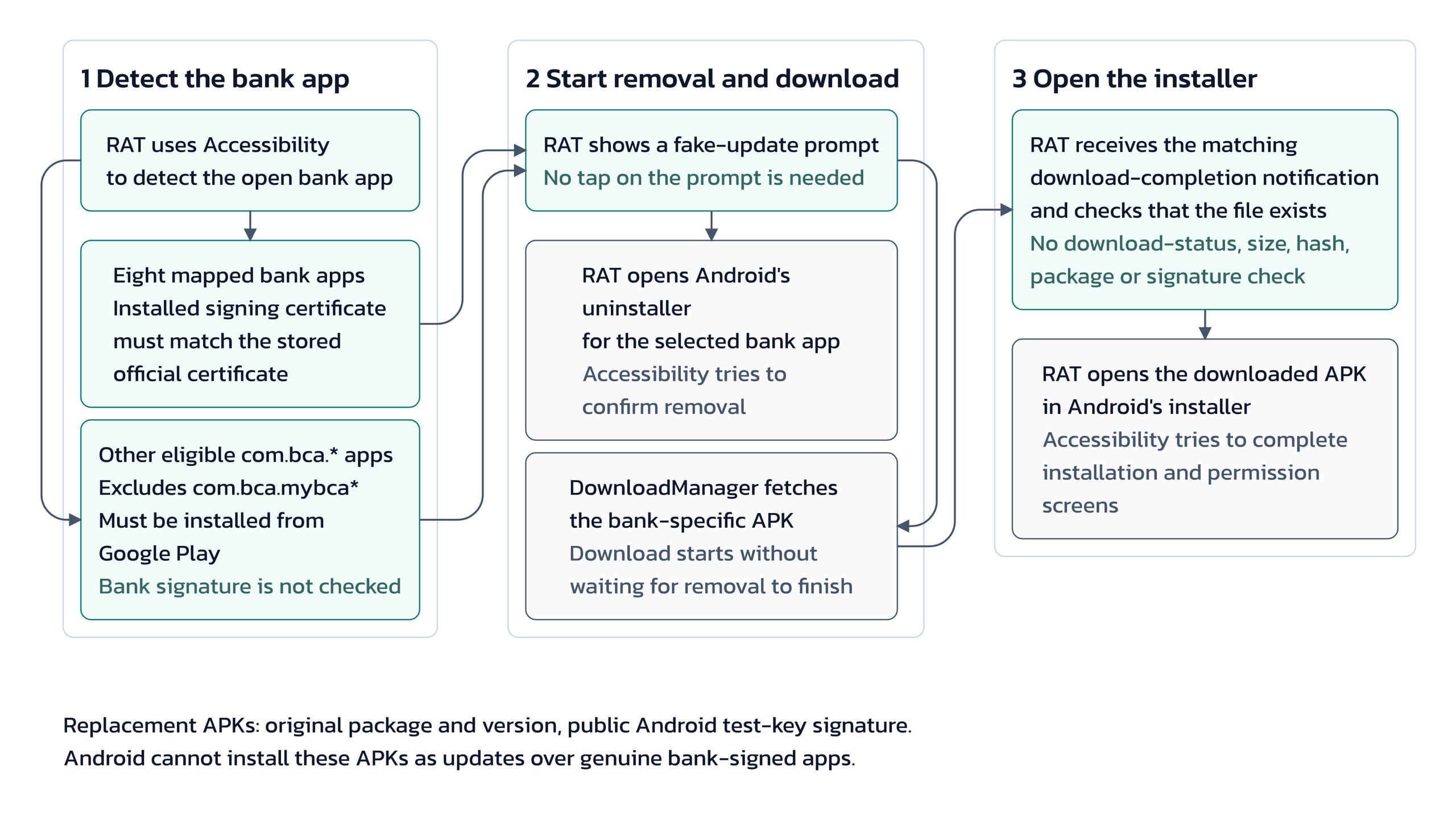
When the payload detects a target banking app, it checks the app’s signing certificate against a stored reference, then shows a fake update prompt and immediately opens Android’s uninstaller without waiting for the user to tap confirm. It downloads the patched replacement in parallel.

“Hirudo keeps a registry of 42 financial apps, but only eight Indonesian apps, across seven banks, have dedicated replacement downloads. For these, the RAT detects the installed banking app through Accessibility, checks its signing certificate against a stored reference, then shows a fake “update” prompt.” reads the analysis. “It opens Android’s uninstaller for the genuine app without waiting for the user to tap, and downloads the bank-specific replacement in parallel.”

The replacement keeps the original package name and version number, but it’s signed with a public test key rather than the bank’s real certificate. Android won’t install it as an update over a properly signed app, which is why the original has to go first. That requirement is a real constraint: the victim can interrupt it. But if they don’t, what follows is clever enough to matter.

The bank’s original code remains almost unchanged. Only one line is added to the app’s Application class. This line loads a built-in hooking engine when the app starts. The engine uses two open-source frameworks: YAHFA to modify Java methods and Dobby to modify native functions. It activates only when it finds a trigger file created by the RAT on the device. Without this file, the modified banking app appears harmless.

Once activated, the engine runs inside the banking app and controls how it responds to security checks. If the app asks for its signing certificate, the engine returns the genuine one. If it checks which accessibility services are enabled, the engine returns an empty list. It also removes the flag that blocks screenshots, allowing the attacker to view and record the banking screen remotely.

Play Integrity checks are sent over plain HTTP to a server controlled by the operator, which returns an acceptable result. Researchers highlight two important points. First, the keybox used for attestation has been leaked publicly, and at least two of its certificates are already on Google’s revocation list. Second, a valid Play Integrity response does not prove that the app has not been tampered with. In this case, the response was relayed through the operator’s server rather than generated through a genuine integrity check.

The lures don’t spread through side-loaded APKs from shady forums. They’re served from Amazon CloudFront, tied to campaign tracking through OpenInstall attribution, and linked to Meta Pixel IDs connecting specific branding to specific campaign groups. Some download routes were still live through late September and into October 2026. The operator APK-processing panel, which rebuilds dropper and payload APKs into finished lures and patched banking apps, was reachable without authentication, with cloud storage buckets and credentials left exposed, a significant operational security failure that helped ThreatFabric map the operation.

Records from August 2026 included thousands of credential entries split across campaign groups, device records, lock-screen history, and financial profiles with monthly income and risk score fields. Operators annotated records they considered “phished,” which signals a workflow built to convert stolen data into actual fraud rather than just collect it.

ThreatFabric’s conclusion on the defensive side is worth reading directly: “once an app can be replaced, its locally produced signals — signature, accessibility list, integrity verdict — must be treated as attacker-influenced and verified server-side.” A valid Play Integrity verdict from a relayed request is not a green light. A clean accessibility list from a patched app is not evidence there’s no controlling service running. The signals the app produces locally are no longer trustworthy, and any bank relying on them as blockers rather than inputs to server-side risk scoring is running on assumptions this trojan was designed to exploit.

“Hirudo marks a deliberate escalation in how Android bankers approach hardened applications. By moving its tampering inside the target app, the operation shifts the contest from the device to the application’s own integrity checks, and from a bespoke patch to a reusable engine that can be retargeted at other apps and regions.” concludes the report. “The defensive conclusion is consistent across every capability we examined: signals produced locally by an app that may have been replaced cannot be trusted on their own.”

Follow me on Twitter: @securityaffairs and Facebook and Mastodon

Pierluigi Paganini

(SecurityAffairs – hacking, Android malware)

❌
❌