❌

Visualização normal

Antes de ontemSecurity Affairs
  • ✇Security Affairs
  • FBI Blames North Korea for $6 Billion Binance Crypto Theft Pierluigi Paganini
    The FBI blames North Korea for stealing $6 billion from Binance and urges crypto firms to block transactions linked to the stolen funds. The FBI has named North Korea as the party behind the theft of more than $6 billion in virtual assets from the crypto exchange Binance, on or about October 29, 2026. The bureau published its findings in a public alert. The FBI specifically blames the North Korea-linked APT “TraderTraitor,” also tracked as Lazarus Group and APT38. Binance hasn’t named a c
     

FBI Blames North Korea for $6 Billion Binance Crypto Theft

1 de Novembro de 2026, 16:23

The FBI blames North Korea for stealing $6 billion from Binance and urges crypto firms to block transactions linked to the stolen funds.

The FBI has named North Korea as the party behind the theft of more than $6 billion in virtual assets from the crypto exchange Binance, on or about October 29, 2026. The bureau published its findings in a public alert. The FBI specifically blames the North Korea-linked APT “TraderTraitor,” also tracked as Lazarus Group and APT38.

Binance hasn’t named a culprit, but the blockchain analysis firm TRM has. It was the first to attribute the attack to TraderTraitor, and Chainalysis also said it’s highly confident in that finding.

“The Federal Bureau of Investigation (FBI) is releasing information advising the Democratic People’s Republic of Korea (North Korea) was responsible for the theft of more than $6 billion USD in virtual assets from cryptocurrency exchange Binance, on or about October 29, 2026. The FBI refers to this specific North Korean malicious cyber activity as “TraderTraitor.”” reads the FBI’s statement.

“The FBI, together with partners at the USSS and IRS-CI, has observed TraderTraitor actors converting stolen assets primarily into Ethereum (ETH). It is expected these assets will then be further laundered by converting them using DeFi and instant swap services as they prepare them for further laundering stages.”

Attackers used access from an engineer’s laptop to reach a service container and send unauthorized withdrawal requests. Binance says it has found no evidence that attackers stole any wallet private keys.

The FBI, along with the U.S. Secret Service (USSS) and IRS Criminal Investigation (IRS-CI), has spotted TraderTraitor actors turning the stolen assets mostly into Ethereum (ETH). The agencies expect the next step to be more laundering, by swapping the funds through DeFi and instant swap services as the actors prepare them for later stages. Instant swap services are aptly named.

The alert is aimed at private companies as well as law enforcement agencies. The FBI, USSS and IRS-CI are asking several types of businesses to help stop the money laundering. These include THORNode operators, who support the THORChain network, RPC node operators, who provide apps with access to blockchains, instant crypto exchanges, DeFi platforms, blockchain analytics companies and other crypto service providers.

The request is clear: these companies should block any transactions involving the wallet addresses used by TraderTraitor, including funds that can be traced back to them. According to the FBI, these addresses have received stolen funds and are controlled by North Korean attackers or are closely linked to them. The full list of addresses is included in the alert.

If you run any of these services, the first job is to check your blocklists against that list. The second is to look at transaction flows that touch those addresses indirectly, since the FBI says to block anything “derived from” them, not just direct transfers. Blockchain analytics firms are named for a reason, because tracing derived funds is their work.

The FBI says it’s committed to protecting the virtual asset community by identifying, mitigating and disrupting North Korea’s illicit cybercrime and virtual asset theft.

“The FBI maintains its commitment to protecting the virtual asset community by identifying, mitigating, and disrupting North Korea’s illicit cybercrime and virtual asset theft activities.” concludes the report. “If you have any information to provide, please contact your local FBI field office or FBI’s Internet Crime Complaint Center at ic3.gov.”

TRM says the attacker moved about $6.36 billion out of Binance wallets on ten blockchains on October 29, most of it in roughly 20 minutes starting at 20:05 UTC. That makes it the largest crypto theft on record, about four times the $1.5 billion Bybit hack of February 2025.

“On October 29, 2026, an attacker moved approximately USD 6.36 billion out of Binance wallets on ten blockchains, most of it in about 20 minutes starting at 20:05 UTC. That makes this the largest crypto theft on record, about four times the USD 1.5 billion Bybit hack of February 2025. Binance has confirmed a security incident and suspended withdrawals on several networks.” TRM said. “TRM attributes the attack to TraderTraitor, North Korea’s elite hacking unit, based on robust on and off-chain intelligence. We make this judgment with high confidence. TRM is tracking the funds and alerting partners through the Beacon Network.”

Freezing the money only went partway. Tether, Circle, Ripple and World Liberty Financial froze about $2.67 billion in stablecoins, and Arbitrum’s Security Council froze 8,426 ETH and 74.6 million ARB, for roughly $2.7 billion in all. But the attacker raced the freezes by selling USDT to market makers and borrowing ETH against USDT on Aave. It now holds more than 420,000 ETH and 18,270 BTC, about $2.4 billion beyond any issuer’s reach.

The early freeze numbers were messy too, Tether and Circle froze approximately $1.79 billion in stablecoins associated with the suspicious transfers in the initial reports. Those amounts describe different moments, and you shouldn’t add them without checking whether they cover distinct assets. A freeze works on tokens that have an issuer to call, and Ether and Bitcoin don’t.

Below is the link to my interview regarding the Binance case for Italian state television.

https://www.youtube.com/watch?v=DtvhBA9TdPo

Follow me on Twitter: @securityaffairs and Facebook and Mastodon

Pierluigi Paganini

(SecurityAffairs – hacking, Binance)

  • ✇Security Affairs
  • FBI Drops Accenture Contractor After Sensitive Data Breach Pierluigi Paganini
    Accenture lost an FBI contract after a missed security patch exposed sensitive employee data, raising serious concerns over operational security. The FBI pulled an Accenture contractor off its account on Monday, and the reason is almost mundane compared to the damage it caused. One update didn’t get installed on time. “The ‌Federal Bureau of Investigation removed an Accenture contractor on Monday over their role in a damaging data breach that exposed sensitive personal details of thousand
     

FBI Drops Accenture Contractor After Sensitive Data Breach

6 de Outubro de 2026, 06:27

Accenture lost an FBI contract after a missed security patch exposed sensitive employee data, raising serious concerns over operational security.

The FBI pulled an Accenture contractor off its account on Monday, and the reason is almost mundane compared to the damage it caused. One update didn’t get installed on time.

“The ‌Federal Bureau of Investigation removed an Accenture contractor on Monday over their role in a damaging data breach that exposed sensitive personal details of thousands of bureau employees, two sources familiar with the matter told Reuters.” Reuters reports. “The development comes as the FBI is still trying to ascertain the ramifications of the breach, ​which some former bureau officials have described as a major blow to the organization’s operational security.”

Two sources told Reuters the bureau cut ties with the contractor over their role in a breach that exposed sensitive personal data on thousands of FBI employees. Former bureau officials are calling it a serious hit to the organization’s operational security, not just an embarrassing headline. That’s a strong statement coming from people who used to run the place.

“To date, our review has determined that the incident occurred as the result of a security failure ​of a platform managed by a third-party organization — after a contractor failed to implement a security patch explicitly issued to secure the ​platform,” FBI cyber chief Brett Leatherman said in the statement to Reuters. “As such, the FBI has removed the contractor and taken all necessary steps to both mitigate any further risk and protect our workforce.”

FBI cyber chief Brett Leatherman laid out exactly what went wrong in a statement to Reuters. The incident traces back to a platform managed by a third party, where a contractor “failed to implement a security patch explicitly issued to secure the platform.” Not an unknown flaw, not a zero day, a fix that already existed and just didn’t get installed.

Reuters’ sources identified the platform as Oracle PeopleSoft, the human resources software running the FBI’s job site, and named Accenture as the third party managing it. Oracle hasn’t responded to requests for comment. Accenture, for its part, said only that it’s proud to support the FBI’s mission and plans to keep doing so, dodging every question about the contractor or the missed patch.

In June, Google warned about a ShinyHunters-linked campaign targeting PeopleSoft users. On the same day, Oracle issued a security alert about the vulnerability and released a fix. Both companies told PeopleSoft customers to install all critical patches and security updates as soon as possible.

ShinyHunters later said they used this same PeopleSoft vulnerability to access the FBI’s job site. Patching large enterprise systems can be difficult, but this wasn’t an unknown or obscure flaw. It had already been publicly identified, attackers were exploiting it, and a fix was available.

In September, the popular cybercrime group ShinyHunters claimed that it breached the U.S. Federal Bureau of Investigation (FBI) and stole sensitive information belonging to FBI employees and job applicants. The group says the operation was not financially motivated and was instead carried out in response to an FBI warning published earlier this year.

The claim surfaced on September 22 and quickly drew attention after ShinyHunters said it obtained data on a large number of current and former FBI personnel. The group reportedly offered a sample of around 5,000 records as evidence and claimed that the stolen information could include names, addresses, phone numbers, Social Security numbers, assignments and, in some cases, family details.

Reuters was able to partially match some of the sample information with other records, including data associated with FBI Director Kash Patel.

“Reuters was able to partially verify the authenticity of the information by running the details, including the Social Security numbers, ​against credit bureau records and previously breached data preserved by the dark-web intelligence firm District 4 Labs.” reads the report published by Reuters. “In at least 10 instances — including in the case ‌of FBI ⁠Director Kash Patel — Reuters found details that appeared to match. A person familiar with the matter said that the job descriptions in the data also matched in at least some cases.”

The FBI acknowledged that it is aware of claims involving unauthorized activity affecting FBIjobs.gov and said it is investigating. The agency has not confirmed that its internal systems were compromised or that ShinyHunters obtained the data it claims to possess.

ShinyHunters provided a possible technical explanation for the alleged intrusion. The group claims the exploitation of an Oracle PeopleSoft zero-day, reportedly using it to gain remote code execution through infrastructure connected to the FBI’s recruitment services.

The attackers also reportedly claimed access to several FBI-related services, including human resources systems and a system they referred to as Medlink. They allegedly said that between 2 TB and 3 TB of data had been taken and that the FBI jobs infrastructure had been compromised.

There is also a clear motive behind the operation claimed by ShinyHunters. The group says it targeted the FBI after a May 2026 public advisory describing its tactics and warning victims against paying. ShinyHunters disputes the FBI’s characterization of its activities and is reportedly demanding that the Bureau retract or correct the warning.

This makes the alleged attack unusual. Instead of immediately demanding a conventional ransom, the group appears to be using the stolen data as leverage in a dispute with U.S. law enforcement.

The timing is also significant. ShinyHunters has recently claimed responsibility for several major breaches and has been involved in a public dispute with the Clop cybercrime operation. The group recently claimed to have compromised Clop’s data leak site, highlighting the increasingly aggressive behavior surrounding the group.

The stolen data is much more sensitive than the usual names and email addresses seen in data breaches. It includes details about named employees’ counterintelligence roles, home addresses of human intelligence operatives, and medical and psychiatric records of FBI staff.

For an agency where some employees depend on keeping their identities, jobs and home addresses private, this goes beyond a normal data breach. It creates a serious operational security risk.

Last week a key ShinyHunters suspect got picked up in Jordan and reportedly started cooperating with investigators, which might help the bureau understand just how bad the damage really is. Removing one contractor doesn’t undo an exposure like this, it just closes the door after the fact.

Follow me on Twitter: @securityaffairs and Facebook and Mastodon

Pierluigi Paganini

(SecurityAffairs – hacking, Accenture)

  • ✇Security Affairs
  • ShinyHunters Suspect Detained in Jordan Helps FBI Track Down the Group Pierluigi Paganini
    A suspected ShinyHunters member arrested in Jordan is reportedly cooperating with the FBI, helping investigators track down the group. A suspected member of ShinyHunters, the group that claims to have stolen data on every FBI employee, was picked up in Jordan this week. The man is Saif al-Din Khader, detained by Jordanian authorities, with two sources placing the arrest on Tuesday. Reuters couldn’t confirm the exact circumstances or where he’s being held. “A suspected member of the S
     

ShinyHunters Suspect Detained in Jordan Helps FBI Track Down the Group

4 de Outubro de 2026, 10:41

A suspected ShinyHunters member arrested in Jordan is reportedly cooperating with the FBI, helping investigators track down the group.

A suspected member of ShinyHunters, the group that claims to have stolen data on every FBI employee, was picked up in Jordan this week.

The man is Saif al-Din Khader, detained by Jordanian authorities, with two sources placing the arrest on Tuesday. Reuters couldn’t confirm the exact circumstances or where he’s being held.

“A suspected member of the ShinyHunters hacking group, which ​says it stole data on every FBI employee, was detained in Jordan this week and is cooperating with the FBI, three people familiar with the matter told Reuters.” the Reuters states.

Two sources said he’s now helping the FBI and international law enforcement track down the rest of the group.

One source told Reuters that Khader is showing investigators his own devices and digital communications to help identify former associates. That gives investigators real access to potential evidence, not just a general promise to cooperate.

“The FBI declined to comment on any specific arrest or activity abroad but said that the bureau “continues to aggressively investigate ​the recent cyber incident allegedly involving ShinyHunters, having already worked with partners to arrest multiple subjects — and we will spare no resource in bringing each of the responsible individuals to justice.”” Reuters continues.

The case matters beyond Khader’s arrest. ShinyHunters claims to have stolen personal data on FBI employees, and Reuters’ earlier analysis found that the leaked sample included detailed personal information, sensitive job-related data, and psychiatric and medical records. Some have compared the incident to the 2015 OPM breach, in which a China-linked attack exposed security clearance data belonging to millions of Americans. If the ShinyHunters claims are even partly confirmed, that comparison would be justified.

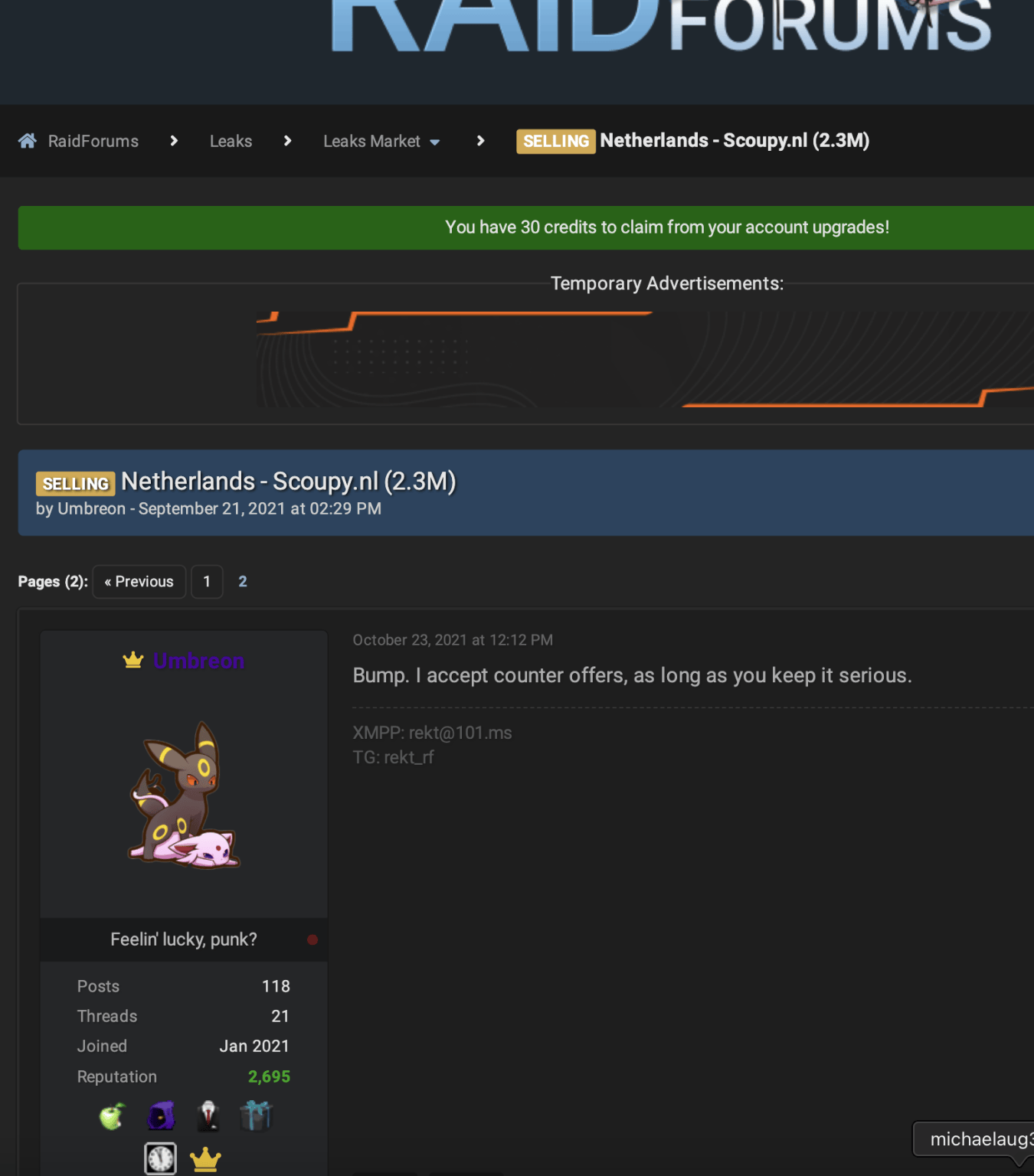
Dutch police confirmed this week that the 24-year-old man from Amsterdam was arrested earlier this month as part of an investigation into the cybercrime group ShinyHunters. The suspect appears before Rotterdam District Court today, September 29. Multiple sources, including KrebsOnSecurity, have identified him as Pepijn van der Stap, a Dutch hacker previously known online as “Umbreon.”

The connection to ShinyHunters runs through the “Umbreon” alias. Van der Stap used that handle and Pokémon imagery on BreachForums as early as 2021.

ShinyHunters
Source KrebsOnSecurity

Then the FBI jobs site defacement that ShinyHunters left after the FBIjobs.gov breach prominently featured an ASCII art version of the same Pokémon character, and the image appears identical to one used in a 2020 HackForums defacement attributed to ShinyHunters, a year before Van der Stap created his Umbreon account. That last detail cuts both ways: either the alias predates him in this context, or the timing coincidence is genuinely awkward. KrebsOnSecurity adds a more pointed interpretation: sources familiar with the investigation say the Umbreon imagery in the FBI defacement may have been a deliberate attempt by ShinyHunters’ current leader, a teenager from Amman, Jordan known as Rey, to pin the hack on Van der Stap. The two reportedly had ongoing bad blood over control of the ShinyHunters brand and data.

FBI Director Kash Patel had already hinted that more arrests were coming.

“FBI teams are working new leads RIGHT NOW. More arrests are on the table.” Patel wrote on X.

NO SAFE HAVEN.

Working with our Dutch National Police partners, the FBI helped put an alleged leader of ShinyHunters—a global cybercrime threat actor—behind bars.

And we’re not done.

FBI teams are working new leads RIGHT NOW. More arrests are on the table.

If you attack… pic.twitter.com/T7CK4KIKl9

— FBI Director Kash Patel (@FBIDirectorKash) September 30, 2026

ShinyHunters’ own infrastructure has been wobbling since this week started. Reuters lost contact with the group’s usual communication account on Tuesday, the same day Khader was reportedly detained, and by Wednesday the group’s dark web leak site had gone offline entirely. The alleged leader of the group, Rey, told journalist Brian Krebs in November 2025 that he’d been quietly cooperating with law enforcement since June, well before any of this became public.

In November 2025, security journalist Brian Krebs reported that Rey was Saif Al-Din Khader after analyzing information obtained from infostealer logs and speaking directly with Khader over Signal.

What is new is what cooperation can look like when someone is in custody. An FBI Cyber Division official explained the situation last week: arrests can make people more willing to talk, while seized servers can reveal information about those who are still outside. Once someone’s laptop becomes evidence, loyalty can disappear very quickly.

A new ShinyHunters leak site reportedly came back online on Thursday, so the group itself isn’t dead, just missing one more member.

Follow me on Twitter: @securityaffairs and Facebook and Mastodon

Pierluigi Paganini

(SecurityAffairs – hacking, ShinyHunters )

  • ✇Security Affairs
  • ShinyHunters claims FBI breach after alleged PeopleSoft zero-day attack Pierluigi Paganini
    ShinyHunters claims FBI breach via PeopleSoft zero-day, steals staff data; FBI investigating, no confirmation yet. The popular cybercrime group ShinyHunters is claiming that it breached the U.S. Federal Bureau of Investigation (FBI) and stole sensitive information belonging to FBI employees and job applicants. The group says the operation was not financially motivated and was instead carried out in response to an FBI warning published earlier this year. The claim surfaced on September 22
     

ShinyHunters claims FBI breach after alleged PeopleSoft zero-day attack

23 de Setembro de 2026, 10:56

ShinyHunters claims FBI breach via PeopleSoft zero-day, steals staff data; FBI investigating, no confirmation yet.

The popular cybercrime group ShinyHunters is claiming that it breached the U.S. Federal Bureau of Investigation (FBI) and stole sensitive information belonging to FBI employees and job applicants. The group says the operation was not financially motivated and was instead carried out in response to an FBI warning published earlier this year.

The claim surfaced on September 22 and quickly drew attention after ShinyHunters said it had obtained data on a large number of current and former FBI personnel. The group reportedly offered a sample of around 5,000 records as evidence and claimed that the stolen information could include names, addresses, phone numbers, Social Security numbers, assignments and, in some cases, family details.

Reuters was able to partially match some of the sample information with other records, including data associated with FBI Director Kash Patel. However, the news agency could not determine where the information originally came from or independently confirm that it had been stolen from FBI systems.

“Reuters was able to partially verify the authenticity of the information by running the details, including the Social Security numbers, ​against credit bureau records and previously breached data preserved by the dark-web intelligence firm District 4 Labs.” reads the report published by Reuters. “In at least 10 instances — including in the case ‌of FBI ⁠Director Kash Patel — Reuters found details that appeared to match. A person familiar with the matter said that the job descriptions in the data also matched in at least some cases.”

The FBI has acknowledged that it is aware of claims involving unauthorized activity affecting FBIjobs.gov and said it is investigating. The agency has not confirmed that its internal systems were compromised or that ShinyHunters obtained the data it claims to possess.

ShinyHunters has provided a possible technical explanation for the alleged intrusion. The group claims the exploitation of an Oracle PeopleSoft zero-day, reportedly using it to gain remote code execution through infrastructure connected to the FBI’s recruitment services.

The claim is notable because ShinyHunters has already been linked to attacks exploiting a real PeopleSoft zero-day earlier this year. In June, Oracle addressed CVE-2026-35273, a critical unauthenticated remote code execution vulnerability in PeopleSoft PeopleTools. Google and Mandiant later linked exploitation of that flaw to ShinyHunters activity targeting organizations, particularly in the education sector.

That history makes the latest claim technically plausible, but it does not prove that the same group used another PeopleSoft zero-day against the FBI. No public CVE or vendor confirmation currently exists for the alleged new vulnerability.

The attackers also reportedly claimed access to several FBI-related services, including human resources systems and a system they referred to as Medlink. They allegedly said that between 2 TB and 3 TB of data had been taken and that the FBI jobs infrastructure had been compromised.

Reuters and other media outlets confirmed the recruitment website did experience disruption around the time of the claim. A page that had reportedly been defaced by the attackers later displayed a scheduled-maintenance message. That disruption could be consistent with an intrusion, but it is not by itself proof that the wider FBI systems were breached.

There is also a clear motive behind the operation claimed by ShinyHunters. The group says it targeted the FBI after a May 2026 public advisory describing its tactics and warning victims against paying. ShinyHunters disputes the FBI’s characterization of its activities and is reportedly demanding that the Bureau retract or correct the warning.

This makes the alleged attack unusual. Instead of immediately demanding a conventional ransom, the group appears to be using the stolen data as leverage in a dispute with U.S. law enforcement.

The timing is also significant. ShinyHunters has recently claimed responsibility for several major breaches and has been involved in a public dispute with the Clop cybercrime operation. The group recently claimed to have compromised Clop’s data leak site, highlighting the increasingly aggressive behavior surrounding the group.

For now, however, the FBI investigation remains the missing piece. Until investigators confirm the intrusion, the extent of access and the origin of the leaked records, the ShinyHunters account should remain a claim rather than an established FBI breach.

What is already clear is that the incident would be serious if confirmed. Personal information belonging to law enforcement personnel could expose agents and their families to targeted harassment, social engineering and other forms of abuse. But the available evidence does not yet allow those consequences to be attributed to a confirmed compromise of FBI internal systems.

Follow me on Twitter: @securityaffairs and Facebook and Mastodon

Pierluigi Paganini

(SecurityAffairs – hacking, FBI)

❌
❌