
Visualização normal

Antes de ontemSecurity Affairs
  • ✇Security Affairs
  • PostgreSQL Hit by 12-Year-Old Vulnerability Allowing Server Takeover Pierluigi Paganini
    PostGREShell (CVE-2026-6471) is a 12-year-old PostgreSQL flaw that lets low-privileged attackers execute code and take over servers. Cyera researchers found a severe PostgreSQL vulnerability, dubbed PostGREShell and tracked as CVE-2026-6471 (CVSS score of 7.2). Present in releases dating back to 2014, the flaw can be exploited by attackers with low-level replication access to execute code, escalate privileges and gain permanent superuser access. “Missing authorization in PostgreSQL logic
     

PostgreSQL Hit by 12-Year-Old Vulnerability Allowing Server Takeover

4 de Setembro de 2026, 10:41

PostGREShell (CVE-2026-6471) is a 12-year-old PostgreSQL flaw that lets low-privileged attackers execute code and take over servers.

Cyera researchers found a severe PostgreSQL vulnerability, dubbed PostGREShell and tracked as CVE-2026-6471 (CVSS score of 7.2). Present in releases dating back to 2014, the flaw can be exploited by attackers with low-level replication access to execute code, escalate privileges and gain permanent superuser access.

“Missing authorization in PostgreSQL logical decoding allows a non-superuser holding REPLICATION privilege to dlopen any file visible to the operating system account running the server, via the choice of logical decoding plugin.” reads the advisory. “This in turn runs arbitrary code as that account. Versions before PostgreSQL 18.6, 17.11, 16.15, 15.19, and 14.24 are affected.”

Attackers could also install a persistent backdoor in the database, potentially leading to a full takeover of the database and underlying server. PostgreSQL is widely used by enterprises worldwide.

PostgreSQL fixed CVE-2026-6471 in versions 18.6, 17.11, 16.15, 15.19, and 14.24.

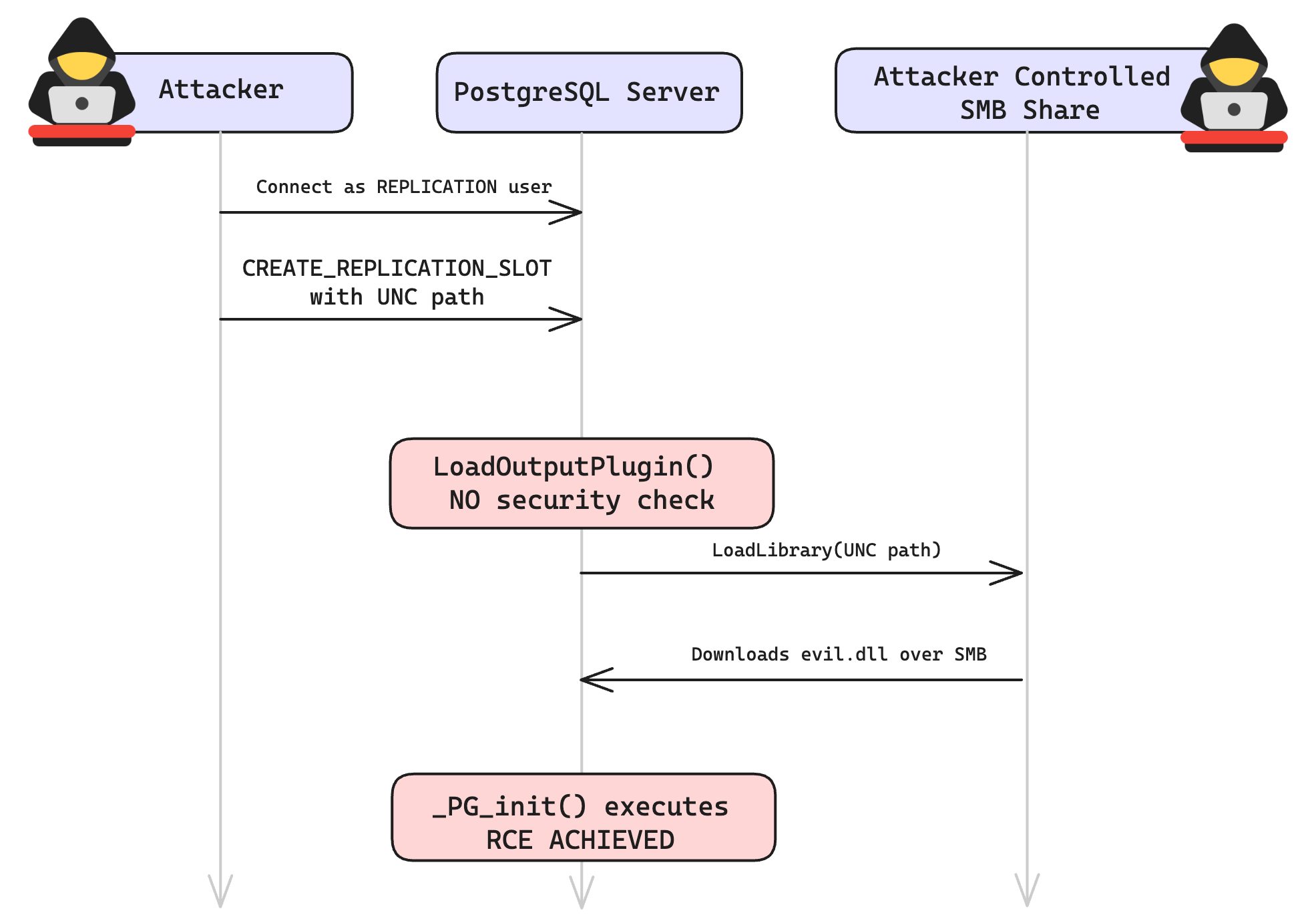
The flaw is caused by missing authorization in PostgreSQL’s logical decoding feature. An attacker with “Replication” privileges could abuse a logical decoding plugin to load any file that the operating system account running PostgreSQL can access.

PostgreSQL uses a dedicated replication system to keep database replicas in sync for backup and recovery. To do this, backup tools, servers, data pipelines and monitoring systems are typically given an account with Replication privileges.

“The flaw lets a low-privilege “backup” account load and execute arbitrary code on the database server, achieving remote code execution across Windows, Linux, and macOS. That foothold escalates to full PostgreSQL superuser with persistent backdoor access, turning a routine replication account into total database and server compromise.” reads the report published by Cyera. “The vulnerability has existed in every PostgreSQL version since 2014 (9.4+) and was never patched until now.”

During logical replication, PostgreSQL records database changes as events that external tools can read. These tools create a logical replication slot and specify an output plugin, which PostgreSQL loads to format and deliver the changes.

When PostgreSQL loads a plugin, it runs the plugin’s initialization code with the same privileges as the database server. To prevent abuse, non-superusers are normally allowed to load plugins only from a directory controlled by an administrator.

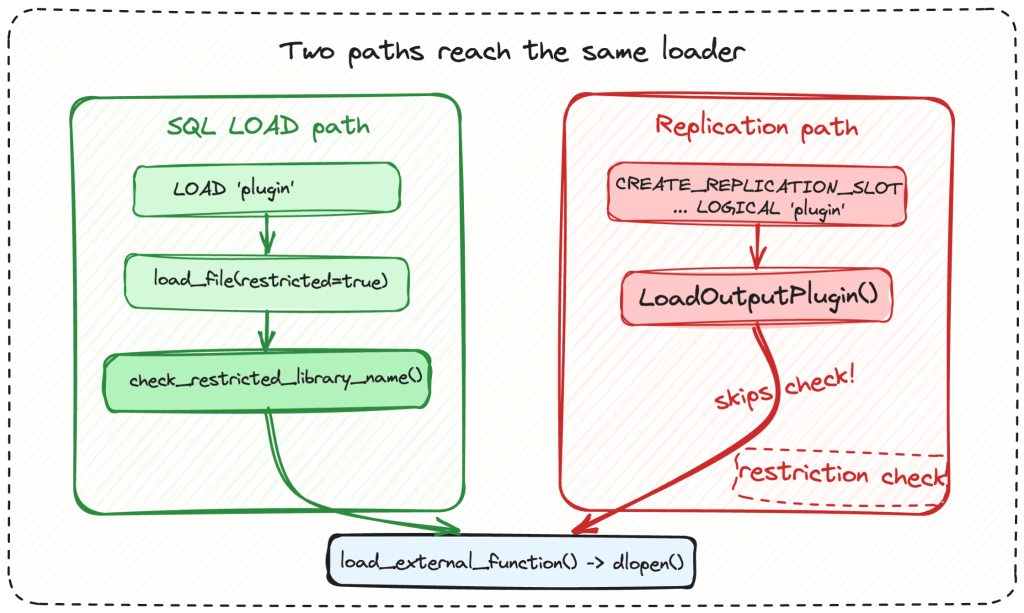
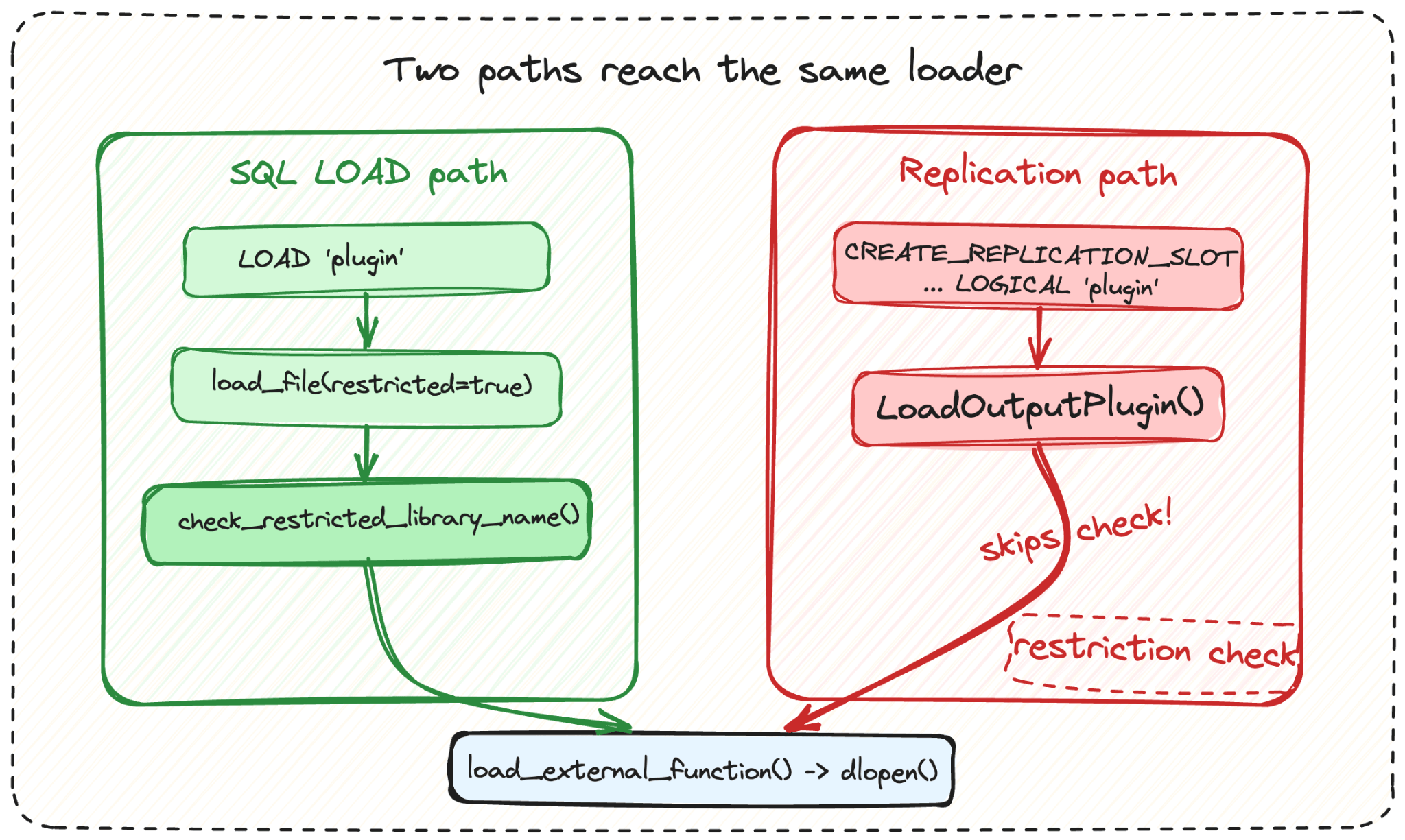
PostgreSQL does not properly check the plugin name before passing it to the loader. This means an attacker could provide a full path to a file on the system. PostgreSQL then passes that path to dlopen(), the C/C++ function used to load shared libraries.

“When PostgreSQL loads the output plugin, the name from the user’s CREATE_REPLICATION_SLOTcommand is passed directly to the loader. No validation, no sanitization, no restriction check. The SQL LOADcommand, by contrast, passes a !superuser()flag that triggers the path validation. The replication path passes nothing. And the replication protocol’s parser accepts almost any character inside a double-quoted plugin name: slashes, backslashes, dots, ../ traversal, even Windows UNC paths.” Cyera states. “So an attacker can hand the loader a full filesystem path, and it reaches dlopen() (Linux/macOS) or LoadLibrary()(Windows) exactly as typed. The whole bug is code execution via dlopen().”
Once obtained, permanent superuser privileges, the attackers can access every table in every database, execute commands on the operating system, read private keys, and write files anywhere the PostgreSQL process can access.
Postgreshell

PostGREShell can give attackers persistent backdoor access, including passwordless connections and restored superuser privileges. The flaw affects PostgreSQL 9.4–18.

Organizations should update their instances as soon as possible, review all Replication accounts, and remove the Replication attribute from accounts that do not need it.

Follow me on Twitter: @securityaffairs and Facebook and Mastodon

Pierluigi Paganini

(SecurityAffairs – hacking, CVE-2026-6471)

  • ✇Security Affairs
  • Attackers Can Take Over WordPress Sites Using Newly Released wp2shell Exploits Pierluigi Paganini
    Public exploits are now available for two critical WordPress flaws that attackers can chain to gain remote code execution without authentication. Public proof-of-concept exploits are now available for the critical wp2shell vulnerabilities affecting WordPress Core. The flaws, tracked as CVE-2026-63030 and CVE-2026-60137, can be chained to achieve pre-authentication remote code execution on default WordPress installations running versions 6.9.x and 7.0.x. CVE-2026-63030 is a REST API batch
     

Attackers Can Take Over WordPress Sites Using Newly Released wp2shell Exploits

19 de Julho de 2026, 02:04

Public exploits are now available for two critical WordPress flaws that attackers can chain to gain remote code execution without authentication.

Public proof-of-concept exploits are now available for the critical wp2shell vulnerabilities affecting WordPress Core. The flaws, tracked as CVE-2026-63030 and CVE-2026-60137, can be chained to achieve pre-authentication remote code execution on default WordPress installations running versions 6.9.x and 7.0.x.

CVE-2026-63030 is a REST API batch-route confusion bug introduced in WordPress 6.9. CVE-2026-60137 is a high-severity SQL injection flaw in the author__not_in parameter of WP_Query, affecting.

“The 7.0.2 security release addresses one critical and one high severity security issue.” reads the WordPress announcement.

“Because this is a security release, it is recommended that you update your sites immediately. Due to the severity, the WordPress.org team have enabled forced updates via the auto-update system for sites running affected versions.”

Cybersecurity researchers at Searchlight Cyber discovered the flaws that can allow remote attackers to compromise vulnerable sites without valid credentials, making immediate patching essential.

“Searchlight Cyber’s security research team has discovered a pre-authentication RCE in WordPress Core. The attack has no preconditions and can be exploited by an anonymous user in a stock install of WordPress with no plugins.” reads the advisory. “It is estimated that over 500 million websites use WordPress.”

Researchers withheld technical details to give organizations time to patch, but released an online tool to help administrators check whether their WordPress instances are vulnerable.

Searchlight Cyber’s security research team estimated that over 500 million websites use WordPress. They are releasing a checker so admins can determine whether their instance is vulnerable.

WordPress has enabled forced automatic security updates for affected supported versions because of the severity of the flaws. The full RCE exploit chain affects WordPress versions 6.9.0–6.9.4 and 7.0.0–7.0.1, according to WordPress security advisories.

Site owners should update immediately to WordPress 7.0.2 or 6.9.5, which prevent the exploitation of the wp2shell attack chain.

If patching is not possible, administrators can temporarily reduce risk by blocking anonymous access to the REST API batch endpoint through a security plugin or WAF rules targeting /wp-json/batch/v1 and ?rest_route=/batch/v1.

Searchlight states that these measures are only temporary and may affect legitimate site functions, so updating remains the preferred solution.

Follow me on Twitter: @securityaffairs and Facebook and Mastodon

Pierluigi Paganini

(SecurityAffairs – hacking, newsletter)

  • ✇Security Affairs
  • Attacker Used AI to Build Custom PowerShell Recon Malware Pierluigi Paganini
    Huntress found an AI-generated PowerShell script used for AD reconnaissance, showing attackers are using AI to create custom, evasive tools. During an incident response investigation on June 3, 2026, Huntress analyst Jevon Ang recovered a PowerShell script from a compromised Windows Server that the attacker had used to map out the victim’s Active Directory environment. The script hadn’t been downloaded from a public repository or pulled from a known offensive toolkit. It was custom-built, al
     

Attacker Used AI to Build Custom PowerShell Recon Malware

14 de Julho de 2026, 07:21

Huntress found an AI-generated PowerShell script used for AD reconnaissance, showing attackers are using AI to create custom, evasive tools.

During an incident response investigation on June 3, 2026, Huntress analyst Jevon Ang recovered a PowerShell script from a compromised Windows Server that the attacker had used to map out the victim’s Active Directory environment. The script hadn’t been downloaded from a public repository or pulled from a known offensive toolkit. It was custom-built, almost certainly by prompting an AI model until the output worked. Huntress researchers reconstructed the full script from PowerShell script block logging, specifically Event ID 4104 in the Microsoft-Windows-PowerShell/Operational log.

“The script, enthusiastically titled “100% Working AD Information Gathering Script – FULLY FIXED”, is a highly aggressive, noisy, custom-built AD enumeration tool. It doesn’t try to hide its functions, and has a number of distinct and interesting phases.” reads the report published by Huntress.

The attack itself wasn’t particularly novel. The threat actor gained RDP access using pre-compromised credentials, staged tools in C:\ProgramData, ran the custom recon script within minutes of establishing the session, then roughly thirty minutes later deployed s5cmd.exe, a legitimate Amazon S3 command-line tool that Huntress has seen repeatedly abused for data theft. A second pass with SharpShares.exe followed, hunting for additional data repositories.

“One thing to emphasize here is that AI isn’t changing the game by any means during this incident. The underlying attack chain still resembles the tried-and-tested smash-and-grab playbook we’ve seen for years.” continues the report.”This core methodology has remained consistent, but it is now being selectively augmented by AI. This hybrid approach prioritises aggression and speed over stealth, allowing threat actors to execute highly damaging campaigns faster than ever.”

The PowerShell file was named Untitled1.ps1, which is what you get when someone copies code out of an AI chat window and saves it without renaming it. The script’s internal title is “100% Working AD Information Gathering Script – FULLY FIXED,” which is a textbook artifact of someone iterating with an AI, hitting errors, pasting those errors back into the chat, and eventually copying out whatever the model produced when it stopped failing. The title isn’t something a human writing their own tool would choose. It’s the label an AI puts on the version that finally passed testing.

The script opens by identifying the domain controller through five separate methods in sequence: DNS lookup, nltest, the Active Directory PowerShell module, environment variables, and finally a hardcoded fallback. A human writing a recon script picks one or two reliable methods. An AI told “make sure it doesn’t fail to find the DC” will exhaustively generate every approach in its training data.

“The five distinct methods to find a Domain Controller scream “AI generation”. A human writing this script would typically pick the best one or two methods. An LLM, when told “make sure it doesn’t fail to find the DC,” will exhaustively generate every method in its training data.” states Huntress.

The most damning single detail is a hardcoded fallback value in that DC discovery block: $dc = "Server1.HR.local". That’s a literal placeholder the AI included as an example, and the attacker copied the script without editing it. The variable would only matter if all four preceding discovery methods failed simultaneously, so it likely never fired, but it was still there, unchanged, in the deployed payload.

Once it located the domain controller, the script ran a structured dump of Active Directory users, computers, groups, organizational units, subnets, domain trusts, DNS subnet records, and a filtered list of users with email addresses. Everything landed in a timestamped directory under C:\AD_Reports_, saved as CSV files.

The script then generated a formatted HTML summary report of the collection, which Huntress notes is almost certainly an unsolicited addition from the AI rather than something the attacker specifically asked for.

“The final phase of the script is surprisingly focused on presentation. Instead of simply zipping the CSV files and exiting, it writes an entire HTML file to summarise the data theft.” states the report. “Why does a threat actor need a beautiful HTML report, you ask? We thought the same. It’s likely a “helpful” inject from the LLM that the attacker simply went along with, rather than being intentionally authored into the script.”

After creating the report, the script zipped everything into a single archive. A threat actor who wanted to understand why their recon output looked the way it did could open a nicely formatted HTML file and find out. Nice touch.

The practical challenge for defenders is that Untitled1.ps1 has never existed before and won’t exist again in the same form. Traditional endpoint detection and antivirus tools rely heavily on file hashes and static string signatures. A known tool like SharpHound gets caught immediately because the binary is recognized. A script generated fresh by an AI for a specific incident has no hash to match against.

“Vibe coding lowers the barrier to entry for cybercrime, allowing unsophisticated actors to generate highly capable, evasive tooling on the fly. While the code itself may be messy, over-engineered, and filled with AI hallmarks like left-behind comments, the threat it poses is very real.” continues the report. “To combat this, defenders must abandon rigid, signature-based thinking and embrace behavioral analytics to catch the underlying actions that no LLM can hide.”

The answer isn’t to try to detect AI-generated code, which isn’t reliably distinguishable from human-written code at the binary level. The answer is to focus on what the code does at runtime rather than what it looks like on disk. Active Directory enumeration using Get-ADUser -Filter * against a domain controller, followed by bulk CSV exports, followed by ZIP archive creation in a staging directory, is the same sequence regardless of whether a human or an AI wrote the script that performs it. The behaviors are detectable. Huntress’s SIEM caught the activity through behavioral telemetry rather than file signatures. The attacker had a custom, never-before-seen script. The defenders still saw it.

Follow me on Twitter: @securityaffairs and Facebook and Mastodon

Pierluigi Paganini

(SecurityAffairs – hacking, AI)

❌
❌