❌

Visualização normal

Antes de ontemSecurity Affairs
  • ✇Security Affairs
  • Microsoft Patch Tuesday Sets New Record with 1,415 CVEs in October 2026 Updates Pierluigi Paganini
    Microsoft Patch Tuesday security updates for October 2026 address a record 1,415 vulnerabilities. Prioritize the exploited zero-day, critical bugs and potentially wormable vulnerabilities. Microsoft just shattered every patch record in the book. October 2026 brought us a staggering 1,415 new CVEs from Microsoft alone. “Well, it’s a new record release from Microsoft, again. This is also the first four-digit volume we have ever seen and includes six-digit CVEs. As always, counting this loa
     

Microsoft Patch Tuesday Sets New Record with 1,415 CVEs in October 2026 Updates

14 de Outubro de 2026, 11:01

Microsoft Patch Tuesday security updates for October 2026 address a record 1,415 vulnerabilities. Prioritize the exploited zero-day, critical bugs and potentially wormable vulnerabilities.

Microsoft just shattered every patch record in the book. October 2026 brought us a staggering 1,415 new CVEs from Microsoft alone.

“Well, it’s a new record release from Microsoft, again. This is also the first four-digit volume we have ever seen and includes six-digit CVEs. As always, counting this load is tricky, but I see 1,415 new CVEs from Microsoft. That puts this month at a greater volume than any previous YEAR from Microsoft. I’m starting to think I don’t like this new normal.” states ZDI. “As for the products affected by this release, we have Windows and Windows components, Office and Office Components, Developer Tools and .NET, SharePoint, Linux kernel, Skype for Business and Microsoft Lync, SQL Server and Dynamics, Azure and cloud services, and Exchange server.”

This is the first time Microsoft has reported more than 1,000 vulnerabilities in a single month. To help security teams handle this huge number of flaws, Microsoft introduced “risk cohorts” to group related vulnerabilities, similar to the old security bulletin system. AI is clearly helping researchers find bugs faster, both for attackers and defenders. The good news is that vulnerabilities are still being discovered faster than attackers are exploiting them. Security teams should focus on the most serious threats first instead of trying to patch every low-risk flaw at once.

Instead, focus immediately on what’s actively burning in the wild. The single zero-day under active attack this month is CVE-2026-96951, a Windows Shell security feature bypass used to dodge Mark of the Web protections.

“An attacker who successfully exploited the vulnerability could evade Mark of the Web (MOTW) defenses.” reads the advisory. “In an email or instant message attack scenario, the attacker could send the targeted user a specially crafted file that is designed to exploit the vulnerability. In any case an attacker would have no way to force a user to view attacker-controlled content. Instead, an attacker would have to convince a user to take action. For example, an attacker could entice a user to either click a link that directs the user to the attacker’s site or send a malicious attachment.”

Other high-priority threats include a critical unauthenticated SharePoint privilege escalation bug (CVE-2026-102866), a high-scoring SQL Server remote code execution flaw (CVE-2026-65674), and a massive wave of 59 potentially wormable vulnerabilities spanning core network services like DHCP, Remote Desktop Gateway, and DNS.

Below are the descriptions for the above issues:

  • CVE-2026-96951 (CVSS score of 8.8) is a Windows Shell command injection vulnerability that allows an unauthorized attacker to bypass security protections over a network. Exploitation can evade Mark of the Web (MOTW) defenses, which help protect users from potentially dangerous files downloaded from the internet. Microsoft confirmed that the flaw is being actively exploited.
  • CVE-2026-102866 (CVSS score of 8.1) is a Microsoft SharePoint Server vulnerability caused by improper verification of cryptographic signatures. It allows an unauthenticated attacker to elevate privileges over a network, potentially gaining unauthorized access to sensitive information or modifying data.
  • CVE-2026-65674 (CVSS score of 8.8) is a Microsoft SQL Server remote code execution vulnerability caused by the deserialization of untrusted data. An authorized attacker with the required privileges could exploit the flaw over a network to execute code on the affected server.

“I may be wrong about some of these – there are a few where the description is somewhat…er…ambiguous, but regardless, this number of wormable bugs in 2026 should cause some level of concern. Not panic.” concludes ZDI. “There’s no need for that, but it is disconcerting to see this many juicy targets sitting out there. Please do your best to test and deploy these fixes in a timely manner.”

Prioritize the proven, public, and exploited flaws first, and take a deep breath before diving into the rest of the patch mountain. Make sure your operational priorities remain laser-focused on real risk rather than chasing vanity metrics.

Make every effort to test and apply these patches as soon as possible.

Follow me on Twitter: @securityaffairs and Facebook and Mastodon

Pierluigi Paganini

(SecurityAffairs – hacking, Patch Tuesday)

  • ✇Security Affairs
  • Volexity Uncovers Stealthy Ivanti VPN Attack Using Three Zero-Day Vulnerabilities Pierluigi Paganini
    Ivanti VPN zero-days let attackers gain root access, steal credentials, evade detection, and prepare for wider network compromise. On October 5, Volexity started investigating suspicious activity at one of its monitoring customers and traced everything back to an Ivanti Connect Secure VPN appliance running version 22.8R2.4, the latest build available at the time. Three chained zero-days gave an unknown attacker unauthenticated root access. “n the first week of October 2026, Volexity disc
     

Volexity Uncovers Stealthy Ivanti VPN Attack Using Three Zero-Day Vulnerabilities

14 de Outubro de 2026, 07:15

Ivanti VPN zero-days let attackers gain root access, steal credentials, evade detection, and prepare for wider network compromise.

On October 5, Volexity started investigating suspicious activity at one of its monitoring customers and traced everything back to an Ivanti Connect Secure VPN appliance running version 22.8R2.4, the latest build available at the time. Three chained zero-days gave an unknown attacker unauthenticated root access.

“n the first week of October 2026, Volexity discovered an unknown threat actor, UTA0576, abusing a zero-day exploit chain to compromise a fully patched (at the time, version 22.8R2.4) Ivanti Connect Secure (ICS) VPN appliance.” states Volexity. “This exploit chain combined an authentication bypass, a remote code execution (RCE), and a privilege escalation vulnerability to achieve unauthenticated root-level code execution. The RCE and authentication bypass vulnerabilities are tracked under CVE-2026-104935.”

The attacker, tracked as UTA0576, had been inside the device since at least October 3, two days before anyone noticed. Ivanti released a patch for two of the three vulnerabilities on October 13; the privilege escalation fix is still coming in a future release.

The first flaw affects welcome.cgi, the public login page. An attacker sends a request to this page that passes the authentication checks but includes the path to a protected internal script in an HTTP header. The system checks the URL to decide whether to allow the request, but uses the header to decide where to send it. This mismatch allows the attacker to bypass authentication.

The attacker then uploads a Perl script disguised as a ZIP file through another endpoint. The server saves the file, checks whether it is a valid ZIP archive, and schedules it for deletion when the check fails. Before the file is deleted, the attacker sends multiple requests to its predictable location on disk. If a request reaches the file in time, the script executes. Both the authentication bypass and the race-condition flaw that enables remote code execution are tracked under CVE-2026-104935.

The third step escalates from the limited web server user to full root. A privileged background service called dsinvoked runs maintenance tasks as root and looks up which programs to execute in a shared configuration store. UTA0576 patches that store in memory, redirects a legitimate task to the Perl interpreter instead, triggers the task, and gets root execution. Then everything gets silently restored to its original state.

Volexity found that the attack changed code in memory but restored the configuration data, which explains why Ivanti’s Integrity Checker Tool did not detect anything suspicious. The tool checks files stored on disk, but this attack left no permanent changes there.

Each time UTA0576 ran a command, the attackers repeated the entire exploit chain. They received the results through normal HTTPS responses instead of using a persistent backdoor or web shell. They also deleted selected entries from Ivanti debug logs and Linux audit logs covering the attack. Temporary files were removed automatically after use. The attackers hid a packet capture tool under a renamed executable in a directory not shown in normal file listings. They also used eight rotating capture files, allowing older network traffic to be overwritten.

Once inside, UTA0576 went straight for credentials. The attacker deployed a custom Python LDAP tool that authenticated to an internal domain controller using the VPN appliance’s own service account and searched Active Directory specifically for LAPS local administrator passwords, BitLocker recovery keys, and any attributes containing passwords in plaintext. Results were compressed and encoded before being exfiltrated back through the same exploit channel.

The attacker also ran a packet capture tool to harvest cleartext credentials from LDAP traffic already flowing through the device, built a custom Kerberos implementation capable of Kerberoasting attacks, and ran password-spraying campaigns against Active Directory accounts.

“Volexity’s forensic investigation revealed that, immediately after exploiting an ICS VPN appliance, UTA0576 began conducting reconnaissance, stealing credentials, and exfiltrating data. Because the operation was detected and disrupted, the threat actor’s ultimate objectives could not be determined.” Volexity continues. “However, Volexity assesses with high confidence that UTA0576’s actions signaled preparation for lateral movement and a broader compromise of the victim network.”

Volexity believes with medium confidence that UTA0576 uses large language models (LLMs) to develop exploits and carry out post-exploitation activities.

That’s not a certain finding, but it’s the kind of attribution detail that’s starting to appear more regularly in incident reports, and it fits the pattern of a single operator producing work that would previously have required a team.

“Volexity’s forensic investigation revealed that, immediately after exploiting an ICS VPN appliance, UTA0576 began conducting reconnaissance, stealing credentials, and exfiltrating data.” concludes the report. “Because the operation was detected and disrupted, the threat actor’s ultimate objectives could not be determined.”

The attackers’ motives remain unclear, but the targets suggest a possible criminal motive rather than espionage. Apply the patches immediately, and don’t assume your appliance is safe just because the Integrity Checker found no problems.

This week, the U.S. Cybersecurity and Infrastructure Security Agency (CISA) added the Ivanti Connect Secure FortiMail flaw CVE-2026-104935 (CVSS score of 8.6) to its Known Exploited Vulnerabilities (KEV) catalog.

Follow me on Twitter: @securityaffairs and Facebook and Mastodon

Pierluigi Paganini

(SecurityAffairs – hacking, Ivanti)

  • ✇Security Affairs
  • AI Agent Chains Zammad Zero-Days To Take Over DIVD Systems in Seconds Pierluigi Paganini
    DIVD was breached through two Zammad zero-days that let an AI agent reach root in seconds, steal data and pivot to other services before being stopped. The Dutch Institute for Vulnerability Disclosure, a nonprofit organization of volunteer security researchers whose whole job is finding and responsibly disclosing vulnerabilities in other people’s software, just disclosed that it got breached through two zero-days in its own ticketing system. The attackers got in through Zammad, an open-s
     

AI Agent Chains Zammad Zero-Days To Take Over DIVD Systems in Seconds

1 de Outubro de 2026, 05:04

DIVD was breached through two Zammad zero-days that let an AI agent reach root in seconds, steal data and pivot to other services before being stopped.

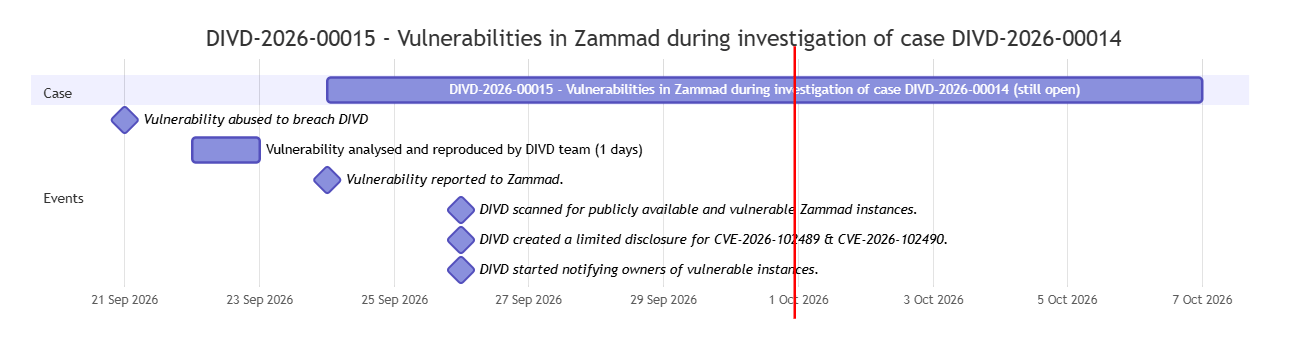
The Dutch Institute for Vulnerability Disclosure, a nonprofit organization of volunteer security researchers whose whole job is finding and responsibly disclosing vulnerabilities in other people’s software, just disclosed that it got breached through two zero-days in its own ticketing system.

The attackers got in through Zammad, an open-source helpdesk platform that DIVD used internally. Working with Merlon Security, DIVD identified two previously unknown vulnerabilities, tracked as CVE-2026-102489 and CVE-2026-102490.

Each vulnerability was serious on its own, but chaining them made the attack much more dangerous. The attackers could hijack sessions, run code remotely and move from a regular Zammad account to root access within seconds. DIVD said the speed was linked to the use of an AI agent during the attack.

“When hackers get hacked, we deal with it in hacker style. While trying to figure out how the attackers got into our own systems, 𝘄𝗲 𝗳𝗼𝘂𝗻𝗱 𝘁𝘄𝗼 𝘇𝗲𝗿𝗼-𝗱𝗮𝘆 𝘃𝘂𝗹𝗻𝗲𝗿𝗮𝗯𝗶𝗹𝗶𝘁𝗶𝗲𝘀 𝗶𝗻 𝗭𝗮𝗺𝗺𝗮𝗱.” the organization wrote on LinkedIn. “Used together, they allowed the attackers to hijack sessions, run code remotely and escalate privileges from the Zammad user to root, in seconds, due to the agentic part of this hack. From there they were able to access other services and read and exfiltrate data. We urge everyone using any version of Zammad to update to version 7 or take it offline as soon as possible.”

The attacker went from the initial access to root privileges in just seconds. The AI agent was able to make decisions and carry out the next steps without waiting for a human operator.

After gaining root access through Zammad, the attacker reached other services, accessed data and stole some of it. Network segmentation and a quick response from DIVD’s IT and incident response teams prevented the attacker from moving further.

However, DIVD said that some damage had already occurred before the attack was stopped. The investigation is still ongoing, with the next public update expected on October 1.

DIVD

Zammad has over 2,000 customers and 55,000 users. DIVD is actively notifying owners of vulnerable instances and has published a script to check logs for signs of abuse. The fix is version 7, which Zammad considers safe. If you can’t update immediately, the guidance is simple:

“We’re still in full investigation mode, and our next public statement will be on October 1st. For more information about the CVEs and a script to check your logs for abuse, check our case file. Link in comments.” the organization states. “If you run any version of Zammad, update to version 7 or take it offline as soon as possible.”

The advice from Zammad is clear: update to version 7 or take the system offline. The reason is simple: the attack can move from unauthenticated access to root privileges within seconds, with the AI agent automatically carrying out each step.

The incident also shows that AI-driven attacks are no longer just a theoretical risk. In this case, the agent was able to analyze the environment, chain the two vulnerabilities, gain higher privileges and move to other services without a human directing every action.

DIVD detected the attack partly because it was relatively noisy. The agent left visible traces of its activity, which helped investigators understand what happened. A more careful attacker using the same approach could be harder to detect.

Follow me on Twitter: @securityaffairs and Facebook and Mastodon

Pierluigi Paganini

(SecurityAffairs – hacking, Zammad)

  • ✇Security Affairs
  • Apple Patches CoreGraphics Zero-Day Linked to Sophisticated Targeted Attacks Pierluigi Paganini
    Apple patched zero-day CVE-2026-86950 in CoreGraphics, exploited in sophisticated targeted attacks against specific iOS users. Apple has released security updates for iOS, iPadOS and macOS to fix a zero-day vulnerability, tracked as CVE-2026-86950, in CoreGraphics that may have been exploited in attacks against specific individuals. The flaw is an out-of-bounds write that can lead to arbitrary code execution when the system processes a specially crafted file. The vulnerability affects iOS
     

Apple Patches CoreGraphics Zero-Day Linked to Sophisticated Targeted Attacks

29 de Setembro de 2026, 10:28

Apple patched zero-day CVE-2026-86950 in CoreGraphics, exploited in sophisticated targeted attacks against specific iOS users.

Apple has released security updates for iOS, iPadOS and macOS to fix a zero-day vulnerability, tracked as CVE-2026-86950, in CoreGraphics that may have been exploited in attacks against specific individuals. The flaw is an out-of-bounds write that can lead to arbitrary code execution when the system processes a specially crafted file.

The vulnerability affects iOS 26.7 and earlier versions before iOS 27, as well as iPadOS 26.7 and earlier and supported versions of macOS Tahoe and macOS Sequoia. Apple released iOS 26.7.1, iPadOS 26.7.1, macOS Tahoe 26.7.1 and macOS Sequoia 15.8.1 to address the issue.

“Processing a maliciously crafted file may lead to arbitrary code execution. Apple is aware of a report that this issue may have been exploited in an extremely sophisticated attack against specific targeted individuals on versions of iOS before iOS 27.” reads Apple’s advisory. “Description: “An out-of-bounds write issue was addressed with improved bounds checking.”

The more important sentence, however, is the one that turns this from another vulnerability disclosure into a security incident worth watching. Apple says it knows of a report that the flaw may have been exploited in an “extremely sophisticated attack against specific targeted individuals” running versions of iOS before iOS 27.

Apple hasn’t disclosed who was targeted, how many people were affected, whether the attacks succeeded, or when exploitation started. It also hasn’t explained how attackers delivered the malicious files. That leaves an important part of the attack chain unknown.

CoreGraphics handles graphics and rendering functions across Apple’s operating systems, including processing content such as images and PDFs. Attackers can trigger the flaw by tricking the victim into opening a malicious file sent through a web page, an email attachment, or a messaging application, However, Apple hasn’t confirmed any of these delivery methods for CVE-2026-86950.

That distinction matters. A crafted file doesn’t need to look like an obvious executable for a vulnerability in a system component that processes content to become useful to an attacker. The security boundary can be crossed while the operating system is simply doing what it’s designed to do: interpreting a file.

Meta Product Security discovered and reported the vulnerability to Apple. The involvement of Meta is particularly interesting because the company has previously identified attacks involving Apple vulnerabilities and targeted users of its messaging platforms.

Last year, WhatsApp disclosed that a vulnerability in its iOS and macOS applications, tracked as CVE-2025-55177, was likely chained with Apple’s ImageIO zero-day CVE-2025-43300 in zero-click attacks against fewer than 200 users. There is no evidence that the new CoreGraphics vulnerability was used through WhatsApp, and SecurityWeek reported that it was seeking clarification from Meta.

That uncertainty is worth keeping intact. It would be easy to connect the two incidents simply because Meta reported the new Apple flaw, but the available information doesn’t establish that link.

The patch itself is also interesting because Apple has fixed the vulnerability in the older operating system branches rather than treating the move to the latest major release as the only answer. Apple released iOS 26.7.1 and iPadOS 26.7.1 for supported iPhones and iPads, while macOS Tahoe 26.7.1 and macOS Sequoia 15.8.1 address the problem on Macs.

CISA had not yet added CVE-2026-86950 to its Known Exploited Vulnerabilities catalog.

This isn’t the first Apple vulnerability this year to carry an exploitation warning. In February, Apple patched CVE-2026-20700, a memory corruption issue in the dynamic linker, or dyld, after reporting that it had been weaponized in sophisticated attacks.

The pattern is more relevant than the individual CVE. Attackers targeting a small number of people don’t need a vulnerability that affects millions of devices indiscriminately. They need a reliable flaw in a component that processes content, a way to get that content in front of the target, and an exploitation chain that can survive the platform’s security controls.

The practical response is straightforward. Organizations managing Apple devices should identify systems still running affected releases and prioritize the relevant security updates, particularly where devices belong to executives, researchers, journalists, government personnel or other users who may face targeted attacks.

Follow me on Twitter: @securityaffairs and Facebook and Mastodon

Pierluigi Paganini

(SecurityAffairs – hacking, Apple)

  • ✇Security Affairs
  • Citrix Confirmed Two New NetScaler Flaws Exploited as Zero-Day Pierluigi Paganini
    Citrix confirmed two critical NetScaler zero-days were exploited before patches were available, with attackers able to remotely execute code. Citrix confirmed that two critical zero-day vulnerabilities in NetScaler ADC and NetScaler Gateway were exploited before the company released patches. The flaws allow remote code execution, meaning attackers can potentially take control of affected appliances. The first warnings did not come from Citrix. On September 26, administrators said IT provider
     

Citrix Confirmed Two New NetScaler Flaws Exploited as Zero-Day

27 de Setembro de 2026, 14:29

Citrix confirmed two critical NetScaler zero-days were exploited before patches were available, with attackers able to remotely execute code.

Citrix confirmed that two critical zero-day vulnerabilities in NetScaler ADC and NetScaler Gateway were exploited before the company released patches. The flaws allow remote code execution, meaning attackers can potentially take control of affected appliances. The first warnings did not come from Citrix. On September 26, administrators said IT providers and security teams were privately advising them to take NetScaler systems offline, sometimes without explaining why.

The two zero-day issues are not related to NetScaler vulnerabilities CVE-2026-19490 and CVE-2026-19489 that were disclosed in August.

The reports show how the attacks were already underway while defenders were still waiting for official details and fixes.

Security researchers at watchTowr then confirmed that the reports were credible. The company said it was investigating reports of multiple unpatched NetScaler remote code execution flaws being exploited in the wild and later said the vulnerabilities had been found during forensic investigations.

“We are currently rapidly reacting to rumors that multiple unpatched Citrix NetScaler RCE vulnerabilities are circulating in the wild. While details are scarce, the information is credible,” watchTowr wrote on X.

We have been made aware of further info, which we are sharing. We had no idea Citrix sysadmins were like GTA6 fans – so friendly 🤗

Please, direct further questions to Citrix. We are not Citrix PSIRT (despite it occasionally looking that way).

Citrix comms & patches are… https://t.co/OemTXwG8PB

— watchTowr (@watchtowrcyber) September 26, 2026

The Dutch National Cyber Security Centre also sent a pre-notification to organizations in the Netherlands. According to a notice seen by BleepingComputer, a European partner CERT had shared information about two critical NetScaler zero-days that could allow remote code execution. One of the flaws could even let an attacker inject shellcode directly into memory.

That warning has now become a confirmed security incident.

Citrix published fixes for the two exploited vulnerabilities on September 27, along with patches for six other security issues. The company confirmed that both NetScaler flaws had been exploited against systems that had not been mitigated, although it hasn’t said how many organizations were affected, who was behind the attacks or when exploitation started.

“Citrix has released updates for NetScaler ADC and NetScaler Gateway to address multiple security vulnerabilities. These vulnerabilities vary by deployment configuration and enabled features, and include issues that could allow remote code execution, denial of service, HTTP request smuggling, policy bypass, and TCP initial sequence number prediction under specific conditions.” reads the advisory. “Exploitation of CVE-2026-88771 and CVE-2026-88772 on unmitigated NetScaler deployments has been observed. Citrix strongly urges affected customers to install the relevant updated versions as soon as possible. “

Citrix confirmed active exploitation of CVE-2026-88771 (CVSS score of 9.5) and CVE-2026-88772 (CVSS score of 9.5) on unpatched systems and urged customers to install the relevant updates as soon as possible.

“Exploitation of CVE-2026-88771 and CVE-2026-88772 on unmitigated NetScaler deployments has been observed. Citrix strongly urges affected customers to install the relevant updated versions as soon as possible.” Continue the advisory.

The first vulnerability, CVE-2026-88771, involves improper input validation and allows an unauthenticated attacker to execute arbitrary commands, and Citrix says it affects all NetScaler ADC and NetScaler Gateway deployments in the affected versions without requiring an additional feature to be enabled.

The second flaw, CVE-2026-88772, is a memory overflow that can lead to remote code execution or denial of service, and it affects appliances with DTLS enabled. That’s particularly relevant for NetScaler Gateway because DTLS is enabled by default for VPN virtual servers unless an administrator has explicitly disabled it.

NetScaler sits at a particularly sensitive point in many corporate networks. These appliances provide VPN and remote access, load balancing and authentication, so compromising one can give an attacker a useful position at the edge of an organization.

Citrix’s fixes are available in NetScaler ADC and Gateway 14.1-73.37 and later, and in the 13.1-64.23 and later releases. Fixes are also available for the 14.1-FIPS, 13.1-FIPS and 13.1-NDcPP branches.

There’s an important detail for organizations that patched NetScaler last month. The builds 14.1-73.32 and 13.1-63.21, which fixed the previously disclosed authentication-bypass vulnerability CVE-2026-19490, are still within the affected range for these new flaws. Installing those earlier builds doesn’t address the two newly disclosed vulnerabilities.

The 13.1 branch also deserves attention because that release line reached End of Maintenance on September 15. The new security fix still covers it, but organizations running that branch should factor its maintenance status into their upgrade planning.

But patching the two zero-days is only half the job.

Citrix is providing generic Indicators of Compromise (IoCs) through NetScaler Console to help customers quickly assess whether their NetScaler deployments may have been compromised.

The feature is available in NetScaler Console service and on-premises deployments with Cloud Connect, starting with version 14.1-73.36, and requires the telemetry channel to be enabled. Customers can launch scans from the Security Advisory page once the IoC detection logic is released. Those without NetScaler Console can contact Citrix Support for access and assistance. Citrix warns that the IoCs do not cover all attacker techniques and may miss compromises, so experienced forensic investigators should be involved when needed.

Follow me on Twitter: @securityaffairs and Facebook and Mastodon

Pierluigi Paganini

(SecurityAffairs – hacking, newsletter)

  • ✇Security Affairs
  • F5 BIG-IP APM Zero-Day Exploited in Zero-Day RCE Attacks Pierluigi Paganini
    F5 warns of a critical BIG-IP APM zero-day, CVE-2026-94127, allowing remote code execution. Attackers are already exploiting it. F5 has released emergency security updates for a critical vulnerability, tracked as CVE-2026-94127 (CVSS score of 9.8), in BIG-IP Access Policy Manager (APM) that attackers are already exploiting in the wild. The flaw can allow an unauthenticated attacker to execute arbitrary code on a vulnerable BIG-IP system. F5 disclosed the issue on September 22 and confirme
     

F5 BIG-IP APM Zero-Day Exploited in Zero-Day RCE Attacks

23 de Setembro de 2026, 15:12

F5 warns of a critical BIG-IP APM zero-day, CVE-2026-94127, allowing remote code execution. Attackers are already exploiting it.

F5 has released emergency security updates for a critical vulnerability, tracked as CVE-2026-94127 (CVSS score of 9.8), in BIG-IP Access Policy Manager (APM) that attackers are already exploiting in the wild.

The flaw can allow an unauthenticated attacker to execute arbitrary code on a vulnerable BIG-IP system. F5 disclosed the issue on September 22 and confirmed that exploitation had already been observed.

The vulnerability affects BIG-IP APM deployments using an access policy together with an OAuth profile on a virtual server. More specifically, the vulnerable configuration is one in which APM operates as an OAuth Authorization Server. Systems using APM only as an OAuth Client or Resource Server are not affected.

“When a BIG-IP APM access policy and an OAuth profile are configured on a virtual server, specific malicious traffic can lead to remote code execution (RCE). This vulnerability is only present when BIG-IP APM is configured as an OAuth Authorization Server. Deployments using APM strictly as an OAuth Client / Resource Server (without OAuth authorization server profiles configured) are not affected by this vulnerability. (CVE-2026-94127)” reads the advisory. “This vulnerability allows an unauthenticated attacker to perform RCE. The BIG-IP system in Appliance mode is also vulnerable. This is a data plane issue; there is no control plane exposure. We have learned that this vulnerability has been exploited.”

F5 says the affected versions include BIG-IP 17.1.0 through 17.1.3, 17.5.0 through 17.5.1, and 21.1.0. The company has released hotfixes for the vulnerable branches. The flaw affects the data plane rather than the BIG-IP management plane, and F5 says the appliance mode is also vulnerable.

The attack is particularly concerning because BIG-IP appliances are commonly positioned at the edge of corporate networks and handle authentication and access to internal applications. A successful compromise could therefore give an attacker a valuable position from which to move deeper into an organization’s infrastructure.

F5 has also provided indicators that defenders can use to look for signs of exploitation. The company recommends paying particular attention to environments showing repeated OAuth authentication failures followed by suspicious commands and, shortly afterward, a TMM SIGABRT event.

Organizations that cannot immediately install the hotfix can apply a temporary mitigation. F5 recommends deploying an iRule provided through its support channels to the affected BIG-IP APM virtual server. However, this should be considered a temporary measure rather than a replacement for the security update.

Shortly after F5 published its advisory, the US Cybersecurity and Infrastructure Security Agency (CISA) added CVE-2026-94127 to its Known Exploited Vulnerabilities (KEV) catalog. US federal agencies were instructed to address the vulnerability by September 25, 2026.

Internet exposure also appears significant. Shadowserver is currently tracking more than 14,700 IP addresses showing BIG-IP APM fingerprints, although this number does not indicate how many systems are actually vulnerable or unpatched.

For organizations running BIG-IP APM, the immediate priority is to determine whether the affected OAuth configuration is in use, identify exposed systems, install the appropriate hotfix and review logs for possible compromise.

Because F5 has confirmed active exploitation, administrators should also treat patching as an incident-response priority rather than as routine vulnerability management.

F5 advisory and technical details: F5 BIG-IP APM security advisory

Follow me on Twitter: @securityaffairs and Facebook and Mastodon

Pierluigi Paganini

(SecurityAffairs – hacking, F5 BIG-IP)

  • ✇Security Affairs
  • ShinyHunters claims FBI breach after alleged PeopleSoft zero-day attack Pierluigi Paganini
    ShinyHunters claims FBI breach via PeopleSoft zero-day, steals staff data; FBI investigating, no confirmation yet. The popular cybercrime group ShinyHunters is claiming that it breached the U.S. Federal Bureau of Investigation (FBI) and stole sensitive information belonging to FBI employees and job applicants. The group says the operation was not financially motivated and was instead carried out in response to an FBI warning published earlier this year. The claim surfaced on September 22
     

ShinyHunters claims FBI breach after alleged PeopleSoft zero-day attack

23 de Setembro de 2026, 10:56

ShinyHunters claims FBI breach via PeopleSoft zero-day, steals staff data; FBI investigating, no confirmation yet.

The popular cybercrime group ShinyHunters is claiming that it breached the U.S. Federal Bureau of Investigation (FBI) and stole sensitive information belonging to FBI employees and job applicants. The group says the operation was not financially motivated and was instead carried out in response to an FBI warning published earlier this year.

The claim surfaced on September 22 and quickly drew attention after ShinyHunters said it had obtained data on a large number of current and former FBI personnel. The group reportedly offered a sample of around 5,000 records as evidence and claimed that the stolen information could include names, addresses, phone numbers, Social Security numbers, assignments and, in some cases, family details.

Reuters was able to partially match some of the sample information with other records, including data associated with FBI Director Kash Patel. However, the news agency could not determine where the information originally came from or independently confirm that it had been stolen from FBI systems.

“Reuters was able to partially verify the authenticity of the information by running the details, including the Social Security numbers, ​against credit bureau records and previously breached data preserved by the dark-web intelligence firm District 4 Labs.” reads the report published by Reuters. “In at least 10 instances — including in the case ‌of FBI ⁠Director Kash Patel — Reuters found details that appeared to match. A person familiar with the matter said that the job descriptions in the data also matched in at least some cases.”

The FBI has acknowledged that it is aware of claims involving unauthorized activity affecting FBIjobs.gov and said it is investigating. The agency has not confirmed that its internal systems were compromised or that ShinyHunters obtained the data it claims to possess.

ShinyHunters has provided a possible technical explanation for the alleged intrusion. The group claims the exploitation of an Oracle PeopleSoft zero-day, reportedly using it to gain remote code execution through infrastructure connected to the FBI’s recruitment services.

The claim is notable because ShinyHunters has already been linked to attacks exploiting a real PeopleSoft zero-day earlier this year. In June, Oracle addressed CVE-2026-35273, a critical unauthenticated remote code execution vulnerability in PeopleSoft PeopleTools. Google and Mandiant later linked exploitation of that flaw to ShinyHunters activity targeting organizations, particularly in the education sector.

That history makes the latest claim technically plausible, but it does not prove that the same group used another PeopleSoft zero-day against the FBI. No public CVE or vendor confirmation currently exists for the alleged new vulnerability.

The attackers also reportedly claimed access to several FBI-related services, including human resources systems and a system they referred to as Medlink. They allegedly said that between 2 TB and 3 TB of data had been taken and that the FBI jobs infrastructure had been compromised.

Reuters and other media outlets confirmed the recruitment website did experience disruption around the time of the claim. A page that had reportedly been defaced by the attackers later displayed a scheduled-maintenance message. That disruption could be consistent with an intrusion, but it is not by itself proof that the wider FBI systems were breached.

There is also a clear motive behind the operation claimed by ShinyHunters. The group says it targeted the FBI after a May 2026 public advisory describing its tactics and warning victims against paying. ShinyHunters disputes the FBI’s characterization of its activities and is reportedly demanding that the Bureau retract or correct the warning.

This makes the alleged attack unusual. Instead of immediately demanding a conventional ransom, the group appears to be using the stolen data as leverage in a dispute with U.S. law enforcement.

The timing is also significant. ShinyHunters has recently claimed responsibility for several major breaches and has been involved in a public dispute with the Clop cybercrime operation. The group recently claimed to have compromised Clop’s data leak site, highlighting the increasingly aggressive behavior surrounding the group.

For now, however, the FBI investigation remains the missing piece. Until investigators confirm the intrusion, the extent of access and the origin of the leaked records, the ShinyHunters account should remain a claim rather than an established FBI breach.

What is already clear is that the incident would be serious if confirmed. Personal information belonging to law enforcement personnel could expose agents and their families to targeted harassment, social engineering and other forms of abuse. But the available evidence does not yet allow those consequences to be attributed to a confirmed compromise of FBI internal systems.

Follow me on Twitter: @securityaffairs and Facebook and Mastodon

Pierluigi Paganini

(SecurityAffairs – hacking, FBI)

  • ✇Security Affairs
  • Chaotic Eclipse Released BigDiskBuster, A PoC For Windows Defender Update DoS Zero-Day Pierluigi Paganini
    The researcher Chaotic Eclipse released BigDiskBuster, a PoC exploit for a Windows Defender Update DoS Zero-Day vulnerability. Security researcher Chaotic Eclipse, also known as INFINITE NIGHTMARE, MSNightmare and Nightmare-Eclipse, released a new zero-day exploit targeting Microsoft Defender. The researcher named the exploit BigDiskBuster, it triggers a Denial of Service Vulnerability in Windows Defender Update. The security researcher claims to have developed BigDiskBuster, a proof-of-c
     

Chaotic Eclipse Released BigDiskBuster, A PoC For Windows Defender Update DoS Zero-Day

22 de Setembro de 2026, 11:04

The researcher Chaotic Eclipse released BigDiskBuster, a PoC exploit for a Windows Defender Update DoS Zero-Day vulnerability.

Security researcher Chaotic Eclipse, also known as INFINITE NIGHTMARE, MSNightmare and Nightmare-Eclipse, released a new zero-day exploit targeting Microsoft Defender. The researcher named the exploit BigDiskBuster, it triggers a Denial of Service Vulnerability in Windows Defender Update.

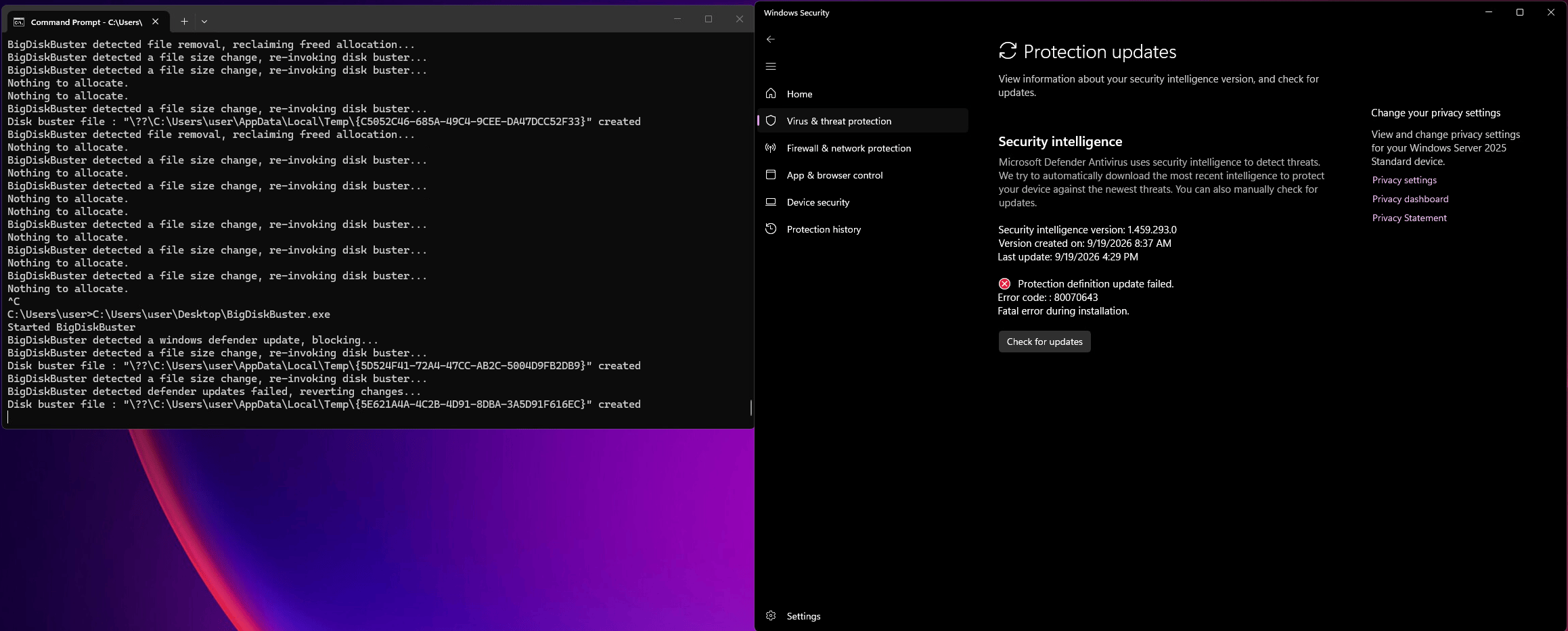
The security researcher claims to have developed BigDiskBuster, a proof-of-concept that can block Microsoft Defender from receiving platform and signature updates.

“This proof of concept is similar to UnDefend, it prevents windows defender from performing platform/signature updates.” wrote the expert. “Seems to work on all supported windows versions but PoC is a bit buggy and needs some rewritting but you get the idea.”

Chaotic Eclipse says the technique works across supported Windows versions, although the current PoC is still buggy and needs further development.

In September, Chaotic Eclipse released multiple zero-day exploits targeting Nvidia (GreenSection) and Microsoft Defender (ShieldCrash).

Recently, Chaotic Eclipse also released exploits targeting other anti-malware and defense solutions. Chaotic Eclipse released a zero-day exploit targeting Kaspersky Endpoint Security he named HardBreacher, which triggers a privilege escalation flaw. The researcher pointed out that the PoC is unstable and may require repeated attempts, but when successful, it creates a DLL in System32 with full user permissions. The researcher also claims taking control of Kaspersky’s UI process can disrupt the antivirus and interfere with file-access controls, potentially leaving the system in an unstable state.

Nightmare Eclipse says the Kaspersky Endpoint Security zero-day allows privilege escalation on a fully patched Windows 11 25H2 system running Kaspersky Endpoint v14.0.0.504.

The researcher also released a zero-day exploit targeting GenDigital Avast Antivirus, named PrettyPrague. The exploit triggers a privilege escalation flaw.

The expert claims to have found another zero-day in an antimalware product, this time targeting Avast Antivirus. The PoC exploits a flaw in Avast Sandbox to dump the Windows SAM database and gain a SYSTEM-level shell. It reportedly works even on fully patched Avast Antivirus and Windows 11 25H2. The researcher also suspects the flaw may affect other Gen Digital products, including AVG and Norton.

Finally, Chaotic Eclipse released a new zero-day exploit targeting Crowdstrike Falcon cybersecurity platform. The researcher named the exploit FalconFlank, it triggers a privilege escalation flaw.

According to the researcher, FalconFlank abuses Falcon’s “Microsoft Office file malicious macro removal” feature. The function is part of Falcon’s remediation capabilities and operates with high privileges. The researcher claims that this behavior can be abused to escalate privileges from a low-privileged local user to a more powerful context.

Chaotic Eclipse is a researcher known for publicly releasing PoC exploits for zero-day vulnerabilities, often after criticizing vendors’ handling of vulnerability reports. His releases have mainly targeted Microsoft products, including Windows and Microsoft Defender, with some later exploited in the wild. Among the most notable are the Undefend and RedSun Defender zero-days.

His work has fueled debate over responsible disclosure and the risks of publishing working exploits.

Recently, Chaotic Eclipse revealed that he is Abdelhamid Naceri, a security researcher. Naceri previously worked with Microsoft in the UK and Germany. In a now-deleted X post, he described his departure from the company, claiming Microsoft terminated his employment without giving him a clear reason. He said Microsoft offered several financial settlements, but he rejected them because he wanted a formal explanation and help staying in Germany.

Naceri also said he challenged the dismissal in a German labor court. According to his account, Microsoft changed its arguments during the case, but the court ultimately upheld the termination. He said the long legal dispute left him with almost no compensation and caused serious financial and emotional problems, including treatment in a psychiatric hospital.

The researcher also admitted that an earlier claim that Microsoft had taken legal action against him was fabricated. The claim came during the controversy over Microsoft’s threats of legal action against security researchers who disclosed zero-day vulnerabilities.

Follow me on Twitter: @securityaffairs and Facebook and Mastodon

Pierluigi Paganini

(SecurityAffairs – hacking, BigDiskBuster)

  • ✇Security Affairs
  • Google Patches Pixel Modem Zero-Day Exploited in Targeted Attacks Pierluigi Paganini
    Google has patched a high-severity zero-day in the Pixel cellular modem after finding evidence that the vulnerability was exploited in limited, targeted attacks. Google has released its September 2026 Pixel security update, addressing a large set of vulnerabilities, including a high-severity flaw, tracked as CVE-2026-58704 (CVSS score of 8.0), in the cellular modem that has already been exploited in the wild. “In Cellular Modem, there is a possible permission bypass due to a logic error i
     

Google Patches Pixel Modem Zero-Day Exploited in Targeted Attacks

16 de Setembro de 2026, 10:43

Google has patched a high-severity zero-day in the Pixel cellular modem after finding evidence that the vulnerability was exploited in limited, targeted attacks.

Google has released its September 2026 Pixel security update, addressing a large set of vulnerabilities, including a high-severity flaw, tracked as CVE-2026-58704 (CVSS score of 8.0), in the cellular modem that has already been exploited in the wild.

“In Cellular Modem, there is a possible permission bypass due to a logic error in the code. This could lead to remote (proximal/adjacent) escalation of privilege with no additional execution privileges needed. User interaction is not needed for exploitation.” reads the advisory.

The vulnerability is an elevation-of-privilege issue caused by a permission bypass resulting from a logic error in the modem code. Google said there are indications that the flaw may have been used in “limited, targeted exploitation.”

“There are indications that CVE-2026-58704 may be under limited, targeted exploitation.” states Google.

As usual, the IT giant has not disclosed who exploited the vulnerability, how many devices were targeted, or what the attacks were designed to achieve.

The vulnerability is particularly notable because it does not require user interaction. According to the CVE record, exploitation can result in remote, proximal or adjacent privilege escalation without requiring additional execution privileges.

The technical details suggest that an attacker able to reach the vulnerable modem environment could exploit the permission bypass to obtain higher privileges. The attack vector is classified as adjacent rather than broadly Internet-facing, an important distinction when assessing the practical exploitation requirements.

The flaw resides in a critical component of moder architecture. Unlike vulnerabilities affecting applications or higher-level Android components, CVE-2026-58704 resides in the cellular modem, a security-sensitive component responsible for communications between the device and mobile networks.

Modem vulnerabilities have historically attracted attention because they can operate below much of the Android application security model. They can also provide attackers with a path toward privileged access without relying on conventional malicious applications or phishing.

In this case, however, Google has not publicly described the complete attack chain. There is also no evidence in the company’s advisory identifying the operation as the work of a commercial spyware vendor or a specific state-sponsored group.

The limited-targeted nature of the exploitation is nevertheless notable.

It suggests that exploitation was not necessarily widespread and may have been directed at a small number of selected devices. Without additional information from Google or independent researchers, the targets and objectives remain unknown.

CVE-2026-58704 is only one of many vulnerabilities addressed by Google’s September Pixel release.

Google’s official Pixel bulletin lists additional security issues affecting components including the kernel, modem, bootloader, telephony stack, Trusted Execution Environment, GPU, Bluetooth, NFC, pKVM and several proprietary Pixel components. The bulletin includes multiple critical-severity vulnerabilities, including remote-code-execution flaws affecting the IP Multimedia Subsystem, libpixelimsmedia, VPU, modem, telephone and BigOcean components.

The broader September Android security bulletin also addresses additional vulnerabilities across the Android platform. Google states that devices using the 2026-09-05 security patch level or later are protected against the issues covered by the Pixel bulletin and the September Android Security Bulletin.

Google’s wording is deliberately limited: it says there are indications that CVE-2026-58704 may be under limited, targeted exploitation.

That is different from saying that the vulnerability is being widely exploited.

At the same time, the confirmation that exploitation has occurred changes the risk profile for affected Pixel users. A vulnerability that exists only as a theoretical security issue can be evaluated differently from one for which exploitation has already been observed.

The absence of public attribution also leaves several questions unanswered.

Was the vulnerability discovered and exploited by a private surveillance company? Was it used by a state-linked operation? Was it part of a broader intrusion chain targeting specific individuals?

At this stage, there is insufficient public evidence to answer those questions.

In the past, exploits of this kind have been used by nation-state actors and commercial spyware vendors.

What is clear is that Google considered the issue serious enough to disclose exploitation and include the fix in its September Pixel security release.

Google recommends that supported Pixel devices receive the latest security update. The 2026-09-05 security patch level addresses the vulnerabilities listed in the September Pixel bulletin as well as those covered by the Android security bulletin.

For users and organizations managing Pixel fleets, the exploitation status of CVE-2026-58704 makes timely patching particularly important.

The incident also highlights a broader security reality: the attack surface of a smartphone extends far beyond the applications installed by the user.

Follow me on Twitter: @securityaffairs and Facebook and Mastodon

Pierluigi Paganini

(SecurityAffairs – hacking, Pixel Modem)

  • ✇Security Affairs
  • One Exploit Chain, Two Espionage Campaigns: Chrome and Windows Under Fire Pierluigi Paganini
    Two China-linked groups ran identical Chrome/Windows zero-day exploits against NGOs, before Chrome’s patch shipped, deploying different backdoors each. Two China-linked threat actors used the same Chrome/Windows zero-day against NGOs starting September 1, 2026, Volexity’s new report lays out the whole chain in detail. On September 1, Volexity detected a spear-phishing campaign by UTA0560 targeting several NGOs. The emails sent victims to a legitimate US university website, which had a cro
     

One Exploit Chain, Two Espionage Campaigns: Chrome and Windows Under Fire

15 de Setembro de 2026, 07:17

Two China-linked groups ran identical Chrome/Windows zero-day exploits against NGOs, before Chrome’s patch shipped, deploying different backdoors each.

Two China-linked threat actors used the same Chrome/Windows zero-day against NGOs starting September 1, 2026, Volexity’s new report lays out the whole chain in detail.

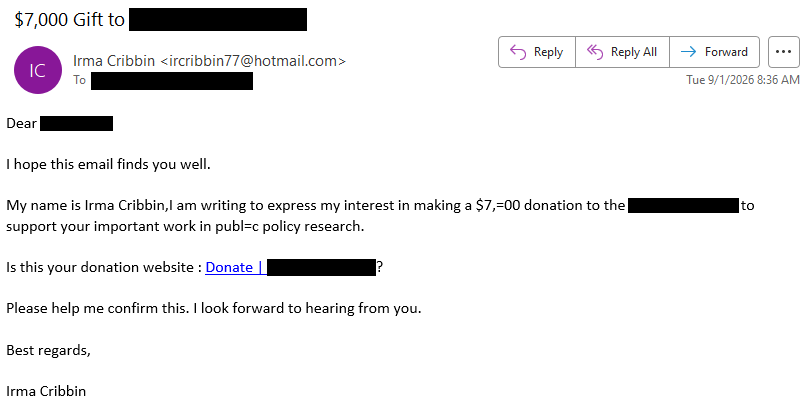
On September 1, Volexity detected a spear-phishing campaign by UTA0560 targeting several NGOs. The emails sent victims to a legitimate US university website, which had a cross-site scripting flaw that attackers used to redirect visitors to their own servers.

The victims were then exposed to a multi-stage attack using a Chrome zero-day CVE-2026-85046. Volexity later found JungleBamboo (also known as APT31, Violet Typhoon, or TA412) using the same exploit chain against different targets. The code was the same, but the infrastructure and final malware were different.

“The exploit first gains arbitrary read/write within the V8 sandbox through the Type confusion vulnerability (CVE-2026-85046), then combines a separate WebAssembly defect to escape the V8 sandbox (CVE-2026-87491). It then exploits a third vulnerability in the Windows kernel (CVE-2026-85880) to escape Chrome’s sandboxed renderer process and inject code into the Chrome browser process.” reads the report published by Volexity. “From there, exploit-chain users can deploy a payload of their choice. Volexity observed two distinct clusters of activity using the exploit chain to deliver different payloads:

  • UTA0560 downloaded and deployed the GRIMWEDGE JScript backdoor providing host reconnaissance, file and process management, command execution, and payload delivery capabilities.
  • JungleBamboo deployed SUPERSTOMP, a loader that installed the LONGTALE credential-stealing Chrome extension.”

Victims only saw an image of a donation form made to look like it belonged to the targeted organization. In reality, the page was there to steal, not collect, donations.

The core Chrome flaw, CVE-2026-85046, was reported to the Chromium project by a private researcher on August 4, 2026. A fix landed in the open-source Chromium codebase not long after. Google Chrome itself, though, hadn’t shipped that fix yet when the phishing started.

” This created an unusual patch gap: The vulnerability was known and fixed upstream, making it an N-day at the Chromium source level, but there was no patch release for Google Chrome users.” continues the report. “Therefore, the exploit was effectively a zero-day against Google Chrome.”

Someone was watching the Chromium source repository closely enough to catch a fix before most users ever got it, and turned it into a working exploit within weeks. Volexity researchers found byte-for-byte identical shellcode across both campaigns. UTA0560 and JungleBamboo weren’t independently reinventing the same exploit; they were running the same one.

The exploit page was far more sophisticated than it first appeared. It accepted 13 URL parameters to support testing, breakpoints, telemetry, and controlled rollouts.

That level of preparation doesn’t look like a quick attack put together on the fly. It suggests the attackers had built a proper development and testing framework, which was either left in place or deliberately used in the live campaign.

Once code execution lands, the two operators split. UTA0560 used its access to drop a custom loader chain ending in GRIMWEDGE, a JScript backdoor running entirely in memory inside msiexec.exe. It’s compact, under 250 lines, but it covers the basics: file operations, process management, command execution, and file upload.

JungleBamboo took a different route. It deployed a loader Volexity calls SUPERSTOMP, which installs a malicious Chrome extension named LONGTALE. The extension masquerades as a Google Gemini assistant and logs every keystroke, steals cookies and session tokens, and takes screenshots when it spots keywords supplied by its command server.

LONGTALE has no remote code execution command at all. It doesn’t need one. Volexity assesses the credential and session theft alone gave JungleBamboo everything it needed, and extensions like this tend to slip past detection more easily than a standalone executable.

Chrome has spent the last year hardening exactly the kind of tampering SUPERSTOMP relies on. Per-preference encrypted hashes arrived in November 2025, and a full-profile integrity check followed in June 2026. SUPERSTOMP still gets through, by stripping the new hashes, forging the older legacy HMAC values Chrome still accepts as a fallback, and letting Chrome’s own migration logic re-authenticate the tampered profile as legitimate.

“Chrome enables this legacy fallback method by default in its releases as of September 8, 2026; only compiling Chromium from source disables it.” Volexity states. “This technique was added to one of the most popular GitHub repositories relating to silent installation of Chrome extensions on August 6, 2026.”

Worth noting: this exact technique showed up in a popular GitHub repository for silent Chrome extension installs on August 6, 2026, weeks before JungleBamboo’s campaign. The line between public research and operational tradecraft keeps getting shorter.

The attribution work here is tidy. UTA0560’s link to its March 2026 campaigns rests on three points: the same phishing sender address, the same hosting IP for its exploit infrastructure, and a per-host beacon naming scheme that mirrors what UTA0560 used six months earlier.

“Volexity assesses with low confidence that the exploit chain may have been sold, or otherwise provided, to different end-users in China, hence the near-simultaneous campaigns conducted by separate threat actors using distinct post-exploitation malware. Volexity assesses with medium confidence that the short time window offered by the Chrome patch delay necessitated that these threat actors reuse the core exploit code without modification.” states the report. “Furthermore, the payloads used by each threat actor were compiled using different toolsets, suggesting entirely different development environments preferred by each malware developer.”

Proofpoint reported similar findings around the same time. It calls the exploit kit BlueMoon and says JungleBamboo first used it on August 28, several days before Volexity detected the campaign.

Proofpoint identified four different groups using the same code within about two weeks. One, tracked as UNK_LateNight, targeted US aerospace companies with the ShadowPad backdoor. Another, UNK_DoubleCheck, targeted a manufacturing company in Vietnam.

Proofpoint also found an interesting clue about how the exploit may have been developed. Some code artifacts suggest the attackers could have used AI during development. There’s no proof of that, but the diagnostic logs, handover notes, and debugging comments look unusual for a professionally developed exploit.

Google patched CVE-2026-85046 in the Stable Channel update on September 3, moving users to Chrome 152.0.7977.82 or .83, alongside eleven other fixes. CISA added the flaw to its Known Exploited Vulnerabilities catalog the next day, with a September 18 deadline for federal systems to remediate. If your fleet hasn’t relaunched Chrome since early September, it’s worth checking the version number rather than assuming the auto-update did its job.

Volexity’s closing point is the one to actually remember here, and it’s not really about UTA0560 or JungleBamboo specifically.

“As large language models become more popular and effective for rapid vulnerability research and exploit development, Volexity assesses with high confidence that patch-gap vulnerabilities present an even greater risk, as they create an additional time window for threat actors to conduct exploitation campaigns.” concludes the report.

Follow me on Twitter: @securityaffairs and Facebook and Mastodon

Pierluigi Paganini

(SecurityAffairs – hacking, Chrome)

  • ✇Security Affairs
  • Google fixes the seventh actively exploited Chrome zero-day of 2026 Pierluigi Paganini
    Google patched 230 Chrome flaws, including an actively exploited V8 bug that could let attackers run arbitrary code through a crafted HTML page. Google released a Chrome update fixing 230 security vulnerabilities, including one already exploited in the wild tracked as CVE-2026-87491 (CVSS score of 8.8). The medium-severity flaw affects V8, Google’s open source high-performance JavaScript and WebAssembly engine, Chrome’s JavaScript and WebAssembly engine. An attacker can exploit the out-o
     

Google fixes the seventh actively exploited Chrome zero-day of 2026

9 de Setembro de 2026, 10:47

Google patched 230 Chrome flaws, including an actively exploited V8 bug that could let attackers run arbitrary code through a crafted HTML page.

Google released a Chrome update fixing 230 security vulnerabilities, including one already exploited in the wild tracked as CVE-2026-87491 (CVSS score of 8.8). The medium-severity flaw affects V8, Google’s open source high-performance JavaScript and WebAssembly engine, Chrome’s JavaScript and WebAssembly engine.

An attacker can exploit the out-of-bounds write through a specially crafted HTML page and execute arbitrary code inside Chrome’s sandbox. Google fixed the issue in Chrome 153.0.8010.36 and later versions.

“CVE-2026-87491: Out of bounds write in V8” reads the advisory. “Google is aware that an exploit for CVE-2026-87491 exists in the wild.”

Researcher Jihyeon Jeong from Seoul National University reported the vulnerability on 2026-08-06.

As usual, Google did not disclose technical details about the attacks exploiting this vulnerability or attribute them to any specific threat actor.

Google rewarded the researcher with a $2,500 bounty for responsibly disclosing the vulnerability.

CVE-2026-87491 is the seventh actively exploited Chrome zero-day of 2026. Since the start of the year, Google has addressed the following zero-day flaws exploited in attacks in the wild:

  • February 2026 – CVE-2026-2441 (CVSS score: 8.8) – Use after free in CSS.
  • March 2026 – CVE-2026-3909 (CVSS score: 8.8) – Out-of-bounds write in the Skia 2D graphics library and CVE-2026-3910 (CVSS score: 8.8) – Flaw in the implementation of the V8 JavaScript/WebAssembly engine.
  • April 2026 – CVE-2026-5281 (CVSS score: 8.8) – Use-after-free bug in Dawn, the WebGPU component used for graphics processing.
  • June 2026 – CVE-2026-11645 (CVSS score: 8.8) – Out-of-bounds memory access in the V8 JavaScript engine
  • September – CVE-2026-85046 (CVSS score: 8.8) – V8 type confusion flaw.

Google has updated Chrome Stable to version 153.0.8010.36 on Linux and 153.0.8010.36/.37 on Windows and Mac. The release includes several fixes and improvements, with the rollout expected over the coming days and weeks.

Follow me on Twitter: @securityaffairs and Facebook and Mastodon

Pierluigi Paganini

(SecurityAffairs – hacking, newsletter)

  • ✇Security Affairs
  • StyleSmuggler: The Magento Zero-Day Behind New Store Attacks Pierluigi Paganini
    StyleSmuggler Magento zero-day is under active attack, letting unauthenticated attackers execute code and install backdoors on stores that may already be patched. A new zero-day flaw, dubbed StyleSmuggler, in Magento and Adobe Commerce is under active attack, giving unauthenticated attackers a path to run code on vulnerable online stores. Sansec researchers say it affects current Magento Open Source releases, including 2.4.7, 2.4.8 and 2.4.9. According to the experts, exploitation began on S
     

StyleSmuggler: The Magento Zero-Day Behind New Store Attacks

7 de Setembro de 2026, 14:49

StyleSmuggler Magento zero-day is under active attack, letting unauthenticated attackers execute code and install backdoors on stores that may already be patched.

A new zero-day flaw, dubbed StyleSmuggler, in Magento and Adobe Commerce is under active attack, giving unauthenticated attackers a path to run code on vulnerable online stores. Sansec researchers say it affects current Magento Open Source releases, including 2.4.7, 2.4.8 and 2.4.9. According to the experts, exploitation began on September 4.

“Sansec discovered StyleSmuggler, an unpatched Magento and Adobe Commerce zero-day that gives unauthenticated attackers remote code execution. All current versions are affected, including 2.4.9.” reads the report published by Sansec. “Attacks started September 4th. Sansec is rolling out emergency mitigation.”

This is not a routine patch-cycle problem. Sansec reproduced the full attack chain on clean installations and observed a first victim running Magento 2.4.6-p15 with July and August 2026 patches already applied and a clean patch-status result. In plain terms, a store could be fully updated according to its normal process and still be exposed.

“StyleSmuggler injects malicious code into Magento’s template system.” states Sansec. “By using the styles properties, it can evade existing safeguards. It works in two stages:

  1. Inject (poison) PHP code, for example by generating a failure report.
  2. Let Magento execute the poisoned code via a failed payment email“

The attack is especially dangerous because it does not require a victim to open an attachment, click a link or even receive a successful email. Magento can execute the injected code while it renders its standard “Payment Transaction Failed Reminder” notification, and the chain can still work if email delivery itself fails.

That makes unusual spikes in failed-payment reminders a useful detection clue, although not conclusive proof of compromise. Legitimate payment failures happen. A sudden burst of them combined with strange system activity is a different conversation.

StyleSmuggler works by placing PHP code into Magento’s templating path and later causing the platform to evaluate it. The first stage creates or poisons a record, while the second stage turns a routine email-rendering process into remote code execution.

The attack reportedly uses GraphQL-related handling and the styles property to evade safeguards that would normally reject dangerous input. Sansec says moving sessions to Redis or a database does not stop the attack, because operators have already adapted their methods when one delivery route fails.

“Moving sessions to Redis or the database does not stop the attack. One merchant reported an attempt that failed against session storage and, eight seconds later, a second attempt that succeeded by using a file uploaded through Magento’s custom options instead.” continues the report. “Both came from the same operator.”

That detail matters because it shows an active operator, not a static proof-of-concept circulating online. Defenders should assume attackers are testing several paths, watching failures and changing tactics quickly.

Once the exploit succeeds, Sansec observed a lightweight Rust backdoor that connects to attacker-controlled infrastructure and waits for commands. At the time of the report, Sansec had not seen evidence that operators had yet used the implant for follow-on actions, but a backdoor that is installed and waiting is not an idle technical curiosity.

The malware initially hid behind a process name resembling [kworker/u:8:0], then appeared as fc-cache on September 6 and as chronyd on September 7.

These names are designed to blend into Linux environments, where administrators may expect to see kernel workers, font-cache utilities and Network Time Protocol daemons.

The fc-cache variant copies itself into a font-cache directory, writes a PID lock file and uses cron to restart twice an hour. The chronyd version can persist through cron as well, but Sansec also observed a build that relaunched itself without relying on a visible cron entry. An empty crontab is not proof that a host is clean.

The command channel is disguised as time synchronisation traffic. The implant sends 48-byte UDP packets to port 123, the standard NTP port, and uses domains that resemble time servers.

“Command and control is disguised as time sync. Every 60 seconds it resolves ntp.timesync.to and sends 48-byte UDP packets to port 123 that look like NTP server replies.” continues the report.

Only the first four bytes look like a normal NTP message; the remaining data can carry the agent ID, hostname, username, operating-system version, memory and disk use, uptime, root status and implant version.

That is a smart concealment choice. Many networks allow NTP traffic without close inspection because reliable time synchronisation is a normal operational requirement. Calling your malware chronyd and making it speak something that resembles NTP is not subtle genius. It is just clever enough to pass a lazy allowlist.

Sansec also found signs of a second, apparently unrelated attacker operating against stores compromised through StyleSmuggler. This actor deployed a compact PHP dropper that placed a web shell inside the product-image cache, using hash-like directory names to make the extra PHP file less obvious.

The web shell returns a normal-looking 404 response unless a request contains the correct X-Cache-Token header. With the header present, it can execute PHP supplied through a POST parameter. That design helps the attacker keep the shell invisible during casual checks and automated scans.

“Before writing that file, the dropper calls out to 457cfa2fb7p5.daf892t5qau4og8pi4cghbc6fhm1dim3u.oast.site, a subdomain of a public service that developers and testers use to confirm that injected code ran.” states the report. “This actor came in through StyleSmuggler. We recovered the dropper from a Store: request header, and its PHP tags are still JSON-escaped from the record Magento logged it into.”

The lesson is not merely to remove the obvious background process. Stores need a full compromise assessment, including a review of PHP files under pub/media, cron spool files, unexpected processes, altered templates, report records, web-server logs and outbound connections.

Adobe was working on a patch as of September 7, according to Sansec, but no release date had been confirmed. A scheduled Adobe security release was due on September 8, although it was not known whether it would address StyleSmuggler.

Until an official fix is available and applied, merchants should consider temporarily disabling GraphQL if they do not have a compensating control capable of blocking this exploit. This can affect storefront and integration functions, so it should be treated as a risk decision rather than a casual configuration change.

Operators should also hunt for processes named [kworker/u:8:0], fc-cache and chronyd that run from unusual paths such as temporary directories, user cache directories or hidden folders. A legitimate chronyd process does not normally emit nine NTP server-mode packets in rapid succession every minute.

Security teams should inspect outbound traffic to suspicious NTP-like domains and UDP port 123 destinations, particularly 185.157.160.251, which Sansec linked to the observed domains on September 7. They should also search authentication and system logs for repeated crontab command not allowed messages generated by the web-service user, such as www-data.

If compromise indicators appear, treat the system as compromised, not merely vulnerable. Isolate the host, preserve logs and forensic evidence, rotate Magento administrator credentials, API tokens, database credentials, payment-provider secrets and cloud keys, then search for secondary backdoors before restoring normal operations.

The Sansec StyleSmuggler report includes current indicators of compromise, malware hashes, C2 infrastructure, suspicious process names and file paths. Its guidance will likely change as the campaign develops, because the attackers have already changed payload names and persistence methods within days.

Follow me on Twitter: @securityaffairs and Facebook and Mastodon

Pierluigi Paganini

(SecurityAffairs – hacking, StyleSmuggler)

❌
❌