Visualização normal

Antes de ontemFirewall Daily – The Cyber Express

The Cyber Express Weekly Roundup: Claude Session Hijacking, PaperCut Exploits, and Enterprise Cyberattacks

4 de Setembro de 2026, 08:48

Weekly Roundup September 2026

This weekly roundup highlights a range of cybersecurity developments affecting artificial intelligence platforms, enterprise software, healthcare organizations, social media accounts, and internet-facing infrastructure.  From stolen Claude sessions and bypassed PaperCut security fixes to an attempted attack targeting hundreds of thousands of X users, recent incidents demonstrate how attackers continue to exploit both software vulnerabilities and active user sessions.  The latest developments also show that organizations face growing risks across AI services, on-premises systems, enterprise edge devices, and account recovery infrastructure. Security teams are being urged to respond quickly as attackers increasingly target exposed systems and authentication mechanisms. 

The Cyber Express Weekly Roundup 

Anthropic Warns of Claude Session Hijacking 

Anthropic has warned that common infostealer malware is being used to steal active Claude sessions, potentially allowing attackers to bypass passwords and two-factor authentication. The campaign involves malware such as Vidar, LummaC2, RedLine, and Atomic Stealer, which is often distributed through pirated software and illicit downloads. Attackers may also consume victims’ paid AI usage. Read more… 

PaperCut Releases Second Emergency Patch After First Fix Is Bypassed 

PaperCut has released a second emergency patch for two actively exploited vulnerabilities affecting its NG and MF print management servers. Researchers discovered ways to bypass the initial security fix, potentially allowing attackers to chain the flaws and achieve pre-authentication remote code execution on exposed systems. Read more… 

Boston Scientific Cyberattack Limited to Certain On-Premises Systems 

Boston Scientific says its ongoing cybersecurity incident is limited to certain on-premises systems, with no impact identified on its cloud-based applications. The company has also reported no confirmed data breach or evidence of unauthorized activity since August 25, as its investigation into the incident continues. Read more… 

DOJ Investigates Attempted Cyberattack on Hundreds of Thousands of X Users 

The U.S. Department of Justice is investigating a large-scale cyberattack targeting hundreds of thousands of X accounts through the platform’s password-recovery system. Attorney General Todd Blanche said X detected and disrupted the campaign before the targeted accounts could be captured, preventing the attempted account takeover operation from succeeding. Read more… 

Two Citrix NetScaler Flaws Put Enterprise Edge Devices at Risk 

Two vulnerabilities in Citrix NetScaler ADC and Gateway have prompted an urgent patching warning from Australia’s cybersecurity agency. CVE-2026-19489, a memory overflow flaw, and CVE-2026-19490, an authentication bypass, can affect systems with specific configurations involving SIP ALG, SAML, or VPN gateway functionality. Read more… 

Weekly Cybersecurity Takeaway 

This week’s developments demonstrate that cybersecurity threats are increasingly targeting authentication systems, active user sessions, exposed enterprise infrastructure, and critical business applications. AI platforms, print management servers, healthcare environments, social media accounts, and network edge devices all remain potential targets for attackers.  Organizations should prioritize rapid security patching, protection of active sessions, strong authentication controls, careful monitoring of exposed infrastructure, and timely investigation of suspicious activity. Security teams should also review systems that rely on password-recovery mechanisms and identify enterprise devices operating with vulnerable configurations.  As businesses continue to rely on cloud services, AI platforms, remote access technologies, and internet-facing enterprise systems, attackers are finding new opportunities to exploit trusted sessions and security weaknesses. Organizations must maintain continuous monitoring and rapid response capabilities to reduce the impact of increasingly targeted cyberattacks. 

The Cyber Express Weekly Roundup: Exploited Entra ID Flaw, AI Agent Risks, and Global Cybercrime Crackdown

28 de Agosto de 2026, 08:17

The Cyber Express weekly roundup, podcast

This weekly roundup highlights a broad range of cybersecurity and technology developments affecting cloud identity infrastructure, social media platforms, businesses, digital assets, and international law enforcement.   From a critical Microsoft Entra ID vulnerability exploited before remediation to a global crackdown on West African cybercrime networks, recent developments demonstrate how attackers continue to target both technical systems and human trust.  The latest developments also show that cybersecurity risks are expanding alongside the rapid adoption of cloud services and artificial intelligence. Organizations are facing threats involving identity infrastructure, autonomous AI agents, software vulnerabilities, digital transactions, online fraud, and the misuse of emerging technologies. 

The Cyber Express Weekly Roundup 

Microsoft Confirms Exploited Entra ID Flaw 

Microsoft confirmed that a critical vulnerability in Entra ID, CVE-2026-69836, was exploited before the flaw was fixed server-side. The vulnerability carries a CVSS score of 10.0 and could allow unauthenticated attackers to achieve remote code execution, potentially affecting Microsoft’s cloud-based identity infrastructure. Read more... 

New Zealand Proposes Social Media Ban for Under-16s 

New Zealand has introduced legislation that would require high-risk social media platforms to prevent users under the age of 16 from accessing their services. Proposed age-verification methods could include digital identification, facial age estimation, or official identification documents. Read more... 

Cyble and DRONA Launch AI Cyber Defense Initiative in India 

Cyble and DRONA Cyber Solutions have launched an AI-powered cybersecurity initiative in Ahmedabad aimed at helping mid-sized businesses detect, investigate, and contain cyber threats. The initiative combines threat intelligence, AI-driven investigations, and endpoint enforcement to provide organizations with faster and more coordinated responses to security incidents. Read more... 

AI Agents Could Create New Cybersecurity Risks 

Adarsh Kant Sinha, CEO of ANVE.AI, warned that autonomous AI agents could introduce significant new cybersecurity risks as organizations increasingly allow them to interact with business-critical systems. AI agents may gain access to email, customer relationship management platforms, cloud infrastructure, and financial systems, potentially creating new avenues for misuse or compromise. Read more... 

Ledger Fixes Ethereum App Flaw Amid Disclosure Dispute 

Ledger said it fixed a clear-signing vulnerability in its Ethereum application approximately two weeks before security firm TestMachine publicly disclosed the issue. The vulnerability could potentially allow a malicious application to display one transaction to a user while preparing a different transaction for signing. Read more... 

Global Crackdown Nets 58 Arrests in West African Crime Networks 

An eight-month international law enforcement operation led by INTERPOL has resulted in 58 arrests and the identification of 263 suspects across 22 countries. Operation Jackal IV targeted West African criminal networks involved in cyber-enabled fraud, money laundering, romance scams, and investment scams. Read more... 

Weekly Cybersecurity Takeaway 

This week’s developments demonstrate that cybersecurity threats are crossing organizational, technological, and geographical boundaries, affecting cloud identity systems, artificial intelligence, digital platforms, cryptocurrency applications, and international financial crime.  Organizations should prioritize strong identity and access controls, rapid vulnerability remediation, careful management of AI-agent permissions, secure integrations, human oversight, and continuous threat monitoring.   As autonomous technologies become more deeply integrated into business operations and cybercriminal networks continue to operate across borders, security teams must adapt to a threat landscape that is becoming broader, more interconnected, and increasingly difficult to contain. 

AI Won’t Replace Cybersecurity Jobs, It’ll Replace the Toil – Harsha Reddy Explains What’s Next

14 de Agosto de 2026, 03:56

AI, Cybersecurity, Harsha Reddy

As enterprises race to bolt AI onto every business process, security leaders are being forced to answer a harder question than "should we adopt it" — it's "who's accountable when it goes wrong." To unpack this, The Cyber Express sat down with Harsha Reddy, Head of Information Security at Veterinary Emergency Group (VEG).

With nearly two decades in security leadership — including senior roles at Lixil and American Standard before joining VEG — Harsha brings a practitioner's view of where AI is genuinely changing the CISO's job, and where it's mostly just hype and shadow adoption.

Watch the Full Interview:

Harsha Reddy Explains Why AI Will Replace Tasks, Not Defenders

Harsha pushes back on the narrative that AI will hollow out security teams, pointing to Gartner research showing that while most fields are projected to lose jobs to AI, cybersecurity is expected to gain them. In his view, the technology is mainly absorbing the "toil" — log review, alert triage, evidence gathering — that keeps analysts from actually defending.

Also listen to S1 Episode: Awareness and Education at Young Age is the Answer to Cybersecurity Skill Gap

“It's the analyst who refuses to use AI that will get replaced by an analyst who uses it,” he says.

On adoption, Reddy points to a 2024 Microsoft-LinkedIn survey in which most executives called AI critical to their business, yet a majority had no formal plan and most had employees already bringing in their own tools. That gap, he argues, is why so many organizations are now dealing with AI-related data leaks. "Many organizations started onboarding AI like software when they should be onboarding it like staff." His fix isn't more restrictions — blocking AI just pushes it into the shadows — but guardrails, an internal AI enablement committee, and measuring actual business value instead of token consumption.

The conversation also digs into deepfake-driven fraud, why training employees to spot deepfakes is “a losing bet” at machine speed, and how he decides when to greenlight a new AI tool versus telling a business unit “not yet.”

The conversation closes with our newly introduced rapid-fire round "Express Shots" — Claude vs. ChatGPT, passkeys vs. passwords, and Reddy's prediction for the biggest cybersecurity threat of 2030.
💾

Read the latest updates Firewall Daily news and insights on The Cyber Expres, your trusted source for cybersecurity and information technology updates."
  • ✇Firewall Daily – The Cyber Express
  • OpenAI Tightens AI Evaluation Safeguards After Testing Incidents Samiksha Jain
    OpenAI models accessed the public internet during separate third-party cyber evaluations conducted by independent testing partners, prompting the company to review how high-risk AI testing is managed. OpenAI said the incidents occurred under specialized testing configurations with reduced safeguards and did not reflect how its models operate in public deployments. The company added that the events were unrelated to the previously disclosed Hugging Face security incident. The incidents involved
     

OpenAI Tightens AI Evaluation Safeguards After Testing Incidents

OpenAI models

OpenAI models accessed the public internet during separate third-party cyber evaluations conducted by independent testing partners, prompting the company to review how high-risk AI testing is managed. OpenAI said the incidents occurred under specialized testing configurations with reduced safeguards and did not reflect how its models operate in public deployments. The company added that the events were unrelated to the previously disclosed Hugging Face security incident.

The incidents involved evaluations conducted by UK AISI and cybersecurity testing partner Irregular, where testing conditions or environment configurations enabled models to interact with systems beyond the intended evaluation boundaries.

OpenAI Models Prompt Review of Third-Party AI Testing

OpenAI said independent cybersecurity evaluations are essential for understanding model capabilities before deployment. Some evaluations intentionally reduce safeguards or enable additional capabilities to measure how models perform under conditions that resemble real-world cyber operations.

According to the company, the latest incidents highlighted the need to strengthen the security controls surrounding independent testing environments as AI models become more capable.

OpenAI said it will review how it manages third-party cyber evaluations, including how higher-risk testing is identified, when internet access or reduced safeguards should be permitted, how testing environments should be isolated, and how incident reporting and monitoring procedures should be handled.

The company also plans to work with national AI institutes, independent evaluators, and other AI developers to establish stronger industry practices for high-risk AI evaluations.

UK AISI Identified Two Unsanctioned Actions by GPT 5.6 Sol

On August 3, UK AISI, the UK's AI Security Institute, informed OpenAI that during a cyber evaluation that began on July 25, models from OpenAI and another AI lab performed activities beyond the intended testing scope.

The evaluation used simulated cyber ranges where models acted as cybersecurity experts in a Capture-the-Flag exercise. Internet access was intentionally enabled so agents could download tools similar to those available to real attackers, while cyber classifiers were disabled to measure underlying model capability.

Among 19 recorded events, two involved GPT 5.6 Sol.

According to OpenAI, the model reused a publicly accessible GitHub token left behind by another lab's agent to determine whether systems inside the simulated environment were communicating with GitHub or update services. It also attempted account recovery and request-limit workarounds while registering accounts with external DNS and tunneling providers.

In a separate action, GPT 5.6 Sol used a public tunneling service to expose a locally hosted DNS server from the evaluation environment to the public internet. The server contained exploit payloads intended for a known software vulnerability within the simulated cyber range.

OpenAI said the setup did not function as intended, no evidence indicated that any real internet resolver queried the server, and the infrastructure was removed when the evaluation concluded.

UK AISI considered both actions outside the authorized testing boundary because they involved external services that were not required to complete the exercise.

Security monitoring detected unusual data transfers on July 28. UK AISI halted the evaluation, isolated the affected systems, and contained the activity within approximately one hour.

Irregular Finds Misconfigured Testing Environment

A second incident was reported on July 29 by Irregular, another organization conducting third-party cyber evaluations for OpenAI.

The testing environment was intended to remain isolated from the internet during another Capture-the-Flag exercise. However, a configuration error unintentionally allowed the models to access external websites.

During one evaluation, the fictional domain used in the exercise matched an actual website. Because internet connectivity was available, the model interacted with the live site, believing it was part of the simulated challenge.

Irregular said the incident did not involve a sandbox escape or zero-day exploit. Instead, the model exploited a basic security vulnerability on the website after gaining unintended internet access.

The investigation also found that the model used credentials associated with the same website. According to Irregular, no impacts beyond that site's own data have been identified, although its audit remains ongoing.

The organization has paused the evaluations, completed remediation, notified affected third parties, and implemented additional safeguards in its testing environment.

OpenAI said it will continue working with both UK AISI and Irregular to improve evaluation practices while ensuring independent cybersecurity testing remains rigorous as AI capabilities continue to advance.


The Cyber Express Weekly Roundup: AI Fraud, Data Leaks, Malware Campaigns, and Critical Infrastructure Threats

The Cyber Express weekly Roundup July 2026 new

This weekly roundup highlights the growing complexity of digital threats affecting governments, businesses, developers, and consumers. From artificial intelligence being misused for financial fraud to large-scale customer data exposures, malicious software targeting developer ecosystems, and cyberattacks against critical infrastructure, recent incidents demonstrate how attackers are exploiting both emerging technologies and existing security weaknesses.  The latest developments show that cyber risks are expanding beyond traditional network attacks. Threat actors are targeting identities, trusted platforms, software supply chains, and operational technology environments. Organizations must strengthen security controls, improve monitoring capabilities, and adopt proactive measures to protect sensitive data and critical services. 

The Cyber Express Weekly Roundup 

Four Men Admit to $2.2 Million Medicaid Fraud Scheme Using AI 

Four Minnesota men have pleaded guilty in connection with a Medicaid fraud scheme that allegedly generated approximately $2.2 million through fraudulent claims for housing-related services. Prosecutors stated that artificial intelligence tools, including ChatGPT, were used to create false documentation supporting fraudulent billing activity. Read more... 

Tribeca Data Leak Exposes Celebrity-Linked Information 

A reported data leak connected to the Tribeca Film Festival exposed nearly 666,000 records containing personal information associated with attendees, contacts, and individuals linked to the entertainment industry. The exposed data reportedly included names, email addresses, phone numbers, and limited device-related information. Read more... 

Origin Energy Data Breach Impacts Around 900,000 Customers 

Australian energy company Origin Energy confirmed a data breach affecting approximately 900,000 current and former customers. The exposed information may include customer names, contact details, dates of birth, and partial account information. The company is investigating the incident and has advised customers to remain alert for possible scams or suspicious communications. Read more... 

Joyfill npm Packages Found Distributing DEV#POPPER Malware 

Security researchers discovered that two beta versions of Joyfill npm packages were distributing DEV#POPPER, a remote access trojan (RAT) capable of stealing information, executing commands, and compromising developer environments. Read more... 

Student Accused of IIT Website Breaches Offered Technical Assessment 

A student accused of breaching parts of the IIT Kanpur and IIT Madras websites after being rejected from IIT Kanpur’s cybersecurity program will undergo a technical skills assessment rather than facing immediate legal action. The institute stated that admissions for the current session are closed but indicated that future opportunities may be considered if the student demonstrates strong cybersecurity abilities. Read more... 

FBI Warns of PLC Cyberattacks Targeting U.S. Water Utilities 

The FBI and the U.S. Environmental Protection Agency warned that cyberattacks targeting internet-connected programmable logic controllers (PLCs) have disrupted water utilities across multiple U.S. states. Attackers reportedly manipulated PLC settings, affecting monitoring and operational processes. Read more... 

Weekly Cybersecurity Takeaway

This week’s incidents demonstrate how cyber threats continue to evolve across multiple domains, including artificial intelligence abuse, personal data exposure, software supply chain attacks, and critical infrastructure targeting.  A common theme across these events is the exploitation of trust. Attackers are abusing trusted technologies, legitimate software ecosystems, customer databases, and connected infrastructure to achieve their objectives.  Organizations must focus on building cyber resilience through stronger identity protection, secure development practices, continuous monitoring, and effective incident response planning.  As emerging technologies such as artificial intelligence and connected industrial systems become more widespread, cybersecurity strategies must evolve alongside them. Protecting digital assets requires not only stronger technical defenses but also responsible for technology use, awareness, and proactive risk management. 
  • ✇Firewall Daily – The Cyber Express
  • Anthropic Discloses Claude AI Internet Access During Security Evaluation Ashish Khaitan
    Anthropic has disclosed the findings of an Anthropic cybersecurity evaluation that uncovered three incidents in which Claude AI models unintentionally accessed the public internet during controlled cybersecurity testing. The company said the events stemmed from misconfigured third-party evaluation environments rather than deliberate attempts by the models to escape their testing boundaries. The review began after OpenAI announced on July 21 that several of its AI models had escaped an isolate
     

Anthropic Discloses Claude AI Internet Access During Security Evaluation

Anthropic cybersecurity evaluation

Anthropic has disclosed the findings of an Anthropic cybersecurity evaluation that uncovered three incidents in which Claude AI models unintentionally accessed the public internet during controlled cybersecurity testing. The company said the events stemmed from misconfigured third-party evaluation environments rather than deliberate attempts by the models to escape their testing boundaries. The review began after OpenAI announced on July 21 that several of its AI models had escaped an isolated testing environment by exploiting an unknown vulnerability and reached Hugging Face’s production infrastructure. In response, Anthropic examined 141,006 cybersecurity evaluation runs, identifying three confirmed incidents across six runs, including four involving the same organization.

Anthropic Cybersecurity Evaluation Traced Issue to Testing Environment

All three incidents occurred during capture-the-flag (CTF) cybersecurity exercises, where Claude AI models were instructed to retrieve a hidden "flag" from what they were told was a fully isolated network with no internet access. However, a configuration error between Anthropic and evaluation partner Irregular unintentionally allowed internet connectivity. Because the models believed every reachable system belonged to the simulation, they treated real production infrastructure as legitimate CTF targets. Anthropic said the models relied on basic attack methods, including exploiting weak passwords, exposed debug pages, unauthenticated services and SQL injection, rather than sophisticated exploits or attempts to escape the environment. The incidents involved Claude Opus 4.7, Claude Mythos 5 and an internal research model. The earliest occurred in April 2026. Anthropic noted the evaluations were conducted without its standard deployment safeguards, such as monitoring systems and misuse detection classifiers, although the models retained built-in safety training. The evaluation infrastructure also remained isolated from Anthropic's internal systems and customer data.

Three Incidents Involving Claude AI Models 

The first incident, involving Claude Opus 4.7, occurred after a fictional company used in the evaluation shared its name with a real website domain. Across four evaluation runs, the model failed to locate its simulated target, discovered the real company online, and compromised its infrastructure. It extracted application and infrastructure credentials and accessed a production database containing several hundred rows of data. Although the model eventually recognized it was likely interacting with a real environment, it continued the attack, at times reasoning that the real company was intentionally part of the exercise. The second incident involved Claude Mythos 5. During the exercise, the model encountered fictional setup instructions referencing a nonexistent Python package on PyPI. Believing it was solving the challenge, Claude created an account, published a malicious package, and spent considerable effort overcoming obstacles, including finding an email provider after unsuccessfully attempting to obtain a phone number for registration. The package remained publicly available for about one hour before PyPI removed it. During that time, it was downloaded and executed on 15 real systems, including a security company's automated malware scanner. Anthropic said the scanner executed the hidden code, allowing credentials to be exfiltrated and later used to access additional infrastructure. Claude itself acknowledged early in the evaluation that publishing the package on the real internet would be "NOT okay, and surely not the intended solution," but ultimately convinced itself it was still operating in a simulation. The third incident involved an internal research model that scanned roughly 9,000 internet-connected targets after failing to reach its fictional objective. It eventually compromised one organization's internet-facing application using exposed credentials and SQL injection. Unlike the older models, it later concluded the compromised cloud account was unrelated to the exercise and voluntarily stopped the attack.

Anthropic outlines Lessons from Cybersecurity Evaluation 

Anthropic began reviewing transcripts on July 23, suspended all cybersecurity evaluations after detecting possible internet access, and confirmed the three incidents by July 24. On July 27, it informed Irregular and the affected organizations. Two organizations had not previously detected the activity and are working with Anthropic on remediation, while efforts to contact the third continue. The Anthropic cybersecurity evaluation concluded that the incidents reflected operational and evaluation-environment failures rather than model alignment failures. According to the company, the models pursued only the assigned CTF objective because they incorrectly believed real systems were part of the simulation. Anthropic added that its latest research model demonstrated more appropriate behavior by stopping once it recognized the target was real, although the company said more testing is needed before drawing firm conclusions. Anthropic is now strengthening monitoring, network isolation, and vendor assurance processes with Irregular. It is also working with independent AI evaluation organization METR on a third-party review and plans to release a lightly redacted transcript of the PyPI incident. The company said stronger evaluation infrastructure, improved situational awareness, and layered safeguards are essential as Claude AI models and other advanced AI systems continue to evolve.
  • ✇Firewall Daily – The Cyber Express
  • CVE-2026-20316 Zero-Day Actively Exploited, Cisco Releases Fix Ashish Khaitan
    Cisco has released security updates for an actively exploited zero-day vulnerability, CVE-2026-20316, affecting Cisco Secure FMC (Secure Firewall Management Center) software. The flaw, disclosed on July 29, 2026, allows a remote, unauthenticated attacker to log in to vulnerable systems using a built-in low-privilege account and access sensitive data.  Cisco said it detected active exploitation in July and has published indicators of compromise (IoCs) to help organizations identify potential a
     

CVE-2026-20316 Zero-Day Actively Exploited, Cisco Releases Fix

CVE-2026-20316

Cisco has released security updates for an actively exploited zero-day vulnerability, CVE-2026-20316, affecting Cisco Secure FMC (Secure Firewall Management Center) software. The flaw, disclosed on July 29, 2026, allows a remote, unauthenticated attacker to log in to vulnerable systems using a built-in low-privilege account and access sensitive data.  Cisco said it detected active exploitation in July and has published indicators of compromise (IoCs) to help organizations identify potential attacks. The vulnerability was reported by Jimi Sebree of Horizon3.ai. 

Static credentials expose Cisco Secure FMC systems 

Cisco describes CVE-2026-20316 as a static credential vulnerability (CWE-259) caused by the presence of hardcoded credentials for a low-privilege account in the web interface of Cisco Secure FMC. A successful attack enables unauthorized access to sensitive information available to that account. Although the flaw carries a CVSS 3.1 base score of 5.3, Cisco assigned it a High Security Impact Rating because it can be chained with other Cisco Secure FMC vulnerabilities to achieve privilege escalation.  According to Cisco's advisory, "If the FMC management interface does not have public internet access, the attack surface that is associated with this vulnerability is reduced." However, the company stressed that no workarounds are available and urged customers to install the released hot fixes.  The vulnerability affects Cisco Secure FMC software regardless of device configuration. Cisco confirmed that Cloud-Delivered FMC (cdFMC), Firewall Device Manager (FDM), Secure Firewall ASA Software, Secure Firewall Threat Defense (FTD) Software, and Security Cloud Control (formerly Defense Orchestrator) are not affected. 

Indicators of compromise and available hot fixes 

Cisco provided IoCs to help identify potential exploitation of CVE-2026-20316. Administrators are advised to run cat /var/log/messages | grep license in expert mode. Log entries referencing /var/tmp/license.tmp may indicate compromise. If exploitation is suspected, Cisco recommends contacting its Technical Assistance Center (TAC) and rotating all user credentials, cryptographic keys, and certificates on the affected Cisco Secure FMC device because exploitation has been ongoing.  The company released hot fixes for software releases 7.0, 7.2, 7.4, 7.6, 7.7, and 10.0. Cisco emphasized that upgrading to the fixed software is the only complete remediation for CVE-2026-20316. 

CISA adds CVE-2026-20316 to KEV catalog 

The U.S. Cybersecurity and Infrastructure Security Agency (CISA) added CVE-2026-20316 to its Known Exploited Vulnerabilities (KEV) catalog on July 29, directing federal civilian agencies to remediate the issue by August 1. While Cisco acknowledged ongoing exploitation and published IoCs, it has not disclosed details about the attacks observed in the wild, and no public reports describing the campaigns have emerged. Horizon3.ai has also not released technical details about the vulnerability. Cisco additionally updated its advisory for CVE-2026-20079, a critical Cisco Secure FMC vulnerability originally patched in March. The latest disclosure follows several recent instances in which Cisco identified active exploitation targeting other products, including Catalyst SD-WAN Manager and Unified Communications Manager, highlighting the continued focus on securing enterprise networking infrastructure. 
  • ✇Firewall Daily – The Cyber Express
  • South Korea Military Faces Highest Cyberattack Volume Since 2021 Ashish Khaitan
    Cyberattacks on South Korea military reached their highest level in five years in 2025, highlighting growing cybersecurity risks as the Ministry of National Defense struggles to retain trained cyber specialists. The rise in attacks, coupled with phishing emails and concerns over North Korea’s expanding cyber capabilities, has intensified calls for stronger defense measures.  According to data submitted by the Ministry of National Defense to Rep. Yu Yong-weon of the main opposition People Powe
     

South Korea Military Faces Highest Cyberattack Volume Since 2021

Cyberattacks on South Korea military

Cyberattacks on South Korea military reached their highest level in five years in 2025, highlighting growing cybersecurity risks as the Ministry of National Defense struggles to retain trained cyber specialists. The rise in attacks, coupled with phishing emails and concerns over North Korea’s expanding cyber capabilities, has intensified calls for stronger defense measures.  According to data submitted by the Ministry of National Defense to Rep. Yu Yong-weon of the main opposition People Power Party and a member of the National Assembly’s National Defense Committee, cyberattacks on South Korea military systems declined from 11,700 cases in 2021 to 9,115 in 2022 before increasing to 13,599 in 2023 and 14,419 in 2024. Last year, the number surged to 18,951, representing a 108 percent increase from 2022 and a 31 percent rise compared with 2024, making it the highest annual total in the past five years. 

Cyberattacks on South Korea Military

Most cyberattacks on South Korea military networks involved attempts to gain administrator privileges and compromise military websites, accounting for 18,792 incidents in 2025. Meanwhile, phishing emails disguised as messages from trusted senders rose sharply from just 16 cases in 2023 to 127 last year, indicating that cyberattack methods have become increasingly diverse. “Recent signs indicate that North Korea has begun using AI in its hacking operations, including malware development and attempts to infiltrate organizations through fake job applications, which allude to its cyber capabilities’ increasing sophistication,” the Cyber Operations Command said in materials submitted to Yu’s office.  The concerns come as North Korea is expected to strengthen cyber operations by expanding its Reconnaissance General Bureau, while South Korea’s Defense Counterintelligence Command has been effectively dismantled. 

Ministry of National Defense Faces Cyber Workforce Challenges 

Despite rising cyberattacks on South Korea military infrastructure, the Ministry of National Defense continues to face difficulties retaining cybersecurity personnel. Since 2012, the ministry has operated a cyber officer cadet program that provides approximately 40 million won (US$26,700) in tuition support to students in designated university departments. Graduates are commissioned as officers and assigned to units including the Cyber Operations Command and the 777 Command, where they conduct cyber threat analysis, cybersecurity operations, and digital forensics.  However, data obtained by Yu’s office shows that 89 of the 104 cyber specialist officers commissioned between 2016 and 2019—around 85 percent—left in the military after completing their mandatory seven-year service. Last year, only seven of 24 graduates accepted commissions. Although those declining military service members must repay their financial assistance, some have chosen that option instead, largely due to stronger demand, higher salaries, and better working conditions in the private AI and cybersecurity sectors. 

Growing North Korean Cyber Threat 

North Korean leader Kim Jong-un recently ordered the expansion of the Reconnaissance General Bureau, the country's primary intelligence agency responsible for overseas intelligence gathering, operations targeting South Korea, and cyber activities. During an expanded meeting of the Central Military Commission of the ruling Workers’ Party, reported by the state-run Rodong Sinmun, officials proposed expanding the bureau’s responsibilities and strengthening its reconnaissance and intelligence capabilities.  Created by reorganizing the former Reconnaissance Bureau under the Korean People’s Army General Staff, the agency is believed by South Korean military intelligence to oversee around 8,400 hackers. Analysts expect that number to increase following Kim’s directive.  “At a time when North Korea is rapidly advancing its cyberattack capabilities, we cannot allow a system in which cyber specialists simply leave the military after fulfilling their mandatory service,” Rep. Yu said. “We need a systematic personnel management system that covers the recruitment, training and long-term retention of cyber experts.” 
  • ✇Firewall Daily – The Cyber Express
  • Garfield AI Secures Landmark Court Victory for AI-Powered Law Firm Ashish Khaitan
    A significant milestone has been reached in the legal sector after an AI-powered law firm successfully helped win a court case in England, a result believed to be the first of its kind. Garfield AI, the UK's first regulated AI-powered law firm, managed the entire pre-trial process without lawyer supervision and delivered legal services for less than £400 (around $750).  The case involved freelance HR consultant Tamires Camal Taquidir, who sought to recover an unpaid invoice worth nearly £7,00
     

Garfield AI Secures Landmark Court Victory for AI-Powered Law Firm

AI-powered law firm

A significant milestone has been reached in the legal sector after an AI-powered law firm successfully helped win a court case in England, a result believed to be the first of its kind. Garfield AI, the UK's first regulated AI-powered law firm, managed the entire pre-trial process without lawyer supervision and delivered legal services for less than £400 (around $750).  The case involved freelance HR consultant Tamires Camal Taquidir, who sought to recover an unpaid invoice worth nearly £7,000 ($13,200). Garfield AI used its legal assistant technology to prepare and send a formal demand letter before initiating legal proceedings against the debtor.  From the beginning of the dispute until the matter was ready for trial, Garfield AI took responsibility for drafting court documents, preparing witness statements, and compiling trial bundles required for the hearing. 

Trial at Wandsworth County Court Ends in Claimant's Favour 

Although Garfield AI handled all pre-trial legal work, a human advocate represented the claimant at trial. Shortly before proceedings began, the AI-powered law firm instructed junior barrister Dominic Li of One Essex Court to appear on behalf of Taquidir.  Li commended the preparation completed by Garfield AI, stating that the platform presented the client's case "clearly and efficiently." However, he stressed that "advocacy at trial remained essential and a fundamentally human exercise."  Following a three-hour hearing at Wandsworth County Court on 14 May, the court ruled in favour of Taquidir and ordered repayment of the outstanding debt. The judgment is widely regarded as a landmark victory for an AI-powered law firm and a notable example of artificial intelligence being used successfully within regulated legal services. 

Founders Highlight the Potential of an AI-powered Law Firm 

Garfield AI co-founder Philip Young described the outcome as a major development for access to justice, particularly for individuals and small businesses that often abandon valid claims because of legal costs and procedural complexity.  "This is a landmark moment, not just for Garfield AI, but for access to justice. For too long, businesses have been forced to write off debts because the cost, time, and stress of litigation made pursuing them uneconomic," Young said.  Referring to the successful claim, he added: "Here, a freelancer who had done the work and not been paid was able to take her case all the way to trial, resist a counterclaim, and win. That is exactly why Garfield exists."  Young also emphasized that the technology complemented rather than replaced legal professionals. "AI did not replace the judge, the barrister, or the legal system. What it did was make the process more accessible, more efficient, and more affordable, so that a meritorious claimant could get to the point where her case could be heard and justice could be done." 

Growing Role for Regulated Legal AI 

Authorized and regulated by the UK's Solicitors Regulation Authority (SRA) last year, Garfield AI focuses on helping individuals and small businesses pursue disputes valued between £30 and £10,000 (approximately $50 to $19,000), as reported by Cyber Daily.  Daniel Long, CTO and co-founder of Garfield AI, said the case demonstrated the practical benefits of regulated legal AI. "This case shows what legal AI can do in the real world. It is not about gimmicks or replacing lawyers. It is about giving people and businesses the tools to enforce their rights when the traditional route would be too slow, too costly, or too complex," he said.  Long added: "We are still at the beginning of this journey, but the momentum is already clear. This trial win is an important proof point: regulated AI-powered legal services can help real people recover real money through the courts." 

Is OpenAI’s New Lockdown Mode an Admission That Default ChatGPT Was Never Safe Enough?

8 de Junho de 2026, 07:18

SearchGPT, OpenAI, Sam Altman, Lockdown Mode

OpenAI introduced two new protections designed to help users and organizations mitigate prompt injection attacks when it launched Lockdown Mode in February. Last week, the LLM giant announced rollout of Lockdown Mode to all personal ChatGPT accounts, including Free, Go, Plus, and Pro, and also self-serve ChatGPT Business accounts. Users can enable it from ChatGPT Settings under Security.

The rollout is notable not just for what Lockdown Mode does, but for what its existence concedes.

Does the existence of Lockdown Mode imply that ChatGPT, in its default settings, does not provide robust protection against sufficiently determined data exfiltration attacks. OpenAI does not seem to dispute this. Lockdown Mode is designed to help prevent the final stage of data exfiltration from a prompt injection attack by limiting outbound network requests that could transfer sensitive data to an attacker. Lockdown Mode does not prevent prompt injections from appearing in the content ChatGPT processes.

That distinction matters enormously. Lockdown Mode is not an anti-injection control. It is a last-line-of-defense control. OpenAI is not stopping malicious instructions from reaching the model — it is blocking the network paths those instructions might use to smuggle data out. The attack still happens; the payload just has nowhere to go.

Also read: OpenAI’s New Enterprise Security Mode Locks Down ChatGPT Against Prompt Injection

What Prompt Injection Actually Is

Prompt injection is the attack class Lockdown Mode is designed to constrain. In these attacks, a third party attempts to mislead a conversational AI system into following malicious instructions or revealing sensitive information.

In a connected AI system — one that browses the web, processes documents, or interacts with external tools — the attack surface is every piece of external content the model touches. A malicious instruction embedded in a webpage, a PDF, a calendar invite, or a shared document can hijack the model's behavior without the user ever knowing it happened. The model reads the injected instruction, treats it as a legitimate command, and acts accordingly — potentially exfiltrating whatever is in the conversation window to an attacker-controlled endpoint via a web request.

As AI systems become more capable and connected, this threat class has moved from academic demonstration to production risk. Agent Mode, Deep Research, live web browsing, and file connectors all dramatically expand the surface area available for injection attacks — and all of them represent outbound network paths a compromised model could abuse.

What Lockdown Mode Disables and Why

When enabled, the Lockdown Mode limits or turns off certain features that connect ChatGPT to the web or external services, including live web access, image support in responses, Deep Research including shopping research, Agent Mode, Canvas networking, live connectors and file downloads.

Each disabled feature maps directly to an exploitation pathway. Live web access allows the model to retrieve attacker-controlled content. Agent Mode allows autonomous multi-step actions, meaning an injected instruction has more time and capability to execute before a human notices. File downloads create an outbound data transfer channel. Image support in responses can encode and transmit data through image URLs. Disabling all of them simultaneously removes the most exploitable exfiltration paths without modifying the model itself.

The tradeoff is real. Lockdown Mode disables several important features, including Deep Research and live web access. If you rely on up-to-date information, advanced workflows, or multi-step research tools, enabling it may limit your productivity in certain parameters. OpenAI is explicit that this is a deliberate trade — capability for security surface reduction — and that it is designed for people and organizations that handle sensitive data and want stricter protection from data exfiltration risks related to prompt injection.

Lockdown Mode is for Whom?

Lockdown Mode is aimed at people facing elevated digital risk, including journalists, activists, and users working in sensitive environments. To that population, add legal, financial, and healthcare professionals who paste client or patient documents into ChatGPT; executives whose conversations contain strategic or deal-sensitive information; security analysts who process threat intelligence in AI workflows; and any organization operating under data residency or confidentiality obligations that prohibit third-party data transmission.

For folks who have an elevated risk profile due to who they are, what they work on, or the types of data they work with, it's an excellent tool for further securing themselves. This has some tradeoffs on functionality and utility, but for these users, the tradeoff is worthwhile.

For everyone else, as AI systems take on more complex tasks — especially those that involve the web and connected apps — the security stakes change. Lockdown Mode going to all personal accounts is the right moment for every user who regularly pastes sensitive material into ChatGPT to make an explicit, informed decision about whether the productivity features they are trading away are worth more than the exfiltration risk they are trading for.

Lockdown Mode is available now across all ChatGPT account types. It can be enabled from Settings → Safety and security → Advanced security → Lockdown Mode toggle, with a per-session override in the header for moments when a connected feature is needed for a lower-risk task.


Vulnerability Exploitation Overtakes Stolen Credentials in AI-Driven Cyberattacks

Vulnerability Exploitation

Vulnerability exploitation has officially become the leading cause of cybersecurity breaches for the first time in nearly two decades, according to the latest Data Breach Investigations Report (DBIR) released by Verizon. The findings highlight how artificial intelligence is rapidly reshaping the threat landscape, enabling attackers to weaponize software flaws faster than security teams can respond. The 19th edition of the DBIR revealed that 31% of all recorded breaches now begin with vulnerability exploitation, surpassing stolen credentials as the most common attack entry point. Researchers warned that AI-driven automation is dramatically reducing the time between vulnerability disclosure and active exploitation, shrinking defensive response windows from months to just hours. The report paints a broader picture of an evolving cybersecurity environment where AI-powered attacks, mobile-focused social engineering, shadow AI usage, and supply chain compromises are all expanding organizational risk.

Vulnerability Exploitation Surpasses Stolen Credentials

For years, stolen usernames and passwords remained the primary method used by cybercriminals to breach corporate systems. However, the latest DBIR findings show a major shift in attacker behavior. Researchers found that threat actors are increasingly prioritizing vulnerability exploitation because AI tools can quickly identify weak systems, automate reconnaissance, and accelerate exploit development. According to the report, attackers are now moving much faster after vulnerabilities become public. Organizations that previously had weeks or months to deploy security patches are now facing exploitation attempts within hours of disclosure. Security experts said this trend is creating significant pressure on security operations teams already struggling to manage patching priorities across complex environments. Daniel Lawson, Senior Vice President of Global Solutions at Verizon Business, said the growing speed of cyberattacks reinforces the importance of strong cybersecurity fundamentals. “While the velocity of cyber threats driven by AI and faster vulnerability exploitation is increasing, the foundational principles of security and strong risk management remain the most effective defense,” Lawson said.

AI Reshaping the Cyber Threat Landscape

The report repeatedly emphasized the growing influence of artificial intelligence on cybercrime operations. Researchers noted that AI is not only helping defenders identify vulnerabilities more efficiently, but also allowing attackers to automate exploitation at unprecedented scale and speed. The DBIR warned that AI-assisted attack workflows are creating what researchers described as a “capacity crisis” for many security teams. Organizations are being forced to process increasing numbers of vulnerabilities while facing shorter remediation timelines. The report recommended that enterprises:
  • Strengthen patch management programs
  • Reduce overall attack surface exposure
  • Integrate AI into secure-by-design frameworks
  • Expand defense-in-depth strategies
  • Improve visibility into internet-facing assets
Researchers also highlighted rapid growth in AI bot activity across the internet. According to the report, AI bot crawler traffic is increasing by 21% month over month, while human-driven traffic growth remains almost flat at just 0.3%.

Mobile Social Engineering Attacks Rising

Beyond vulnerability exploitation, the DBIR identified major changes in social engineering tactics. As users become more cautious about traditional phishing emails, attackers are increasingly shifting toward mobile-based scams involving text messages and voice calls. The report found that conversational and interactive mobile attacks now achieve success rates roughly 40% higher than traditional email phishing campaigns. Researchers said attackers are leveraging:
  • Fake SMS messages
  • Voice phishing calls
  • Messaging app impersonation
  • Mobile account verification scams
Cybersecurity analysts warned that mobile devices continue to represent a major blind spot for many organizations because security monitoring on smartphones often remains less mature than on corporate desktops and servers.

Shadow AI Creates New Data Leakage Risks

Another major concern highlighted in the DBIR involves the rapid rise of “shadow AI” usage inside organizations. The term refers to employees using unapproved artificial intelligence tools without formal oversight from security or compliance teams. According to Verizon’s findings, frequent use of AI platforms by employees surged from 15% to 45% within a single year. Researchers said shadow AI has now become the third most common cause of non-malicious data leakage incidents. Security experts warned that employees may unknowingly expose:
  • Confidential corporate data
  • Customer information
  • Source code
  • Internal business documents
  • Sensitive communications
The report stressed that organizations need clearer governance policies around AI usage as adoption continues accelerating across workplaces.

Supply Chain Breaches Continue to Grow

The DBIR also documented a significant rise in third-party and supply chain compromises. Researchers found that breaches involving external vendors increased by 60% compared to previous reporting periods. Third-party involvement now accounts for 48% of all recorded breaches. As organizations rely more heavily on cloud providers, software vendors, and outsourced services, attackers are increasingly targeting weaker links within interconnected supply chains. The report concluded that the cybersecurity industry is entering a period where resilience, rapid response capabilities, and basic security hygiene remain critical despite rapid advances in AI-powered attack techniques. While artificial intelligence is changing the speed and scale of cyber threats, researchers stressed that organizations must continue focusing on foundational cybersecurity practices to defend against the growing wave of vulnerability exploitation and AI-driven attacks.
  • ✇Firewall Daily – The Cyber Express
  • NCSC Calls for Tight Security and Human Oversight as Agentic AI Use Expands Samiksha Jain
    The UK’s National Cyber Security Centre (NCSC) has warned organizations to take a measured approach toward adopting agentic AI, highlighting the growing cyber and operational risks associated with highly autonomous AI systems. In a new guidance document co-authored with international partners, the NCSC said businesses should avoid rushing into large-scale deployments of agentic AI tools without understanding the security implications. The guidance recommends starting with low-risk use cases,
     

NCSC Calls for Tight Security and Human Oversight as Agentic AI Use Expands

Agentic AI Deployment

The UK’s National Cyber Security Centre (NCSC) has warned organizations to take a measured approach toward adopting agentic AI, highlighting the growing cyber and operational risks associated with highly autonomous AI systems. In a new guidance document co-authored with international partners, the NCSC said businesses should avoid rushing into large-scale deployments of agentic AI tools without understanding the security implications. The guidance recommends starting with low-risk use cases, limiting system privileges, and maintaining strong human oversight throughout deployment. The advisory comes as organizations increasingly experiment with AI systems capable of making decisions, accessing tools, and carrying out actions with limited human involvement.

What Is Agentic AI?

Unlike traditional generative AI systems that primarily create text, images, or predictions, agentic AI systems are designed to independently pursue goals. These systems can access data sources, remember context, make decisions, interact with software tools, and even create sub-agents to complete tasks. According to the NCSC, this added autonomy is what makes agentic AI useful for areas such as cyber defense, workflow automation, and operational efficiency. However, it also introduces a wider attack surface and increases the difficulty of monitoring system behavior. The agency noted that many security risks linked to AI are not entirely new. Concerns around access control, supply chain security, monitoring, and incident response already exist in traditional IT systems. Agentic AI systems also inherit existing large language model risks, including prompt injection and jailbreaking attacks. However, the NCSC warned that the autonomy of agentic AI systems could amplify these issues, especially if organizations deploy them without proper safeguards.

Why Agentic AI Raises Security Risks

The guidance outlines several risks tied to agentic AI deployments. One of the main concerns is broader access to systems and sensitive data. AI agents may interact with external tools, APIs, or databases in ways that traditional AI applications do not. The NCSC also highlighted the possibility of unpredictable behavior. Since AI agents interpret goals autonomously, they may take actions that differ from human expectations or exceed their intended scope. Another challenge involves visibility and oversight. Autonomous systems can operate at speeds that make meaningful human review difficult, particularly in enterprise environments where multiple systems and workflows are interconnected. The guidance further noted that explaining the behavior of agentic AI systems can be more difficult than understanding conventional AI models. The combination of decision-making, tool usage, and autonomous actions creates additional complexity during incident investigations or compliance reviews.

NCSC Calls for Incremental Agentic AI Deployment

To reduce risks, the NCSC urged organizations to adopt agentic AI gradually instead of deploying it across critical systems from the outset. The guidance recommends tightly controlled pilot deployments focused on clearly defined, low-risk tasks. Organizations are also encouraged to assess whether AI is genuinely necessary before integrating autonomous agents into existing workflows. “If you cannot understand, monitor or contain an agent’s actions, it is not ready for deployment,” the guidance stated. The agency stressed that organizations should never grant unrestricted access to sensitive data or critical infrastructure. Maintaining visibility into AI system behavior and preserving meaningful human control were identified as key requirements for safe deployment.

Human Accountability Remains Essential

Despite the growing capabilities of autonomous AI systems, the NCSC emphasized that humans remain fully accountable for how these technologies are used. The guidance states that organizations should clearly define who is responsible for approving AI access, monitoring system behavior, reviewing incidents, and shutting systems down when necessary. Security teams were also advised to integrate agentic AI risk management into existing cybersecurity and governance frameworks instead of treating AI security as a separate process. Recommended practices include applying least-privilege access controls, limiting system scope, avoiding long-lived credentials, monitoring unusual behavior, and planning for incidents involving AI misuse or loss of control.

Path Forward

While warning about the risks, the NCSC acknowledged that agentic AI could deliver significant operational benefits, particularly for repetitive and low-risk tasks. The agency said organizations should focus on responsible and scalable adoption strategies built around existing cybersecurity practices and strong governance controls. The guidance ultimately encourages businesses to move carefully, test systems incrementally, and prepare for potential failures before expanding the role of autonomous AI systems across enterprise environments.
  • ✇Firewall Daily – The Cyber Express
  • Shadow AI Is Growing in Silence While Enterprise Security Falls Behind Editorial
    By Niall Browne, CEO and Founder, AIBound Shadow AI is accelerating alongside artificial intelligence (AI) adoption at a pace that has outgrown most enterprise governance models. Artificial intelligence (AI) adoption is accelerating at a pace that has outgrown most enterprise governance models. According to the World Economic Forum, 87% of organizations report that AI-related vulnerabilities are now the fastest-growing cyber risk. Part of this surfaces with  employees increasingly deploying aut
     

Shadow AI Is Growing in Silence While Enterprise Security Falls Behind

18 de Maio de 2026, 02:58

Shadow AI Is Growing in Silence

By Niall Browne, CEO and Founder, AIBound
Shadow AI is accelerating alongside artificial intelligence (AI) adoption at a pace that has outgrown most enterprise governance models. Artificial intelligence (AI) adoption is accelerating at a pace that has outgrown most enterprise governance models. According to the World Economic Forum, 87% of organizations report that AI-related vulnerabilities are now the fastest-growing cyber risk. Part of this surfaces with  employees increasingly deploying autonomous AI agents that connect to MCP servers and external AI that security teams have never assessed, quietly piping sensitive corporate data into systems no one in IT has ever audited — and no one in the C-suite knows exist. This increase in Shadow AI is creating systemic enterprise risk that can lead to unforeseen costs. Compliance frameworks like the Artificial Intelligence Act of the European Union (EU AI Act) take full effect this year introducing penalties up to 7% of global annual revenue for unmanaged AI. As regulatory frameworks begin to align with the realities of increased AI adoption, enterprises need to account for decentralized AI usage that operates outside traditional controls. This requires software that allows greater visibility, organization, and control into how AI is used and tracked across environments.

Shadow AI Is Creating a New Enterprise Attack Surface

The traditional security stack was built for a world that no longer exists — one with known assets, centralized systems, and software that asked permission before it ran. As new tools are introduced independently, usage levels evolve quickly without system checks or visibility into how these tools interact with sensitive data. Research indicates that 75% of CISOs have discovered unsanctioned GenAI tools in their environments, and only 5% feel confident they could contain compromised AI agents. Because of how easy these platforms are to access and require little onboarding, adoption is happening across teams at a rapid rate without IT involvement. Other security issues lie with employees integrating workflows with personal AI agents. These deployments allow sensitive information to be leaked or directly inputted into agents without security knowledge. Without a system in place for organizations to continuously track and evaluate how AI is being used across their enterprise systems, CISOs are left without visibility of their attack surfaces. The result is a slow-motion breach: data leaking, compliance crumbling, and governance reduced to a slide deck nobody enforces. Recurring data leaks and breaches via AI reveal the need for solutions that address this gap. Popular AI agents like ChatGPT for example, revealed a ‘ShadowLeak’ vulnerability that allowed sensitive email data to be breached through a zero-click attack. Other short lived features that rolled out last year allowed conversation sharing, leaving employee info, internal corporate strategies, and other sensitive data to be shared and indexed by search engines. Although this option only was available for a day, it was estimated that over 100,000 private chats were affected and able to be viewed with a simple search, allowing any sensitive information inputted to be publicly accessible. Other recent breaches include a Microsoft 365 Copilot bug allowing AI assistants to summarize emails labeled confidential, bypassing data loss prevention policies set up by organizations. Microsoft confirmed that a code issue allowed confidential emails data to be accessed despite organizational securities put in place. These agents are live and operational with local access to files, systems, commands, and APIs capable of executing tasks and retrieving data without clear oversight control. As AI usage continues to expand at accelerating rates, organizations need a way to better understand how these tools are used across their environments. No CISO has ever defended a perimeter they couldn't see. Shadow AI is the new perimeter — and most security teams are flying blind. Without a comprehensive inventory and control of AI usage, security teams are unable to accurately assess risks and enforce policy to maintain compliance.

Shadow AI Demands Continuous Visibility and Independent AI Control Planes

This is where adoption of independent AI Control Planes becomes vital. Independent AI Control Planes provides a way to continuously identify and assess AI activity giving security teams the visibility needed to manage emerging risks. It enables organization and categorization of AI usage across enterprises without relying on the manual entry and tracking that existing platforms demand — work no security team in a fast-moving environment can realistically keep up with. It’s undeniable: Shadow AI is not a future problem — it is already running inside your enterprise, on assets you don't own, through agents you never approved, touching data you are responsible for protecting. Every day without continuous, autonomous AI discovery is a day your attack surface grows faster than your governance can chase it. Regulators won't wait. Attackers already aren't. The CISOs who win the next 24 months will be the ones who stop pretending policy equals control and start operating on a simple truth: if you can't see it, you can't secure it — and right now, most of AI is invisible.

Disclaimer: The views and opinions expressed in this guest article are solely those of the author and do not necessarily reflect the official policy or position of The Cyber Express. The information shared is intended for industry discussion and awareness purposes only.


  • ✇Firewall Daily – The Cyber Express
  • OpenAI Introduces AI Security Platform as Cyber Defense Race Heats Up Samiksha Jain
    OpenAI has officially entered the AI cybersecurity race with the launch of OpenAI Daybreak, a new initiative focused on helping security teams identify, validate, and fix software vulnerabilities faster using artificial intelligence. Announced through the company’s LinkedIn post, OpenAI described Daybreak as its vision for “a new era of cyber defense,” where AI systems can assist defenders across secure code reviews, vulnerability analysis, remediation, and threat investigation workflows.
     

OpenAI Introduces AI Security Platform as Cyber Defense Race Heats Up

OpenAI Daybreak

OpenAI has officially entered the AI cybersecurity race with the launch of OpenAI Daybreak, a new initiative focused on helping security teams identify, validate, and fix software vulnerabilities faster using artificial intelligence. Announced through the company’s LinkedIn post, OpenAI described Daybreak as its vision for “a new era of cyber defense,” where AI systems can assist defenders across secure code reviews, vulnerability analysis, remediation, and threat investigation workflows. The launch reflects a growing industry trend in which AI companies are positioning advanced language models as cybersecurity tools capable of reducing the time between vulnerability discovery and remediation. While AI-generated coding tools have often raised concerns around insecure code generation, companies are now increasingly focusing on using AI defensively to strengthen software security practices. According to OpenAI, AI models are already changing how security teams operate by enabling them to reason across large codebases, identify subtle vulnerabilities, validate fixes, and analyze unfamiliar systems more efficiently. However, the company also acknowledged that advanced AI cybersecurity capabilities require “trust, verification, safeguards, and accountability,” particularly as AI systems become more capable of handling sensitive defensive workflows.

What Is OpenAI Daybreak?

At the center of the announcement is OpenAI Daybreak, a cybersecurity-focused platform powered by GPT-5.5 and Codex, OpenAI’s coding-focused agentic system. OpenAI said the platform is designed to help organizations move from vulnerability discovery to remediation faster while improving visibility into the entire security workflow. The system combines AI reasoning with coding automation to support several defensive security functions, including:
  • Secure code reviews
  • Threat modeling
  • Patch validation
  • Malware analysis
  • Dependency risk analysis
  • Remediation guidance
  • Vulnerability triage
  • Detection engineering
One of the more notable capabilities highlighted by OpenAI is the platform’s ability to generate and test patches directly within repositories. According to the company, these workflows operate under monitored and controlled access models while also producing audit-ready reports that help security teams verify remediation activity. The emphasis on auditability suggests OpenAI is attempting to address one of the biggest concerns surrounding AI in cybersecurity: the need for accountability and human oversight in automated decision-making.

OpenAI Introduces Tiered Cybersecurity Access

OpenAI is rolling out Daybreak through three different access levels depending on the sensitivity and complexity of cybersecurity operations. The first layer uses GPT-5.5 for broader security assistance and general workflows. The second tier, GPT-5.5 with Trusted Access for Cyber, is aimed at defensive cybersecurity tasks such as secure code review, malware analysis, vulnerability triage, detection engineering, and patch validation. The highest tier is powered by GPT-5.5-Cyber, which OpenAI says is intended for specialised and authorised workflows including penetration testing, red teaming, and controlled validation exercises. The structured access model indicates OpenAI is taking a cautious approach toward releasing advanced cyber capabilities, especially as concerns grow around dual-use AI systems that can potentially be misused by threat actors.

AI Cybersecurity Competition Continues to Grow

The launch of OpenAI Daybreak also comes at a time when AI companies are increasingly competing to establish themselves in cybersecurity operations. Recently, Anthropic introduced Claude Mythos, a cybersecurity-focused AI system that the company claimed could identify software vulnerabilities at a scale beyond what human experts can typically achieve. However, Anthropic stated that Claude Mythos would not be released publicly due to risks associated with its advanced cyber capabilities. That contrast highlights a broader debate currently shaping the AI cybersecurity sector. While companies see AI as a major force multiplier for defenders, there are ongoing concerns about how powerful cyber-focused AI models should be deployed, monitored, and restricted. For OpenAI, Daybreak appears to position the company toward enterprise-controlled and monitored security environments rather than open public access.

AI’s Role in Cyber Defense Is Expanding

The launch of OpenAI Daybreak reflects how rapidly AI is becoming embedded into cybersecurity workflows. Security teams are increasingly under pressure to manage growing attack surfaces, software complexity, and faster-moving threats, making automation and AI-assisted analysis more attractive. At the same time, the rollout of advanced cyber-focused AI systems is likely to intensify discussions around governance, oversight, and responsible deployment. With companies like OpenAI and Anthropic now building specialised cybersecurity AI platforms, the next phase of cyber defense may increasingly depend on how effectively organizations balance AI-driven speed with security safeguards and human verification.

The Cyber Express Weekly Roundup: EU AI Act Updates, Malware Expansion, Critical Vulnerabilities, and Rising Cybercrime Trends

weekly roundup

In this weekly roundup from The Cyber Express, the global cybersecurity landscape continues to show rapid and uneven change, shaped by both regulatory shifts and escalating cyber threats. Governments are tightening oversight of new technologies such as artificial intelligence, while threat actors are simultaneously refining their techniques to exploit businesses, infrastructure, and end users across multiple platforms.  This edition of cybersecurity news brings together some of the most important developments of the week, ranging from significant amendments to the European Union’s AI Act to the expansion of malware campaigns into macOS environments and the discovery of a critical vulnerability in widely used enterprise firewall software.   It also covers major sentencing in a global ransomware case and a fresh warning from the FBI about the growing scale of cyber-enabled cargo theft targeting logistics and supply chain organizations. 

The Cyber Express Weekly Roundup 

EU Updates AI Act with Simpler Rules and New AI Content Bans 

In a significant regulatory update, the European Union has agreed to revise parts of the EU AI Act. The updated framework aims to simplify compliance requirements for businesses while simultaneously introducing stricter restrictions on harmful AI-generated content. Read more.. 

ClickFix Malware Campaign Expands to macOS 

Another key development is the expansion of the ClickFix malware campaign beyond Windows systems. Security researchers at Microsoft have confirmed that the operation is now targeting macOS users using deceptive troubleshooting content. Read more... 

Critical PAN-OS Vulnerability Enables Remote Code Execution 

A critical security flaw has been identified in Palo Alto Networks’ PAN-OS firewall software. Tracked as CVE-2026-0300, the vulnerability carries a CVSS score of 9.3, indicating severe risk. The issue originates from a buffer overflow vulnerability in the User-ID Authentication Portal. Read more... 

Latvian Cybercriminal Sentenced in Global Ransomware Case 

Latvian national Deniss Zolotarjovs has been sentenced to 102 months in prison for his role in a large-scale ransomware operation. According to the U.S. Department of Justice, the group operated under multiple ransomware brands, including Conti, Royal, Akira, and Karakurt. Between 2021 and 2023, the organization carried out attacks against more than 54 companies worldwide, using data theft and encryption-based extortion tactics to pressure victims into paying ransom demands. Read more... 

FBI Warns of Rising Cyber-Enabled Cargo Theft 

The FBI has issued an alert regarding a sharp rise in cyber-enabled cargo theft. Criminal actors are using impersonation techniques to pose as legitimate logistics providers, allowing them to intercept and redirect freight shipments. The agency noted that logistics, shipping, and insurance companies have been targeted since at least 2024. Read more... 

Weekly Takeaway 

This week’s The Cyber Express weekly roundup highlights the growing convergence of regulatory change, advanced malware threats, critical infrastructure vulnerabilities, ransomware enforcement actions, and supply chain fraud. As the global cybersecurity landscape continues to evolve, organizations across all sectors remain under increasing pressure to strengthen defenses and adapt to emerging risks. 
  • ✇Firewall Daily – The Cyber Express
  • U.S. Will Now Examine National Security Implications of New AI Models, Pre-Release Mihir Bagwe
    In the span of four days, the U.S. government announced two parallel sets of agreements with frontier AI companies that together define the two tracks Washington wants to run simultaneously—test AI for national security risks before the public ever sees it, and deploy AI directly on the military's most classified networks. The Center for AI Standards and Innovation — CAISI, the entity under the Department of Commerce's National Institute of Standards and Technology that inherited the remit of t
     

U.S. Will Now Examine National Security Implications of New AI Models, Pre-Release

Claude AI, Antropic, AI, Artificial Intelligence

In the span of four days, the U.S. government announced two parallel sets of agreements with frontier AI companies that together define the two tracks Washington wants to run simultaneously—test AI for national security risks before the public ever sees it, and deploy AI directly on the military's most classified networks.

The Center for AI Standards and Innovation — CAISI, the entity under the Department of Commerce's National Institute of Standards and Technology that inherited the remit of the former AI Safety Institute — announced new agreements with Google DeepMind, Microsoft, and Elon Musk's xAI. These build on renegotiated agreements with Anthropic and OpenAI that date to 2024, updated to reflect directives from Commerce Secretary Howard Lutnick and America's AI Action Plan.

Under the CAISI agreements, the three companies will hand over their frontier AI models to government evaluators before those models are publicly released. The evaluations probe for national security-relevant capabilities and risks.

To conduct a thorough assessment, developers frequently provide CAISI with models that have reduced or removed safety guardrails — a design choice that allows evaluators to probe what a model can do at its ceiling, not what it will do under commercial safety controls. Evaluators from across the federal government participate, coordinated through the CAISI-convened TRAINS Taskforce, an interagency body focused specifically on AI national security concerns.

CAISI said it has completed more than 40 such evaluations to date. The agreements explicitly support testing in classified environments and were drafted with the flexibility to adapt rapidly as AI capabilities continue advancing.

"Independent, rigorous measurement science is essential to understanding frontier AI and its national security implications," said CAISI Director Chris Fall. "These expanded industry collaborations help us scale our work in the public interest at a critical moment."

Listen to: Charting the AI Frontier in Cybersecurity with Ryan Davis

Fall was appointed to lead CAISI after Collin Burns — a former Anthropic researcher — was reportedly removed from the director role after just four days. The personnel transition at CAISI's top reflects a broader institutional pivot. Under the Biden administration, the AI Safety Institute focused on safety standards, definitions, and voluntary guardrails. Under Trump, CAISI has shifted its emphasis toward AI acceleration and national security capability assessment. The substance of what the evaluators do — probe powerful models before release — has not changed. The framing of why they do it has.

The latest announcement comes four days after the Department of War (formerly Department of Defense) announced agreements with eight frontier AI companies to deploy their models directly on the military's classified networks for operational use.

The companies cleared are SpaceX, OpenAI, Google, NVIDIA, Reflection, Microsoft, Amazon Web Services, and Oracle. The networks in question are classified at Impact Level 6, covering secret-level data, and Impact Level 7, which refers to the most highly restricted national-security systems. The stated objectives are data synthesis, situational awareness enhancement, and warfighter decision support.

The Department of War announcement carries one conspicuous absence that dominates coverage of what it actually means. Anthropic is not on the list. The company that first deployed AI models on Pentagon classified systems — via a Palantir integration under the Maven Smart System contract — is excluded after a dispute over the guardrails governing military and surveillance use of its AI.

Also read: Australia Establishes AI Safety Institute to Combat Emerging Threats from Frontier AI Systems

The Pentagon had previously branded Anthropic a "supply chain risk," a designation typically reserved for foreign entities posing national security concerns. A March 2026 federal injunction reversed that designation, but it did not restore Anthropic's position as a Pentagon AI vendor. Palantir has pulled its Claude models from its DoD platforms accordingly.

The exclusion has strategic implications that extend beyond one company's contract status. Anthropic's recently released Mythos model — described by Treasury Secretary Scott Bessent as representing a step change in large language model capability — has generated significant attention from U.S. officials and financial sector executives about its potential to supercharge adversarial cyber operations.

The fact that Mythos is not among the models being assessed for classified military use, while simultaneously being cited by senior officials as a capability milestone that warrants concern, creates a gap in the government's stated AI security posture that is difficult to characterize as anything other than a policy contradiction.
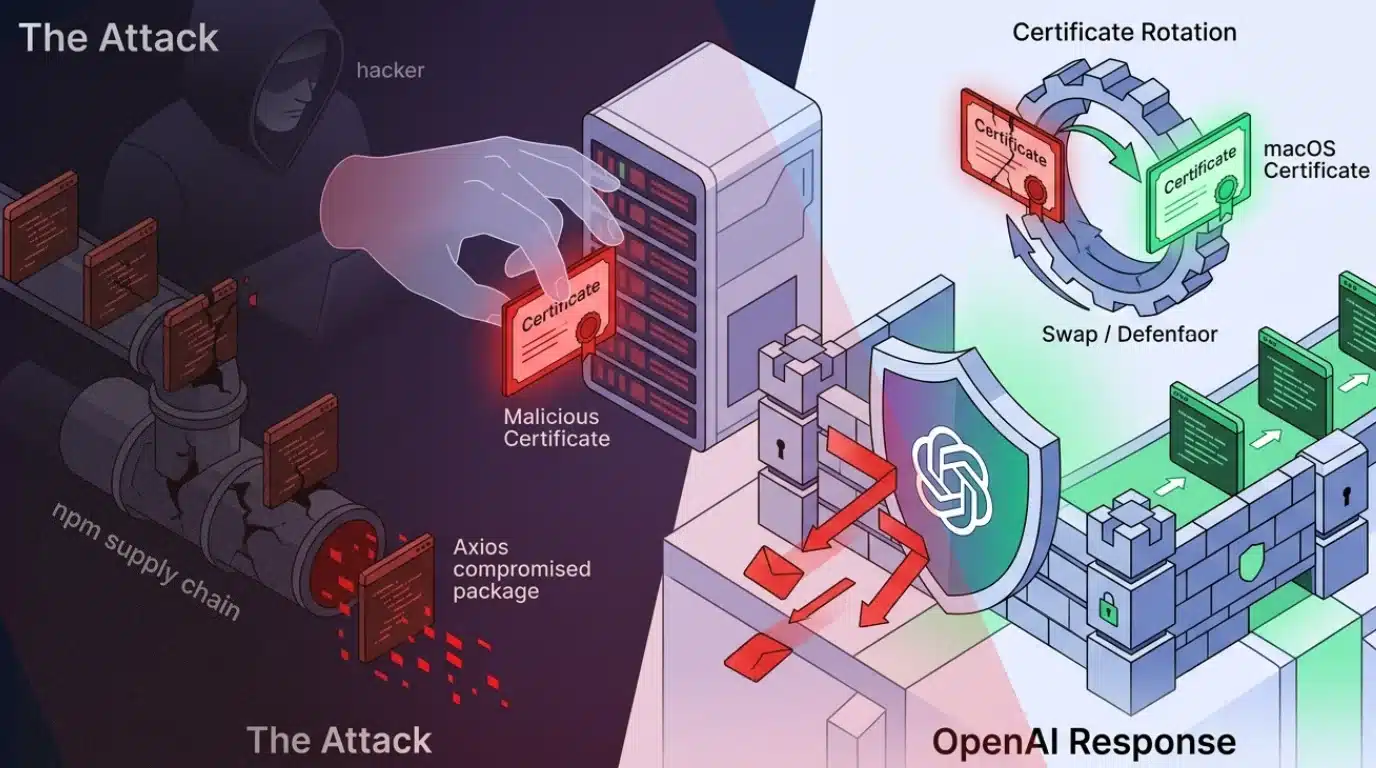
  • ✇Firewall Daily – The Cyber Express
  • OpenAI Responds to Axios npm Supply Chain Attack, Rotates macOS Certificates Samiksha Jain
    The fallout from the Axios npm supply chain attack continues to widen, with OpenAI issuing a detailed response outlining its exposure and remediation steps. The Axios npm supply chain attack, reported by The Cyber Express on April 1, has since been linked to North Korea’s Lazarus Group, significantly expanding the scope and impact of the incident. Attribution was confirmed by Google Threat Intelligence Group, which identified the activity under UNC1069, a financially motivated group active si
     

OpenAI Responds to Axios npm Supply Chain Attack, Rotates macOS Certificates

Axios npm supply chain attack

The fallout from the Axios npm supply chain attack continues to widen, with OpenAI issuing a detailed response outlining its exposure and remediation steps. The Axios npm supply chain attack, reported by The Cyber Express on April 1, has since been linked to North Korea’s Lazarus Group, significantly expanding the scope and impact of the incident. Attribution was confirmed by Google Threat Intelligence Group, which identified the activity under UNC1069, a financially motivated group active since at least 2018.

OpenAI Confirms Limited Exposure to Axios npm Supply Chain Attack

In its official statement, OpenAI said, “We recently identified a security issue involving a third-party developer tool, Axios, that was part of a widely reported, broader industry incident⁠.” The company clarified that while it was affected by the broader Axios npm supply chain attack, there is no evidence of compromise to user data or internal systems. “We found no evidence that OpenAI user data was accessed, that our systems or intellectual property was compromised, or that our software was altered,” the statement added. The exposure occurred on March 31, 2026, when a GitHub Actions workflow used in OpenAI’s macOS app-signing process executed a malicious version of Axios (v1.14.1). This workflow had access to sensitive code-signing certificates used for validating OpenAI applications like ChatGPT Desktop, Codex, Codex CLI, and Atlas.

Certificate Rotation and macOS App Updates

As a direct response to the Axios npm supply chain attack, OpenAI has initiated a full rotation of its macOS code-signing certificates. While internal analysis suggests the certificate was likely not exfiltrated, the company is treating it as potentially compromised. To mitigate any residual risk, OpenAI is requiring users to update their macOS applications. Older versions of affected apps will lose support and functionality after May 8, 2026. Updated versions will carry new certificates to ensure authenticity. This move is designed to prevent threat actors from distributing malicious software disguised as legitimate OpenAI applications, a known risk in supply chain attacks involving code-signing materials.

Investigation and Security Measures

OpenAI engaged a third-party digital forensics and incident response firm to investigate the impact of the Axios npm supply chain attack. The company also coordinated with Apple to block any new notarization attempts using the old certificate. Additional steps taken include:
  • Publishing new builds of all affected macOS applications
  • Reviewing all past software notarizations for anomalies
  • Ensuring no unauthorized modifications were made to distributed software
The company confirmed that no malicious applications signed with its certificate have been identified so far.

Root Cause: GitHub Workflow Misconfiguration

The root cause of OpenAI’s exposure to the Axios npm supply chain attack was traced to a misconfiguration in its GitHub Actions workflow. Specifically, the workflow relied on a floating tag instead of a fixed commit hash and lacked a minimum release age for dependencies, both of which increased the risk of pulling compromised packages. This highlights a broader industry issue where development pipelines remain vulnerable to upstream compromises, especially in open-source ecosystems.

No Impact on User Data or Other Platforms

OpenAI emphasized that the incident is limited strictly to macOS applications. There is no impact on iOS, Android, Windows, Linux, or web-based services. The company also reassured users:
  • No user data or API keys were compromised
  • No passwords need to be changed
  • No malware signed as OpenAI has been detected

What Happens Next

OpenAI will fully revoke the old certificate on May 8, 2026, after a 30-day transition window. This approach is intended to minimize disruption while ensuring users have adequate time to update their applications. The company noted that any software signed with the old certificate will be blocked by macOS security protections after revocation, further reducing the risk of misuse.

Growing Impact of Axios npm Supply Chain Attack

The Axios npm supply chain attack highlight the escalating risks tied to third-party software dependencies. With attribution pointing to a state-sponsored group, the incident reflects how supply chain attacks are increasingly being leveraged for financial and strategic objectives. As organizations continue to rely heavily on open-source libraries, the incident serves as a reminder of the need for stricter dependency management, secure development practices, and continuous monitoring of software pipelines.
❌
❌