

Visualização normal

Antes de ontemFirewall Daily – The Cyber Express
  • ✇Firewall Daily – The Cyber Express
  • Gunra Ransomware Builds a New Attack Network Through RaaS Samiksha Jain
    Gunra ransomware has expanded its operations through a structured ransomware-as-a-service (RaaS) affiliate program, prompting the FBI, CISA and other agencies to issue a joint advisory warning organizations about the threat. The Gunra ransomware variant uses a double-extortion model, encrypting victim data while threatening to publish stolen information on a dedicated leak site if ransom demands are not met. The FBI first observed Gunra in April 2025 as a double-extortion ransomware variant d
     

Gunra Ransomware Builds a New Attack Network Through RaaS

11 de Agosto de 2026, 08:01

Gunra ransomware

Gunra ransomware has expanded its operations through a structured ransomware-as-a-service (RaaS) affiliate program, prompting the FBI, CISA and other agencies to issue a joint advisory warning organizations about the threat. The Gunra ransomware variant uses a double-extortion model, encrypting victim data while threatening to publish stolen information on a dedicated leak site if ransom demands are not met. The FBI first observed Gunra in April 2025 as a double-extortion ransomware variant derived from leaked Conti ransomware source code.

Gunra Ransomware Shifts to Affiliate Model

By early 2026, the group had expanded through a formal ransomware-as-a-service affiliate program advertised on dark web forums. The program provides affiliates with a management panel, configurable ransomware builder, cross-platform locker payloads and affiliate documentation. The FBI also observed Gunra operating under new branding aliases, including Golden Community, while recruiting penetration testers and ethical hackers as initial access brokers. Gunra initially focused on Windows environments before introducing a Linux variant and moving toward broader cross-platform targeting. Victims observed on the group’s dedicated leak site include organizations across the Americas, Europe, the Middle East, Africa and the Asia-Pacific. Targeted sectors include healthcare and public health, financial services and insurance, critical manufacturing, transportation, government services, utilities, academia, media and communications, retail, and professional and nonprofit services. Gunra ransomware

VPN Vulnerabilities Used for Initial Access

According to the advisory, Gunra actors primarily gained initial access by exploiting known vulnerabilities in internet-facing devices, including firewall and VPN gateways. The FBI observed exploitation of CVE-2024-55591 and CVE-2025-24472, authentication bypass vulnerabilities affecting specific FortiOS and FortiProxy versions. The Republic of Korea’s National Police Agency also observed Gunra actors exploiting credential exposure and SSH access control weaknesses in internet-facing VPN gateways to obtain unauthorized remote access. After gaining access, attackers used tools including Impacket utilities to move laterally through victim networks using SMB. In one case, actors compromised an SSL-VPN appliance using default credentials where account lockout controls were absent. They later used stolen session information to access internal virtual desktop infrastructure and move through systems including Active Directory servers and IT personnel workstations.

Data Theft Precedes Encryption

The double-extortion ransomware operation involves stealing sensitive information before encrypting systems. The FBI observed Gunra actors collecting business-critical documents, databases, personally identifiable information, and internal email communications. In at least one case, the actors used a malicious executable called main.exe to exfiltrate data from Microsoft OneDrive and SharePoint. Compressed archives containing sensitive information were also transferred to the Mega file-sharing service, with the volume of exfiltrated data reaching tens of terabytes. For encryption, Gunra uses ChaCha20 and RSA-4096 algorithms and has been observed using the .ENCRT extension for encrypted files. A documented sample from July 2025 used the .CRYPT extension. The ransomware also uses Windows Management Instrumentation to delete volume shadow copies before encryption, while one victim had backup and archived data deleted from both primary and disaster recovery infrastructure.
Agencies Urge Patching and Network Segmentation

The authoring agencies recommend that organizations prioritize patching known exploited vulnerabilities in internet-facing systems, including VPN gateways and RDP-exposed infrastructure. They also advise implementing and testing offline, immutable backups stored in physically separate and segmented locations. Network segmentation is another key recommendation, intended to restrict lateral movement and limit the spread of ransomware between systems. The agencies also recommend reviewing domain controllers, servers, workstations and Active Directory environments for unrecognized accounts, auditing administrative privileges, requiring MFA where possible and testing security controls against the Gunra techniques mapped to the MITRE ATT&CK framework. The joint advisory was published August 10, 2026, as part of the ongoing #StopRansomware initiative.

The Cyber Express Weekly Roundup: Crypto Breaches, State-Linked Schemes, and Platform Exploits

The Cyber Express weekly roundup cybersecurity

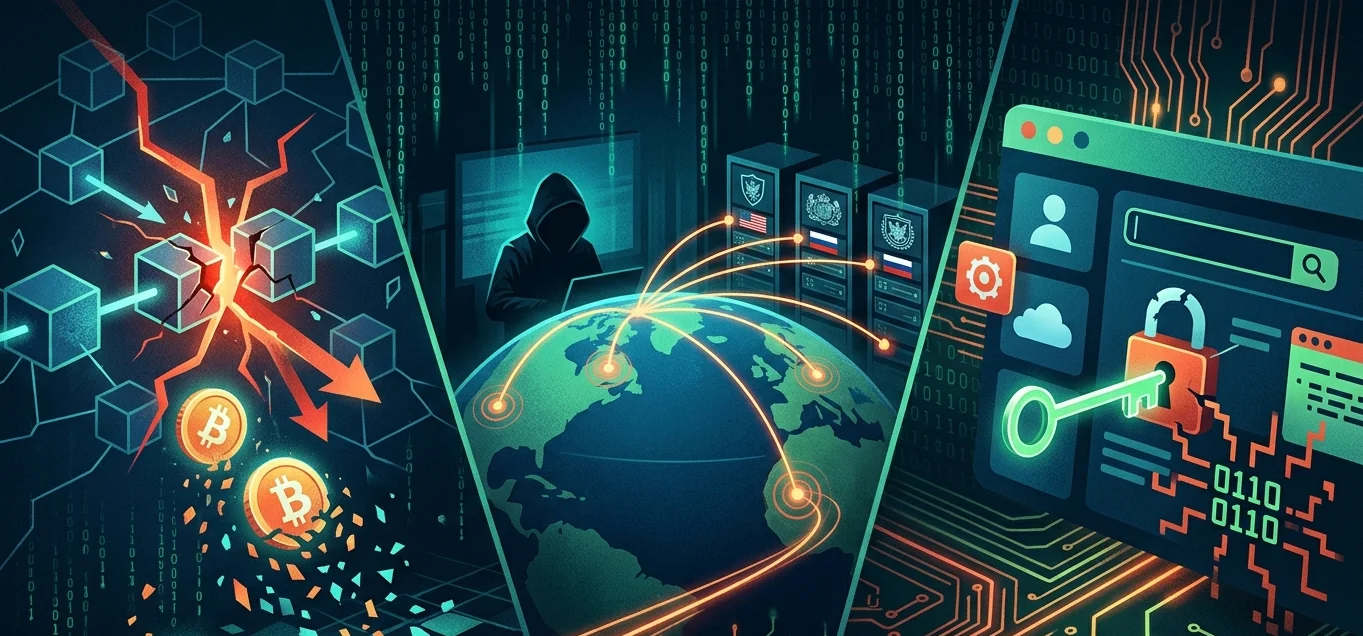
In this week’s weekly roundup, The Cyber Express reviews major developments across the cybersecurity domain. highlighting incidents involving crypto ecosystem attacks, state-linked fraud operations, regulatory scrutiny, and underground cybercrime activity. The broader threat landscape continues to show attackers targeting infrastructure weaknesses, social engineering pathways, and third-party dependencies rather than isolated technical flaws.  Across multiple cases, state-aligned and financially motivated actors are focusing on routers, DNS layers, and decentralized systems to intercept data and manipulate transactions. At the same time, gaps in regulation and enforcement continue to complicate platform accountability, particularly in online safety and digital content governance.  

The Cyber Express Weekly Roundup 

$15M Grinex Hack Halts Trading After Wallet Breach 

Grinex suspended trading and withdrawals following a coordinated attack that compromised its wallet infrastructure, resulting in the theft of more than $15 million in USDT. The attackers rapidly moved assets across Ethereum and Tron networks, using chain-hopping and layering techniques to obscure transaction trails and avoid detection. Read more... 

Two U.S. Nationals Sentenced in $5M North Korea IT Worker Scheme 

Two U.S. nationals, Kejia Wang and Zhenxing Wang, received prison sentences of 108 and 92 months for their roles in a North Korea-linked remote employment scheme that generated over $5 million. The operation used stolen identities, domestic “laptop farms,” and shell companies to present overseas workers as U.S.-based employees across more than 100 companies. Read more... 

Australia Social Media Ban Faces Enforcement Questions 

Australia’s under-16 social media restriction is facing renewed scrutiny after a study of 1,050 children found that over 60% of previously active users aged 12–15 continue accessing platforms such as TikTok, YouTube, and Instagram. Many accounts remained active without intervention from providers, and in some cases, users created new profiles after restrictions were applied. Read more... 

TierOne Dark Web Contest Offers $10K for Exploit Writeups 

A dark web forum known as TierOne has launched a $10,000 contest encouraging detailed technical write-ups on vulnerability exploitation techniques. Running from April 13 to May 14, 2026, and reportedly sponsored by a ransomware group, the contest focuses on topics such as remote code execution, IDOR, SSTI, firmware attacks, and EDR bypass methods.  Read more... 

Rockstar Cyberattack Confirmed Amid Extortion Threat 

Rockstar Games confirmed a cyberattack involving unauthorized access through a third-party service, though it stated that core operations and player systems were unaffected. The threat actor group ShinyHunters claimed responsibility, alleging access to internal company data and demanding payment by April 14, 2026, under threat of public release. Read more... 

Weekly Takeaway 

The Cyber Express weekly roundup reflects a threat landscape that is fragmented yet interconnected. From multimillion-dollar crypto thefts and criminal employment schemes to underground exploit markets and extortion-driven breaches, attackers are consistently blending technical exploitation with deception and supply chain targeting.   Regulatory uncertainty and weak enforcement mechanisms further amplify these risks, allowing both state-linked and financially motivated actors to operate with greater flexibility across digital environments. 
❌
❌