❌

Visualização normal

Antes de ontemFirewall Daily – The Cyber Express
  • ✇Firewall Daily – The Cyber Express
  • Why Is Kim Yo-jong Suddenly Responding to a Binance Hack? Samiksha Jain
    On October 29, Binance lost control of about $6.34 billion in digital assets in a matter of hours. The attackers did not break in on that day, though. They had been working their way inside since June. The Binance hack was a slow campaign aimed at a handful of engineers, and it used a tampered download, a fake job interview and the exchange's own internal AI tool to reach the systems that sign transactions. Binance CEO Richard Teng called it "one of the most sophisticated attacks the digital
     

Why Is Kim Yo-jong Suddenly Responding to a Binance Hack?

4 de Novembro de 2026, 02:57

Binance hack Targeted

On October 29, Binance lost control of about $6.34 billion in digital assets in a matter of hours. The attackers did not break in on that day, though. They had been working their way inside since June. The Binance hack was a slow campaign aimed at a handful of engineers, and it used a tampered download, a fake job interview and the exchange's own internal AI tool to reach the systems that sign transactions. Binance CEO Richard Teng called it "one of the most sophisticated attacks the digital asset industry has ever seen." He said the company takes full responsibility and that no user will bear the loss.

Why the Binance Hack Targeted Engineers, Not Systems

According to the post-mortem Binance released on Tuesday, the attackers went after people with access to wallet infrastructure. In June, Wallet DevOps Engineer A searched for a popular AI coding tool and downloaded a tampered Homebrew installation. Binance's security team spotted the anomaly, replaced the device and rotated his credentials. But the damage was done in another way: Engineer A's role, and his colleagues on the wallet infrastructure team, were now known to the attacker. In September, the attackers moved to social engineering. Software Engineer B, whose profile on a legitimate job-hunting platform mentioned his Binance experience, was approached by someone posing as a project director. A first-round video interview followed with a supposed HR representative, who shared personal photos and videos on social media to build trust. Binance said this was more advanced than social engineering it had seen before. Binance hack infographic In the second round, held on a popular chat app, Engineer B was told to download an "assignment" onto his work computer. It contained malicious code that ran during setup, swapped a legitimate development tool for a malicious version, and connected to an attacker-controlled server. The zero-day malware was not detected by endpoint security tools at the time. On October 20, the attackers used Engineer B's compromised computer and an internal AI tool to gain control over Engineer A and another wallet engineer, Engineer C. They then found that Engineer A had a container deployment permission token on his machine.

How the Binance Hack Unfolded on October 29

Between 17:15 and 19:56 UTC, the attacker logged onto Engineer C's computer, used Engineer A's stolen credentials, deployed a container and triggered a malicious script. That gave them unauthorized access to an internal wallet signing service, which they used to send transactions outside the normal withdrawal process. Between 20:05 and 20:09 UTC, five Binance hot wallets sent 233.46 million XRP to an attacker-controlled address. Hot wallets on Solana and Optimism sent about 970,500 SOL and 44.2 million OP. Binance then received an internal alert about large transfers, and another hot wallet sent 18,270 BTC.

Why Binance Couldn't Stop It Faster

Binance suspended withdrawals, but that did not end the outflows. The attacker had used the signing service to exploit Ethereum's EIP-7702 authorization mechanism. By submitting 50 signing transactions, they gave an attacker-controlled smart contract partial execution rights over a Binance hot wallet. Those authorizations lived on-chain and worked independently of Binance's withdrawal systems. And because the wallet used Multi-Party Computation, there was no single private key that could instantly revoke them. Binance had to build a special procedure to do it. The final unauthorized transfer of 2,961.9 ETH was confirmed at 23:56 UTC. At 00:10 UTC on October 30, Binance cleared the malicious delegation.

Who Is Behind It

Over the weekend, the FBI and other U.S. agencies blamed the theft on TraderTraitor, a North Korea state-sponsored group that has spent years attacking cryptocurrency platforms. Binance said it had detected and stopped 57 suspected North Korea-linked threats in 2026 alone, many using fake job interviews and malicious developer tools. On Tuesday, Kim Yo-jong rejected the U.S. findings, calling them a "grave political provocation" in a statement carried by the Korean Central News Agency. Observers noted the statement ended by saying Pyongyang had matters to "reconsider," without directly threatening retaliation. South Korea's Unification Ministry called her personal response unprecedented. An official said it suggested the North was taking the allegations seriously and was "increasingly conscious of its international standing."

Where Users Stand

Binance says it has set aside more than 100% of the funds needed to cover the loss. As of October 31, 98% of impacted token assets had been replenished, and Binance is buying the remaining, less liquid assets. About $2.85 billion has been frozen or intercepted with help from law enforcement, token issuers and blockchain intelligence firms. Withdrawals have broadly resumed. The exchange says it has rebuilt the affected wallet system and AI tool, replaced devices, revoked credentials tied to the affected engineers and brought in independent security firms. The investigation is ongoing.
  • ✇Firewall Daily – The Cyber Express
  • FBI Blames North Korea for $6B Binance Hack as Recovery Hits 95% Samiksha Jain
    The Binance hack involving more than $6 billion in virtual assets has been attributed to North Korea by the US Federal Bureau of Investigation (FBI), while the cryptocurrency exchange has begun preparing to restore withdrawals in phases and reported that approximately 95% of the affected amount has been covered. The incident, which Binance says occurred around October 29, 2026, has prompted security reviews, efforts to trace stolen assets, and cooperation between law enforcement and industry par
     

FBI Blames North Korea for $6B Binance Hack as Recovery Hits 95%

2 de Novembro de 2026, 02:46

Binance hack

The Binance hack involving more than $6 billion in virtual assets has been attributed to North Korea by the US Federal Bureau of Investigation (FBI), while the cryptocurrency exchange has begun preparing to restore withdrawals in phases and reported that approximately 95% of the affected amount has been covered. The incident, which Binance says occurred around October 29, 2026, has prompted security reviews, efforts to trace stolen assets, and cooperation between law enforcement and industry partners. The FBI refers to the North Korean activity associated with the theft as “TraderTraitor.” In its advisory, the agency said the stolen assets were being converted primarily into Ethereum (ETH), with further laundering through decentralized finance (DeFi) platforms and instant swap services expected. Binance said on November 1 that the first phase of withdrawal services was scheduled to resume between 06:00 and 09:00 UTC. The exchange said the restoration would depend on security assessments and operational readiness checks, with additional assets and networks becoming available as they pass the required checks.

Binance Hack: FBI Attributes $6 Billion Theft to North Korea

According to the FBI, North Korea was responsible for stealing more than $6 billion in virtual assets from Binance on or around October 29, 2026. The agency is working with the US Secret Service (USSS) and the Internal Revenue Service Criminal Investigation division (IRS-CI) to address the activity. The agencies have observed stolen crypto assets being converted primarily into Ethereum. The FBI expects the operators to use DeFi platforms and instant swap services to move the funds through additional laundering stages. The FBI, USSS, and IRS-CI have urged cryptocurrency industry participants to block transactions involving addresses used by the TraderTraitor actors, including transactions derived from those addresses. The request covers THORNode operators, remote procedure call (RPC) node operators, instant exchanges, DeFi services, blockchain analytics firms, and other virtual asset service providers. The FBI has also asked anyone with relevant information to contact a local FBI field office or submit information through the Internet Crime Complaint Center.

Binance Withdrawals to Resume in Phases

In its November 1 recovery update, Binance said it was preparing to restore withdrawals progressively after temporarily suspending the service as a precautionary measure. The exchange said the suspension allowed its teams to contain the impact of the incident, assess affected services, review withdrawal infrastructure, and monitor for residual risks. The company also said it was working with law enforcement and industry partners to trace and recover stolen funds. The first phase prioritizes assets and networks based on user demand over the preceding week. Binance said additional networks and assets would be added as they become ready, rather than reopening every withdrawal service simultaneously. Users may encounter temporary delays or longer processing times during the initial rollout because of traffic volumes. Binance advised users to check the withdrawal page for their selected asset and network, or consult its network status page, to confirm availability. The exchange said deposit services remained open and were not affected by the incident. It also stated that it would absorb the financial impact of the stolen funds rather than pass the losses on to users.

Binance Reports 95% Recovery of Affected Assets

Binance's recovery updates show a steady increase in the amount of affected assets it says has been covered. In its October 31 update, the company reported that coverage had reached approximately 90%, up from around 80% in the previous update. By November 1, Binance said it had covered approximately 95% of the impacted amount. The remaining 5% consists of tokens outside the ten assets it identified as fully backed, which include BTC, ETH, USDT, BNB, SOL, USDC, XRP, USD1, RLUSD, and ZEC. According to Binance, these remaining tokens have lower market liquidity and take longer to acquire at the required scale. The company said it was continuing to purchase the outstanding assets through market transactions and over-the-counter (OTC) channels. The exchange also said its replenishment efforts involved its corporate treasury, a partial deployment of the Secure Asset Fund for Users (SAFU), and a portion of its Futures insurance fund. Binance committed to replenishing SAFU to bring the fund back to approximately $1 billion.
  • ✇Firewall Daily – The Cyber Express
  • US Treasury Launches Major Campaign to Disrupt Iran’s Global Networks Samiksha Jain
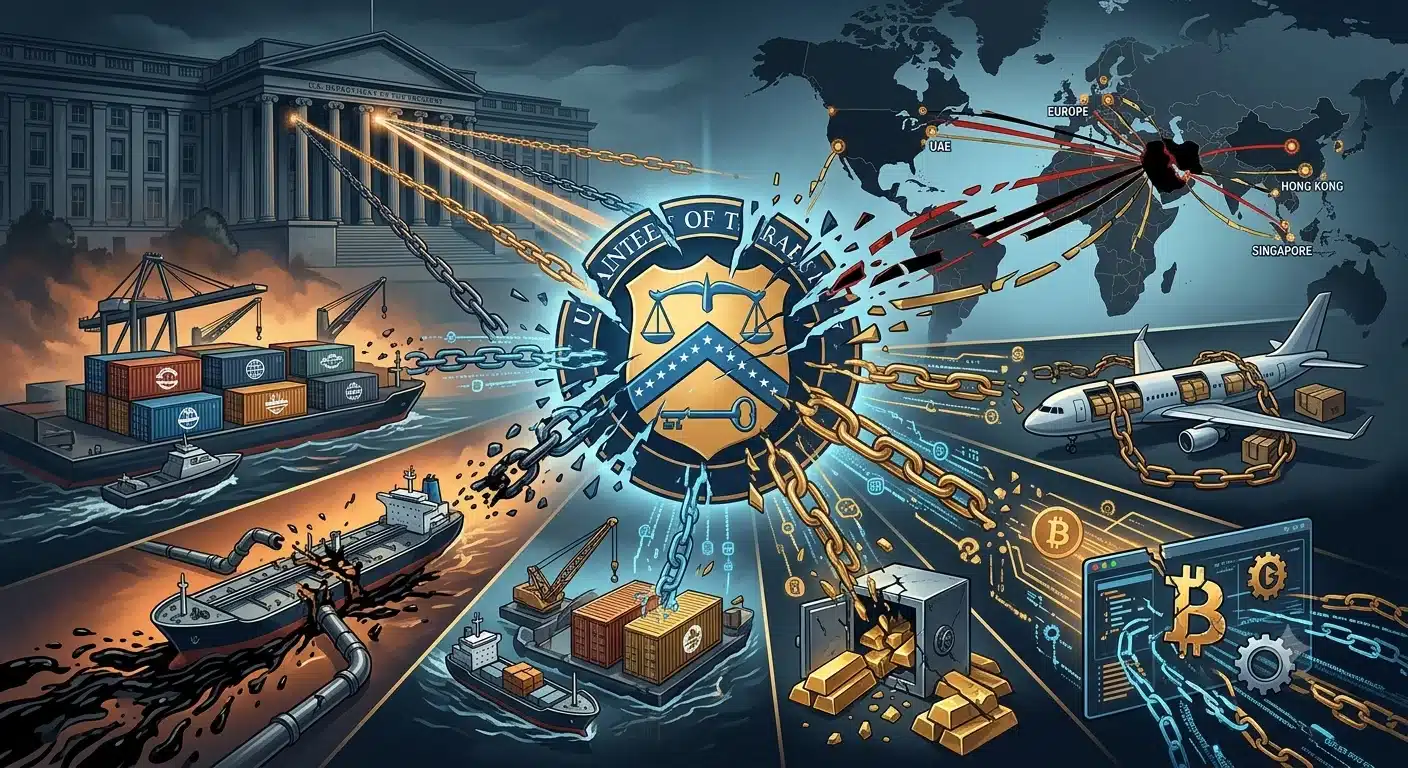
    The U.S. Department of the Treasury has launched Operation Economic Outcast, a whole-of-government campaign aimed at disrupting the economic networks and revenue channels supporting the Iranian regime and the Islamic Revolutionary Guard Corps (IRGC). The initiative expands Iran sanctions across digital assets, technology, gold, aviation and shipping, while targeting nearly 60 entities, individuals and vessels across multiple jurisdictions. Treasury said the campaign follows direction from Pre
     

US Treasury Launches Major Campaign to Disrupt Iran’s Global Networks

25 de Agosto de 2026, 03:44

Operation Economic Outcast

The U.S. Department of the Treasury has launched Operation Economic Outcast, a whole-of-government campaign aimed at disrupting the economic networks and revenue channels supporting the Iranian regime and the Islamic Revolutionary Guard Corps (IRGC). The initiative expands Iran sanctions across digital assets, technology, gold, aviation and shipping, while targeting nearly 60 entities, individuals and vessels across multiple jurisdictions. Treasury said the campaign follows direction from President Trump and is intended to systematically target financial channels used for oil smuggling, sanctions evasion and other activities linked to Iran.

Operation Economic Outcast Expands Iran Sanctions

Under Operation Economic Outcast, the Office of Foreign Assets Control (OFAC) issued five sectoral sanctions determinations covering digital assets, technology, gold, aviation and shipping. Treasury said the measures increase its ability to sanction foreign persons operating in or providing services to these sectors of the Iranian economy. The department said Iran has increasingly used cryptocurrency for sanctions evasion, while advanced technology has been sought for weapons programs. Gold has also been used to stabilize the rial, while aviation and shipping networks have been linked to the movement of fighters, weapons, sensitive technologies, oil and other assets. The new determinations build on earlier measures covering Iran’s financial, petroleum and petrochemical sectors.

OFAC Sanctions Nearly 60 Iran-Linked Targets

OFAC also sanctioned nearly 60 entities, individuals and vessels across networks associated with nuclear and missile technology procurement, cyber operations and oil revenue generation. The action includes a procurement network spanning the Middle East and East Asia that Treasury said helped Iranian entities obtain sensitive dual-use technology through front companies, financial channels and logistics intermediaries. Treasury also targeted a malicious cyber group directed by Iran’s Ministry of Intelligence and Security (MOIS). The department said members of the group compromised and exfiltrated data from U.S. companies in critical infrastructure sectors, including energy, healthcare, defense, information technology and financial services. The designations also include Iranian cyber actors accused of network compromises and digital asset theft. Treasury said one individual illicitly gained control of a Bitcoin wallet containing more than $30,000 in 2023.

Secondary Sanctions Risk Expands

The campaign also increases secondary sanctions exposure for entities that continue conducting certain business with the Iranian regime. Treasury said countries are being given timelines to address identified Iran-related activity, while entities facilitating money laundering or sanctions evasion could face restrictions involving the U.S. financial system. OFAC also suspended several general licenses that previously authorized certain remittance payments to Iran and Iranian access to parts of the U.S. cultural and academic system.

Iran’s Shadow Fleet and Oil Networks Targeted

A major component of the measures focuses on Iran’s shadow fleet and oil revenue channels. Treasury sanctioned brokers, companies, and vessels involved in transporting Iranian crude oil and petroleum products across multiple jurisdictions. The department identified shipping networks involving the UAE, Hong Kong, China, Singapore, Switzerland, Europe, and other regions. Several UAE-based entities and individuals were designated over alleged roles in facilitating Iranian oil shipments and cryptocurrency payments. OFAC also targeted five vessels identified as blocked property, including SIFRA, G SILVER, QUANTUM HOPE, VOYAGE ELITE and TELA. Treasury said these vessels had transported Iranian LPG, petroleum products or crude oil to markets in Asia. The measures mean that property and interests in property belonging to designated or blocked persons that are in the United States or under the control of U.S. persons are blocked and must be reported to OFAC. Treasury said violations of U.S. sanctions can result in civil or criminal penalties, while certain transactions involving designated persons may also expose foreign financial institutions to secondary sanctions.
❌
❌