❌

Visualização normal

Antes de ontemFirewall Daily – The Cyber Express
  • ✇Firewall Daily – The Cyber Express
  • Why Is Kim Yo-jong Suddenly Responding to a Binance Hack? Samiksha Jain
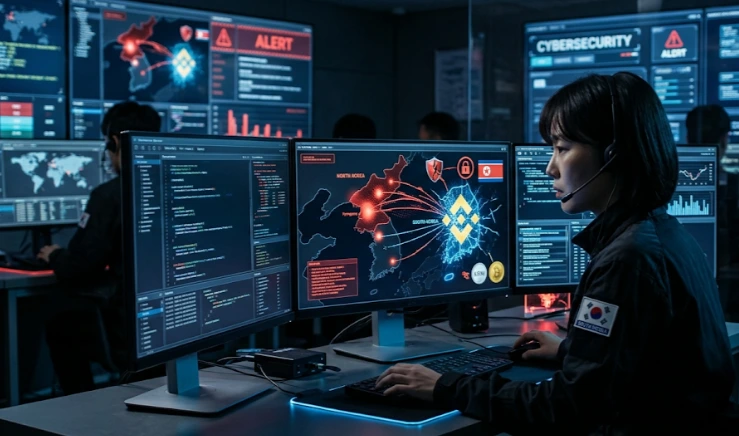
    On October 29, Binance lost control of about $6.34 billion in digital assets in a matter of hours. The attackers did not break in on that day, though. They had been working their way inside since June. The Binance hack was a slow campaign aimed at a handful of engineers, and it used a tampered download, a fake job interview and the exchange's own internal AI tool to reach the systems that sign transactions. Binance CEO Richard Teng called it "one of the most sophisticated attacks the digital
     

Why Is Kim Yo-jong Suddenly Responding to a Binance Hack?

4 de Novembro de 2026, 02:57

Binance hack Targeted

On October 29, Binance lost control of about $6.34 billion in digital assets in a matter of hours. The attackers did not break in on that day, though. They had been working their way inside since June. The Binance hack was a slow campaign aimed at a handful of engineers, and it used a tampered download, a fake job interview and the exchange's own internal AI tool to reach the systems that sign transactions. Binance CEO Richard Teng called it "one of the most sophisticated attacks the digital asset industry has ever seen." He said the company takes full responsibility and that no user will bear the loss.

Why the Binance Hack Targeted Engineers, Not Systems

According to the post-mortem Binance released on Tuesday, the attackers went after people with access to wallet infrastructure. In June, Wallet DevOps Engineer A searched for a popular AI coding tool and downloaded a tampered Homebrew installation. Binance's security team spotted the anomaly, replaced the device and rotated his credentials. But the damage was done in another way: Engineer A's role, and his colleagues on the wallet infrastructure team, were now known to the attacker. In September, the attackers moved to social engineering. Software Engineer B, whose profile on a legitimate job-hunting platform mentioned his Binance experience, was approached by someone posing as a project director. A first-round video interview followed with a supposed HR representative, who shared personal photos and videos on social media to build trust. Binance said this was more advanced than social engineering it had seen before. Binance hack infographic In the second round, held on a popular chat app, Engineer B was told to download an "assignment" onto his work computer. It contained malicious code that ran during setup, swapped a legitimate development tool for a malicious version, and connected to an attacker-controlled server. The zero-day malware was not detected by endpoint security tools at the time. On October 20, the attackers used Engineer B's compromised computer and an internal AI tool to gain control over Engineer A and another wallet engineer, Engineer C. They then found that Engineer A had a container deployment permission token on his machine.

How the Binance Hack Unfolded on October 29

Between 17:15 and 19:56 UTC, the attacker logged onto Engineer C's computer, used Engineer A's stolen credentials, deployed a container and triggered a malicious script. That gave them unauthorized access to an internal wallet signing service, which they used to send transactions outside the normal withdrawal process. Between 20:05 and 20:09 UTC, five Binance hot wallets sent 233.46 million XRP to an attacker-controlled address. Hot wallets on Solana and Optimism sent about 970,500 SOL and 44.2 million OP. Binance then received an internal alert about large transfers, and another hot wallet sent 18,270 BTC.

Why Binance Couldn't Stop It Faster

Binance suspended withdrawals, but that did not end the outflows. The attacker had used the signing service to exploit Ethereum's EIP-7702 authorization mechanism. By submitting 50 signing transactions, they gave an attacker-controlled smart contract partial execution rights over a Binance hot wallet. Those authorizations lived on-chain and worked independently of Binance's withdrawal systems. And because the wallet used Multi-Party Computation, there was no single private key that could instantly revoke them. Binance had to build a special procedure to do it. The final unauthorized transfer of 2,961.9 ETH was confirmed at 23:56 UTC. At 00:10 UTC on October 30, Binance cleared the malicious delegation.

Who Is Behind It

Over the weekend, the FBI and other U.S. agencies blamed the theft on TraderTraitor, a North Korea state-sponsored group that has spent years attacking cryptocurrency platforms. Binance said it had detected and stopped 57 suspected North Korea-linked threats in 2026 alone, many using fake job interviews and malicious developer tools. On Tuesday, Kim Yo-jong rejected the U.S. findings, calling them a "grave political provocation" in a statement carried by the Korean Central News Agency. Observers noted the statement ended by saying Pyongyang had matters to "reconsider," without directly threatening retaliation. South Korea's Unification Ministry called her personal response unprecedented. An official said it suggested the North was taking the allegations seriously and was "increasingly conscious of its international standing."

Where Users Stand

Binance says it has set aside more than 100% of the funds needed to cover the loss. As of October 31, 98% of impacted token assets had been replenished, and Binance is buying the remaining, less liquid assets. About $2.85 billion has been frozen or intercepted with help from law enforcement, token issuers and blockchain intelligence firms. Withdrawals have broadly resumed. The exchange says it has rebuilt the affected wallet system and AI tool, replaced devices, revoked credentials tied to the affected engineers and brought in independent security firms. The investigation is ongoing.

South Korea President Eyes Cybersecurity Task Force After North Korea-Linked Crypto Heist

3 de Novembro de 2026, 05:10

cybersecurity task force

South Korean President Lee Jae-myung has directed officials to look into creating a cybersecurity task force. A wave of hacking incidents at financial firms and a massive cryptocurrency theft linked to North Korea have raised alarm over the country's digital defenses.  Lee instructed on Tuesday, Nov. 3, 2026, during a Cabinet meeting at Cheong Wa Dae in Seoul. The proposed task force would focus solely on strengthening online security. 

Cybersecurity Task Force and North Korea's Binance Heist 

The directive follows a string of attacks on domestic financial companies that exposed customer data. The most recent targets were Mirae Asset Global Investments, cryptocurrency exchange Bithumb, and Daishin Securities. It also comes after the hacking of Binance, the world's largest crypto exchange, in which more than US$6 billion in cryptocurrency was stolen. The U.S. Federal Bureau of Investigation (FBI) has since attributed the theft to North Korea, which gives the incident a national security dimension beyond financial crime. Lee said cyber threats have grown severe enough to endanger the national economy, national security and the daily lives of ordinary citizens. He called for "a comprehensive prevention system" to address them. According to the president, hacking methods are becoming more sophisticated and widespread, driven partly by advances in artificial intelligence (AI). He said this trend is exposing clear limits in the systems currently used to maintain security.

A Possible "Czar Agency" Amid North Korea Threats 

Lee's plans go further than a single task force. He stressed the need for talks on setting up a pan-government agency responsible for cybersecurity across both the public and private sectors.  He specifically told officials to "proactively consider the formation of a cybersecurity czar agency" that could act as a strong and effective control tower for security management.  The president also ordered officials to thoroughly fix security weaknesses at major state institutions and key national infrastructure, naming information communications, energy, and finance. Because hackers tied to North Korea have repeatedly targeted financial assets, the finance sector is a particularly pressing concern. 

Social Media Limits for Teens Also on the Agenda 

Cybersecurity was not the only digital issue raised at the meeting. Lee also called for quick discussions on the government's plan to restrict adolescents' use of social media.  "The harmful effects (of social media on teenagers) appear to be greater than what we think," Lee said.  The government is pursuing measures to limit social media sign-ups by young teens and to restrict their use of certain services, including algorithm-based ones. The goal is to shield adolescents from the harms of social media.  Lee told Kim Jong-cheol, chairman of the Korea Media and Communications Commission, to "conduct relevant discussions thoroughly and promptly." He pointed to similar efforts already under way in Europe, Australia and Canada.  Kim replied that the plan should be pursued on the basis of social consensus. He said the commission intends to gather public input and finalize the measures in the first half of next year.  Officials will now weigh whether to form a cybersecurity task force and a broader czar agency. Their decisions will shape how South Korea responds to escalating digital threats, including attacks attributed to North Korea. 
  • ✇Firewall Daily – The Cyber Express
  • FBI Blames North Korea for $6B Binance Hack as Recovery Hits 95% Samiksha Jain
    The Binance hack involving more than $6 billion in virtual assets has been attributed to North Korea by the US Federal Bureau of Investigation (FBI), while the cryptocurrency exchange has begun preparing to restore withdrawals in phases and reported that approximately 95% of the affected amount has been covered. The incident, which Binance says occurred around October 29, 2026, has prompted security reviews, efforts to trace stolen assets, and cooperation between law enforcement and industry par
     

FBI Blames North Korea for $6B Binance Hack as Recovery Hits 95%

2 de Novembro de 2026, 02:46

Binance hack

The Binance hack involving more than $6 billion in virtual assets has been attributed to North Korea by the US Federal Bureau of Investigation (FBI), while the cryptocurrency exchange has begun preparing to restore withdrawals in phases and reported that approximately 95% of the affected amount has been covered. The incident, which Binance says occurred around October 29, 2026, has prompted security reviews, efforts to trace stolen assets, and cooperation between law enforcement and industry partners. The FBI refers to the North Korean activity associated with the theft as “TraderTraitor.” In its advisory, the agency said the stolen assets were being converted primarily into Ethereum (ETH), with further laundering through decentralized finance (DeFi) platforms and instant swap services expected. Binance said on November 1 that the first phase of withdrawal services was scheduled to resume between 06:00 and 09:00 UTC. The exchange said the restoration would depend on security assessments and operational readiness checks, with additional assets and networks becoming available as they pass the required checks.

Binance Hack: FBI Attributes $6 Billion Theft to North Korea

According to the FBI, North Korea was responsible for stealing more than $6 billion in virtual assets from Binance on or around October 29, 2026. The agency is working with the US Secret Service (USSS) and the Internal Revenue Service Criminal Investigation division (IRS-CI) to address the activity. The agencies have observed stolen crypto assets being converted primarily into Ethereum. The FBI expects the operators to use DeFi platforms and instant swap services to move the funds through additional laundering stages. The FBI, USSS, and IRS-CI have urged cryptocurrency industry participants to block transactions involving addresses used by the TraderTraitor actors, including transactions derived from those addresses. The request covers THORNode operators, remote procedure call (RPC) node operators, instant exchanges, DeFi services, blockchain analytics firms, and other virtual asset service providers. The FBI has also asked anyone with relevant information to contact a local FBI field office or submit information through the Internet Crime Complaint Center.

Binance Withdrawals to Resume in Phases

In its November 1 recovery update, Binance said it was preparing to restore withdrawals progressively after temporarily suspending the service as a precautionary measure. The exchange said the suspension allowed its teams to contain the impact of the incident, assess affected services, review withdrawal infrastructure, and monitor for residual risks. The company also said it was working with law enforcement and industry partners to trace and recover stolen funds. The first phase prioritizes assets and networks based on user demand over the preceding week. Binance said additional networks and assets would be added as they become ready, rather than reopening every withdrawal service simultaneously. Users may encounter temporary delays or longer processing times during the initial rollout because of traffic volumes. Binance advised users to check the withdrawal page for their selected asset and network, or consult its network status page, to confirm availability. The exchange said deposit services remained open and were not affected by the incident. It also stated that it would absorb the financial impact of the stolen funds rather than pass the losses on to users.

Binance Reports 95% Recovery of Affected Assets

Binance's recovery updates show a steady increase in the amount of affected assets it says has been covered. In its October 31 update, the company reported that coverage had reached approximately 90%, up from around 80% in the previous update. By November 1, Binance said it had covered approximately 95% of the impacted amount. The remaining 5% consists of tokens outside the ten assets it identified as fully backed, which include BTC, ETH, USDT, BNB, SOL, USDC, XRP, USD1, RLUSD, and ZEC. According to Binance, these remaining tokens have lower market liquidity and take longer to acquire at the required scale. The company said it was continuing to purchase the outstanding assets through market transactions and over-the-counter (OTC) channels. The exchange also said its replenishment efforts involved its corporate treasury, a partial deployment of the Secure Asset Fund for Users (SAFU), and a portion of its Futures insurance fund. Binance committed to replenishing SAFU to bring the fund back to approximately $1 billion.
  • ✇Firewall Daily – The Cyber Express
  • South Korea Police Dismantle AI-Driven Cybercrime Ring That Hit 90 Companies Ashish Khaitan
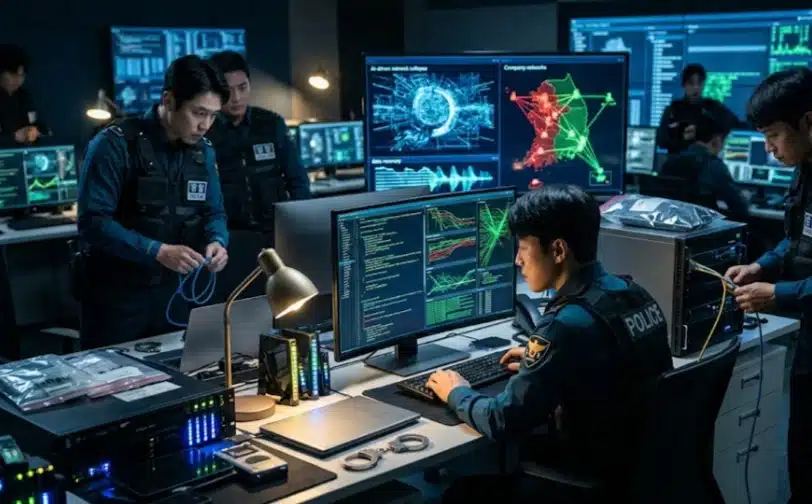
    Police in South Korea have broken up a cybercrime ring accused of using generative AI to hack about 90 domestic companies, steal roughly 8.2 million personal records, and demand money in exchange for silence. Investigators believe the group's leader, who never studied IT, used AI to rapidly expand the range of targets.  Seven Suspects Tied to the Cybercrime Ring  On the 26th, the Cyber Investigation Division of the Seoul Metropolitan Police Agency said it had apprehended seven people, includin
     

South Korea Police Dismantle AI-Driven Cybercrime Ring That Hit 90 Companies

26 de Outubro de 2026, 06:21

cybercrime ring

Police in South Korea have broken up a cybercrime ring accused of using generative AI to hack about 90 domestic companies, steal roughly 8.2 million personal records, and demand money in exchange for silence. Investigators believe the group's leader, who never studied IT, used AI to rapidly expand the range of targets. 

Seven Suspects Tied to the Cybercrime Ring 

On the 26th, the Cyber Investigation Division of the Seoul Metropolitan Police Agency said it had apprehended seven people, including the 32-year-old ringleader, identified as A, on suspicion of extortion and violating the Information and Communications Network Act. A has been detained, while the other six are being investigated without detention.  The group allegedly broke into the systems of around 90 companies from September last year through this month, taking personal information and internal data. Victims included private academies, hospitals, golf courses and affiliates of major conglomerates. The suspects reportedly warned, "If you don't pay, we'll leak the information," and pointed to the reputational harm, surcharges and damages lawsuits a public breach could bring as extra pressure. 

How AI Widened the Attacks Across South Korea 

A is believed to have learned hacking through blogs and other sources and worked in penetration testing at a cybersecurity company from 2019 to 2022. Early on, A used automated tools to find website vulnerabilities, but from August this year expanded the attacks using generative AI and an AI-powered autonomous penetration system. Police believe about 60 of the roughly 90 victim companies were hacked with AI's help.  Digital forensic evidence, A's statements, and other materials pointed to about 8.2 million stolen records. The cybercrime ring demanded a total of 360 million won from 38 companies, but swift arrests limited its takings to just 300,000 won. Police are also examining whether other companies paid quietly or never reported the threats. 

Tracking Down the Cybercrime Ring 

The investigation began after one victim company filed a report in June. As similar cases surfaced nationwide, police consolidated them in August. From July to September, officers arrested five accomplices involved in the threats one after another, and early this month caught another who had directed the crimes via Telegram. Police searched A's residence in Yeoksam-dong, Gangnam-gu, Seoul, on the 13th, inspecting the generative AI running on a computer used in the crimes. After tracing access logs from victim companies and other records, they arrested A on the 15th and seized computers, hacking tools and accounts used to send threats. On the 23rd, A was sent to prosecutors in custody on suspicion of stealing about 900,000 records from 15 companies that had filed reports. Police plan to investigate allegations involving the roughly 75 remaining companies that have yet to report.

A First for South Korea

Police called it the first case in South Korea in which suspects were caught running a large-scale hacking and data theft operation that exploited generative AI. They said it shows the barriers to cybercrime are falling, as individuals, not just professional hacker groups, can now use AI to attack multiple companies in a short time.  Authorities will keep identifying additional victims and accomplices while tracing the proceeds of the crimes. 
  • ✇Firewall Daily – The Cyber Express
  • South Korea’s Shinhan Bank Hack Exposes Data of 25,000 Customers Samiksha Jain
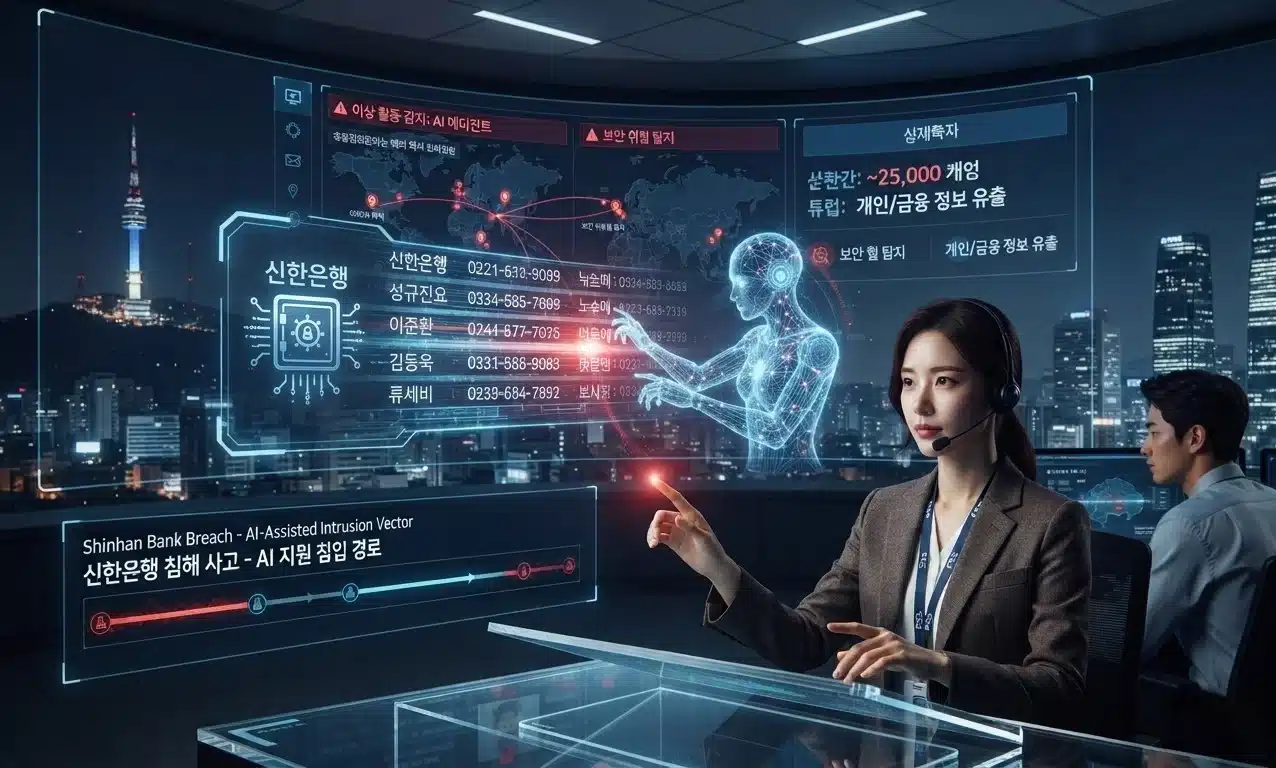
    The Shinhan Bank cyberattack has exposed personal and financial information belonging to about 25,000 customers in South Korea, with investigators examining whether advanced artificial intelligence tools were used to carry out the intrusion. The leaked information reportedly includes customers’ names, phone numbers, loan borrowing details and annual income. South Korea’s Financial Supervisory Service has launched an emergency on-site inspection as authorities investigate how the breach occurr
     

South Korea’s Shinhan Bank Hack Exposes Data of 25,000 Customers

5 de Outubro de 2026, 03:55

Shinhan Bank cyberattack

The Shinhan Bank cyberattack has exposed personal and financial information belonging to about 25,000 customers in South Korea, with investigators examining whether advanced artificial intelligence tools were used to carry out the intrusion. The leaked information reportedly includes customers’ names, phone numbers, loan borrowing details and annual income. South Korea’s Financial Supervisory Service has launched an emergency on-site inspection as authorities investigate how the breach occurred and whether the suspected use of AI points to a wider risk for financial institutions.

Shinhan Bank Cyberattack Under Investigation

Shinhan Bank said the information was leaked on Wednesday after hackers gained access to its systems. The bank immediately formed a response team and took measures aimed at limiting further damage. These measures included blocking access from external IP addresses and suspending the affected services. The bank said it had completed safety measures related to the incident. Sources cited in the reports said the attackers are suspected to be based overseas and may have used advanced AI tools during the attack. Experts said the bank may not have been specifically targeted, but could instead have been caught in attacks against vulnerable online platforms. The Financial Supervisory Service sent a team to the bank to examine the incident. Its investigation is expected to take months as officials determine the nature and extent of the data exposure.

AI Agent-Assisted Attacks Raise Concern

The suspected use of AI has added another concern to the Shinhan Bank breach. Cybersecurity experts said AI tools originally developed or shared for defensive purposes can also be adapted for malicious activity. Mun Chong-hyun, director at cybersecurity firm Genians, said several recent attacks in South Korea have involved such AI tools. He described the technology as a double-edged sword because capabilities created for cybersecurity can also be used to facilitate cybercrime. The concern is not limited to Shinhan Bank. An industry official said the wider financial sector could be exposed to AI agent-assisted attacks, and that financial institutions should conduct their own security checks to identify potential weaknesses and abnormal access attempts. The incident also highlights the type of information that can be exposed in attacks against banks. Unlike a breach involving only basic contact information, the Shinhan incident reportedly exposed both personal details and financial information.

South Korean Banks Face More Data Breaches

The Shinhan Bank cyberattack comes amid several recent incidents affecting South Korean lenders. KB Kookmin Bank said last Friday that personal information belonging to 119 customers had been leaked following an external intrusion. Hana Bank also reported a separate hack affecting 89 customers. South Korea’s Financial Services Commission has already held a meeting with local banks over the recent breaches and is expected to hold another meeting this week. The latest incidents have raised concerns about how AI-powered hacking could affect the financial sector, particularly if attackers can use automated tools to identify vulnerable systems or support attacks at greater scale. The Shinhan incident is relatively small compared with some of South Korea’s largest data breaches in terms of the number of affected people. However, the combination of personal and financial information makes the breach significant. Sungho Hwang, Korea country manager at NordVPN, said the exposed information could be used to create personalized scams. He also noted that generative AI has made such scams more convincing.

South Korea Faces Wider Cybersecurity Pressure

The banking incidents come as South Korea cyberattacks have increased across other sectors. Cyberattacks targeting South Korean military systems reached 18,951 cases in 2025, the highest annual figure in five years. The number was up 31 percent from 2024 and 108 percent from 2022. South Korea has also expanded its use of AI for defensive cybersecurity. The Ministry of Education and the Korea Education and Research Information Service operate an AI-based system designed to detect suspicious activity and issue automated alerts across 435 monitored institutions. In 2025, the system detected about 480 million potential cyber threat indicators, of which around 86,000 were confirmed as actual intrusions. As the investigation into the Shinhan Bank breach continues, the suspected role of AI is adding to concerns that financial institutions may need to account for increasingly automated forms of cyberattacks.

The Cyber Express Weekly Roundup: ShinyHunters’ FBI Breach Claim, North Korea’s WaterPlum Campaign, and the EU KIDS Act

25 de Setembro de 2026, 10:00

weekly roundup The Cyber Express TCE Sep 2026

This weekly roundup covers a brazen breach claim against the FBI's recruitment portal, a multinational advisory exposing North Korea's fake-recruiter malware operation, a sweeping EU proposal to reshape children's access to social media, a conversation on application security in the age of AI agents, a short-lived Discord ban in the Philippines, and a multimillion-dollar hot-wallet heist at a crypto casino.  From federal law enforcement to individual job seekers, this week's developments show that no target is too prominent or too small. Cybercriminals are openly taunting the agencies that pursue them, state-backed actors are turning the hiring process into an attack vector, and governments are testing how far they can push platforms on child safety, sometimes reversing course within hours. 

The Cyber Express Weekly Roundup 

Shiny Hunters Claims FBI Breach, Says FBIjobs Agent Data Exposed 

The FBI is investigating an apparent breach after the cybercriminal group Shiny Hunters claimed to have stolen personal data belonging to thousands of federal agents, with the probe centering on the bureau's FBIjobs recruitment website. Read more... 

WaterPlum Hackers Steal $10.7M in Crypto From IT Workers 

A North Korean cyber actor group known as WaterPlum, also referred to as "Contagious Interview," has infected at least 30,000 devices across more than 100 countries while stealing cryptocurrency from IT professionals worldwide. Read more... 

EU KIDS Act Sets New Social Media Rules for Children 

The European Commission adopted the proposal on September 18, setting out rules that would prevent children under 13 from accessing social media and establish 15 as the minimum age for minors to open accounts independently. Users aged 13 to under 15 could instead access parent-managed mini accounts with limits on social contacts and up to 60 minutes of screen time per day, while platforms would bear the responsibility of proving their services are safe for children. Read more… 

Harness' Rahul Sood: AppSec in the Agentic Era Is About More Than Code. It's About Authority 

In this conversation, The Cyber Express spoke with Rahul Sood, the General Manager for Application Security at Harness, who leads the company's AppSec portfolio and focuses on building security for the AI era, integrated directly into modern DevOps workflows. The conversation centers on a shift in how security teams must think about AI agents: the risk no longer lies only in the code being shipped, but in what authority autonomous agents are granted once they operate inside production systems. Read more… 

Ban on Discord Lifted After Platform Commits to Work With DICT and CICC 

The Philippine government has lifted its ban on Discord after the platform's representatives met with officials from the Department of Information and Communications Technology (DICT) and the Cybercrime Investigation and Coordinating Center (CICC), with the restriction removed on Thursday, Sept. 24. Read more... 

Duelbits Hit by $7 Million Hack as Crypto Stolen Across Four Blockchains 

Crypto casino Duelbits has shut down its platform after attackers took roughly $7 million from several of its wallets, with the stolen assets moved across four blockchains and mostly converted into Ether. The company says funds held in user accounts have not been affected, but it has not explained how the attackers got in or when the site will return. Read more... 

Weekly Cybersecurity Takeaway 

This week's developments span the full spectrum of cyber risk, from a criminal group openly retaliating against the FBI over a public advisory, to a state-backed operation weaponizing job interviews against developers, to a crypto platform losing millions from the very hot wallets that keep it running.  Meanwhile, the policy response is moving on multiple fronts: the EU is flipping the burden of proof onto platforms to demonstrate child safety by design, and the Philippines has shown how quickly a government can block, and then restore, a major platform in exchange for enforcement commitments. At the same time, security leaders are warning that AI agents are introducing an entirely new question of who, or what, holds authority inside enterprise systems.  Taken together, the stories point to an increasingly confrontational threat landscape, where attackers are bolder, trust-based processes like hiring are being exploited at scale, and institutions are experimenting with more aggressive levers to hold platforms and adversaries accountable. 

Four Countries Attribute “Contagious Interview” Fake-Job Malware Campaign to North Korea’s WaterPlum

18 de Setembro de 2026, 09:50

Contagious Interview, WaterPlum, North Korea

Japan, the United States, Australia and Germany, today issued a joint cybersecurity advisory formally attributing the long-running "Contagious Interview" campaign to a North Korean state-sponsored group they are calling WaterPlum. The operation has infected more than 30,000 computers in more than 100 countries and stolen about 1.7 billion yen, or some $10.7 million, in cryptocurrency.

The advisory carries the seals of Japan's National Police Agency and National Cybersecurity Office, the FBI and the U.S. Defense Department's Cyber Crime Center, the Australian Signals Directorate's Australian Cyber Security Centre and Germany's BND and BfV intelligence services. It places WaterPlum under the 313 General Bureau of North Korea's Munitions Industry Department, which oversees weapons production — framing the theft as state revenue generation rather than ordinary cybercrime.

Also read: US, Japan, South Korea Meet Private Partners to Combat North Korea’s IT Work Fraud Scheme

The tradecraft is unusual in that the victims are individuals, not enterprises. Operators pose as recruiters for AI, cryptocurrency and NFT companies, approaching developers, web designers and blockchain specialists via social media, job boards and freelance marketplaces.

At the technical-interview stage, the candidate is asked to run a coding assignment or troubleshoot a video-conferencing problem. Either pretext delivers malware, typically via malicious Node Package Manager packages hosted on GitHub or Bitbucket. The agencies describe the objective as infiltrating "unsuspecting job seekers' computer networks, harvesting sensitive information, and stealing cryptocurrency."

Five malware families are named. BeaverTail, a JavaScript infostealer hidden in npm packages; InvisibleFerret, a Python backdoor; OtterCookie, a JavaScript remote access trojan with stealer functions; OtterCandy, which blends OtterCookie with a family called RATatouille; and StoatWaffle, a modular Node.js loader bundling credential harvesting and a RAT.

Together they siphon credentials, clipboard contents, keystrokes, screenshots, wallet keys and seed phrases, identity documents and source code. Japanese police put the most intense phase between December 2025 and July 2026, with roughly 7,000 cryptocurrency wallet cases recorded.

Also read: Don’t Fall for the Fake Job! FBI Warns of Work-From-Home Scams Using Cryptocurrency

The advisory pairs the campaign with North Korea's remote IT worker scheme, treating it as the same revenue apparatus seen from the employer's side. Operatives use stolen identity documents and virtual private servers to obscure their locations, working from North Korea, China, Russia, Africa and Southeast Asia, while "laptop farms" in facilitators' homes supply plausible in-country IP addresses. Where placements sour, the agencies say the workers have turned to extortion over payment disputes, website defacement and publication of stolen source code. Japanese investigators dismantled one domestic laptop farm and traced several hundred million yen abroad.

Guidance for practitioners is that run untrusted interview code only in a virtual machine; treat commands containing curl, base64, -enc, mshta or Invoke-WebRequest with suspicion; open unfamiliar projects in Visual Studio Code's Restricted Mode and inspect .vscode/tasks.json first; and after any infection, assume credentials are lost, rotate wallets from a clean device and reinstall the operating system. Employers are told to check applicant IP addresses against claimed locations and to watch for refusal to meet in person, frequent audio and video freezes, or use of face-swapping software.

Also read: North Korean Cyber Fraud Scheme Targets U.S. Firms, DOJ Indicts Five Individuals

The compliance exposure is significant. The U.S. State Department issued an alert to companies on North Korean IT workers in July, and the Justice Department has prosecuted facilitators and seized laptop farms. Firms that unknowingly pay a North Korean contractor risk sanctions liability, which is why the advisory pushes contractual controls and identity verification, not detection alone. Japan's Foreign Ministry said it would "strengthen its efforts with the ally and like-minded countries and the private sector."

What to watch: whether the attribution is followed by sanctions designations, how npm and code-hosting platforms respond to package delivery at this scale, and whether the ACSC issues Australia-specific guidance for contractor and Web3 employers.

❌
❌