 Entrar

FBI Blames North Korea for $6B Binance Hack as Recovery Hits 95%
2 de Novembro de 2026, 02:46





The FBI and the U.S. Secret Service (USSS) have issued a joint cybersecurity advisory warning organizations about FortiBleed, an active global credential-compromise campaign targeting internet-facing Fortinet FortiGate firewalls and SSL VPN gateways. The advisory, published on October 6, 2026, cites SOCRadar data verifying more than 86,644 compromised devices across 194 countries.
According to the advisory, the campaign exploits reused or leaked credentials and legacy SHA-256 password storage, allowing threat actors to harvest and crack authentication data at scale. Attackers continue to scan exposed Fortinet firewalls using previously obtained credentials, and some affected organizations have been locked out of their own systems.
The operation's internal workflow came to light after the threat actors unintentionally exposed their own backend server. The open directory revealed a mature, multi-stage campaign run as an initial access broker operation.
Attackers first scanned the internet for exposed FortiGate SSL VPN portals using automated scripts. They then gathered credentials through credential stuffing and password spraying, drawing on prior Fortinet leak dumps and infostealer logs.
Password hashes taken from compromised devices were exfiltrated and fed into a GPU-accelerated cracking cluster running on rented infrastructure, where Hashcat and Hashtopolis ran distributed jobs to convert stolen data into plaintext credentials.
[caption id="attachment_114628" align="aligncenter" width="800"] Source: FBI[/caption]
Cracked credentials were then validated, with scripts filtering out honeypots, mapping organizations and ranking high-value targets by revenue and network structure. Attackers created new administrative accounts on firewalls to maintain persistence, then moved into victim networks to enumerate Active Directory and identify privileged accounts. The final stage involved selling access, including working VPN configurations and target lists, to downstream threat actors.
The advisory warns that victims may lose access to their Fortinet devices if attackers delete original accounts or change their passwords. In certain cases, threat actors removed existing accounts to block organizations from their devices while attempting lateral movement. Recovery may require steps beyond standard patching and password resets.
Reporting also indicates that initial access brokers using the FortiBleed attack chain have supplied access to ransomware affiliates, currently including INC/Lynx ransomware and Payload ransomware.
The agencies released indicators of compromise (IOCs) to help defenders review their environments. IP address 45.154.12.132 was observed as a command and control server, while 154.202.59.169 and 103.27.186.156 served as proxy nodes and 45.155.250.158 functioned as a beacon relay. The address 85.11.187.8 was linked to the Hashtopolis tool. The advisory also lists 13 IP addresses observed between June 18 and July 23, 2026, conducting brute force attacks or authenticating with compromised accounts.
Account names found on victim systems include adminin, fortiAdmin, forticloud-sync, fgtsecure, adminsslvpn, itadmin and roadmin. The agencies note that IP addresses may be reassigned over time and advise organizations to vet IOCs before acting on them.
The FBI and USSS recommend that organizations:
Organizations that detect a compromise are urged to isolate affected hosts, scope the intrusion and report incidents to the FBI's Internet Crime Complaint Center (IC3), a local FBI field office or a local USSS field office.

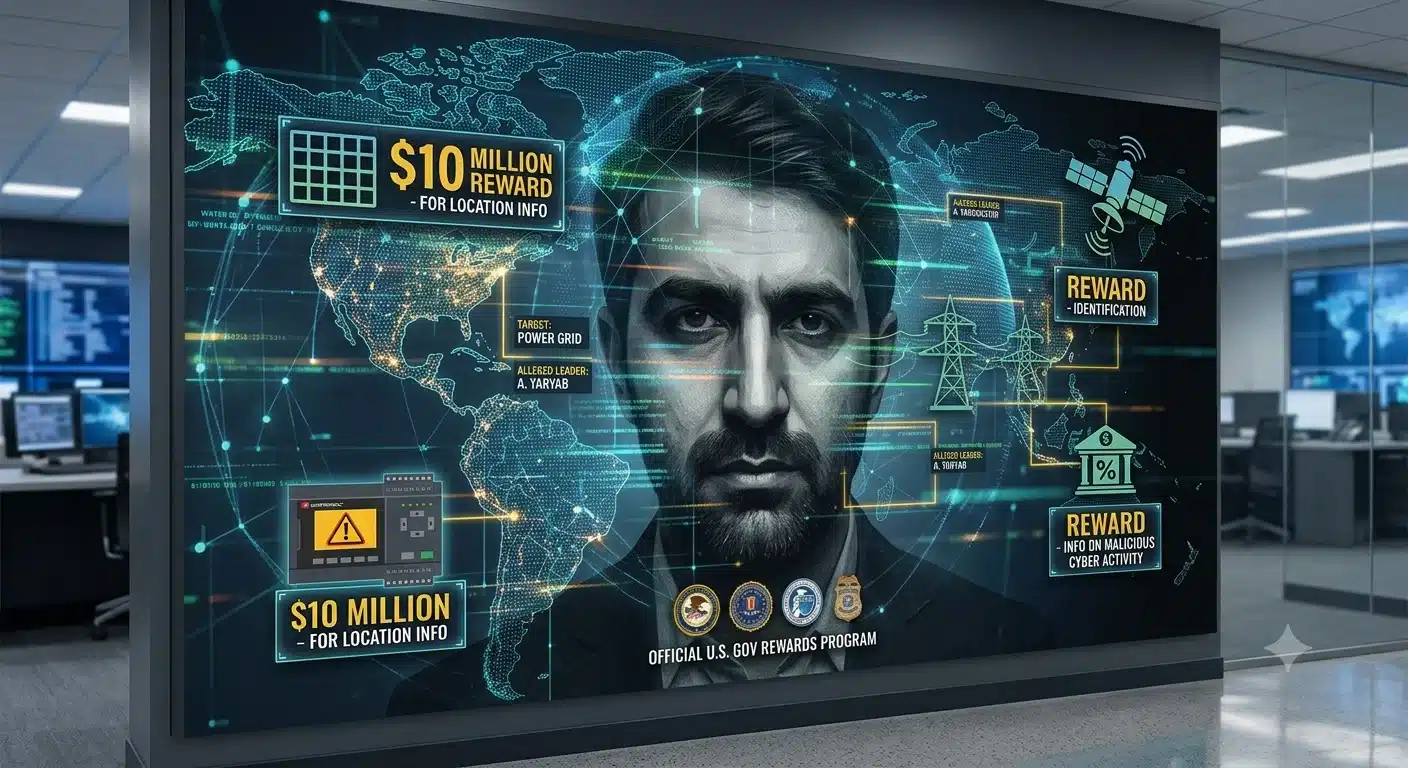
Image Source: https://rewardsforjustice.net/[/caption]
Yaryab is also accused of directing Shahid Hemmat and Shahid Shushtari, two groups linked to cyberattacks against U.S. organizations. The sectors allegedly targeted include defense, news, shipping, travel, energy, financial services and telecommunications.
The six Iranian officials named in the advisory are linked to Iran's Islamic Revolutionary Guard Corps and its Cyber-Electronic Command.
The CISA and FBI, along with cybersecurity agencies from Australia, Canada, New Zealand and the U.K., have released new guidance on outage communications for service providers dealing with major IT and OT outages. The guide calls for prompt, factual and audience-specific communication during disruptions caused by malicious cyber activity or non-malicious events.
Titled “Communicating Under Pressure: Best Practices for Service Providers,” the guidance says effective communication is critical to limiting operational impact when IT and OT outages affect customers, network defenders, critical infrastructure owners and operators, and the public. It recommends that organizations clearly communicate what is known, what remains unknown and what is still under investigation, while providing frequent updates as circumstances change.
The agencies recommend that service providers establish an outage communications plan before an incident occurs. The plan should define incident thresholds, escalation paths, target audiences and procedures for status pages, customer and partner notices, and regulatory communications. Organizations are also advised to establish cross-functional incident teams involving engineering and operations, communications, legal, risk and compliance, and customer support.
The guidance calls for clearly defined roles, including an incident lead, communications lead and spokesperson. It also recommends parallel workstreams so technical teams can focus on diagnosing and remediating the root cause while communications teams manage external messaging and leadership handles strategy and regulatory requirements.
For organizations responding to cyber incidents, the guidance places particular emphasis on balancing transparency with operational security. If malicious activity is suspected or confirmed, external communications should not compromise investigations, containment efforts or other response activities. Organizations are also advised against making premature conclusions when the root cause remains under investigation.
The guidance recommends segmenting communications for technical teams, executives and the public. Audiences can include enterprise IT teams and security operations centers, employees and customers, government partners and regulators, critical infrastructure owners and operators, as well as the media and general public.
During an outage, organizations should lead with a concise summary covering affected systems, user impact, scope and the known cause without speculation. The agencies also advise against vague descriptions such as “service degradation” and recommend messaging that can be understood quickly during high-pressure situations.
Transparency is another central principle. Service providers are advised to state what they know and do not know, use a single source of truth such as a status page, and focus communications on actionable guidance rather than reputation management. Customers should be told what actions they need to take or clearly informed when no action is required.
The guidance also calls for continuous, time-stamped updates that show the incident timeline, actions taken, and recovery milestones. Organizations should maintain a single status page and align external messaging with legal, contractual and sector-specific reporting obligations.
Agencies ultimately frame effective outage communications around five principles: immediate acknowledgement, technical and actionable information, transparency, accountability, and continuous updates. For service providers, the guidance positions communication as an important part of incident response, alongside technical remediation and recovery.
The FBI is warning the public about sexual exploitation actors illegally accessing social media and personal accounts to steal explicit images and videos from adult and underage victims. The stolen material, also known as non-consensual intimate images (NCII), is being posted or sold on criminal marketplaces, often without the victim's knowledge.
According to the FBI, these actors use social engineering and cyber intrusion tactics to target specific individuals or general targets of opportunity. After gaining access to accounts, they steal explicit content and share it through community forums or illicit marketplaces.
The FBI said personally identifiable information, including a victim's name, date of birth, email address, phone number and social media username, is often posted alongside the stolen material. This can expose victims to continued harassment and re-victimization.
The FBI has identified several methods used by sexual exploitation actors to gain access to victims' accounts.
In password/PIN targeting, actors use high-volume password and PIN attempts against social media and personal accounts. The information used in these attempts can come from data leak sites, social media and open-source information.
When victims are known to the actors, curated lists may include personal details such as names, date of birth or variations of those details.
Another tactic involves social media customer service impersonation through text messages. Victims may receive messages claiming their account is being disabled or locked unless they provide a verification code.
The actor then requests a password reset, causing a code to be sent to the victim. If the victim shares the code, the actor can reset the password and access the account.
The FBI also warns about phishing campaigns using look-alike domains and email accounts designed to appear as social media customer support.
These messages may claim there has been a new login and contain an embedded link asking the victim to change their password. Clicking the malicious link can give the actor access to the account.
Once explicit content is stolen, sexual exploitation actors may post or sell it while including personal information about the victim. The FBI said victims can subsequently face harassment, sextortion, stalking or other targeted attacks.
The actors may also advertise stolen content through a victim's own social media page, increasing the potential for further exposure.
The FBI advises people to avoid storing sensitive images or videos on social media platforms or other internet-accessible sites.
It recommends using unique, complex passphrases and PINs along with multi-factor authentication (MFA). Password information directly associated with a person's identity, including names or birthdays, should be avoided.
Users should also be cautious with links received through emails and text messages. The FBI recommends going directly to the relevant website to address account concerns and checking URLs before clicking.
Unrequested temporary passwords, PIN resets or access codes should also be treated with caution. The FBI advises users not to share login information, even when someone claims to represent a platform or service.
People who believe their explicit content was stolen or leaked can provide information through the FBI's NCII reporting site. The FBI also advises the public to continue reporting fraud, scams and cyber threats to the Internet Crime Complaint Center or a local FBI Field Office.
.ENCRT extension for encrypted files. A documented sample from July 2025 used the .CRYPT extension. The ransomware also uses Windows Management Instrumentation to delete volume shadow copies before encryption, while one victim had backup and archived data deleted from both primary and disaster recovery infrastructure.
