Visualização normal

Antes de ontemFirewall Daily – The Cyber Express
  • ✇Firewall Daily – The Cyber Express
  • Sunil Varkey Joins Hexaware Technologies as EVP & CISO Samiksha Jain
    Sunil Varkey has been appointed as Executive Vice President (EVP) and Chief Information Security Officer (CISO) at Hexaware Technologies, where he will lead the company's information security strategy, governance, risk management, and enterprise resilience initiatives. The appointment marks the latest leadership role for the cybersecurity veteran, who brings more than three decades of experience across global enterprises and multiple industry sectors. Based in Chennai, India, and operating in
     

Sunil Varkey Joins Hexaware Technologies as EVP & CISO

Sunil Varkey

Sunil Varkey has been appointed as Executive Vice President (EVP) and Chief Information Security Officer (CISO) at Hexaware Technologies, where he will lead the company's information security strategy, governance, risk management, and enterprise resilience initiatives. The appointment marks the latest leadership role for the cybersecurity veteran, who brings more than three decades of experience across global enterprises and multiple industry sectors. Based in Chennai, India, and operating in a hybrid work model, Varkey will be responsible for strengthening enterprise cybersecurity governance, risk management frameworks, and overall security strategy at Hexaware Technologies. His appointment was announced in June 2026.

Sunil Varkey to Lead Cybersecurity Strategy at Hexaware Technologies

In his new role, Sunil Varkey will oversee key areas including information security governance, enterprise risk management, and resilience initiatives. His responsibilities align with Hexaware Technologies' broader technology and growth objectives as the company continues to support large-scale digital transformation programs for clients worldwide. Hexaware Technologies delivers technology-led services across application development, cloud services, automation, data analytics, and enterprise IT operations. The company serves organizations across multiple industries and supports digital modernization initiatives at scale. Varkey's appointment comes as organizations continue to focus on strengthening cybersecurity programs and managing digital risks across increasingly complex technology environments.

More Than 30 Years of Cybersecurity Leadership Experience

Varkey brings over 30 years of experience in cybersecurity leadership spanning banking, telecommunications, IT services, manufacturing, and enterprise technology sectors. His professional experience extends across India, the Middle East, and the United States. His areas of expertise include cybersecurity governance, risk and compliance (GRC), security architecture, incident response, DevSecOps, cloud security, privacy management, cyber defense, business continuity management, security operations, and AI security. Prior to joining Hexaware Technologies, Varkey served as Cyber Security Consultant and Advisor at TAHAKOM in Riyadh, Saudi Arabia, from June 2023 to March 2025. In that role, he worked alongside the organization's CISO to enhance cybersecurity resilience and strengthen security posture. Before TAHAKOM, he held the position of Vice President and Chief Technology Officer for EMEA and APJ at Forescout Technologies Inc. between April 2021 and November 2022. Based in Dubai, he focused on IT/OT security strategy, enterprise cybersecurity advisory services, and product positioning across global markets.

Leadership Roles Across Global Organizations

Between March 2020 and January 2021, Varkey served as Managing Director and Global Head of Cyber Security Assessments and Testing at HSBC in Hyderabad. He led a team of approximately 300 professionals responsible for penetration testing, threat modeling, vulnerability management, and third-party security risk assessments. Earlier, from December 2018 to February 2020, he worked as CTO and Security Strategist for the Middle East, Africa, and Eastern Europe region at Symantec. His responsibilities included developing cybersecurity strategies for enterprise, government, industrial, and financial sector organizations. His career also includes senior leadership positions such as Global CISO at Wipro, CISO for Security and Privacy at Idea Cellular, and Vice President of Security Engineering at Barclays. Additionally, he held global security leadership roles at GE Capital, Genpact, Paramount Computer Systems, and other multinational organizations.

Focus on Governance, Risk Management, and Enterprise Resilience

Throughout his career, Varkey has overseen cybersecurity functions covering governance, compliance, strategy, security engineering, incident response, privacy, cloud security, cyber defense, and enterprise resilience. His experience includes leading security programs for organizations with large-scale user bases and complex operational environments. At Wipro, he served as Global CISO for a technology company supporting more than 200,000 end users. At Idea Cellular, he led security and privacy initiatives for a telecom operator with approximately 120 million subscribers. With his appointment, Hexaware Technologies adds a cybersecurity leader with extensive experience in building and scaling security programs across global enterprises. The move underscores the company's continued focus on strengthening cybersecurity operations, governance frameworks, and digital risk management capabilities as part of its ongoing technology initiatives.
  • ✇Firewall Daily – The Cyber Express
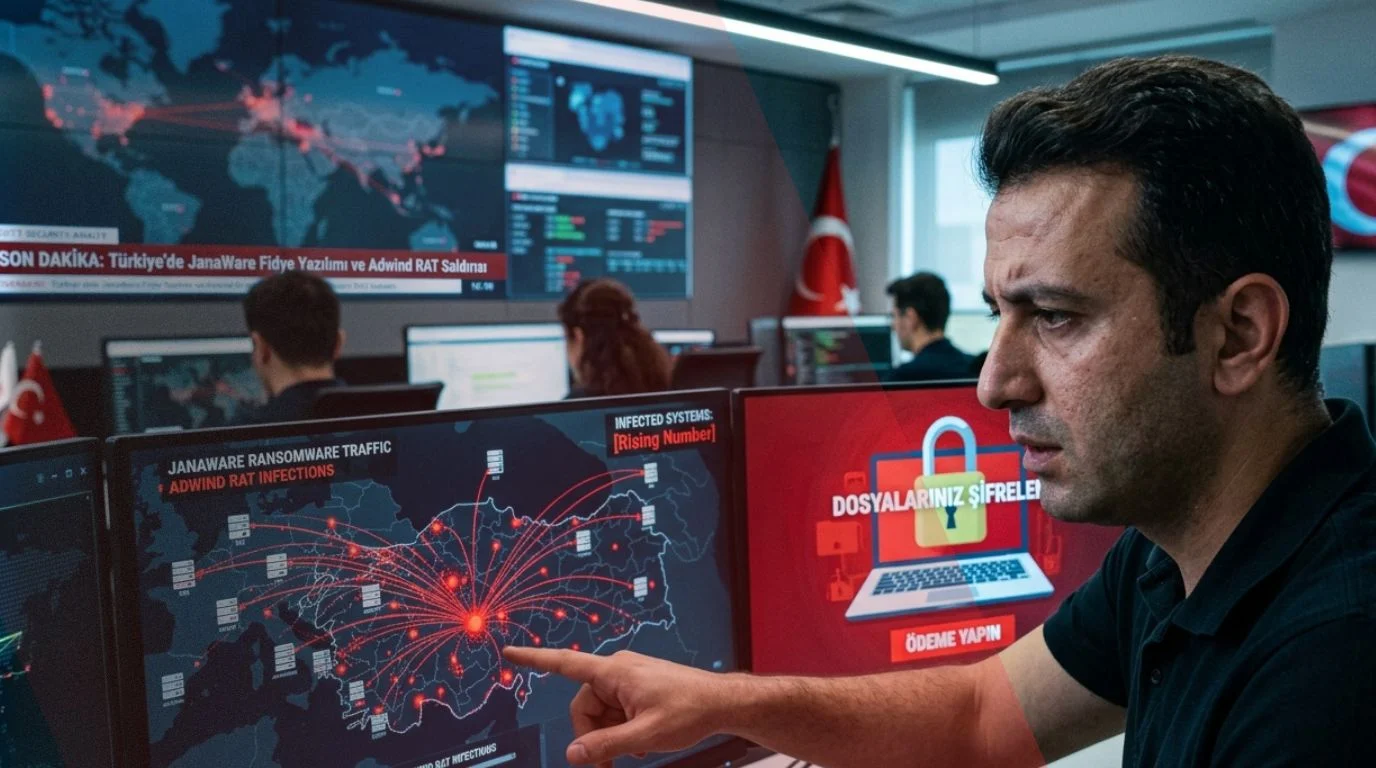
  • JanaWare Ransomware Targets Turkish Users Through Adwind RAT Campaign Samiksha Jain
    A newly identified cyber campaign involving JanaWare ransomware is targeting users in Turkey, with researchers linking the activity to a customized version of the Adwind Remote Access Trojan (RAT). The findings come from an analysis by researchers at Acronis’ Threat Research Unit (TRU), who identified the threat cluster during an investigation into suspicious Java-based malware samples. According to the researchers, the JanaWare ransomware operation appears to have been active since at least
     

JanaWare Ransomware Targets Turkish Users Through Adwind RAT Campaign

JanaWare Ransomware Targets Turkish Users

A newly identified cyber campaign involving JanaWare ransomware is targeting users in Turkey, with researchers linking the activity to a customized version of the Adwind Remote Access Trojan (RAT). The findings come from an analysis by researchers at Acronis’ Threat Research Unit (TRU), who identified the threat cluster during an investigation into suspicious Java-based malware samples. According to the researchers, the JanaWare ransomware operation appears to have been active since at least 2020. Evidence from malware samples and infrastructure indicates that the campaign has continued into late 2025, suggesting sustained activity with limited visibility. The attack relies on a modified Adwind RAT that includes polymorphic capabilities. This allows the malware to change its structure across infections, making detection more difficult. Combined with code obfuscation, these techniques have likely contributed to the campaign remaining relatively unnoticed. Unlike large ransomware groups that focus on high-value enterprise targets, JanaWare ransomware appears to follow a different strategy. Observed ransom demands range between $200 and $400, pointing to a model that prioritizes volume over large individual payouts.

Phishing Identified as Primary Infection Vector

The JanaWare ransomware campaign primarily spreads through phishing emails. Victims are lured into clicking malicious links, which lead to the download of a Java archive file. In many observed cases, the payload is hosted on cloud storage platforms. Telemetry data reviewed by researchers shows a consistent attack chain. A phishing email is opened in Microsoft Outlook, followed by a browser session that downloads the malicious file. The file is then executed using Java, triggering the infection. [caption id="attachment_111347" align="aligncenter" width="761"]JanaWare Ransomware Image Source: Acronis’ Threat Research Unit (TRU)[/caption] User reports on public cybersecurity forums also describe similar incidents, supporting the assessment that phishing is the main entry point.

Geofencing Restricts Janaware Ransomware Attacks to Turkey

A key feature of the JanaWare ransomware is its use of geofencing. The malware is designed to execute only on systems that meet specific regional criteria linked to Turkey. It checks system language, locale settings, and external IP geolocation before proceeding. If the system does not match Turkish parameters, the malicious activity is halted. Researchers note that this approach likely serves both operational and defensive purposes. It allows attackers to focus on a specific region while reducing exposure to global security monitoring and automated analysis systems.

Obfuscation and Polymorphism Hinder Detection

The JanaWare ransomware incorporates multiple techniques to evade detection. Researchers identified the use of known obfuscation tools such as Stringer and Allatori, alongside custom methods that complicate analysis. The malware also includes a self-modifying component that alters its file structure during deployment. By adding random data to its Java archive, each instance generates a unique file hash, limiting the effectiveness of signature-based detection. In addition, the malware contains embedded configuration parameters that control its behavior. These include command-and-control server details, communication ports, and authentication values used during initial connections.

Security Controls Disabled Before Encryption Stage

Before encrypting files, the malware attempts to weaken system defenses. It executes commands to disable Microsoft Defender, suppress security alerts, and remove recovery mechanisms such as Volume Shadow Copies. It also interferes with Windows Update and scans for installed antivirus software. These steps reduce the likelihood of detection or recovery once the ransomware payload is activated. The encryption process is carried out by a secondary module delivered after the initial compromise. This module uses AES encryption and communicates with command-and-control infrastructure over the Tor network.

Turkish-Language Ransom Notes Signal Targeted Approach

After encryption, the malware drops ransom notes across affected systems. These notes are written in Turkish and instruct victims to contact the attackers through encrypted communication channels such as qTox or Tor-based websites. Researchers say the consistent use of Turkish-language content, combined with geofencing, indicates a deliberate focus on users in Turkey rather than a broad, global campaign. The JanaWare ransomware campaign highlights how targeted, lower-profile operations can persist over long periods without drawing significant attention. By focusing on home users and small businesses, and keeping ransom demands relatively low, the attackers appear to maintain a steady but less visible operation. Researchers caution that such localized campaigns may continue to operate alongside larger ransomware groups, adding another layer to the evolving threat landscape.
❌
❌