Visualização normal

Antes de ontemFirewall Daily – The Cyber Express
  • ✇Firewall Daily – The Cyber Express
  • US Puts $10 Million Bounty on Alleged Iranian Cyber Chief Samiksha Jain
    The U.S. State Department has posted a $10 million reward for Amir Yaryab, a senior Iranian official accused of leading the Islamic Revolutionary Guard Corps Cyber-Electronic Command (IRGC-CEC) Cyber Operations Command and directing multiple hacking groups targeting critical infrastructure across the United States, Europe and the Middle East. According to the Rewards for Justice program, Yaryab allegedly oversees cyber operations conducted by IRGC-CEC-affiliated groups including CyberAv3ngers
     

US Puts $10 Million Bounty on Alleged Iranian Cyber Chief

7 de Setembro de 2026, 02:51

$10 Million Reward for Amir Yaryab

The U.S. State Department has posted a $10 million reward for Amir Yaryab, a senior Iranian official accused of leading the Islamic Revolutionary Guard Corps Cyber-Electronic Command (IRGC-CEC) Cyber Operations Command and directing multiple hacking groups targeting critical infrastructure across the United States, Europe and the Middle East. According to the Rewards for Justice program, Yaryab allegedly oversees cyber operations conducted by IRGC-CEC-affiliated groups including CyberAv3ngers, Dadeh Afzar Arman (DAA) and Mehrsam Andisheh Saz Nik (MASN). U.S. officials accuse these groups of using malware and conducting cyber and cyber-enabled information operations against civilian infrastructure worldwide.

$10 Million Reward for Amir Yaryab

The $10 million reward for Amir Yaryab seeks information leading to his identification or location. The offer applies to individuals acting at the direction or under the control of a foreign government who participate in malicious cyber activities against U.S. critical infrastructure in violation of the Computer Fraud and Abuse Act. [caption id="attachment_113961" align="aligncenter" width="600"]$10 million reward for Amir Yaryab Image Source: https://rewardsforjustice.net/[/caption] Yaryab is also accused of directing Shahid Hemmat and Shahid Shushtari, two groups linked to cyberattacks against U.S. organizations. The sectors allegedly targeted include defense, news, shipping, travel, energy, financial services and telecommunications. The six Iranian officials named in the advisory are linked to Iran's Islamic Revolutionary Guard Corps and its Cyber-Electronic Command.

Iranian Cyberattacks Target PLCs

The allegations also involve attacks against programmable logic controllers (PLCs), highlighting concerns around Iranian cyberattacks targeting industrial systems rather than focusing only on data theft. U.S. officials said Iranian-linked hackers compromised industrial control systems, specifically targeting the Vision series of PLCs manufactured by Israel-based Unitronics. These devices are used across water and wastewater, energy, food and beverage, manufacturing and healthcare sectors. The attackers exploited default credentials on the devices and left anti-Israel messages. Some of the compromises reportedly rendered the PLCs inoperative. The CyberAv3ngers group, which is linked to the IRGC-CEC, claimed responsibility for attacks against Unitronics Vision PLCs in October 2023. Beginning in November 2023, the group compromised default credentials in PLCs across the United States and left messages on the devices' digital screens.

CyberAv3ngers Attacks Critical Infrastructure

CyberAv3ngers has also claimed responsibility for attacks affecting other infrastructure. In October 2023, the group claimed it had breached ORPAK Systems, a provider of gas station solutions in Israel. The group said it had obtained the company's database and intended to publish it through its Telegram channel. The attack was reported to have disconnected 200 gasoline pumps from the system in the occupied Palestinian territories. In December 2023, CyberAv3ngers also claimed to possess and sell 1TB of data allegedly linked to Israel's electricity infrastructure. The group advertised the dataset for 5 Bitcoin, with an initial 100GB portion also offered at the same price.

U.S. Agencies Warn of PLC Cyberattacks

Concerns over critical infrastructure attacks involving PLCs continued into 2026. A joint advisory issued on April 7 by the FBI, CISA, NSA and other agencies warned that Iran-linked threat actors were actively exploiting internet-facing PLCs. The advisory said several organizations had experienced operational disruptions and financial losses after attackers interfered with industrial processes. The developments come amid broader U.S. actions against Iranian-linked cyber activity. The Justice Department accused Iran-connected hackers of breaching employee email accounts associated with the Department of Labor, the Federal Energy Regulatory Commission and multiple United Nations organizations. The Treasury Department also sanctioned Iranian nationals over cyberattacks targeting critical infrastructure. The State Department's reward offer places Amir Yaryab and the alleged activities of IRGC-CEC-linked groups at the center of the U.S. effort to identify individuals responsible for malicious cyber activity targeting critical infrastructure.
  • ✇Firewall Daily – The Cyber Express
  • EMEA Emerges as Global Hotspot for Financial Services DDoS Attacks Samiksha Jain
    The global financial sector is facing a sharp rise in Financial Services DDoS Attacks, with cybercriminals increasingly targeting banks, payment systems, and online financial platforms through larger, longer, and more attacks, according to new research from Akamai. In its latest State of the Internet (SOTI) Security report titled AI-Empowered Botnets and API Visibility Gaps: Attack Trends in Financial Services, research warned that AI-powered botnets and politically motivated hacktivist group
     

EMEA Emerges as Global Hotspot for Financial Services DDoS Attacks

Financial Services DDoS Attacks

The global financial sector is facing a sharp rise in Financial Services DDoS Attacks, with cybercriminals increasingly targeting banks, payment systems, and online financial platforms through larger, longer, and more attacks, according to new research from Akamai. In its latest State of the Internet (SOTI) Security report titled AI-Empowered Botnets and API Visibility Gaps: Attack Trends in Financial Services, research warned that AI-powered botnets and politically motivated hacktivist groups are intensifying the cyber threat landscape for the banking and financial services industry. Researchers found that Financial Services DDoS Attacks have become more persistent and operationally disruptive, particularly across Layers 3 and 4 web and API infrastructure.

Financial Services DDoS Attacks Top the Chart

According to the report, financial services organizations are now the most targeted industry for web and API distributed denial-of-service attacks. Akamai revealed that the median duration of global Layers 3 and 4 Financial Services DDoS Attacks has increased by 738% since 2024. The company attributed the surge to AI-powered attack infrastructure and growing hacktivist activity, including campaigns linked to pro-Iran cyber groups. Security researchers said attackers are increasingly focusing on:
  • Online banking systems
  • Real-time payment platforms
  • API infrastructure
  • Customer-facing financial applications
The report noted that while financial institutions continue expanding digital banking and payment services, the growing reliance on APIs and cloud-connected infrastructure has also expanded the attack surface available to threat actors.

API-Related Cyber Risks Emerging as Major Security Weakness

One of the strongest findings in the report involved API-related cyber risks. According to reserach’s 2026 API Security Impact Study, 96% of financial service leaders surveyed reported at least one API security incident within the past year. That figure was the highest recorded among all industries included in the research. The report also found that:
  • 60% of all web attacks in 2025 targeted banking institutions
  • 83% of attacks against API endpoints focused on financial organizations
Researchers warned that APIs are increasingly becoming high-value targets because they support critical services such as digital payments, account management, authentication systems, and mobile banking applications. Steve Winterfeld, Advisory Chief Information Security Officer at Akamai, said APIs are now central to modern cyberattacks against financial institutions. “Cybercriminals and hacktivists continue to escalate DDoS from nuisance attacks to a sustained siege encompassing both hacktivism and cybercrime, and financial services are in the crosshairs,” Winterfeld said. He added that artificial intelligence is accelerating existing cybersecurity threats rather than replacing them.

AI Botnets Driving DDoS Campaigns

The report highlighted how AI-driven infrastructure is helping attackers automate and scale malicious operations more effectively. Researchers observed a 147% surge in advanced bot activity during late 2025. In one case study referenced by Akamai, nearly 96% of all traffic reaching a targeted website was identified as malicious scraping bot activity. The company warned that AI-powered botnets are making Financial Services DDoS Attacks more difficult to detect and mitigate because attackers can dynamically adapt attack patterns and traffic behavior. These botnets are also being used to:
  • Overwhelm infrastructure
  • Disrupt payment systems
  • Target APIs
  • Scrape sensitive data
  • Launch credential abuse campaigns
Cybersecurity experts have increasingly warned that AI-enabled automation allows threat actors to launch large-scale attacks with fewer technical resources.

Attack Patterns Differ Across Global Regions

Research also identified major regional differences in cyberattack patterns targeting financial institutions. The report found:
  • Europe, the Middle East, and Africa accounted for 62% of Layers 3 and 4 DDoS attacks
  • Asia-Pacific experienced 52% of Layer 7 DDoS attacks
  • North America recorded the highest volume of web attacks at 44%
Researchers said these differences reflect varying attacker strategies, infrastructure deployment patterns, and regional cybersecurity maturity levels. The report also revealed that nearly 80% of financial institutions experienced ransomware attacks during the past two years. However, fewer than half of surveyed organizations reported adopting advanced cybersecurity technologies capable of handling modern attack methods.

Growing Pressure on Financial Sector Cybersecurity

The latest findings add to growing concerns around operational resilience within the global financial industry. As banks and financial institutions continue accelerating digital transformation initiatives, cybersecurity teams are being forced to defend increasingly complex environments that rely heavily on APIs, cloud platforms, automated infrastructure, and third-party integrations. Research said organizations must improve visibility into APIs, strengthen DDoS mitigation strategies, and modernize threat detection capabilities to address the evolving threat landscape. The SOTI report also includes guidance on DNS security, DDoS mitigation practices, AI architecture security considerations, and insights from financial sector cybersecurity experts, including contributions from the FS-ISAC.

  • ✇Firewall Daily – The Cyber Express
  • Targeted Cyberattack on Northern Ireland Schools Exposes Personal Data Samiksha Jain
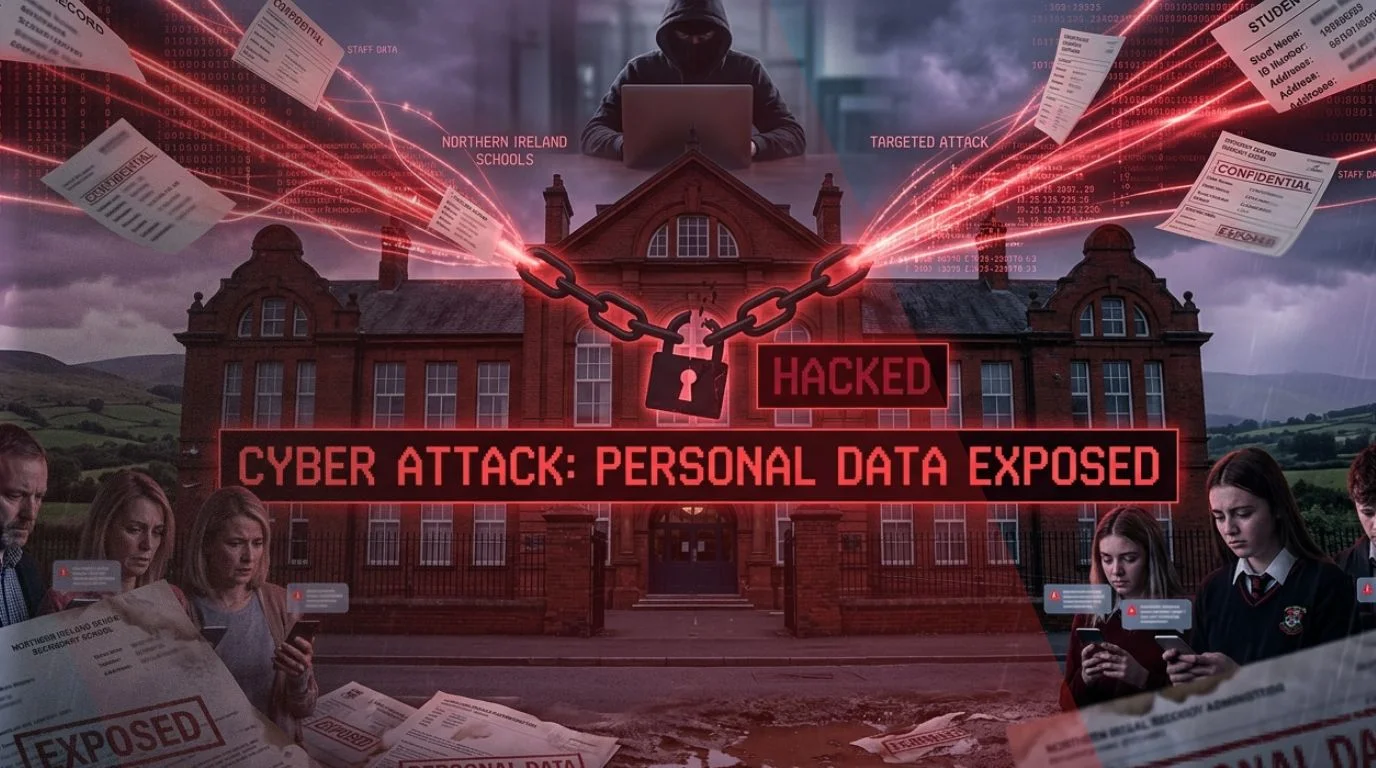
    The Education Authority cyberattack investigation has confirmed that a recent incident involved a targeted attack on a small number of schools, leading to the compromise of some personal data. The update comes days after the incident was first reported, with new findings shedding light on the nature and impact of the breach. According to officials, the Education Authority cyberattack was identified on April 10, 2026, when authorities were alerted to suspicious activity affecting school system
     

Targeted Cyberattack on Northern Ireland Schools Exposes Personal Data

Education Authority cyberattack

The Education Authority cyberattack investigation has confirmed that a recent incident involved a targeted attack on a small number of schools, leading to the compromise of some personal data. The update comes days after the incident was first reported, with new findings shedding light on the nature and impact of the breach. According to officials, the Education Authority cyberattack was identified on April 10, 2026, when authorities were alerted to suspicious activity affecting school systems. Forensic experts have since determined that attackers gained specific and targeted access to personal information linked to certain schools.

Targeted Nature of Education Authority Cyberattack

The latest findings indicate that the Education Authority cyberattack was not a widespread system breach but a focused attack on select institutions. Investigators confirmed that personal data was accessed in these cases, though the full extent of the compromised information has not yet been disclosed. Authorities had earlier stated that there was no evidence of data exfiltration or corruption. That assessment was based on initial findings, with officials noting at the time that the investigation was ongoing. The updated confirmation reflects the results of a more detailed forensic review, which required analysis across multiple systems. The breach is believed to have occurred before additional cybersecurity measures were implemented by the authority earlier this month.

Investigation and Law Enforcement Involvement

The Education Authority cyberattack is currently under active investigation, with law enforcement agencies involved. The Police Service of Northern Ireland and the Information Commissioner’s Office were notified immediately after forensic experts confirmed that personal data had been accessed. Officials stated that details of the incident are being disclosed publicly following an arrest made by the police. Prior to this development, authorities had withheld information to avoid interfering with ongoing investigations. The involvement of regulatory and law enforcement bodies highlights the seriousness of the Education Authority cyberattack, particularly given the sensitivity of data held by educational institutions.

Containment and System Recovery Efforts

System managers have assessed that the Education Authority cyberattack has been contained. Additional security measures were deployed as soon as the incident was detected, aimed at preventing further unauthorized access. Efforts are now focused on restoring normal operations. Work is ongoing to reconnect affected schools to the C2k system, which supports digital services across the education network. Officials said that restoring full functionality remains a priority while ensuring system security. The authority has also urged users to reset their C2k passwords as a precautionary step.

Notification of Affected Individuals

Authorities have confirmed that individuals whose personal data may have been compromised in the Education Authority cyberattack will be notified. The process of informing affected schools and individuals is currently underway and is being guided by the final findings of the investigation, along with advice from relevant authorities. Officials acknowledged the concern such incidents may cause and said efforts are being made to communicate with impacted parties as quickly as possible. At the same time, they noted that certain details cannot yet be disclosed publicly due to the ongoing police investigation. Further updates are expected once authorities are able to share more information without affecting the case.

Ongoing Monitoring and Next Steps

The Education Authority cyberattack remains under close monitoring as forensic analysis continues. Investigators are working to fully understand how the breach occurred and whether additional risks remain. While the incident appears to be contained, the confirmation of targeted access to personal data underscores the risks facing education systems, which often manage sensitive information across interconnected platforms. Authorities have indicated that further updates will be provided as the investigation progresses and more details become available.
  • ✇Firewall Daily – The Cyber Express
  • Hackers Exploit Kali Forms Vulnerability to Take Over WordPress Sites Ashish Khaitan
    A recently disclosed Kali Forms vulnerability affecting a widely used WordPress plugin has escalated into an active security threat, enabling unauthenticated attackers to achieve Remote Code Execution on affected websites. The flaw impacts Kali Forms, a drag-and-drop form builder with more than 10,000 active installations, and has already been exploited in the wild shortly after public disclosure.  Security researchers reported that the vulnerability was first submitted on March 2, 2026, thro
     

Hackers Exploit Kali Forms Vulnerability to Take Over WordPress Sites

Kali Forms vulnerability

A recently disclosed Kali Forms vulnerability affecting a widely used WordPress plugin has escalated into an active security threat, enabling unauthenticated attackers to achieve Remote Code Execution on affected websites. The flaw impacts Kali Forms, a drag-and-drop form builder with more than 10,000 active installations, and has already been exploited in the wild shortly after public disclosure.  Security researchers reported that the vulnerability was first submitted on March 2, 2026, through a bug bounty program, identifying a critical Remote Code Execution issue in the Kali Forms vulnerability chain. The vendor released a patched version on March 20, 2026, and the issue was simultaneously added to the Wordfence Intelligence database. On the same day, attackers began actively exploiting it on scale. 

Timeline of the Kali Forms Vulnerability in the WordPress Plugin Ecosystem 

The Kali Forms vulnerability followed a rapid disclosure-to-exploitation cycle: 
  • March 2, 2026: Initial submission of the Remote Code Execution flaw via bug bounty reporting. 
  • March 5, 2026: Wordfence Premium, Care, and Response users received firewall protection. 
  • March 20, 2026: Patched version released; vulnerability publicly disclosed; attackers began exploiting the same day. 
  • April 4, 2026: Free Wordfence users received delayed firewall protection. 
  • April 4–10, 2026: Peak exploitation activity observed against the Kali Forms vulnerability. 
The patched release addressed the issue in version 2.4.10 of the WordPress plugin, while all versions up to and including 2.4.9 remained vulnerable. 

Technical Root Cause Behind the Kali Forms Vulnerability

The core of this WordPress plugin flaw lies in how user-supplied form data is processed and stored internally. The vulnerability resides in the form_process flow and the prepare_post_data() function, which incorrectly maps attacker-controlled input into internal placeholder storage without proper validation or allow-list restrictions.  These placeholders are later used in the _save_data() method, where unsafe execution occurs through call_user_func().  A simplified excerpt of the vulnerable logic includes: 
if (isset($this->placeholdered_data['{entryCounter}'])) {    $this->placeholdered_data['{entryCounter}'] =        call_user_func($this->placeholdered_data['{entryCounter}'], $this->post->ID); } 
Because the Kali Forms vulnerability allows attackers to fully control values like {entryCounter} and {thisPermalink}, an unauthenticated user can inject arbitrary PHP function names. These are then executed directly, resulting in Remote Code Execution (RCE) attacks.  Researchers noted that the lack of input restrictions in prepare_post_data() enables overwriting internal placeholders. As a result, attacker-controlled values flow directly into call_user_func(), making exploitation trivial once the request is submitted.  One observed abuse pattern demonstrates authentication bypass attempts using built-in WordPress functions. For example, attackers can assign: 
  • {entryCounter} = wp_set_auth_cookie  
  • formId = 1  
This leads to execution of wp_set_auth_cookie(1), which may log attackers in as the default administrator account if it exists, effectively turning the Kali Forms vulnerability into a full account takeover vector. 

Active Exploitation of the Kali Vulnerability in Real-world Attacks 

Telemetry from security monitoring shows that exploitation began immediately after disclosure. Attackers have been systematically targeting the WordPress plugin using automated requests to admin-ajax.php.  A representative exploit request includes: 
POST /wp-admin/admin-ajax.php HTTP/1.1 Content-Type: application/x-www-form-urlencoded action=kaliforms_form_process& data[formId]=1& data[nonce]=66ddddb2b7& data[entryCounter]=wp_set_auth_cookie 
This confirms how the Remote Code Execution flaw is triggered through manipulated form submission data.  Security systems recorded significant attack volume: 
  • Over 312,200 exploit attempts were blocked targeting the Kali Forms vulnerability. 
  • Heavy targeting was observed immediately after March 20, 2026 disclosure. 
  • Increased spike in activity between April 4 and April 10, 2026. 

Top Attacking IP Addresses Observed 

Threat intelligence identified several IPs responsible for large-scale exploitation attempts: 
  • 209.146.60.26 – over 152,000 blocked requests  
  • 49.156.40.126 – over 50,000  
  • 124.248.183.139 – over 26,000  
  • 202.56.2.126 – over 14,000  
  • 130.12.182.154 – over 11,000  
  • 104.28.160.197 – over 9,000  
  • 1.53.114.181 – over 5,700  
  • 157.15.40.74 – over 3,000  
  • 114.10.99.126 – over 2,500  
  • 83.147.12.83 – over 1,300  
These sources were repeatedly associated with exploitation attempts targeting the Kali Forms vulnerability in the affected WordPress plugin. 
  • ✇Firewall Daily – The Cyber Express
  • Dark Web Article Contest Offers $10,000 for Exploit Writing on TierOne Forum Ashish Khaitan
    In an unusual development within the underground cyber world, a dark web article contest has been announced on a well-known dark web forum, TierOne forum. The initiative is backed by a $10,000 prize pool. The contest places a spotlight on technical writing centered around vulnerability exploitation, offering insight into how knowledge is shared and rewarded in these spaces.  Traditionally, dark web forums have been linked to illicit activities such as trading stolen data, coordinating ransomw
     

Dark Web Article Contest Offers $10,000 for Exploit Writing on TierOne Forum

dark web article contest

In an unusual development within the underground cyber world, a dark web article contest has been announced on a well-known dark web forum, TierOne forum. The initiative is backed by a $10,000 prize pool. The contest places a spotlight on technical writing centered around vulnerability exploitation, offering insight into how knowledge is shared and rewarded in these spaces.  Traditionally, dark web forums have been linked to illicit activities such as trading stolen data, coordinating ransomware attacks, and distributing malware. However, this contest introduces a different dynamic, one that mirrors legitimate cybersecurity ecosystems, where researchers document findings and share exploit techniques.  

The Dark Web Article Contest Overview and Prize Structure 

According to an official announcement shared by an administrator on the forum, the post states: “Всем привет! Мы рады сообщить T1 erone [КОНКУРС СТАТЕЙ #1 - 2026]. Победители конкурса получают призы: 1 место 5.000$, 2 место - 3.000$, 3 место - 2.000$, [Призовой фонд 10.000$]. Прием статей начинается 13.04.2026 и заканчивается 14.05.2026.”   The announcement indicates that the dark web article contest will run from April 13, 2026, to May 14, 2026, with prize amounts set at $5,000 for first place, $3,000 for second place, and $2,000 for third place, making up a total prize pool of $10,000, reportedly sponsored by the ransomware group cry0. 

Topics Focused on Vulnerability Exploitation 

The contest invites submissions covering a wide range of advanced topics related to vulnerability exploitation with real-world applicability. These include: 
  • Remote Code Execution (RCE) through deserialization flaws in React and Node.js frameworks. 
  • Command injection attacks in APIs and backend systems. 
  • Insecure Direct Object Reference (IDOR) vulnerabilities in SaaS platforms. 
  • Server-Side Template Injection (SSTI) in modern templating engines. 
  • Exploitation of insecure deserialization in PHP and Java. 
  • Client-side RCE via Markdown or Office file rendering. 
  • Firmware attacks targeting routers and cameras. 
  • Privilege escalation techniques in RouterOS and similar systems. 
  • Exploitation methods for products from Cisco, MikroTik, Oracle, and Ubiquiti. 
  • Zero-day discovery in browser components like WebGPU and Blink. 
  • AI-assisted vulnerability discovery and reverse engineering. 
  • Techniques for bypassing AV and EDR security systems. 
  • Exploitation of Remote Procedure Call (RPC) mechanisms. 
For context, vulnerabilities such as RCE, IDOR, and SSTI allow attackers to execute arbitrary code or access restricted data, while firmware attacks enable persistent control over hardware devices. Similarly, AV/EDR bypass techniques are designed to evade detection by modern security solutions. 

Participation Rules and Requirements 

The TierOne forum has outlined strict guidelines for participants. Articles must be published within the forum’s designated section and include a specific prefix to qualify: 
  • Submissions must be posted under the Articles section with the prefix “[Contest]”. 
  • A link to the article must be shared in the contest thread with a participation note. 
  • All users are eligible, regardless of registration date or activity level. 
  • The use of multiple accounts is strictly prohibited. 
In addition, the contest enforces content quality standards: 
  • Articles must be original and based on the author’s own experience. 
  • Copy-pasted or reposted material is not allowed. 
  • Submissions should comprehensively cover the chosen topic, including tools, techniques, and methodologies. 
  • Minimum length requirement is at least one A4 page. 
  • Excessive filler content is discouraged. 
  • Including video demonstrations may improve chances of winning. 

A Glimpse into Dark Web Knowledge Sharing 

While the existence of such a contest may seem surprising, it notes a bigger trend within dark web forums. Beyond illegal marketplaces and data trading, these platforms also function as hubs for technical exchange, where members document and refine vulnerability exploitation techniques. In many ways, the structure resembles legitimate bug bounty programs and penetration testing workflows, where cybersecurity professionals publish detailed reports on discovered flaws. The key difference lies in the intent and environment in which this knowledge is applied. It is important to note that this article does not endorse participation in such activities. Instead, it aims to shed light on how these underground ecosystems operate. The TierOne forum contest highlights that even within the dark web, there are organized efforts to produce structured, experience-based technical content, albeit in a context that raises ethical and legal concerns.
❌
❌