Visualização normal

Antes de ontemFirewall Daily – The Cyber Express

OverlayPhantom Android Banking Trojan Targets 180+ Financial Apps Across 10 Countries

OverlayPhantom

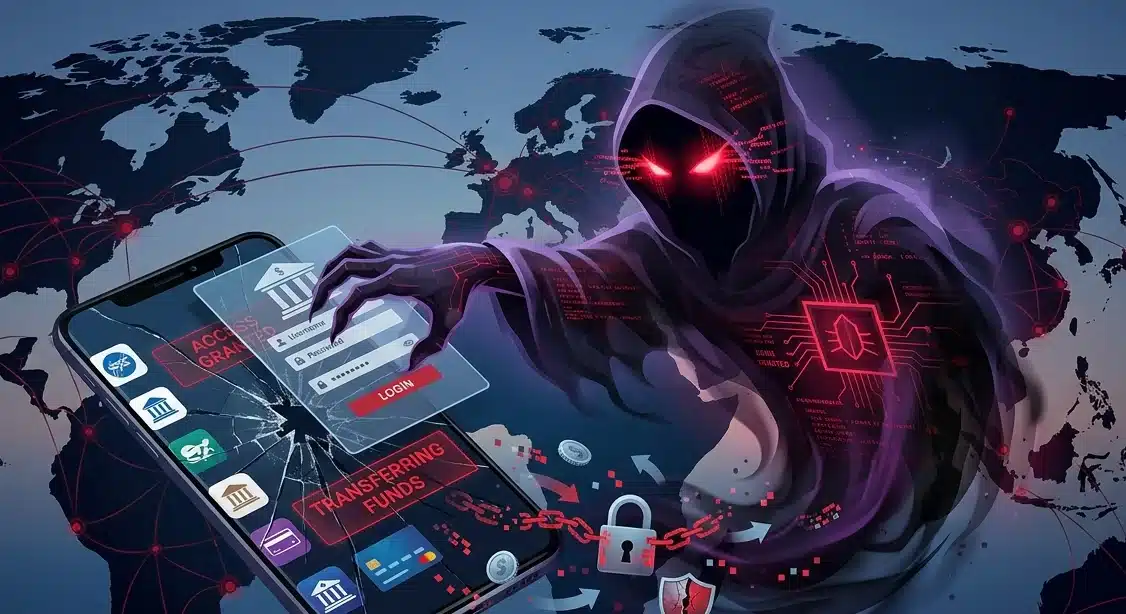
A newly discovered Android banking trojan known as OverlayPhantom is raising concerns among cybersecurity researchers after evidence revealed that the malware is actively targeting banking, financial, and cryptocurrency users across multiple Western countries.  The malware campaign, uncovered by Cyble Research and Intelligence Labs (CRIL), demonstrates how modern threat actor groups are combining social engineering, remote device control, phishing overlays, and real-time surveillance capabilities into a single malicious framework.  According to researchers, OverlayPhantom has been active since May 2025 and is currently targeting more than 180 applications across 10 countries, including the United States, Australia, Germany, France, Belgium, Finland, the Netherlands, Italy, Spain, and the United Kingdom. The Android banking trojan is being distributed via malicious URLs that impersonate trusted applications, attempting to trick users into installing infected APK files. 

OverlayPhantom Uses Trusted Brands to Infect Victims 

The initial OverlayPhantom sample was discovered on a malicious domain distributing a fake version of ID Austria, the Austrian government’s official digital identity application. Researchers noted that the use of a government-themed lure increased the effectiveness of the malware campaign because victims are more likely to trust requests tied to identity verification or public services. A second sample linked to the same threat actor impersonated TikTok and appeared to focus on users in Spain. The shift from a government application to a mainstream social media platform suggested that the operators behind OverlayPhantom are deliberately broadening their infection strategies to target both institutional trust and consumer familiarity. CRIL researchers stated that the Android banking trojan employs a two-stage infection process. Victims initially download a dropper application that displays what appears to be a legitimate Google Play update screen. The fake update interface is designed to reduce suspicion and persuade users to continue the installation process. The malware also includes a guided tutorial that instructs victims on how to enable Android Accessibility Service permissions — a critical step that grants the threat actor elevated access to the infected device.

Android Banking Trojan Abuses Accessibility Services

Once installed, OverlayPhantom disguises itself as “Google Play Services,” making the malicious application harder for users to detect or remove. Researchers said the Android banking trojan abuses Android’s Accessibility Service to monitor user activity, intercept inputs, simulate gestures, and maintain persistent device control.  The malware establishes communication with its command-and-control (C&C) infrastructure through the IP address hxxps://199.217[.]99[.]122 using three separate ports dedicated to different tasks: 
  • Port 9092 handles device status reporting
  • Port 9091 is used for command-and-control communication
  • Port 9090 supports screen streaming functionality
Researchers found that OverlayPhantom can execute more than 30 remote commands issued by the threat actor. These commands allow attackers to perform taps, swipes, long presses, open recent apps, manipulate clipboard contents, increase or lower volume, lock screens, display fake notifications, and even launch fraudulent overlay windows designed to capture passwords or PINs. The Android banking trojan also supports commands such as startStreamJpeg and stopStreamJpeg, enabling remote screen streaming sessions.

OverlayPhantom Conducts Advanced Overlay Attacks 

One of the most dangerous features of OverlayPhantom is its use of embedded HTML phishing overlays. The malware continuously monitors which applications are running in the foreground and compares them against a hardcoded target list embedded within the APK. When a targeted banking or cryptocurrency application is opened, the Android banking trojan launches a counterfeit login page through an embedded WebView. Researchers said these phishing interfaces are carefully designed to visually match legitimate financial applications, making them difficult for victims to distinguish from the real apps. From the user’s perspective, the fake login screen appears authentic. However, any credentials entered into the overlay are immediately harvested and transmitted back to the threat actor’s infrastructure. CRIL researchers noted that OverlayPhantom specifically targets banking, finance, and cryptocurrency platforms, reflecting a financially motivated operation focused on large-scale fraud.

Real-Time Screen Streaming Expands Threat Actor Capabilities 

OverlayPhantom also includes a built-in real-time screen streaming mechanism powered by Android’s MediaProjection API. When activated, the malware captures screen activity through a VirtualDisplay instance named “jpeg-stream” and continuously transmits compressed JPEG images back to the C&C server over port 9090.  The captured output is resized to a fixed width of 540 pixels while preserving the original aspect ratio of the victim’s device. Researchers explained that JPEG compression helps reduce bandwidth usage while still giving the threat actor near real-time visibility into user activity.  The malware also contains resilience mechanisms to maintain streaming sessions. If the connection drops or no image frames are available, OverlayPhantom pauses briefly before attempting reconnection. Once retry limits are exceeded, the malware disables the streaming session to avoid endless reconnection loops. According to researchers, the operator can terminate screen streaming at any moment by issuing the stopStreamJpeg command.

Researchers Warn OverlayPhantom Threat May Expand 

Cybersecurity researchers described OverlayPhantom as a “mature and methodically engineered Android banking trojan” due to its combination of phishing overlays, Accessibility Service abuse, multi-port communication infrastructure, and remote device manipulation features. While many of the individual techniques used by the malware are not entirely new, researchers warned that the coordinated integration of government impersonation, consumer application lures, credential theft overlays, and real-time surveillance capabilities makes this threat actor particularly dangerous. The report concluded that the operational scale of OverlayPhantom — including its targeting of more than 180 applications across multiple countries — indicates that the Android banking trojan campaign may continue expanding in scope and sophistication in the coming months. Security experts advised organizations and individuals in affected regions to treat OverlayPhantom as a high-priority threat due to its ability to silently harvest credentials, monitor device activity, and facilitate financial fraud without obvious signs of compromise.
  • ✇Firewall Daily – The Cyber Express
  • Global Instructure Breach Hits Queensland Schools Through QLearn Platform Samiksha Jain
    A major QLearn cybersecurity incident has affected thousands of educational institutions globally, including Queensland state schools and universities, after a cyber breach involving third-party education technology provider Instructure exposed personal information linked to students and staff. Queensland Education Minister John-Paul Langbroek confirmed the incident in an official statement, saying the Queensland Department of Education was briefed about the international cybersecurity breach
     

Global Instructure Breach Hits Queensland Schools Through QLearn Platform

QLearn Cybersecurity Incident

A major QLearn cybersecurity incident has affected thousands of educational institutions globally, including Queensland state schools and universities, after a cyber breach involving third-party education technology provider Instructure exposed personal information linked to students and staff. Queensland Education Minister John-Paul Langbroek confirmed the incident in an official statement, saying the Queensland Department of Education was briefed about the international cybersecurity breach involving Instructure, the provider behind the Department’s online learning platform, QLearn. According to early assessments, the breach may affect more than 200 million people and over 9,000 institutions worldwide, making it one of the largest education-sector cybersecurity incidents disclosed this year.

QLearn Cybersecurity Incident Impacts Queensland Schools

The Department of Education said students and staff who have worked or studied at Education Queensland schools since 2020 may have been affected by the QLearn cybersecurity incident. Authorities stated that compromised information currently appears limited to names, email addresses, and school locations. Officials added there is currently no evidence that passwords, dates of birth, or financial information were accessed during the breach. The online learning platform QLearn was introduced in Queensland schools in 2020 under the previous government and has since become a widely used digital education system across the state. Minister Langbroek said school principals have already begun contacting affected families and teachers to notify them about the breach and provide further guidance. “This morning I have been briefed by the Department of Education about an international cybersecurity breach involving a third-party provider, Instructure, which delivers the Department’s online learning platform, QLearn,” Langbroek said in the statement.

Instructure Data Breach Raises Concerns Across Education Sector

The QLearn cybersecurity incident has once again highlighted the growing cybersecurity risks facing the global education sector, particularly as schools and universities continue relying heavily on third-party digital learning platforms. Because the breach involves Instructure, a provider serving institutions across multiple countries, the incident extends far beyond Queensland. Authorities indicated that educational institutions across Australia and overseas are also impacted. While officials stressed that no sensitive financial or authentication data has been identified as compromised so far, cybersecurity experts often warn that exposed personal information such as names and email addresses can still be valuable to cybercriminals. Threat actors frequently use this type of information in phishing campaigns, identity-based scams, and social engineering attacks targeting students, parents, and school employees. The Department of Education has not publicly disclosed how the cybersecurity breach occurred or whether any ransomware or unauthorized network access was involved. Investigations into the incident are ongoing.

Queensland Department Prioritizes Support for Vulnerable Families

In response to the QLearn cybersecurity incident, the Queensland Department of Education said it is prioritizing support for vulnerable individuals and families potentially affected by the breach. According to the Minister’s statement, the Department is providing priority assistance to families and teachers with known family and domestic violence concerns, as well as individuals connected to Child Safety services. The additional support measures appear aimed at reducing potential risks associated with the exposure of school-related location information and contact details. Government agencies increasingly recognize that cybersecurity incidents affecting education systems can carry broader safety implications, especially for vulnerable groups whose personal or location-related information may require additional protection.

Global Education Sector Continues Facing Cybersecurity Threats

The QLearn cybersecurity incident adds to a growing list of cyberattacks and data breaches targeting educational institutions worldwide. Schools, universities, and online learning providers have become frequent targets due to the large amount of personal information they manage and the widespread use of interconnected digital platforms. Education systems often rely on multiple third-party vendors for online learning, communications, and student management services, increasing the potential attack surface for cybercriminals. The Queensland Department of Education said it will continue updating the public as more information becomes available from the ongoing investigation into the breach. At this stage, authorities have not advised affected individuals to reset passwords or take additional security measures, though officials are continuing to assess the full scope and impact of the incident. The investigation into the Instructure-related breach remains active as educational institutions worldwide work to determine the extent of the exposure and any potential long-term cybersecurity implications.
  • ✇Firewall Daily – The Cyber Express
  • Gov. Tim Walz Deploys National Guard After Winona Cyberattack Disrupts Services Samiksha Jain
    A Winona County cyberattack has disrupted critical systems and forced Minnesota to step in with emergency support. The cyberattack on Winona County began on April 6 and continued overnight into April 7, affecting key digital infrastructure used to run emergency and municipal services. County officials said the disruption significantly impaired their ability to deliver essential services, including core administrative and public-facing operations. Governor Tim Walz signed an executive order
     

Gov. Tim Walz Deploys National Guard After Winona Cyberattack Disrupts Services

Winona County cyberattack

A Winona County cyberattack has disrupted critical systems and forced Minnesota to step in with emergency support. The cyberattack on Winona County began on April 6 and continued overnight into April 7, affecting key digital infrastructure used to run emergency and municipal services. County officials said the disruption significantly impaired their ability to deliver essential services, including core administrative and public-facing operations. Governor Tim Walz signed an executive order authorizing the Minnesota National Guard to assist with the response. “Cyberattacks are an evolving threat that can strike anywhere, at any time,” said Governor Walz. “Swift coordination between state and local experts matters in these moments. That's why I am authorizing the National Guard to support Winona County as they work to protect critical systems and maintain essential services.”

Winona County Cyberattack Strains Local Response

The Winona County cyberattack quickly overwhelmed local response efforts. Officials said teams have been working around the clock since the incident was detected. The county is coordinating with Minnesota Information Technology Services, the Minnesota Bureau of Criminal Apprehension, the League of Minnesota Cities, the Federal Bureau of Investigation, and external cybersecurity specialists. Despite this multi-agency response, officials confirmed that the scale and complexity of the incident exceeded both internal and commercial response capabilities. This led to a formal request for cyber protection support from the Minnesota National Guard. The incident highlights how even smaller jurisdictions are now facing large-scale cyber disruptions that require state-level intervention.

National Guard Activated Under Emergency Order

Under the emergency order, the Adjutant General is authorized to deploy personnel, equipment, and other resources to support the response to the Winona County cyberattack. The order also allows the state to procure services needed to manage the incident and confirms that costs will be covered through the state’s general fund. It is already in effect and will remain active until the emergency conditions subside or the order is formally rescinded. Officials say the priority is to stabilize affected systems, prevent further damage, and restore full functionality as quickly as possible.

Essential Services Continue Amid Disruption

Even as systems remain impacted, officials stressed that emergency services are still operational. 911 services, fire response, and other emergency operations continue to function during the Winona County cyberattack, ensuring that urgent public safety needs are not affected. However, the disruption has slowed other county services, and officials have warned that some delays are expected as systems are brought back online. Residents have been asked for patience while recovery efforts continue.

Investigation Underway

Authorities have not disclosed the nature of the Winona County cyberattack or whether it involves ransomware or another type of cyber intrusion. The FBI is actively involved in the investigation, along with state agencies and external cybersecurity experts. Investigators are working to determine how the attack occurred, what systems were impacted, and whether any sensitive data was accessed. For now, the focus remains on containment, system recovery, and strengthening defenses to prevent further intrusion.

Earlier Ransomware Incident Raises Concerns

The latest Winona County cyberattack comes as an update to a ransomware incident the county first reported in January 2026. At the time, officials said, “We recently identified and responded to a ransomware incident affecting our computer network. Upon discovery, we immediately initiated an investigation to assess the scope and impact of the incident.” A local emergency was declared during that event by County Board Chair Commissioner Meyer, as officials worked to maintain continuity of services. Emergency operations, including 911 and fire response, remained active while systems were analyzed and restored. The recurrence of cyber incidents in such a short period has raised concerns about ongoing vulnerabilities and the growing threat landscape facing local governments.

Growing Cyber Pressure on Local Governments

The Winona County cyberattack highlight a broader trend, local governments are increasingly targeted but often lack the resources to respond to complex cyber incidents on their own. When systems go down, the impact is immediate. Public services are disrupted, and recovery can take time. State support is now helping Winona County stabilize operations. But the incident highlights a larger issue: cyberattacks are becoming more frequent, more disruptive, and harder for local agencies to handle without outside assistance.

❌
❌