Six hours. That's the incident notification window under the UAE's Information Assurance Standard v2. Once a breach is detected, the framework requires incident notifications within 6 hours of detection, alongside quarterly compliance updates and annual maturity assessments.
Saudi Arabia's regulators aren't far behind — SAMA's cybersecurity framework and the Kingdom's PDPL both converge on a 72-hour notification standard, and the NCA's Essential Cybersecurity Controls point organizations tow
Six hours. That's the incident notification window under the UAE's Information Assurance Standard v2. Once a breach is detected, the framework requires incident notifications within 6 hours of detection, alongside quarterly compliance updates and annual maturity assessments.
Saudi Arabia's regulators aren't far behind — SAMA's cybersecurity framework and the Kingdom's PDPL both converge on a 72-hour notification standard, and the NCA's Essential Cybersecurity Controls point organizations toward a similar 72-hour reporting expectation for serious cyber incidents.
Read that again. Regulators across the GCC aren't asking enterprises to respond fast anymore — they're mandating how fast enterprises must know. And that's the part most security programs still get wrong.
The Compliance Clock Starts at Detection, Not Response
Every regulatory framework reshaping the region's cybersecurity posture — NCA ECC, NESA/UAE IAS v2.1, SAMA CSF — shares a structural assumption: the organization already knows it's been breached. The clock for reporting, escalation, and remediation only starts ticking once detection happens.
That assumption breaks down inside most enterprise SOCs. Detection today typically means:
Alerts triaged manually across siloed tools, hours or days after initial compromise
Threat intelligence that arrives as static reports, not real-time signal
Exposure discovered only after a regulator, a customer, or an attacker's leak site announces it
Under NESA's incident management requirements, tested response procedures and a maintained incident log matter — but the underlying detection of SLA still has to be met before any of that documentation is worth anything. A perfect incident response plan is irrelevant if the breach itself goes unnoticed for a week.
Why Reactive Detection Can't Survive These Timelines
Reactive security was designed around a different clock — the attacker's dwell time, not the regulator's reporting window. Under IAS v2's enhanced SOC requirements, Tier 1 critical infrastructure entities now need 24/7 monitoring capability paired with defined detection and response SLAs, not just a monitoring function. That's a measurable performance bar, not a checkbox.
For a Gulf enterprise, missing that bar isn't just a security failure — it's a compliance failure with financial, contractual, and reputational consequences layered on top. And because a single incident can trigger overlapping obligations across multiple regulators at once, one detection gap can cascade into several separate compliance breaches simultaneously.
Where AI-powered Threat Intelligence Closes the Gap
This is the shift Cyble Vision is built for. Instead of waiting for a signature match or a manual review cycle, AI-powered threat intelligence continuously correlates external signals — leaked credentials, dark web chatter, exposed assets, attacker infrastructure — against your enterprise footprint in real time.
That matters specifically because GCC frameworks measure speed from the moment of detection, not from the moment someone happens to notice. Closing that gap means:
Continuous exposure monitoring instead of periodic scans, so assets breaching policy or appearing in threat actor chatter surface immediately
AI-correlated alerting that cuts through noise and prioritizes what actually threatens regulated systems
Audit-ready detection logs that document when a threat was identified — the evidence NESA and SAMA assessors specifically ask for
Don't wait for attackers — or a regulator — to find your blind spots first.
What "Regulatory-Ready" Detection Actually Looks Like?
For a CISO or compliance lead building toward NCA ECC, NESA, SAMA, or UAE IAS v2.1, the operational bar has moved from "can we respond" to "can we prove we detected in time." That means:
Detection telemetry timestamped and retained for regulator review
Threat intelligence mapped directly to the assets and systems in scope
Alerting fast enough to fit inside a 6-to-72-hour reporting clock — not just a monthly threat report
Cybersecurity compliance in the UAE and Saudi Arabia is no longer a documentation exercise. It's a speed test, and most enterprises are still building for the exam they used to take.
Find Your Blind Spots Before the Regulator Does
AI-powered threat intelligence isn't a nice-to-have layered on top of compliance anymore — for Gulf enterprises operating under NCA ECC, NESA, SAMA, and UAE IAS v2.1, it's becoming the mechanism that makes compliance achievable at all.
Supply chain attacks in 2026 are no longer an edge-case risk buried in a vendor questionnaire — they are a primary breach vector that regulators, incident responders, and CISOs now treat as a first-order threat. Verizon's 2026 Data Breach Investigations Report found third-party involvement in 48% of breaches, up 60% year over year, following the 2025 edition, which already recorded a jump from 15% to 30%.
Every vendor integration, every open-source dependency, and every managed file transf
Supply chain attacks in 2026 are no longer an edge-case risk buried in a vendor questionnaire — they are a primary breach vector that regulators, incident responders, and CISOs now treat as a first-order threat. Verizon's 2026 Data Breach Investigations Report found third-party involvement in 48% of breaches, up 60% year over year, following the 2025 edition, which already recorded a jump from 15% to 30%.
Every vendor integration, every open-source dependency, and every managed file transfer tool expands the attack surface that an organization does not directly control. That is the core problem with supply chain security today: the weakest link is rarely the enterprise itself.
It is the supplier three tiers removed that nobody in procurement flagged as high-risk.
What Is a Supply Chain Attack, and Why Does It Bypass Standard Defenses?
A supply chain attack targets the vendors, software components, and build pipelines that an organization depends on, rather than attacking the organization directly.
Software supply chain security failures happen when a trusted update, library, or third-party platform is compromised upstream, and that compromise rides in through a channel the target already trusts and has whitelisted.
Traditional vulnerability scanning is built to find flaws in owned infrastructure — it was never designed to flag a poisoned dependency sitting inside a vendor's codebase.
Recent Supply Chain Attacks Prove the Blind Spot Is Structural, Not Occasional
The pattern keeps repeating at scale. The Cybersecurity and Infrastructure Security Agency and FBI documented in advisory AA23-158A how the Cl0p ransomware group exploited a SQL injection flaw (CVE-2023-34362) in Progress Software's MOVEit Transfer platform, a widely used managed file transfer tool. Exploitation began on May 27, 2023. CISA added the vulnerability to its Known Exploited Vulnerabilities catalog on June 2, six days later, and Progress had published its own advisory on May 31.
By January 2024, breaches or downstream exposures at more than 2,700 organizations had compromised the personal data of more than 93 million people, according to tracking by Emsisoft and KonBriefing Research. Censys counted more than 3,000 MOVEit environments exposed to the internet before the flaw was disclosed or patched.
The same advisory covers an earlier Cl0p campaign against Fortra's GoAnywhere MFT, launched in late January 2023 against a separate zero-day, CVE-2023-0669. Cl0p claimed to have exfiltrated data affecting approximately 130 victims over the course of 10 days, a claim CISA and the FBI recorded in the advisory.
The agencies did not identify lateral movement from GoAnywhere into victim networks, which suggests the breach stopped at the platform itself. That detail is the point, not a caveat: the attacker never needed to go any further because the platform already held the data.
These campaigns share a structure: one vendor, one flaw, hundreds of downstream victims who had no visibility into the vendor's exposure until the breach was already public.
Why Vendor Dependencies Create Blind Spots Scanning Alone Can't Close
This is the operational reality procurement and vendor risk teams face: an organization can harden its own perimeter completely and still inherit a breach through a supplier's unpatched system, a compromised update mechanism, or a fourth-party dependency nobody mapped.
Supply chain threats don't trip an internal vulnerability scanner because the vulnerable asset was never inside the scan's scope to begin with.
By the time a breach notification arrives from a vendor, the exposure window has already closed — and the damage is already done.
Supply Chain Attack Prevention Now Requires Continuous, External Vendor Visibility
Governments are formalizing the response. In September 2025, CISA and the NSA, together with 19 international partners, published joint guidance establishing a shared framework for Software Bills of Materials, treating component-level transparency as a baseline security expectation rather than a nice-to-have.
CISA, the NSA, the FBI, and international partners followed on July 29, 2026, with 2026 Minimum Elements for a Software Bill of Materials, which updates and replaces the minimum elements NTIA published in 2021.
The revision draws on more than 90 public comments and applies to all software, including open-source components, AI systems, and software delivered as a service
CISA has since followed with the 2026 Minimum Elements for SBOM guidance, updating the original 2021 federal standard.
The regulatory direction is unambiguous: organizations are expected to know what's inside their vendors' software stacks —not just their own—before deployment, not after an incident.
Monitoring the Vendor, Not Just the Perimeter
Closing this blind spot requires continuous monitoring of vendor infrastructure, exposed credentials, dark web chatter, and third-party breach signals — the exact layer traditional vulnerability management doesn't cover.
Cyble's Third-Party Risk Management platform continuously tracks vendor risk posture, surfacing exposure signals tied to suppliers before they cascade into a confirmed compromise, giving CISOs, vendor risk managers, and procurement security teams the lead time that reactive scanning can't provide.
Supply chain attacks in 2026 succeed for the same reason every time: organizations extend trust to vendors faster than they extend visibility into them. CISA's own advisory record — from GoAnywhere to MOVEit — shows that a single upstream compromise can cascade into hundreds of victims before any of them see it coming. Patching internal systems faster won't fix that. Neither will another vendor questionnaire be filed away after onboarding.
What changes the outcome is continuous visibility into the vendors, software components, and dependencies an organization has already accepted as trusted — tracked before a breach notification forces the issue. That's the gap threat intelligence is built to close, and it's the difference between reacting to a supplier's incident and seeing it coming.
Disclaimer: This blog is for general informational purposes only and does not constitute security, legal, or compliance advice. Statistics and incidents referenced are drawn from public advisories issued by CISA, FBI, and NSA, accurate as of their publication dates. Threat conditions and guidance change frequently — consult the original advisories and your own security team before making risk or compliance decisions.
Europe faced a ransomware onslaught in the first half of 2026 that sets a troubling precedent for the remainder of the year. According to Cyble Research and Intelligence Labs (CRIL), the region experienced 866 documented ransomware attacks, 51 confirmed data breach incidents, and 7 initial access sales between January and June 2026. These figures represent not just a volume problem, but a fundamental shift in how threat actors are organizing, targeting, and monetizing their operations within E
Europe faced a ransomware onslaught in the first half of 2026 that sets a troubling precedent for the remainder of the year. According to Cyble Research and Intelligence Labs (CRIL), the region experienced 866 documented ransomware attacks, 51 confirmed data breach incidents, and 7 initial access sales between January and June 2026. These figures represent not just a volume problem, but a fundamental shift in how threat actors are organizing, targeting, and monetizing their operations within European territory.
What distinguishes the ransomware threats in Europe from other global regions is the concentration of power among a small number of highly sophisticated threat actors. While the threat ecosystem encompasses dozens of groups, five dominant ransomware operators account for approximately 55% of all documented activity. This concentration creates predictability—European security leaders can now identify, profile, and build specific defensive strategies against known adversaries.
The Five Dominant Ransomware Groups Targeting Europe
1. Qilin: The Biggest Ransomware Threat in Europe
Attack Volume: 158 documented incidents (18.2% of regional total)
Qilin stands as the dominant ransomware threat actor targeting Europe, commanding operational superiority through sophisticated affiliate management, rapid exploit weaponization, and industry-specific targeting intelligence.
Qilin's dominance stems from understanding European organizational economics. Construction projects operate under time-sensitive contracts with contractually-defined penalties for delay. A single day of downtime on a €50 million construction project can trigger cascading costs exceeding €100,000. This economic reality translates directly into ransom payment likelihood, making Qilin's targeting strategy rational and highly effective.
The group maintains an extensive affiliate network capable of concurrent operations across multiple European nations. Evidence suggests Qilin has compartmentalized its operations: initial access brokers handle reconnaissance and network compromise, mid-tier operators manage lateral movement and privilege escalation, and final-stage operators execute encryption and exfiltration. This division of labor enables rapid scaling and reduces attribution risk.
Why Qilin Dominates:
Industry Expertise: Deep understanding of construction project timelines and financial exposure
Exploit Library: Rapid weaponization of both known and zero-day vulnerabilities
Data Monetization: Established data brokerage partnerships ensure exfiltrated data reaches buyers
European Security Implications: Organizations in construction, professional services, and manufacturing should treat Qilin as their primary threat actor concern. Defensive strategies must prioritize data exfiltration prevention, network segmentation, and immutable backup infrastructure.
2. The Gentlemen: The Rising European Threat
Attack Volume: 144 documented incidents (16.6% of regional total)
The Gentlemen represent an emerging threat actor that has achieved remarkable scale in a relatively short operational window. Unlike established groups that evolved from other cybercriminal operations, The Gentlemen appear purpose-built for ransomware-as-a-service operations.
Geographic Concentration:
Europe: 144 attacks (primary focus)
United States: 100 attacks (secondary focus)
Thailand: 35 attacks (supply-chain targeting)
South Asia: 40 attacks
Worldwide Sectoral Targeting:
Construction: 45 incidents
Manufacturing: 56 incidents
Healthcare: 37 incidents
IT & ITES: 36 incidents
Professional Services: 29 incidents
Operational Characteristics:
The Gentlemen's rapid emergence and sustained growth suggest significant operational funding and technical sophistication. The group's geographic diversification—maintaining European dominance while aggressively expanding into Asia-Pacific—indicates either organizational scale or partnerships with regional threat actors.
Notably, The Gentlemen's Thailand targeting (35 incidents) suggests supply-chain attack sophistication. By compromising manufacturing and logistics operations in Thailand, the group can leverage these beachheads for downstream attacks against Western European organizations. This cross-continental supply-chain targeting represents a significant evolution in ransomware operational sophistication.
Key Distinction: While Qilin focuses on maximizing ransom payments from individual targets, The Gentlemen appear to prioritize operational scale and geographic expansion. This suggests the group may be building toward either:
A mega-RaaS platform rivaling LockBit's historical dominance
Preparation for potential acquisition or partnership with state-sponsored actors
Geographic arbitrage—leveraging lower prosecution risk in developing nations while maintaining European operations
European Security Implications: The Gentlemen's emergence signals market competition is intensifying. Organizations should monitor this group's operational evolution closely, as aggressive growth often precedes operational mistakes that create defensive opportunities.
3. LockBit: The Persistent Legacy Threat
Attack Volume: 61 documented incidents (7.0% of regional total)
LockBit's presence in European targeting represents a significant finding given sustained law enforcement pressure and multiple platform disruption attempts. Despite being targeted by coordinated international takedown operations, LockBit maintained operational capability throughout H1 2026.
Geographic Concentration:
Europe: 61 attacks (Primary operations)
North America: 47 attacks (Secondary operations)
Distributed: Global presence indicating resilient infrastructure
Worldwide Sectoral Targeting:
Construction: 22 incidents
Manufacturing: 22 incidents
Government & LEA: 12 incidents
Healthcare: 19 incidents
Professional Services: 13 incidents
Operational Resilience:
LockBit's continued operations despite international enforcement actions demonstrate several critical lessons:
Affiliate Compartmentalization: By maintaining separate operational cells, LockBit can continue operations even when core infrastructure is disrupted
Rapid Rebranding: The group has adopted multiple identities and platform variants, complicating attribution
Infrastructure Redundancy: Multiple command-and-control server locations across jurisdictions with varying law enforcement cooperation levels
Operator Recruitment: Continuous recruitment of new affiliates from emerging cybercriminal talent pools
The group's continued viability suggests that law enforcement actions, while disruptive, are insufficient to eliminate established RaaS operations. Organizations cannot rely on law enforcement intervention as a defensive strategy; they must assume LockBit and similar groups will remain operational threats indefinitely.
European Security Implications: LockBit should remain on European security teams' active threat monitoring lists. The group maintains technical sophistication, access to critical zero-day exploits, and demonstrated willingness to target European critical infrastructure.
4. Akira: The Opportunistic European Operator
Attack Volume: 59 documented incidents (6.8% of regional total)
Akira represents a secondary-tier ransomware group with focused European operations. The group demonstrates strong preference for Manufacturing and Construction sectors, suggesting industry-specific expertise or targeted affiliate recruitment.
Geographic Concentration:
Europe & UK: 59 attacks (Secondary focus)
North America: 268 attacks (Primary focus)
Secondary: Limited operations in other regions
Worldwide Sectoral Targeting:
Manufacturing: 54 incidents
Construction: 57 incidents
Professional Services: 47 incidents
Consumer Goods: 34 incidents
Healthcare: 13 incidents
Operational Profile:
Akira's disproportionate North American presence (268 attacks) with lower European activity (59 attacks) suggests the group may have established affiliate networks in North America with secondary capacity for European operations. The strong manufacturing and construction focus mirrors Qilin's strategy, indicating these sectors offer superior ransom payment likelihood across multiple geographic markets.
European Security Implications: While not as immediately threatening as Qilin or The Gentlemen, Akira's persistent operations warrant inclusion in threat modeling exercises. European manufacturing and construction organizations should monitor Akira's affiliate recruitment channels and tactical innovations.
5. Dragonforce: The Supply-Chain Specialist
Attack Volume: 54 documented incidents (6.2% of regional total)
Dragonforce rounds out the top-five European threat actors with apparent specialization in Manufacturing and Technology sectors, suggesting possible supply-chain attack capabilities.
Geographic Concentration:
North America: 135 attacks (Primary focus)
Europe & UK: 54 attacks (Secondary focus)
Secondary: Limited global operations
Worldwide Sectoral Targeting:
Manufacturing: 31 incidents
Construction: 48 incidents
Professional Services: 28 incidents
Food & Beverages: 9 incidents
Healthcare: 9 incidents
Operational Pattern:
Dragonforce's heavy US focus with secondary European operations suggests the group may be leveraging North American-based supply chains to gain access to European targets. Manufacturing supply chains are deeply interconnected across transatlantic partners; compromising US manufacturers could provide lateral access into European operations.
European Security Implications: European manufacturing organizations should implement aggressive third-party risk management programs, particularly for US-based suppliers. Dragonforce's supply-chain sophistication suggests the group may bypass direct targeting in favor of compromising upstream vendors.
Top five European Nations Attacked by Ransomware Actors in 2026 H1 (Source: Cyble Research)
Germany: The Manufacturing Battleground
Attack Volume: 155 ransomware attacks (17.9% of regional total)
Germany's position as Europe's manufacturing powerhouse places it at the center of ransomware targeting campaigns. The nation's industrial sector—encompassing automotive, machinery, chemicals, and precision manufacturing—represents the most valuable ransomware target set in Europe.
German organizations represent an optimal target combination: high asset value, supply-chain criticality, strong operational technology integration, and proven willingness to pay ransoms to maintain production schedules. Additionally, Germany's federal structure creates jurisdictional complexity that may slow law enforcement response.
The nation's Mittelstand (mid-market manufacturing firms) are particularly vulnerable—large enough to justify ransom payments, but sometimes lacking enterprise-grade security infrastructure.
Defensive Priority: German manufacturing organizations should assume Qilin, The Gentlemen, Akira, and Dragonforce all maintain active operations targeting their sector. Network segmentation between IT and operational technology (OT) environments should be elevated to critical priority.
United Kingdom: The Financial Services Crosshairs
Attack Volume: 138 ransomware attacks (15.9% of regional total)
The UK faces a different threat profile than Germany, driven primarily by London's position as a global financial services hub. While manufacturing is targeted, Banking, Financial Services, and Insurance (BFSI) organizations command disproportionate attention.
Threat Actor Concentration:
Qilin: 26 attacks
The Gentlemen: 26 attacks
LockBit: 18 attacks
Akira: 13 attacks
Dragonforce: 11 attacks
Sectoral Breakdown:
BFSI: 38 incidents (concentrated targeting)
Technology: 32 incidents
Retail: 26 incidents
Professional Services: 24 incidents
Government & LEA: 16 incidents
Why the UK Is Targeted
London's financial services ecosystem manages trillions in assets, making it extraordinarily valuable to data-exfiltrating threat actors. BFSI organizations hold customer financial data, internal financial records, and strategic information that commands premium prices on dark web marketplaces.
Additionally, regulatory requirements (FCA, PRA, etc.) create pressure for rapid ransom payment to avoid breach notification delays that could trigger regulatory sanctions.
Data Exfiltration Risk: The UK's status as a financial services hub makes it particularly vulnerable to data-centric attack strategies. Organizations should assume that successful breach attempts will include aggressive data exfiltration alongside encryption deployment.
Defensive Priority: UK BFSI organizations must implement robust data loss prevention (DLP), encryption for data in transit and at rest, and aggressive monitoring for unauthorized data access or exfiltration attempts.
France: The Balanced Threat
Attack Volume: 119 ransomware attacks (13.7% of regional total)
France experiences balanced threat distribution across multiple sectors, reflecting both its manufacturing capacity and significant professional services sector.
Threat Actor Concentration:
Qilin: 28 attacks
The Gentlemen: 28 attacks
LockBit: 15 attacks
Akira: 14 attacks
Dragonforce: 8 attacks
Sectoral Breakdown:
Professional Services: 26 incidents
Manufacturing: 24 incidents
Construction: 19 incidents
Technology: 14 incidents
Healthcare: 10 incidents
Why France Faces Distributed Threat
As Europe's second-largest economy, France is attractive to ransomware operators across multiple sectors. The nation's professional services sector (legal, accounting, consulting) is particularly valuable for data exfiltration, while manufacturing remains a consistent target.
Defensive Priority: French organizations should implement sector-specific defensive strategies: professional services firms should prioritize client data protection and DLP, while manufacturing organizations should focus on OT segmentation and operational resilience.
Italy: The Construction and Manufacturing Hub
Attack Volume: 115 ransomware attacks (13.3% of regional total)
Italy faces concentrated targeting in construction and manufacturing sectors, with particular pressure on small-to-medium enterprises in industrial regions.
Threat Actor Concentration:
Qilin: 19 attacks
The Gentlemen: 18 attacks
LockBit: 12 attacks
Akira: 16 attacks
Dragonforce: 8 attacks
Sectoral Breakdown:
Construction: 48 incidents (concentrated)
Manufacturing: 38 incidents
Professional Services: 18 incidents
Retail: 14 incidents
Why Italy Faces Sector-Specific Pressure
Italy's construction industry is particularly vulnerable to ransom attacks due to tight project timelines and significant financial exposure. The nation's manufacturing sector, while sophisticated, sometimes operates with legacy infrastructure that creates exploitation opportunities.
Defensive Priority: Italian construction and manufacturing organizations should prioritize incident response readiness, backup infrastructure resilience, and supply-chain risk management.
Spain: The Emerging Risk
Attack Volume: 87 ransomware attacks (10.0% of regional total)
Spain experiences lower absolute attack volume than Germany, UK, France, or Italy, but faces concentrated pressure in manufacturing and professional services sectors.
Threat Actor Concentration:
Qilin: 20 attacks
The Gentlemen: 18 attacks
LockBit: 8 attacks
Akira: 12 attacks
Dragonforce: 7 attacks
Sectoral Breakdown:
Manufacturing: 28 incidents
Professional Services: 19 incidents
Construction: 16 incidents
Technology: 10 incidents
Regional Observation: Spain's lower attack volume may reflect either lower overall ransomware targeting or more effective defensive implementations. Spanish security teams should not interpret lower numbers as reduced threat but rather as a baseline for future comparison.
Where European Organizations Face Maximum Risk: A Sectoral Analysis
Construction: The Ransomware Goldmine
Attack Volume: 107 documented incidents (58% of all sector targeting across regions – not just in Europe – analyzed)
Construction organizations face disproportionate ransomware targeting across the entire European region. This concentration reflects understood economic vulnerabilities that threat actors exploit with precision.
Why Construction Is Targeted
Time-Sensitive Financial Exposure: Construction projects operate under contractually-defined timelines. Each day of delay triggers cascading costs, financial penalties, and potential contract termination. Organizations facing potential loss of €50-100 million contracts will prioritize rapid recovery over law enforcement involvement.
Operational Technology Integration: Modern construction increasingly relies on Building Information Modeling (BIM), cloud-based project management, and real-time equipment tracking. This IT/OT convergence creates exploitation pathways unavailable in purely IT-based industries.
Supply-Chain Complexity: Construction projects depend on dozens of subcontractors and suppliers. Compromising a single upstream supplier can provide lateral access into prime contractors.
Financial Pressure: Construction firms often operate with tight cash flow, making ransom negotiation essential to preserve solvency.
Accessibility: Many construction firms, particularly smaller regional players, operate with basic security infrastructure, creating easy exploitation opportunities.
European Construction Risk Mapping:
Germany (14 attacks): Heavy machinery and precision manufacturing integration
Supply-Chain Due Diligence: Implement security requirements for subcontractors and equipment suppliers
Professional Services: The Data Exfiltration Target
Attack Volume: 86 documented incidents
Professional services firms (law, accounting, consulting) face sophisticated targeting driven by data exfiltration opportunities rather than operational disruption pressure.
Why Professional Services Are Targeted
Client Confidentiality Risk: Legal privilege and client confidentiality create existential regulatory and reputational exposure. Threat actors leverage this to demand premium ransoms.
Sensitive Data Concentration: Professional services firms accumulate client financial records, litigation strategies, tax information, and corporate secrets—all commanding premium dark web prices.
Regulatory Exposure: GDPR breach notification requirements create pressure for rapid response and ransom payment to avoid regulatory sanctions.
Supply-Chain Position: Professional services firms advise major corporations; compromising advisors provides indirect access to clients.
Trust-Based Business Model: Client relationships depend on confidentiality. A single breach can destroy long-term client relationships and firm reputation.
European Professional Services Risk:
France (16 attacks): Concentrated targeting of Paris-based firms
Germany (16 attacks): Heavy focus on Frankfurt financial advisory firms
UK (17 attacks): London-based legal and accounting partnerships
Italy (6 attacks): Milan and Rome-based advisory firms
Spain (7 attacks): Barcelona and Madrid professional services sector
Key Finding: Professional services firms experience disproportionate data breach incidents (exfiltration with confirmed leak activity) compared to other sectors. Of the 51 total data breach incidents across Europe and UK, professional services represents a concentrated target.
Defensive Recommendations:
Client Data Segregation: Isolate client data on separate network segments with distinct access controls
Data Loss Prevention (DLP): Deploy DLP solutions with aggressive egress controls monitoring client data exfiltration
Encryption Standards: Implement client-facing encryption for all sensitive communications
Access Auditing: Maintain comprehensive logs of all access to sensitive client data
Ransomware-Specific Insurance: Consider cyber insurance with specific ransomware coverage addressing confidentiality exposure
Manufacturing: The Supply-Chain Critical Target
Attack Volume: 123 documented incidents
European manufacturing organizations face sophisticated, supply-chain-aware threat actors who understand production dependencies and downtime economics.
Why Manufacturing Is Targeted
Operational Technology Integration: Modern factories integrate IT and OT systems. Ransomware deployment can halt production lines, creating catastrophic financial exposure.
Supply-Chain Criticality: Manufacturing downtime cascades through dependent enterprises. A single organization's compromise can impact dozens of downstream customers.
Export Dependency: European manufacturers serve global markets. Production delays translate directly into lost revenue and market share.
Legacy Infrastructure: Many manufacturing facilities operate aging, unpatched systems integrated with newer IT infrastructure, creating exploitation bridges.
Financial Pressure: Manufacturing organizations face razor-thin margins; production downtime can drive solvency crises.
UK (14attacks): Aerospace, automotive, precision manufacturing
Critical Vulnerability Pattern: Manufacturing organizations are disproportionately targeting known, exploitable vulnerabilities in critical infrastructure appliances (network appliances, security tools, identity systems). Rather than deploying zero-days, threat actors exploit patched vulnerabilities that organizations have not implemented.
Defensive Recommendations:
OT/IT Segmentation: Implement airgapped network separation between operational technology and corporate IT
Vulnerability Management Prioritization: Focus patching efforts on network appliances, security tools, and identity systems
Industrial Control System (ICS) Monitoring: Deploy behavioral monitoring for unusual activity on manufacturing control systems
Healthcare organizations face a unique threat dynamic where ransomware directly endangers patient safety, creating existential operational pressure distinct from financial threats.
Why Healthcare Is Targeted
Patient Safety Risk: Ransomware disables critical medical systems (diagnostic equipment, pharmaceutical dispensing, patient records). Unlike other industries, downtime directly threatens life.
Regulatory Pressure: GDPR, HIPAA-equivalent regulations, and national privacy laws create breach notification requirements that incentivize ransom payment.
Data Value: Patient medical records, pharmaceutical research data, and clinical trial information command premium dark web prices.
Continuous Operation Requirement: Unlike manufacturing or services, healthcare cannot delay critical procedures. The operational pressure to pay ransoms is existential.
System Complexity: Healthcare IT environments integrate numerous legacy systems (PACS, EHR, medical devices) with varying security architectures.
European Healthcare Risk Distribution:
Germany (14 attacks): Concentrated in Berlin, Munich, and Frankfurt urban medical centers
Austria (2 attacks): private healthcare sector
France (5 attacks): Concentrated in Paris and Lyon region hospitals
Switzerland (3 attacks): medical centers
Spain (3 attacks): Barcelona and Madrid hospital networks
Critical Finding: Healthcare organizations experience disproportionately high data breach incident rates, suggesting organized threat actors specifically target health information exfiltration.
Defensive Recommendations:
Clinical System Isolation: Implement complete network separation between clinical systems and corporate IT
Redundant Critical Systems: Deploy redundant diagnostic and pharmaceutical systems capable of manual operation
Patient Data Encryption: Implement end-to-end encryption for all patient medical records
Breach Response Planning: Develop healthcare-specific incident response plans addressing patient notification and continuity of care
Medical Device Security: Implement inventory and monitoring for all connected medical devices
Supply-Chain Assessment: Assess security of medical device manufacturers and pharmaceutical distributors
The Data Exfiltration Reality: Beyond Encryption
Confirmed Data Breaches: 51 Incidents Across Europe and UK
While ransomware attacks total 866, only 51 incidents resulted in confirmed data breaches and leaks (5.9% confirmation rate). This apparent low percentage masks a critical operational truth: organizations cannot distinguish between encryption-only attacks and data exfiltration scenarios until exfiltration attempts or threats emerge.
Data Breach Distribution by Sector:
Sector
Confirmed Breaches
Percentage
BFSI
9
17.6%
Telecom
9
17.6%
Retail
8
15.7%
Government & LEA
6
11.8%
Media & Entertainment
5
9.8%
Technology
4
7.8%
Healthcare
4
7.8%
Automotive
3
5.9%
Construction
2
3.9%
Education
1
2.0%
Others
6
11.8%
Critical Observation: BFSI and Telecom sectors experience disproportionate data breach incidents, suggesting these industries are specifically targeted for data exfiltration rather than operational disruption. The strategic implication is clear: threat actors targeting financial and telecommunications organizations prioritize data monetization over ransom payment.
Most Active Threat Actors in Data Exfiltration: The Leak Economy
Primary Exfiltration Actors:
Actor
Confirmed Leak Posts
Targeting Pattern
tanaka
6
Industry-agnostic, global operations
kazutlg
4
BFSI and Professional Services focus
aslan1
2
Government and Technology sectors
darkcybervault
2
Retail and Professional Services
breach3d
2
Technology focus
frog
2
Diverse sector targeting
ken6k
2
BFSI concentration
max9898
2
Retail and Technology
worldrdp
2
Technology sector
zyad2drkwb
2
Government targeting
zoozkooz
2
Diverse sector
mr_x1
1
Retail focus
ventuuas
1
Professional Services
Others
18
Distributed diverse targeting
Strategic Finding: While Qilin, The Gentlemen, and LockBit dominate ransomware attack volume, data exfiltration is fragmented across numerous smaller actors, including tanaka (6 posts), kazutlg (4 posts), and dozens of single-incident operators. This suggests a mature data brokerage ecosystem where extracted data is resold to specialized exfiltration actors.
Dark Web Data Marketplace Activity:
916 unique domains impacted by data leaks
Approximately 86 distinct leak posts across dark web channels
Data types: Financial records, customer PII, medical records, intellectual property, trade secrets
Implication: Organizations can no longer assume encrypted data is "lost forever" if backups are restored. Exfiltrated data will be monetized regardless of whether organizations pay ransoms. Data loss prevention becomes as critical as ransomware detection.
Geopolitical and Ideological Dimensions: The Activism-Cybercrime Convergence
Pro-Russian Hacktivism: Blurred Lines Between Ideology and Profit
H1 2026 witnessed increasing overlap between geopolitically motivated hacktivism and financially motivated cybercrime, particularly among pro-Russian collectives targeting NATO-aligned European nations.
Key Threat Actors to Monitor
NoName057(16) - The Pro-Russian DDoS Coalition
Primary Activity: Large-scale DDoS attacks against NATO-aligned governments and Ukrainian supporters
Secondary Activity: Data exfiltration for monetization
Geographic Targets: Estonia, UK, Ukraine, Italy, Spain, France, Poland, Norway, Denmark, Lithuania, Latvia, Czech Republic, Germany, Moldova
Operational Pattern: Coordinated DDoS campaigns often accompanied by data theft and subsequent leak activity
Operational Evolution: NoName057(16) began as a purely activist collective claiming ideological motivation (anti-NATO, pro-Russia). By H1 2026, the group had evolved to include data exfiltration and monetization—suggesting either organizational evolution or infiltration by financially motivated threat actors.
Strategic Implication: European organizations cannot compartmentalize threat modeling. A geopolitically motivated attack that begins as a DDoS campaign can transition into ransomware deployment when exfiltration opportunities present themselves.
Strategic Defense Recommendations for European Organizations
Prioritized Defensive Roadmap
Based on CRIL's H1 2026 regional data, European security leaders should prioritize defensive investments in the following sequence:
Defensive Focus: Data encryption, DLP with aggressive egress controls, cyber insurance
If You're in Healthcare:
Primary Threat: Qilin, The Gentlemen, LockBit
Secondary Threat: Data exfiltration operators
Vulnerability: Patient safety risk, critical operational pressure, medical device security
Defensive Focus: Clinical system isolation, redundant critical systems, incident response for operational continuity
Conclusion: The European Ransomware Reality
Europe and the UK face a mature, organized ransomware ecosystem dominated by five sophisticated threat actors who have developed deep understanding of regional economic vulnerabilities. The threat is not random or opportunistic—it is strategic, targeted, and evolved.
Key Takeaways:
Five groups dominate: Qilin (158 attacks), The Gentlemen (144), LockBit (61), Akira (59), and Dragonforce (54) collectively account for 476 of 866 documented attacks (55%). European security leaders can build specific defensive strategies against known adversaries.
Geography matters: Germany, UK, France, Italy, and Spain face distinct threat profiles. Security strategies must be regionally and sector-specific, not generic.
Sectors are targeted deliberately: Construction, Professional Services, and Manufacturing are not randomly selected—they face extraordinary pressure due to economic vulnerabilities that threat actors systematically exploit.
Data exfiltration is the primary leverage: Of 866 attacks, only 51 resulted in confirmed breaches—but this understates the risk. Organizations must assume all breaches involve data exfiltration and cannot rely on backup restoration alone.
Patch management is the primary defense: Nearly 90% of exploited vulnerabilities had patches available. Disciplined patch management, particularly for network appliances, would prevent the vast majority of successful attacks.
Known vulnerabilities are the current threat: Despite awareness of zero-day sophistication, threat actors continue exploiting known vulnerabilities because patches lag adoption. This creates a predictable exploitation window that defensive teams can close.
For European security leaders, the path forward is to understand your regional threat actors, prioritize critical infrastructure protection, implement robust data protection measures, and establish resilient backup and recovery infrastructure. The threat is severe, but it is also understood and defensible. The question is not whether European organizations will face ransomware attacks in the remainder of 2026 and beyond—the data confirms they will. The question is whether they will be prepared.
You may have heard your peers say, “Cybercrime has become industrialized.” But did you have any proof?
We do.
Cyble Research and Intelligence Labs (CRIL) closed out its tracking for the first half of 2026 with a deep analysis of the Global Threat Landscape spanning ransomware, initial access brokers, data breaches and leaks, nation-state espionage, and hacktivism, among others.
One of the most striking analyses that puts the threat landscape severity in perspective was the number of
You may have heard your peers say, “Cybercrime has become industrialized.” But did you have any proof?
We do.
Cyble Research and Intelligence Labs (CRIL) closed out its tracking for the first half of 2026 with a deep analysis of the Global Threat Landscape spanning ransomware, initial access brokers, data breaches and leaks, nation-state espionage, and hacktivism, among others.
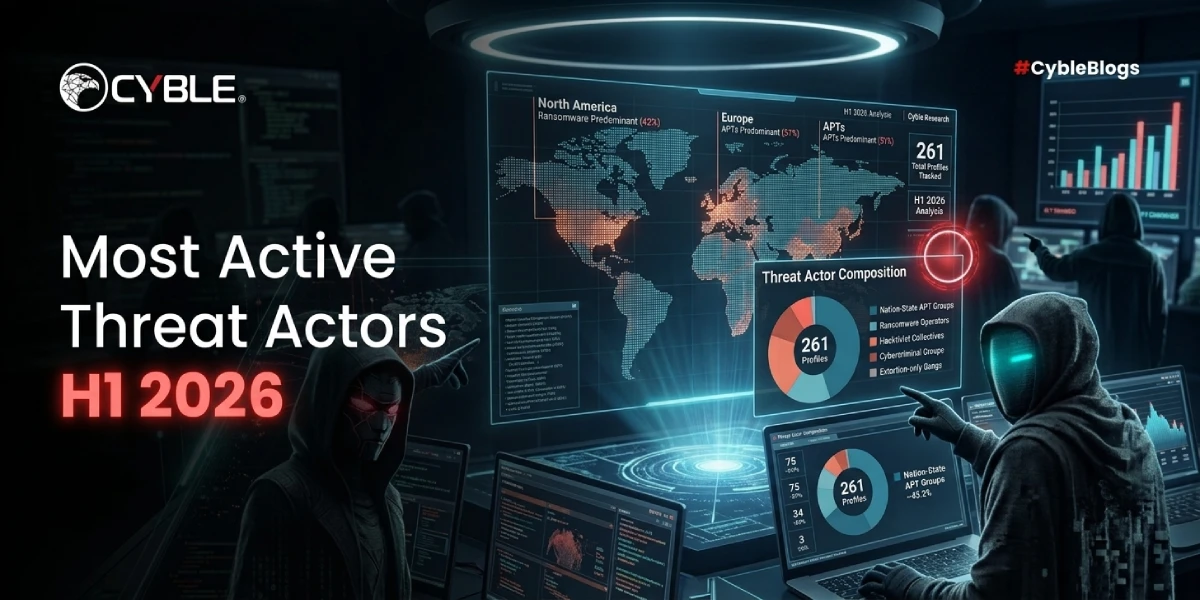
One of the most striking analyses that puts the threat landscape severity in perspective was the number of distinct threat actor profiles active worldwide between January and June. 261 — that’s how many identifiable groups and individuals, each with its own tradecraft, targeting logic, and operational rhythm, running campaigns simultaneously across nation-state espionage, ransomware, hacktivism, and cybercrime.
What makes this data set valuable isn't just the headline count. It's what the composition reveals. A threat landscape dominated by nation-state APT groups tells a very different story than one dominated by ransomware crews — and as Cyble's regional breakdown shows, that composition shifts dramatically depending on where you're standing.
The Worldwide Picture of Most Active Threat Actors: APTs Lead, But Not Everywhere
Across all 261 profiles tracked globally, nation-state Advanced Persistent Threat (APT) groups were the single largest category — accounting for 118 profiles, or just over 45% of the total. Ransomware operators came second at 75 profiles (29%), followed by hacktivist collectives (34), cybercriminal groups (31), and dedicated extortion-only gangs, which remained a niche category at just 3.
Threat Actor Category
Profiles Tracked
Share of Total
Nation-State APT Groups
118
45.2%
Ransomware Groups
75
28.7%
Hacktivist Collectives
34
13.0%
Cybercriminal Groups
31
11.9%
Extortion-Only Groups
3
1.1%
Total
261
100%
That APT dominance reflects the sheer number of state-sponsored programs China, North Korea, Iran, and Russia field simultaneously across espionage, intellectual property theft, and pre-positioning operations.
The extortion-only category being almost statistically irrelevant is telling too — it confirms that pure extortion has essentially been absorbed into the ransomware business model rather than surviving as an independent specialty. Double extortion is now just how ransomware works.
Worried your business is not immune to the tactics of these APT and ransomware groups? Book a demo to validate and fortify your defenses today!
Threat Actors to Watch Out For
CRIL flagged five groups worldwide as carrying the highest confidence and activity levels for security teams to track through the rest of 2026:
Communications, Energy, Manufacturing, Government, IT
Desert Falcons
Palestine
UAE, Israel, Jordan, and 12+ other MEA nations
Aerospace & Defense, Government, Law Enforcement, Media
SideCopy
Pakistan
India, Afghanistan
Government, Defense/military
Two of these deserve particular attention for how they operate.
Bluenoroff, a financially motivated Lazarus Group subgroup, funds North Korean state operations by impersonating established crypto investors and planting malicious links inside victims' Calendly scheduling accounts. This fraud vector blends social engineering with a tool most professionals trust implicitly.
Volt Typhoon continues to favor "living off the land" techniques that blend into normal network activity, prioritizing long-term undetected access over rapid data theft — a profile consistent with pre-positioning for a future disruption event rather than opportunistic espionage.
UNC6508 is worth flagging separately: the group compromises externally accessible REDCap research environments and has been observed creating malicious mail-forwarding rules to silently exfiltrate correspondence — all routed through US-based residential proxies and compromised routers specifically to obscure attribution.
For a regional breakdown of which actors were the most active and which sectors they target, download Cyble Research and Intelligence Labs’ H1 2026 Global Threat Landscape Report.
The threat actor profiles, targeting patterns, and regional breakdowns in this analysis are drawn from Cyble's H1 2026 Global Threat Landscape Report, built on continuous monitoring across dark web forums, ransomware leak sites, and threat actor communications worldwide.
Cyble Vision provides ongoing tracking of these groups — including new actor emergence, TTP shifts, and targeting changes — as they develop.
Request a demoto see how continuous threat actor intelligence can sharpen your regional security priorities.
The first half of 2026 has given security teams little room to breathe. Ransomware operators kept up a punishing pace. If that wasn’t enough, access brokers turned network intrusions into a marketplace, and nation-state activity blurred further into hacktivism and organized cybercrime. Taken together, the numbers point to a threat landscape that isn't just growing louder; it's becoming faster, more coordinated, and harder to attribute.
Cyble's monthly and quarterly research has tracked this
The first half of 2026 has given security teams little room to breathe. Ransomware operators kept up a punishing pace. If that wasn’t enough, access brokers turned network intrusions into a marketplace, and nation-state activity blurred further into hacktivism and organized cybercrime. Taken together, the numbers point to a threat landscape that isn't just growing louder; it's becoming faster, more coordinated, and harder to attribute.
Cyble's monthly and quarterly research has tracked this shift in real time, and the pattern across regions is consistent. In short, attackers are scaling operations while defenders are still catching up. These threat intelligence trends 2026 also provide an early look at the top cyber threats 2026 and what organizations should expect during the remainder of the year.
Ransomware Set the Pace for Threat Intelligence Trends in 2026
Ransomware was one of the biggest threat intelligence trends by far in 2026, in terms of visibility. In just the month of March, a total of 702 ransomware attacks and 54 major data breaches and leaks were registered worldwide. More than 56% of that activity was brought by five groups-Qilin, Akira, The Gentlemen, Dragonforce, and INC Ransom- showing how much consolidation has taken place in the ecosystem.
The pattern was consistent across regions. In the Americas, there were 1,305 cyber incidents in Q1 2026, of which 1,138 were publicly claimed ransomware attacks — and, once again, just five groups drove 58% of that volume. The most affected were construction, professional services, manufacturing, healthcare, and government bodies, primarily because downtime in these sectors has immediate operational or public-safety consequences.
Dual-extortion tactics, pairing data theft with system disruption, have become close to standard practice.
Access Brokers Are Quietly Powering the Ecosystem
The purchase and sale of access to compromised networks is a major driver of ransomware and espionage campaigns. In March 2026, 20 distinct incidents of the sale of access were observed on underground forums, and the most commonly listed sectors were professional services (25%) and retail (20%).
Three of these sellers, vexin, holyduxy, and algoyim, accounted for over 55% of this activity, effectively forming a supply chain for the larger attacks. This is one of the upstream markets where response time matters; access is usually sold and exploited long before a breach is publicly detected.
What if attackers are already buying access to your environment before you know it's been compromised? Discover how Cyble Attack Surface Managementhelps identify exposed assets and reduce opportunities for initial access.
Identity Has Replaced the Perimeter
Perhaps the biggest change over the past year has been the shift from malware-first breaches to attacks based on identities. Credential theft, MFA bypass, session hijacking, and third-party access abuses have all become key vectors. Instead of breaking in, attackers are logging in -- and that has some serious implications for the design of monitoring and access controls.
The numbers back this up. In North America, technology and financial services accounted for 44% of all breach activity in the first half of 2026 — sectors where identity and access sit right at the center of daily operations. Nearly 300 domains were also hit by hacktivist campaigns in the region over that same time, reminding everyone that disruption doesn't always have to come from a super-sophisticated intrusion; sometimes all it takes is one exposed login or an edge system that's gone unpatched.
Attackers don't always break in anymore—they simply log in. Learn how Cyble Brand Intelligence & Protection helps detect exposed credentials and identity-related threats before they're exploited.
Geopolitics Is Now a Cyber Multiplier
State-sponsored activity has grown more strategic, with actors focused on mapping dependencies and pre-positioning access rather than pursuing immediate disruption. Regional tensions have accelerated this further, with hybrid operations blending cyberattacks, disinformation, and kinetic action in ways that ripple well beyond the immediate conflict zone.
During the February 2026 escalation in the Middle East, internet connectivity in targeted regions dropped to as low as 1–4% of normal levels, more than 70 hacktivist groups joined the fray, and disruption to navigation systems affected over 1,100 vessels near the Strait of Hormuz. More than 8,000 conflict-themed domains were also registered during this period to run scams, malware, and disinformation campaigns.
Critical infrastructure, energy, water, transportation, and communications have emerged as the common target across nearly every regional threat report published this year, and India's own H1 tally from 2024 (593 attacks, including 388 breaches, 107 leaks, and 39 ransomware incidents) shows the same dynamics playing out closer to home.
AI Is Reshaping Both Sides of the Fight
AI-driven tooling has moved from experimental to operational. An open-source AI-native testing framework was used to compromise more than 600 Fortinet FortiGate appliances across 55 countries, while 26 malicious npm packages linked to North Korean actors distributed RAT malware through Pastebin- and Vercel-based infrastructure. These incidents also reflect broader vulnerability exploitation trends, where exposed security infrastructure is weaponized rapidly after vulnerabilities become known.
This tracks with a broader trend flagged going into the year: AI-driven ransomware activity jumped 50%, and October 2025 alone saw software supply chain attacks spike 32% above the previous record. On the defensive side, organizations are beginning to lean on AI-assisted monitoring to keep pace with attacks that no longer unfold on human timescales.
Cyble Blaze AI accelerates these threat investigations with AI-powered analysis, helping security teams quickly understand, prioritize, and respond to cyber threats.
Threats evolve every day. Your threat intelligence should too. See how Cyble Cyber Threat Intelligence delivers actionable insights across ransomware, identity, vulnerabilities, and emerging threats.
Conclusion
The first half of the year highlights a few things about threat intelligence trends that need to be cleared up. First, threat actors are operating with more coordination. Second, less patience, and overlapping motives, financial, political, and strategic. And lastly, organizations that treat cybersecurity as a purely technical function are recalibrating, with boards and executives now directly involved in risk decisions.
Taken together, these developments provide a clear mid-year threat intelligence trends forecast and shape the broader cyber risk outlook for 2026. Security teams should expect attackers to continue scaling operations, exploiting identities, and leveraging AI throughout the remainder of the year.
Cyble's full H1 2026 Threat Landscape Report will bring together this data with deeper sector, regional, and actor-level analysis to help security teams prioritize what actually matters for the second half of the year.
What happened in H1 2026 will define the threats of tomorrow.
From ransomware operations and underground access markets to AI-driven attacks and geopolitical cyber campaigns, the threat landscape is evolving faster than ever.
The FIFA World Cup 2026 kicks off on June 11, and the world's biggest sporting event is drawing more than just fans — it is already attracting a wave of cybercriminals targeting ticket buyers, job seekers, streaming viewers, and corporate brands alike.
The FBI has issued a formal Public Service Announcement warning that threat actors are creating fraudulent versions of FIFA-affiliated websites to steal personal information, conduct financial fraud, and sell fake products and services. Cyble
The FIFA World Cup 2026 kicks off on June 11, and the world's biggest sporting event is drawing more than just fans — it is already attracting a wave of cybercriminals targeting ticket buyers, job seekers, streaming viewers, and corporate brands alike.
The FBI has issued a formal Public Service Announcement warning that threat actors are creating fraudulent versions of FIFA-affiliated websites to steal personal information, conduct financial fraud, and sell fake products and services. Cyble researchers independently analyzed the domains flagged by the FBI and confirmed that many remained active and operational at the time of publishing this report.
With 48 teams, 16 host cities across the United States, Canada, and Mexico, and an estimated global audience of billions, the FIFA World Cup 2026 is set to be the largest men's World Cup in history. That scale is precisely why cybercriminals are prying on it — and why the threat is arriving earlier and more aggressively than in previous tournaments.
The FBI warns that threat actors are building fraudulent versions of FIFA's official website, www.fifa.com, designed to closely mimic the legitimate experience. These sites are engineered to collect personally identifiable information (PII), including full names, home addresses, phone numbers, email addresses, banking information, and payment card details.
The same fraudulent infrastructure is used to run a range of operations simultaneously: FIFA ticket scams, fake hospitality package sales, fraudulent job listings, and other forms of financial fraud.
The most common technical method is typosquatting — registering domains with subtle spelling changes or different extensions that trick users into believing they have landed on an official page. A single missing letter, a swapped extension, or a hyphenated variant can be enough to deceive even vigilant users, especially when the site is dressed with FIFA branding, tournament schedules, and professional-looking navigation menus.
The FBI flagged the following domains as fraudulent FIFA-related sites:
www.fifa[.]cab
www.fifa[.]pink
www.fifa[.]blue
www.fifa[.]pub
FIFA[.]city
Fifa[.]bio
fifa[.]beer
fifa[.]click
fifa[.]cam
fifa[.]ceo
fifa[.]help
filfa[.]org
fifa-online[.]com
https://fifa-2026[.]xyz
jobs-fifa[.]com
fifa-hr[.]com
fifa-careerhub[.]com
fifaworldcup-careers[.]com
fifa-hiring[.]com
fifahiring[.]com
fifa-ticket[.]live
fifastore.us[.]com
fifaworldcup26[.]sale
fifaworldcup26.xcover-staging[.]com
worldcup2026-tickets.com[.]mx
worldcup26ticket[.]com
2026fifaworldcuptickets[.]online
fwc2026[.]net
fwc2026.web[.]app
www.fifa2026p[.]com
fifa2026fworldcup[.]com
wvvw-fifa[.]com
ww-fifa[.]com
fifa-com[.]com
www.fifa-com[.]services
quiniela-fifa-2026.pages[.]dev
Source: FBI PSA — Domains defanged for safety
Is your brand being spoofed? Cyble tracks typosquatted domains in real time Request a demo
Cyble researchers tracked these domains and confirmed that many were still operational at the time of publishing. Notably, even when a malicious domain is taken down, new ones tend to appear almost instantaneously. The fraudulent infrastructure is not a one-time campaign — it is continuously regenerating.
Fake FIFA Hospitality, Ticket, and Sale Sites
One of the most convincing examples identified by Cyble researchers was ww-fifa[.]com — a classic typosquatting attack that removes a single "w" from the legitimate FIFA URL. The site presents itself as an official FIFA World Cup 2026 portal, complete with tournament branding, navigation menus, ticket information, and hospitality package offers.
Fake FIFA World Cup 2026 Hospitality Domain (Source: Cyble)
Visitors to this site are encouraged to purchase premium packages that include tickets, food, beverages, lounge access, and related services — all fraudulent.
Cyble researchers identified several indicators that expose the site as illegitimate:
Duplicate page titles appearing twice in the browser tab
Missing or broken images throughout the site
Navigation links leading to attacker-controlled pages
Ticket purchase prompts requesting personal and financial information with no legitimate payment processing
What makes these sites especially dangerous is the sophistication of the presentation. Unlike the crude phishing pages of a decade ago, modern FIFA 2026 scam sites replicate the visual design of official sports portals convincingly enough to pass a casual inspection.
Security Vendors Have Already Flagged FIFA-Related Domains
Cyble researchers analyzed the domain fifa[.]help using VirusTotal and found that, at the time of analysis, 15 out of 92 security vendors had classified it as malicious. Vendor classifications included phishing, fraud, and related threat categories.
Fake FIFA 2026 domain scoring (Source: VirusTotal)
While a detection rate of 15/92 may seem modest, it represents significant early-stage flagging. Many security vendors lag in classifying newly registered domains, so the fact that multiple established providers had already flagged this domain confirms a credible threat.
As these domains age and accumulate more malicious activity reports, detection rates will rise — but by then, victims will already have been targeted.
Not all FIFA World Cup 2026 scams target ticket buyers or fans. Cyble researchers identified an entirely separate fraud vector targeting job seekers: the domain fifaworldcup-careers[.]com, which presents itself as a FIFA employment portal for World Cup-related positions.
Subdomain related to fifaworldcup-careers[.]com (Source: VirusTotal)
VirusTotal data revealed:
www.fifaworldcup-careers[.]com was flagged by 8 out of 91 vendors
The root domain was flagged by 14 out of 91 vendors
The domain resolved to multiple IP addresses, including 3.71.180.249, 13.249.91.65, and 13.249.91.101
The use of multiple IP addresses suggests the domain may be operating behind content delivery or load-balancing infrastructure, which makes takedowns significantly more difficult to execute.
WHOIS data shows the domain was registered and updated in mid-to-late April 2026, with the registrant's identity hidden behind a privacy shield. Two SSL certificates were also issued on April 15 and April 16, including a wildcard certificate covering *.fifaworldcup-careers[.]com — a sign of deliberate, technically capable infrastructure setup rather than an opportunistic amateur operation.
Why this matters: Job seekers searching for World Cup-related employment — hospitality roles, security staff, event coordinators, media positions — are a highly vulnerable and largely overlooked audience. These individuals are not on guard for ticket scams; they are in application mode, and they will willingly submit full personal information, resumes, and even government ID to what they believe is a legitimate employer.
How to Avoid FIFA World Cup 2026 Ticket Scams
As fans search for how to watch the FIFA World Cup 2026 or purchase tickets, the FBI recommends the following precautions:
Type fifa.com directly into your browser's address bar — never rely on search results or links in messages
Avoid sponsored search results, which can be purchased by attackers to appear above legitimate results
Confirm that the URL is exactly www.fifa.com before entering any information
Use saved bookmarks or browser favorites when revisiting FIFA websites
Access FIFA subdomains only through the official homepage, not by typing them directly
Be cautious of websites with broken graphics, poor-quality branding, or duplicate content
Do not provide sensitive information unless the site's legitimacy has been independently verified
Review URLs carefully before clicking any advertisements
These steps are especially important for avoiding FIFA 2026 ticket price scams, where attackers create a false sense of urgency through fake discounts, exclusive hospitality offers, or limited-time deals that pressure users into making fast payment decisions.
How to Watch FIFA World Cup 2026 Safely
Scammers are targeting not only ticket buyers but viewers as well. Fraudulent streaming platforms are expected to proliferate as the tournament approaches, exploiting the high demand for match access — particularly from fans in regions where official broadcasts are expensive or limited.
To reduce risk when looking for FIFA World Cup 2026 streaming options:
Use only official FIFA channels and licensed regional broadcasters for tournament information
Watch matches exclusively through broadcasters licensed for your region
Avoid streaming links shared through unsolicited emails, social media messages, or WhatsApp groups
Verify URLs carefully before creating accounts or entering any payment information
Be cautious of websites offering heavily discounted subscription packages or "exclusive" access to all matches
Many fake streaming platforms use the same tactics seen in FIFA ticket scams: they exploit demand for tournament content to harvest personal and financial information, either immediately or through credential-stuffing attacks down the line.
What To Do If You Become a Victim of a FIFA World Cup 2026 Scam
The FBI expects additional spoofed domains to appear throughout the tournament period — before, during, and after matches. If you encounter a suspected FIFA World Cup 2026 scam, document as much information as possible before the site disappears, including:
The fraudulent domain name
Screenshots of the website
Any communication records (emails, SMS, chat logs)
Payment details if a transaction occurred
Cryptocurrency wallet addresses, if applicable
Victims can file a complaint with the Internet Crime Complaint Center (IC3) at ic3.gov and should include the fake domain involved, details of all interactions with the site, information submitted to the scammers, payment records, receiving financial institution information, and any cryptocurrency transaction details.
Reporting promptly not only helps your case but also contributes to the broader effort to get these domains flagged and taken down faster.
Protect Your Brand from Fake FIFA World Cup 2026 Phishing Campaigns
Major global events like the FIFA World Cup create a concentrated window of opportunity for cybercriminals to launch phishing campaigns, register fraudulent domains, and impersonate trusted brands. As the active FIFA-related scam infrastructure identified by Cyble researchers demonstrates, this is not a theoretical risk — it is a live and expanding threat landscape.
Organizations operating in travel, hospitality, ticketing, media, and any sector adjacent to the FIFA World Cup 2026 need proactive brand protection measures in place now — not after the first incident.
Cyble's Brand Intelligence solution helps organizations detect malicious domains, phishing websites, brand impersonation attempts, and other forms of digital abuse in real time. Combined with Dark Web and Cyber Crime Monitoring and Takedown & Disruption services, security teams can identify threats early, investigate malicious activity, and accelerate the removal of fraudulent infrastructure before it causes financial or reputational damage.
Check out how Cyble helps organizations detect, monitor, and disrupt phishing campaigns, fraudulent domains, and brand abuse before they lead to financial loss or reputational damage.
Frequently Asked Questions
1. How do I know if a FIFA World Cup 2026 ticket website is legitimate?
The only official platform for FIFA World Cup 2026 tickets is accessible through www.fifa.com. Always type this address directly into your browser. Legitimate FIFA ticket pages will never ask you to log in through a third-party site or pay via cryptocurrency or wire transfer.
2. Are FIFA World Cup 2026 jobs being posted on fake websites?
Yes. Cyble researchers identified at least one domain — fifaworldcup-careers[.]com — that impersonates a FIFA employment portal targeting job seekers for World Cup positions. Always verify any job listing through the official FIFA website or a recognized recruitment agency.
3. What should I do if I accidentally visited a fake FIFA site?
Do not enter any personal information. Close the browser tab immediately. If you already entered information, change any reused passwords, monitor your financial accounts for unusual activity, and file a report at ic3.gov.
4. Can I safely use Google to search for FIFA World Cup 2026 tickets?
You can search, but be cautious. The FBI specifically warns against clicking sponsored search results, which attackers can purchase to appear at the top of results pages. Always manually navigate to www.fifa.com after your search rather than clicking links.
5. How many fake FIFA 2026 domains are there?
The FBI flagged over 40 fraudulent domains in its PSA. Cyble researchers confirmed that many of these remain active. Given that new fraudulent domains are registered continuously, the actual number of fake FIFA-related domains in circulation is expected to grow significantly as the tournament approaches.
In a digital landscape that moves at the speed of AI, we feel recognition is more than just a market positioning—it is a validation of vision.
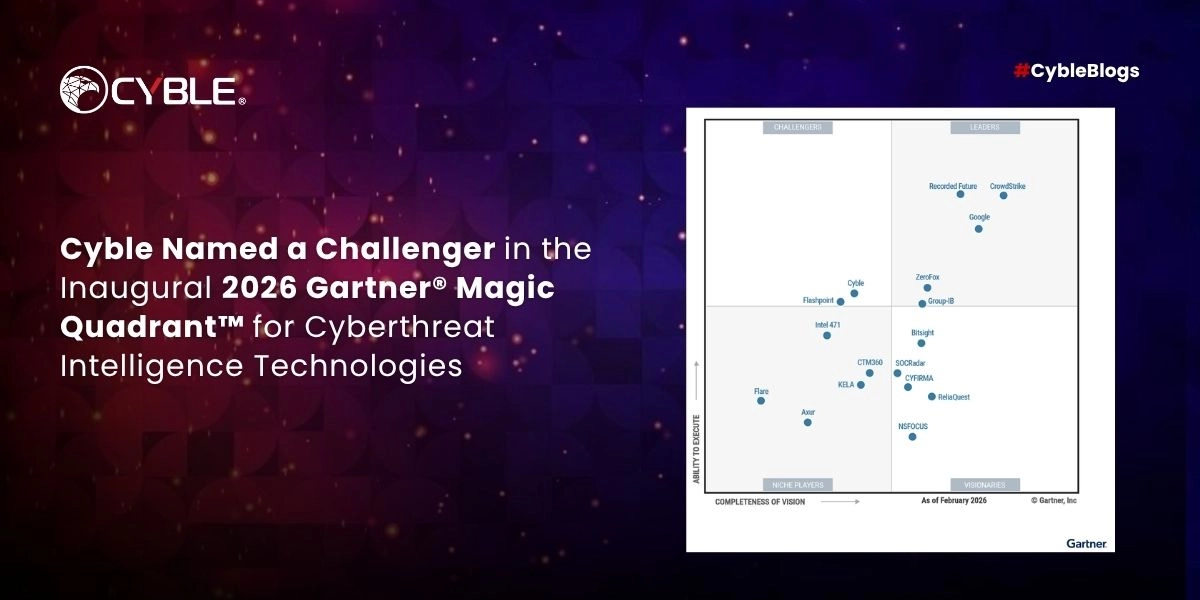
We are proud to announce that Cyble has been named a Challenger in the first-ever Gartner® Magic Quadrant™ for Cyberthreat Intelligence Technologies.
For us, being positioned in the Challengers Quadrant in this inaugural report is a testament to our rapid disruption of the CTI market. It reflects our commitment to moving beyond "static" threat fe
For us, being positioned in the Challengers Quadrant in this inaugural report is a testament to our rapid disruption of the CTI market. It reflects our commitment to moving beyond "static" threat feeds and providing our customers with a proactive, AI-native shield that sees what others miss.
Why CTI Needs a New Perspective
The threat intelligence market is at a crossroads. As this inaugural Gartner report suggests, “the CTI technologies market has undergone a significant transformation, driven by the increasing sophistication of cyberthreats and the growing need for proactive security strategies.”. For too long, organizations have been "intelligence-rich but insight-poor," drowning in data without the context to act.
Cyble was founded to bridge this "Defense Gap." We believe our recognition as a Challenger highlights our ability to execute on a massive scale while maintaining a vision that looks six months ahead of the adversary.
The Engine Behind the Excellence: AI-Native Intelligence
What sets Cyble apart in a crowded field? We believe it comes down to our core philosophy, “Intelligence must be autonomous to be effective.”
Our placement in the Magic Quadrant follows a year of significant technical breakthroughs, centered around three core pillars:
Blaze AI™ & Agentic Reasoning: While traditional tools act as libraries, Cyble Vision acts as an analyst. Our Blaze AI uses an agentic architecture to hunt, reason, and prioritize threats across the deep, dark, and surface web in real-time.
High-Fidelity, Zero Noise: Our platform processes over 350 billion threat signals daily. By leveraging AI to achieve a 95% signal-to-noise ratio, we ensure that SOC teams focus on the 5% of threats that actually matter.
“I feel being named a Challenger validates what our customers have known for years: that the old way of doing CTI is broken,” said Beenu Arora, Co-founder and CEO of Cyble. “We didn't build Cyble to fit into the existing market; we built it to redefine it. To us, this recognition is just the beginning. Our goal is to move from challenging the market to leading the world in autonomous threat prevention.”
Selecting an analyst-recognized vendor can often be a smarter move, especially if your business prioritizes reliability over "bleeding-edge" experimentation.
In our view, here are the main positives of choosing a vendor that is recognized by industry analysts
Reliable Execution: They have a proven track record of meeting client expectations today. You are not buying a promise of future tech; you are buying a platform that works right now at a high level.
Operational Stability: Trusted vendors typically have established, efficient sales and distribution structures. They are often well-capitalized with high financial viability, meaning there is very little risk of the company disappearing or failing to support you.
Customer-Centric Performance: They often focus more on perfecting current offerings and keeping their existing customer base happy through better support and responsiveness.
In short, if you need a strong, consistent, and well-supported solution that fits your current needs exactly, we believe a Challenger is often the most practical choice.
Looking Ahead
As we celebrate this recognition, our focus remains on our mission: democratizing dark web intelligence. Whether it’s forecasting a ransomware attack before it happens or identifying a leaked credential in seconds, Cyble is committed to ensuring that organizations of all sizes have the "unfair advantage" they need to stay secure.
We want to thank our customers, our partners, and our incredible team of researchers and engineers who have made this recognition possible.
Get the Full Story To understand the shifts in the CTI landscape and see why Cyble is being recognized as a market Challenger, you can access the full report here: Download the 2026 Gartner® Magic Quadrant™ for Cyberthreat Intelligence Technologies
Book a demo today and get a tailored walkthrough for your environment and needs.
Report Citation
Gartner, Magic Quadrant for Cyber Threat Intelligence Technologies, Jonathan Nunez, Carlos De Sola Caraballo, Jaime Anderson, May 4, 2026.
Trademark and Disclaimer
Gartner and Magic Quadrant are trademarks of Gartner, Inc. and/or its affiliates.Gartner does not endorse any company, vendor, product or service depicted in its publications, and does not advise technology users to select only those vendors with the highest ratings or other designation. Gartner publications consist of the opinions of Gartner’s business and technology insights organization and should not be construed as statements of fact. Gartner disclaims all warranties, expressed or implied, with respect to this publication, including any warranties of merchantability or fitness for a particular purpose. This graphic was published by Gartner, Inc. as part of a larger research document and should be evaluated in the context of the entire document. The Gartner document is available upon request from Cyble.
In 2026, opportunistic assaults and isolated breaches will no longer characterize Australia's cyber risk environment. Industrialized data theft, in which stolen data is packaged, repackaged, and marketed on underground marketplaces, is influencing it.
Threat actors are already combining Australian data into composite "breach packages," increasing both its commercial worth and its downstream danger, as opposed to single-company breaches occurring in isolation. This trend is also intensifying
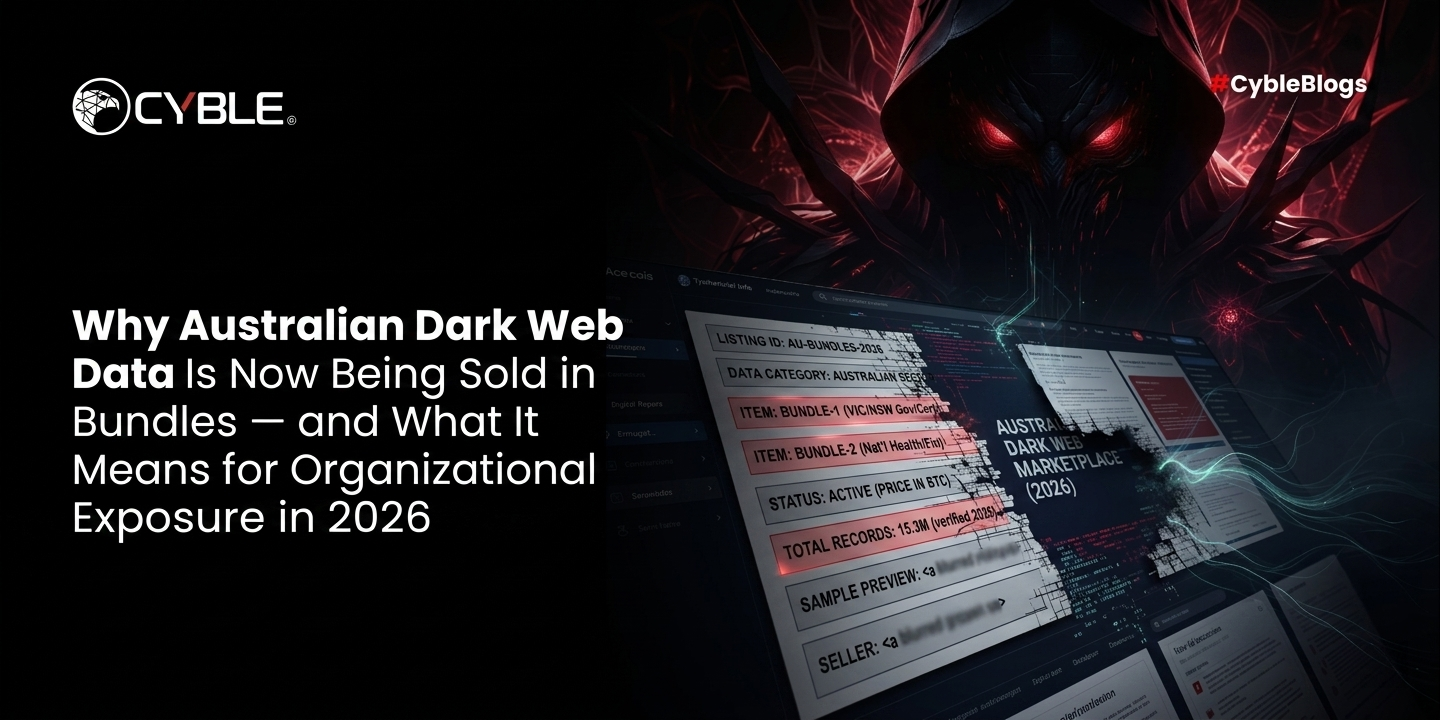
In 2026, opportunistic assaults and isolated breaches will no longer characterize Australia's cyber risk environment. Industrialized data theft, in which stolen data is packaged, repackaged, and marketed on underground marketplaces, is influencing it.
Threat actors are already combining Australian data into composite "breach packages," increasing both its commercial worth and its downstream danger, as opposed to single-company breaches occurring in isolation. This trend is also intensifying concerns around Australian dark web data, where aggregated breach packages are increasingly traded and monetized.
This move has a direct impact on how exposed enterprises will be in 2026 and is not merely cosmetic; rather, it represents a structural shift in how cybercriminal ecosystems monetize stolen information.
Why are Australian dark web data breaches increasing?
Australian cyber events have sharply increased, according to Cyble cyber threat intelligence monitoring. 71 publicly reported data breaches involving Australian companies were found between January and early October 2025. Compared to the 48 breaches that were reported at the same time in 2024, that is a 48% increase.
The overall trend is even more telling: 71 breaches in 2025 have already surpassed the 66 Australian breaches that were reported in 2024. This suggests that the year is structurally exceeding previous standards rather than just drifting upward. The rapid escalation in both the number and severity of every major data breach Australia has experienced indicates a maturing underground economy centered on stolen information.
Cyble reported 1,684 occurrences of reported data breaches worldwide in 2025, an 18% increase. In light of this, Australia's more rapid growth stands out as being disproportionately severe rather than a component of a global increase.
It is crucial to remember that these numbers only include occurrences that have been reported to the public. Since many breaches never appear on forums or leak sites, the actual exposure baseline is probably much greater. This means the scale of the current Australian data breach landscape may still be underestimated.
Why “Bundled Data” Has Become the New Trade Standard
The packaging of stolen Australian data into bundled datasets is one of the most significant developments in underground markets. Threat actors are progressively combining several datasets into composite offerings rather than selling a single breach per victim organization.
Bundled data is easier to monetize, which provides a straightforward economic explanation for this practice. It enables cybercriminals to:
Combine data from several organizations to increase resale value
Attract a larger range of purchasers (ransomware affiliates, fraud groups, and access brokers)
Cut down on the time spent promoting specific violations
Bundling also indicates maturity in the supply chain for cybercrime from an operational perspective. Data is now curated rather than just stolen.
This implies that an organization's security posture is no longer the only factor influencing exposure. One vendor or partner's data may unintentionally be included in a larger selling bundle with unrelated victims due to a breach. This is one reason why modern dark web data breach operations are becoming more difficult to contain once information is leaked.
Ransomware Groups Are Driving the Acceleration
The prevalence of ransomware-related entities is a significant contributing element to Australia's breach rise.
Ransomware groups were responsible for around half of the 71 breaches that were discovered in 2025. This indicates a change in attribution from around 42% of Australian violations in 2024 to approximately 71% in 2025.
This modification shows how ransomware tactics have evolved. Data theft is becoming more important to groups than encryption. Even if encryption is never used, attackers exfiltrate sensitive data before using it for extortion or resale, rather than depending only on locking measures.
This dual-use approach feeds directly into the bundling ecosystem. Stolen datasets become modular assets that can be repackaged across multiple campaigns, contributing to the growing volume of dark web data breaches impacting Australian organizations.
Supply Chain Attacks Expand the Blast Radius
The increase in supply chain compromise is another significant factor. Attackers are taking advantage of third-party providers' laxer security measures rather than going after companies directly.
This has a domino effect:
Numerous downstream companies may be exposed by a single hacked vendor
Unintentionally, data from unrelated victims is combined
Attack surfaces extend beyond the impacted enterprise's direct control
This is one of the main ways that bundled data sales are made possible. Multi-organization datasets are inevitably created by supply chain breaches, consolidated, and resold.
Sector Exposure: No Industry Left Untouched
Australian breaches in 2025 have impacted a wide range of industries, including:
Professional services
Information technology
Healthcare
Energy and utilities
Banking and financial services
Education
Construction and real estate
Telecommunications
Transportation and hospitality
Manufacturing
The breadth of targeting highlights a key reality: attackers are no longer selecting industries solely based on prestige or financial value. Instead, any organization with usable data, operational leverage, or weak third-party dependencies becomes a viable target.
Notable Incidents Highlight the Scale of Exposure
Several incidents in 2025 illustrate the depth and variety of compromised data:
A threat actor operating via a private Telegram channel claimed access to approximately 2TB of sensitive documents allegedly belonging to a major Australian airline
A telecommunications-related database containing around 236,000 records reportedly included names, emails, passwords, phone numbers, billing details, and payment data
A SaaS provider offering loan management and digital signing tools reportedly had its source code exposed, including authentication systems, APIs, and administrative modules
An ICT and telecommunications provider breach allegedly exposed financial records and internal databases, claimed by an extortion group
In construction, 71GB of engineering and infrastructure files were advertised, including geotechnical reports and safety documentation
A trading platform breach reportedly exposed 27,000 records containing KYC data, user identities, and transaction histories
Pension funds were impacted through credential reuse attacks that enabled unauthorized account access and financial losses
Energy and logistics systems were affected by leaks involving millions of operational files from petroleum distribution and internal logistics networks
Across these incidents, one pattern stands out: attackers are extracting structured, high-value data sets that can be reused, recombined, and resold.
Why Australia Is in the Crosshairs
The increase in targeting can be explained by several structural factors:
First, ransomware and data extortion groups find Australian companies appealing because they are very data-driven and technologically advanced.
Second, systemic exposure is increased by reliance on outside service providers. One provider's security flaws can spread throughout large ecosystems.
Third, the cost of starting large-scale campaigns is being reduced by attackers using sophisticated tools, such as automation and AI-assisted phishing.
Lastly, Australia's widespread use of digital technology raises the attack surface and data accessibility.
Defensive Shifts Required for 2026
Organizations are being forced to adopt intelligence-driven security solutions due to the shifting threat landscape.
Risk-based vulnerability management, which concentrates remedial efforts on actively exploited vulnerabilities rather than theoretical problems, is becoming important.
To protect against credential-based assaults, which are commonly employed in supply chain and ransomware incursions, multi-factor authentication is becoming a standard requirement.
To identify vulnerability outside of their immediate surroundings, organizations are also improving their supply chain risk assessments.
To combat contemporary threats like AI-generated phishing, deepfake impersonation, and automated social engineering efforts, security awareness programs are changing.
Behavioral analytics and AI-driven detection systems are becoming more and more important at the infrastructure level to find anomalies that conventional monitoring tools overlook.
Lastly, as businesses shift from implicit trust to continuous verification models, Zero Trust architectures are becoming more popular.
While such systems vary in implementation, the broader trend is clear: security teams are moving away from static defense models toward continuous monitoring of external threat ecosystems.
This shift is especially relevant in environments where stolen data is rapidly aggregated and resold, making early detection of exposure more valuable than post-incident response.
Bundling Is the New Exposure Multiplier
The 48% increase in Australian data breaches highlights a major shift in cybercrime operations. Stolen data is no longer traded in isolation — cybercriminals are bundling, repackaging, and reselling Australian dark web data across larger underground ecosystems, increasing exposure for multiple organizations at once.
For the upcoming years, organizations must focus not only on preventing breaches but also on understanding how stolen data is reused and monetized after exfiltration. With AI-native threat intelligence, dark web monitoring, and attack surface management, Cyble helps organizations identify exposed data, detect emerging threats, and strengthen cyber resilience.
Want to see the intelligence behind the data in this report or learn how Cyble can help protect your organization?
Modern cyberattacks no longer follow predictable patterns or slow timelines. They unfold at machine speed, often moving from initial access to data exfiltration in minutes. In this environment, security teams face a paradox: they are surrounded by vast amounts of data yet struggle to extract clarity from it quickly enough to prevent damage.
This is where Cyble Blaze AI introduces a different operational model, centered on cyber threat intelligence, security analytics, and large-scale threa
Modern cyberattacks no longer follow predictable patterns or slow timelines. They unfold at machine speed, often moving from initial access to data exfiltration in minutes. In this environment, security teams face a paradox: they are surrounded by vast amounts of data yet struggle to extract clarity from it quickly enough to prevent damage.
This is where Cyble Blaze AI introduces a different operational model, centered on cyber threat intelligence, security analytics, and large-scale threat intelligence automation designed to convert raw signals into immediate defensive action. Instead of treating security as a sequence of alerts and manual investigations, Cyble Blaze AI redefines it as a continuous intelligence system that observes, reasons, and responds in real time.
The Data Overload Problem in Cyber Threat Intelligence and AI Security Analytics
Enterprises today generate security telemetry across endpoints, cloud workloads, identity systems, SaaS platforms, and external intelligence feeds. On top of that, threat actors continuously operate in hidden ecosystems such as dark web forums and encrypted communication channels. The issue is not a lack of data; it is fragmentation. Security teams often deal with disconnected signals that fail to form a coherent picture of risk.
Cyble Blaze AI addresses this by applying ai security analytics to unify structured enterprise data with unstructured external intelligence. Instead of treating each alert as an isolated event, it interprets them as part of a broader behavioral system. This shift is essential for modern cyber threat intelligence, where context matters as much as detection.
At the core of Cyble Blaze AI is an architecture designed from the ground up for threat intelligence automation, not retrofitted with it. This distinction matters because it allows intelligence, analysis, and action to operate within a single system rather than across disconnected tools.
The platform is built on a dual-memory design:
Neural Memory (Structured Intelligence Layer)
This layer functions as a continuously evolving knowledge graph. It maps:
Indicators of compromise (IOCs)
Threat actor behaviors
Attack infrastructure relationships
Campaign-level linkages
By structuring intelligence this way, Cyble Blaze AI can track how threats evolve rather than reacting to individual alerts.
Vector Memory (Contextual Intelligence Layer)
This layer processes unstructured data such as analyst notes, reports, chat logs, and security documentation. Using semantic understanding, it identifies meaning rather than relying on keywords alone.
Together, these layers enable cross-domain reasoning, a core requirement for modern cyber threat intelligence platforms that rely on AI security analytics to connect disparate signals into actionable insights.
Threat Intelligence Automation from Hunt to Resolution
Cyble Blaze AI replaces traditional manual workflows with an automated intelligence lifecycle built on threat intelligence automation principles:
Hunt: The system continuously scans dark web forums, phishing infrastructures, malware ecosystems, and external feeds to identify emerging indicators of compromise.
Correlate: Signals are cross-referenced across endpoint telemetry, cloud environments, and enterprise applications. This step transforms scattered signals into unified threat narratives.
Act: Once validated, automated responses are triggered. These may include endpoint isolation, domain blocking, policy enforcement, or workflow-based remediation across integrated tools.
Report: Structured reports are generated for both technical and executive audiences, aligned with controlled sharing frameworks such as TLP (Traffic Light Protocol).
This end-to-end threat intelligence automation pipeline reduces the gap between detection and response.
Autonomous Agents and Rapid Response in Cyber Threat Intelligence
Cyble Blaze AI operates through coordinated autonomous agents, each handling specific security domains:
Vision Agent: detects anomalies across environments
Strato Agent: secures cloud workloads
Titan Agent: manages endpoint containment and remediation
These agents do not work in isolation. They continuously share intelligence, enabling synchronized responses.
In optimized scenarios, full incident handling, from detection to containment, can be completed in under two minutes, a major reduction compared to traditional workflows.
This capability highlights how AI security analytics can compress response timelines when paired with effective threat intelligence automation.
Predictive Cyber Threat Intelligence and Future Risk Detection
Beyond real-time response, Cyble Blaze AI extends into predictive analysis. By processing global datasets and behavioral signals, it identifies emerging threats before they fully materialize.
Based on these inputs, it can forecast potential attack campaigns up to six months in advance. This shifts cyber threat intelligence from reactive monitoring to anticipatory defense, where organizations can prepare for threats long before execution.
360° Visibility Through AI Security Analytics and External Intelligence
One of the defining strengths of Cyble Blaze AI is its ability to unify internal enterprise telemetry with external threat ecosystems. This includes dark web monitoring sources, phishing infrastructures, and underground communication channels.
By applying AI security analytics, the platform correlates these external signals with internal system behavior, building a complete view of organizational risk.
This 360° visibility ensures that compromised credentials, for example, detected on underground forums can immediately be traced across enterprise environments to identify potential exploitation.
Scale, Integrations, and Intelligence Depth
Cyble Blaze AI operates at large enterprise scale with integration support for more than 70 security and IT tools, including SIEM, SOAR, EDR/XDR, cloud platforms, and collaboration systems.
Its intelligence foundation is supported by over 350 billion threat data points, enabling deep contextual analysis across global threat landscapes.
This scale is essential for effective threat intelligence automation, where the quality of decisions depends on the breadth and depth of underlying data.
Role-Based Impact of Cyber Threat Intelligence Automation
The platform’s design supports different security roles:
Analysts benefit from reduced alert fatigue and faster triage through ai security analytics
Threat hunters gain unified visibility across internal and external intelligence sources
Incident responders achieve faster containment through automated workflows
Executives and CISOs receive predictive risk insights aligned with business exposure
This alignment ensures that cyber threat intelligence is not confined to security teams but becomes actionable across the organization.
Toward Autonomous Cyber Defense
Cyble brings cyber threat intelligence, AI security analytics, and threat intelligence automation together through Cyble Blaze AI to turn massive volumes of security data into coordinated, real-time defense actions. Instead of overwhelming teams with alerts, it focuses on context, prediction, and autonomous response—reducing the time between detection and mitigation to near real time.
With this approach, Cyble shifts security operations from reactive monitoring to proactive and automated defense, where threats are identified earlier and neutralized faster across enterprise environments.
To explore how Cyble can help modernize security operations with AI-native intelligence, organizations can connect with Cyble and schedule a demo to see Cyble Blaze AI in action.
The conversation around ANZ ransomware threats has shifted noticeably over the past year. What once looked like sporadic, high-profile incidents has evolved into a sustained and structured campaign against organizations across Australia and New Zealand. Signals emerging from underground forums and marketplaces reveal a sobering reality: ransomware is no longer just a technical problem; it is an economic strategy driven by efficiency, specialization, and scale.
At the center of this shift is
The conversation around ANZ ransomware threats has shifted noticeably over the past year. What once looked like sporadic, high-profile incidents has evolved into a sustained and structured campaign against organizations across Australia and New Zealand. Signals emerging from underground forums and marketplaces reveal a sobering reality: ransomware is no longer just a technical problem; it is an economic strategy driven by efficiency, specialization, and scale.
At the center of this shift is ransomware dark web intelligence, which paints a clear picture of attacker intent. Threat actors are not simply increasing volume; they are refining their focus. The ANZ region, with its high-value economy and deeply digitized infrastructure, has become a preferred hunting ground.
Australia’s economic profile plays directly into the hands of ransomware operators. A strong GDP, combined with a relatively small population, creates a high-return environment. Attackers don’t need to cast a wide net; each successful breach can yield significant payouts.
By mid-2025, 71 ransomware incidents had been publicly claimed in Australia, compared to nine in New Zealand. On the surface, those figures may seem moderate. However, when adjusted for population, the rate of ransomware attacks in Australia and New Zealand stands out globally. Even larger economies have not experienced the same intensity relative to their size.
This imbalance reflects a fundamental principle driving ANZ organizations cybersecurity risks: attackers prioritize value over volume. In practical terms, fewer victims can still mean higher profits.
A Fragmented Threat Landscape with No Single Dominant Actor
Unlike regions where one ransomware group dominates headlines, the dark web ANZ cyber threats ecosystem is notably fragmented. Multiple groups, including Qilin, Akira, INC, Lynx, and Dragonforce, operate concurrently, each claiming a similar share of attacks.
This decentralization complicates defense strategies. Organizations are not facing a predictable adversary with a consistent playbook. Instead, they must prepare for a rotating cast of threat actors, each bringing different techniques, timelines, and negotiation tactics.
From a ransomware dark web intelligence perspective, this fragmentation signals a competitive market. Threat actors are actively testing sectors, probing defenses, and adapting quickly based on what works.
Industries Under Sustained Pressure
The distribution of ANZ ransomware threats is far from uniform. Certain sectors continue to absorb the majority of attacks due to the nature of their operations.
Healthcare and professional services sit at the top of the list. In healthcare, the urgency of patient care creates a near-zero tolerance for downtime, increasing the likelihood of ransom payments. Professional services firms, on the other hand, hold large volumes of sensitive client data, making them lucrative targets.
However, the scope is broader than these two sectors alone. Aviation software providers, pharmaceutical companies, engineering firms, and even steel manufacturers have all been affected. This pattern reinforces a key insight: ransomware attacks in Australia and New Zealand are opportunistic but calculated, targeting environments where disruption carries tangible consequences.
Notable Incidents Reveal Tactical Evolution
Several incidents in 2025 highlight how attackers are evolving their methods.
The Akira group compromised an Australian industrial technology provider, exfiltrating approximately 10GB of sensitive data, including financial records and employee identification documents. This case highlights the growing overlap between ransomware and critical infrastructure risk.
In another breach, a political organization suffered exposure to communications, identity records, and financial data, highlighting that ANZ organizations' cybersecurity risks extend beyond the private sector.
Meanwhile, Dragonforce leaked over 100GB of data from an engineering firm, including technical drawings and internal reports. The long-term implications of such intellectual property theft often exceed immediate financial damage.
These cases share a common thread: encryption is no longer the sole objective. Data exfiltration and double extortion have become standard practices.
The Rise of Initial Access Brokers
One of the most important developments in shaping dark web ANZ cyber threats is the growth of the initial access market. In 2025 alone, 92 instances of compromised access sales were observed across Australia and New Zealand.
Retail organizations accounted for roughly 34% of these cases, followed by BFSI and professional services. The implications are significant. Attackers no longer need to breach networks themselves; they can simply purchase access.
This shift has redefined how ANZ ransomware threats materialize. The most complex phase of an attack—initial intrusion—is now outsourced, accelerating timelines and increasing overall attack volume.
It also introduces indirect risk. Organizations may be compromised through vendors, partners, or shared platforms, expanding the attack surface beyond traditional boundaries.
Ransomware-as-a-Service and the Scaling Problem
The emergence of affiliate-driven models, particularly groups like INC Ransom, has further amplified ransomware attacks in Australia and New Zealand. Operating under a Ransomware-as-a-Service structure, these groups separate responsibilities: affiliates handle intrusions, while core operators manage ransom negotiations.
This model enables rapid scaling. Multiple attacks can be executed simultaneously, each leveraging shared infrastructure and tooling.
INC Ransom’s activity across healthcare and professional services highlights how effective this approach has become. Their operations often involve credential compromise, privilege escalation, lateral movement, and eventual deployment of ransomware—frequently paired with data exfiltration.
From a ransomware dark web intelligence standpoint, this reflects a mature ecosystem where roles are specialized, and efficiency is maximized.
A Regional Problem with Cross-Border Impact
Although Australia is the primary target, the broader region is not immune. A ransomware attack on Tonga’s Ministry of Health disrupted national healthcare services, while a major breach in New Zealand’s healthcare sector involved both data theft and system encryption.
These incidents reinforce the interconnected nature of ANZ organizations' cybersecurity risks. Threat actors operate without regard for national boundaries, shifting focus wherever defenses appear weakest.
Common Entry Points and Techniques
Despite the evolving ecosystem, many attack methods remain consistent. Spear-phishing campaigns, exploitation of unpatched systems, and the use of stolen credentials continue to dominate.
Once inside, attackers often rely on legitimate tools—file compression utilities, remote management software, and standard data transfer mechanisms—to blend into normal operations. This “living off the land” approach makes detection significantly more difficult.
From Defense to Resilience
The steady rise of ANZ ransomware threats signals a need for strategic change. Perimeter-based defenses are no longer sufficient in an environment where access can be purchased, and attacks can be outsourced.
As access is bought and attacks are outsourced, organizations must shift toward stronger identity controls, continuous monitoring, rapid patching, and tighter third-party risk management.
Cybersecurity is no longer just about prevention—it’s about resilience. Attacks are inevitable, but their impact doesn’t have to be. Cyble helps organizations stay ahead with AI-powered threat intelligence, dark web monitoring, and predictive defense through its AI-native platform, Cyble Blaze.
Stay ahead of ransomware threats—book a free demoand build a more resilient security posture.
Cybersecurity is no longer a luxury or an afterthought for Australian organizations; it is a necessity. The scale and complexity of cyberattacks have reached unprecedented levels, and businesses, government bodies, and critical infrastructure sectors are feeling the strain. No longer confined to isolated breaches or small-scale data thefts, cyber threats now target entire systems, aiming to disrupt, steal, or hold hostage valuable assets.
Recent reports indicate a sharp rise in cyber threat
Cybersecurity is no longer a luxury or an afterthought for Australian organizations; it is a necessity. The scale and complexity of cyberattacks have reached unprecedented levels, and businesses, government bodies, and critical infrastructure sectors are feeling the strain. No longer confined to isolated breaches or small-scale data thefts, cyber threats now target entire systems, aiming to disrupt, steal, or hold hostage valuable assets.
Recent reports indicate a sharp rise in cyber threats targeting Australian businesses. In the first half of 2025 alone, Australia saw 57 ransomware attacks, doubling the number recorded in the same period of the previous year. Healthcare, finance, and critical infrastructure sectors have been the most severely impacted, with healthcare experiencing the highest volume of cyber incidents, particularly ransomware attacks. In addition, supply chain attacks have surged significantly, with 79 incidents documented in the first half of 2025, a notable increase from previous months.
This transition is being powered by Artificial Intelligence (AI), which is enabling organizations to not only respond to threats but also anticipate them before they materialize. AI-powered threat detection and predictive cybersecurity solutions are taking center stage, offering the promise of more resilient defenses against cyber adversaries.
The Growing AI Cybersecurity Threat Landscape in Australia
Australia’s cybersecurity landscape is facing a critical period as cyberattacks evolve in both sophistication and scale. According to Cyble's H1 2025 report, Australia has seen a marked increase in the number of cyberattacks targeting critical infrastructure, with IT and software supply chain incidents rising by 25% compared to 2024. In particular, there has been a notable uptick in attacks aimed at telecommunications and technology companies, which are rich targets for cybercriminals seeking to exploit downstream users.
The first half of 2025 also saw an increase in AI-powered phishing, where adversaries are leveraging artificial intelligence to generate highly convincing social engineering attacks. These AI-driven phishing campaigns are more tailored and difficult to detect, presenting a new challenge for organizations in sectors like government, finance, and healthcare. As phishing becomes more sophisticated, the financial damage from these attacks has escalated, with average ransom demands exceeding USD $750,000 in many cases.
Cloud security is another growing area of concern. The rapid adoption of cloud infrastructure has made it an attractive target for cybercriminals, especially those exploiting misconfigurations and weak access controls. In the first half of 2025 alone, Cyble's investigations uncovered over 200 billion exposed files across major cloud service providers, demonstrating the critical need for stronger cloud security measures.
Reactive vs Proactive Cybersecurity
For many years, cybersecurity strategies in Australia were largely reactive. Organizations would implement security measures after an attack had occurred, with systems designed to detect and mitigate threats once they were already inside the network. This reactive model is no longer sufficient.
In contrast, proactive or predictive cybersecurity focuses on identifying and neutralizing threats before they can strike. This shift requires an understanding of the evolving threat landscape and the ability to anticipate attack strategies before they unfold. By leveraging predictive cybersecurity solutions powered by AI and machine learning, organizations can stay several steps ahead of cybercriminals.
The Role of AI in Predictive Cybersecurity
AI is transforming cybersecurity by offering more than just automated responses. With its ability to analyze vast amounts of data and identify patterns, AI is the key enabler of predictive threat intelligence. Using machine learning algorithms, AI-powered platforms can detect anomalies, predict future threats, and even automate incident response actions.
One such platform revolutionizing cybersecurity is Cyble Blaze AI, an advanced AI-powered threat detection system that uses predictive analytics to foresee cyberattacks and respond autonomously. Unlike traditional systems that rely on predefined rules, Cyble Blaze AI uses machine learning to learn from every interaction and adapt to new, unknown threats. This continuous learning ensures that the system becomes more accurate and effective over time, making it an essential tool in the shift from reactive to proactive cybersecurity.
The Power of Machine Learning in Cybersecurity
Machine learning (ML) has become a cornerstone of modern cybersecurity solutions. By leveraging large datasets, machine learning models can identify emerging patterns and trends in cyberattack strategies that would otherwise go unnoticed. ML algorithms can also classify threats based on their severity, enabling organizations to prioritize responses and allocate resources more effectively.
In addition, machine learning in cybersecurity supports the concept of "autonomous defense." Rather than requiring human intervention to detect and respond to every attack, AI systems like Cyble Blaze AI can take action in real-time. For example, when Cyble Blaze AI detects a potential breach, it doesn’t just issue an alert; it can automatically isolate affected systems, shut down compromised accounts, and block malicious traffic, significantly reducing the time between detection and mitigation.
Cyble Blaze AI: Leading the Way in Predictive Cyber Defense
Cyble’s AI-driven platform, including the Blaze AI engine, represents a significant leap in cybersecurity technology. Blaze AI employs a dual-brain architecture, which integrates neural and vector memory systems to process both structured and unstructured data from a variety of sources. This comprehensive approach enables the platform to detect emerging threats across multiple domains, including the dark web, endpoint systems, and network activity.
What sets Cyble Blaze AI apart is its ability to predict cyberattacks before they occur. By continuously analyzing data from over 350 billion signals, the system identifies early warning signs of potential threats, such as leaked credentials or new exploit discussions on the dark web. This predictive capability empowers organizations to take preemptive action, patch vulnerabilities, and strengthen defenses long before an attack is launched.
Furthermore, Blaze AI’s autonomous agents collaborate seamlessly to execute threat responses in real-time. For example, if the system detects a phishing attempt or ransomware infection, it can take immediate corrective action, such as blocking the malicious file, isolating affected systems, or even restoring data from backups, all without human intervention.
The Importance of Predictive Cybersecurity Solutions for Australian Businesses
For Australian businesses, the adoption of AI-driven cyber defense strategies is no longer a matter of choice, it’s a matter of survival. As the threat landscape becomes more sophisticated and cybercriminals grow more organized, organizations must evolve their cybersecurity practices to keep pace.
By embracing AI-powered threat detection and predictive cybersecurity solutions, businesses can reduce the risk of significant breaches and minimize the impact of cyberattacks. These technologies offer several key benefits:
Early Threat Detection: AI can identify potential threats based on historical data and emerging patterns, giving organizations a head start in addressing vulnerabilities.
Automated Response: By automating routine tasks, AI systems can reduce the burden on human cybersecurity teams, allowing them to focus on more complex issues.
Continuous Learning: Machine learning algorithms improve over time, enabling AI systems to adapt to new types of attacks and threats.
Cost Efficiency: By preventing successful attacks before they escalate, AI-powered platforms can save organizations from the high costs associated with data breaches, downtime, and reputational damage.
Seamless Integration: Modern AI cybersecurity platforms like Cyble Blaze AI integrate with existing security tools, providing a unified, adaptive defense mechanism across all systems.
The underground economy of stolen credentials has matured into a structured, high-volume marketplace, and Indian enterprises are at the center. What makes this trend notable is not just the scale of cyber incidents in India, but the type of data being exposed and how efficiently it is monetized on dark web credential markets India forums. This has evolved into a corporate data leak India dark web ecosystem.
Credentials, usernames, passwords, session tokens, have become the currency that pow
The underground economy of stolen credentials has matured into a structured, high-volume marketplace, and Indian enterprises are at the center. What makes this trend notable is not just the scale of cyber incidents in India, but the type of data being exposed and how efficiently it is monetized on dark web credential markets India forums. This has evolved into a corporate data leak India dark web ecosystem.
Credentials, usernames, passwords, session tokens, have become the currency that powers everything from ransomware intrusions to financial fraud. This is not an abstract risk. It is a measurable, expanding problem backed by government data and visible shifts in attacker behavior.
A Rapidly Expanding Attack Surface
India’s digital growth has been aggressive, but security maturity has not scaled at the same pace. According to the Indian Computer Emergency Response Team (CERT-In), the country recorded 29.44 lakh (2.94 million) cybersecurity incidents in 2025. Just four years earlier, that number stood at 14.02 lakh in 2021, effectively doubling within a short span.
This surge is not just about more attacks; it reflects a widening attack surface and growing enterprise cybersecurity threats India. Every new digital service, cloud migration, or remote access point introduces another potential entry for attackers. More importantly, each successful intrusion increases the likelihood of credential exposure, feeding directly into dark web markets.
Earlier data reinforces this pattern. CERT-In reported handling 13,91,457 incidents in 2022, spanning phishing, malware infections, and unauthorized access attempts. These are not isolated technical events; they are the primary pipelines through which credentials are harvested at scale.
Why Credentials Are the Primary Target
Unlike credit card data, which can be canceled, or systems that can be patched, credentials offer persistent value. A valid login can grant access to corporate networks, financial systems, or sensitive communications without triggering immediate alarms.
Attackers understand this. Phishing campaigns and malware infections, both widely reported by CERT-In as dominant attack vectors, are designed not just to infiltrate systems but to extract authentication data. Once obtained, these credentials, often part of Indian company login credentials stolen sets, are packaged and sold on underground forums, often categorized by industry, privilege level, or geographic origin.
India’s enterprise landscape makes it particularly attractive in this context. Organizations across banking, IT services, manufacturing, and government sectors manage vast amounts of sensitive and operationally critical data. This makes their credentials more valuable and more likely to be traded.
High-Value Targets Across Critical Sectors
Government-backed reporting highlights the concentration of attacks in sectors that naturally generate high-value credentials. CERT-In’s scope of incident response spans banking, energy, telecom, transport, and IT sectors, all of which rely heavily on identity-driven access controls.
In 2023 alone, around 2,04,844 cybersecurity incidents were reported within government organizations. Credentials associated with such entities carry strategic value, not just financial. They can be used for espionage, disruption, or long-term access to sensitive systems.
Similarly, sectors like BFSI and IT services face constant exposure due to their role in handling financial transactions and managing global client data. A single compromised account in these environments can provide entry into broader supply chains or interconnected systems.
The Dark Web as a Distribution Channel
What sets the current landscape apart is how efficiently stolen credentials are distributed. Dark web marketplaces have evolved beyond simple data dumps. They now function like structured platforms where access is categorized, reviewed, and resold.
Credential sets originating from India are often bundled with additional context, such as organization names, roles, or VPN access details, making them more actionable for buyers. In many cases, these credentials are not used immediately. Instead, they are stored, resold, or combined with other datasets to increase their value.
The presence of compromised access listings and credential sales across underground forums reflects a broader shift: attackers no longer need to breach systems themselves. They can simply purchase access, reducing both effort and risk.
Weak Points: Human and Systemic
A portion of credential exposure still traces back to preventable weaknesses. Phishing remains one of the most effective techniques because it exploits human behavior rather than technical flaws. Employees unknowingly provide login details, often bypassing sophisticated security controls.
On the system side, unpatched vulnerabilities and misconfigured services continue to play a role. Government data consistently highlights the exploitation of vulnerable services and outdated systems as a recurring issue. These weaknesses allow attackers to extract credentials directly from compromised environments or escalate privileges once inside.
The combination of human error and systemic gaps creates a steady supply of fresh credentials, exactly what dark web markets depend on.
A Self-Sustaining Ecosystem
The relationship between cyber incidents in India and dark web credential markets is not coincidental, it is cyclical. More attacks lead to more compromised credentials. More credentials increase the availability of access for other attackers. This, in turn, fuels further attacks.
The growth from 14.02 lakh incidents in 2021 to 29.44 lakh in 2025 is not just a statistic; it signals the acceleration of this cycle. As long as credentials remain easy to obtain and difficult to monitor once exposed, Indian enterprises will continue to be a prime target.
Rethinking the Problem
The challenge is no longer limited to preventing breaches; it now includes understanding what happens after data leaves the network and enters underground ecosystems, where exploitation timelines can be extremely short. Indian enterprises are not uniquely vulnerable, but they are highly valuable due to their scale, sector diversity, and rapid digital adoption, making them consistent targets in an environment where access itself is the commodity.
Breaking this cycle requires visibility into how stolen credentials are traded, reused, and weaponized, and this is where platforms like Cyble become critical, delivering AI-native threat intelligence, dark web monitoring, and attack surface visibility to help organizations move from reactive defense to proactive risk anticipation.
With capabilities like Cyble Vision and Cyble Blaze AI, security teams can detect exposure earlier, correlate threats in real time, and respond autonomously before stolen data is exploited. To stay ahead of evolving credential-driven attacks, organizations should evaluate Cyble’s unified threat intelligence platform and request a demo to see how continuous visibility across the dark web and enterprise attack surface can materially reduce risk.
Cyble Research & Intelligence Labs (CRIL) in its monthly threat landscape analysis observed a highly active threat environment throughout March 2026, shaped by large-scale ransomware campaigns, persistent data breach activity, growing initial access brokerage markets, and exploitation of critical vulnerabilities affecting widely deployed enterprise systems.
Threat actors continued to prioritize financial extortion, credential access, and operational disruption, while increasingly targeti
Cyble Research & Intelligence Labs (CRIL) in its monthly threat landscape analysis observed a highly active threat environment throughout March 2026, shaped by large-scale ransomware campaigns, persistent data breach activity, growing initial access brokerage markets, and exploitation of critical vulnerabilities affecting widely deployed enterprise systems.
Threat actors continued to prioritize financial extortion, credential access, and operational disruption, while increasingly targeting sectors rich in sensitive data or dependent on business continuity.
Quick Summary
Key threat trends identified during March 2026 include:
20 compromised access sale listings tracked across cybercrime forums.
High concentration of attacks against Professional Services, Manufacturing, Retail, and Government sectors.
Continued exploitation of vulnerabilities listed in CISA’s Known Exploited Vulnerabilities (KEV) catalog.
Fig 1. Cyber incidents recorded in March 2026 (Data Source: Cyble Blaze AI)
These trends indicate a mature cybercriminal ecosystem where access brokers, ransomware operators, and data leak actors increasingly operate in parallel.
Ransomware Activity Remained the Dominant Threat
CRIL recorded 702 ransomware attacks worldwide in March 2026, reflecting sustained aggression from both established groups and emerging operators.
Top Ransomware Groups
Qilin, Akira, The Gentlemen, Dragonforce, and INC Ransom were the top five most active ransomware actors in March 2026.
Fig 2. Top five ransomware actors (Data Source: Cyble Blaze AI)
Together, the top five groups accounted for more than 56% of observed ransomware activity, highlighting strong operational scale and affiliate ecosystems.
Most Targeted Industries
Construction, Professional Services, Manufacturing, Healthcare, and Energy & Utilities were the most targeted sectors by ransomware actors in March 2026.
Fig 3. Top 10 industry-wise attacks by ransomware actors (Data Source: Cyble Blaze AI)
Threat actors continued using data theft + operational disruption as dual-extortion pressure tactics.
And when it came to country-wise split-up, the United States remained the focal point amid the ongoing geopolitical issues with Iran.
Fig 4. Top 10 country-wise attacks by ransomware actors (Data Source: Cyble Blaze AI)
Compromised Access Market Expanded
CRIL tracked 20 distinct incidents involving the sale of unauthorized network access on underground forums.
These three actors were responsible for over 55% of observed access listings.
This reinforces the role of access brokers as upstream enablers for ransomware, espionage, and fraud operations.
Data Breaches and Leak Markets Remained Active
CRIL observed 54 significant breach and leak incidents during the month.
Most Targeted Sectors
Government & Law Enforcement
Retail
Technology
Fig 6. Sector-wise data breaches and leaks recorded (Data Source: Cyble Blaze AI)
Notable Incidents
Hospitality Holdings – TA Claimed 5TB Leak
Threat actor “nightly” claimed theft of over 5TB of data, including biometric records, CCTV footage, and financial documents.
South African Government Dataset for Sale
Threat actor XP95 advertised 3.8TB of allegedly stolen provincial government data.
Travel Data Leak
Over 95,000 travel-related records were reportedly exposed, including passports and payment data.
Exploited Vulnerabilities Accelerated Risk
March also saw active exploitation of critical vulnerabilities affecting enterprise technologies.
Notable KEV-listed vulnerabilities included:
CVE-2026-20131 – Cisco Secure Firewall Management Center
CVE-2025-53521 – F5 BIG-IP APM
CVE-2026-20963 – Microsoft SharePoint Server
CVE-2026-33017 – Langflow AI
CVE-2021-22681 – Rockwell Automation ICS
Key Trend
Attackers exploited both:
Newly disclosed zero-days
Legacy vulnerabilities from prior years
This showcases widespread failures in patch management and exposure reduction.
Emerging Strategic Threat Developments
AI-Augmented Offensive Operations
Threat actors reportedly used CyberStrikeAI, an open-source AI-native security testing framework, in attacks against Fortinet FortiGate devices across 55 countries, compromising more than 600 appliances.
North Korean actors were linked to 26 malicious npm packages distributing RAT malware through Pastebin/Vercel-based infrastructure.
Geopolitical Cyber Risk
Iran-linked cyber operations were assessed as likely to increase following regional tensions, with potential ransomware and hacktivist targeting across the Middle East.
Industries Facing Highest Risk
Based on March activity, organizations in the following sectors faced elevated risk:
Professional Services
Government
Manufacturing
Retail
Healthcare
Critical Infrastructure
Transportation & Logistics
These sectors combine valuable data, high uptime requirements, or complex supply chains.
Conclusion
The March 2026 threat landscape was defined by scale, specialization, and speed.
Threat actors increasingly leveraged:
Access brokerage markets
High-volume ransomware operations
Large-scale data theft
Rapid weaponization of critical vulnerabilities
AI-enhanced offensive tooling
The combination of concentrated criminal ecosystems and widespread enterprise exposure creates a sustained high-risk environment for organizations globally.
Key Recommendations
Prioritize remediation of KEV-listed vulnerabilities
Strengthen identity security and MFA across remote access platforms
Monitor for exposed credentials and access sale activity
Segment critical networks to reduce lateral movement
Conduct tabletop exercises for ransomware response
Improve backup resilience and recovery testing
Monitor software supply chain ecosystems
Expand threat intelligence coverage across dark web and leak forums
The tempo of UK cyberattacks has shifted from sporadic disruption to something far more systemic. When incidents reach a frequency of four national events each week, the issue stops being purely technical and becomes structural. It raises a more uncomfortable question than whether attacks will happen; it asks whether UK cybersecurity readiness is evolving fast enough to keep pace with a threat environment that is no longer linear, but compounding.
The latest assessment from the National Cybe
The tempo of UK cyberattacks has shifted from sporadic disruption to something far more systemic. When incidents reach a frequency of four national events each week, the issue stops being purely technical and becomes structural. It raises a more uncomfortable question than whether attacks will happen; it asks whether UK cybersecurity readiness is evolving fast enough to keep pace with a threat environment that is no longer linear, but compounding.
The latest assessment from the National Cyber Security Centre (NCSC) reveals a sharp escalation in UK national cyber threats. In the 12 months leading to September 2025, 204 incidents were classified as nationally significant, more than double the 89 recorded in the previous year. This is the highest figure on record.
The Acceleration of UK National Cyber Threats
In total, 429 cyber incidents required NCSC intervention during this period. Among them, 18 were categorized as “highly significant,” meaning they carried the potential to severely disrupt essential services or compromise national security. That figure alone notes an almost 50% increase compared with the previous year, continuing a three-year trend of intensifying severity in cyberattacks in the UK.
These are not isolated breaches caused by opportunistic threat actors. A large share of activity is linked to advanced persistent threat (APT) groups, well-funded, highly capable operators that pursue long-term access to critical systems. Their objectives range from strategic intelligence gathering to financial gain and, in some cases, deliberate disruption.
Dr Richard Horne, Chief Executive of the NCSC, has made the situation explicit: the growing frequency of serious incidents demonstrates that the UK’s exposure to cyber risk is rapidly. He has warned that delays in strengthening defenses are no longer neutral, they actively increase vulnerability.
When Cybersecurity Becomes a Boardroom Issue
The rising intensity of UK cyberattacks has prompted direct intervention from the government. Senior executives across major UK businesses, including those in the FTSE 350, have been formally urged to treat cyber resilience as a board-level responsibility rather than a technical afterthought.
This shift is not symbolic. It reflects recognition that cyber risk now sits alongside financial and operational risk. Organizations are being pushed to integrate security into strategic decision-making, rather than relegating it to IT departments.
To support this, the NCSC has introduced tools aimed at improving baseline protections, particularly for smaller businesses that often lack dedicated security resources. The Cyber Essentials programme has been positioned as an accessible entry point, with added incentives such as free cyber insurance for eligible firms to encourage adoption.
Energy Transformation and the Expanding Attack Surface
One of the less obvious drivers behind the rise in UK national cyber threats is the transformation of the energy sector. The UK’s clean energy ambitions, particularly under the Clean Power 2030 initiative, are reshaping infrastructure at speed.
Battery storage capacity is expected to increase sixfold, while wind and solar generation could nearly triple. At the same time, the system is becoming more decentralized, introducing a wider range of operators and digital interfaces.
From a cybersecurity perspective, this creates a paradox. The energy system becomes more resilient in terms of generation diversity, but more vulnerable in terms of digital exposure. Each new connection, whether a distributed solar installation or a grid-scale battery, adds another potential entry point for attackers.
This is why UK critical infrastructure attacks are increasingly focused on non-traditional targets. Recent incidents in Europe have shown adversaries probing distributed renewable assets, exploiting the reliance on remote management and interconnected control systems.
The Cascading Risk of Infrastructure Disruption
Energy systems do not operate in isolation. They underpin transport networks, healthcare services, communications, and financial systems. A disruption in energy supply can trigger cascading failures across multiple sectors.
Even non-cyber incidents put a spotlight on this fragility. The 2025 North Hyde substation fire demonstrated how quickly a localized event can create broader disruption. In the case of coordinated cyberattacks, the potential for systemic impact is higher.
This interconnectedness is what makes cyberattacks in the UK particularly concerning. The risk is not just service interruption, but the amplification of disruption across dependent systems.
Rethinking Regulation for Modern Threats
To address these challenges, the UK government is reassessing its regulatory framework, particularly the Network and Information Systems (NIS) Regulations. Introduced in 2018, these rules were designed for a more centralized energy system and may no longer reflect current realities.
The key issue is scope. Many organizations that contribute to system stability fall outside NIS requirements because they do not meet existing thresholds or have not been formally designated as critical operators.
The proposed reforms aim to close this gap through two primary measures:
Expanding NIS coverage under the Cyber Security and Resilience Bill to better capture modern critical infrastructure
Introducing baseline cyber resilience requirements for all Ofgem licensees in the downstream gas and electricity sector
This dual approach acknowledges that UK cybersecurity readiness cannot rely solely on protecting the largest players. In a decentralized system, smaller entities can represent equally critical points of failure.
Baseline Security: Necessary but Not Sufficient
The proposed baseline requirements are designed to establish a minimum standard of cyber hygiene across the sector. These measures are expected to be proportionate and widely applicable, focusing on preventing common attack vectors rather than enforcing advanced capabilities.
They align closely with the Cyber Essentials framework, which emphasizes five core controls: firewalls, secure configuration, access management, malware protection, and patching.
However, this approach has limitations. Cyber Essentials is primarily tailored to IT environments and does not fully address operational technology (OT), which is central to energy infrastructure. OT systems require different security models, as they interact directly with physical processes.
Recognizing this, policymakers are considering a hybrid model that extends beyond technical controls to include governance, supply chain security, and incident response planning. This reflects a more mature understanding of UK national cyber threats, where organizational resilience is as important as technical defense.
Conclusion
With UK cyberattacks occurring at a rate of four national incidents per week, the financial impact of significant cyberattacks in the UK, often exceeding £436,000 per breach, makes gaps in UK cybersecurity readiness a measurable risk. As UK national cyber threats grow and UK critical infrastructure attacks become more likely, organizations need timely threat intelligence and faster response.
Cyble provides real-time threat intelligence and automated detection to help identify and mitigate risks earlier. Schedule a demo to see how Cyble can support your security operations.
Cyble Research & Intelligence Labs (CRIL) in its weekly vulnerability report tracked 1,431 bugs last week.
Of these, over 270 vulnerabilities have publicly available Proof-of-Concept (PoC) exploits, significantly accelerating exploitation timelines and increasing real-world attack likelihood.
Additionally, 3 vulnerabilities were actively discussed across underground forums, signaling strong adversarial interest and rapid weaponization.
A total of 130 vulnerabilities were rated critic
Cyble Research & Intelligence Labs (CRIL) in its weekly vulnerability report tracked 1,431 bugs last week.
Of these, over 270 vulnerabilities have publicly available Proof-of-Concept (PoC) exploits, significantly accelerating exploitation timelines and increasing real-world attack likelihood.
Additionally, 3 vulnerabilities were actively discussed across underground forums, signaling strong adversarial interest and rapid weaponization.
A total of 130 vulnerabilities were rated critical under CVSS v3.1, while 45 were rated critical under CVSS v4.0, reflecting the severity of disclosed issues.
Furthermore, CISA added 3 vulnerabilities to its Known Exploited Vulnerabilities (KEV) catalog, confirming active exploitation in the wild.
On the industrial front, CISA issued 5 ICS advisories covering 6 vulnerabilities, impacting vendors such as Siemens, Hitachi Energy, and Yokogawa.
Weekly Vulnerability Report’s Top 5 Vulnerabilities
CVE-2026-32213 — Microsoft Azure AI Foundry (Critical)
CVE-2026-32213 is a critical authorization bypass vulnerability in Microsoft Azure AI Foundry.
The flaw exists in the platform’s authorization logic, allowing unauthenticated attackers to bypass security checks and grant themselves administrative privileges. Successful exploitation enables full control over AI environments and associated resources.
CVE-2026-35022 — Claude Code CLI / Agent SDK (Critical)
CVE-2026-35022 is a critical OS command injection vulnerability affecting Anthropic’s Claude Code CLI and Agent SDK.
The vulnerability allows attackers to inject malicious commands into development workflows, resulting in remote code execution and potential compromise of AI pipelines.
CVE-2026-22738 — Spring AI (Critical)
CVE-2026-22738 is a remote code execution vulnerability in Spring AI caused by improper input sanitization in expression evaluation.
Attackers can inject malicious expressions that are executed by the Spring Expression Language, leading to complete application and server compromise.
CVE-2026-4631 — Cockpit (Critical)
CVE-2026-4631 is an unauthenticated remote code execution vulnerability in Cockpit, a web-based Linux server management interface.
The flaw allows attackers to execute arbitrary commands without authentication, potentially leading to full system takeover in enterprise environments.
CVE-2026-35616 is a critical authentication bypass vulnerability in Fortinet FortiClient EMS.
Attackers can bypass authentication and execute arbitrary commands, leading to complete compromise of endpoint management systems.
Data Source: Cyble Vision
Vulnerabilities Added to CISA KEV
CISA continues to expand its KEV catalog, reflecting real-world exploitation trends.
Notable addition:
CVE-2026-35616 — Fortinet FortiClient EMS This vulnerability enables authentication bypass and remote command execution, making it a high-priority remediation target.
The inclusion of enterprise security tools in KEV highlights attackers’ focus on compromising centralized management systems.
Critical ICS Vulnerabilities
CISA issued 5 ICS advisories covering 6 vulnerabilities, many of which impact critical infrastructure environments.
Data Source: Cyble Vision
CVE-2026-1579 — PX4 Autopilot (Critical)
A missing authentication vulnerability allowing attackers to execute critical functions without credentials.
This flaw poses risks to autonomous and unmanned systems, potentially enabling unauthorized control.
CVE-2026-3356 — Anritsu Systems (Critical)
This vulnerability involves missing authentication in Anritsu devices, allowing attackers to gain unauthorized access.
CVE-2025-10492 — Hitachi Energy Ellipse (Critical)
A deserialization vulnerability enabling attackers to execute arbitrary code within industrial systems.
Siemens SICAM 8 (Chained Risk)
Two vulnerabilities affecting Siemens SICAM 8 systems—resource exhaustion and out-of-bounds write—can be chained together.
This creates a denial-of-service risk capable of disrupting industrial processes and operational visibility.
CVE-2025-7741 — Yokogawa CENTUM VP (Medium)
A hard-coded password vulnerability that weakens authentication mechanisms and increases risk of unauthorized access.
Critical Infrastructure Sectors Spotlight
Data Source: Cyble Vision
Analysis indicates:
Critical Manufacturing appears in 66.7% of vulnerabilities
Cross-sector exposure spans:
Transportation Systems
Emergency Services
Defense Industrial Base
Communications
This highlights interconnected infrastructure risks, where a single vulnerability can cascade across multiple sectors.
Conclusion
This week’s findings highlight several critical trends:
Expansion of vulnerabilities into AI and development ecosystems
Increasing exploitation of enterprise management platforms
Continued weaknesses in industrial control systems
Cross-sector risk amplification in critical infrastructure
With 270+ PoCs, KEV-confirmed exploitation, and emerging threats in AI frameworks, organizations face heightened risk across both digital and physical environments.
Key Recommendations
Prioritize vulnerabilities with PoCs and KEV inclusion
Secure AI development environments and pipelines
Patch enterprise management and remote access systems immediately
Implement strict authentication and access control mechanisms
Segment IT and OT networks to prevent lateral movement
Apply compensating controls for unpatched ICS vulnerabilities
Conduct continuous vulnerability assessments and penetration testing
Cyble’s attack surface management and vulnerability intelligence solutions help organizations proactively identify risks, prioritize remediation, and detect emerging threats. By integrating intelligence-driven security strategies, organizations can strengthen resilience across enterprise and critical infrastructure environments.
Modern cybersecurity no longer suffers from a lack of data; it suffers too much of it, scattered across systems that rarely speak the same language. Security teams today must monitor endpoints, cloud workloads, SaaS applications, and an ever-expanding universe of external threats, including those emerging from hidden corners of the internet.
This is where Cyble Blaze AI introduces a different approach. Rather than acting as another layer of alerts, it functions as an enterprise threat inte
Modern cybersecurity no longer suffers from a lack of data; it suffers too much of it, scattered across systems that rarely speak the same language. Security teams today must monitor endpoints, cloud workloads, SaaS applications, and an ever-expanding universe of external threats, including those emerging from hidden corners of the internet.
This is where Cyble Blaze AI introduces a different approach. Rather than acting as another layer of alerts, it functions as an enterprise threat intelligence platform designed to unify signals and convert them into decisive action.
Cyble Blaze AI threat visibility is about connecting what happens inside an organization with what is brewing outside it, particularly across forums, marketplaces, and channels often associated with dark web activity. The result is a continuous, contextual understanding of risk that spans both internal systems and external threat landscapes.
Rethinking Threat Intelligence with AI-Native Architecture
Many security tools claim intelligence, but most still rely on predefined rules and human-driven workflows. Cyble Blaze AI takes a fundamentally different path by operating as an AI-native system. This distinction matters. Instead of layering automation on top of legacy infrastructure, the platform embeds reasoning into every stage, from ingestion to response.
This architectural shift allows it to process massive volumes of telemetry generated daily across enterprise environments. Whether it’s logs from endpoint detection systems or chatter picked up by a dark web monitoring AI, the platform treats all data as part of a unified intelligence fabric rather than isolated inputs.
The Dual-Brain System Behind Cyble Blaze AI Threat Visibility
A defining feature of Cyble Blaze AI threat visibility is its dual-brain architecture, which mirrors how experienced analysts combine structured evidence with contextual interpretation.
The first layer, often described as neural memory, operates like a living knowledge graph. It maps relationships between indicators of compromise, attacker infrastructure, and behavioral patterns. This enables the system to track how threats evolve over time, linking seemingly unrelated signals into coherent attack narratives.
The second layer, vector memory, handles unstructured data. This includes analyst notes, intelligence reports, and content gathered through AI dark web surveillance tools. Instead of relying on keyword matching, it interprets meaning through semantic embeddings. This allows the platform to understand nuance, intent, and emerging threat signals that would otherwise go unnoticed.
Together, these layers enable cross-domain reasoning that bridges enterprise telemetry with enterprise dark web detection, offering a far more complete picture of risk.
From Alerts to Outcomes
One of the most persistent problems in cybersecurity is alert fatigue. Traditional tools generate thousands of notifications, leaving analysts to manually triage and investigate. Critical signals are often buried in noise.
Cyble Blaze AI addresses this by shifting from alert generation to outcome delivery. It doesn’t just surface potential threats; it investigates them, correlates related activities, and initiates response actions automatically.
For example, a credential leak detected through dark web monitoring AI can immediately trigger internal checks across endpoints and identity systems. If suspicious activity is confirmed, the platform can isolate affected systems or enforce access controls without waiting for manual approval. This dramatically reduces the time between detection and containment.
Autonomous Agents and Real-Time Orchestration
The platform’s operational strength lies in its network of autonomous agents. Each agent is designed for a specific function, threat detection, intelligence gathering, cloud security, or endpoint remediation. What makes this system effective is coordination.
Insights generated by one agent are instantly shared across the system. A signal identified through an AI dark web surveillance tool can influence actions within enterprise infrastructure in seconds. This real-time orchestration enables end-to-end response cycles that are often completed in under two minutes.
This model replaces fragmented workflows with a unified, collaborative system where detection and response are tightly integrated.
Predicting Threats Before They Materialize
Beyond detection, Cyble Blaze AI threat visibility extends into prediction. By analyzing historical attack patterns, vulnerability disclosures, and global threat activity, the platform identifies where risks are likely to emerge next.
Its access to vast datasets, including signals from enterprise dark web detection pipelines, allows it to uncover weak signals early. These might include discussions about new exploits, leaked credentials, or subtle behavioral anomalies within enterprise systems.
Instead of reacting to incidents, organizations can address vulnerabilities months in advance. This shifts cybersecurity from defensive posture to proactive risk management.
A static security system quickly becomes outdated. Attack techniques evolve constantly, and defenses must adapt just as fast. Cyble Blaze AI incorporates continuous learning into its core operations.
Every detection, investigation, and response feeds back into the system, refining its models over time. This feedback loop improves accuracy and reduces false positives, ensuring that analysts are not overwhelmed by irrelevant alerts.
As the system matures, it begins to replicate expert-level decision-making, handling both routine and complex scenarios with autonomy.
Integrating the Enterprise Security Ecosystem
Modern enterprises rely on dozens of security tools, from SIEM platforms to cloud security solutions. These systems often operate in silos, making it difficult to achieve a unified view of risk.
As an enterprise threat intelligence platform, Cyble Blaze AI integrates with more than 70 tools, including EDR, XDR, SOAR, and cloud platforms. This interoperability allows organizations to enhance existing investments rather than replace them.
By acting as an orchestration layer, it bridges gaps between tools, ensuring that intelligence flows seamlessly across the environment.
Supporting Every Layer of the Security Team
The benefits of Cyble Blaze AI threat visibility extend across the organization. Tier-1 analysts gain faster triage through automated summaries. Threat hunters receive a unified view that combines endpoint telemetry with insights from dark web monitoring AI.
Incident responders can execute coordinated actions more efficiently, while leadership gains clear visibility into business risk and compliance metrics. This alignment between technical operations and strategic decision-making is critical in complex enterprise environments.
A Shift Toward Preventive Cybersecurity
Cyble Blaze AI signals a break from reactive cybersecurity, where delayed responses can no longer keep pace with machine-speed attacks. By combining autonomous agents, predictive analytics, and tightly integrated AI dark web surveillance tools, it unifies external threat intelligence with internal defenses into a continuous, self-reinforcing system.
In this model, enterprise dark web detection and internal monitoring operate as a single intelligence layer that not only detects but anticipates and neutralizes threats before they escalate. This shift highlights a new industry direction where speed, context, and automation define effectiveness, and where Cyble Blaze AI threat visibility demonstrates that true 360° security depends on turning vast, fragmented data into immediate, actionable insight.
Cybersecurity has always been a race, but it is no longer a fair one. Attackers now operate at machine speed, orchestrating campaigns that evolve in seconds, while many defense teams still rely on workflows measured in hours or days. This widening gap has forced a fundamental shift in thinking. The conversation is no longer about faster response alone; it is about anticipation, autonomy, and intelligent coordination.
Cybersecurity AI innovation built on agentic AI architecture is the new sh
Cybersecurity has always been a race, but it is no longer a fair one. Attackers now operate at machine speed, orchestrating campaigns that evolve in seconds, while many defense teams still rely on workflows measured in hours or days. This widening gap has forced a fundamental shift in thinking. The conversation is no longer about faster response alone; it is about anticipation, autonomy, and intelligent coordination.
Cybersecurity AI innovation built on agentic AI architecture is the new shift everyone is talking about. These systems are not passive tools waiting for instructions; they actively investigate, reason, and act. What distinguishes this evolution is the emergence of dual-brain design, a concept that blends real-time decision-making with long-term contextual understanding.
The Dual-Brain Model: Separating Speed from Understanding
Traditional systems struggle because they attempt to process everything, real-time signals and historical context, within a single framework. Dual-brain architecture breaks this limitation by dividing responsibilities into two complementary layers.
The first layer, often described as neural memory, operates like a continuously evolving knowledge graph. It maps relationships across attacker behaviors, infrastructure patterns, and indicators of compromise. This is where neural memory threat intelligence becomes critical. Instead of storing static data, it builds a living model of how threats behave over time, adapting as new intelligence flows in.
The second layer focuses on unstructured information. Security data rarely arrives neatly packaged; it exists in fragmented reports, dark web discussions, and analyst notes. This layer transforms raw, ambiguous inputs into semantic meaning. It doesn’t just match patterns; it interprets intent.
Together, these layers create a system capable of both immediate reaction and informed reasoning. One “brain” reacts in real time; the other provides depth and memory. The result is a more balanced and capable AI cybersecurity architecture that can connect weak signals long before they become visible threats.
From Alerts to Outcomes: Fixing Alert Fatigue
One of the most persistent failures in cybersecurity operations is an alert overload. Analysts are inundated with notifications, many of which lack context or urgency. Critical threats often hide in plain sight, buried under noise.
Dual-brain systems address this by shifting the focus from alerts to outcomes. Instead of generating isolated warnings, they construct a coherent narrative around a threat. Signals from endpoints, cloud systems, and external intelligence sources are correlated into a single, actionable story.
This is where autonomous AI security becomes transformative. The system doesn’t stop detecting; it investigates, validates, and responds. Compromised systems can be isolated, malicious domains blocked, and policies enforced automatically. What once required hours of manual effort can now happen in seconds, with minimal human intervention.
Cyble Blaze AI: Dual-Brain Architecture in Practice
A clear example of this cybersecurity ai innovation in action can be seen in Cyble Blaze AI, a platform designed to operationalize agentic ai architecture at scale. Its implementation of dual-brain design brings together real-time detection and long-term contextual reasoning in a way that mirrors how experienced analysts think, only at machine speed.
Cyble Blaze AI uses a neural memory layer to continuously map relationships between threat actors, attack techniques, and infrastructure patterns. This intelligence base allows it to connect early indicators, such as leaked credentials or exploit chatter, with internal vulnerabilities. Complementing this is a vector-based processing layer that interprets unstructured data, enabling deeper contextual understanding across sources like dark web forums and fragmented threat reports.
What sets the platform apart is its ability to act on this intelligence autonomously. Built on a distributed agentic ai architecture, Cyble Blaze AI deploys specialized agents that monitor endpoints, cloud environments, and external threat landscapes simultaneously. These agents collaborate in real time, sharing insights and triggering coordinated responses across domains.
The platform’s predictive capabilities are particularly notable. By analyzing more than 350 billion threat data points, it identifies patterns that signal where attacks are likely to emerge. In many cases, it can forecast risks up to six months in advance, turning neural memory threat intelligence into a forward-looking defense mechanism rather than a retrospective tool.
Agentic AI Architecture: A Network of Specialized Intelligence
The real power of this approach lies in its structure. Rather than relying on a monolithic system, modern platforms use a distributed agentic ai architecture composed of specialized agents.
Each agent has a defined role. Some continuously scan for anomalies across endpoints. Others focus on cloud environments or SaaS ecosystems. Response agents execute containment and remediation actions. What makes this effective is not just specialization, but coordination.
When one agent detects a signal, it is immediately shared across the system. A suspicious login identified in a cloud environment can trigger endpoint containment actions without delay. This real-time collaboration enables detection, analysis, and response to occur in under two minutes in many scenarios.
This level of orchestration marks a clear departure from traditional tools. It reflects a broader shift toward autonomous ai security, where systems operate with a high degree of independence while maintaining precision.
Predictive Defense: Seeing Months Ahead
Perhaps the most significant advancement in this cybersecurity ai innovation is its predictive capability. By analyzing vast datasets, often exceeding 350 billion threat data points, these systems identify patterns that indicate where future attacks are likely to emerge.
This is not guesswork. It is a large-scale correlation across historical attacks, newly disclosed vulnerabilities, and global threat activity. Early indicators, such as leaked credentials or exploit discussions on underground forums, are linked to an organization’s environment.
Through neural memory threat intelligence, the system recognizes trajectories. It can forecast risks up to six months in advance, giving organizations a critical window to act before an attack materializes.
This fundamentally changes the role of cybersecurity. Defense is no longer reactive; it becomes anticipatory.
Toward a Preventive Security Model
Dual-brain architecture redefines cybersecurity by shifting the goal from reacting to threats to preventing them altogether. By combining agentic ai architecture, predictive analytics, and neural memory threat intelligence, platforms like Cyble Blaze AI enable autonomous ai security that anticipates attack paths, reduces exposure, and neutralizes risks before they escalate.
This marks a fundamental evolution in AI cybersecurity architecture, where speed and context work together to deliver predictive, outcome-driven defense. To see how this cybersecurity AI innovation operates in practice, organizations can request a personalized demo for Cyble Blaze AI and explore its capabilities firsthand.
Modern cybersecurity has a timing problem. Attackers move at machine speed, while many defenses still depend on human-led investigation cycles. This mismatch leaves a dangerous window where threats can spread before they are even understood. The rise of predictive cybersecurity aims to close that gap, not by reacting faster, but by anticipating attacks before they unfold.
This is where AI cyber threat prediction begins to shift the conversation. Instead of treating security as a stream of al
Modern cybersecurity has a timing problem. Attackers move at machine speed, while many defenses still depend on human-led investigation cycles. This mismatch leaves a dangerous window where threats can spread before they are even understood. The rise of predictive cybersecurity aims to close that gap, not by reacting faster, but by anticipating attacks before they unfold.
This is where AI cyber threat prediction begins to shift the conversation. Instead of treating security as a stream of alerts, newer systems approach it as a continuous reasoning process. Cyble Blaze AI represents one such shift, built around agentic AI cybersecurity principles that allow systems to independently hunt, analyze, and neutralize risks.
Its most notable claim, forecasting threats up to six months in advance, signals a move toward true cyber threat forecasting, where prevention becomes the primary objective.
A Dual-Brain Approach to Cyber Threat Forecasting
At the core of this platform is a dual memory architecture designed to mimic how experienced analysts connect disparate signals over time.
The first layer, often described as neural memory, functions as a living knowledge graph. It maps relationships between indicators of compromise, attacker behaviors, and infrastructure patterns. Unlike static databases, this layer evolves continuously, allowing the system to refine its understanding as new intelligence emerges.
The second layer, vector memory, handles the messier side of cybersecurity, unstructured data. Threat reports, analyst notes, dark web conversations, and even fragmented chat logs are processed into contextual meaning. This enables the system to interpret nuance, not just matching patterns.
Together, these layers enable a form of reasoning that goes beyond detection. They support proactive threat intelligence by identifying weak signals, subtle indicators that often precede large-scale attacks.
From Signals to Decisions: Eliminating Alert Fatigue
One of the persistent challenges in security operations is not the lack of data, but its overwhelming abundance. Traditional tools generate alerts; they rarely resolve them. This creates a backlog where critical threats can be buried under noise.
Cyble Blaze AI approaches this differently. Instead of presenting fragmented insights, it manages the entire lifecycle of a threat:
It actively searches for risks across endpoints, cloud systems, and external intelligence sources
It correlates seemingly unrelated signals into a unified narrative
It executes remediation actions without waiting for manual approval
It produces concise, decision-ready reports for leadership
This shift transforms cybersecurity from passive monitoring into predictive cybersecurity, where outcomes, not alerts, define success.
The Mechanics of Agentic AI Cybersecurity
The platform operates through a coordinated system of autonomous agents, each specializing in a different domain. This is the essence of agentic AI cybersecurity, distributed intelligence working collaboratively.
Detection agents continuously scan environments for anomalies. Cloud-focused agents monitor SaaS and multi-cloud ecosystems. Response agents handle containment and remediation at the endpoint level.
What makes this model effective is orchestration. These agents do not operate in isolation; they share context in real time. A signal identified in one domain can immediately influence actions in another. This interconnected approach enables threat detection, analysis, and response to occur in under two minutes in many scenarios.
Predictive Cybersecurity in Practice
The most distinctive capability of the system lies in its predictive engine. By analyzing historical attack patterns, new vulnerabilities, and global threat activity, it identifies trajectories where threats are likely to appear next.
This is not guesswork. It is a form of AI cyber threat prediction grounded in pattern recognition at scale. With access to more than 350 billion threat data points, the system can identify correlations that are invisible at smaller scales.
For example, early signals from dark web marketplaces, such as leaked credentials or discussions of new exploits, can be linked to vulnerabilities within an organization’s environment. When combined with behavioral anomalies, these signals allow the system to surface risks months before exploitation occurs.
This is the essence of cyber threat forecasting: recognizing that most attacks leave traces long before execution.
Machine-Speed Response and Autonomous Action
Prediction alone is not enough. The value of foresight depends on the ability to act quickly and consistently.
Cyble Blaze AI automates remediation actions at scale, including:
Isolating compromised systems
Blocking malicious domains and communication channels
Enforcing security policies across distributed environments
Initiating coordinated response workflows
Because these actions occur without manual intervention, response times shrink dramatically. What once required hours of investigation can now happen in seconds. This capability reinforces proactive threat intelligence, ensuring that identified risks are neutralized before escalation.
Continuous Learning and System Evolution
A defining characteristic of advanced predictive cybersecurity systems is their ability to improve over time. Every detection, investigation, and response feeds back into the system, refining its models.
This continuous learning loop reduces false positives and sharpens accuracy. More importantly, it allows the system to adapt to new attack techniques without requiring manual rule updates. In effect, the defense evolves alongside the threat landscape.
Bridging the Gap Between Technical and Strategic Security
Cybersecurity tools often struggle to serve both operational teams and executive leadership. Technical users need granular data, while decision-makers require clarity and context.
Cyble Blaze AI attempts to bridge this divide. Analysts benefit from automated triage and contextual insights, reducing investigation time. Threat hunters gain visibility across disparate intelligence sources within a unified workspace. Meanwhile, executives receive structured reports that translate technical findings into business risk.
This alignment ensures that proactive threat intelligence is not confined to the security operations center but informs broader organizational strategy.
Toward a Predictive Security Model
The broader implication of platforms like this is a shift in mindset. Cybersecurity is no longer defined by how quickly an organization can respond to incidents, but by how effectively it can prevent them.
Agentic AI cybersecurity introduces a model where systems independently reason, act, and adapt. Combined with large-scale data analysis and continuous learning, this creates a foundation for reliable AI cyber threat prediction.
The ability to anticipate threats six months in advance is not just a technical milestone; it represents a fundamental change in how risk is managed. Organizations move from reacting to breaches to disrupting them before they begin.
Conclusion
Cyber threats rarely appear out of nowhere; they build through patterns, signals, and behaviors that, when analyzed at scale, reveal where attacks are headed long before they strike. The real challenge has always been connecting those signals in time to act.
Cyble Blaze AI addresses this by combining autonomous agents, dual-brain intelligence, and massive data processing to make predictive cybersecurity, AI cyber threat prediction, and cyber threat forecasting operational at scale, turning proactive threat intelligence into measurable defense outcomes rather than theory.
Instead of reacting to incidents, organizations can prevent them entirely. For teams looking to move beyond alerts and into truly agentic AI cybersecurity, Cyble offers a practical next step: explore Cyble Blaze AI and request a personalized demo to see how autonomous, predictive security works in real environments.
Let's talk about the sector that keeps our lights on, water running, and industries humming—and why it's become ransomware's favorite target.
In 2025, the global energy and utilities sector faced 187 confirmed ransomware attacks. Not attempts. Confirmed, successful intrusions where attackers locked systems, stole data, and demanded payment. And that's just what we know about.
If you think that number sounds alarming, you're paying attention.
When Ransomware Hits Where It Hurts
Here
Let's talk about the sector that keeps our lights on, water running, and industries humming—and why it's become ransomware's favorite target.
In 2025, the global energy and utilities sector faced 187 confirmed ransomware attacks. Not attempts. Confirmed, successful intrusions where attackers locked systems, stole data, and demanded payment. And that's just what we know about.
If you think that number sounds alarming, you're paying attention.
When Ransomware Hits Where It Hurts
Here's the thing about attacking energy infrastructure: the impact cascades. When ransomware paralyzed Halliburton's operations in August 2025, the company disclosed a $35 million loss. When hackers using FrostyGoop malware hit a Ukrainian municipal energy company, residents in Lviv lost heating during sub-zero temperatures.
These aren't abstract data breaches. They're disruptions that affect millions of people who depend on essential services. And attackers know this—which makes energy companies prime targets for extortion.
The ransomware groups leading this assault? RansomHub tops the list with 24 incidents (12.8% of the total), followed closely by Akira with 20 attacks (10.7%) and Play with 18 (9.6%). Throw in Qilin and Hunters/Lynx, and you've got five crews responsible for nearly half of all ransomware incidents against energy targets worldwide.
Figure 1. Most active ransomware actors in the energy sector (Source: Cyble Energy Sector Report)
That's not a diverse threat landscape—that's concentrated, organized, industrial-scale cybercrime targeting critical infrastructure.
Why Energy? Follow the Vulnerability
Energy companies face a perfect storm of attack vectors that most sectors don't deal with.
Legacy Infrastructure Many power plants, refineries, and water treatment facilities run on operational technology (OT) systems that are decades old. We're talking about industrial control systems running outdated protocols like Modbus and DNP3—designed in an era when "cybersecurity" wasn't even a concept. These systems were built for reliability and uptime, not network defense.
IT-OT Convergence As energy companies digitized operations for efficiency, they connected previously isolated industrial systems to corporate IT networks. That convergence created pathways for attackers to move from phishing an employee's laptop to accessing SCADA systems controlling physical infrastructure.
Distributed Attack Surface Unlike a bank with centralized data centers, energy infrastructure is geographically dispersed. Solar farms, wind installations, substations, pipeline monitoring stations—each represents a potential entry point. And managing security across hundreds or thousands of remote sites? That's a nightmare.
The Numbers Tell a Grim Story
Between July 2024 and June 2025, the energy sector didn't just face ransomware. It got hit from every angle:
37 incidents of compromised network access advertised for sale on criminal forums
57 data breach and leak events exposing sensitive operational data
187 ransomware attacks encrypting systems and exfiltrating files
Over 39,000 hacktivist posts targeting energy infrastructure
Figure 2. Cybercrime incidents related to the energy sector (Source: Cyble Energy Sector Report 2025)
To get the complete analysis on data breaches, ransomware attacks and attackers, hacktivists, and vulnerabilities plaguing the energy and utilities sector worldwide, download Cyble’s full report now!
North America bore the brunt of ransomware attacks, accounting for over one-third of incidents. But Asia and Europe weren't far behind, each absorbing significant portions of compromised access sales and data breaches.
Figure 3. Regional ransomware targeting distribution (Source: Cyble Energy Sector Report 2025)
This geographic distribution tells us something important: attackers aren't focused on one region. They're systematically targeting energy infrastructure globally, exploiting whichever networks offer the easiest access.
The Broker Economy Feeding the Fire
Here's a disturbing trend: initial access brokers are specializing in energy targets.
During the reporting period, Zerosevengroup, mommy, and miyako led sales of compromised energy sector credentials. Together, they posted about 27% of observed access offerings. That might not sound like much until you realize the remaining 73% was split among dozens of one-time sellers.
What this fragmentation means: barriers to entry for attacking energy infrastructure are low. You don't need to be an elite hacker anymore. Just buy credentials from a broker for a few thousand dollars, and you've got a foothold in a power company's network.
One particularly alarming listing? In March 2025, ZeroSevenGroup advertised admin-level access to a UAE water and power holding company, claiming reach over 5,000 network hosts. Another broker offered access to an Indonesian power plant operations subsidiary. A third claimed control-level access to a French wastewater treatment platform.
These aren't theoretical vulnerabilities. They're active criminal advertisements offering buyers the keys to critical infrastructure.
When Hacktivists Target the Grid
Geopolitical hacktivist groups added another dimension to the threat landscape in 2025—and some crossed lines that genuinely matter.
Pro-Russian groups like Sector 16 didn't just deface websites or leak stolen documents. They claimed—and provided video evidence of—actual manipulation of operational technology at US oil and gas facilities. We're talking about interfaces controlling shutdown systems, production monitoring, gas-lift controls, and valve actuation.
Whether they could have caused physical damage is debatable. That they had access to try? Undeniable.
Figure 4. Hacktivism targeting by region (Source: Cyble Energy Sector Report 2025)
Similarly, the Golden Falcon Team claimed breach of a French wastewater monitoring platform with access to pH controls, temperature settings, and water distribution parameters. Again, the claimed level of access would allow manipulation of real-world physical processes.
Most hacktivist activity in 2025 consisted of low-level DDoS attacks and propaganda—more noise than genuine threat. But when groups start demonstrating OT access? That's crossing from nuisance into dangerous territory.
The Colonial Pipeline Echo
Remember May 2021? The Colonial Pipeline ransomware attack that caused fuel shortages across the US East Coast?
That incident was supposed to be a wake-up call. Colonial supplies 45% of fuel for the East Coast. The attack forced them to pay $5 million in ransom just to resume operations. Panic buying. Gas station shortages. Economic disruption.
Four years later, we're seeing similar attacks globally but with faster execution. The median time from breach to encryption has collapsed. Modern ransomware groups move through networks in hours, not weeks. They know exactly which systems to target for maximum leverage.
And here's the kicker: many of these attacks succeed using known vulnerabilities that victims simply hadn't patched.
Vulnerabilities: The Same Old Story
Throughout 2025, attackers exploited critical flaws in systems that energy companies depend on daily:
ABB ASPECT systems used in substations
Siemens SENTRON PAC3200 power meters
Mass-deployed solar inverter platforms
Schneider Electric Jira instances
Various VMware, Ivanti, and Fortinet products
What's frustrating is that patches existed for most of these. The median remediation time across energy enterprises exceeded 21 days—while attackers were weaponizing exploits within 72 hours of public disclosure.
That 18-day gap? That's your exposure window. That's when you're vulnerable to attacks using publicly documented methods that everyone knows about.
What Defense Looks Like
So what actually works when you're defending energy infrastructure against this onslaught?
Segment Everything Your OT networks shouldn't be reachable from corporate IT. Period. Air-gap where possible. When connection is necessary, lock it down with rigorous access controls, monitoring, and authentication. Every pathway between IT and OT is a potential attack vector.
Hunt the Broker Market Continuous monitoring of criminal forums isn't just for intelligence agencies anymore. Organizations need visibility into whether their credentials or network access is being advertised for sale. Finding out after an attack that your access was sold three months earlier? That's too late.
Patch with Urgency I know, I know—patching OT systems is complex. Downtime is expensive. Testing is slow. But you know what's more expensive? Halliburton's $35 million ransomware loss. Or NovaScotia Power dealing with 280,000 customers' exposed data.
Create aggressive patch timelines. Test in parallel. Prioritize internet-facing systems and known exploited vulnerabilities. Move fast.
Prepare for the Worst Every energy company should have tested incident response playbooks that assume successful breach. Can you isolate compromised systems? Do you have offline backups they can't encrypt? Can you switch to manual operations if SCADA goes down? Have you drilled these scenarios?
Because when ransomware locks your systems at 3 AM on a Sunday, you won't have time to figure it out.
The Honest Truth
Here's what nobody wants to say out loud: perfect security for energy infrastructure is impossible.
The attack surface is too large. The systems are too old. The connectivity requirements are too complex. The attacker economics favor offense.
But perfect security isn't the goal. Resilience is.
Resilient organizations detect breaches quickly. They respond effectively. They recover without paying ransoms. They learn from incidents and improve their defenses.
The energy sector can't eliminate ransomware risk. But it can reduce the window of exposure, limit the blast radius, and ensure continuity of critical operations even under attack.
Because the next attack isn't coming someday. It's probably happening right now, somewhere in the supply chain, and the question is whether defenses will catch it before ransomware deploys.
For energy and utilities operators navigating the 2026 threat landscape, the challenge is clear: defend infrastructure designed for a pre-internet era against adversaries armed with industrialized attack tools. Resilience isn't optional anymore—it's survival.

 Entrar