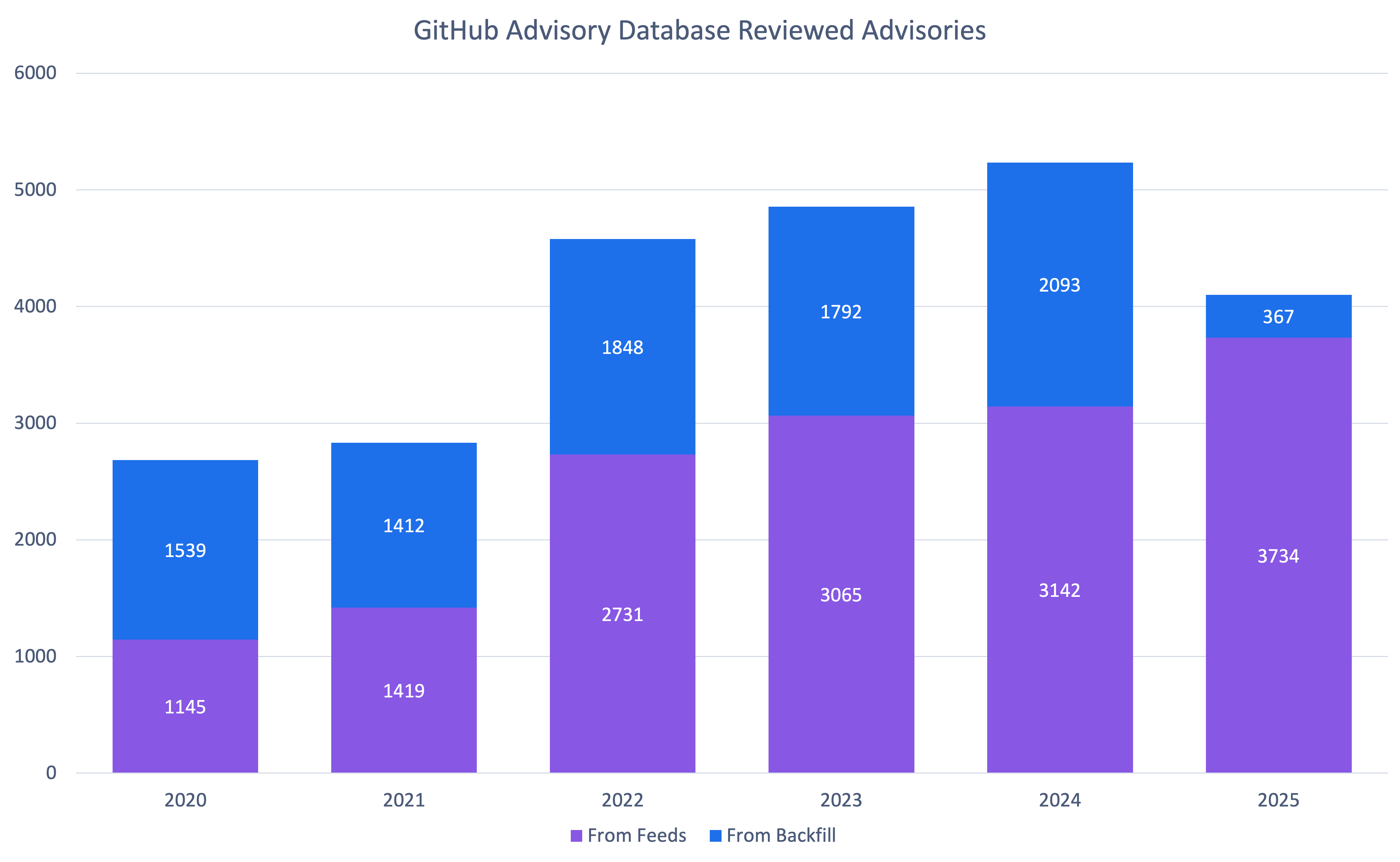
GitHub published 4,101 reviewed advisories in 2025. This is the fewest number of reviewed advisories since 2021. Does this mean open source is shipping more secure code? Let’s dig into the data to find out.
GitHub reviewed advisories
Fewer advisories reviewed doesn’t mean fewer vulnerabilities were reported. The drop is because GitHub reviewed far fewer older vulnerabilities. When you look only at newly reported vulnerabilities from our sources, GitHub actually reviewed 19% more advisori
GitHub published 4,101 reviewed advisories in 2025. This is the fewest number of reviewed advisories since 2021. Does this mean open source is shipping more secure code? Let’s dig into the data to find out.
GitHub reviewed advisories
Fewer advisories reviewed doesn’t mean fewer vulnerabilities were reported. The drop is because GitHub reviewed far fewer older vulnerabilities. When you look only at newly reported vulnerabilities from our sources, GitHub actually reviewed 19% more advisories year over year.
So why the change? Quite frankly, we are running out of unreviewed vulnerabilities that are older than the Advisory Database. At the same time, the number of newly reported vulnerabilities hasn’t dropped.
It’s also worth clarifying that “unreviewed” in the database can be misleading: most advisories marked unreviewed have already been looked at by a curator and found not to affect any package in a supported ecosystem, so they may never be fully reviewed.
This means that you should be receiving fewer brand-new Dependabot alerts about old vulnerabilities.
Note: If you find an unreviewed advisory that affects a supported package, please let us know so we can get it reviewed!
How vulnerabilities were distributed across ecosystems in 2025
The distribution of ecosystems in advisories reviewed in 2025 is similar to the overall distribution in the database, with the exception of Go. Go is overrepresented in 2025 advisories by 6%. This is largely due to dedicated campaigns to re-examine potentially missing advisories found through an internal review for packages where we had inconsistent coverage.
How the types of vulnerabilities changed in 2025
Rank
Common Weakness Enumeration (CWE)
Number of 2025 Advisories*
Change in Rank from 2024
Change in Rank from the Overall Database
1
CWE-79
672
+0
+0
2
CWE-22
214
+2
+1
3
CWE-863
169
+9
+8
4
CWE-20
154
+1
+1
5
CWE-200
145
-2
-1
6
CWE-400
144
+4
+0
7
CWE-770
136
+7
+10
8
CWE-502
134
+5
+1
9
CWE-94
119
-3
-1
10
CWE-918
103
+5
+8
* An advisory may have more than CWE. For example, an advisory might have both CWE-400 and CWE-770. It would then count for both.
As usual, cross-site scripting (CWE-79) is by far the most common vulnerability type. However, there are significant changes in the following areas. Resource exhaustion (CWE-400 and CWE-770), unsafe deserialization (CWE-502), and server-side request forgery (CWE-918) were unusually common in 2025. CWE-863 (“Incorrect Authorization”) saw a significant jump, but that is largely due to reclassification away from CWE-284 (“Improper Access Control”) and CWE-285 (“Improper Authorization”), which are higher level CWEs that the CWE program discourages using.
One of the biggest quality improvements in 2025 was more specific, more consistent CWE tagging. Advisories without any CWE dropped 85% (from 452 in 2024 to 65 in 2025). CWE-20 (“Improper Input Validation”) is still common, but in prior years it was often the only CWE listed on an advisory.
In 2025, advisories far more often list CWE-20 plus one or more additional CWEs that describe the concrete failure mode. This added specificity makes the data more actionable for triage, prioritization, and remediation.
Together, they can give you a head start on your risk assessment process.
As you can see, when considering impact, most vulnerabilities skew moderate to high of the impact range. Low-impact vulnerabilities are likely more common than the CVSS data suggests but are often not considered worth the time and effort for researchers and maintainers to report. The EPSS scores for moderate to high impact vulnerabilities support this decision.
So should you trust the EPSS or CVSS scores? To judge that, let’s look at how they match up to vulnerabilities in CISA’s Known Exploited Vulnerabilities Catalog. The exploited vulnerabilities are at least scored moderate, and most are critical or high. While CVSS has more of the exploited vulnerabilities as critical, it also has far more vulnerabilities in the range in general. Combining the two can help you prioritize which vulnerabilities to address to prevent exploitation.
npm malware advisories
2025 was a huge year for npm malware advisories. Due to large malware campaigns, such as SHA1-Hulud, GitHub saw a 69% increase in published malware advisories compared to 2024. This is the most malware advisories GitHub has published since our initial release of historical malware when we added support in 2022.
You can receive Dependabot alerts when your repositories depend on npm packages with known malicious versions. When you enable malware alerting, Dependabot matches your npm dependencies against malware advisories in the GitHub Advisory Database.
GitHub CVE Numbering Authority (CNA)
CVE publications
2025 was a big year for the GitHub, Inc. CNA. We saw a 35% increase in published CVE records, outpacing the overall CVE Project’s increase of 21%.
In fact, we saw 10 to 16% growth every quarter. If this trend continues, GitHub will publish over 50% more CVEs in 2026.
You can help make that a reality by requesting a CVE from us the next time you publish a repository security advisory about a vulnerability!
Organizations using GitHub’s CNA
Every year, GitHub sees more organizations use its CNA services. 2025 is no exception with a 20% increase in new organizations requesting CVE IDs.
Unlike reviewed global advisories, which are always mapped to packages in ecosystems we support, any maintainer on GitHub can request a CVE, even if they don’t publish that package to a supported ecosystem. In fact, 2025 is the first year that GitHub has published more CVEs from organizations that do not use a supported ecosystem than those that do.
We would like to thank all 987 organizations that published CVEs with us in 2025 and highlight the top 10 most prolific organizations.
Top 10 organizations using the GitHub CNA
Organization
Number of 2025 CVEs
LabReDeS (WeGIA)*
130
XWiki
40
Frappe
28
Discourse
27
Enalean
27
FreeScout*
27
DataEase
26
Nextcloud
25
GLPI
24
DNN Software*
23
* Organizations that published CVEs through GitHub for the first time in 2025
Onward to 2026
The data from 2025 shows incredible growth:
4,101 reviewed advisories
7,197 malware advisories
2,903 CVEs published
679 new organizations using our CNA services.
These numbers represent real security improvements for millions of developers.
You can be part of this in 2026. Here’s how:
1. Use our CNA services
Publishing CVEs shouldn’t be complicated. Request a CVE directly from your repository security advisory, and we’ll take care of curating and publishing it for you. It’s free, it’s fast, and it helps the entire ecosystem understand and respond to vulnerabilities.
2. Improve advisory accuracy
Found an unreviewed advisory affecting a supported package? See incorrect severity scores or missing affected versions? Suggest edits. Your edits will be reviewed by the Advisory Database team and ultimately, will help make the database more accurate for everyone. In 2025, 675 contributions from the community improved the quality of this data for the entire software industry!
3. Protect your projects
The most direct impact you can have is protecting your own code. Enable Dependabot to automatically receive security updates and explore GitHub Advanced Security for comprehensive protection.
Critical authentication bypass vulnerabilities (CVE-2025-25291 + CVE-2025-25292) were discovered in ruby-saml up to version 1.17.0. Attackers who are in possession of a single valid signature that was created with the key used to validate SAML responses or assertions of the targeted organization can use it to construct SAML assertions themselves and are in turn able to log in as any user. In other words, it could be used for an account takeover attack. Users of ruby-saml should update to versi
Critical authentication bypass vulnerabilities (CVE-2025-25291 + CVE-2025-25292) were discovered in ruby-saml up to version 1.17.0. Attackers who are in possession of a single valid signature that was created with the key used to validate SAML responses or assertions of the targeted organization can use it to construct SAML assertions themselves and are in turn able to log in as any user. In other words, it could be used for an account takeover attack. Users of ruby-saml should update to version 1.18.0. References to libraries making use of ruby-saml (such as omniauth-saml) need also be updated to a version that reference a fixed version of ruby-saml.
In this blog post, we detail newly discovered authentication bypass vulnerabilities in the ruby-saml library used for single sign-on (SSO) via SAML on the service provider (application) side. GitHub doesn’t currently use ruby-saml for authentication, but began evaluating the use of the library with the intention of using an open source library for SAML authentication once more. This library is, however, used in other popular projects and products. We discovered an exploitable instance of this vulnerability in GitLab, and have notified their security team so they can take necessary actions to protect their users against potential attacks.
GitHub previously used the ruby-saml library up to 2014, but moved to our own SAML implementation due to missing features in ruby-saml at that time. Following bug bounty reports around vulnerabilities in our own implementation (such as CVE-2024-9487, related to encrypted assertions), GitHub recently decided to explore the use of ruby-saml again. Then in October 2024, a blockbuster vulnerability dropped: an authentication bypass in ruby-saml (CVE-2024-45409) by ahacker1. With tangible evidence of exploitable attack surface, GitHub’s switch to ruby-saml had to be evaluated more thoroughly now. As such, GitHub started a private bug bounty engagement to evaluate the security of the ruby-saml library. We gave selected bug bounty researchers access to GitHub test environments using ruby-saml for SAML authentication. In tandem, the GitHub Security Lab also reviewed the attack surface of the ruby-saml library.
As is not uncommon when multiple researchers are looking at the same code, both ahacker1, a participant in the GitHub bug bounty program, and I noticed the same thing during code review: ruby-saml was using two different XML parsers during the code path of signature verification. Namely, REXML and Nokogiri. While REXML is an XML parser implemented in pure Ruby, Nokogiri provides an easy-to-use wrapper API around different libraries like libxml2, libgumbo and Xerces (used for JRuby). Nokogiri supports parsing of XML and HTML. It looks like Nokogiri was added to ruby-saml to support canonicalization and potentially other things REXML didn’t support at that time.
We both inspected the same code path in the validate_signature of xml_security.rb and found that the signature element to be verified is first read via REXML, and then also with Nokogiri’s XML parser. So, if REXML and Nokogiri could be tricked into retrieving different signature elements for the same XPath query it might be possible to trick ruby-saml into verifying the wrong signature. It looked like there could be a potential authentication bypass due to a parser differential!
The reality was actually more complicated than this.
Roughly speaking, four stages were involved in the discovery of this authentication bypass:
Discovering that two different XML parsers are used during code review.
Establishing if and how a parser differential could be exploited.
Finding an actual parser differential for the parsers in use.
Leveraging the parser differential to create a full-blown exploit.
To prove the security impact of this vulnerability, it was necessary to complete all four stages and create a full-blown authentication bypass exploit.
Security assertion markup language (SAML) responses are used to transport information about a signed-in user from the identity provider (IdP) to the service provider (SP) in XML format. Often the only important information transported is a username or an email address. When the HTTP POST binding is used, the SAML response travels from the IdP to the SP via the browser of the end user. This makes it obvious why there has to be some sort of signature verification in play to prevent the user from tampering with the message.
Let’s have a quick look at what a simplified SAML response looks like:
Note: in the response above the XML namespaces were removed for better readability.
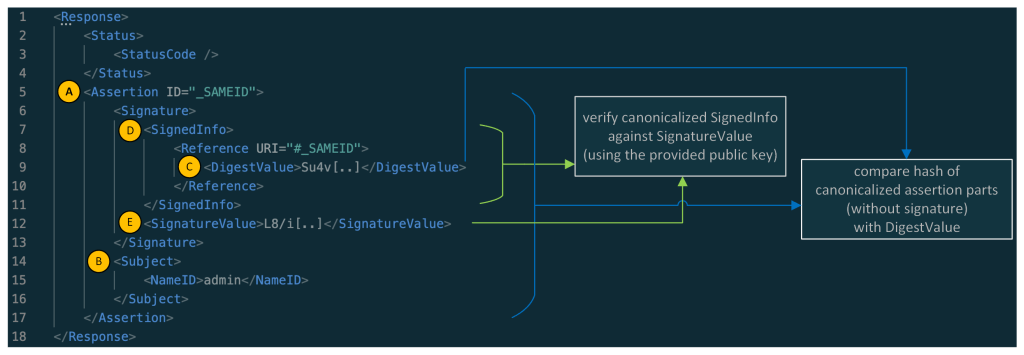
As you might have noticed: the main part of a simple SAML response is its assertion element (A), whereas the main information contained in the assertion is the information contained in the Subject element (B) (here the NameID containing the username: admin). A real assertion typically contains more information (e.g. NotBefore and NotOnOrAfter dates as part of a Conditions element.)
Normally, the Assertion (A) (without the whole Signature part) is canonicalized and then compared against the DigestValue (C) and the SignedInfo (D) is canonicalized and verified against the SignatureValue (E). In this sample, the assertion of the SAML response is signed, and in other cases the whole SAML response is signed.
We learned that ruby-saml used two different XML parsers (REXML and Nokogiri) for validating the SAML response. Now let’s have a look at the verification of the signature and the digest comparison.
The focus of the following explanation lies on the validate_signature method inside of xml_security.rb.
Inside that method, there’s a broad XPath query with REXML for the first signature element inside the SAML document:
Hint: When reading the code snippets, you can tell the difference between queries for REXML and Nokogiri by looking at how they are called. REXML methods are prefixed with REXML::, whereas Nokogiri methods are called on document.
Later, the actual SignatureValue is read from this element:
Note: the name of the Signature element might be a bit confusing. While it contains the actual signature in the SignatureValue node it also contains the part that is actually signed in the SignedInfo node. Most importantly the DigestValue element contains the digest (hash) of the assertion and information about the used key.
So, an actual Signature element could look like this (removed namespace information for better readability):
The method extract_signed_element_idextracts the signed element id with help of REXML. From the previous authentication bypass (CVE-2024-45409), there’s now a check that only one element with the same ID can exist.
The first of the reference_nodes is taken and canonicalized:
The assertion is extracted and canonicalized with Nokogiri, and then hashed. In contrast, the hash against which it will be compared is extracted with REXML.
The SignedInfo element is extracted and canonicalized with Nokogiri - it is then verified against the SignatureValue, which was extracted with REXML.
The question is: is it possible to create an XML document where REXML sees one signature and Nokogiri sees another?
It turns out, yes.
Ahacker1, participating in the bug bounty, was faster to produce a working exploit using a parser differential. Among other things, ahacker1 was inspired by the XML roundtrips vulnerabilities published by Mattermost’s Juho Forsén in 2021.
Not much later, I produced an exploit using a different parser differential with the help of Trail of Bits’ Ruby fuzzer called ruzzy.
Both exploits result in an authentication bypass. Meaning that an attacker, who is in possession of a single valid signature that was created with the key used to validate SAML responses or assertions of the targeted organization, can use it to construct assertions for any users which will be accepted by ruby-saml. Such a signature can either come from a signed assertion or response from another (unprivileged) user or in certain cases, it can even come from signed metadata of a SAML identity provider (which can be publicly accessible).
An exploit could look like this. Here, an additional Signature was added as part of the StatusDetail element that is only visible to Nokogiri:
In summary:
The SignedInfo element (A) from the signature that is visible to Nokogiri is canonicalized and verified against the SignatureValue (B) that was extracted from the signature seen by REXML.
The assertion is retrieved via Nokogiri by looking for its ID. This assertion is then canonicalized and hashed (C). The hash is then compared to the hash contained in the DigestValue (D). This DigestValue was retrieved via REXML. This DigestValue has no corresponding signature.
So, two things take place:
A valid SignedInfo with DigestValue is verified against a valid signature. (which checks out)
A fabricated canonicalized assertion is compared against its calculated digest. (which checks out as well)
This allows an attacker, who is in possession of a valid signed assertion for any (unprivileged) user, to fabricate assertions and as such impersonate any other user.
Parts of the currently known, undisclosed exploits can be stopped by checking for Nokogiri parsing errors on SAML responses. Sadly, those errors do not result in exceptions, but need to be checked on the errors member of the parsed document:
doc = Nokogiri::XML(xml) do |config|
  config.options = Nokogiri::XML::ParseOptions::STRICT | Nokogiri::XML::ParseOptions::NONET
end

raise "XML errors when parsing: " + doc.errors.to_s if doc.errors.any?
While this is far from a perfect fix for the issues at hand, it renders at least one exploit infeasible.
We are not aware of any reliable indicators of compromise. While we’ve found a potential indicator of compromise, it only works in debug-like environments and to publish it, we would have to reveal too many details about how to implement a working exploit so we’ve decided that it’s better not to publish it. Instead, our best recommendation is to look for suspicious logins via SAML on the service provider side from IP addresses that do not align with the user’s expected location.
Some might say it’s hard to integrate systems with SAML. That might be true. However, it’s even harder to write implementations of SAML using XML signatures in a secure way. As others have stated before: it’s probably best to disregard the specifications, as following them doesn’t help build secure implementations.
To rehash how the validation works if the SAML assertion is signed, let’s have a look at the graphic below, depicting a simplified SAML response. The assertion, which transports the protected information, contains a signature. Confusing, right?
To complicate it even more: What is even signed here? The whole assertion? No!
What’s signed is the SignedInfo element and the SignedInfo element contains a DigestValue. This DigestValue is the hash of the canonicalized assertion with the signature element removed before the canonicalization. This two-stage verification process can lead to implementations that have a disconnect between the verification of the hash and the verification of the signature. This is the case for these Ruby-SAML parser differentials: while the hash and the signature check out on their own, they have no connection. The hash is actually a hash of the assertion, but the signature is a signature of a different SignedInfo element containing another hash. What you actually want is a direct connection between the hashed content, the hash, and the signature. (And once the verification is done you only want to retrieve information from the exact part that was actually verified.) Or, alternatively, use a less complicated standard to transport a cryptographically signed username between two systems - but here we are.
In this case, the library already extracted the SignedInfo and used it to verify the signature of its canonicalized string,canon_string. However, it did not use it to obtain the digest value. If the library had used the content of the already extracted SignedInfo to obtain the digest value, it would have been secure in this case even with two XML parsers in use.
As shown once again: relying on two different parsers in a security context can be tricky and error-prone. That being said: exploitability is not automatically guaranteed in such cases. As we have seen in this case, checking for Nokogiri errors could not have prevented the parser differential, but could have stopped at least one practical exploitation of it.
The initial fix for the authentication bypasses does not remove one of the XML parsers to prevent API compatibility problems. As noted, the more fundamental issue was the disconnect between verification of the hash and verification of the signature, which was exploitable via parser differentials. The removal of one of the XML parsers was already planned for other reasons, and will likely come as part of a major release in combination with additional improvements to strengthen the library. If your company relies on open source software for business-critical functionality, consider sponsoring them to help fund their future development and bug fix releases.
If you’re a user of ruby-saml library, make sure to update to the latest version, 1.18.0, containing fixes for CVE-2025-25291 and CVE-2025-25292. References to libraries making use of ruby-saml (such as omniauth-saml) need also be updated to a version that reference a fixed version of ruby-saml. We will publish a proof of concept exploit at a later date in the GitHub Security Lab repository.
Special thanks to Sixto Martín, maintainer of ruby-saml, and Jeff Guerra from the GitHub Bug Bounty program.
Special thanks also to ahacker1 for giving inputs to this blog post.
2024-11-04: Bug bounty report demonstrating an authentication bypass was reported against a GitHub test environment evaluating ruby-saml for SAML authentication.
2024-11-04: Work started to identify and test potential mitigations.
2024-11-12: A second authentication bypass was found by Peter that renders the planned mitigations for the first useless.
2024-11-13: Initial contact with Sixto Martín, maintainer of ruby-saml.
2024-11-14: Both parser differentials are reported to ruby-saml, the maintainer responds immediately.
2024-11-14: The work on potential patches by the maintainer and ahacker1 begins. (One of the initial ideas was to remove one of the XML parsers, but this was not feasible without breaking backwards compatibility).
2025-02-04: ahacker1 proposes a non-backwards compatible fix.
2025-02-06: ahacker1 also proposes a backwards compatible fix.
2025-02-12: The 90 days deadline of GitHub Security Lab advisories ends.
2025-02-16: The maintainer starts working on a fix with the idea to be backwards-compatible and easier to understand.
2025-02-17: Initial contact with GitLab to coordinate a release of their on-prem product with the release of the ruby-saml library.
2025-03-12: A fixed version of ruby-saml was released.

 Entrar