Visualização normal

Antes de ontemStream principal
  • ✇Securelist
  • Exploits and vulnerabilities in Q1 2026 Alexander Kolesnikov
    During Q1 2026, the exploit kits leveraged by threat actors to target user systems expanded once again, incorporating new exploits for the Microsoft Office platform, as well as Windows and Linux operating systems. In this report, we dive into the statistics on published vulnerabilities and exploits, as well as the known vulnerabilities leveraged by popular C2 frameworks throughout Q1 2026. Statistics on registered vulnerabilities This section provides statistical data on registered vulnerabiliti
     

Exploits and vulnerabilities in Q1 2026

7 de Maio de 2026, 07:00

During Q1 2026, the exploit kits leveraged by threat actors to target user systems expanded once again, incorporating new exploits for the Microsoft Office platform, as well as Windows and Linux operating systems.

In this report, we dive into the statistics on published vulnerabilities and exploits, as well as the known vulnerabilities leveraged by popular C2 frameworks throughout Q1 2026.

Statistics on registered vulnerabilities

This section provides statistical data on registered vulnerabilities. The data is sourced from cve.org.

We examine the number of registered CVEs for each month starting from January 2022. The total volume of vulnerabilities continues rising and, according to current reports, the use of AI agents for discovering security issues is expected to further reinforce this upward trend.

Total published vulnerabilities per month from 2022 through 2026 (download)

Next, we analyze the number of new critical vulnerabilities (CVSS > 8.9) over the same period.

Total critical vulnerabilities published per month from 2022 through 2026 (download)

The graph indicates that while the volume of critical vulnerabilities slightly decreased compared to previous years, an upward trend remained clearly visible. At present, we attribute this to the fact that the end of last year was marked by the disclosure of several severe vulnerabilities in web frameworks. The current growth is driven by high-profile issues like React2Shell, the release of exploit frameworks for mobile platforms, and the uncovering of secondary vulnerabilities during the remediation of previously discovered ones. We will be able to test this hypothesis in the next quarter; if correct, the second quarter will show a significant decline, similar to the pattern observed in the previous year.

Exploitation statistics

This section presents statistics on vulnerability exploitation for Q1 2026. The data draws on open sources and our telemetry.

Windows and Linux vulnerability exploitation

In Q1 2026, threat actor toolsets were updated with exploits for new, recently registered vulnerabilities. However, we first examine the list of veteran vulnerabilities that consistently account for the largest share of detections:

  • CVE-2018-0802: a remote code execution (RCE) vulnerability in the Equation Editor component
  • CVE-2017-11882: another RCE vulnerability also affecting Equation Editor
  • CVE-2017-0199: a vulnerability in Microsoft Office and WordPad that allows an attacker to gain control over the system
  • CVE-2023-38831: a vulnerability resulting from the improper handling of objects contained within an archive
  • CVE-2025-6218: a vulnerability allowing the specification of relative paths to extract files into arbitrary directories, potentially leading to malicious command execution
  • CVE-2025-8088: a directory traversal bypass vulnerability during file extraction utilizing NTFS Streams

Among the newcomers, we have observed exploits targeting the Microsoft Office platform and Windows OS components. Notably, these new vulnerabilities exploit logic flaws arising from the interaction between multiple systems, making them technically difficult to isolate within a specific file or library. A list of these vulnerabilities is provided below:

  • CVE-2026-21509 and CVE-2026-21514: security feature bypass vulnerabilities: despite Protected View being enabled, a specially crafted file can still execute malicious code without the user’s knowledge. Malicious commands are executed on the victim’s system with the privileges of the user who opened the file.
  • CVE-2026-21513: a vulnerability in the Internet Explorer MSHTML engine, which is used to open websites and render HTML markup. The vulnerability involves bypassing rules that restrict the execution of files from untrusted network sources. Interestingly, the data provider for this vulnerability was an LNK file.

These three vulnerabilities were utilized together in a single chain during attacks on Windows-based user systems. While this combination is noteworthy, we believe the widespread use of the entire chain as a unified exploit will likely decline due to its instability. We anticipate that these vulnerabilities will eventually be applied individually as initial entry vectors in phishing campaigns.

Below is the trend of exploit detections on user Windows systems starting from Q1 2025.

Dynamics of the number of Windows users encountering exploits, Q1 2025 – Q1 2026. The number of users who encountered exploits in Q1 2025 is taken as 100% (download)

The vulnerabilities listed here can be leveraged to gain initial access to a vulnerable system and for privilege escalation. This underscores the critical importance of timely software updates.

On Linux devices, exploits for the following vulnerabilities were detected most frequently:

  • CVE-2022-0847: a vulnerability known as Dirty Pipe, which enables privilege escalation and the hijacking of running applications
  • CVE-2019-13272: a vulnerability caused by improper handling of privilege inheritance, which can be exploited to achieve privilege escalation
  • CVE-2021-22555: a heap out-of-bounds write vulnerability in the Netfilter kernel subsystem
  • CVE-2023-32233: a vulnerability in the Netfilter subsystem that allows for Use-After-Free conditions and privilege escalation through the improper processing of network requests

Dynamics of the number of Linux users encountering exploits, Q1 2025 – Q1 2026. The number of users who encountered exploits in Q1 2025 is taken as 100% (download)

In the first quarter of 2026, we observed a decrease in the number of detected exploits; however, the detection rates are on the rise relative to the same period last year. For the Linux operating system, the installation of security patches remains critical.

Most common published exploits

The distribution of published exploits by software type in Q1 2026 features an updated set of categories; once again, we see exploits targeting operating systems and Microsoft Office suites.

Distribution of published exploits by platform, Q1 2026 (download)

Vulnerability exploitation in APT attacks

We analyzed which vulnerabilities were utilized in APT attacks during Q1 2026. The ranking provided below includes data based on our telemetry, research, and open sources.

TOP 10 vulnerabilities exploited in APT attacks, Q1 2026 (download)

In Q1 2026, threat actors continued to utilize high-profile vulnerabilities registered in the previous year for APT attacks. The hypothesis we previously proposed has been confirmed: security flaws affecting web applications remain heavily exploited in real-world attacks. However, we are also observing a partial refresh of attacker toolsets. Specifically, during the first quarter of the year, APT campaigns leveraged recently discovered vulnerabilities in Microsoft Office products, edge networking device software, and remote access management systems. Although the most recent vulnerabilities are being exploited most heavily, their general characteristics continue to reinforce established trends regarding the categories of vulnerable software. Consequently, we strongly recommend applying the security patches provided by vendors.

C2 frameworks

In this section, we examine the most popular C2 frameworks used by threat actors and analyze the vulnerabilities targeted by the exploits that interacted with C2 agents in APT attacks.

The chart below shows the frequency of known C2 framework usage in attacks against users during Q1 2026, according to open sources.

TOP 10 C2 frameworks used by APTs to compromise user systems, Q1 2026 (download)

Metasploit has returned to the top of the list of the most common C2 frameworks, displacing Sliver, which now shares the second position with Havoc. These are followed by Covenant and Mythic, the latter of which previously saw greater popularity. After studying open sources and analyzing samples of malicious C2 agents that contained exploits, we determined that the following vulnerabilities were utilized in APT attacks involving the C2 frameworks mentioned above:

  • CVE-2023-46604: an insecure deserialization vulnerability allowing for arbitrary code execution within the server process context if the Apache ActiveMQ service is running
  • CVE-2024-12356 and CVE-2026-1731: command injection vulnerabilities in BeyondTrust software that allow an attacker to send malicious commands even without system authentication
  • CVE-2023-36884: a vulnerability in the Windows Search component that enables command execution on the system, bypassing security mechanisms built into Microsoft Office applications
  • CVE-2025-53770: an insecure deserialization vulnerability in Microsoft SharePoint that allows for unauthenticated command execution on the server
  • CVE-2025-8088 and CVE-2025-6218: similar directory traversal vulnerabilities that allow files to be extracted from an archive to a predefined path, potentially without the archiving utility displaying any alerts to the user

The nature of the described vulnerabilities indicates that they were exploited to gain initial access to the system. Notably, the majority of these security issues are targeted to bypass authentication mechanisms. This is likely due to the fact that C2 agents are being detected effectively, prompting threat actors to reduce the probability of discovery by utilizing bypass exploits.

Notable vulnerabilities

This section highlights the most significant vulnerabilities published in Q1 2026 that have publicly available descriptions.

CVE-2026-21519: Desktop Window Manager vulnerability

At the core of this vulnerability is a Type Confusion flaw. By attempting to access a resource within the Desktop Window Manager subsystem, an attacker can achieve privilege escalation. A necessary condition for exploiting this issue is existing authorization on the system.

It is worth noting that the DWM subsystem has been under close scrutiny by threat actors for quite some time. Historically, the primary attack vector involves interacting with the NtDComposition* function set.

RegPwn (CVE-2026-21533): a system settings access control vulnerability

CVE-2026-21533 is essentially a logic vulnerability that enables privilege escalation. It stems from the improper handling of privileges within Remote Desktop Services (RDS) components. By modifying service parameters in the registry and replacing the configuration with a custom key, an attacker can elevate privileges to the SYSTEM level. This vulnerability is likely to remain a fixture in threat actor toolsets as a method for establishing persistence and gaining high-level privileges.

CVE-2026-21514: a Microsoft Office vulnerability

This vulnerability was discovered in the wild during attacks on user systems. Notably, an LNK file is used to initiate the exploitation process. CVE-2026-21514 is also a logic issue that allows for bypassing OLE technology restrictions on malicious code execution and the transmission of NetNTLM authentication requests when processing untrusted input.

Clawdbot (CVE-2026-25253): an OpenClaw vulnerability

This vulnerability in the AI agent leaks credentials (authentication tokens) when queried via the WebSocket protocol. It can lead to the compromise of the infrastructure where the agent is installed: researchers have confirmed the ability to access local system data and execute commands with elevated privileges. The danger of CVE-2026-25253 is further compounded by the fact that its exploitation has generated numerous attack scenarios, including the use of prompt injections and ClickFix techniques to install stealers on vulnerable systems.

CVE-2026-34070: LangChain framework vulnerability

LangChain is an open-source framework designed for building applications powered by large language models (LLMs). A directory traversal vulnerability allowed attackers to access arbitrary files within the infrastructure where the framework was deployed. The core of CVE-2026-34070 lies in the fact that certain functions within langchain_core/prompts/loading.py handled configuration files insecurely. This could potentially lead to the processing of files containing malicious data, which could be leveraged to execute commands and expose critical system information or other sensitive files.

CVE-2026-22812: an OpenCode vulnerability

CVE-2026-22812 is another vulnerability identified in AI-assisted coding software. By default, the OpenCode agent provided local access for launching authorized applications via an HTTP server that did not require authentication. Consequently, attackers could execute malicious commands on a vulnerable device with the privileges of the current user.

Conclusion and advice

We observe that the registration of vulnerabilities is steadily gaining momentum in Q1 2026, a trend driven by the widespread development of AI tools designed to identify security flaws across various software types. This trajectory is likely to result not only in a higher volume of registered vulnerabilities but also in an increase in exploit-driven attacks, further reinforcing the critical necessity of timely security patch deployment. Additionally, organizations must prioritize vulnerability management and implement effective defensive technologies to mitigate the risks associated with potential exploitation.

To ensure the rapid detection of threats involving exploit utilization and to prevent their escalation, it is essential to deploy a reliable security solution. Key features of such a tool include continuous infrastructure monitoring, proactive protection, and vulnerability prioritization based on real-world relevance. These mechanisms are integrated into Kaspersky Next, which also provides endpoint security and protection against cyberattacks of any complexity.

  • ✇Securelist
  • Coruna: the framework used in Operation Triangulation Boris Larin
    Introduction On March 4, 2026, Google and iVerify published reports about a highly sophisticated exploit kit targeting Apple iPhone devices. According to Google, the exploit kit was first discovered in targeted attacks conducted by a customer of an unnamed surveillance vendor. It was later used by other attackers in watering-hole attacks in Ukraine and in financially motivated attacks in China. Additionally, researchers discovered an instance with the debug version of the exploit kit, which reve
     

Coruna: the framework used in Operation Triangulation

26 de Março de 2026, 05:00

Introduction

On March 4, 2026, Google and iVerify published reports about a highly sophisticated exploit kit targeting Apple iPhone devices. According to Google, the exploit kit was first discovered in targeted attacks conducted by a customer of an unnamed surveillance vendor. It was later used by other attackers in watering-hole attacks in Ukraine and in financially motivated attacks in China. Additionally, researchers discovered an instance with the debug version of the exploit kit, which revealed the internal names of the exploits and the framework name used by its developers — Coruna. Analysis of the kit showed that it relies on the exploitation of many previously patched vulnerabilities and also includes exploits for CVE-2023-32434 and CVE-2023-38606. These two vulnerabilities particularly caught our attention because they had been first discovered as zero-days used in Operation Triangulation.

Operation Triangulation is a complex mobile APT campaign targeting iOS devices. We discovered it while monitoring the network traffic of our own corporate Wi-Fi network. We noticed suspicious activity that originated from several iOS-based phones. Following the investigation, we learned that this campaign employed a sophisticated spyware implant and multiple zero-day exploits. The investigation lasted for over six months, during which we disclosed our findings in connection to the attack. Kaspersky GReAT experts also presented these findings at the 37th Chaos Communication Congress (37C3).

Although all the details of both CVE-2023-32434 and CVE-2023-38606 have long been publicly available, and other researchers have developed their own exploits without ever seeing the Triangulation code, we decided to closely investigate the exploits used in Coruna. Some of the exploit kit distribution links provided by Google remained active at the time the report was published, which allowed us to collect, decrypt, and analyze all components of Coruna.

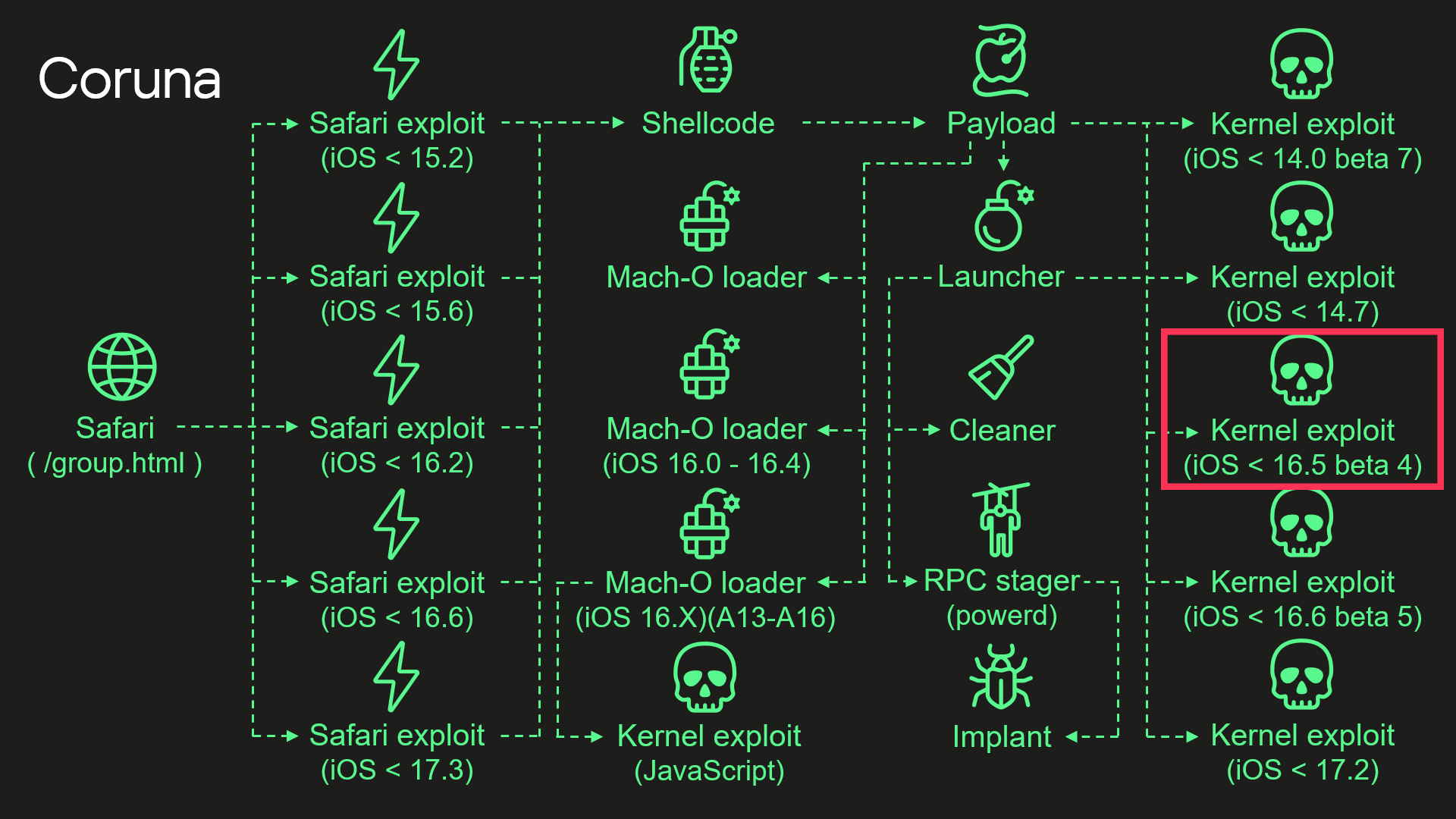
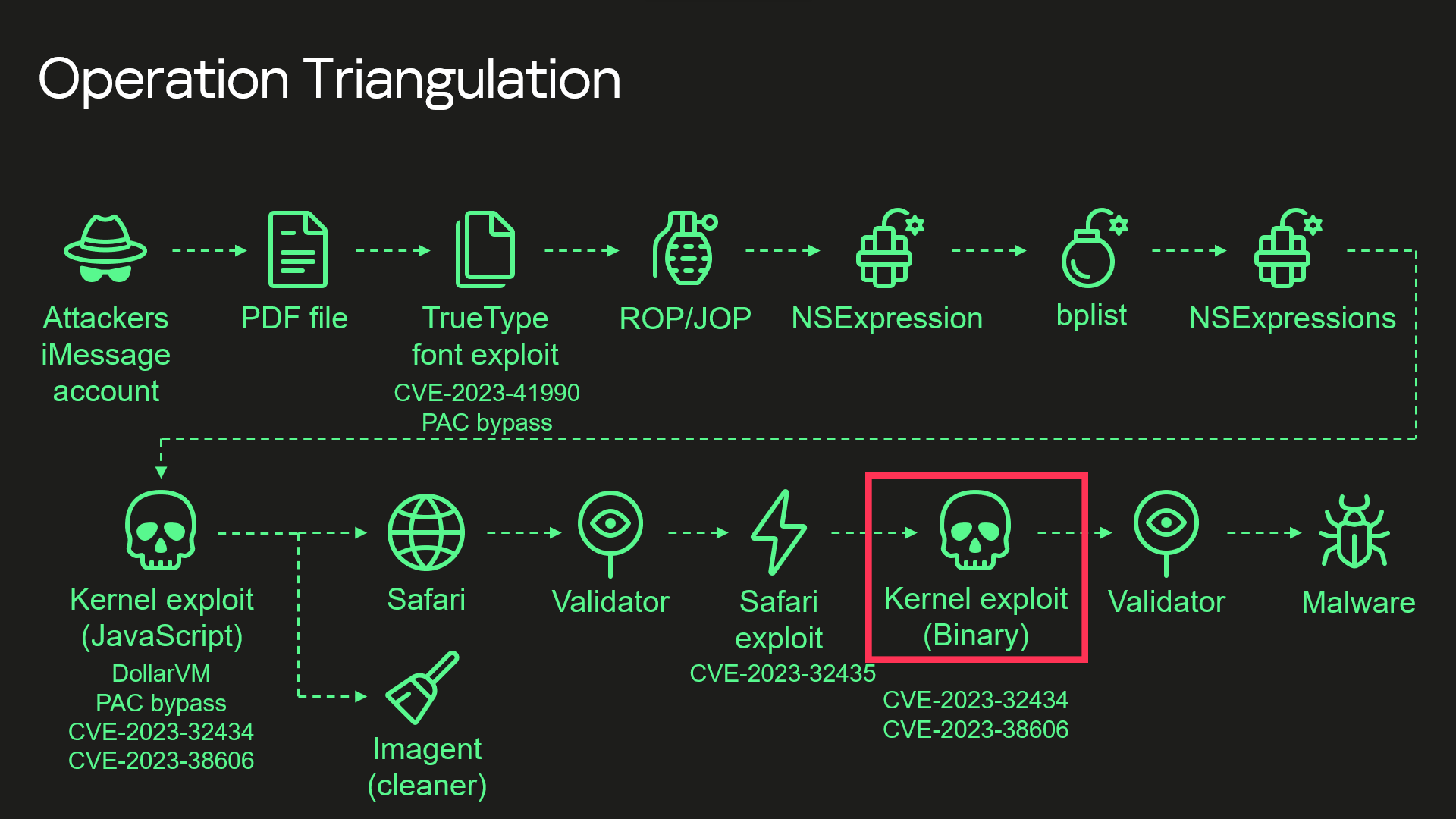
During our analysis, we discovered that the kernel exploit for CVE-2023-32434 and CVE-2023-38606 vulnerabilities used in Coruna, in fact, is an updated version of the same exploit that had been used in Operation Triangulation. The images below illustrate a high-level overview of the two attack chains. The exploit in question is highlighted with a red rectangle.

Attack chain of Operation Triangulation (simplified)

Attack chain of Operation Triangulation (simplified)

Attack chain of Coruna (simplified)

Attack chain of Coruna (simplified)

Moreover, we discovered that Coruna includes four additional kernel exploits that we had not seen used in Operation Triangulation, two of which were developed after the discovery of Operation Triangulation. All of these exploits are built on the same kernel exploitation framework and share common code. Code similarities from kernel exploits can also be found in other components of Coruna. These findings led us to conclude that this exploit kit was not patchworked but rather designed with a unified approach. We assume that it’s an updated version of the same exploitation framework that was used — at least to some extent — in Operation Triangulation.

Technical details

While we continue to investigate all exploits and vulnerabilities used by Coruna, this post provides a high-level overview of the exploit kit and attack chain.

Safari

Exploitation begins with a stager that fingerprints the browser and selects and executes appropriate remote code execution (RCE) and pointer authentication code (PAC) exploits depending on the browser version. It also contains a URL to an encrypted file with information about all available packages containing exploits and other components. The stager also includes a 256-bit key used to decrypt it. The URL and decryption key are passed to a payload embedded in PAC exploits.

Payload

The payload is responsible for initiating the exploitation of the kernel. After initialization, the payload first downloads a file with information about other available components. To extract it, the payload performs several steps processing multiple file formats.

First, the downloaded file is decrypted using the ChaCha20 stream cipher. Decryption yields a container with the magic number 0xBEDF00D, which stores LZMA-compressed data.

The file format used by the exploit kit to store compressed data

Offset Field
0x00 Magic number (0xBEDF00D)
0x04 Decompressed data size
0x08 LZMA-compressed data

The decompressed data presents another container with the magic number 0xF00DBEEF. This file format is used in the exploit kit to store and retrieve files by their IDs.

The file format used by the exploit kit to store files

Offset Field
0x00 Magic number (0xF00DBEEF)
0x04 Number of entries
0x08 Entry[0].File ID
0x0C Entry[0].Status
0x10 Entry[0].File offset
0x14 Entry[0].File size

We provide a description of all possible File ID values below. At this stage, when the payload gathers information about all available file packages, this container holds only one file, and its File ID is 0x70000.

Finally, we get to the file with information about all available file packages. It starts with the magic value 0x12345678. The exploit kit uses this file format to obtain URLs and decryption keys for additional components that need to be downloaded.

The file format used by the exploit kit to store information about file packages

Offset Field
0x00 Magic number (0x12345678)
0x04 Flags
0x08 Directory path
0x108 Number of entries
0x10C Entry[0].Package ID
0x110 Entry[0].ChaCha20 key
0x130 Entry[0].File name

The components required for exploiting a targeted device are selected using the Package ID. Its high byte specifies the package type and required hardware. We’ve seen the following package types:

  • 0xF2 – exploit for ARM64,
  • 0xF3 – exploit for ARM64E,
  • 0xA2 – Mach-O loader for ARM64,
  • 0xA3 – Mach-O loader for ARM64E,
  • 2 – implant for ARM64,
  • 0xE2 – implant for ARM64E.

The payload code also supports additional package types, such as 0xF1, an exploit for older ARM devices that do not support 64-bit architecture. Interestingly, however, the files for such exploits are missing.

Other bytes of the Package ID define the supported firmware version and CPU generation.

Some of the observed Package IDs (those with unique content)

Package ID Description
0xF3300000 Kernel exploit (iOS < 14.0 beta 7) and other components
0xF3400000 Kernel exploit (iOS < 14.7) and other components
0xF3700000 Kernel exploit (iOS < 16.5 beta 4) and other components
0xF3800000 Kernel exploit (iOS < 16.6 beta 5) and other components
0xF3900000 Kernel exploit (iOS < 17.2) and other components
0xA3030000 Mach-O loader (iOS 16.X) (A13 – A16)
0xA3050000 Mach-O loader (iOS 16.0 – 16.4)

The files inside these packages are also stored in encrypted and compressed 0xF00DBEEF containers, but this time compression is optional and is determined by the second bit in the Flags field. Different packages contain different sets of files. A description of all possible File IDs is given in the table below.

Observed File IDs

File ID Description
0x10000 Implant
0x50000 Mach-O loader (default)
0x70000 List of additional components
0x70005 Launcher config
0x80000 Launcher in 0xF2/0xF3 packages, or Mach-O loader in 0xA2/0xA3
0x90000 Kernel exploit
0x90001 Kernel exploit (for Mach-O loader)
0xA0000 Logs cleaner
0xA0001 Mach-O loader component
0xA0002 Mach-O loader component
0xF0000 RPC stager

After downloading the necessary components, the payload begins executing kernel exploits, Mach-O loaders, and the malware launcher. The payload selects an appropriate Mach-O loader based on the firmware version, CPU, and presence of the iokit-open-service permission.

Kernel exploits

We analyzed all five kernel exploits from the kit and discovered that one of them is an updated version of the same exploit we discovered in Operation Triangulation. There are many small changes, but the most noticeable are as follows:

  • The code takes into account more values ​​from XNU version strings, allowing for more accurate version checking.
  • Added a check for iOS 17.2. We assume that this was the latest version of iOS at the time of development (released in December 2023).
  • Added checks for newer Apple processors: A17, M3, M3 Pro, M3 Max (released in fall 2023).
  • Added a check for iOS version 16.5 beta 4. This version patched the exploit after our report to Apple.

Why does the exploit need to check for iOS 17.2 and newer CPUs if the targeted vulnerabilities were fixed in iOS 16.5 beta 4? The answer can be found by examining other exploits: they are all based on the same source code. The only difference is in the vulnerabilities they exploit, so these checks were added to support the newer exploits and appeared in the older version after recompilation.

Launcher

The launcher is responsible for orchestrating the post-exploitation activities. It also uses the kernel exploit and the interface it provides. However, since the exploit creates special kernel objects during its execution that provide the ability to read and write to kernel memory, the launcher simply reuses these objects without the need to trigger vulnerabilities and go through the entire exploitation path again. The launcher cleans up exploitation artifacts, retrieves the process name for injection from a config with the 0xDEADD00F magic number, injects a stager into the target process, uses it to execute itself, and launches the implant.

Conclusions

This case demonstrates once again the dangers associated with such malicious tools that lie in their potential wide usage. Originally developed for cyber-espionage purposes, this framework is now being used by cybercriminals of a broader kind, placing millions of users with unpatched devices at risk. Given its modular design and ease of reuse, we expect that other threat actors will begin incorporating it into their attacks. We strongly recommend that users install the latest security updates as soon as possible, if they have not already done so.

  • ✇Security Affairs
  • Apple urges iPhone users to update as Coruna and DarkSword exploit kits emerge Pierluigi Paganini
    Apple warns that outdated iPhones are vulnerable to Coruna and DarkSword exploit kits and urges users to update iOS. Apple has warned that iPhones running outdated iOS versions are at risk from exploit kits like Coruna and DarkSword. These attacks use malicious web content to trigger infection chains that can steal sensitive data. Users are strongly advised to update their devices to stay protected. “Security researchers recently identified web-based attacks that target out-of-date versio
     

Apple urges iPhone users to update as Coruna and DarkSword exploit kits emerge

20 de Março de 2026, 08:22

Apple warns that outdated iPhones are vulnerable to Coruna and DarkSword exploit kits and urges users to update iOS.

Apple has warned that iPhones running outdated iOS versions are at risk from exploit kits like Coruna and DarkSword. These attacks use malicious web content to trigger infection chains that can steal sensitive data. Users are strongly advised to update their devices to stay protected.

“Security researchers recently identified web-based attacks that target out-of-date versions of iOS through malicious web content. For example, if you’re using an older version of iOS and were to click a malicious link or visit a compromised website, the data on your iPhone might be at risk of being stolen.” reads Apple’s advisory. “We thoroughly investigated these issues as they were found and released software updates as quickly as possible for the most recent operating system versions to address vulnerabilities and disrupt such attacks.”

Keeping the iPhone updated is the most effective way to stay protected from threats like Coruna and DarkSword. Devices running the latest iOS versions are not vulnerable, and Lockdown Mode also blocks these attacks, even on older systems, though updates are still strongly recommended.

If your iPhone runs an older iOS version, take action:

  • Devices on iOS 15 to iOS 26 are already protected if fully updated
  • Apple released updates on March 11, 2026, to extend protection to iOS 15 and 16 devices
  • Devices on iOS 13 or 14 must upgrade to iOS 15 and install a Critical Security Update
  • Safari’s Safe Browsing feature helps block known malicious domains by default

Updating ensures user data remains secure.

In February, Google’s Threat Intelligence Group identified a powerful new iOS exploit kit called Coruna (also known as CryptoWaters) that targets Apple iPhones running iOS versions 13.0 through 17.2.1. The kit includes five full exploit chains and a total of 23 exploits.

CodenameCVEType
buffoutCVE-2021-30952WebContent R/W
jacurutuCVE-2022-48503WebContent R/W
bluebirdNo CVEWebContent R/W
terrorbirdCVE-2023-43000WebContent R/W
cassowaryCVE-2024-23222WebContent R/W
breezyNo CVEWebContent PAC bypass
breezy15No CVEWebContent PAC bypass
seedbellNo CVEWebContent PAC bypass
seedbell_16_6No CVEWebContent PAC bypass
seedbell_17No CVEWebContent PAC bypass
IronLoaderCVE-2023-32409WebContent sandbox escape
NeuronLoaderNo CVEWebContent sandbox escape
NeutronCVE-2020-27932PE
DynamoCVE-2020-27950PE (infoleak)
PendulumNo CVEPE
PhotonCVE-2023-32434PE
ParallaxCVE-2023-41974PE
GruberNo CVEPE
QuarkNo CVEPPL Bypass
GalliumCVE-2023-38606PPL Bypass
CarboneNo CVEPPL Bypass
SparrowCVE-2024-23225PPL Bypass
RocketCVE-2024-23296PPL Bypass

While highly capable against iPhones running iOS 13.0 through 17.2.1versions, Coruna is ineffective against the latest iOS release, according to Google.

GTIG tracked the use of the exploit in highly targeted attacks by a surveillance vendor’s customer, in Ukrainian watering hole campaigns by UNC6353, and later in broad-scale attacks by Chinese financial threat actor UNC6691, showing an active market for “second-hand” zero-day exploits. Multiple threat actors now reuse and adapt these advanced techniques for new vulnerabilities.

GTIG shared the findings to raise awareness and protect users, adding identified domains to Safe Browsing.

Initial discovery occurred in February 2025 when GTIG captured a previously unseen JavaScript framework delivering an iOS exploit chain from a surveillance vendor’s customer.

“In February 2025, we captured parts of an iOS exploit chain used by a customer of a surveillance company.” reads the report published by GTIG. “The exploits were integrated into a previously unseen JavaScript framework that used simple but unique JavaScript obfuscation techniques.”

“The core technical value of this exploit kit lies in its comprehensive collection of iOS exploits, with the most advanced ones using non-public exploitation techniques and mitigation bypasses.”  

The framework uses fingerprinting to detect device type and iOS version, then loads the appropriate WebKit RCE exploit and pointer authentication bypass. One recovered exploit, CVE-2024-23222, was later patched in iOS 17.3.

Government-backed attackers used the same framework in Ukrainian watering hole attacks, delivering multiple RCE exploits to select iPhone users. Later, Chinese scam websites deployed the full Coruna kit, dropping the same exploits via hidden iFrames on fake financial and crypto sites. GTIG collected hundreds of samples covering all five exploit chains and observed debug versions exposing internal exploit names, confirming the kit’s internal name as Coruna.

The Coruna exploit kit relies on a highly engineered framework that links all components through shared utilities and custom loaders. It avoids devices in Lockdown Mode or private browsing, derives resource URLs from a hard-coded cookie, and delivers WebKit RCE and PAC bypasses in clear form. After exploitation, a binary loader deploys encrypted, compressed payloads disguised as .min.js files, tailored to specific chips and iOS versions. In total, the kit includes 23 exploits covering iOS 13 through 17.2.1, with advanced mitigation bypasses and reusable modules for defeating memory and kernel protections.

At the end of the chain, a stager called PlasmaLoader injects into a root daemon and deploys a financially focused payload.

The malware scans for crypto wallets, backup phrases, and banking data, exfiltrating sensitive information and loading additional modules from command-and-control servers. It targets numerous cryptocurrency apps, uses encrypted communications, and falls back on a custom domain generation algorithm seeded with “lazarus” to maintain persistence.

Google published Indicators of Compromise (IOCs) and Yara rules for this exploit.

Recently, Lookout Threat Labs discovered a new iOS exploit kit called DarkSword that has been used since late 2025 by multiple threat actors, including surveillance vendors and likely nation-state actors. The toolkit enables full-chain attacks to steal sensitive data from Apple devices and has been observed in campaigns targeting countries such as Saudi Arabia, Turkey, Malaysia, and Ukraine.

The exploit chain relies on six vulnerabilities, three used as zero-days, to achieve full device compromise:

  • CVE-2025-31277 – JavaScriptCore memory corruption (CVSS: 8.8)
  • CVE-2026-20700 – dyld PAC bypass (CVSS: 8.6(zero-day)
  • CVE-2025-43529 – JavaScriptCore memory corruption (CVSS: 8.8(zero-day)
  • CVE-2025-14174 – ANGLE memory corruption (CVSS: 8.8(zero-day)
  • CVE-2025-43510 – iOS kernel memory issue (CVSS: 8.6)
  • CVE-2025-43520 – iOS kernel memory corruption (CVSS: 8.6)

Together, these flaws enable full-chain exploitation and complete control of targeted iOS devices.

DarkSword targets iPhones running iOS 18.4–18.7 and has been used by the suspected Russian-linked group UNC6353 against Ukrainian targets. It allows attackers to steal sensitive data, including credentials and crypto wallet information, then quickly exfiltrates it in a “hit-and-run” approach before cleaning traces.

The exploits appear to be linked to Coruna exploits, DarkSword enables near full device access with minimal user interaction, showing how advanced exploits are now available on a secondary market to a wider range of threat actors.

“DarkSword aims to extract an extensive set of personal information including credentials from the device and specifically targets a plethora of crypto wallet apps, hinting at a financially motivated threat actor.” reads the report published by Lookout. “Notably, DarkSword appears to take a “hit-and-run” approach by collecting and exfiltrating the targeted data from the device within seconds or at most minutes followed by cleanup.”

Researchers investigating Coruna uncovered related infrastructure linked to Russian actor UNC6353, including a similar domain used in attacks on compromised Ukrainian sites, even government ones. Malicious iframes loaded scripts to fingerprint devices and target specific iOS versions. Further analysis revealed a new exploit chain, later named DarkSword, discovered in late 2025 through joint research by Lookout, iVerify, and Google, confirming a distinct and evolving threat.

While it initially appeared that this may be another site distributing Coruna, upon closer inspection of the our researchers found that the iframe loads a javascript file called rce_loader.js, which is largely responsible for fingerprinting devices visiting the compromised site in order to determine whether to route the devices to the iOS exploit chain. However, the script was looking for iOS devices with OS versions 18.4 or 18.6.2, which are iOS versions that are not susceptible to the exploit chains used in Coruna.

darksword exploit
An excerpt from rce_loader.js showing that devices with specific iOS versions are routed to different scripts for exploitation based on the version. – Source Lookout report

Recognizing that this was a new threat, our researchers analyzed the code and began capturing all of the stages of the exploits. 

According to Lookout, the actor behind the exploit, UNC6353, remains a largely unknown group but has used advanced iOS exploit chains in watering hole attacks on Ukrainian websites. Likely well-funded, it appears to rely on third-party or brokered exploits, possibly linked to Russian ecosystems. The group targets both intelligence and financial data, including crypto assets, suggesting dual motives.

Its infrastructure is limited but shows deep access to compromised sites. Poor obfuscation and signs of AI-assisted code suggest limited in-house expertise. Overall, UNC6353 is assessed as a capable yet not highly sophisticated actor, potentially a Russia-aligned proxy blending espionage with cybercrime.

Google GTIG experts found multiple actors using DarkSword since November 2025, and believes other surveillance vendors or threat groups are likely using the exploit chain as well.

“The use of both DarkSword and Coruna by a variety of actors demonstrates the ongoing risk of exploit proliferation across actors of varying geography and motivation.” concludes GTIG.

Follow me on Twitter: @securityaffairs and Facebook and Mastodon

Pierluigi Paganini

(SecurityAffairs – hacking, exploit kits)

❌
❌