Visualização normal

Antes de ontemStream principal
  • ✇bellingcat
  • When Satellite Imagery Goes Dark: New Tool Shows Damage in Iran and the Gulf Jake Godin
    Access to open source visuals of the current Iran conflict, which has spread to many parts of the Middle East, continues to be sporadic. Videos and photos from within Iran trickle out on social media as the Iranian internet blackout hinders the flow of digital communication.  In past conflicts, satellite imagery has provided a vital overview of potential damage to both military and civilian infrastructure, especially when there are digital black spots or obstacles to on-the-ground reporting.
     

When Satellite Imagery Goes Dark: New Tool Shows Damage in Iran and the Gulf

7 de Abril de 2026, 10:35

Access to open source visuals of the current Iran conflict, which has spread to many parts of the Middle East, continues to be sporadic. Videos and photos from within Iran trickle out on social media as the Iranian internet blackout hinders the flow of digital communication. 

In past conflicts, satellite imagery has provided a vital overview of potential damage to both military and civilian infrastructure, especially when there are digital black spots or obstacles to on-the-ground reporting. But imagery from commercial providers is becoming increasingly restricted, leaving even those who have access to the most expensive imagery in the dark. 

Shortly after the war in Gaza began in 2023, Bellingcat introduced a free tool authored by University College London lecturer and Bellingcat contributor, Ollie Ballinger, that was able to estimate the number of damaged buildings in a given area. This helped monitor and map the scale of destruction across the territory as Israel’s military operation progressed. 

Bellingcat is now introducing an updated version of the open source tool — called the Iran Conflict Damage Proxy Map — focused on destruction in Iran and the wider Gulf region. 

It can be accessed here.

How it Works


The tool works by conducting a statistical test on Synthetic Aperture Radar (SAR) imagery captured by the Sentinel-1 satellite which is part of the Copernicus mission developed and operated by the European Space Agency. SAR sends pulses of microwaves at the earth’s surface and uses their echo to capture textural information about what it detects. 

The SAR data for the geographic area covered by the tool is put through the Pixel-Wise T-Test (PWTT) damage detection algorithm, which was also developed by Ollie Ballinger. It takes a reference period of one year’s worth of SAR imagery before the onset of the war and calculates a “normal” range within which 99% of the observations fall. It then conducts the same process for imagery in an inference period following the onset of the war, and compares it to the reference period. The core idea is that if a building has become damaged since the beginning of the war, then the “echo” (called backscatter) from that pixel will be consistently outside of the normal range of values for that particular area. Investigators can then further probe potential damage around this highlighted area.

The plot below shows how the process was applied to Gaza and several Syrian, Iraqi and Ukrainian cities. The bars represent the weekly total number of clashes in each place, sourced from the Armed Conflict Location Event (ACLED) dataset. The pre-war reference periods are shaded in blue, spanning one year before the onset of each conflict. The one month inference periods after the respective conflicts  began are shaded in orange. The blue and orange areas are what the tool compares. 

The plot below shows an area with a number of warehouses in Tehran’s southwest. Some of the buildings show clear damage in optical Sentinel-2 imagery (something that has to be accessed outside of the tool via the Copernicus Browser). 

Clicking on the map within the tool generates a chart displaying that pixel’s historical backscatter; the red dotted lines denote a range within which 99% of the pre-war backscatter values fall. In this example, we can see that from March 14 onwards, the backscatter values over this warehouse begin to consistently fall outside of their historical normal range. This could signal that damage has been detected in the area.

Two important aspects of this workflow are that it utilises free and fully open access satellite data, as opposed to commercial satellite services; the second is that it overcomes some key limitations of AI in this domain, the most serious of which is called overfitting. This is where a model trained in one area is deployed in a new unseen area, and fails to generalise. Because we’re only ever comparing each pixel against its own historical baseline, we don’t run into that problem. 

Accuracy


The PWTT has been published in a scientific journal after two years of review.  Its accuracy was  assessed using an original dataset of over two million building footprints labeled by the United Nations, spanning 30 cities across Gaza, Ukraine, Sudan, Syria, and Iraq. Despite being simple and lightweight, the algorithm has been recorded achieving building-level accuracy statistics (AUC=0.87 in the full sample) rivaling state of the art methods that use deep learning and high resolution imagery. The plot below compares building-level predictions from the PWTT against the UN damage annotations in Hostomel, Ukraine. True positives (PWTT and United Nations agree on damage) are shown in red, true negatives are shown in green, false positives in orange, and false negatives in purple. The graphic shows the accuracy of the tool, while also emphasising that further checks on what it highlights should be conducted to draw full conclusions.  

It is important to note that just because the tool may show a high probability of a building or buildings being damaged or destroyed, that doesn’t make it definite. 

It is best to check with any other available imagery — either open source photos and videos that’ve been geolocated by a group such as Geoconfirmed or Sentinel-2 as well as other commercial satellite imagery if it’s up-to-date for the area. At time of publication, Sentinel-2 satellite imagery still offers coverage over the area that the tool focuses on. Other commercial satellite imagery providers have limited their coverage.

What the tool excels at is highlighting and narrowing down areas so that further corroboration or further confirmation can be sought.

Testing the Tool


Using the Iran Conflict Damage Proxy Map, we can spot some of the larger areas of potential damage or destruction that have occurred since the Iran war started. 

Starting from a zoomed-out view of Tehran, there are a few spots that appear with large clusters of high damage probability. Cross-referencing these locations with open source map data from platforms like OpenStreetMap or Wikimapia, we can start finding sites that would make for likely targets – such as military sites.

One example of a potentially damaged site visible in the tool is the Valiasr Barracks in central Tehran, which was struck in the first week of the war. By going to the Copernicus Browser and reviewing the area with optical Sentinel-2 imagery, we can see clear indications of damage at the barracks.

IRGC Valiasr Barracks in Tehran:

Below: Sentinel-2 comparison of February 20 and March 17.

A large Islamic Revolutionary Guard Corps (IRGC) compound near Isfahan is another example of military infrastructure that is readily visible in both the Iran Conflict Damage Proxy Map as well as Sentinel-2 imagery. 

IRGC Ashura Garrison in Isfahan:

Below: Sentinel-2 comparison of February 20 and March 17.

Air bases have also been a frequent target for U.S.-Israeli strikes in Iran. The Fath Air Base just outside of Tehran, near the city of Karaj, shows the signature of potential damage when using the tool. Checking Sentinel-2 imagery shows damage to multiple large buildings on the northern side of the base.

Fath Air Base in Karaj:

Below: Sentinel-2 comparison of February 20 and March 17.

The U.S. has stated that destroying Iran’s “defense industrial base” is also a goal, which makes large areas like the Khojir missile production complex east of Tehran a good location to search with this tool. The tool suggests large clusters of damage on both the eastern and western sides of the complex — near areas where solid propellant is reportedly produced and where other fuel components are reportedly made.

Khojir Missile Production Complex outside of Tehran:

Below: Sentinel-2 comparison of February 20 and March 17.

Usage in the Gulf Region

While useful for providing a sense of damaged areas in Iran, the Iran Conflict Damage Proxy Map can also be used to see damage outside of Iran, particularly at sites in the region which Iran has been targeting with drones and missiles.

In the below example at Al Udeid Air Base in Qatar, which hosts U.S. Central Command’s Combined Air Operations Center, there is a notable indication of damage over a warehouse-like building at 25.115647, 51.333125. Checking the same location in Sentinel-2 imagery shows that there does appear to be damage at that warehouse — represented by a large blackened area on the white roof. According to Qatar’s Ministry of Defense, at least one Iranian ballistic missile struck the base in early March.

Al Udeid Air Base in Qatar:

Below: Sentinel-2 comparison of February 22 and March 14.

Civilian sites struck by Iranian drones or missiles are also visible in the tool — though the damage has to be fairly large in order to be picked up. Something like damage to the sides of high rise buildings from an Iranian drone attack doesn’t readily appear in the tool. Sites that do appear are places like oil refineries, such as a fuel tank at Fujairah port in the United Arab Emirates. 

Fuel tanks at Fujairah Port, UAE:

Below: Sentinel-2 comparison of March 3 and March 28.

Accessing the Tool

It’s important to keep in mind that the data for the Iran Conflict Damage Proxy Map is updated approximately one or two times per week as new satellite data is collected by the Sentinel-1 satellite, so it’s not meant to be a representation of real-time damage to buildings. 

Still, it can be useful for researchers to quickly gain an overview of damage throughout Iran and the Gulf where suspected strikes may have taken place and when there is no other open source information available.

You can access the Iran Conflict Damage Proxy Map here.

Similar tools using the same methodology to assess damage in Ukraine following Russia’s full-scale invasion and Turkey following the 2023 earthquake can be found here. The Gaza Damage Proxy Map can be found here


Bellingcat’s Logan Williams contributed to this report.

This article was updated on April 7, 2026, to note that Sentinel-1 and Sentinel-2 are part of the Copernicus mission developed and operated by the European Space Agency.

Bellingcat is a non-profit and the ability to carry out our work is dependent on the kind support of individual donors. If you would like to support our work, you can do so here. You can also subscribe to our Patreon channel here. Subscribe to our Newsletter and follow us on Bluesky here, Instagram here, Reddit here and YouTube here.

The post When Satellite Imagery Goes Dark: New Tool Shows Damage in Iran and the Gulf appeared first on bellingcat.

  • ✇bellingcat
  • The War You’re Not Allowed to See: How the UAE Rewrites the Story of Iranian Strikes Sebastian Vandermeersch
    Bellingcat has identified several high-profile incidents where authorities in the United Arab Emirates have downplayed damage, mischaracterised interceptions and in some instances not acknowledged successful Iranian drone strikes on the country. A review of official statements shows that the public account does not always align with what can be observed through open sources. This comes as the UAE faces sustained aerial attacks on civilian and economic infrastructure, challenging its image as
     

The War You’re Not Allowed to See: How the UAE Rewrites the Story of Iranian Strikes

2 de Abril de 2026, 12:29

Bellingcat has identified several high-profile incidents where authorities in the United Arab Emirates have downplayed damage, mischaracterised interceptions and in some instances not acknowledged successful Iranian drone strikes on the country.

A review of official statements shows that the public account does not always align with what can be observed through open sources. This comes as the UAE faces sustained aerial attacks on civilian and economic infrastructure, challenging its image as a secure global hub for business and tourism. Hours after the United States and Israel launched coordinated attacks on Iran on Feb. 28, the Islamic Republic responded by launching an attack against US-allies in the region including the UAE. 

In the wake of the attacks, the UAE’s attorney general warned that publication of images or videos of strikes was illegal. People were also encouraged to report anyone sharing photos or videos of the strikes to authorities. 

The country’s attorney general has ordered the arrest of 35 people and said they would face an expedited trial for “publishing video clips on social media platforms containing misleading, fabricated content and content that harmed defence measures and glorified acts of military aggression against UAE.” Separately police in Abu Dhabi reported they had arrested just over 100 people on suspicion of filming incidents related to Iran’s attacks on the UAE and sharing misleading information online.

Bellingcat contacted the Dubai Media Office, the Fujairah Media Office as well as the UAE’s Ministry of Defence to understand how statements are put out and how distinctions are made between successful drone strikes and damage caused by debris. We did not receive a response by the time of publication.

“Spreading Rumours is a Crime”

During the first days of the conflict several videos were posted on social media, primarily on X, TikTok and Telegram showing footage of Iranian attacks and interceptions across the UAE. 

Around the same time the Dubai Media Office, the X account of the Government of Dubai’s press office, warned followers that legal action would be taken against those sharing “unverified material”.

 The X account of the Dubai Media Office has more than 2.3 million followers making it one of the largest state-run accounts in the country. 

“The public and media are urged to rely solely on official sources for accurate information and refrain from sharing unverified material,” the account posted.

Dubai Police issued similar warnings on social media, stating that sharing content that contradicts official announcements could lead to imprisonment of at least two years and fines of no less than 200,000 dirhams (approximately $55,000).

An image shared by Dubai Police on March 3, 2026. Source: X/DubaiPoliceHQ

Despite authorities urging the public to rely on official sources only, Bellingcat found that some of the videos posted online as well as satellite imagery from the region contradicts a number of official accounts of high-profile attacks. For this piece we have only included links to videos that have already been widely published in mainstream news outlets, posted by professional journalists, or have been widely viewed on social media.

Successful Interceptions?

On March 3, a video filmed from a vessel appears to show a drone striking the port of Fujairah, one of the UAE’s most strategically important energy hubs. The port handles roughly 1.7 million barrels of oil per day and is among the world’s largest.

The drone appears to approach its target intact, with no visible sign of interception, Sam Lair, a researcher at James Martin Center for Nonproliferation Studies, told Bellingcat. 

Moments after it descends behind storage tanks, an explosion is heard and a large plume of smoke rises from the site.

On the same day, the Fujairah Media Office stated that a fire resulted from debris following a successful interception, adding that the fire had been brought under control. Satellite images captured on March 4 and 5 show thick black smoke rising from the site. NASA FIRMS data also detected fires on March 3, March 4 and March 5. By March 7, satellite imagery shows at least three storage tanks fully destroyed (25.184565, 56.345481).

Satellite imagery of Fujiarah oil port from March 7, 2026, provided by Planet Labs PBC.

Detained in Dubai, a group that provides legal advice to people detained in the UAE, said that a Vietnamese national who filmed the strike on Fujairah port had been detained by authorities after posting the footage online. 

Authorities made a similar report on March 1, stating that a fire at one of the berths of Jebel Ali Port was caused by debris from an aerial interception. Satellite imagery from the same day shows fires at two separate locations – approximately 3 km apart – within the port. One appears to be a central facility associated with fuel handling operations, connected via pipelines to surrounding storage tanks (25.00704, 55.07499). The other is a large structure (24.97953, 55.05204) in the military area of the port, which is one of the US Navy’s busiest ports in the Middle East. The New York Times previously identified an Iranian strike as the cause of the fire at the site. 

Satellite imagery of Jebel Ali Port from March 1, 2026, Planet Labs PBC, inset imagery Google Earth. 

Burj Al Arab: A “Limited” Fire

Damage at Dubai’s Burj Al Arab Hotel was attributed by the Dubai Media Office to “shrapnel” from an intercepted drone and described as a “limited” fire. However, footage shows the fire extended to approximately 30 metres in height, covering approximately eight floors of the building, suggesting a far more significant incident than officially described.  

Lair told Bellingcat that the damage appeared more consistent with a direct impact. He added that if the damage had resulted from an interception it would have occurred irresponsibly close to the building.

Fairmont The Palm: Omission of Cause

On Feb. 28, the Fairmont hotel in Dubai’s Palm Jumeirah area was struck by a drone, as shown in footage verified by Bellingcat.

However the Dubai Media office did not confirm a strike took place, instead they stated  only that an “incident occurred in a building in the Palm Jumeirah area,” and urged the public not to share footage.

One video of the fire was shared by a Dubai-based Bloomberg journalist. In the replies to the journalist’s post, multiple users tagged the Dubai Police, a pattern seen across posts documenting the strikes, in an apparent effort to flag violations of the cyber-crime laws to authorities.  

The aftermath of the strike was also captured by a content-creator who has since left the UAE. 

Radha Stirling, founder of Detained in Dubai, told Bellingcat at least five people have been confirmed by the British embassy to have been charged and detained under the UAE’s cybercrime law in connection with documenting this strike. According to Stirling, authorities have sought access to individuals’ phones following incidents to determine whether they filmed or shared footage.

“Even just taking a photo is illegal, it’s illegal to share content that the government deems negative, even in a private message,” Stirling said.

Dubai International Airport: An Unacknowledged Strike

On March 7, the Dubai Media Office announced the temporary suspension of operations at Dubai International Airport, stating only that a situation was being handled under safety protocols. 

Footage that emerged online around the same time, and was verified by Bellingcat, shows a drone strike next to an airport terminal building (25.24165, 55.37498).

Stirling told Bellingcat that she has been in contact with a cabin crew member who was detained after sending an image to colleagues of Dubai airport after an explosion. 

Warda Complex: A Direct Hit

On March 1, a drone struck a residential apartment on the 19th floor of the Warda complex in Dubai (25.004320, 55.293164). Two videos filmed from different angles show the drone hitting the building directly, with no visible sign of interception. In one clip, filmed inside the apartment, a British resident says: “We’ve just been hit by a drone… I didn’t even finish my cup of tea.”

Geolocation diagram with screengrab of drone before impact. Satellite imagery provided by Google Earth. 

The footage shows relatively limited damage and no explosion, indicating the drone did not detonate. However, the incident appears to show a direct hit by an Iranian drone.

In contrast, statements published the same day by the Dubai Media Office describe air defence activity and attribute sounds heard across the emirate to successful interception operations. Bellingcat was unable to find any acknowledgement of a direct hit in UAE media.

These cases point to a gap between official accounts and observable evidence, raising questions about how incidents are being presented to the public.

Influencers and Narrative Control

At the same time, pro-government messaging has proliferated online. A number of near-identical videos posted by influencers promoting the UAE’s safety and leadership appeared, often using the format: “You live in Dubai, aren’t you scared?” followed by images of UAE leaders and the response: “No, because I know who protects us.” 

Screengrab of TikTok post, Source: makshaeva_aa

Analysis by the BBC found that some of these videos were uploaded within seconds of each other, suggesting coordinated activity.

Stirling told Bellingcat that influencers in the UAE, who require licences to operate, are often paid to promote official narratives. “They are seen as an asset,” she said, describing them as “almost an extension of the government.”

As of April 1, UAE media reported that a total of 12 people had been killed and 190 injured by strikes since the beginning of the war.  

“People are dying. It’s not as safe as the government is reporting. It’s not as safe as influencers are reporting. It’s like a dream narrative that you wish was true.” Stirling said.

Bellingcat also identified a number of incidents in which authorities reported deaths or injuries caused by “debris” following “successful interceptions”. In these cases, however, we were unable to identify supporting photo, video, or other independently verifiable evidence to corroborate the official account.

Notably, fewer videos of such incidents appear to have emerged online in recent weeks, likely as public awareness of detentions under the cyber-criminality law has increased.

Jonathan Dagher, head of the Middle East desk at Reporters Without Borders told Bellingcat that the UAE government was using the Iran war to further restrict independent reporting in the country. 

“When the conflict began, the government stepped up this repression, explicitly prohibiting the public (including journalists) from publishing photos or information related to the strikes, and encouraging the public to report on such incidents.”  

He added that legitimate concerns about national security should not infringe on the public’s right to information. 

“Broad and loosely worded bans on covering events, in the name of security, violate this right and expose journalists to arrest and violence.”

Bellingcat contacted the Dubai Media Office, the Fujairah Media Office as well as the UAE’s Ministry of Defence to understand how statements are put out and how distinctions are made between successful drone strikes and damage caused by debris. We did not receive a response by the time of publication.

Lana Nusseibeh, a representative of the UAE’s Foreign Ministry previously told the BBC: 

“In order for everyone to feel safe it’s important at this time that the information is credible and the sources are reliable. That is the basis of the legislation that has come into play in this State, which is obviously a tense time.” 

She added that her advice for residents, citizens, tourists and journalists in the UAE was to: “Follow the guidelines. The guidelines are there for your safety and for your protection.” 


Merel Zoet contributed to this report.

Bellingcat is a non-profit and the ability to carry out our work is dependent on the kind support of individual donors. If you would like to support our work, you can do so here. You can also subscribe to our Patreon channel here. Subscribe to our Newsletter and follow us on Bluesky here, Instagram here, Reddit here and YouTube here.

The post The War You’re Not Allowed to See: How the UAE Rewrites the Story of Iranian Strikes appeared first on bellingcat.

  • ✇bellingcat
  • Two Waves of Bombing: New Videos Reveal Further Details About Iran School Strike Conflict and Human Rights Team
    Bellingcat has geolocated and verified two new videos showing the deadly strikes that hit an Iranian Revolutionary Guard Corps (IRGC) compound as well as an adjacent school in the city of Minab in late February. The new videos were released by Iran’s Ministry of Foreign Affairs and show multiple missiles hitting the complex.  One of the new videos shows the area around the school being struck while the other shows a nearby IRGC clinic and two buildings within the IRGC facility being hit by
     

Two Waves of Bombing: New Videos Reveal Further Details About Iran School Strike

27 de Março de 2026, 18:12

Bellingcat has geolocated and verified two new videos showing the deadly strikes that hit an Iranian Revolutionary Guard Corps (IRGC) compound as well as an adjacent school in the city of Minab in late February.

The new videos were released by Iran’s Ministry of Foreign Affairs and show multiple missiles hitting the complex. 

One of the new videos shows the area around the school being struck while the other shows a nearby IRGC clinic and two buildings within the IRGC facility being hit by Tomahawk missiles. 

Support Bellingcat

Your donations directly contribute to our ability to publish groundbreaking investigations and uncover wrongdoing around the world.

Visual and solar analysis of the videos appears to show there was a time gap between when each was filmed, suggesting that there were at least two waves of strikes carried out in the area. 

Applying the same solar analysis techniques to social media footage that showed the school after it had been hit indicates the school was impacted during the first wave of strikes.

Previous investigations by Bellingcat and other news organisations showed a US Tomahawk missile struck the IRGC facility on Feb. 28. 

The US is the only party to the conflict to possess Tomahawk missiles.

Media reports, including from the New York Times and Reuters, have since detailed that a preliminary investigation by the US military concluded it was likely a US strike that hit the Shajarah Tayyebeh elementary school.

According to Iranian media, at least 175 people were killed in the attack, including children.

Analysing New Minab Videos

The first video (video one) is filmed from just over 2.5 kilometres (1.5 miles) away from the IRGC base and shows at least 10 missiles impacting the area over a period of 50 seconds.

The first explosion is visible five seconds into the video. The area around where the school was located is struck at 14 seconds. This is the fourth explosion visible in the footage.

Another structure that was damaged in the strikes is situated approximately 100 metres away from the school in the same general area. It was therefore not possible to determine which exact structure was hit from this footage alone.

Screenshot of Video one showing 10 missiles striking the area. The fourth impact hits the area round the school (white box), seconds after the first three explosions. Annotation by Bellingcat. Source: Tasnim News.

The second new video (video two) was filmed approximately two kilometres southeast of the school, and is of a higher quality than video one. This video shows three Tomahawk missiles in the moments before impact.

Screenshots from Video two showing each Tomahawk missile before impact. Annotations added by Bellingcat. Source: Iran Ministry of Foreign Affairs.

Video two includes annotations and pauses when each Tomahawk appears on screen. 

A frame-by-frame analysis also shows what appear to be two minor visual glitches where some frames are transposed and annotations were added, highlighting when missiles can be seen.

The second impact seen in video two is the same as seen in footage released by Iranian media in early March, and previously reported on by Bellingcat and others, only from a different perspective.

Video two also only shows the southern part of the base, with its northern section not visible. The school is located on the northern edge of the base and is therefore not visible in video two.

Left: Tomahawk missile strike in footage previously published showing Tomahawk strike in Minab. Right: The same strike visible in Video two. Sources: Mehr News and Tasnim News.

Bellingcat asked the Iranian Ministry of Foreign Affairs why only part of the strike, as seen in video one, was released and if there was a longer version that may show further impacts. We did not receive a response before publication.

Bellingcat also asked the US Department of Defense whether it had any further information on the strike since its reported preliminary findings. It referred us to CENTCOM, which said: “We have nothing for you on this. The investigation is still ongoing.”

Geolocating the Videos

Bellingcat was able to geolocate and verify video one by tracing sightlines on satellite imagery to determine the camera’s location and identify objects such as buildings, trees and a water tower within the IRGC facility. 

According to this analysis, video one was most likely filmed from an electric substation southeast of the school.

Left: Screengrab from video one. The dashed vertical lines represent the intersection of planes of constant angle with the image plane. These planes connect the center of the camera and enable the selected elements to be geolocated. Right: annotated satellite imagery showing the corresponding perspective lines and the geolocated elements. The analysis allowed us to identify, geolocate buildings and locate the explosion points. Annotated by Bellingcat. Source: Tasnim News. Satellite Image: Google Earth/Airbus

Once all key elements were identified and geolocated, we analysed each explosion that can be seen in the footage. 

Fourteen seconds into video one, the fourth impact appears to hit the area immediately around the school, which was approximately 200 meters behind a water tower. 

While the school was walled off and outside the IRGC facility, the water tower and another building (situated between the school and the water tower) are located within it.

Due to the relatively small distance between the school and the other IRGC building (roughly 100m), it was not possible to determine what structure was hit at the moment of the strike visible in video one.

More information, such as obtaining the entire strike video sequence, would be needed to fully determine which structure was hit in this footage. However, social media footage captured at the scene does suggest that the school was hit around this time.

Left: Line of sight passing by the yellow building intersects the point of forth explosion from behind the IRGC water tower. Center: Direction of line of sight intersects school and passes close to a nearby IRGC building. Both buildings were damaged in the attack. Right: Satellite image showing both the school and IRGC building. More details would be needed to determine which of both buildings were hit in this video. Satellite image: Google Earth/Airbus

For video two, we stitched together a rough panorama of what could be seen in the footage. 

This made it possible to match up multiple buildings visible southeast of the IRGC base and school, while also building rough sightlines to show which part of the base was being filmed.

Annotated geolocation with Google Earth imagery showing key visual elements visible in the stitched panoramic from the end of Video two and their corresponding locations in satellite imagery. Source: Tasnim News. Satellite Image: Google Earth/Airbus/Maxar.

Bellingcat was able to narrow down the areas hit by the three missiles seen in video two by comparing it with the point of view of a short video released in early March, showing a Tomahawk hitting the complex, as well as with what could be seen in video one. Post-strike satellite imagery also helped confirm the buildings that were hit in the footage. 

We were thus able to determine that video two shows an IRGC clinic and two buildings within the IRGC compound being hit.

Left: Planet SkySat imagery of the IRGC Base, and the adjacent school and health clinic, collected March 04, 2026 after the strikes. Annotated by Bellingcat. Right: Screenshots of the three explosions in video two. Sources: Planet and Iran Ministry of Foreign Affairs

Time of the Strikes

The Iranian Ministry of Foreign Affairs has claimed that two waves of strikes occurred

Initial analysis did suggest that video one and two appeared to be filmed at different times as the strikes visible in each clip cannot be synced up. 

Solar data also gives clues as to the time each was taken, suggesting that there was a time gap of at least an hour between the strikes seen in the two videos.

According to the New York Times, the strikes were first reported on social media just after 11:30 am.

Solar data, derived by the direction of shadows visible in video one and simulated via the SunCalc platform, appears to indicate it was filmed between 10:30 and 11:30am.

Left: Screengrab from video one showing an object on a roof casting a shadow consistent with a time between 10:30-11:30 a.m on February 28 2026. Right: Solar data simulation center on the object. Source: Tasnim News, SunCalc.org

Analysing the shadows seen in the earlier March video using the same method, appears to show that it was filmed between 13:30 and 14:30. 

This would seem to indicate that video two and the earlier March video were likely filmed after video one.

Left: Screengrab from earlier March video showing rebars casting a shadow parallel to the building construction and consistent with a time between 13:30-14:30 on February 28 2026. Top Right: Solar data simulation center on the object. Bottom Right; Satellite image showing the shadow direction along the building line. Source: The Washington PostSunCalc.org. Satellite Image: Google Earth Pro/Airbus

Solar data from a video posted to Telegram showing the smouldering school, and damage to the nearby IRGC building about 100m away, shows that it was recorded around the time of the first video.

Left: Screengrabs from a video released the day of the strikes, showing the destroyed school (blue), and damaged roof of the IRGC building about 100m away (red box). Inset: Planet SkySat imagery showing this building (red) and the school (blue). Right: The shadow cast by the bystander is consistent with a time between 11:00-12:00 on February 28 2026. Right: Solar data simulation centred on where the bystander was standing.. Sources: Mehr News, Planet, and SunCalc.

This, therefore, appears to confirm that the school was impacted before the wave of attacks seen in video two.

Iranian media previously released images of munition remnants they claim they recovered from the school. 

Bellingcat was not able to verify where the remnants were originally found, but was able to identify them as Tomahawk missile remnants. The New York Times also confirmed this identification by matching the contract number on a remnant to a contract for the Tomahawk missile.


Bellingcat’s Carlos Gonzales, Jake Godin and Trevor Ball contributed research to this article.

Bellingcat is a non-profit and the ability to carry out our work is dependent on the kind support of individual donors. If you would like to support our work, you can do so here. You can also subscribe to our Patreon channel here. Subscribe to our Newsletter and follow us on Bluesky here, Instagram here, Reddit here and YouTube here.

The post Two Waves of Bombing: New Videos Reveal Further Details About Iran School Strike appeared first on bellingcat.

  • ✇Security Boulevard
  • Cyberattacks Spike 245% in the Two Weeks After the Start of War With Iran Jeffrey Burt
    Akamai researchers saw a 245% spike in cyberattacks in the first two weeks after the start of the U.S. and Israeli war against Iran as Iranian nation-state groups and independent hacktivists launch increasingly decentralized and destructive cyberattacks, which are expected to increase as long as the kinetic battle continues. The post Cyberattacks Spike 245% in the Two Weeks After the Start of War With Iran appeared first on Security Boulevard.
     
  • ✇Firewall Daily – The Cyber Express
  • Nasscom Calls for Vigilance as Firms Brace for Impact from West Asia Conflict Ashish Khaitan
    As tensions linked to the ongoing West Asia conflict continue to shape the geopolitical environment, India’s technology industry body NASSCOM has urged member companies to remain alert and strengthen operational preparedness. The NASSCOM advisory highlights the need for heightened vigilance across business continuity and cybersecurity frameworks amid developments in the Middle East.  The Nasscom advisory states that while business operations for companies remain stable at present, organizatio
     

Nasscom Calls for Vigilance as Firms Brace for Impact from West Asia Conflict

10 de Março de 2026, 03:27

Nasscom advisory

As tensions linked to the ongoing West Asia conflict continue to shape the geopolitical environment, India’s technology industry body NASSCOM has urged member companies to remain alert and strengthen operational preparedness. The NASSCOM advisory highlights the need for heightened vigilance across business continuity and cybersecurity frameworks amid developments in the Middle East.  The Nasscom advisory states that while business operations for companies remain stable at present, organizations are proactively reassessing contingency plans. Firms are reviewing operational safeguards and resilience measures to minimize potential disruption if the West Asia conflict in the Middle East escalates further. 

Nasscom Advisory Highlights Operational Preparedness 

The official Nasscom advisory, titled “Strengthening Operational and Cyber Resilience Amid Evolving Middle East Situation,” outlines a set of measures companies should implement in response to the geopolitical developments linked to the West Asia conflict.  According to the advisory, organizations should ensure their business continuity frameworks are fully prepared to address potential disruptions across the Middle East. Even though services are currently functioning normally, the advisory stresses that companies must be ready to respond quickly if the situation deteriorates.  The advisory notes, “Nasscom Advisory: Strengthening Operational and Cyber Resilience Amid Evolving Middle East Situation. Considering the geopolitical situation in the Middle East, Nasscom has issued another advisory to member companies, urging heightened vigilance and preparedness across business continuity and cybersecurity frameworks.” 

Companies Reviewing Business Continuity Plans 

One of the key recommendations in the Nasscom advisory relates to the activation and review of business continuity plans. Companies with operations or exposure to the Middle East are examining contingency frameworks to ensure operational stability if the West Asia conflict disrupts regional infrastructure or logistics.  These contingency measures are intended to help maintain uninterrupted service delivery even if regional instability affects normal operations. 

Employee Safety Prioritized as Middle East Tensions Persist 

The Nasscom advisory also stresses the importance of employee safety. Companies have been asked to prioritize the well-being of staff members located in areas affected by the West Asia conflict.  Many organizations are enabling remote work arrangements for employees based in impacted geographies across the Middle East. Firms are also closely monitoring the situation to ensure the safety of their workforce.  Another focus area highlighted in the Nasscom advisory involves strengthening technology infrastructure resilience. Companies are assessing alternative routing options for cloud infrastructure and data centers located in or connected to the Middle East.  These steps aim to protect critical systems and ensure that services remain operational even if regional disruptions linked to the West Asia conflict affect connectivity or infrastructure. 

Travel Advisories Issued Due to West Asia Conflict 

Given that the Middle East serves as a major global transit hub, the Nasscom advisory recommends limiting non-essential travel through the region. Companies have been advised to explore alternative transit routes where possible to avoid potential disruptions arising from the West Asia conflict. Employees are being encouraged to postpone or reconsider travel plans unless necessary.  The Nasscom advisory also calls on companies to maintain proactive communication with customers. Firms are engaging with clients to provide updates about preparedness measures and reassure them about service continuity despite uncertainties linked to the West Asia conflict.  Maintaining transparent communication, the advisory notes can help minimise concerns among clients with operations tied to the Middle East. 

Cybersecurity Risks Rise During Geopolitical Tensions 

The Nasscom advisory warns that geopolitical instability, including the ongoing West Asia conflict, often leads to an increase in coordinated cyber threats, disinformation campaigns, and attacks targeting critical infrastructure. To address these risks, organizations have been asked to treat several cybersecurity actions as immediate priorities.  These include rotating credentials across the organization and applying patches for critical Common Vulnerabilities and Exposures (CVEs). The advisory also recommends enforcing multi-factor authentication across all external access paths, such as VPNs, RDP, SSH, and cloud administration systems.   Implementing conditional access controls can help counter token theft and adversary-in-the-middle attacks. 

Supply Chain and DDoS Readiness Highlighted 

The Nasscom advisory further advises companies to conduct thorough audits of third-party vendors, especially those with exposure to the Middle East. According to the advisory, a single compromised vendor could potentially trigger disruptions across the broader industry supply chain.  Companies have also been urged to prepare for potential distributed denial-of-service (DDoS) attacks by coordinating with internet service providers and cloud partners to ensure adequate mitigation capacity.  To strengthen resilience, the Nasscom advisory recommends maintaining offline and immutable backups for critical systems such as industrial control systems, operational technology environments, core banking platforms, and healthcare infrastructure.  Employee awareness is also considered a key line of defense. Organizations are being encouraged to conduct training sessions to help staff recognize social engineering attempts that may exploit narratives around the West Asia conflict or fake government alerts. 

Anthropic CEO Calls OpenAI’s Military Messaging ‘Straight Up Lies’

5 de Março de 2026, 13:19

Anthropic CEO Dario Amodei is openly challenging how OpenAI describes its defense work, sharpening the debate over what AI “guardrails” really mean.

The post Anthropic CEO Calls OpenAI’s Military Messaging ‘Straight Up Lies’ appeared first on TechRepublic.

  • ✇Open Source Intelligence Brasil
  • OSINT: Groenlândia, Satélites e Movimentações Militares (Janeiro de 2026) osintbrasil.blogspot.com
    Nos últimos meses, a Groenlândia tem sido foco de intensos debates geopolíticos e reforços militares por parte de países europeus da OTAN em resposta às tensões envolvendo os Estados Unidos e potenciais interesses estratégicos no Ártico. Países como França, Alemanha, Suécia e Noruega anunciaram o envio de tropas para a região a pedido da Dinamarca diante de negociações e discordâncias com os EUA — refletindo um redesenho nas prioridades de segurança do Ártico. 📡 O papel dos satélites públicosIma
     

OSINT: Groenlândia, Satélites e Movimentações Militares (Janeiro de 2026)

Nos últimos meses, a Groenlândia tem sido foco de intensos debates geopolíticos e reforços militares por parte de países europeus da OTAN em resposta às tensões envolvendo os Estados Unidos e potenciais interesses estratégicos no Ártico. Países como França, Alemanha, Suécia e Noruega anunciaram o envio de tropas para a região a pedido da Dinamarca diante de negociações e discordâncias com os EUA — refletindo um redesenho nas prioridades de segurança do Ártico.


📡 O papel dos satélites públicos

Imagens recentes obtidas por satélites de observação da Terra como o Copernicus Sentinel-2 não evidenciam alterações claras em termos de grandes movimentações militares (exército em campo, colunas de veículos ou grupos de forças) na Groenlândia atualmente — apenas imagens de paisagem e gelo polar, por exemplo da região do Glaciar Helheim capturadas em 14 de janeiro de 2026.

➡️ Isso ocorre porque:

  • Os principais satélites públicos (Sentinel-1/2, MODIS, Landsat etc.) são projetados principalmente para monitoramento ambiental, gelo e uso da terra, não para vigilância militar específica;

  • Movimentações de tropas ou instalações militares frequentemente não aparecem diretamente em imagens públicas de resolução média, especialmente em zonas remotas e cobertas por gelo.

  • Movimentações navais (navios) dificilmente são capturadas de forma consistente em imagens públicas gratuitas devido à frequência orbital e cobertura limitadas.

📊 Fontes de imagens que permitem análises indiretas
Alguns recursos que podem ser consultados para acompanhar tendências ou impactos indiretos incluem:

  • DMI / Polar View — mapas de gelo marinho e imagens diárias de áreas costeiras da Groenlândia.

  • Copernicus Open Access Hub — acervo de imagens Sentinel (rádio-detalhadas e ópticas) para observação ambiental.

  • NSIDC / Greenland Ice Mapping Project — mosaicos e séries de imagens para mudanças ambientais.

📍 Resumo OSINT

Movimentação militar real: confirmação pública de tropas europeias sendo deslocadas para reforçar a defesa do Ártico junto com a Dinamarca.
Imagens de satélite públicas recentes: disponíveis, porém sem sinais evidentes de movimentações militares ou grandes formações em solo aberto; o foco das imagens é ambiental e geográfico.
Limitações das imagens públicas: Satélites gratuitos não são projetados para detecção detalhada de movimentos militares — para isso seriam necessárias imagens comerciais de resolução sub-métrica ou dados SIGINT específicos.

📡 Conclusão para profissionais de OSINT
A análise de imagens públicas mostra que, embora exista movimentação militar declarada no terreno, não há evidência visual aberta disponível que mostre isso diretamente em imagens de satélite públicas recentes. Para investigação aprofundada, integrar outros dados (AIS naval, sensores térmicos comerciais, alertas geoespaciais e feeds pagos de satélite) é crucial.


🛰️ LinkedIn Post — OSINT Satellite Imagery Update on Greenland (January 2026)

🔍 Open-Source Intelligence (OSINT) — Satellite Imagery & Observations on Greenland

Over the past weeks, public Earth observation satellites such as the Copernicus Sentinel-2 mission have captured high-resolution images of Greenland’s terrain, including rugged mountains and extensive ice fields near major outlet glaciers like Helheim Glacier. These images, taken in mid-January 2026, primarily show snow, ice, and topography — not military activity.

📡 Satellite Imagery Highlights
• The Sentinel-2 satellites, part of the Copernicus program, recently captured broad-swath optical imagery of southeast Greenland — offering stunning views of the ice sheet and mountainous landscape. These datasets are designed for environmental monitoring (e.g., snow cover, ice dynamics, terrain change) rather than detecting military ground movements.
• Radar remote sensing from the Sentinel-1 mission provides a decade-long record of ice sheet flow and dynamics from repeated passes, but it does not reveal ground troop or equipment positions.
• Updated Greenland ice mosaics from Sentinel-1 (radar) show ice sheet margins and coastal areas with temporal resolutions of 6 to 12 days — valuable for glaciological analysis, not live defense tracking.

🛰️ OSINT Limitations & Capabilities
Public satellites (Copernicus, NASA) are excellent for environmental, climatic, and ice motion analysis, but they do not provide classified or high-resolution military surveillance imagery.
• No publicly available recent satellite pass shows signs of troop assemblies, military vehicles, or base construction that could be attributed to either NATO or foreign defense forces in Greenland — not surprising, as these systems are not tailored for that type of detection.
• For actionable geostrategic analysis, satellite sociotechnical integration (e.g., commercial providers with sub-meter resolution) is needed — usually behind subscription or licensing.
• Public OSINT satellite imagery can detect large naval presence if ships broadcast AIS (maritime tracking), but many military vessels do not broadcast AIS for operational security.

🌍 What the Satellite Data Tells Us
• Recent imagery confirms icy landscape dynamics and structural features of the Greenland ice sheet — data useful for climate OSINT and mapping initiatives.
• Sentinel-1 long-term radar data, updated through 2025, continues to show patterns of ice movement — not military activity — across Greenland and Antarctic ice sheets.
• Tools like the MEaSUREs Greenland Image Mosaics provide consistent datasets for time-series research (ice behavior), reaffirming the environmental focus of publicly released satellite data.

📊 Summary OSINT Perspective
✔ Publicly accessible satellite images from early 2026 show environmental and terrain information — not evidence of military ground movement.
✔ The most recent optical and radar imagery traces glacial and terrain features, not force deployments.
✔ OSINT remains strongest when combining satellite monitoring, AIS naval data, social media signals, and geopolitical statements.


https://x.com/hashtag/Groelandia?src=hashtag_click


  • ✇bellingcat
  • How Russia’s Invasion is Impacting Ukraine’s Youth Bellingcat Investigation Team
    Last month, in the dead of a cold Autumn night, residents in the Ukrainian town of Balakliia were woken by the sound of two massive explosions. Social media footage showed apartments ablaze, balconies obliterated and a deep crater smouldering in a parking lot. Three people were killed and 13 injured in the November 17 attack, Ukraine’s State Emergency Services (SES) said. Four of those injured were children, the SES added. A kindergarten, situated just over a hundred metres from one of the
     

How Russia’s Invasion is Impacting Ukraine’s Youth

17 de Dezembro de 2025, 04:07

Last month, in the dead of a cold Autumn night, residents in the Ukrainian town of Balakliia were woken by the sound of two massive explosions.

Social media footage showed apartments ablaze, balconies obliterated and a deep crater smouldering in a parking lot.

Three people were killed and 13 injured in the November 17 attack, Ukraine’s State Emergency Services (SES) said. Four of those injured were children, the SES added. A kindergarten, situated just over a hundred metres from one of the impact sites, was also reported to have suffered damage.

Since the beginning of the full-scale invasion of Ukraine, schools, educational facilities and spaces used by children have repeatedly been damaged in strikes or closed because of them.  

According to the United Nation’s agency for children, UNICEF, many schools remain closed or continue to be disrupted by air raid alarms. Almost one million children have also been forced to study online, UNICEF states.

Balakliia lies in Kharkiv Oblast in the north east of Ukraine. Another Russian strike carried out there earlier in November caused damage near the town’s main square. Located just over 100 metres away was a high school and not far from that a local theatre school. While neither of those facilities appeared to be directly damaged, many other educational institutions have not been so lucky.

Educational Facilities in the Firing Line

A Ukrainian government website (saveschools.in.ua) has been tracking the number of kindergartens, high schools, colleges and universities that have been damaged and destroyed across the country.

At time of publication 3,676 educational facilities have been damaged nationwide and 394 destroyed, according to saveschools.in.ua.

These trends are reflected in social media data collected by Bellingcat.

Since the start of Russia’s full-scale invasion, Bellingcat has been gathering and verifying social media footage showing incidents of civilian harm. 

More than 2,500 incidents have been identified during this period, including attacks on hospitals, power stations, residential buildings and cultural sites. The full dataset is public and can be found here. But this is likely just a fraction of the damage caused across Ukraine as the data only captures incidents recorded and published on social media channels that have been verified.

Amongst this dataset are more than 200 cases of educational facilities that have been damaged or destroyed.

In September this year, for example, social media footage captured the moment a Russian drone hit an administrative building at Kharkiv’s National University of Pharmacy.

As far  back as July 2022, a school for the visually impaired in eastern Kharkiv was hit by Russian rockets, leaving windows smashed and classrooms burned out.

Just a few months before that, footage posted online appeared to show the remains of a missile that hit a school in the town of Merefa, situated around 30 kilometres to the southeast of Kharkiv.

Kharkiv’s Youth Bears Burden

More educational facilities have been damaged or destroyed in Kharkiv Oblast than in any other territory currently held by Ukraine, according to Bellingcat’s dataset and saveschools.in.ua statistics.

In Kharkiv city and its surrounding areas, Bellingcat found and archived footage of at least 26 schools, kindergartens, colleges or universities that have been damaged and destroyed since Russia’s full-scale invasion. A further 36 strikes that impacted areas around educational facilities in Kharkiv but did not directly hit them were also verified and archived by Bellingcat.

Bohdan Levchykov, a 15-year-old teenager, walks by a damaged habitation building in Balakliia, on October 13, 2025. OLEKSII FILIPPOV / AFP

Sustained attacks on educational facilities as well as widespread disruption to studies caused by the war are having a lasting impact on Ukraine’s young people, children’s rights groups say. 

A report from Save the Children earlier this year detailed how attacks on educational facilities had doubled in Ukraine over the course of 2024. The same report found that parents were scared to send their children to school and that many children were being forced to resort to online learning at home.

A 2024 report from UNICEF has found Ukrainian children are falling behind children in other countries across all/multiple subjects including  reading, maths and science.

In Balakliia, journalists from Agence France-Presse (AFP) bureaus in Paris and Kharkiv spoke to teenage student Bohdan Levchykov who said he studies at home and seldom leaves the house. Levchykov also spoke about the impact of losing his father in the early months of the war.

About an hour’s drive to the northwest, in the town of Khorocheve, a psychologist with the non-profit Voices of Children , Maryna Dudbyk, told AFP that the ongoing war means that everyone is living under stress. 

“This has a huge impact on children’s emotional state,” she said.

“We diagnose a lot of fear and anxiety among children. Adolescents suffer from self-harm, suicidal thoughts, and the loss of loved ones.”

Beyond Schools

Other facilities, beyond schools, regularly enjoyed by children have also been impacted by the war, compounding the challenges young people face.

Bellingcat’s dataset found 28 incidents where swimming pools, parks, football pitches, bowling alleys or museums had been impacted in and around Kharkiv. A further 16 incidents were recorded in areas surrounding such facilities. The below interactive shows (in red) incidents where educational or recreational facilities used by young people have been impacted by Russian strikes in and around Kharkiv. The other markers in the map (in purple) detail additional civilian harm incidents Bellingcat has been able to verify. A wider dataset of showing incidents that have impacted areas surrounding educational and recreational facilities can be found here.

Incidents of civilian harm directly affecting schools and childrens’ leisure facilities are highlighted in red.

One video from March this year showed young men playing football scrambling for cover as a drone can be heard overhead before an explosion can be seen.

Although Ukraine’s policymakers are facing many challenges as Russia’s invasion of Ukraine approaches its fifth year,  the mental health of the country’s youth is on their minds.

Oksana Zbitnieva, head of the Interministerial Coordination Center for Mental Health told AFP that “130,000 frontline health professionals—nurses, pediatricians, family doctors—have received certified training as part of a WHO mental health program.” 

Meanwhile, more than 300 “resilience centres” welcome children and parents across the country, with three hundred more expected to be built next year, according to Ukrainian Social Affairs Minister Denys Uliutine. 

New concepts are also being tested and tried.

Children leave an underground school in Kharkiv, on October 16, 2025. OLEKSII FILIPPOV / AFP

In Kharkiv, underground schools – located beneath the streets of the city – are being set up to help bring children back into the classroom.

City authorities told AFP there would be 10 underground schools operational by the end of 2025.

At a school visited by AFP, a rotating system allows it to continue offering children in-person education, even if only for a limited time, each week. The school enables every  child to attend  half a day of their class in-person each week. When the  child returns home they continue their education via remote classes, while another student comes into school for their half day spot. This allows the school to accommodate 1,400 children, including on weekends. 

Yet recent events in Kharkiv highlight that normal life is far from returning, despite recent peace efforts.

At the end of October, a kindergarten in the west of the city was struck by a Russian drone.

Footage from the scene showed panicked parents and disoriented children being carried from away by emergency workers as smoke billowed from the kindergarten.

Despite the scale of the destruction visible in social media footage, only one person (an adult male) was reported to have died during this strike.

For many youngsters in Ukraine, there may be no reclaiming the childhood that war has taken from them.

But Bohdan Levchykov in Balakliia believes there are still things to look forward to.

He told AFP about  the friends he had made online   – including one named Lana who lives more than 400km away in the city of Dnipro- and his  hopes of  meeting them in real life one day.

“I’ve talked about it with my mother,” he told AFP. 

“Maybe our parents can arrange something for us to meet,” he said hopefully.


Eoghan Macguire, Youri van der Weide and Logan Williams contributed to this report for Bellingcat as did Stéphanie Ladel and Olivia Gresham from Bellingcat’s Volunteer Community.

Boris Bachorz reported and conducted interviews for AFP with the help of Natalia Yermak.

A version of this story can be found on the website of the Central European Digital Media Observatory (CEDMO) website.

Bellingcat is a non-profit and the ability to carry out our work is dependent on the kind support of individual donors. If you would like to support our work, you can do so here. You can also subscribe to our Patreon channel here. Subscribe to our Newsletter and follow us on Twitter here and Mastodon here.

The post How Russia’s Invasion is Impacting Ukraine’s Youth appeared first on bellingcat.

  • ✇bellingcat
  • A Guide To Monitoring Conflict Amidst a Sea of Misinformation Makepeace Sitlhou
    Join Bellingcat’s WhatsApp Channel for the latest news and resources from us. How does one monitor a conflict zone on the brink of civil war, especially in a region which is difficult to access, experiences frequent internet shutdowns and where misinformation is common? In this guide, we outline the open source tools and methods we can use to evidence what is really happening in many such conflict settings. Our focus for this guide is on India, which recorded 84 internet shutdowns in 2024
     

A Guide To Monitoring Conflict Amidst a Sea of Misinformation

1 de Setembro de 2025, 06:44

Join Bellingcat’s WhatsApp Channel for the latest news and resources from us.

How does one monitor a conflict zone on the brink of civil war, especially in a region which is difficult to access, experiences frequent internet shutdowns and where misinformation is common? In this guide, we outline the open source tools and methods we can use to evidence what is really happening in many such conflict settings.

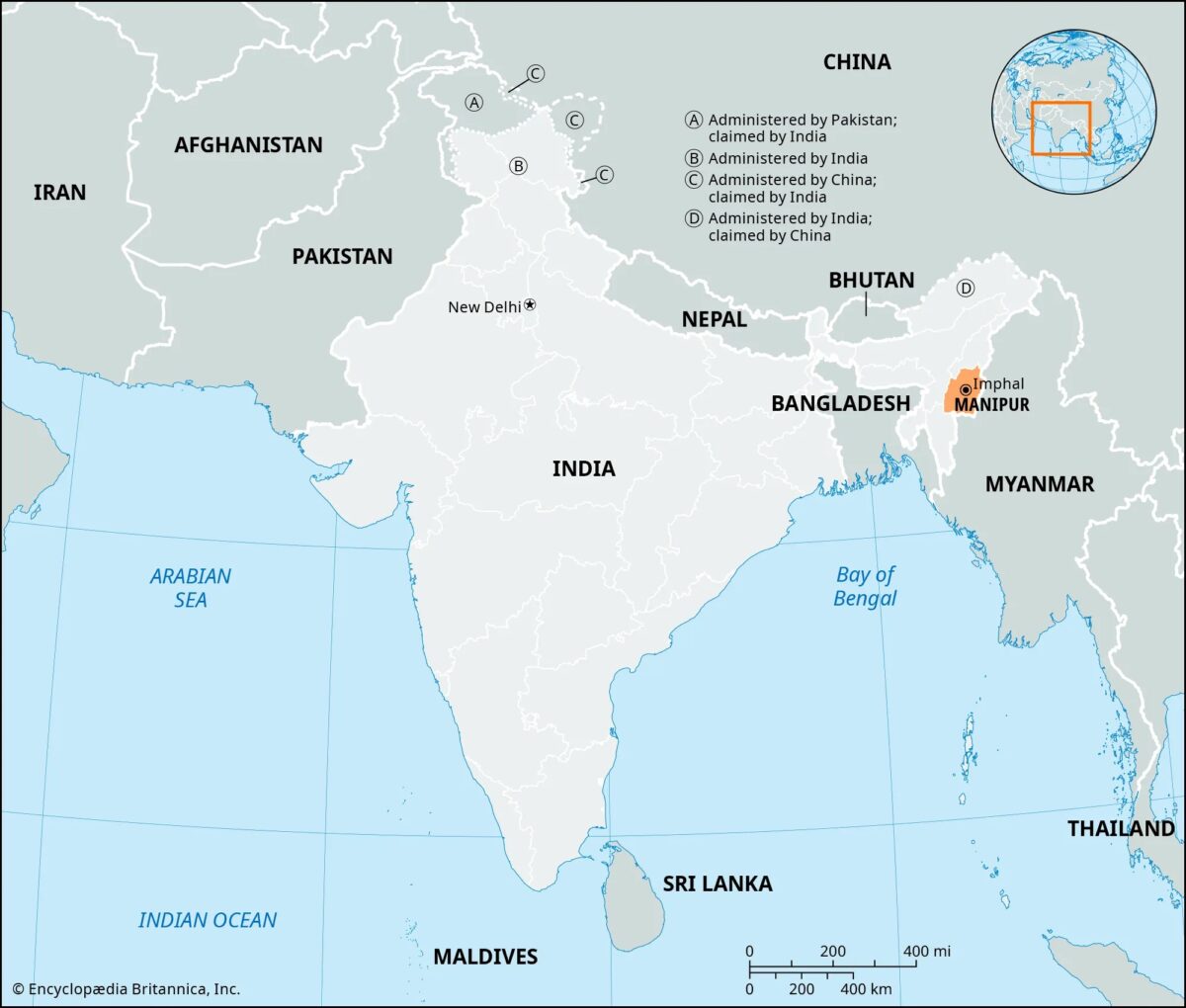
Our focus for this guide is on India, which recorded 84 internet shutdowns in 2024 – the highest number amongst democratic nations. In early June, authorities imposed a curfew and suspended internet access in parts of Manipur after protests erupted over the arrest of ethnic leaders. The state, in the north-east of the country, has been wracked by violence for years.

Map of Manipur, Northeast India (Source: Encyclopedia Britannica)

The ethnic conflict between the majority, mostly Hindu Meitei population and the indigenous, largely Christian Kuki Zo communities is one of the worst spates of violence Manipur, also known as the “Land of Jewels”, has experienced in decades. 

The Imphal valley in Manipur is surrounded by mountains. It is home to 39 ethnic communities. Just over half of its nearly three million residents belong to the Meitei community, followed by the Naga (20 percent) and the Kuki Zo (16 percent) tribes.

The landscape is complex, with ethnic armed groups divided into multiple factions (this list is not complete):

  • The ethno-nationalist militia – yet to be designated as a banned group – Arambai Tenggol (AT), the United National Liberation Front (UNLF) – Meitei
  • Kuki National Army, Kuki National Front – Kuki 
  • Zomi Revolutionary Army – Zomi
  • National Socialist Council of Nagalim (Isak Muivah) – Naga

In May 2023, the Manipur High Court passed an order recommending a Scheduled Tribe status (a category for indigenous communities in India that guarantees affirmative action and constitutional protection over identity and land) for the dominant Meitei community. Tribal communities rallied against the decision while the Meitei community held counter-rallies and counter-blockades. Clashes broke out between the Kuki and Meitei groups. Since then, the conflict has displaced more than 60,000 people and claimed more than 260 lives from both communities.

In this guide, we show you how to use open source methods in any secluded area to:

  • Analyse weapon imagery and the groups using them
  • Investigate weapons that were looted and where they ended up
  • Analyse images of drones potentially used as weapons to deploy munitions

Analysing Weapon Imagery

One effective approach for open source researchers is to trace the digital footprint of  weapons. In the Manipur case, local armed groups, such as the Arambai Tenggol, the UNLF and the Kuki National Front, have been posting weapon imagery mainly in WhatsApp groups and Facebook accounts.

Support Bellingcat

Your donations directly contribute to our ability to publish groundbreaking investigations and uncover wrongdoing around the world.

According to media reports, the war has been fueled by weaponry looted from police armouries or procured on the black market either from Myanmar, across the border, or through surrenders in amnesty drives.

The 6,000 firearms looted included pump-action shotguns, grenade launchers, AK-pattern rifles, INSAS rifles and ammunition. The police claimed that in February and March alone, more than 1,000 weapons were surrendered, with more than half from the Meitei-dominated valley districts, where a majority of the weapons were looted.

Bellingcat analysed weapon imagery from 2023 and 2024, accessed from WhatsApp groups and Facebook accounts linked to non-state actors, including the AT, Kuki Zo militant groups, and various volunteer organisations. While these groups have surrendered some weapons in amnesty drives, many sophisticated weapons were not turned in and were only recovered in search operations by security forces.

A photo posted to Facebook shows members of The Kuki National Front posing with a number of weapons.

For verification, we ran screenshots of images of the weapons without visible serial numbers or other markings first through reverse image searches on Google and Yandex. Then, we cross-referenced the images with resources like the Small Arms Survey handbook and Open Source Munitions Portal (OSMP). 

However, these databases are limited in their documentation from India.

We also looked at the public dashboard of Conflict Armament Research (iTrace). This is a far larger data source. However, the full dataset, which contains a huge number of images of weapons from around the world, is not publicly available. Only broad statistics, and no images, are visible via the dashboard.

The Small Arms Survey handbook helped match and identify, to an approximate accuracy, some of the older weapon models published on social media platforms and YouTube. However, the guerrilla modifications or customisation of weapons by the militant and militia groups made it challenging to identify the specific models.

This was the case in a video posted on X, which purported to show militants preparing to fire a mortar projectile.

By breaking down the video into frames using InVID, a platform that contains a number of useful tools for analysing videos, we were able to identify the weapons, providing clearer imagery we could use to go back to reverse image tools on Google and Yandex, as well as the Small Arms Survey handbook.

We identified three weapons from the video:

Images of a bolt action rifle taken from the video (source: X)
Comparative images of bolt action rifles captured by Manipur Police (source: X/@manipur_police). There are many varieties of bolt action rifles, but the bolt handle, indicative of bolt action rifles, is visible in each image.

The shape of the weapon held by the militant wearing the beanie cap and scarf in the same video matches a FAL pattern rifle, such as the Indian 1A1 FAL, which has a distinctive long wooden handguard with multiple elongated ventilation holes. 

“In India, the rifle was produced by the Ordnance Factory, Tiruchirappalli and was in service up to 1998, when it was replaced by the INSAS Rifle. Over a million units of the 7.62 mm SLR rifle have been produced by the OFB,” wrote (Retd) Major General Dhruv C Katoch, who previously served as the Director for Centre for Land Warfare Studies.

The FAL in the video (top left and right, source: X) and the search results from Yandex.

Also visible in the video is an unidentified model 60mm commando mortar. Commando mortars are characterised by a more portable design, typically featuring a much smaller baseplate and a sling or carrying handle rather than a bipod, all of which can be seen in the images below.  The reverse image search on Google led us to a file photo on Wikimedia posted by the US Army, besides this assessment by Jesus Roman, Editor of Revista Ejercitos.

The 60mm commando mortar from the video with its lightweight baseplate and sling (top), the reverse image search results (bottom left) and the post by Jesus Roman, Editor of Revista Ejercitos (bottom right, credit: X/jesusfroman)

Munitions researcher and PhD candidate in War Studies at Kings College London, Andro Mathewson, described it as likely being a 60mm mortar. “It looks like one man is using the mortar tube, which is relatively unusual. Normally, it’s at least a two or three-man team. And the munition looks light green in colour with a sort of light metal-coloured fuse and light silvery tail fins,” he said. “It’s definitely a small calibre mortar, which is a mainstay in military forces. This appears to be military/official manufacture rather than improvised,” Matthewson told Bellingcat.

Which Groups Use the Weapons?

From the data collected from 2023 and 2024, Bellingcat found that many rifles in the images have different furniture and display cloth wraps, improvised slings, aftermarket optics, even taped-on foregrips.

The next step is to identify the various groups in the pictures. Analysing symbols is a good way to do that. For example, we know that the Saipikhup is the traditional weave of the Kukis. It symbolises heritage and identity and is often worn during important occasions. We also found images of Kuki militants wearing this handwoven shawl (saipikhup) belonging to the Thadou indigenous tribe.

A group of militants wearing the shawl (left, credit: Facebook) and a Thadou couple in traditional Saipikhup and Khamtang dress (right, credit: Wikimedia Commons)

Their fatigues bear the insignia of the President faction of the Kuki National Front, which has been accused of attacking paramilitary security forces. Meanwhile, the same group in the image brandishes AR-pattern and INSAS rifles. The INSAS rifle is an Indian police or military issue, matching reported looting from armouries. Several weapons in the image were also heavily customised, consistent with militia or irregular combatant practices.

Other images also offer clues.

The Kangleipak is a seven-colour flag usually brandished by the AT.

A group of militants with the traditional Kangleipak flag (source: Facebook) and the Kangleipak flag (bottom right, credit: Wikipedia/Punshiba18 – Own work, CC BY-SA 4.0)

Bellingcat also identified the AT’s commander-in-chief, Korounganba Khuman, in the photos and videos. He actively posts on his Facebook profile and has been widely covered by the local and national press.

Arambai Tenggol commander-in-chief, Korounganba Khuman, sitting with a gun in his hand. Source: Facebook

News outlets are also valuable sources of information. They might contain images of symbols such as flags, which you can then search for on social media. In one of the videos, we identified militants speaking Meitei Lon, a language used by Arambai Tenggol and militant groups like the UNLF, preparing to fire a mortar projectile from a mortar. Their fatigues bore an insignia that we matched to the UNLF armed group using reverse image search, which led us to a news story featuring the group’s flag as the lead image.

A report by The Indian Express, including the militant flag (top right), the same flag seen on the uniform of a man preparing to fire a mortar from a rooftop (left corner and centre image)

Praveen Donthi, a senior analyst with the Crisis Group who visited Manipur last year during elections, told Bellingcat that though he hadn’t seen arms on any of the aforementioned Kuki Zo militant groups, he had seen INSAS rifles, automatics and double-barrel shotguns being wielded by several young men in the Imphal valley.

“I saw these young men who must have been in their early teens to early twenties when I’d gone to meet Meitei Leepun [a Hindu right-wing activist group] first wielding what looked like state-issued weapons,” he said. “Then later, they replaced it with double-barreled guns. But their leader [Pramot Singh] was openly carrying a pistol in his holster when he came to meet me,” Donthi explained.

Donthi, a former journalist who has reported from conflict zones in Kashmir and Chhattisgarh in India, said he was struck by the young men who were heavily armed in a volatile environment without any evident goal or political ideology guiding them.

Weapons Looted: Where Did They End Up?

When investigating conflicts, identifying the origin of weapons is one of the most difficult tasks, particularly in regions plagued by misinformation or a lack of reliable data. This is the case in Manipur.

Of the 6,000 firearms and ammunition looted from state police armouries mentioned earlier, about half of the weapons have been recovered to date. Around 1,200 matched serial numbers from official inventories, according to reports. Of the weapons recovered, approximately 800 sophisticated ones likely originated outside the state, and 600 were crude, locally produced firearms.

Subscribe to the Bellingcat newsletter

Subscribe to our newsletter for first access to our published content and events that our staff and contributors are involved with, including interviews and training workshops.

The largest surrender of weapons took place in February and March when more than 1,000 weapons were reportedly surrendered, with more than half from the Meitei-dominated valley districts, where a majority of the weapons were looted. The largest cache was surrendered on February 27 by the Arambai Tenggol (AT). However, the state police is yet to complete categorising the details of the weapons and ammunition surrendered between February 20 and March 6 against the inventory of weapons looted from the state armouries.

Bellingcat requested official data from the Manipur police on surrendered weapons matched against serial numbers from official inventories, but had received no response by the time of publication.

Instead, we decided to see what we could find by using open sources. First, we scraped the state police force’s official X profile (@manipur_police) from Sept. 10, 2023, until June 14, 2025. We did it manually and using Meltwater – a social media monitoring tool.

We dug deeper into media reports, experts’ posts and research to understand what was being used locally. In the Manipur case, recovered firearms include locally manufactured bolt-action rifles, improvised mortars and weapons such as the “Pumpi” – a gun made from repurposed metallic electric poles. These are especially common in the hill areas where the Kuki Zo people live.

A “Pumpi” presented by the Manipur police in February 2024 (Credit: X/@manipur_police)

The heavy reliance on grenades and improvised explosives is consistent with the guerrilla-style, asymmetric engagements – hit-and-fades, booby-traps, and area denial – rather than large-scale firefights. The presence of multiple improvised munitions types reflects local workshops or village-level bomb-making, likely to supplement limited access to military-grade ordnance, consistent with media reporting on the same (see here and here).

Claims Over Weaponised Drones

In September last year, Indian media reported villagers in the valley district witnessing drones allegedly dropping as many as 50 bombs. Kuki Zo village volunteers and insurgent groups were reported to have set up bunkers in the hills, much like their Meitei counterparts in the valley.

These claims were supported by a Manipur Police statement. The central counter terrorism law enforcement authority, the National Investigating Agency, which filed a case alleging weaponised drone attacks, told the Manipur High Court that Kuki militants dropped 40 drone bombs.

A source in the Defence Ministry told Indian news site The Print that the drone videos circulating online were from either Myanmar or Palestine. Many of the videos showed fertiliser drones, but these were deployed by the People’s Defence Forces in Myanmar, they added.

How Do You Investigate Potential Drone Usage With Open Source Tools?

The Manipur Police posted an image of a drone recovered in the Kangpokpi District, a day after the first set of attacks.

The drone recovered in the Kangpokpi District (Credit: X/manipur_police)

The first step is to identify the possible drone type. The easiest way is by using Google’s reverse image search engine. We identified the drone as commercial-grade, weighing approximately 181g. These carbon fibre lightweight drones, built for speed and agility with a payload capacity of up to 1.5kg, are widely available on the internet. Security sources told The Print that the bombs weighed 300-400g and were nine to 10 inches (23 to 25cm) in size.

Reverse search on Google Images

After establishing the possible drone type, we can also examine the reported impact sites. Since we only have images of the attack sites shown in the media, we asked Andro Mathewson, a reputed munitions researcher and explosives expert completing his doctoral studies on weaponised drones in smaller conflicts at King’s College London, for help. 

He told Bellingcat that in this situation, “the payload is probably quite small. So the damage won’t be extensive”.

“Some of the images that are shared in The Print report,” added Mathewson, “obviously show a lot of destruction, but a lot of it seems to be sort of secondary destruction from fires rather than from explosions itself”.

Nothing was visible that could specifically determine if drones were used to deploy munitions. The damage from a smaller payload like 400-600g of a grenade would not exceed more than 20 to 30m, according to Mathewson, adding that larger or heavier payloads are not typically seen among non-professional militaries.

Screengrab from a BBC report on drone attacks in Manipur. Source: BBC News India.

The next step is to find out if the munitions have been adapted for drone deployment. Mathewson told Bellingcat that photos of drone parts published by the media were not consistent with munitions deployed by drones. Bellingcat was not able to independently confirm the source or authenticity of these photos.

“That shrapnel looks large, very thick, and very heavy, which is more consistent with larger artillery rounds or even small missiles,” he said. He also noted that the printed fin “looks quite small”.

“Fins made out of plastic are not likely to be attached to a much larger munition that’s produced that type of shrapnel,” he told Bellingcat, saying that “from the scale that we can get in those images, those don’t seem to add up to me”.

Drone parts published in local media outlets, circulating on Facebook.

For future reference, when we asked Mathewson what to look out for to confirm the use of weaponised drones, he suggested two things. One would be to see and verify videos of drone strikes, either shot by other drones or on phones – something that is conspicuously missing from Manipur despite the authorities’ claims that there have been drone strikes, although there is plenty of online footage of other sophisticated weapons used there. Secondly, Mathewson also said it was worth looking out for 3D-printed munition parts, such as 3D-printed fins that are attached to conventional weapons.

“That’s not necessarily a guarantee, but it’s most closely associated with [modified drones] because the only reason you would attach fins to a grenade, for example, is to make them be dropped from drones,” he added.

Correction: This article has been updated after an image previously incorrectly stated members of the Kuki National Front were posing with AK-47s, M4 Carbines and M16 weapons. We also updated it to reflect errors in identifying the bolt action rifle, the FAL and 60mm commando-style mortar grenade. A section on chronolocation of this video was also removed, and a clarification was added that only the public iTrace dashboard was consulted, rather than cross-referenced with OSMP and the Small Arms Survey.


Additional reporting by Douminlien Haokip.

Pooja Chaudhuri, Claire Press and Gyula Csák contributed to this report for Bellingcat.

Bellingcat is a non-profit and the ability to carry out our work is dependent on the kind support of individual donors. If you would like to support our work, you can do so here. You can also subscribe to our Patreon channel here. Subscribe to our Newsletter and follow us on Twitter here and Mastodon here.

Join Bellingcat’s WhatsApp Channel for the latest news and resources from us.

The post A Guide To Monitoring Conflict Amidst a Sea of Misinformation appeared first on bellingcat.

  • ✇bellingcat
  • Kenyan Weapons Linked to Sudan’s Civil War Carlos Gonzales
    Bellingcat and our partners at Kenya’s Daily Nation have identified Kenyan-labelled crates of ammunition inside an alleged RSF depot close to the recently recaptured Sudanese capital Khartoum. Although we couldn’t independently verify the contents of every crate identified, tins with ammunition matching the labels on the crates were found nearby among the captured weapons displayed by the Sudanese Armed Forces (SAF). The confirmation of ammunition crates inside Sudan raises new questions a
     

Kenyan Weapons Linked to Sudan’s Civil War

15 de Junho de 2025, 16:00

Bellingcat and our partners at Kenya’s Daily Nation have identified Kenyan-labelled crates of ammunition inside an alleged RSF depot close to the recently recaptured Sudanese capital Khartoum.

Although we couldn’t independently verify the contents of every crate identified, tins with ammunition matching the labels on the crates were found nearby among the captured weapons displayed by the Sudanese Armed Forces (SAF).

The confirmation of ammunition crates inside Sudan raises new questions about Kenya’s involvement in the conflict following a high-profile visit by Rapid Support Forces leader General Mohamed Hamdan Dagalo to Nairobi earlier this year.

In response to the visit, the Sudanese government banned all imports from Kenya amid a perception of close ties between the Ruto government and General Dagalo, widely known as Hemedti. 

The Kenyan government defended the decision to host Hemedti, stating that their aim was to promote dialogue and peace and emphasising the importance of engaging all parties involved in the conflict.

Examples of images of Kenyan MOD-labelled ammunition crates. These images had been circulating on social media, allegedly showing ammunition left behind by the RSF. Credit: posted on X

While the Kenya Ordnance Factories Corporation (KOFC) states on its website that it produces small arms ammunition, it does not indicate manufacturing higher-calibre 14.5×114 mm cartridges and the Chinese-made HE PP87 mortar bombs identified in this investigation.

Our partners at Daily Nation reached out to the Ministry of Defence (MoD) of Kenya to ask about the crates we identified and how they ended up in Sudan. We also asked whether it was Kenyan government policy to supply ammunition or weapons to the Rapid Support Forces and how this comports with the government’s public commitment to facilitating peace and dialogue in Sudan.

Support Bellingcat

Your donations directly contribute to our ability to publish groundbreaking investigations and uncover wrongdoing around the world.

In its response, the Ministry of Defence said it did not recognise the crates or labels on them and distanced itself from the allegations. Its answer appears to be limited to nationally produced ammunition only as well as internal protocols. It didn’t mention if Kenya has done any imports, international transfers or diversions of the weapons or ammunition in question. A statement that leaves key concerns about the Sudan connection unclear.

“Upon examination of the photographs provided, we wish to state that we do not recognize the crates nor the inscriptions on them.

The Kenya Ordinance Factory Corporation and, by extension, the Ministry is alive to the sensitive nature of the ammunition it manufactures, and as a result, it has clear records of its supplies within and beyond Kenya. Alongside this, and to guarantee public safety, audits of the factory’s operations are frequently conducted by the managing and external oversight authorities.

The Ministry of Defence, therefore, distances itself from the allegations you sent earlier. 

Further, we remain fully committed to upholding the rule of law and continue to operate strictly within the mandate granted by the Constitution and applicable authorizations.”

Justin Lynch, Managing Director of the Conflict Insights Group and a Sudan researcher, told Bellingcat the discovery of the crates is further evidence of Kenya’s political and logistical support for the RSF.

A Country at War, Awash with Foreign Weapons

Sudan is in the midst of an ongoing civil war between two rival factions, the Sudanese Armed Forces (SAF) and the paramilitary Rapid Support Forces (RSF).

The stash of ammunition crates located near Sudan’s capital was filmed by Sudanese Armed Forces (SAF) soldiers who took part in the final push to retake the city from the RSF who have controlled Khartoum and its surrounding cities for much of the civil war.

The SAF declared it had retaken the final areas of resistance in Khartoum, its twin city of Omdurman, and the neighbouring city of Bahri on May 20, stating the three areas were now completely free of RSF forces.

The re-taking of the capital has led to much footage and images being released. Including footage that appears to show supplies used by the RSF.

A 2005 UN arms embargo remains in place prohibiting any country from supplying weapons to Darfur, Sudan, an area that has seen intense fighting since the outbreak of the civil war.

However both Amnesty International and Human Rights Watch have identified weapons produced in China, Iran, Russia, Serbia and the UAE being used in the conflict. 

The Sudanese government brought a case before the International Court of Justice in The Hague in May, accusing the UAE of complicity in genocide for its role in supporting the RSF. The UAE has categorically denied supporting the RSF. The case was dismissed as the UAE has not signed Article 9 of the Genocide Convention.

Both sides of the conflict have been accused of war crimes, and the RSF has been accused of ethnic cleansing in certain areas, including around Darfur. The UN says more than 24,000 people have been killed since fighting began in 2023 following a peaceful uprising by civilians against dictator Omar al-Bashir. More than 11 million people have reportedly been displaced. 

While there is detailed reporting on routes between the UAE and Sudan’s neighbouring countries, including Chad, being used for weapons transfers, specific details about how the Kenyan ammunition crates ended up in the country remain scarce.

How Do We Know the Ammunition Crates Were in the Vicinity of Khartoum?

On May 19, after weeks of reported intense fighting with the RSF, SAF soldiers and allied forces posted video clips claiming they were inside the Salha area in southern Omdurman, located across the Nile from Khartoum.

Bellingcat and Daily Nation have identified three videos containing Kenyan MOD-labelled ammunition crates allegedly left behind by the RSF inside an unknown depot most likely in Salha.

Using social media, we identified soldiers seen in the depot next to the ammunition: A Major from the SAF’s General Intelligence Service (GIS) and at least one other young Sudanese soldier. Both appear to have been in the depot during the same time the operation in Salha was taking place.

Video 1, Video 2 and Video 3 show soldiers rummaging through several rooms containing crates and talking about the armour allegedly left behind by the RSF. Photos of the same type of crates with the same label from the Kenyan MOD had been circulating on social media for some time earlier this year. But it had been difficult to geolocate inside Sudan before these more recent videos emerged.

In video 3, the speaker mentions the ammunition discovery and repeats ‘Salha’, the location, several times. 

In video 1, an Arabic speaker can be heard saying: “But I swear to God, you can’t fight again and you won’t defeat us, is this the work (equipment) you leave?”

Above: Example of one of the crates featured in one of the videos filmed inside the dark depot. Below: The stencil label appears to be the same as seen in other previous pictures circulating earlier on social media. Credit: X

Video 1 shows a man inside the depot wearing a fatigued t-shirt, glasses and white Tasbih prayer beads. We found further footage showing what appears to be the same man wearing the same clothes and accessories. Elements in the background tell us that the video was indeed filmed in Salha, Omdurman, along the main road (15.5479, 32.4273).

Left: Soldier in the armour depot. Right: Stitched frames of a video showing the same soldier wearing the same clothes and accessories but on this occasion in an outdoor setting. Credit: X, Facebook
The outdoor setting was geolocated to Salha, Omdurman (15.5479, 32.4273). Credit: Facebook, Google Earth

We identified the soldier above as a Major (Ra’id) from the SAF’s General Intelligence Service, as indicated by his uniform insignias and patches seen in another video circulating on May 20. His name appears to be Al-Makki Abdul Quddus Ahmed.

A video showing a man with the same characteristics as the soldier from the depot is wearing a uniform featuring an insignia consistent with a Rai’d/Major rank used by the Sudanese Armed Forces and a patch from the General Intelligence Service of Sudan. Using Optical Character Recognition, his name appears to read Al-Makki Abdul Quddus Ahmed. Credit: X, globalsecurity.org, gis.gov.sd

Similarly, in another video filmed approx 150m from Major Al-Makki, here (15.546947, 32.427022), we identified a second man seen in the ammunition depot videos. In both videos, he is seen wearing the same clothes with a small Sudanese flag on his left shoulder.

A young soldier who was in the ammo depot was also seen outdoors in a street scene celebrating with other soldiers and wearing the same outfit and accessories as in the depot.
We geolocated the young soldier just 150m from Major Al-Makki in Salha, Omdurman. Credit: Facebook/Google Earth Pro

All the videos analysed were posted between May 19 and May 21. We geolocated the soldiers in a market area of southern Omdurman’s Salha district. This is consistent with the Sudanese Armed Forces retaking the city. Aljazeera reported that SAF had regained full control of the area by May 20.

Although we were unable to confirm the exact location of the depot, corroborating the presence of soldiers in the Salha area, along with open source information, strongly indicates that the depot is indeed located in the Salha neighbourhood of Omdurman.

From Sudan to the World: International Connections of the Weapons Crates

We compared the labels of the crates located near the Khartoum depot with other images of Kenyan munition crates circulating online, reportedly also from Sudan. On the labels, we can see English wording that includes the name of the product, contract number, batch number, quantity, volume, case number and total case number. 

To be clear, although the crates are labelled with contractual and technical information, we are not able to say with certainty the origin or producer of the munitions. However, there are important details to highlight.

Bellingcat and our partners at Daily Nation shared images of the crates with three independent armament experts. All confirmed that the markings indicated the ammunition crates were part of the same contract (No. 23PTI) and were delivered to the Kenyan Ministry of Defence (KEMOD-01). 

Australian-based Armament Research Services (ARES) told us: “The markings on this crate are consistent with other crates we have seen that we believe to be delivered on a Kenyan contract.”

Still of video showing Kenyan MOD-labelled ammunition crates. These images had been circulating on social media, allegedly showing ammunition allegedly captured by SAF in Khartoum. Credit: X, Sudan Nabaa

Upon examining the images, the weapons experts also told us that many of the crates indicate delivery during or after 2024 – when the civil war in Sudan was well underway.

Former Royal Artillery Army officer and director of Chiron Resources, Chris Cobb-Smith said: “The batch number suggests they were packed in 2024 – delivery date to Kenya would probably have been the same year. When delivered to Sudan is not known.” 

All three experts agreed that the type of ammunition indicated on the labels was 57 calibre (14.5×114mm) armour-piercing incendiary (API) cartridges.

Cobb said that 14.5×114mm (.57 calibre) is a heavy machine gun and anti-material rifle cartridge used by the Soviet Union, the former Warsaw Pact states, modern Russia, and other countries.

Although not specified on the crates, Cobb added that this type of cartridge has been manufactured in Bulgaria, China, Egypt, Hungary, Iraq, North Korea, Poland, Romania, Russia, and the former Czechoslovakia.

One of the videos we found with these crates inside a depot in Salha, Omdurman, showed cans inside the crates and at least one open can next to the crates had visible ammunition consistent with the specifications on the label. The ammunition visible appears to have a green case and what appears to be a standard black-tip.

Several cans were visible inside crates in the depot. At least one open can located next to the crates had visible ammunition consistent with the specs on the label. Credit: X
Left and centre: screenshots from Salha depot Video 1, showing a round next to the Kenyan MOD-labelled crates. The bullet appears to feature a green-coloured case and a black marking on the tip. Right: Example of a 14.5×114 MM API cartridge. Credit: X, cjaie.com

We were also able to identify two additional green crates seen in a video showing the Salha depot. The label appears to indicate the boxes likely contain (or at least contained) an explosive with the specification “82mm HE Mortar Bomb Type PP87”.

Two additional green crates are seen in one of the videos showing the Salha depot. The label on the Kenyan-labelled crate reads 82 mm HE Mortar Bomb Type PP87. Credit: X

According to weapons experts, the markings on the crate suggest the box and its contents were likely initially delivered to Kenyan authorities under contract AMI/KEN/099/2023.

Director of Chiron Resources, Chris Cobb-Smith told Bellingcat that the contract number on these crates indicates the Kenyan MOD purchased mortar bombs from China in 2023. He added that it would be impossible to say whether they were immediately diverted or not.

Human Rights Watch reported in 2024 that RSF appeared to be using this Chinese-made mortar ammunition. This video shows a man in RSF camouflage and another in civilian clothes unpacking 82mm HE Mortar Bomb Type PP87. HRW was unable to verify RSF claims that it captured this new mortar munition from the SAF. Amnesty International has also reported the use of this weapon in Sudan.

Still image of a video from June 2024 showing a man in RSF camouflage and another in civilian clothes unpacking 82mm HE Mortar Bomb Type PP87. Credit: X

We also found another sample of these bombs among other SAF-captured ammo displayed in early May in Khartoum. The Chinese-made bomb was photographed next to another Kenyan labelled crate stating it contained 7.62mm SMG (submachine guns or self-loaded rifles) TYPE CS/LR11- sold by the intermediary China Jing An Import & Export Corporation (CJAIE).

82mm HE Mortar Bomb Type PP87 photographed next to another Kenyan-labelled crate stating it contained: 7.62mm SMG TYPE CS/LR11 – a submachine gun or self-loaded rifle (SMG) sold by the intermediary China Jing An Import & Export Corporation (CJAIE). Credit: China Xinhua News, Facebook

There have been several reports identifying Chinese-made weapons in the arms of the RSF. In April, China’s charge d’affaires in Port Sudan was summoned by the Sudanese government over the RSF’s use of Chinese-made drones. China has stressed they have “nothing to do with the presence of these drones and has no connection with the RSF”. Earlier this month Sudanese media outlet Ayin used open sources to identify Chinese-made weapons in the hands of RSF fighters.

Chadian Labelled Crates

In a separate alleged capture of weapons and ammunition displayed by the SAF at the Engineering Corps building in Omdurman (15.609734, 32.480369), similar crates were seen but with the stencil label removed.

The Sudanese army displays weapons allegedly captured from Rapid Support Forces (RSF) in Omdurman in mid-May 2025. Source: Facebook

Next to the crates, a green box is seen with a stencil label that appears to read:

 “Direction Générale de la réserve Stratégique de la Présidence … République du Tchad”: General Directorate of Strategic Reserves (DGRS) of the Presidency… Republic of Chad.

The label on this box indicates a different designation  “73-DTG02”. According to the Collective Awareness to Unexploded Ordnance (CAT-UXO), this designation is believed to be a Chinese 73mm High-Explosive-Dual-Purpose (HEDP), High-Explosive-Anti-Tank (HEAT) with Anti-Personnel (AP) HE-Frag, fin-stabilised Rocket.

The UAE has been accused of supplying Sudan’s RSF via a Chad airstrip. Dozens of flights from the UAE appear to have used an airstrip at Amdjarass in eastern Chad since the war began in April 2023.

Weapons Continue to Fuel Suffering

The discovery of the Kenyan-labelled munitions crates is further evidence of Kenya’s political and logistical support to the RSF, Justin Lynch, Managing Director of Conflict Insights Group and Sudan researcher, told Bellingcat.

He said the UAE has used Kenya and other African states as a political and logistical hub to support the Rapid Support Forces.

“It seems hardly a coincidence that RSF public conferences in Nairobi were immediately followed by a $1.5 billion loan from the UAE and a surge in suspicious UAE-to-RSF shipments transiting through Kenya,” Lynch said.

Kenya is reported to draw down next week the first portion of $500 million from the $1.5 billion United Arab Emirates (UAE) – backed commercial loan.

Delegates affiliated to Sudan’s Rapid Support Forces (RSF) react during a meeting for the planned signing, later postponed, of a political charter that would provide for a “Government of Peace and Unity” to govern the territories the force controls in Nairobi, Kenya, February 18, 2025. REUTERS/Monicah Mwangi

Despite losing control of the beating heart of the country, the RSF still rules huge swathes of Sudan including Darfur in the country’s southwest where violence is causing one of the world’s worst humanitarian crises, according to the UN.

As long as the conflict continues, questions about who is providing weapons and support to the warring sides will remain.

This article has been updated to reflect new information.


Bellingcat would like to thank our partners at the Daily Nation Forensics Unit for collaborating on this investigation.

Pooja Chaudhuri, Youri van der Weide and Jake Godin contributed to this report.

Bellingcat is a non-profit and the ability to carry out our work is dependent on the kind support of individual donors. If you would like to support our work, you can do so here. You can also subscribe to our Patreon channel here. Subscribe to our Newsletter and follow us on Bluesky here and Mastodon here.

The post Kenyan Weapons Linked to Sudan’s Civil War appeared first on bellingcat.

  • ✇bellingcat
  • Open Sources Show Myanmar Junta Airstrike Damages Despite Post-Earthquake Ceasefire gyula
    Bellingcat has identified at least 22 villages damaged by airstrikes in Myanmar, despite a temporary ceasefire declared by the State Administrative Control (SAC) or the military junta from April 2 to 22 following a 7.7 magnitude earthquake that hit the country on March 28. The ceasefire has been extended to April 30. The earthquake’s epicentre was recorded just 16km northwest of Mandalay, the second-largest city in Myanmar, and it struck just before 1pm local time. More than 3,000 people died
     

Open Sources Show Myanmar Junta Airstrike Damages Despite Post-Earthquake Ceasefire

Por:gyula
29 de Abril de 2025, 06:53

Bellingcat has identified at least 22 villages damaged by airstrikes in Myanmar, despite a temporary ceasefire declared by the State Administrative Control (SAC) or the military junta from April 2 to 22 following a 7.7 magnitude earthquake that hit the country on March 28. The ceasefire has been extended to April 30.

The earthquake’s epicentre was recorded just 16km northwest of Mandalay, the second-largest city in Myanmar, and it struck just before 1pm local time. More than 3,000 people died and aid groups report that over 17 million people living in earthquake-affected areas are in urgent need of food, water, shelter and healthcare.

The country, which has already been devastated by four years of civil war, continues to be hit with multiple aftershocks. The SAC, ruling Myanmar since seizing power from the democratically elected government in 2021, declared a temporary pause to fighting only after the main opposition coalition announced one – except in the case of defensive actions. 

Bellingcat has geolocated at least 19 villages damaged in military assaults during the first 20 days of the ceasefire. Two of them were identified from ground reporting. Three additional villages were damaged after the earthquake but before the ceasefire – bringing the total to 22 villages.

The airstrikes targeted civilian areas in territory held by rebel forces and territory where the junta is fighting to regain control. The villages damaged after the ceasefire were geolocated by cross-referencing our findings with NASA FIRMS or satellite imagery alongside local and other media sources.

Villages bombed since the earthquake on March 28; the epicentre is marked in black, yellow and red

“It’s quite clear that only the military can do airstrikes. The rebels don’t have aircrafts,” Aye Chan Naing, co-founder and editor-in-chief of Democratic Voice of Burma (DVB), one of Myanmar’s largest independent media organisations, told Bellingcat.

Lacking jets or fighter planes, resistance groups heavily rely on commercial drones “improvised into sort of military use,” Naing said.

Targeting and scaring civilians is part of the military’s strategy, he explained. “If you support the rebels, then you know we [the military] are going to burn the village.”

“At a moment when the sole focus should be on ensuring humanitarian aid gets to disaster zones, the military is instead launching attacks,” said UN Human Rights Office spokesperson Ravina Shamdasani on April 11.

“Since the earthquake, military forces have reportedly carried out over 120 attacks – more than half of them after their declared ceasefire was due to have gone into effect on 2 April,” she told journalists.

According to local media reports, the Myanmar military carried out an aerial attack just hours after the earthquake struck. Anti-junta armed group TNLA claimed that the military bombed Nawng Len village, approximately 120km from the earthquake’s epicentre in the eastern Shan State. Seven members of a TNLA-aligned ethnic armed organisation (EAO) were reportedly killed in the attack.

We were not able to independently confirm the airstrike, but we were able to geolocate images of several damaged buildings, to a location in the north of the village. The intact buildings can be seen on Google Earth imagery in late January.

Left: Location of the village on Google Earth. Right: Photos of Nawng Len after the attack, Source: The Irrawaddy (Burmese)/ Instagram

The military junta did not respond to Bellingcat’s request for comment.

Attacks in Worst-Affected Earthquake Areas

Out of the 22 villages we identified, 14 of them are in either Sagaing or Mandalay, which were some of the worst affected areas by the earthquake. Large parts of both regions are located in central Myanmar, where a lot of townships are either contested or under junta control.

The military tries to cut the rebels’ survival pipeline, Naing told Bellingcat.

“They understand that the rebels cannot survive without civilians because that’s where they get food and maybe tax money,” he said.

Since the rebels don’t have permanent bases, members are difficult to locate. While drones might strike and kill a few individuals, it’s much easier for the army to identify and target areas where civilians live, Naing added.

On April 9, twenty people were reportedly killed in an airstrike in Nan Khan in Sagaing’s Wuntho Township. We were able to geolocate images of damaged buildings to the coordinates 23.9983922,95.8881422.

Left: Image of houses damaged in Nan Khan, Source: Khit Thit Media/ Facebook; Right: Location on Google Maps

Just days before this attack, on April 6, Thone Pan Hla in Chaung-U Township was reportedly attacked in an airstrike, killing three members of a family. “The motivation for such an attack on a village of melon farmers is difficult to understand. It seems to be an effort to terrorise a civilian population that strongly supports the anti-regime National Unity Government (NUG) and its armed rebel PDF wing,” reported The Times newspaper. NUG is the country’s parallel government in exile, elected democratically and ousted in the 2021 coup.

About 25km northeast of Thone Pan Hla is the village of Ngar Shan also in Chaung-U Township. Local news outlets reported that the village was burned down by the junta, just days after the earthquake. While we weren’t able to geolocate specific images or independently confirm the cause of the fire, thermal hotspots were detected at the site on March 31. This lines up with the timeline and reports of 170 houses being burned in Ngar Shan on April 1 local time.

Images of the destruction shared on Facebook show the village in ruins. However, NASA’s Fire Information for Resource Management System, FIRMS, detects thermal hotspots in the entire village in the early hours of that day.

Source: NASA FIRMS, March 31, 2025 UTC

A false-colour infrared map from Sentinel Hub’s Copernicus platform also reveals signs of destruction in the village. Though commonly used to assess vegetation health, this type of imagery shows plant-covered areas in deep red, while cities and exposed ground are grey or tan, and water appears blue or black. Following the attack, exposed ground, indicative of possible damage, can be seen primarily in the northwest of the village.

Source: Sentinel Hub’s Copernicus platform

Chaung-U Township is located in the southern Sagaing region, where the geography poses challenges for resistance armies.

“Unlike ethnic resistance groups along Myanmar’s borders, or those in northern Sagaing near India, the resistance forces in southern Sagaing do not have foreign borders across which they can attempt to retreat,” wrote Centre for Information Resilience’s Myanmar Witness in a December 2024 report

Sagaing remains an epicentre for violence with a strong resistance presence due to the region’s strategic importance. A state of emergency was declared in the state following the quake.

Repeated Bombings in Lost Territories

Another region of strategic importance is Mandalay where the Central Military Command is located in the Mandalay Palace, reported to have been damaged in the earthquake. Mandalay is also a logistical hub in Myanmar’s heartland, and since late last year, the SAC has been trying to retake townships it has lost there. 

Two of those townships are Thabeikkyin and Singu. Both were attacked during the ceasefire. 

On April 19, the Myanmar military reportedly carried out an airstrike on the village of Yae Htwet in Thabeikkyin Township. The attack killed at least 27 people, according to the BBC. The report added that pro-military Telegram channels claimed the attack targeted PDF camps, the armed wing of the anti-regime National Unity Government. 

Just a day earlier, 13 people were reportedly killed in an attack on Leik Kya village, located 3km north of Yae Htwet.

A separate aerial attack was reportedly carried out over a village in Thabeikkyin, killing two people. It took place on April 13 in Chaung Gyi along the highway running through the village. We were able to identify distinct features of the roof of buildings across the street from the attack and, along with the location of trees, match satellite images of the area.

Above: Photo of the damage in Chaung Gyi, Source: Khit Thit Media/ Facebook; Below: Location on Google Earth

Bellingcat also geolocated a school (here: 22.689505, 96.016978) in Singu Township, the site of a reported airstrike in Kyi Tauk Pau village that injured six people.

Destruction of Schools and Religious Sites

The junta has a track record of targeting schools. According to a tally by Radio Free Asia last November, nearly 200 schools were hit by airstrikes since the 2021 military coup in regions and states which have seen fighting by resistance forces opposing junta rule.

A school in Sagaing’s Shwebo Township was reportedly bombed during the ceasefire on April 20, killing two people, including a pregnant woman. According to DVB, Shwebo Township People’s Administration, a local anti-junta governance body, said displaced people were taking shelter in the school.

Bellingcat found four schools and seven religious sites – monasteries and churches – damaged in recent attacks.

Peter Bouckaert of the human rights and advocacy group Fortify Rights called the attacks on churches and monasteries that could be hosting people displaced by the earthquake “a great violation of the laws of war”.

“These are protected sites under international humanitarian law. They are direct deliberate attacks on these protected institutions,” he told Bellingcat.

The junta has a history of attacking religious sites. During the ceasefire, a Baptist church was bombed in Mindat in the neighbouring Chin State, where several armed opposition groups have emerged since 2021. While there were no reported casualties at the church, six people were killed in the attack on the town.

The Baptist Church in Mindat before (left, source: bruno.assaz/wikiloc) and after (right, source: Tachileik News agency/ Instagram) the attack

Mindat was taken over by resistance forces last year amid reports of hundreds of homes destroyed by alleged junta shelling, arson, and airstrikes. A lot of this damage is now visible on Google Maps’ updated imagery from January 2025.

Several churches in Chin State have been damaged in the past few years, Myanmar Witness had found in 2023. It is the only Christian-majority state in Buddhist-majority Myanmar.

Battle for Control of Town Rages Amid Ceasefire

Indaw is a small town close to the border with Kachin, a state partly controlled by the Kachin Independence Army (KIA)-led resistance forces. Indaw was reportedly bombed on April 1 when it was still under the junta’s control. According to local accounts, two people were killed and eight others injured. A monastery was damaged in the attack. We were able to geolocate the images of the aftermath by comparing old pictures and satellite images of the monastery with structures still standing after the recent attack.

Left: Before image of the monastery, Source: Kachin News Group; Right: Photo of monastery after the military’s attack Source: Indaw Revolution-IR/ Facebook; Middle: Location on Google Maps

The destruction on April 1 was just one of the many assaults the town has witnessed since resistance forces launched an offensive in August last year. The junta’s reported airstrikes against the resistance displaced hundreds of people, and many others fled. 

Despite the ceasefire, on April 8, resistance forces captured Indaw after months of fighting. However, the junta has continued to carry out airstrikes in civilian areas, according to reports. As Richard Horsey, Senior Adviser on Myanmar at Crisis Group, previously told Bellingcat, the junta often bombs areas it has lost so people have nothing left to return to.

Images show that large parts of Indaw were destroyed last year. Source: Google Earth Pro Imagery

Attacks During Burmese New Year

The military regime reportedly carried out airstrikes on monasteries over the four-day Thingyan or Burmese New Year festival from April 13 to 16. According to data compiled by an independent news site, The Irrawaddy, at least 23 civilians were killed in these attacks.

In one of the monastery attacks, six people were reportedly killed and 20 others injured. Bellingcat geolocated the aftermath of the reported strike. This was in Kan Ni village in Kawkareik Township in Kayin, one of the southernmost states of the country.

Left: Screenshot from a video capturing damage in the monastery, Source: Independent Mon News Agency/ Facebook; Right: Photo of the monastery on Google Maps

Despite Widespread Violations, Junta Extends Ceasefire

The Myanmar military has now extended the ceasefire to April 30 in a move to “expedite relief and rebuilding efforts”, but reports say that aid is being restricted. “The SAC is weaponising humanitarian assistance,” Surachanee Sriyai, interim director at the Center for Sustainable Humanitarian Action to Displaced Ethnic Communities, told Bellingcat, explaining that aid is not reaching areas that aren’t under the SAC’s control. An analysis by the BBC in November last year reported that the military only has full control of 21% of Myanmar’s territory. 

Sriyai noted that while the earthquake has drawn some attention to Myanmar, the country has already been in critical need of aid due to the prolonged armed conflict. Meanwhile, bombings persist even during the extended ceasefire period.


Members of Bellingcat’s Global Authentication Project, including Afton Knox, Nicole Kiess, Stéphanie Ladel, Timothy B and Max F. Wan contributed research to this piece. Interactive map by Miguel Ramalho.

Bellingcat is a non-profit and the ability to carry out our work is dependent on the kind support of individual donors. If you would like to support our work, you can do so here. You can also subscribe to our Patreon channel here. Subscribe to our Newsletter and follow us on Bluesky here, Instagram here and YouTube here.

The post Open Sources Show Myanmar Junta Airstrike Damages Despite Post-Earthquake Ceasefire appeared first on bellingcat.

❌
❌