Visualização normal

Ontem — 8 de Maio de 2026Stream principal
  • ✇Security Affairs
  • Nation-state actors exploit Palo Alto PAN-OS zero-day for weeks Pierluigi Paganini
    Palo Alto says hackers exploited PAN-OS zero-day CVE-2026-0300 for weeks, gaining root access to exposed firewalls and hiding traces. Palo Alto Networks warned that suspected state-sponsored hackers have been exploiting the critical PAN-OS zero-day CVE-2026-0300 for nearly a month. After exploiting the flaw, attackers deployed tunneling tools such as EarthWorm and ReverseSocks5, used stolen credentials to probe Active Directory, and deleted logs and other evidence to hide the intrusion. “
     

Nation-state actors exploit Palo Alto PAN-OS zero-day for weeks

7 de Maio de 2026, 17:44

Palo Alto says hackers exploited PAN-OS zero-day CVE-2026-0300 for weeks, gaining root access to exposed firewalls and hiding traces.

Palo Alto Networks warned that suspected state-sponsored hackers have been exploiting the critical PAN-OS zero-day CVE-2026-0300 for nearly a month. After exploiting the flaw, attackers deployed tunneling tools such as EarthWorm and ReverseSocks5, used stolen credentials to probe Active Directory, and deleted logs and other evidence to hide the intrusion.

“We are aware of only limited exploitation of CVE-2026-0300 at this time. Unit 42 is tracking CL-STA-1132, a cluster of likely state-sponsored threat activity exploiting CVE-2026-0300. The attacker behind this activity exploited CVE-2026-0300 to achieve unauthenticated remote code execution (RCE) in PAN-OS software. Upon successful exploitation, the attacker was able to inject shellcode into an nginx worker process.” reads the advisory by the cybersecurity vendor. “Post-exploitation activity includes deployment of publicly available tunneling tools (EarthWorm, ReverseSocks5), Active Directory enumeration using credentials likely obtained from the firewall, and the systematic destruction of logs and other evidence of compromise.”

EarthWorm has been used in past attacks associated with several China-linked threat actors, including , APT41, CL-STA-0046, and Volt Typhoon.

The flaw is a buffer overflow that allows unauthenticated remote code execution, especially when the User-ID portal is exposed to the internet.

“A buffer overflow vulnerability in the User-ID™ Authentication Portal (aka Captive Portal) service of Palo Alto Networks PAN-OS software allows an unauthenticated attacker to execute arbitrary code with root privileges on the PA-Series and VM-Series firewalls by sending specially crafted packets.” reads the advisory published by Palo Alto Networks. “The risk of this issue is greatly reduced if you secure access to the User-ID™ Authentication Portal per the best practice guidelines by restricting access to only trusted internal IP addresses.”

This week, Palo Alto Networks has warned that the critical PAN-OS vulnerability CVE-2026-0300 is actively exploited in the wild.

Below is the list of impacted products:

VersionsAffectedUnaffected
Cloud NGFWNoneAll
PAN-OS 12.1< 12.1.4-h5
< 12.1.7
>= 12.1.4-h5 (ETA: 05/13)
>= 12.1.7 (ETA: 05/28)
PAN-OS 11.2< 11.2.4-h17
< 11.2.7-h13
< 11.2.10-h6
< 11.2.12
>= 11.2.4-h17 (ETA: 05/28)
>= 11.2.7-h13 (ETA: 05/13)
>= 11.2.10-h6 (ETA: 05/13)
>= 11.2.12 (ETA: 05/28)
PAN-OS 11.1< 11.1.4-h33
< 11.1.6-h32
< 11.1.7-h6
< 11.1.10-h25
< 11.1.13-h5
< 11.1.15
>= 11.1.4-h33 (ETA: 05/13)
>= 11.1.6-h32 (ETA: 05/13)
>= 11.1.7-h6 (ETA: 05/28)
>= 11.1.10-h25 (ETA: 05/13)
>= 11.1.13-h5 (ETA: 05/13)
>= 11.1.15 (ETA: 05/28)
PAN-OS 10.2< 10.2.7-h34
< 10.2.10-h36
< 10.2.13-h21
< 10.2.16-h7
< 10.2.18-h6
>= 10.2.7-h34 (ETA: 05/28)
>= 10.2.10-h36 (ETA: 05/13)
>= 10.2.13-h21 (ETA: 05/28)
>= 10.2.16-h7 (ETA: 05/28)
>= 10.2.18-h6 (ETA: 05/13)
Prisma AccessNoneAll

The cybersecurity vendor states that the issue doesn’t impact Prisma Access, Cloud NGFW and Panorama appliances.

Palo Alto Networks says the flaw is being exploited in a limited way, mainly against systems where the User-ID Authentication Portal is exposed to the public internet.

The flaw remains unpatched, with fixes expected from May 13, 2026. It affects PA-Series and VM-Series firewalls using the User-ID Authentication Portal. Palo Alto Networks notes risk is much lower for organizations that follow best practices, like limiting access to trusted internal networks only.

“Limited exploitation has been observed targeting Palo Alto Networks User-ID™ Authentication Portals that are exposed to untrusted IP addresses and/or the public internet.” concludes the advisory. “Customers following standard security best practices, such as restricting sensitive portals to trusted internal networks are at a greatly reduced risk.”

EarthWorm is an open-source tunneling tool written in C that works across Windows, Linux, macOS, and ARM/MIPS platforms. It acts as a SOCKS5 proxy and port-forwarding utility, enabling attackers to create covert communication channels, bypass network restrictions, and move laterally within compromised environments. Its features include forward and reverse SOCKS5 tunnels, port bridging, traffic forwarding, and multi-hop tunneling for protocols such as RDP and SSH. The tool has previously been linked to threat groups including Volt Typhoon and APT41.

ReverseSocks5 is another open-source networking tool designed to bypass firewalls and NAT protections by creating outbound connections from compromised systems to attacker-controlled servers. Once connected, it establishes a SOCKS5 proxy tunnel that allows remote access into the internal network. While commonly used by administrators for legitimate remote management, threat actors also abuse it for stealthy pivoting and post-compromise operations.

“The reliance of the attackers behind CL-STA-1132 on open-source tooling, rather than proprietary malware, minimized signature-based detection and facilitated seamless environment integration. This technical choice, combined with a disciplined operational cadence of intermittent interactive sessions over a multi-week period, intentionally remained below the behavioral thresholds of most automated alerting systems.” concludes Palo Alto Networks. “The lateral movement technique prioritized identity trust abuse over traditional network-layer pivoting, effectively reducing the attacker’s footprint. Consequently, this campaign demonstrates that operational restraint—specifically the use of non-persistent access windows—is a primary factor in maintaining long-term residency on edge infrastructure.”

Follow me on Twitter: @securityaffairs and Facebook and Mastodon

Pierluigi Paganini

(SecurityAffairs – hacking, PAN-OS)

Antes de ontemStream principal

U.S. CISA adds a flaw in Palo Alto Networks PAN-OS to its Known Exploited Vulnerabilities catalog

7 de Maio de 2026, 03:51

The U.S. Cybersecurity and Infrastructure Security Agency (CISA) adds a flaw in Palo Alto Networks PAN-OS to its Known Exploited Vulnerabilities catalog

The U.S. Cybersecurity and Infrastructure Security Agency (CISA) added a flaw in the Palo Alto Networks PAN-OS, tracked as CVE-2026-0300 (CVSS score of 9.3), to its Known Exploited Vulnerabilities (KEV) catalog.

The flaw is a buffer overflow that allows unauthenticated remote code execution, especially when the User-ID portal is exposed to the internet.

“A buffer overflow vulnerability in the User-ID™ Authentication Portal (aka Captive Portal) service of Palo Alto Networks PAN-OS software allows an unauthenticated attacker to execute arbitrary code with root privileges on the PA-Series and VM-Series firewalls by sending specially crafted packets.” reads the advisory published by Palo Alto Networks. “The risk of this issue is greatly reduced if you secure access to the User-ID™ Authentication Portal per the best practice guidelines by restricting access to only trusted internal IP addresses.”

This week, Palo Alto Networks has warned that the critical PAN-OS vulnerability CVE-2026-0300 is actively exploited in the wild.

Below is the list of impacted products:

VersionsAffectedUnaffected
Cloud NGFWNoneAll
PAN-OS 12.1< 12.1.4-h5
< 12.1.7
>= 12.1.4-h5 (ETA: 05/13)
>= 12.1.7 (ETA: 05/28)
PAN-OS 11.2< 11.2.4-h17
< 11.2.7-h13
< 11.2.10-h6
< 11.2.12
>= 11.2.4-h17 (ETA: 05/28)
>= 11.2.7-h13 (ETA: 05/13)
>= 11.2.10-h6 (ETA: 05/13)
>= 11.2.12 (ETA: 05/28)
PAN-OS 11.1< 11.1.4-h33
< 11.1.6-h32
< 11.1.7-h6
< 11.1.10-h25
< 11.1.13-h5
< 11.1.15
>= 11.1.4-h33 (ETA: 05/13)
>= 11.1.6-h32 (ETA: 05/13)
>= 11.1.7-h6 (ETA: 05/28)
>= 11.1.10-h25 (ETA: 05/13)
>= 11.1.13-h5 (ETA: 05/13)
>= 11.1.15 (ETA: 05/28)
PAN-OS 10.2< 10.2.7-h34
< 10.2.10-h36
< 10.2.13-h21
< 10.2.16-h7
< 10.2.18-h6
>= 10.2.7-h34 (ETA: 05/28)
>= 10.2.10-h36 (ETA: 05/13)
>= 10.2.13-h21 (ETA: 05/28)
>= 10.2.16-h7 (ETA: 05/28)
>= 10.2.18-h6 (ETA: 05/13)
Prisma AccessNoneAll

The cybersecurity vendor states that the issue doesn’t impact Prisma Access, Cloud NGFW and Panorama appliances.

Palo Alto Networks says the flaw is being exploited in a limited way, mainly against systems where the User-ID Authentication Portal is exposed to the public internet.

The flaw remains unpatched, with fixes expected from May 13, 2026. It affects PA-Series and VM-Series firewalls using the User-ID Authentication Portal. Palo Alto Networks notes risk is much lower for organizations that follow best practices, like limiting access to trusted internal networks only.

“Limited exploitation has been observed targeting Palo Alto Networks User-ID™ Authentication Portals that are exposed to untrusted IP addresses and/or the public internet.” concludes the advisory. “Customers following standard security best practices, such as restricting sensitive portals to trusted internal networks are at a greatly reduced risk.”

According to Binding Operational Directive (BOD) 22-01: Reducing the Significant Risk of Known Exploited Vulnerabilities, FCEB agencies have to address the identified vulnerabilities by the due date to protect their networks against attacks exploiting the flaws in the catalog.

Experts also recommend that private organizations review the Catalog and address the vulnerabilities in their infrastructure.

CISA orders federal agencies to fix the vulnerability by May 9, 2026.

Pierluigi Paganini

Follow me on Twitter: @securityaffairs and Facebook and Mastodon

(SecurityAffairs – hacking, US CISA Known Exploited Vulnerabilities catalog)

  • ✇Security Affairs
  • Palo Alto Networks PAN-OS flaw exploited for remote code execution Pierluigi Paganini
    Palo Alto Networks warns of a critical PAN-OS flaw (CVE-2026-0300) that is under active attack, allowing unauthenticated remote code execution. Palo Alto Networks has warned that a critical PAN-OS vulnerability, tracked as CVE-2026-0300 (CVSS score of 9.3), is actively exploited in the wild. The flaw is a buffer overflow that allows unauthenticated remote code execution, especially when the User-ID portal is exposed to the internet. “A buffer overflow vulnerability in the User-ID Authent
     

Palo Alto Networks PAN-OS flaw exploited for remote code execution

6 de Maio de 2026, 05:52

Palo Alto Networks warns of a critical PAN-OS flaw (CVE-2026-0300) that is under active attack, allowing unauthenticated remote code execution.

Palo Alto Networks has warned that a critical PAN-OS vulnerability, tracked as CVE-2026-0300 (CVSS score of 9.3), is actively exploited in the wild. The flaw is a buffer overflow that allows unauthenticated remote code execution, especially when the User-ID portal is exposed to the internet.

“A buffer overflow vulnerability in the User-ID™ Authentication Portal (aka Captive Portal) service of Palo Alto Networks PAN-OS software allows an unauthenticated attacker to execute arbitrary code with root privileges on the PA-Series and VM-Series firewalls by sending specially crafted packets.” reads the advisory published by Palo Alto Networks. “The risk of this issue is greatly reduced if you secure access to the User-ID™ Authentication Portal per the best practice guidelines by restricting access to only trusted internal IP addresses.”

Below is the list of impacted products:

VersionsAffectedUnaffected
Cloud NGFWNoneAll
PAN-OS 12.1< 12.1.4-h5
< 12.1.7
>= 12.1.4-h5 (ETA: 05/13)
>= 12.1.7 (ETA: 05/28)
PAN-OS 11.2< 11.2.4-h17
< 11.2.7-h13
< 11.2.10-h6
< 11.2.12
>= 11.2.4-h17 (ETA: 05/28)
>= 11.2.7-h13 (ETA: 05/13)
>= 11.2.10-h6 (ETA: 05/13)
>= 11.2.12 (ETA: 05/28)
PAN-OS 11.1< 11.1.4-h33
< 11.1.6-h32
< 11.1.7-h6
< 11.1.10-h25
< 11.1.13-h5
< 11.1.15
>= 11.1.4-h33 (ETA: 05/13)
>= 11.1.6-h32 (ETA: 05/13)
>= 11.1.7-h6 (ETA: 05/28)
>= 11.1.10-h25 (ETA: 05/13)
>= 11.1.13-h5 (ETA: 05/13)
>= 11.1.15 (ETA: 05/28)
PAN-OS 10.2< 10.2.7-h34
< 10.2.10-h36
< 10.2.13-h21
< 10.2.16-h7
< 10.2.18-h6
>= 10.2.7-h34 (ETA: 05/28)
>= 10.2.10-h36 (ETA: 05/13)
>= 10.2.13-h21 (ETA: 05/28)
>= 10.2.16-h7 (ETA: 05/28)
>= 10.2.18-h6 (ETA: 05/13)
Prisma AccessNoneAll

The cybersecurity vendor states that the issue doesn’t impact Prisma Access, Cloud NGFW and Panorama appliances.

Palo Alto Networks says the flaw is being exploited in a limited way, mainly against systems where the User-ID Authentication Portal is exposed to the public internet.

The flaw remains unpatched, with fixes expected from May 13, 2026. It affects PA-Series and VM-Series firewalls using the User-ID Authentication Portal. Palo Alto Networks notes risk is much lower for organizations that follow best practices, like limiting access to trusted internal networks only.

“Limited exploitation has been observed targeting Palo Alto Networks User-ID™ Authentication Portals that are exposed to untrusted IP addresses and/or the public internet.” concludes the advisory. “Customers following standard security best practices, such as restricting sensitive portals to trusted internal networks are at a greatly reduced risk.”

Follow me on Twitter: @securityaffairs and Facebook and Mastodon

Pierluigi Paganini

(SecurityAffairs – hacking, PAN-OS)
  • ✇Firewall Daily – The Cyber Express
  • PAN-OS Flaw CVE-2026-0300 Exposes Firewalls to Remote Code Execution Ashish Khaitan
    A newly disclosed cybersecurity issue, tracked as CVE-2026-0300, has drawn urgent attention due to its critical severity and active exploitation. The flaw affects PAN-OS, the operating system used in Palo Alto Networks firewalls, and has been categorized as a buffer overflow vulnerability with serious implications for enterprise security environments.  The CVE-2026-0300 PAN-OS vulnerability was officially published on May 6, 2026, and updated the same day after being discovered in real-world
     

PAN-OS Flaw CVE-2026-0300 Exposes Firewalls to Remote Code Execution

Buffer Overflow Vulnerability

A newly disclosed cybersecurity issue, tracked as CVE-2026-0300, has drawn urgent attention due to its critical severity and active exploitation. The flaw affects PAN-OS, the operating system used in Palo Alto Networks firewalls, and has been categorized as a buffer overflow vulnerability with serious implications for enterprise security environments.  The CVE-2026-0300 PAN-OS vulnerability was officially published on May 6, 2026, and updated the same day after being discovered in real-world production environments. It carries a CVSS score of 9.3, placing it firmly in the “critical” category. The issue stems from a buffer overflow vulnerability in the User-ID Authentication Portal, also known as the Captive Portal service, within PAN-OS.  This flaw allows an unauthenticated attacker to execute arbitrary code with root privileges by sending specially crafted network packets. Because the attack requires no authentication, no user interaction, and can be carried out over the network with low complexity, the exposure risk is considered extremely high. 

Technical Details of the Buffer Overflow Vulnerability in PAN-OS 

The root cause of CVE-2026-0300 PAN-OS is classified under CWE-787: Out-of-bounds Write, a common but dangerous type of buffer overflow vulnerability. Attackers can exploit this flaw to overwrite memory and potentially take full control of affected systems.  The vulnerability impacts PA-Series and VM-Series firewalls when the User-ID™ Authentication Portal is enabled. Importantly, Prisma Access, Cloud NGFW, and Panorama appliances are not affected.  Security data associated with the vulnerability highlights the following: 
  • Attack Vector: Network  
  • Attack Complexity: Low  
  • Privileges Required: None  
  • User Interaction: None  
  • Confidentiality, Integrity, Availability Impact: High  
Additionally, the vulnerability is automatable and has already reached the “ATTACKED” stage in exploit maturity, indicating that real-world attacks have been observed. 

Active Exploitation and Risk Factors 

Evidence shows limited exploitation of CVE-2026-0300 PAN-OS, particularly targeting systems where the User-ID Authentication Portal is exposed to untrusted networks or the public internet. Environments that allow external access to this portal face the highest level of risk. The severity is further highlighted by the CVSS vector:  CVSS:4.0/AV:N/AC:L/AT:N/PR:N/UI:N/VC:H/VI:H/VA:H  This translates to a scenario where attackers can remotely compromise systems without needing credentials or user involvement, leveraging the buffer overflow vulnerability to gain root-level access. 

Affected and Unaffected Versions 

Multiple versions of PAN-OS are impacted by CVE-2026-0300, including: 
  • PAN-OS 12.1 versions prior to 12.1.4-h5 and 12.1.7  
  • PAN-OS 11.2 versions prior to 11.2.4-h17, 11.2.7-h13, 11.2.10-h6, and 11.2.12  
  • PAN-OS 11.1 versions prior to 11.1.4-h33, 11.1.6-h32, 11.1.7-h6, 11.1.10-h25, 11.1.13-h5, and 11.1.15  
  • PAN-OS 10.2 versions prior to 10.2.7-h34, 10.2.10-h36, 10.2.13-h21, 10.2.16-h7, and 10.2.18-h6  
Patches are scheduled with estimated availability dates ranging from May 13 to May 28, 2026. Cloud NGFW and Prisma Access deployments remain unaffected. 

Mitigation and Workarounds 

While patches are being rolled out, organizations are advised to take immediate steps to reduce exposure to the buffer overflow vulnerability in PAN-OS.  Recommended mitigations include: 
  • Restricting access to the User-ID Authentication Portal to trusted internal IP addresses only  
  • Preventing any exposure of the portal to the public internet  
  • Disabling the User-ID Authentication Portal entirely if it is not required  
The risk associated with CVE-2026-0300 PAN-OS drops significantly when these best practices are implemented. Systems that already follow strict network segmentation and access control policies are at a much lower risk. 
  • ✇Security Affairs
  • Agent’s claims on WhatsApp access spark security concerns Pierluigi Paganini
    A US agent claimed WhatsApp encryption is fake and Meta can access messages; the probe was abruptly shut, raising security concerns. A US agent claimed WhatsApp encryption is fake, alleging Meta accesses all unencrypted messages, but Commerce Department abruptly shut the probe, leaving leaders questioning if consumer apps are safe for sensitive business decisions. In early 2026, a remarkable exchange unfolded inside the U.S. Commerce Department that has since sparked debate across cyberse
     

Agent’s claims on WhatsApp access spark security concerns

30 de Abril de 2026, 13:39

A US agent claimed WhatsApp encryption is fake and Meta can access messages; the probe was abruptly shut, raising security concerns.

A US agent claimed WhatsApp encryption is fake, alleging Meta accesses all unencrypted messages, but Commerce Department abruptly shut the probe, leaving leaders questioning if consumer apps are safe for sensitive business decisions.

In early 2026, a remarkable exchange unfolded inside the U.S. Commerce Department that has since sparked debate across cybersecurity, privacy, and corporate governance circles. A special agent from the Bureau of Industry and Security (BIS) sent an email asserting something astonishing: Meta’s WhatsApp, despite its public claims of end-to-end encryption, allows the company to access and store all user messages, including texts, photos, audio, and video, in unencrypted form. Just months later, the investigation was abruptly terminated.

“After roughly 10 months of collecting documents and conducting interviews, the agent circulated a Jan. 16 email to more than a dozen officials across federal agencies outlining preliminary conclusions.” reported TechSpot. “According to records reviewed by Bloomberg and corroborated by recipients, the agent asserted that Meta’s systems allow access to message content in ways that conflict with how WhatsApp’s encryption has been publicly described.”

After a 10-month probe internally dubbed “Operation Sourced Encryption,” the BIS agent circulated a January 16 email to over a dozen federal officials.

“There is no limit to the type of WhatsApp message that can be viewed by Meta. Meta can and does view and store all the text messages, photographs, audio and video recordings in an unencrypted format.” reads the email the agent wrote.

The email also described a “tiered permissions system” in place since at least 2019, granting access not only to Meta employees but also to contractors and “a significant number of foreign/overseas workers in India.”

The email also suggested the conduct could involve “civil and criminal violations that span several federal jurisdictions,” though he did not specify which laws. Importantly, this was not a formal accusation, it was a preliminary conclusion from an internal investigation that would soon be scrubbed from existence.

However Shortly after the email circulated, senior leadership at BIS shut down the inquiry.

“The [agency] is not investigating WhatsApp or Meta for violations of export laws,” said a spokesperson for the agency, Lauren Weber Holley.

Meta strongly denied the claims.

“The claim that WhatsApp can access people’s encrypted communications is patently false.” said Meta spokesperson Andy Stone

Meta says that only chat participants can read or hear messages on WhatsApp—not even the company itself. It has also defended this stance in court, including a 2021 case against India’s traceability rules.

Not everyone agrees with the agent’s claims. Former Meta security chief Alex Stamos said they are “almost certainly false.” He noted that any backdoor would have to exist in widely inspected app code, making it easy for researchers to find. He also argued Meta wouldn’t share such powerful access with contractors.

“A widespread backdoor would be easily found by security researchers,” Stamos said. “Also, a backdoor in WhatsApp would be a massive signals intelligence tool. There’s no way Meta would provide that capability to Accenture contractors if they had it.” said Stamos.

Still, two individuals interviewed by the agent claimed broad access to WhatsApp messages while performing content moderation work under contract with Accenture, which did not respond to comment requests.

The investigation’s closure leaves key questions unanswered, including what evidence was found and whether WhatsApp’s encryption will be further examined, keeping uncertainty high.

Follow me on Twitter: @securityaffairs and Facebook and Mastodon

Pierluigi Paganini

(SecurityAffairs – hacking, WhatsApp)

  • ✇Krebs on Security
  • Anti-DDoS Firm Heaped Attacks on Brazilian ISPs BrianKrebs
    A Brazilian tech firm that specializes in protecting networks from distributed denial-of-service (DDoS) attacks has been enabling a botnet responsible for an extended campaign of massive DDoS attacks against other network operators in Brazil, KrebsOnSecurity has learned. The firm’s chief executive says the malicious activity resulted from a security breach and was likely the work of a competitor trying to tarnish his company’s public image. An Archer AX21 router from TP-Link. Image: tp-link.com.
     

Anti-DDoS Firm Heaped Attacks on Brazilian ISPs

30 de Abril de 2026, 11:04

A Brazilian tech firm that specializes in protecting networks from distributed denial-of-service (DDoS) attacks has been enabling a botnet responsible for an extended campaign of massive DDoS attacks against other network operators in Brazil, KrebsOnSecurity has learned. The firm’s chief executive says the malicious activity resulted from a security breach and was likely the work of a competitor trying to tarnish his company’s public image.

An Archer AX21 router from TP-Link. Image: tp-link.com.

For the past several years, security experts have tracked a series of massive DDoS attacks originating from Brazil and solely targeting Brazilian ISPs. Until recently, it was less than clear who or what was behind these digital sieges. That changed earlier this month when a trusted source who asked to remain anonymous shared a curious file archive that was exposed in an open directory online.

The exposed archive contained several Portuguese-language malicious programs written in Python. It also included the private SSH authentication keys belonging to the CEO of Huge Networks, a Brazilian ISP that primarily offers DDoS protection to other Brazilian network operators.

Founded in Miami, Fla. in 2014, Huge Networks’s operations are centered in Brazil. The company originated from protecting game servers against DDoS attacks and evolved into an ISP-focused DDoS mitigation provider. It does not appear in any public abuse complaints and is not associated with any known DDoS-for-hire services.

Nevertheless, the exposed archive shows that a Brazil-based threat actor maintained root access to Huge Networks infrastructure and built a powerful DDoS botnet by routinely mass-scanning the Internet for insecure Internet routers and unmanaged domain name system (DNS) servers on the Web that could be enlisted in attacks.

DNS is what allows Internet users to reach websites by typing familiar domain names instead of the associated IP addresses. Ideally, DNS servers only provide answers to machines within a trusted domain. But so-called “DNS reflection” attacks rely on DNS servers that are (mis)configured to accept queries from anywhere on the Web. Attackers can send spoofed DNS queries to these servers so that the request appears to come from the target’s network. That way, when the DNS servers respond, they reply to the spoofed (targeted) address.

By taking advantage of an extension to the DNS protocol that enables large DNS messages, botmasters can dramatically boost the size and impact of a reflection attack — crafting DNS queries so that the responses are much bigger than the requests. For example, an attacker could compose a DNS request of less than 100 bytes, prompting a response that is 60-70 times as large. This amplification effect is especially pronounced when the perpetrators can query many DNS servers with these spoofed requests from tens of thousands of compromised devices simultaneously.

A DNS amplification attack, illustrated. It shows an attacker on the left, sending malicious commands to a number of bots to the immediate right, which then make spoofed DNS queries with the source address as the target's IP address.

A DNS amplification and reflection attack, illustrated. Image: veracara.digicert.com.

The exposed file archive includes a command-line history showing exactly how this attacker built and maintained a powerful botnet by scouring the Internet for TP-Link Archer AX21 routers. Specifically, the botnet seeks out TP-Link devices that remain vulnerable to CVE-2023-1389, an unauthenticated command injection vulnerability that was patched back in April 2023.

Malicious domains in the exposed Python attack scripts included DNS lookups for hikylover[.]st, and c.loyaltyservices[.]lol, both domains that have been flagged in the past year as control servers for an Internet of Things (IoT) botnet powered by a Mirai malware variant.

The leaked archive shows the botmaster coordinated their scanning from a Digital Ocean server that has been flagged for abusive activity hundreds of times in the past year. The Python scripts invoke multiple Internet addresses assigned to Huge Networks that were used to identify targets and execute DDoS campaigns. The attacks were strictly limited to Brazilian IP address ranges, and the scripts show that each selected IP address prefix was attacked for 10-60 seconds with four parallel processes per host before the botnet moved on to the next target.

The archive also shows these malicious Python scripts relied on private SSH keys belonging to Huge Networks’s CEO, Erick Nascimento. Reached for comment about the files, Mr. Nascimento said he did not write the attack programs and that he didn’t realize the extent of the DDoS campaigns until contacted by KrebsOnSecurity.

“We received and notified many Tier 1 upstreams regarding very very large DDoS attacks against small ISPs,” Nascimento said. “We didn’t dig deep enough at the time, and what you sent makes that clear.”

Nascimento said the unauthorized activity is likely related to a digital intrusion first detected in January 2026 that compromised two of the company’s development servers, as well as his personal SSH keys. But he said there’s no evidence those keys were used after January.

“We notified the team in writing the same day, wiped the boxes, and rotated keys,” Nascimento said, sharing a screenshot of a January 11 notification from Digital Ocean. “All documented internally.”

Mr. Nascimento said Huge Networks has since engaged a third-party network forensics firm to investigate further.

“Our working assessment so far is that this all started with a single internal compromise — one pivot point that gave the attacker downstream access to some resources, including a legacy personal droplet of mine,” he wrote.

“The compromise happened through a bastion/jump server that several people had access to,” Nascimento continued. “Digital Ocean flagged the droplet on January 11 — compromised due to a leaked SSH key, in their wording — I was traveling at the time and addressed it on return. That droplet was deprecated and destroyed, and it was never part of Huge Networks infrastructure.”

The malicious software that powers the botnet of TP-Link devices used in the DDoS attacks on Brazilian ISPs is based on Mirai, a malware strain that made its public debut in September 2016 by launching a then record-smashing DDoS attack that kept this website offline for four days. In January 2017, KrebsOnSecurity identified the Mirai authors as the co-owners of a DDoS mitigation firm that was using the botnet to attack gaming servers and scare up new clients.

In May 2025, KrebsOnSecurity was hit by another Mirai-based DDoS that Google called the largest attack it had ever mitigated. That report implicated a 20-something Brazilian man who was running a DDoS mitigation company as well as several DDoS-for-hire services that have since been seized by the FBI.

Nascimento flatly denied being involved in DDoS attacks against Brazilian operators to generate business for his company’s services.

“We don’t run DDoS attacks against Brazilian operators to sell protection,” Nascimento wrote in response to questions. “Our sales model is mostly inbound and through channel integrator, distributors, partners — not active prospecting based on market incidents. The targets in the scripts you received are small regional providers, the vast majority of which are neither in our customer base nor in our commercial pipeline — a fact verifiable through public sources like QRator.”

Nascimento maintains he has “strong evidence stored on the blockchain” that this was all done by a competitor. As for who that competitor might be, the CEO wouldn’t say.

“I would love to share this with you, but it could not be published as it would lose the surprise factor against my dishonest competitor,” he explained. “Coincidentally or not, your contact happened a week before an important event – ​​one that this competitor has NEVER participated in (and it’s a traditional event in the sector). And this year, they will be participating. Strange, isn’t it?”

Strange indeed.

  • ✇Security Affairs
  • Meta accused of violating DSA by failing to safeguard minors Pierluigi Paganini
    The European Commission accuses Meta of failing to protect children, allowing users under 13 on Instagram and Facebook, in breach of the DSA rules. The European Commission has accused Meta of violating child safety rules. Instagram and Facebook allegedly failed to prevent children under 13 from accessing their platforms. According to the Commission, Meta did not properly assess and mitigate risks to minors, breaching obligations under the Digital Services Act (DSA). “The European Commissi
     

Meta accused of violating DSA by failing to safeguard minors

30 de Abril de 2026, 06:11

The European Commission accuses Meta of failing to protect children, allowing users under 13 on Instagram and Facebook, in breach of the DSA rules.

The European Commission has accused Meta of violating child safety rules. Instagram and Facebook allegedly failed to prevent children under 13 from accessing their platforms. According to the Commission, Meta did not properly assess and mitigate risks to minors, breaching obligations under the Digital Services Act (DSA).

“The European Commission has preliminarily found Meta’s Instagram and Facebook in breach of the Digital Services Act (DSA) for failing to diligently identify, assess and mitigate the risks of minors under 13 years old accessing their services.” reads the press release. “Despite Meta’s own terms and conditions setting the minimum age to access Instagram and Facebook safely at 13, the measures put in place by the company to enforce these restrictions do not seem to be effective. The measures do not adequately prevent minors under the age of 13 from accessing their services nor promptly identify and remove them, if they already gained access.”

Minors under 13 can easily bypass age rules on Instagram and Facebook by entering false birth dates, as Meta lacks effective verification checks. Reporting tools are also weak: they require multiple steps, are not user-friendly, and often fail to trigger proper action, allowing underage users to remain active. The European Commission says Meta’s risk assessment is incomplete and ignores evidence that 10–12% of under-13s use these platforms, as well as research showing younger children are more vulnerable to harm. As a result, Meta is urged to revise its risk evaluation methods and strengthen measures to detect, prevent, and remove underage users, ensuring better privacy, safety, and protection for minors.

“At this stage, the Commission considers that Instagram and Facebook must change their risk assessment methodology, in order to evaluate which risks arise on Instagram and Facebook in the European Union, and how they manifest.” continues the press release. “Moreover, Instagram and Facebook need to strengthen their measures to prevent, detect and remove minors under the age of 13 from their service.”

Instagram and Facebook can now review the Commission’s evidence and respond to the preliminary findings, while also taking steps to address the issues under the 2025 DSA Guidelines. The European Board for Digital Services will be consulted. If breaches are confirmed, Meta could face fines of up to 6% of its global annual turnover, along with periodic penalties to enforce compliance. These findings are not final.

The case stems from formal proceedings launched in May 2024, based on extensive analysis of internal data, risk reports, and input from experts and civil society. The Commission used DSA guidelines as a benchmark, stressing the need for effective age verification tools that are accurate, reliable, and privacy-friendly, and has proposed an EU age verification app as a reference model.

“The Commission continues its investigation into other potential breaches that are part of these ongoing proceedings, including Meta’s compliance with DSA obligations to protect minors and the physical and mental well-being of users of all ages.” concludes the press release. “This investigation covers also the assessment and mitigation of risks arising from the design of Facebook’s and Instagram’s online interfaces, which may exploit the vulnerabilities and inexperience of minors, leading to addictive behaviour and reinforcing the so-called ‘rabbit hole’ effects.”

Follow me on Twitter: @securityaffairs and Facebook and Mastodon

Pierluigi Paganini

(SecurityAffairs – hacking, European Commission)

  • ✇Security Boulevard
  • Unauthorized Users Reportedly Gain Access to Anthropic’s Mythos AI Model Jeffrey Burt
    A group of unauthorized users reportedly has gained access to Anthropic’s controversial Claude Mythos Preview AI frontier model despite the AI vendor’s efforts to keep it out of public hands by limiting the organizations that can use it. Bloomberg reported that the unnamed group had tried multiple ways to gain access to the AI model.. The post Unauthorized Users Reportedly Gain Access to Anthropic’s Mythos AI Model appeared first on Security Boulevard.
     
  • ✇Cybersecurity News
  • The “Open Door” Vulnerability: Unchanged Default Passwords Put Juniper vLWC at Risk Ddos
    The post The “Open Door” Vulnerability: Unchanged Default Passwords Put Juniper vLWC at Risk appeared first on Daily CyberSecurity. Related posts: Network Hijack: Critical 9.8 CVSS Flaw in AdGuard Home Grants Hackers Full DNS Control Under Attack: Cisco Urges Immediate Action as Hackers Actively Exploit SD-WAN Manager Flaws Exploited in the Wild: Critical 9.3 CVSS Flaw Turns Tianxin Systems into Hacker Gateways
     
  • ✇Cybersecurity News
  • Palo Alto Networks Patches Trio of Security Flaws: From Agent Disabling to System Privileges Ddos
    The post Palo Alto Networks Patches Trio of Security Flaws: From Agent Disabling to System Privileges appeared first on Daily CyberSecurity. Related posts: Under Attack: Cisco Urges Immediate Action as Hackers Actively Exploit SD-WAN Manager Flaws Vault Unlocked: High-Severity Flaws in Vaultwarden Expose Encrypted Secrets and Allow Privilege Escalation Unauthenticated Takeover: Critical 9.6 CVSS Zoom Flaw Exposes Windows Users to Remote Privilege Escalation
     

ImageMagick Zero-Day Enables RCE on Linux and WordPress Servers

New research from Octagon Networks reveals a critical zero-day ImageMagick vulnerability that allows Remote Code Execution (RCE) via simple image uploads affecting Ubuntu, Amazon Linux, and WordPress. This magic byte shift bypasses even the most secure policies.

Best AI Security Solutions for Enterprises in 2026

Enterprise AI security solutions in 2026, compare Check Point, Palo Alto, CrowdStrike, Fortinet, and Zscaler across cloud, endpoint, and network.
  • ✇Arstechnica
  • Researchers disclose vulnerabilities in IP KVMs from four manufacturers Dan Goodin
    Researchers are warning about the risks posed by a low-cost device that can give insiders and hackers unusually broad powers in compromising networks. The devices, which typically sell for $30 to $100, are known as IP KVMs. Administrators often use them to remotely access machines on networks. The devices, not much bigger than a deck of cards, allow the machines to be accessed at the BIOS/UEFI level, the firmware that runs before the loading of the operating system. This provides power and conve
     

Researchers disclose vulnerabilities in IP KVMs from four manufacturers

17 de Março de 2026, 14:07

Researchers are warning about the risks posed by a low-cost device that can give insiders and hackers unusually broad powers in compromising networks.

The devices, which typically sell for $30 to $100, are known as IP KVMs. Administrators often use them to remotely access machines on networks. The devices, not much bigger than a deck of cards, allow the machines to be accessed at the BIOS/UEFI level, the firmware that runs before the loading of the operating system.

This provides power and convenience to admins, but in the wrong hands, the capabilities can often torpedo what might otherwise be a secure network. Risks are posed when the devices—which are exposed to the Internet—are deployed with weak security configurations or surreptitiously connected to by insiders. Firmware vulnerabilities also leave them open to remote takeover.

Read full article

Comments

© Getty Images

  • ✇Krebs on Security
  • Iran-Backed Hackers Claim Wiper Attack on Medtech Firm Stryker BrianKrebs
    A hacktivist group with links to Iran’s intelligence agencies is claiming responsibility for a data-wiping attack against Stryker, a global medical technology company based in Michigan. News reports out of Ireland, Stryker’s largest hub outside of the United States, said the company sent home more than 5,000 workers there today. Meanwhile, a voicemail message at Stryker’s main U.S. headquarters says the company is currently experiencing a building emergency. Based in Kalamazoo, Michigan, Stryker
     

Iran-Backed Hackers Claim Wiper Attack on Medtech Firm Stryker

11 de Março de 2026, 13:20

A hacktivist group with links to Iran’s intelligence agencies is claiming responsibility for a data-wiping attack against Stryker, a global medical technology company based in Michigan. News reports out of Ireland, Stryker’s largest hub outside of the United States, said the company sent home more than 5,000 workers there today. Meanwhile, a voicemail message at Stryker’s main U.S. headquarters says the company is currently experiencing a building emergency.

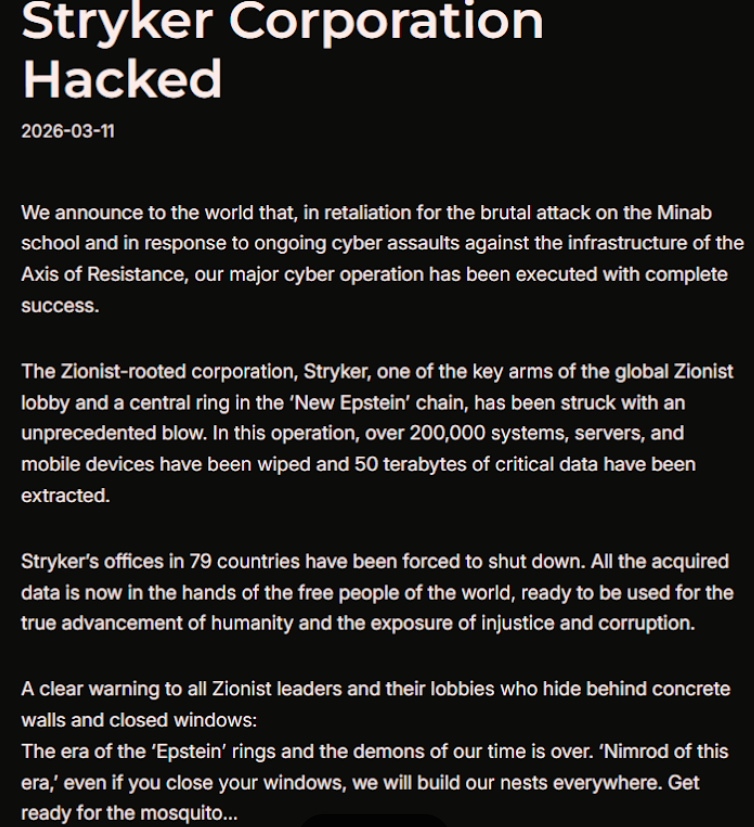
Based in Kalamazoo, Michigan, Stryker [NYSE:SYK] is a medical and surgical equipment maker that reported $25 billion in global sales last year. In a lengthy statement posted to Telegram, a hacktivist group known as Handala (a.k.a. Handala Hack Team) claimed that Stryker’s offices in 79 countries have been forced to shut down after the group erased data from more than 200,000 systems, servers and mobile devices.

A manifesto posted by the Iran-backed hacktivist group Handala, claiming a mass data-wiping attack against medical technology maker Stryker.

A manifesto posted by the Iran-backed hacktivist group Handala, claiming a mass data-wiping attack against medical technology maker Stryker.

“All the acquired data is now in the hands of the free people of the world, ready to be used for the true advancement of humanity and the exposure of injustice and corruption,” a portion of the Handala statement reads.

The group said the wiper attack was in retaliation for a Feb. 28 missile strike that hit an Iranian school and killed at least 175 people, most of them children. The New York Times reports today that an ongoing military investigation has determined the United States is responsible for the deadly Tomahawk missile strike.

Handala was one of several hacker groups recently profiled by Palo Alto Networks, which links it to Iran’s Ministry of Intelligence and Security (MOIS). Palo Alto says Handala surfaced in late 2023 and is assessed as one of several online personas maintained by Void Manticore, a MOIS-affiliated actor.

Stryker’s website says the company has 56,000 employees in 61 countries. A phone call placed Wednesday morning to the media line at Stryker’s Michigan headquarters sent this author to a voicemail message that stated, “We are currently experiencing a building emergency. Please try your call again later.”

A report Wednesday morning from the Irish Examiner said Stryker staff are now communicating via WhatsApp for any updates on when they can return to work. The story quoted an unnamed employee saying anything connected to the network is down, and that “anyone with Microsoft Outlook on their personal phones had their devices wiped.”

“Multiple sources have said that systems in the Cork headquarters have been ‘shut down’ and that Stryker devices held by employees have been wiped out,” the Examiner reported. “The login pages coming up on these devices have been defaced with the Handala logo.”

Wiper attacks usually involve malicious software designed to overwrite any existing data on infected devices. But a trusted source with knowledge of the attack who spoke on condition of anonymity told KrebsOnSecurity the perpetrators in this case appear to have used a Microsoft service called Microsoft Intune to issue a ‘remote wipe’ command against all connected devices.

Intune is a cloud-based solution built for IT teams to enforce security and data compliance policies, and it provides a single, web-based administrative console to monitor and control devices regardless of location. The Intune connection is supported by this Reddit discussion on the Stryker outage, where several users who claimed to be Stryker employees said they were told to uninstall Intune urgently.

Palo Alto says Handala’s hack-and-leak activity is primarily focused on Israel, with occasional targeting outside that scope when it serves a specific agenda. The security firm said Handala also has taken credit for recent attacks against fuel systems in Jordan and an Israeli energy exploration company.

“Recent observed activities are opportunistic and ‘quick and dirty,’ with a noticeable focus on supply-chain footholds (e.g., IT/service providers) to reach downstream victims, followed by ‘proof’ posts to amplify credibility and intimidate targets,” Palo Alto researchers wrote.

The Handala manifesto posted to Telegram referred to Stryker as a “Zionist-rooted corporation,” which may be a reference to the company’s 2019 acquisition of the Israeli company OrthoSpace.

Stryker is a major supplier of medical devices, and the ongoing attack is already affecting healthcare providers. One healthcare professional at a major university medical system in the United States told KrebsOnSecurity they are currently unable to order surgical supplies that they normally source through Stryker.

“This is a real-world supply chain attack,” the expert said, who asked to remain anonymous because they were not authorized to speak to the press. “Pretty much every hospital in the U.S. that performs surgeries uses their supplies.”

John Riggi, national advisor for the American Hospital Association (AHA), said the AHA is not aware of any supply-chain disruptions as of yet.

“We are aware of reports of the cyber attack against Stryker and are actively exchanging information with the hospital field and the federal government to understand the nature of the threat and assess any impact to hospital operations,” Riggi said in an email. “As of this time, we are not aware of any direct impacts or disruptions to U.S. hospitals as a result of this attack. That may change as hospitals evaluate services, technology and supply chain related to Stryker and if the duration of the attack extends.”

According to a March 11 memo from the state of Maryland’s Institute for Emergency Medical Services Systems, Stryker indicated that some of their computer systems have been impacted by a “global network disruption.” The memo indicates that in response to the attack, a number of hospitals have opted to disconnect from Stryker’s various online services, including LifeNet, which allows paramedics to transmit EKGs to emergency physicians so that heart attack patients can expedite their treatment when they arrive at the hospital.

“As a precaution, some hospitals have temporarily suspended their connection to Stryker systems, including LIFENET, while others have maintained the connection,” wrote Timothy Chizmar, the state’s EMS medical director. “The Maryland Medical Protocols for EMS requires ECG transmission for patients with acute coronary syndrome (or STEMI). However, if you are unable to transmit a 12 Lead ECG to a receiving hospital, you should initiate radio consultation and describe the findings on the ECG.”

This is a developing story. Updates will be noted with a timestamp.

Update, 2:54 p.m. ET: Added comment from Riggi and perspectives on this attack’s potential to turn into a supply-chain problem for the healthcare system.

Update, Mar. 12, 7:59 a.m. ET: Added information about the outage affecting Stryker’s online services.

  • ✇Security Affairs
  • Facebook is experiencing a global outage Pierluigi Paganini
    Facebook is experiencing a global outage since 4:15 PM ET, with users reporting they cannot access their accounts. Facebook users worldwide report problems while attempting to access their accounts. The outage started around 4:15 PM ET. Upon attempting to access their account, users are presented the following message: “Account Temporarily Unavailable. Your account is currently unavailable due to a site issue. We expect this to be resolved shortly. Please try again in a few minutes.”
     

Facebook is experiencing a global outage

3 de Março de 2026, 20:19

Facebook is experiencing a global outage since 4:15 PM ET, with users reporting they cannot access their accounts.

Facebook users worldwide report problems while attempting to access their accounts. The outage started around 4:15 PM ET. Upon attempting to access their account, users are presented the following message:

“Account Temporarily Unavailable.

Your account is currently unavailable due to a site issue. We expect this to be resolved shortly. Please try again in a few minutes.”

The status and outage page of Meta business products reports “High Disruptions” affecting Ads Manager, Instagram Boost, and the WhatsApp Business API. There is no mention of Facebook login.

Reports on DownDetector spiked in the last hours, with thousands of complaints regarding login, website, and app issues.

 Independent and non-partisan global internet monitor NetBlocks also reported that the social media giant is experiencing international outages. The organization confirmed that the incident is not related to country-level internet disruptions or filtering.

ℹ Note: Social media platform Facebook is currently experiencing international outages; incident not related to country-level internet disruptions or filtering #FacebookDown pic.twitter.com/KAwA8y4lTU

— NetBlocks (@netblocks) March 3, 2026

Over the past hour, multiple websites [1, 2, 3] confirmed a surge of users experiencing problems globally.

Stay tuned …

Update March 4, 2026

Facebook outage has been resolved though the company has not disclosed the root cause of the problem.

Follow me on Twitter: @securityaffairs and Facebook and Mastodon

Pierluigi Paganini

(SecurityAffairs – hacking, Meta)

Asian Cyber Espionage Campaign Breached 37 Countries

6 de Fevereiro de 2026, 18:37

Palo Alto Networks says an Asian cyber espionage campaign breached 70 organizations in 37 countries, targeting government agencies and critical infrastructure.

The post Asian Cyber Espionage Campaign Breached 37 Countries appeared first on TechRepublic.

❌
❌