Visualização normal

Antes de ontemStream principal
  • ✇Firewall Daily – The Cyber Express
  • Apple Patches WebKit Vulnerability CVE-2026-20643 Across iOS, macOS Ashish Khaitan
    Apple has released a new security update to address a critical WebKit vulnerability tracked as CVE-2026-20643. The vulnerability was identified as a cross-origin issue within the Navigation API of WebKit, the browser engine that underpins Safari and other web-based functionality across iOS, iPadOS, and macOS.   The flaw could allow maliciously crafted web content to bypass the Same Origin Policy, a fundamental security control that prevents unauthorized data access between websites.  Apple
     

Apple Patches WebKit Vulnerability CVE-2026-20643 Across iOS, macOS

19 de Março de 2026, 08:16

WebKit vulnerability

Apple has released a new security update to address a critical WebKit vulnerability tracked as CVE-2026-20643. The vulnerability was identified as a cross-origin issue within the Navigation API of WebKit, the browser engine that underpins Safari and other web-based functionality across iOS, iPadOS, and macOS.   The flaw could allow maliciously crafted web content to bypass the Same Origin Policy, a fundamental security control that prevents unauthorized data access between websites.  Apple addressed this issue through improved input validation. The fix was released as part of Background Security Improvements for: 
  • iOS 26.3.1 (a) 
  • iPadOS 26.3.1 (a) 
  • macOS 26.3.1 (a) 
  • macOS 26.3.2 (a) 
These Apple updates were issued on Wednesday. Notably, the “(a)” suffix indicates a background patch rather than a traditional OS update. 

The WebKit Vulnerability CVE-2026-20643 

According to the Apple’s official documentation, “About the security content of Background Security Improvements for iOS 26.3.1, iPadOS 26.3.1, macOS 26.3.1, and macOS 26.3.2 This document describes the content of Background Security Improvements.”  The documentation further explains, “Background Security Improvements deliver important security improvements between software updates and are available only for the latest versions of iOS, iPadOS, and macOS.”  The vulnerability is also tracked in WebKit Bugzilla under ID 306050 and credited to researcher Thomas Espach.  Despite being designed as automatic and unobtrusive, these background patches are not entirely hands-off for organizations. Security professionals emphasize the need for continued monitoring and configuration. 

Continued Support for Older iOS and iPadOS Versions 

Alongside addressing CVE-2026-20643 in modern systems, Apple also released security updates for older devices that cannot upgrade to the latest versions of iOS and iPadOS.  On March 11, 2026, updates for iOS 16.7.15 and iPadOS 16.7.15 were issued. These included a WebKit fix for a vulnerability (CVE-2023-43010) that could lead to memory corruption when processing malicious web content. The issue was originally addressed in iOS 17.2 on December 11, 2023, and has now been backported to older devices.  Similarly, updates for iOS 15.8.7 and iPadOS 15.8.7 included multiple fixes affecting both the kernel and WebKit: 
  • CVE-2023-41974: A kernel vulnerability allowing arbitrary code execution, originally fixed in iOS 17. 
  • CVE-2024-23222: A WebKit type confusion issue that could enable code execution. 
  • CVE-2023-43000 and CVE-2023-43010: Memory corruption flaws in WebKit, addressed through improved memory handling. 

These updates help ensure that older devices remain protected against known threats, including exploit chains like Coruna, which have been addressed across multiple patches. By backporting fixes, Apple is maintaining consistent security coverage across WebKit on iOS, iPadOS, and macOS, even for systems that cannot run the latest versions.

The response to CVE-2026-20643 also highlights a shift in Apple’s update strategy. By separating critical fixes from full OS releases, the company can deliver patches faster, reducing the window of exposure for vulnerabilities in WebKit across iOS, iPadOS, and macOS.

At the same time, this approach requires IT and security teams to adjust. Instead of relying on periodic updates, they must track and verify smaller background patches, ensure compliance, maintain visibility into deployments, and confirm protections like those for CVE-2026-20643 are properly applied across all managed devices.

Apple patches WebKit bug that could let sites access your data

18 de Março de 2026, 08:19

Apple has released a Background Security Improvement that silently fixes a WebKit vulnerability (CVE-2026-20643).

The post Apple patches WebKit bug that could let sites access your data appeared first on Security Boulevard.

  • ✇SOC Prime Blog
  • CVE-2026-20643: Vulnerability in WebKit Navigation API May Bypass Same Origin Policy Daryna Olyniychuk
    Just a little over a month after fixing the actively exploited CVE-2026-20700 zero-day, Apple has now issued its first Background Security Improvements release to address CVE-2026-20643, a WebKit vulnerability that could allow maliciously crafted web content to bypass the Same Origin Policy, one of the browser’s core security boundaries. The issue in the limelight adds to the constantly rising vulnerability threat. Experts forecast that 2026 will be the first year to surpass 50,000 published CV
     

CVE-2026-20643: Vulnerability in WebKit Navigation API May Bypass Same Origin Policy

18 de Março de 2026, 10:01
CVE-2026-20643 in WebKit Navigation API fixed by Apple

Just a little over a month after fixing the actively exploited CVE-2026-20700 zero-day, Apple has now issued its first Background Security Improvements release to address CVE-2026-20643, a WebKit vulnerability that could allow maliciously crafted web content to bypass the Same Origin Policy, one of the browser’s core security boundaries.

The issue in the limelight adds to the constantly rising vulnerability threat. Experts forecast that 2026 will be the first year to surpass 50,000 published CVEs, with a median estimate of 59,427 and a realistic possibility of far higher totals. At the same time, the NIST has already recorded over 13K+ vulnerabilities this year, underscoring the growing scale defenders must monitor.

Sign up for the SOC Prime Platform to access the global marketplace of 800,000+ detection rules and queries made by detection engineers, updated daily, and enriched with AI-native threat intel to proactively defend against emerging threats. 

Just click the Explore Detections below and immediately reach the extensive detection stack filtered out by “CVE” tag. All detections are compatible with dozens of SIEM, EDR, and Data Lake formats and are mapped to MITRE ATT&CK®. 

Explore Detections

Security experts can also leverage Uncoder AI to accelerate detection engineering end-to-end by generating rules directly from live threat reports, refining and validating detection logic, visualizing Attack Flows, converting IOCs into custom hunting queries, and instantly translating detection code across diverse language formats.

CVE-2026-20643 Analysis

CVE-2026-20643 affects WebKit, the browser engine behind Safari and a wide range of Apple web content handling across iPhone, iPad, and Mac. Apple’s advisory says the flaw could allow maliciously crafted web content to bypass the Same Origin Policy because of a cross-origin issue in the Navigation API.

Notably, the Same Origin Policy is one of the web’s foundational protections. It is meant to stop one website from reaching into the data, sessions, or active content of another. When this boundary is breached, a malicious webpage may access data from another site, undermining one of the basic rules browsers rely on to keep web activity separate and private.

The exposure is broader than Safari alone. WebKit powers Safari, many third-party browsers on iOS and iPadOS, and in-app web views across Apple platforms. In practice, that means the vulnerable component is exercised not only when a user browses the web directly, but also when apps load embedded web content. 

Apple has not mentioned that CVE-2026-20643 was exploited in the wild, and its advisory focuses on the technical impact rather than observed attack activity. Still, the issue resides in a high-exposure component that processes untrusted web content constantly. In enterprise environments, a flaw that weakens browser isolation can increase the risk of session abuse, cross-site data access, and follow-on compromise through malicious or compromised web content. 

What makes Apple’s latest release especially notable is how the vendor delivered the fix. Background Security Improvements is designed to ship smaller security patches between full software updates. It is currently available on the latest versions of iOS, iPadOS, and macOS. In the case of CVE-2026-20643, Apple used the new mechanism to push a WebKit fix directly to supported devices instead of waiting for a broader release.

CVE-2026-20643 Mitigation

Apple addressed CVE-2026-20643 through its first Background Security Improvements release for supported iPhone, iPad, and Mac devices. The fix was shipped as the corresponding “(a)” update for iOS 26.3.1, iPadOS 26.3.1, macOS 26.3.1, and macOS 26.3.2, with Apple citing improved input validation as the remediation. Security researcher Thomas Espach was credited with reporting the flaw.

Apple says Background Security Improvements are managed from the Privacy & Security menu. Apple recommends keeping Automatically Install enabled so devices receive these fixes between normal software releases.

Notably, if Background Security Improvements are turned off, the device will not receive these protections until they are included in a later software update. Apple also says that removing an installed Background Security Improvement reverts the device to the baseline software version without any applied background security patches. For that reason, the safest path is to leave automatic installation on and avoid removing the update unless a compatibility issue makes it necessary.

Additionally, by leveraging SOC Prime’s AI-Native Detection Intelligence Platform backed by top cyber defense expertise, global organizations can adopt a resilient security posture and transform their SOC to always stay ahead of emerging threats tied to zero-day exploitation.

FAQ

What is CVE-2026-20643 and how does it work?

CVE-2026-20643 is a WebKit vulnerability affecting iOS, iPadOS, and macOS. Apple describes it as a cross-origin issue in the Navigation API that may allow maliciously crafted web content to bypass the Same Origin Policy.

When was CVE-2026-20643 disclosed?

Apple published the security advisory for CVE-2026-20643 on March 17, 2026, alongside its first Background Security Improvements release covering this flaw.

What is the impact of CVE-2026-20643 on systems?

The main impact is a breakdown in browser isolation. If exploited, the flaw may let malicious web content bypass the Same Origin Policy, which is designed to prevent one site from accessing data or active content from another.

Can CVE-2026-20643 still affect me in 2026?

Yes. Devices that have not received the relevant Background Security Improvements release, or where those protections were disabled or removed, may still remain exposed while running affected versions.

How can I protect from CVE-2026-20643?

Install the applicable Background Security Improvements release for your current Apple OS version and make sure Automatically Install is enabled under Privacy & Security so future fixes are applied without delay.


The post CVE-2026-20643: Vulnerability in WebKit Navigation API May Bypass Same Origin Policy appeared first on SOC Prime.

  • ✇Malwarebytes
  • Apple patches WebKit bug that could let sites access your data
    Apple has released a Background Security Improvement to patch a flaw that could allow malicious websites to bypass browser protections and access data from other sites. What is it? The patched WebKit vulnerability is described as: “A cross-origin issue in the Navigation API was addressed with improved input validation.” WebKit vulnerabilities refer to security flaws in Apple’s web rendering engine, which powers Safari, Mail, and the App Store on iOS and macOS. What this means is
     

Apple patches WebKit bug that could let sites access your data

18 de Março de 2026, 08:19

Apple has released a Background Security Improvement to patch a flaw that could allow malicious websites to bypass browser protections and access data from other sites.

What is it?

The patched WebKit vulnerability is described as:

“A cross-origin issue in the Navigation API was addressed with improved input validation.”

WebKit vulnerabilities refer to security flaws in Apple’s web rendering engine, which powers Safari, Mail, and the App Store on iOS and macOS.

What this means is that the CVE-2026-20643 vulnerability makes it possible for a malicious website to pretend to be another site, maybe one you trust, and then read or steal information that should be kept separate. Normally, browsers enforce a rule called the “same‑origin policy,” which is like a strict fence that stops one site from peeking into another site’s data. This bug could help cybercriminals cut through that fence.

In practical terms, an attacker would first have to lure you to a specially crafted web page. If you visited it, that page could try to bypass the normal isolation between sites and access things it should not see, such as data from another tab or embedded content from a different service.

Attackers do not currently appear to exploit this flaw in the wild, but they like to chain issues like this with other bugs to steal accounts or sensitive data, which likely prompted Apple to ship it as a Background Security Improvement. Apple’s fix tightens how WebKit checks and handles cross‑site navigation.

What to do

This patch for a WebKit vulnerability, tracked as CVE-2026-20643, installs on top of versions 26.3.1/26.3.2 and not as a separate full OS version. Background Security Improvements are only available on the latest OS branch (26.x) and apply silently in the background if you’re on the latest version.

For iOS and iPadOS users, you can check if you’re using the latest software version by  going to Settings > General > Software Update. It’s also worth turning on Automatic Updates if you haven’t already. You can do that on the same screen.

For macOS Tahoe users, you can find out if you’re on the latest 26.3 version from the Apple menu. In the upper-left corner of your screen, choose About This Mac. The information shown there includes the macOS name and version number. If you need to know the build number as well, click the version number to see it.

This Background Security Improvement is only available for Mac users running Tahoe 26.3.1 and MacBook Neo users running 26.3.2.

All users have to do is to check if they have the Background Security Improvements option set to enabled.

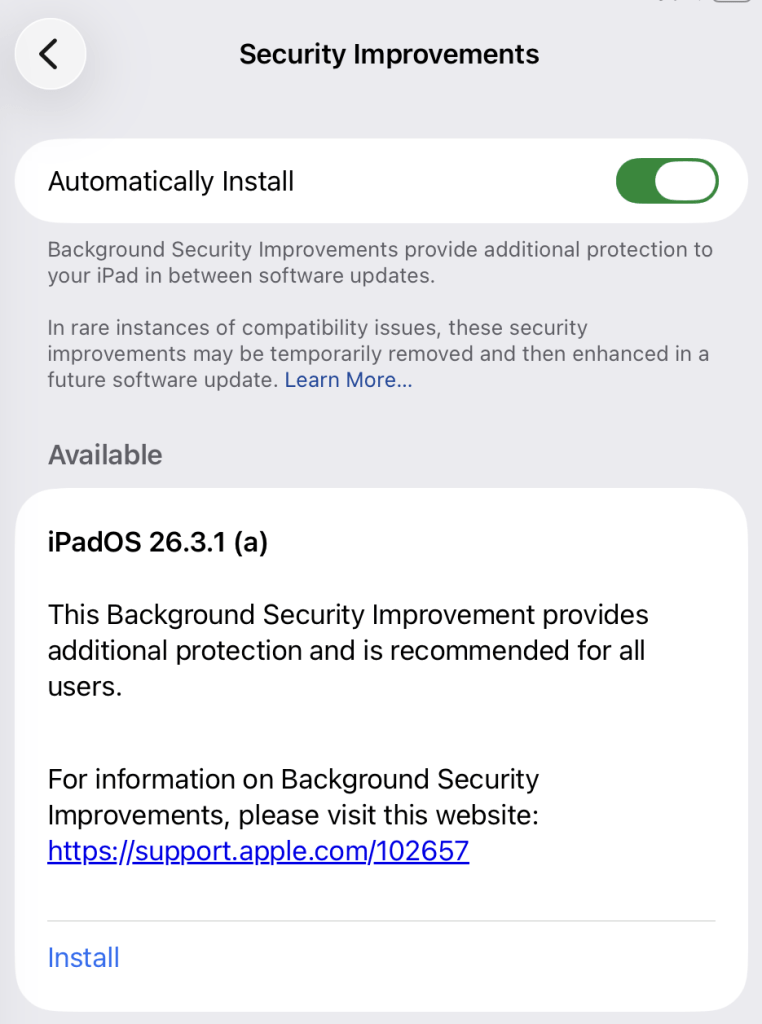
For iPhone and iPad users, this setting can be found under Privacy & Security, where you can scroll down and look for the Background Security Improvements toggle.

Automatically install security improvements

On a Mac (macOS Tahoe 26.3.+ only), you can check by following these instructions:

  1. Click the Apple menu > System Settings.
  2. In the sidebar, click Privacy & Security.
  3. Scroll down on the right and click Background Security Improvements.
  4. Make sure Automatically Install is turned on. If it’s off, the Mac won’t get Background Security Improvements until the fixes are rolled into a later full update.

The Install option in my screenshot means that you can speed up the process by clicking it. But it’s fine to wait until it happens automatically.

After the update, your OS version should show 26.3.1 (a), except for MacBook Neos which should be at 26.3.2 (a).


We don’t just report on phone security—we provide it

Cybersecurity risks should never spread beyond a headline. Keep threats off your mobile devices by downloading Malwarebytes for iOS, and Malwarebytes for Android today.

❌
❌