 Entrar
K2view vs Broadcom For Test Data Management
22 de Abril de 2026, 13:26
Compare Broadcom TDM and K2view across architecture, integration, masking, and scalability to find the right test data management solution for your needs.



Booking.com warned that hackers may have accessed customer data linked to travel reservations. Exposed details could include names, email addresses, phone numbers, and information shared with accommodations.
Booking.com is one of the world’s leading online travel agencies (OTAs) and digital travel companies, specializing in accommodation bookings, including hotels, vacation rentals, and apartments.
“In that spirit, we’re writing to inform you that unauthorized third parties may have been able to access certain booking information associated with your reservation.” reads the data breach notification sent to the impacted users.
“We recently noticed suspicious activity affecting a number of reservations and we immediately took action to contain the issue. Based on the findings of our investigation to date, accessed information could include booking details and name(s), emails, addresses, phone numbers associated with the booking and anything that you may have shared with the accommodation.”

In response to the incident, the company reset reservation PINs.
Booking.com did not provide technical details about the attack. It is unclear whether the attackers compromised its systems. The company has not disclosed how many users were impacted, but said it has contained the incident and notified impacted customers.
The company said no payment data was accessed. Customers are urged to stay alert for phishing, as the company never asks for card details or unusual transfers via email, phone, WhatsApp, or SMS.
Recently, multiple users claimed online that scammers contacted them using what looked like real reservation details. It’s not yet clear whether these incidents are linked to the cyber incident disclosed by Booking.com.
Follow me on Twitter: @securityaffairs and Facebook and Mastodon
(SecurityAffairs – hacking, security breach)

Rapid7 Labs uncovered a China-linked threat group known as Red Menshen has been running a long-term espionage campaign by infiltrating telecom networks, mainly in the Middle East and Asia. Active since at least 2021, the group uses highly stealthy BPFDoor implants to maintain hidden access inside critical infrastructure.
This strategic positioning allows attackers to quietly monitor and potentially spy on government communications. Researchers describe these implants as extremely hard to detect, acting like “digital sleeper cells” embedded deep within telecom environments for prolonged surveillance.
Compromised telecoms threaten entire populations, not just individual companies, as they carry critical communications and digital identities. Over the past decade, similar state-backed intrusions have targeted multiple countries, exposing call records, sensitive communications, and trusted operator links, revealing a worrying global pattern.
Investigations reveal a structured, long-term campaign by a China-linked threat actor targeting telecommunications infrastructure. Rather than short-term intrusions, the operation plants “sleeper cells”, dormant footholds embedded deep within networks to maintain persistent access over extended periods. Recurring tools in the attackers’ arsenal include kernel-level implants, passive backdoors, credential-harvesting utilities, and cross-platform command frameworks, forming a layered, stealthy access model. Experts highlighted the central role of BPFdoor, a Linux backdoor operating within the kernel that activates only when triggered by specially crafted packets, without exposing ports or command-and-control channels. By positioning below traditional visibility layers, this approach complicates detection and demonstrates a shift toward deep, covert tradecraft. BPFdoor is not an isolated tool but part of a broader, scalable intrusion model targeting telecom environments at high stealth.
Modern telecom networks are built in layers, making them highly valuable targets. At the edge are customer-facing systems like base stations, routers, VPNs, and firewalls, which connect to the core backbone that carries massive volumes of global traffic.

Attacks usually begin at the network edge by exploiting exposed services or valid accounts on devices like VPNs, firewalls, and virtualization hosts. Once inside, attackers deploy tools such as CrossC2 for command execution, TinyShell for stealthy persistence, and keyloggers or brute-force tools to steal credentials and move laterally toward core systems.
A key tool is BPFdoor, a stealthy Linux backdoor that hides in the kernel and activates only when it receives a specially crafted “magic” packet.
“BPFdoor first came to broader public attention around 2021, when researchers uncovered a stealthy Linux backdoor used in long-running espionage campaigns targeting telecommunications and government networks. The BPFDoor source code reportedly leaked online in 2022, making the previously specialized Linux backdoor more accessible to other threat actors.” reads the report published by Rapid7. “Normally, BPF is used by tools like tcpdump or libpcap to capture specific network traffic, such as filtering for TCP port 443. It operates partly in kernel space, meaning it processes packets before they reach user-space applications. BPFdoor abuses this capability. Rather than binding to a visible listening port, the implant installs a custom BPF filter inside the kernel that inspects incoming packets for a specific pattern, a predefined sequence of bytes often referred to as a “magic packet” or “magic byte.” “
Like a hidden lock that opens with the right code, it leaves no visible trace, making detection extremely difficult while enabling long-term, covert access across telecom environments.
Rapid7 Labs hunted BPFdoor variants by analyzing ELF samples and grouping them by code similarity, revealing both recurring clusters and outliers. Using custom tools, they discovered new features, including a variant “F” with a 26-instruction BPF filter and updated magic packets. Some samples inspect SCTP traffic, giving attackers access to telecom signaling, subscriber data, and location tracking. Other tactics include mimicking bare-metal servers like HPE ProLiant or container services such as Docker to blend into telecom hardware and 5G core environments. These strategies allow implants to remain hidden while embedding directly into the backbone, turning persistence into deep visibility across critical networks.
According to Rapid7, recent BPFdoor variants show significant evolution in stealth and control. Instead of simple magic packets, triggers are now hidden inside legitimate HTTPS traffic, passing through proxies, load balancers, and firewalls.

A clever padding mechanism, called the 26- or 40-byte “magic ruler,” ensures the activation marker lands at a fixed offset, surviving header changes. The malware also uses lightweight RC4-MD5 encryption for fast command execution and reuses proven routines from prior Chinese-linked malware. ICMP packets are used as a small control channel between infected systems. A special marker (0xFFFFFFFF) tells the receiving host to execute commands, letting attackers manage multiple compromised servers quietly across telecom and enterprise networks.
“BPFdoor and new eBPF malware families like Symbiote demonstrate how kernel packet filtering can be abused for stealth persistence. As defenders improve visibility at higher layers, adversaries are increasingly shifting implants deeper into the operating system.” concludes the report that provides Indicators of Compromise (IoCs).
Follow me on Twitter: @securityaffairs and Facebook and Mastodon
(SecurityAffairs – hacking, telecom)

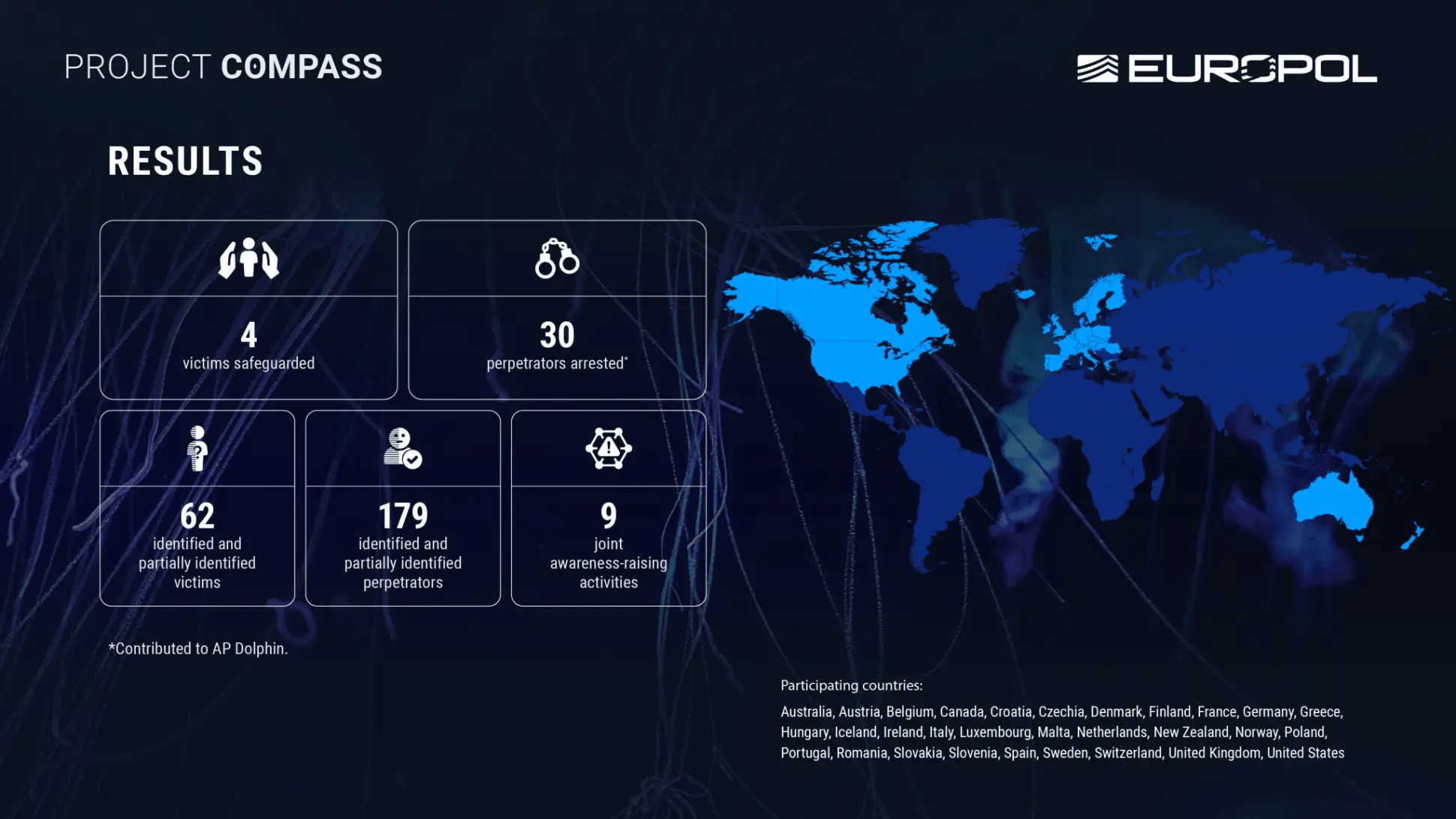
A yearlong operation, code-named Project Compass, led by Europol has dealt a major blow to The Com,’ a cybercrime network known for targeting children and teenagers. The joint effort, called Project Compass and coordinated by Europol’s European Counter Terrorism Centre, brought together law enforcement agencies from 28 countries.
“The Com” operates through a scattered online network, using social media, messaging apps, gaming platforms and streaming services to recruit and exploit young people. Its decentralized structure makes.
The Com is mostly composed of English-speaking cybercriminals aged 16 to 25. The group has been linked to attacks ranging from crippling British retailers’ IT systems to making bomb threats and coercing teenage girls into self-harm. Its latest alleged victims are premium users of Pornhub, whose data was reportedly hacked by ShinyHunters, an offshoot tied to the broader Com network, which includes Scattered Spider.
Since January 2025, Project Compass has delivered significant operational results, including the safeguarding of four victims and the arrest of 30 perpetrators. Investigators identified or partially identified 62 victims and 179 suspects, while also carrying out nine joint awareness initiatives. The project has strengthened cross-border cooperation among 28 countries, enabling coordinated investigations, faster responses to emerging threats, and structured information sharing.
“These networks deliberately target children in the digital spaces where they feel most at ease. Project Compass allows us to intervene earlier, safeguard victims and disrupt those who exploit vulnerability for extremist purposes.” said Anna Sjöberg, Head of Europol’s European Counter Terrorism Centre. “No country can address this threat alone – and through this cooperation, we are closing the gaps they try to hide in.”
Follow me on Twitter: @securityaffairs and Facebook and Mastodon
(SecurityAffairs – hacking, cybercrime)
In early January 2026, KrebsOnSecurity revealed how a security researcher disclosed a vulnerability that was used to build Kimwolf, the world’s largest and most disruptive botnet. Since then, the person in control of Kimwolf — who goes by the handle “Dort” — has coordinated a barrage of distributed denial-of-service (DDoS), doxing and email flooding attacks against the researcher and this author, and more recently caused a SWAT team to be sent to the researcher’s home. This post examines what is knowable about Dort based on public information.
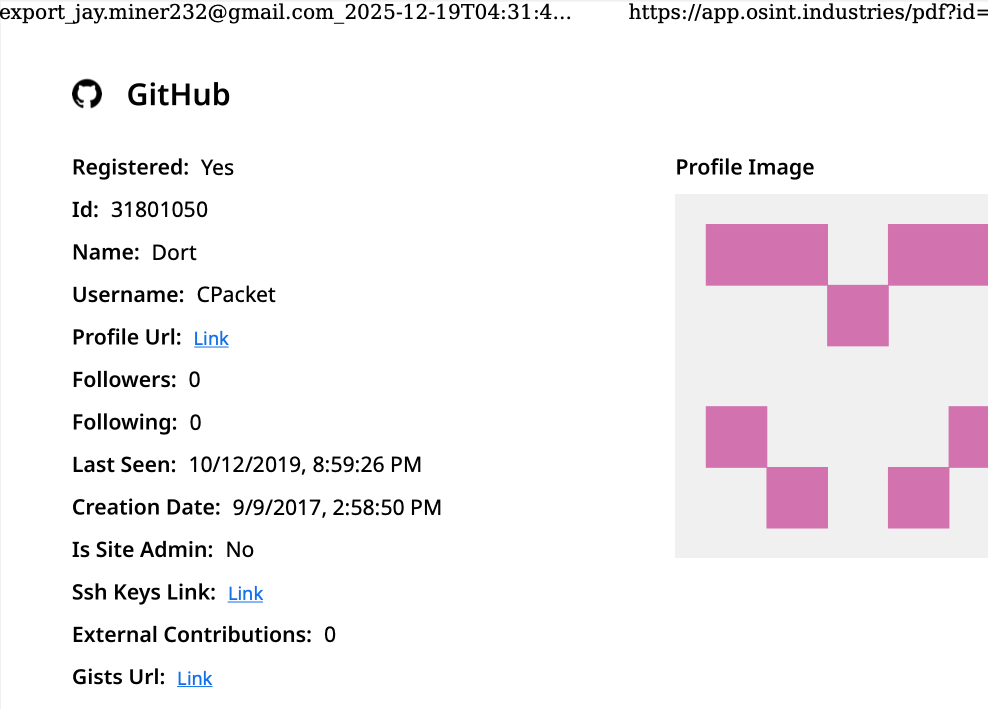
A public “dox” created in 2020 asserted Dort was a teenager from Canada (DOB August 2003) who used the aliases “CPacket” and “M1ce.” A search on the username CPacket at the open source intelligence platform OSINT Industries finds a GitHub account under the names Dort and CPacket that was created in 2017 using the email address jay.miner232@gmail.com.

Image: osint.industries.
The cyber intelligence firm Intel 471 says jay.miner232@gmail.com was used between 2015 and 2019 to create accounts at multiple cybercrime forums, including Nulled (username “Uubuntuu”) and Cracked (user “Dorted”); Intel 471 reports that both of these accounts were created from the same Internet address at Rogers Canada (99.241.112.24).
Dort was an extremely active player in the Microsoft game Minecraft who gained notoriety for their “Dortware” software that helped players cheat. But somewhere along the way, Dort graduated from hacking Minecraft games to enabling far more serious crimes.
Dort also used the nickname DortDev, an identity that was active in March 2022 on the chat server for the prolific cybercrime group known as LAPSUS$. Dort peddled a service for registering temporary email addresses, as well as “Dortsolver,” code that could bypass various CAPTCHA services designed to prevent automated account abuse. Both of these offerings were advertised in 2022 on SIM Land, a Telegram channel dedicated to SIM-swapping and account takeover activity.
The cyber intelligence firm Flashpoint indexed 2022 posts on SIM Land by Dort that show this person developed the disposable email and CAPTCHA bypass services with the help of another hacker who went by the handle “Qoft.”
“I legit just work with Jacob,” Qoft said in 2022 in reply to another user, referring to their exclusive business partner Dort. In the same conversation, Qoft bragged that the two had stolen more than $250,000 worth of Microsoft Xbox Game Pass accounts by developing a program that mass-created Game Pass identities using stolen payment card data.
Who is the Jacob that Qoft referred to as their business partner? The breach tracking service Constella Intelligence finds the password used by jay.miner232@gmail.com was reused by just one other email address: jacobbutler803@gmail.com. Recall that the 2020 dox of Dort said their date of birth was August 2003 (8/03).
Searching this email address at DomainTools.com reveals it was used in 2015 to register several Minecraft-themed domains, all assigned to a Jacob Butler in Ottawa, Canada and to the Ottawa phone number 613-909-9727.
Constella Intelligence finds jacobbutler803@gmail.com was used to register an account on the hacker forum Nulled in 2016, as well as the account name “M1CE” on Minecraft. Pivoting off the password used by their Nulled account shows it was shared by the email addresses j.a.y.m.iner232@gmail.com and jbutl3@ocdsb.ca, the latter being an address at a domain for the Ottawa-Carelton District School Board.
Data indexed by the breach tracking service Spycloud suggests that at one point Jacob Butler shared a computer with his mother and a sibling, which might explain why their email accounts were connected to the password “jacobsplugs.” Neither Jacob nor any of the other Butler household members responded to requests for comment.
The open source intelligence service Epieos finds jacobbutler803@gmail.com created the GitHub account “MemeClient.” Meanwhile, Flashpoint indexed a deleted anonymous Pastebin.com post from 2017 declaring that MemeClient was the creation of a user named CPacket — one of Dort’s early monikers.
Why is Dort so mad? On January 2, KrebsOnSecurity published The Kimwolf Botnet is Stalking Your Local Network, which explored research into the botnet by Benjamin Brundage, founder of the proxy tracking service Synthient. Brundage figured out that the Kimwolf botmasters were exploiting a little-known weakness in residential proxy services to infect poorly-defended devices — like TV boxes and digital photo frames — plugged into the internal, private networks of proxy endpoints.
By the time that story went live, most of the vulnerable proxy providers had been notified by Brundage and had fixed the weaknesses in their systems. That vulnerability remediation process massively slowed Kimwolf’s ability to spread, and within hours of the story’s publication Dort created a Discord server in my name that began publishing personal information about and violent threats against Brundage, Yours Truly, and others.
Dort and friends incriminating themselves by planning swatting attacks in a public Discord server.
Last week, Dort and friends used that same Discord server (then named “Krebs’s Koinbase Kallers”) to threaten a swatting attack against Brundage, again posting his home address and personal information. Brundage told KrebsOnSecurity that local police officers subsequently visited his home in response to a swatting hoax which occurred around the same time that another member of the server posted a door emoji and taunted Brundage further.
Dort, using the alias “Meow,” taunts Synthient founder Ben Brundage with a picture of a door.
Someone on the server then linked to a cringeworthy (and NSFW) new Soundcloud diss track recorded by the user DortDev that included a stickied message from Dort saying, “Ur dead nigga. u better watch ur fucking back. sleep with one eye open. bitch.”
“It’s a pretty hefty penny for a new front door,” the diss track intoned. “If his head doesn’t get blown off by SWAT officers. What’s it like not having a front door?”
With any luck, Dort will soon be able to tell us all exactly what it’s like.
Update, 10:29 a.m.: Jacob Butler responded to requests for comment, speaking with KrebsOnSecurity briefly via telephone. Butler said he didn’t notice earlier requests for comment because he hasn’t really been online since 2021, after his home was swatted multiple times. He acknowledged making and distributing a Minecraft cheat long ago, but said he hasn’t played the game in years and was not involved in Dortsolver or any other activity attributed to the Dort nickname after 2021.
“It was a really old cheat and I don’t remember the name of it,” Butler said of his Minecraft modification. “I’m very stressed, man. I don’t know if people are going to swat me again or what. After that, I pretty much walked away from everything, logged off and said fuck that. I don’t go online anymore. I don’t know why people would still be going after me, to be completely honest.”
When asked what he does for a living, Butler said he mostly stays home and helps his mom around the house because he struggles with autism and social interaction. He maintains that someone must have compromised one or more of his old accounts and is impersonating him online as Dort.
“Someone is actually probably impersonating me, and now I’m really worried,” Butler said. “This is making me relive everything.”
But there are issues with Butler’s timeline. For example, Jacob’s voice in our phone conversation was remarkably similar to the Jacob/Dort whose voice can be heard in this Sept. 2022 Clash of Code competition between Dort and another coder (Dort lost). At around 6 minutes and 10 seconds into the recording, Dort launches into a cursing tirade that mirrors the stream of profanity in the diss rap that Dortdev posted threatening Brundage. Dort can be heard again at around 16 minutes; at around 26:00, Dort threatens to swat his opponent.
Butler said the voice of Dort is not his, exactly, but rather that of an impersonator who had likely cloned his voice.
“I would like to clarify that was absolutely not me,” Butler said. “There must be someone using a voice changer. Or something of the sorts. Because people were cloning my voice before and sending audio clips of ‘me’ saying outrageous stuff.”
Further reading:
Jan. 8, 2026: Who Benefited from the Aisuru and Kimwolf Botnets?
Jan. 20, 2026: Kimwolf Botnet Lurking in Corporate, Govt. Networks
Jan. 26, 2026: Who Operates the Badbox 2.0 Botnet?
Feb. 11, 2026: Kimwolf Botnet Swamps Anonymity Network I2P
Mar. 19, 2026: Feds Disrupt IoT Botnets Behind Huge DDoS Attacks
The UK’s online safety and privacy regulators are targeting companies that violate new age verification laws at both ends : Porn sites that did not keep children out, and mainstream platforms that profited from children coming in.
On February 23, media regulator Ofcom fined porn operators that failed to put “highly effective” age checks in place. Within the same 24-hour time frame, the Information Commissioner’s Office (ICO)—which is a separate, independent regulatory office—hit Reddit with an $18.2 million fine for unlawfully using children’s personal data for targeted advertising and recommendation systems.
Together, the cases show how quickly the UK is moving from guidance and “codes” to very real enforcement for services that don’t take children’s rights seriously.
Under the UK’s Online Safety Act 2023, services that publish or host pornography must use “highly effective” age assurance to stop children from accessing pornographic content. That means the classic splash page warning or an “I am over 18” tick box are no longer suitable.
Porn companies have reacted in different ways as the rules began to take hold: Some big players embraced more intrusive checks; others, like Pornhub, geo‑restricted or partially withdrew from the UK, and a minority effectively called the regulator’s bluff and carried on with token measures. Ofcom is now going after that last group.
On Monday, Ofcom fined US‑based porn operator 8579 LLC around $1.8 million for failing to implement proper age verification on its sites and for dragging its heels on compliance. The company has also been ordered to hand over a complete list of all websites it operates, with an extra daily penalty if it fails to comply.
Ofcom said it opened investigations into dozens of adult sites and will impose fines and daily penalties until proper age checks are in place, and reports that more than 6,000 porn sites have now moved to “highly effective” age checks. It can also employ certain business‑disruption and blocking powers for stubborn operators that continue to violate the law.
Meanwhile, the Information Commissioner’s Office (ICO) took aim at something different, but very much related: How mainstream online platforms treat the children they already have, rather than how they keep children out.
The Office’s latest decision imposes a substantial fine on Reddit for “children’s privacy failures,” after the regulator concluded the platform unlawfully used UK children’s personal data for targeted advertising and profiling. The decision follows a multi‑year push by the ICO to enforce its Age Appropriate Design Code (also known as the Children’s code) and to crack down on platforms that treat under‑18s like just another audience segment.
The ICO said its investigation found that Reddit:
The regulator’s concerns about Reddit are not new. In 2025 it announced investigations into TikTok, Reddit, and Imgur that focused on how the companies use UK children’s data and what age‑assurance tools they rely on. By late 2025, the ICO had issued a notice of intent to fine Reddit, signaling that it believed serious breaches had occurred. The new $18.2 million fine is the outcome of that process.
The message from Information Commissioner John Edwards is blunt: Social media and video‑sharing platforms are welcome in the UK, but “this cannot be at the expense of children’s privacy,” and the responsibility to keep children safe “lies firmly at the door of the companies offering these services.”
Although Ofcom and the ICO have different remits, their actions line up neatly.
The regulators have explicitly said they will work closely together to coordinate their efforts on children’s safety. In practical terms, that means:
The overlap is already visible. The ICO investigated how Reddit and other platforms use age assurance and recommender systems, while Ofcom set out specific guidance on acceptable age‑verification methods under the Online Safety Act.
Regulators such as Ofcom publish lists of acceptable age‑verification methods, each with its own privacy and usability trade‑offs. None are perfect, and many shift risk from governments and platforms onto users’ most sensitive personal data.
My personal preference would be double‑blind verification: a third‑party provider verifies your age, then issues a simple token like “18+” to sites without revealing your identity or learning which site you visit, offering stronger privacy than most current approaches.
In almost every case, users must surrender personal information or documents to prove their age, increasing the risk that sensitive data ends up in the wrong hands.
We don’t just report on privacy—we offer you the option to use it.
Privacy risks should never spread beyond a headline. Keep your online privacy yours by using Malwarebytes Privacy VPN.
The cybercriminals in control of Kimwolf — a disruptive botnet that has infected more than 2 million devices — recently shared a screenshot indicating they’d compromised the control panel for Badbox 2.0, a vast China-based botnet powered by malicious software that comes pre-installed on many Android TV streaming boxes. Both the FBI and Google say they are hunting for the people behind Badbox 2.0, and thanks to bragging by the Kimwolf botmasters we may now have a much clearer idea about that.
Our first story of 2026, The Kimwolf Botnet is Stalking Your Local Network, detailed the unique and highly invasive methods Kimwolf uses to spread. The story warned that the vast majority of Kimwolf infected systems were unofficial Android TV boxes that are typically marketed as a way to watch unlimited (pirated) movie and TV streaming services for a one-time fee.
Our January 8 story, Who Benefitted from the Aisuru and Kimwolf Botnets?, cited multiple sources saying the current administrators of Kimwolf went by the nicknames “Dort” and “Snow.” Earlier this month, a close former associate of Dort and Snow shared what they said was a screenshot the Kimwolf botmasters had taken while logged in to the Badbox 2.0 botnet control panel.
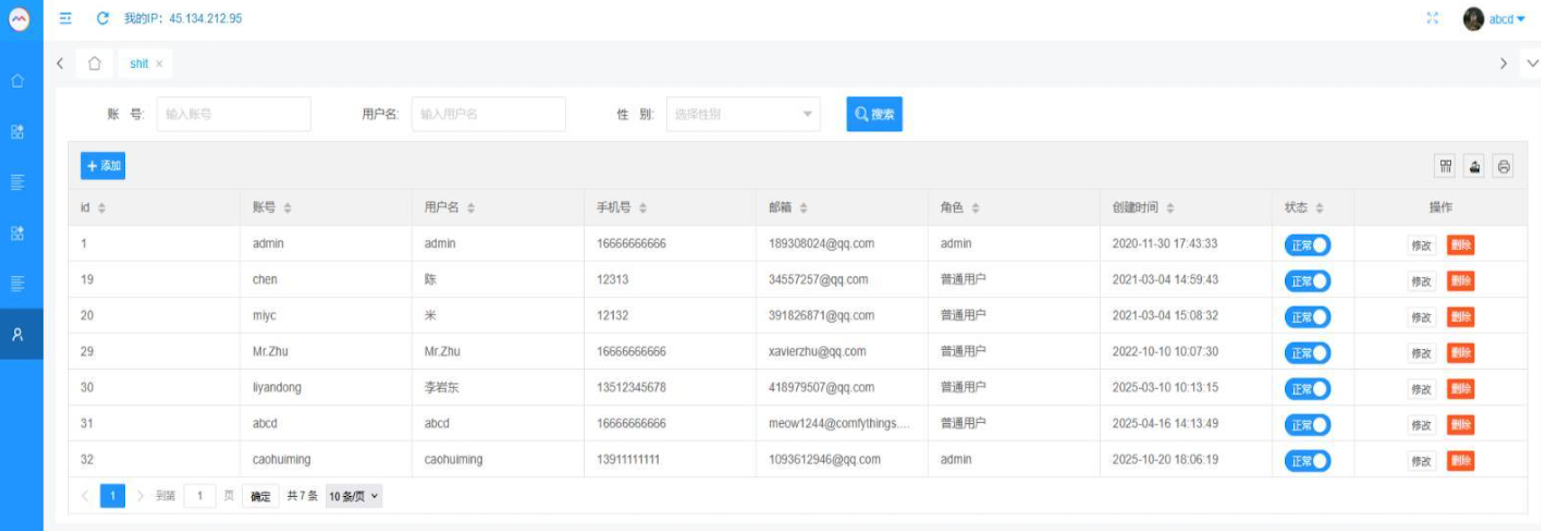
That screenshot, a portion of which is shown below, shows seven authorized users of the control panel, including one that doesn’t quite match the others: According to my source, the account “ABCD” (the one that is logged in and listed in the top right of the screenshot) belongs to Dort, who somehow figured out how to add their email address as a valid user of the Badbox 2.0 botnet.
The control panel for the Badbox 2.0 botnet lists seven authorized users and their email addresses. Click to enlarge.
Badbox has a storied history that well predates Kimwolf’s rise in October 2025. In July 2025, Google filed a “John Doe” lawsuit (PDF) against 25 unidentified defendants accused of operating Badbox 2.0, which Google described as a botnet of over ten million unsanctioned Android streaming devices engaged in advertising fraud. Google said Badbox 2.0, in addition to compromising multiple types of devices prior to purchase, also can infect devices by requiring the download of malicious apps from unofficial marketplaces.
Google’s lawsuit came on the heels of a June 2025 advisory from the Federal Bureau of Investigation (FBI), which warned that cyber criminals were gaining unauthorized access to home networks by either configuring the products with malware prior to the user’s purchase, or infecting the device as it downloads required applications that contain backdoors — usually during the set-up process.
The FBI said Badbox 2.0 was discovered after the original Badbox campaign was disrupted in 2024. The original Badbox was identified in 2023, and primarily consisted of Android operating system devices (TV boxes) that were compromised with backdoor malware prior to purchase.
KrebsOnSecurity was initially skeptical of the claim that the Kimwolf botmasters had hacked the Badbox 2.0 botnet. That is, until we began digging into the history of the qq.com email addresses in the screenshot above.
An online search for the address 34557257@qq.com (pictured in the screenshot above as the user “Chen“) shows it is listed as a point of contact for a number of China-based technology companies, including:
–Beijing Hong Dake Wang Science & Technology Co Ltd.
–Beijing Hengchuang Vision Mobile Media Technology Co. Ltd.
–Moxin Beijing Science and Technology Co. Ltd.
The website for Beijing Hong Dake Wang Science is asmeisvip[.]net, a domain that was flagged in a March 2025 report by HUMAN Security as one of several dozen sites tied to the distribution and management of the Badbox 2.0 botnet. Ditto for moyix[.]com, a domain associated with Beijing Hengchuang Vision Mobile.
A search at the breach tracking service Constella Intelligence finds 34557257@qq.com at one point used the password “cdh76111.” Pivoting on that password in Constella shows it is known to have been used by just two other email accounts: daihaic@gmail.com and cathead@gmail.com.
Constella found cathead@gmail.com registered an account at jd.com (China’s largest online retailer) in 2021 under the name “陈代海,” which translates to “Chen Daihai.” According to DomainTools.com, the name Chen Daihai is present in the original registration records (2008) for moyix[.]com, along with the email address cathead@astrolink[.]cn.
Incidentally, astrolink[.]cn also is among the Badbox 2.0 domains identified in HUMAN Security’s 2025 report. DomainTools finds cathead@astrolink[.]cn was used to register more than a dozen domains, including vmud[.]net, yet another Badbox 2.0 domain tagged by HUMAN Security.
A cached copy of astrolink[.]cn preserved at archive.org shows the website belongs to a mobile app development company whose full name is Beijing Astrolink Wireless Digital Technology Co. Ltd. The archived website reveals a “Contact Us” page that lists a Chen Daihai as part of the company’s technology department. The other person featured on that contact page is Zhu Zhiyu, and their email address is listed as xavier@astrolink[.]cn.
A Google-translated version of Astrolink’s website, circa 2009. Image: archive.org.
Astute readers will notice that the user Mr.Zhu in the Badbox 2.0 panel used the email address xavierzhu@qq.com. Searching this address in Constella reveals a jd.com account registered in the name of Zhu Zhiyu. A rather unique password used by this account matches the password used by the address xavierzhu@gmail.com, which DomainTools finds was the original registrant of astrolink[.]cn.
The very first account listed in the Badbox 2.0 panel — “admin,” registered in November 2020 — used the email address 189308024@qq.com. DomainTools shows this email is found in the 2022 registration records for the domain guilincloud[.]cn, which includes the registrant name “Huang Guilin.”
Constella finds 189308024@qq.com is associated with the China phone number 18681627767. The open-source intelligence platform osint.industries reveals this phone number is connected to a Microsoft profile created in 2014 under the name Guilin Huang (桂林 黄). The cyber intelligence platform Spycloud says that phone number was used in 2017 to create an account at the Chinese social media platform Weibo under the username “h_guilin.”
The public information attached to Guilin Huang’s Microsoft account, according to the breach tracking service osintindustries.com.
The remaining three users and corresponding qq.com email addresses were all connected to individuals in China. However, none of them (nor Mr. Huang) had any apparent connection to the entities created and operated by Chen Daihai and Zhu Zhiyu — or to any corporate entities for that matter. Also, none of these individuals responded to requests for comment.
The mind map below includes search pivots on the email addresses, company names and phone numbers that suggest a connection between Chen Daihai, Zhu Zhiyu, and Badbox 2.0.
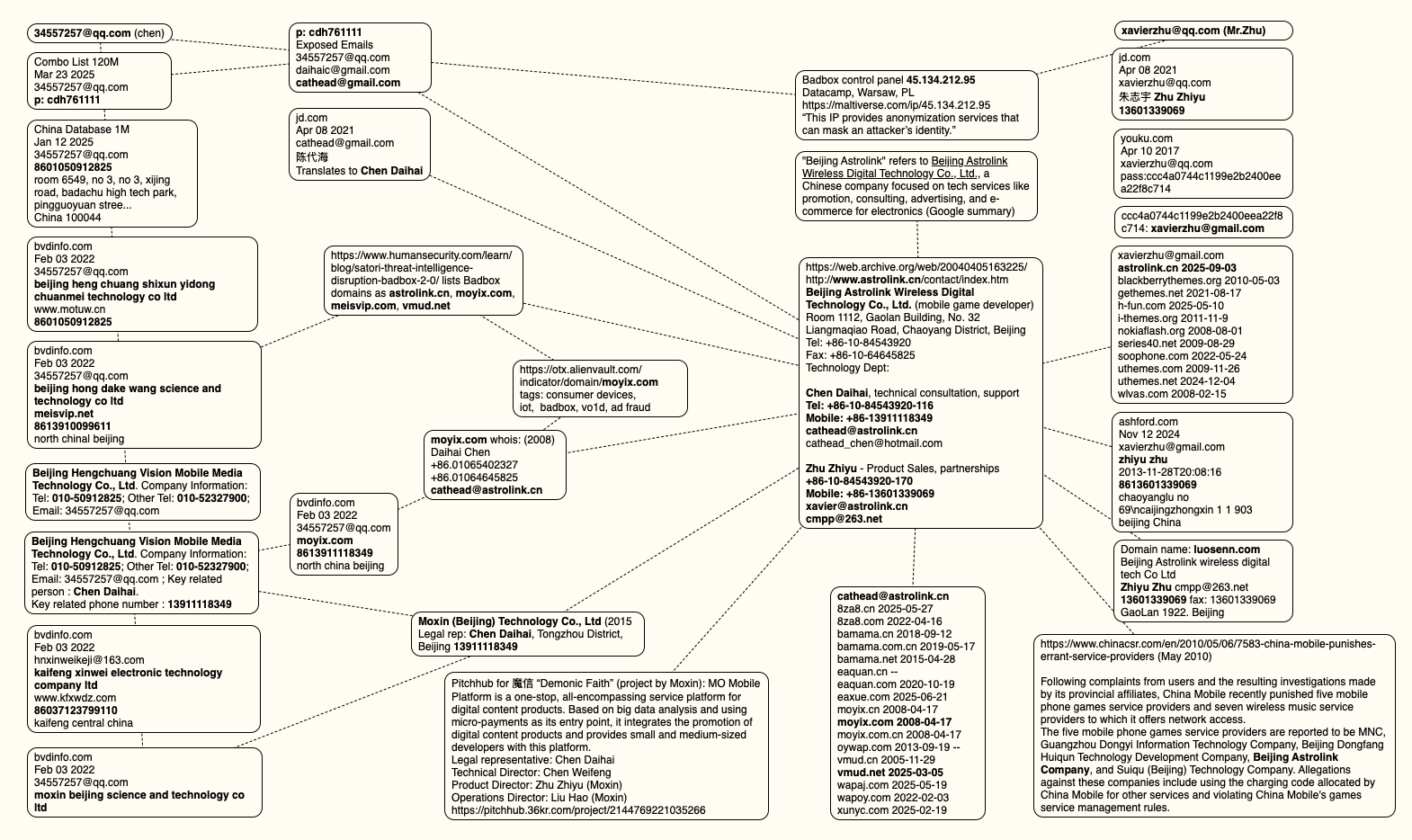
This mind map includes search pivots on the email addresses, company names and phone numbers that appear to connect Chen Daihai and Zhu Zhiyu to Badbox 2.0. Click to enlarge.
The idea that the Kimwolf botmasters could have direct access to the Badbox 2.0 botnet is a big deal, but explaining exactly why that is requires some background on how Kimwolf spreads to new devices. The botmasters figured out they could trick residential proxy services into relaying malicious commands to vulnerable devices behind the firewall on the unsuspecting user’s local network.
The vulnerable systems sought out by Kimwolf are primarily Internet of Things (IoT) devices like unsanctioned Android TV boxes and digital photo frames that have no discernible security or authentication built-in. Put simply, if you can communicate with these devices, you can compromise them with a single command.
Our January 2 story featured research from the proxy-tracking firm Synthient, which alerted 11 different residential proxy providers that their proxy endpoints were vulnerable to being abused for this kind of local network probing and exploitation.
Most of those vulnerable proxy providers have since taken steps to prevent customers from going upstream into the local networks of residential proxy endpoints, and it appeared that Kimwolf would no longer be able to quickly spread to millions of devices simply by exploiting some residential proxy provider.
However, the source of that Badbox 2.0 screenshot said the Kimwolf botmasters had an ace up their sleeve the whole time: Secret access to the Badbox 2.0 botnet control panel.
“Dort has gotten unauthorized access,” the source said. “So, what happened is normal proxy providers patched this. But Badbox doesn’t sell proxies by itself, so it’s not patched. And as long as Dort has access to Badbox, they would be able to load” the Kimwolf malware directly onto TV boxes associated with Badbox 2.0.
The source said it isn’t clear how Dort gained access to the Badbox botnet panel. But it’s unlikely that Dort’s existing account will persist for much longer: All of our notifications to the qq.com email addresses listed in the control panel screenshot received a copy of that image, as well as questions about the apparently rogue ABCD account.
Cybercriminals are abusing a widespread lack of authentication in the customer service platform Zendesk to flood targeted email inboxes with menacing messages that come from hundreds of Zendesk corporate customers simultaneously.
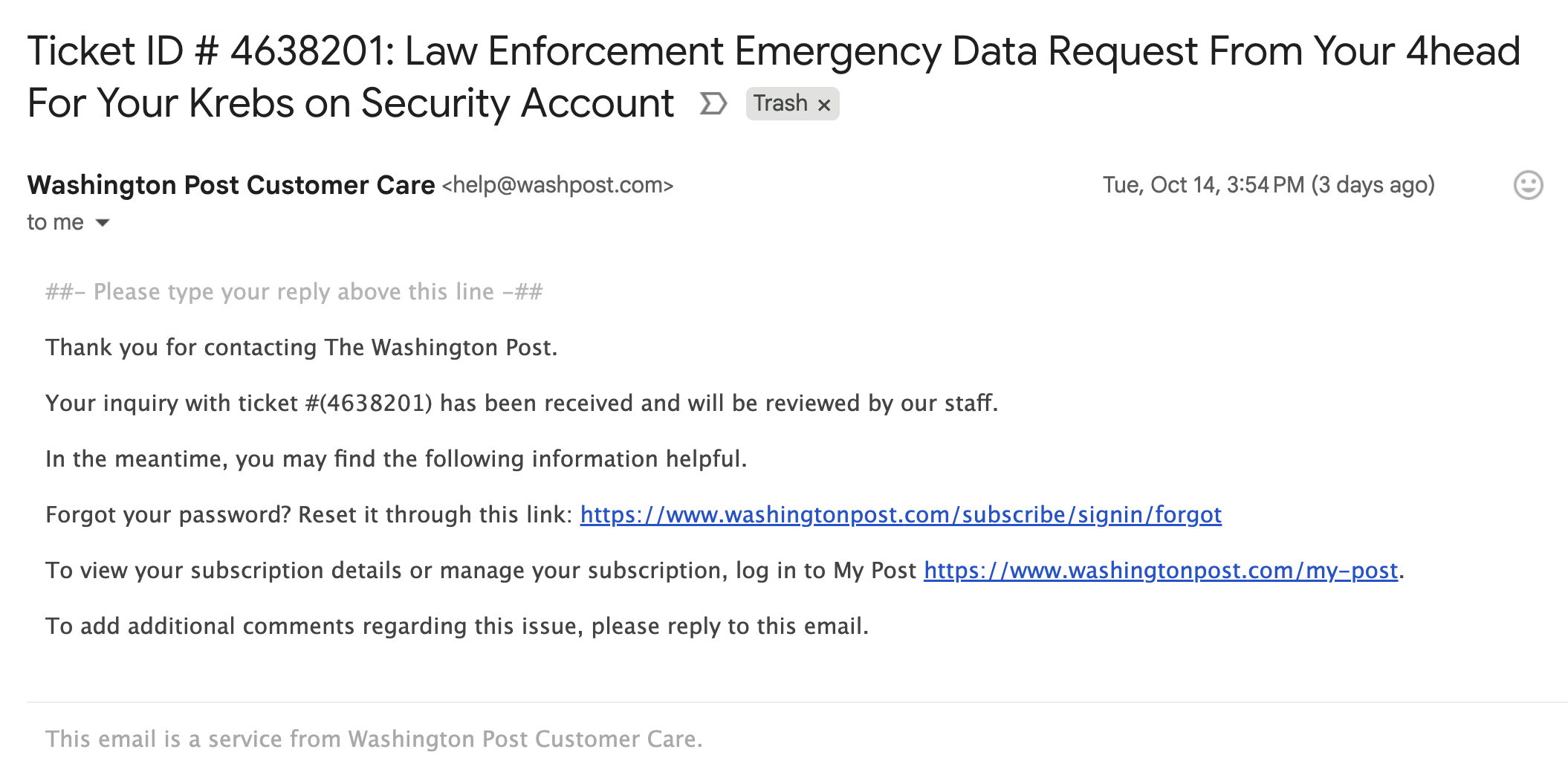
Zendesk is an automated help desk service designed to make it simple for people to contact companies for customer support issues. Earlier this week, KrebsOnSecurity started receiving thousands of ticket creation notification messages through Zendesk in rapid succession, each bearing the name of different Zendesk customers, such as CapCom, CompTIA, Discord, GMAC, NordVPN, The Washington Post, and Tinder.
The abusive missives sent via Zendesk’s platform can include any subject line chosen by the abusers. In my case, the messages variously warned about a supposed law enforcement investigation involving KrebsOnSecurity.com, or else contained personal insults.
Moreover, the automated messages that are sent out from this type of abuse all come from customer domain names — not from Zendesk. In the example below, replying to any of the junk customer support responses from The Washington Post’s Zendesk installation shows the reply-to address is help@washpost.com.
One of dozens of messages sent to me this week by The Washington Post.
Notified about the mass abuse of their platform, Zendesk said the emails were ticket creation notifications from customer accounts that configured their Zendesk instance to allow anyone to submit support requests — including anonymous users.
“These types of support tickets can be part of a customer’s workflow, where a prior verification is not required to allow them to engage and make use of the Support capabilities,” said Carolyn Camoens, communications director at Zendesk. “Although we recommend our customers to permit only verified users to submit tickets, some Zendesk customers prefer to use an anonymous environment to allow for tickets to be created due to various business reasons.”
Camoens said requests that can be submitted in an anonymous manner can also make use of an email address of the submitter’s choice.
“However, this method can also be used for spam requests to be created on behalf of third party email addresses,” Camoens said. “If an account has enabled the auto-responder trigger based on ticket creation, then this allows for the ticket notification email to be sent from our customer’s accounts to these third parties. The notification will also include the Subject added by the creator of these tickets.”
Zendesk claims it uses rate limits to prevent a high volume of requests from being created at once, but those limits did not stop Zendesk customers from flooding my inbox with thousands of messages in just a few hours.
“We recognize that our systems were leveraged against you in a distributed, many-against-one manner,” Camoens said. “We are actively investigating additional preventive measures. We are also advising customers experiencing this type of activity to follow our general security best practices and configure an authenticated ticket creation workflow.”
In all of the cases above, the messaging abuse would not have been possible if Zendesk customers validated support request email addresses prior to sending responses. Failing to do so may make it easier for Zendesk clients to handle customer support requests, but it also allows ne’er-do-wells to sully the sender’s brand in service of disruptive and malicious email floods.

U.S. prosecutors last week levied criminal hacking charges against 19-year-old U.K. national Thalha Jubair for allegedly being a core member of Scattered Spider, a prolific cybercrime group blamed for extorting at least $115 million in ransom payments from victims. The charges came as Jubair and an alleged co-conspirator appeared in a London court to face accusations of hacking into and extorting several large U.K. retailers, the London transit system, and healthcare providers in the United States.
At a court hearing last week, U.K. prosecutors laid out a litany of charges against Jubair and 18-year-old Owen Flowers, accusing the teens of involvement in an August 2024 cyberattack that crippled Transport for London, the entity responsible for the public transport network in the Greater London area.
A court artist sketch of Owen Flowers (left) and Thalha Jubair appearing at Westminster Magistrates’ Court last week. Credit: Elizabeth Cook, PA Wire.
On July 10, 2025, KrebsOnSecurity reported that Flowers and Jubair had been arrested in the United Kingdom in connection with recent Scattered Spider ransom attacks against the retailers Marks & Spencer and Harrods, and the British food retailer Co-op Group.
That story cited sources close to the investigation saying Flowers was the Scattered Spider member who anonymously gave interviews to the media in the days after the group’s September 2023 ransomware attacks disrupted operations at Las Vegas casinos operated by MGM Resorts and Caesars Entertainment.
The story also noted that Jubair’s alleged handles on cybercrime-focused Telegram channels had far lengthier rap sheets involving some of the more consequential and headline-grabbing data breaches over the past four years. What follows is an account of cybercrime activities that prosecutors have attributed to Jubair’s alleged hacker handles, as told by those accounts in posts to public Telegram channels that are closely monitored by multiple cyber intelligence firms.
Jubair is alleged to have been a core member of the LAPSUS$ cybercrime group that broke into dozens of technology companies beginning in late 2021, stealing source code and other internal data from tech giants including Microsoft, Nvidia, Okta, Rockstar Games, Samsung, T-Mobile, and Uber.
That is, according to the former leader of the now-defunct LAPSUS$. In April 2022, KrebsOnSecurity published internal chat records taken from a server that LAPSUS$ used, and those chats indicate Jubair was working with the group using the nicknames Amtrak and Asyntax. In the middle of the gang’s cybercrime spree, Asyntax told the LAPSUS$ leader not to share T-Mobile’s logo in images sent to the group because he’d been previously busted for SIM-swapping and his parents would suspect he was back at it again.
The leader of LAPSUS$ responded by gleefully posting Asyntax’s real name, phone number, and other hacker handles into a public chat room on Telegram:
In March 2022, the leader of the LAPSUS$ data extortion group exposed Thalha Jubair’s name and hacker handles in a public chat room on Telegram.
That story about the leaked LAPSUS$ chats also connected Amtrak/Asyntax to several previous hacker identities, including “Everlynn,” who in April 2021 began offering a cybercriminal service that sold fraudulent “emergency data requests” targeting the major social media and email providers.
In these so-called “fake EDR” schemes, the hackers compromise email accounts tied to police departments and government agencies, and then send unauthorized demands for subscriber data (e.g. username, IP/email address), while claiming the information being requested can’t wait for a court order because it relates to an urgent matter of life and death.
The roster of the now-defunct “Infinity Recursion” hacking team, which sold fake EDRs between 2021 and 2022. The founder “Everlynn” has been tied to Jubair. The member listed as “Peter” became the leader of LAPSUS$ who would later post Jubair’s name, phone number and hacker handles into LAPSUS$’s chat channel.
Prosecutors in New Jersey last week alleged Jubair was part of a threat group variously known as Scattered Spider, 0ktapus, and UNC3944, and that he used the nicknames EarthtoStar, Brad, Austin, and Austistic.
Beginning in 2022, EarthtoStar co-ran a bustling Telegram channel called Star Chat, which was home to a prolific SIM-swapping group that relentlessly used voice- and SMS-based phishing attacks to steal credentials from employees at the major wireless providers in the U.S. and U.K.
Jubair allegedly used the handle “Earth2Star,” a core member of a prolific SIM-swapping group operating in 2022. This ad produced by the group lists various prices for SIM swaps.
The group would then use that access to sell a SIM-swapping service that could redirect a target’s phone number to a device the attackers controlled, allowing them to intercept the victim’s phone calls and text messages (including one-time codes). Members of Star Chat targeted multiple wireless carriers with SIM-swapping attacks, but they focused mainly on phishing T-Mobile employees.
In February 2023, KrebsOnSecurity scrutinized more than seven months of these SIM-swapping solicitations on Star Chat, which almost daily peppered the public channel with “Tmo up!” and “Tmo down!” notices indicating periods wherein the group claimed to have active access to T-Mobile’s network.
A redacted receipt from Star Chat’s SIM-swapping service targeting a T-Mobile customer after the group gained access to internal T-Mobile employee tools.
The data showed that Star Chat — along with two other SIM-swapping groups operating at the same time — collectively broke into T-Mobile over a hundred times in the last seven months of 2022. However, Star Chat was by far the most prolific of the three, responsible for at least 70 of those incidents.
The 104 days in the latter half of 2022 in which different known SIM-swapping groups claimed access to T-Mobile employee tools. Star Chat was responsible for a majority of these incidents. Image: krebsonsecurity.com.
A review of EarthtoStar’s messages on Star Chat as indexed by the threat intelligence firm Flashpoint shows this person also sold “AT&T email resets” and AT&T call forwarding services for up to $1,200 per line. EarthtoStar explained the purpose of this service in post on Telegram:
“Ok people are confused, so you know when u login to chase and it says ‘2fa required’ or whatever the fuck, well it gives you two options, SMS or Call. If you press call, and I forward the line to you then who do you think will get said call?”
New Jersey prosecutors allege Jubair also was involved in a mass SMS phishing campaign during the summer of 2022 that stole single sign-on credentials from employees at hundreds of companies. The text messages asked users to click a link and log in at a phishing page that mimicked their employer’s Okta authentication page, saying recipients needed to review pending changes to their upcoming work schedules.
The phishing websites used a Telegram instant message bot to forward any submitted credentials in real-time, allowing the attackers to use the phished username, password and one-time code to log in as that employee at the real employer website.
That weeks-long SMS phishing campaign led to intrusions and data thefts at more than 130 organizations, including LastPass, DoorDash, Mailchimp, Plex and Signal.
A visual depiction of the attacks by the SMS phishing group known as 0ktapus, ScatterSwine, and Scattered Spider. Image: Amitai Cohen twitter.com/amitaico.
EarthtoStar’s group Star Chat specialized in phishing their way into business process outsourcing (BPO) companies that provide customer support for a range of multinational companies, including a number of the world’s largest telecommunications providers. In May 2022, EarthtoStar posted to the Telegram channel “Frauwudchat”:
“Hi, I am looking for partners in order to exfiltrate data from large telecommunications companies/call centers/alike, I have major experience in this field, [including] a massive call center which houses 200,000+ employees where I have dumped all user credentials and gained access to the [domain controller] + obtained global administrator I also have experience with REST API’s and programming. I have extensive experience with VPN, Citrix, cisco anyconnect, social engineering + privilege escalation. If you have any Citrix/Cisco VPN or any other useful things please message me and lets work.”
At around the same time in the Summer of 2022, at least two different accounts tied to Star Chat — “RocketAce” and “Lopiu” — introduced the group’s services to denizens of the Russian-language cybercrime forum Exploit, including:
-SIM-swapping services targeting Verizon and T-Mobile customers;
-Dynamic phishing pages targeting customers of single sign-on providers like Okta;
-Malware development services;
-The sale of extended validation (EV) code signing certificates.
The user “Lopiu” on the Russian cybercrime forum Exploit advertised many of the same unique services offered by EarthtoStar and other Star Chat members. Image source: ke-la.com.
These two accounts on Exploit created multiple sales threads in which they claimed administrative access to U.S. telecommunications providers and asked other Exploit members for help in monetizing that access. In June 2022, RocketAce, which appears to have been just one of EarthtoStar’s many aliases, posted to Exploit:
Hello. I have access to a telecommunications company’s citrix and vpn. I would like someone to help me break out of the system and potentially attack the domain controller so all logins can be extracted we can discuss payment and things leave your telegram in the comments or private message me ! Looking for someone with knowledge in citrix/privilege escalation
On Nov. 15, 2022, EarthtoStar posted to their Star Sanctuary Telegram channel that they were hiring malware developers with a minimum of three years of experience and the ability to develop rootkits, backdoors and malware loaders.
“Optional: Endorsed by advanced APT Groups (e.g. Conti, Ryuk),” the ad concluded, referencing two of Russia’s most rapacious and destructive ransomware affiliate operations. “Part of a nation-state / ex-3l (3 letter-agency).”
The Telegram and Discord chat channels wherein Flowers and Jubair allegedly planned and executed their extortion attacks are part of a loose-knit network known as the Com, an English-speaking cybercrime community consisting mostly of individuals living in the United States, the United Kingdom, Canada and Australia.
Many of these Com chat servers have hundreds to thousands of members each, and some of the more interesting solicitations on these communities are job offers for in-person assignments and tasks that can be found if one searches for posts titled, “If you live near,” or “IRL job” — short for “in real life” job.
These “violence-as-a-service” solicitations typically involve “brickings,” where someone is hired to toss a brick through the window at a specified address. Other IRL jobs for hire include tire-stabbings, molotov cocktail hurlings, drive-by shootings, and even home invasions. The people targeted by these services are typically other criminals within the community, but it’s not unusual to see Com members asking others for help in harassing or intimidating security researchers and even the very law enforcement officers who are investigating their alleged crimes.
It remains unclear what precipitated this incident or what followed directly after, but on January 13, 2023, a Star Sanctuary account used by EarthtoStar solicited the home invasion of a sitting U.S. federal prosecutor from New York. That post included a photo of the prosecutor taken from the Justice Department’s website, along with the message:
“Need irl niggas, in home hostage shit no fucking pussies no skinny glock holding 100 pound niggas either”
Throughout late 2022 and early 2023, EarthtoStar’s alias “Brad” (a.k.a. “Brad_banned”) frequently advertised Star Chat’s malware development services, including custom malicious software designed to hide the attacker’s presence on a victim machine:
We can develop KERNEL malware which will achieve persistence for a long time,
bypass firewalls and have reverse shell access.This shit is literally like STAGE 4 CANCER FOR COMPUTERS!!!
Kernel meaning the highest level of authority on a machine.
This can range to simple shells to Bootkits.Bypass all major EDR’s (SentinelOne, CrowdStrike, etc)
Patch EDR’s scanning functionality so it’s rendered useless!Once implanted, extremely difficult to remove (basically impossible to even find)
Development Experience of several years and in multiple APT Groups.Be one step ahead of the game. Prices start from $5,000+. Message @brad_banned to get a quote
In September 2023 , both MGM Resorts and Caesars Entertainment suffered ransomware attacks at the hands of a Russian ransomware affiliate program known as ALPHV and BlackCat. Caesars reportedly paid a $15 million ransom in that incident.
Within hours of MGM publicly acknowledging the 2023 breach, members of Scattered Spider were claiming credit and telling reporters they’d broken in by social engineering a third-party IT vendor. At a hearing in London last week, U.K. prosecutors told the court Jubair was found in possession of more than $50 million in ill-gotten cryptocurrency, including funds that were linked to the Las Vegas casino hacks.
The Star Chat channel was finally banned by Telegram on March 9, 2025. But U.S. prosecutors say Jubair and fellow Scattered Spider members continued their hacking, phishing and extortion activities up until September 2025.
In April 2025, the Com was buzzing about the publication of “The Com Cast,” a lengthy screed detailing Jubair’s alleged cybercriminal activities and nicknames over the years. This account included photos and voice recordings allegedly of Jubair, and asserted that in his early days on the Com Jubair used the nicknames Clark and Miku (these are both aliases used by Everlynn in connection with their fake EDR services).
Thalha Jubair (right), without his large-rimmed glasses, in an undated photo posted in The Com Cast.
More recently, the anonymous Com Cast author(s) claimed, Jubair had used the nickname “Operator,” which corresponds to a Com member who ran an automated Telegram-based doxing service that pulled consumer records from hacked data broker accounts. That public outing came after Operator allegedly seized control over the Doxbin, a long-running and highly toxic community that is used to “dox” or post deeply personal information on people.
“Operator/Clark/Miku: A key member of the ransomware group Scattered Spider, which consists of a diverse mix of individuals involved in SIM swapping and phishing,” the Com Cast account stated. “The group is an amalgamation of several key organizations, including Infinity Recursion (owned by Operator), True Alcorians (owned by earth2star), and Lapsus, which have come together to form a single collective.”
The New Jersey complaint (PDF) alleges Jubair and other Scattered Spider members committed computer fraud, wire fraud, and money laundering in relation to at least 120 computer network intrusions involving 47 U.S. entities between May 2022 and September 2025. The complaint alleges the group’s victims paid at least $115 million in ransom payments.
U.S. authorities say they traced some of those payments to Scattered Spider to an Internet server controlled by Jubair. The complaint states that a cryptocurrency wallet discovered on that server was used to purchase several gift cards, one of which was used at a food delivery company to send food to his apartment. Another gift card purchased with cryptocurrency from the same server was allegedly used to fund online gaming accounts under Jubair’s name. U.S. prosecutors said that when they seized that server they also seized $36 million in cryptocurrency.
The complaint also charges Jubair with involvement in a hacking incident in January 2025 against the U.S. courts system that targeted a U.S. magistrate judge overseeing a related Scattered Spider investigation. That other investigation appears to have been the prosecution of Noah Michael Urban, a 20-year-old Florida man charged in November 2024 by prosecutors in Los Angeles as one of five alleged Scattered Spider members.
Urban pleaded guilty in April 2025 to wire fraud and conspiracy charges, and in August he was sentenced to 10 years in federal prison. Speaking with KrebsOnSecurity from jail after his sentencing, Urban asserted that the judge gave him more time than prosecutors requested because he was mad that Scattered Spider hacked his email account.
Noah “Kingbob” Urban, posting to Twitter/X around the time of his sentencing on Aug. 20.
A court transcript (PDF) from a status hearing in February 2025 shows Urban was telling the truth about the hacking incident that happened while he was in federal custody. The judge told attorneys for both sides that a co-defendant in the California case was trying to find out about Mr. Urban’s activity in the Florida case, and that the hacker accessed the account by impersonating a judge over the phone and requesting a password reset.
Allison Nixon is chief research officer at the New York based security firm Unit 221B, and easily one of the world’s leading experts on Com-based cybercrime activity. Nixon said the core problem with legally prosecuting well-known cybercriminals from the Com has traditionally been that the top offenders tend to be under the age of 18, and thus difficult to charge under federal hacking statutes.
In the United States, prosecutors typically wait until an underage cybercrime suspect becomes an adult to charge them. But until that day comes, she said, Com actors often feel emboldened to continue committing — and very often bragging about — serious cybercrime offenses.
“Here we have a special category of Com offenders that effectively enjoy legal immunity,” Nixon told KrebsOnSecurity. “Most get recruited to Com groups when they are older, but of those that join very young, such as 12 or 13, they seem to be the most dangerous because at that age they have no grounding in reality and so much longevity before they exit their legal immunity.”
Nixon said U.K. authorities face the same challenge when they briefly detain and search the homes of underage Com suspects: Namely, the teen suspects simply go right back to their respective cliques in the Com and start robbing and hurting people again the minute they’re released.
Indeed, the U.K. court heard from prosecutors last week that both Scattered Spider suspects were detained and/or searched by local law enforcement on multiple occasions, only to return to the Com less than 24 hours after being released each time.
“What we see is these young Com members become vectors for perpetrators to commit enormously harmful acts and even child abuse,” Nixon said. “The members of this special category of people who enjoy legal immunity are meeting up with foreign nationals and conducting these sometimes heinous acts at their behest.”
Nixon said many of these individuals have few friends in real life because they spend virtually all of their waking hours on Com channels, and so their entire sense of identity, community and self-worth gets wrapped up in their involvement with these online gangs. She said if the law was such that prosecutors could treat these people commensurate with the amount of harm they cause society, that would probably clear up a lot of this problem.
“If law enforcement was allowed to keep them in jail, they would quit reoffending,” she said.
The Times of London reports that Flowers is facing three charges under the Computer Misuse Act: two of conspiracy to commit an unauthorized act in relation to a computer causing/creating risk of serious damage to human welfare/national security and one of attempting to commit the same act. Maximum sentences for these offenses can range from 14 years to life in prison, depending on the impact of the crime.
Jubair is reportedly facing two charges in the U.K.: One of conspiracy to commit an unauthorized act in relation to a computer causing/creating risk of serious damage to human welfare/national security and one of failing to comply with a section 49 notice to disclose the key to protected information.
In the United States, Jubair is charged with computer fraud conspiracy, two counts of computer fraud, wire fraud conspiracy, two counts of wire fraud, and money laundering conspiracy. If extradited to the U.S., tried and convicted on all charges, he faces a maximum penalty of 95 years in prison.
In July 2025, the United Kingdom barred victims of hacking from paying ransoms to cybercriminal groups unless approved by officials. U.K. organizations that are considered part of critical infrastructure reportedly will face a complete ban, as will the entire public sector. U.K. victims of a hack are now required to notify officials to better inform policymakers on the scale of Britain’s ransomware problem.
For further reading (bless you), check out Bloomberg’s poignant story last week based on a year’s worth of jailhouse interviews with convicted Scattered Spider member Noah Urban.
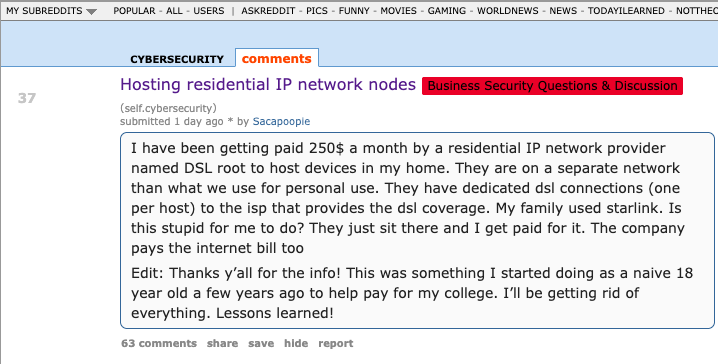
The cybersecurity community on Reddit responded in disbelief this month when a self-described Air National Guard member with top secret security clearance began questioning the arrangement they’d made with company called DSLRoot, which was paying $250 a month to plug a pair of laptops into the Redditor’s high-speed Internet connection in the United States. This post examines the history and provenance of DSLRoot, one of the oldest “residential proxy” networks with origins in Russia and Eastern Europe.
The query about DSLRoot came from a Reddit user “Sacapoopie,” who did not respond to questions. This user has since deleted the original question from their post, although some of their replies to other Reddit cybersecurity enthusiasts remain in the thread. The original post was indexed here by archive.is, and it began with a question:
“I have been getting paid 250$ a month by a residential IP network provider named DSL root to host devices in my home,” Sacapoopie wrote. “They are on a separate network than what we use for personal use. They have dedicated DSL connections (one per host) to the ISP that provides the DSL coverage. My family used Starlink. Is this stupid for me to do? They just sit there and I get paid for it. The company pays the internet bill too.”
Many Redditors said they assumed Sacapoopie’s post was a joke, and that nobody with a cybersecurity background and top-secret (TS/SCI) clearance would agree to let some shady residential proxy company introduce hardware into their network. Other readers pointed to a slew of posts from Sacapoopie in the Cybersecurity subreddit over the past two years about their work on cybersecurity for the Air National Guard.
When pressed for more details by fellow Redditors, Sacapoopie described the equipment supplied by DSLRoot as “just two laptops hardwired into a modem, which then goes to a dsl port in the wall.”
“When I open the computer, it looks like [they] have some sort of custom application that runs and spawns several cmd prompts,” the Redditor explained. “All I can infer from what I see in them is they are making connections.”
When asked how they became acquainted with DSLRoot, Sacapoopie told another user they discovered the company and reached out after viewing an advertisement on a social media platform.
“This was probably 5-6 years ago,” Sacapoopie wrote. “Since then I just communicate with a technician from that company and I help trouble shoot connectivity issues when they arise.”
Reached for comment, DSLRoot said its brand has been unfairly maligned thanks to that Reddit discussion. The unsigned email said DSLRoot is fully transparent about its goals and operations, adding that it operates under full consent from its “regional agents,” the company’s term for U.S. residents like Sacapoopie.
“As although we support honest journalism, we’re against of all kinds of ‘low rank/misleading Yellow Journalism’ done for the sake of cheap hype,” DSLRoot wrote in reply. “It’s obvious to us that whoever is doing this, is either lacking a proper understanding of the subject or doing it intentionally to gain exposure by misleading those who lack proper understanding,” DSLRoot wrote in answer to questions about the company’s intentions.
“We monitor our clients and prohibit any illegal activity associated with our residential proxies,” DSLRoot continued. “We honestly didn’t know that the guy who made the Reddit post was a military guy. Be it an African-American granny trying to pay her rent or a white kid trying to get through college, as long as they can provide an Internet line or host phones for us — we’re good.”
DSLRoot is sold as a residential proxy service on the forum BlackHatWorld under the name DSLRoot and GlobalSolutions. The company is based in the Bahamas and was formed in 2012. The service is advertised to people who are not in the United States but who want to seem like they are. DSLRoot pays people in the United States to run the company’s hardware and software — including 5G mobile devices — and in return it rents those IP addresses as dedicated proxies to customers anywhere in the world — priced at $190 per month for unrestricted access to all locations.
The DSLRoot website.
The GlobalSolutions account on BlackHatWorld lists a Telegram account and a WhatsApp number in Mexico. DSLRoot’s profile on the marketing agency digitalpoint.com from 2010 shows their previous username on the forum was “Incorptoday.” GlobalSolutions user accounts at bitcointalk[.]org and roclub[.]com include the email clickdesk@instantvirtualcreditcards[.]com.
Passive DNS records from DomainTools.com show instantvirtualcreditcards[.]com shared a host back then — 208.85.1.164 — with just a handful of domains, including dslroot[.]com, regacard[.]com, 4groot[.]com, residential-ip[.]com, 4gemperor[.]com, ip-teleport[.]com, proxysource[.]net and proxyrental[.]net.
Cyber intelligence firm Intel 471 finds GlobalSolutions registered on BlackHatWorld in 2016 using the email address prepaidsolutions@yahoo.com. This user shared that their birthday is March 7, 1984.
Several negative reviews about DSLRoot on the forums noted that the service was operated by a BlackHatWorld user calling himself “USProxyKing.” Indeed, Intel 471 shows this user told fellow forum members in 2013 to contact him at the Skype username “dslroot.”
USProxyKing on BlackHatWorld, soliciting installations of his adware via torrents and file-sharing sites.
USProxyKing had a reputation for spamming the forums with ads for his residential proxy service, and he ran a “pay-per-install” program where he paid affiliates a small commission each time one of their websites resulted in the installation of his unspecified “adware” programs — presumably a program that turned host PCs into proxies. On the other end of the business, USProxyKing sold that pay-per-install access to others wishing to distribute questionable software — at $1 per installation.
Private messages indexed by Intel 471 show USProxyKing also raised money from nearly 20 different BlackHatWorld members who were promised shareholder positions in a new business that would offer robocalling services capable of placing 2,000 calls per minute.
Constella Intelligence, a platform that tracks data exposed in breaches, finds that same IP address GlobalSolutions used to register at BlackHatWorld was also used to create accounts at a handful of sites, including a GlobalSolutions user account at WebHostingTalk that supplied the email address incorptoday@gmail.com. Also registered to incorptoday@gmail.com are the domains dslbay[.]com, dslhub[.]net, localsim[.]com, rdslpro[.]com, virtualcards[.]biz/cc, and virtualvisa[.]cc.
Recall that DSLRoot’s profile on digitalpoint.com was previously named Incorptoday. DomainTools says incorptoday@gmail.com is associated with almost two dozen domains going back to 2008, including incorptoday[.]com, a website that offers to incorporate businesses in several states, including Delaware, Florida and Nevada, for prices ranging from $450 to $550.
As we can see in this archived copy of the site from 2013, IncorpToday also offered a premiere service for $750 that would allow the customer’s new company to have a retail checking account, with no questions asked.
Global Solutions is able to provide access to the U.S. banking system by offering customers prepaid cards that can be loaded with a variety of virtual payment instruments that were popular in Russian-speaking countries at the time, including WebMoney. The cards are limited to $500 balances, but non-Westerners can use them to anonymously pay for goods and services at a variety of Western companies. Cardnow[.]ru, another domain registered to incorptoday@gmail.com, demonstrates this in action.
A copy of Incorptoday’s website from 2013 offers non-US residents a service to incorporate a business in Florida, Delaware or Nevada, along with a no-questions-asked checking account, for $750.
The oldest domain (2008) registered to incorptoday@gmail.com is andrei[.]me; another is called andreigolos[.]com. DomainTools says these and other domains registered to that email address include the registrant name Andrei Holas, from Huntsville, Ala.
Public records indicate Andrei Holas has lived with his brother — Aliaksandr Holas — at two different addresses in Alabama. Those records state that Andrei Holas’ birthday is in March 1984, and that his brother is slightly younger. The younger brother did not respond to a request for comment.
Andrei Holas maintained an account on the Russian social network Vkontakte under the email address ryzhik777@gmail.com, an address that shows up in numerous records hacked and leaked from Russian government entities over the past few years.
Those records indicate Andrei Holas and his brother are from Belarus and have maintained an address in Moscow for some time (that address is roughly three blocks away from the main headquarters of the Russian FSB, the successor intelligence agency to the KGB). Hacked Russian banking records show Andrei Holas’ birthday is March 7, 1984 — the same birth date listed by GlobalSolutions on BlackHatWorld.
A 2010 post by ryzhik777@gmail.com at the Russian-language forum Ulitka explains that the poster was having trouble getting his B1/B2 visa to visit his brother in the United States, even though he’d previously been approved for two separate guest visas and a student visa. It remains unclear if one, both, or neither of the Holas brothers still lives in the United States. Andrei explained in 2010 that his brother was an American citizen.
We can all wag our fingers at military personnel who should undoubtedly know better than to install Internet hardware from strangers, but in truth there is an endless supply of U.S. residents who will resell their Internet connection if it means they can make a few bucks out of it. And these days, there are plenty of residential proxy providers who will make it worth your while.
Traditionally, residential proxy networks have been constructed using malicious software that quietly turns infected systems into traffic relays that are then sold in shadowy online forums. Most often, this malware gets bundled with popular cracked software and video files that are uploaded to file-sharing networks and that secretly turn the host device into a traffic relay. In fact, USPRoxyKing bragged that he routinely achieved thousands of installs per week via this method alone.
There are a number of residential proxy networks that entice users to monetize their unused bandwidth (inviting you to violate the terms of service of your ISP in the process); others, like DSLRoot, act as a communal VPN, and by using the service you gain access to the connections of other proxies (users) by default, but you also agree to share your connection with others.
Indeed, Intel 471’s archives show the GlobalSolutions and DSLRoot accounts routinely received private messages from forum users who were college students or young people trying to make ends meet. Those messages show that many of DSLRoot’s “regional agents” often sought commissions to refer friends interested in reselling their home Internet connections (DSLRoot would offer to cover the monthly cost of the agent’s home Internet connection).
But in an era when North Korean hackers are relentlessly posing as Western IT workers by paying people to host laptop farms in the United States, letting strangers run laptops, mobile devices or any other hardware on your network seems like an awfully risky move regardless of your station in life. As several Redditors pointed out in Sacapoopie’s thread, an Arizona woman was sentenced in July 2025 to 102 months in prison for hosting a laptop farm that helped North Korean hackers secure jobs at more than 300 U.S. companies, including Fortune 500 firms.
Lloyd Davies is the founder of Infrawatch, a London-based security startup that tracks residential proxy networks. Davies said he reverse engineered the software that powers DSLRoot’s proxy service, and found it phones home to the aforementioned domain proxysource[.]net, which sells a service that promises to “get your ads live in multiple cities without getting banned, flagged or ghosted” (presumably a reference to CraigsList ads).
Davies said he found the DSLRoot installer had capabilities to remotely control residential networking equipment across multiple vendor brands.
Image: Infrawatch.app.
“The software employs vendor-specific exploits and hardcoded administrative credentials, suggesting DSLRoot pre-configures equipment before deployment,” Davies wrote in an analysis published today. He said the software performs WiFi network enumeration to identify nearby wireless networks, thereby “potentially expanding targeting capabilities beyond the primary internet connection.”
It’s unclear exactly when the USProxyKing was usurped from his throne, but DSLRoot and its proxy offerings are not what they used to be. Davies said the entire DSLRoot network now has fewer than 300 nodes nationwide, mostly systems on DSL providers like CenturyLink and Frontier.
On Aug. 17, GlobalSolutions posted to BlackHatWorld saying, “We’re restructuring our business model by downgrading to ‘DSL only’ lines (no mobile or cable).” Asked via email about the changes, DSLRoot blamed the decline in his customers on the proliferation of residential proxy services.
“These days it has become almost impossible to compete in this niche as everyone is selling residential proxies and many companies want you to install a piece of software on your phone or desktop so they can resell your residential IPs on a much larger scale,” DSLRoot explained. “So-called ‘legal botnets’ as we see them.”
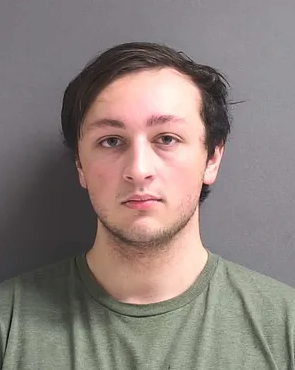
A 20-year-old Florida man at the center of a prolific cybercrime group known as “Scattered Spider” was sentenced to 10 years in federal prison today, and ordered to pay roughly $13 million in restitution to victims.
Noah Michael Urban of Palm Coast, Fla. pleaded guilty in April 2025 to charges of wire fraud and conspiracy. Florida prosecutors alleged Urban conspired with others to steal at least $800,000 from five victims via SIM-swapping attacks that diverted their mobile phone calls and text messages to devices controlled by Urban and his co-conspirators.
A booking photo of Noah Michael Urban released by the Volusia County Sheriff.
Although prosecutors had asked for Urban to serve eight years, Jacksonville news outlet News4Jax.com reports the federal judge in the case today opted to sentence Urban to 120 months in federal prison, ordering him to pay $13 million in restitution and undergo three years of supervised release after his sentence is completed.
In November 2024 Urban was charged by federal prosecutors in Los Angeles as one of five members of Scattered Spider (a.k.a. “Oktapus,” “Scatter Swine” and “UNC3944”), which specialized in SMS and voice phishing attacks that tricked employees at victim companies into entering their credentials and one-time passcodes at phishing websites. Urban pleaded guilty to one count of conspiracy to commit wire fraud in the California case, and the $13 million in restitution is intended to cover victims from both cases.
The targeted SMS scams spanned several months during the summer of 2022, asking employees to click a link and log in at a website that mimicked their employer’s Okta authentication page. Some SMS phishing messages told employees their VPN credentials were expiring and needed to be changed; other missives advised employees about changes to their upcoming work schedule.
That phishing spree netted Urban and others access to more than 130 companies, including Twilio, LastPass, DoorDash, MailChimp, and Plex. The government says the group used that access to steal proprietary company data and customer information, and that members also phished people to steal millions of dollars worth of cryptocurrency.
For many years, Urban’s online hacker aliases “King Bob” and “Sosa” were fixtures of the Com, a mostly Telegram and Discord-based community of English-speaking cybercriminals wherein hackers boast loudly about high-profile exploits and hacks that almost invariably begin with social engineering. King Bob constantly bragged on the Com about stealing unreleased rap music recordings from popular artists, presumably through SIM-swapping attacks. Many of those purloined tracks or “grails” he later sold or gave away on forums.
Noah “King Bob” Urban, posting to Twitter/X around the time of his sentencing today.
Sosa also was active in a particularly destructive group of accomplished criminal SIM-swappers known as “Star Fraud.” Cyberscoop’s AJ Vicens reported in 2023 that individuals within Star Fraud were likely involved in the high-profile Caesars Entertainment and MGM Resorts extortion attacks that same year.
The Star Fraud SIM-swapping group gained the ability to temporarily move targeted mobile numbers to devices they controlled by constantly phishing employees of the major mobile providers. In February 2023, KrebsOnSecurity published data taken from the Telegram channels for Star Fraud and two other SIM-swapping groups showing these crooks focused on SIM-swapping T-Mobile customers, and that they collectively claimed internal access to T-Mobile on 100 separate occasions over a 7-month period in 2022.
Reached via one of his King Bob accounts on Twitter/X, Urban called the sentence unjust, and said the judge in his case discounted his age as a factor.
“The judge purposefully ignored my age as a factor because of the fact another Scattered Spider member hacked him personally during the course of my case,” Urban said in reply to questions, noting that he was sending the messages from a Florida county jail. “He should have been removed as a judge much earlier on. But staying in county jail is torture.”
A court transcript (PDF) from a status hearing in February 2025 shows Urban was telling the truth about the hacking incident that happened while he was in federal custody. It involved an intrusion into a magistrate judge’s email account, where a copy of Urban’s sealed indictment was stolen. The judge told attorneys for both sides that a co-defendant in the California case was trying to find out about Mr. Urban’s activity in the Florida case.
“What it ultimately turned into a was a big faux pas,” Judge Harvey E. Schlesinger said. “The Court’s password…business is handled by an outside contractor. And somebody called the outside contractor representing Judge Toomey saying, ‘I need a password change.’ And they gave out the password change. That’s how whoever was making the phone call got into the court.”
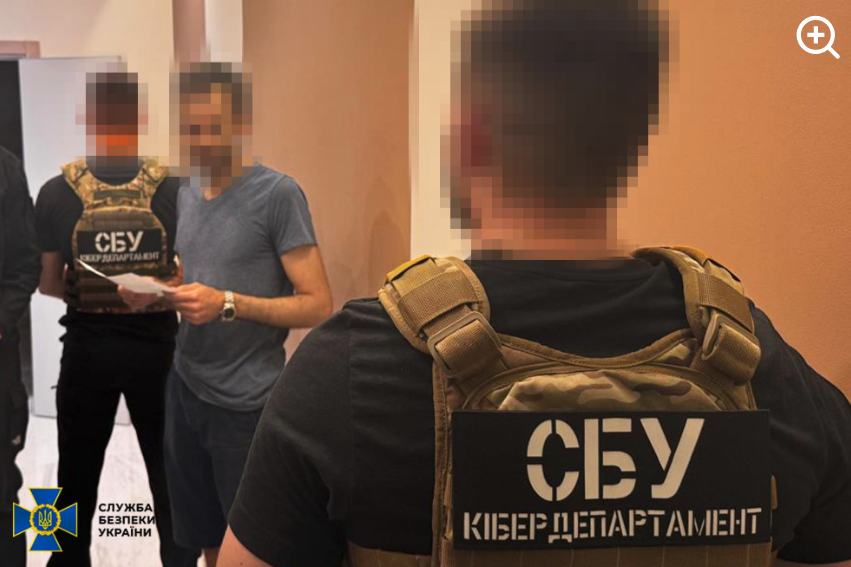
On July 22, 2025, the European police agency Europol said a long-running investigation led by the French Police resulted in the arrest of a 38-year-old administrator of XSS, a Russian-language cybercrime forum with more than 50,000 members. The action has triggered an ongoing frenzy of speculation and panic among XSS denizens about the identity of the unnamed suspect, but the consensus is that he is a pivotal figure in the crime forum scene who goes by the hacker handle “Toha.” Here’s a deep dive on what’s knowable about Toha, and a short stab at who got nabbed.
An unnamed 38-year-old man was arrested in Kiev last month on suspicion of administering the cybercrime forum XSS. Image: ssu.gov.ua.
Europol did not name the accused, but published partially obscured photos of him from the raid on his residence in Kiev. The police agency said the suspect acted as a trusted third party — arbitrating disputes between criminals — and guaranteeing the security of transactions on XSS. A statement from Ukraine’s SBU security service said XSS counted among its members many cybercriminals from various ransomware groups, including REvil, LockBit, Conti, and Qiliin.
Since the Europol announcement, the XSS forum resurfaced at a new address on the deep web (reachable only via the anonymity network Tor). But from reviewing the recent posts, there appears to be little consensus among longtime members about the identity of the now-detained XSS administrator.
The most frequent comment regarding the arrest was a message of solidarity and support for Toha, the handle chosen by the longtime administrator of XSS and several other major Russian forums. Toha’s accounts on other forums have been silent since the raid.
Europol said the suspect has enjoyed a nearly 20-year career in cybercrime, which roughly lines up with Toha’s history. In 2005, Toha was a founding member of the Russian-speaking forum Hack-All. That is, until it got massively hacked a few months after its debut. In 2006, Toha rebranded the forum to exploit[.]in, which would go on to draw tens of thousands of members, including an eventual Who’s-Who of wanted cybercriminals.
Toha announced in 2018 that he was selling the Exploit forum, prompting rampant speculation on the forums that the buyer was secretly a Russian or Ukrainian government entity or front person. However, those suspicions were unsupported by evidence, and Toha vehemently denied the forum had been given over to authorities.
One of the oldest Russian-language cybercrime forums was DaMaGeLaB, which operated from 2004 to 2017, when its administrator “Ar3s” was arrested. In 2018, a partial backup of the DaMaGeLaB forum was reincarnated as xss[.]is, with Toha as its stated administrator.
Clues about Toha’s early presence on the Internet — from ~2004 to 2010 — are available in the archives of Intel 471, a cyber intelligence firm that tracks forum activity. Intel 471 shows Toha used the same email address across multiple forum accounts, including at Exploit, Antichat, Carder[.]su and inattack[.]ru.
DomainTools.com finds Toha’s email address — toschka2003@yandex.ru — was used to register at least a dozen domain names — most of them from the mid- to late 2000s. Apart from exploit[.]in and a domain called ixyq[.]com, the other domains registered to that email address end in .ua, the top-level domain for Ukraine (e.g. deleted.org[.]ua, lj.com[.]ua, and blogspot.org[.]ua).
A 2008 snapshot of a domain registered to toschka2003@yandex.ru and to Anton Medvedovsky in Kiev. Note the message at the bottom left, “Protected by Exploit,in.” Image: archive.org.
Nearly all of the domains registered to toschka2003@yandex.ru contain the name Anton Medvedovskiy in the registration records, except for the aforementioned ixyq[.]com, which is registered to the name Yuriy Avdeev in Moscow.
This Avdeev surname came up in a lengthy conversation with Lockbitsupp, the leader of the rapacious and destructive ransomware affiliate group Lockbit. The conversation took place in February 2024, when Lockbitsupp asked for help identifying Toha’s real-life identity.
In early 2024, the leader of the Lockbit ransomware group — Lockbitsupp — asked for help investigating the identity of the XSS administrator Toha, which he claimed was a Russian man named Anton Avdeev.
Lockbitsupp didn’t share why he wanted Toha’s details, but he maintained that Toha’s real name was Anton Avdeev. I declined to help Lockbitsupp in whatever revenge he was planning on Toha, but his question made me curious to look deeper.
It appears Lockbitsupp’s query was based on a now-deleted Twitter post from 2022, when a user by the name “3xp0rt” asserted that Toha was a Russian man named Anton Viktorovich Avdeev, born October 27, 1983.
Searching the web for Toha’s email address toschka2003@yandex.ru reveals a 2010 sales thread on the forum bmwclub.ru where a user named Honeypo was selling a 2007 BMW X5. The ad listed the contact person as Anton Avdeev and gave the contact phone number 9588693.
A search on the phone number 9588693 in the breach tracking service Constella Intelligence finds plenty of official Russian government records with this number, date of birth and the name Anton Viktorovich Avdeev. For example, hacked Russian government records show this person has a Russian tax ID and SIN (Social Security number), and that they were flagged for traffic violations on several occasions by Moscow police; in 2004, 2006, 2009, and 2014.
Astute readers may have noticed by now that the ages of Mr. Avdeev (41) and the XSS admin arrested this month (38) are a bit off. This would seem to suggest that the person arrested is someone other than Mr. Avdeev, who did not respond to requests for comment.
For further insight on this question, KrebsOnSecurity sought comments from Sergeii Vovnenko, a former cybercriminal from Ukraine who now works at the security startup paranoidlab.com. I reached out to Vovnenko because for several years beginning around 2010 he was the owner and operator of thesecure[.]biz, an encrypted “Jabber” instant messaging server that Europol said was operated by the suspect arrested in Kiev. Thesecure[.]biz grew quite popular among many of the top Russian-speaking cybercriminals because it scrupulously kept few records of its users’ activity, and its administrator was always a trusted member of the community.
The reason I know this historic tidbit is that in 2013, Vovnenko — using the hacker nicknames “Fly,” and “Flycracker” — hatched a plan to have a gram of heroin purchased off of the Silk Road darknet market and shipped to our home in Northern Virginia. The scheme was to spoof a call from one of our neighbors to the local police, saying this guy Krebs down the street was a druggie who was having narcotics delivered to his home.
I happened to be lurking on Flycracker’s private cybercrime forum when his heroin-framing plan was carried out, and called the police myself before the smack eventually arrived in the U.S. Mail. Vovnenko was later arrested for unrelated cybercrime activities, extradited to the United States, convicted, and deported after a 16-month stay in the U.S. prison system [on several occasions, he has expressed heartfelt apologies for the incident, and we have since buried the hatchet].
Vovnenko said he purchased a device for cloning credit cards from Toha in 2009, and that Toha shipped the item from Russia. Vovnenko explained that he (Flycracker) was the owner and operator of thesecure[.]biz from 2010 until his arrest in 2014.
Vovnenko believes thesecure[.]biz was stolen while he was in jail, either by Toha and/or an XSS administrator who went by the nicknames N0klos and Sonic.
“When I was in jail, [the] admin of xss.is stole that domain, or probably N0klos bought XSS from Toha or vice versa,” Vovnenko said of the Jabber domain. “Nobody from [the forums] spoke with me after my jailtime, so I can only guess what really happened.”
N0klos was the owner and administrator of an early Russian-language cybercrime forum known as Darklife[.]ws. However, N0kl0s also appears to be a lifelong Russian resident, and in any case seems to have vanished from Russian cybercrime forums several years ago.
Asked whether he believes Toha was the XSS administrator who was arrested this month in Ukraine, Vovnenko maintained that Toha is Russian, and that “the French cops took the wrong guy.”
So who did the Ukrainian police arrest in response to the investigation by the French authorities? It seems plausible that the BMW ad invoking Toha’s email address and the name and phone number of a Russian citizen was simply misdirection on Toha’s part — intended to confuse and throw off investigators. Perhaps this even explains the Avdeev surname surfacing in the registration records from one of Toha’s domains.
But sometimes the simplest answer is the correct one. “Toha” is a common Slavic nickname for someone with the first name “Anton,” and that matches the name in the registration records for more than a dozen domains tied to Toha’s toschka2003@yandex.ru email address: Anton Medvedovskiy.
Constella Intelligence finds there is an Anton Gannadievich Medvedovskiy living in Kiev who will be 38 years old in December. This individual owns the email address itsmail@i.ua, as well an an Airbnb account featuring a profile photo of a man with roughly the same hairline as the suspect in the blurred photos released by the Ukrainian police. Mr. Medvedovskiy did not respond to a request for comment.
My take on the takedown is that the Ukrainian authorities likely arrested Medvedovskiy. Toha shared on DaMaGeLab in 2005 that he had recently finished the 11th grade and was studying at a university — a time when Mevedovskiy would have been around 18 years old. On Dec. 11, 2006, fellow Exploit members wished Toha a happy birthday. Records exposed in a 2022 hack at the Ukrainian public services portal diia.gov.ua show that Mr. Medvedovskiy’s birthday is Dec. 11, 1987.
The law enforcement action and resulting confusion about the identity of the detained has thrown the Russian cybercrime forum scene into disarray in recent weeks, with lengthy and heated arguments about XSS’s future spooling out across the forums.
XSS relaunched on a new Tor address shortly after the authorities plastered their seizure notice on the forum’s homepage, but all of the trusted moderators from the old forum were dismissed without explanation. Existing members saw their forum account balances drop to zero, and were asked to plunk down a deposit to register at the new forum. The new XSS “admin” said they were in contact with the previous owners and that the changes were to help rebuild security and trust within the community.
However, the new admin’s assurances appear to have done little to assuage the worst fears of the forum’s erstwhile members, most of whom seem to be keeping their distance from the relaunched site for now.
Indeed, if there is one common understanding amid all of these discussions about the seizure of XSS, it is that Ukrainian and French authorities now have several years worth of private messages between XSS forum users, as well as contact rosters and other user data linked to the seized Jabber server.
“The myth of the ‘trusted person’ is shattered,” the user “GordonBellford” cautioned on Aug. 3 in an Exploit forum thread about the XSS admin arrest. “The forum is run by strangers. They got everything. Two years of Jabber server logs. Full backup and forum database.”
GordonBellford continued:
And the scariest thing is: this data array is not just an archive. It is material for analysis that has ALREADY BEEN DONE . With the help of modern tools, they see everything:
Graphs of your contacts and activity.
Relationships between nicknames, emails, password hashes and Jabber ID.
Timestamps, IP addresses and digital fingerprints.
Your unique writing style, phraseology, punctuation, consistency of grammatical errors, and even typical typos that will link your accounts on different platforms.They are not looking for a needle in a haystack. They simply sifted the haystack through the AI sieve and got ready-made dossiers.

Regulator acts on leasing of ‘global title’ numbers after industry efforts to tackle problem were ineffective
The UK communications regulator Ofcom is banning mobile operators from leasing numbers that can be used by criminals to intercept and divert calls and messages, including security codes sent by banks to customers.
Ofcom said it would stop the leasing of “global titles”, special types of phone numbers used by mobile networks to support services to make sure messages and calls reach the intended recipient.
Continue reading...
© Photograph: Andy Rain/EPA
© Photograph: Andy Rain/EPA
