Entrar

How Cyble Blaze AI Turns Billions of Threat Signals into Actionable Intelligence

Modern cyberattacks no longer follow predictable patterns or slow timelines. They unfold at machine speed, often moving from initial access to data exfiltration in minutes. In this environment, security teams face a paradox: they are surrounded by vast amounts of data yet struggle to extract clarity from it quickly enough to prevent damage.
This is where Cyble Blaze AI introduces a different operational model, centered on cyber threat intelligence, security analytics, and large-scale threat intelligence automation designed to convert raw signals into immediate defensive action. Instead of treating security as a sequence of alerts and manual investigations, Cyble Blaze AI redefines it as a continuous intelligence system that observes, reasons, and responds in real time.
The Data Overload Problem in Cyber Threat Intelligence and AI Security Analytics
Enterprises today generate security telemetry across endpoints, cloud workloads, identity systems, SaaS platforms, and external intelligence feeds. On top of that, threat actors continuously operate in hidden ecosystems such as dark web forums and encrypted communication channels. The issue is not a lack of data; it is fragmentation. Security teams often deal with disconnected signals that fail to form a coherent picture of risk.
Cyble Blaze AI addresses this by applying ai security analytics to unify structured enterprise data with unstructured external intelligence. Instead of treating each alert as an isolated event, it interprets them as part of a broader behavioral system. This shift is essential for modern cyber threat intelligence, where context matters as much as detection.
AI-Native Architecture Driving Threat Intelligence Automation
At the core of Cyble Blaze AI is an architecture designed from the ground up for threat intelligence automation, not retrofitted with it. This distinction matters because it allows intelligence, analysis, and action to operate within a single system rather than across disconnected tools.
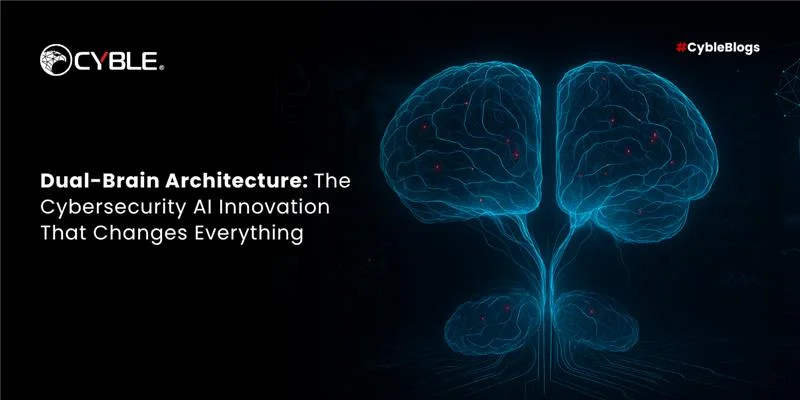
The platform is built on a dual-memory design:
Neural Memory (Structured Intelligence Layer)
This layer functions as a continuously evolving knowledge graph. It maps:
- Indicators of compromise (IOCs)
- Threat actor behaviors
- Attack infrastructure relationships
- Campaign-level linkages
By structuring intelligence this way, Cyble Blaze AI can track how threats evolve rather than reacting to individual alerts.
Vector Memory (Contextual Intelligence Layer)
This layer processes unstructured data such as analyst notes, reports, chat logs, and security documentation. Using semantic understanding, it identifies meaning rather than relying on keywords alone.
Together, these layers enable cross-domain reasoning, a core requirement for modern cyber threat intelligence platforms that rely on AI security analytics to connect disparate signals into actionable insights.
Threat Intelligence Automation from Hunt to Resolution
Cyble Blaze AI replaces traditional manual workflows with an automated intelligence lifecycle built on threat intelligence automation principles:
- Hunt: The system continuously scans dark web forums, phishing infrastructures, malware ecosystems, and external feeds to identify emerging indicators of compromise.
- Correlate: Signals are cross-referenced across endpoint telemetry, cloud environments, and enterprise applications. This step transforms scattered signals into unified threat narratives.
- Act: Once validated, automated responses are triggered. These may include endpoint isolation, domain blocking, policy enforcement, or workflow-based remediation across integrated tools.
- Report: Structured reports are generated for both technical and executive audiences, aligned with controlled sharing frameworks such as TLP (Traffic Light Protocol).
This end-to-end threat intelligence automation pipeline reduces the gap between detection and response.
Autonomous Agents and Rapid Response in Cyber Threat Intelligence
Cyble Blaze AI operates through coordinated autonomous agents, each handling specific security domains:
- Vision Agent: detects anomalies across environments
- Strato Agent: secures cloud workloads
- Titan Agent: manages endpoint containment and remediation
These agents do not work in isolation. They continuously share intelligence, enabling synchronized responses.
In optimized scenarios, full incident handling, from detection to containment, can be completed in under two minutes, a major reduction compared to traditional workflows.
This capability highlights how AI security analytics can compress response timelines when paired with effective threat intelligence automation.
Predictive Cyber Threat Intelligence and Future Risk Detection
Beyond real-time response, Cyble Blaze AI extends into predictive analysis. By processing global datasets and behavioral signals, it identifies emerging threats before they fully materialize.
The system analyzes:
- Dark web discussions and marketplace activity
- Exploit development trends
- Reconnaissance patterns
- Vulnerability disclosures
- Historical attack behavior
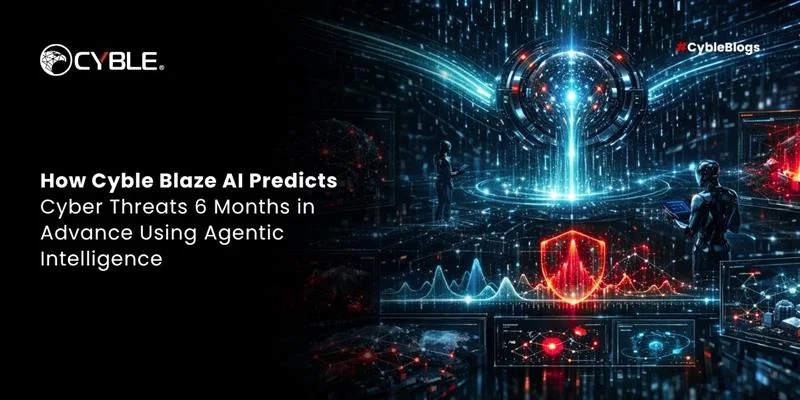
Based on these inputs, it can forecast potential attack campaigns up to six months in advance. This shifts cyber threat intelligence from reactive monitoring to anticipatory defense, where organizations can prepare for threats long before execution.
360° Visibility Through AI Security Analytics and External Intelligence
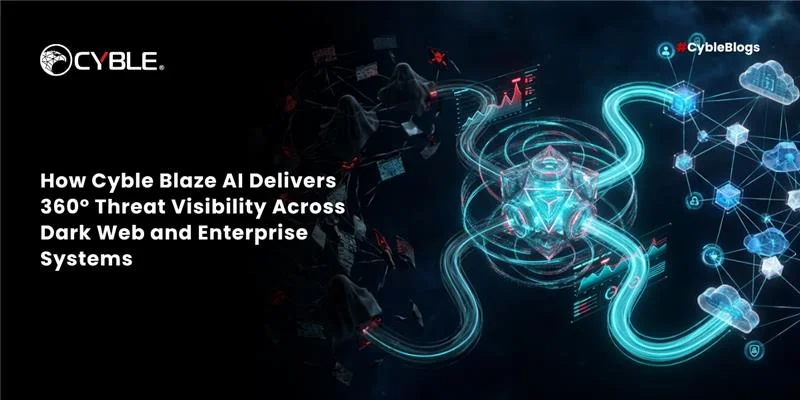
One of the defining strengths of Cyble Blaze AI is its ability to unify internal enterprise telemetry with external threat ecosystems. This includes dark web monitoring sources, phishing infrastructures, and underground communication channels.
By applying AI security analytics, the platform correlates these external signals with internal system behavior, building a complete view of organizational risk.
This 360° visibility ensures that compromised credentials, for example, detected on underground forums can immediately be traced across enterprise environments to identify potential exploitation.
Scale, Integrations, and Intelligence Depth
Cyble Blaze AI operates at large enterprise scale with integration support for more than 70 security and IT tools, including SIEM, SOAR, EDR/XDR, cloud platforms, and collaboration systems.
Its intelligence foundation is supported by over 350 billion threat data points, enabling deep contextual analysis across global threat landscapes.
This scale is essential for effective threat intelligence automation, where the quality of decisions depends on the breadth and depth of underlying data.
Role-Based Impact of Cyber Threat Intelligence Automation
The platform’s design supports different security roles:
- Analysts benefit from reduced alert fatigue and faster triage through ai security analytics
- Threat hunters gain unified visibility across internal and external intelligence sources
- Incident responders achieve faster containment through automated workflows
- Executives and CISOs receive predictive risk insights aligned with business exposure
This alignment ensures that cyber threat intelligence is not confined to security teams but becomes actionable across the organization.
Toward Autonomous Cyber Defense
Cyble brings cyber threat intelligence, AI security analytics, and threat intelligence automation together through Cyble Blaze AI to turn massive volumes of security data into coordinated, real-time defense actions. Instead of overwhelming teams with alerts, it focuses on context, prediction, and autonomous response—reducing the time between detection and mitigation to near real time.
With this approach, Cyble shifts security operations from reactive monitoring to proactive and automated defense, where threats are identified earlier and neutralized faster across enterprise environments.
To explore how Cyble can help modernize security operations with AI-native intelligence, organizations can connect with Cyble and schedule a demo to see Cyble Blaze AI in action.
The post How Cyble Blaze AI Turns Billions of Threat Signals into Actionable Intelligence appeared first on Cyble.