Visualização normal

Antes de ontemStream principal
  • ✇Firewall Daily – The Cyber Express
  • China Demands Proof After Costa Rica Blames UNC2814 for ICE Cyberattack Ashish Khaitan
    Tensions between China and Costa Rica have intensified following allegations tied to an ICE cyberattack that Costa Rican authorities say was linked to the cyberespionage group UNC2814. The dispute centers on a breach affecting Costa Rica’s state-run electricity and telecommunications provider and has quickly evolved from a domestic cybersecurity issue into a diplomatic disagreement involving competing narratives and demands for proof.  China has now publicly asked the government of Costa Rica
     

China Demands Proof After Costa Rica Blames UNC2814 for ICE Cyberattack

16 de Março de 2026, 04:19

ICE cyberattack

Tensions between China and Costa Rica have intensified following allegations tied to an ICE cyberattack that Costa Rican authorities say was linked to the cyberespionage group UNC2814. The dispute centers on a breach affecting Costa Rica’s state-run electricity and telecommunications provider and has quickly evolved from a domestic cybersecurity issue into a diplomatic disagreement involving competing narratives and demands for proof.  China has now publicly asked the government of Costa Rica to provide evidence supporting claims that Chinese-linked actors were behind the ICE cyberattack. The request came from Chinese Ambassador Wang Xiaoyao on Friday, one day after Costa Rican officials attributed the breach to UNC2814, a group that cybersecurity researchers have described as a suspected cyberespionage actor with ties to the People’s Republic of China. 

China Requests Evidence in ICE Cyberattack Case 

Ambassador Wang Xiaoyao said China wants to review any technical evidence related to the ICE cyberattack so the allegations can be verified and, if necessary, addressed through legal channels. According to the ambassador, providing proof would allow the matter to be examined under established legal frameworks rather than through political accusations.  Wang also said that China has been attempting since 2024 to engage Costa Rica in cybersecurity cooperation. The initiatives reportedly included technical consultations, professional exchanges, and other collaborative efforts, but the Chinese side claims it received no response from Costa Rican authorities.  The Chinese embassy added that it proposed using mechanisms linked to the United Nations cybercrime framework to address cybersecurity concerns. It also suggested activating a bilateral joint commission between China and Costa Rica, which, according to the embassy, has not yet convened. 

Costa Rica Identifies UNC2814 as Suspected Actor 

The diplomatic dispute began after Costa Rican officials revealed details of the ICE cyberattack at a press conference on March 12. Authorities said the Costa Rican Electricity Institute, known as ICE, discovered cyberespionage activity affecting its administrative email systems.  Investigators determined that the intrusion was first detected in late January. During the operation, attackers extracted approximately nine gigabytes of internal email data. Despite the breach, ICE officials stated that electricity generation and telecommunications services remained unaffected.  Marco Acuña Mora, executive president of ICE, said the incident did not disrupt the country’s critical infrastructure. He confirmed that the ICE cyberattack did not compromise sensitive customer information or interrupt services provided to residents of Costa Rica.  The Costa Rican government linked the incident to UNC2814 after receiving intelligence from Mandiant, the cybersecurity division of Google. The information was shared through Costa Rica’s national incident response system, which coordinates cybersecurity investigations involving government institutions. 

Global Espionage Campaign Linked to UNC2814 

Google had previously reported on the activities of UNC2814, describing the group as a cyberespionage actor it has tracked since 2017. On February 25, the company announced that it had worked with partners to disrupt a global campaign attributed to the group.  According to Google’s analysis, UNC2814 targeted telecommunications providers and government organizations across multiple regions. At the time of the disruption, confirmed intrusions had been identified in 42 countries across four continents.  Costa Rican Minister Paula Bogantes Zamora said the actor responsible for the ICE cyberattack specializes in operations targeting the telecommunications sector. She added that the group has been associated with cyberespionage activities affecting dozens of countries. 

China Rejects Allegations 

China has firmly rejected the accusations linking it to the ICE cyberattack. The Chinese embassy in Costa Rica said it was “deeply surprised and disappointed” by what it described as unfounded claims made by some Costa Rican officials.  In its statement, the embassy said China had not received any request for evidence or investigative cooperation from the Costa Rican government regarding the ICE cyberattack. It also stated that China has “no interest in the data of Costa Rica” and opposes all forms of cyberattacks.  The embassy further warned against politicizing cybersecurity issues. Chinese officials argued that disputes related to cyber incidents should be handled through dialogue and cooperation rather than public accusations.  The statement also included a broader diplomatic message, warning that “sacrificing relations between China and Costa Rica to please other countries does not gain respect.” 
  • ✇ASEC BLOG
  • February 2026 APT Group Trends Report ATCP
    Purpose and Scope. this report summarizes major APT group activity in February 2026. the analysis covers supply chain compromises, zero-day exploits, network segregation bypass, and backup and network infrastructure compromises. the major groups included in the report are APT28, Lotus Blossom, TA-RedAnt (APT37), UAT-8616, UNC3886, and UNC6201. Major APT groups by region. Lotus Blossom exploited […]
     

February 2026 APT Group Trends Report

Por:ATCP
11 de Março de 2026, 12:00
Purpose and Scope. this report summarizes major APT group activity in February 2026. the analysis covers supply chain compromises, zero-day exploits, network segregation bypass, and backup and network infrastructure compromises. the major groups included in the report are APT28, Lotus Blossom, TA-RedAnt (APT37), UAT-8616, UNC3886, and UNC6201. Major APT groups by region. Lotus Blossom exploited […]
  • ✇Security Affairs
  • Google GTIG disrupted China-linked APT UNC2814 halting attacks on 53 orgs in 42 countries Pierluigi Paganini
    Google and partners disrupted UNC2814, a suspected China-linked group that hacked 53 organizations across 42 countries. Google, with industry partners, disrupted the infrastructure of UNC2814, a suspected China-linked cyber espionage group that breached at least 53 organizations in 42 countries. The group has been active since at least 2017, and was spotted targeting governments and global telecoms across Africa, Asia, and the Americas, making it a highly prolific and elusive threat. UNC2814
     

Google GTIG disrupted China-linked APT UNC2814 halting attacks on 53 orgs in 42 countries

26 de Fevereiro de 2026, 05:29

Google and partners disrupted UNC2814, a suspected China-linked group that hacked 53 organizations across 42 countries.

Google, with industry partners, disrupted the infrastructure of UNC2814, a suspected China-linked cyber espionage group that breached at least 53 organizations in 42 countries. The group has been active since at least 2017, and was spotted targeting governments and global telecoms across Africa, Asia, and the Americas, making it a highly prolific and elusive threat. UNC2814 is likely linked to additional infections in more than 20 other nations.

“Last week, Google Threat Intelligence Group (GTIG), Mandiant, and partners took action to disrupt a global espionage campaign targeting telecommunications and government organizations in dozens of nations across four continents.” reads the GTIG’s report. “The threat actor, UNC2814, is a suspected People’s Republic of China (PRC)-nexus cyber espionage group that GTIG has tracked since 2017. “

UNC2814 used API calls to SaaS apps as command-and-control (C2) infrastructure, disguising malicious traffic as legitimate activity. Rather than exploiting product flaws, the group leveraged legitimate Google Sheets API functions through a novel backdoor called GRIDTIDE.

The group’s operations target different victims than other campaigns, such as “Salt Typhoon,” using unique techniques and TTPs.
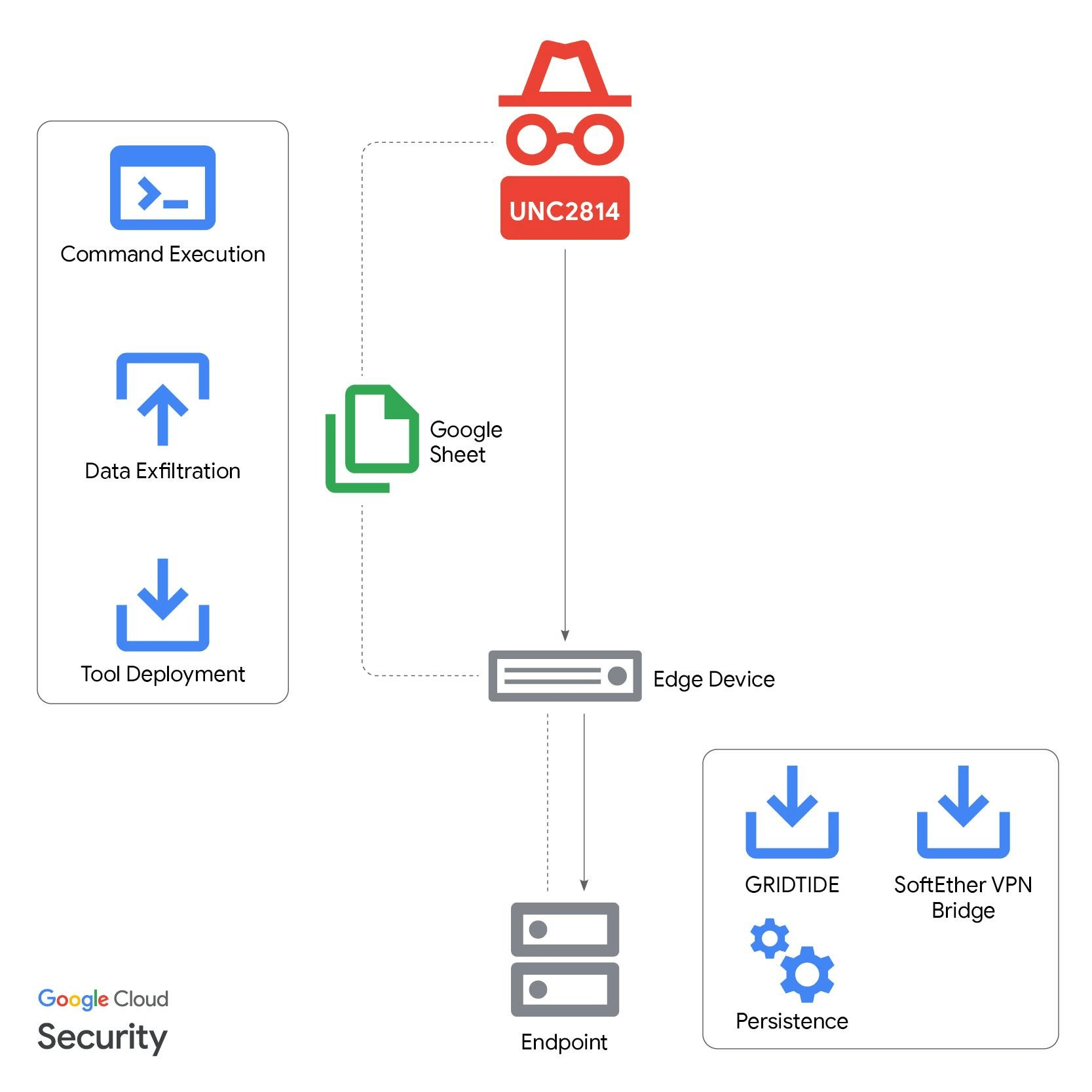
Mandiant, using Google SecOps, detected suspicious activity on a CentOS server where the binary /var/tmp/xapt launched a root shell and ran id to confirm root access, showing the attacker had escalated privileges. The researchers reported that the payload mimicked a legacy Debian tool to avoid detection.

Post-compromise, the actor moved laterally via SSH, used living-off-the-land binaries for reconnaissance, and installed the GRIDTIDE backdoor for persistence via a systemd service. Attackers executed GRIDTIDE with nohup ./xapt to keep it running after session closure, and deployed SoftEther VPN Bridge to create an encrypted outbound connection.

UNC2814 targeted endpoints containing personally identifiable information (names, phone numbers, dates of birth, and national IDs) consistent with telecom-focused cyber espionage. While no direct exfiltration was observed, UNC2814 could leverage such access to monitor communications, including call records and SMS messages, for surveillance and intelligence-gathering purposes.

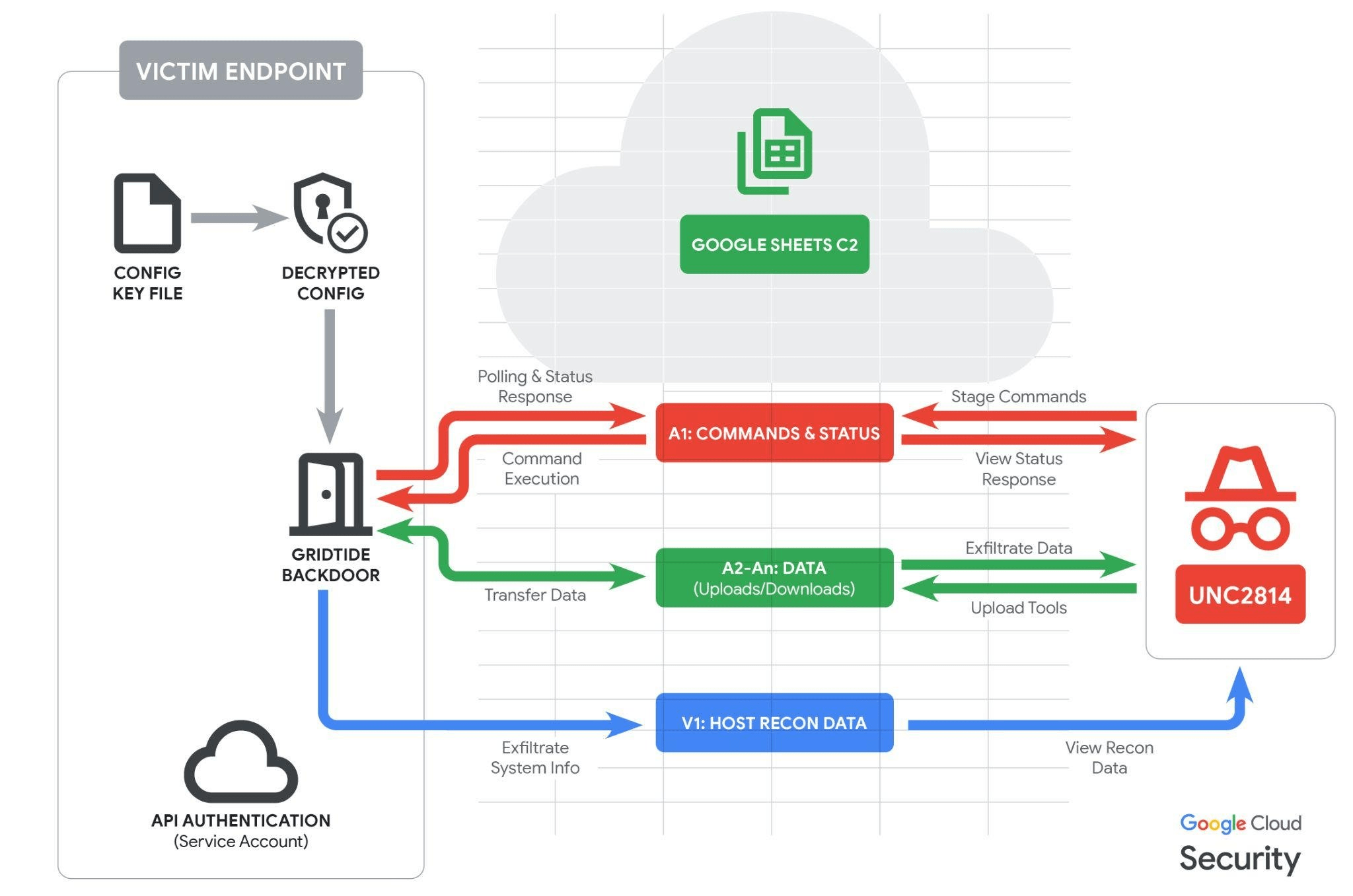
GRIDTIDE is a sophisticated C-based backdoor used by UNC2814 that can execute shell commands, upload and download files. The malware uses Google Sheets as a command-and-control (C2) channel, hiding malicious traffic within legitimate API requests. While it currently uses Google Sheets, other cloud-based spreadsheet platforms could be exploited in a similar way.

The backdoor requires a 16-byte cryptographic key on the host to decrypt its Google Drive configuration, which contains service account credentials, spreadsheet IDs, and private keys.

“When executed, GRIDTIDE sanitizes its Google Sheet. It does this by deleting the first 1000 rows, across columns A to Z in the spreadsheet, by using the Google Sheets API batchClear method. This prevents previous commands or file data stored in the Sheet from interfering with the threat actor’s current session.” continues the report. “Once the Sheet is prepared, the backdoor conducts host-based reconnaissance. It fingerprints the endpoint by collecting the victim’s username, endpoint name, OS details, local IP address, and environmental data such as the current working directory, language settings, and local time zone.”

Commands from the attacker follow a structured syntax, allowing execution of Bash commands, file uploads, and downloads, with status responses returned to cell A1. Data transfer occurs via cells A2 to An, and the malware uses URL-safe Base64 encoding to evade detection.
UNC2814 has leveraged GRIDTIDE since at least 2017 to target telecommunications and government organizations worldwide.

Google Threat Intelligence Group (GTIG) and its partners terminated all attacker-controlled Google Cloud Projects and accounts, disabled the UNC2814 infrastructure, and revoked access to Google Sheets API calls.

GTIG took coordinated action to disrupt UNC2814 and protect affected organizations. They terminated all attacker-controlled Cloud Projects, disabling GRIDTIDE backdoor access, and took down known UNC2814 infrastructure, including current and historical domains. Attacker accounts and Google Sheets access were revoked, and victim organizations were formally notified and supported. GTIG also refined detection signatures to block GRIDTIDE activity and released indicators of compromise (IOCs) used by UNC2814 since 2023, helping organizations worldwide identify and defend against this threat.

“The global scope of UNC2814’s activity, evidenced by confirmed or suspected operations in over 70 countries, underscores the serious threat facing telecommunications and government sectors, and the capacity for these intrusions to evade detection by defenders.” concludes the report. “Prolific intrusions of this scale are generally the result of years of focused effort and will not be easily re-established. We expect that UNC2814 will work hard to re-establish their global footprint.”

Follow me on Twitter: @securityaffairs and Facebook and Mastodon

Pierluigi Paganini

(SecurityAffairs – hacking, China)

❌
❌