Visualização normal

Antes de ontemStream principal
  • ✇Firewall Daily – The Cyber Express
  • Hacker Active Well Beyond Context.ai Compromise, Says Vercel CEO Mihir Bagwe
    Vercel CEO Guillermo Rauch, in an update today said that after scanning through petabytes of logs of the company's networks and APIs, his security team concluded that the threat actor behind the Vercel breach had been active well beyond Context.ai's compromise. Rauch said that the "threat intel points to the distribution of malware to computers in search of valuable tokens like keys to Vercel accounts and other providers. Once the attacker gets ahold of those keys, our logs show a repeated p
     

Hacker Active Well Beyond Context.ai Compromise, Says Vercel CEO

23 de Abril de 2026, 05:35

Vercel, Vercel Breach, APIs, npm Packages

Vercel CEO Guillermo Rauch, in an update today said that after scanning through petabytes of logs of the company's networks and APIs, his security team concluded that the threat actor behind the Vercel breach had been active well beyond Context.ai's compromise. Rauch said that the "threat intel points to the distribution of malware to computers in search of valuable tokens like keys to Vercel accounts and other providers. Once the attacker gets ahold of those keys, our logs show a repeated pattern: rapid and comprehensive API usage, with a focus on enumeration of non-sensitive environment variables." Researchers at Hudson Rock had earlier confirmed that the attack actually initiated in February itself when a Context.ai employee’s computer was infected with Lumma Stealer malware after they searched for Roblox game exploits, a common vector for infostealer deployments. What the latest findings mean is that there could be a wider net of victims that the threat actor may have phished for and what we know is just the tip of the iceberg - or not.
Also read: Vercel Incident Linked to AI Tool Hack, Internal Access Gained

Vercel Finds Customers Breached in Separate Malware, Social Engineering Attacks

In an official update, the company also stated that initially it identified a limited subset of customers whose non-sensitive environment variables stored on Vercel were compromised. However, a deeper assessment of the their network, as well as environment variable read events in the company's logs uncovered two additional findings.

"First, we have identified a small number of additional accounts that were compromised as part of this incident," the company noted.

But the main concern is the next finding: "Second, we have uncovered a small number of customer accounts with evidence of prior compromise that is independent of and predates this incident, potentially as a result of social engineering, malware, or other methods." 

The company did not disclose who were the attackers, what was the motive, or the impact on customers, and is yet to respond to these queries from The Cyber Express. It only stated: "In both cases, we have notified the affected customers."

Meanwhile, Rauch said, Vercel had notified other suspected victims and encouraged them to rotate credentials and adopt best practices.

No Compromise of npm Packages

The news of npm packages being compromised has surfaced a lot in recent times. To cover that front, Vercel's security team in collaboration with GitHub, Microsoft, npm, and Socket, confirmed that no npm packages published by Vercel had been compromised. "There is no evidence of tampering, and we believe the supply chain remains safe," the company said.

North Korea Spent 6 Months Infiltrating Drift Protocol Only to Drain $285M in 12 Mins

6 de Abril de 2026, 07:12

Drift Protocol, Drift hacked, Solona, Nonces

The message Drift Protocol posted to X on April 1, opened with an unusual disclaimer: "This is not an April Fools joke." Within hours, the reason became clear. A $285 million exploit had wiped out more than half of the Solana-based decentralized perpetual futures exchange's total value locked — and the attack had been in preparation for six months. A malicious actor gained unauthorized access to Drift Protocol through a novel attack involving durable nonces, resulting in a rapid takeover of Drift's Security Council administrative powers. The incident, which took place on April 1, was confirmed as a highly sophisticated operation involving multi-week preparation and staged execution. Drift is the largest decentralized perpetual futures exchange on Solana, a blockchain network. It allows users to trade leveraged financial positions without a centralized intermediary. The protocol held approximately $550 million in user assets before the attack. According to TRM Labs, the drain took roughly 12 minutes, making this the largest DeFi hack of 2026 and the second-largest exploit in Solana's history, behind only the $326 million Wormhole bridge hack in 2022.

A Six-Month Long-Con Operation

A North Korean state-linked group spent roughly six months infiltrating Drift Protocol under the guise of a quantitative trading firm before executing the exploit. The attackers built trust by meeting Drift contributors at conferences, depositing more than $1 million, and integrating an Ecosystem Vault. They then compromised devices via a malicious TestFlight app and a VSCode/Cursor vulnerability to obtain multisig approvals. On-chain staging began on March 11, nearly three weeks before the April 1 execution, with a 10 ETH withdrawal from Tornado Cash. The funds began moving at around 12:00 AM GMT on March 12 — approximately 9:00 AM Pyongyang time — and shortly after funded the deployment of CarbonVote Token (CVT), the fictitious asset used to manipulate Drift's price oracles.

The Fake Token That Fooled an Oracle

A key element of the attack was entirely manufactured. The attacker created CarbonVote Token (CVT), minting around 750 million units, seeded a small liquidity pool of approximately $500 on the Raydium decentralized exchange, and used wash trading — artificial back-and-forth trades between attacker-controlled wallets — to build a price history near $1. Over time, this artificial price was picked up by oracles, making the token appear legitimate. An oracle, in the context of blockchain protocols, is a system that feeds real-world price data into smart contracts so that a protocol knows the value of the assets it holds. By manufacturing a fake price history for a worthless token, the attackers tricked Drift's oracles into treating CVT as legitimate collateral worth hundreds of millions of dollars.

Durable Nonces: The Governance Weapon

The attack's most novel element exploited a legitimate Solana feature called durable nonces. By securing two misleading approvals from Drift's five-member Security Council multisig, the attacker pre-signed transactions that remained valid for more than a week, then used them to seize protocol-level control in minutes. A multisig — short for multi-signature — is a governance structure where multiple people must approve any administrative action, so compromising one person is insufficient. Durable nonces allow transactions on Solana to be pre-signed and executed later, a feature designed for operational convenience. In this attack, the attackers obtained two of the five required signatures through social engineering — presenting the signers with what appeared to be routine transactions — and held those approvals dormant until execution day. When Drift executed a legitimate Security Council migration on March 27, the attacker adapted. By March 30, new nonce activity appeared tied to a member of the updated multisig, indicating the attacker had re-obtained the required two-of-five approval threshold under the new configuration. On April 1, two transactions, four slots apart on the Solana blockchain, created and approved a malicious admin transfer, then executed it. Within minutes, the attacker had full control of Drift's protocol-level permissions and used it to introduce a fraudulent withdrawal mechanism and drain the vaults.

DPRK Attribution and Laundering

Investigators attributed the attack to UNC4736, a North Korean state-affiliated group also tracked as AppleJeus or Citrine Sleet, based on both on-chain fund flows tracing back to the Radiant Capital attackers and operational overlap with known DPRK-linked personas. Stolen assets were consolidated and swapped into USDC and SOL, then partially bridged to Ethereum using Circle's Cross-Chain Transfer Protocol. On Ethereum, portions were converted into ETH while some funds moved through centralized exchanges. On-chain investigator ZachXBT publicly criticized Circle for failing to freeze the stolen USDC despite it crossing during U.S. business hours, contrasting that inaction with Circle's recent decision to freeze unrelated corporate wallets in a civil case. If confirmed, the Drift incident would represent the eighteenth DPRK-linked crypto theft Elliptic has tracked in 2026, with over $300 million stolen to date. DPRK-linked actors have stolen over $6.5 billion in cryptoassets in recent years, with proceeds linked to funding North Korea's weapons programs. The Drift exploit did not occur in isolation. It landed on the same day multiple security vendors attributed the Axios npm supply chain attack to North Korean group UNC1069 — a simultaneous two-front operation against the software development ecosystem and the crypto finance layer that funds Pyongyang's strategic programs.
Read: North Korea’s Lazarus Group Behind the Axios npm Supply Chain Attack
Drift has frozen all protocol functions, removed the compromised wallet from the multisig, and is coordinating with security firms, exchanges, bridges, and law enforcement to trace and recover stolen assets. A detailed postmortem is expected. The DRIFT token fell more than 20% following news of the exploit.
  • ✇Firewall Daily – The Cyber Express
  • North Korea’s Lazarus Group Behind the Axios npm Supply Chain Attack Mihir Bagwe
    On Monday, the Axios npm supply chain attack came to light where malicious packages had been inserted into one of JavaScript's most widely used libraries. Three major threat intelligence firms have now attributed the attack to North Korea's Lazarus Group, and the scale of the fallout is considerably larger than initially understood. The attack was confirmed as North Korean state-sponsored on when Google Threat Intelligence Group published its attribution, identifying the responsible actor as UN
     

North Korea’s Lazarus Group Behind the Axios npm Supply Chain Attack

1 de Abril de 2026, 03:23

Axios npm Supply Chain Attack, Supply Chain Attack, Axios, npm Package, GTIG, CTI, North Korea, Lazarus Group, Lazarus

On Monday, the Axios npm supply chain attack came to light where malicious packages had been inserted into one of JavaScript's most widely used libraries. Three major threat intelligence firms have now attributed the attack to North Korea's Lazarus Group, and the scale of the fallout is considerably larger than initially understood.

The attack was confirmed as North Korean state-sponsored on when Google Threat Intelligence Group published its attribution, identifying the responsible actor as UNC1069 — a financially motivated North Korea-nexus group active since at least 2018 and tracked by Mandiant, now part of Google. ThreatBook independently reached the same conclusion, attributing the campaign to Lazarus Group based on long-term APT tracking data and overlapping infrastructure artifacts.

Between March 31, 00:21 and 03:20 UTC, an attacker introduced a malicious dependency named plain-crypto-js into axios NPM releases versions 1.14.1 and 0.30.4. Axios is the most popular JavaScript library used to simplify HTTP requests, with packages that typically have over 100 million and 83 million weekly downloads, respectively.

npm is the world's largest software registry — the system JavaScript developers use to download and install code libraries their applications depend on. A postinstall hook is a script that executes automatically, silently, the moment a developer runs npm install. The attackers exploited both to devastating effect.

How the Attack Was Staged

Analysis indicates the maintainer account associated with the axios package was compromised, with the associated email address changed to an attacker-controlled ProtonMail account. The threat actor used the postinstall hook within the package.json file of the malicious dependency to achieve silent execution. Upon installation of the compromised axios package, npm automatically executed an obfuscated JavaScript dropper named setup.js in the background.

The dropper, tracked by GTIG as SILKBELL, dynamically checks the target system's operating system and delivers platform-specific payloads.

On Windows, it copies PowerShell to a renamed binary and downloads a PowerShell script to the user's Temp directory.

On macOS, it downloads a native Mach-O binary to /Library/Caches/com.apple.act.mond. On Linux, it drops a Python backdoor to /tmp/ld.py.

After successfully dropping each payload, the dropper attempts to delete itself and revert the modified package.json. This acts as an anti-forensic cleanup step designed to remove evidence of the postinstall hook entirely.

The platform-specific payloads deploy a backdoor tracked by GTIG as WAVESHAPER.V2 — a C++ backdoor that collects system information, enumerates directories, and executes additional payloads, connecting to the command-and-control server at sfrclak[.]com:8000/6202033. GTIG's attribution to UNC1069 rests specifically on WAVESHAPER.V2 being an updated version of WAVESHAPER, a backdoor previously used by this group, combined with infrastructure overlap across past UNC1069 campaigns.

All payload variants use the same anachronistic user-agent string — an Internet Explorer 8 string on Windows XP — which is highly anomalous in 2026 and a reliable detection indicator. The C2 path /6202033, when reversed, reads 3-30-2026, the date of the attack.

The Blast Radius

The malicious axios versions were removed within a few hours, but axios is present in approximately 80% of cloud and code environments and is downloaded roughly 100 million times per week, enabling rapid exposure, with observed execution in 3% of affected environments.

Mandiant CTO Charles Carmakal framed the downstream risk in serious terms. Carmakal said the blast radius of the axios npm supply chain attack is broad and extends to other popular packages that have dependencies on it, and warned that the secrets stolen over the past two weeks will enable more software supply chain attacks, SaaS environment compromises leading to downstream customer compromises, ransomware and extortion events, and crypto heists over the next several days, weeks, and months.

He noted awareness of hundreds of thousands of stolen credentials, with a variety of actors across varied motivations behind these attacks.

GTIG Chief Analyst John Hultquist said North Korean hackers have deep experience with supply chain attacks, which they have historically used to steal cryptocurrency, and that given the popularity of the compromised package, the full breadth of the incident is still unclear but far-reaching impacts are expected.

Huntress identified approximately 135 compromised devices. However, the true number affected during the three-hour window remains under investigation.

What Defenders Should Do Now

Any engineering team that ran npm install between 00:21 UTC and approximately 03:20 UTC on March 31 should treat their environment as potentially compromised.

Defenders should check for RAT artifacts at /Library/Caches/com.apple.act.mond (macOS), %PROGRAMDATA%\wt.exe (Windows), and /tmp/ld.py (Linux); downgrade to axios 1.14.0 or 0.30.3; remove plain-crypto-js from node_modules; audit CI/CD pipeline logs for the affected window; rotate all credentials on any system where RAT artifacts are found; and block egress to sfrclak[.]com.

  • ✇Firewall Daily – The Cyber Express
  • Hackers Impersonate Ukrainian CERT to Plant a RAT on Government, Hospital Networks Mihir Bagwe
    Ukraine's frontline cyber defense agency became the subject of its own investigation last week after an unknown threat actor built a convincing fake version of its website, sent emails impersonating its staff and instructed recipients across the country to download malware packaged as official security software. The Computer Emergency Response Team of Ukraine, CERT-UA, disclosed on Sunday, that between March 26 and 27, attackers distributed emails falsely attributed to CERT-UA, urging recipie
     

Hackers Impersonate Ukrainian CERT to Plant a RAT on Government, Hospital Networks

30 de Março de 2026, 05:45

CERT-UA, AGEWHEEZE, RAT, Remote Access Trojan, Government, Hospitals

Ukraine's frontline cyber defense agency became the subject of its own investigation last week after an unknown threat actor built a convincing fake version of its website, sent emails impersonating its staff and instructed recipients across the country to download malware packaged as official security software. The Computer Emergency Response Team of Ukraine, CERT-UA, disclosed on Sunday, that between March 26 and 27, attackers distributed emails falsely attributed to CERT-UA, urging recipients to download a password-protected archive named either "CERT_UA_protection_tool.zip" or "protection_tool.zip". The file was made available for download from Files.fm file-sharing service and installed what the messages described as specialized protective software. The phishing emails were targeted at a broad cross-section of Ukrainian institutions including government organizations, medical centers, security companies, educational institutions, financial institutions and software development firms. Supporting the phishing campaign, attackers had registered and populated a counterfeit website at cert-ua[.]tech — a domain created on March 27, just one day into the distribution window. The look-a-like website had content lifted directly from the official CERT-UA website at cert[.]gov[.]ua, alongside fabricated instructions for downloading the malicious "protection tool." The executable file inside those archives was not protective software. CERT-UA classified it as AGEWHEEZE, a full-featured Remote Access Trojan (RAT) written in the Go programming language. A RAT is malware that gives an attacker complete remote control over an infected machine: not just file access, but live screen viewing, keyboard and mouse emulation, command execution, process and service management, clipboard reading and writing, and the ability to shut down, restart, or lock the device entirely. AGEWHEEZE's command set is exhaustive and purpose-built for persistent, covert control. It supports screen capture and real-time input emulation, full file system operations including read, write, delete, rename, and directory creation, process killing, service control, autorun management, terminal access, and the ability to open arbitrary URLs on the victim machine. AGEWHEEZE establishes persistence through the Windows registry startup key, the Startup directory, or a scheduled task, creating entries named "SvcHelper" or "CoreService" depending on the infection path. All communications to its command-and-control server route over WebSocket connections to a server hosted on infrastructure belonging to French cloud provider OVH. That command-and-control server carried its own revealing details. On port 8443, a web page titled "The Cult" displayed an authentication form. Buried in the HTML source of that page, investigators found Russian-language text reading: "Membership suspended. Your access to the Cult has been blocked. Contact the administrator to restore it." The self-signed SSL certificate on the server was created on March 18, with "TVisor" listed in the Organization field, matching the internal package name found inside the malware itself: "/example.com/tvisor/agent. Attribution arrived quickly and from the attackers themselves. A review of the AI-generated fake website at cert-ua[.]tech uncovered a line embedded in the HTML code reading: "With Love, CYBER SERP — https://t[.]me/CyberSerp_Official." [caption id="attachment_110836" align="aligncenter" width="600"]CERT-UA, AGEWHEEZE, RAT, Remote Access Trojan, Government, Hospitals Fake website and HTML code embedding CyberSerp details. (Source: CERT-UA)[/caption] On March 28, the day after the campaign launched, the Telegram channel referenced in that code published a message claiming responsibility for the attack, eliminating any ambiguity about attribution. CERT-UA created the tracking identifier UAC-0255 for this activity. The agency assessed the cyberattack as "unsuccessful." No more than a few personal devices belonging to employees of educational institutions were identified as infected. CERT-UA said its specialists provided methodological and practical assistance to affected parties, and acknowledged Ukrainian electronic communications providers for their contribution to delivering cyber threat information to subscribers and maintaining national cyber incident response infrastructure. CERT-UA itself has previously documented campaigns by multiple threat groups — including UAC-0002, UAC-0035, and the group tracked here as UAC-0252 — that similarly weaponize government branding. In this case, the attackers targeted the cyber defense agency whose name carries the highest authority in Ukrainian information security communications, turning that trust directly against the institutions that rely on it. CERT-UA noted that the development of artificial intelligence significantly simplifies the execution of cyber threats. The attackers' own use of an AI-generated phishing site is a direct illustration of that warning, the cyber defense agency explained. It recommended that organizations reduce their attack surface by configuring standard operating system protections including Software Restriction Policies and AppLocker, and deploying specialized endpoint protection tools. Full indicators of compromise including file hashes, network indicators, and host-based artifacts are available in the CERT-UA advisory.
Also read: Hackers Exploit RDP Tools to Breach Ukraine’s Notarial Offices, CERT-UA Reports

One Operator, 373,000 Dark Web Sites, and a Criminal Business Built on Selling Nothing

23 de Março de 2026, 06:08

Operation Alice, Dark Web Sites, Dark Web

A 35-year-old man operating from China ran the largest fraudulent dark web network ever dismantled and the most disturbing detail is not the scale of the infrastructure he built, but what he was selling — child sexual abuse material that did not exist, to thousands of buyers who paid for it anyway.

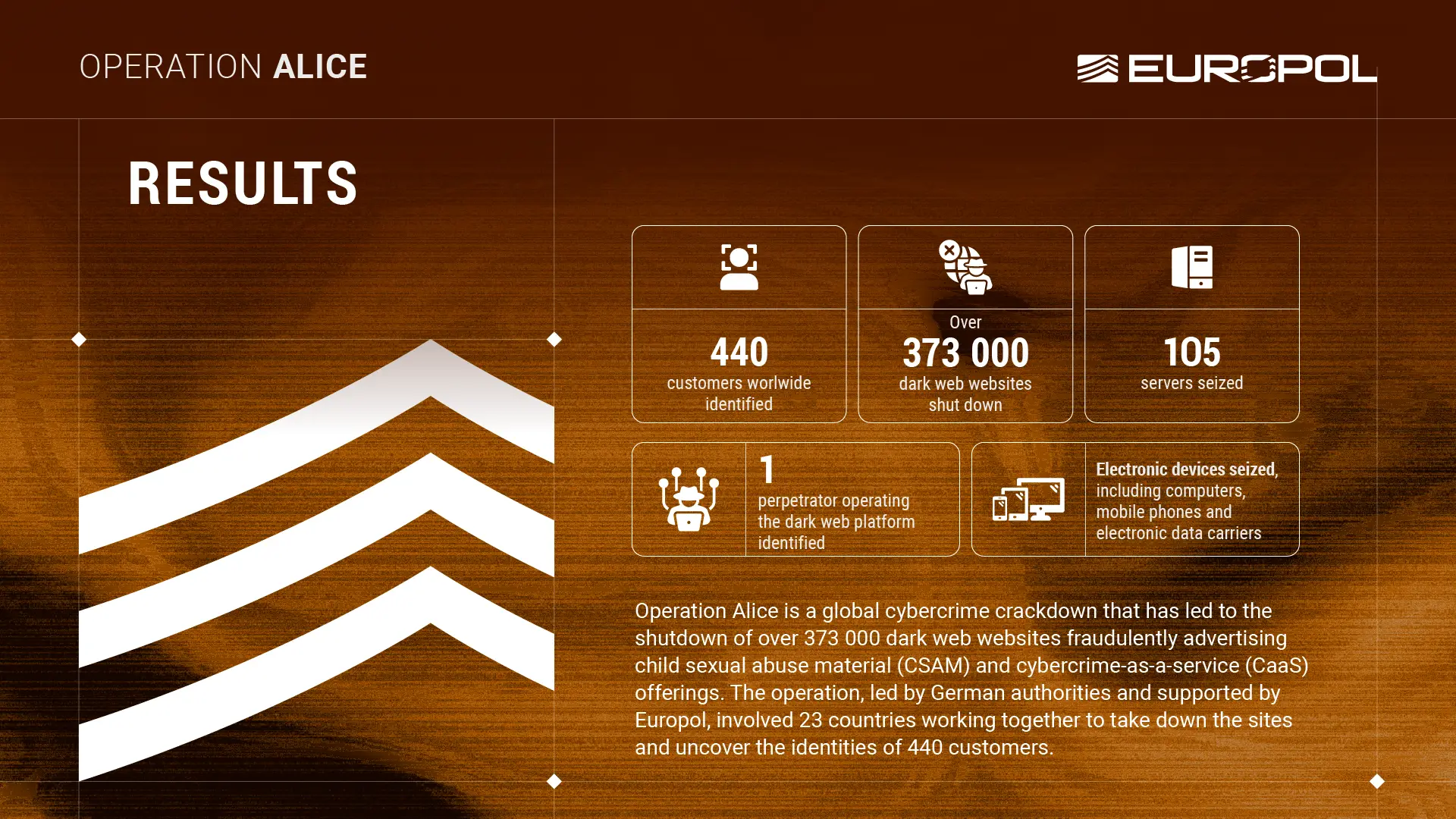
On March 9, a global operation led by German authorities and supported by Europol was launched against one of the largest networks of fraudulent platforms in the dark web. The investigation began in mid-2021 against the dark web platform "Alice with Violence CP." During the investigation, authorities discovered that the platform's operator ran more than 373,000 fraudulent websites advertising child sexual abuse material and cybercrime-as-a-service offerings.

The first phase of Operation Alice ran for 10 days, with 23 countries joining forces. The participating nations included Spain, Germany, the United States, the United Kingdom, Ukraine, Mexico, Canada, and Australia. Europol facilitated intelligence exchange, provided analytical support, coordinated the international response, and played a critical role in tracing cryptocurrency payments across jurisdictions.

The criminal model this operator constructed sits at an unusual intersection of two distinct threats that security teams rarely analyze together. From February 2020 to July 2025, the suspect advertised child sexual abuse material on different platforms accessible through more than 90,000 of those onion domains. The perpetrator offered material in purchasable packages after buyers provided an email address and made a payment in Bitcoin, with each package costing between €17 and €215 and promising data volumes ranging from a few gigabytes to several terabytes.

The material was never delivered. Customers were tricked into providing payment for these products but received nothing in return. Europol estimated the suspect made around €345,000 — approximately $400,000 — from around 10,000 people who attempted to buy the illicit material.

Not Just Any Other Dark Web Economy

The fraud architecture layered two criminal economies on top of each other. Alongside child abuse material, the platform also offered cybercrime-as-a-service listings — including stolen credit card data and access to compromised backend computer systems — extending the operator's reach from child exploitation into enterprise-grade cybercrime services.

The CaaS dimension means the operator's customer base included not only individuals seeking abuse material but also cybercriminals seeking ready-made access to corporate networks, broadening the downstream harm considerably.

The infrastructure scale alone places this case in a different category from any previous dark web takedown. The dark web runs on onion domains — a special type of website address engineered specifically to conceal the identity and location of both the operator and visitors by routing traffic through layered encryption relays.

Over nearly five years of investigation, German authorities discovered that a single individual operated over 373,000 onion domains on the dark web. Managing that volume of infrastructure requires automation, deliberate operational security planning, and sustained technical capability.

Operation Alice initially only targeted the platform operator. However, through international cooperation, the investigation uncovered the identities of 440 customers who had used the operator's services. Due to the nature of the purchases, additional investigations were launched against them, and the operation remains ongoing against more than 100 of those individuals.

The operational results include the seizure of 105 servers along with computers, mobile phones, and electronic storage devices. Investigators also seized the financial proceeds generated across five years of operation.

Also read: FBI and Europol Dismantle LeakBase Cybercrime Forum With 142,000 Users

Multiple Threat Actors Exploiting a Six-Vulnerability iOS Exploit Kit Dubbed “DarkSword”

19 de Março de 2026, 04:12

DarkSword, DarkSword iOS Exploit, GTIG, Google, Lookout, iVerify, Apple, iOS Exploit

It takes a single page load on a compromised Ukrainian government site, no tap, no download, no warning — and an iPhone running iOS 18.4 through 18.6.2 hands over its messages, photos, passwords, Telegram history, iCloud files, and cryptocurrency wallet keys to an attacker halfway across the world, then erases every trace of the intrusion within minutes.

That is DarkSword. And it has already spread to at least four countries.

On Wednesday, Google Threat Intelligence Group (GTIG), mobile security firm Lookout and device integrity company iVerify published coordinated research disclosing a new iOS full-chain exploit kit they named DarkSword — a name taken directly from a variable buried inside the malware's own code: const TAG = "DarkSword-WIFI-DUMP". The three organizations collaborated across separate discovery threads, with each contributing distinct pieces of a deeply alarming picture.

DarkSword in the Hands of Spyware Vendors and State Actors

GTIG tracked DarkSword deployments since at least November 2025, identifying multiple distinct threat actors — including commercial surveillance vendors and suspected state-sponsored groups — deploying the same exploit chain against targets in Saudi Arabia, Turkey, Malaysia, and Ukraine. The chain leverages six vulnerabilities across iOS 18.4 through 18.7, and all six have now been patched in iOS 26.3, though most arrived in earlier updates. Apple was notified by GTIG in late 2025.

Studying the Exploit Chain

The exploit chain's entry point for Ukrainian targets sits inside two compromised websites, novosti[.]dn[.]ua, a news portal, and 7aac[.]gov[.]ua, a Ukrainian government domain. Both sites contained an invisible malicious iframe injected by attackers, which silently loaded exploit code hosted on a server in Estonia. That server only delivered the payload to devices having Ukrainian IP addresses — a deliberate geofencing technique that reduces exposure, frustrates researchers, and increases the operational window before detection.

Once Safari loaded the iframe, DarkSword executed a disciplined, multi-stage attack entirely in JavaScript — a design choice that is itself significant. There is no binary implant, no Mach-O library injected into processes, no traditional malware artifact that endpoint detection logic would expect to find.

The chain breaks out of WebKit's WebContent sandbox, uses WebGPU to inject into a background media process called mediaplaybackd, builds arbitrary kernel read-write access from there, and then uses that access to lift sandbox restrictions across the device's most privileged processes — including configd, wifid, securityd, and UserEventAgent.

The final payload orchestrator, pe_main.js, then injects targeted data-theft modules into each of these processes before staging everything in accessible filesystem locations and exfiltrating the complete collection to a command-and-control server. The staged files are then deleted and the process exits cleanly.

The entire dwell time on a victim device measures in minutes. GTIG has identified three distinct malware families delivered following successful DarkSword compromise: GHOSTBLADE, GHOSTKNIFE, and GHOSTSABER.

What DarkSword steals covers almost every surface of a modern iPhone. SMS and iMessage content, call history, address book, WiFi passwords, Safari browsing history and cookies, location history, health data, photos, iCloud Drive, emails, saved passwords, WhatsApp and Telegram message histories, and the complete list of installed applications.

Most unusually for a state-adjacent espionage tool, DarkSword specifically targets cryptocurrency wallets like Coinbase, Binance, Kraken, Kucoin, Ledger, Trezor, MetaMask, and Exodus, among others. Lookout assesses this as evidence of a financially motivated dimension to the threat actor's operations, distinct from conventional cyber espionage.

The Six Vulnerabilities Underneath DarkSword

DarkSword's power derives from chaining six distinct flaws across different layers of iOS, each one unlocking the next stage of access.

[caption id="attachment_110322" align="aligncenter" width="486"]DarkSword, DarkSword iOS Exploit Chain The six vulnerabilities exploited at various levels of the exploit chain. (Image source: GTIG)[/caption]

The remote code execution stage exploited two memory corruption vulnerabilities in JavaScriptCore — the JavaScript engine that powers WebKit and Safari. The first, CVE-2025-31277, formed the foundation of the earliest observed DarkSword deployments targeting iOS 18.4 and 18.5.

A second JavaScriptCore memory corruption bug, CVE-2025-43529, was added in a later iteration of the kit targeting iOS 18.6, giving operators redundant entry points across a wider version range. Both bugs enable an attacker to corrupt memory through a malicious webpage alone, requiring no interaction from the victim beyond the page load itself.

Alongside either RCE exploit, DarkSword chains CVE-2026-20700, a Pointer Authentication Code (PAC) bypass in dyld — the dynamic linker responsible for loading code into Apple processes. PAC is a hardware-level security feature Apple introduced specifically to prevent attackers from hijacking code execution; bypassing it is a prerequisite for the deeper access DarkSword achieves. The remaining three vulnerabilities handle the sandbox escape and privilege escalation stages, progressively dismantling iOS security boundaries until the attacker holds unrestricted kernel read-write access across the entire device.

Apple addressed the vulnerabilities on a rolling basis rather than in a single emergency patch, reflecting the staggered pace at which researchers discovered each flaw. CVE-2025-31277 and CVE-2025-43529 received fixes in iOS 26.1 and iOS 26.2 respectively, while CVE-2026-20700 and the remaining privilege escalation vulnerabilities were closed with iOS 26.3.

The final complete remediation, covering all six DarkSword vulnerabilities, landed in iOS 18.7.3 for devices on the iOS 18 branch. The gap between the earliest known DarkSword deployment in November 2025 and the final patch in iOS 26.3 represents a window of roughly four months during which the full chain operated against unpatched devices.

The Evolution of DarkSword Under Various Threat Actors

The infrastructure analysis by Lookout revealed an important link to a prior campaign. The delivery domain cdncounter[.]net shares nameservers, registrar, registration date, and IP resolution overlap with uacounter[.]com, a domain GTIG previously tied to UNC6353 — a suspected Russian espionage group that also used the earlier Coruna iOS exploit kit against Ukrainian targets. The same Ukrainian government domain that hosted DarkSword delivery code had previously distributed Coruna. GTIG has now observed UNC6353 incorporating DarkSword into its watering hole campaign repertoire alongside its previous toolkit.

Also read: How Russia-Linked Spies Turned Everyday Websites into Surveillance Traps aka ‘Watering Hole’

Perhaps the most significant finding across all three research publications is not the sophistication of any single vulnerability, but what the proliferation of DarkSword across multiple unrelated threat actors reveals about the commercial exploit market. Code comments written in Russian appear in the early infrastructure stages; code in subsequent exploit stages switches to English — consistent with a tool built by one developer and sold or transferred to multiple buyers. References to iOS 17.4.1 and 17.5.1 in portions of the code indicate this kit evolved from an earlier version, suggesting an ongoing commercial development and distribution pipeline rather than a one-time build.

Lookout states the threat actor likely gained access to an exploit and post-exploitation toolkit built by a third party. The nation-state grade iOS zero-day chains, which were once assumed exclusive to Tier 1 commercial surveillance vendors supplying governments, now circulate in a secondary market accessible to actors with narrower resources and mixed motives, including financial crime.

Devices running iOS 18.7.3 or iOS 26.3 and later are not vulnerable. Google has added DarkSword delivery domains to Safe Browsing. For devices that cannot be updated immediately, Apple's Lockdown Mode reduces the available attack surface.

  • ✇Firewall Daily – The Cyber Express
  • The Cyber Express Weekly Roundup: Space Security, Malware & Regulatory Alerts Ashish Khaitan
    In this week’s edition of The Cyber Express weekly roundup, some interesting news and cybersecurity stories share an interesting shift in the cyber domain. Critical developments span space cybersecurity, AI vulnerabilities, mobile malware, and global regulatory enforcement, highlighting how digital threats are becoming more sophisticated and interconnected.   From government-led initiatives to strengthen national defense, to high-profile breaches impacting multinational enterprises, and the r
     

The Cyber Express Weekly Roundup: Space Security, Malware & Regulatory Alerts

27 de Fevereiro de 2026, 09:50

weekly roundup The Cyber Express

In this week’s edition of The Cyber Express weekly roundup, some interesting news and cybersecurity stories share an interesting shift in the cyber domain. Critical developments span space cybersecurity, AI vulnerabilities, mobile malware, and global regulatory enforcement, highlighting how digital threats are becoming more sophisticated and interconnected.   From government-led initiatives to strengthen national defense, to high-profile breaches impacting multinational enterprises, and the rise of AI-augmented attacks, this cybersecurity news digest provides a detailed snapshot of the challenges facing organizations, agencies, and individual users worldwide.  This weekly roundup from The Cyber Express emphasizes the urgent need for stakeholders across all sectors to stay informed, adapt strategies in real time, and anticipate new cyber threats before they escalate. 

The Cyber Express Weekly Roundup 

India Strengthens Space Cybersecurity 

India has unveiled new space cybersecurity guidelines developed jointly by the Indian Computer Emergency Response Team (CERT-In) and SatCom Industry Association India (SIA-India). Announced at the DefSat Conference & Expo 2026 in New Delhi, the framework introduces risk-based, secure-by-design practices for satellites, ground systems, and supply chains. Read more... 

Apple Devices Certified for NATO Restricted Data 

Apple Inc. has become the first consumer device maker approved to handle NATO “restricted” classified information on standard iPhone and iPad devices running iOS 26 and iPadOS 26. Certification, granted following testing by Germany’s Federal Office for Information Security, allows personnel across NATO member states to use commercial devices without specialized security softwareRead more... 

OpenClaw Vulnerability Threatens Local AI Agents 

Security researchers have discovered a critical flaw in the open-source AI agent OpenClaw, allowing any malicious website visited by a developer to hijack the locally running agent. The vulnerability, present in OpenClaw’s local WebSocket gateway, permitted password brute-forcing and administrative access without plugins or user interaction. Read more... 

Cisco SD-WAN Zero-Day Exploitation Spans Three Years 

Cisco Systems’ Catalyst SD-WAN controllers were compromised via a critical zero-day flaw (CVE-2026-20127) for at least three years, according to Cisco Talos. Threat actors exploited the authentication bypass to gain administrative access and insert rogue peers, chaining the exploit with an older vulnerability (CVE-2022-20775) to escalate privileges while avoiding detection. Read more... 

U.S. Sanctions Russian Zero-Day Broker 

The U.S. Department of State sanctioned Operation Zero, a Russia-linked cyber brokerage network, targeting Russian national Sergey Sergeyevich Zelenyuk and associated entities. Authorities allege Australian national Peter Williams stole eight classified exploits from a U.S. defense contractor between 2022 and 2025, selling them for $1.3 million in cryptocurrency. Read more... 

X Appeals €120M EU Fine 

Social media platform X has filed an appeal against a €120 million penalty under the EU Digital Services Act, challenging enforcement related to its paid verification system, advertising disclosures, and public data access for researchers. X claims procedural errors and misinterpretation of obligations, framing the case as a precedent-setting test for platform accountability, user trust, and regulatory compliance. Read more... 

Weekly Takeaway 

This week’s The Cyber Express weekly roundup highlights how cybersecurity risks are advancing across sectors, from national space programs to AI agents, mobile malware, and critical infrastructure. Organizations and regulators must adapt in real time, balancing innovation with governance, monitoring, and incident preparedness. As this cybersecurity news highlights, proactive measures remain essential in a complex digital environment. 
❌
❌