

Visualização normal

Antes de ontemStream principal
  • ✇SOC Prime Blog
  • CVE-2026-20700: Apple Patches Zero-Day Exploited in Sophisticated Cyber Attacks Daryna Olyniychuk
    SOC Prime previously highlighted Apple’s actively exploited WebKit zero-day CVE-2025-14174, a case that showed how quickly weaponized iOS flaws can move from targeted activity to real operational risk for organizations and high-value users. That same case later led to additional fixes, with CVE-2025-14174 and CVE-2025-43529 both issued in response to it, reinforcing a familiar pattern in which separate bugs are addressed as part of a broader security incident rather than in isolation.  In Febru
     

CVE-2026-20700: Apple Patches Zero-Day Exploited in Sophisticated Cyber Attacks

12 de Fevereiro de 2026, 12:45

SOC Prime previously highlighted Apple’s actively exploited WebKit zero-day CVE-2025-14174, a case that showed how quickly weaponized iOS flaws can move from targeted activity to real operational risk for organizations and high-value users. That same case later led to additional fixes, with CVE-2025-14174 and CVE-2025-43529 both issued in response to it, reinforcing a familiar pattern in which separate bugs are addressed as part of a broader security incident rather than in isolation. 

In February 2026, that story continued with CVE-2026-20700, an exploited memory corruption vulnerability in dyld, Apple’s Dynamic Link Editor. Apple states that an attacker with memory write capability may be able to achieve arbitrary code execution, and notes the issue may have been used in an “extremely sophisticated attack” against specific targeted individuals.

Notably, with the latest update, Apple has addressed its first actively exploited zero-day in 2026. Public reporting also notes that the company patched nine zero-day vulnerabilities exploited in the wild in 2025.

Register for SOC Prime’s AI-Native Detection Intelligence Platform, backed by cutting-edge technologies and top cybersecurity expertise to outscale cyber threats and build a resilient cybersecurity posture. Click Explore Detections to access the comprehensive collection of SOC content for vulnerability exploit detection, filtered by the custom “CVE” tag.

Explore Detections

Detections from the dedicated rule set can be applied across 40+ SIEM, EDR, and Data Lake platforms and are mapped to the latest MITRE ATT&CK® framework v18.1. Security teams can also leverage Uncoder AI to accelerate detection engineering end-to-end by generating rules directly from live threat reports, refining and validating detection logic, auto-visualizing Attack Flows, converting IOCs into custom hunting queries, and instantly translating detection code across diverse language formats.

CVE-2026-20700 Analysis

Apple clarifies that CVE-2026-20700 resides in dyld, the system component responsible for loading dynamic libraries into memory and bridging application code with system frameworks. That placement matters because vulnerabilities in foundational loader components can be valuable in real-world exploit chains that depend on how code is mapped and executed at runtime.

Apple keeps technical details limited, but it confirms two points defenders should prioritize. Apple is aware of exploitation tied to highly targeted activity, which suggests mature tradecraft rather than opportunistic attacks. Apple also confirms the impact is arbitrary code execution, which means the outcome is not only stability issues, but attacker-controlled instruction execution on the device under the right conditions.

Patches for CVE-2026-20700 are available in iOS 26.3 and iPadOS 26.3, macOS Tahoe 26.3, watchOS 26.3, tvOS 26.3, and visionOS 26.3. Apply the latest Apple security updates across all supported devices, confirm that systems are running the remediated versions, and enforce and validate compliance. Users are also prompted to enable automatic updates on personal devices.

To strengthen coverage beyond patching, rely on the SOC Prime Platform to reach the world’s largest detection intelligence dataset, adopt an end-to-end pipeline that spans detection through simulation while streamlining security operations and speeding up response workflows, reduce engineering overhead, and stay ahead of emerging threats.

FAQ

What is CVE-2026-20700 and how does it work?

CVE-2026-20700 is a memory corruption vulnerability in Apple’s dyld component. Apple states that an attacker with memory write capability may be able to exploit the flaw to execute arbitrary code.

When was CVE-2026-20700 first discovered?

Apple publicly disclosed and patched CVE-2026-20700 in its February 11, 2026 security release.

What is the impact of CVE-2026-20700 on organizations and users?

Successful exploitation can result in arbitrary code execution, which is dangerous because it can enable deeper compromise depending on the attacker’s access and the device’s role in the environment.

Can CVE-2026-20700 still affect me in 2026?

Yes. Devices running vulnerable versions, especially those not updated to the patched OS releases, can remain exposed.

How can you protect from CVE-2026-20700?

Update Apple devices to the latest available security release for your OS line, including iOS 26.3,iPadOS 26.3, and macOS Tahoe 26.3, where applicable. Enable automatic updates where possible and verify patch coverage, particularly if you maintain older OS branches that may require separate backported fixes.


The post CVE-2026-20700: Apple Patches Zero-Day Exploited in Sophisticated Cyber Attacks appeared first on SOC Prime.
  • ✇Malwarebytes
  • Apple patches zero-day flaw that could let attackers take control of devices
    Apple has released security updates for iPhones, iPads, Macs, Apple Watches, Apple TVs, and Safari, fixing, in particular, a zero-day flaw that is actively exploited in targeted attacks. Exploiting this zero-day flaw would allow cybercriminals to run any code they want on the affected device, potentially installing spyware or backdoors without the owner noticing. Installing these updates as soon as possible keeps your personal information—and everything else on your Apple devices—safe from
     

Apple patches zero-day flaw that could let attackers take control of devices

12 de Fevereiro de 2026, 08:40

Apple has released security updates for iPhones, iPads, Macs, Apple Watches, Apple TVs, and Safari, fixing, in particular, a zero-day flaw that is actively exploited in targeted attacks.

Exploiting this zero-day flaw would allow cybercriminals to run any code they want on the affected device, potentially installing spyware or backdoors without the owner noticing.

Installing these updates as soon as possible keeps your personal information—and everything else on your Apple devices—safe from such an attack.

CVE-2026-20700

The zero-day vulnerability tracked as CVE-2026-20700, is a memory corruption issue in versions before watchOS 26.3, tvOS 26.3, macOS Tahoe 26.3, visionOS 26.3, iOS 26.3 and iPadOS 26.3. An attacker with memory write capability may be able to execute arbitrary code.

Apple says the vulnerability was used as part of an infection chain combined with CVE-2025-14174 and CVE-2025-43529 against devices running iOS versions prior to iOS 26.

Those two vulnerabilities were already patched in the December 2025 update.

Updates for your particular device

The table below shows which updates are available and points you to the relevant security content for that operating system (OS).

iOS 26.3 and iPadOS 26.3iPhone 11 and later, iPad Pro 12.9-inch 3rd generation and later, iPad Pro 11-inch 1st generation and later, iPad Air 3rd generation and later, iPad 8th generation and later, and iPad mini 5th generation and later
iOS 18.7.5 and iPadOS 18.7.5iPhone XS, iPhone XS Max, iPhone XR, iPad 7th generation
macOS Tahoe 26.3macOS Tahoe
macOS Sequoia 15.7.4macOS Sequoia
macOS Sonoma 14.8.4macOS Sonoma
tvOS 26.3Apple TV HD and Apple TV 4K (all models)
watchOS 26.3Apple Watch Series 6 and later
visionOS 26.3Apple Vision Pro (all models)
Safari 26.3macOS Sonoma and macOS Sequoia

How to update your Apple devices

How to update your iPhone or iPad

For iOS and iPadOS users, here’s how to check if you’re using the latest software version:

  • Go to Settings > General > Software Update. You will see if there are updates available and be guided through installing them.
  • Turn on Automatic Updates if you haven’t already—you’ll find it on the same screen.
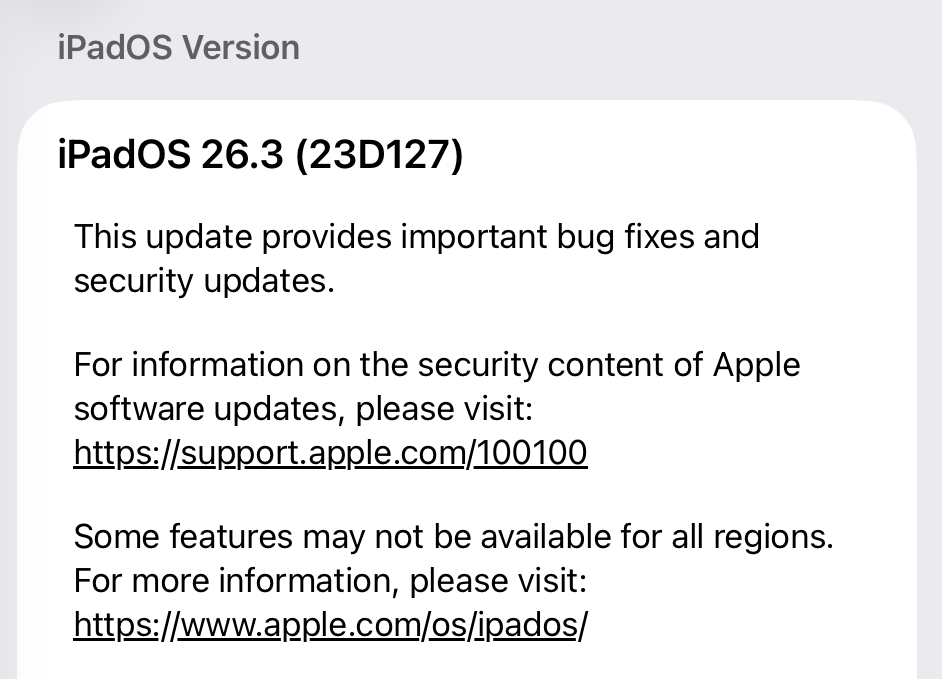
iPadOS 26.3 update

How to update macOS on any version

To update macOS on any supported Mac, use the Software Update feature, which Apple designed to work consistently across all recent versions. Here are the steps:

  • Click the Apple menu in the upper-left corner of your screen.
  • Choose System Settings (or System Preferences on older versions).
  • Select General in the sidebar, then click Software Update on the right. On older macOS, just look for Software Update directly.
  • Your Mac will check for updates automatically. If updates are available, click Update Now (or Upgrade Now for major new versions) and follow the on-screen instructions. Before you upgrade to macOS Tahoe 26, please read these instructions.
  • Enter your administrator password if prompted, then let your Mac finish the update (it might need to restart during this process).
  • Make sure your Mac stays plugged in and connected to the internet until the update is done.

How to update Apple Watch

Ensure your iPhone is paired with your Apple Watch and connected to Wi-Fi, then:

  • Keep your Apple Watch on its charger and close to your iPhone.
  • Open the Watch app on your iPhone.
  • Tap General > Software Update.
  • If an update appears, tap Download and Install.
  • Enter your iPhone passcode or Apple ID password if prompted.

Your Apple Watch will automatically restart during the update process. Make sure it remains near your iPhone and on charge until the update completes.

How to update Apple TV

Turn on your Apple TV and make sure it’s connected to the internet, then:

  • Open the Settings app on Apple TV.
  • Navigate to System > Software Updates.
  • Select Update Software.
  • If an update appears, select Download and Install.

The Apple TV will download the update and restart as needed. Keep your device connected to power and Wi-Fi until the process finishes.

How to update your Safari browser

Safari updates are included with macOS updates, so installing the latest version of macOS will also update Safari. To check manually:

  • Open the Apple menu > System Settings > General > Software Update.
  • If you see a Safari update listed separately, click Update Now to install it.
  • Restart your Mac when prompted.

If you’re on an older macOS version that’s still supported (like Sonoma or Sequoia), Apple may offer Safari updates independently through Software Update.

More advice to stay safe

The most important fix—however inconvenient it may be—is to upgrade to iOS 26.3 (or the latest available version for your device). Not doing so means missing an accumulating list of security fixes, leaving your device vulnerable to newly found vulnerabilities.

 But here are some other useful tips:

  • Make it a habit to restart your device on a regular basis.
  • Do not open unsolicited links and attachments without verifying with the trusted sender.
  • Remember: Apple threat notifications will never ask users to click links, open files, install apps or ask for account passwords or verification codes.
  • For Apple Mail users, these vulnerabilities create risk when viewing HTML-formatted emails containing malicious web content.
  • Malwarebytes for iOS can help keep your device secure, with Trusted Advisor alerting you when important updates are available.
  • If you are a high-value target, or you want the extra level of security, consider using Apple’s Lockdown Mode.

We don’t just report on phone security—we provide it

Cybersecurity risks should never spread beyond a headline. Keep threats off your mobile devices by downloading Malwarebytes for iOS, and Malwarebytes for Android today.

❌
❌