 Entrar
Legacy Leak: Deprecated GNU C Library Functions Spark New Security Fears
29 de Abril de 2026, 10:30
The post Legacy Leak: Deprecated GNU C Library Functions Spark New Security Fears appeared first on Daily CyberSecurity.



Proteja sua empresa contra ataques digitais, vazamentos de informação e crises de reputação online.
Todos os dias empresas sofrem ataques digitais, vazamentos de dados e exposição negativa na internet. Muitas só descobrem quando o dano já aconteceu.
Uma única crise digital pode gerar:
Detectamos ameaças online, menções negativas, vazamentos e riscos digitais antes que se tornem crises.
Estratégias para proteger a imagem da empresa, executivos e marca no ambiente digital.
Mapeamento da exposição digital da empresa para reduzir vulnerabilidades e riscos online.
Resposta rápida e estratégica para reduzir danos quando ocorre uma crise na internet.
🚀 Proteja sua empresa antes que seja tarde

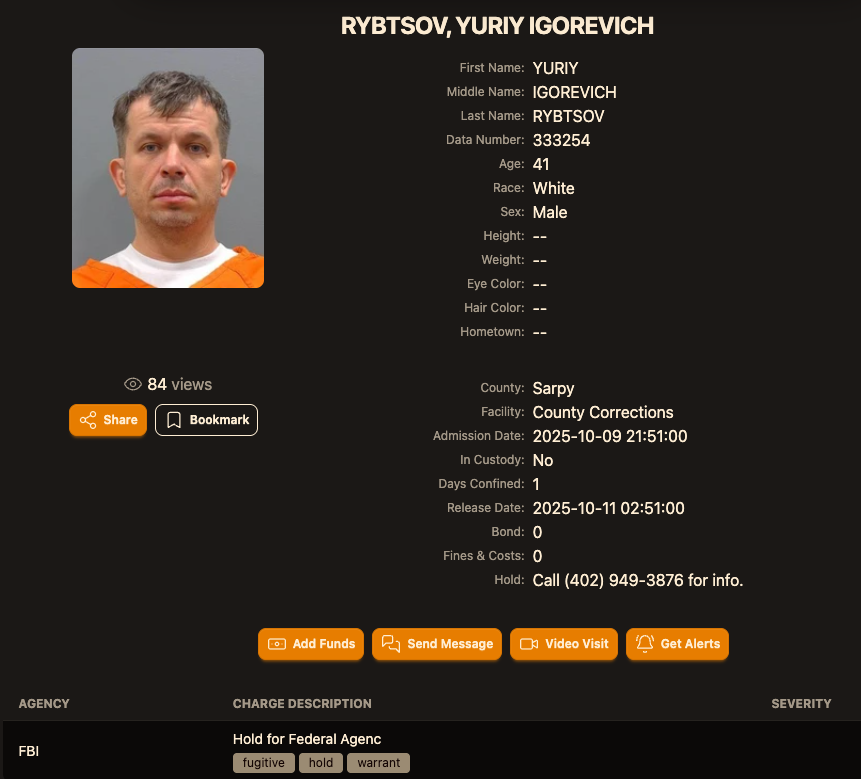
A Ukrainian man indicted in 2012 for conspiring with a prolific hacking group to steal tens of millions of dollars from U.S. businesses was arrested in Italy and is now in custody in the United States, KrebsOnSecurity has learned.
Sources close to the investigation say Yuriy Igorevich Rybtsov, a 41-year-old from the Russia-controlled city of Donetsk, Ukraine, was previously referenced in U.S. federal charging documents only by his online handle “MrICQ.” According to a 13-year-old indictment (PDF) filed by prosecutors in Nebraska, MrICQ was a developer for a cybercrime group known as “Jabber Zeus.”
Image: lockedup dot wtf.
The Jabber Zeus name is derived from the malware they used — a custom version of the ZeuS banking trojan — that stole banking login credentials and would send the group a Jabber instant message each time a new victim entered a one-time passcode at a financial institution website. The gang targeted mostly small to mid-sized businesses, and they were an early pioneer of so-called “man-in-the-browser” attacks, malware that can silently intercept any data that victims submit in a web-based form.
Once inside a victim company’s accounts, the Jabber Zeus crew would modify the firm’s payroll to add dozens of “money mules,” people recruited through elaborate work-at-home schemes to handle bank transfers. The mules in turn would forward any stolen payroll deposits — minus their commissions — via wire transfers to other mules in Ukraine and the United Kingdom.
The 2012 indictment targeting the Jabber Zeus crew named MrICQ as “John Doe #3,” and said this person handled incoming notifications of newly compromised victims. The Department of Justice (DOJ) said MrICQ also helped the group launder the proceeds of their heists through electronic currency exchange services.
Two sources familiar with the Jabber Zeus investigation said Rybtsov was arrested in Italy, although the exact date and circumstances of his arrest remain unclear. A summary of recent decisions (PDF) published by the Italian Supreme Court states that in April 2025, Rybtsov lost a final appeal to avoid extradition to the United States.
According to the mugshot website lockedup[.]wtf, Rybtsov arrived in Nebraska on October 9, and was being held under an arrest warrant from the U.S. Federal Bureau of Investigation (FBI).
The data breach tracking service Constella Intelligence found breached records from the business profiling site bvdinfo[.]com showing that a 41-year-old Yuriy Igorevich Rybtsov worked in a building at 59 Barnaulska St. in Donetsk. Further searching on this address in Constella finds the same apartment building was shared by a business registered to Vyacheslav “Tank” Penchukov, the leader of the Jabber Zeus crew in Ukraine.
Vyacheslav “Tank” Penchukov, seen here performing as “DJ Slava Rich” in Ukraine, in an undated photo from social media.
Penchukov was arrested in 2022 while traveling to meet his wife in Switzerland. Last year, a federal court in Nebraska sentenced Penchukov to 18 years in prison and ordered him to pay more than $73 million in restitution.
Lawrence Baldwin is founder of myNetWatchman, a threat intelligence company based in Georgia that began tracking and disrupting the Jabber Zeus gang in 2009. myNetWatchman had secretly gained access to the Jabber chat server used by the Ukrainian hackers, allowing Baldwin to eavesdrop on the daily conversations between MrICQ and other Jabber Zeus members.
Baldwin shared those real-time chat records with multiple state and federal law enforcement agencies, and with this reporter. Between 2010 and 2013, I spent several hours each day alerting small businesses across the country that their payroll accounts were about to be drained by these cybercriminals.
Those notifications, and Baldwin’s tireless efforts, saved countless would-be victims a great deal of money. In most cases, however, we were already too late. Nevertheless, the pilfered Jabber Zeus group chats provided the basis for dozens of stories published here about small businesses fighting their banks in court over six- and seven-figure financial losses.
Baldwin said the Jabber Zeus crew was far ahead of its peers in several respects. For starters, their intercepted chats showed they worked to create a highly customized botnet directly with the author of the original Zeus Trojan — Evgeniy Mikhailovich Bogachev, a Russian man who has long been on the FBI’s “Most Wanted” list. The feds have a standing $3 million reward for information leading to Bogachev’s arrest.
Evgeniy M. Bogachev, in undated photos.
The core innovation of Jabber Zeus was an alert that MrICQ would receive each time a new victim entered a one-time password code into a phishing page mimicking their financial institution. The gang’s internal name for this component was “Leprechaun,” (the video below from myNetWatchman shows it in action). Jabber Zeus would actually re-write the HTML code as displayed in the victim’s browser, allowing them to intercept any passcodes sent by the victim’s bank for multi-factor authentication.
“These guys had compromised such a large number of victims that they were getting buried in a tsunami of stolen banking credentials,” Baldwin told KrebsOnSecurity. “But the whole point of Leprechaun was to isolate the highest-value credentials — the commercial bank accounts with two-factor authentication turned on. They knew these were far juicier targets because they clearly had a lot more money to protect.”
Baldwin said the Jabber Zeus trojan also included a custom “backconnect” component that allowed the hackers to relay their bank account takeovers through the victim’s own infected PC.
“The Jabber Zeus crew were literally connecting to the victim’s bank account from the victim’s IP address, or from the remote control function and by fully emulating the device,” he said. “That trojan was like a hot knife through butter of what everyone thought was state-of-the-art secure online banking at the time.”
Although the Jabber Zeus crew was in direct contact with the Zeus author, the chats intercepted by myNetWatchman show Bogachev frequently ignored the group’s pleas for help. The government says the real leader of the Jabber Zeus crew was Maksim Yakubets, a 38-year Ukrainian man with Russian citizenship who went by the hacker handle “Aqua.”
Alleged Evil Corp leader Maksim “Aqua” Yakubets. Image: FBI
The Jabber chats intercepted by Baldwin show that Aqua interacted almost daily with MrICQ, Tank and other members of the hacking team, often facilitating the group’s money mule and cashout activities remotely from Russia.
The government says Yakubets/Aqua would later emerge as the leader of an elite cybercrime ring of at least 17 hackers that referred to themselves internally as “Evil Corp.” Members of Evil Corp developed and used the Dridex (a.k.a. Bugat) trojan, which helped them siphon more than $100 million from hundreds of victim companies in the United States and Europe.
This 2019 story about the government’s $5 million bounty for information leading to Yakubets’s arrest includes excerpts of conversations between Aqua, Tank, Bogachev and other Jabber Zeus crew members discussing stories I’d written about their victims. Both Baldwin and I were interviewed at length for a new weekly six-part podcast by the BBC that delves deep into the history of Evil Corp. Episode One focuses on the evolution of Zeus, while the second episode centers on an investigation into the group by former FBI agent Jim Craig.
Image: https://www.bbc.co.uk/programmes/w3ct89y8

When a company that manages data for millions of UK citizens falls victim to ransomware, the whole industry should pay attention to it. On 15 October 2025, the UK Information Commissioner’s Office (ICO) published a detailed 136 page report about the Capita breach.
The aim of this blog is to extract actionable cybersecurity lessons from the ICO’s findings as well as open source reports surrounding the breach from a cyber threat intelligence (CTI) analyst’s perspective to help SOC and CERT teams, and CISOs understand what happened and how to avoid the mistakes made by others.
The Capita Group is a business process outsourcing (BPO) and professional services group employing approximately 34,500 people worldwide and with a reported annual revenue of £2,421.6 million. For readers outside of Great Britain, Capita is best known as the UK’s go-to managed service provider for large-scale, data-sensitive public sector operations.
Companies within the Capita Group act as data processors for a range of business services to both public and private sector organisations. Capita plc is the ultimate parent company of a large corporate group consisting of multiple legal entities.
Capita has long been one of the UK government’s biggest suppliers of outsourced services.
They manage (or have managed):
The ICO established that during the Incident, data was exfiltrated from two legal entities which were acting as data controllers, and from four legal entities which were acting as data processors:
In the ICO’s report, a timeline of events that led to data exfiltration and ransomware deployment was provided. The timeline diagram below helps illustrate what happened.

TheRecord also reported that Capita’s share price dropped more than 12% from a high of £38.64 ($47.97) on March 30, the day before the incident was first reported, to £33.72 ($42.58) on Wednesday morning.
On 3 April 2023, Capita released a public statement about the cyber incident. At the time, Capita said the “issue was limited to parts of the Capita network and there is no evidence of customer, supplier or colleague data having been compromised.”
On 8 April 2023, Brett Callow spotted that Capita had been listed on BlackBasta’s Tor data leak site before it was quickly removed that same day.

Security researcher Kevin Beaumont who analysed the leaked data samples at the time identified copies of stolen passport scans, PII records, bank account details, internal floor plans of multiple buildings from various schools as well as Capita Nuclear, part of Capita Business Services.
It took Capita until 20 April 2023 to confirm that some of its systems were in fact breached and that data had been stolen.
In the ICO’s report, we learn that 6,024,221 data subjects for whom Capita was the data processor had personal data exfiltrated, as determined by Capita’s forensic provider.
Types of data stolen included sensitive such as Home Address, Email, Phone Number, National Insurance Numbers, Driver’s License Scans, Passport Scans, Bank Account Numbers & Sort Codes, Credit Card Numbers, Biometrics, Criminal Record Checks, and Employee Login details.
The tactics, techniques, and procedures (TTPs) of the BlackBasta operators provided in the breach timeline by the ICO are useful for understanding what technical steps were involved that led to the breach and ransomware attack. A summary of the aspects of the attack have been mapped to a diamond model diagram below.

Outside of the breach timeline, some additional technical details were shared:

The domain "corpcitrix.ad.capita.co.uk" appears to be an internal Active Directory domain name used by Capita to host its corporate Citrix environment. The "ad" label shows it’s an AD DNS namespace, "corpcitrix" indicates the environment is for Citrix-published desktops/apps or related infrastructure, and "capita.co.uk" is the organisation’s FQDN.
The command shown above is a PowerShell invocation (potentially via Cobalt Strike) to enumerate every system in the domain, resolve each machine’s IP address, and save the results to “SFS_pc.txt” file. Powerpick runs the code in an unmanaged PowerShell environment and can execute without being dependent on powershell.exe.
In short, this command shows a BlackBasta operator running net reconnaissance mapping hosts and IPs (likely to plan lateral movement, targeting, exfiltration or ransomware deployment).
