Visualização normal

Ontem — 8 de Maio de 2026Stream principal

Hackers Use Morse Code to Trick Grok and Bankrbot, Steal $200K in Crypto Tokens

Threat actors have successfully executed a novel prompt injection attack against artificial intelligence agents, draining approximately $200,000 in cryptocurrency. By using Morse code to bypass standard AI safety filters, an attacker tricked the Grok AI model and an autonomous wallet agent, Bankrbot, into authorizing a massive unauthorized transfer on the Base network. This incident exposes […]

The post Hackers Use Morse Code to Trick Grok and Bankrbot, Steal $200K in Crypto Tokens appeared first on GBHackers Security | #1 Globally Trusted Cyber Security News Platform.

  • ✇Krebs on Security
  • Canvas Breach Disrupts Schools & Colleges Nationwide BrianKrebs
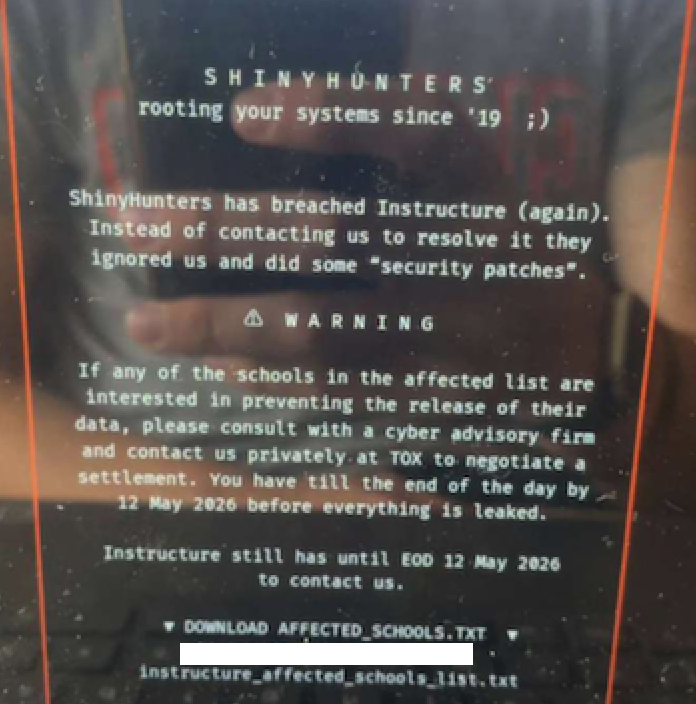
    An ongoing data extortion attack targeting the widely-used education technology platform Canvas disrupted classes and coursework at school districts and universities across the United States today, after a cybercrime group defaced the service’s login page with a ransom demand that threatened to leak data from 275 million students and faculty across nearly 9,000 educational institutions. A screenshot shared by a reader showing the extortion message that was shown on the Canvas login page today. C
     

Canvas Breach Disrupts Schools & Colleges Nationwide

7 de Maio de 2026, 23:58

An ongoing data extortion attack targeting the widely-used education technology platform Canvas disrupted classes and coursework at school districts and universities across the United States today, after a cybercrime group defaced the service’s login page with a ransom demand that threatened to leak data from 275 million students and faculty across nearly 9,000 educational institutions.

A screenshot shared by a reader showing the extortion message that was shown on the Canvas login page today.

Canvas parent firm Instructure responded to today’s defacement attacks by disabling the platform, which is used by thousands of schools, universities and businesses to manage coursework and assignments, and to communicate with students.

Instructure acknowledged a data breach earlier this week, after the cybercrime group ShinyHunters claimed responsibility and said they would leak data on tens of millions of students and faculty unless paid a ransom. The stated deadline for payment was initially set at May 6, but it was later pushed back to May 12.

In a statement on May 6, Instructure said the investigation so far shows the stolen information includes “certain identifying information of users at affected institutions, such as names, email addresses, and student ID numbers, as well as as messages among users.” The company said it found no evidence the breached data included more sensitive information, such as passwords, dates of birth, government identifiers or financial information.

The May 6 update stated that Canvas was fully operational, and that Instructure was not seeing any ongoing unauthorized activity on their platform. “At this stage, we believe the incident has been contained,” Instructure wrote.

However, by mid-day on Thursday, May 7, students and faculty at dozens of schools and universities were flooding social media sites with comments saying that a ransom demand from ShinyHunters had replaced the usual Canvas login page. Instructure responded by pulling Canvas offline and replacing the portal with the message, “Canvas is currently undergoing scheduled maintenance. Check back soon.”

“We anticipate being up soon, and will provide updates as soon as possible,” reads the current message on Instructure’s status page.

While the data stolen by ShinyHunters may or may not contain particularly sensitive information (ShinyHunters claims it includes several billion private messages among students and teachers, as well as names, phone numbers and email addresses), this attack could hardly have come at a worse time for Instructure: Many of the affected schools and universities are in the middle of final exams, and a prolonged outage could be highly damaging for the company.

The extortion message that greeted countless Canvas users today advised the affected schools to negotiate their own ransom payments to prevent the publication of their data — regardless of whether Instructure decides to pay.

“ShinyHunters has breached Instructure (again),” the extortion message read. “Instead of contacting us to resolve it they ignored us and did some ‘security patches.'”

A source close to the investigation who was not authorized to speak to the press told KrebsOnSecurity that a number of universities have already approached the cybercrime group about paying. The same source also pointed out that the ShinyHunters data leak blog no longer lists Instructure among its current extortion victims, and that the samples of data stolen from Canvas customers were removed as well. Data extortion groups like ShinyHunters will typically only remove victims from their leak sites after receiving an extortion payment or after a victim agrees to negotiate.

Dipan Mann, founder and CEO of the security firm Cloudskope, slammed Instructure for referring to today’s outage as a “scheduled maintenance” event on its status page. Mann said Shiny Hunters first demonstrated they’d breached Instructure on May 1, prompting Instructure’s Chief Information Security Officer Steve Proud to declare the following day that the incident had been contained. But Mann said today’s attack is at least the third time in the past eight months that Instructure has been breached by ShinyHunters.

In a blog post today, Mann noted that in September 2025, ShinyHunters released thousands of internal University of Pennsylvania files — donor records, internal memos, and other confidential materials — through what the Daily Pennsylvanian and other outlets later determined was, in part, a Canvas/Instructure-mediated access path.

“Penn was the named victim,” Mann wrote. “Instructure was the mechanism. The incident was treated as a Penn-specific story by most of the national press and quietly handled by Instructure as a customer-specific matter. That framing was wrong then. It is dramatically more wrong in light of the May 2026 events, which now look like the planned escalation of an attack pattern that ShinyHunters had been working against Instructure’s environment for at least eight months prior. The September 2025 Penn breach was the proof of concept. The May 1, 2026 incident was the production run. The May 7, 2026 recompromise was ShinyHunters demonstrating publicly that the May 2 ‘containment’ did not happen.”

In February, a ShinyHunters spokesperson told The Daily Pennsylvanian that Penn failed to pay a $1 million ransom demand. On March 5, ShinyHunters published 461 megabytes worth of data stolen from Penn, including thousands of files such as donor records and internal memos.

ShinyHunters is a prolific and fluid cybercriminal group that specializes in data theft and extortion. They typically gain access to companies through voice phishing and social engineering attacks that often involve impersonating IT personnel or other trusted members of a targeted organization.

Last month, ShinyHunters relieved the home security giant ADT of personal information on 5.5 million customers. The extortion group told BleepingComputer they breached the company by compromising an employee’s Okta single sign-on account in a voice phishing attack that enabled access to ADT’s Salesforce instance. BleepingComputer says ShinyHunters recently has taken credit for a number of extortion attacks against high-profile organizations, including Medtronic, Rockstar Games, McGraw Hill, 7-Eleven and the cruise line operator Carnival.

The attack on Canvas customers is just one of several major cybercrime campaigns being launched by ShinyHunters at the moment, said Charles Carmakal, chief technology officer at the Google-owned Mandiant Consulting. Carmakal declined to comment specifically on the Canvas breach, but said “there are multiple concurrent and discrete ShinyHunters intrusion and extortion campaigns happening right now.”

Cloudskope’s Mann said what happens next depends largely on whether Instructure’s customers — the universities, K-12 districts, and education ministries paying for Canvas — choose to apply pressure or absorb the breach quietly.

“The history of education-vendor incidents suggests the path of least resistance is the second one,” he concluded.

Update, May 8, 11:05 a.m. ET: Instructure has published an incident update page that includes more information about the breach. Instructure said its Canvas portal is functioning normally again, and that the hackers exploited an issue related to Free-for-Teacher accounts.

“This is the same issue that led to the unauthorized access the prior week,” Instructure wrote. “As a result, we have made the difficult decision to temporarily shut down Free-for-Teacher accounts. These accounts have been a core part of our platform, and we’re committed to resolving the issues with these accounts.”

Instructure said affected organizations were notified on May 6.

“If your organization is affected, Instructure will contact your organization’s primary contacts directly,” the update states. “Please don’t rely on third-party lists or social media posts naming potentially affected organizations as those lists aren’t verified. Instructure will confirm validated information through direct outreach to all affected organizations.”

Antes de ontemStream principal

276 Arrested as Authorities Dismantle Crypto Scam Centers Targeting Americans

In an unprecedented international law enforcement operation, authorities have dismantled at least nine overseas cryptocurrency scam centers, resulting in the arrest of 276 individuals. The coordinated effort, led by the FBI, Dubai Police, and the Chinese Ministry of Public Security, targeted transnational criminal networks running sophisticated “pig butchering” investment fraud schemes against American citizens. Threat […]

The post 276 Arrested as Authorities Dismantle Crypto Scam Centers Targeting Americans appeared first on GBHackers Security | #1 Globally Trusted Cyber Security News Platform.

  • ✇Firewall Daily – The Cyber Express
  • Iran-Linked Hackers Use Messaging Platform to Target Dissidents and Journalists Samiksha Jain
    The Iran Telegram malware campaign has once again put the spotlight on how state-backed cyber actors are adapting their tactics by blending into widely used digital platforms. In a recent alert, the Federal Bureau of Investigation (FBI) revealed that cyber actors linked to Iran’s Ministry of Intelligence and Security (MOIS) are using Telegram as a command-and-control (C2) infrastructure to deploy malware. The campaign specifically targets Iranian dissidents, journalists, and individuals or gr
     

Iran-Linked Hackers Use Messaging Platform to Target Dissidents and Journalists

24 de Março de 2026, 02:35

Iran Telegram malware

The Iran Telegram malware campaign has once again put the spotlight on how state-backed cyber actors are adapting their tactics by blending into widely used digital platforms. In a recent alert, the Federal Bureau of Investigation (FBI) revealed that cyber actors linked to Iran’s Ministry of Intelligence and Security (MOIS) are using Telegram as a command-and-control (C2) infrastructure to deploy malware. The campaign specifically targets Iranian dissidents, journalists, and individuals or groups perceived as opposing the Iranian government. According to the FBI, these operations have led to intelligence collection, data leaks, and reputational damage, indicating that the intent goes beyond simple access and leans toward sustained monitoring and impact.

Iran Telegram Malware Reflects Targeted Surveillance Strategy

The Iran Telegram malware activity dates back to at least Fall 2023, with multiple malware variants identified targeting Windows systems. The victim profile is not random. It is clearly defined, focused on individuals whose views or affiliations are seen as a threat by the Iranian government. However, the FBI also notes that the malware can be used against any individual of interest, suggesting the capability is broader than the currently observed targets. What stands out is the level of preparation. The malware is not just deployed, it is tailored. Attackers appear to study their targets in advance, customizing lures to increase the chances of success. This points to a deliberate and intelligence-driven approach rather than opportunistic attacks.

How the Iran Telegram Malware Operates

The FBI outlines a structured, multi-stage malware framework that combines deception with persistence.
Social Engineering Drives Initial Access
Attackers reach out through messaging platforms, impersonating trusted contacts or even technical support. Victims are persuaded to download files disguised as legitimate applications. These files often appear as commonly used software, including messaging tools or utilities, making them harder to question.
Multi-Stage Malware Deployment
  • Stage 1: Masquerades as legitimate applications such as Telegram-related tools, KeePass, or other software
  • Stage 2: Installs a persistent implant after user interaction
Once executed, the second stage connects the infected device to a Telegram bot, establishing a C2 channel via Telegram’s infrastructure.
Persistent Access and Control
At this stage, attackers gain remote access to the compromised system. The use of Telegram allows bidirectional communication, enabling continuous control without raising immediate suspicion.

Data Collection and Exfiltration via Telegram

The primary objective of the Iran Telegram malware campaign is data collection. The malware is capable of:
  • Recording screen activity and audio
  • Capturing cached data and files
  • Compressing and staging data for exfiltration
  • Deleting files after extraction
Some variants were even designed to record screen and audio during active Zoom sessions, highlighting a focus on capturing sensitive, real-time information. All collected data is routed through Telegram infrastructure, reinforcing its role as a central component of the attack chain.

Links to Handala Hack and Proxy Operations

The FBI also connects this campaign to the online entity “Handala Hack,” which claimed responsibility for a 2025 hack-and-leak operation targeting individuals critical of Iran. The agency assesses that some of the leaked data was obtained using malware associated with this campaign. Handala Hack is known for phishing, data theft, extortion, and destructive cyber activities, including the use of wiper malware. Additionally, the group is linked to “Homeland Justice,” another entity assessed to be operated by MOIS cyber actors. This reflects a broader pattern where technical intrusions are followed by public data exposure. The goal is not just access, but also reputational and political damage through controlled information release.

Execution Techniques and Persistence Mechanisms

The malware used in the Iran Telegram malware campaign employs several techniques to maintain access and avoid detection:
  • Use of PowerShell execution without warnings
  • Registry modifications to ensure persistence
  • Deployment of multiple malware files for different functions
Observed file names include variants mimicking legitimate tools, such as Telegram_authenticator.exe and WhatssApp.exe, further reinforcing the deception strategy. [caption id="attachment_110479" align="aligncenter" width="826"]Iran Telegram malware campaign Image Source: FBI[/caption] Once inside a system, additional malware components are downloaded to expand capabilities and maintain long-term access.

Why This Campaign Stands Out

What makes the Iran Telegram malware campaign particularly concerning is its simplicity combined with precision.
  • It relies heavily on human interaction rather than technical exploits
  • It uses trusted platforms instead of suspicious infrastructure
  • It focuses on specific individuals rather than mass attacks
This combination makes detection harder and increases the likelihood of success.

Mitigation- Simple Steps, Critical Impact

Despite the sophistication of the campaign, the FBI’s recommendations remain grounded in basic cybersecurity practices:
  • Be cautious of unexpected messages, even from known contacts
  • Avoid downloading files from unverified sources
  • Keep systems updated with the latest software patches
  • Use strong passwords and enable multi-factor authentication
  • Regularly run antivirus or anti-malware tools
The advisory makes one thing clear: even advanced campaigns often succeed because of small lapses in user awareness.

A Clear Signal for Cyber Defenders

The Iran Telegram malware campaign is a reminder that cyber threats are no longer confined to obscure or easily identifiable channels. By embedding malicious activity within widely used platforms like Telegram, attackers are reducing friction and increasing stealth. For defenders, this raises an important challenge, security strategies must account not just for malicious code, but for how and where that code is delivered. In this case, the platform is familiar. The method is simple. And that is exactly what makes it effective.

Founder of CoinDCX Arrested Amid Serious Fraud and Cheating Charges

The Indian cryptocurrency sector is currently facing a significant legal and cybersecurity controversy following the recent arrest of prominent CoinDCX executives. Local law enforcement from Mumbra police in Thane apprehended co-founders Sumit Gupta and Neeraj Khandelwal in Bengaluru. Both executives were produced before a court and remanded into police custody, facing charges of criminal breach […]

The post Founder of CoinDCX Arrested Amid Serious Fraud and Cheating Charges appeared first on GBHackers Security | #1 Globally Trusted Cyber Security News Platform.

  • ✇Krebs on Security
  • Iran-Backed Hackers Claim Wiper Attack on Medtech Firm Stryker BrianKrebs
    A hacktivist group with links to Iran’s intelligence agencies is claiming responsibility for a data-wiping attack against Stryker, a global medical technology company based in Michigan. News reports out of Ireland, Stryker’s largest hub outside of the United States, said the company sent home more than 5,000 workers there today. Meanwhile, a voicemail message at Stryker’s main U.S. headquarters says the company is currently experiencing a building emergency. Based in Kalamazoo, Michigan, Stryker
     

Iran-Backed Hackers Claim Wiper Attack on Medtech Firm Stryker

11 de Março de 2026, 13:20

A hacktivist group with links to Iran’s intelligence agencies is claiming responsibility for a data-wiping attack against Stryker, a global medical technology company based in Michigan. News reports out of Ireland, Stryker’s largest hub outside of the United States, said the company sent home more than 5,000 workers there today. Meanwhile, a voicemail message at Stryker’s main U.S. headquarters says the company is currently experiencing a building emergency.

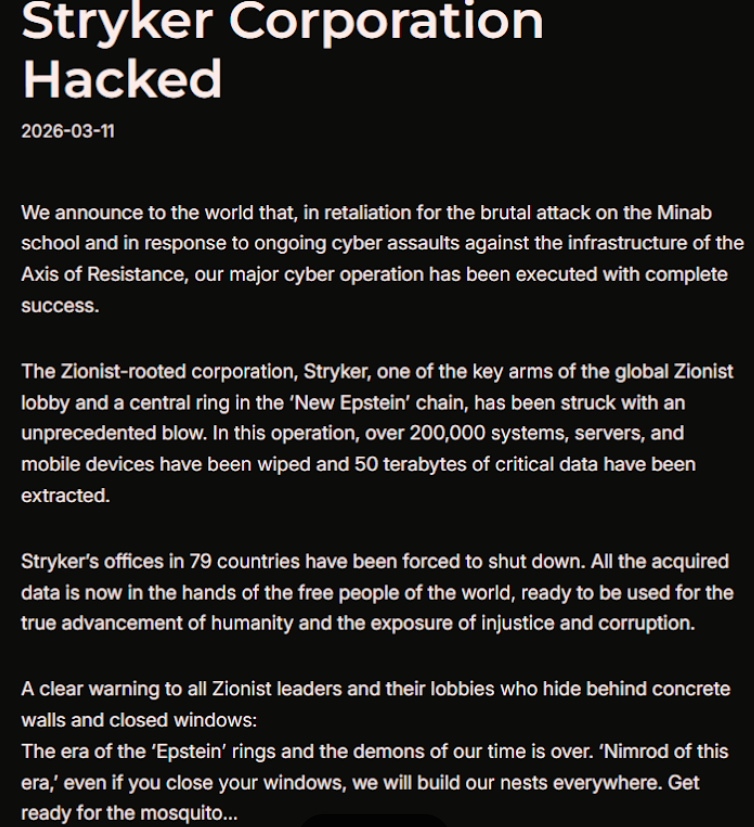
Based in Kalamazoo, Michigan, Stryker [NYSE:SYK] is a medical and surgical equipment maker that reported $25 billion in global sales last year. In a lengthy statement posted to Telegram, a hacktivist group known as Handala (a.k.a. Handala Hack Team) claimed that Stryker’s offices in 79 countries have been forced to shut down after the group erased data from more than 200,000 systems, servers and mobile devices.

A manifesto posted by the Iran-backed hacktivist group Handala, claiming a mass data-wiping attack against medical technology maker Stryker.

A manifesto posted by the Iran-backed hacktivist group Handala, claiming a mass data-wiping attack against medical technology maker Stryker.

“All the acquired data is now in the hands of the free people of the world, ready to be used for the true advancement of humanity and the exposure of injustice and corruption,” a portion of the Handala statement reads.

The group said the wiper attack was in retaliation for a Feb. 28 missile strike that hit an Iranian school and killed at least 175 people, most of them children. The New York Times reports today that an ongoing military investigation has determined the United States is responsible for the deadly Tomahawk missile strike.

Handala was one of several hacker groups recently profiled by Palo Alto Networks, which links it to Iran’s Ministry of Intelligence and Security (MOIS). Palo Alto says Handala surfaced in late 2023 and is assessed as one of several online personas maintained by Void Manticore, a MOIS-affiliated actor.

Stryker’s website says the company has 56,000 employees in 61 countries. A phone call placed Wednesday morning to the media line at Stryker’s Michigan headquarters sent this author to a voicemail message that stated, “We are currently experiencing a building emergency. Please try your call again later.”

A report Wednesday morning from the Irish Examiner said Stryker staff are now communicating via WhatsApp for any updates on when they can return to work. The story quoted an unnamed employee saying anything connected to the network is down, and that “anyone with Microsoft Outlook on their personal phones had their devices wiped.”

“Multiple sources have said that systems in the Cork headquarters have been ‘shut down’ and that Stryker devices held by employees have been wiped out,” the Examiner reported. “The login pages coming up on these devices have been defaced with the Handala logo.”

Wiper attacks usually involve malicious software designed to overwrite any existing data on infected devices. But a trusted source with knowledge of the attack who spoke on condition of anonymity told KrebsOnSecurity the perpetrators in this case appear to have used a Microsoft service called Microsoft Intune to issue a ‘remote wipe’ command against all connected devices.

Intune is a cloud-based solution built for IT teams to enforce security and data compliance policies, and it provides a single, web-based administrative console to monitor and control devices regardless of location. The Intune connection is supported by this Reddit discussion on the Stryker outage, where several users who claimed to be Stryker employees said they were told to uninstall Intune urgently.

Palo Alto says Handala’s hack-and-leak activity is primarily focused on Israel, with occasional targeting outside that scope when it serves a specific agenda. The security firm said Handala also has taken credit for recent attacks against fuel systems in Jordan and an Israeli energy exploration company.

“Recent observed activities are opportunistic and ‘quick and dirty,’ with a noticeable focus on supply-chain footholds (e.g., IT/service providers) to reach downstream victims, followed by ‘proof’ posts to amplify credibility and intimidate targets,” Palo Alto researchers wrote.

The Handala manifesto posted to Telegram referred to Stryker as a “Zionist-rooted corporation,” which may be a reference to the company’s 2019 acquisition of the Israeli company OrthoSpace.

Stryker is a major supplier of medical devices, and the ongoing attack is already affecting healthcare providers. One healthcare professional at a major university medical system in the United States told KrebsOnSecurity they are currently unable to order surgical supplies that they normally source through Stryker.

“This is a real-world supply chain attack,” the expert said, who asked to remain anonymous because they were not authorized to speak to the press. “Pretty much every hospital in the U.S. that performs surgeries uses their supplies.”

John Riggi, national advisor for the American Hospital Association (AHA), said the AHA is not aware of any supply-chain disruptions as of yet.

“We are aware of reports of the cyber attack against Stryker and are actively exchanging information with the hospital field and the federal government to understand the nature of the threat and assess any impact to hospital operations,” Riggi said in an email. “As of this time, we are not aware of any direct impacts or disruptions to U.S. hospitals as a result of this attack. That may change as hospitals evaluate services, technology and supply chain related to Stryker and if the duration of the attack extends.”

According to a March 11 memo from the state of Maryland’s Institute for Emergency Medical Services Systems, Stryker indicated that some of their computer systems have been impacted by a “global network disruption.” The memo indicates that in response to the attack, a number of hospitals have opted to disconnect from Stryker’s various online services, including LifeNet, which allows paramedics to transmit EKGs to emergency physicians so that heart attack patients can expedite their treatment when they arrive at the hospital.

“As a precaution, some hospitals have temporarily suspended their connection to Stryker systems, including LIFENET, while others have maintained the connection,” wrote Timothy Chizmar, the state’s EMS medical director. “The Maryland Medical Protocols for EMS requires ECG transmission for patients with acute coronary syndrome (or STEMI). However, if you are unable to transmit a 12 Lead ECG to a receiving hospital, you should initiate radio consultation and describe the findings on the ECG.”

This is a developing story. Updates will be noted with a timestamp.

Update, 2:54 p.m. ET: Added comment from Riggi and perspectives on this attack’s potential to turn into a supply-chain problem for the healthcare system.

Update, Mar. 12, 7:59 a.m. ET: Added information about the outage affecting Stryker’s online services.

  • ✇Security Boulevard
  • FBI is Investigating the ‘Sophisticated’ Hack of Its Surveillance System Jeffrey Burt
    The FBI, CISA, and NSA reportedly are investigating the hack by an unnamed "sophisticated" actor of a FBI surveillance system that holds sensitive information. The breach carries the hallmarks of Chinese nation-state groups and comes amid concerns about attacks in the wake of the war against Iran and the shrinking of the federal cybersecurity apparatus. The post FBI is Investigating the ‘Sophisticated’ Hack of Its Surveillance System appeared first on Security Boulevard.
     

FBI is Investigating the ‘Sophisticated’ Hack of Its Surveillance System

6 de Março de 2026, 18:00
SEC rules, cybersecurity, SEC cyber data breach rules

The FBI, CISA, and NSA reportedly are investigating the hack by an unnamed "sophisticated" actor of a FBI surveillance system that holds sensitive information. The breach carries the hallmarks of Chinese nation-state groups and comes amid concerns about attacks in the wake of the war against Iran and the shrinking of the federal cybersecurity apparatus.

The post FBI is Investigating the ‘Sophisticated’ Hack of Its Surveillance System appeared first on Security Boulevard.

  • ✇Blog oficial da Kaspersky
  • Botnets sobre rodas: a invasão em massa das câmeras veiculares Stan Kaminsky
    Câmeras veiculares, populares em alguns países e ilegais em outros, geralmente são vistas como um seguro em caso de acidente ou disputa no trânsito. Mas uma equipe de pesquisadores de segurança cibernética de Singapura tem outra visão. Eles consideram as câmeras veiculares off-line uma base adequada para um sistema de vigilância em massa: e mais, capaz de se expandir automaticamente. Eles apresentaram os detalhes de sua pesquisa no Security Analyst Summit 2025. O potencial de espionagem de uma c
     

Botnets sobre rodas: a invasão em massa das câmeras veiculares

26 de Dezembro de 2025, 14:45

Câmeras veiculares, populares em alguns países e ilegais em outros, geralmente são vistas como um seguro em caso de acidente ou disputa no trânsito. Mas uma equipe de pesquisadores de segurança cibernética de Singapura tem outra visão. Eles consideram as câmeras veiculares off-line uma base adequada para um sistema de vigilância em massa: e mais, capaz de se expandir automaticamente. Eles apresentaram os detalhes de sua pesquisa no Security Analyst Summit 2025.

O potencial de espionagem de uma câmera veicular

Então, como um dispositivo off-line pode ser usado para vigilância? Bem, embora seja verdade que a maioria das câmeras veiculares não está equipada com um cartão SIM ou conectividade 4G/5G, mesmo modelos baratos têm Wi-Fi. Isso permite que o telefone do motorista se conecte ao dispositivo por meio de um aplicativo móvel para ajustar configurações, baixar vídeos e para outros fins. E, como sabemos, muitas câmeras veiculares permitem ignorar a etapa de autenticação, o que possibilita que um agente mal-intencionado se conecte a elas a partir do próprio dispositivo e então baixe os dados armazenados.

Um invasor tem muito a ganhar com isso. Primeiro, há o vídeo de alta resolução, que mostra claramente placas e sinais de trânsito. Alguns modelos de câmeras veiculares também gravam o interior do carro, e outros possuem lentes grande-angulares e/ou câmeras traseiras. Em segundo lugar, as câmeras veiculares podem gravar áudio, principalmente conversas dentro do veículo. Terceiro, essas gravações de áudio e vídeo levam carimbos de data e hora precisos, além de tags de GPS.

Portanto, ao baixar dados de uma câmera veicular, alguém pode rastrear os movimentos do proprietário, obter imagens dos locais onde ele dirige e estaciona, descobrir sobre o que se fala no carro e, muitas vezes, obter fotos e vídeos dos passageiros do veículo ou de pessoas próximas ao carro. Naturalmente, para a vigilância direcionada, o hacker precisaria comprometer uma câmera veicular específica, enquanto para a vigilância em massa, ele precisaria comprometer um grande número de dispositivos.

Vetores de ataque para câmeras veiculares

Os pesquisadores iniciaram seus experimentos com uma popular câmera veicular Thinkware, mas rapidamente ampliaram o escopo do estudo para incluir duas dúzias de modelos de cerca de 15 marcas diferentes.

Eles descobriram muitas semelhanças no funcionamento dos diferentes dispositivos. A conexão inicial normalmente é feita a um ponto de acesso Wi-Fi criado pela própria câmera veicular, usando o SSID e a senha padrão do manual.

A maioria dos modelos testados pelos pesquisadores tinha uma senha codificada, permitindo que um invasor estabelecesse uma conexão com eles. Uma vez conectado, o hacker obtém acesso a uma configuração familiar encontrada em outros gadgets de IoT: um processador ARM e uma versão leve do Linux. O invasor então tem à disposição um arsenal de truques comprovados para burlar a autenticação do fabricante, projetada para distinguir o proprietário de um usuário não autorizado. Pelo menos um desses métodos normalmente funciona:

  • Acesso direto ao arquivo. Enquanto o minúsculo servidor Web na câmera veicular aguarda que um cliente envie uma senha no ponto de entrada oficial, as solicitações maliciosas para downloads diretos de vídeo geralmente passam sem uma verificação de senha
  • Falsificação de endereço MAC. Muitas câmeras veiculares verificam a identidade do proprietário confirmando o endereço MAC exclusivo do adaptador Wi-Fi do smartphone. O invasor pode captar o endereço via ondas de rádio e depois usar uma forma falsificada em suas próprias requisições, o que basta para estabelecer a conexão
  • Ataque de reprodução. Ao simplesmente gravar toda a troca de dados Wi-Fi entre a câmera veicular e o smartphone do proprietário durante uma conexão legítima, o invasor pode reproduzir essa gravação posteriormente para obter as permissões necessárias

A maioria dos serviços on-line está protegida contra esses tipos de ataques há anos, senão décadas. No entanto, essas vulnerabilidades clássicas do passado ainda são comumente descobertas em dispositivos incorporados.

Para que usuários possam revisar rapidamente arquivos gravados na tela do celular ou até acompanhar uma transmissão ao vivo da câmera, as câmeras veiculares geralmente operam múltiplos servidores semelhantes aos utilizados na Internet. Um servidor FTP permite downloads rápidos de arquivos, enquanto um servidor RTSP transmite vídeo ao vivo e assim por diante. Em teoria, esses servidores possuem segurança própria baseada em senha para protegê-los contra acessos não autorizados. Na prática, eles geralmente usam uma senha padrão, codificada, idêntica para cada unidade daquele modelo, uma senha que pode ser facilmente extraída do aplicativo móvel do fabricante.

O hack como chave-mestra

Por que os pesquisadores estão convencidos de que esses dispositivos podem ser comprometidos em grande escala? Devido a dois fatores principais:

  • Alguns poucos modelos populares de câmeras veiculares representam a maior parte do mercado. Por exemplo, em Singapura, quase metade de todas as câmeras veiculares vendidas pertence à marca IMAKE
  • Modelos diferentes, às vezes de marcas diferentes, têm arquiteturas de hardware e software muito semelhantes. Isso ocorre porque esses fabricantes de câmeras veiculares obtêm seus componentes e firmware do mesmo desenvolvedor

Consequentemente, um único código malicioso capaz de testar algumas dezenas de senhas e aplicar três ou quatro métodos distintos de ataque pode comprometer com sucesso cerca de um quarto das câmeras veiculares em um ambiente urbano real.

Na versão inicial do ataque, os pesquisadores modelaram um cenário semiestacionário. Nessa configuração, um invasor com um laptop estaria em um local onde os carros param por alguns minutos, como um posto ou drive-through. Contudo, investigações posteriores revelaram algo ainda mais preocupante: todo o ataque pode ser realizado diretamente na própria câmera veicular! Eles conseguiram escrever um código que funciona como um worm de computador: uma câmera veicular infectada tenta se conectar e comprometer as câmeras veiculares de carros próximos enquanto o veículo está em movimento. Isso é viável quando os veículos trafegam a velocidades semelhantes, como em congestionamentos.

Do ataque em massa à vigilância em massa

Os autores do estudo não se limitaram a provar que o hack era possível; eles desenvolveram um sistema completo para coleta e análise de dados. Os dados de câmeras veiculares comprometidas podem ser enviados à central diretamente para o computador do invasor, por exemplo, um posto de gasolina, ou por meio de recursos de nuvem integrados às câmeras.

Alguns modelos de câmeras veiculares são equipados com um módulo LTE, permitindo que o código malicioso envie dados diretamente ao controlador do botnet. Mas também há uma opção para modelos mais simples. Por exemplo, uma câmera veicular pode conseguir carregar dados em um smartphone, que os sincroniza com a nuvem do fornecedor, ou o dispositivo pode encaminhar dados para outras câmeras veiculares, que então os encaminham ao invasor.

Às vezes, a segurança inadequada do armazenamento em nuvem permite que os dados sejam extraídos de maneira direta, especialmente se o invasor conhecer os identificadores de usuário armazenados na câmera.

O invasor pode combinar vários métodos para analisar os dados coletados:

  • Extração de metadados de GPS de fotos e vídeos
  • Analisar imagens de vídeo para detectar sinais de trânsito e reconhecer texto, identificando ruas e pontos de referência específicos
  • Uso de um serviço semelhante ao Shazam para identificar músicas tocando no carro
  • Usar modelos da OpenAI para transcrever áudio e gerar um resumo conciso de todas as conversas dentro do veículo

O resultado é um resumo breve e informativo de cada viagem: a rota, o tempo de viagem e os assuntos discutidos. À primeira vista, o valor desses dados parece limitado porque são anônimos. Na realidade, a desanonimização não é um problema. Às vezes, o nome do proprietário ou a placa do veículo são explicitamente listados nas configurações da câmera. Além disso, ao analisar a combinação de locais frequentemente visitados (como casa e trabalho), torna-se relativamente fácil identificar o proprietário da câmera veicular.

Conclusões e estratégias de defesa

As recentes revelações sobre a parceria entre a Flock e a Nexar ressaltam como as câmeras veiculares podem de fato se tornar um elo valioso em um sistema global de vigilância e monitoramento de vídeo. A Flock opera a maior rede de câmeras automáticas de leitura de placas para a polícia nos Estados Unidos, enquanto a Nexar mantém uma rede de câmeras veiculares conectadas à nuvem, projetadas para criar uma “visão colaborativa” das estradas.

No entanto, a invasão em massa de câmeras veiculares pode levar a um esforço de coleta de dados muito mais agressivo e malicioso, com informações sendo usadas para esquemas criminosos e fraudulentos. O combate a essa ameaça é, principalmente, responsabilidade dos fornecedores, que precisam adotar práticas de desenvolvimento seguras (Security by Design), implementar criptografia robusta e aplicar outros controles técnicos. Para os motoristas, as opções de autodefesa são limitadas e dependem muito dos recursos específicos de seu modelo de câmera veicular. Listamos abaixo essas opções, da mais à menos radical:

  • Adquira um modelo sem os recursos LTE, Wi-Fi e Bluetooth. Essa é a alternativa mais segura
  • Desative completamente o Wi-Fi, o Bluetooth e os outros recursos de comunicação na câmera veicular
  • Desative a gravação de áudio e, se possível, desconecte fisicamente o microfone
  • Desative o modo estacionamento. Esse recurso mantém a câmera veicular sempre ativa para registrar incidentes enquanto o carro está estacionado. No entanto, esse recurso consome toda a bateria do carro e, muito provavelmente, mantém o Wi-Fi ativado, o que aumenta significativamente o risco de uma invasão
  • Verifique as configurações de Wi-Fi disponíveis na câmera veicular:
    • Se houver desligamento automático do Wi-Fi após certo tempo, configure-o para o menor tempo possível
    • Se puder alterar a senha padrão do Wi-Fi ou o nome da rede (SSID), não deixe de fazer isso
    • Se houver uma opção para ocultar o nome da rede (geralmente chamada de SSID Oculto, Transmissão Wi-Fi Desativada ou Modo Furtivo), ative-a
  • Atualize regularmente o firmware da câmera veicular e seu aplicativo de smartphone emparelhado. Isso aumenta as chances de que vulnerabilidades, como as descritas neste artigo, sejam corrigidas ao instalar uma versão mais recente.

Os carros modernos também são suscetíveis a outros tipos de ataques cibernéticos:

  • ✇Krebs on Security
  • The Ongoing Fallout from a Breach at AI Chatbot Maker Salesloft BrianKrebs
    The recent mass-theft of authentication tokens from Salesloft, whose AI chatbot is used by a broad swath of corporate America to convert customer interaction into Salesforce leads, has left many companies racing to invalidate the stolen credentials before hackers can exploit them. Now Google warns the breach goes far beyond access to Salesforce data, noting the hackers responsible also stole valid authentication tokens for hundreds of online services that customers can integrate with Salesloft,
     

The Ongoing Fallout from a Breach at AI Chatbot Maker Salesloft

1 de Setembro de 2025, 18:55

The recent mass-theft of authentication tokens from Salesloft, whose AI chatbot is used by a broad swath of corporate America to convert customer interaction into Salesforce leads, has left many companies racing to invalidate the stolen credentials before hackers can exploit them. Now Google warns the breach goes far beyond access to Salesforce data, noting the hackers responsible also stole valid authentication tokens for hundreds of online services that customers can integrate with Salesloft, including Slack, Google Workspace, Amazon S3, Microsoft Azure, and OpenAI.

Salesloft says its products are trusted by 5,000+ customers. Some of the bigger names are visible on the company’s homepage.

Salesloft disclosed on August 20 that, “Today, we detected a security issue in the Drift application,” referring to the technology that powers an AI chatbot used by so many corporate websites. The alert urged customers to re-authenticate the connection between the Drift and Salesforce apps to invalidate their existing authentication tokens, but it said nothing then to indicate those tokens had already been stolen.

On August 26, the Google Threat Intelligence Group (GTIG) warned that unidentified hackers tracked as UNC6395 used the access tokens stolen from Salesloft to siphon large amounts of data from numerous corporate Salesforce instances. Google said the data theft began as early as Aug. 8, 2025 and lasted through at least Aug. 18, 2025, and that the incident did not involve any vulnerability in the Salesforce platform.

Google said the attackers have been sifting through the massive data haul for credential materials such as AWS keys, VPN credentials, and credentials to the cloud storage provider Snowflake.

“If successful, the right credentials could allow them to further compromise victim and client environments, as well as pivot to the victim’s clients or partner environments,” the GTIG report stated.

The GTIG updated its advisory on August 28 to acknowledge the attackers used the stolen tokens to access email from “a very small number of Google Workspace accounts” that were specially configured to integrate with Salesloft. More importantly, it warned organizations to immediately invalidate all tokens stored in or connected to their Salesloft integrations — regardless of the third-party service in question.

“Given GTIG’s observations of data exfiltration associated with the campaign, organizations using Salesloft Drift to integrate with third-party platforms (including but not limited to Salesforce) should consider their data compromised and are urged to take immediate remediation steps,” Google advised.

On August 28, Salesforce blocked Drift from integrating with its platform, and with its productivity platforms Slack and Pardot.

The Salesloft incident comes on the heels of a broad social engineering campaign that used voice phishing to trick targets into connecting a malicious app to their organization’s Salesforce portal. That campaign led to data breaches and extortion attacks affecting a number of companies including Adidas, Allianz Life and Qantas.

On August 5, Google disclosed that one of its corporate Salesforce instances was compromised by the attackers, which the GTIG has dubbed UNC6040 (“UNC” stands for “uncategorized threat group”). Google said the extortionists consistently claimed to be the threat group ShinyHunters, and that the group appeared to be preparing to escalate its extortion attacks by launching a data leak site.

ShinyHunters is an amorphous threat group known for using social engineering to break into cloud platforms and third-party IT providers, and for posting dozens of stolen databases to cybercrime communities like the now-defunct Breachforums.

The ShinyHunters brand dates back to 2020, and the group has been credited with or taken responsibility for dozens of data leaks that exposed hundreds of millions of breached records. The group’s member roster is thought to be somewhat fluid, drawing mainly from active denizens of the Com, a mostly English-language cybercrime community scattered across an ocean of Telegram and Discord servers.

Recorded Future’s Alan Liska told Bleeping Computer that the overlap in the “tools, techniques and procedures” used by ShinyHunters and the Scattered Spider extortion group likely indicate some crossover between the two groups.

To muddy the waters even further, on August 28 a Telegram channel that now has nearly 40,000 subscribers was launched under the intentionally confusing banner “Scattered LAPSUS$ Hunters 4.0,” wherein participants have repeatedly claimed responsibility for the Salesloft hack without actually sharing any details to prove their claims.

The Telegram group has been trying to attract media attention by threatening security researchers at Google and other firms. It also is using the channel’s sudden popularity to promote a new cybercrime forum called “Breachstars,” which they claim will soon host data stolen from victim companies who refuse to negotiate a ransom payment.

The “Scattered Lapsus$ Hunters 4.0” channel on Telegram now has roughly 40,000 subscribers.

But Austin Larsen, a principal threat analyst at Google’s threat intelligence group, said there is no compelling evidence to attribute the Salesloft activity to ShinyHunters or to other known groups at this time.

“Their understanding of the incident seems to come from public reporting alone,” Larsen told KrebsOnSecurity, referring to the most active participants in the Scattered LAPSUS$ Hunters 4.0 Telegram channel.

Joshua Wright, a senior technical director at Counter Hack, is credited with coining the term “authorization sprawl” to describe one key reason that social engineering attacks from groups like Scattered Spider and ShinyHunters so often succeed: They abuse legitimate user access tokens to move seamlessly between on-premises and cloud systems.

Wright said this type of attack chain often goes undetected because the attacker sticks to the resources and access already allocated to the user.

“Instead of the conventional chain of initial access, privilege escalation and endpoint bypass, these threat actors are using centralized identity platforms that offer single sign-on (SSO) and integrated authentication and authorization schemes,” Wright wrote in a June 2025 column. “Rather than creating custom malware, attackers use the resources already available to them as authorized users.”

It remains unclear exactly how the attackers gained access to all Salesloft Drift authentication tokens. Salesloft announced on August 27 that it hired Mandiant, Google Cloud’s incident response division, to investigate the root cause(s).

“We are working with Salesloft Drift to investigate the root cause of what occurred and then it’ll be up to them to publish that,” Mandiant Consulting CTO Charles Carmakal told Cyberscoop. “There will be a lot more tomorrow, and the next day, and the next day.”

  • ✇McAfee Blog
  • How to Know If Your Phone Has Been Hacked Amy Bunn
    “My phone’s been hacked!” These are words you never want to hear or say. Ever. You are not alone in this sentiment. Our phones have become the central hub of our lives, storing everything from personal and financial information, access to payment apps, files, photos, and contacts. This has made our phones irresistible, prized targets for cyber criminals. And because these devices are always on and always with us, the opportunity for attack is constant. What are the signs that you have been hacke
     

How to Know If Your Phone Has Been Hacked

2 de Julho de 2025, 10:15

“My phone’s been hacked!” These are words you never want to hear or say. Ever. You are not alone in this sentiment.

Our phones have become the central hub of our lives, storing everything from personal and financial information, access to payment apps, files, photos, and contacts. This has made our phones irresistible, prized targets for cyber criminals. And because these devices are always on and always with us, the opportunity for attack is constant. What are the signs that you have been hacked and how can you reclaim your control? This guide walks you through the common indicators of a hacked phone and what steps you can take to protect your data and privacy.

What is phone hacking and how does it work?

Phone hacking is the unauthorized access and control of your smartphone and its data. It can happen to any person and any device, whether it’s an iPhone or an Android. To achieve this, cybercriminals—also called hackers—use various types of malicious software, sometimes called malware, such as:

  • Spyware, which secretly tracks your every move
  • Adware, which bombards your device with pop-up ads
  • Ransomware, which locks your files until you pay a fee 

These attacks are typically motivated by financial gain, such as stealing banking credentials, or by a desire to monitor someone’s personal life. 

The cost of phone hacking to you

Phone hacking isn’t just a technical or convenience issue. It has real and often costly consequences for your personal life, finances, and privacy. Here, we list the kinds of losses you might face with a hacked phone:

  • Financial loss: Hackers can access banking apps to drain your accounts, steal credit card information for fraudulent purchases, or use your phone to subscribe to premium services without your consent.
  • Identity theft: Cybercriminals can steal personal information from your device, such as your social security number, passwords, and photos—to open new accounts or commit crimes in your name.
  • Severe privacy invasion: Through spyware, an attacker can turn on your phone’s camera and microphone to secretly record you, track your location in real-time, and read all your private messages.
  • Emotional and reputational damage: The stress of being hacked is significant. A criminal could use your accounts to impersonate you, spread misinformation or damage your relationships with family, friends, and colleagues.

The consequences of a hacked phone go far beyond inconvenience. This is why it is so critical to stay alert for the warning signs of a compromise and know exactly what to do if your phone is hacked.

Common ways hackers gain access to your smartphone

The unfortunate reality is that anyone’s phone can be targeted and successfully hacked. Cybercriminals have developed several sophisticated methods that allow them to remotely take over your device. These tactics are done mainly by surreptitiously installing malicious software or malware, monitoring calls and messages, stealing personal information, or even taking over your various accounts. Here are detailed explanations for each hacking method:

  • Malicious apps: Malware can be disguised as legitimate applications, such as games and utility tools, available on unofficial third-party app stores. Once installed, it can steal data, track your location, or install more malware. Always be cautious of apps that ask for permissions that exceed their intended function, such as a calculator app requesting access to your contacts.
  • Visiting malicious websites: Visiting a compromised website on your phone could infect it with malware through a drive-by download which automatically installs malicious software, scripts that exploit your phone’s operating system vulnerabilities, or pop-ups or ads that trick you into authorizing a download, often disguised as a software update or a prize notification. 
  • Phishing or smishing: You might receive a text message (SMS) or email that appears to be from a trusted source, like your bank or a delivery service. These messages contain links that lead to fake websites designed to trick you into entering your passwords or personal information. A common example is a text claiming there’s a problem with a package delivery, urging you to click a link to reschedule.
  • Unsecured public Wi-Fi: When you connect to a free, public Wi-Fi network at a café, airport, or hotel without protection, your data can be vulnerable. Hackers on the same network can intercept the information you send, including passwords and credit card details. Using a virtual private network (VPN) protects you on public networks.
  • SIM swapping: This sophisticated scam involves a hacker impersonating you and convincing your mobile carrier to transfer your phone number to a new SIM card they control. Once they have your number, they can intercept calls and texts, including two-factor authentication codes, allowing them to take over your online accounts.
  • Juice-jacking: Cybercriminals can modify public USB charging stations to install malware onto your phone while it charges. This technique can steal sensitive data from your phone. It’s always safer to use your own AC power adapter and a wall outlet.
  • Outdated operating systems: Hackers actively search for security holes in older versions of iOS and Android. Installing the latest security updates for your phone’s operating system locks the doors to malware as these updates contain critical patches that protect you from newly discovered threats.

12 signs your phone was hacked

To be certain that your phone has been hacked, here are some signs you should consider. Note that these might be signs of a hacked phone, yet not always. 

  1. More popups than usual: Phones hit with adware will be bombarded with pop-up ads. Never tap or click on them, as they might take you to pages designed to steal personal information.
  2. Data spikes or unknown call charges: A hacker is likely using your phone to transfer data, make purchases, send messages, or make calls via your phone. 
  3. Issues with online accounts: Spyware might have stolen your account credentials, then transmitted them to the hacker, leading to credit and debit fraud. In some cases, hackers will change the password and lock out the device owner.
  4. Unexpected battery drain: Your phone’s battery dies much faster than usual because hidden malware is constantly running in the background.
  5. Sluggish performance: Your device freezes, crashes, or lags significantly as malicious software consumes its processing power and memory.
  6. Unfamiliar apps or messages: You discover apps you never installed or see outgoing calls and texts you didn’t make, indicating unauthorized use.
  7. Phone overheats while idle: Your device feels unusually warm even when you’re not using it, a sign of malware overworking the processor.
  8. Random reboots or shutdowns: The phone restarts on its own, which could be caused by conflicting malicious code or a hacker remotely controlling it.
  9. Camera or mic activates unexpectedly: Someone may be spying on you when the camera or microphone indicator light turns on when you aren’t using it.
  10. Websites look different: Pages you visit look unusual or frequently redirect you to spammy sites, indicating your web traffic is being hijacked.
  11. Unauthorized 2FA requests: You receive notifications for two-factor authentication codes you didn’t request, a strong signal that someone has your password and is trying to access your accounts.
  12. Inability to shut down properly: Your phone resists being turned off or fails to shut down completely, as malware may be designed to keep it running. 

If you see several of these signs, it’s crucial to take immediate action to secure your device and data.

Clarifying misconceptions about phone hacking

Ultimately, the biggest factor in security is user behavior. Regardless of whether you use Android or iOS, practising safe habits—like avoiding suspicious links, using strong passwords, and keeping your operating system updated—is the most critical defense against having your phone hacked.

What’s easier to hack: Android or iPhone?

This is a long-standing debate, and the truth is that both platforms can be hacked. Android’s open-source nature and accommodation of third-party sources apps create more potential vulnerabilities. Additionally, security updates can sometimes be delayed depending on the device manufacturer. iPhones, while generally more secure, can be vulnerable if a user jailbreaks the device or falls victim to phishing and other social engineering scams.

Can answering a phone call get you hacked?

Simply answering a phone call cannot install malware on a modern, updated smartphone. The real danger comes from social engineering, where the caller will convince you into taking an action that compromises your security such as giving your personal information or installing something yourself. This is often called vishing or voice phishing.

Can your phone camera be hacked?

Yes, your phone’s camera and microphone can be hacked, a process known as camfecting. This is typically done using spyware hidden in malicious apps disguised as legitimate software that you may have been tricked into installing. Signs of a compromised camera include the indicator light turning on unexpectedly, finding photos or videos in your gallery that you didn’t take, or experiencing unusually high battery drain.

Can a phone be hacked when turned off?

When your phone is completely powered down, its network connections and most of its hardware are inactive, making it impossible to be actively hacked over the internet. However, some modern smartphones have features that remain active even when the device seems off, like the location tracker. Sophisticated, state-level spyware like Pegasus are also theoretically capable of attacking a device’s firmware even while turned off. 

Hacking off a hacker: A step-by-step recovery guide 

Sometimes you are fortunate enough to catch the hacking attempt while it is in progress, such as during a vishing incident. When this happens, you can take these immediate steps to thwart the hacker before, during and after:

  • Use call screening and blocking: Enable your carrier’s spam call filtering services and manually block any suspicious numbers that call you.
  • Never share one-time codes: Legitimate companies will never call you to ask for a password, PIN, or two-factor authentication (2FA) code. Treat any such request as a scam.
  • Hang up and verify independently: If you receive a suspicious call, hang up immediately. Find the official phone number for the company online and call them directly.

Discovering that your phone has been hacked can be alarming, but acting quickly can help minimize the damage and restore your privacy. Here are the actions to take to regain control and protect your personal information:

  1. Back up essential data: Before taking any action, save your irreplaceable data such as photos, contacts, and important documents to a cloud service or computer. Do not back up applications or system data, as these may be infected.
  2. Disconnect immediately: The first step is to restart your phone in Safe Mode (for Android) or Recovery Mode (for iPhone). This cuts off its connection to Wi-Fi and cellular networks, preventing the hacker from sending or receiving more data.
  3. Run a security scan: Use a trusted mobile security app, like McAfee Mobile Security to scan your device. It’s designed to find and remove malware that may be hiding on your phone.
  4. Delete suspicious apps and files: Manually go through your applications and delete anything you don’t remember installing or that looks unfamiliar. Check your downloads folder for suspicious files and delete those as well.
  5. Clear browser cache and data: Malicious code could be stored in your browser’s cache. Go into your browser settings and clear all history, cookies, and cached data to remove lingering threats.
  6. Change your passwords: From a separate, uninfected device, change the passwords for your critical accounts, including email, banking, and social media. Use a password manager to create and store strong, unique passwords for each account. Enable 2FA where possible for added security. 
  7. Secure your accounts: Review recent activity on your online accounts for any unauthorized transactions or messages. Have your bank accounts frozen and request new cards and credentials.
  8. Update your operating system: Check for and install the latest OS update for your device. These updates often contain critical security patches that can fix the vulnerability the hacker exploited in the first place.
  9. Perform a full shutdown when needed, disable always-on location features if you’re concerned.
  10. Perform a factory reset: If the issues persist, a factory reset is your most effective —and last—option. Once you have backed up files, resetting is a straightforward process and will completely remove any lingering malware.
  11. Verify backups before restoring: After cleaning your device or a factory reset, be cautious when restoring data. Ensure your backup is from a date before the hacking occurred to avoid reinfecting your phone. Restore only essential data and manually reinstall apps only from official app stores.
  12. Notify your contacts and authorities: Let your contacts know your phone was hacked so they can be wary of strange messages from your number. If you suspect identity theft or financial fraud, report it to the relevant authorities and your financial institutions immediately.

Future-proof your phone from hacks

  • Set a SIM PIN: Add a personal identification number to your SIM card through your phone’s settings. This prevents a fraudster from using your SIM in another device to execute a SIM swap attack.
  • Enable automatic security updates: Ensure your phone is set to automatically download and install OS updates. These patches often fix critical security vulnerabilities that hackers actively exploit.
  • Use encrypted DNS: Enable the Private DNS feature on Android or an equivalent app on iOS to encrypt your web traffic lookups. This prevents eavesdroppers on public Wi-Fi from seeing which websites you visit.
  • Disable developer options and USB debugging: These settings are for app developers and can create security backdoors if left on. Turn them off in your phone’s settings unless you have a specific need for them.

Protective measures to take in the first place

Applying security measures the moment you bring home your brand new phone helps to keep your phone from getting hacked in the first place. It only takes a few minutes. Follow these tips to find yourself much safer from the start:  

  1. Install trusted security software immediately. You’ve adopted this good habit on your desktops and laptops. Your phones? Not so much. Online protection software gives you the first line of defense against attacks, and more.
  2. Go with a VPN. Make a public network safe by deploying a virtual private network, which serves as your Wi-Fi hotspot.  It will encrypt your data to keep you safe from advertisers and prying eyes.
  3. Use a password manager. Strong, unique passwords offer another primary line of defense. Try a password manager that can create and safely store them. 
  4. Avoid public charging stations. Look into a portable power pack that you can charge up ahead of time or run on AA batteries. They’re pretty inexpensive and are a safer alternative to public charging stations.  
  5. Keep your eyes on your phone. Preventing the actual theft of your phone is important. This is a good case for password or PIN protecting your phone, and turning on device tracking. In case it is stolen, Apple and Google provide a step-by-step guide for remotely wiping devices.  
  6. Stick with trusted app stores. Stick with legitimate app stores like Google Play and Apple’s App Store, which vet apps to ensure they are safe.
  7. Keep an eye on app permissions. Check what permissions your apps are asking for. Both iPhone and Android users can allow or revoke app permission.
  8. Update your phone’s operating system. Keeping your phone’s operating system up to date can fix vulnerabilities that hackers rely on to pull off attacks—it’s another tried and true method to keep your phone safe and performing well.

Advanced ways to block hackers from your phone

  • Enable a SIM Card PIN: Set up a PIN for your SIM card to prevent hackers from using it in another phone for a SIM swap attack, which requires the PIN upon restart.
  • Use an eSIM if possible: An embedded SIM (eSIM) cannot be physically removed from your phone, making it difficult for criminals to execute a fraudulent SIM swap.
  • Enforce encrypted DNS: Configure your phone to use DNS-over-HTTPS (DoH), which encrypts your DNS queries, preventing eavesdroppers on public Wi-Fi from seeing which websites you visit.
  • Deploy a hardware security key: For the ultimate 2FA protection, a physical key (like a YubiKey) for sensitive accounts makes it nearly impossible for hackers to log in without it.
  • Disable USB debugging and developer mode: Unless you are an app developer, keep these advanced Android features off to close potential backdoors that malware could exploit.
  • Turn off unused wireless radios: Manually disable Wi-Fi, Bluetooth, and NFC when you aren’t using them to reduce your phone’s attack surface and prevent unauthorized connections.

Stay proactive with mobile security

Protecting your phone from hackers doesn’t have to be overwhelming. By remaining vigilant for the warning signs, keeping your software updated, and using trusted security tools, you can significantly reduce your risk of getting your phone infiltrated. Think of your digital security as an ongoing practice, not a one-time fix. 

Mobile security solutions like McAfee Mobile Security are specifically designed to scan your device for malware, spyware, and other malicious code. Key features to look for in a quality security app include real-time antivirus protection, web protection to block dangerous websites, and privacy monitoring to check which apps have access to your personal data. McAfee Mobile Security also offers award-winning antivirus, real-time malware scanning to stop malicious apps before they can cause harm. The included Secure VPN encrypts your connection, making public Wi-Fi safe for browsing and banking. With features like Identity Monitoring to alert you if your details are found on the dark web and Safe Browsing to block risky websites, you’re protected from multiple angles. 

Be very cautious of fake anti-hack apps; these could be scams that can install malware themselves. To be safe, always download security software from reputable providers through official channels like the Google Play Store or Apple’s App Store.

The post How to Know If Your Phone Has Been Hacked appeared first on McAfee Blog.

❌
❌