Visualização normal

Antes de ontemStream principal
  • ✇Security Affairs
  • 412,000 The Town 2025 Ticket Buyers’ Data Hits the Dark Web Pierluigi Paganini
    412,000 The Town 2025 festival buyer records are being sold for $10,000, with Brazil’s data openly marketed for bank fraud, loans and SIM registration. A seller on a Russian-language data-trading forum listed what they’re calling a Ticketmaster database on September 2, claiming over 412,000 Latin American purchase records with a heavy concentration of Brazilian data. Ransomnews’s analysis confirms the sample is genuine ticket-buyer data from The Town 2025, the São Paulo music festival, thoug
     

412,000 The Town 2025 Ticket Buyers’ Data Hits the Dark Web

3 de Setembro de 2026, 10:17

412,000 The Town 2025 festival buyer records are being sold for $10,000, with Brazil’s data openly marketed for bank fraud, loans and SIM registration.

A seller on a Russian-language data-trading forum listed what they’re calling a Ticketmaster database on September 2, claiming over 412,000 Latin American purchase records with a heavy concentration of Brazilian data. Ransomnews’s analysis confirms the sample is genuine ticket-buyer data from The Town 2025, the São Paulo music festival, though who actually lost the data and how remains unconfirmed.

“The listing is headed “SELLING NEW TICKETMASTER DATABASE” and describes a global ticketing platform, Latin America region, with an internal ticketing database as the source and a breach date of 28 August 2026. It advertises 412,192 rows across 34 columns.” reported Ransomnews. “The country breakdown is dominated by Brazil at 251,557 records, or 61%, with Argentina at 219, Chile 155, Colombia 144, Peru 123 and Paraguay 72, plus nine more countries not itemised.”
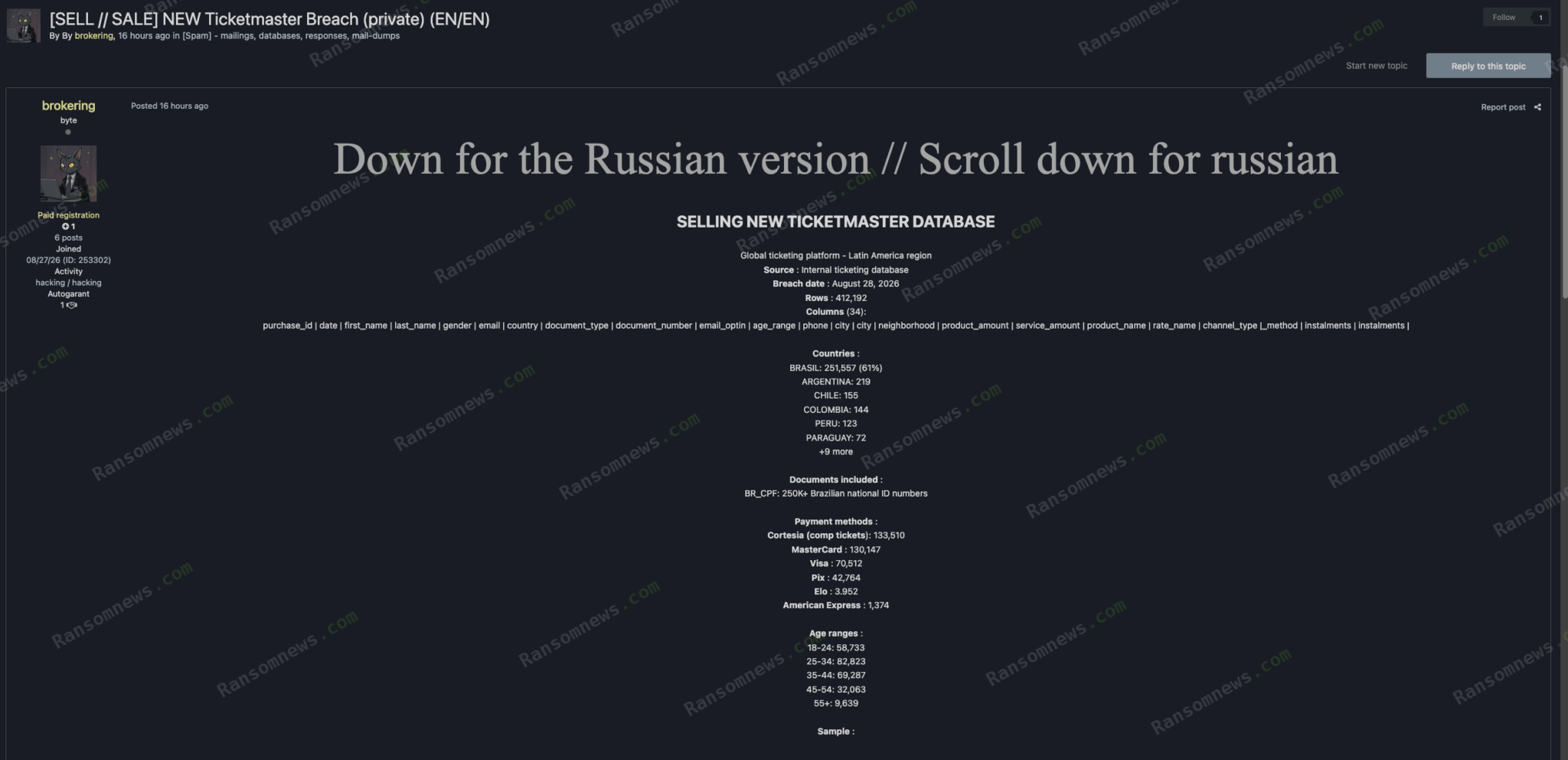
The seller is asking $10,000 for the full database, or $80 for every 1,000 records, with escrow available. The 251,557 Brazilian records make up about 61% of the database, meaning the seller is effectively asking around four cents per person.

The data includes names, email addresses, CPF numbers, phone numbers, neighborhoods, ticket types, and payment details. Together, these details provide a detailed profile that could be used for identity theft and fraud.

“The seller’s own notes are the part that should concern Brazilian readers most. Alongside the sales copy, the listing states that the CPF numbers work “for Brazilian bank fraud, loan apps and SIM registration”.” continues the report.”That is not our characterisation of the risk. It is the seller describing the intended use of the file.”

Ransomnews ran the kind of checks that usually expose fake listings within minutes, and this one kept passing. Purchase IDs across the sample rise in strict chronological order, exactly what an auto-incrementing database key produces and something close to statistically impossible to fake by chance. Every CPF number in the sample passes Brazil’s official check-digit validation, phone area codes correctly match the state listed on each row rather than defaulting to a single city, and neighborhood names map precisely onto their stated cities, the kind of granular accuracy a random data generator simply doesn’t produce.

The ticket prices provide another strong sign that the database is genuine. Full-price tickets cost exactly 975 reais, while discounted tickets cost 487.50 reais, matching Brazil’s legal student discount. The database also lists Pix and Elo as payment methods, both widely used in Brazil.

Even the incomplete records look realistic. Complimentary tickets issued by the festival’s back office contain no name or CPF, only the ticket type and date. These kinds of inconsistencies are common in real databases but would be unusual in fabricated data.

However, there is an important detail that challenges the claim of a direct Ticketmaster breach. Every record in the sample has exactly the same processing timestamp: October 1, 2025 at 23:05:41, about two weeks after the festival ended.
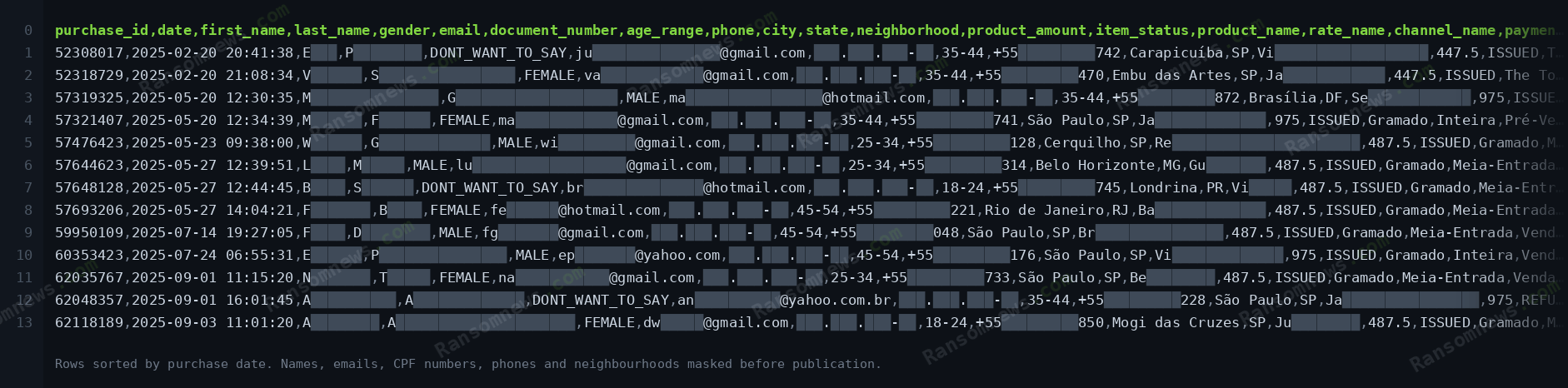
A live database dump would normally contain different timestamps. The identical timestamp instead suggests that the data may have been exported in a single batch after the event and then shared with a promoter, sponsor, payment provider, or another partner. Ransomnews therefore warns that blaming Ticketmaster directly would go beyond what the available evidence currently shows.

That distinction matters more than it might seem, because it points at an industry-wide blind spot rather than one company’s failure. Brazilian ticketing requires CPF collection to enforce discount eligibility rules, which means live-events companies routinely end up holding a national identity number, a verified phone, and a home neighborhood for hundreds of thousands of people, data with the sensitivity of a bank record sitting inside an industry with nothing like a bank’s security requirements. The moment that data gets exported into a spreadsheet to reconcile ticket sales with a partner, which happens constantly and rarely makes headlines, it becomes dramatically easier to lose.

“If you bought tickets to The Town 2025, treat your CPF as exposed.” concludes the report. “A CPF cannot be reissued the way a password can, and the seller is explicitly marketing these numbers for credit and telecoms fraud.”

If you bought tickets to The Town 2025, the practical response here isn’t panic, it’s specific vigilance. A CPF can’t be reissued the way a password gets reset, so treat it as permanently exposed and check your credit record through Brazil’s Central Bank registry or services like Serasa for accounts you didn’t open. Watch closely for SIM swap attempts given the seller’s explicit mention of telecom fraud, and be skeptical of any inbound call or message referencing your actual festival purchase, since whoever holds this file knows exactly which days you attended and how you paid, more than enough detail to make a scam call sound completely legitimate.

Follow me on Twitter: @securityaffairs and Facebook and Mastodon

Pierluigi Paganini

(SecurityAffairs – hacking, The Town 2025)

  • ✇Cybersecurity News
  • Windows Server 2022 Mainstream Support Ends October 2026 Do Son
    Windows Server 2022 exits mainstream support in October 2026, entering extended security updates until 2031, as Microsoft pushes upgrades to Server 2025. Related Posts: Microsoft Removes WMIC from Default Windows 11 Installs Windows 11 WinRE Gains Automatic Wi-Fi Reconnection for Cloud Rebuild Windows 11 Tests Customizable Right-Click Context Menu to Cut App Clutter The post Windows Server 2022 Mainstream Support Ends October 2026 appeared first on Daily CyberSecurity.
     

NDSS 2025 – JBomAudit: Assessing The Landscape, Compliance, And Security Implications Of Java SBOMS

28 de Fevereiro de 2026, 13:00

Session 14A: Software Security: Applications & Policies

Authors, Creators & Presenters: Yue Xiao (IBM Research), Dhilung Kirat (IBM Research), Douglas Lee Schales (IBM Research), Jiyong Jang (IBM Research), Luyi Xing (Indiana University Bloomington), Xiaojing Liao (Indiana University)

PAPER
JBomAudit: Assessing the Landscape, Compliance, and Security Implications of Java SBOMs

A Software Bill of Materials (SBOM) is a detailed inventory that lists the dependencies that make up a software product. Accurate, complete, and up-to-date SBOMs are essential for vulnerability management, reducing license compliance risks, and maintaining high software integrity. The US National Institute of Standards and Technology (NTIA) has established minimum requirements for SBOMs to comply with, especially the correctness and completeness of listed dependencies in SBOMs. However, these requirements remain unexamined in practice. This paper presents the first systematic study on the landscape of SBOMs, including their prevalence, release trends, and characteristics in the Java ecosystem. We developed an end-to-end tool to evaluate the completeness and accuracy of dependencies in SBOMs. Our tool analyzed 25,882 SBOMs and associated JAR files, identifying that 7,907 SBOMs failed to disclose direct dependencies, highlighting the prevalence and severity of SBOM noncompliance issues. Furthermore, 4.97% of these omitted dependencies were vulnerable, leaving software susceptible to potential exploits. Through detailed measurement studies and analysis of root causes, this research uncovers significant security implications of non-compliant SBOMs, especially concerning vulnerability management. These findings, crucial for enhancing SBOM compliance assurance, are being responsibly reported to relevant stakeholders.

ABOUT NDSS
The Network and Distributed System Security Symposium (NDSS) fosters information exchange among researchers and practitioners of network and distributed system security. The target audience includes those interested in practical aspects of network and distributed system security, with a focus on actual system design and implementation. A major goal is to encourage and enable the Internet community to apply, deploy, and advance the state of available security technologies.


Our thanks to the Network and Distributed System Security (NDSS) Symposium for publishing their Creators, Authors and Presenter’s superb NDSS Symposium 2025 Conference content on the Organizations' YouTube Channel.

Permalink

The post NDSS 2025 – JBomAudit: Assessing The Landscape, Compliance, And Security Implications Of Java SBOMS appeared first on Security Boulevard.

  • ✇Security Boulevard
  • NDSS 2025 – CASPR: Context-Aware Security Policy Recommendation Marc Handelman
    Session 14A: Software Security: Applications & Policies Authors, Creators & Presenters: All From The Institute of Information Engineering, Chinese Academy of Sciences: Lifang Xiao, Hanyu Wang, Aimin Yu, Lixin Zhao, Dan Meng PAPER CASPR: Context-Aware Security Policy Recommendation Nowadays, SELinux has been widely used to provide flexible mandatory access control and security policies are critical to maintain the security of operating systems. Strictly speaking, all access requests must
     

NDSS 2025 – CASPR: Context-Aware Security Policy Recommendation

27 de Fevereiro de 2026, 17:00

Session 14A: Software Security: Applications & Policies

Authors, Creators & Presenters: All From The Institute of Information Engineering, Chinese Academy of Sciences: Lifang Xiao, Hanyu Wang, Aimin Yu, Lixin Zhao, Dan Meng

PAPER
CASPR: Context-Aware Security Policy Recommendation

Nowadays, SELinux has been widely used to provide flexible mandatory access control and security policies are critical to maintain the security of operating systems. Strictly speaking, all access requests must be restricted by appropriate policy rules to satisfy the functional requirements of the software or application. However, manually configuring security policy rules is an error-prone and time-consuming task that often requires expert knowledge. Therefore, it is a challenging task to recommend policy rules without anomalies effectively due to the numerous policy rules and the complexity of semantics. The majority of previous research mined information from policies to recommend rules but did not apply to the newly defined types without any rules. In this paper, we propose a context-aware security policy recommendation (CASPR) method that can automatically analyze and refine security policy rules. Context-aware information in CASPR includes policy rules, file locations, audit logs, and attribute information. According to these context-aware information, multiple features are extracted to calculate the similarity of privilege sets. Based on the calculation results, CASPR clusters types by the K-means model and then recommends rules automatically. The method automatically detects anomalies in security policy, namely, constraint conflicts, policy inconsistencies, and permission incompleteness. Further, the detected anomalous policies are refined so that the authorization rules can be effectively enforced. The experiment results confirm the feasibility of the proposed method for recommending effective rules for different versions of policies. We demonstrate the effectiveness of clustering by CASPR and calculate the contribution of each context-aware feature based on SHAP. CASPR not only recommends rules for newly defined types based on context-aware information but also enhances the accuracy of security policy recommendations for existing types, compared to other rule recommendation models. CASPR has an average accuracy of 91.582% and F1-score of 93.761% in recommending rules. Further, three kinds of anomalies in the policies can be detected and automatically repaired. We employ CASPR in multiple operating systems to illustrate the universality. The research has significant implications for security policy recommendation and provides a novel method for policy analysis with great potential.

ABOUT NDSS
The Network and Distributed System Security Symposium (NDSS) fosters information exchange among researchers and practitioners of network and distributed system security. The target audience includes those interested in practical aspects of network and distributed system security, with a focus on actual system design and implementation. A major goal is to encourage and enable the Internet community to apply, deploy, and advance the state of available security technologies.


Our thanks to the Network and Distributed System Security (NDSS) Symposium for publishing their Creators, Authors and Presenter’s superb NDSS Symposium 2025 Conference content on the Organizations' YouTube Channel.

Permalink

The post NDSS 2025 – CASPR: Context-Aware Security Policy Recommendation appeared first on Security Boulevard.

  • ✇Security Boulevard
  • NDSS 2025 -DUMPLING: Fine-Grained Differential JavaScript Engine Fuzzing Marc Handelman
    Session 13A: JavaScript Security Authors, Creators & Presenters: Liam Wachter (EPFL), Julian Gremminger (EPFL), Christian Wressnegger (Karlsruhe Institute of Technology (KIT)), Mathias Payer (EPFL), Flavio Toffalini (EPFL) PAPER DUMPLING: Fine-Grained Differential JavaScript Engine Fuzzing Web browsers are ubiquitous and execute untrusted JavaScript (JS) code. JS engines optimize frequently executed code through just-in-time (JIT) compilation. Subtly conflicting assumptions between optimiza
     

NDSS 2025 -DUMPLING: Fine-Grained Differential JavaScript Engine Fuzzing

21 de Fevereiro de 2026, 13:00

Session 13A: JavaScript Security

Authors, Creators & Presenters: Liam Wachter (EPFL), Julian Gremminger (EPFL), Christian Wressnegger (Karlsruhe Institute of Technology (KIT)), Mathias Payer (EPFL), Flavio Toffalini (EPFL)

PAPER
DUMPLING: Fine-Grained Differential JavaScript Engine Fuzzing

Web browsers are ubiquitous and execute untrusted JavaScript (JS) code. JS engines optimize frequently executed code through just-in-time (JIT) compilation. Subtly conflicting assumptions between optimizations frequently result in JS engine vulnerabilities. Attackers can take advantage of such diverging assumptions and use the flexibility of JS to craft exploits that produce a miscalculation, remove bounds checks in JIT compiled code, and ultimately gain arbitrary code execution. Classical fuzzing approaches for JS engines only detect bugs if the engine crashes or a runtime assertion fails. Differential fuzzing can compare interpreted code against optimized JIT compiled code to detect differences in execution. Recent approaches probe the execution states of JS programs through ad-hoc JS functions that read the value of variables at runtime. However, these approaches have limited capabilities to detect diverging executions and inhibit optimizations during JIT compilation, thus leaving JS engines under-tested. We propose DUMPLING, a differential fuzzer that compares the full state of optimized and unoptimized execution for arbitrary JS programs. Instead of instrumenting the JS input, DUMPLING instruments the JS engine itself, enabling deep and precise introspection. These extracted fine-grained execution states, coined as (frame) dumps, are extracted at a high frequency even in the middle of JIT compiled functions. DUMPLING finds eight new bugs in the thoroughly tested V8 engine, where previous differential fuzzing approaches struggled to discover new bugs. We receive $11,000 from Google's Vulnerability Rewards Program for reporting the vulnerabilities found by DUMPLING.


ABOUT NDSS
The Network and Distributed System Security Symposium (NDSS) fosters information exchange among researchers and practitioners of network and distributed system security. The target audience includes those interested in practical aspects of network and distributed system security, with a focus on actual system design and implementation. A major goal is to encourage and enable the Internet community to apply, deploy, and advance the state of available security technologies.


Our thanks to the Network and Distributed System Security (NDSS) Symposium for publishing their Creators, Authors and Presenter’s superb NDSS Symposium 2025 Conference content on the Organizations' YouTube Channel.

Permalink

The post NDSS 2025 -DUMPLING: Fine-Grained Differential JavaScript Engine Fuzzing appeared first on Security Boulevard.

NDSS 2025 – NodeMedic-FINE: Automatic Detection And Exploit Synthesis For Node.js Vulnerabilities

20 de Fevereiro de 2026, 17:00

Session 13A: JavaScript Security

Authors, Creators & Presenters: Darion Cassel (Carnegie Mellon University), Nuno Sabino (IST & CMU), Min-Chien Hsu (Carnegie Mellon University), Ruben Martins (Carnegie Mellon University), Limin Jia (Carnegie Mellon University)

PAPER
NodeMedic-FINE: Automatic Detection and Exploit Synthesis for Node.js Vulnerabilities

The Node.js ecosystem comprises millions of packages written in JavaScript. Many packages suffer from vulnerabilities such as arbitrary code execution (ACE) and arbitrary command injection (ACI). Prior work has developed automated tools based on dynamic taint tracking to detect potential vulnerabilities, and to synthesize proof-of-concept exploits that confirm them, with limited success. One challenge these tools face is that expected inputs to package APIs often have varied types and object structure. Failure to call these APIs with inputs of the correct type and with specific fields leads to unsuccessful exploit generation and missed vulnerabilities. Generating inputs that can successfully deliver the desired exploit payload despite manipulation performed by the package is also difficult. To address these challenges, we use a type and object-structure aware fuzzer to generate inputs to explore more execution paths during dynamic taint analysis. We leverage information generated by the taint analysis to infer the types and structure of the inputs, which are then used by the exploit synthesis engine to guide exploit generation. We implement NodeMedic-FINE and evaluate it on 33,011 npm packages that contain calls to ACE and ACI sinks. Our tool finds 2257 potential flows and automatically synthesizes working exploits in 766 packages.


ABOUT NDSS
The Network and Distributed System Security Symposium (NDSS) fosters information exchange among researchers and practitioners of network and distributed system security. The target audience includes those interested in practical aspects of network and distributed system security, with a focus on actual system design and implementation. A major goal is to encourage and enable the Internet community to apply, deploy, and advance the state of available security technologies.


Our thanks to the Network and Distributed System Security (NDSS) Symposium for publishing their Creators, Authors and Presenter’s superb NDSS Symposium 2025 Conference content on the Organizations' YouTube Channel.

Permalink

The post NDSS 2025 – NodeMedic-FINE: Automatic Detection And Exploit Synthesis For Node.js Vulnerabilities appeared first on Security Boulevard.

‘Mortified’ OBR chair hopes inquiry into budget leak will report next week

Reuters news agency says it obtained document after visiting URL it predicted file would be uploaded to

The chair of the Office for Budget Responsibility has said he felt mortified by the early release of its budget forecasts as the watchdog launched a rapid inquiry into how it had “inadvertently made it possible” to see the documents.

Richard Hughes said he had written to the chancellor, Rachel Reeves, and the chair of the Treasury select committee, Meg Hillier, to apologise.

Continue reading...

© Photograph: Kirsty O’Connor/Treasury

© Photograph: Kirsty O’Connor/Treasury

© Photograph: Kirsty O’Connor/Treasury

  • ✇Krebs on Security
  • Microsoft Patch Tuesday, November 2025 Edition BrianKrebs
    Microsoft this week pushed security updates to fix more than 60 vulnerabilities in its Windows operating systems and supported software, including at least one zero-day bug that is already being exploited. Microsoft also fixed a glitch that prevented some Windows 10 users from taking advantage of an extra year of security updates, which is nice because the zero-day flaw and other critical weaknesses affect all versions of Windows, including Windows 10. Affected products this month include the W
     

Microsoft Patch Tuesday, November 2025 Edition

16 de Novembro de 2025, 18:47

Microsoft this week pushed security updates to fix more than 60 vulnerabilities in its Windows operating systems and supported software, including at least one zero-day bug that is already being exploited. Microsoft also fixed a glitch that prevented some Windows 10 users from taking advantage of an extra year of security updates, which is nice because the zero-day flaw and other critical weaknesses affect all versions of Windows, including Windows 10.

Affected products this month include the Windows OS, Office, SharePoint, SQL Server, Visual Studio, GitHub Copilot, and Azure Monitor Agent. The zero-day threat concerns a memory corruption bug deep in the Windows innards called CVE-2025-62215. Despite the flaw’s zero-day status, Microsoft has assigned it an “important” rating rather than critical, because exploiting it requires an attacker to already have access to the target’s device.

“These types of vulnerabilities are often exploited as part of a more complex attack chain,” said Johannes Ullrich, dean of research for the SANS Technology Institute. “However, exploiting this specific vulnerability is likely to be relatively straightforward, given the existence of prior similar vulnerabilities.”

Ben McCarthy, lead cybersecurity engineer at Immersive, called attention to CVE-2025-60274, a critical weakness in a core Windows graphic component (GDI+) that is used by a massive number of applications, including Microsoft Office, web servers processing images, and countless third-party applications.

“The patch for this should be an organization’s highest priority,” McCarthy said. “While Microsoft assesses this as ‘Exploitation Less Likely,’ a 9.8-rated flaw in a ubiquitous library like GDI+ is a critical risk.”

Microsoft patched a critical bug in OfficeCVE-2025-62199 — that can lead to remote code execution on a Windows system. Alex Vovk, CEO and co-founder of Action1, said this Office flaw is a high priority because it is low complexity, needs no privileges, and can be exploited just by viewing a booby-trapped message in the Preview Pane.

Many of the more concerning bugs addressed by Microsoft this month affect Windows 10, an operating system that Microsoft officially ceased supporting with patches last month. As that deadline rolled around, however, Microsoft began offering Windows 10 users an extra year of free updates, so long as they register their PC to an active Microsoft account.

Judging from the comments on last month’s Patch Tuesday post, that registration worked for a lot of Windows 10 users, but some readers reported the option for an extra year of updates was never offered. Nick Carroll, cyber incident response manager at Nightwing, notes that Microsoft has recently released an out-of-band update to address issues when trying to enroll in the Windows 10 Consumer Extended Security Update program.

“If you plan to participate in the program, make sure you update and install KB5071959 to address the enrollment issues,” Carroll said. “After that is installed, users should be able to install other updates such as today’s KB5068781 which is the latest update to Windows 10.”

Chris Goettl at Ivanti notes that in addition to Microsoft updates today, third-party updates from Adobe and Mozilla have already been released. Also, an update for Google Chrome is expected soon, which means Edge will also be in need of its own update.

The SANS Internet Storm Center has a clickable breakdown of each individual fix from Microsoft, indexed by severity and CVSS score. Enterprise Windows admins involved in testing patches before rolling them out should keep an eye on askwoody.com, which often has the skinny on any updates gone awry.

As always, please don’t neglect to back up your data (if not your entire system) at regular intervals, and feel free to sound off in the comments if you experience problems installing any of these fixes.

[Author’s note: This post was intended to appear on the homepage on Tuesday, Nov. 11. I’m still not sure how it happened, but somehow this story failed to publish that day. My apologies for the oversight.]

1-15 March 2025 Cyber Attacks Timeline

5 de Setembro de 2025, 06:44
In the first timeline of March 2025, I collected 127 events with a threat landscape dominated by malware and ransomware...
  • ✇HACKMAGEDDON
  • February 2025 Cyber Attacks Statistics Paolo Passeri
    After the cyber attacks timelines, it’s time to publish the statistics for February 2025 where I collected and analyzed 231 events. In February 2025, Cyber Crime continued to lead the Motivations chart with 64% down from 75%, of February. Operations driven by Cyber Espionage ranked at number two with 20%, an important increase from 12% and once again ahead of Hacktivism slightly down to 3% from 4%. Only a single event was attributed to Cyber Warfare that closes the chart.
     

February 2025 Cyber Attacks Statistics

7 de Agosto de 2025, 11:47
After the cyber attacks timelines, it’s time to publish the statistics for February 2025 where I collected and analyzed 231 events. In February 2025, Cyber Crime continued to lead the Motivations chart with 64% down from 75%, of February. Operations driven by Cyber Espionage ranked at number two with 20%, an important increase from 12% and once again ahead of Hacktivism slightly down to 3% from 4%. Only a single event was attributed to Cyber Warfare that closes the chart.
  • ✇HACKMAGEDDON
  • 16-28 February 2025 Cyber Attacks Timeline Paolo Passeri
    In the second timeline of February 2025, I collected 116 events (8.92 events/day) with a threat landscape dominated by malware with 29%, a value very close to 30% of the previous timeline, ahead of ransomware, back at number two with 21%, from 8% of the previous fortnight, and targeted attacks with 17%, very close to 16% of H1.
     

16-28 February 2025 Cyber Attacks Timeline

5 de Agosto de 2025, 11:01
In the second timeline of February 2025, I collected 116 events (8.92 events/day) with a threat landscape dominated by malware with 29%, a value very close to 30% of the previous timeline, ahead of ransomware, back at number two with 21%, from 8% of the previous fortnight, and targeted attacks with 17%, very close to 16% of H1.

1-15 February 2025 Cyber Attacks Timeline

23 de Julho de 2025, 07:53
In the first timeline of February 2025, I collected 115 events (7.67 events/day) with a threat landscape dominated by malware with 30%, the same value of the previous timeline.
  • ✇HACKMAGEDDON
  • 16-31 January Cyber Attacks Timeline Paolo Passeri
    In the second timeline of January 2025, I collected 107 events with a threat landscape dominated by malware with 30%, up from 18% of the previous timeline, and very close to the values of December 2024, ahead of ransomware with 19%.
     

16-31 January Cyber Attacks Timeline

4 de Junho de 2025, 12:45
In the second timeline of January 2025, I collected 107 events with a threat landscape dominated by malware with 30%, up from 18% of the previous timeline, and very close to the values of December 2024, ahead of ransomware with 19%.
  • ✇HACKMAGEDDON
  • 1-15 January 2025 Cyber Attacks Timeline Paolo Passeri
    In the first timeline of January 2025, I collected 109 events with a threat landscape dominated by malware with 18%, down from 33% of the previous timeline, and once again ahead of account takeovers with 17% (it was 20% in the previous timeline), and ransomware with 14%.
     

1-15 January 2025 Cyber Attacks Timeline

6 de Maio de 2025, 01:26
In the first timeline of January 2025, I collected 109 events with a threat landscape dominated by malware with 18%, down from 33% of the previous timeline, and once again ahead of account takeovers with 17% (it was 20% in the previous timeline), and ransomware with 14%.
❌
❌