❌

Visualização normal

Antes de ontemStream principal
  • ✇Cybersecurity News
  • North Korean Threat Actors Accelerate Cyber Operations With Artificial Intelligence Do Son
    Microsoft reveals how North Korean threat actors use tools like ARTEX. See how AI-enabled North Korean threat actors speed up cyber operations. Related Posts: Binance Hack Investigation Traces Historic $6.3B Breach Polymarket Supply Chain Attack Drains Trader Wallets Binance Hot Wallet Breach Prompts Multibillion-Dollar Inquiry The post North Korean Threat Actors Accelerate Cyber Operations With Artificial Intelligence appeared first on Daily CyberSecurity.
     
  • ✇Firewall Daily – The Cyber Express
  • Three Cyberattack Campaigns Target Japan, Exposing AI’s Growing Role Ashish Khaitan
    A wave of data leaks from Japanese web systems in autumn 2026 has sharpened concern over AI's role in cyberattacks on Japan. The National Cybersecurity Office alerted businesses on October 9, and the chair of the ruling party's cybersecurity headquarters said cyberspace was in a "state of emergency."  Researchers reconstructed three attack infrastructures from files left in attackers' open directories. All three are separate from those in earlier reports on ARTEX, an autonomous AI penetration
     

Three Cyberattack Campaigns Target Japan, Exposing AI’s Growing Role

29 de Outubro de 2026, 06:10

Cyberattacks on Japan

A wave of data leaks from Japanese web systems in autumn 2026 has sharpened concern over AI's role in cyberattacks on Japan. The National Cybersecurity Office alerted businesses on October 9, and the chair of the ruling party's cybersecurity headquarters said cyberspace was in a "state of emergency."  Researchers reconstructed three attack infrastructures from files left in attackers' open directories. All three are separate from those in earlier reports on ARTEX, an autonomous AI penetration-testing system.   AI's role varied widely. Without victim-side logs, the findings cannot confirm each attempt's success, the full damage, or the attackers' identities. Victims are described only by count, industry, size, and country. 

Case A: Automated Cyberattacks on Japan 

In a short burst in October 2026, Case A abused CyberStrikeAI, an open-source agent-based penetration-testing tool with a Simplified Chinese console. Entries like "credential-search agent 8/44" show 44 agents dividing up reconnaissance, exploitation, command and control, persistence, exfiltration, and reporting. The platform produced Japanese forms and fake login pages.   It also throttled traffic to each target to avoid detection. At least 19 organizations received identical reports, including at least 16 in Japan and others in Taiwan and Hong Kong. Most were smaller businesses and local public bodies. Yet many entries read "no session, no web shell, no exfiltration." The deepest intrusion began at an unauthenticated administration interface on a legacy system. 

Case B: Human-Led, AI-Assisted 

Over about 24 days in August and September, a human operator used an LLM for planning and tooling. The operator scanned at least 6,000 Japanese IP addresses and also probed AI assets in South Korea. One LLM-written plan targeted AI and GPU services. To get it, the operator framed the request as an authorized assessment to bypass the model's guardrails. Other tools sought to hijack and pool access to other people's AI services, likely to get cheap inference capacity.  One company suffered full control through FTP, a database, administrator rights, a web shell, and SSH, and the attacker repeatedly restored backdoors after cleanup. At another, a GIS server left on default credentials exposed several hundred thousand cadastral and commercial records, Windows credentials, and email. Several hundred attempts on one cluster failed. 

Case C: Limited AI Role 

From January to October, a seasoned operator ran at least six campaigns, several in parallel from September onward. They targeted at least 1,300 WebLogic candidates and 35 VPN entry points, mainly in Japan and South Korea. The target lists also included the UK, France, Italy, Qatar, and Colombia. Devices included Cisco SD-WAN, Citrix NetScaler, F5 BIG-IP, and Yamaha RTX1210. On the RTX1210, leftover credentials in configuration files opened direct access to corporate networks. Section headings such as echo '=== ... ===' in the command history and emoji status markers in scripts point, with high confidence, to AI-written tools. A skilled human mimicking that style cannot be excluded. 

Lessons Beyond ARTEX 

All three operations worked in Simplified Chinese and sorted results under names like jp_success, jp_attack, and jp_cve_attack. Each picked targets opportunistically, and most of their activity came before the ARTEX reports. Whether they share an operator is unconfirmed, and their language is only a weak clue to origin.  AI increased scale, speed, localization, and reporting. It did not change the types of vulnerabilities exploited, the entry points, or how many targets were deeply compromised. The AI also logged planned steps as finished and overstated success. LLMs can also invent vulnerability IDs. These flaws can help with detection and honeypots. Defenders found the PHP2Shell flaws, disclosed in October 2026, through an AI-assisted audit, but no AI-found zero-day was exploited in these cases. 

Defending Against Cyberattacks on Japan 

Recommended steps: 
  • Inventory public-facing systems and update or isolate legacy ones. 
  • Remove exposed default credentials and admin interfaces. 
  • Secure VPN and edge-device configurations against credential reuse. 
  • Check internal AI and GPU services for exposure. 
  • Monitor for low-frequency, distributed attempts. 
  • Prepare for LLM misuse through requests built on false premises. 
Fast patching and virtual patching matter more as the time between disclosure and exploitation shrinks. The attackers' identities, the AI models used, and the full damage remain unknown. 
  • ✇ASEC BLOG
  • The Weak Link Identified by AI: October 2026, When the Outer Contact Point Collapsed ATCP
    Security Blind Spots Identified by AI The large-scale data breaches disclosed in quick succession in South Korea and Japan in October 2026 mostly originated not from internal core systems, but from peripheral entry points such as externally exposed web services, app backend APIs, and outsourced SaaS (services provided by third-party vendors via the cloud, such […]
     

The Weak Link Identified by AI: October 2026, When the Outer Contact Point Collapsed

Por:ATCP
27 de Outubro de 2026, 12:00
Security Blind Spots Identified by AI The large-scale data breaches disclosed in quick succession in South Korea and Japan in October 2026 mostly originated not from internal core systems, but from peripheral entry points such as externally exposed web services, app backend APIs, and outsourced SaaS (services provided by third-party vendors via the cloud, such […]
  • ✇Security Affairs
  • Microsoft Links ConnectWise Breach to China-Linked Group Using AI Pentesting Tool ARTEX Pierluigi Paganini
    China-linked Storm-0940 used AI tool ARTEX to target 2,250 Microsoft 365 tenants, exploiting stolen ConnectWise credentials at machine speed. Microsoft published a detailed technical report naming Storm-0940, a China state-aligned group, as the actor behind the ConnectWise Cloud Backup supply chain compromise. The group used ARTEX, an open-source AI-driven penetration testing framework, to run attacks at machine speed against hundreds of organizations across aerospace, defense, energy, finan
     

Microsoft Links ConnectWise Breach to China-Linked Group Using AI Pentesting Tool ARTEX

22 de Outubro de 2026, 17:47

China-linked Storm-0940 used AI tool ARTEX to target 2,250 Microsoft 365 tenants, exploiting stolen ConnectWise credentials at machine speed.

Microsoft published a detailed technical report naming Storm-0940, a China state-aligned group, as the actor behind the ConnectWise Cloud Backup supply chain compromise. The group used ARTEX, an open-source AI-driven penetration testing framework, to run attacks at machine speed against hundreds of organizations across aerospace, defense, energy, financial services, government, manufacturing, and more.

“Several of these Storm-0940 ARTEX-driven attacks have resulted in the actor obtaining privileged access to an organization’s cloud infrastructure – including multiple instances where the time from initial targeting to privileged access was less than 3 hours.” reads the report. “Microsoft assesses that Storm-0940 was responsible for the recently disclosed ConnectWise supply chain compromise of a multi-tenant application.”

Storm-0940 has been active since 2021 and has historically relied on password spraying and OAuth application abuse to get into Microsoft 365 environments. Adding ARTEX changed the scale of what they could do. In some attacks, the time between initial targeting and achieving privileged cloud access was under three hours.

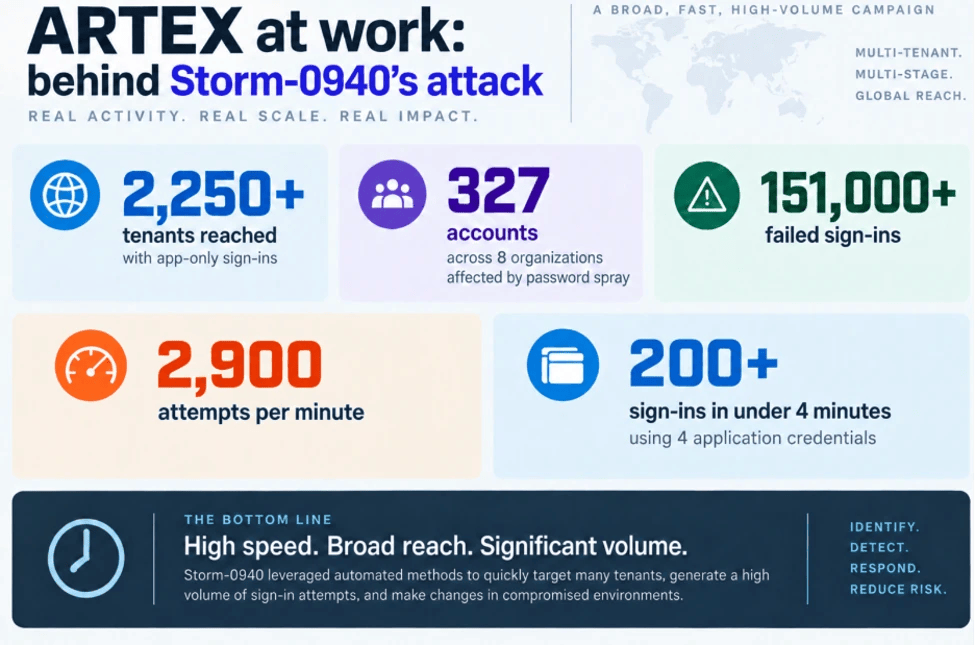
Before obtaining the ConnectWise credentials, Storm-0940 launched a password spraying attack between October 10 and 14. The attack came from the IP address 144.172.64[.]99. Microsoft recorded more than 151,000 failed login attempts against 327 accounts at eight organizations. Activity peaked on October 11, with 2,900 failed attempts per minute. Forty-eight accounts each received more than 1,000 failed attempts. None of these attempts succeeded.

The situation changed on October 15, one day after the ConnectWise breach became public. The AI agents stopped trying passwords and switched to a different attack method. By then, Storm-0940 had obtained the credentials of several ConnectWise cloud application accounts. The agents used these credentials to log directly into customer Microsoft 365 environments.

“Storm-0940’s use of ARTEX accelerated the speed of compromised application abuse to authenticate to Microsoft 365 customer environments through applications that had already been granted access.” Microsoft continues. “This allowed the threat actor to operate without requiring an interactive user sign-in. “

The agents used applications that already had permission to access their targets. This allowed the attackers to enter customer environments without requiring users to sign in interactively.

In a subset of environments where authentication succeeded, the agents didn’t stop there. They moved into Microsoft Graph and ran directory reconnaissance, modified application credentials to establish persistence, and attempted changes to identities, groups, and privileged roles. Microsoft identified multiple customer environments with evidence of this follow-on activity.

The persistence mechanism is the part defenders need to act on now, even if they’ve already disabled the ConnectWise connections.

“These changes can remain active as a backdoor even after the original compromised application is mediated.” says the IT giant.

An attacker who added their own credentials to a trusted application before you revoked access still has a working key. Reviewing all service principal credential additions since at least October 1 is the right starting point, not October 15 when the public breach was announced.

ARTEX is not a tool used only by Storm-0940. Microsoft says threat actors in several regions have used the same framework. Originally open-source, ARTEX was written in Go and can use different AI models to plan and carry out tasks. Researchers at Zscaler and Recorded Future also found a Chinese-speaking group using it to target South Korean financial institutions. The setup used DeepSeek, GLM, and Grok as coordinated AI agents, with GLM checking DeepSeek’s work. After these attacks became public, the project went closed-source. However, anyone who already has a copy can still use it.

The speed point is what Microsoft keeps coming back to in its report. Agents don’t take weekends, don’t sleep, and can run multiple attack paths simultaneously.

“This activity demonstrates how threat actors are integrating agentic AI into existing offensive security workflows and allows them to scale their operations exponentially.” Microsoft concludes. “Agents are not constrained by factors affecting humans – they can work around the clock, on weekends, and on holidays and attempt multiple breach paths simultaneously enabling significantly reduced time from selecting a target to achieving objectives, increasing the speed and impact of complex attacks like supply chain compromises.”

When Storm-0940 had valid application credentials, they didn’t have to iterate slowly. They hit 2,250 tenants with 2,900 sign-in attempts per minute, a pace at which manual detection and response simply can’t keep up.

Follow me on Twitter: @securityaffairs and Facebook and Mastodon

Pierluigi Paganini

(SecurityAffairs – hacking, ARTEX)

Analysis of the Infrastructure of ARTEX, a Chinese AI Penetration Testing Tool #4 – The Birth of Copy Cat

Por:ATCP
14 de Outubro de 2026, 12:00
Key Summary Since the original ARTEX GitHub repository disappeared, there has been an increase in independent distributions and customized instances based on the existing ARTEX codebase. These distributions are being redistributed with the product name, UI, filesystem structure, agent settings, and language modified, while retaining traces of ARTEX. Key Observations In several instances, ARTEX was […]
  • ✇Cybersecurity News
  • CrowdStrike Links South Korean Bank Breaches to Chinese AI Pentesting Tool ARTEX Do Son
    CrowdStrike links the ARTEX AI tool to breaches at South Korean banks, run by a suspected Chinese-speaking, profit-driven attacker. Related Posts: The Devastating Ledger Security Breach The Reality of Ransomware Recovery Services SoftBank IDCF Cloud Ransomware Attack Exposed by Hackers The post CrowdStrike Links South Korean Bank Breaches to Chinese AI Pentesting Tool ARTEX appeared first on Daily CyberSecurity.
     
  • ✇Security Affairs
  • AI-Driven tool ARTEX used in attacks against South Korean Banks Pierluigi Paganini
    CrowdStrike analyzes open directories left by an attacker who used the ARTEX AI pentest tool and LLMs to breach South Korean financial firms. CrowdStrike published a research on a campaign against South Korean financial organizations that ran from late September to early October 2026 and ended with stolen data. The attacker left their working notes where anyone could read them. Open directories on servers controlled by the attacker exposed Claude Code session histories, ARTEX configuratio
     

AI-Driven tool ARTEX used in attacks against South Korean Banks

9 de Outubro de 2026, 04:53

CrowdStrike analyzes open directories left by an attacker who used the ARTEX AI pentest tool and LLMs to breach South Korean financial firms.

CrowdStrike published a research on a campaign against South Korean financial organizations that ran from late September to early October 2026 and ended with stolen data. The attacker left their working notes where anyone could read them.

Open directories on servers controlled by the attacker exposed Claude Code session histories, ARTEX configuration files, and Claude memory files. Researchers could see how the operator worked, prompt by prompt. That is rare, and it makes this report particularly interesting.

“Analysis of threat actor-controlled open directories uncovered Claude Code session histories, ARTEX configuration files, and Claude memory files, providing direct insight into the threat actor’s operational methodology and tooling.” reads the report published by CrowdStrike. “The use of agentic AI tooling alongside traditional offensive capabilities highlights the continued evolution CrowdStrike has observed in adversarial tradecraft.”

ARTEX is a recently released open-source tool from China that allows AI agents to run penetration tests on their own. The attacker combined it with large language models. CrowdStrike has not linked the activity to a specific group, but it has moderate confidence that the operator is Chinese-speaking and financially motivated, based on the tool used and the Chinese-language prompts.

Industry reports describe several South Korean financial organizations breached since late September. At one bank, the attacker reportedly got into a loan progress inquiry service used by financial brokers. At another, they compromised an employee mobile work-support system. Nobody has confirmed how many organizations were hit.

Investigators connected the dots through overlapping IP addresses and references to the string ARTEX in HTML files on a server the attacker reportedly controlled. One address, 38.244.50[.]120, hosted an ARTEX instance and an open directory. Inside sat a Claude Code markdown file with a Chinese-language pentesting prompt that told the model how to run its tests.

“The IP address 38.244.50[.]120 was associated with the activity described and hosted an ARTEX instance and open directory containing a Claude Code markdown document at http[:]//38.244.50[.]120:18899/.claude/CLAUDE.md.” continues the report. “The markdown document contained a Chinese-language pentesting prompt that specified how the LLM should conduct pentesting activities.”

That file also pointed to a Hong Kong IP address, and that server held more open directories with session histories, configuration files and memory files. The files show the operator going after Korean financial targets with ARTEX and LLMs across those weeks, and the targets match the ones in industry reporting.

The sessions reveal a two-server setup. The Hong Kong address is the attacker’s main infrastructure, and 38.244.50[.]120 runs the ARTEX instance likely behind the Korean attacks. DeepSeek v4.1-flash served as the main model, with GLM-5.3 from Zhipu AI and Grok 4.6 added for extra sessions. The operator probably reached DeepSeek through a reseller, xcai[.]pro, and used nine proxy addresses that CrowdStrike lists in its report.

“Analysis of Claude Code sessions showed the threat actor also used the following proxy IP addresses during the ARTEX-related activity:

  • 101.53.80[.]20
  • 205.214.59[.]31
  • 124.155.252[.]63
  • 154.201.79[.]246
  • 23.248.249[.]90
  • 23.158.220[.]98
  • 103.248.148[.]84
  • 203.160.133[.]172
  • 209.209.85[.]38

In addition to conducting ARTEX-related operations, the threat actor asked Claude where threat actors typically sell Korean data breach information and asked Claude for assistance in finding Korean Telegram data sales groups.” reads the report.

Exfiltration was only the first step. The stolen data was already being prepared for sale.

In one session, the user asked Claude to write a security researcher résumé with bullet points describing the ARTEX results. The prompt also included personal details. The same Telegram username appeared in sessions involving a Telegram-based NFT gift marketplace and the targeting of what may have been a Chinese payment platform. CrowdStrike says the details likely belong to the operator, but it cannot confirm the link. Given that uncertainty, those details should not be included in a news article.

According to The Hacker News, ARTEX’s developer, Autumn-27, has since closed the source and stopped updates, saying the tool was built for learning and research and that the attacks have nothing to do with the project. Copies already in circulation don’t disappear with a license change.

CrowdStrike says this activity shows how AI tooling can let a financially motivated actor run several intrusions in a short time.

“The use of agentic AI tooling alongside traditional offensive capabilities highlights the continued evolution observed by CrowdStrike in adversarial tradecraft. This activity demonstrates how AI tooling can enable a financially motivated threat actor to conduct multiple intrusions within a short time span.” concludes the report. “CrowdStrike Intelligence assesses that adversaries will likely continue to experiment with implementing AI tooling in their operations to enhance their operational tempo and capabilities.”

Follow me on Twitter: @securityaffairs and Facebook and Mastodon

Pierluigi Paganini

(SecurityAffairs – hacking, ARTEX)

❌
❌