
Visualização normal

Hoje — 7 de Setembro de 2026Stream principal
  • ✇Security Affairs
  • Berlin Ransomware Leak Exposes State Secrets Pierluigi Paganini
    Berlin refused a 30 Bitcoin ransom, leading hackers to leak 6TB of sensitive state administration and national defense data on the dark web. When a ransomware gang dumps nearly six terabytes of state administration files onto the dark web, ignoring them does not make the problem go away. The Rhysida ransomware group recently carried out this exact threat against Berlin after local authorities refused to pay a thirty Bitcoin ransom. At the end of August, Berlin’s state government confirmed
     

Berlin Ransomware Leak Exposes State Secrets

7 de Setembro de 2026, 04:19

Berlin refused a 30 Bitcoin ransom, leading hackers to leak 6TB of sensitive state administration and national defense data on the dark web.

When a ransomware gang dumps nearly six terabytes of state administration files onto the dark web, ignoring them does not make the problem go away. The Rhysida ransomware group recently carried out this exact threat against Berlin after local authorities refused to pay a thirty Bitcoin ransom.

At the end of August, Berlin’s state government confirmed it was dealing with an extortion attempt following an August cyberattack on the city-state’s administrative network, and officials have already refused the requested ransom. The ransomware group Rhysida claimed responsibility on its leak site August 28, posting an entry titled simply “Berlin, Germany” and claiming 5.79 terabytes of data across roughly 1.44 million files, with personal information on 12,076 individuals allegedly included.
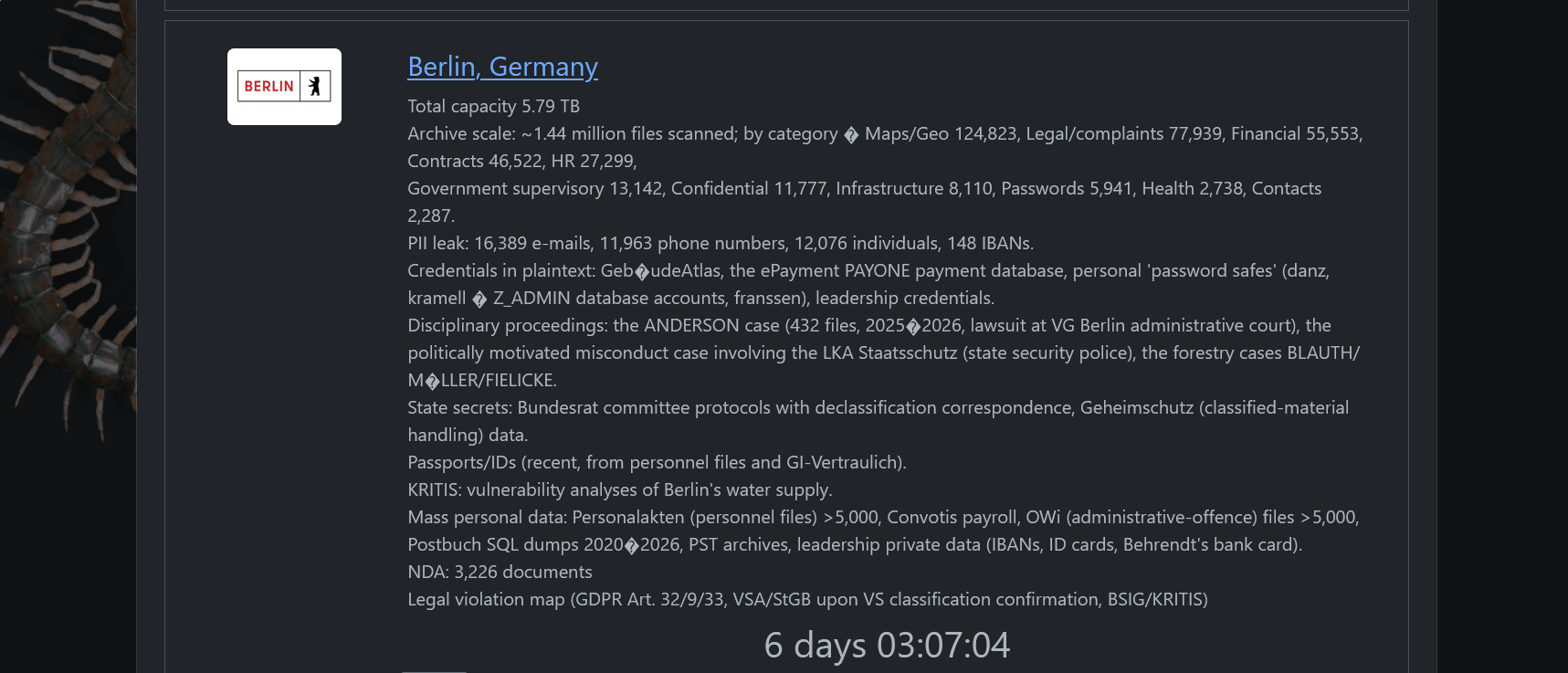
Rhysida claimed it stole 5.79 TB of data, covering around 1.44 million files. The alleged dataset includes:

  • Personal data: 12,076 individuals, 16,389 email addresses, 11,963 phone numbers and 148 IBANs.
  • Sensitive records: more than 5,000 personnel files, more than 5,000 administrative-offence files, payroll data and leadership information.
  • Credentials: plaintext passwords and credentials for systems including GebäudAtlas, the ePayment PAYONE database and Z_ADMIN accounts.
  • Government and legal material: disciplinary proceedings, court cases, supervisory documents, NDA records and Bundesrat committee protocols.
  • Classified information: data related to classified-material handling and documents allegedly containing state secrets.
  • Critical infrastructure: vulnerability analyses concerning Berlin’s water supply.
  • Identity documents: passports and ID cards from personnel records.
  • Other material: contracts, financial documents, HR records, infrastructure files, health data, password stores and SQL/PST archives.

The group also claimed that the material could involve violations of GDPR, German classified-information rules, criminal law and KRITIS/BSIG requirements. These are Rhysida’s claims and have not been independently verified.

The scale of the breach is staggering. Investigators are now looking at roughly 1.4 million files containing personal details of civil servants, internal infrastructure records, and critical government data.
The fallout goes far beyond routine data theft. Investigative journalist Lars Winkelsdorf pointed out the gravity of the situation on social media.

Die absolute Vollkatastrophe ist eingetreten

Dieses Datenleck ist schlimmer als alle bisherigen Terroranschläge zusammen 1/xhttps://t.co/epU4mCYgew

— Lars Winkelsdorf (@winkelsdorf) September 4, 2026

“In addition to LKA documents related to investigations, the files also include plans concerning national defense—ranging from the federal government’s secret communication channels in the event of an apocalypse to defense-related companies and emergency plans developed by government agencies,” Winkelsdorf wrote.

Exposing crisis response plans and secret communication channels turns a financial shakedown into a national security headache.

Worse still, the leaked material includes files concerning chemical, biological, radiological, and nuclear threats.

“Among the published files is a folder titled “AG CBRN-Rahmenplanung.” CBRN stands for chemical, biological, radiological and nuclear threats,” notes the Euronews report

Having that kind of operational data floating around public forums gives hostile actors a blueprint for disaster.

Refusing to pay ransoms is the right policy, but it rarely stops the bleeding once the network is compromised. Governments keep treating cybersecurity like an IT expense rather than an existential line of defense.

Until boards start treating network segmentation with the same seriousness as physical security, we will keep watching expensive countdown timers tick down to zero.

Berlin’s state government announced the launch of a crisis response after the threat actors published the stolen data.

“A ‌central ⁠crisis unit will oversee the review, verification and assessment of the leaked data and support efforts to inform affected citizens and ​businesses, said the ​city.” Reuters reports.

Follow me on Twitter: @securityaffairs and Facebook and Mastodon

Pierluigi Paganini

(SecurityAffairs – hacking, Berlin)

Antes de ontemStream principal
  • ✇Security Affairs
  • Rhysida Ransomware Group Targets Berlin Government Ahead of Vote Pierluigi Paganini
    Berlin ‘s government faces a Rhysida ransomware attack weeks before elections, with officials refusing to pay despite a claimed 5.79 TB data theft. Berlin’s state government confirmed this week it’s dealing with an extortion attempt following an August cyberattack on the city-state’s administrative network, and officials have already refused the requested ransom. The ransomware group Rhysida claimed responsibility on its leak site August 28, posting an entry titled simply “Berlin, Germany” a
     

Rhysida Ransomware Group Targets Berlin Government Ahead of Vote

29 de Agosto de 2026, 07:55

Berlin ‘s government faces a Rhysida ransomware attack weeks before elections, with officials refusing to pay despite a claimed 5.79 TB data theft.

Berlin’s state government confirmed this week it’s dealing with an extortion attempt following an August cyberattack on the city-state’s administrative network, and officials have already refused the requested ransom. The ransomware group Rhysida claimed responsibility on its leak site August 28, posting an entry titled simply “Berlin, Germany” and claiming 5.79 terabytes of data across roughly 1.44 million files, with personal information on 12,076 individuals allegedly included.

Rhysida claims it stole 5.79 TB of data, covering around 1.44 million files. The alleged dataset includes:

  • Personal data: 12,076 individuals, 16,389 email addresses, 11,963 phone numbers and 148 IBANs.
  • Sensitive records: more than 5,000 personnel files, more than 5,000 administrative-offence files, payroll data and leadership information.
  • Credentials: plaintext passwords and credentials for systems including GebäudAtlas, the ePayment PAYONE database and Z_ADMIN accounts.
  • Government and legal material: disciplinary proceedings, court cases, supervisory documents, NDA records and Bundesrat committee protocols.
  • Classified information: data related to classified-material handling and documents allegedly containing state secrets.
  • Critical infrastructure: vulnerability analyses concerning Berlin’s water supply.
  • Identity documents: passports and ID cards from personnel records.
  • Other material: contracts, financial documents, HR records, infrastructure files, health data, password stores and SQL/PST archives.

The group also claims that the material could involve violations of GDPR, German classified-information rules, criminal law and KRITIS/BSIG requirements. These are Rhysida’s claims and have not been independently verified.

The timing makes this attack especially sensitive. Berlin will elect its state parliament on September 20, less than a month after the breach, so an attack on government systems just before the vote was bound to raise questions. Interior Senator Iris Spranger said the election remains secure and that, so far, the attackers haven’t taken any election-related data. Security officials support that assessment.

Broadcaster RBB first reported on Thursday that Berlin had received ransom demands.

“The state ​of Berlin will not submit to extortion,” Berlin Mayor Kai Wegner and Berlin’s interior senator, ​Iris Spranger, said in a joint statement on Friday, before the ransomware group claimed the attack ‌on ⁠their Tor data leak site.

That position follows long-standing advice from US federal agencies, which warn that paying a ransom doesn’t guarantee data recovery and can encourage more attacks. Saying no to the ransom is one thing; dealing with the consequences if the attackers publish the stolen data is another.

Berlin first disclosed the compromise on August 17, isolating the Senate Department for Mobility, Transport, Climate Protection and Environment along with a second department from the network. Forensic investigators later found the actual data exfiltration happened earlier than the public disclosure, sometime between August 7 and August 12, with the affected department having flagged an initial outflow internally on August 7, a full week before the network got cut off. That gap between first internal detection and actual network isolation is the kind of detail that tends to get scrutinized hardest once the immediate crisis passes.

Rhysida isn’t a new name to anyone tracking ransomware against government targets. The group has claimed roughly 280 victims since emerging in 2023, according to tracking services cited by Reuters, including nine in Germany alone and headline targets like the British Library and Chile’s army. Roughly half its victims sit in the US, with the UK, Canada, and Italy rounding out the next tier, a spread that suggests Rhysida isn’t picking targets based on geography so much as opportunity.

A joint advisory from CISA, the FBI, and the Multi-State Information Sharing and Analysis Center, first published in November 2023, lays out exactly how Rhysida typically gets in: compromised VPN credentials at organizations without multi-factor authentication, exploitation of the Zerologon vulnerability that Microsoft patched back in 2020, and old-fashioned phishing. None of those entry points are exotic or new, which is precisely the point; Rhysida doesn’t need novel techniques when so many organizations still haven’t closed gaps that have been publicly known for years.

Berlin reconnected all Senate departments to the network on August 23, but forensic teams are still checking the systems. The state’s data protection commissioner and Germany’s federal cybersecurity agency, the BSI, are following the investigation.

As of publication, neither Berlin’s data protection office nor the Senate Chancellery had given specific advice to the roughly 12,000 people whose data Rhysida claims to have stolen. If you’re among them and haven’t received any official message yet, don’t assume that means you’re safe. Investigators are still working to establish exactly what the attackers accessed and took.

Follow me on Twitter: @securityaffairs and Facebook and Mastodon

Pierluigi Paganini

(SecurityAffairs – hacking, Rhysida Ransomware)

❌
❌