❌

Visualização normal

Hoje — 7 de Novembro de 2026Stream principal
  • ✇Security Affairs
  • U.S. CISA adds SonicWall SonicOS SSLVPN flaw to its Known Exploited Vulnerabilities catalog Pierluigi Paganini
    U.S. CISA adds SonicWall SonicOS SSLVPN vulnerability CVE-2026-19868 to its Known Exploited Vulnerabilities catalog. The U.S. Cybersecurity and Infrastructure Security Agency (CISA) added a SonicWall SonicOS SSLVPN flaw, tracked as CVE-2026-19868 (CVSS score of 7.5), to its Known Exploited Vulnerabilities (KEV) catalog. CVE-2026-19868 is an authentication bypass vulnerability affecting the SSL VPN service in SonicWall SonicOS. “An authentication enforcement vulnerability in SonicOS SSL
     

U.S. CISA adds SonicWall SonicOS SSLVPN flaw to its Known Exploited Vulnerabilities catalog

7 de Novembro de 2026, 06:09

U.S. CISA adds SonicWall SonicOS SSLVPN vulnerability CVE-2026-19868 to its Known Exploited Vulnerabilities catalog.

The U.S. Cybersecurity and Infrastructure Security Agency (CISA) added a SonicWall SonicOS SSLVPN flaw, tracked as CVE-2026-19868 (CVSS score of 7.5), to its Known Exploited Vulnerabilities (KEV) catalog.

CVE-2026-19868 is an authentication bypass vulnerability affecting the SSL VPN service in SonicWall SonicOS.

“An authentication enforcement vulnerability in SonicOS SSLVPN service may allow a user with valid credentials for an alternate authentication method to bypass SAML authentication controls. Successful exploitation may also bypass SAML-enforced multi-factor authentication (MFA).” reads the advisory.

The flaw occurs when the system does not properly enforce SAML authentication controls. An attacker who already has valid credentials for an alternative authentication method may exploit this weakness to bypass SAML-based authentication.

The impact is particularly serious when organisations rely on SAML to enforce multi-factor authentication (MFA). Successful exploitation may allow an attacker to access the SSL VPN without completing the expected SAML authentication process, potentially bypassing the additional MFA protection.

In practical terms, the vulnerability could weaken an organisation’s remote access security by allowing users with alternative valid credentials to circumvent its intended authentication controls.

It’s important to highlight that this is not an unauthenticated remote access vulnerability. The attacker needs valid credentials for an alternative authentication method, but may then bypass SAML-enforced security controls.

SonicWall’s PSIRT team is investigating a report of possible exploitation of this flaw. The company strongly recommends that customers install the latest available update as soon as possible to reduce the risk of attacks.

“SonicWall PSIRT has investigated a report indicating potential exploitation of this vulnerability. Customers are strongly urged to upgrade to the latest release as soon as possible to mitigate the associated risks.” reads the advisory.

According to Binding Operational Directive (BOD) 22-01: Reducing the Significant Risk of Known Exploited Vulnerabilities, FCEB agencies have to address the identified vulnerabilities by the due date to protect their networks against attacks exploiting the flaws in the catalog.

Experts also recommend that private organizations review the Catalog and address the vulnerabilities in their infrastructure.

CISA orders federal agencies to fix the flaw by November 20, 2026.

Follow me on Twitter: @securityaffairs and Facebook and Mastodon

Pierluigi Paganini

(SecurityAffairs – hacking, CISA)

Ontem — 6 de Novembro de 2026Stream principal

CISA Warns Hackers Are Exploiting 18-Year-Old WordPress Core Vulnerability

CVE-2026-119977 lets hackers hijack WordPress sites during core updates. CISA confirms exploitation as users are told to patch…
Antes de ontemStream principal
  • ✇Security Affairs
  • U.S. CISA adds Apple flaw to its Known Exploited Vulnerabilities catalog Pierluigi Paganini
    U.S. Cybersecurity and Infrastructure Security Agency (CISA) adds Apple flaw to its Known Exploited Vulnerabilities catalog. The U.S. Cybersecurity and Infrastructure Security Agency (CISA) added an Apple flaw, tracked as CVE-2024-27834 (CVSS score of 5.5), to its Known Exploited Vulnerabilities (KEV) catalog. “This type of vulnerability is a frequent attack vector for malicious cyber actors and poses significant risks to the federal enterprise.” reads the advisory by CISA. CVE-2024-27
     

U.S. CISA adds Apple flaw to its Known Exploited Vulnerabilities catalog

5 de Novembro de 2026, 05:55

U.S. Cybersecurity and Infrastructure Security Agency (CISA) adds Apple flaw to its Known Exploited Vulnerabilities catalog.

The U.S. Cybersecurity and Infrastructure Security Agency (CISA) added an Apple flaw, tracked as CVE-2024-27834 (CVSS score of 5.5), to its Known Exploited Vulnerabilities (KEV) catalog.

“This type of vulnerability is a frequent attack vector for malicious cyber actors and poses significant risks to the federal enterprise.” reads the advisory by CISA.

CVE-2024-27834 is a security vulnerability affecting Apple’s operating systems and Safari. It could allow an attacker who already has arbitrary read and write capabilities on a device to bypass Pointer Authentication (PAC), a hardware-based security mechanism designed to protect memory addresses and prevent certain types of memory-corruption attacks.

Pointer Authentication is a security feature implemented in Apple processors. It adds cryptographic signatures to pointers, helping ensure that memory addresses have not been maliciously modified.

An attacker who gains the ability to read and write arbitrary memory could potentially exploit CVE-2024-27834 to circumvent these protections. This could weaken an important security barrier and make further exploitation of the device easier.

What is the impact?

  • Bypassing Pointer Authentication protections.
  • Weakening defenses against memory-corruption attacks.
  • Potentially facilitating further exploitation when combined with other vulnerabilities.

Apple addressed the vulnerability through improved security checks in:

  • Safari 17.5
  • iOS 16.7.8 and iOS 17.5
  • iPadOS 16.7.8 and iPadOS 17.5
  • macOS Sonoma 14.5
  • tvOS 17.5
  • watchOS 10.5

Cybersecurity firm Sekoia reports on attacks attributed with moderate to high confidence to Russia-linked cyberespionage group APT29. Attackers used compromised websites, fake websites and a supply-chain compromise of Plerdy SEO Tracker to deliver malicious JavaScript. The zero-click exploit chain targeted Safari and Chrome vulnerabilities to bypass security protections and deploy information-stealing malware capable of collecting browser cookies and device data.

“Achieving arbitrary read/write access within the renderer is no longer sufficient for full exploitation on modern Apple silicon. This architecture relies on Pointer Authentication Codes (PAC) to cryptographically sign control-flow pointers. Because of this, even if an attacker can manipulate memory, they cannot simply overwrite a function pointer to hijack the execution flow, triggering an improperly signed pointer will crash the process rather than execute the payload.” Sekoia writes. “To overcome this mitigation and forge the valid pointers required for arbitrary code execution, the exploit chain incorporates a PAC bypass utilizing CVE-2024-27834.”

According to Binding Operational Directive (BOD) 22-01: Reducing the Significant Risk of Known Exploited Vulnerabilities, FCEB agencies have to address the identified vulnerabilities by the due date to protect their networks against attacks exploiting the flaws in the catalog.

Experts also recommend that private organizations review the Catalog and address the vulnerabilities in their infrastructure.

CISA orders federal agencies to fix the flaw by November 18, 2026.

Follow me on Twitter: @securityaffairs and Facebook and Mastodon

Pierluigi Paganini

(SecurityAffairs – hacking, CISA)

  • ✇Security Affairs
  • U.S. CISA adds Ivanti Connect Secure flaws to its Known Exploited Vulnerabilities catalog Pierluigi Paganini
    U.S. Cybersecurity and Infrastructure Security Agency (CISA) adds Ivanti Connect Secure flaws to its Known Exploited Vulnerabilities catalog. The U.S. Cybersecurity and Infrastructure Security Agency (CISA) added the following Ivanti Connect Secure vulnerabilities to its Known Exploited Vulnerabilities (KEV) catalog: CVE-2026-111357 (CVSS score of 8.8) – A missing authentication check for a critical function that could allow an authenticated local attacker to gain higher privileges. C
     

U.S. CISA adds Ivanti Connect Secure flaws to its Known Exploited Vulnerabilities catalog

31 de Outubro de 2026, 16:33

U.S. Cybersecurity and Infrastructure Security Agency (CISA) adds Ivanti Connect Secure flaws to its Known Exploited Vulnerabilities catalog.

The U.S. Cybersecurity and Infrastructure Security Agency (CISA) added the following Ivanti Connect Secure vulnerabilities to its Known Exploited Vulnerabilities (KEV) catalog:

  • CVE-2026-111357 (CVSS score of 8.8) – A missing authentication check for a critical function that could allow an authenticated local attacker to gain higher privileges.
  • CVE-2026-118527 (CVSS score of 4.3) – A predictable identifier vulnerability that could allow an authenticated remote attacker to upload files containing malicious content to a known location on the system.

The vulnerabilities are part of an exploit chain that cybersecurity firm Volexity first documented in mid-October.

“Volexity has identified active in-the-wild exploitation of a vulnerability chain allowing unauthenticated remote code execution in Ivanti Connect Secure VPN devices. Ivanti has published an advisory providing upgrade instructions to customers.” states Volexity. “Systems exhibiting signs of compromise, such as attempts to move laterally originating from the ICS VPN device, should be forensically investigated to ensure no breach has occurred.“

The attacks combined these vulnerabilities with an authentication bypass vulnerability, tracked as CVE-2026-104935 (CVSS score of 8.6).

In early October 2026, Volexity discovered that a threat actor tracked as UTA0576 was exploiting a zero-day vulnerability chain to compromise fully patched Ivanti Connect Secure VPN appliances. The attack combined authentication bypass, remote code execution, and privilege escalation flaws, allowing attackers to gain root access without logging in. The authentication bypass and RCE flaws are tracked as CVE-2026-104935.

After gaining access, the attackers targeted Active Directory credentials and sensitive information, including LAPS passwords and BitLocker recovery keys. Volexity worked with Ivanti as soon as it suspected the vulnerabilities were being exploited.

CISA added CVE-2026-104935 to the Known Exploited Vulnerabilities (KEV) catalog on October 13, 2026.

Ivanti released security updates to address both CVE-2026-111357 and CVE-2026-118527:

  • Version 25.1.1.2 and earlier: upgrade to 25.1.1.3.
  • Version 22.8R2.5 and earlier: upgrade to 22.8R2.6.

Ivanti said it disclosed CVE-2026-104935 first because a fix was already available and ready for testing. When researchers discovered the additional privilege escalation flaws, the company decided not to delay the release of the first patch, which addressed the main attack method. Ivanti also worked with Volexity to share information about the attackers’ techniques, including how they chained the vulnerabilities.

Ivanti had already fixed part of the issue in its July 25.1.3.0 release and was preparing updates for other supported versions. Patches are now available for all the vulnerabilities used in the attacks.

“At the time of discovery of exploitation, Ivanti had a fix developed for CVE-2026-104935 which was already in QA for supported versions, and we made the decision to not delay getting a fix to customers that resolved the primary exploitation path when the LPE was discovered. Because of this, our focus was initially centered on the disclosure of CVE-2026-104935 and providing protection for our customers as quickly as possible.” states Ivanti. “Additionally, Ivanti collaborated with Volexity on their blog post which provided information to arm defenders on known threat actor behavior, including chaining the local privilege escalation vulnerability. These additional CVE disclosures have now been added to this Security Advisory and a fix is available now.”

According to Binding Operational Directive (BOD) 22-01: Reducing the Significant Risk of Known Exploited Vulnerabilities, FCEB agencies have to address the identified vulnerabilities by the due date to protect their networks against attacks exploiting the flaws in the catalog.

Experts also recommend that private organizations review the Catalog and address the vulnerabilities in their infrastructure.

CISA orders federal agencies to fix CVE-2026-111357 by November 2, 2026, and CVE-2026-118527 by November 13, 2026.

Follow me on Twitter: @securityaffairs and Facebook and Mastodon

Pierluigi Paganini

(SecurityAffairs – hacking, CISA)

  • ✇Security Affairs
  • U.S. CISA adds GitLab and Cisco flaws to its Known Exploited Vulnerabilities catalog Pierluigi Paganini
    U.S. Cybersecurity and Infrastructure Security Agency (CISA) adds GitLab and Cisco flaws to its Known Exploited Vulnerabilities catalog. The U.S. Cybersecurity and Infrastructure Security Agency (CISA) added GitLab and Cisco vulnerabilities to its Known Exploited Vulnerabilities (KEV) catalog: Below are the flaws added to the catalog: CVE-2026-97229 (CVSS score of 10.0) GitLab Community Edition and Enterprise Edition Integer Overflow or Wraparound vulnerability CVE-2026-76418 (CVSS
     

U.S. CISA adds GitLab and Cisco flaws to its Known Exploited Vulnerabilities catalog

30 de Outubro de 2026, 17:25

U.S. Cybersecurity and Infrastructure Security Agency (CISA) adds GitLab and Cisco flaws to its Known Exploited Vulnerabilities catalog.

The U.S. Cybersecurity and Infrastructure Security Agency (CISA) added GitLab and Cisco vulnerabilities to its Known Exploited Vulnerabilities (KEV) catalog:

Below are the flaws added to the catalog:

  • CVE-2026-97229 (CVSS score of 10.0) GitLab Community Edition and Enterprise Edition Integer Overflow or Wraparound vulnerability
  • CVE-2026-76418 (CVSS score of 8.6) Cisco Secure Firewall ASA Software and Cisco Secure FTD Software Unchecked Return Value to NULL Pointer Dereference Vulnerability

CVE-2026-97229 is a critical security flaw that could let attackers run code on its servers without logging in.

The flaw affects Community Edition (CE) and Enterprise Edition (EE), it is an integer overflow bug caused by weak validation of regular expressions in CI/CD configurations. The issue affects GitLab versions 19.2 before 19.2.8, 19.3 before 19.3.5, and 19.4 before 19.4.2. Users should upgrade to a patched version to protect their systems. GitLab advisory

“GitLab has remediated an issue that, under certain conditions, could have allowed an unauthenticated user to execute arbitrary code on the GitLab server via a specially crafted regular expression in a CI/CD configuration, due to insufficient regular expression validation.” reads the advisory.

The researchers joaxcar reported this vulnerability through the company’s HackerOne bug bounty program.

Alpine Linux recently reported that an unknown attacker tried to exploit the vulnerability against Alpine Linux on October 20 and 21, 2026, but the attempts failed.

CVE-2026-76418 is a NULL pointer dereference vulnerability affecting Cisco Secure Firewall ASA and FTD Software. It could allow an unauthenticated remote attacker to force a device to reload, causing a denial-of-service (DoS) condition.

Cisco said it became aware of active exploitation earlier this month. The company has not disclosed who is behind the attacks, how many organizations have been targeted, or what attackers may have done after gaining access.

According to Binding Operational Directive (BOD) 22-01: Reducing the Significant Risk of Known Exploited Vulnerabilities, FCEB agencies have to address the identified vulnerabilities by the due date to protect their networks against attacks exploiting the flaws in the catalog.

Experts also recommend that private organizations review the Catalog and address the vulnerabilities in their infrastructure.

CISA orders federal agencies to fix the two vulnerabilities by November 1st, 2026.

Follow me on Twitter: @securityaffairs and Facebook and Mastodon

Pierluigi Paganini

(SecurityAffairs – hacking, CISA)

U.S. CISA adds Linux Kernel and Broadcom VMWare ESX  flaws to its Known Exploited Vulnerabilities catalog

29 de Outubro de 2026, 13:05

U.S. Cybersecurity and Infrastructure Security Agency (CISA) adds Linux Kernel and Broadcom VMWare ESX flaws to its Known Exploited Vulnerabilities catalog.

The U.S. Cybersecurity and Infrastructure Security Agency (CISA) added Linux Kernel and Broadcom VMWare ESX vulnerabilities to its Known Exploited Vulnerabilities (KEV) catalog:

Below are the flaws added to the catalog:

  • CVE-2026-41709 (CVSS score of 7.6) Broadcom VMWare ESX Insufficient Logging Vulnerability
  • CVE-2026-46300 (CVSS score of 2.7) Linux Kernel Missing Initialization of a Variable Vulnerability

In July, Broadcom released patches to address five vulnerabilities affecting VMware ESXi, vCenter, Workstation, and Fusion, including CVE-2026-41709. The vulnerability in VMware ESX is caused by insufficient logging. A malicious user with administrator privileges could perform certain operations on the affected system without those actions being recorded in the logs.

This could allow an attacker to hide specific activities and make it harder for security teams to detect suspicious behavior, investigate incidents, and determine what happened. The flaw does not itself grant administrator privileges; the attacker must already have them.

According to CrowdStrike’s 2026 Legal Threat Landscape Report, which said the China-linked threat actor Warp Panda (aka Armory Castle, UNC5221, Clay Typhoon and VerdantBamboo) exploited CVE-2026-41709 as a zero-day in early 2026 to reduce the visibility of its activities in audit logs.

Warp Panda targets internet-facing edge devices by exploiting zero-day vulnerabilities and deploying custom malware to maintain persistent, covert access. The group also attempts to evade detection by bypassing audit logging, stealing cloud session tokens and registering unauthorized multi-factor authentication (MFA) devices.

The second flaw added to the catalog is CVE-2026-46300, also known as Fragnesia, could let local attackers gain root access through page cache corruption.

The flaw affects the XFRM ESP-in-TCP subsystem and could allow local attackers to gain full root access by corrupting the kernel page cache.

Security experts warn that the issue is dangerous because attackers with low privileges can modify read-only files in memory and take complete control of vulnerable systems. The vulnerability was discovered by William Bowling of the V12 security team, while Wiz published a detailed technical analysis.

“The vulnerability allows unprivileged local attackers to modify read-only file contents in the kernel page cache.” reads the report published by Wiz. “Attackers can then achieve root privileges through deterministic page-cache corruption.”

Fragnesia shares similarities with earlier Linux privilege escalation flaws, such as Dirty Frag and Copy Fail. According to researchers, the bug can reliably provide root access on major Linux distributions without requiring race conditions or complicated timing attacks.

According to Binding Operational Directive (BOD) 22-01: Reducing the Significant Risk of Known Exploited Vulnerabilities, FCEB agencies have to address the identified vulnerabilities by the due date to protect their networks against attacks exploiting the flaws in the catalog.

Experts also recommend that private organizations review the Catalog and address the vulnerabilities in their infrastructure.

CISA orders federal agencies to fix CVE-2026-41709 by November 11, 2026, while CVE-2026-46300, must be fixed by October 31, 2026.

Follow me on Twitter: @securityaffairs and Facebook and Mastodon

Pierluigi Paganini

(SecurityAffairs – hacking, CISA)

CVE-2026-41709

  • ✇Cybersecurity News
  • CISA Adds Linux Kernel Flaw Chained With PHP2Shell and VMware ESX Bug to KEV Do Son
    CISA adds Linux kernel vulnerability CVE-2026-46300, chained with PHP2Shell for root, and VMware ESX flaw CVE-2026-41709 to KEV. Patch now. Related Posts: Kerio Connect Vulnerability CVE-2026-112353 Exploited in the Wild to Steal Mailboxes Apache Kafka Fixes 12 Vulnerabilities, Including a JWT Bypass That Grants Full Cluster Access FreeSWITCH Vulnerability CVE-2026-116779 Exploited in the Wild to Run Commands The post CISA Adds Linux Kernel Flaw Chained With PHP2Shell and VMware ESX Bug to KE
     
  • ✇Cybersecurity News
  • CISA Adds Adobe Magento and Google Brotli Flaws to KEV Catalog Do Son
    CISA KEV catalog adds actively exploited Magento flaw CVE-2026-48356 and Brotli vulnerability CVE-2026-111497. Patch before November 10. Related Posts: Intelbras Camera Vulnerability Lets Attackers Knock Mibo Cameras Offline Body-Parser Flaw CVE-2026-111181 Lets One Request Crash Express Servers, PoC Public Unauthenticated File Read Leaks Master Key in LiteLLM Enterprise Proxy, CVSS 10.0 The post CISA Adds Adobe Magento and Google Brotli Flaws to KEV Catalog appeared first on Daily CyberSecur
     

U.S. CISA adds Google Brotli and Adobe Commerce and Magento flaws to its Known Exploited Vulnerabilities catalog

28 de Outubro de 2026, 07:05

U.S. Cybersecurity and Infrastructure Security Agency (CISA) adds Google Brotli and Adobe Commerce and Magento flaws to its Known Exploited Vulnerabilities catalog.

The U.S. Cybersecurity and Infrastructure Security Agency (CISA) added Google Brotli and Adobe Commerce and Magento vulnerabilities to its Known Exploited Vulnerabilities (KEV) catalog:

Below are the flaws added to the catalog:

  • CVE-2026-111497 (CVSS score: 9.2) – An unchecked return value vulnerability in Google Brotli that could allow a remote, unauthenticated attacker to corrupt decoder memory, expose sensitive information, cause a denial-of-service, or potentially execute arbitrary code by sending a specially crafted Brotli-compressed stream.
  • CVE-2026-48356 (CVSS score: 9.3) – An unrestricted file upload vulnerability in Adobe Commerce and Magento that could allow an attacker to execute arbitrary code with the privileges of the current user, potentially gaining elevated access or taking control of the victim’s account or session.

Brotli is a data-compression algorithm developed by Google.It reduces the size of web content, such as HTML, CSS, JavaScript, and other text-based resources. Security researchers have observed exploitation attempts targeting CVE-2026-111497 (aka Node2Shell), a critical flaw in Google’s Brotli library. Previdian recorded one attempt by October 27, while ELLIO researchers recently detected traffic carrying a public exploit that could execute code on vulnerable systems. The activity may indicate attempts to exploit the flaw on a larger scale, but its scope remains unclear. An attacker can trigger the vulnerability to cause crashes, expose sensitive memory or remote code execution when applications decompress attacker-controlled Brotli data. Because Brotli is widely used, multiple projects and vendors have released security updates, including Node.js, PHP, Bun, and Microsoft .NET. Cybersecurity firm Wiz warned that 91% of cloud environments contain resources vulnerable to the flaw, while 82% have publicly exposed Node.js instances.

The second flaw added to the catalog is an unrestricted file upload vulnerability tracked as CVE-2026-48356, dubbed PolyShell. Recently WordPress security firm Sansec warned of attacks exploiting CVE-2026-48356 to infect at least 953 of online stores. The attackers reportedly used a Magento CMS block to insert a malicious loader capable of retrieving and executing a payload hosted under their control.

So far, researchers have not recovered the subsequent payload, leaving the campaign’s ultimate objectives unclear. The activity is believed to have been underway since at least July 2025 and remains ongoing.

According to Binding Operational Directive (BOD) 22-01: Reducing the Significant Risk of Known Exploited Vulnerabilities, FCEB agencies have to address the identified vulnerabilities by the due date to protect their networks against attacks exploiting the flaws in the catalog.

Experts also recommend that private organizations review the Catalog and address the vulnerabilities in their infrastructure.

CISA orders federal agencies to fix the flaws by October 29, 2026.

Follow me on Twitter: @securityaffairs and Facebook and Mastodon

Pierluigi Paganini

(SecurityAffairs – hacking, CISA)

CISA Confirms PHP2Shell Exploitation, Orders Federal Agencies to Patch

The US Cybersecurity and Infrastructure Security Agency (CISA) added two critical PHP flaws, CVE-2026-109618 and CVE-2026-109619, to its…
  • ✇Security Affairs
  • U.S. CISA adds PHP flaws PHP2Shell to its Known Exploited Vulnerabilities catalog Pierluigi Paganini
    U.S. Cybersecurity and Infrastructure Security Agency (CISA) adds PHP flaws PHP2Shell to its Known Exploited Vulnerabilities catalog. The U.S. Cybersecurity and Infrastructure Security Agency (CISA) added the PHP PHP2Shell vulnerabilities to its Known Exploited Vulnerabilities (KEV) catalog: CVE-2026-109618 – PHP Memory Corruption Vulnerability  CVE-2026-109619 – PHP Stale Internal Request-State Vulnerability  On October 21, PHP released emergency patches for two critical vulnerab
     

U.S. CISA adds PHP flaws PHP2Shell to its Known Exploited Vulnerabilities catalog

27 de Outubro de 2026, 07:39

U.S. Cybersecurity and Infrastructure Security Agency (CISA) adds PHP flaws PHP2Shell to its Known Exploited Vulnerabilities catalog.

The U.S. Cybersecurity and Infrastructure Security Agency (CISA) added the PHP PHP2Shell vulnerabilities to its Known Exploited Vulnerabilities (KEV) catalog:

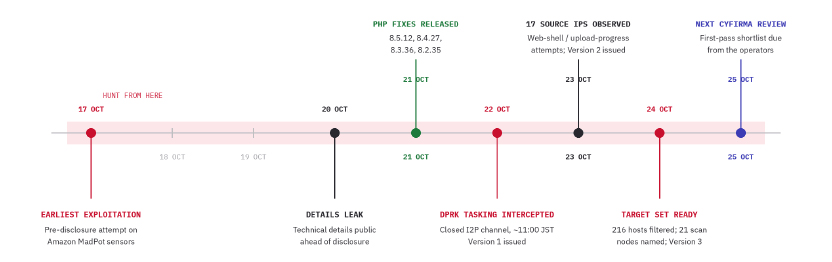
On October 21, PHP released emergency patches for two critical vulnerabilities, CVE-2026-109618 and CVE-2026-109619 (CVSS score of 9.2). The flaws affect all PHP versions that handle web requests.

The vulnerable code dates back to PHP 5.4, released in 2012, and resides in the PHP engine itself rather than in individual applications. Attackers can exploit the flaws to execute code remotely by sending specially crafted HTTP requests, without authentication.

Exploitation attempts increased rapidly after the vulnerabilities became public. Cloudflare researchers reported tens of thousands of attempts within the first 45 minutes, hundreds of thousands in just two hours, and millions by October 22.

Cyfirma reported that a group of North Korea-linked group has identified 216 hosts that may still be vulnerable to PHP2Shell. The operators communicate through a private I2P channel that Cyfirma has monitored since October 22. On October 24, they reported that 216 hosts appeared to be unpatched or only partly protected, earlier than Cyfirma expected.

They are checking the systems from 21 compromised machines. At the time Cyfirma captured the conversation, the operators had already checked about one-third of the targets.

“Two handles active since March 2026, coordinating in a closed I2P channel; staging infrastructure shared in-channel.” states the cybersecurity firm. “Target set and scan nodes. “On 24 October the operators reported 216 unpatched or partially mitigated hosts and named 21 scan nodes; the same addresses were seen performing web-shell tooling and upload-progress session-poisoning attempts.”

The scanning is slow on purpose. Volume stays low, the machines rotate, and any node that shows filtering or rate limiting gets pulled and never reused. That’s why a rate-based alert will probably stay quiet.

According to Binding Operational Directive (BOD) 22-01: Reducing the Significant Risk of Known Exploited Vulnerabilities, FCEB agencies have to address the identified vulnerabilities by the due date to protect their networks against attacks exploiting the flaws in the catalog.

Experts also recommend that private organizations review the Catalog and address the vulnerabilities in their infrastructure.

CISA orders federal agencies to fix the flaws by October 29, 2026.

Follow me on Twitter: @securityaffairs and Facebook and Mastodon

Pierluigi Paganini

(SecurityAffairs – hacking, CISA)

U.S. CISA adds Arista VeloCloud Orchestrator flaw to its Known Exploited Vulnerabilities catalog

24 de Outubro de 2026, 05:30

U.S. Cybersecurity and Infrastructure Security Agency (CISA) adds Arista VeloCloud Orchestrator flaw to its Known Exploited Vulnerabilities catalog.

The U.S. Cybersecurity and Infrastructure Security Agency (CISA) added a critical Arista VeloCloud Orchestrator flaw, tracked as CVE-2026-114625 (CVSS score of 9.4), to its Known Exploited Vulnerabilities (KEV) catalog.

VeloCloud Orchestrator (VCO) is the central management system for VMware SD-WAN, a technology that helps companies securely connect offices, data centers, cloud services, and remote sites over wide-area networks.

It is now associated with Arista Networks, which acquired VMware’s SD-WAN business. The orchestrator gives network administrators a central place to configure, monitor, and manage the network.

The flaw is a SQL Injection issue that affects on-premises VeloCloud Orchestrator (VCO). It allows an authenticated user to gain operator privileges and impersonate a local superuser operator account. This could give a remote attacker access to internal functions that should not be remotely available, potentially compromising the system and the data it manages. Hosted VCO versions, including Dedicated, were also affected but have already been patched.

“VeloCloud Orchestrator (VCO) on-prem has a security issue where this issue may allow a remote attacker to access privileged internal functionality and impact the VCO host. Successful exploitation may compromise the confidentiality, integrity, and availability of the orchestrator and data managed by the orchestrator.” reads the advisory. “On an affected system, any authenticated user can gain operator privileges and masquerade as a local “superuser operator” user. This includes access to functionality that is intended for internal use only and which is not intended to be remotely accessible.”

VeloCloud Orchestrator (VCO) is vulnerable by default. An attacker needs access to its web interface and a valid account. Even an account with the lowest permission level, Enterprise Read Only, is enough. No configuration change can prevent this exposure.

Administrators should check web access logs for unusual requests, encoded text, attempts to access internal services, or an unusually high number of requests. They should also block these IP addresses linked to attacks:

  • 74.82.197.86
  • 38.54.50.151

If an attack is suspected, administrators should save web, application, system and database logs, along with relevant file timestamps, before starting recovery, if possible.

According to Binding Operational Directive (BOD) 22-01: Reducing the Significant Risk of Known Exploited Vulnerabilities, FCEB agencies have to address the identified vulnerabilities by the due date to protect their networks against attacks exploiting the flaws in the catalog.

Experts also recommend that private organizations review the Catalog and address the vulnerabilities in their infrastructure.

CISA orders federal agencies to fix the flaw by October 26, 2026.

Follow me on Twitter: @securityaffairs and Facebook and Mastodon

Pierluigi Paganini

(SecurityAffairs – hacking, CISA)

  • ✇Cybersecurity News
  • Kiloview E3 NDI Encoder Flaws Allow Root Command Execution, CISA Warns Do Son
    CISA warns of nine Kiloview E3 vulnerabilities in the NDI encoder, including CVSS 9.9 flaws CVE-2026-107861 and CVE-2026-110243. Update to V1.30. Related Posts: Palo Alto Networks Confirms PHP2Shell Flaws Affect PAN-OS and Panorama PHP Warns of New Session Upload Progress Flaw CVE-2026-115560, Urges Mitigation LiteSpeed Cache Flaws Expose 7 Million WordPress Sites to Stored XSS The post Kiloview E3 NDI Encoder Flaws Allow Root Command Execution, CISA Warns appeared first on Daily CyberSecurit
     
  • ✇Cybersecurity News
  • SafePay Ransomware Hits 600 Victims as FBI, CISA and Allies Issue Joint Warning Do Son
    A new StopRansomware advisory warns SafePay ransomware has hit 600+ victims via VPN logins and edge flaws. See its tactics and key defenses. Related Posts: Exposed Attacker Server Reveals AI Agent Toolkit and a Second PaperCut RCE Path LiteLLM 1.107.0 Compromised to Steal Cloud, AI Tool and Developer Credentials 333 Tor Exit Nodes Hijacked by Ebury Malware for SSH Attacks The post SafePay Ransomware Hits 600 Victims as FBI, CISA and Allies Issue Joint Warning appeared first on Daily CyberSecu
     
  • ✇Cybersecurity News
  • CISA Warns of Critical Flaws in dcm4chee Medical Archive and Unpatched EseeCloud IP Cameras Do Son
    CISA warns of dcm4chee vulnerabilities that expose patient data, plus unpatched EseeCloud cameras with hard-coded credentials (CVE-2026-107617). Related Posts: Roundcube 1.6.20 and 1.7.5 Fix 20 Security Flaws, Including IMAP Command Injection PwnEscape Linux Kernel Flaw CVE-2026-99999 Lets VM Guests Escape to the Host Six Linux Kernel Flaws Disclosed With Public PoC Exploits for Root Access and Container Escape The post CISA Warns of Critical Flaws in dcm4chee Medical Archive and Unpatched Es
     
  • ✇Security Affairs
  • U.S. CISA adds Atlassian flaw to its Known Exploited Vulnerabilities catalog Pierluigi Paganini
    U.S. Cybersecurity and Infrastructure Security Agency (CISA) adds Atlassian flaw to its Known Exploited Vulnerabilities catalog. The U.S. Cybersecurity and Infrastructure Security Agency (CISA) added an Atlassian flaw, tracked as CVE-2026-21589 (CVSS score of 9.3), to its Known Exploited Vulnerabilities (KEV) catalog. In early October, threat actors started exploiting CVE-2026-21589, a critical arbitrary file access flaw in Atlassian Data Center products. The vulnerability could allow att
     

U.S. CISA adds Atlassian flaw to its Known Exploited Vulnerabilities catalog

16 de Outubro de 2026, 08:05

U.S. Cybersecurity and Infrastructure Security Agency (CISA) adds Atlassian flaw to its Known Exploited Vulnerabilities catalog.

The U.S. Cybersecurity and Infrastructure Security Agency (CISA) added an Atlassian flaw, tracked as CVE-2026-21589 (CVSS score of 9.3), to its Known Exploited Vulnerabilities (KEV) catalog.

In early October, threat actors started exploiting CVE-2026-21589, a critical arbitrary file access flaw in Atlassian Data Center products. The vulnerability could allow attackers to access sensitive files under certain conditions. Affected products include Bitbucket, Confluence, Jira Service Management, Jira Software, Bamboo, Crowd, Crucible, and Fisheye.

“This Arbitrary File Access vulnerability allows an unauthenticated attacker to access specific files within the web application root directory in affected versions. Exploitation requires prior knowledge of the target file’s exact name and path; this vulnerability does not allow attackers to enumerate or list directory contents.” reads the advisory. “In some configurations, there may be some sensitive files that make this highly severe.”

Previdian telemetry has detected 15 exploitation attempts from three IP addresses in Japan and the U.S..

“Exploitation has now started to hit our honeypot network” Previdian Founder Ryan Dewhurst wrote on LinkedIn.

On October 6, watchTowr Labs published a technical analysis of CVE-2026-21589 after comparing vulnerable and patched Atlassian packages.

Researchers found a path traversal flaw where double-colon (::) sequences can be treated as path separators, allowing attackers to read files from the application web root.

“While semicolons (;) are very common in path traversal within Java applications, along with the everyday dots (.) and slashes (/), one item stood out: the matching of double colons (::).” reads the analysis. “This is uncommon syntax for this type of vulnerability, but grepping through the codebase we came across an all too familiar sight.”

In one Crowd deployment with Jira, researchers were able to read crowd.properties, which exposed application credentials. They then used those credentials to create a user and add it to the jira-administrators group. Crowd IP allowlisting can block this attack path.

Exploitation attempts against its honeypot network reportedly began two hours after watchTowr published additional technical details about the vulnerability.

According to watchTowr, the problem is in Atlassian’s web-resource handling. It can turn a string such as ..::..::..::..::WEB-INF::web.xml into ../../../../WEB-INF/web.xml, allowing attackers to move through directories and access files they should not be able to read.

Atlassian says all versions before the listed fixed versions are affected:

ProductFixed versions
Bitbucket Data Center9.4.26, 10.2.8, 10.5.1
Confluence Data Center9.2.26, 10.2.19
Jira Service Management Data Center5.12.40, 10.3.26, 11.3.12
Jira Software Data Center9.12.40, 10.3.26, 11.3.12
Bamboo Data Center10.2.24, 12.1.12
Crowd Data Center6.3.7, 7.0.3, 7.1.7, 7.2.4
Crucible4.9.15
Fisheye4.9.15

watchTowr has released a free tool on GitHub to help check if a server is vulnerable.

According to Binding Operational Directive (BOD) 22-01: Reducing the Significant Risk of Known Exploited Vulnerabilities, FCEB agencies have to address the identified vulnerabilities by the due date to protect their networks against attacks exploiting the flaws in the catalog.

Experts also recommend that private organizations review the Catalog and address the vulnerabilities in their infrastructure.

CISA orders federal agencies to fix the flaw by October 18, 2026.

Follow me on Twitter: @securityaffairs and Facebook and Mastodon

Pierluigi Paganini

(SecurityAffairs – hacking, CISA)

U.S. CISA adds Palo Alto Networks PAN-OS, Ahsay AhsayCBS, and Cisco Secure Email Gateway flaws to its Known Exploited Vulnerabilities catalog

15 de Outubro de 2026, 16:21

U.S. Cybersecurity and Infrastructure Security Agency (CISA) adds Palo Alto Networks PAN-OS, Ahsay AhsayCBS, and Cisco Secure Email Gateway flaws to its Known Exploited Vulnerabilities catalog.

The U.S. Cybersecurity and Infrastructure Security Agency (CISA) added the following vulnerabilities to its Known Exploited Vulnerabilities (KEV) catalog:

  • CVE-2026-0322 Palo Alto Networks PAN-OS Code Injection Vulnerability 
  • CVE-2026-76519 Cisco Secure Email Gateway Relative Path Traversal Vulnerability
  • CVE-2026-105133 Ahsay AhsayCBS Improper Authentication Vulnerability 
  • CVE-2026-105134 Ahsay AhsayCBS Command Injection Vulnerability 

Cisco confirmed this week that threat actors are exploiting a critical vulnerability in Cisco Secure Email Gateway, tracked as CVE-2026-76519 (CVSS score of 9.8). An attacker can exploit the flaw by sending a crafted email attachment through the gateway and, if it lands right, writing arbitrary files to the underlying operating system.

The flaw CVE-2026-0322 (CVSS score: 8.6) is a high-severity code injection vulnerability in the management interface of Palo Alto Networks PAN-OS. It could allow an authenticated attacker with network access and high-level privileges to execute arbitrary code with root privileges on an affected firewall. The vulnerability affects PA-Series and VM-Series firewalls and Panorama appliances. Palo Alto Networks confirmed that limited exploitation has been observed targeting the management interface. The company recommends restricting access to trusted internal IP addresses and installing the relevant security updates.

The flaw CVE-2026-105133 (CVSS score: 5.5) is an improper authentication vulnerability in AhsayCBS, a backup management platform. The flaw affects the checkSysPwd function in the product’s API and could allow a remote attacker to bypass authentication by manipulating the random parameter. Starting on October 7, 2026, attackers used it to bypass authentication before exploiting a second vulnerability, CVE-2026-105134, to execute commands on affected servers. Huntress reported that at least five organizations had been targeted by October 8.

The flaw CVE-2026-105134 (CVSS score: 9.3) is a critical operating system command injection vulnerability in the Replication Receiver component of AhsayCBS. The flaw affects the /rps/api/json/UpdateReceivers.do endpoint and could allow an unauthenticated remote attacker to execute arbitrary commands on the underlying system. The vulnerability is being actively exploited in the wild. Attackers have chained it with CVE-2026-105133 to gain remote code execution with NT AUTHORITY\SYSTEM privileges, deploy JSP web shells and install XMRig cryptocurrency miners disguised as Microsoft Edge processes. Huntress observed attacks against at least five organizations by October 8, 2026.

According to Binding Operational Directive (BOD) 22-01: Reducing the Significant Risk of Known Exploited Vulnerabilities, FCEB agencies have to address the identified vulnerabilities by the due date to protect their networks against attacks exploiting the flaws in the catalog.

Experts also recommend that private organizations review the Catalog and address the vulnerabilities in their infrastructure.

CISA orders federal agencies to fix the flaws by October 17, 2026.

Follow me on Twitter: @securityaffairs and Facebook and Mastodon

Pierluigi Paganini

(SecurityAffairs – hacking, CISA)

  • ✇Security Affairs
  • U.S. CISA adds Microsoft Windows Shell flaw to its Known Exploited Vulnerabilities catalog Pierluigi Paganini
    U.S. Cybersecurity and Infrastructure Security Agency (CISA) adds Microsoft Windows Shell flaw to its Known Exploited Vulnerabilities catalog. The U.S. Cybersecurity and Infrastructure Security Agency (CISA) added a Microsoft Windows Shell flaw, tracked as CVE-2026-96951 (CVSS score of 8.8), to its Known Exploited Vulnerabilities (KEV) catalog. Microsoft Patch Tuesday security updates for October 2026 address a record 1,415 vulnerabilities, including a zero-day under active attack. The fl
     

U.S. CISA adds Microsoft Windows Shell flaw to its Known Exploited Vulnerabilities catalog

14 de Outubro de 2026, 18:15

U.S. Cybersecurity and Infrastructure Security Agency (CISA) adds Microsoft Windows Shell flaw to its Known Exploited Vulnerabilities catalog.

The U.S. Cybersecurity and Infrastructure Security Agency (CISA) added a Microsoft Windows Shell flaw, tracked as CVE-2026-96951 (CVSS score of 8.8), to its Known Exploited Vulnerabilities (KEV) catalog.

Microsoft Patch Tuesday security updates for October 2026 address a record 1,415 vulnerabilities, including a zero-day under active attack. The flaw, tracked as CVE-2026-96951, is a Windows Shell command injection vulnerability that allows an unauthorized attacker to bypass security protections over a network. Exploitation can evade Mark of the Web (MOTW) defenses, which help protect users from potentially dangerous files downloaded from the internet. Microsoft confirmed that the flaw is being actively exploited.

“An attacker who successfully exploited the vulnerability could evade Mark of the Web (MOTW) defenses.” reads the advisory. “In an email or instant message attack scenario, the attacker could send the targeted user a specially crafted file that is designed to exploit the vulnerability. In any case an attacker would have no way to force a user to view attacker-controlled content. Instead, an attacker would have to convince a user to take action. For example, an attacker could entice a user to either click a link that directs the user to the attacker’s site or send a malicious attachment.”

According to Binding Operational Directive (BOD) 22-01: Reducing the Significant Risk of Known Exploited Vulnerabilities, FCEB agencies have to address the identified vulnerabilities by the due date to protect their networks against attacks exploiting the flaws in the catalog.

Experts also recommend that private organizations review the Catalog and address the vulnerabilities in their infrastructure.

CISA orders federal agencies to fix the flaw by October 16, 2026.

The U.S. Cybersecurity and Infrastructure Security Agency (CISA) also added an Ivanti Connect Secure FortiMail flaw, tracked as CVE-2026-104935 (CVSS score of 8.6), to its Kev Catalog.

The vulnerability is an authentication bypass issue caused by spoofing in ICS versions before 25.1.3.0 that could allow a remote, unauthenticated attacker to execute arbitrary commands. ICS versions 22.7R2.14 and earlier are not affected.

Follow me on Twitter: @securityaffairs and Facebook and Mastodon

Pierluigi Paganini

(SecurityAffairs – hacking, CISA)

  • ✇Security Affairs
  • U.S. CISA adds Ivanti Connect Secure flaw to its Known Exploited Vulnerabilities catalog Pierluigi Paganini
    U.S. Cybersecurity and Infrastructure Security Agency (CISA) adds Ivanti Connect Secure flaw to its Known Exploited Vulnerabilities catalog. The U.S. Cybersecurity and Infrastructure Security Agency (CISA) added an Ivanti Connect Secure FortiMail flaw, tracked as CVE-2026-104935 (CVSS score of 8.6), to its Known Exploited Vulnerabilities (KEV) catalog. The vulnerability is an authentication bypass issue caused by spoofing in ICS versions before 25.1.3.0 that could allow a remote, unauthen
     

U.S. CISA adds Ivanti Connect Secure flaw to its Known Exploited Vulnerabilities catalog

13 de Outubro de 2026, 15:14

U.S. Cybersecurity and Infrastructure Security Agency (CISA) adds Ivanti Connect Secure flaw to its Known Exploited Vulnerabilities catalog.

The U.S. Cybersecurity and Infrastructure Security Agency (CISA) added an Ivanti Connect Secure FortiMail flaw, tracked as CVE-2026-104935 (CVSS score of 8.6), to its Known Exploited Vulnerabilities (KEV) catalog.

The vulnerability is an authentication bypass issue caused by spoofing in ICS versions before 25.1.3.0 that could allow a remote, unauthenticated attacker to execute arbitrary commands. ICS versions 22.7R2.14 and earlier are not affected.

“Authentication bypass by spoofing in ICS before version 25.1.3.0 allows a remote unauthenticated attacker to execute arbitrary commands. This does not impact ICS version 22.7R2.14 or prior.” reads the advisory. “Ivanti has released updates for Ivanti Connect Secure (ICS) which addresses one high severity vulnerability. Successful exploitation could allow a remote unauthenticated attacker to execute arbitrary commands.”

The company confirmed that the vulnerability was exploited in attacks in the wild.

“We are aware of exploitation in the wild affecting a limited number of customers at the time of disclosure.” continues the report.

According to Binding Operational Directive (BOD) 22-01: Reducing the Significant Risk of Known Exploited Vulnerabilities, FCEB agencies have to address the identified vulnerabilities by the due date to protect their networks against attacks exploiting the flaws in the catalog.

Experts also recommend that private organizations review the Catalog and address the vulnerabilities in their infrastructure.

CISA orders federal agencies to fix the flaw by October 16, 2026.

Follow me on Twitter: @securityaffairs and Facebook and Mastodon

Pierluigi Paganini

(SecurityAffairs – hacking, CISA)

U.S. CISA adds ProFTPD, ONLYOFFICE Docs, Strapi, Apache Struts, and ISC BIND flaws to its Known Exploited Vulnerabilities catalog

11 de Outubro de 2026, 06:18

U.S. Cybersecurity and Infrastructure Security Agency (CISA) adds ProFTPD, ONLYOFFICE Docs, Strapi, Apache Struts, and ISC BIND to its Known Exploited Vulnerabilities catalog.

The U.S. Cybersecurity and Infrastructure Security Agency (CISA) added the following vulnerabilities to its Known Exploited Vulnerabilities (KEV) catalog:

  • CVE-2015-3306 (CVSS score of 10.0) – An access control flaw in ProFTPD that could let remote attackers read or modify arbitrary files by abusing the SITE CPFR and SITE CPTO commands.
  • CVE-2021-3199 (CVSS score of 9.8) – A path traversal flaw in ONLYOFFICE Docs when JSON Web Token (JWT) is enabled. Attackers could exploit a /.. sequence in an image upload parameter to potentially execute code remotely.
  • CVE-2023-22894 (CVSS score of 7.2) – A vulnerability in Strapi that exposes sensitive information stored in cleartext. An attacker with admin panel access could use query filters to retrieve confidential user details.
  • CVE-2016-3081 (CVSS score of 8.1) – A command injection flaw in Apache Struts that could allow remote attackers to run arbitrary code through method: prefixes when Dynamic Method Invocation is enabled.
  • CVE-2015-5477 (CVSS score of 7.5) – A reachable assertion vulnerability in ISC BIND that could be triggered by remote TKEY queries, potentially causing a denial-of-service condition.

The five vulnerabilities have been added to a broader list of flaws linked to cyber operations attributed to China-linked actors associated with Integrity Technology Group, a China-based cybersecurity company. The update coincides with a joint advisory issued by Australia, Canada, Japan, New Zealand, Spain, the United Kingdom and the United States. U.S. authorities have also taken action against tools associated with Integrity Tech and used in cyber espionage operations.

The activity reportedly involved the exploitation of eight vulnerabilities, including the five listed above, to gain initial access to targeted networks and steal sensitive information. The attackers used scanning tools, cross-site scripting (XSS) and password-spraying attacks against Microsoft Exchange servers. They also relied on VPN software to maintain access and scripts to extract emails and credentials.

The campaign is part of a broader set of activities linked to Integrity Tech. The U.S. Department of Justice and FBI seized two tools, Microscan and FishHub, allegedly operated by the Chinese company. Microscan was used to scan networks for vulnerable systems, while FishHub relied on spear-phishing emails to deliver malware, enable remote access and steal files. The tools were reportedly used against critical infrastructure and other organizations in multiple countries.

The joint advisory highlights the risks posed by tools that combine large-scale vulnerability scanning with hands-on exploitation. The coordinated action by seven countries and the U.S. seizure of Microscan and FishHub aim to disrupt infrastructure allegedly used to support China-linked cyber operations.

According to Binding Operational Directive (BOD) 22-01: Reducing the Significant Risk of Known Exploited Vulnerabilities, FCEB agencies have to address the identified vulnerabilities by the due date to protect their networks against attacks exploiting the flaws in the catalog.

Experts also recommend that private organizations review the Catalog and address the vulnerabilities in their infrastructure.

CISA orders federal agencies to fix the flaws by October 11, 2026.

Follow me on Twitter: @securityaffairs and Facebook and Mastodon

Pierluigi Paganini

(SecurityAffairs – hacking, CISA)

❌
❌