
Visualização normal

Antes de ontemStream principal
  • ✇Security Affairs
  • Project noRecognition: Teaching AI to Fool Surveillance Cameras Pierluigi Paganini
    Researchers tested 31 million patterns to disrupt surveillance AI, with promising results but significant gaps between simulation and real-world use. The Kansas City-based cybersecurity researcher Bill Swearingen spent the past year doing something that sounds almost too simple to work: printing patterns, watching cameras fail to detect them, and repeating. TechCrunch reports that after roughly 31 million tests, he can now generate patterns on demand that block license plate readers and surv
     

Project noRecognition: Teaching AI to Fool Surveillance Cameras

18 de Agosto de 2026, 14:05

Researchers tested 31 million patterns to disrupt surveillance AI, with promising results but significant gaps between simulation and real-world use.

The Kansas City-based cybersecurity researcher Bill Swearingen spent the past year doing something that sounds almost too simple to work: printing patterns, watching cameras fail to detect them, and repeating. TechCrunch reports that after roughly 31 million tests, he can now generate patterns on demand that block license plate readers and surveillance cameras from recognizing whatever the pattern covers, whether that’s a person or a vehicle.

The project is called noRecognition, and the core idea isn’t stealth in the traditional sense. The camera still records everything just fine. What breaks is the detection layer sitting on top of the footage, the software that flags license plates, tracks faces, or spots “activity of interest” across thousands of hours of video. Swearingen’s patterns don’t hide you from the lens; they make the algorithm looking through that lens shrug and move on.

Swearingen, co-founder of the SecKC meetup, said his project started for personal reasons. He became concerned about the growing number of surveillance cameras in his town and the possibility of being tracked while attending a protest.

What started as a simple experiment later became a reinforcement learning system. He taught the model to create patterns, learn from failures and keep improving. Over time, it learned how to avoid detection by several camera systems.

Every time a pattern failed and got detected, the system adjusted and tried again, eventually learning to defeat multiple detection algorithms simultaneously rather than just one at a time.

The research dashboard behind the project, published at sandbox.norecognition.org, goes considerably deeper into the numbers than the headline claim suggests, and it’s refreshingly upfront about what’s proven versus what isn’t. The team states its overall objective plainly as “one pattern that defeats every detector,” and by their own account that goal remains only partially met. Their strongest validated result against a detector extracted directly from a real deployed surveillance camera sits at 61.7% non-detection across held-out test subjects, a solid number, but nowhere near total, and still a digital simulation rather than a real-world fabric test.

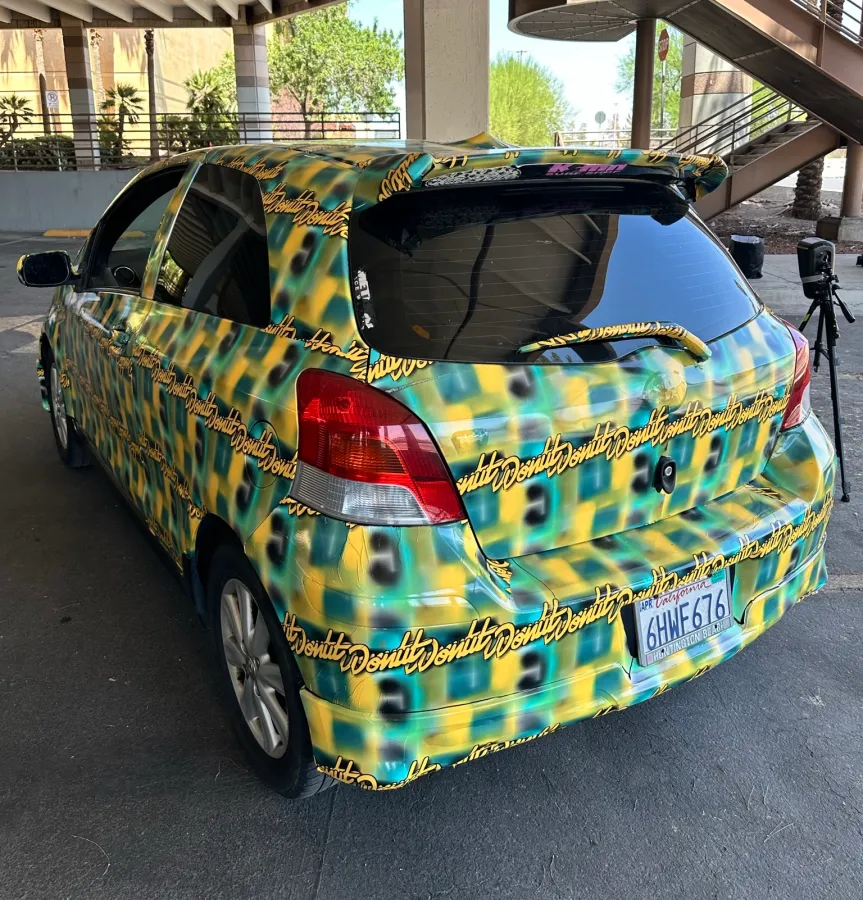
That distinction matters more than it might seem. Most of the dashboard’s headline figures are explicitly labeled as digital, simulated results, meaning the pattern was tested against a virtual camera and printed ink model rather than an actual garment photographed by an actual camera in the field. The gap between “works in simulation” and “works when Donut Media wraps a real 2009 Toyota Yaris in it,” which is the physical test Swearingen ran live at DEF CON, is exactly the gap this kind of research has to close before anyone should treat it as a reliable, everyday privacy tool.

“On Friday at the Def Con cybersecurity conference in Las Vegas, Swearingen ran his first real-world test. With help from Donut Media, the test involved covering a 2009 Toyota Yaris with one of Swearingen’s newest patterns to see if the car would be invisible to detection by a Flock camera.” reports TechCrunch.

“We proved it was effective,” said Swearingen, though the wheels were a challenge. The video of the demo will be out in the next few weeks, said Donut Media.”

That DEF CON demo is where things got concrete. Swearingen covered a car in one of his newest patterns and tested it against a Flock Safety camera, the kind widely deployed for automated license plate reading across the US. He said the test proved effective, though the vehicle’s wheels turned out to be a persistent weak point, curved surfaces apparently don’t cooperate with flat printed patterns the way a car door does.
Project noRecognition: Teaching AI to Fool Surveillance Cameras
Source Tech Crunch – A photo of a 2009 Toyota Yaris at the Def Con conference in Las Vegas, covered in a pattern made by Bill Swearingen, as part of a test to see if it can defeat surveillance camera detection.
Image Credits:Bill Swearingen / Donut Media

Swearingen is not publishing his best patterns because he does not want camera makers to easily find and block them. Instead, he is using crowdfunding to develop and sell printed products such as T-shirts and hoodies, with vehicle wraps possibly coming later.

It is still unclear whether the project will become a practical privacy tool for everyday users or remain mainly a DEF CON demonstration. Its real effectiveness will depend on how well the patterns work on real clothing, in different weather and camera conditions.

Follow me on Twitter: @securityaffairs and Facebook and Mastodon

Pierluigi Paganini

(SecurityAffairs – hacking, Surveillance camera)
  • ✇Schneier on Security
  • Adversarial Clothing Designed to Fool Facial Recognition Systems Bruce Schneier
    There are many companies manufacturing adversarial clothing designed to confuse facial recognition systems. It’s a cool idea, but I worry that it’s mostly security theater: “Our patterns play with that chaos, confuse algorithms and make it way harder to pin you down,” he said. Bell, however, said “none of these products are tried and tested, and a lot of these surveillance technologies can deal with a little resistance … [but] even if the designs don’t necessarily work perfectly, fashion is als
     

Adversarial Clothing Designed to Fool Facial Recognition Systems

6 de Agosto de 2026, 08:04

There are many companies manufacturing adversarial clothing designed to confuse facial recognition systems.

It’s a cool idea, but I worry that it’s mostly security theater:

“Our patterns play with that chaos, confuse algorithms and make it way harder to pin you down,” he said.

Bell, however, said “none of these products are tried and tested, and a lot of these surveillance technologies can deal with a little resistance … [but] even if the designs don’t necessarily work perfectly, fashion is also a visible sign of resistance.

“This is consumers collectively coming together to make a visible statement.”

Without serious testing, there is no reason to trust the technology. And even with testing, there is no reason to trust that a new version of the facial recognition software doesn’t break the anti-surveillance properties.

I don’t want people to mistakenly rely on this stuff.

  • ✇Schneier on Security
  • Facial Recognition at Madison Square Garden Bruce Schneier
    Last month, the story broke (alternate link) that Madison Square Garden uses facial recognition software on everyone entering the facility, and—among other groups—flags activists that oppose using facial recognition. Turns out that the system was shut off for Taylor Swift’s wedding. Evan Greer—one of the people that MSG alerts on—comments: Ironically, Swift herself has reportedly used facial recognition at her own concerts to identify stalkers. This “privacy for me, surveillance for thee” attitu
     

Facial Recognition at Madison Square Garden

31 de Julho de 2026, 08:08

Last month, the story broke (alternate link) that Madison Square Garden uses facial recognition software on everyone entering the facility, and—among other groups—flags activists that oppose using facial recognition.

Turns out that the system was shut off for Taylor Swift’s wedding.

Evan Greer—one of the people that MSG alerts on—comments:

Ironically, Swift herself has reportedly used facial recognition at her own concerts to identify stalkers. This “privacy for me, surveillance for thee” attitude feels like a perfect encapsulation of the future we’re already living in: one where wealthy elites can afford privacy, while the rest of us are forced to live in a corporate surveillance panopticon.

Whatever privacy measures Swift had in place for the wedding seems to have worked. No photos have leaked online.

  • ✇Arstechnica
  • Forgot your Google password? Now you can log in with a selfie. Ryan Whitwam
    Getting locked out of an account is no fun. Google has a few ways to help you regain access if you happen to forget your password or lose an authenticator, including recovery contacts and backup codes. Now, Google has a completely new option: your face. You can now give Google a video record of your face and sign into your account with a selfie, which sounds like something people are going to just love. You will have to set this feature up ahead of time if you want the option of regaining accoun
     

Forgot your Google password? Now you can log in with a selfie.

23 de Julho de 2026, 16:14

Getting locked out of an account is no fun. Google has a few ways to help you regain access if you happen to forget your password or lose an authenticator, including recovery contacts and backup codes. Now, Google has a completely new option: your face. You can now give Google a video record of your face and sign into your account with a selfie, which sounds like something people are going to just love.

You will have to set this feature up ahead of time if you want the option of regaining account access with a selfie later on. To get started, verify your account type is supported. You won't be able to configure selfie sign-ins for Workspace accounts, child accounts, or any account enrolled in Google's Advanced Protection Program.

Configuring selfie sign-in requires you to record a video, which Google will store on its servers. Google's selfie sign-in landing page includes the typical disclaimers about privacy and data access, promising that the company will keep the video encrypted and won't use it for any other purposes unless you opt in.

Read full article

Comments

© Google

GhostApproval Flaws Let Top AI Coding Tools Write Outside Workspaces

Wiz found GhostApproval symlink flaws in major AI coding assistants that could hide sensitive file targets, bypass approval checks and enable system access too.

Iris Recognition vs Fingerprint: Which Biometric Wins in 2026?

Compare iris recognition and fingerprint biometrics in 2026, from accuracy and speed to security, privacy, and where each technology works best.

Meta Is Testing Facial Recognition for Police and Military

26 de Junho de 2026, 13:40

We know that ICE wants to deploy eyeglasses with facial recognition that can identify people in real time.

Turns out Meta is prototyping the feature with a Pentagon supplier. (Alternate news story.)

Madison Square Garden Hack Exposes 26 Million Visitor Records

24 de Junho de 2026, 12:00

Madison Square Garden faces a 26M-record hack tied to visitor data, facial recognition, and security records from its venue operations, with fallout from the leak.

The post Madison Square Garden Hack Exposes 26 Million Visitor Records appeared first on TechRepublic.

  • ✇Malwarebytes
  • Meta’s face-recognition code raises new concerns about smart glasses
    Meta’s smart glasses are once again at the center of a privacy debate due to face recognition. WIRED reports that Meta had quietly embedded unreleased face-recognition code, internally called “NameTag,” into its Meta AI companion app, which powers the company’s smart glasses. The code was not active, but its presence in an app installed on more than 50 million devices raised immediate concerns about how quickly using smart glasses could slide into biometric surveillance. Face recognition i
     

Meta’s face-recognition code raises new concerns about smart glasses

9 de Junho de 2026, 10:57

Meta’s smart glasses are once again at the center of a privacy debate due to face recognition.

WIRED reports that Meta had quietly embedded unreleased face-recognition code, internally called “NameTag,” into its Meta AI companion app, which powers the company’s smart glasses. The code was not active, but its presence in an app installed on more than 50 million devices raised immediate concerns about how quickly using smart glasses could slide into biometric surveillance.

Face recognition in glasses, even if disabled or unreleased, is especially sensitive because it can identify people at a distance, in real time, and without their consent. Many organizations have warned that this technology could be misused by stalkers, abusers, and others who want to identify people in public without drawing attention.

Gizmodo reports on a proposed Pennsylvania bill that would require smart glasses and similar wearable recording devices to include a visible indicator light when they are capturing audio or video. The bill would also prohibit users from disabling that indicator, a move clearly aimed at reducing covert recording in public spaces.

Most smart glasses already include such an indicator, but reporters noted that some users have been paying others to have them removed or disabled. The proposal is interesting because it tries to solve a hardware-level trust problem with a visible signal. But a visible light only helps if it is both mandatory and difficult to bypass, and history suggests that any visible privacy safeguard becomes a target for tampering when the incentives are high enough.

These two stories are really about the same issue: smart glasses are normalizing the use of always-on cameras, microphones, and AI features in a form that is much easier to conceal than a phone. That creates an unwanted privacy problem for people around the wearer.

Smart glasses are supposed to make computing more seamless. Instead, they are becoming a test case for what happens when cameras, microphones, AI, and biometric features are squeezed into everyday wearables before the privacy rules catch up.

From our point of view, smart glasses sit at the intersection of consumer privacy, surveillance tech, and potential abuse. The risk is not just that a device records audio or video. AI-enabled wearables can process what they see, deduce identities, and potentially store biometric data in ways that ordinary users and bystanders can’t easily detect.

We’d rather err on the side of caution and use an app that can detect when smart glasses are nearby. Unfortunately, it only detects some devices, and we don’t yet know how well it will perform if smart glasses become more common.

As noted by 404 Media, the app is an imperfect, tech-based response to a social and legal problem: it can misfire, it can’t tell you who is being recorded, and it risks giving a false sense of safety. The developer frames it not as a solution but as a small, user-controlled countermeasure in an environment where surveillance devices are becoming less visible and more AI-enabled.

Don’t get recognized

If facial recognition features ever become common in smart glasses, much of their effectiveness will depend on how much information about you is already available online. There are a few steps you can take today to reduce your visibility in facial recognition systems and people-search databases.

A major factor is limiting who can see the photographs you post on social media and other online platforms. But there is more you can do:

Remove yourself from reverse face search engines

The major, most accurate reverse face search engines, Pimeyes and Facecheck.id, offer opt-out and removal processes that can help reduce your visibility in search results:

Remove yourself from people search engines

Most people don’t realize how much information can be found from a name alone. People-search sites often aggregate home addresses, phone numbers, ages, and relatives from public records and commercial databases.

The New York Times has compiled a useful guide to many of the major people-search sites, along with instructions for opting out and removing your information.

Scrub your data

If you’re in the US, you can also use Malwarebytes Personal Data Remover to help find and remove personal information that data broker sites have collected about you.

  • ✇Security Boulevard
  • The Real State of Offensive Security: AI, Penetration Testing & The Road Ahead with Andrew Wilson Tom Eston
    Tom Eston interviews offensive AI researcher and PhD candidate Andrew Wilson, a former Bishop Fox partner who helped grow the firm from under 20 people to nearly 500, built award-winning AI solutions for SOC modernization, founded Cactus Con, and relocated his family to Guadalajara to open and scale a Bishop Fox office. They discuss Mexico’s […] The post The Real State of Offensive Security: AI, Penetration Testing & The Road Ahead with Andrew Wilson appeared first on Shared Security Podcast
     
  • ✇Security Boulevard
  • The Privacy Problem With Meta’s Ray-Ban Smart Glasses Tom Eston
    This episode discusses Meta Ray-Ban Smart Glasses, which blend a camera, microphone, AI features, and social media integration into sunglasses that look like normal fashion eyewear, raising major privacy concerns. It highlights reports that footage captured by the glasses may be reviewed by human contractors to help train Meta’s AI systems, and notes critics’ concerns […] The post The Privacy Problem With Meta’s Ray-Ban Smart Glasses appeared first on Shared Security Podcast. The post The Privac
     

The Privacy Problem With Meta’s Ray-Ban Smart Glasses

16 de Março de 2026, 01:00

This episode discusses Meta Ray-Ban Smart Glasses, which blend a camera, microphone, AI features, and social media integration into sunglasses that look like normal fashion eyewear, raising major privacy concerns. It highlights reports that footage captured by the glasses may be reviewed by human contractors to help train Meta’s AI systems, and notes critics’ concerns […]

The post The Privacy Problem With Meta’s Ray-Ban Smart Glasses appeared first on Shared Security Podcast.

The post The Privacy Problem With Meta’s Ray-Ban Smart Glasses appeared first on Security Boulevard.

💾

  • ✇Security Boulevard
  • Threat Modeling with AI: A Developer-Driven Boon for Enterprise Security  Matias Madou
    For companies running a modern, adaptive and defense-centered security program, threat modeling is not a new concept. In fact, it’s one of the core tenets of preventative cybersecurity best practices. Being able to find vulnerabilities within software or a network, map them out and remediate them – before an attacker can successfully orchestrate a breach.. The post Threat Modeling with AI: A Developer-Driven Boon for Enterprise Security  appeared first on Security Boulevard.
     

We're in the top 1%: A personal reflection on our Leading Employer recognition

I'm incredibly proud to share that EclecticIQ has been officially certified as a Leading Employer Netherlands 2025, placing us among the top 1% of employers in the Netherlands. Having joined the company about a year ago, this recognition validates what drew me here in the first place and what I've experienced firsthand: our people truly are our greatest asset.

❌
❌