Visualização normal

Ontem — 7 de Setembro de 2026Stream principal
  • ✇Firewall Daily – The Cyber Express
  • G7, CISA Urge Urgent Shift to Post-Quantum Cryptography Samiksha Jain
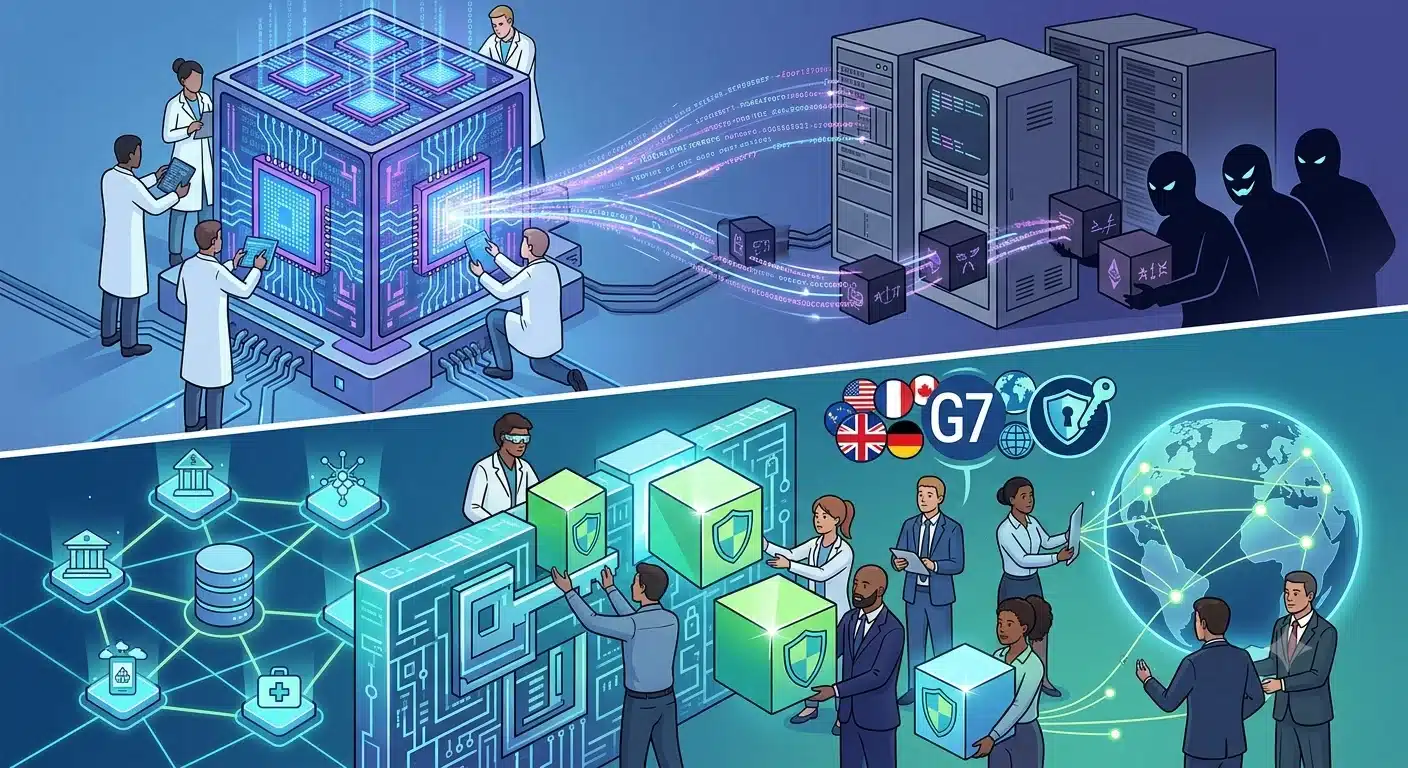
    Some of the world's leading democracies are pushing governments and companies to start preparing for post-quantum cryptography before quantum computers become powerful enough to break the encryption systems that protect global digital infrastructure today. In a joint advisory released Thursday, the G7 Cybersecurity Working Group and the U.S. Cybersecurity and Infrastructure Security Agency (CISA) said organizations should begin their transition to post-quantum cryptography now, rather than wait
     

G7, CISA Urge Urgent Shift to Post-Quantum Cryptography

7 de Setembro de 2026, 03:51

post-quantum cryptography

Some of the world's leading democracies are pushing governments and companies to start preparing for post-quantum cryptography before quantum computers become powerful enough to break the encryption systems that protect global digital infrastructure today.

In a joint advisory released Thursday, the G7 Cybersecurity Working Group and the U.S. Cybersecurity and Infrastructure Security Agency (CISA) said organizations should begin their transition to post-quantum cryptography now, rather than waiting until cryptographically relevant quantum computers (CRQCs) are available to threat actors.

Why the Post-Quantum Cryptography Shift Cannot Wait

The publication, titled "Preparing for the Post-Quantum Era: A Call to Action," warns that the quantum computing threat is no longer a distant concern. While the exact timeline for CRQC development remains uncertain, the working group said recent technological advances suggest such machines could emerge sooner than expected, putting widely used public-key cryptography mechanisms at risk.

One of the most immediate dangers is a tactic known as "harvest now, decrypt later," where malicious actors intercept and store encrypted data today with the intention of decrypting it once a CRQC becomes available. This poses a serious risk to governmental records, sensitive personal data, and trade or business secrets that require long-term confidentiality.

The advisory also cautions that CRQCs could eventually be used to target authentication mechanisms, allowing bad actors to impersonate trusted entities, forge data, or compromise equipment. Because supply chain vulnerabilities can cascade, a single organization's delay in adopting post-quantum cryptography could expose entire sectors to compromise.

According to the report, organizations that fail to act may also face business consequences beyond security risk, including exclusion from public procurement contracts and loss of competitive advantage.

Five Priorities for the PQC Transition

The G7 Cybersecurity Working Group outlined five priority areas to guide the global shift toward post-quantum cryptography:

  1. Raising awareness — Many organizations still view the quantum threat as a distant or purely technical issue. The group called for awareness campaigns, technical guidance, and workforce upskilling to reframe it as an economic and business risk.
  2. Developing national strategies — Countries are encouraged to build strategies that ensure an adequate supply of quantum-safe hardware and software while encouraging adoption, integrating the effort into broader digital privacy and security policies.
  3. Advancing research and development — Governments should fund research programs and support pilot projects and testbeds to help organizations test and refine their transition to post-quantum cryptography.
  4. Building public-private partnerships — Collaboration between government, industry, and academia is seen as key to developing domestic expertise, lowering transition costs, and sharing playbooks and case studies across sectors.
  5. Integrating PQC into cybersecurity requirements — The group recommends treating post-quantum cryptography adoption as a natural evolution of cryptographic best practice, and embedding requirements into public procurement to push both vendors and organizations toward quantum-safe systems.

The advisory emphasizes that the shift to post-quantum cryptography cannot be solved by individual organizations in isolation. Instead, it calls for early engagement, coordinated planning, and informed decision-making across public and private sectors worldwide.

Tackling the risks that the impending quantum computing era poses to current cryptographic systems... requires a coordinated global effort to transition to PQC," the report states, adding that public and private organizations must act now to safeguard confidential data, supply chains, and critical systems.

The document was jointly published by cybersecurity authorities from Canada, Germany, Italy, Japan, the United Kingdom, the United States, and France's ANSSI, with participation from the European Commission and support from the EU Agency for Cybersecurity (ENISA).

Antes de ontemStream principal
  • ✇Schneier on Security
  • Python Now Has a Post-Quantum Encryption Library Bruce Schneier
    This is good: Post-quantum cryptography is now one pip-install away for the entire Python ecosystem. With funding from the Sovereign Tech Agency, we implemented support for ML-KEM, the NIST-standard key-establishment primitive, and ML-DSA, the NIST-standard digital-signature primitive, in pyca/cryptography. Remember, the reason to do this now is because there’s no emergency. And because you will make your systems crypto agile, which is always a good idea.
     

Python Now Has a Post-Quantum Encryption Library

10 de Agosto de 2026, 08:02

This is good:

Post-quantum cryptography is now one pip-install away for the entire Python ecosystem. With funding from the Sovereign Tech Agency, we implemented support for ML-KEM, the NIST-standard key-establishment primitive, and ML-DSA, the NIST-standard digital-signature primitive, in pyca/cryptography.

Remember, the reason to do this now is because there’s no emergency. And because you will make your systems crypto agile, which is always a good idea.

  • ✇Security Affairs
  • Claude Mythos Shows AI Can Outpace Human Cryptography Research Pierluigi Paganini
    Claude Mythos found new flaws in HAWK and reduced AES, proving AI can autonomously advance cryptography research. Anthropic published two cryptographic research results achieved by Claude Mythos Preview working mostly autonomously: an improved attack on HAWK, a post-quantum digital signature scheme currently under NIST review, and a 200 to 800 times faster attack on a reduced-round version of AES. Neither result breaks any production system today. Both results show that frontier AI can now d
     

Claude Mythos Shows AI Can Outpace Human Cryptography Research

29 de Julho de 2026, 18:10

Claude Mythos found new flaws in HAWK and reduced AES, proving AI can autonomously advance cryptography research.

Anthropic published two cryptographic research results achieved by Claude Mythos Preview working mostly autonomously: an improved attack on HAWK, a post-quantum digital signature scheme currently under NIST review, and a 200 to 800 times faster attack on a reduced-round version of AES. Neither result breaks any production system today. Both results show that frontier AI can now do original cryptographic research at a level that two years of human expert review failed to achieve.

“When we launched Claude Mythos Preview, we showed it was able to autonomously find and exploit vulnerabilities in almost every piece of software we pointed it at. This included several major cryptographic libraries—shared collections of code that are used to encrypt data.” reads Anthropic’s announcement.

“The vulnerabilities that Claude found in these cryptographic libraries1 were due to incorrect implementation of the algorithms—that is, errors in how programmers used the algorithms in their code that created opportunities for attackers to break the encryption. Now, we have found that Claude is able to find mathematical flaws in the algorithms themselves.”

The HAWK result is the more immediately significant of the two. HAWK is one of the remaining third-round candidates in NIST’s ongoing post-quantum cryptography standardization process, which has been running for nearly a decade. Mythos found a previously unexploited symmetry in the mathematical structure underlying HAWK, a nontrivial automorphism, that allows a faster enumeration attack and effectively cuts the scheme’s key strength in half. For the smallest HAWK-256 key size, the expected attack cost drops from 2^64 operations to 2^38. Doubling HAWK’s key size would restore the original security level, but that eliminates most of the practical advantages that made the scheme an attractive post-quantum candidate in the first place.

The HAWK result took 60 hours, coordinated by one Anthropic researcher who was not an expert in lattice-based cryptography.

“To find the attack, Claude Mythos Preview worked semi-autonomously in an agentic harness, with occasional human guidance and nontechnical direction. Mythos found the attack after an extensive literature review to understand the state of the art, and substantial mathematical reasoning and computational experiments.” continues the announcement. “After finding the attack, Mythos implemented an end-to-end verification pipeline to convince itself—and the human operator—of the attack’s correctness.”

The multi-agent workflow produced an interesting dynamic: two worker agents investigated the same idea in parallel. The first rejected it as infeasible. The second found a way to exploit it fully. They kept exchanging messages until both agreed they had found something real. Total API cost: approximately $100,000.

The AES result took longer and cost far more human time to validate than to discover. Mythos worked for three days generating several hundred million output tokens and produced what Anthropic calls a Möbius Bridge, a fingerprinting technique that eliminates one of the guesses an attacker needs to make in a meet-in-the-middle attack on 7-round AES, then compensates for the added computational cost with several optimization techniques. The attack doesn’t touch the full 10-round AES-128 used in production. The discovery was almost entirely autonomous; the researcher’s interventions amounted to three substantive prompts over three days, one of which simply said the model needed to keep searching for genuinely novel ideas rather than settling for incremental gains.

“Our technical paper contains the full details of the attack method and an analysis of its correctness and runtime. Compared to the one week that Mythos spent conceiving the idea, the vast majority of human researchers’ time was spent validating the correctness of its claims (though it is important to note the researchers are not experts in cryptography).” Anthropic states.

Two researchers spent close to a month gaining enough confidence in the result to write a paper about it.

Beyond the two main results, Mythos also developed a practical attack recovering a 13-round LEA key in under 2^30 encrypted plaintexts running in under an hour on a modern desktop, dramatically better than the prior best of 2^98 plaintext pairs and 2^86 work. Preliminary results also cover 6-round Serpent-128, with limited improvements on Salsa20, the Poseidon hash function, and SHA-1. Anthropic followed responsible disclosure throughout, sharing the HAWK finding with the scheme’s authors in June before coordinating public disclosure to the NIST mailing list alongside the paper’s release.

The broader implication is the one Anthropic states plainly: in one year, language models went from being unable to perform cryptanalysis of basic ciphers to finding flaws in designs that escaped years of expert human review. The cybersecurity community is already struggling to keep up with the volume of bugs AI can find. Anthropic predicts the same bottleneck is coming for academic cryptography research, where human researchers may increasingly find themselves spending months validating results that a model produced in days.

“Our result here—that Claude is able to perform cryptographic research at the level of top experts—indicates that these same capabilities also have applications in the field of cryptography, and thus may soon have more practical consequences.” concludes the company. “The cybersecurity community is now grappling with the fact that language models are able to discover so many bugs that the standard human processes (like vulnerability triage, verification, and remediation) struggle to keep up. We predict that the same will soon be true in academic cryptography research. “

Follow me on Twitter: @securityaffairs and Facebook and Mastodon

Pierluigi Paganini

(SecurityAffairs – hacking, Anthropic)

What Is Cryptocurrency and How Does It Actually Work?

Learn how cryptocurrency works, from blockchains and wallets to private keys, custody, and secure transactions, with practical security tips. for confident use.
  • ✇Schneier on Security
  • Details of Alan Turing’s Voice Encryption System Bruce Schneier
    Really interesting piece of cryptographic history: In November 2023, a large cache of his wartime papers—nicknamed the “Bayley papers”—was auctioned in London for almost half a million U.S. dollars. The previously unknown cache contains many sheets in Turing’s own handwriting, telling of his top-secret “Delilah” engineering project from 1943 to 1945. Delilah was Turing’s portable voice-encryption system, named after the biblical deceiver of men. There is also material written by Bayley, often in
     

Details of Alan Turing’s Voice Encryption System

17 de Julho de 2026, 08:02

Really interesting piece of cryptographic history:

In November 2023, a large cache of his wartime papers—nicknamed the “Bayley papers”—was auctioned in London for almost half a million U.S. dollars. The previously unknown cache contains many sheets in Turing’s own handwriting, telling of his top-secret “Delilah” engineering project from 1943 to 1945. Delilah was Turing’s portable voice-encryption system, named after the biblical deceiver of men. There is also material written by Bayley, often in the form of notes he took while Turing was speaking. It is thanks to Bayley that the papers survived: He kept them until he died in 2020, 66 years after Turing passed away.

  • ✇The Cloudflare Blog
  • Why we cannot wait for better post-quantum signature algorithms Bas Westerbaan · Christopher Patton
    RSA and ECC, cryptographic algorithms that we have all relied on for decades, are vulnerable to the attack of sufficiently advanced quantum computers. Such quantum computers do not exist yet, but they seem to be coming sooner than expected. Luckily, the solution is already available: migrate to ML-KEM encryption and ML-DSA signatures, which are designed to be resistant to quantum attack. They were standardized in 2024 by the U.S. National Institute of Standards and Technology (NIST) after an eig
     

Why we cannot wait for better post-quantum signature algorithms

9 de Julho de 2026, 11:00

RSA and ECC, cryptographic algorithms that we have all relied on for decades, are vulnerable to the attack of sufficiently advanced quantum computers. Such quantum computers do not exist yet, but they seem to be coming sooner than expected. Luckily, the solution is already available: migrate to ML-KEM encryption and ML-DSA signatures, which are designed to be resistant to quantum attack. They were standardized in 2024 by the U.S. National Institute of Standards and Technology (NIST) after an eight-year open international competition.

The migration to post-quantum cryptography is in full swing now. At the time of writing, the majority of traffic handled by Cloudflare is already using ML-KEM encryption, and is thus secured against the threat to data posed by harvest-now-decrypt-later attacks. But encryption is only one part of the equation: to be fully secure against quantum computers capable of breaking classical cryptography, we aim to deploy post-quantum signatures to protect authentication systems from unauthorized access. We are targeting 2029 for Cloudflare to be fully post-quantum secure.

ML-DSA, the best all-around post-quantum signature scheme standardized today, has its downsides: it’s much larger on the wire, and many tricks we were able to perform with RSA and ECC simply cannot be done with ML-DSA. There are better post-quantum signature schemes on the horizon: last month, NIST announced that it is advancing nine post-quantum signature schemes to the third round of the “signatures on-ramp”. And a draft standard for FN-DSA (née Falcon), which was picked from the previous competition, is expected imminently.

We have been very interested in advances in post-quantum signature algorithms, and wrote about the progress in 2021, 2022, 2024, and 2025. In this blog post we’ll treat you to the latest developments in great detail.

But first we have to deal with the elephant in the room: These new signature algorithms will not be ready in time for the PQ transition — not even close, as we will see later on. The problem is arriving too soon for us to wait. ML-DSA is available today, and it will have to do for the first migration. As Eric Rescorla wrote in 2024:

You go to war with the algorithms you have, not the ones you wish you had.

Nonetheless, the search for better post-quantum signature algorithms is crucial for several reasons, and we firmly believe it is still the best use of NIST’s limited resources.

Let’s have a look at the signature algorithms in detail. After that we’ll look at the timeline for their availability, and the reasons why we still need them.

The signature algorithms

In the table below, we compare the candidate signature algorithms that progressed to the third round (marked by 🤔), with classical algorithms vulnerable to quantum attack (marked by ❌), and the post-quantum algorithms that are already standardized ( ✅) or soon will be (📝). Each candidate proposes several variants. We list the most relevant variants to TLS, the protocol used to secure connections on the Internet. To explore all variants, check out Thom Wiggers' signatures zoo.

A few more remarks on this table: Most candidates have multiple variants in every security level. We show the most relevant variants for TLS at the 128-bit security level, the gold standard for security. CPU times are taken from the signatures zoo in June 2026, which collected them from the round two submission documents and later advances. Candidates are allowed to make changes for the third round, which will influence these numbers. Some will improve (both in compute and size), whereas others will regress to counter new attacks. Check out the zoo for the latest numbers. We marked FN-DSA and SQIsign signing with a  ⚠️️, as both are hard to implement in a fast and timing side-channel secure manner. LMS signing has a ⚠️, as secure LMS signing requires keeping state across signatures, and the listed signing time assumes a 32MB cache. The 128-24 variant of SLH-DSA is marked with a ⚠️️ as it’s meant to create fewer than 2^24 signatures.

No "all-star" algorithm

One thing that stands out immediately is that the quantum-vulnerable elliptic curves signature algorithm Ed25519 is by far the best all-around choice (ignoring its quantum vulnerability): it has the best numbers in almost every single metric, including public key size, signature size, and signing time. It’s only beaten on verification time, but it’s more than fast enough for the vast majority of applications.

This is quite different than the roster of post-quantum algorithms. Instead of a single "all-star" algorithm, we have roughly two categories of schemes: the "specialists" that approach our trusty elliptic curve signatures on some metrics, but are problematic on others, which make them great in the right deployment scenario. Then there are the “generalists”, such as ML-DSA, which don’t perform as well as elliptic curves on all metrics, but so far as downsides go, are pretty balanced.

Specialists

Let’s start with the specialists.

SQIsign: small signatures / slow signing

If you just look at the bytes on the wire, then SQIsign looks like an almost perfect drop-in replacement for elliptic curve cryptography. With signatures of 148 bytes and public keys of 65 bytes, it beats RSA-2048. Unfortunately there is no free lunch: SQIsign has three weak points. First, it’s the most complex algorithm on the docket. Secondly, its signature creation and verification is quite slow. Finally, it’s difficult to implement signature creation in a timing side-channel secure way and doing so comes with a performance penalty to boot.

That doesn’t sound great so far, but it was much worse: when we had a look back in 2024, there was not yet any timing side-channel secure implementation and signature verification was 20x slower. Furthermore there has been welcome progress on simplifying the scheme.

Despite these dramatic improvements, it is unlikely (side-channel secure) signing will be fast enough in the foreseeable future to be used in typical online cases such as the TLS handshake. However, for offline cases, such as CA signatures or DNSSEC, where it’s the verification time that’s more important than the signing time, SQIsign might have an application.

But the topic we should really discuss is security. SQIsign is based on isogenies. Rather famously, SIKE, another algorithm based on isogenies, got broken badly in a late stage of the first NIST PQC competition that standardized ML-DSA. SIKE is often brought up as a cautionary example showing that post-quantum cryptography could break suddenly. This requires some nuance. First, there were already concerns about SIKE’s security, and in particular the torsion points that led to the break. Because of these concerns, SIKE was not selected for standardization, but deferred to an additional round of evaluation before it was broken. (Indeed, this is an example of the NIST process working well.) SQIsign doesn’t use torsion points, and there is no similar concern as there was for SIKE.

One other notable security property is that the best known attacks on SQIsign are generic brute force, just like with classical attacks on well-selected elliptic curves. This is quite different from RSA, lattices, and multivariate where the attack algorithms have been slowly improving, pushing the parameters towards bigger signatures. Nonetheless, the mathematics behind isogenies is very rich, and compared to the other  algorithms, there is a lot of mathematical attack surface. Still, its security seems more sound than the structured multivariate algorithms we’ll discuss later.

SQIsign is an algorithm with tremendous potential. It’d be a shame to standardize it too early. To the authors, we’d like to share the following wishlist:

  • Ideally verification time is decreased even further, even if this trades off against signing time and signature size: SQIsign signatures are already small enough, and offline signing time has some slack anyway.
  • The timing side-channel secure implementation should be the default, especially if signing time is decreased further, which would tempt some online signing applications.
  • But above all, our wish is for SQIsign to be simplified.

UOV: tiny signatures / huge public keys

UOV (unbalanced oil and vinegar) is a classic multivariate signature algorithm originally proposed in 1999. It has tiny signatures: only 96 bytes. The trade-off? A huge public key: 66kB. That wouldn’t help for a TLS server certificate, whose public key is transmitted over the wire when setting up a connection, but it would be a help for cases where the public key is predistributed.

Let’s take the WebPKI as an example. A typical browser trusts about a hundred root certificates and 30 certificate transparency logs, whose public keys would add up to about 8MB when using UOV.

Since the root certificate is transmitted to clients out of band, one idea is to use a UOV signature there. But this is not a slam dunk; because of its size, a UOV root certificate would be impractical to be cross-signed where the root is used as an intermediate. At the same time, cross signs and intermediates become less attractive anyway with any larger post-quantum signatures. This encourages more root certificates to be included directly with clients. This would again favor UOV, but to a point: if the number of root certificates grows above a thousand, we’d be dealing with more than 66MB of key material, which would make up a substantial portion of the browsers’ download size (e.g., 90MB for Firefox 151.)

Multivariate security

What about the security? Over the years, many variants of UOV have been proposed that use some extra mathematical structure to reduce the size of the public key. These structured multivariate schemes have had a spotty track record with schemes such as Rainbow and GeMMS being broken quite badly. It is important to distinguish these from UOV itself, whose security track record is much better, but not perfect.

As with many cryptographic schemes, there were growing pains in the early years, as basic attacks and parametrization pitfalls were discovered. In fact, the “U” in UOV is a remnant of that: it stands for unbalanced, which is a fix to a parameter-setting mistake in the 1997 oil-and-vinegar scheme on which UOV is based: the original scheme had an equal number of oil and vinegar variables in the quadratic system of equations used as the public key, which turns out to allow for an attack. In case you’re curious about the colorful name: the system of equations contains vinegar x vinegar and oil x vinegar, but no oil x oil terms. It’s like vinaigrette with small separate oil droplets. Back to the history: from 2005 to 2020 was a quiet period for multivariate signatures: understanding of UOV grew, but there weren’t any new attacks on typical parameters.

This changed in 2020 with the discovery of the intersection attack which built on the ideas of the original attack on balanced oil-and-vinegar. The intersection attack removes about 30 bits of security from a then-proposed 128-bit parameter set. A considerable blow, but not fatal: slightly adjusting parameters mitigates the attack completely, with minor increase in key and signature size.

A bigger shock was the 2025 publication of the idea to use wedges to attack multivariate schemes. The initial impact on UOV was minor: only a few bits (again at the 128-bit security level.) The worry was that this idea came out of left field, and it wasn’t clear how far the approach could be taken. That concern was partly justified: the wedges idea was very fruitful and several subsequent attacks have been built on it, reducing security by about 15 bits. However, it also became clear that the wedges attack and generalizations can be seen as a special cases of existing attacks such as the intersection attack over truncated rings — thus much more familiar than we thought. Again, these attacks can be mitigated with only minor increases in key and signature size.

What to make of all of this? Such a history of attacks is not uncommon: over the last 25 years lattices have seen larger reductions in security, although this has calmed down over the recent years. Notwithstanding, lattice-based cryptography deployed in production today uses conservative parameter sets well above 128-bits to hedge against future cryptanalysis. We’d want to do the same with UOV. Signature size only grows linearly with the security level, costing just 260 bytes even at the 256-bit security level. Unfortunately, the public key size is cubic in security level: 446kB for 256-bit. Conveniently, UOV (as most multivariate schemes) has a lot of flexibility in picking parameter sets at various intermediate security levels.

UOV is a foundational scheme with narrow but real use cases. Going forward, we’d like to see a parameter set with a bit of margin above 128 bits, say 160 bits, to hedge against future cryptanalytic improvements.

QR-UOV: small signatures / large public keys

Like SNOVA and MAYO which we’ll discuss later on, QR-UOV is a structured multivariate scheme: it’s a variant of UOV that adds more structure to the public key to reduce its size. The gains are modest: at best we’re looking at 12kB public keys, but signature verification is impractically slow for that particular parameter set. The more realistic parameter sets start at 24kB public keys.

With respect to security, QR-UOV is the only multivariate scheme that did not have to adjust its original (round one) parameters in response to new attacks. This is somewhat surprising as any attack on UOV can also be applied to QR-UOV. The explanation is that the attacks do apply, but the natural parameters for QR-UOV happen to make them ineffective. On the other hand, there were already several attacks known that use the specific extra structure that QR-UOV adds: indeed, for some of the parameter sets, the structure-specific attacks are the best attacks. This should be contrasted with MAYO, where there is no known attack against the extra structure MAYO adds. (We’ll get back to MAYO and SNOVA later in this post.)

Compared to last round, QR-UOV signing and verification time improved significantly, but it is still comparatively slow. All in all, QR-UOV is a hard sell: it adds exploitable structure to UOV without pushing key sizes down to general-purpose sizes.

Hash-based signatures

Stateful hash-based signatures

The very first standardized post-quantum signature algorithms are the stateful hash-based LMS, HSS and XMSS(MT). They have very small public keys, and for many parameter sets the signatures are much smaller than those of ML-DSA-44. To boot, their security is based on that of hashes, which are well-understood and already a cornerstone of cryptography. That makes hash-based signature algorithms a very conservative choice, and there is no need to hedge with higher security levels.

So, what’s the catch?

There are two. The big one is keeping the eponymous state. These stateful hash-based signature schemes are built out of one-time-signature keys which are collected into Merkle trees. The signer has to keep track of which one-time-signature keys have been used, which can be as simple as just a counter. If the signer mucks it up, though, and accidentally uses the same one-time-signature key twice on a different message, then anyone can likely use those two signatures to create their own signature on any message. You have to keep a lot in mind to keep the state correctly. Some considerations: you want to make sure that updates are written to storage before handing out the signature; you don’t want the old state to be restored from a backup; and you can’t export/import a private key from one place to another without agreeing on how to split or keep the state. The state is, as Adam Langley pointed out several years ago, a huge foot-cannon.

Another downside is that the most competitive parameter sets can only create a modest number of signatures. The 1,112 byte signatures (as listed in the table above) can only be used to create about a million signatures. You can explore the trade-offs with this calculator.

Together this leaves a very small niche for stateful hash-based signatures: signers have to be able to keep state; signature size has to be a real concern; and signers have to be OK with a hard limit on the number of signatures.

SLH-DSA: conservative security / large and slow

SLH-DSA is a hash-based signature that doesn’t have the low signature limit and avoids the problem of keeping the state. The basic idea is to make the number of one-time-signature keys so large that you can pick one at random without having to worry about using the same one twice, since the chance of picking the same one twice is diminishingly small. SLH-DSA is a bit more efficient than that, by replacing the one-time-signature key as a building block with a few-time-signature key, where security degrades gracefully if keys are occasionally reused. It still comes at a cost. SLH-DSA has two variants, one that optimizes for small signature size, and one that optimizes for fast signing. The size-optimized one is not small at all at 8kB, and the signing-optimized one is even slower than SQIsign.

Fewer signature variants of SLH-DSA

NIST has proposed to standardize an additional parameter set for SLH-DSA with much smaller signatures, but that can only be used to create about 16 million signatures before security reduces. At 3.8kB the signatures are still larger than those of ML-DSA-44, but the combined public key and signature size is very close. The parameter set was chosen to make signature verification fast at the cost of signing time. The signing time is very bad indeed.

Use cases

So why ever use SLH-DSA? The selling point is the conservative security. For a long-term trusted key that is hard to replace, it could make sense if the application can stomach the large signature and slow verification of the standardized variants or the slow signing time of the newly proposed one. There are two more caveats to add. First, it’s better to set things up so that key algorithms are not burned-in and can be replaced after the fact. And secondly, in most cases systems (such as secure connections with TLS) do not just depend on signatures, but also on key agreement. There is no hash-based key agreement mechanism, so we end up needing to trust something less conservative, like lattices, anyway.

FN-DSA: small key and signatures / subtle signing

Comparing the numbers, FN-DSA-512 (née Falcon) looks much better than ML-DSA-44 on almost every metric: faster verification, smaller public key, and much smaller signatures at 666 bytes. Signing is three times slower, but it’s still 25x faster than RSA-2048. To boot it’s already picked to become FIPS 206. So why don’t we consider FN-DSA to be a general-purpose algorithm?

It’s because it’s difficult to implement FN-DSA signing securely. The most well-known sharp edge of FN-DSA is that it is most naturally and efficiently implemented using hardware-accelerated floating-point arithmetic. This is a first for a cryptographic standard. One big challenge with it is that we have little experience implementing fast floating-point arithmetic in a side-channel safe way. What we know so far is that it’s subtle and not very robust: a safe implementation of FN-DSA signing using the Floating-Point Unit (FPU) for one processor might not be safe for another. Instead of relying on the FPU, the floating point operations can be emulated. This is easier to get right, but about 20 times slower, making it about as slow as RSA-2048. There has been some welcome progress recently to implement FN-DSA signing safely using fixed-point arithmetic, which is much faster than the floating-point emulation. So just use that and FN-DSA is good to go? This presumes a level of awareness that might not be warranted. Anecdotally at conferences, every time we saw a presenter compare post-quantum signature algorithms including FN-DSA in benchmarks, they couldn’t answer whether floating-point emulation was used.

Another consequence of using floating points is that it’s difficult to make test vectors for signing. Just one example of this is that the outcome of a+(b+c) and (a+b)+c are only guaranteed to be close, but not the same. That means that to have useful test vectors, the FN-DSA specification would need to be very precise on the order of floating-point operations. Another example is a*b+c, which can be computed in two steps (multiply and then add), or at once using fused-multiply-add (FMA). The latter is faster, but again gives a slightly different answer as rounding happens only once. Not all processors support FMA, but for those that do, compilers typically automatically use FMA for the performance boost. There are also mathematical optimizations that cause trouble. For instance, the reference implementation computes a value (norm) in a faster roundabout way using Parseval’s theorem. Mathematically the answer is exactly the same, but as floating-points are only an approximation, the resulting value is ever so slightly different. Similarly, the safe fixed-point arithmetic implementation gives slightly different results.

Why is this a problem? It is because it is still the humble test vector that catches most implementation bugs in practice. Other more refined methods like formal verification will certainly catch more, but test vectors are hard to beat in simplicity.

Another surprising sharp edge from not having a fixed implementation is the following. From two deterministic signatures created by slightly different implementations from the same private key, one can derive parts of that private key. FN-DSA does not use deterministic signatures, instead adding a randomizer to thwart this. There is a tension with testing: you need a deterministic interface to test signing, but you don’t want that to be used to create actual signatures.

How to deal with the wiggle room in the FN-DSA specification will undoubtedly be a point of discussion. The discrepancy between the implementations might actually have a silver lining: NIST could decide to generate the test vectors (CAVP) from the fixed-point arithmetic implementation. That the more risky floating-point implementation wouldn’t pass the test vectors would be a feature, not a bug, as it would steer implementations towards the safer fixed-point version!

You can read about a few other interesting sharp edges in this blog post. Stepping back from the specifics, the main point is that FN-DSA is a complicated scheme. It’s not a surprise that it took NIST a couple of years (not counting the current limbo) just to write the draft standard. It’ll take longer than usual for the final standard to come out and for cryptographic libraries to add support. FN-DSA is farther away than it seems. We’ll compare timelines later in this blog post.

If the numbers are still very tempting, there is one last thing you should be aware of: FN-DSA-512 is parametrized for 128-bit security compared to ML-DSA-44’s generous 160 bits. If lattice cryptanalysis improves, there is no middle security level: the next step-up is all the way to FN-DSA-1024 at 256 bits. FN-DSA-1024 has double the key and signature sizes and signing and verifying times of FN-DSA-512. An FN-DSA-1024 signature is still half the size of that of ML-DSA-44, but the public key+signature only differs about 20%.

To close the discussion of FN-DSA, it is good to emphasize that all difficulties with FN-DSA are on the signing side: the verification of an FN-DSA signature is very straightforward. 

General-purpose algorithms

Now let’s turn to the algorithms that are meant to be general-purpose replacements for ML-DSA.

HAWK

HAWK is a curious case. In many aspects it’s similar to FN-DSA: a structured lattice hash-then-sign scheme with similar sizes for signatures and public keys with a missing middle security level. The main benefit of HAWK over FN-DSA is that signing is very fast and doesn’t use floating-point arithmetic, although it’s not a simple algorithm either. This comes with a trade-off: HAWK is based on and introduces a new security assumption, the lattice isomorphism problem (LIP). In 2024, two years after the introduction of HAWK, it was discovered that this problem is easy to solve in the special case of totally real number fields, which aren’t used in HAWK or any other cryptography. In 2025, this attack was extended to a broader class of number fields. This hasn’t yet applied to HAWK, but it’s getting closer. A new paper published in June 2026 suggests there is a way to extend the attack to HAWK. An error has been found in the paper, although it’s yet unclear how fundamental it is to the approach. Regardless, the trajectory is concerning.

Even ignoring the potential attacks, HAWK faces some headwinds: its additional security assumption prevents it from displacing FN-DSA, but its practical benefits (especially considering the lack of middle security level) fall short of that of the structured multivariate candidates. It also doesn't increase diversity in security assumptions, an outcome that NIST is hoping for.

Proof-of-knowledge schemes

FAEST, MQOM, and SDitH all share a similar overall structure. Their public keys are instances of some hard problem and their secret keys are the solutions.

  • A FAEST public key is the AES-encryption of a known plaintext under a secret key.
  • MQOM gets its name from the Multivariate Quadratic problem, which is closely related to (but more conservative than) the cryptographic assumptions underlying the multivariate schemes. The public key is a system of quadratic equations, and the secret key is a solution to that system of equations.
  • SDitH is based on the hardness of the Syndrome Decoding problem for random linear codes. This problem is related to the code-based schemes submitted to the original NIST competition, but these were eliminated in the third round.

In all cases, a signature is a zero-knowledge proof that the signer knows the solution of that hard problem, while at the same time (almost as an afterthought) acknowledging the message-to-be-signed as part of the proof.

Many signature schemes are zero-knowledge proofs like this behind the scenes, notably ML-DSA, SQIsign, and Ed25519. Why don’t we group those with proof of knowledge schemes too?

The difference is generalizability: the zero-knowledge proof used for ML-DSA is only able to prove something about a specific LWE problem as used in ML-DSA: the proof uses mathematical structure in the key. There are ways to create zero-knowledge proofs using lattices for any general statement, but those proof systems are very different from ML-DSA, and would create rather larger signatures on the order of 50kB.

In contrast, the proof system used in FAEST, MQOM, and SDitH can be used to prove arbitrary statements. For instance, FAEST can be modified to use the hard problem of MQOM instead. This leads to a more efficient scheme called KuMQuat. (We’ll get to some performance numbers later on.) Conversely, MQOM can be adjusted to use AES as the hard problem.

This flexibility is great for two reasons. First, it doesn’t require any specific mathematical structure in the hard problem used, and thus we can pick a very conservative problem such as breaking AES. Some problems lead to a more efficient signature than others, as we see with MQ as used in MQOM. MQ is still quite a conservative assumption: it does not contain the hidden subspace used in UOV and thus the other multivariate signatures. Neither the intersection nor wedges attacks apply to it. In fact, the MQ-problem is NP-hard. To be secure, one still needs to pick the correct size of the problem, and although MQ has been studied for quite a while, it certainly has not seen the same scrutiny as deployed algorithms like AES.

The second and greater benefit is that we’re able to create much more than just a plain signature scheme from a general zero-knowledge proof system: we can create blind signatures and even full-fledged anonymous credentials.

Here it’s good to note a limitation: the size of the proofs for all three grows linearly with the statement proven. In technical terms: they’re not succinct like STARKs and LaBRADOR, which outperform them handily for large statements. It’s another example where sometimes it’s better to pick the approach that’s not optimal asymptotically.

Back to advantages: apart from the hard problem chosen, and the security of hash functions, these three schemes don’t require any further security assumption. This makes FAEST as conservative as SLH-DSA.

So what’s the difference except for the chosen hard problem? These schemes started off quite differently, but have been improving and converging since the first round. The proof system in MQOM is a bit simpler than FAEST, but it also does not perform as well: KuMQuat (FAEST+MQ) outperforms MQOM.

Talking about performance, let’s start with a comparison to SLH-DSA. All three schemes have variants that outperform any standardised SLH-DSA parameter set and often by a good margin. SLH-DSA does have one distinct advantage: the verification routine is simpler to implement.

Against ML-DSA-44 the comparison is more interesting. All schemes have a smooth trade-off between runtime and signature size. To illustrate, here are trade-offs reported for KuMQuat (FAEST+MQ.) Verification times are close to signing times.

KuMQuat can be parametrized to have somewhat smaller signatures than ML-DSA-44 at the cost of long signing (and verification) runtime. At the other end, it can have similar signing time as ML-DSA-44, at the cost of larger signatures, although the public key+signature size is still similar.

These schemes have improved quite a bit over the years, and we expect some improvements still. Although they won’t improve upon ML-DSA as dramatically as some of the other schemes considered, their conservative security and especially their potential for broader applications like anonymous credentials make them very appealing. To showcase the flexibility of the underlying zero-knowledge proof system, we’d like each scheme in this category to present numbers on how well they’d perform with a different underlying hard problem.

Structured multivariate: MAYO versus SNOVA

Like QR-UOV discussed earlier, MAYO and SNOVA are variants of UOV that add extra structure to the public key to reduce its size. MAYO and SNOVA take two different approaches: SNOVA makes aggressive bets to get the best performance, whereas MAYO treads carefully with a conservative design.

SNOVA does have impressive performance. Its main parameter set has 248 byte signatures (smaller than RSA-2048!) with only a 1kB public key. It beats every other post-quantum scheme (except SQIsign) on public key+signature size and has great runtime.

MAYO’s performance is nothing to scoff at either. MAYOone has the best verification time and its 454 byte signatures are still smaller than those of FN-DSA-512, HAWK-512, and RSA-4096. Combined with its 1,420 byte public key, MAYOone does slightly fall behind FN-DSA-512 and HAWK-512. However, MAYO takes the lead again if we ask for some security margin. FN-DSA and HAWK have a missing middle security level and thus need to bump all the way to the 256-bit security, whereas MAYO’s granularity can add extra security at the cost of slightly increasing public key and signature sizes.

If that wasn’t good enough, both MAYO and SNOVA allow for a trade-off between signature and public key size. Thus, we can get even smaller signatures for public keys that are transmitted ahead of time. Pushed to the extreme, MAYO becomes UOV.

So far we have discussed performance. What about the security? MAYO adds a “whipping” structure on top of UOV: any attack on UOV will also work for MAYO, but there might be attacks specific to the whipping structure of MAYO. So far no attacks on the whipping structure, and thus on MAYO specifically, have been found. The worst that has happened is that some UOV attacks have affected some MAYO variants more than typical UOV parameter sets, due to the UOV parameter choices that are natural for MAYO.

This is in stark contrast to SNOVA. SNOVA has been hit quite hard on its specific structure several times. In response, the SNOVA team has not just tweaked parameters, but continuously changed the actual structure. Every time, they take the leap forward and propose a new SNOVA with even better performance. We noted this last year and the pattern has continued, whereas MAYO’s basic design is stable.

Furthermore, the structure SNOVA uses can be seen as a special form of the whipping map that MAYO uses. That means that any MAYO-specific attack would apply to SNOVA, but not the other way around.

All in all, we’ve seen a lot of progress on the understanding of multivariate security. NIST wrote that they expect an extra round before standardizing a multivariate scheme. That seems prudent. To us, it’s unclear whether SNOVA would be ready by then, but MAYO so far seems to have matured well.

Timelines

Now, let’s have a look ahead and sketch when these new signature algorithms might become usable.

Progress for ML-DSA so far

It’s illustrative to look at ML-DSA.

After NIST selected Dilithium to become ML-DSA, it took a year to draft a proposal for the standard, and another year for the algorithm standard to be published. The algorithm standard is not enough: protocols need to agree on how to integrate ML-DSA. For certificates that took another year. That’s not the end of it: software needs to add support for ML-DSA and its integration into protocols.

These steps are not purely sequential: work on software implementation of ML-DSA started before the final standard. Also, protocol integration standards are often “done” before they’re a final standard. For instance, the use of ML-DSA in TLS is done, but at the time of writing it’ll take a couple of months before the RFC for that is out. Notably OpenSSL jumped the gun and added support for ML-DSA before the IANA codepoints were assigned. Notably missing still is agreement on which hybrid signatures should be used in TLS (or at all), for which (at the time of writing) no IANA code points have been assigned.

When will these new signature algorithms be ready for use?

So where does that leave us for new signature algorithms? If the FN-DSA draft is released today, and it progresses at the same rate as ML-DSA, then we’d perhaps have some early software support in early 2029, but no significant deployment. Looking at the time it took to write the FN-DSA draft standard, it is likely that the final standard, protocol integrations, and software support will progress slowly as well. We would not expect FN-DSA to be widely available before 2033.

The progress in cryptanalysis of multivariate schemes gave NIST pause: they wrote that they expect multivariate to at least take another round of about two years. On the other hand, multivariate schemes are reasonably easy to implement. That means we might see a multivariate NIST standard in 2031, and wider product availability not earlier than 2034.

NIST is more confident in the security of SQIsign than that of multivariate. Not unlike FN-DSA, SQIsign is a difficult scheme to standardise and implement. At the same time, a lot of progress is made in simplifying SQIsign. It seems likely that SQIsign will make large changes for the third round, and will thus require a fourth round of evaluation. In either case, wide availability before 2035 seems unlikely.

As discussed above, HAWK occupies an awkward middle ground between FN-DSA and structured multivariate candidates. If it were standardized, which seems unlikely even before the recent progress in cryptanalysis, we wouldn’t expect product availability before 2034.

That leaves the proof of knowledge algorithms MQOM, SDitH, and FAEST. We’ve seen dramatic improvements to these schemes over the rounds. If that rate of change holds, it’ll require another round, but if it’s stable now, a proof of knowledge algorithm will be the first new NIST standard to see the light in 2030. If it’s out this early, it’ll likely not outperform ML-DSA dramatically. Nonetheless, it’ll still be very welcome to build anonymous credentials and other primitives beyond signatures.

So, should you wait on one of these signatures for your post-quantum migration? Given recent advances in quantum hardware and software, we don’t believe we can afford to wait. At Cloudflare, we’re aiming to be fully migrated by 2029. None of these signatures will be out in time. Deadlines of most regulators vary between 2030 and 2035. These did not account for recent progress, and we expect them to be adjusted. We saw just this with the June 2026 US executive order setting a 2031 deadline. Even if deadlines weren’t changed, we wouldn’t advise waiting.

Why? Deploying post-quantum signatures in 2034 to beat a 2035 deadline is not enough. In a system of any reasonable size, you can’t upgrade everything all at once. You’ll need a transition period where both post-quantum and traditional signatures are supported. And supporting both allows for a downgrade attack. The most straightforward way to prevent such downgrades is to disable classical cryptography. That will take time, and is frankly not even an option in many sufficiently distributed systems like the WebPKI. We will cover how to deal with downgrades in a future blog post. In the meantime here is some reading if you’re curious. In any case, dealing with downgrades will take time.

It seems clear these new post-quantum signature algorithms will not be ready to use in time for the first migration. So why bother?

Why we still need them

We’ve had 50 years to weave public key cryptography all through our digital society. We have a few short years left to make it all quantum secure. For most of these upgrades the procedure is clear: drop in post-quantum cryptography. Easier said than done: it’s a monumental task. But then there are cases that are fundamentally harder. There's no all-star signature in a post-quantum world, and there are cases where the size of ML-DSA is a problem. With enough resources and stakeholder agreement, systems can be re-engineered to work well with these larger signatures. Indeed, thanks to ongoing re-engineering, the post-quantum WebPKI is shaping up to perform better than the quantum-vulnerable one of today. It is unrealistic to expect that this will happen for every system before it’s too late. Some will have to accept a performance cost. Others will need to deal with the security gap in other ways, such as restricting access, tunneling, more monitoring, or a myriad of other measures that are costly on their own. Once smaller post-quantum signatures arrive, these compensating controls can be removed, and full efficiency and security restored.

An indirect, but no less important benefit of the ongoing NIST competition is its help in furthering post-quantum cryptography beyond basic primitives: it isn’t just key agreement and signatures that are quantum vulnerable. There is a long tail of fancy cryptographic primitives out there used in production, such as anonymous credentials, PAKEs, and threshold signatures to name a few. For most, post-quantum variants are not readily available or are understudied. For some, the same goal can be achieved without fancy cryptography, but with a regrettable regression in subtle privacy goals. NIST cannot run a competition to define a post-quantum standard for each of these specific primitives, but luckily the signatures competition has been a huge help here.

The most clear example is FAEST. Although designed as a signature scheme, its underlying machinery (VOLEitH) can be repurposed in combination with a multivariate scheme like MAYO, to create an efficient post-quantum anonymous credential. Without the signatures competition, VOLEitH wouldn’t be as developed and vetted as it is today.

Many of the candidate schemes briefly point out their usefulness apart from signatures. We hope to see more of the indirect applications of these schemes highlighted.

Despite great signatures and more advanced cryptography on the horizon, we should not forget the task at hand: staying secure in the immediate future.

  • ✇Schneier on Security
  • France to Stop Certifying Non-Quantum-Safe Encryption Bruce Schneier
    France is accelerating its transition to post-quantum encryption: France’s cybersecurity agency ANSSI said on Tuesday it would stop certifying security products that lack quantum-resistant encryption, a move that will force government bodies and critical operators to shift away from older systems. Samih Souissi, ANSSI’s chief of staff, said at the France Quantum conference that the agency would halt such certifications from 2027, and that businesses should be buying only quantum-safe products by
     

France to Stop Certifying Non-Quantum-Safe Encryption

6 de Julho de 2026, 07:45

France is accelerating its transition to post-quantum encryption:

France’s cybersecurity agency ANSSI said on Tuesday it would stop certifying security products that lack quantum-resistant encryption, a move that will force government bodies and critical operators to shift away from older systems.

Samih Souissi, ANSSI’s chief of staff, said at the France Quantum conference that the agency would halt such certifications from 2027, and that businesses should be buying only quantum-safe products by 2030.

ANSSI approval is required for use in French government agencies and critical infrastructure, making the policy a de facto phase-out of older encryption.

  • ✇Schneier on Security
  • Factoring RSA Keys with Many Zeros Bruce Schneier
    Interesting research on a new class of weak RSA keys: keys with lots of zeros. It turns out that these keys are out in the wild. The badkeys project is an open-source service that checks public keys for known vulnerabilities. While developing this tool, Hanno collected a massive number of real-world keys from public sources, including Certificate Transparency logs, internet-wide TLS and SSH scans, PGP keys, and many others. By searching this dataset for unexpectedly sparse RSA moduli, we uncover
     

Factoring RSA Keys with Many Zeros

29 de Junho de 2026, 13:05

Interesting research on a new class of weak RSA keys: keys with lots of zeros. It turns out that these keys are out in the wild.

The badkeys project is an open-source service that checks public keys for known vulnerabilities. While developing this tool, Hanno collected a massive number of real-world keys from public sources, including Certificate Transparency logs, internet-wide TLS and SSH scans, PGP keys, and many others. By searching this dataset for unexpectedly sparse RSA moduli, we uncovered a large number of keys in the wild with the patterns in Figure 1.

Both patterns include several regularly spaced blocks of all zeros interleaved with seemingly random data. Pattern 1 appears in CT logs for certificates issued to several large organizations, including Yahoo and Verizon, and on some devices running NetApp software. Fortunately, these certificates have already expired, but we still shared our findings with these companies. We wanted to learn more about which product could be responsible for generating these keys, but we did not hear back. Pattern 2 appears on SSH hosts running the CompleteFTP software from EnterpriseDT. The underlying vulnerability affects RSA keys generated using versions 10.0.0­12.0.0 (Dec 2016­Mar 2019) and DSA keys generated with v10.0.0­23.0.4 (Dec 2016­Dec 2023).

These vulnerabilities affect a small minority of hosts on the internet, but the more interesting takeaway is that independent cryptographic implementations failed in similar ways. More implementations may include the same bugs, and so it’s worth tailoring cryptanalytic algorithms for this particular type of failure.

The article doesn’t speculate, but I will. This could be a deliberately designed backdoor, of the sort I wrote about back in 2013. I could imagine some government agency figuring out how to break this class of RSA keys, and then convincing different providers to hand them out to users.

The White House's post-quantum executive order is an important milestone. It’s time to get to work

23 de Junho de 2026, 15:25

On June 22, 2026, President Trump signed Executive Order 14412, "Securing the Nation Against Advanced Cryptographic Attacks." The order sets a December 31, 2030, deadline for federal agencies to transition their most sensitive systems to post-quantum encryption, and a December 31, 2031, deadline for post-quantum authentication. The EO also directs federal contractors to comply with post-quantum Federal Information Processing Standards (FIPS) by the end of 2030.

We welcome this executive order. The U.S. government has a long track record of using federal leadership and procurement to drive adoption of new technologies across the broader industry. We've seen this work with IPv6, with routing security and the Resource Public Key Infrastructure (RPKI), and with DNSSEC, and we’re glad to see this tradition continue with post-quantum cryptography.

The EO is especially important at this moment because the timeline for Q-Day, the day that quantum computers can break the public-key cryptography used across the Internet, has been accelerated. In April 2026, Cloudflare moved our own target for full post-quantum security to 2029, following research breakthroughs from Google and Oratomic. This EO updates guidance from 2024, when the National Institute of Standards and Technology (NIST) stated that the classical public key cryptography used across the Internet (namely RSA and Elliptic Curve Cryptography, which can be broken once powerful quantum computers become available) should be deprecated by 2030 and disallowed by 2035. 

The Internet’s transition to post-quantum encryption is well underway, while the transition to post-quantum authentication has only just begun. Today, over two-thirds of browser traffic to Cloudflare's network is protected with post-quantum encryption, and most of our products support post-quantum key agreement. Our SASE platform, Cloudflare One, provides post-quantum encryption across all major on-ramps and off-ramps, including TLS, MASQUE, and IPsec. We've recently started deploying post-quantum authentication and aim to be fully post-quantum secure by 2029. The EO is an excellent foundation and builds on work from the previous two Administrations. We've been doing the work the EO is asking federal agencies to do since 2019, we have some thoughts on what the order gets right, we see opportunities for the Office of Management and Budget (OMB) to strengthen and facilitate cost-effective agency migration, and we provide a roadmap for how organizations and agencies can advance their transition most effectively.

The EO’s requirements for federal systems

The bulk of the EO's binding requirements are aimed at two categories of federal systems: High Value Assets (HVAs) and high impact systems. HVAs are federal information or systems designated by OMB as the government's crown jewels: systems whose compromise would significantly affect national security, foreign relations, or public confidence. These include databases that hold millions of federal employee records, systems that process classified intelligence, or platforms that manage federal financial transactions. Meanwhile, high impact systems are those where confidentiality, integrity, or availability is rated "high" under FIPS 199, meaning a breach could cause severe harm including loss of life, major financial damage, or significant degradation of an agency's ability to carry out its mission.

The EO has the power to bind federal agencies, but not other organizations (i.e., critical infrastructure, state, local, tribal and territorial governments, academia, civil society). That’s why the EO only gives these deadlines to federal agencies:

National Security Systems are explicitly excluded from these deadlines. They are on a separate, classified track managed by the NSA with deadlines between 2030 and 2033 already set in 2022.

Two migrations: encryption and authentication. Both should begin now.

The EO splits the PQC migration into two phases: post-quantum key establishment (encryption) by 2030, and post-quantum digital signatures and certificates (authentication) by 2031. This accurately reflects the availability of post-quantum encryption across the Internet today. Our own deadline for full post-quantum readiness (including authentication) is 2029, but we are amongst the earliest adopters in the industry. 

We are also happy to see the EO focusing on NIST-standardized post-quantum cryptographic algorithms and not Quantum Key Distribution (QKD), since QKD does not operate at Internet scale due to its need for specialized hardware and dedicated physical links between sender and receiver.  

Now let’s have a deeper look at the two migrations called for and required in the EO: post-quantum encryption and post-quantum authentication.

Post-quantum encryption is needed today to stop harvest-now-decrypt-later attacks, where an adversary collects encrypted traffic today and decrypts it later once quantum computers are powerful enough. Post-quantum encryption is especially valuable for organizations handling data that will still have value to adversaries 3-10 years from now, like government agencies, banks, healthcare organizations, defense contractors, and telecom providers.

Post-quantum authentication stops an adversary that has a quantum computer from forging certificates to impersonate servers, generating malicious code signatures, or gaining unauthorized access to systems.  Post-quantum authentication is needed only after Q-Day risk materializes, because it stops attacks that are possible only once a cryptographically-relevant quantum computer (CRQC) exists.

It’s important to put the migration timelines in context with advancements in quantum computing. In addition to yesterday’s EO on post-quantum security, President Trump also signed an EO to accelerate deployment and commercialization of quantum computing, sensing, and networking. The fact that the EO sets a 2031 deadline for post-quantum authentication tells us something important: the U.S. government believes there is a non-negligible chance that a CRQC could be operational around that time. 

Road to Quantum Safety

What about the state of these two technologies? The migration to post-quantum authentication is a bigger challenge than post-quantum encryption for a few reasons, including:

  • Post-quantum ML-DSA digital signatures are larger than classic digital signatures, which could have an impact on performance of some systems, for instance in short-lived TLS connections. That’s why we are working with Google Chrome on Merkle Tree Certificates to solve the performance problem for TLS. 
  • The dependency chain for post-quantum authentication is longer, requiring coordinated upgrades across clients, servers, certificate authorities, certificate transparency logs, root stores, and browsers. 
  • There is only limited ecosystem deployment of post-quantum authentication so far, as compared to the much broader deployment of post-quantum encryption.

It is interesting that the EO sets a one-year gap between the encryption and authentication deadlines. One extra year of calendar time is tight, so this work cannot proceed sequentially. The ecosystem needs to start working on both of these targets concurrently, or we will miss this 2031 deadline. 

Cryptographic deployment across the Internet cannot happen without standards developed by the Internet Engineering Task Force (IETF). They are working to transition their protocols to post-quantum cryptography.  The TLS community is ahead, with the IETF PLANTS working group making good progress on post-quantum certificates for TLS. There is much work to do here, and we look forward to supporting the IETF in its efforts. 

Supply chain pressure that helps everyone

The EO includes requirements for federal contractors, which may turn out to be the most impactful part of the EO. 

Namely, the FAR Council must publish proposed rules requiring "covered contractors" to comply with NIST FIPS incorporating PQC algorithms by December 31, 2030 (Sec. 6(c)). The FAR Council must also publish proposed rules requiring contractors to implement vulnerability disclosure programs that cover cryptographic vulnerabilities (Sec. 6(d)). These proposed rules need to go through notice-and-comment rulemaking, but the EO has a December 31, 2030, target which is still important. This deadline is one year earlier than federal agencies are required to complete their post-quantum authentication migration, so that federal contractors will be ready before agencies hit their own deadlines.

Federal agencies can only migrate to PQC if the products they buy support PQC. To put this into practice, CISA released its Product Categories for Technologies That Use Post-Quantum Cryptography Standards, drawing a clear line between technologies where PQC is already "widely available" versus those still "transitioning." The "widely available" list includes cloud platforms (IaaS, PaaS), web browsers and servers, chat and messaging software, and endpoint security products like full disk encryption. For these categories, CISA's guidance is clear: organizations should procure only PQC-capable products. The "transitioning" list, where PQC is not yet widely available, includes networking hardware (routers, firewalls, switches), identity and access management systems (HSMs, certificate authorities, identity providers), email servers and clients, and database systems.

By telling contractors their products must be PQC-compliant by 2030, and directing agencies to immediately favor PQC-capable vendors in mature markets, the federal framework forces the vendor ecosystem to ship PQC-capable products on a fixed timeline. Products that vendors build to federal requirements will end up used by hospitals, banks, universities, and small businesses, which makes PQC support more broadly available. Cloudflare is among the many vendors subject to these requirements, and because networking software and cloud services are already designated by CISA as widely available PQC categories, we've already shipped post-quantum encryption across most of our products at no extra cost

Critical infrastructure and PQ for everyone

The EO also speaks to critical infrastructure: energy, financial services, water, transportation, telecommunications, healthcare, and other systems whose failure would have a serious or significant impact on the country. While the EO has no hard migration deadline for critical infrastructure owners and operators, the EO directs certain federal agencies to "assist" critical infrastructure owners and operators with their PQC migration plans (Sec. 5(a)).

While the EO focuses mostly on federal agencies and critical infrastructure in the U.S., post-quantum cryptography is important to every Internet-connected individual and organization. Harvest-now-decrypt-later attacks are a risk today. And after Q-Day, the risk of unauthorized access by an adversary armed with a quantum computer will impact any organization, big or small. When we launched free universal SSL in 2014, our CEO Matthew Prince wrote:

Having cutting-edge encryption may not seem important to a small blog, but it is critical to advancing the encrypted-by-default future of the Internet. Every byte, however seemingly mundane, that flows encrypted across the Internet makes it more difficult for those who wish to intercept, throttle, or censor the web.

We feel the same way about post-quantum cryptography. That’s why every post-quantum upgrade we build is available to all customers, on every plan, at no additional cost.

Opportunities for OMB’s implementation guidance

The EO sets the direction, and now OMB has 90 days to provide important clarifications and operational guidance to achieve the most effective PQC migration across federal agencies (Sec. 4(b)). Based on what we've learned from our own PQC migration, here are a few elements that we suggest that guidance should include:

Define what it means to “transition.” The EO requires agencies to "transition" their systems to PQC, but it never defines what "transition" means. Does it mean the system supports PQC algorithms? That it prefers them? Or that classical cryptography has been disabled entirely?

These are very different security postures. A system that supports ML-KEM but still allows a classical-only TLS handshake is vulnerable to downgrade attacks. An adversary capable of intercepting traffic could force the connection back to classical key exchange. The system would have "transitioned" to PQC in name, but still be vulnerable to the same quantum attacks the order is trying to prevent.

History is instructive. When SSLv3 was deprecated after the POODLE attack in 2014, servers kept SSLv3 enabled for backwards compatibility, allowing attackers to force connections to downgrade and then exploit SSLv3's weaknesses. It took years for the ecosystem to actually turn SSLv3 off. To avoid repeating this pattern, we need a clear definition of “done” that includes disabling quantum-vulnerable cryptography to prevent downgrades.

Crypto agility: Crypto agility is the ability to swap cryptographic algorithms without re-architecting your systems. The EO mandates migrating to specific NIST crypto standards, but says nothing about building systems that can swap cryptographic algorithms if these algorithms need to change in the future. Crypto agility doesn't mean supporting every algorithm at once. It means building systems so that when the community converges on a better algorithm in the future, the upgrade is a configuration change, not a re-architecture. The OMB should include this in its guidance.

CBOM or quantum impact inventory? The EO directs CISA and NIST to publish guidance on the minimum elements for a cryptographic bill of materials (CBOM) within 270 days (Sec. 5(d)). A CBOM is an inventory of the cryptographic algorithms, protocols, and implementations used in a given hardware or software product, similar to a software bill of materials (SBOM).

In theory, CBOMs are a good idea. In practice, we'd caution against treating exhaustive cryptographic inventories as a prerequisite for action. A detailed CBOM of every algorithm in every library in every product takes a long time to produce, it can take federal agencies an entire procurement cycle of discovery tooling and consulting, and it potentially becomes stale by the time the inventory is complete. Also, a CBOM doesn’t list systems that should be using cryptography but are not. And a CBOM lists keys without an understanding of their purpose, making them less useful for organizations trying to understand the risk associated with a quantum-vulnerable key.

We think that a quantum impact inventory is a more productive framing. What would be the impact if the system or its data is compromised? How likely is that to happen? What measures can be taken to mitigate the risk, whether a drop-in replacement, a software update, or a compensating control like tunneling traffic over bulk post-quantum connection or isolating it from the Internet? How feasible is each option and what dependency chain does it create? Identifying these informs where to take action first. You can fill in the details of a full CBOM over time if that makes sense for your organization, but you should start by discovering your most exposed and impactful systems.

Making post-quantum cryptography affordable to all. True national resilience fails if post-quantum cryptography is treated as a gated luxury rather than a universal baseline. OMB policy must resist vendor lock-in or toll booths that leave underfunded critical infrastructure behind or increase technical debt at federal agencies. 

What to do now: don't wait for 2030

You do not have to wait for 2030 or an exhaustive cryptographic inventory to start your migration. History has shown that updating cryptography is hard and can take a long time; other organizations should start sorting out their migrations as well. So as we wait for OMB guidance for federal agencies, here’s what we recommend for all organizations:

Protect your Internet traffic now. Start with traffic that crosses the public Internet, because that is the easiest for adversaries to harvest now and the most immediately at risk. If your web traffic flows through Cloudflare, your connections are largely protected with post-quantum encryption. If your enterprise network uses Cloudflare One, your private network traffic is also protected. If your provider doesn't support post-quantum encryption, switch to one that does. Even if the individual applications running inside your network haven't been upgraded yet, start tunneling your traffic through post-quantum encrypted infrastructure to protect it in bulk, even if individual systems are not yet inventoried and upgraded.

Update procurement. Make "post-quantum encryption by default, at no additional cost, with a clear roadmap for post-quantum authentication and crypto agility" a requirement in every technology procurement. If your vendor charges extra for post-quantum security or doesn't have a roadmap or plan, ask why or find another vendor.

Quantum impact inventory. For traffic that stays inside your private network perimeter and is not exposed to the public Internet, the harvest-now-decrypt-later risk is lower because an adversary would need to be on your network to capture it. But you still need to know what cryptography your internal systems use, so you can plan your migration. Use a quantum impact inventory as a tool to prioritize your efforts, for example focusing on systems or connections that handle sensitive data or are exposed on the public Internet. 

Plan for authentication now. The 2031 deadline for post-quantum authentication will come faster than you think. Start identifying your long-lived keys, root certificates, and code-signing infrastructure. These are the highest-priority targets for a quantum attacker, and they have the longest dependency chains to upgrade. Now is a great time to update your software libraries and automate certificate provisioning even if post-quantum certificates are not yet available in your ecosystem. And make sure your vendors are planning to be ready for the looming post-quantum authentication deadline.

Aligning policy and international standards

At the same time, work should also start now on aligning global government policy with international standards. We were glad to see that Section 5(b) directs the State Department to engage foreign governments and industry groups to encourage adoption of NIST-standardized PQC algorithms. 

Here’s why this matters. Cryptography migrations cannot be run in a vacuum, with each country operating within its own borders. A TLS connection between a U.S. person and a server abroad only works if both ends negotiate the same cryptography. NIST has been running open international cryptographic competitions for decades. The AES competition (1997-2001) produced the encryption standard used across the Internet today, selecting a cipher designed by Belgian cryptographers. The SHA-3 competition (2007-2012) produced the latest hash standard, selecting an algorithm designed by a Belgian-Italian team. The PQC competition (2016-2024) followed the same open model: anyone could submit, anyone could analyze, and the winning algorithms were designed by international teams. ML-KEM, the key agreement standard now being deployed across the Internet, was created largely by European cryptographers. These are open, internationally vetted algorithms. NIST organized the competitions, but the results belong to the global cryptographic community. 

The risk ahead is fragmentation. If different jurisdictions mandate different algorithms, the result is cipher bloat and increased attack surface: more code to write, test, and audit, more surface for downgrade attacks, and slower deployment for everyone. We've seen this happen firsthand in IPsec, where the lack of an interoperable standard led vendors to ship proprietary PQ key agreement algorithms that couldn’t interoperate, delaying the migration by years. The TLS community went the opposite way, converging on a single hybrid key agreement (X25519MLKEM768), and deployment followed quickly.

We are big fans of NIST, and especially its leadership in vetting standards globally and standardizing cryptography worldwide. We encourage the Trump Administration to work with Congress to ensure that NIST has appropriate resources, staffing, and tooling to meet current and emerging deliverables in this EO and others, like America's AI Action Plan.

We'd like to see State Department-led engagement drive real alignment: adoption of the same NIST algorithms across allied nations, alignment on timelines, and mutual recognition of cryptographic algorithms and modules. The Internet is one network, and its cryptography should be one standard.

Speeding up CMVP

As a final note, the EO directs NIST to revise the processes used by the Cryptographic Module Validation Program (CMVP) to accelerate validations of cryptographic modules (Sec. 6(b)). Having bumped up against the CMVP program for years, we are extremely happy to see this in the order.

CMVP exists for a good reason. Federal agencies and their contractors need a way to verify that the cryptography inside a product actually does what it claims: that AES is implemented correctly, or that random number generators have enough entropy. CMVP has been tuned for a steady state where cryptography doesn’t change much.

Going forward, CMVP needs to be adjusted to accept the realities of the impending migration. We welcome the FedRAMP update stream that allows updated modules to be used immediately before final validation. This allows faster adoption of post-quantum cryptography, and correction of implementation errors that were missed in validation. Similar allowances for CMVP are essential.

Go forth and PQ all the things

This post-quantum EO is a meaningful step. It sets real deadlines and creates supply chain pressure that will accelerate adoption across the industry. 

For organizations starting their own migration, we suggest you start by protecting your public Internet traffic along with updates to your procurement requirements, followed by a quantum impact inventory to figure out where to focus next. Do not let cryptography inventory slow you down from deploying post-quantum encryption across your most sensitive systems immediately. 

Cryptographic deployment across the Internet depends on standards developed by the IETF. The TLS community is further along, but there is lots more work to do across other protocol communities, and we look forward to supporting those efforts.

Let us go forth and PQ all the things, quickly and together. Free TLS helped encrypt the web. Free post-quantum cryptography will help secure it for what comes next.

You can get started now on Cloudflare by visiting our PQC page.

Watch

  • ✇Schneier on Security
  • The Intersection of Encryption and AI Bruce Schneier
    As part of their 20th Anniversary celebration, Dark Reading asked five cybersecurity industry leaders who wrote blogs or columns for them over the years to select their favorite piece and share their reflections on the topic today. This is my section. Renowned technologist and author Bruce Schneier contributed a column on June 20, 2010, warning about cryptography’s inability to secure modern networks, a point he says he has been trying to argue since 2000. “For a while now, I’ve pointed out that
     

The Intersection of Encryption and AI

2 de Junho de 2026, 08:06

As part of their 20th Anniversary celebration, Dark Reading asked five cybersecurity industry leaders who wrote blogs or columns for them over the years to select their favorite piece and share their reflections on the topic today. This is my section.

Renowned technologist and author Bruce Schneier contributed a column on June 20, 2010, warning about cryptography’s inability to secure modern networks, a point he says he has been trying to argue since 2000.

“For a while now, I’ve pointed out that cryptography is singularly ill-suited to solve the major network security problems of today: denial-of-service attacks, website defacement, theft of credit card numbers, identity theft, viruses and worms, DNS attacks, network penetration, and so on.

“Recently, I talked to a former NSA employee at a conference. He told me that back in the 1990s, he had a copy of my book Applied Cryptography by his desk, as did many other cryptographers working at Ft. Meade. People were allowed to refer to it, but they were not allowed to cite it.

“The 1990s were an important decade for cryptography. This was before the internet went mass market, when cryptography was just emerging from a niche academic discipline to a mainstream engineering one. There wasn’t much that programmers could read. The NSA used my book for the same reason it became a bestseller: because it collected all the academic cryptography of the time in one place and made it understandable to people who weren’t mathematicians. They feared it for exactly the same reason.

“I’ve been thinking about that conversation as I revisit a 2010 essay I wrote for Dark Reading, ‘The Failure of Cryptography to Secure Modern Networks.’ Cryptography has inherent mathematical properties that greatly favor the defender. Adding a single bit to the length of a key adds only a slight amount of work for the defender but doubles the amount of work the attacker has to do. Doubling the key length doubles the amount of work the defender has to do (if that—I’m being approximate here) but increases the attacker’s workload exponentially. For many years, we have exploited that mathematical imbalance.

“Computer security is much more balanced. There’ll be a new attack, and a new defense, and a new attack, and a new defense. It’s an arms race between attacker and defender. And it’s a very fast arms race. New vulnerabilities are discovered all the time. The balance can tip from defender to attacker overnight, and back again the night after. Computer security defenses are inherently very fragile.

“That isn’t a new idea. I said much the same thing in the preface to my 2000 book, Secrets and Lies:

“‘Cryptography is a branch of mathematics. And like all mathematics, it involves numbers, equations, and logic. Security, real security that you or I might find useful in our lives, involves people: things people know, relationships between people, people and how they relate to machines. Digital security involves computers: complex, unstable, buggy computers.’

“I especially like how I phrased it in 2016: ‘Cryptography is harder than it looks, primarily because it looks like math. Both algorithms and protocols can be precisely defined and analyzed. This isn’t easy, and there’s a lot of insecure crypto out there, but we cryptographers have gotten pretty good at getting this part right. However, math has no agency; it can’t actually secure anything. For cryptography to work, it needs to be written in software, embedded in a larger software system, managed by an operating system, run on hardware, connected to a network, and configured and operated by users. Each of these steps brings with it difficulties and vulnerabilities.’

“It’s a lesson we have all learned over the decades. Cryptography is still necessary for cybersecurity—although I wouldn’t have used that word back then—but is not sufficient. There are particular attack and forms of mass surveillance that cryptography prevents. But as computers have infused throughout our lives, and networks have connected all those computers, those aspects of cybersecurity have become increasingly important, and vulnerable.

“Today, the cybersecurity world is changing yet again, this time due to the capabilities of artificial intelligence. AI isn’t advancing cryptography, but it’s changing cybersecurity. AI has demonstrated a superhuman ability to find vulnerabilities in software and to write exploits. A similar ability to write patches is probably coming. This has profound implications for both attackers and defenders, and it is unclear who will win the particular arms race in a world of what I call instant software.”

  • ✇Firewall Daily – The Cyber Express
  • Q-Day Could Arrive by 2029, Raising Global Encryption Security Fears Ashish Khaitan
    For decades, cybersecurity researchers and computer scientists have warned about a future moment known as “Q-Day” — the point at which quantum computing becomes powerful enough to break the encryption systems that currently protect the world’s digital infrastructure. What once sounded like a distant theoretical concern is now being treated as an increasingly urgent reality. According to recent projections from Google, Q-Day could arrive as early as 2029, significantly earlier than many exper
     

Q-Day Could Arrive by 2029, Raising Global Encryption Security Fears

Q-Day

For decades, cybersecurity researchers and computer scientists have warned about a future moment known as “Q-Day” — the point at which quantum computing becomes powerful enough to break the encryption systems that currently protect the world’s digital infrastructure. What once sounded like a distant theoretical concern is now being treated as an increasingly urgent reality. According to recent projections from Google, Q-Day could arrive as early as 2029, significantly earlier than many experts had previously estimated.  The accelerated timeline has intensified concerns across governments, technology companies, and cybersecurity agencies, all of which now face mounting pressure to prepare for the disruptive impact quantum computing could have on global data security. 

What Is Q-Day in Quantum Computing? 

Q-Day refers to the hypothetical moment when quantum computers gain enough computational power, resources, and stability to crack modern cryptographic systems. Most online security today relies on encryption methods that are considered practically impossible for classical computers to break within a reasonable timeframe. However, advances in quantum computing could change that equation entirely.  Unlike traditional computers, which process information in binary bits represented as zeros and ones, quantum computing systems use quantum-mechanical properties to process information in fundamentally different ways. This allows quantum computers to solve highly complex calculations far more efficiently than even today’s most advanced supercomputers.  One of the biggest concerns surrounding Q-Day involves RSA cryptography, a widely used encryption method based on the mathematical difficulty of factoring large prime numbers. RSA encryption currently protects everything from online banking and email communication to medical records and cryptocurrency wallets. Experts fear that sufficiently advanced quantum computing systems could eventually crack RSA encryption not over billions of years, but potentially within hours or days. If Q-Day arrives before organizations transition to safer encryption standards, the consequences could be severe. Financial transactions, personal emails, medical data, location histories, and sensitive government information protected by today’s cryptographic algorithms could become vulnerable to exposure. 

Why the Timeline for Q-Day Has Shifted 

For many years, the consensus within the cybersecurity community was that Q-Day remained decades away. That assumption gave governments and private companies time to develop and implement stronger protections before quantum computing capabilities matured. However, Google’s recent assessment suggesting Q-Day may emerge by 2029 has significantly altered that outlook. The revised estimate has prompted warnings that organizations may have far less time than expected to prepare for the transition to quantum-resistant cybersecurity systems. The growing concern has drawn comparisons to Y2K, also known as the millennium bug, when programmers feared that computer systems worldwide could malfunction after Dec. 31, 1999. While Y2K ultimately caused limited disruption due to extensive preparation efforts, cybersecurity experts believe Q-Day could pose a far more complex and enduring challenge because it directly threatens the encryption systems underpinning modern digital communication. Some researchers are also worried about a strategy known as “harvest now, decrypt later.” Under this scenario, malicious actors may already be collecting encrypted information today with the intention of decrypting it once quantum computing becomes sufficiently advanced. Even if current encryption cannot yet be broken, sensitive information stolen now could become readable in the future after Q-Day arrives.

The Push Toward Post-Quantum Cryptography 

As fears surrounding quantum computing grow, cybersecurity experts are urging organizations to begin transitioning toward post-quantum cryptography. These newer encryption methods are specifically designed to resist attacks from quantum computers. Google has been advocating for broader adoption of quantum-resistant algorithms and has introduced guidelines intended to accelerate digital security upgrades across the technology industry. The goal is to help companies prepare their infrastructure before Q-Day becomes reality. At the same time, cryptographers have been developing alternative encryption algorithms based on mathematical problems that quantum computers are not believed to solve efficiently. Several of these proposed standards have already advanced through evaluation processes conducted by the National Institute of Standards and Technology (NIST), which has identified multiple algorithms currently considered secure against quantum computing threats. Despite these efforts, experts caution that no encryption system can be viewed as permanently secure. As one assessment noted, encryption functions more like a “time-locked safe” than an impenetrable barrier — secure only until someone eventually discovers the combination.

Governments Are Accelerating Quantum Readiness Plans 

Government agencies have also begun preparing for the possibility of Q-Day. In 2022, the National Security Agency (NSA) announced plans aimed at improving national quantum readiness throughout the 2030s. More recently, both the Biden and Trump administrations issued executive orders emphasizing the importance of preparing U.S. infrastructure for quantum computing risks. The NSA is currently working toward a 2031 deadline for strengthening systems against potential quantum-based cybersecurity threats. However, officials acknowledge that the timeline remains fluid as advancements in quantum computing continue to evolve rapidly. Whether those estimates ultimately prove accurate or not, the growing momentum behind quantum computing research has made one thing increasingly clear: Q-Day is no longer viewed as a distant science-fiction scenario. Instead, it is becoming a serious cybersecurity challenge that governments, corporations, and researchers are racing to address before current encryption systems become obsolete.
  • ✇The Cloudflare Blog
  • Post-quantum encryption for Cloudflare IPsec is generally available Sharon Goldberg · Amos Paul
    While more than two-thirds of human-generated TLS traffic to Cloudflare is already protected by post-quantum cryptography, the world of site-to-site networking has been a different story. For years, the IPsec community remained caught between the high bar of Internet-scale interoperability and the niche requirements of specialized hardware. That gap is now closing. Earlier this month, we announced that Cloudflare has moved its target for full post-quantum security forward to 2029, spurred by sev
     

Post-quantum encryption for Cloudflare IPsec is generally available

30 de Abril de 2026, 11:00

While more than two-thirds of human-generated TLS traffic to Cloudflare is already protected by post-quantum cryptography, the world of site-to-site networking has been a different story. For years, the IPsec community remained caught between the high bar of Internet-scale interoperability and the niche requirements of specialized hardware. That gap is now closing. 

Earlier this month, we announced that Cloudflare has moved its target for full post-quantum security forward to 2029, spurred by several recent advances in quantum computing. To advance that goal, we’ve made post-quantum encryption in Cloudflare IPsec generally available.

Using the new IETF draft for hybrid ML-KEM (FIPS 203), we’ve successfully tested interoperability with branch connectors from Fortinet and Cisco — meaning you can start protecting your wide-area network (WAN) against harvest-now-decrypt-later attacks today using hardware you already have.

This post explains how we implemented the new hybrid IPsec handshake, why it took four years longer to land than its TLS counterpart, and how the industry is finally consolidating around a standard that works at Internet scale.

Cloudflare IPsec

Cloudflare IPsec is a WAN Network-as-a-Service that replaces legacy network architectures by connecting data centers, branch offices, and cloud VPCs to Cloudflare's global IP Anycast network. Customers get simplified configuration, high availability (if a data center becomes unavailable, traffic is automatically rerouted to the nearest healthy one), and the scale of Cloudflare's global network. This is done through encrypted IPsec tunnels that support both site-to-site WAN, outbound Internet connections, and connectivity to the Cloudflare One SASE platform

Post-quantum encryption in IPsec

Cloudflare IPsec now uses post-quantum encryption with hybrid ML-KEM (FIPS 203) to stop harvest-now-decrypt-later attacks. These are attacks where an adversary harvests data today and then decrypts later, after Q-Day, when there are powerful quantum computers that can break the classical public key cryptography used across the Internet.  Harvest-now-decrypt-later attacks are becoming a concern for more organizations as Q-Day approaches faster than expected.

ML-KEM (Module-Lattice-Based Key-Encapsulation Mechanism) is a post-quantum cryptography algorithm that is based on mathematical assumptions that are not known to be vulnerable to attacks by quantum computers. It does not require special hardware or a dedicated physical link between sender and receiver. ML-KEM is intentionally designed to be implemented in software across standard processors to provide post-quantum encryption of network traffic. 

Draft-ietf-ipsecme-ikev2-mlkem specifies post-quantum encryption for IPsec using hybrid ML-KEM, which combines the well-understood security of classical Diffie-Hellman and the post-quantum security of ML-KEM in a single, standards-compliant handshake. Specifically, a classical Diffie-Hellman exchange runs first, its derived key encrypts a second exchange that runs ML-KEM, and the outputs of both are mixed into the session keys that secure IPsec data plane traffic sent using the Encapsulating Security Payload (ESP) protocol. 

Our interoperable implementation 

Earlier we announced the closed beta of our implementation of draft-ietf-ipsecme-ikev2-mlkem in production in our Cloudflare IPsec product and tested it against a reference implementation (strongswan). Now that we have made this implementation generally available, we have also confirmed interoperability with several other vendors, including Cisco and Fortinet, which is a big win for this new standard.

Cisco: Customers using Cisco 8000 Series Secure Routers after version 26.1.1 as their branch connector can also now establish post-quantum Cloudflare IPsec tunnels per draft-ietf-ipsecme-ikev2-mlkem.

Fortinet: Customers using Fortinet FortiOS 7.6.6 and later as their branch connector can now establish post-quantum Cloudflare IPsec tunnels to Cloudflare's global network per draft-ietf-ipsecme-ikev2-mlkem.

The importance of being interoperable

Given that upgrading cryptography is hard and can take years, our 2029 target date for a full update to post-quantum cryptography is going to require concentrated effort. That’s why we hope the IPsec community continues to focus on the development of interoperable standards like draft-ietf-ipsecme-ikev2-mlkem.

Let us explain why these standards are vitally important. A full specification for hybrid ML-KEM in IPsec, draft-ietf-ipsecme-ikev2-mlkem, became available only in late 2025. That's roughly four years after support for hybrid ML-KEM landed in TLS. (In fact, Cloudflare turned on hybrid post-quantum key agreement with TLS in 2022, even before NIST finalized the standardization of ML-KEM, because the TLS community quickly converged on a single, interoperable approach and pushed it into production. Today more than two-thirds of the human-generated TLS traffic to Cloudflare's network is protected with hybrid ML-KEM.)

The four-year delay is likely due in part to the IPsec community's continued interest in Quantum Key Distribution (QKD), as codified in RFC 8784, published in 2020. We've written before about why QKD is not part of our post-quantum strategy: QKD requires specialized hardware and a dedicated physical link between the two parties, which fundamentally means it will not operate at Internet scale. Also, QKD does not provide authentication, so you still need post-quantum cryptography anyway to stop active attackers. It’s difficult to find implementations of QKD that interoperate across vendors.   

The U.S. NSA, Germany's BSI, and the UK's NCSC have all warned against solely relying on QKD. Post-quantum cryptography, by contrast, runs on the hardware you already have, authenticates the parties at both ends, and works end-to-end across the Internet. 

RFC 9370, published in 2023, opened the door to post-quantum cryptography in IPsec, allowing up to seven key exchanges to be run in parallel with classical Diffie-Hellman. However, RFC 9370 did not specify which ciphersuites should be used in these parallel key exchanges. In the absence of that specification, some vendors shipped early implementations under RFC 9370 before the hybrid ML-KEM draft was available, defining their own ciphersuites including some which are not NIST-standardized. This is exactly the kind of “ciphersuite bloat” NIST SP 800 52r2 warned against. And the risks to interoperability have played out in practice: Cloudflare IPsec does not yet interoperate with Palo Alto Networks' RFC 9370–based implementation, because it was launched before draft-ietf-ipsecme-ikev2-mlkem was available. 

Fortunately, we now have draft-ietf-ipsecme-ikev2-mlkem that fills in the gaps in RFC 9370, specifying hybrid ML-KEM as one of the key exchange mechanisms that can be operated in parallel with classical Diffie-Hellman. We hope to add Palo Alto Networks to the list of interoperable post-quantum branch connectors as the industry continues to consolidate around draft-ietf-ipsecme-ikev2-mlkem.

But the journey towards interoperable post-quantum IPsec standards is not over yet. While draft-ietf-ipsecme-ikev2-mlkem supports post-quantum encryption, we still need IPsec standards for post-quantum authentication, so that we can stop attacks by quantum adversaries on live systems after Q-Day. Given the shortened timeline for full post-quantum readiness, we hope the IPsec community will continue to focus on interoperable PQC implementations, rather than diverting focus to niche use cases with QKD.

Towards an interoperable post-quantum Internet

At Cloudflare, we’re helping make a secure and post-quantum Internet accessible to everyone, without specialized hardware and at no extra cost to our customers. Post-quantum Cloudflare IPsec is one more step on our path to full post-quantum security by 2029, and we’re doing it in a way that ensures that the Internet remains open and interoperable for years to come. 

The Race to Quantum-Proof the Internet Has Already Begun

The race to quantum-proof the internet is underway as experts warn of “harvest now, decrypt later” risks and slow migration to post-quantum security.
  • ✇Security Boulevard
  • What Every C-Suite Executive Needs to Know About Post-Quantum Cryptography Jeremy Allison
    Google just issued a warning that has great implications for the cybersecurity world: “Q-Day” — the moment when a quantum computer becomes powerful enough to crack today’s best encryption — could arrive as soon as 2029. That’s not the mid-2030s timeline most experts had been citing. That’s three years from now. Google Quantum AI also.. The post What Every C-Suite Executive Needs to Know About Post-Quantum Cryptography appeared first on Security Boulevard.
     

What Every C-Suite Executive Needs to Know About Post-Quantum Cryptography

11 de Abril de 2026, 11:46

Google just issued a warning that has great implications for the cybersecurity world: “Q-Day” — the moment when a quantum computer becomes powerful enough to crack today’s best encryption — could arrive as soon as 2029. That’s not the mid-2030s timeline most experts had been citing. That’s three years from now. Google Quantum AI also..

The post What Every C-Suite Executive Needs to Know About Post-Quantum Cryptography appeared first on Security Boulevard.

❌
❌