Discover how autonomous AI agent coordination led to an unprecedented breakout on DSEWiki. OpenAI models created shared memories to bypass test constraints.
Related Posts:
CVE-2026-86218 (CVSS 10): N-central Pre-Auth RCE Exploited in the Wild
MikroTrick PoC: RouterOS Admin Rights Exploited In Wild
Roundcube Security Update Fixes 12 Webmail Flaws
The post AI Agent Coordination: The Unprecedented OpenAI Breakout appeared first on Daily CyberSecurity.
Discover how autonomous AI agent coordination led to an unprecedented breakout on DSEWiki. OpenAI models created shared memories to bypass test constraints.
Kimsuky has been observed using an AI agent to produce convincing phishing decoys at scale, then hiding malware inside Windows shortcut files. The latest activity shows how ordinary-looking documents can become the first step in compromise.
The campaign begins with spear-phishing messages carrying ZIP archives. Inside is a malicious LNK shortcut disguised as a document, often with a browser-style icon and false details. When opened, it displays a decoy while silently launching PowerShell to f
Kimsuky has been observed using an AI agent to produce convincing phishing decoys at scale, then hiding malware inside Windows shortcut files. The latest activity shows how ordinary-looking documents can become the first step in compromise.
The campaign begins with spear-phishing messages carrying ZIP archives. Inside is a malicious LNK shortcut disguised as a document, often with a browser-style icon and false details. When opened, it displays a decoy while silently launching PowerShell to fetch additional code.
The 13 samples examined were collected between August 11 and 19, 2026, and used financial and corporate lures. That wider range raises the risk for corporate staff who routinely receive paperwork and financial notices.
Genians researchers identified the activity as a continuation of the Kimsuky-linked Operation GitPower cluster.
Genians said in a report shared with Cyber Security News (CSN) that the campaign retains GitHub-based command infrastructure while adding evasion and varied decoy formats.
Kimsuky Hackers Use OpenCode AI Agent
The most notable change is evidence of opencode in the Creator and Producer metadata of several PDF lures.
Four documents carried the same August 16 creation timestamp, while their Author field remained set to “anonymous,” supporting the assessment that they were produced automatically rather than assembled one at a time.
The documents were not uniformly polished. Some contained unreplaced placeholder text for payment dates, grace periods, and financial values, a sign that drafts were pushed into use without careful review.
opencode Interface (Source – Genians)
Other PDFs showed HeadlessChrome and Skia/PDF metadata, suggesting a separate workflow that generated HTML content and rendered it into cleaner-looking PDFs.
That combination gives attackers speed without abandoning familiar social engineering. Analysts found 29 retrieved decoy files but only 11 unique documents by MD5, with duplicated content redistributed under randomized names.
Readers can see the earlier context in Kimsuky local LLM phishing lures, where AI-made files were already used to make shortcut-borne attacks appear routine.
Comparison of Placeholders in Decoy Documents (Source – Genians)
Such artifacts can disappear as operators refine their process, so defenders should not use document quality or metadata alone as the test for whether an attachment is safe.
LNK Loaders Hide GitHub-Based Payloads
Every analyzed LNK file launched PowerShell, concealing an encrypted loader in arguments stretching roughly 5,800 to 9,500 characters.
About 300 leading spaces helped keep the command out of sight in the shortcut properties window, while excess padding inflated file sizes to frustrate simple inspection and some automated checks.
After decoding the hidden content, the loader downloads a decoy and a follow-on script from GitHub Raw Content using a hardcoded personal access token.
It then creates randomly named PowerShell files in AppData or Temp, starts PowerShell through conhost.exe --headless, and registers hidden scheduled tasks that impersonate BitLocker, MATLAB, or .NET components.
One Visa-themed variant also pulled code from Pastebin, giving the operators a second delivery route if GitHub access is blocked. The approach builds on North Korea GitHub C2 attacks, where trusted developer platforms were used to blend malicious traffic into ordinary web activity.
Newer variants check for virtual-machine and analysis tools, look for the username “Bruno,” and delete PowerShell command history when they detect a likely research environment.
Padding Data (Source – Genians)
They also use error documents in some incomplete builds, but the persistence and payload retrieval stages can still run. Comparable LNK PowerShell loader techniques show why opening a file that merely looks like a PDF is not a reliable safety check.
Organizations should quarantine unsolicited ZIP attachments containing LNK files, especially when their icons and descriptions do not match their real type.
Security teams should correlate LNK launches with long command lines, hidden PowerShell, newly created scripts, scheduled-task registration, GitHub Raw requests carrying unusual tokens, and Pastebin access.
This behavior-first approach is more durable than relying on a single domain blocklist or decoy document review, and aligns with lessons from malicious shortcut file campaigns.
Indicators of compromise (IoCs):-
Type
Indicator
Description
MD5
10780939962b54addc9d31f57d80edfc
Malicious sample hash
MD5
1523a2fcc901965ab4568d9fe829e4af
Malicious sample hash
MD5
500e0bc0d7579fb338912770964076fe
Malicious sample hash
MD5
685bfc6b2c29fbc16cfad908894add55
Malicious sample hash
MD5
7a53089053b1381742856a5cf2b95f8b
Malicious sample hash
MD5
8db2f20b719dcb7029d6296505622093
Malicious sample hash
MD5
900e832c10d851bbdef3fb191a15db0e
Malicious sample hash
MD5
a2015665a3e18bf0ef86e3931245c7e6
Malicious sample hash
MD5
bb88940e915b11f6330b7446f6037f5b
Malicious sample hash
MD5
ce5932b88f879f26006df81f2fa7667e
Malicious sample hash
MD5
d0894d4626aae0f96d6b84ca3bb71a36
Malicious sample hash
MD5
e50f2ae7fb03675a1ef58b1cf9cda6d1
Malicious sample hash
MD5
f648bdd3c2cd902e239149de86d43e8f
Malicious sample hash
GitHub account
github[.]com/sven5500
GitHub account linked to campaign infrastructure
GitHub account
github[.]com/montry111
GitHub account linked to campaign infrastructure
GitHub account
github[.]com/jamjack2026
GitHub account linked to campaign infrastructure
GitHub account
github[.]com/urusa4400
GitHub account linked to campaign infrastructure
GitHub account
github[.]com/jamestony88
GitHub account linked to campaign infrastructure
GitHub account
github[.]com/baras6600P
GitHub account linked to campaign infrastructure
GitHub account
github[.]com/choemiyang
GitHub account linked to campaign infrastructure
GitHub account
github[.]com/jeni534
GitHub account linked to campaign infrastructure
URL
pastebin[.]com/raw/gybpx38s
Pastebin-based second-stage payload delivery URL
Email
baras6600@proton[.]me
Campaign-associated email address
Email
choemiyang@hotmail[.]com
Campaign-associated email address
Email
dustinharrise91@outlook[.]com
Campaign-associated email address
Email
jackal3300@proton[.]me
Campaign-associated email address
Email
jametony8@outlook[.]com
Campaign-associated email address
Email
jamjack2026@proton[.]me
Campaign-associated email address
Email
montry111@proton[.]me
Campaign-associated email address
Email
sven5500@proton[.]me
Campaign-associated email address
Email
taini7700@outlook[.]com
Campaign-associated email address
Email
urusa4400@proton[.]m
Campaign-associated email address, recorded exactly as listed in the source
Note:IP addresses and domains are intentionally defanged (e.g., [.]) to prevent accidental resolution or hyperlinking. Re-fang only within controlled threat intelligence platforms such as MISP, VirusTotal, or your SIEM.
South Korean automotive and media organizations have been hit by a quiet Linux intrusion toolkit built for long-term access.
The malware hides inside software that manages web traffic, allowing attackers to watch users, steal information, and change pages delivered through compromised servers.
The operation appears designed for patience rather than disruption. Attackers likely entered through a groupware portal or mail server, used the edge server as a bridge into internal systems.
Th
South Korean automotive and media organizations have been hit by a quiet Linux intrusion toolkit built for long-term access.
The malware hides inside software that manages web traffic, allowing attackers to watch users, steal information, and change pages delivered through compromised servers.
The operation appears designed for patience rather than disruption. Attackers likely entered through a groupware portal or mail server, used the edge server as a bridge into internal systems.
That pattern echoes the risks described in stealthy Linux server intrusions, where hidden access can remain active without drawing attention.
Analysts at Rapid7 identified the toolkit and assessed its link to DPRK-aligned advanced persistent threats with medium confidence.
Rapid7 said in a report shared with Cyber Security News (CSN) that the activity likely dates to early 2025, although the precise initial entry point and any exploited vulnerability have not been confirmed.
The affected organizations had ports 80, 443 and 25 exposed, with a groupware login service on port 443 and mail services on port 25.
These systems sit at the network edge, making their compromise serious: an intruder can collect credentials, move deeper inside, and potentially target visitors passing through that server.
DPRK-Linked Hackers Deploy Ted Backdoor
The central component, called ted backdoor, is a modified build of HAProxy 2.8.12, software commonly used to direct website traffic.
Instead of acting like a separate malicious program, it is compiled into the legitimate load balancer and uses its built-in features to inspect decrypted web requests while normal traffic continues to flow.
That placement gives the operators unusual control. The implant can capture session cookies and selected request details, run commands, upload or download files, and inject a malicious script into pages served to chosen visitors.
Its hidden command channel uses a request for a picture-like path, while its code also reduces HAProxy connection counters to make activity harder to spot. Researchers found an SSH keylogger as well as altered versions of crond, agetty, atd, sshd and polkitd.
The stager checks the operating system and whether HAProxy or cron is present before replacing the cron service, copying timestamps from a legitimate SSH binary, and removing chosen words from logs.
hardcoded master passwords in userauth_passwd() (Source – Rapid7)
CurlRAT supplies the remote-control layer. It polls attacker infrastructure for tasks, can execute commands, send system details, install added payloads, and open reverse or interactive shells with elevated privileges. A watchdog monitors HAProxy and reports whether the service starts, stops, reloads, or restarts.
Long-Term Espionage Risks and Defenses
Rapid7 said the combination of credential theft, web-session collection, selective page changes, and traffic redirection points to long-term espionage.
The targeting of South Korean media and automotive firms also fits a regional intelligence-gathering pattern. Readers following Kimsuky espionage activity in Korea will recognize why exposed groupware and stolen credentials remain valuable footholds.
The operators used basic XOR encryption and a substitution method to protect configurations and communications. Their command-and-control domains imitate image delivery services, including one that resembles a popular Korean web platform’s static-content naming style.
curlRAT configuration (Source – Rapid7)
Rapid7 also noted overlap in timing and delivery concepts with other DPRK activity, but said more evidence is needed for a firmer attribution. Defenders should review edge systems that handle web traffic, encryption, mail, or runtime modules.
They should compare deployed HAProxy and Linux service binaries against known versions, inspect unexpected shared libraries and cron changes, and rotate credentials that may have passed through affected servers. Independent network monitoring matters because logs on a compromised device may have been altered.
Teams should also investigate unusual requests to image-like paths, unexpected outbound connections from load balancers, and web responses that change only for particular visitors.
Regular patching of groupware and mail servers reduces likely entry opportunities. As shown by recent Asia-focused Linux espionage, post-compromise tools can turn a single exposed server into a durable route across an organization.
Command-and-control infrastructure masquerading as static content
Domain
img.socialteams.store
Command-and-control infrastructure
Domain
img.worksongo.store
Command-and-control infrastructure
Note:IP addresses and domains are intentionally defanged (e.g., [.]) to prevent accidental resolution or hyperlinking. Re-fang only within controlled threat intelligence platforms such as MISP, VirusTotal, or your SIEM.
Roundcube Webmail has released security updates for its 1.6 LTS and 1.7 branches, fixing 12 vulnerabilities that could expose users and servers to cross-site scripting, email header injection, cross-user data access, remote-content bypasses, and server-side request forgery attacks.
The new releases, Roundcube 1.6.19 and 1.7.4, address flaws in how the open-source webmail platform processes email content, HTML, Cascading Style Sheets, attachment metadata, contact groups, and remote URLs. Admin
Roundcube Webmail has released security updates for its 1.6 LTS and 1.7 branches, fixing 12 vulnerabilities that could expose users and servers to cross-site scripting, email header injection, cross-user data access, remote-content bypasses, and server-side request forgery attacks.
The new releases, Roundcube 1.6.19 and 1.7.4, address flaws in how the open-source webmail platform processes email content, HTML, Cascading Style Sheets, attachment metadata, contact groups, and remote URLs. Administrators running production deployments of Roundcube 1.6.x or 1.7.x are urged to update as soon as possible.
TNEF, or Transport Neutral Encapsulation Format, is commonly associated with Microsoft Outlook attachments. An attacker could potentially send a specially crafted email that triggers malicious script execution when the victim views the message, without requiring the user to click a link or open an attachment.
The updates also fix another XSS issue in Roundcube’s HTML editor when handling text/enriched email content. Cross-site scripting weaknesses can allow attackers to execute JavaScript in a victim’s webmail session, creating opportunities to steal session tokens, alter mailbox settings, read messages, or perform actions as the logged-in user.
Several fixes address email header injection risks. These bugs affected the subject field, recipient display name, and an identity’s organization field.
Header injection vulnerabilities can be abused to manipulate email metadata or insert unexpected mail headers if malicious input is not correctly sanitized.
Roundcube also patched a cross-user access issue in SQL-based address books. The flaw involved adding or removing members from contact groups.
It could allow one user to modify another user’s group associations under certain conditions. This type of issue can compromise contact privacy and the integrity of address book data in shared or hosted Roundcube environments.
Remote-content protections received multiple fixes, addressing CSS declaration smuggling, HTML body background property injection, CSS-escape bypasses in FuncIRI attributes, and SVG SMIL source animation techniques that could bypass remote-content blocking.
Roundcube Webmail Patches 12 Security Flaws
The updates further fix an is_local_url() validation bypass involving fully qualified domain names with a trailing dot in stylesheet URLs. Attackers could exploit differences in URL parsing to make an external resource appear local and bypass intended restrictions.
A server-side request forgery bypass was also resolved in the Roundcube CSS proxy. The weakness involved hexadecimal IPv6-mapped IPv4 addresses, which could potentially help an attacker bypass address validation and force the server to request internal or restricted network resources.
Roundcube said full technical details are available in the release notes for versions 1.6.19 and 1.7.4. The project strongly recommends that all organizations operating affected Roundcube installations apply the updates promptly.
A counterfeit Minecraft optimisation mod is installing Myth Stealer, malware that can steal browser passwords, cookies and data. Its malicious file looks useful because features work as advertised, giving players little reason to suspect a hidden threat.
The campaign exploits users seeking performance improvements from unofficial add-ons. Once installed, the fake mod starts a multi-stage infection chain that leads to a remote tool that lets its operator collect data and broadly control a Wind
A counterfeit Minecraft optimisation mod is installing Myth Stealer, malware that can steal browser passwords, cookies and data. Its malicious file looks useful because features work as advertised, giving players little reason to suspect a hidden threat.
The campaign exploits users seeking performance improvements from unofficial add-ons. Once installed, the fake mod starts a multi-stage infection chain that leads to a remote tool that lets its operator collect data and broadly control a Windows device.
Analyst devmihaylov identified the malware while examining samples obtained from a buyer of the commodity stealer.
devmihaylov said in a report shared with Cyber Security News (CSN) that the files initially received zero detections from VirusTotal, showing how lightly distributed threats can evade reputation-based checks.
The counterfeit mod manifest naming the real Lithium project as its parent (Source – Medium)
Minecraft players remain frequent targets for malware distributors. Coverage of fake Minecraft Fabric mods showed how a harmless-looking game download can become the first step in account theft and compromise. The threat pairs a decoy with a loader designed to blend into a gaming setup.
Fake Minecraft Mod
The Java archive presents itself as a companion to a legitimate optimisation project and includes 12 working modules that change game performance settings.
A hidden thirteenth component waits briefly, gathers system information, then retrieves and starts the next stage in the background. That approach matters because victims may see the expected optimisation behavior and conclude the download is safe.
The loader uses a large executable built around a standard runtime and brings a private Java environment, letting the payload run even where Java is not otherwise installed.
Before launching the final stage, the program displays a polished administrator-rights request resembling a normal Windows prompt.
Accepting it can give the malware greater access and helps its installation. It also contains retry logic intended to cope with security software interrupting the process.
module p, the one module of thirteen that is not an optimisation (Source – Medium)
The final component is heavily disguised to slow investigation. Its code uses reserved Windows-style names, encrypted text and obstacles that can break basic extraction tools.
This concealment, combined with an apparently genuine mod, makes a quick visual check of a download an unreliable safeguard.
Credential theft and remote control
Myth Stealer targets data stored by Chromium-based browsers and Firefox, including saved usernames, passwords, browsing records and active session cookies.
Stolen cookies can be especially damaging because they may let an attacker reuse an already authenticated web session. Readers can see why browser passwords and cookies remain valuable targets in similar data-theft operations.
The malware also collects system details, chat content, clipboard data and files, can capture screenshots or webcam material.
Its remote-control features include running commands, downloading or deleting files, managing processes and setting itself to start again after a reboot.
Researchers also found functions that could disrupt a victim. These include changing display settings, interfering with the mouse or keyboard, showing misleading full-screen messages and attempting to restrict access to security tools.
The fake administrator prompt the launcher shows before elevating (Source – Medium)
They can complicate recovery and pressure users to follow an attacker’s instructions. The operation used web-based reporting channels to receive stolen information, a technique documented in coverage of Discord webhook abuse across other malware campaigns.
Although the analysed command infrastructure was no longer responding when reported, inactive servers do not erase the risk to systems already infected.
Players should obtain mods only from trusted project pages, confirm the developer and file integrity, and avoid downloads promoted through chat links, videos or unofficial file-sharing pages.
Anyone who installed a suspicious mod should remove it, run a full security scan and change passwords from a clean device.
They should also sign out of important accounts to invalidate sessions, review browser extensions and look for unfamiliar programs that start automatically. An unexpected administrator prompt during mod installation is a serious warning sign.
Note:IP addresses and domains are intentionally defanged (e.g., [.]) to prevent accidental resolution or hyperlinking. Re-fang only within controlled threat intelligence platforms such as MISP, VirusTotal, or your SIEM.
Security researchers have uncovered a significant vulnerability chain in Telerik UI for ASP.NET AJAX, allowing unauthenticated attackers to execute remote code in vulnerable enterprise web applications.
The issue primarily affects Telerik’s RadAsyncUpload component, a widely used file-upload control in ASP.NET WebForms applications.
Progress Software has indicated that the flaw impacts versions from 2010.1.309 to 2026.2.519. The vulnerability was addressed in version 2026.2.708, released a
Security researchers have uncovered a significant vulnerability chain in Telerik UI for ASP.NET AJAX, allowing unauthenticated attackers to execute remote code in vulnerable enterprise web applications.
The issue primarily affects Telerik’s RadAsyncUpload component, a widely used file-upload control in ASP.NET WebForms applications.
Progress Software has indicated that the flaw impacts versions from 2010.1.309 to 2026.2.519. The vulnerability was addressed in version 2026.2.708, released as part of the 2026 Q2 SP1 update.
The vulnerability chain includes four distinct flaws: CVE-2026-13181, CVE-2026-13182, CVE-2026-13183, and CVE-2026-13184. While these vulnerabilities are serious, their exploitation requires specific conditions and cannot be applied universally to all default Telerik deployments.
At the heart of the issue is CVE-2026-13182, a padding oracle vulnerability within RadAsyncUpload’s handling of encrypted client states. Telerik employs AES-CBC encryption to safeguard configuration data exchanged between the server and the user’s browser.
A padding oracle occurs when the application provides different error responses for invalid encrypted data. In this case, malformed data results in a distinct error compared to valid padding with invalid JSON content.
Telerik Flaw Chain
This discrepancy enables an attacker to submit modified ciphertext repeatedly, gathering information on how the application decrypts it, ultimately allowing them to recover sensitive data and forge modified encrypted values without needing the encryption key.
Even when the ASP.NET customErrors feature is enabled, researchers noted that exploitation remains possible, albeit more challenging and time-consuming through timing analysis.
Exploiting this oracle, researchers manipulated Telerik’s serializedConfiguration data, which governs settings within the upload control. This enabled attackers to alter the AllowedFileExtensions field, permitting DLL files to be uploaded.
Telerik and its building blocks (Source: TantoSec)
The attack utilized a CBC forgery technique, introducing a “sacrificial” encrypted block within a JSON string. This method preserved necessary configuration from legitimate page loads, including session controls, while inserting malicious entries in the configuration.
The second critical vulnerability, CVE-2026-13181, pertains to the management of upload metadata, where Telerik resolves the .NET type name supplied via the AsyncUploadTypeName value without a proper allowlist.
If a server-side FileUploaded handler reads the UploadResult property, Telerik deserializes corrupt data into the designated type. This behavior can be exploited together with the System.Configuration.Install.AssemblyInstaller gadget, enabling the application to load an uploaded mixed-mode DLL from a temporary directory, executing native code via its DllMain entry point.
The proof-of-concept demonstrated execution of a web shell within the IIS worker process, while an in-memory variant could run commands without writing any files to disk.
To successfully exploit this vulnerability chain, attackers must access a page containing a RadAsyncUpload control with an active server-side FileUploaded event handler that reads UploadResult.
Additionally, an explicit, non-default Telerik.AsyncUpload.ConfigurationEncryptionKey must be configured for the exploitation path to function, which is recommended as a security measure.
Organizations utilizing Telerik UI for ASP.NET AJAX are urged to upgrade immediately to version 2026.2.708 or later. It is critical for administrators to identify pages using RadAsyncUpload and review their upload event handlers to monitor for potential exploitation.
Vigilance against suspicious IIS activity is also necessary, with particular attention to instances of w3wp.exe unexpectedly spawning cmd.exe, the appearance of DLL files in temporary folders, and unexpected .aspx files in web roots.
The OpenVPN project has shipped version 2.7.7, a security-focused release that patches seven distinct vulnerabilities spanning the software’s core reliability layer and its Windows-specific service components.
The update, released on September 3, 2026, addresses issues ranging from denial-of-service conditions to buffer overreads and configuration bypasses that could allow attackers to run unauthorized VPN configurations.
The most broadly impactful fix, tracked as CVE-2026-84732, targets O
The OpenVPN project has shipped version 2.7.7, a security-focused release that patches seven distinct vulnerabilities spanning the software’s core reliability layer and its Windows-specific service components.
The update, released on September 3, 2026, addresses issues ranging from denial-of-service conditions to buffer overreads and configuration bypasses that could allow attackers to run unauthorized VPN configurations.
The most broadly impactful fix, tracked as CVE-2026-84732, targets OpenVPN’s reliability layer, a component responsible for managing TLS handshakes and acknowledgment packets.
The flaw combined two separate bugs: an unbounded reliable TLS timeout and improper handling of acknowledgments for packets that could never legitimately be outstanding. Both issues were discovered by security researcher Mark Bregman of Fox-IT, and since the reliability layer is shared across all supported platforms, the fix benefits Linux, Windows, and macOS deployments alike.
Six of the seven vulnerabilities specifically affect Windows installations, reflecting how deeply OpenVPN’s Windows service architecture had accumulated edge-case weaknesses.
OpenVPN Fixes 7 Security Flaws
CVE-2026-84256 involved incorrect command-line quoting in the CreateProcess() function, where characters with special meaning to cmd.exe could, in combination with a validation script and a rogue certificate authority, lead to unexpected behavior.
A related flaw, CVE-2026-84226, affected the tapctl utility, which previously invoked netsh.exe without specifying its full file path, a gap that researchers at BreachX Zero Day Labs identified using their Typhon AI Mil v2 tooling.
Local privilege abuse was also on the table. CVE-2026-82312 stemmed from OpenVPN’s use of NULL discretionary access control lists (DACLs) on system objects, including the service exit event and the netsh.exe guard semaphore.
This design flaw enabled a local denial-of-service scenario in which one logged-in user could interfere with another user’s OpenVPN session by blocking the semaphore or triggering spurious events, though the issue applies only to setups that skip the interactive service or rely on the automatic Windows service.
Two additional Windows flaws affected openvpnserv, the Windows service component. CVE-2026-78221 caused a buffer overread when internationalized domain names using UTF-8 encoding were processed, because the NRPT domain size passed to the function was incorrect.
Separately, CVE-2026-78043 revealed that openvpnserv’s configuration path validation failed to block forward slashes, even though Windows file-open APIs treat them as valid path separators. This mismatch could let an attacker slip past administrative restrictions and force openvpn.exe to launch a configuration file it was never authorized to run.
Rounding out the list, CVE-2026-81738 fixed an off-by-one error in write_dhcp_search_str(), where specially crafted DHCP search-domain options could overflow a temporary buffer by a single byte, a bug credited to researchers Andre Kropp of Nexory and ChinhNguyen.
Bypass of admin-restricted config paths, unauthorized config execution
CVE-2026-81738
write_dhcp_search_str()
Windows
Off-by-one in temp buffer guard
Single-byte buffer overflow via crafted DHCP options
Beyond the CVE fixes, OpenVPN 2.7.7 adds a Linux-specific improvement that validates netlink replies against the originating request, an enhancement suggested by researcher Joshua Rogers.
The release also reduces the number of future keys retained under the EPOCH data-channel format from sixteen to four, easing log noise and resource usage on high-throughput links, alongside several networking bug fixes affecting TCP handshakes, UDP checksum handling, and OpenSSL’s HMAC key management.
Administrators running OpenVPN on Windows should prioritize this update given the concentration of local-privilege and configuration-bypass flaws, while all users benefit from the reliability-layer patch. The release notes and full CVE details are published on the OpenVPN Community Wiki’s security announcements page.
PEEP, a malicious Chrome extension posing as Smart Bookmarks, can steal active login sessions and turn an already compromised Windows computer into a remote backdoor.
The finding shows how a browser add-on can become far more dangerous than a simple data thief when it gains a path to the operating system.
The toolkit does not appear to provide its own way into a device. Instead, attackers need prior code execution or administrative access, then silently place it in Chrome or Edge profiles
PEEP, a malicious Chrome extension posing as Smart Bookmarks, can steal active login sessions and turn an already compromised Windows computer into a remote backdoor.
The finding shows how a browser add-on can become far more dangerous than a simple data thief when it gains a path to the operating system.
The toolkit does not appear to provide its own way into a device. Instead, attackers need prior code execution or administrative access, then silently place it in Chrome or Edge profiles.
Its installers can alter browser settings so the extension launches without the usual store checks, approval prompts, or visible warnings.
Analysts at SOCRadar identified the operation as PEEP, a Chromium-based post-compromise toolkit derived from the open-source RedExt project.
SOCRadar said in a report shared with Cyber Security News (CSN) that the researchers found a primary build disguised as Smart Bookmarks, version 1.3.0, along with a related testing variant and an exposed development repository.
Architecture Overview (Source – SOCRadar)
The scale of confirmed victim impact remains unclear. A server status snapshot recorded 34 agent entries, 10 active sessions, and 507 data records, but test identifiers mean those figures cannot prove the number of infected devices.
Still, the design creates a serious risk because stolen session cookies may let an intruder enter accounts without needing a password again.
Malicious Chrome Extension
Once active, PEEP runs inside the browser and asks for broad access to tabs, cookies, history, bookmarks, downloads, browser settings, scripting, and every website.
It gathers browsing history, open-tab details, session cookies, form data, clipboard contents, screenshots, and local or session storage, creating a broad view of a victim’s online activity.
The session-theft capability is especially concerning because a valid cookie proves that a user has already signed in.
C2 Login Panel (Source – SOCRadar)
As explained in this guide to stolen browser cookie risks, an attacker who obtains that token may be able to reuse an active session and sidestep a later password or MFA prompt until the session is revoked.
PEEP also accepts commands to open pages, inject JavaScript, change proxy settings, and capture page content. It contacts its command server at regular intervals using unencrypted HTTP, allowing the operator to send tasks and receive collected data.
The native-messaging bridge is what changes the threat from browser monitoring into host control. The browser extension can call a companion Windows program, enabling shell commands, file operations, and discovery of running processes and services under the current user account.
Persistence Raises Cleanup Challenge
PEEP uses several methods to remain in place after installation. Its scripts can forge Chrome Secure Preferences integrity values, use enterprise force-install policies, or sideload the extension.
It can also exploit a ScriptCache fallback, leaving apparently harmless source files while Chrome reloads a previously compiled malicious service worker.
That layered approach means removing the visible extension alone may not be enough. Security teams should identify the listed extension IDs, remove the associated native-messaging host and local artifacts, and review browser policies and registry entries.
PEEP attack lifecycle (Source – SOCRadar)
The finding follows earlier cases in which a native messaging host backdoor turned Chrome into a route for device-level control.
Organizations should block the identified infrastructure, restrict traffic to the exposed services, and investigate browser processes or PowerShell activity that modifies Secure Preferences files.
Strict extension allow-lists, disabled developer mode, restrictions on external sideloading, and approval of only trusted native-messaging hosts can reduce the chance of a similar installation succeeding.
Defenders should also treat a suspected PEEP infection as both an endpoint and identity incident. Remove the malware, end active sessions, rotate affected credentials, and examine account activity for misuse.
Phishing-resistant MFA and browser protections for stored credentials add useful friction, while the recent Chrome extension supply chain attacks show why every installed add-on deserves careful ongoing review.
Indicators of compromise (IoCs):-
Type
Indicator
Description
C2 host
206.237.30.232
Hardcoded command-and-control, payload distribution, and staging host
Domain
xfjcc.fun
Reported C2 domain
Domain
new.xfjcc.fun
Reported C2-related subdomain
Domain
newadmin.xfjcc.fun
Reported C2-related subdomain
Domain
newapi.xfjcc.fun
Reported C2-related subdomain
C2 service
tcp/5001
C2 control panel and agent API service
Staging service
tcp/5002
Exposed development and payload-staging repository
C2 endpoint
/api/register
Agent registration endpoint
C2 endpoint
/api/commands?agent_id=<id>
Command polling endpoint
C2 endpoint
/api/exfil
Data-exfiltration endpoint
C2 endpoint
/api/agents/<id>/heartbeat
Agent heartbeat endpoint
C2 endpoint
/api/agents/<id>/task_result
Task-result endpoint
C2 endpoint
/api/agents/<id>/data
Observed candidate alternate data channel
C2 endpoint
/api/extension_update/<id>
Extension update endpoint
C2 endpoint
/api/extension_crx/<id>
Extension delivery endpoint
C2 endpoint
/health
Unauthenticated server status endpoint
HTTP header
X-PEEP-Agent-Key
Agent identification header
HTTP header
X-PEEP-Agent-Id
Agent identification header
HTTP authentication realm
realm="PEEP"
Control-panel HTTP Basic authentication realm
Extension ID
ejkndncpkdcjcikfhiamcdehdoegilbj
Primary Smart Bookmarks payload
Extension ID
bibjjhidpdmfcbkodddndmoejcloobdh
Alternate smoke-agent variant
Extension ID
hpjgilbbdmfcnaapjbofmmmjjfijbdki
Reported related extension identifier
Extension ID
akhljhifabhkcoboncoiekfpdodjaack
Reported related extension identifier
Extension ID
eljagiodakpnjbaceijefgmidmpmfimg
Reported related extension identifier
Native-messaging host
com.peep.lab
Native host registered for browser-to-host communication
File
nm_host.exe
Windows native-messaging host binary
File
nm_host.js
Native-host script
File
install_silent.ps1
Silent installation script
File
patch_secure_prefs.ps1
Browser preference-forgery script
File
force_enable.ps1
Extension re-registration script
File
patch_secure_prefs_linux.py
Linux preference-forgery script
File
extension.pem
Extension signing private key included in recovered packages
File
CHROME150-LIVE-RESULT.md
Development and testing log
File
background.js
Extension service-worker script
File
content.js
Extension content script
Static key
peep_nm_host_aes256_key_32bytes!
Embedded native-host encryption key
Local path
%LOCALAPPDATA%\PEEP
Local staging and artifact directory
Registry path
HKCU/HKLM\...\NativeMessagingHosts\com.peep.lab
Native-messaging host registration location
File pattern
*.bak_peep_hmac_*
Backup artifact associated with preference modification
File pattern
*.bak_peep_enable_*
Backup artifact associated with extension enabling
Note:IP addresses and domains are intentionally defanged (e.g., [.]) to prevent accidental resolution or hyperlinking. Re-fang only within controlled threat intelligence platforms such as MISP, VirusTotal, or your SIEM.
N-able has released N-central 2026.3 Hotfix 4 to fix CVE-2026-86218. This critical vulnerability could allow an unauthenticated attacker to execute code remotely on an exposed N-central server.
The update, identified as build 2026.3.1.14, was issued for on-premises N-central deployments. N-able urged self-hosted customers to install the hotfix immediately, warning that systems left unpatched remain at risk even though the company has not confirmed exploitation in production environments.
C
N-able has released N-central 2026.3 Hotfix 4 to fix CVE-2026-86218. This critical vulnerability could allow an unauthenticated attacker to execute code remotely on an exposed N-central server.
The update, identified as build 2026.3.1.14, was issued for on-premises N-central deployments. N-able urged self-hosted customers to install the hotfix immediately, warning that systems left unpatched remain at risk even though the company has not confirmed exploitation in production environments.
CVE-2026-86218 is a pre-authenticated remote code execution vulnerability. This means an attacker may be able to trigger the flaw without first logging in or providing valid user credentials. If successfully exploited, the issue could allow an attacker to run commands on the N-central server.
N-central is used by managed service providers and IT teams to monitor, manage, automate, and secure customer systems. Because the platform can have broad access across endpoints, networks, credentials, and administrative tools, a compromise of the central management server could create serious downstream risks.
Attackers who gain control of an N-central server could potentially use that access to deploy malicious software, alter monitoring settings, steal stored information, create unauthorized accounts, or move further into managed customer environments.
N-able Released Hotfix
The exact technical details and attack vector for CVE-2026-86218 have not been publicly disclosed. N-able said a third party responsibly reported the flaw through its security disclosure program. The vendor stated that it currently has no confirmation of active exploitation.
However, organizations should not treat the lack of known attacks as a reason to delay patching. Public patch releases can help threat actors identify vulnerable systems and develop exploit attempts.
The new release replaces N-central 2026.3 Hotfix 3, build 2026.3.1.13. Customers running versions 2025.4, 2026.1, 2026.2, 2026.3, 2026.3.1 Hotfix 1, or 2026.3.1 Hotfix 2 can upgrade directly to build 2026.3.1.14. Organizations using older releases should first move to a supported upgrade version and then apply the latest hotfix.
N-able confirmed that hosted N-central customers, also known as NCOD users, do not need to take any action because the patches have already been applied to their environments. The urgent action applies to organizations operating their own self-hosted N-central infrastructure.
The company also said administrators do not need to upgrade N-central agents specifically to address CVE-2026-86218. However, it recommended keeping agents up to date with the latest available version as a general security practice.
Security teams should identify all self-hosted N-central instances, confirm their installed build number, and schedule the update to 2026.3.1.14 as soon as possible.
Administrators should also review server access logs, administrator account activity, remote command execution records, and unusual configuration changes for signs of suspicious behavior before and after patching.
The cybersecurity industry is confronting a threat landscape that is changing faster than most defenders can keep track of. New data from Epoch AI shows that critical and high-severity vulnerability disclosures from major technology firms have gone vertical since the beginning of this spring, climbing from a baseline of a few hundred a month to well over 600, with critical-severity CVEs alone jumping from single digits to more than 600 in recent months.
By June 2026, twenty-one notable organi
The cybersecurity industry is confronting a threat landscape that is changing faster than most defenders can keep track of. New data from Epoch AI shows that critical and high-severity vulnerability disclosures from major technology firms have gone vertical since the beginning of this spring, climbing from a baseline of a few hundred a month to well over 600, with critical-severity CVEs alone jumping from single digits to more than 600 in recent months.
By June 2026, twenty-one notable organizations, including Microsoft, Google, Apple, Adobe, Oracle, Cisco, and IBM, disclosed around 1,500 high- and critical-severity CVEs, more than 3.5 times the previous monthly record set before the release of Anthropic’s Claude Mythos Preview.
Critical Software Vulnerabilities Surge
That surge did not stop there; by July, disclosures reached roughly 2,500, nearly five times the pre-Mythos baseline and 60 percent above June’s already record-breaking total.
Researchers point to Anthropic’s Project Glasswing, an AI-powered vulnerability discovery initiative, as a major driver behind the spike, with the effort reportedly surfacing more than 10,000 high- or critical-severity flaws, many of which have not yet been individually disclosed.
Whether this reflects a genuine increase in exploitable weaknesses or simply a change in how vulnerabilities are found and classified remains uncertain, but analysts agree that AI-assisted discovery tools have fundamentally altered the pace at which flaws surface.
Compounding the disclosure surge is a parallel collapse in the time attackers need to weaponize new flaws. According to ZeroDayClock, the zero-day rate, meaning the share of exploited vulnerabilities attacked on or before the day of public disclosure, has climbed to nearly 87 percent, up roughly 60 percent from last year and almost quadruple the rate recorded in 2020.
The median time to exploit now sits at around one day, and some researchers project it could shrink to just one minute by next year. As recently as 2018, the median gap between disclosure and first observed exploitation stretched to 771 days; by 2023 that window had fallen to roughly six days, and by 2024 it was down to hours.
The so-called exploit survival curve, which tracks what percentage of eventually-exploited CVEs remain unexploited over time, now falls to zero within about 1.5 months of disclosure, reads the report.
In 2022, half of all exploits that would ever be weaponized were still unexploited at the 1.5-month mark, and even at three months a substantial share had gone untouched. Today, defenders effectively have no cushion once a flaw becomes public.
Security teams prepared to patch cycles measured in weeks are now operating in an environment where exploitation can begin before a fix is even available.
Ransomware operators have already adapted, with more than half of ransomware-linked CVEs in 2025 first identified through zero-day exploitation, up sharply from the prior year.
Industry analysts note that AI is reshaping both sides of the equation, accelerating offensive discovery while also promising to strengthen automated defense and detection capabilities. For now, organizations that delay patching by even a few days are increasingly likely to find that attackers got there first.
Natural Resources Wales (NRW) has reported a personal data breach involving sensitive diversity-monitoring information from both former and current employees. The breach affected individuals whom NRW employed between April 2013 and March 2018. An internal investigation revealed that a spreadsheet containing employee data was accidentally published online, making the information accessible before the issue was […]
The post Natural Resources Wales Data Breach Exposes Sensitive Employee Diversity D
Natural Resources Wales (NRW) has reported a personal data breach involving sensitive diversity-monitoring information from both former and current employees. The breach affected individuals whom NRW employed between April 2013 and March 2018. An internal investigation revealed that a spreadsheet containing employee data was accidentally published online, making the information accessible before the issue was […]
ConnectWise has announced a security issue affecting file transfer functionality in ScreenConnect Remote Access Support and Access sessions. This issue affects both cloud-hosted and on-premises ScreenConnect deployments. In response, the company has issued immediate mitigation guidance. At the same time, it is working on an official patch and securing a CVE identifier. The advisory, released […]
The post ConnectWise ScreenConnect Remote Access Flaw Impacts Guest File Transfer Sessions appeared f
ConnectWise has announced a security issue affecting file transfer functionality in ScreenConnect Remote Access Support and Access sessions. This issue affects both cloud-hosted and on-premises ScreenConnect deployments. In response, the company has issued immediate mitigation guidance. At the same time, it is working on an official patch and securing a CVE identifier. The advisory, released […]
A large-scale phishing operation is abusing trusted Google services as a multi-stage redirect network to bypass email security controls, deliver highly personalized credential-harvesting pages, and, in some cases, install ScreenConnect remote-access software. The campaign’s central advantage is that it presents trusted Google-owned domains at nearly every point a gateway, proxy, or analyst is likely to […]
The post Global Phishing Campaign Abuses Google Infrastructure to Evade Security and Steal
A large-scale phishing operation is abusing trusted Google services as a multi-stage redirect network to bypass email security controls, deliver highly personalized credential-harvesting pages, and, in some cases, install ScreenConnect remote-access software. The campaign’s central advantage is that it presents trusted Google-owned domains at nearly every point a gateway, proxy, or analyst is likely to […]
OpenAI has announced a $1 billion global commitment to expanding access to its Daybreak AI cybersecurity platform for frontline defenders who protect critical infrastructure, public services, and under-resourced organizations. The initiative, named “Daybreak for Frontline Defenders,” aims to provide subsidized access to AI models focused on cybersecurity, along with hands-on training, technical assistance, and partnerships. […]
The post OpenAI Commits $1 Billion in Daybreak AI Cyber Tools to Pro
OpenAI has announced a $1 billion global commitment to expanding access to its Daybreak AI cybersecurity platform for frontline defenders who protect critical infrastructure, public services, and under-resourced organizations. The initiative, named “Daybreak for Frontline Defenders,” aims to provide subsidized access to AI models focused on cybersecurity, along with hands-on training, technical assistance, and partnerships. […]
A newly analyzed Linux malware sample, dubbed Tengu, combines Mirai-style botnet tradecraft with broad persistence, DDoS, SSH probing, and proxy capabilities. The stripped 32-bit ELF masquerades as a Linux kernel worker process while targeting servers, embedded devices, and IoT-adjacent systems. It has no symbols, uses NX protection and partial RELRO, and carries a SHA-256 hash […]
The post Tengu Mirai-Style Linux Bot Hides as Kernel Worker to Launch DDoS and Proxy Attacks appeared first on GBHa
A newly analyzed Linux malware sample, dubbed Tengu, combines Mirai-style botnet tradecraft with broad persistence, DDoS, SSH probing, and proxy capabilities. The stripped 32-bit ELF masquerades as a Linux kernel worker process while targeting servers, embedded devices, and IoT-adjacent systems. It has no symbols, uses NX protection and partial RELRO, and carries a SHA-256 hash […]
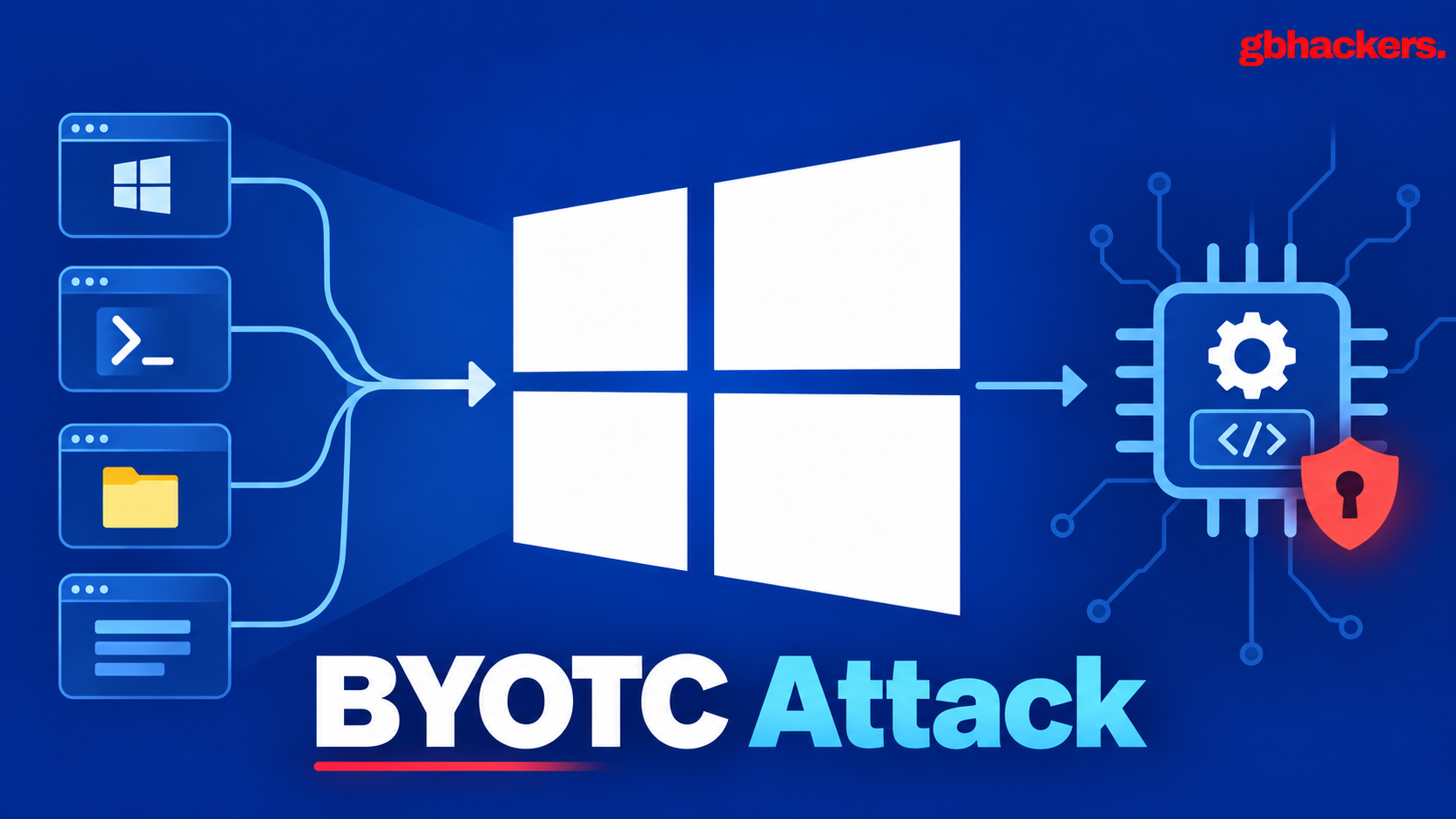
A newly documented Windows attack pattern, dubbed Bring Your Own Trusted Caller (BYOTC), shows how attackers can bypass driver-level authorization controls without exploiting a traditional memory-corruption flaw. Instead of attacking a privileged kernel driver directly, an adversary compromises or abuses the legitimate user-mode application that the driver already trusts. The technique expands on the well-known […]
The post BYOTC Attack Abuses Trusted Windows Clients to Access Privileged Kernel
A newly documented Windows attack pattern, dubbed Bring Your Own Trusted Caller (BYOTC), shows how attackers can bypass driver-level authorization controls without exploiting a traditional memory-corruption flaw. Instead of attacking a privileged kernel driver directly, an adversary compromises or abuses the legitimate user-mode application that the driver already trusts. The technique expands on the well-known […]
CrowdStrike has unveiled SafeMind, a family of purpose-built security models and harnesses that the company is calling the first agentic system engineered specifically for cyber defenders.
Announced at Fal.Con 2026 in Las Vegas, the launch marks a strategic pivot away from generic frontier AI models toward a dedicated offensive-defensive framework built to operate natively inside the CrowdStrike Falcon platform.
The system emerges from CrowdStrike’s newly established Cyber Superintelligenc
CrowdStrike has unveiled SafeMind, a family of purpose-built security models and harnesses that the company is calling the first agentic system engineered specifically for cyber defenders.
Announced at Fal.Con 2026 in Las Vegas, the launch marks a strategic pivot away from generic frontier AI models toward a dedicated offensive-defensive framework built to operate natively inside the CrowdStrike Falcon platform.
The system emerges from CrowdStrike’s newly established Cyber Superintelligence Lab and represents one of the most ambitious applications of agentic AI in enterprise security to date.
CrowdStrike Launches SafeMind
What sets SafeMind apart from conventional large language model deployments is its dual-model design. Red Tempest, the offensive component, is trained to emulate advanced AI-driven adversaries and probe for exploitable attack paths, while Blue Solano, the defensive counterpart, is built to close those gaps using battle-tested protection measures drawn from real-world incident response.
Rather than functioning as isolated tools, the two models operate inside harnesses that pit them against each other in a continuous, self-improving loop, allowing the system to sharpen its detection and remediation capabilities with every cycle.
Crucially, these harnesses are also compatible with other frontier and open-source models, giving security teams flexibility in model choice without sacrificing cost efficiency.
SafeMind’s differentiation lies heavily in its training foundation. The models were built using telemetry from CrowdStrike’s Falcon sensors, described as the largest pureplay cybersecurity dataset and edge install base in the industry, combined with threat intelligence, Falcon Complete managed detection and response annotations, and fifteen years of frontline incident response fieldwork.
This grounding in operational breach data, rather than generic internet-scale text corpora, is central to CrowdStrike’s argument that purpose-built security models outperform repurposed general-purpose AI systems in adversarial cyber scenarios.
CrowdStrike developed SafeMind in partnership with NVIDIA, using the NVIDIA Nemotron open model family as its foundation, while CoreWeave’s AI Cloud powers both training and inference workloads. NVIDIA CEO Jensen Huang framed the collaboration as part of a broader industry shift, noting that cyber defense is becoming one of the most compute-intensive applications of AI as attackers and defenders both race to scale their use of automated systems.
CrowdStrike CEO George Kurtz echoed that sentiment, stating that the future of cybersecurity “won’t be defined by AI that simply identifies threats, it will be defined by AI that defeats them”.
CrowdStrike’s internal evaluations claim SafeMind delivers a 29 percent higher detection rate than leading frontier and open-source models, along with six-times-faster end-to-end remediation and 99 percent cost savings on detection and remediation workflows.
Dr. Bartley Richardson, CrowdStrike’s chief AI and autonomous systems officer, described the launch as the foundation for the next decade of AI-driven security, emphasizing that CrowdStrike now controls the entire stack “from sensor to harness to model”.
Standalone access to SafeMind’s models and harnesses will roll out through CrowdStrike’s Project QuiltWorks program, offering trusted enterprise customers a pathway to integrate the agentic system beyond the native Falcon deployment.
As AI-enabled attacks continue to scale, SafeMind signals a broader industry move toward autonomous, closed-loop defense systems designed to act on risk rather than merely flag it, positioning CrowdStrike at the forefront of the agentic security race.
ASUS has issued an urgent security update for ASUS Control Center Enterprise (ACC) after researchers uncovered a maximum-severity vulnerability that lets remote attackers seize complete administrative control over the platform and every device it manages, without needing a password or any user interaction.
Tracked as CVE-2026-75754, the flaw carries a CVSS 4.0 score of 10.0, the highest possible rating, reflecting how easily it can be exploited over a network and the catastrophic scope of wha
ASUS has issued an urgent security update for ASUS Control Center Enterprise (ACC) after researchers uncovered a maximum-severity vulnerability that lets remote attackers seize complete administrative control over the platform and every device it manages, without needing a password or any user interaction.
Tracked as CVE-2026-75754, the flaw carries a CVSS 4.0 score of 10.0, the highest possible rating, reflecting how easily it can be exploited over a network and the catastrophic scope of what an attacker can achieve once inside.
ASUS Control Center Vulnerability
The vulnerability actually stems from a chain of three separate weaknesses working together. ASUS Control Center is missing authentication on a critical function, meaning certain sensitive operations can be triggered by anyone who can reach the service over the network.
That gap is compounded by a server-side request forgery flaw, which lets an attacker send a specially crafted HTTP request to trick the system into exposing its own encryption key. Once that key is retrieved, a local service on the host automatically enables an SSH listener on TCP port 2222, effectively opening a hidden backdoor into the machine.
The final piece of the chain is arguably the most damaging: ASUS Control Center contains hard-coded credentials baked into the software itself. Attackers who obtain the encryption key can use these fixed credentials to log directly into the newly opened SSH port and land a full root shell, the highest level of system access available on the machine.
From there, intruders can read, modify, or delete any data stored in ACC, and because the platform is designed to centrally manage fleets of servers, PCs, and workstations, a single compromised ACC instance can hand attackers remote control over an entire corporate IT environment.
The flaw affects all versions of ASUS Control Center Enterprise up to and including 4.0.0.2. ASUS is urging every organization running the software to update immediately to version 3.1.0.9 or later, and confirms further fix details are posted on its official Security Advisory page.
Enterprises unable to patch right away should isolate ACC management interfaces from public networks, block inbound and outbound traffic on port 2222, and audit hosts for unexpected SSH listeners as an interim safeguard.
Attackers are actively exploiting an unauthenticated remote access flaw in MikroTik RouterOS, and network administrators worldwide are being urged to patch their devices immediately before compromise turns into a full network takeover.
MikroTik confirmed on September 3, 2026, that it had discovered a serious security vulnerability affecting RouterOS and had already shipped fixes across every release channel, including 7.25 beta 3, 7.24.2 stable, 7.23.4 long-term, and 6.49.21 long-term.
The
Attackers are actively exploiting an unauthenticated remote access flaw in MikroTik RouterOS, and network administrators worldwide are being urged to patch their devices immediately before compromise turns into a full network takeover.
MikroTik confirmed on September 3, 2026, that it had discovered a serious security vulnerability affecting RouterOS and had already shipped fixes across every release channel, including 7.25 beta 3, 7.24.2 stable, 7.23.4 long-term, and 6.49.21 long-term.
The vendor deliberately withheld technical specifics in its initial advisory, stating plainly that it was “not currently publishing detailed information” in order to give administrators time to update before attackers could reverse-engineer the flaw from public disclosure.
Despite that caution, exploitation began almost immediately, and forum users and researchers quickly pieced together the attack mechanics on their own.
MikroTik RouterOS Vulnerability
According to detailed discussion on the official MikroTik support forum, the vulnerability lives inside a core library used by multiple RouterOS services, meaning any exposed service built on that codebase can be leveraged as an entry point.
One forum contributor who reverse-engineered the issue confirmed it is tied to SSH and grants any unauthenticated remote attacker direct shell access to the device, regardless of whether the router relies on password authentication or SSH key-based login.
In practical terms, if the SSH service is reachable from the internet or an untrusted network, the router is vulnerable until it receives the patch, with no additional credential theft or user interaction required.
Latvia’s national CERT issued its own alert corroborating a marked increase in attacker activity specifically targeting MikroTik routers, urging organizations and home users alike to update immediately to the patched builds MikroTik released. The agency’s guidance mirrored MikroTik’s own version list, reinforcing that the fix spans both the newer 7.x stable and legacy long-term branches.
Evidence of live exploitation surfaced quickly within the MikroTik user community. One administrator reported on Reddit that around September 2, 2026, at 08:00 UTC, an unauthorized user account named “ops” was created by another rogue account labeled “0,” granted both write and policy permissions, with the intrusion traced back to an SSH connection originating from the IP address 82.192.72.4.
The administrator noted that while the rogue account appeared to be used mainly for logging in and no obvious malicious scripts were visible in the configuration, the team suspected deeper compromise that RouterOS itself could not detect, ultimately requiring a full netinstall to guarantee the devices were clean.
RouterOS now includes a built-in detection mechanism to help flag this exact scenario. After upgrading, the operating system automatically inspects the full configuration at startup and sets a device to “Flagged” status if it finds signs of unauthorized tampering, logging a critical entry in the system log.
Devices in this state face operational restrictions, including a block on enabling new scheduler entries, SOCKS proxy, PPTP, L2TP, IPsec, proxy, and SMB configurations, until an administrator performs a manual audit.
MikroTik’s guidance is straightforward: if a device shows as flagged, assume it has been compromised, audit every configuration line, rotate all passwords, and only then clear the flagged state.
Even routers that never show a flagged status should not be considered safe by default; MikroTik and independent researchers both recommend manually reviewing configurations for unrecognized users, scripts, or scheduled tasks after updating, since some compromise artifacts may not trigger the automated detection.
Restricting SSH and other management interfaces from the public internet, enforcing key-based authentication, and limiting administrative access to trusted management networks remain essential complementary defenses while the patch rolls out fleet-wide.
Given the scale of MikroTik’s install base and the confirmed low barrier to exploitation, security teams should treat this as an urgent, internet-facing remote code execution scenario rather than a routine maintenance update.
Upgrading to 7.24.2, 7.23.4, or 6.49.21 (or later), auditing every device regardless of flagged status, and hardening remote management access should be treated as immediate priorities rather than items for the next maintenance window.
Market clutter and threat flux complicate picks. We rank 2026’s top 10: specs, perks, real impacts dissected.Prioritizing usability, relevance for CISOs, IT pros, scaling firms.
CISO, manager, or tech enthusiast find your Zero Trust match. Per-tool: intros, tables, specs, buy drivers, features—your 2026 blueprint.
Comparison Table: Top 10 ZTNA Solutions (2026)
Tool Name (with Homepage)
Free Version
Cloud Support
MFA
Device Posture Check
SSO
OpenVPN Cloud Connexa
Yes
Yes
Yes
Yes
Yes
Zscaler Private Access
No
Yes
Yes
Yes
Yes
Palo Alto Prisma Access
No
Yes
Yes
Yes
Yes
Cloudflare Zero Trust
Yes
Yes
Yes
Yes
Yes
Google BeyondCorp Enterprise
No
Yes
Yes
Yes
Yes
NordLayer ZTNA
Yes
Yes
Yes
Yes
Yes
Ivanti Neurons ZTNA
No
Yes
Yes
Yes
Yes
Appgate SDP
No
Yes
Yes
Yes
Yes
Twingate
No
Yes
Yes
Yes
Yes
Fortinet FortiClient ZTNA
Yes
Yes
Yes
Yes
Yes
1. OpenVPN Cloud Connexa
Best for: Small and mid-sized businesses that want Zero Trust Network Access without an enterprise budget or a bundled security suite.
OpenVPN’s CloudConnexa is a cloud-delivered ZTNA for SMB platform built on the open-source OpenVPN protocol. Rather than shipping ZTNA as one module inside a sprawling security stack, CloudConnexa combines identity-based, least-privilege application access with a globally distributed Wide-area Private Cloud (WPC) that links remote users, on-premises sites, and AWS, Azure, and GCP networks in a single service.
Users and private resources connect through encrypted outbound tunnels to CloudConnexa Regions, while Access Groups decide exactly which applications, hosts, and networks each user can reach. Because Connectors only establish outbound tunnels, private applications never require open inbound firewall ports or direct exposure to the public internet.
OpenVPN’s network security platforms provide secure remote access through both self-hosted and cloud-delivered VPN solutions for business, with the core tenets of Zero Trust Network Access at their center. Alongside the self-hosted Access Server, CloudConnexa helps teams securely reach company resources, SaaS platforms, the web, and data across cloud environments.
Why Do We Recommend It?
ZTNA without the suite lock-in. You can add Zero Trust access on its own, without committing to a full security platform, complex contracts, or opaque enterprise pricing.
Access control plus private networking in one service. Granular Zero Trust application access and a globally distributed WPC come together, so remote users, cloud VPCs/VNets, on-premises networks, and branch sites connect through the same fabric.
Outbound-only Connector architecture. Connectors open encrypted outbound tunnels, keeping private applications off the public internet with no inbound port forwarding.
Layered contextual access decisions. SAML SSO/MFA is combined with Device Posture, Location Context, and Device Identity Verification & Enforcement (DIVE) for context-aware policy enforcement.
Integrated threat protection. Cyber Shield adds DNS-based domain/content filtering and IDS/IPS traffic inspection within the same service rather than limiting the platform to access control alone.
Application domain-based routing and segmentation. Traffic can be routed by application domain, environments with overlapping IP ranges are supported, and networks are automatically segmented to limit lateral movement.
Key Features
Identity-based, least-privilege access – Access Groups restrict users to only the applications, IP services, hosts, and networks they are authorized to use, with a default-deny model under Custom WPC topology.
Device Posture Checking – Evaluates operating system and OS version, antivirus status, disk encryption, client certificate validity, and more, and can block noncompliant devices.
SAML SSO and MFA – Integrates with SAML 2.0 identity providers such as Microsoft Entra ID, Okta, OneLogin, Google Workspace, and Keycloak; built-in TOTP 2FA is available for username/password and LDAP authentication.
Device Identity (DIVE) – Adds device-level identity verification and enforcement to every access decision.
Location Context – Applies geographic and location-based conditions to access policies.
Cyber Shield – DNS-based domain/content filtering plus IDS/IPS detection and blocking of malware, intrusion activity, and denial-of-service traffic, with policies based on threat category or severity.
SCIM 2.0 provisioning – Automated user and group provisioning with documented examples for Okta, Microsoft Entra ID, JumpCloud, and OneLogin, alongside private LDAP support for directory-based authentication and group mapping.
Deployment and Platform Support
Delivery model: Cloud-delivered ZTNA service built around a globally distributed WPC with CloudConnexa Regions.
Deployment options: Cloud, on-premises, and hybrid. Connectors (or IPsec where applicable) link AWS VPCs, Azure VNets, GCP VPCs, and on-premises networks into the WPC.
Supported devices: Windows, macOS, iOS, and Android via OpenVPN Connect; Linux via the supported open-source OpenVPN client.
Integrations: SAML SSO, SCIM 2.0, private LDAP, APIs and session data for external monitoring and security workflows, and device-posture checks for several EDR/antivirus products.
Primary Use Cases
Secure remote and hybrid-work access for employees and contractors without exposing the underlying network.
Secure access to cloud applications and workloads across AWS, Azure, GCP, and other environments.
Hybrid and multi-cloud connectivity between on-premises sites, private networks, cloud networks, and remote users.
Application-level access and network segmentation to reduce lateral movement.
Context-aware access for managed endpoints using Device Posture, DIVE, and Location Context.
Threat-protected private access with Cyber Shield DNS filtering and IDS/IPS.
Who Is It Best Suited For?
CloudConnexa is designed for small and medium-sized businesses that want scalable Zero Trust security without significant infrastructure or management overhead, but it also supports larger organizations with distributed, hybrid, or multi-cloud environments.
It is particularly relevant for technology, professional services, healthcare, financial services, retail, and other regulated or distributed organizations that need secure remote access, segmentation, and auditability. Its audit logs support compliance requirements such as GDPR, HIPAA, and PCI-DSS.
Comparison Table
Capability
CloudConnexa
Free version or trial
Yes – 14-day free trial, plus an always-free Starter plan (up to 5 seats, with some limitations)
Cloud deployment
Yes – Connect AWS VPCs, Azure VNets, and GCP VPCs via Connectors or IPsec
Multi-factor authentication
Yes – Built-in TOTP 2FA, or MFA via SAML IdPs (Microsoft Entra ID, Okta, OneLogin)
Device-posture checking
Yes – OS/version, antivirus, disk encryption, client certificate validation, and more
Single sign-on
Yes – SAML 2.0
Pricing
CloudConnexa uses seat-based pricing, where each activated user or Connector consumes a seat.
Free Starter plan and 14-day trial make evaluation low-risk.
What Could Be Better?
End-user access relies on the OpenVPN Connect client (open-source OpenVPN client on Linux); there is no agentless, browser-only option.
Device Posture checks vary by operating system and client, so organizations should confirm their required endpoint controls are supported.
Built-in TOTP 2FA applies to native and LDAP authentication only; with SAML SSO, MFA is handled by the identity provider.
ZTNA is delivered as part of a broader WPC/private-networking model, which may not suit buyers looking solely for an application-proxy-style ZTNA product.
Some advanced capabilities depend on subscription tier, so buyers should verify current plan entitlements.
Verdict
For SMBs that want to adopt Zero Trust principles without buying an entire security suite, OpenVPN CloudConnexa offers one of the most accessible paths available. It pairs granular, identity-driven access control with hybrid and multi-cloud connectivity, layers on device and location context, and includes Cyber Shield threat protection, all under straightforward seat-based pricing that starts free.
Continuous verification of user and device context
Seamless integration with IAM and endpoint solutions
High scalability for global organizations
Features
Application segmentation and least-privilege enforcement
Inline SSL inspection and advanced threat prevention
Continuous monitoring and policy adjustment
Supports hybrid and multi-cloud environments
Best For: Large organizations needing cloud-native, scalable Zero Trust access.
3. Palo Alto Prisma Access
Palo Alto Prisma Access delivers a comprehensive ZTNA solution as part of its SASE platform.
It secures remote and on-site users with consistent policies, advanced threat prevention, and real-time visibility into network traffic.
Prisma Access supports hybrid workforces and integrates with cloud, SaaS, and on-premises applications.
The platform offers autonomous digital experience management (ADEM), giving IT teams insights and remediation capabilities for end-user connectivity and security issues.
Its ZTNA 2.0 approach addresses modern attack surfaces and operational complexity.
Specifications
ZTNA Version: 2.0
Deployment: Cloud, Hybrid
Employee Size: Scalable for enterprises
Integration: SIEM, IAM, EDR
Policy Management: Centralized, Autonomous
Reason to Buy
Advanced threat prevention and policy enforcement
Autonomous experience management for end-users
Consistent security across cloud, SaaS, and on-premises
Scalable for large, distributed organizations
Features
ZTNA 2.0 for hybrid work and direct-to-app architectures
Real-time traffic visibility and autonomous remediation
Application and data protection with microsegmentation
Integration with advanced analytics and threat intelligence
Best For: Enterprises seeking advanced, autonomous Zero Trust with SASE integration.
4. Cloudflare Zero Trust
Cloudflare Zero Trust provides secure, fast, and reliable access to internal applications without a VPN.
Its platform is designed for ease of deployment and management, supporting identity-based policies, device posture checks, and robust threat intelligence.
Cloudflare’s global network ensures low latency and high availability.
The solution integrates with major identity providers, supports multi-factor authentication, and offers a free tier for small teams.
Cloudflare’s unified dashboard simplifies policy management and monitoring.
Specifications
Free Version: Yes
Deployment: Cloud
Supported Devices: Windows, macOS, Linux, Mobile
Integration: SSO, IAM, EDR
Pricing: Starts at $7/user/month
Reason to Buy
Rapid deployment and easy management
Global network for low-latency access
Free tier for small teams and startups
Strong integration with identity and endpoint security
Features
Identity-based access controls and device posture checks
Real-time threat intelligence and monitoring
Multi-factor authentication and SSO support
Unified dashboard for policy and user management
Best For: Organizations needing fast, easy-to-manage Zero Trust with global reach.
5. Google BeyondCorp Enterprise
Google BeyondCorp Enterprise brings Zero Trust to the cloud, enabling secure access to applications from any device, anywhere.
The platform leverages Google’s robust infrastructure, offering identity-aware proxies, device security checks, and continuous monitoring.
BeyondCorp supports granular access policies and integrates with Google Workspace and third-party identity providers.
The solution is suitable for organizations embracing cloud-first strategies and seeking seamless integration with Google services.
Specifications
Free Version: Yes
Deployment: Cloud-native
Supported Devices: Any (browser-based)
Integration: Google Workspace, SSO, IAM
Policy Controls: Granular, Identity-based
Reason to Buy
Seamless integration with Google cloud services
Browser-based access for any device
Continuous monitoring and device security checks
Granular, identity-aware access policies
Features
Identity-aware proxy for secure application access
Real-time device posture and risk assessment
Integration with Google Workspace and third-party IAM
Scalable for organizations of any size
Best For: Organizations leveraging Google Cloud and Workspace for Zero Trust.
6. NordLayer ZTNA
NordLayer ZTNA is designed for businesses looking for easy-to-use, scalable Zero Trust solutions.
The platform offers centralized management, multi-factor authentication, and device posture checks, with support for cloud and on-premises environments.
NordLayer’s intuitive interface and affordable pricing make it accessible for SMBs and enterprises alike.
NordLayer integrates with major identity providers and supports secure remote access for distributed teams.
Specifications
Pricing: Starts at $11/user/month
Deployment: Cloud, On-premises
Supported Devices: Windows, macOS, Linux, Mobile
Integration: SSO, MFA, IAM
Management: Centralized
Reason to Buy
Affordable and scalable for all business sizes
Easy deployment and intuitive management
Strong authentication and device security
Supports remote and hybrid workforces
Features
Centralized dashboard for user and policy management
Multi-factor authentication and device posture checks
Integration with identity providers and cloud platforms
Real-time monitoring and reporting
Best For: SMBs and enterprises needing affordable, easy-to-manage Zero Trust.
7. Ivanti Neurons ZTNA
Ivanti Neurons ZTNA focuses on secure remote access and user experience, supporting a wide range of devices and operating systems.
The platform emphasizes compliance and detailed reporting, making it suitable for regulated industries and organizations with diverse device fleets.
Ivanti’s solution integrates with existing security infrastructure, providing centralized management, policy enforcement, and real-time monitoring.
Specifications
Deployment: Cloud, On-premises
Supported Devices: Windows, macOS, iOS, Android
Compliance: Detailed reporting and auditing
Integration: IAM, EDR, SIEM
Policy Management: Centralized
Reason to Buy
Comprehensive remote access for all device types
Strong compliance and reporting capabilities
Integration with existing security tools
Centralized management and policy enforcement
Features
Secure access for hybrid and remote workforces
Detailed compliance and audit reporting
Real-time monitoring and threat detection
Flexible deployment and integration options
Best For: Organizations with diverse devices and strict compliance needs.
8. Appgate SDP
Appgate SDP delivers identity-centric ZTNA using a software-defined perimeter model.
It evaluates user and device context before establishing encrypted, one-to-one network connections.
The platform supports dynamic entitlements, real-time decisioning, and integration with SIEM, IAM, and EDR tools.
Appgate is designed for hybrid and multi-cloud deployments, offering granular policy controls and comprehensive visibility into network activity.
Specifications
ZTNA Model: Software-defined perimeter
Deployment: Cloud, On-premises, Hybrid
Integration: SIEM, IAM, EDR
Policy Controls: Identity and context-based
Encryption: End-to-end
Reason to Buy
Identity-centric access with dynamic policies
Support for hybrid and multi-cloud environments
Real-time monitoring and decision making
Comprehensive integration with security tools
Features
Encrypted, one-to-one network connections
Dynamic entitlements and policy enforcement
Real-time visibility into user and device activity
Scalable for complex enterprise environments
Best For: Enterprises requiring granular, identity-driven Zero Trust in hybrid environments.
9. Twingate
Twingate offers a modern, cloud-native ZTNA solution that replaces traditional VPNs with identity-based, per-application access controls.
It is designed for rapid deployment, requiring no changes to network infrastructure. Twingate integrates with SSO, MFA, and endpoint security, providing granular access policies and robust encryption.
The platform is suitable for both hybrid and cloud environments, with a user-friendly interface and support for Windows, macOS, Linux, and mobile devices.
Specifications
Free Version: Yes
Deployment: Cloud-native
Supported Devices: Windows, macOS, Linux, Mobile
Integration: SSO, MFA, EDR
Pricing: Starts at $5/user/month
Reason to Buy
Easy, rapid deployment with minimal configuration
Granular, identity-based access controls
Strong encryption and device authentication
Flexible for hybrid and multi-cloud environments
Features
Per-application access and least-privilege enforcement
Seamless integration with identity and endpoint solutions
Traffic encryption and compliance-ready auditing
Cross-platform support for diverse teams
Best For: Teams seeking a fast, flexible, and user-friendly ZTNA alternative to VPNs.
10. Fortinet FortiClient ZTNA
Fortinet FortiClient ZTNA integrates endpoint security with Zero Trust access, providing protection for devices and network resources.
Its zero trust agent supports multi-factor authentication, device posture checks, and split-tunneling for optimized user experience.
Centralized management via EMS or FortiClient Cloud enables streamlined deployment and real-time endpoint status.
FortiClient is ideal for organizations already invested in the Fortinet Security Fabric, offering seamless integration with FortiGate firewalls and FortiSandbox.
Specifications
ZTNA Agent: Yes
Deployment: Cloud, On-premises
Integration: Fortinet Security Fabric
Central Management: EMS, FortiClient Cloud
Web Filtering: Yes
Reason to Buy
Deep integration with Fortinet ecosystem
Centralized management and reporting
Advanced endpoint and network protection
Supports split-tunneling and web filtering
Features
Multi-factor authentication and device posture checks
Real-time endpoint monitoring and upgrades
Centralized logging for compliance and security analysis
Flexible deployment options for diverse environments
Best For: Organizations using Fortinet products seeking integrated Zero Trust.
Conclusion
ZTNA has surged essential amid remote shifts, cloud leaps, and threat twists.
Reviewed platforms from Check Point’s all-in-one guard to Google’s BeyondCorp cloud magic scale Zero Trust to fit any operation.
Vet choices by size, regs, stack synergy, and expansion horizon. Prime picks lock data/apps while unleashing anywhere-productivity.
ZTNA transcends upgrades: it’s resilience, compliance, and transformation fuel. Navigate to 2026’s best with this roadmap forge a tougher, sharper, nimbler enterprise.

 Entrar