Researchers detected the Dark Caracal GoCaracal malware in South America. Learn how this GoCaracal malware uses Ethereum smart contracts.
Related Posts:
Cambodia Malware Campaign Uses PNG Files to Deliver SparkRAT
BREEZE COMET Threat Actor Attacks Brazilian Banks
AnonyMousKIT Uses AI Voice Calls to Unlock Stolen iPhones
The post Dark Caracal Deploys New GoCaracal Malware Framework appeared first on Daily CyberSecurity.
SilkParasite APT ran China-nexus cyberespionage across Central Asia, using 7 custom RATs, DLL sideloading, and AI-assisted malware.
Related Posts:
FBI Seizes QScan and QTRouter Platforms Run by China State Hackers
Operation CameraSwarm: 14,500 Dahua Cameras Compromised Across Ukraine and Russia
Core Werewolf Deploys New CoreRAT Malware Against Russian Targets
The post SilkParasite APT Hits Central Asian Governments With 7 RATs appeared first on Daily CyberSecurity.
CoreRAT malware powers Core Werewolf attacks on Russian defense and government targets, using fake military PDFs and Telegram phishing.
Related Posts:
Balonx Sistema: Mexican PhaaS Adds AI Vishing and RAT
StopAndProtect Malware Turns Hacked WordPress Sites Into a Botnet
Cisco Talos Exposes UAT-10147 Agentic AI Attacks
The post Core Werewolf Deploys New CoreRAT Malware Against Russian Targets appeared first on Daily CyberSecurity.
Google tracks three Russia-linked espionage clusters using phishing and legitimate authentication tools to target researchers, diplomats and defense staff.
Google’s Threat Intelligence Group tracked three separate suspected Russia-linked cyber espionage clusters. All three focus on the same thing: abusing authentication features that are supposed to protect accounts to access them instead.
Threat actors target researchers, academics, government officials, think-tank analysts, and defense
Google tracks three Russia-linked espionage clusters using phishing and legitimate authentication tools to target researchers, diplomats and defense staff.
Google’s Threat Intelligence Group tracked three separate suspected Russia-linked cyber espionage clusters. All three focus on the same thing: abusing authentication features that are supposed to protect accounts to access them instead.
Threat actors target researchers, academics, government officials, think-tank analysts, and defense sector personnel across Europe and the United States. The three clusters are tracked as UNC6293, UNC7005, and UNC5976, and while they operate differently and with different tools, Google published them together for a reason.
“These clusters engage in persistent, adaptive phishing campaigns, using sophisticated social engineering tactics to compromise personal accounts across multiple platforms.” reads the report published by GTIG. “Because these operations abuse legitimate authentication flows which may not immediately seem like phishing attempts to users, GTIG is raising awareness about these social engineering campaigns targeting individuals so that targets can more readily recognize malicious outreach.”
UNC6293 is the oldest of the three and the most precisely attributed. Google assesses with moderate confidence that it’s a sub-cluster of ICE RELIC, the group also tracked as APT29, responsible for initial access operations.
Its operations are narrow by design: typically fewer than five targets at a time, with themes built around diplomatic events and upcoming conferences. Since it was first documented in June 2025, UNC6293 has consistently impersonated US State Department officials to run app password phishing. The technique is simple but effective. The attacker convinces a target to set a specific app password on their account, one that the attacker already knows, and then uses it to log in without triggering two-factor authentication.
By October 2025, UNC6293 was still reusing screenshots from its June phishing lures, including the ms.state.gov reference, while only changing the surrounding text. By June 2026, the group had added OAuth phishing. After logging in to a legitimate service, victims were asked to share a URL or “verification code,” allowing attackers to obtain valid access tokens. The trick works because the login itself is legitimate, while the attackers hide the malicious step elsewhere.
UNC7005, tracked by Microsoft as STORM-2945, is a related but separate cluster first identified in February 2026. Google assesses it’s also connected to ICE RELIC, but notes it operates with lower technical sophistication and worse operational security than UNC6293. It compensates with a wider toolkit. UNC7005 runs app password phishing, device code phishing against both Microsoft and WhatsApp, malware distribution, and OAuth phishing operations, sometimes in the same month.
“UNC7005 also conducts device code phishing operations for both Microsoft and WhatsApp accounts.” continues the report. “The themes of these phishing waves often involve invitations for calls with individuals from notable organizations related to the target’s field or, most recently, invitations to diplomatic events and conferences. “
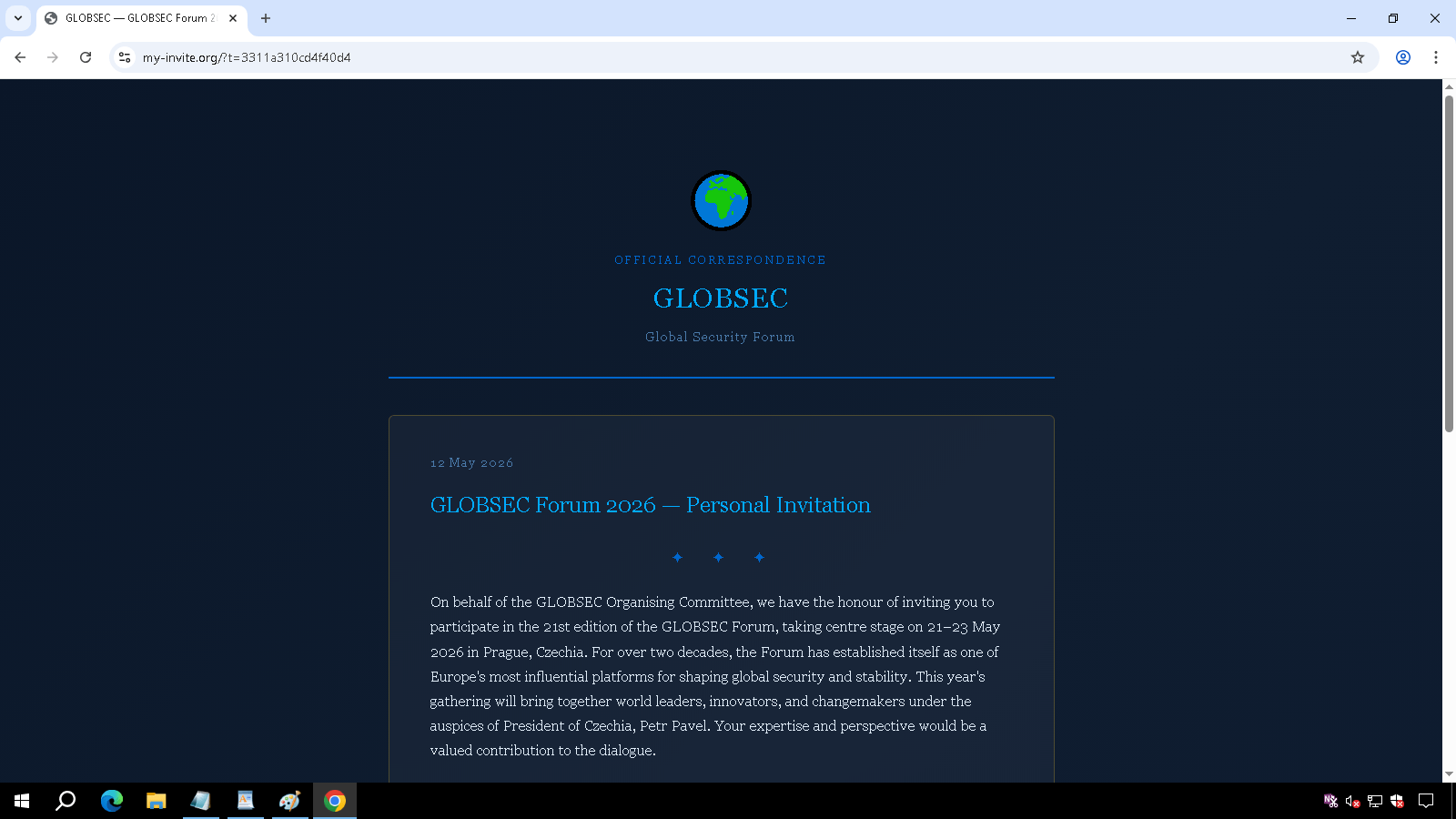
The GLOBSEC conference spoof is a useful illustration of how UNC7005 works. The actor built a landing page mimicking an invitation to the legitimate GLOBSEC forum in May 2026, collected detailed registration information from targets including, not for the first time in ICE RELIC-linked operations, a wine selection for a fictional dinner, and then presented a Microsoft device code for the target to enter. The registration form still contained a reference to “Embassy security policy” rather than GLOBSEC, a leftover from the previous lure template that the actor hadn’t cleaned up. When Google flagged the page quickly, UNC7005 revised the template within days, citing “technical difficulties” to explain the change to anyone still watching.
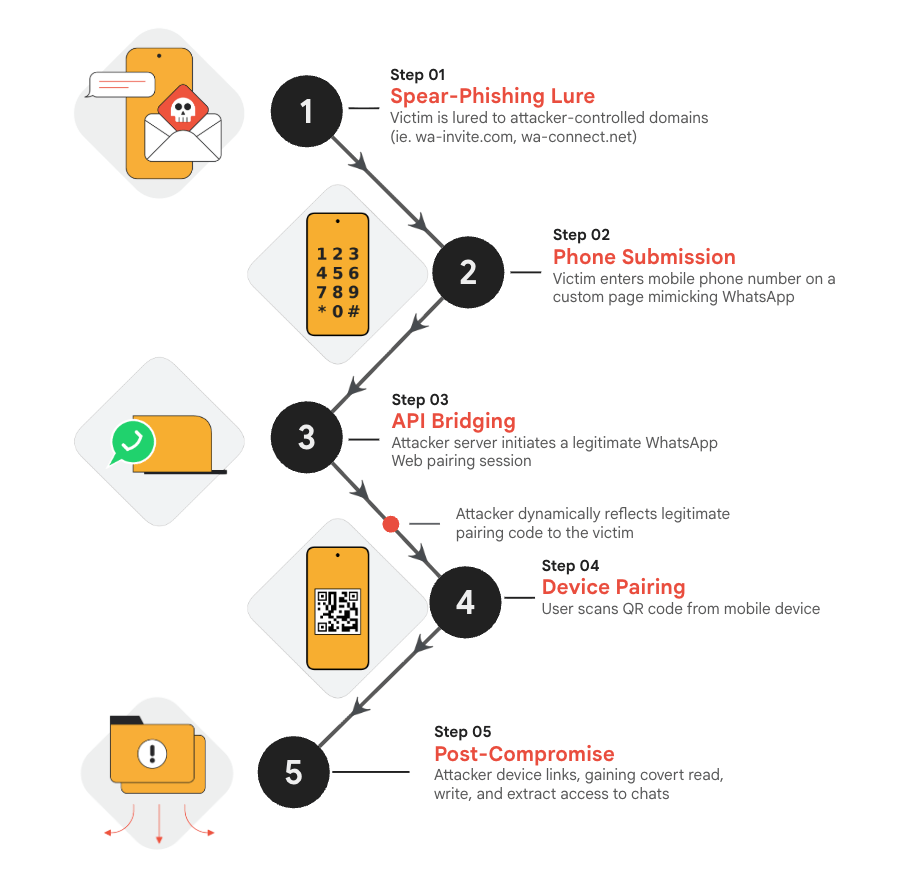
UNC7005 also used WhatsApp phishing pages to trick victims into linking their accounts to an attacker-controlled device. The fake pages offered options such as joining a call, opening an encrypted chat or downloading a file. If victims chose the call option, malicious JavaScript asked for microphone and camera access, recorded them, and sent the footage to the attackers.
In late May 2026, UNC7005 ran a broader phishing wave targeting US-based academics, diplomats, and Russia researchers. The lure was a fake “Summit Companion App” to read a document supporting Ukraine.
“In May and June 2026, UNC7005 conducted social engineering operations spoofing WhatsApp. The phishing pages distributed by the attacker lure targets into linking their WhatsApp accounts with an attacker controlled device in order to join a secure WhatsApp call, chat, or document share.” states the report. “The attacker also attempts multiple other methods of compromise after the device is linked.”
Windows users who downloaded it received VIDAR, an off-the-shelf infostealer sold as a service that pulls saved credentials, cookies, and payment data from browsers. Mac users received ATOMIC, also known as AtomicStealer, a macOS infostealer operating the same business model. Neither is custom tooling. The actor’s email address in this operation was nearly identical to one used by UNC6293 a year earlier.
The hospitality captive portal campaign, previously reported by Reliaquest and Microsoft and attributed to Midnight Blizzard, connects directly to UNC7005. Google traces the infrastructure back to April 2026: domains spoofing Microsoft authentication resources, which Google added to Safe Browsing blocklists as they appeared. By mid-July 2026, those same domains were receiving redirects from captive portals at hotels and conference centers. The IP resolution trail links the captive portal infrastructure to the GLOBSEC device code phishing operation and to ENGINELIGHT, a Go-based malware used in a separate limited UNC7005 operation in May 2026.
CHERRYPIE, also known as ChocoShell, is a PowerShell infostealer that adds another interesting detail. Google found comments and code references that appear consistent with AI-generated code, suggesting the attackers may be using an LLM to develop malware. The data it targets overlaps with the commercial infostealers already used by UNC7005, leading Google to suspect that CHERRYPIE could be a customized version of a malware-as-a-service tool.
UNC5976 is the third cluster and the most distinct. It focuses on military, aerospace, defense industrial base, and NGO targets, concentrating geographically on Ukraine and Armenia. Instead of residential proxies for post-compromise access, as UNC6293 and UNC7005 use, it runs dedicated infrastructure. Its OAuth phishing is more automated: the actor registers file-sharing-themed domains, creates Google Cloud projects behind them, and uses cloud-hosted scripts to collect authentication tokens from targets who log in through what looks like a Google sign-in prompt on a fake file-sharing page. Within three months of Google disrupting this infrastructure, UNC5976 had built at least twelve new domains and was already migrating toward non-Google hosting providers.
In April 2026, UNC5976 also distributed HEADRUSH, a malicious Excel plugin, through a domain impersonating a Ukrainian research institute, potentially targeting a Ukrainian aerospace and imaging company. HEADRUSH eventually leads to an HTA downloader, though Google wasn’t able to recover the full infection chain.
The defender challenge that runs through all three clusters is the same one Google names directly.
” The accounts these groups target are often personal, rather than corporate domain-joined accounts, creating a visibility gap for monitoring compromise from an organizational perspective. The likely use of encrypted messenger applications instead of email for initial outreach also presents a challenge to defenders hoping to track and remediate abuse.” concludes the report. “The combination of these tactics not only enables the attacker to conduct quick-turnaround exfiltration operations, but also presents opportunities for the attacker to further phish targets of interest from compromised, legitimate accounts. “
Security teams watching corporate email and endpoint telemetry won’t see the initial contact. By the time a compromised personal account starts being used to phish the target’s contacts, the original access event is already cold.
Google’s practical guidance for individuals: don’t set app passwords for anyone who asks, revoke existing ones you don’t recognize, check WhatsApp’s linked devices list, and treat any OAuth authorization prompt from an unsolicited message as suspicious regardless of how polished the surrounding page looks. High-risk individuals should consider Google’s Advanced Protection Program, which blocks app password creation entirely.
Kaspersky uncovered the Armored Likho Still Toolkit. Read our Armored Likho Still Toolkit analysis to explore the Telegram stealer and audio spying tools.
Related Posts:
PATCHCORD Malware Hits Afghan Telecom in New APT36 Campaign
HoneyMyte CoolClient Rootkit Deploys Kernel Driver
DOJ Charges 17 Iranians in Mabna Institute Cyber Theft
The post Armored Likho Still Toolkit Deploys Covert Spying Implants appeared first on Daily CyberSecurity.
Kaspersky uncovered the Armored Likho Still Toolkit. Read our Armored Likho Still Toolkit analysis to explore the Telegram stealer and audio spying tools.
Microsoft says Russian hackers hijacked hotel Wi-Fi portals to spread malware and steal Microsoft 365 tokens from travelers.
Microsoft Threat Intelligence disclosed CaptiveCrunch, a campaign it attributes to Storm-2945, an operational sub-cluster of Midnight Blizzard, the Russian SVR-linked group also known as APT29 and Cozy Bear. Since early May 2026, Storm-2945 has been manipulating DNS and HTTP traffic on captive portal networks at hotels, conference centers, and shared venues worldwide t
Microsoft says Russian hackers hijacked hotel Wi-Fi portals to spread malware and steal Microsoft 365 tokens from travelers.
Microsoft Threat Intelligence disclosed CaptiveCrunch, a campaign it attributes to Storm-2945, an operational sub-cluster of Midnight Blizzard, the Russian SVR-linked group also known as APT29 and Cozy Bear. Since early May 2026, Storm-2945 has been manipulating DNS and HTTP traffic on captive portal networks at hotels, conference centers, and shared venues worldwide to redirect guests toward malware and credential theft operations. If you connected to hotel Wi-Fi while traveling in the past few months, this report is worth reading carefully.
“Since early May 2026, Microsoft Threat Intelligence has observed Storm-2945 manipulating DNS and HTTP traffic from networks served by captive portals to redirect user traffic through actor-controlled infrastructure.” reads the report published by Microsoft. “To date, Microsoft has identified widespread compromise of Wi-Fi networks at hospitality-related organizations and other networks serviced by captive portal equipment in several countries. ReliaQuest has identified this activity not only at hotels, but also conference centers and other shared venues, and assesses that the goal of this activity is to access the accounts of corporate travelers.”
That last point matters: the shared infrastructure patterns suggest this may not be a series of individual venue compromises but rather access to something shared across portions of the captive portal ecosystem. Microsoft hasn’t named any provider.
The malware delivered through these networks is CornFlake, a full-featured Windows remote access trojan written in Go.
“CornFlake registers as a Windows service named svchost32 with the display name “Cloud Sync Service” and description “Synchronizes files with the cloud storage provider”, deliberately mimicking the legitimate svchost.exe process.” continues the report. “It establishes redundant persistence mechanisms: Windows service registrations, Registry Run keys, named scheduled tasks, and a persistence watchdog routine that runs continuously to restore any persistence mechanism that is removed by defenders or endpoint protection.”
CornFlake establishes an encrypted C2 channel using ECDH P-256 key exchange and supports dynamic reconfiguration without redeployment. Once installed, the RAT can log keystrokes, monitor the clipboard, capture screenshots, audio and webcam feeds, steal browser credentials, exfiltrate files, monitor USB devices, collect detailed system information, and execute remote commands. It also exposes a local HTTP API, allowing companion malware such as ChocoShell to reuse its secure C2 channel for file theft, configuration updates, and connectivity checks.
“For command and control (C2), CornFlake performs an Elliptic Curve Diffie-Hellman (ECDH) P-256 ephemeral key exchange with the C2 server, derives a session key via SHA-256, and communicates over a custom JSON protocol framed within the encrypted channel.” states the report. “This provides an encrypted channel to the C2 server, with each C2 session using a unique ephemeral key, making decryption of captured traffic impossible without the session-specific private key. “
Each C2 session uses a unique ephemeral key, which means captured traffic can’t be decrypted without that session’s private key. The malware also supports a runtime configuration file that lets the attacker reconfigure C2 servers and targeting without redeploying the implant.
CornFlake is delivered via ClickFix-style pages that impersonate Windows Update screens, Google verification pages, DirectX installers, browser update prompts, and disk optimization utilities — whatever looks most plausible for the venue. The victim still has to execute the payload, but the captive portal controls exactly what they see when they try to connect. Microsoft also found indications that Storm-2945 may be targeting Android devices through the same landing pages, which include instructions to download and install an APK.
The second tool, ChocoShell, is a PowerShell infostealer that runs entirely in memory. Its primary target is credentials.
“ChocoShell collects Microsoft 365 and Azure Active Directory (AD) access tokens, refresh tokens, and Web Account Manager (WAM) tokens from .tbres files in the Token Broker cache. Collection of these tokens represents a significant threat to enterprise environments, as threat actors could replay SSO sessions without browser cookies.” states Microsoft. “Additionally, Wi-Fi credentials are harvested via netsh wlan show profile with key=clear.”
ChocoShell also implements three silent UAC bypass techniques with ordered fallback, disables Windows Defender signature updates, and uses Chrome DevTools Protocol to extract browser cookies by launching the browser with a remote debugging port. This technique bypasses Chrome’s App-Bound Encryption entirely.
Since July 16, some CaptiveCrunch landing pages have added device code phishing to the mix, redirecting guests into Microsoft’s legitimate device code authentication flow. The attacker initiates the authentication request and presents the user with a code to enter at Microsoft’s real sign-in page. When the user enters it, they authenticate the attacker’s session instead of their own — an MFA-satisfied session, since the user just completed the factor. Microsoft recommends blocking the device code flow through Conditional Access policies everywhere it isn’t explicitly required.
Researchers also detailed FruitStone, the web-based C2 panel used by Storm-2945 operators to manage the CaptiveCrunch campaign. It provides a centralized interface to control CornFlake implants, deploy payloads, collect stolen data, and manage compromised devices. Disguised as a legitimate “CloudSync Console,” it supports multi-operator access, agent monitoring, remote commands, file theft, credential collection, configuration updates, and campaign infrastructure management.
The practical advice for travelers is blunt: treat hotel, conference, and airport Wi-Fi as hostile. Use a mobile hotspot or cellular data instead wherever possible. Don’t download or execute anything a captive portal presents as an update, certificate, troubleshooting tool, or security utility. Don’t enter corporate credentials on venue registration pages. And if your organization hasn’t already blocked device code flow in Conditional Access, now is a reasonable time to check.
Recently, ReliaQuest’s threat research team also documented attackers compromising the Wi-Fi gateways at hotels and conference centers, then quietly rerouting guests toward fake Microsoft login pages.
There’s a pattern connecting all this to previous campaigns. The tradecraft echoes a Russian-linked operation called FrostArmada, which hit home routers the same way earlier this year, and researchers tie both to the group known as APT28 (aka UAC-0001, aka Fancy Bear, Pawn Storm, Sofacy Group, Sednit, BlueDelta, and STRONTIUM). The link isn’t a smoking gun; it’s shared technique, not shared infrastructure, and the researchers say so plainly.
In this article
The CaptiveCrunch campaignStorm-2945 and Midnight BlizzardCaptiveCrunch tradecraft and toolingHow to protect against CaptiveCrunch activityMicrosoft Defender detections and hunting guidanceIndicators of compromise
Since early May 2026, Microsoft Threat Intelligence has observed Storm-2945, a sub-cluster of Midnight Blizzard, conducting widespread but targeted traffic manipulation attacks involving hospitality sector networks served by captiv
Since early May 2026, Microsoft Threat Intelligence has observed Storm-2945, a sub-cluster of Midnight Blizzard, conducting widespread but targeted traffic manipulation attacks involving hospitality sector networks served by captive portals worldwide. Despite some tactic, technique, and procedure (TTP) similarities to the Forest Blizzard DNS hijacking operation that we publicly disclosed in April 2026, we attribute this campaign, which we call CaptiveCrunch, to Storm-2945. As reported by ReliaQuest on July 23, a portion of this activity leverages doppelganger domains mimicking Microsoft online services to conduct follow-on adversary-in-the-middle (AitM) phishing operations that abuse the device code authentication flow in Microsoft Entra ID. Microsoft Threat Intelligence has also identified active traffic manipulation attacks leading to the delivery of malware on impacted systems. Microsoft has observed Storm-2945 leveraging AI to support a significant portion of these operations.
Today, we are sharing our findings on these ongoing intrusions to raise awareness of this threat and enable customers to protect their devices, especially while traveling. We provide our assessment of Storm-2945’s relationship to Midnight Blizzard and analysis of the CaptiveCrunch campaign, detailing the malware and tradecraft used in these operations. We also provide mitigation, detection, and hunting guidance to help organizations identify and defend against Storm-2945 and related activity.
Microsoft Threat Intelligence would like to thank our partners at Anthropic and OpenAI for their collaboration and support during this investigation.
The CaptiveCrunch campaign
Since February 2026, Storm-2945 has conducted AI-augmented operations including targeted device code and OAuth code phishing campaigns leading to Entra device registration and subsequent data collection from Microsoft 365. Since early May 2026, Microsoft Threat Intelligence has observed Storm-2945 manipulating DNS and HTTP traffic from networks served by captive portals to redirect user traffic through actor-controlled infrastructure. Although our investigation into the initial compromise vector for the captive portal networks is ongoing, we have observed notable commonalities in the equipment and management systems used across multiple affected networks. These similarities suggest that the activity might not be limited to isolated compromises of individual venues and could reflect access to shared services within portions of the captive portal ecosystem.
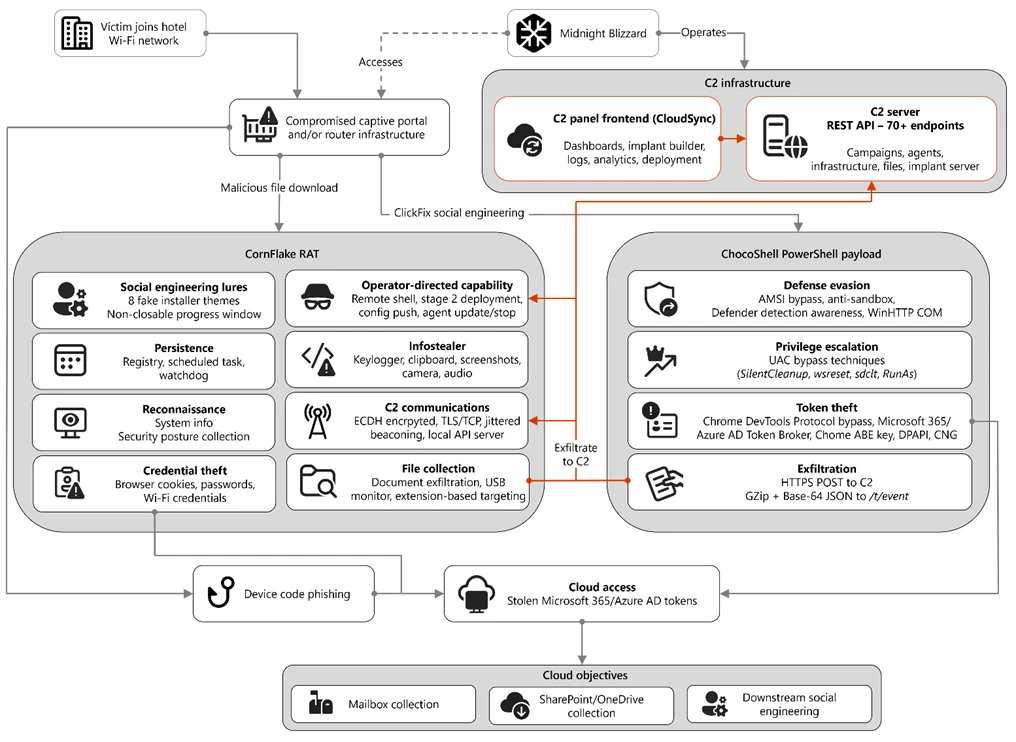
Figure 1. Overview of the CaptiveCrunch attack flow
As part of the CaptiveCrunch campaign, Storm-2945 has leveraged their AitM position to redirect users through actor-controlled phishing infrastructure and has also delivered malware purporting to be browser or operating system updates in response to automated connectivity checks issued by users’ browsers. Multiple variants have been delivered, including fully-featured Windows remote access trojans (RAT) in compiled Golang, with functionality to conduct system enumeration, collect files and keystrokes, steal credentials and session tokens, conduct audio and video surveillance, monitor for removable media, and provide the threat actor a remote shell on infected systems.
The threat actor infrastructure leverages a variety of ClickFix techniques to elicit the user into downloading and executing the malware:
Figure 2. ClickFix prompt with manual user instructionsFigure 3. ClickFix prompt with additional user instructions after verification failure
In addition to variants of malware targeting Windows systems, Microsoft Threat Intelligence is also aware of indications that the threat actor might be targeting Android devices with similar techniques as the ClickFix landings also include instructions for Android devices to download and install an APK file.
To date, Microsoft has identified widespread compromise of Wi-Fi networks at hospitality-related organizations and other networks serviced by captive portal equipment in several countries. ReliaQuest has identified this activity not only at hotels, but also conference centers and other shared venues, and assesses that the goal of this activity is to access the accounts of corporate travelers.
Storm-2945 and Midnight Blizzard
Microsoft Threat Intelligence assesses that Storm-2945 is an operational sub-cluster of Midnight Blizzard based on distinctive technical and operational overlaps. These include technical similarities to Storm-2372, a Midnight Blizzard initial access operations sub-cluster, also notable for their device code and OAuth code phishing operations tracked throughout 2025, Microsoft Graph-based email exfiltration, social engineering delivered via commercial messaging apps, and significant similarities in victimology.
Midnight Blizzard is a Russia-based threat actor attributed by the US and UK governments to the Foreign Intelligence Service of the Russian Federation, also known as the SVR. This threat actor is known to primarily target governments, diplomatic entities, non-governmental organizations (NGOs), and information technology (IT) service providers, primarily in the US and Europe. Midnight Blizzard is consistent and persistent in their operational targeting, and their objectives rarely change. Their focus is to collect intelligence through longstanding and dedicated espionage in support of Russian foreign policy interests.
Midnight Blizzard operations often involve compromise of valid accounts and, in some highly targeted cases, advanced techniques to compromise authentication mechanisms within an organization to expand access and evade detection. They utilize diverse initial access methods, and Midnight Blizzard is also adept at identifying and abusing OAuth applications to move laterally across cloud environments and for post-compromise activity, such as email collection.
CaptiveCrunch tradecraft and tooling
CornFlake: Remote access and infostealer implant
CornFlake is a full-featured Windows RAT written in Go that serves as Storm-2945’s primary persistent implant. Microsoft has observed the threat actor rapidly iterating on this malware layer, which features customizable capabilities from the social engineering user interface and data collection capabilities to anti-detection and evasion techniques.
On initial execution, CornFlake operates in dropper mode: it displays a convincing fake progress window designed to occupy the victim’s attention while the binary copies itself to %APPDATA%\svchost32\svchost32.exe and establishes persistence.
Fake window options configurable by the threat actor at build time:
winupdate — A Windows Update screen displaying “Working on updates… Don’t turn off your computer”
defender — A Windows Security virus scan
directx — A DirectX End-User Runtime Web Installer
vcredist — A Microsoft Visual C++ 2015-2022 Redistributable installer
sysopt — A disk optimization utility
netfix — A Windows Network Diagnostics tool
browser — A browser update prompt
pdfview — A document viewer installer
Figure 4. False update window
CornFlake registers as a Windows service named svchost32 with the display name “Cloud Sync Service” and description “Synchronizes files with the cloud storage provider”, deliberately mimicking the legitimate svchost.exe process. It establishes redundant persistence mechanisms: Windows service registrations, Registry Run keys, named scheduled tasks, and a persistence watchdog routine that runs continuously to restore any persistence mechanism that is removed by defenders or endpoint protection.
For command and control (C2), CornFlake performs an Elliptic Curve Diffie-Hellman (ECDH) P-256 ephemeral key exchange with the C2 server, derives a session key via SHA-256, and communicates over a custom JSON protocol framed within the encrypted channel. This provides an encrypted channel to the C2 server, with each C2 session using a unique ephemeral key, making decryption of captured traffic impossible without the session-specific private key. The runtime configuration file sync.dat supports hot reconfiguration of C2 servers, watched directories, file targeting patterns, and Transport Layer Security (TLS) settings without requiring redeployment.
Once established on a victim system, CornFlake provides the operator with a comprehensive collection toolkit, gated by configuration flags that allow selective activation post-deployment:
Capability
Description
Keylogging
Raw input API-based keylogger capturing all keystrokes, including password fields
Clipboard monitoring
Captures clipboard changes with SHA-256 deduplication and records the active window title at time of capture
Screenshot capture
Idle-triggered and on-demand screenshots with configurable idle threshold
Audio surveillance
Windows Audio Session API (WASAPI)-based microphone capture, encoded as WAV files
Video surveillance
Media Foundation-based webcam capture, encoded as JPEG
Browser credential theft
ChromeKatz-derived module supporting live cookie extraction from process memory (Chromium browsers) and stored password extraction from on-disk databases, including Chrome App-Bound Encryption (ABE) bypass and Firefox NSS/SDR decryption
File exfiltration
Targets files based on file extensions with real-time file system monitoring and an upload throttle (1,000 files or 500 MB per cycle). File extensions are categorized as Documents, Archives, Images, Code, Data, Emails, and Keys
USB drive monitoring
Detects and scans removable media when inserted
Security posture sweep
Collects 18 categories of host intelligence including installed software, antivirus (AV)/endpoint detection and response (EDR) products, Defender exclusions, User Account Control (UAC) level, Remote Desktop Protocol (RDP) history, Office most recently used (MRU) files, and credential hints
Remote shell
Arbitrary command execution via cmd.exe or PowerShell (with -NoP flag to suppress profile-based detection)
CornFlake also exposes a localhost HTTP API server (/upload, /reload, /status) that transforms the RAT into a modular platform: companion or next-stage payloads such as ChocoShell could task file exfiltration, trigger configuration hot reloads or check C2 connectivity using the pre-established secure C2 channel for communication.
ChocoShell: PowerShell infostealer
ChocoShell is the campaign’s Powershell-based infostealer, delivered and executed entirely in-memory. Its primary objective is the high-volume theft of browser session cookies, saved passwords, Microsoft 365 Single Sign-On (SSO) tokens, and Wi-Fi credentials from compromised systems. Where CornFlake provides the operator with a persistent, long-running foothold on the device, ChocoShell is designed to extract the most operationally valuable credentials, giving the operator access to victim cloud environments.
The ChocoShell script was authored with full developer comments that reveal the operator’s intent behind each code decision, including explicit references to Microsoft detection signatures and the reasoning behind specific evasion choices. The consistent coding standard and descriptive commentary suggest the author might have leveraged AI-assisted code generation.
Defense evasion. Upon execution, ChocoShell beacons to a hardcoded C2 server at 213.145.86[.]112 and implements several evasion techniques in sequence. It disables the Antimalware Scan Interface (AMSI) via .NET reflection to prevent ScriptBlock scanning and evades Microsoft behavioral detection that triggers on suspicious PowerShell web request cmdlets. A timing-based sandbox detection check is also employed as a virtual machine (VM) detection mechanism, silently exiting without performing any collection if detected.
C2 communication. ChocoShell communicates with its C2 server using HTTPS with URI paths designed to blend in with legitimate web traffic. Beacons use /t/pixel.gif?m=<status>, mimicking an image tracking pixel. Additional tooling is fetched from /cdn/chunks/polyfill-7e2b.min.js, disguised as a JavaScript polyfill file. This downloaded module is Base64-decoded and executed in memory via [ScriptBlock]::Create(), providing browser encryption key extraction capabilities, SYSTEM token impersonation, and Defender signature locking. Exfiltrated data is sent by POST to /t/event as GZip-compressed, Base64-wrapped JSON.
Privilege escalation. ChocoShell requires administrative privileges for its most impactful capabilities: SYSTEM token impersonation for Chrome ABE decryption, Volume Shadow Copy Service (VSS) shadow copy creation, Defender signature locking. It implements three silent UAC bypass techniques with ordered fallback:
SilentCleanup task hijack: Writes a malicious command to HKCU\Environment\windir, then triggers the built-in SilentCleanup scheduled task, which resolves %windir% from the user’s environment, executing the threat actor’s command at elevated privilege. The registry value is cleaned up after two seconds to avoid cloud detection.
wsreset.exe COM hijack: Creates a COM handler key in HKCU\Software\Classes and launches the auto-elevating Windows Store reset tool.
sdclt.exe folder hijack: Hijacks HKCU\Software\Classes\Folder\shell\open\command and launches the Windows Backup utility with the /KickOffElev flag.
If none of the silent bypasses succeed (for example, the user is not a local administrator), ChocoShell falls back to a visible UAC prompt via Start-Process -Verb RunAs. Notably, the script also contains a variant designed to execute within the WinGet Desired State Configuration (DSC) host process (ConfigurationRemotingServer), suggesting an attack vector through malicious WinGet DSC configuration used in Windows machine provisioning.
Credential and session theft. Once running with elevated permissions, ChocoShell locks Defender signature updates and systematically harvests data from multiple sources. For Chromium-based browsers (Chrome, Edge, Brave, Opera, Opera GX, Vivaldi), it extracts the master encryption key from the browser’s Local State file, handling both the modern ABE scheme (Chrome v127+) and the legacy data protection API (DPAPI)-only scheme. ABE decryption requires SYSTEM-level DPAPI access, which the malware obtains by impersonating a SYSTEM process token borrowed from winlogon.exe, wininit.exe, or services.exe. Locked browser SQLite databases are accessed through three strategies: shared file access, Volume Shadow Service snapshots, and direct copy as a fallback.
As a parallel collection path, ChocoShell launches Chrome, Edge, and Brave with the –remote-debugging-port flag and issues Network.getAllCookies through the Chrome DevTools Protocol (CDP). This completely bypasses ABE, enabling the browser to perform its own internal decryption and returns plaintext cookie values. To handle privilege issues (SYSTEM-launched browsers inherit the wrong token), the malware creates transient scheduled tasks with TASK_LOGON_INTERACTIVE_TOKEN to launch the browser under the signed-in user’s session. After extraction, the browser is stopped and relaunched with –restore-last-session to avoid alerting the user.
For Firefox family browsers (Firefox, Waterfox, LibreWolf, Floorp, Zen), the malware copies unencrypted cookies.sqlite databases from each profile. Additionally, ChocoShell collects Microsoft 365 and Azure Active Directory (AD) access tokens, refresh tokens, and Web Account Manager (WAM) tokens from .tbres files in the Token Broker cache. Collection of these tokens represents a significant threat to enterprise environments, as threat actors could replay SSO sessions without browser cookies. Additionally, Wi-Fi credentials are harvested via netsh wlan show profile with key=clear.
Exfiltration and cleanup. All collected data is aggregated into a JSON structure, GZip-compressed, Base64-encoded, and sent by POST to the C2’s /t/event endpoint. After exfiltration, all collected data variables are nulled, garbage collection is forced, VSS shadow copies are deleted via Windows Management Instrumentation (WMI), temporary elevation scripts are removed, and all UAC bypass registry keys (already cleaned during escalation) are verified removed.
FruitStone: Operator C2 panel
FruitStone is the web-based C2 panel that Storm-2945 operators use to manage the entire CaptiveCrunch campaign infrastructure. Implemented as a single-page application (HTML and JavaScript) serving as the front-end of the C2 server with all functionality exposed without authentication, FruitStone provides a centralized dashboard for managing compromised endpoints, building and deploying new campaign payloads, and reviewing all collected data (such as screenshots, keystrokes, browser credentials).
Operational cover. The panel is branded as “CloudSync Console” with a footer reading “Acuity Systems, Inc. — Cloud Infrastructure Portal v3.2.1,” designed to appear as legitimate enterprise cloud management software if the panel URL is discovered by defenders or hosting providers. This masquerading extends to the CornFlake agent’s service name (Cloud Sync Service) and description (“Synchronizes files with the cloud storage provider”), creating a consistent cover story across the toolchain.
Figure 5. CloudSync Console panel masquerade
Session management and multi-operator support. FruitStone uses JSON Web Token (JWT)-based authentication, session revocation, and rate limiting with IP blocking to prevent brute force attacks against the panel sign in. Multiple operators could be provisioned with individual accounts, and all active sessions are visible with IP address, user-agent, and creation time to enable operational security awareness across the operators.
Agent management. The panel displays all registered CornFlake agents in a dashboard with real-time status updates via Server-Sent Events (SSE). Each agent card shows comprehensive system information including hostname, username, OS version, CPU, RAM, disk usage, screen resolution, timezone, domain membership, and camera/microphone presence, all collected during the CornFlake posture sweep. Agents are grouped by country and subnet, with geographic distribution visualized on a map.
Operators could interact with individual agents through:
Remote shell — Interactive cmd.exe or PowerShell command execution with command history
File system browser — Live directory traversal and arbitrary file download from compromised hosts
Collection tasking — On-demand screenshot, process list, keylog buffer flush, clipboard dump, security posture survey, ChromeKatz cookie/password extraction, camera capture, and audio recording
Configuration push — Live runtime reconfiguration of C2 servers, watch paths, and C2 beacon timing
Agent update — In-place implant update by pushing a new CornFlake build to a running agent
Agent kill — Remote termination of the CornFlake implant
Campaign builder. A step-by-step wizard enables operators to configure and build new CornFlake payloads directly from the panel:
Identity — Campaign ID, C2 host and port, HTTP base URL, executable file name (svchost32.exe by default), and dropper type (C dropper at ~19 KB, Go stub at ~8 MB, or standalone self-installer)
File Paths — Configure targeted directories and file extensions by category (documents, archives, images, code, data, emails, encryption keys)
Figure 8. File paths tab
Evasion — Enable garble symbol randomization (for GoLang payloads), XOR string encoding, GZip upload compression, and debug mode
Figure 9. Evasion tab
Infrastructure management. FruitStone provides management interfaces for three layers of supporting infrastructure:
Proxy relays — Multi-proxy C2 relay architecture with TLS certificate tracking (fingerprint, expiry), health checks, connection counts, bytes forwarded, and rotation capabilities that push updated server lists to all online agents
Beacon profiles — Configurable timing profiles controlling agent sleep intervals, reconnection delays, TLS Server Name Indication (SNI) spoofing (like teams.microsoft.com), and DNS fallback domains
Staging servers — External payload hosting infrastructure with push-to-deploy, file listing, and health monitoring
Figure 10. View of the CloudSync staging servers interface
Device code abuse for cloud access
Since July 16, Microsoft has observed a portion of CaptiveCrunch landing pages redirecting users to device code authentication flow experiences. In these cases, users served these landings might be instructed to enter a device code into a legitimate Microsoft sign-in page, a technique commonly referred to as device code phishing.
Device code authentication is a legitimate OAuth workflow designed for devices that cannot support a traditional sign-in experience. However, threat actors could abuse this flow by initiating an authentication request on behalf of a user then convincing the user to enter an actor-controlled device code into a legitimate Microsoft authentication page. When successful, the victim authenticates the threat actor’s session rather than their own.
This activity is consistent with previously reported device code phishing operations conducted by Midnight Blizzard since August 2024. The observed technique does not appear fundamentally novel; however, integrating device code phishing into captive portal and traffic manipulation operations might increase the likelihood that users perceive the authentication request as legitimate. For additional details on Midnight Blizzard-related device code phishing techniques, see: Storm-2372 conducts device code phishing campaign. To understand other threat actors’ use of device code phishing and associated mitigations, see Inside an AI‑enabled device code phishing campaign.
How to protect against CaptiveCrunch activity
Minimize trust in hospitality and guest networks
When traveling, users should treat hotel, conference, airport, and other guest wireless networks as untrustworthy.
Prefer private connectivity (including mobile hotspots, satellite, and eSIM-based cellular data connections) over public Wi‑Fi whenever practical.
Consider using enterprise-managed travel routers or hotspot devices that establish encrypted tunnels back to trusted corporate infrastructure before accessing sensitive resources.
Avoid downloading software updates, certificates, browser updates, network troubleshooting tools, or security utilities presented through captive portals or other unexpected web prompts.
Verify update requests through trusted operating system mechanisms rather than pop-up messages or website prompts.
Strengthen identity and access controls
Organizations should assume that public and hospitality network infrastructure might not be trustworthy and should adopt controls that limit exposure to traffic manipulation, credential theft, and device code phishing.
Educate users to recognize ClickFix-style prompts, fake verification checks, and paste-and-run instructions as malicious, especially when they invoke command interpreters or script hosts such as cmd.exe, PowerShell, rundll32.exe, or mshta.exe.
Use passwordless solutions like passkeys and implement multifactor authentication (MFA).
Only allow device code flow where necessary. Microsoft recommends blocking device code flow wherever possible. Where necessary, configure Microsoft Entra ID’s device code flow in your Conditional Access policies.
Implement a sign-in risk policy to automate response to risky sign-ins. A sign-in risk represents the probability that a given authentication request is not authorized by the identity owner. A sign-in risk-based policy can be implemented by adding a sign-in risk condition to Conditional Access policies that evaluates the risk level of a specific user or group. Based on the risk level (high/medium/low), a policy can be configured to block access or force MFA.
When a user is a high risk and Conditional access evaluation is enabled, the user’s access is revoked, and they are forced to re-authenticate.
For regular activity monitoring, use Risky sign-in reports, which surface attempted and successful user access activities where the legitimate owner might not have performed the sign-in.
Use a Security Service Edge (SSE) solution like Global Secure Access to secure access to any app or resource using network, identity, and endpoint access controls.
Reduce exposure during captive portal registration
Organizations should review what information employees provide to hospitality providers when connecting to guest networks.
Do not reuse corporate credentials on hotel, conference, or guest-network registration pages.
Where possible, organizations should evaluate whether venue-provided wireless is required for corporate events and conferences.
Organizations should minimize unnecessary disclosure of employee identities, organizational affiliations, and travel details when booking accommodations or registering for guest network access, consistent with corporate policy and applicable local requirements.
Microsoft Defender detections and hunting guidance
Microsoft Defender customers can refer to the list of applicable detections below. Microsoft Defender coordinates detection, prevention, investigation, and response across endpoints, identities, email, apps to provide integrated protection against attacks like the threat discussed in this blog.
Microsoft Defender for Endpoint detects Storm-2945 activity under the detection Suspicious activity linked to a Russian state-sponsored threat actor has been detected. However, these alerts might be triggered by unrelated threat actor activity. The following chart lists Microsoft Defender detections specific to the TTPs utilized by Storm-2945 in this attack.
CornFlake registers a Windows service, a Registry Run key, a scheduled task
Microsoft Defender for Endpoint – Suspicious Scheduled Task Process Launched – Suspicious scheduled task – Suspicious file added to run key – Suspicious service registration
Microsoft Defender XDR – User account compromise via OAuth device code phishing – Malicious sign in from an IP address associated with recognized attacker infrastructure – Suspicious Azure authentication through possible device code phishing
Microsoft Security Copilot is embedded in Microsoft Defender and provides security teams with AI-powered capabilities to summarize incidents, analyze files and scripts, summarize identities, use guided responses, and generate device summaries, hunting queries, and incident reports.
Security Copilot is also available as a standalone experience where customers can perform specific security-related tasks, such as incident investigation, user analysis, and vulnerability impact assessment. In addition, Security Copilot offers developer scenarios that allow customers to build, test, publish, and integrate AI agents and plugins to meet unique security needs.
Threat intelligence reports
Microsoft Defender XDR customers can use the following threat analytics reports in the Defender portal (requires license for at least one Defender XDR product) to get the most up-to-date information about the threat actor, malicious activity, and techniques discussed in this blog. These reports provide the intelligence, protection information, and recommended actions to prevent, mitigate, or respond to associated threats found in customer environments.
Microsoft Security Copilot customers can also use the Microsoft Security Copilot integration in Microsoft Defender Threat Intelligence, either in the Security Copilot standalone portal or in the embedded experience in the Microsoft Defender portal to get more information about this threat actor.
Hunting queries
Microsoft Defender XDR
Microsoft Defender XDR customers can run the following advanced hunting queries to find related activity in their networks:
Detect file creation after Wi-Fi connectivity test on devices
The following query checks for a file creation on a device within two minutes of the device performing built‑in Network Connectivity Status Indicator (NCSI) test, which occurs when network connectivity is established to a Wi-Fi network with a captive portal. This activity might indicate an attacker’s initial access file presence on a device.
Please note that not all files discovered through this query might be malicious or related to this threat activity.
The following query checks for the CornFlake RAT Windows service registration.
DeviceRegistryEvents
| where RegistryKey has @"\SYSTEM\CurrentControlSet\Services\svchost32"
| where ActionType == "RegistryValueSet"
| where (RegistryValueName == "DisplayName" and RegistryValueData == "Cloud Sync Service")
    or (RegistryValueName == "Description" and RegistryValueData == "Synchronizes files with the cloud storage provider")
| project
    Timestamp,
    DeviceName,
    DeviceId,
    RegistryKey,
    RegistryValueName,
    RegistryValueData,
    ActionType,
    InitiatingProcessFileName,
    InitiatingProcessCommandLine,
    InitiatingProcessAccountName,
    ReportId
Microsoft Sentinel
Microsoft Sentinel customers can use the TI Mapping analytics (a series of analytics all prefixed with ‘TI map’) to automatically match the malicious domain indicators mentioned in this blog post with data in their workspace. If the TI Map analytics are not currently deployed, customers can install the Threat Intelligence solution from the Microsoft Sentinel Content Hub to have the analytics rule deployed in their Sentinel workspace.
Detect network IP and domain indicators of compromise using ASIM
The following query checks IP addresses and domain IOCs across data sources supported by ASIM network session parser:
//IP list and domain list- _Im_NetworkSession
let lookback = 30d;
let ioc_ip_addr = dynamic(["213.145.86.112"]);
let ioc_domains = dynamic(["213.145.86.112/t/pixel.gif", "213.145.86.112/cdn/chunks/polyfill-7e2b.min.js", "213.145.86.112/t/event"]);
_Im_NetworkSession(starttime=todatetime(ago(lookback)), endtime=now())
| where DstIpAddr in (ioc_ip_addr) or DstDomain has_any (ioc_domains)
| summarize imNWS_mintime=min(TimeGenerated), imNWS_maxtime=max(TimeGenerated),
  EventCount=count() by SrcIpAddr, DstIpAddr, DstDomain, Dvc, EventProduct, EventVendor
Detect web sessions IP and file hash indicators of compromise using ASIM
The following query checks IP addresses, domains, and file hash IOCs across data sources supported by ASIM web session parser:
//IP list - _Im_WebSession
let lookback = 30d;
let ioc_ip_addr = dynamic(["213.145.86.112"]);
let ioc_sha_hashes =dynamic([“918fa52ae45ed60ba7cc8bdc99c3cbe9ab92e0375ec31fc05d0d4513be11c593”, “be99857449d2856dd5a84e21c8a3d5e0e01456adb44062ddec5a6b4970d8d42c”]);
_Im_WebSession(starttime=todatetime(ago(lookback)), endtime=now())
| where DstIpAddr in (ioc_ip_addr) or FileSHA256 in (ioc_sha_hashes)
| summarize imWS_mintime=min(TimeGenerated), imWS_maxtime=max(TimeGenerated),
  EventCount=count() by SrcIpAddr, DstIpAddr, Url, Dvc, EventProduct, EventVendor
Detect domain and URL indicators of compromise using ASIM
The following query checks domain and URL IOCs across data sources supported by ASIM web session parser:
// file hash list - imFileEvent
// Domain list - _Im_WebSession
let ioc_domains = dynamic(["https://213.145.86.112/t/pixel.gif", "https://213.145.86.112/cdn/chunks/polyfill-7e2b.min.js", "https://213.145.86.112/t/event"]);
_Im_WebSession (url_has_any = ioc_domains)
ChocoShell C2 communications
The following query detects ChocoShell communications with its C2 server using HTTPS with URI paths designed to blend in with legitimate web traffic. Beacons use /t/pixel.gif?m=<status>, mimicking an image tracking pixel.
let lookback = 30d;
let ioc_url_artifacts = dynamic(["/t/pixel.gif?m="]);
_Im_WebSession(starttime=todatetime(ago(lookback)), endtime=now())
| where DstDomain  in (ioc_url_artifacts)
| summarize imWS_mintime=min(TimeGenerated), imWS_maxtime=max(TimeGenerated),
  EventCount=count() by SrcIpAddr, DstIpAddr, Url, Dvc, EventProduct, EventVendor
To hear stories and insights from the Microsoft Threat Intelligence community about the ever-evolving threat landscape, listen to the Microsoft Threat Intelligence podcast.
Hackers compromised hotel Wi-Fi gateways to redirect users to fake Microsoft 365 login pages and steal credentials.
ReliaQuest’s threat research team just documented attackers compromising the Wi-Fi gateways at hotels and conference centers, then quietly rerouting guests toward fake Microsoft login pages. No phishing email required. No malicious attachment. Just bad luck about which hotel you picked.
“Adversaries have been compromising public Wi-Fi gateways at hotels, conference centers,
Hackers compromised hotel Wi-Fi gateways to redirect users to fake Microsoft 365 login pages and steal credentials.
ReliaQuest’s threat research team just documented attackers compromising the Wi-Fi gateways at hotels and conference centers, then quietly rerouting guests toward fake Microsoft login pages. No phishing email required. No malicious attachment. Just bad luck about which hotel you picked.
“Adversaries have been compromising public Wi-Fi gateways at hotels, conference centers, and other shared venues to hijack the accounts of traveling corporate employees.” reads the report published by ReliaQuest. “Once they control the Wi-Fi gateway, they quietly redirect users to attacker-controlled infrastructure to steal credentials, in activity ongoing since at least June 2026.”
The mechanism is simple once you see it. These gateways handle DNS for every device that connects, so whoever controls the gateway controls where your traffic actually goes, even when the address bar looks completely normal. ReliaQuest found compromised devices across several US cities plus India and Saudi Arabia, hitting employees from finance, law, healthcare, energy, and retail, which tells you this isn’t aimed at one industry. It’s aimed at anyone who travels for work.
Researchers think the entry point was weak or reused admin credentials on internet-facing management interfaces, things like exposed SSH or web consoles.
“ReliaQuest assesses with low-to-medium confidence that initial access into these devices exploited exposed management interfaces (including internet-facing SSH, SNMP, and web administration consoles) in combination with weak or reused administrative credentials.” continues the report. “We encountered visibility constraints into the individual devices that prevented confirmation of this hypothesis, but this methodology would be consistent with the gateway targeting and DNS poisoning patterns documented in recent reporting on an APT28-linked campaign known as “FrostArmada.””
Once inside, the attackers pointed DNS toward domains built to look like Microsoft’s login pages, including m365-owa.com and ms365-live.com. The whole thing runs on trust, since a device joining a network just assumes the DNS resolver it’s handed is telling the truth.
That trust gets abused in a way that dodges the DNS protections people already have. Switching to a hardcoded resolver like 8.8.8.8 doesn’t save you, because the query still leaves the laptop unencrypted and the gateway can rewrite the answer before it ever reaches Google’s server. Encrypted DNS tools help only if they run in strict mode; the default “opportunistic” mode quietly falls back to plaintext the moment encryption fails, and that fallback is exactly what gets hijacked.
“Two configurations do stop it. A full-tunnel VPN routes all DNS through the corporate tunnel before the gateway can touch the request. Encrypted DNS in strict mode (DNS over HTTPS or DNS over TLS with plaintext fallback disabled) ensures the gateway can’t forge a response.” states the cybersecurity firm. “Most DNS encryption tools default to opportunistic mode, which permits plaintext fallback when encrypted resolution fails. That fallback is what the gateway redirects, making opportunistic mode insufficient; only strict mode closes the gap.”
ReliaQuest also caught something extra in about a third of cases: an attempt to abuse Windows’ automatic proxy discovery feature, known as WPAD.
WPAD is a Windows feature that automatically discovers proxy settings when a device connects to a network. In this campaign, attackers abused it by controlling DNS responses, potentially tricking Windows into loading a malicious proxy configuration. If successful, they could intercept traffic from browsers, authentication services, and enterprise apps. Because the traffic still uses HTTPS, the attack can blend in with normal network activity and be difficult to detect.
Pull that off and the attacker routes a much wider slice of an employee’s traffic, not just login attempts, through their own proxy. In a smaller number of cases, the attackers skipped credential theft entirely and went after Microsoft’s device-code sign-in flow instead, tricking users into approving a login they didn’t realize belonged to someone else. Approve that prompt and the attacker walks away with a valid, MFA-cleared session token, no password needed.
“In roughly one-third of observed cases—Windows devices that didn’t have Web Proxy Auto-Discovery (WPAD) disabled, or Mac devices—the attacker also attempted WPAD abuse. If successful, it routes all Windows application traffic through the attacker’s proxy, broadening the redirection surface well beyond authentication traffic.” continues the report. “This technique wasn’t documented in prior FrostArmada-linked reporting, making it one of the clearest distinctions between this campaign and previously observed APT28 activity.”
There’s a pattern connecting all this to previous campaigns. The tradecraft echoes a Russian-linked operation called FrostArmada, which hit home routers the same way earlier this year, and researchers tie both to the group known as APT28 (aka UAC-0001, aka Fancy Bear, Pawn Storm, Sofacy Group, Sednit, BlueDelta, and STRONTIUM). The link isn’t a smoking gun; it’s shared technique, not shared infrastructure, and the researchers say so plainly.
The fix is almost boringly simple, which is rare in this line of work. Force every corporate device onto an always-on VPN with full-tunnel routing, so DNS never touches the hotel network at all, and shut off split-tunnel exceptions that would let it sneak through anyway. Disable WPAD where nobody needs it, block Microsoft’s device-code flow at the identity provider unless someone has a real reason to keep it, and train people to check the certificate before they type a password on airport or hotel Wi-Fi.
None of this requires new budget or a six-month project. It requires someone actually flipping the switches that already exist.
Dutch intelligence says Russia hacks IP cameras to monitor NATO military logistics and weapons shipments to Ukraine.
The Netherlands’ AIVD and MIVD, the civilian and military intelligence services, published a joint advisory on July 10 confirming that at least one Russian intelligence service is systematically compromising internet-connected IP cameras across the Netherlands, other EU and NATO member states, and Ukraine to collect military intelligence.
The operation is ongoing. The advi
Dutch intelligence says Russia hacks IP cameras to monitor NATO military logistics and weapons shipments to Ukraine.
The Netherlands’ AIVD and MIVD, the civilian and military intelligence services, published a joint advisory on July 10 confirming that at least one Russian intelligence service is systematically compromising internet-connected IP cameras across the Netherlands, other EU and NATO member states, and Ukraine to collect military intelligence.
The operation is ongoing. The advisory is based on intelligence gathered by both services and covers a campaign that has escalated since Russia’s full-scale invasion of Ukraine.
The immediate military application in Ukraine is the most direct part of the finding.
“The information obtained by the Russian state actor via digital espionage operations targeting IP cameras provides insight into relevant military data, such as EU and NATO military transport routes and weapon deliveries to Ukraine. The Russian state actor uses image recognition software to conduct targeted searches for military vehicles and the military cargo they are transporting. In some cases, the access to IP cameras gained by the Russian state actor in Ukraine is used to identify the locations of Ukrainian military personnel.” reads the advisory. “Intelligence reveals that this information is subsequently used to neutralise Ukrainian military personnel and military materiel in use by the Ukrainian armed forces. Furthermore, the Dutch services have determined that the Russian service is using the access to IP cameras to acquire relevant military intelligence in EU and NATO member states, including information that is not directly relevant to the war in Ukraine.”
A roadside camera or a business camera overlooking a loading area becomes a targeting asset. That’s the direct line from a default password left unchanged to a strike on Ukrainian forces.
The surveillance operation in EU and NATO member states serves a different but related purpose.
“Furthermore, the Dutch services have determined that the Russian service is using the access to IP cameras to acquire relevant military intelligence in EU and NATO member states, including information that is not directly relevant to the war in Ukraine.” confirms the advisory. “To date, the Dutch services have not observed the Russian state actor using such information for military attacks outside Ukraine.”
The intelligence collected includes EU and NATO military transport routes and weapons deliveries bound for Kyiv. The Dutch services separately confirmed they caught a small number of cameras breached directly on military logistics routes inside the Netherlands, and warned the organizations running them so they could act.
The services are explicit that this isn’t a one-off campaign.
“The Dutch services assess that there has been a systematic increase in the number of digital espionage operations by Russian state actors to support military operations since the start of the war in Ukraine. The digital activities that target IP cameras form only a small part of their operations.” continues the joint advisory. “The Russian authorities derive significant tactical and strategic advantages from the deployment of cyber operations, from both defensive and offensive perspectives. For example, the MIVD has previously issued a warning about exploratory activities by Russian state actors targeting logistical routes, including routes in the Netherlands”
The camera surveillance is described as a small part of a much larger digital intelligence effort.
Getting into a camera isn’t technically sophisticated. The operators scan for internet-connected devices, fingerprint cameras by brand, and walk into those still running default passwords, outdated firmware, or factory settings. Once they’re in, image-recognition software runs automated searches through the video feed looking for military vehicles and the cargo they carry. No zero-days required.
“Once an IP camera has been identified, the malicious actor can attempt to gain access to the IP camera via the internet. This is often a relatively simple process, since many IP cameras that are connected to the internet lack adequate security measures.” states the advisory. “For example, they often have default passwords, obsolete firmware and factory configurations.”
The Dutch services have not observed the same camera-derived intelligence being used for military attacks outside Ukraine. But they say this demonstrates that Russia has the capability to do so, and that the same approach could be applied by Russian military units in a future conflict. That’s not a hypothetical being raised for rhetorical effect. It’s an assessment of demonstrated capability.
The most important variables, according to the advisory, are what the camera can see and whether it’s reachable from the public internet. On the first: cameras should be positioned for their actual purpose and should avoid covering logistics routes, loading docks, ports, or any area where military movements or weapons shipments pass. Sensitive zones within the field of view should be masked or blurred where possible, and GPS location data should be stripped from video streams.
On accessibility: live streams should not be publicly reachable unless there’s an essential reason for it. Port forwarding and UPnP should be disabled. Remote access should go through a VPN rather than direct exposure. Default passwords should be changed immediately on installation, admin accounts should be kept separate from stream-viewing accounts, and MFA should be enabled wherever the device supports it. The advisory also flags the origin of the hardware itself: China, Russia, and Iran are cited as countries actively running offensive cyber programs targeting Dutch and European interests, and buyers should factor that into procurement decisions.
Cybersecurity firm Censys counted more than 87,000 internet-connected cameras across EU and NATO countries and Ukraine running services matching known-exploited vulnerabilities. In the Netherlands alone, more than 45,000 cameras are reachable from the public internet.
The numbers illustrate the scale of the exposed surface the advisory is addressing. Fixing it doesn’t require new technology. It requires treating a camera pointing at a transport route with the same security discipline as any other system connected to the internet.
Chinese actors used Claude Code and DeepSeek to automate attacks that breached government systems and targeted financial firms.
Hunt.io researchers stumbled onto an active intrusion campaign in June 2026 while pivoting on known TencShell command-and-control infrastructure. A single HTTP header fingerprint on port 1111 led them to 13 Hong Kong-based servers and, on one of them, an open directory containing 2,431 files and 80 subdirectories: victim source code, custom exploit scripts, cloned l
Chinese actors used Claude Code and DeepSeek to automate attacks that breached government systems and targeted financial firms.
Hunt.io researchers stumbled onto an active intrusion campaign in June 2026 while pivoting on known TencShell command-and-control infrastructure. A single HTTP header fingerprint on port 1111 led them to 13 Hong Kong-based servers and, on one of them, an open directory containing 2,431 files and 80 subdirectories: victim source code, custom exploit scripts, cloned login pages, and operator logs with notes written in Simplified Chinese. Someone left the door open. Researchers walked right in.
What made this find unusual wasn’t just the scope of the targeting. It was the tooling.
“What caught our attention was the tooling behind it. Claude Code and DeepSeek-v4-pro ran as working parts of the intrusion, not tools off to the side. They handled reasoning for bypass techniques, reworked exploits after failed attempts, and built the phishing pages used to harvest credentials.” reads the report published by Hunt.io. “That puts this campaign alongside Anthropic’s November 2025 disclosure of a China-linked operation that used Claude Code to automate large-scale intrusions.”
This puts the campaign alongside Anthropic’s own November 2025 disclosure of a China-linked operation that used Claude Code to automate large-scale intrusions.
The campaign resembles another China-linked operation that Anthropic disclosed in November 2025, where attackers also used Claude Code to automate large-scale intrusions.
The recovered logs show that the attackers split the work between two AI models. Claude Code 2.1.165 handled execution by running Bash commands, managing long-running sessions, carrying out tasks in parallel, and creating phishing infrastructure. DeepSeek-v4-pro handled the planning by generating scripts, choosing attack techniques, and finding new ways to bypass defenses when earlier attempts failed.
“DeepSeek-v4-pro operates as the underlying reasoning model, handling attack logic, script generation, and decision-making.” continues the report. “In short, offensive logic is routed through a Chinese domestic LLM while leveraging Anthropic’s agentic execution infrastructure.”
A recovered CLAUDE.md file also contained instructions telling Claude Code to automatically create, test, and improve cloned phishing pages for multiple targets.
Session IDs in the logs confirmed the same infrastructure was used across different country-specific campaigns, with Taiwan operations saved to dedicated working directories. Timestamps on the files span June 8 through 12, 2026, and the three servers sharing SSH keys were actively maintained as recently as June 18-19, when all three reissued their ARL certificates together.
In Thailand, attackers used SQLMap to exploit a government administrative system through SQL injection, gained admin panel access, and deployed a web shell disguised as a GIF file for persistent command execution. The exfiltrated database held the names, national ID numbers, and job titles of government employees. The directory contained 980 files referencing this system alone, suggesting a lengthy and focused operation. Test entries the attackers created during the intrusion confirmed they had hands-on, interactive access to the data, not just automated extraction.
In Afghanistan, a government web application handling citizen complaint submissions was compromised. The attackers extracted source code, database credentials, encryption keys, and mail infrastructure code from a Laravel 5.8.38 installation, then used those credentials to build a custom Python exploit targeting Laravel’s deserialization mechanisms. Six distinct copied versions of the complaint submission form appeared in the directory. For a state actor, access to a live channel where citizens report grievances against government and institutions is a particular kind of intelligence prize.
In Taiwan, eight organizations in supply chain and defense-adjacent sectors were mapped and fingerprinted, with two successfully exploited. A chemical manufacturer was hit through SQL injection. A telecom and edge device manufacturer was compromised after attackers found hardcoded Supabase keys and Azure Logic App tokens in publicly accessible JavaScript files, giving them direct access to cloud infrastructure accounts. The reconnaissance script targeting these organizations ran DNS brute-forcing, certificate transparency queries, and HTTP service fingerprinting with an emphasis on VPN gateways, GitLab instances, and Jira environments.
The United States appeared at earlier stages of the operation rather than as a confirmed breach. NASA hosts launchpad.nasa[.]gov and ngis.nasa[.]gov were logged in network scanning output but not pursued further. Cloned pages impersonating the D.C. Council and Delaware County, Pennsylvania were recovered at varying levels of completion: the D.C. Council WordPress admin login page was fully built while the homepage was still missing images.
Hunt.io assessed the targeting of mid-tier government administrative bodies as consistent with documented Chinese intelligence collection priorities around procurement, vendor relationships, and policy visibility. The county contact form clone, specifically built to capture citizen submissions, fits that same pattern.
A parallel campaign hit financial services firms across Europe, Australia, and Asia. A CORS exploit page on one of the attacker-controlled servers successfully extracted WordPress administrator credentials from a large payment processing platform, with LinkedIn cross-referencing confirming the extracted account names matched real employees.
“In addition to the government-sector activity, the operators ran a parallel campaign against financial services firms across multiple regions. The clearest example being an attacker-developed CORS exploit page on 112.213.124[.]159 that successfully extracted WordPress administrator account data from a large payment processing platform.” states the report. “A cross-reference on the exposed accounts against public LinkedIn profiles, confirmed individuals with the same name as employees of the company.”
The 13 servers are all in Hong Kong, spread across four hosting providers: VMISS Inc., MEGA-II IDC, CTG Server Limited, and Antbox Networks Limited. Three share SSH host key fingerprints and ran identical ARL reconnaissance software serving the same default TLS certificate, with fields pointing to Shanghai. Two servers in the cluster also presented certificates self-identifying as “Gshell C2,” a previously undocumented C2 framework. Because those two servers overlap with the TencShell cluster, Hunt.io assesses with moderate confidence that Gshell is a second C2 framework operated in parallel by the same actors.
The malware recovered from the delivery ports was a previously unreported Linux/ARM 32-bit binary that communicates back to the same infrastructure hub over WebSocket. It’s capable of extracting Tencent QQ messaging credentials including SDK identifiers and cryptographic keys, enterprise messaging platform tokens, and cloud service access keys. A separate Linux/x86 variant uses the Go obfuscation tool garble to strip function names, but both variants share an identical 80-byte encryption key, pointing to a shared codebase across architectures.
“The campaign reflects an intermediate-to-advanced capability set: custom exploit development aimed at specific framework versions, multi-platform malware variants, and integration of LLMs for real-time attack assistance.” concludes the report. “Observable indicators: Simplified Chinese in code and documentation, Hong Kong infrastructure clustering, and multi-continent targeting, are consistent with China-based threat actor activity.”
Hunt.io notified the affected organizations and national CERTs on July 6, 2026, and held publication for a seven-day disclosure window. The full indicator set, including file hashes and network infrastructure, is in the original report.
FBI warns Russian spies now target Signal Backup Recovery Keys, enabling access to message history and long-term account takeover.
The FBI and CISA updated their March 2026 warning about Russian intelligence phishing campaigns, and the new advisory adds a detail that wasn’t in the original: the operators have shifted their primary objective from stealing verification codes to stealing Signal Backup Recovery Keys.
The March warning covered FSB-linked groups targeting government officials,
FBI warns Russian spies now target Signal Backup Recovery Keys, enabling access to message history and long-term account takeover.
The FBI and CISA updated their March 2026 warning about Russian intelligence phishing campaigns, and the new advisory adds a detail that wasn’t in the original: the operators have shifted their primary objective from stealing verification codes to stealing Signal Backup Recovery Keys.
The March warning covered FSB-linked groups targeting government officials, military personnel, journalists, and Ukrainian officials through fake Signal support messages. The June update gives those groups public tracking names: UNC5792 and UNC4221, both linked to Russian Federal Security Service officers including those embedded with FSB Border Guards and others working on behalf of Russian military services.
“RIS cyber threat actors have compromised individual CMA accounts, but not the CMA’s encryption or the application itself. To date, this activity has been publicly tracked as UNC5792 and UNC4221.” reads the PSA alert published by the FBI.. “RIS cyber threat actors continue to masquerade as automated CMA support accounts in updated phishing messages but have evolved their tactics to attempt to elicit victims’ Backup Recovery Keys.”
The earlier version of this campaign asked targets for SMS verification codes, account PINs, or tricked them into clicking doctored group invite links that silently linked an attacker’s device to the account. The new version is more damaging. The phishing message walks the target step by step through enabling Signal backups, navigating to the Recovery Key, and pasting it into the chat. Two sample messages are printed in the advisory: one dressed as a mandatory two-factor rollout announcement, the other as an urgent data recovery warning claiming messages are at risk of permanent loss.
The Recovery Key is what makes this particularly serious.
“RIS cyber threat actors continue to elicit victims’ verification codes and account PINs (see Figure 1). If a targeted user backs up their CMA messages as directed in Figure 1 and later provides their Backup Recovery Key (see Figure 2), RIS cyber threat actors can view the account’s historical messages, private and group messages, and take over the victim’s account.” continues the alert.
A backup recovery key doesn’t just unlock one session. It unlocks the entire message archive, and unlike a stolen code that expires, this key keeps working.
“If a victim inadvertently shares their Backup Recovery Key, that same key remains valid even if they create a new account following the compromise using the same phone number.” continues the report. “Consequently, the actor could potentially use the compromised key to take over the new account in the future as well.”
Making a new account doesn’t help if the old key still works against it. The only fix is generating a new key through Settings, which invalidates the old one for future backup downloads. That doesn’t recover anything the attacker already pulled, and the advisory is clear about that.
The FBI and CISA are unambiguous on one point that tends to get lost in coverage of these incidents: none of this breaks Signal’s encryption or the application itself. The attackers aren’t cracking anything. They’re walking through a legitimate feature with a key the user handed them, which is a completely different problem with a completely different solution.
Alongside the advisory, the State Department’s Rewards for Justice program announced it’s offering up to $10 million for information on UNC5792. The activity overlaps with warnings issued earlier this year by Dutch intelligence, Germany’s BfV and BSI, and France’s ANSSI, and it builds on Google Threat Intelligence Group’s documentation of UNC5792 abusing Signal’s linked-device feature in early 2025. The same tradecraft has since been observed against WhatsApp and Telegram.
For anyone using Signal who works in government, security, journalism, or military-adjacent roles, the advisory’s guidance is direct. Treat any in-app message claiming to be Signal support as hostile: real support doesn’t contact users inside the app to ask for codes, PINs, or Recovery Keys.
Open Settings, check Linked Devices, remove anything unrecognized. If you think you handed over your Recovery Key at any point, generate a new one now and assume anything backed up before that moment is already in someone else’s possession.
The encryption holds. The account is the weak point, and the advisory makes clear that the targeting is deliberate, sustained, and still active.
“To mitigate this risk, the user must generate a new Backup Recovery Key within the Settings control; this action will invalidate the previous key for all future backup downloads. However, please note that this does not prevent the actor from having already downloaded a backup of the original account.” concludes the alert.
When a senior executive at a Dubai-based energy conglomerate receives a WhatsApp message that appears to come directly from their CEO — complete with the right profile photo, a familiar tone, and an urgent wire transfer request. This type of CEO fraud, CEO impersonation scam, or executive impersonation attack is becoming one of the most effective forms of financial cybercrime targeting Gulf organizations.
According to Cyble’s Middle East & Africa Threat Landscape Report: Q1 2026 report,
When a senior executive at a Dubai-based energy conglomerate receives a WhatsApp message that appears to come directly from their CEO — complete with the right profile photo, a familiar tone, and an urgent wire transfer request. This type of CEO fraud, CEO impersonation scam, or executive impersonation attack is becoming one of the most effective forms of financial cybercrime targeting Gulf organizations.
According to Cyble’s Middle East & Africa Threat Landscape Report: Q1 2026 report, executive impersonation has emerged as one of the most targeted and financially damaging attack vectors facing organizations in the UAE, Saudi Arabia, and Qatar in 2026.
Why Gulf Executives Are Prime Targets
Gulf executives sit at a uniquely lucrative intersection for threat actors: energy wealth, cross-border financial authority, and high political exposure. The UAE and Saudi Arabia's sovereign wealth funds — ADIA, Mubadala, PIF — operate across dozens of markets, and the executives overseeing them routinely authorize large international transactions while maintaining visible digital footprints on platforms like LinkedIn.
That visibility draws both financially motivated attackers and state-sponsored actors. Senior figures at government-linked entities and national oil companies are espionage targets as much as fraud targets — a dynamic illustrated when threat actors attempted to harvest executive credentials at Saudi Aramco through spear-phishing emails designed to mimic internal communications.
What SAMA's Cybersecurity Framework Requires
For organizations operating in Saudi Arabia's financial sector, the Saudi Arabian Monetary Authority (SAMA) Cybersecurity Framework sets direct expectations around executive-level risk. The framework mandates that organizations implement identity and access management controls, establish threat intelligence programs, and maintain incident detection and reporting capabilities — including those that address impersonation risks at the leadership level.
Specifically, SAMA's controls require organizations to assess and manage risks associated with social engineering and targeted attacks against key personnel. This includes monitoring for unauthorized use of executive identities, maintaining awareness of digital exposure, and having documented response procedures when impersonation attempts are detected or confirmed.
Failure to meet these requirements carries regulatory consequences, but more immediately, it leaves financial institutions open to the kind of Business Email Compromise (BEC) CEO fraud, whaling attacks, and executive fraud schemes that have cost Gulf organizations tens of millions of dollars in recent years.
For executive stakeholders, Cyble's executivemonitoring provides a strategic view of of these external threats, helping organizations track emerging risks and make informed decisions before incidents escalate.
Attack Methods Specific to This Region
LinkedIn Impersonation: Attackers clone executive profiles on LinkedIn — photos, job history, connections — to approach employees or vendors with fraudulent requests, exploiting the platform's trusted reputation to bypass skepticism.
WhatsApp CEO Fraud: Because WhatsApp doubles as a primary business channel across the Gulf, attackers clone or hijack executive accounts to send urgent, convincing requests to finance and HR staff with little reason to question them.
Fake Domain Creation: Threat actors register lookalike domains — tweaked letters, swapped TLDs, added hyphens — to spoof corporate email and portal infrastructure, with Cyble tracking dozens targeting UAE and Saudi entities in 2025 alone, several timed to coincide with public announcements.
Deepfake Fraud: Threat actors are experimenting with AI-generated voice and video content to impersonate senior executives during financial approval workflows.
Publicly Reported Incidents in the Region
The threat is not theoretical. Several high-profile incidents have put Gulf organizations on alert in recent years.
In Qatar, a state-linked organization was targeted in 2022 as part of a broader campaign attributed to Iranian-nexus threat actors, with spear-phishing attempts specifically designed to harvest credentials from senior personnel. The incident underscored the political dimension of executive targeting in the region.
In Saudi Arabia, threat actors linked to the Lazarus Group — a North Korean state-sponsored actor — have been documented targeting financial institutions and energy sector executives through spear-phishing lures tailored to the Saudi business context, including fake recruitment offers and investment communications.
In the UAE, a 2023 incident involving a Dubai-based financial services firm saw attackers use a combination of LinkedIn reconnaissance and WhatsApp impersonation to attempt a multi-stage BEC fraud.
How Cyble Vision Detects Threats at the Recon Stage
Most executive impersonation attacks succeed not because defenses fail at the moment of attack, but because organizations have no visibility into the reconnaissance phase that precedes it. By the time a fraudulent LinkedIn profile is being used to approach employees, or a lookalike domain is sending phishing emails, the attacker has already completed weeks or months of preparation.
Cyble Vision is designed to interrupt this cycle early. The platform monitors across the surface web, deep web, and dark web for indicators that an organization or its executives are being profiled for attack. This includes detection of:
Lookalike domain registrations that mimic corporate identities are flagged in near-real time as they appear in certificate transparency logs and domain registries.
Dark web mentions of executive names, email addresses, or corporate credentials being traded or discussed in threat actor communities.
Fraudulent social media profiles that impersonate executives or use scraped corporate branding.
Leaked credentials from third-party breaches that could be used to compromise executive accounts or enable account takeover.
By identifying these indicators before campaigns become operational, Cyble Vision gives security teams critical lead time to respond — whether by dismantling malicious infrastructure, notifying at-risk individuals, or strengthening defenses before attackers can gain traction.
Get the intelligence that matters. Download the Cyble META Threat Landscape Report for a full breakdown of threat actors, attack patterns, and risk signals across META.
Executive Summary
Cyble Research and Intelligence Labs (CRIL) has uncovered a targeted cyberespionage campaign leveraging social engineering and trusted infrastructure to establish persistent, covert access to victim systems.
The attack is delivered via phishing emails containing a malicious LNK file disguised within a RAR archive, using a Russian humanitarian aid request form to exploit contextual trust. Evidence of a secondary survey-based lure indicates the threat actor is actively
Cyble Research and Intelligence Labs (CRIL) has uncovered a targeted cyberespionage campaign leveraging social engineering and trusted infrastructure to establish persistent, covert access to victim systems.
The attack is delivered via phishing emails containing a malicious LNK file disguised within a RAR archive, using a Russian humanitarian aid request form to exploit contextual trust. Evidence of a secondary survey-based lure indicates the threat actor is actively refining delivery techniques.
Execution triggers a stealthy, multi-stage infection chain in which a decoy document is presented to the user while a heavily obfuscated, fileless (PE-less) Python-based implant is silently deployed.
The payload is retrieved from GitHub Releases, enabling the attacker to blend malicious traffic with legitimate services and evade traditional detection mechanisms. Persistence is established through scheduled tasks, ensuring long-term, resilient access.
Once active, the implant operates as a full-spectrum surveillance platform, enabling credential harvesting, keystroke logging, clipboard and screenshot capture, sensitive data exfiltration, and covert remote access. The campaign prioritizes continuous intelligence collection while maintaining a low operational footprint and minimal user visibility.
While attribution remains inconclusive, the artifacts strongly suggest a deliberate intelligence-gathering operation likely targeting Russian-speaking individuals or entities.
Figure 1 - Infection chain
Key Takeaways
The LNK file contains self-obfuscated content that is extracted and executed by PowerShell, using a deliberate technique to evade automated sandbox analysis.
Multiple lure types themed around humanitarian aid, written in Russian, have been observed, suggesting the intended targets are Russian-speaking individuals, and the threat actor is actively adapting delivery approaches.
The payload is obfuscated using PyArmor and hosted on GitHub Releases, a deliberate combination to evade static detection and bypass network-level security controls.
During analysis, the implant was observed collecting browser credentials, session cookies, keystrokes, clipboard data, screenshots, Telegram session data, and sensitive files from the victim's machine.
Remote desktop access is established silently using RustDesk or AnyDesk, giving the attacker persistent interactive access to the victim's machine with no visible window.
Persistence is achieved through a Windows Scheduled Task that survives system reboots, ensuring the implant remains continuously active in the background.
The threat actor behind this campaign has not been conclusively attributed. The campaign uses a surveillance-first, PE-less Python architecture and custom C2 infrastructure, consistent with a targeted espionage operation.
Technical Analysis
This section provides a detailed walkthrough of the attack chain, from initial delivery to payload execution and data collection, based on static and dynamic analysis of the identified samples.
Stage 1: Malicious LNK File Delivery
The infection begins with a Windows shortcut file delivered to the target.
The LNK file is significantly larger than a typical Windows shortcut, as it contains self-obfuscated Unicode content embedded within its body. PowerShell reads this content from a specific offset, decodes it, and executes it in memory. This is a deliberate anti-sandbox technique, as the malware will not execute if the original file is absent from disk, making it appear clean to automated scanning tools.
Figure 2 - Obfuscated and de-obfuscated LNK file contents
Stage 2: Decoy Lure Delivery
Upon execution, the malware downloads a Russian-language humanitarian aid request form ("O predostavlenii gumanitarnoy pomoshchi") from the C2 server, saves it to %TEMP%\open_doc, and displays it to the victim. The lure of both the RAR archive and the LNK file reference humanitarian aid, reinforcing the lure's credibility.
While the victim reads the document, the real installation runs silently in the background. A second variant involving a survey link (hxxp[:]//159.198.41.140/test/index.php?r=survey/index&sid=936926&newtest=Y&lang=ru%22) has also been observed.
Stage 3: Python Environment Bootstrap
The malware creates a fully self-contained Python environment inside the user's %appdata% folder, requiring no administrator privileges.
Installation Path
%APPDATA%\WindowsHelper
`The installation directory is named WindowsHelper to mimic a legitimate Windows system component. The malware correctly handles a known technical requirement for Python's embedded distribution (patching the ._pth file to enable pip), a detail that reflects genuine developer skill. The following Python libraries are installed, each enabling a specific capability:
Figure 5 - Python environment setup
Stage 4: Payload Download and Persistence
The main payload is downloaded from a dedicated GitHub account. Storing it in GitHub Releases rather than the repository code is a deliberate evasion choice, as release artifacts receive less scrutiny from automated scanners and updates can be pushed silently with no commit history. The same account also hosts clean, legitimate files, including the Python embedded runtime and pip installer, making the entire download chain appear as normal GitHub traffic.
Figure 6 – GitHub pageFigure 7 – Releases
Beyond the malicious payload, the same GitHub account also hosts the Python embedded runtime (python-3.12.10-embed-amd64.zip) and the pip installer (get-pip.py) as separate release tags. These are clean, legitimate files. Hosting them on the same repository allows the attacker to download and bootstrap the entire Python environment from a single trusted source, making the full installation chain appear as normal GitHub traffic to network monitoring tools.
Figure 8 - Other clean files
The attacker's GitHub Release page shows frequent republishing of data.zip, with its sha256 hash changing across versions, confirming the threat actor remains active and is continuously updating the campaign payload.
Figure 9 - Release page is active and updated
Persistence
Two silent VBScript launchers, run.vbs and launch_module.vbs, invoke the payload through pythonw.exe with no visible window.
Figure 10 - Persistence through Windows Task Schedular
A Windows Scheduled Task named “WindowsHelper” is registered to run at a short recurring interval, ensuring the implant persists across reboots and remains continuously active in the background.
Stage 5: Active Payload Capabilities
The main payload, module.pyw, is protected with PyArmor v9.2 Pro, a commercial obfuscation tool that converts Python bytecode into a format that resists static analysis and decompilation. Analysis of the disassembled bytecode revealed the following active capabilities:
Figure 11 - Contents of module.pyw
Browser Credential and Cookie Collection
The implant collects stored passwords and session cookies from all major Chromium-based browsers, including Firefox. For Chromium browsers, it extracts the AES-GCM master key from the Local State file and uses it to decrypt stored credentials. It handles both legacy DPAPI-based decryption and newer Chrome encryption schemes (v10, v11, and v20).
Functions identified in bytecode: get_master_key, decrypt_chromium_data, extract_chromium_passwords, collect_and_send_cookies, extract_login_data, extract_firefox_passwords
Figure 12 - Browser data collection
Keylogging
Keystrokes are captured continuously via the keyboard library, stored in keystrokes_log.txt, and periodically uploaded to the C2 server.
Figure 13 - key_strokes.txt
Clipboard Monitoring
The malware monitors clipboard contents in real time using the pyperclip library. Any text copied by the victim, including passwords, tokens, and other sensitive content.
Figure 14 – Clipboard monitoring
Screenshot Capture
The mss library captures continuous desktop screenshots, which are archived as ZIP files and uploaded periodically. Old archives are automatically cleaned up to avoid excessive disk usage.
Figure 15 – PNG files screen capture
File Collection
The implant recursively scans user directories, skipping system folders and low-value file types, to collect documents, configuration files, and credential stores.
This selective filtering is designed to identify high-value files, including documents, configuration files, source code, and credential stores on the Desktop, in Documents, and similar user locations.
Figure 16 - Contents of inventory_state.db
A SQLite database inventory_state.db tracks scanned files to avoid re-uploading unchanged content. Files are also scanned for 64-character hexadecimal strings consistent with cryptocurrency private keys.
Telegram Session Collection
The tdata session folder is extracted and uploaded, giving the attacker full access to the victim's Telegram account without requiring a password.
Figure 17 - Telegram data exfiltration
Remote Access via RustDesk and AnyDesk
Static analysis of the payload reveals the capability to silently download and install RustDesk and AnyDesk. RustDesk, signed by Open Source Developer Huabing Zhou, is a legitimate remote desktop tool that is being abused here to blend in with normal software. The code is designed to hide the application window from the victim and to send the connection credentials back to the C2 server, potentially giving the attacker persistent remote desktop access.
All collected data is transmitted to a single attacker-controlled server. The server hosts a custom-built login panel (Login - Dashboard) that the attacker can use to access all collected data, monitor active implants, and initiate remote desktop sessions.
Figure 19 - Threat Actor Login panel to access stolen data
C2 Server
hxxp://159.198.41[.]140
Server Stack
nginx/1.24.0 on Ubuntu Linux, Flask 3.1.3 backend, Python 3.12.3
Hosting Provider
Namecheap, Inc. (web-hosting.com VPS) - ASN 22612, Atlanta, GA, USA
Upload Endpoint
/upload
Tunnel Endpoint
/tunnel (RustDesk proxy)
User-Agent Spoofed
Mozilla/5.0 (Windows NT 10.0; Win64; x64) ... Chrome/143.0.0.0 ... Edg/143.0.0.0
The C2 server was confirmed live and serving the attacker's login panel as of May 2026. The use of a commercial VPS provider with low-friction provisioning reflects a common pattern among threat actors seeking to quickly deploy and replace infrastructure.
Figure 20 - Uploading files to C&CFigure 21 - Response from C&C
Attribution:
The intended targets of this campaign appear to be Russian-speaking individuals, as evidenced by the Russian-language lure content referencing humanitarian aid. The use of a humanitarian aid application form as a decoy suggests the targets may include individuals or organizations involved in aid distribution, civil administration, or related government functions.
Conclusion
This campaign represents a well-constructed, technically capable cyberespionage operation. The attacker combines a convincing Russian-language humanitarian aid lure with a multi-stage infection chain that silently deploys a full-featured surveillance platform on victim machines.
The Python implant goes beyond credential collection. It enables the attacker to monitor every action a victim takes, collect active browser sessions, capture communications, and maintain live remote desktop access.
The use of PyArmor v9.2 Pro for payload obfuscation, GitHub Releases for payload hosting, and a custom Flask C2 panel demonstrates a technically skilled and operationally disciplined threat actor.
The campaign is active and ongoing. The Russian-language lure content and humanitarian aid theme point to Russian-speaking individuals as the intended target audience.
The use of multiple lure types, particularly humanitarian ones, indicates active development and adaptation. Organizations and individuals should treat this as an active threat and apply the recommendations in this report.
Recommendations
Treat unsolicited files received through email or messaging platforms with caution, especially compressed archives and shortcut files. Verify the sender through a separate trusted channel before opening any attachment.
Enable file extension visibility in Windows to prevent files from being disguised using misleading names or double extensions.
Regularly audit the Windows Task Scheduler for unexpected or newly created tasks, particularly those scheduled to run at short, recurring intervals without a known business justification.
Monitor endpoint activity for the creation of self-contained scripting environments in user-writable directories, as this is a common technique for executing malicious code without administrative privileges.
Block outbound network traffic to known malicious infrastructure at the perimeter and alert on downloads from newly registered or low-reputation hosting accounts on code-sharing platforms.
Monitor for the silent installation of remote desktop tools by non-administrative processes, as legitimate software abused for remote access is a growing attacker technique that can be difficult to detect without process-level visibility.
Deploy endpoint detection rules targeting obfuscated or packed script files appearing in non-standard user directories, as commercially packed payloads are increasingly used to evade static analysis.
Ensure security teams have visibility into scheduled task creation, scripting interpreter activity, and outbound HTTP connections from user-space processes, as these are the primary indicators of this class of threat.
MITRE ATT&CK TTPs
Tactic (Tactic ID)
Technique (Technique ID)
Description
Initial Access (TA0001)
Phishing: Spearphishing Attachment (T1566.001)
Malicious LNK file inside a RAR archive, delivered as a Russian-language humanitarian aid
Execution (TA0002)
User Execution: Malicious File (T1204.002)
The victim must open the LNK file to trigger the infection chain
Execution (TA0002)
Command and Scripting Interpreter: PowerShell (T1059.001)
PowerShell reads content from a specific offset within the LNK file and executes the obfuscated payload
Execution (TA0002)
Command and Scripting Interpreter: VBScript (T1059.005)
run.vbs and launch_module.vbs silently invokes the Python payload with no visible window
Execution (TA0002)
Command and Scripting Interpreter: Python (T1059.006)
Core surveillance implant written in Python, executed via windowless pythonw.exe
Persistence (TA0003)
Scheduled Task/Job: Scheduled Task (T1053.005)
WindowsHelper scheduled task fires every 5 minutes indefinitely and survives system reboots.
Defense Evasion (TA0005)
Obfuscated Files or Information: Software Packing (T1027.002)
Python payload packed with PyArmor v9.2 Pro to resist static analysis and decompilation
Defense Evasion (TA0005)
Masquerading: Match Legitimate Name or Location (T1036.005)
WindowsHelper directory name mimics a legitimate Windows system component
Defense Evasion (TA0005)
Ingress Tool Transfer (T1105)
Payload (data.zip) downloaded at runtime from GitHub Releases, abusing trusted infrastructure.
Credential Access (TA0006)
Credentials from Password Stores: Credentials from Web Browsers (T1555.003)
Collects stored passwords and cookies from Chrome, Edge, Brave, Opera, Yandex Browser, and Firefox
Credential Access (TA0006)
Steal Web Session Cookie (T1539)
Session cookies collected
Credential Access (TA0006)
Unsecured Credentials: Credentials in Files (T1552.001)
Scans for files containing 64-character hex strings consistent with private keys
Collection (TA0009)
Input Capture: Keylogging (T1056.001)
The keyboard library captures all keystrokes continuously and stores them for upload.
Collection (TA0009)
Clipboard Data (T1115)
pyperclip monitors and collects clipboard contents in real time
Collection (TA0009)
Screen Capture (T1113)
mss library takes continuous desktop screenshots and archives
Collection (TA0009)
Data from Local System (T1005)
A selective recursive scan collects documents and configuration files from user directories.
Command and Control (TA0011)
Application Layer Protocol: Web Protocols (T1071.001)
HTTP used to upload all collected data to the C2 server at 159.198.41[.]140
Lateral Movement / Persistence (TA0008)
Remote Access Software (T1219)
RustDesk and AnyDesk are silently installed for persistent interactive remote desktop access.
Exfiltration (TA0010)
Exfiltration Over C2 Channel (T1041)
All collected data was uploaded to the attacker-controlled C2 server in batched archives.
Introduction to Infrastructure Pivoting
Pivoting on infrastructure is a handy skill for cyber threat
intelligence (CTI) analysts to learn. It can help to reveal the bigger picture
when it comes to malware, phishing, or network exploitation campaigns. Infrastructure
pivoting essentially is the act of looking for more systems an adversary has
created. The main benefit of this pursuit is the identification of additional
targets or victims, more tools or malware samples, and ultimately new insigh
Pivoting on infrastructure is a handy skill for cyber threat
intelligence (CTI) analysts to learn. It can help to reveal the bigger picture
when it comes to malware, phishing, or network exploitation campaigns. Infrastructure
pivoting essentially is the act of looking for more systems an adversary has
created. The main benefit of this pursuit is the identification of additional
targets or victims, more tools or malware samples, and ultimately new insights
about the adversary’s capabilities.
If done correctly, being able to pivot on adversary
infrastructure will be very useful during incident response (IR) engagements. For
example, it may lead to being able to attribute the intrusion to a known
adversary. This will help others during an IR engagement understand the level
of threat posed to the victim organisation.
Receiving Threat Data
To be able to pivot on adversary infrastructure, threat data
is needed such as the intelligence shared by threat reports put out
by various researchers from public and private sector organisations. This
scenario, however, involves relying on the analysis skills of other researchers to explain
what the infrastructure is and when they observed it in use.
This blog will examine threat data provided by public sector
organisations such as the Computer Emergency Response Team of Ukraine (CERT-UA)
as well as cybersecurity vendors such as Deep Instinct, Cyble, and Fortinet.
These organisations have shared indicators of compromise (IOCs) uncovered
following analysis of adversary intrusion activities or upload to online
malware sandboxes, such as VirusTotal, among others.
Introduction to the Ghostwriter Campaign
On 3 June 2024, Fortinet shared a report
on malicious XLS macro documents leading to Cobalt Strike Beacons. Analysis of
the XLS documents showed that they appeared to be targeting the Ukrainian
military and linked to a known Belarusian state-sponsored APT group tracked as Ghostwriter
(aka UNC1151, UAC-0057, TA445). On 4 June 2024, Cyble also shared a report
on a similar campaign.
In both reports, if the XLS was opened and the macros were executed
by the target, a malicious DLL file was downloaded from an adversary-created domain.
In Fortinet’s report, two similar “.shop” domains were mentioned. In Cyble’s
report another “.shop” domain was also called out.
Overlapping IOCs
The first pivot on Ghostwriter APT infrastructure that will be
demonstrated involves finding indicators of compromise (IOCs) such as domains
and IP addresses that appear in multiple threat reports.
The fastest way to realize these overlaps is through
continuous collection of reported IOCs into a Threat Intelligence Platform
(TIP). This will reveal IOCs that appear in multiple threat reports through
tagging and sources of where IOCs come from. Eventually, one domain or IP
address will get reported by multiple entities and the connection will make
itself apparent.
In Figure 1 (see below) the domain “goudieelectric[.]shop”
appeared in both Cyble’s blog and Fortinet’s blog. Analysis of all three
domains found that they use the same generic top-level domain (gTLD),
registrar, and name servers, as well as have a robots.txt directory configured.
These common infrastructure characteristics indicate that all three domains
were created by the same adversary.
Figure 1. Three similar
domains appearing in two threat reports.
Domain Registration & Hosting Overlaps
When more IOCs are reported in other threat reports it is
possible to link them to other known domains, this is due to adversaries
reusing the same registrars, name servers, and gTLDs.
In Figure 2 (see below), Deep Instinct reported
two more domains that could also be linked to the previous three domains through
the mutual use of the PublicDomainsRegistry registrar, Cloudflare name servers,
and the robots.txt file.
Figure 2. Five
similar domains that appear across three threat reports.
Further, CERT-UA reported three more domains (see
Figure 3 below) that could be linked to the infrastructure cluster through this
same method as well. This pattern of behaviour is a strong indicator that these
domains were created by the same adversary.
Figure 3. Eight similar domains that appear across four threat reports.
Finding Unreported Domains
Since the domains from the above threat reports were
collected and linked together through overlapping attributes, it is now
possible to use these attributes to find more domains that had gone unreported.
Using a VirusTotal domain attribute query, additional domains
can be found by using the following registration pattern:
Name Servers: CLOUDFLARE
Registrar: PublicDomainRegistry
TLD: *.shop
This revealed up to 24 domains that matched this pattern
that were likely created by Ghostwriter, a state-sponsored APT group:
backstagemerch[.]shop
bryndonovan[.]shop
chaptercheats[.]shop
clairedeco[.]shop
connecticutchildrens[.]shop
disneyfoodblog[.]shop
eartheclipse[.]shop
empoweringparents[.]shop
foampartyhats[.]shop
goudieelectric[.]shop
ikitas[.]shop
jackbenimblekids[.]shop
kingarthurbaking[.]shop
lansdownecentre[.]shop
lauramcinerney[.]shop
medicalnewstoday[.]shop
moonlightmixes[.]shop
penandthepad[.]shop
physio-pedia[.]shop
semanticscholar[.]shop
simonandschuster[.]shop
thevegan8[.]shop
twisterplussize[.]shop
utahsadventurefamily[.]shop
Note: VirusTotal domain searches are only available
to VirusTotal Enterprise users. There are other providers which allow you to search
for domain registration patterns such as DomainTools, Validin, and Zetalytics. There
also some free OSINT sites such as nslookup.io
and viewdns.info that can be useful in
certain scenarios.
Finding Related Malware Samples
Using the list of similar domains that were uncovered
through the registration pattern search, it is then possible to find additional
malware samples communicating with them.
This can be achieved by looking at domains in VirusTotal and
checking the Relations tab can show communicating files as shown in
Figure 4 below.
Figure 4. Additional malware samples
uncovered via the VirusTotal relations tab
Using a VirusTotal graph can help to reveal every
communicating file with every domain discovered through the registration pattern
search, as shown in Figure 5 below.
Figure 5. All
communicating files with every additional domain identified.
In conclusion, it is important for CTI analysts to closer
inspect the attributes of the IOCs they come across. It is not uncommon for
state-sponsored APT groups to make such mistakes when creating their
infrastructure to launch attacks from. By exploiting this fact, CTI analysts
can learn much more about the adversary’s targets, capabilities, and the behaviours
of the humans themselves behind such campaigns.
The importance of this type of work was demonstrated in
December 2023 when the US Treasury
sanctioned members of the Russian APT group known as Callisto
(aka Star Blizzard, BlueCharlie, COLDRIVER, GOSSAMER BEAR). The real world
identity of Andrey Korinets was revealed after he was sanctioned for fraudulently
creating and registering malicious domain infrastructure for Russian federal
security service (FSB) spear phishing campaigns.

 Entrar