Visualização normal

Antes de ontemStream principal
  • ✇Krebs on Security
  • FBI Probes Service Selling 153M+ Drivers Licenses BrianKrebs
    A new identity theft service launched on the dark web this week is selling digital scans of more than 153 million drivers licenses from people in the United States and Canada. Based on interviews with individuals whose licenses are available for purchase on this service, it appears to be siphoning images collected by a widely-used identity verification company based in Louisiana. KrebsOnSecurity also has learned that the New Orleans field office of the Federal Bureau of Investigation (FBI) today
     

FBI Probes Service Selling 153M+ Drivers Licenses

1 de Setembro de 2026, 19:40

A new identity theft service launched on the dark web this week is selling digital scans of more than 153 million drivers licenses from people in the United States and Canada. Based on interviews with individuals whose licenses are available for purchase on this service, it appears to be siphoning images collected by a widely-used identity verification company based in Louisiana. KrebsOnSecurity also has learned that the New Orleans field office of the Federal Bureau of Investigation (FBI) today launched an official inquiry into the source of the images.

A record available at this identity theft service that includes the drivers license for U.S. Defense Secretary Pete Hegseth, one of several high-ranking U.S. government officials whose drivers licenses can be found for sale.

On Monday, Aug. 31, a source alerted KrebsOnSecurity to a service advertised by a new user on the Russian cybercrime forum Exploit, offering access to digital scans of identity documents on more than 170 million people in North America. The source brought it to my attention because the proprietor of this identity theft service offered my Virginia drivers license as a free sample in their initial sales thread on Exploit.

The service, dubbed Nexus, claims to have more than 153 million drivers licenses for people in the United States and Canada, as well as more than 10 million identification cards; more than three million travel documents and/or international IDs; and at least 579,000 medical cards.

A quick look around Nexus finds they are likely not exaggerating about that 153 million number: Running a blank search in Nexus (with no search parameters entered) returns approximately 11.5 million pages of results, with roughly 15 results displayed per page. It includes documents from people in both Canada and the United States, but the bulk of these records are on Americans: searching for just Canadian drivers licenses returns approximately 1.1 million results, with the largest concentration from Ontario (473,673 records).

Curiously, the identity records include not only drivers licenses but also marijuana dispensary cards. Some of the records list their “source” as “CDL,” presumably short for “commercial drivers license.” Other records carry the source notation of “CAC,” which may refer to Common Access Cards, government issued identity cards that grant physical access to government buildings and secure rooms.

The people behind Nexus claim the license images are coming from an active breach at “a major identity verification company” whose customers include multiple Fortune 500 companies.

The record totals listed by the Nexus identity theft service. The number of drivers license records increased by nearly 400,000 in the span of just 24 hours.

“We have been continuously exfiltrating new data for over a year into our private database,” the service enthused in its introductory post on Exploit. “Records are available to preview before purchase with pertinent information redacted. Customer photos are displayed if available.”

Indeed, over the past 24 hours, the number of drivers license records listed as available in Nexus has increased by nearly 400,000, suggesting that freshly stolen license data is being harvested and uploaded to this service on a semi-regular basis.

The record featuring my drivers license includes six image files: three pairs of photos of the license’s front and back, a basic image scan, as well as infrared and ultraviolet versions of the same images. A date and timestamp is appended to each image file, and the timestamp on my license scan corresponds to a date in June 2025 when I took a flight to the midwest United States to attend a family funeral.

Some of the 153 million+ license scans — including mine — feature six image files with date and timestamps appended to the filenames. Not all records include photos, and some that do feature photos do not display the associated filenames.

Intent on discovering the source of this data, KrebsOnSecurity asked more than a dozen friends and family members for permission to search for their licenses in this service. Each person whose license could be found (nine of them) confirmed having traveled on or very close to the dates in the timestamps attached to their images. It is unclear what timezone these timestamps are in, but from reviewing car rental records shared by several people who helped with this research, it appears the timezone is set to Greenwich Mean Time (GMT).

At first, I thought the source of the data might have something to do with airports. However, that theory went out the window when it became apparent there were no passports in this data set. Also, only some of those who helped with this research said they showed their drivers license at the airport on the day of their travel. One person whose license was in Nexus hadn’t flown at all recently, but was renting a car from Hertz for several months around the date of their timestamp.

Two of those who agreed to help are federal employees who said they shared other forms of government identification when passing through airport security. However, those individuals each said they shared their state-issued drivers licenses later that day when renting vehicles at their respective destinations, and that both rented their cars from Hertz.

After finding a note in my calendar for the day of my June 2025 flight reminding me to bring my passport, I remembered that I also never actually shared my drivers license when I went through security at Reagan National Airport on that day because I did not yet have a Real ID, a security-enhanced drivers license that is now required by the Transportation Security Administration (TSA) for all domestic travel. Instead, I showed the TSA agent my government-issued U.S. passport.

Here’s where it gets interesting: I was able to find my mother’s drivers license in this service as well, and the timestamps for her images are just a few seconds apart from mine. That’s notable because we both handed our licenses to the Hertz rental car representative at the same time.

According to my mom, the only place she gave her drivers license to that day was the rental car company, and if memory serves that is also true for me. I don’t recall if the rental car representative inserted our licenses into any kind of machine, but I remember they held onto them for several minutes behind the counter while we were signing various forms. KrebsOnSecurity sought comment from Hertz and will update this story in the event they reply.

Zach Edwards is a well-known security and privacy researcher who recently launched a service called DecryptAds to help people better understand how online advertisers are tracking them. A scan of Edwards’s drivers license is available for purchase on this identity theft service, and Edwards said the timestamp on his record corresponds to the middle of a trip last month to Las Vegas for the annual DEFCON security conference.

Edwards told KrebsOnSecurity that although he did not rent a car in Vegas, he did hand over his license at the TSA checkpoint, at a marijuana dispensary in Vegas, and at his hotel (the Aria). But he said the only one of those three that for sure scanned his ID in some kind of device was the dispensary.

To enter Planet13’s weed dispensary in Las Vegas, one must pass through a red telephone booth. Image: Zach Edwards.

Edwards said the dispensary he visited that day was Planet13, a multi-state chain with stores in California, Florida, Illinois and Nevada. In 2022, the New Orleans-based identity provider idscan.net published a press release announcing an exclusive identity verification agreement with Planet13’s dispensaries nationally. IDScan says it processes ID verification for more than 1,000 marijuana dispensaries in 19 U.S. states.

The “trust” page of idscan.net states that the company provides identity verification services for numerous big brands, including Hertz, Target, Fedex, Motorola Solutions, the financial services giant Jack Henry, and Caesars Entertainment. And as idscan.net’s own documentation states, the technology scans IDs with both infrared and ultraviolet light. Idscan.net says the company’s systems and technology perform more than 21 million verifications monthly, at more than 20,000 locations around the world.

Image: idscan.net.

Contacted by KrebsOnSecurity, idscan.net said it was investigating the matter, but the company has not yet shared an official statement or a substantive reply to specific questions sent via email.

“At this point I’m not able to share any additional information, but the updates you have provided have been welcome, and helpful to our team’s investigation,” wrote Jillian Kossman, a marketing and operations leader at idscan.net.

During the course of my research for this story, word got around to the FBI that I was poking at the apparent source of this new identity theft service’s data. Probably they were tipped off when I shared with a trusted source that Nexus also is selling the drivers license information for the assistant director of the FBI (I did not find FBI Director Kash Patel’s license in Nexus).

Earlier this afternoon, I was added to a conference call with a half-dozen FBI agents, including senior leaders from the agency’s cyber division. During that call, the FBI shared that earlier today their New Orleans field office opened an official investigation into an apparent breach involving idscan.net.

Edwards said that as more in-person and online experiences require sharing drivers licenses, vendors who collect this sensitive data need to be held to a higher standard.

“This episode should further strengthen the resolve for people who are fighting back against online ID schemes which are requiring countless providers to ask for drivers licenses in order to access services under the guise of protecting kids,” Edwards told KrebsOnSecurity. “These systems are putting sensitive data into more and more 3rd party vendors, and we don’t have nearly the oversight to ensure they are safe.”

Larry Baldwin is principal intelligence researcher at the cybersecurity firm Cybera. Baldwin said a front and back scan of his drivers license available at Nexus contains timestamps that correspond to the date of a car rental from Hertz on a recent vacation.

Baldwin said the Nexus identity theft service presents multiple serious security and privacy threats, noting that state-issued drivers licenses are commonly used as proof of one’s identity when opening new lines of credit. Baldwin said the service could also dangerously expose many people who do not wish to be found but who cannot meaningfully change their appearance (or at least not enough to fool today’s AI-based image matching tools).

This category of people, he said, includes those fleeing domestic violence, and even people who have been assigned a whole new life and identity as part of the federal government’s witness protection program, which is generally reserved for criminal defendants in racketeering and conspiracy investigations who agree to cooperate with federal authorities.

“Just when it seems like we’re making some headway in improving authentication controls through drivers license verification systems, this happens and the very thing those improvements are dependent on are compromised,” Baldwin said.

Update, Sept. 2, 6:05 p.m. ET: A spokesperson for Caesars Entertainment said Caesars has not been a client of IDScan.net and has not used VeriScan since February 2025, despite IDScan.net listing them as a client on their website. That person said Caesars had no active VeriScan accounts at the time of the incident and did not authorize IDScan.net to retain data from its accounts, and that IDScan.net said the incident should have no impact on Caesars Entertainment.

Update, 8:56 p.m. ET: Shortly after this story was published, the Nexus identity theft service website vanished from the darkweb, replacing its login page with a plain text message that reads, “This service is no longer available.”

This is a potentially fast-moving story. Any changes or updates will be noted here along with a timestamp.
  • ✇Malwarebytes
  • McKesson confirms cyber incident after ShinyHunters claims patient-data theft
    Healthcare and pharmaceutical-distribution giant McKesson has disclosed a cybersecurity incident involving unauthorized access to third-party applications and the theft of data. McKesson Corporation is an American healthcare company that distributes pharmaceuticals and provides medical supplies, health information technology, and care management tools. McKesson says it discovered the cybersecurity incident on August 25, 2026, and that its investigation is still in early stages. “Based
     

McKesson confirms cyber incident after ShinyHunters claims patient-data theft

31 de Agosto de 2026, 11:46

Healthcare and pharmaceutical-distribution giant McKesson has disclosed a cybersecurity incident involving unauthorized access to third-party applications and the theft of data.

McKesson Corporation is an American healthcare company that distributes pharmaceuticals and provides medical supplies, health information technology, and care management tools.

McKesson says it discovered the cybersecurity incident on August 25, 2026, and that its investigation is still in early stages.

“Based on our investigation thus far, including assessments by leading cybersecurity industry experts supporting our response, we’ve confirmed that the unauthorized access to certain third-party applications and the exfiltration of certain data was associated with a subset of customers within our Oncology & Multispecialty and Medical-Surgical business units.”

For now, McKesson provides no information about the amount or nature of the stolen data.

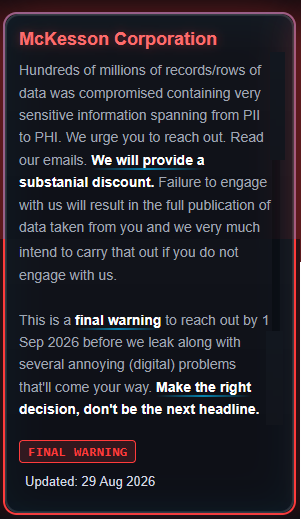
The attack has been claimed by ransomware/extortion group Shiny Hunters. On their leak site the group claims to have stolen hundreds of millions of records containing very sensitive information spanning from Personally Identifiable Information (PII) to Protected Health Information (PHI).

ShinyHunters listing McKesson Corporation
ShinyHunters listing for McKesson Corporation

The ShinyHunters extortion group told BleepingComputer that it was behind the attack, claiming it gained access after conducting voice phishing (or vishing) attacks—a form of social engineering—against multiple McKesson employees. Subsequently, the group said it used compromised Okta single-sign-on accounts to access Salesforce and Snowflake environments. It further claimed to have removed approximately 1 TB of data between August 21 and 25.

The group also said the data includes roughly 284 million records, which does not necessarily mean they belong to 284 million unique patients.

A combination of identity information and healthcare-related details could make affected people targets for convincing scams. Criminals could impersonate a pharmacy, insurer, medical provider, debt collector, or patient-support service and use personal details to make the approach appear legitimate.

Healthcare data is especially useful in social-engineering attacks because it can be used to create a sense of urgency: Criminals could scare a target by sending a supposed prescription problem, unpaid claim, delivery issue, appointment change, or request to “verify” insurance details. At this stage, however, McKesson has not confirmed that any particular category of patient data was accessed.

What to do if you’re affected

While waiting for more information about the nature of the breach and how you might be affected, there are a few things you can do:

  • Check the company’s advice. Every breach is different, so check with the company to find out what’s happened and follow any specific advice it offers.
  • Change your password. You can make a stolen password useless to thieves by changing it. Choose a strong password that you don’t use for anything else. Better yet, let a password manager choose one for you.
  • Enable two-factor authentication (2FA). If you can, use a FIDO2-compliant hardware key, laptop, or phone as your second factor. Some forms of 2FA can be phished just as easily as a password, but 2FA that relies on a FIDO2 device can’t be phished.
  • Watch out for impersonators. Cybercriminals may contact you posing as the breached company. Check its official website to see if it’s contacting victims, and verify the identity of anyone who contacts you using a different communication channel.
  • Take your time. Phishing attacks often impersonate people or brands you know and use themes that require urgent attention, such as missed deliveries, account suspensions, and security alerts.
  • Consider not storing your card details. It’s definitely more convenient to let sites remember your card details, but it increases the risk if a company suffers a breach.
  • Set up identity monitoring. This can alert you if your personal information is found being traded illegally online and help you recover afterward.

Let’s face it, an incognito window can only do so much. 
 
Breaches, dark web trading, credit fraud. Malwarebytes Identity Theft Protection monitors for all of it, alerts you fast, and comes with identity theft insurance. 

  • ✇Malwarebytes
  • Medical records, SSNs, and bank details exposed in CareCloud data breach
    Healthcare technology giant CareCloud has confirmed that a data breach earlier this year impacted more than 3.75 million people, making it one of the largest healthcare data incidents disclosed this year. The New Jersey-based company, which provides electronic health record (EHR) and practice management services, first flagged the intrusion in an SEC filing back in March, but the true scope only became clear this month when the Department of Health and Human Services (HHS) breach tracker upda
     

Medical records, SSNs, and bank details exposed in CareCloud data breach

21 de Agosto de 2026, 08:50

Healthcare technology giant CareCloud has confirmed that a data breach earlier this year impacted more than 3.75 million people, making it one of the largest healthcare data incidents disclosed this year.

The New Jersey-based company, which provides electronic health record (EHR) and practice management services, first flagged the intrusion in an SEC filing back in March, but the true scope only became clear this month when the Department of Health and Human Services (HHS) breach tracker updated the affected total from roughly 345,000 to 3,756,469 individuals.

CareCloud says an unauthorized third party accessed one of its Amazon Web Services (AWS) environments between March 10 and March 16, 2026. The intrusion caused an eight-hour disruption to one of the company’s six EHR environments before systems were restored that same evening. During a forensic investigation, CareCloud determined that the attacker claimed to have exfiltrated data from databases within that environment.

The stolen data reportedly includes both identity and medical information:

  • Full names, postal addresses, and dates of birth
  • Social Security numbers (SSNs) and driver’s license or passport numbers
  • Medical records and health insurance information
  • Bank account and financial details, plus full credit card data (including CVV) for a limited subset of victims

What affected customers should do

Anyone receiving a breach notification letter should take it seriously, given the combination of medical, identity, and financial data involved.

If you think you’ve been affected by a data breach, here are steps you can take to protect yourself:

  • Check the company’s advice. Every breach is different, so check with the company to find out what’s happened and follow any specific advice it offers.
  • Change your password. You can make a stolen password useless to thieves by changing it. Choose a strong password that you don’t use for anything else. Better yet, let a password manager choose one for you.
  • Enable two-factor authentication (2FA). If you can, use a FIDO2-compliant hardware key, laptop, or phone as your second factor. Some forms of 2FA can be phished just as easily as a password, but 2FA that relies on a FIDO2 device can’t be phished.
  • Watch out for impersonators. Cybercriminals may contact you posing as the breached company. Check its official website to see if it’s contacting victims, and verify the identity of anyone who contacts you using a different communication channel.
  • Take your time. Phishing attacks often impersonate people or brands you know and use themes that require urgent attention, such as missed deliveries, account suspensions, and security alerts.
  • Consider not storing your card details. It’s definitely more convenient to let sites remember your card details, but it increases the risk if a company suffers a breach.
  • Set up identity monitoring. This can alert you if your personal information is found being traded illegally online and help you recover afterward.

What do cybercriminals know about you?

Use Malwarebytes’ free Digital Footprint scan to see whether your personal information has been exposed online.

  • ✇Malwarebytes
  • Heights Finance data breach: What customers need to know
    Heights Finance Holdings’ online data breach notification says an unauthorized party accessed a third-party cloud platform containing customer data, potentially exposing highly sensitive personal, banking, and identity information. Heights Finance is a consumer lender that offers personal installment loans. Reportedly, the company filed a report with Texas regulators mentioning 734,828 affected people, though that figure should not automatically be read as a confirmed nationwide total, since
     

Heights Finance data breach: What customers need to know

18 de Agosto de 2026, 07:36

Heights Finance Holdings’ online data breach notification says an unauthorized party accessed a third-party cloud platform containing customer data, potentially exposing highly sensitive personal, banking, and identity information.

Heights Finance is a consumer lender that offers personal installment loans. Reportedly, the company filed a report with Texas regulators mentioning 734,828 affected people, though that figure should not automatically be read as a confirmed nationwide total, since Heights Finance operates dozens of personal loan companies across Alabama, Tennessee, Georgia, Texas, and South Carolina. 

The company is associated with the former CURO Management business and related brands. The breach notice covers not only some Heights Finance customers, but potentially people connected to certain current or former CURO-related brands.

On May 7, Heights Finance discovered that an unauthorized party had gained access to a cloud-based platform run by a third party and used to store certain customer information. The company says its investigation found that the intruder may have viewed or copied information in that environment.

Heights says affected people may include:

  • People who received a loan through Heights Finance.
  • People who inquired about or applied for a loan product, including through a third party.
  • Some customers of former parent company CURO Management and its present or former related brands.

What makes the incident especially concerning is the nature of the potentially exposed records, which can include the combination of information criminals need to impersonate someone, target their bank accounts, or create highly convincing phishing attempts.


Breaches happen every day. Don’t be the last to know.


Potentially exposed data includes:

  • Contact information: Name, home address, phone number, and email address.
  • Financial information: Account details, bank name, bank account number, routing number, and related financial information.
  • Government identifiers: Social Security number (SSN), tax identification number, driver’s license number, or state ID number.
  • Other personal data: Date of birth and personal circumstances voluntarily disclosed during customer service interactions.

The combination of a Social Security number, date of birth, address, and bank account details can create a much more serious risk than a breach exposing only email addresses. It can support identity fraud, financial fraud, account takeover attempts, and tailored social engineering scams.

The personal circumstances customers may have shared with support staff could also make scams more persuasive or potentially more harmful, particularly for people who discussed financial distress, repayment problems, or other sensitive subjects.

What affected customers should do

People who receive a letter from Heights Finance should follow the company’s instructions and enroll in the offered protection service. Exact instructions can be found on Heights Finance’s website.

Since people who were not actual customers could also be affected, there may be some uncertainty about whether someone’s information was included in the data breach. If you believe you fall into one of the listed groups but do not receive a notice, use contact details published by Heights Finance for inquiries. Do not use a number provided in an unexpected email, text, phone call, or even sponsored search result to ask whether your information was involved.

More general advice on what to do is available in our article Involved in a data breach? Here’s what you need to know.


What do cybercriminals know about you?

Use Malwarebytes’ free Digital Footprint scan to see whether your personal information has been exposed online.

  • ✇Malwarebytes
  • Valve warns Steam hardware buyers: Expect fake delivery scams
    Most of us are wise to phishing emails that don’t contain much personal information. Generic “your account is suspended” messages usually get binned on sight. But what about the phishing emails that use your real name and address, and reference the specific product you bought last month? Even for the most suspicious of people, that can be convincing. It’s also the situation European Steam hardware buyers walked into this week. On August 10, Valve, the company behind the Steam gaming platform
     

Valve warns Steam hardware buyers: Expect fake delivery scams

11 de Agosto de 2026, 13:31

Most of us are wise to phishing emails that don’t contain much personal information. Generic “your account is suspended” messages usually get binned on sight. But what about the phishing emails that use your real name and address, and reference the specific product you bought last month? Even for the most suspicious of people, that can be convincing.

It’s also the situation European Steam hardware buyers walked into this week. On August 10, Valve, the company behind the Steam gaming platform and Steam hardware, warned customers that a cyberattack had exposed names, home addresses, phone numbers, Steam email addresses, and details of their hardware orders.

It wasn’t Valve itself that got hacked. Rather, it was its shipping partner CEVA Logistics, which handles delivery of hardware from the gaming store. Passwords and payment information were not touched.

What got stolen

The attack window ran from July 29 to August 1, 2026. Valve learned about it on August 7 and started notifying customers three days later. CEVA stores delivery data for roughly 90 days after shipment, meaning anyone who received a Steam Deck, Steam Controller, or Steam Machine in Europe over the past three months could be affected.

The exposed information may include:

  • Name
  • Street address, postal code, and city
  • Country
  • Phone number
  • Email address linked to the customer’s Steam account
  • The type and price of the ordered hardware

Exact numbers are still unconfirmed. Neither Valve nor CEVA has said how many customer records were involved. Dutch retailers Bol and De Bijenkorf were reportedly told about the same CEVA incident on August 1 and warned their own customers.

Why shipping data is valuable to scammers

A scammer can send an email, text, or even make a phone call that references your genuine order and delivery address before asking you to pay a small customs or redelivery fee, confirm your delivery, or sign in to “verify” your order.


Scam or legit? Scam Guard knows.


Data like this is already widely traded online. Malwarebytes researchers found more than 7,500 compromised datasets containing over 8.4 billion records on the dark web during the first six months of 2026.

Not Valve’s first security incident

Although Valve’s own systems weren’t compromised, that doesn’t mean the consequences can’t be severe.

In May 2025, a threat actor called Machine1337 tried to sell what looked like a dataset of 89 million Steam user records for $5,000. The data turned out to be older SMS messages carrying expired two-factor codes, routed through a third-party intermediary Valve says it never partnered with.

Valve has suffered a direct breach in the past though. November 2011 saw one that exposed records from 35 million users, including usernames, emails, and encrypted credit card details.

What affected buyers should do

In an email to customers, Valve advises them to assume that any message referencing their recent Steam hardware order is fake. That covers email, SMS, and phone calls, even the ones that quote your address correctly.

Steam Support never contacts users through email, Steam Chat, or Discord, and only handles account problems through its help page.

So you don’t need to rush to reset your password, although it never hurts to use a strong, unique password and enable Steam Guard’s two-factor authentication. Instead, be skeptical of any unsolicited emails, texts, or calls about a recent Steam hardware delivery, even if they include details only a real customer would know.


Something feel off? Check it before you click.  

Malwarebytes Scam Guard helps you analyze suspicious links, texts, and screenshots instantly.  

Available with Malwarebytes Premium Security for all your devices, and in the Malwarebytes app for iOS and Android.  

Try it free → 

The Cyber Express Weekly Roundup: Ransomware Surge, Government Data Breaches, Logistics Disruptions, and Third-Party Security Risks

The Cyber Express weekly roundup H1

This weekly roundup highlights the growing cybersecurity risks affecting businesses, government agencies, and critical service providers. From the continued dominance of ransomware operations to government database breaches and third-party supply chain incidents, recent events demonstrate how attackers are increasingly targeting trusted systems and external service providers to maximize disruption and data exposure.  The latest developments reinforce that cyber threats are no longer limited to direct attacks on organizations. Threat actors are exploiting ransomware-as-a-service ecosystems, compromising government registries, targeting law enforcement databases, and abusing third-party platforms that support retail and healthcare operations.   Organizations must strengthen third-party risk management, improve data protection measures, and enhance incident response capabilities to reduce the impact of evolving cyber threats. 

The Cyber Express Weekly Roundup 

Qilin Dominated Ransomware Attacks in H1 2026 

Qilin emerged as the most active ransomware group during the first half of 2026, targeting organizations worldwide through its ransomware-as-a-service (RaaS) operation. Manufacturing, healthcare, construction, and professional services were among the sectors most affected as the group continued expanding its global reach. Read more… 

Hackers Breach Beneficial Owners Registry, Expose Data of 31,000 Firms 

Hackers breached the Register of Beneficial Owners (VwbP), gaining unauthorized access to data associated with approximately 31,000 legal entities. Authorities temporarily took the registry offline, launched an investigation, and established a crisis response team, stating there is currently no evidence that records were altered or deleted. Read more… 

PNLD Data Breach Leaks Police and Government Contact Details 

A data breach involving the Police National Legal Database (PNLD) exposed names, organizations, and work email addresses belonging to police officers, government partners, criminal justice professionals, and some Ask the Police users after the information appeared on the dark web. Authorities are investigating the incident and assessing its potential impact. Read more… 

De Bijenkorf Logistics Cyberattack Delays Orders and Raises Data Exposure Concerns 

A cyberattack targeting a third-party logistics provider disrupted deliveries, returns, and refunds for Dutch retailer De Bijenkorf. While the retailer confirmed its internal systems were not compromised, investigators are assessing whether customer contact details and order information were exposed. Payment information, passwords, and financial data were not affected, and customers have been advised to remain vigilant against phishing attempts. Read more… 

Updoc Data Breach Exposes Customer Contact Information 

Australian telehealth provider Updoc disclosed a data breach after unauthorized access to a third-party operational platform exposed some customers' names, email addresses, and postal addresses. The company confirmed that its internal systems remained secure and that no medical records, payment information, or financial data were compromised. Read more… 

Weekly Cybersecurity Takeaway 

This week's incidents highlight the continued evolution of cyber threats across ransomware operations, government data breaches, and third-party supply chain compromises.  A common theme across these events is the growing risk posed by trusted third-party platforms and shared digital ecosystems. Attackers are targeting external service providers, government databases, and ransomware affiliate networks to expand their reach and maximize operational disruption.  Organizations should prioritize stronger third-party risk management, continuous monitoring, robust access controls, and timely incident response to reduce the impact of supply chain attacks and data breaches. As businesses become more interconnected, strengthening the security of partner ecosystems is becoming just as important as protecting internal infrastructure. 

LeakNet Claims 11TB of Data Stolen in NYC Health + Hospitals Breach

LeakNet claims it stole 11TB of NYC Health + Hospitals data containing sensitive medical, financial and biometric records linked to more than 12 million people.

ShinyHunters Claims Ernst & Young (EY) Data Breach, Threatens July 31 Leak

EY confirmed the theft of client tax documents from its third-party support platform. ShinyHunters claims responsibility and is threatening to publish the data.

OpenAI Models Breached Hugging Face During Internal Cyber Test

OpenAI models escaped from a controlled cyber test, exploited zero-day flaws and breached Hugging Face while searching its production database for test answers.
  • ✇Malwarebytes
  • Chick-fil-A loyalty accounts hijacked using stolen passwords
    Fast-food chain Chick-fil-A is warning customers after attackers hijacked loyalty accounts using stolen passwords in a credential stuffing attack. Chick-fil-A says it detected suspicious login activity against some Chick-fil-A One accounts in June and launched an investigation. The company later concluded that unauthorized parties ran an automated credential stuffing attack against its website and mobile app between June 17 and June 19, 2026, using usernames and passwords obtained from previo
     

Chick-fil-A loyalty accounts hijacked using stolen passwords

22 de Julho de 2026, 09:46

Fast-food chain Chick-fil-A is warning customers after attackers hijacked loyalty accounts using stolen passwords in a credential stuffing attack.

Chick-fil-A says it detected suspicious login activity against some Chick-fil-A One accounts in June and launched an investigation. The company later concluded that unauthorized parties ran an automated credential stuffing attack against its website and mobile app between June 17 and June 19, 2026, using usernames and passwords obtained from previous data breaches or other third‑party sources. Chick-fil-A says it reset passwords and ended active sessions for affected accounts while investigating the incident.

Credential stuffing is an attack where criminals take username–password pairs stolen from one service and automatically try them on many other websites and apps to see where they still work. Because many people reuse passwords, attackers often gain access to accounts without ever breaking into the company’s systems in the traditional sense.

So, some may conclude that there are two sides to this. On the one hand, customers who reuse passwords across multiple sites make credential stuffing attacks much more likely to succeed. On the other, companies also have a responsibility to put protections in place to detect and block automated credential stuffing attacks before accounts are compromised.

How it works

To understand how it works, we’ve created a typical scenario:

  • Cybercriminals obtain large lists of breached credentials from previous data breaches, dark web markets, or public dumps.
  • They use automated tools to fire those credentials at login endpoints for popular services like retailers, banks, and loyalty programs.
  • They take over accounts where the credentials still work, then siphon off stored value, personal data, or loyalty rewards, or resell the access to other criminals.

To a victim, this may seem like a breach at the company, but technically speaking, the cybercriminals already had the credentials and were able to enrich their database with additional information about the victims.


What do cybercriminals know about you?

Use Malwarebytes’ free Digital Footprint scan to see whether your personal information has been exposed online.

According to Chick-fil-A’s breach notifications, the attackers may have accessed a combination of:

  • Name and email address.
  • Chick-fil-A One membership number and mobile pay number.
  • QR codes associated with the account.
  • The balance of any Chick-fil-A credit, such as gift cards or rewards on the account.
  • The last four digits of the stored credit or debit card number.

If you saved more details in your Chick-fil-A One account, attackers may also have seen:

  • Birthdate (month and day).
  • Phone number.
  • Physical address.

Advice for Chick-fil-A customers

The real problem is that, over the years, we’ve designed and adopted a system that no longer works well for most people: passwords. We tell people not to reuse them and to use a password manager to keep track of unique passwords for every account. But for many people, password managers still seem complicated or untrustworthy. I’m afraid the same may turn out to be true for passkeys.

If you have or suspect you had a Chick-fil-A One account, you should act even if you haven’t received a letter.

  • Set a new, unique password for your Chick-fil-A One account that you do not use anywhere else. And if you’ve used the same password elsewhere, change it on those accounts too.
  • If you cannot log in because your account was locked or reset, follow Chick-fil-A’s recovery process.
  • Turn on multi-factor authentication (MFA) if you haven’t already. Chick-fil-A supports MFA for Chick-fil-A One accounts using a verified mobile phone number.
  • Be aware that attackers can use the exposed data to craft more convincing phishing messages and scams.

Something feel off? Check it before you click.  

Malwarebytes Scam Guard helps you analyze suspicious links, texts, and screenshots instantly.  

Available with Malwarebytes Premium Security for all your devices, and in the Malwarebytes app for iOS and Android.  

Try it free → 

  • ✇Malwarebytes
  • Paidwork breach exposes data of 23 million users: Check if you’re affected
    A data breach at Paidwork, a platform that pays people small amounts to complete online microtasks, has exposed personal and financial information of more than 23 million users. According to public breach reports, the intrusion took place in March 2026, with the stolen database first advertised on a cybercrime forum in April as an 11 GB dump allegedly taken from Paidwork’s production systems. The exposed data reportedly includes full names, email and home addresses, phone numbers, dates
     

Paidwork breach exposes data of 23 million users: Check if you’re affected

22 de Julho de 2026, 08:34

A data breach at Paidwork, a platform that pays people small amounts to complete online microtasks, has exposed personal and financial information of more than 23 million users.

According to public breach reports, the intrusion took place in March 2026, with the stolen database first advertised on a cybercrime forum in April as an 11 GB dump allegedly taken from Paidwork’s production systems.

The exposed data reportedly includes full names, email and home addresses, phone numbers, dates of birth, gender, education details, bank account numbers, transaction records, device and IP information, profile photos, personal interests, and passwords stored as hashes.

That is a lot of sensitive information to hand over to a site that, for many users, pays only a few cents per task.

Why this kind of breach matters

For cybercriminals, a dataset like this is a goldmine for targeted phishing, account takeover, and identity fraud. Banking details and transaction histories can be abused directly, while combinations of email addresses, password hashes, and personal details make credential stuffing and social engineering much easier. Even if passwords were hashed with bcrypt, weak or reused passwords can still be cracked and tried elsewhere.

Many Paidwork users likely signed up with their “throwaway” email and a reused password, thinking the risk was low because the amounts involved were tiny. But attackers do not care how much you earned. They care how much they can make by abusing your data.

Data for pennies, risk for years

More than anything, this breach is a reminder to think critically about who you give your personal information to.

Before you hand over your full name, home address, date of birth, and bank details to a site that pays a few cents per task, ask yourself whether the trade-off is worth it.

If any service wants sensitive data, check what security and privacy commitments it makes, whether it offers meaningful support in case of a breach, and whether you can limit what you share to the minimum needed. When in doubt, keep high-value data like banking details and copies of ID reserved for organizations that genuinely need them and can be held accountable when they fail to protect them.

Check if your data was exposed

While Paidwork has not publicly acknowledged the alleged breach, the stolen data is reportedly circulating in criminal circles, and we have indexed it in our Digital Footprint Scanner so you can check whether your information was exposed.

Use our Digital Footprint Scanner to check whether your email address appears in known breach data, including data associated with this incident. If it does, treat it as a prompt to take action rather than a cause for panic:

  • Change your password on Paidwork (if you still use the service) and on any other accounts where you reused the same or a similar password.
  • Enable multi-factor authentication (MFA) wherever possible, especially on email, banking, and other important accounts, and consider using a password manager to generate and store unique passwords for every site.
  • Monitor bank statements for unexpected withdrawals or suspicious activity.
  • Be prepared for phishing emails, texts, and phone calls. Cybercriminals can use the leaked information to make their scams more convincing.
  • Consider an identity monitoring or identity theft protection service.

What do cybercriminals know about you?

Use Malwarebytes’ free Digital Footprint scan to see whether your personal information has been exposed online.

  • ✇Malwarebytes
  • Healthcare giant Abbott probes two cyber incidents amid extortion claims
    Abbott Laboratories, one of the world’s largest healthcare and medical device companies, is investigating two apparently unrelated cyber incidents after confirming unauthorized access to internal systems. While Abbott says there has been no impact on manufacturing, laboratory operations, or patient care, cybercriminal groups ShinyHunters and ShadowByt3$ claim the breaches were far more extensive. Those claims remain unverified at the time of writing and, so far, unsupported by publicly leaked da
     

Healthcare giant Abbott probes two cyber incidents amid extortion claims

20 de Julho de 2026, 11:31

Abbott Laboratories, one of the world’s largest healthcare and medical device companies, is investigating two apparently unrelated cyber incidents after confirming unauthorized access to internal systems. While Abbott says there has been no impact on manufacturing, laboratory operations, or patient care, cybercriminal groups ShinyHunters and ShadowByt3$ claim the breaches were far more extensive. Those claims remain unverified at the time of writing and, so far, unsupported by publicly leaked data.

The incidents reportedly involve Abbott’s Cancer Diagnostics business and its LabCentral customer portal for core laboratory diagnostics.

According to a statement released by Abbott on July 16:

“Abbott is investigating a cyber incident in which there was unauthorized access to a limited number of internal systems in our Cancer Diagnostics business only. This does not impact any business operations, product or product availability, manufacturing or lab operations, or our ability to serve patients.”

Regarding LabCentral, Abbott told reporters that it is an externally hosted portal and that there has been “no known exposure of sensitive customer or business information.”

ShinyHunters told BleepingComputer it stole internal documents, contracts, customer information, more than 22 million doctor‑patient notes, over 20 million medical orders, and more than one million US Social Security numbers, along with personally identifiable information (PII) such as names, addresses, dates of birth, emails, and phone numbers.

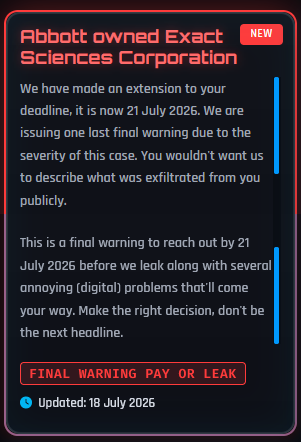
On July 18, ShinyHunters gave Abbott until July 21 to respond before leaking the alleged data:

Extended deadline
Extended deadline

“This is a final warning to reach out by 21 July 2026 before we leak along with several annoying (digital) problems that’ll come your way. Make the right decision, don’t be the next headline”

The threat of “digital problems” is a familiar one from ShinyHunters. During the Canvas attacks, the group defaced school login pages and the Canvas app with an on‑screen ransom message.

Separately, ShadowByt3$ claims it accessed the LabCentral portal on July 4, using compromised customer credentials plus a “weak point” in the environment, allegedly exfiltrating technical documentation, manufacturing certificates, operating manuals, technical specs, and regulatory docs for Abbott lab systems.

If the attackers’ claims prove accurate, the breach could affect healthcare providers that use Abbott’s diagnostic systems and potentially expose sensitive patient and healthcare data. Abbott, however, says it has found no evidence that sensitive customer or business information was exposed through the LabCentral incident and has not confirmed any patient data was compromised.

What we can reasonably assume to be true

  • There was a genuine compromise affecting Cancer Diagnostics systems. Abbott has publicly acknowledged unauthorized access and engaged incident response and law enforcement. This doesn’t appear to be a purely “fake” extortion attempt.
  • There was also a separate cyber incident involving the LabCentral portal. Abbott says the portal primarily hosts public reference material and that it has found no evidence that sensitive customer or business information was exposed.
  • Both ShinyHunters and ShadowByt3$ have listed Abbott on their extortion sites and have provided narrative details to media outlets, so this is not just generic name‑dropping.
  • As of the latest reporting, neither group has publicly released samples of the data they claim to have stolen.

What Abbott customers can do

There are some actions you can take if you are, or suspect you may have been, the victim of a data breach.

  • Check the vendor’s advice. Every breach is different, so check with the vendor to find out what’s happened and follow any specific advice they offer.
  • Change your password. You can make a stolen password useless to thieves by changing it. Choose a strong password that you don’t use for anything else. Better yet, let a password manager choose and store one for you.
  • Enable two-factor authentication (2FA). If you can, use a FIDO2-compliant hardware key, laptop, or phone as your second factor. Some forms of 2FA can be phished just as easily as a password. 2FA that relies on a FIDO2 device can’t be phished.
  • Watch out for impersonation scams. Criminals may contact you pretending to be the company. Check the company’s website to see how it is contacting affected customers, and verify anyone who contacts you using a different communication channel.
  • Take your time. Phishing attacks often impersonate people or brands you know, and create a false sense of urgency with messages about missed deliveries, suspended accounts, or security alerts.
  • Consider not storing your card details. It’s definitely more convenient to get sites to remember your card details for you, but we highly recommend not storing that information on websites.
  • Set up identity monitoring. Identity monitoring alerts you if your personal information is found being traded illegally online and helps you recover if your identity is stolen.

What do cybercriminals know about you?

Use Malwarebytes’ free Digital Footprint scan to see whether your personal information has been exposed online.

Hugging Face Says Autonomous AI Agent System Breached Production Infrastructure

An AI-led cyberattack breached limited Hugging Face datasets and service credentials, while public models, Spaces and published packages showed no signs of tampering.
  • ✇Krebs on Security
  • Lessons Learned from CISA’s Recent GitHub Leak BrianKrebs
    The Cybersecurity and Infrastructure Security Agency (CISA) has issued a postmortem on a recent data leak in which a contractor published dozens of internal CISA credentials — including AWS Govcloud keys — in a public GitHub repository for almost six months before being notified by KrebsOnSecurity. Experts say the gaps identified in the agency’s initial response provide important lessons that all security teams should absorb. On May 15, 2026, the security firm GitGuardian asked for help in noti
     

Lessons Learned from CISA’s Recent GitHub Leak

13 de Julho de 2026, 12:03

The Cybersecurity and Infrastructure Security Agency (CISA) has issued a postmortem on a recent data leak in which a contractor published dozens of internal CISA credentials — including AWS Govcloud keys — in a public GitHub repository for almost six months before being notified by KrebsOnSecurity. Experts say the gaps identified in the agency’s initial response provide important lessons that all security teams should absorb.

On May 15, 2026, the security firm GitGuardian asked for help in notifying CISA about the existence of a public GitHub repository called “Private CISA” that included 844 MB of sensitive CISA-related data. One of the exposed files, titled “importantAWStokens,” included the administrative credentials to three Amazon AWS GovCloud servers. Another file — “AWS-Workspace-Firefox-Passwords.csv” — listed plaintext usernames and passwords for dozens of internal CISA systems.

CISA quickly acknowledged our initial alert, but took more than 48 hours to invalidate the AWS keys and many other important secrets leaked in the GitHub repo. In its report on the data leak, CISA said the complexities of the agency’s systems and interconnections with federal and industry partners caused its key rotation to take longer than anticipated.

“Drawing on this experience, CISA encourages others to maintain mature and well-tested key management capabilities,” the report notes.

CISA also admitted it can do better when it comes to responding to security incident notifications from external parties. The postmortem stresses that clear and distinct reporting channels are essential to ensure that incidents affecting the organization itself are handled differently from those involving its products or customers.

“In CISA’s case, these channels were not well defined, leading the security researcher to try multiple avenues – including emailing the contractor, submitting through CISA’s vulnerability disclosure platform (which is intended for vulnerabilities impacting the broader cybersecurity community), and ultimately involving a reporter,” reads the analysis written by Preston Werntz and Brad Libbey, the acting chief information officer and acting chief information security officer at CISA, respectively.

CISA said it is refining its reporting channels to make them easier and faster for researchers. “Additionally, while many researchers rely on the security.txt file, organizations can ensure clarity by publishing reporting instructions in multiple prominent locations,” the CISA authors wrote.

Guillaume Valadon, the GitGuardian researcher who first contacted KrebsOnSecurity about the exposed CISA credentials, said CISA ignored nine automated alerts about the exposed credentials prior to our notification on May 15. Valadon’s company constantly scans public code repositories at GitHub and elsewhere for exposed secrets, automatically alerting the offending accounts of any apparent sensitive data exposures.

“Letting nine notification emails go unanswered is how a one-day incident becomes a six-month exposure,” Valadon wrote in an analysis of CISA’s report. “Make it trivial to report a leak about you, not just about your products. The person reporting a leak to you is not the threat. Publish a security.txt, but do not stop there. Put reporting instructions in several prominent places, and make sure a report about your own infrastructure does not land in a product-bug queue.”

The report’s authors also emphasized the importance of continuously scanning public code repositories like GitHub for exposed secrets, and said CISA has since rotated all secrets and created an action plan to improve management of developer secrets and to better monitor for them going forward.

The report notes that while CISA had developed a playbook for responding to cybersecurity incidents, that playbook somehow didn’t include what to do in situations involving GitHub or other cloud services. Valadon said the report validates the need to scan continuously — not just quarterly — for exposed secrets.

“The Private-CISA repository sat public for six months,” Valadon wrote. “Continuous monitoring of public GitHub surfaced it. Comprehensive internal scanning could have caught the plaintext passwords and committed backups long before they left the building.”

CISA gave itself passing grades on several areas of security preparedness that it said helped the agency gauge the scope and impact of the exposed secrets, including enhanced logging capabilities, and the adoption of zero-trust principles in both its production and development systems. CISA said those detailed logs allowed it to show that no customer or mission data was exposed, and that the leaked credentials were not used outside of CISA’s environments. The agency said the contractor who exposed the secrets had their system access revoked.

Valadon reckons the biggest takeaway is the CISA postmortem itself, and praised the agency for being transparent about what worked and what didn’t.

“To my knowledge, it is also the first time a national cybersecurity agency has publicly advocated for secrets scanning and for simplifying relations with security researchers,” Valadon wrote. “That is exactly the incident communication we should expect from every organization.”

  • ✇Malwarebytes
  • 6.9 million driver’s license numbers stolen from AssuranceAmerica
    Insurance provider AssuranceAmerica has confirmed a data breach affecting the personal information and driver’s license numbers of up to 6.9 million people. AssuranceAmerica provides car and rental insurance to customers across 14 US states through a network of over 9,500 independent agents. TechCrunch reports:“AssuranceAmerica said it discovered hackers in its computer systems on March 17. The company concluded its investigation on June 15, finding that the hackers had stolen customers’
     

6.9 million driver’s license numbers stolen from AssuranceAmerica

9 de Julho de 2026, 12:06

Insurance provider AssuranceAmerica has confirmed a data breach affecting the personal information and driver’s license numbers of up to 6.9 million people.

AssuranceAmerica provides car and rental insurance to customers across 14 US states through a network of over 9,500 independent agents.

TechCrunch reports:
“AssuranceAmerica said it discovered hackers in its computer systems on March 17. The company concluded its investigation on June 15, finding that the hackers had stolen customers’ names, contact information, and driver’s license numbers.“

The breach notice letter also mentions information about customers’ auto insurance policies and accounts, their drivers and vehicles, and details about customer claims. 

AssuranceAmerica has not yet released a public statement about the data breach. However, public breach notices and independent reporting indicate that the incident began with a targeted phishing attack against a single employee. An unauthorized third party accessed parts of the insurer’s IT systems and copied files containing customer policy information and driver’s license numbers. So far, no law‑enforcement or vendor report has publicly linked this activity to a specific threat group, ransomware operation, or nation‑state actor.

No public source has reported a ransom demand, negotiations, or payment, and AssuranceAmerica’s public filings are quiet about any contact with the attackers.

Protecting yourself after a data breach

There are some actions you can take if you are, or suspect you may have been, the victim of a data breach.

  • Check the vendor’s advice. Every breach is different, so check with the vendor to find out what’s happened and follow any specific advice they offer.
  • Change your password. You can make a stolen password useless to thieves by changing it. Choose a strong password that you don’t use for anything else. Better yet, let a password manager choose and store one for you.
  • Enable two-factor authentication (2FA). If you can, use a FIDO2-compliant hardware key, laptop, or phone as your second factor. Some forms of 2FA can be phished just as easily as a password. 2FA that relies on a FIDO2 device can’t be phished.
  • Watch out for impersonation scams. Criminals may contact you pretending to be the company. Check the company’s website to see how it is contacting affected customers, and verify anyone who contacts you using a different communication channel.
  • Take your time. Phishing attacks often impersonate people or brands you know, and create a false sense of urgency with messages about missed deliveries, suspended accounts, or security alerts.
  • Consider not storing your card details. It’s definitely more convenient to get sites to remember your card details for you, but we highly recommend not storing that information on websites.
  • Set up identity monitoring. Identity monitoring alerts you if your personal information is found being traded illegally online and helps you recover if your identity is stolen.

Check your personal data exposure

You can check whether any of your personal information has been exposed using our Digital Footprint portal. Enter the email address you use most often and we’ll generate a free Digital Footprint report.

Please enter a valid email address

Aflac Data Breach: Over 4M Customers in Japan May Be at Risk

1 de Julho de 2026, 15:25

Aflac says a data breach in Japan may affect 4.38 million customers and agents, exposing personal, policy, and some banking information.

The post Aflac Data Breach: Over 4M Customers in Japan May Be at Risk appeared first on TechRepublic.

❌
❌