The UK’s digital watchdogs have warned enterprises that they can’t evade their legal responsibilities by blaming errors on AI agents that they have deployed.
“By taking action on behalf of users, such as making purchases and communicating with businesses, these agents could transform how people use digital services, engage with markets and unlock wider innovation,” said the Digital Regulation Cooperation Forum (DRCF), a body comprising the UK’s Competition and Markets A
The UK’s digital watchdogs have warned enterprises that they can’t evade their legal responsibilities by blaming errors on AI agents that they have deployed.
“By taking action on behalf of users, such as making purchases and communicating with businesses, these agents could transform how people use digital services, engage with markets and unlock wider innovation,” said the Digital Regulation Cooperation Forum (DRCF), a body comprising the UK’s Competition and Markets Authority (CMA), Financial Conduct Authority (FCA), Information Commissioner’s Office (ICO), and communications regulator Ofcom, in a joint statement.
While the DRCF welcomed such uses it advised, “firms developing or deploying personal agents should think carefully about how consumers can understand when and how an agent acts on their behalf, how authority to act is given and how their personal data is used.”
The DRCF didn’t pull its punches. “We want to be explicit that existing legal and regulatory frameworks apply to personal AI agents, including competition, consumer and data protection law, online safety, financial services, payments and cyber security requirements,” it said, adding, “An AI agent’s autonomy does not diminish the responsibility of organisations that deploy it to comply with applicable law and relevant regulation.”
The four UK regulators aren’t immune to that doubt: Only a few weeks earlier, they issued a Call for Input on their 2027-27 work plan to help them avoid overlap and uncertainty about the interplay between their respective regulatory regimes.
The new year will see a new CEO for HP, which after a nine-month search has named Emma Walmsley to lead the company from January 4, 2027.
Walmsley was previously CEO of drug company GSK, where she turned around its finances and spun off its consumer healthcare business into a new company, Haleon. She has a reputation for courting confrontation rather than yes-men in the boardroom. HP needs a shake-up as revenue from printing declines and AI-driven demand for components
The new year will see a new CEO for HP, which after a nine-month search has named Emma Walmsley to lead the company from January 4, 2027.
Walmsley was previously CEO of drug company GSK, where she turned around its finances and spun off its consumer healthcare business into a new company, Haleon. She has a reputation for courting confrontation rather than yes-men in the boardroom. HP needs a shake-up as revenue from printing declines and AI-driven demand for components is forcing up PC prices.
She will take over from HP’s interim CEO Bruce Broussard, who stepped in in February when former CEO Enrique Lores left the company after more than 25 years to become president and CEO at PayPal. There’s a consolation prize for Broussard, who will become chair of HP’s board, succeeding Chip Bergh who remains a board member.
Although Walmsley has been on Microsoft’s board for seven years (she is stepping down in December), this is her first foray into leading a tech company. Her almost 16-year tenure at GSK included more than eight years as CEO, and earlier in her career, she spent 17 years at L’Oréal.
Bergh said that during the executive search, she stood out “for the strength of her leadership experience across multiple industries, the clarity of her strategic thinking and her ability to translate customer insights into new growth.” He particularly cited her people-first leadership approach.
Walmsley reiterated her commitment to the philosophy in a post on LinkedIn. “HP has an extraordinary innovation heritage, an inspiring purpose and an incredible opportunity ahead as AI reshapes technology and what customers need from it. I’m excited to build on those strengths and help translate innovation into impact,” she wrote. “Behind every innovation are the people who work to make someone’s day a little easier, their work more productive, their ideas possible. In an age of AI, I believe human leadership has never mattered more. It’s a privilege to be joining this team.”
Announcing Walmsley’s appointment Broussard said, “We need a leader who can build on our innovation heritage and strengths to boldly shape the company’s future. Emma is a proven CEO with a track record of leading organizations at scale and guiding them through significant change. She has the experience and skills to bring HP’s businesses, capabilities, and people together to capture the opportunities ahead as AI moves to the edge, transforming how we work and live in a more connected world.”
Apple announced steep internal AI budget cuts, curbing daily token allowances for engineers as corporate technology spending faces tighter scrutiny.
Related Posts:
OpenAI Unveils ChatGPT Images 2.6 with Animated GIF Support
ChatGPT Search Volume Reaches 20 Percent of Google
Postman AI Plugin Hijacking Sparks Developer Outcry
The post Apple AI Budget Cuts Target Internal Model Usage appeared first on Daily CyberSecurity.
Over many years of working through successive waves of enterprise technology and IT architecture, including fast-moving AI, I’ve heard the same question in different forms: “How can I build my business with AI while avoiding lock-in and tech debt?”
It came up again during a recent conversation about a major technology investment, when a CIO asked, “Should we really be making this commitment if the technology is changing constantly?” That resonated with me because it
Over many years of working through successive waves of enterprise technology and IT architecture, including fast-moving AI, I’ve heard the same question in different forms: “How can I build my business with AI while avoiding lock-in and tech debt?”
It came up again during a recent conversation about a major technology investment, when a CIO asked, “Should we really be making this commitment if the technology is changing constantly?” That resonated with me because it reflects a pattern I have seen across technology waves: the architecture must provide stability even as the capabilities around it continue to evolve.
For decades, the goal has been to build a technology foundation that serves the enterprise for five, seven or even 10 years. With the emergence of AI, some technologies become outdated before implementation is complete.
If shorter technology lifecycles are the challenge, adaptability is the answer. Instead of asking, “What will serve us for the next decade?” CIOs should ask, “How can we remain flexible as technology changes?” That requires being deliberate about what must remain durable and where the enterprise must be ready to adapt.
Think of it like a house. The foundation, walls and furnace are built to last, while paint, furniture and bathrooms change as needs and styles evolve. Enterprise architecture increasingly works the same way.
AI is separating the experience of work from the systems behind it
I recently heard about a company that now gives new employees a single onboarding tool: ChatGPT, connected to the enterprise systems and key data sources behind it. Instead of learning multiple applications, employees simply ask for the information or support they need, without knowing which underlying system provides it.
Of course, a single interface doesn’t mean blanket access to enterprise systems. This model requires security measures that ensure employees can access only the information and capabilities they’re authorized to use: carrying each employee’s identity and existing permissions through every request, limiting access to what’s necessary, tracking where information comes from, and logging retrievals and actions. Changes with significant business consequences should also require review.
This does change how we think about work and the technology that supports it. If agents are becoming the primary interface, the central question shifts from “Which application should employees use?” to “Can our data be accessed, understood and used securely by the interfaces and agents we adopt next?”
Adaptability means running at two speeds
Some technology capabilities should endure; others should evolve quickly. The mistake is treating everything as having the same lifecycle.
The durable layer includes ERP, HCM and other core systems, along with data, security and foundational architecture. These investments remain essential, but CIOs should design them around future business possibilities rather than solely around today’s processes.
The fast-moving layer comprises agents, interfaces, analytics, workflows, AI models and tools, experiments and business-specific solutions. The CIO’s role is to distinguish this layer from the durable core and ensure that rapidly evolving capabilities can be replaced without destabilizing the durable foundation.
CIOs need practical ways to change the underlying technology without disrupting the applications the business relies on. That starts with clear, consistent rules for how systems exchange data and interact with APIs, MCP connections and AI agents, keeping the implementation choices behind those boundaries. Before changing a model, agent or application, teams should confirm existing data and integrations will keep working, test security and expected behavior, and introduce changes in stages with a rollback plan if something goes wrong.
This two-speed model is a substantial departure from traditional enterprise IT management and from the way we did things when I was coming up in the tech world. It changes how CIOs plan investments, organize technology functions, structure vendor relationships and govern the connections between durable and fast-moving capabilities.
Invest thoughtfully for both durability and adaptability
In the pre-AI era, CIOs prioritized technologies with decade-long relevance. Today, they should avoid overspending on solutions prone to rapid obsolescence and invest in business outcomes and a durable foundation for intelligence.
Projects lasting more than six months warrant scrutiny: Will the solution remain relevant, or are we embedding processes that AI may soon handle; perhaps with a single prompt?
Durability extends beyond core systems to include the organization’s capacity to understand, evaluate and adopt new technology.
Today, most companies critically underinvest in skills. Knowing how to operate ChatGPT or Claude is not the same as working effectively with AI. OpenAI’s study found that AI power users outperform average users by sixfold. Upskilling gives CIOs leverage by helping employees redesign work and use AI effectively, while stronger leadership fluency facilitates new business models rather than merely supporting existing operations.
Most companies are also underinvesting in the data foundation. In West Monroe’s recent survey of 417 business leaders, AI governance, risk and compliance ranked as the lowest investment priority for the next 12 months. Traditionally, IT addressed data operations to ensure successful ERP implementation. Now, because data quality directly impacts AI value, investing in governance and accessibility is imperative.
CIOs need practices that preserve data meaning and reliability as platforms change. Those include assigning clear ownership, establishing authoritative sources and shared definitions, tracking data lineage and setting standards for quality and access. Definitions and rules should be maintained in portable documentation and data contracts, rather than embedding them in a single AI model or vendor platform, so they carry forward as technology evolves.
Break down IT silos to encourage adaptive architecture
Typically, CIOs organize operations around disciplines such as infrastructure, data, applications and security, with IT teams choosing an application and then defining processes and architecture around it. But as future architecture becomes less certain, CIOs must instead envision future business capabilities and design for change, bringing AI and data into architectural thinking alongside traditional cloud and application expertise.
Consider a reporting process that today moves from data analysis to Excel to PowerPoint to human review before a decision is made. An adaptive architecture focuses less on preserving each of those steps and more on the outcome: turning data into intelligence that informs a decision or action. Excel and PowerPoint may still have a role, but they no longer need to be hardwired into the process.
CIOs also need to break down silos. Teams often define architecture around a single suite, such as Salesforce or SAP, without considering alternatives. While working with an energy company recently, I saw how bringing analytics teams into the discussion shifted the focus from the ERP itself to how data should be accessed and used. Small, cross-functional teams can help create that broader view and design around business needs rather than individual platforms.
Build partnerships around future business outcomes
The most effective CIOs I work with are shifting their focus from simply controlling costs to driving value, actively partnering with the business, and reimagining how functions can evolve with AI, data and IT.
As vendor offerings expand across applications, analytics, agents and interfaces, CIOs need to balance integrated ecosystems with the flexibility to combine providers. Prioritizing open standards, multi-cloud support, data portability, interoperability and adaptable contracts can help organizations use the strongest elements of core systems while integrating agents and data across systems to adapt faster as needs evolve.
CIOs should build flexibility into vendor contracts, so changing providers doesn’t mean losing access to valuable data, context or governance rules. Contracts should provide for usable exports of data and metadata, documented interfaces that vendors keep current, advance notice of discontinued features, and support for testing portability and transitioning to another provider. They should also specify security and audit obligations throughout the relationship and during the transition.
The bottom line: buy with the future in mind. Don’t just ask if an application meets current requirements. Instead, envision what future business functions should look like, then derive technology needs from that vision. Shift the mindset from using HCM checklists to driving workforce optimization, from CRM checklists to revenue management, and from ERP checklists to enterprise data and intelligence.
Find the signal in the noise
As AI gets smarter and cheaper, the challenge will shift from affording it to connecting it to business outcomes. I believe the defining constraint in 2027 will be focus, not cost: CIOs must identify the few high-leverage priorities their organizations can absorb and execute well. That’s easier said than done.
There’s no established playbook for the AI era: we’re all experiencing it for the first time. CIOs face a flood of startups, models, architectural approaches, evolving standards, vendor claims and internal requests. The task becomes curation: deciding what deserves attention. Distinguishing signal from noise is becoming an essential leadership skill.
The new long game for CIOs
I believe CIOs are at a pivotal moment. They can remain excellent IT leaders or help the business rethink work through intelligence. In that sense, the role could evolve into what I call the chief intelligence officer: the leader who helps the enterprise turn fast-changing technology into durable business value.
Suspected cyberattacks disrupted refrigeration across seven European countries. Learn how stores were affected and what EMEA retailers should do next.
The post European Supermarket Freezers Set to 122°F in Suspected Hacks appeared first on TechRepublic.
Google's Threat Intelligence Group says it has shut down a massive botnet called x.cpe. At its height, x.cpe ran on more than 1.3 million Android TV devices, and unusually, these were Google-certified boxes. Google says its screening process missed the malware due to "obfuscation techniques" employed by Shenzhen-based Videostrong Technology.
In a detailed blog post, the Threat Intelligence Group explains how the x.cpe botnet evolved quickly from a single-stage dropper into a modular three-stage
Google's Threat Intelligence Group says it has shut down a massive botnet called x.cpe. At its height, x.cpe ran on more than 1.3 million Android TV devices, and unusually, these were Google-certified boxes. Google says its screening process missed the malware due to "obfuscation techniques" employed by Shenzhen-based Videostrong Technology.
In a detailed blog post, the Threat Intelligence Group explains how the x.cpe botnet evolved quickly from a single-stage dropper into a modular three-stage malware platform that sold access to third parties. Manufacturers must have their devices certified if they want access to Google apps and branding, a process that is supposed to catch threats like this. However, Videostrong's compromised boxes, mostly sold under the MECOOL brand, evaded detection by using a backdoor to remotely install the malware after the devices were set up and online.
After devices appeared online, a stub application called x.cpe or com.oemservice would phone home. This package did not have any malicious capabilities of its own, but it had the system-level permissions necessary to install malware modules at the operator's behest. It also disabled Play Protect, which would have otherwise flagged the silently installed packages as malicious.
On October 29, Binance lost control of about $6.34 billion in digital assets in a matter of hours. The attackers did not break in on that day, though. They had been working their way inside since June. The Binance hack was a slow campaign aimed at a handful of engineers, and it used a tampered download, a fake job interview and the exchange's own internal AI tool to reach the systems that sign transactions.
Binance CEO Richard Teng called it "one of the most sophisticated attacks the digital
On October 29, Binance lost control of about $6.34 billion in digital assets in a matter of hours. The attackers did not break in on that day, though. They had been working their way inside since June. The Binance hack was a slow campaign aimed at a handful of engineers, and it used a tampered download, a fake job interview and the exchange's own internal AI tool to reach the systems that sign transactions.
Binance CEO Richard Teng called it "one of the most sophisticated attacks the digital asset industry has ever seen." He said the company takes full responsibility and that no user will bear the loss.
Why the Binance Hack Targeted Engineers, Not Systems
According to the post-mortem Binance released on Tuesday, the attackers went after people with access to wallet infrastructure.
In June, Wallet DevOps Engineer A searched for a popular AI coding tool and downloaded a tampered Homebrew installation. Binance's security team spotted the anomaly, replaced the device and rotated his credentials. But the damage was done in another way: Engineer A's role, and his colleagues on the wallet infrastructure team, were now known to the attacker.
In September, the attackers moved to social engineering. Software Engineer B, whose profile on a legitimate job-hunting platform mentioned his Binance experience, was approached by someone posing as a project director. A first-round video interview followed with a supposed HR representative, who shared personal photos and videos on social media to build trust. Binance said this was more advanced than social engineering it had seen before.
In the second round, held on a popular chat app, Engineer B was told to download an "assignment" onto his work computer. It contained malicious code that ran during setup, swapped a legitimate development tool for a malicious version, and connected to an attacker-controlled server. The zero-day malware was not detected by endpoint security tools at the time.
On October 20, the attackers used Engineer B's compromised computer and an internal AI tool to gain control over Engineer A and another wallet engineer, Engineer C. They then found that Engineer A had a container deployment permission token on his machine.
How the Binance Hack Unfolded on October 29
Between 17:15 and 19:56 UTC, the attacker logged onto Engineer C's computer, used Engineer A's stolen credentials, deployed a container and triggered a malicious script. That gave them unauthorized access to an internal wallet signing service, which they used to send transactions outside the normal withdrawal process.
Between 20:05 and 20:09 UTC, five Binance hot wallets sent 233.46 million XRP to an attacker-controlled address. Hot wallets on Solana and Optimism sent about 970,500 SOL and 44.2 million OP. Binance then received an internal alert about large transfers, and another hot wallet sent 18,270 BTC.
Why Binance Couldn't Stop It Faster
Binance suspended withdrawals, but that did not end the outflows. The attacker had used the signing service to exploit Ethereum's EIP-7702 authorization mechanism. By submitting 50 signing transactions, they gave an attacker-controlled smart contract partial execution rights over a Binance hot wallet.
Those authorizations lived on-chain and worked independently of Binance's withdrawal systems. And because the wallet used Multi-Party Computation, there was no single private key that could instantly revoke them. Binance had to build a special procedure to do it. The final unauthorized transfer of 2,961.9 ETH was confirmed at 23:56 UTC. At 00:10 UTC on October 30, Binance cleared the malicious delegation.
Who Is Behind It
Over the weekend, the FBI and other U.S. agencies blamed the theft on TraderTraitor, a North Korea state-sponsored group that has spent years attacking cryptocurrency platforms. Binance said it had detected and stopped 57 suspected North Korea-linked threats in 2026 alone, many using fake job interviews and malicious developer tools.
On Tuesday, Kim Yo-jong rejected the U.S. findings, calling them a "grave political provocation" in a statement carried by the Korean Central News Agency. Observers noted the statement ended by saying Pyongyang had matters to "reconsider," without directly threatening retaliation.
South Korea's Unification Ministry called her personal response unprecedented. An official said it suggested the North was taking the allegations seriously and was "increasingly conscious of its international standing."
Where Users Stand
Binance says it has set aside more than 100% of the funds needed to cover the loss. As of October 31, 98% of impacted token assets had been replenished, and Binance is buying the remaining, less liquid assets. About $2.85 billion has been frozen or intercepted with help from law enforcement, token issuers and blockchain intelligence firms. Withdrawals have broadly resumed.
The exchange says it has rebuilt the affected wallet system and AI tool, replaced devices, revoked credentials tied to the affected engineers and brought in independent security firms.
The investigation is ongoing.
The November 2026 bulletin resolves critical MediaTek vulnerabilities, including modem flaws CVE-2026-20499, CVE-2026-20545, and CVE-2026-20546.
Related Posts:
Public PoC Exploit Disclosed for Linux Kernel Bonding Vulnerability
Critical FreePBX Vulnerabilities Patched in User Manager
Apache Wicket Fixes 19 Vulnerabilities in 8.20.0, 9.25.0 and 10.12.0
The post Critical MediaTek Vulnerabilities Patched in Chipsets appeared first on Daily CyberSecurity.
The Binance hack involving more than $6 billion in virtual assets has been attributed to North Korea by the US Federal Bureau of Investigation (FBI), while the cryptocurrency exchange has begun preparing to restore withdrawals in phases and reported that approximately 95% of the affected amount has been covered. The incident, which Binance says occurred around October 29, 2026, has prompted security reviews, efforts to trace stolen assets, and cooperation between law enforcement and industry par
The Binance hack involving more than $6 billion in virtual assets has been attributed to North Korea by the US Federal Bureau of Investigation (FBI), while the cryptocurrency exchange has begun preparing to restore withdrawals in phases and reported that approximately 95% of the affected amount has been covered. The incident, which Binance says occurred around October 29, 2026, has prompted security reviews, efforts to trace stolen assets, and cooperation between law enforcement and industry partners.
The FBI refers to the North Korean activity associated with the theft as “TraderTraitor.” In its advisory, the agency said the stolen assets were being converted primarily into Ethereum (ETH), with further laundering through decentralized finance (DeFi) platforms and instant swap services expected.
Binance said on November 1 that the first phase of withdrawal services was scheduled to resume between 06:00 and 09:00 UTC. The exchange said the restoration would depend on security assessments and operational readiness checks, with additional assets and networks becoming available as they pass the required checks.
Binance Hack: FBI Attributes $6 Billion Theft to North Korea
According to the FBI, North Korea was responsible for stealing more than $6 billion in virtual assets from Binance on or around October 29, 2026. The agency is working with the US Secret Service (USSS) and the Internal Revenue Service Criminal Investigation division (IRS-CI) to address the activity.
The agencies have observed stolen crypto assets being converted primarily into Ethereum. The FBI expects the operators to use DeFi platforms and instant swap services to move the funds through additional laundering stages.
The FBI, USSS, and IRS-CI have urged cryptocurrency industry participants to block transactions involving addresses used by the TraderTraitor actors, including transactions derived from those addresses. The request covers THORNode operators, remote procedure call (RPC) node operators, instant exchanges, DeFi services, blockchain analytics firms, and other virtual asset service providers.
The FBI has also asked anyone with relevant information to contact a local FBI field office or submit information through the Internet Crime Complaint Center.
Binance Withdrawals to Resume in Phases
In its November 1 recovery update, Binance said it was preparing to restore withdrawals progressively after temporarily suspending the service as a precautionary measure.
The exchange said the suspension allowed its teams to contain the impact of the incident, assess affected services, review withdrawal infrastructure, and monitor for residual risks. The company also said it was working with law enforcement and industry partners to trace and recover stolen funds.
The first phase prioritizes assets and networks based on user demand over the preceding week. Binance said additional networks and assets would be added as they become ready, rather than reopening every withdrawal service simultaneously.
Users may encounter temporary delays or longer processing times during the initial rollout because of traffic volumes. Binance advised users to check the withdrawal page for their selected asset and network, or consult its network status page, to confirm availability.
The exchange said deposit services remained open and were not affected by the incident. It also stated that it would absorb the financial impact of the stolen funds rather than pass the losses on to users.
Binance Reports 95% Recovery of Affected Assets
Binance's recovery updates show a steady increase in the amount of affected assets it says has been covered. In its October 31 update, the company reported that coverage had reached approximately 90%, up from around 80% in the previous update.
By November 1, Binance said it had covered approximately 95% of the impacted amount. The remaining 5% consists of tokens outside the ten assets it identified as fully backed, which include BTC, ETH, USDT, BNB, SOL, USDC, XRP, USD1, RLUSD, and ZEC.
According to Binance, these remaining tokens have lower market liquidity and take longer to acquire at the required scale. The company said it was continuing to purchase the outstanding assets through market transactions and over-the-counter (OTC) channels.
The exchange also said its replenishment efforts involved its corporate treasury, a partial deployment of the Secure Asset Fund for Users (SAFU), and a portion of its Futures insurance fund. Binance committed to replenishing SAFU to bring the fund back to approximately $1 billion.
42 publicly listable cloud buckets containing 18 billion files, including exposed credentials, database dumps and backups.
The Ransomnews research team counted 484,142 publicly listable cloud storage buckets in October 2026, holding 18.05 billion files. They built the count from the search engines that index open cloud storage and published it as the Ransomnews Cloud Exposure Index, written by Mantas Sasnauskas.
“No file was opened for this index. Every number below comes from bucket nam
42 publicly listable cloud buckets containing 18 billion files, including exposed credentials, database dumps and backups.
The Ransomnews research team counted 484,142 publicly listable cloud storage buckets in October 2026, holding 18.05 billion files. They built the count from the search engines that index open cloud storage and published it as the Ransomnews Cloud Exposure Index, written by Mantas Sasnauskas.
“No file was opened for this index. Every number below comes from bucket names, file extensions, file counts and last-modified timestamps. That is a deliberate limit. It keeps the research on the right side of the line, and it turns out to be enough to see where the sensitive material concentrates.” Ransomnews states. “We are calling it the Ransomnews Cloud Exposure Index, and we will rerun it quarterly so the numbers can be compared over time.”
The researchers used bucket names, file types, file counts and last-modified dates to collect their data. They did not open any files, allowing them to identify where sensitive information might be stored without accessing the content. They plan to repeat the research every three months to track changes over time.
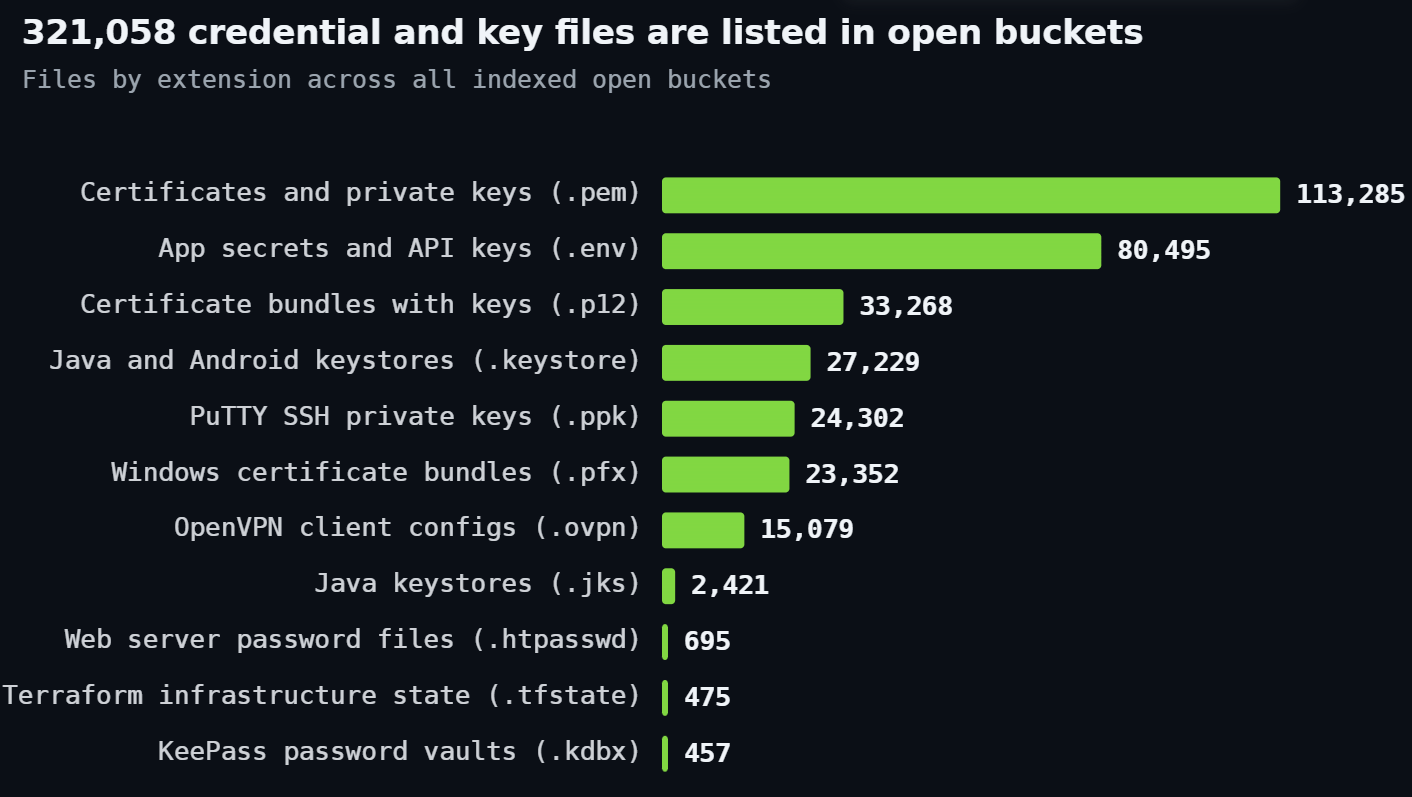
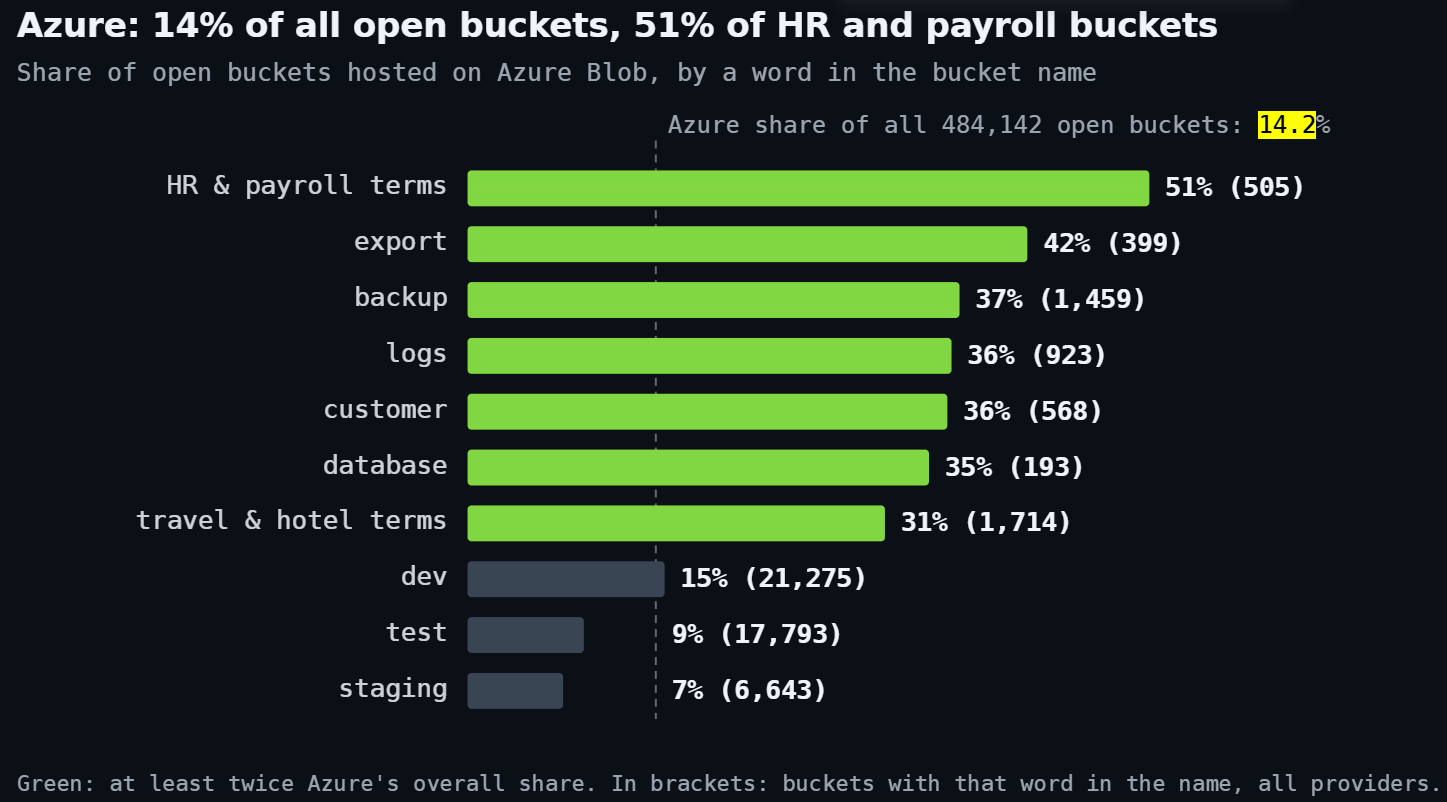
Amazon S3 accounts for 72% of the exposed buckets, roughly in line with its share of the market. This does not mean S3 has weaker security than other providers. Azure Blob, however, appears 2.5 to 3.6 times more often than expected among buckets named for backups, data exports and payroll records. The researchers also found 321,058 files related to credentials and keys. Of the exposed .env files, 67% were last modified in 2026.
Below is the split by provider, from a snapshot taken on October 7:
Provider
Open buckets
Share
Amazon S3
347,984
71.9%
Azure Blob
68,532
14.2%
Google Cloud Storage
53,131
11.0%
DigitalOcean Spaces
11,069
2.3%
Alibaba OSS
3,426
0.7%
Total
484,142
100%
A lot of these buckets are public on purpose, holding website assets, CDN mirrors, open datasets and podcast archives. So the index isn’t 484,142 breaches. It’s the pool where breaches hide, and the rest of the report narrows it down to the stores that should never have been listable.
“Azure, by a wide margin relative to its size. Azure Blob holds 14.2% of open buckets, but 37% of the 1,459 buckets with “backup” in the name, 42% of the 399 named for exports, and 51% of the 505 carrying HR or payroll terms.” continues the report. “Buckets named for logs, customers and databases sit at 35% to 36%, all around two and a half times Azure’s baseline.”
The skew only shows up for operational data. Buckets named “dev” sit at Azure’s baseline of 15 percent, and “test” and “staging” fall below it, at 9 and 7 percent. The authors suspect Azure storage accounts more often hold line-of-business data such as backups, exports and HR systems that enterprises run on Microsoft, while S3 and Google Cloud carry more application assets. They call it a hypothesis the counts suggest and don’t prove, and it’s the first thing they want to test next time.
By sector, retail and e-commerce names lead with 5,666 buckets, mostly storefront assets. The more worrying number is that names tied to regulated sectors (finance, healthcare, education, government, legal and HR) appear on 10,891 unique open buckets. Those are the places where a stray file most likely holds personal, health or financial records, and where regulators expect to hear about it.
Sector (by bucket name)
Open buckets
Files in them
Retail and e-commerce
5,666
269.9M
Finance and insurance
3,508
58.0M
Healthcare
2,709
47.9M
Media and entertainment
2,696
136.2M
Education
2,393
60.6M
Gaming
2,296
79.0M
Travel and hospitality
1,714
118.7M
Real estate
1,137
60.7M
Government and public sector
1,000
36.2M
Legal
978
11.3M
Crypto
630
11.9M
HR and payroll
505
8.4M
Healthcare-related names appear in 2,709 buckets containing 47.9 million files. The researchers identified them using terms such as “hospital” (135 buckets), “patient” (135), “clinic” (277) and “dental” (331). HR and payroll is the smallest sector, with 505 buckets, 259 of which are hosted on Azure.
These figures are based on names, not proof of ownership. The search matches parts of words, so “store” can refer to object storage as well as shops. A single bucket can also appear in two sectors.
The exposed buckets also list about 4.7 million database and dump files, 15,130 mailbox archives, and tens of millions of spreadsheets and documents. Credential files are particularly concerning because they can turn a cloud misconfiguration into a real intrusion.
File type
What it is
Files listed
.pem
Certificates and private keys
113,285
.env
App secrets and API keys
80,495
.p12
Certificate bundles with keys
33,268
.keystore
Java and Android keystores
27,229
.ppk
PuTTY SSH private keys
24,302
.pfx
Windows certificate bundles
23,352
.ovpn
OpenVPN client configs
15,079
.jks
Java keystores
2,421
.htpasswd
Web server password files
695
.tfstate
Terraform infrastructure state
475
.kdbx
KeePass password vaults
457
Each of these exists to grant access. A .env file is where developers keep database passwords and API keys. A .tfstate file is Terraform’s record of a whole cloud setup, often with secrets in plain text, and a .kdbx vault is encrypted but now open to anyone who wants to guess passwords offline. Some .pem files are public certificates and some files are test fixtures, so the counts are a ceiling on live secrets and not a measure of them. It’s still a big ceiling.
Database files make up most of the sensitive material by volume:
File type
What it usually holds
Files listed
.sqlite
Embedded app databases
2,561,807
.bak
Database and server backups
752,055
.sql
Database dumps
687,446
.sqlite3
Embedded app databases
488,176
.dump
Database dumps
176,603
.mdb / .accdb
Microsoft Access databases
36,467
.dmp
Memory and crash dumps
12,809
.pst / .ost / .mbox
Mailbox archives
15,130
.eml
Saved emails
4,549,665
.csv
Data exports and records
at least 69,580,112
.xlsx / .xls
Spreadsheets
42,544,997
.docx
Word documents
24,936,788
.pdf
Documents, invoices, scans
at least 106,191,393
.log
Application and server logs
at least 61,310,809
The exposed buckets contain thousands of virtual disk images, including VMware, Hyper-V and QEMU files. A single disk image can contain an entire server, including credentials.
Some exposures involve active systems. Of 80,495 .env files, 67% were last modified in 2026. Certificates and SQLite databases include both recent and older files. Backups appear older, with 89% of the 752,055 .bak files last modified before 2025. Almost all PuTTY key files date from 2024.
Recent leaks need urgent attention, while long-standing exposures point to poor security management. The problem is ongoing: at least 113.6 million files were added to publicly listable buckets in the seven days before September 9. Over the previous 30 days, these included more than 21,000 SQL dumps, nearly 21,000 backup files, 4,477 .pem files and 1,298 .env files.
Public .env files can expose database passwords that ransomware affiliates and initial access brokers look for. Similar credentials appear in stolen-data logs, but in this case, attackers do not need to infect a device. They only need to search for exposed files.
Cloud providers already offer settings to prevent public access. Organizations should enable S3 Block Public Access, disable anonymous access to Azure Blob storage, and enable public access prevention in Google Cloud. These controls should apply at account or organization level to prevent new storage buckets from becoming public.
Organizations should also scan their storage for sensitive files such as .env, .sql, .bak, .pem, .ppk, .tfstate and .kdbx. Terraform state files and virtual disk images should be treated as secrets, stored privately, encrypted and monitored. Backups should never be publicly accessible, and recovery procedures must be tested.
One exposed bucket may be a mistake, but many often indicate a wider process failure. Organizations need to fix the underlying security controls, not just individual buckets.
The research has some limitations. The team queried search engines on October 25, while the bucket list was current to October 7 and the newest indexed file dated September 9. File-level data may therefore be about a month old. Counts are also capped at one million per query, so researchers split larger categories into date ranges and added the results.
Some limits apply. The team queried the search engines on October 25. The bucket list was current to October 7 and the newest indexed file was dated September 9, so file-level figures lag by about a month. The index caps any single count at one million, so larger types were split into date windows and summed.
A last-modified date shows when a file was written, not when it was exposed, and a listed file isn’t proof that its contents can be read. No bucket is named in the report. Exposures with a known owner in regulated sectors are going through responsible disclosure, with national CERTs copied where the owner is public sector or doesn’t respond.
“Rotate any secret that has ever sat in a public bucket. Closing the bucket does not un-leak the key. Assume anything that was listable was copied.” conlcudes the report.
Before trick-or-treaters arrive, check your Ring Doorbell motion zones to reduce unwanted alerts and make sure visitors are detected along your walkway.
The post Your Ring Doorbell Could Miss Trick-or-Treaters — Check These Settings Before Halloween appeared first on TechRepublic.
Before trick-or-treaters arrive, check your Ring Doorbell motion zones to reduce unwanted alerts and make sure visitors are detected along your walkway.
Artificial intelligence has been part of semiconductor design for years, helping engineers optimize chip architectures for performance, power efficiency, silicon area and faster development. More recently, the industry has begun integrating large language models and AI agents into established electronic design automation (EDA) workflows. Now Cadence Design Systems is taking that approach further with its Maestro AI Model Portfolio, a collection of domain-specialized models
Artificial intelligence has been part of semiconductor design for years, helping engineers optimize chip architectures for performance, power efficiency, silicon area and faster development. More recently, the industry has begun integrating large language models and AI agents into established electronic design automation (EDA) workflows. Now Cadence Design Systems is taking that approach further with its Maestro AI Model Portfolio, a collection of domain-specialized models designed to work with the company’s engineering software and AI Super Agents.
Maestro combines specialized model training, reinforcement learning and established EDA tools to improve how AI agents execute engineering tasks and evaluate results. Cadence claims better design outcomes with greater token efficiency versus general-purpose foundation models. While initially focused on chip and electronic system design, I also see broader implications for enterprise AI economics, proprietary data protection and deployment across complex engineering and business applications.
AI builds on established engineering software
Modern semiconductor design is enormously complex. Engineers must balance performance, power consumption, silicon area, manufacturing constraints and costs across chips containing billions of transistors. Cadence and chief competitor Synopsys have spent decades developing software to optimize for these challenges, and both are now incorporating AI agents capable of executing increasingly complex engineering workflows using those tools.
Cadence Design Systems, Inc.
“Revolutionizing complex engineering tasks requires deep domain-specialized intelligence,” notes Cadence president and CEO Anirudh Devgan in the company’s announcement. In my discussions with Cadence executives, we explored how Maestro builds on that approach to improve engineering workflows and design outcomes.
Cadence Maestro combines domain-specialized, post-trained language models, trained decision models and reusable agent skills with Cadence’s EDA and system design automation (SDA) tools. The portfolio supports ChipStack, InnoStack, ViraStack and AuraStack AI Super Agents, which interpret engineering objectives, break them into tasks and engage appropriate models and software tools. Rather than relying on a single model, agents can combine Maestro with commercial frontier and open-weight models according to workload requirements.
What I find particularly interesting is Cadence’s reinforcement learning architecture. EDA tools, evaluation frameworks and deterministic solvers assess AI-generated outputs against engineering constraints, including timing, power and physical design requirements. That feedback can improve subsequent model decisions and agent behavior. It’s a potentially important advantage over relying exclusively on general-purpose LLMs, since engineering results can be evaluated against measurable design constraints rather than language-based assessments alone.
NVIDIA is contributing its Nemotron model technology and collaborating with Cadence on agent security through its OpenShell AI sandboxing architecture, with integration work by both companies underway.
The business case for domain-trained AI in engineering
Cadence Design Systems, Inc.
Cadence reports that initial Maestro evaluations delivered up to 30% better quality of results and five times greater token efficiency, compared to a general-purpose foundation model. These are early vendor-reported results, however, and Cadence hasn’t disclosed enough benchmark detail to establish how consistently those advantages translate across production workloads.
Greater token efficiency is always a goal of course, particularly for AI agents executing lengthy, iterative engineering tasks. But reducing token consumption doesn’t always translate into proportional cost reductions. Engineering software, simulation infrastructure, verification and available compute resources also contribute substantially to development costs.
To me, the larger opportunity is improving design quality and shortening development cycles. Chip development programs can require hundreds of engineers and substantial capital investment, so even modest productivity improvements or faster time to market can offer significant value.
Cadence Design Systems, Inc.
Cadence customer Socionext expects up to fivefold productivity gains from deploying the company’s InnoStack AI Super Agent in production, although that’s a projection rather than a demonstrated Maestro result. Silicon Labs has also reported faster root-cause analysis and debugging using Cadence’s ChipStack technology. These examples show progress with agent-based engineering, but Maestro’s performance claims still need production validation. I’ll be interested to see how those results develop.
Deployment flexibility and data control
Another noteworthy aspect of Maestro is deployment flexibility. Cadence says its agentic engineering environment supports deployment through its own secure cloud platform, supported public clouds or customer-controlled on-prem infrastructure. Customers can also further train supported models using proprietary engineering data.
For semiconductor companies, where intellectual property can represent billions of dollars in investment, maintaining control over sensitive design information is critical. Similar considerations apply in financial services, healthcare and aerospace, where proprietary data and regulatory requirements can complicate AI deployment.
The tradeoffs warrant examination, however. On-prem deployments can shift responsibility for GPU infrastructure, model updates, security controls and optimization to the customer. Those costs need to be weighed against cloud inference expenses, data residency requirements and the potential performance benefits of processing data close to engineering workloads. In my view, Cadence’s deployment flexibility is valuable because enterprises can evaluate these choices against their infrastructure, security policies and engineering economics.
Specialized AI continues to gain momentum in chip design
Cadence Maestro is part of a broader industry push toward AI-driven semiconductor engineering. Established EDA vendors are expanding their agentic capabilities, while AI-native startups are developing systems for RTL generation, verification, debugging and physical design optimization. Domain-trained models, engineering feedback loops and intelligent model routing are also gaining attention.
What’s interesting here is the potential for agents to coordinate multiple engineering tools and models while retaining the design context needed for complex tasks. The business opportunity extends beyond automating individual steps to reducing the effort required to reach verified design results. For enterprise technology execs, that puts greater emphasis on toolchain integration, measurable productivity improvements and the economics of AI-assisted engineering.
Proving the value of specialized AI in chip design
Cadence’s first Maestro models are entering select customer early access in the fourth quarter of 2026, so it’s too early to know whether the company’s performance claims will translate consistently into production.
General-purpose models will remain important for broad reasoning, language and multimodal applications. However, specialized engineering processes often demand deeper domain knowledge, validated results and tight integration with existing software.
From my perspective, Cadence’s approach offers a glimpse of where enterprise AI is heading. Selecting the right models, tools and deployment architecture for specific workloads will be critical as adoption expands. And the early results are promising, with specialized AI showing the potential to improve engineering outcomes, boost productivity and reduce development costs at scale.
CIOs are dealing with a lot of change, from the rapid rise of AI and cloud modernization, to cybersecurity and workforce transformation. Many are sharing what they’re learning as they tackle these challenges, including what’s working, what isn’t, and how they’re implementing new technologies in their organizations. Here, a select group of tech leaders reveal the CIOs they follow and why.
Suma Nallapati, chief AI and information officer, City and County of Denver
I fo
CIOs are dealing with a lot of change, from the rapid rise of AI and cloud modernization, to cybersecurity and workforce transformation. Many are sharing what they’re learning as they tackle these challenges, including what’s working, what isn’t, and how they’re implementing new technologies in their organizations. Here, a select group of tech leaders reveal the CIOs they follow and why.
Suma Nallapati, chief AI and information officer, City and County of Denver
I follow Suma Nallapati primarily through public technology and AI leadership discussions. She regularly discusses AI adoption, responsible AI, digital transformation, technology strategy, AI governance, human-centered technology, and using AI to improve public services. I find her perspective particularly valuable because she connects AI strategy with practical organizational and citizen outcomes. She also emphasizes responsible and human-centered AI rather than viewing AI simply as a technology implementation exercise. One initiative I found particularly interesting was Denver’s use of AI through its multilingual Sunny chatbot and other city services. Her current role includes scaling AI across areas such as resident engagement, internal automation, permitting, and emergency response while maintaining governance, transparency, and public trust. – Sachin Gupta, senior IT manager, Arrow Electronics
Jennifer Hartsock, chief information and digital officer, Cargill
I follow Jennifer Hartsock through the CIO community, as well as through her thought leadership, interviews, and LinkedIn. I especially enjoy hearing her perspective in longer-form conversations where she talks candidly about the realities of leading technology and transformation in a large, complex organization. Hartsock talks about many of the issues CIOs are navigating right now, including AI, digital transformation, technology operating models, talent, and leadership. A consistent theme in her perspective is connecting tech decisions back to the business, including how tech teams work with the business, and how you create greater ownership closer to the outcomes you’re trying to achieve. – Kathy Kay, EVP and CIO, Principal Financial Group
Fletcher Previn, SVP and CIO, Cisco
Fletcher Previn’s profile shows how a modern technology leader can discuss change without reducing it to a narrative about vendors. He explores AI, culture, talent, and productivity, with an emphasis on conditions that determine whether transformation lasts. The insight worth returning to is his focus on adoption as a leadership responsibility. New technology fails when teams lack learning time, managers lack clarity, and incentives reward behavior that no longer serves the business. CIOs can apply that lens to modernization, security initiatives, and data governance. It encourages an honest definition of progress based on decisions and outcomes rather than launch dates or dashboards. – Sherif Koussa, CEO, Software Secured
Kellie Romack, CDIO, ServiceNow
What makes Kellie Romack’s perspective valuable is she talks about AI from inside a large enterprise IT organization, not the outside. Her posts regularly cover enterprise AI, AI governance, autonomous IT, workforce transformation, cybersecurity, digital transformation, and how the CIO role is changing.
The point that stayed with me was her argument that CIO organizations now have to redesign jobs, teams, and workflows around AI while building new human skills at the same time. That’s a useful distinction. It frames successful AI adoption as an organizational and leadership problem as much as a technology one. Her seat at ServiceNow also gives her a view of what happens after the experiments stop. ServiceNow has reported that its internal AI use cases grew from 15 to more than 200. That makes her worth reading about for any CIO trying to understand what scaling enterprise AI actually looks like. – Tapabrata Biswas, project manager, InfluxIQ Tech Pvt. Ltd.
Mike Blandina, CIO, Snowflake
I follow Mike Blandina for his practical perspective on enterprise AI adoption and the operational realities behind digital transformation. His commentary consistently connects emerging technology with the governance, workforce skills, and measurable outcomes needed to make it useful. One insight that particularly resonates with me comes from this CIO.com article.
He makes the case for building an editing culture rather than a writing culture. As AI increasingly handles first drafts of code, reports, and other work, he argues that the critical human skill becomes evaluating outputs, identifying mistakes, and knowing when to challenge the system. I also appreciate his emphasis on data lineage, access permissions, and measuring actual productivity improvements instead of AI tool logins. Those are the less visible decisions that determine whether enterprise AI adoption delivers lasting value. – Parth Patel, director of operations, Shaligram
Deepa Soni, EVP and CIO, New York Life Insurance Company
Deepa Soni’s insights are particularly valuable because she oversees AI in one of the most critical and regulated sectors of financial services, a Fortune 100 life insurance company where AI decisions have real consequences for policyholders and regulators.
Soni frequently shares in-depth thoughts on what responsible AI adoption truly looks like within a large financial institution. She discusses the delicate balance between the speed of innovation and the readiness of governance, as well as how tech leaders can foster cultures that promote both agility and accountability. What sets her apart is that her approach to AI strategy is rooted in operational realities rather than just vendor hype, which is a rare and precious perspective for CIOs facing similar challenges. – Viren Meghani, technical architect and independent researcher in AI governance
Sears Merritt, CIO and head of enterprise technology and experience, MassMutual
I follow Sears Merritt on LinkedIn and through his interviews. He talks about what enterprise AI costs to run and how to keep the option to change your mind. Merritt also discusses why AI vendor contracts should be capped at 12 months to maintain flexibility, how success metrics are defined before AI pilots begin to determine whether they should be scaled, and the data platform he spent three years building before the AI wave arrived. This is useful to other CIOs because he’s one of the few CIOs at a regulated insurer who talks about AI in the language of procurement and measurement rather than vision. – Egiziago Cioffi, IT/enterprise architect and CEO, SynSphere Italia
Ganesh Ariyur, CIO and head of enterprise technology, Gainwell Technologies
I follow Ganesh Ariyur for his insightful views on AI, enterprise architecture, transformation, tech strategy, governance, and ways CIOs can link tech investments to quantifiable business value. What I find particularly helpful is his content extends beyond just talking about new technologies. He continually positions technology choices in relation to business results, operational frameworks, financial discipline, and implementation. This is particularly important for CIOs facing pressure to showcase ROI from AI and modernization efforts.
An example is his work, The 2026 CIO Operating Model: Architecture, AI, and Enterprise Value. His main point is that tech strategy must be viewed more like capital strategy, with CIOs assessing issues like if cloud expenditures enhance unit economics, and if architecture facilitates quicker decision-making. That viewpoint is important as it transitions the dialogue from which technology to implement, to what ways technology should transform the enterprise’s operations and value creation. – Ketan Patel, digital marketing manager, WeDoWebApps
Jim Swanson, EVP and CIO, Johnson & Johnson
I’m interested in how Jim Swanson thinks about the relationship between technology and the business, particularly where innovation carries considerable responsibility. For example, he recently discussed how AI agents are changing the way people interact with enterprise software. What caught my attention was his emphasis on the complexity that comes with that change — the integration, oversight, and accountability required to make it work. Those are questions that deserve as much attention as the technology itself. – Bill Huber, partner, ISG
Kimberly Basile, CIO, Kyndryl
I follow Kim Basile along with her bylined pieces on Kyndryl’s newsroom and interviews in the business press. She discusses enterprise AI adoption, workforce readiness, AI governance, platform modernization, and security leadership, informed by her earlier role as SVP and CISO at Leidos. Basile speaks from inside a transformation few CIOs have experienced, having helped guide Kyndryl’s technology separation from IBM and consolidate its application portfolio. She treats governance and people readiness as part of AI adoption from the start, and she’s candid about what hasn’t worked. In a recent feature on agentic AI, for instance, she said Kyndryl initially focused on counting agents, and the number didn’t tell the true story. Her team pivoted to measure business process flows. She also identified automating a process that hadn’t been properly validated as one of the company’s biggest mistakes. Activity metrics are easy to report, so organizations default to them. Her lesson pushes CIOs to validate a process before automating it.
She matters beyond the technology because women remain underrepresented in IT leadership, and she uses her visibility to lift others. When she was named to Women We Admire’s Top Women CIOs of 2026, her second year on the list, she used her post to congratulate the other honorees by name and highlight how these leaders help employees embrace technology. That generosity matters in a field where women CIOs are still too few. As the co-founder of Girl Power Talk, I pay attention to leaders who open doors for the next generation of women in tech. Basile does that consistently. – Sameer Somal, founder and CEO, Blue Ocean Global Technology
Enterprise collaboration technology has become an essential part of daily business operations, but managing it is increasingly complicated. What was once a relatively isolated audiovisual (AV) environment is now deeply integrated with enterprise IT infrastructure, unified communications and collaboration (UCC) platforms, and security systems.
For IT leaders, that convergence is creating new demands on resources, expertise, and budgets.
“Complexity has increased drama
Enterprise collaboration technology has become an essential part of daily business operations, but managing it is increasingly complicated. What was once a relatively isolated audiovisual (AV) environment is now deeply integrated with enterprise IT infrastructure, unified communications and collaboration (UCC) platforms, and security systems.
For IT leaders, that convergence is creating new demands on resources, expertise, and budgets.
“Complexity has increased dramatically in the environments that customers have to manage today,” says Karen Klosinski, VP Product & Solutions at AVI-SPL.
Supporting these environments now requires expertise across multiple disciplines, while frequent software updates introduce a pace of change that many internal IT teams struggle to maintain. As collaboration environments become more complex, organizations are reconsidering whether traditional support models can keep pace.
Recognizing when IT needs additional support
Several indicators can signal that an organization’s approach to collaboration management needs to evolve. Platform migrations, for example, can require extensive retraining or hiring to develop new technical capabilities. IT leaders may also find that maintaining collaboration systems consumes resources needed for more strategic initiatives. Meanwhile, recurring technical issues and declining employee satisfaction can suggest that existing support models are falling short.
These challenges don’t necessarily require organizations to outsource everything. Managed services can supplement internal capabilities, giving IT teams access to specialized expertise without the expense and difficulty of building every competency in-house.
That economic argument is becoming increasingly relevant to smaller organizations. As demand for specialized skills grows, even midsize businesses may struggle to justify the cost of hiring experienced administrators for platforms such as Microsoft Teams.
Moving beyond reactive support
The greatest value of managed services comes from improving how collaboration environments perform over time. An effective provider should deliver more than service-level agreements and troubleshooting. It should analyze recurring problems, identify underlying causes, and recommend improvements that reduce future disruptions.
For example, repeated failures involving the same technology might warrant configuration changes, upgrades, or replacement planning. Providers can also help coordinate changes across internal IT groups, particularly when network modifications affect collaboration systems.
The ultimate measure of success is the employee experience. As Klosinski explains, “It’s not the ticket count, it’s the, you know, we’re helping your business work seamlessly.”
This proactive approach allows IT leaders to focus less on recurring operational issues and more on initiatives that support business growth.
Building a model that scales with the business
Collaboration requirements rarely remain static. As organizations expand or consolidate, adopt new platforms, and adjust staffing, managed services can provide the flexibility to accommodate these changes without continually rebuilding internal support capabilities.
AVI-SPL offers both remote-centric and on-site managed services for AV and UCC environments, allowing organizations to select an approach aligned with their operational requirements and network access policies. For CIOs evaluating providers, the priority should be a long-term partnership built around technical expertise, transparent performance reporting, shared operational standards, and continuous optimization.
As collaboration technology becomes more deeply embedded in business operations, the ability to manage it effectively will increasingly depend on having the right expertise, processes, and flexibility in place.
Learn more about how AVI-SPL’s Enterprise Managed Services can help your organization simplify AV and UCC management, improve collaboration experiences, and continuously optimize performance at scale.
For the past two years, the conversation around AI has focused on which industries it will disrupt. But AI’s rapid growth is also creating a major infrastructure challenge. As investment pours into data centres and supporting infrastructure, the AI boom is becoming central to delivering the next wave of the digital economy, reshaping construction in unexpected ways.
Earlier this year, NVIDIA CEO Jensen Huang called AI the “largest infrastructure buildout in human histor
For the past two years, the conversation around AI has focused on which industries it will disrupt. But AI’s rapid growth is also creating a major infrastructure challenge. As investment pours into data centres and supporting infrastructure, the AI boom is becoming central to delivering the next wave of the digital economy, reshaping construction in unexpected ways.
Earlier this year, NVIDIA CEO Jensen Huang called AI the “largest infrastructure buildout in human history.” For Australia, that presents a significant opportunity. Global tech companies are investing heavily in the infrastructure needed to support AI growth, and Australia is increasingly viewed as the place to do it because of our land availability, stable institutions and long-term renewable energy potential.
The interesting part isn’t just the scale and opportunity AI presents. It’s that construction has reached its own inflection point, with the data and AI boom creating a rare opportunity to modernise how the industry plans, designs and delivers projects.
Construction is becoming more data-driven
Construction will always be grounded in the physical work of building.
But increasingly, data is shaping how projects are planned, coordinated and delivered.
Long before construction starts onsite, projects are developed in highly detailed digital environments. On the most advanced projects, buildings are now designed, coordinated and resolved virtually before anyone steps foot on site. Architectural, structural and services information is combined into a single living digital model where thousands of potential clashes can be identified and addressed up front, providing greater certainty of programme, cost and delivery.
This shift has made digital pre-construction one of the industry’s most valuable investment areas, reducing rework, improving productivity and minimising disruption for surrounding communities.
Unlike many other industries, construction generates large volumes of real-world data that general AI models can’t scrape from the internet. Laser scans and site cameras capture a detailed picture of how physical assets are designed and assembled, and companies that use that data effectively can build faster and with better certainty.
That data has historically been fragmented and underutilised.
AI is creating the opportunity to connect that information and turn it into better decisions, creating a significant competitive advantage.
The workforce shift no one expected
One of the more important opportunities created by AI is the chance to rethink how technical and trade-based careers evolve.
Construction and technology have typically followed separate talent pathways. Today, those worlds are increasingly converging as digital tools, data and advanced manufacturing become further embedded across the industry.
The workforce is beginning to evolve as modern construction becomes more digital. Tradespeople are increasingly working from digital models on tablets, assembling components prebuilt in factories and engaging with advanced manufacturing processes that would have been unfamiliar a decade ago.
At the same time, construction companies are recruiting machine learning engineers, AI product managers and advanced manufacturing specialists alongside traditional project teams.
The result is an industry with the potential to look very different from the stereotypes that still shape how it is often perceived.
AI still needs builders
Technology companies receive much of the attention when it comes to AI. But AI growth cannot exist within a vacuum.
Behind every model, agent and application sits an ecosystem of physical infrastructure that must be financed, designed, powered and built. As AI investment accelerates, the industries responsible for delivering that infrastructure will become increasingly important to the success of the digital economy.
There’s an irony in that.
The technology many people believe will transform the future relies on an industry still often viewed as traditional. For construction, that creates a rare opportunity: to use the data and AI boom not only to deliver the next wave of infrastructure, but to accelerate the industry’s own transformation.
AI does well in digital settings with clear rules. The physical world is messier and harder to predict. Ultimately, AI still relies on people to make decisions and safely build what it runs on. There’s something reassuring in that, and a little ironic. For all the talk about machines, it’s still people who set the pace.
DeepSeek has been dealt a huge blow in the US, even as it continues to innovate and keep pace with, or in some cases outperform, rival models from American labs.
The US Secretary of Homeland Security has issued an order banning all DeepSeek products and services from federal agencies. Government organizations must purge their IT systems of it within 60 days; those with “compelling justification” can make a case for exemption by written request to the Cybersecurity and I
DeepSeek has been dealt a huge blow in the US, even as it continues to innovate and keep pace with, or in some cases outperform, rival models from American labs.
The US Secretary of Homeland Security has issued an order banning all DeepSeek products and services from federal agencies. Government organizations must purge their IT systems of it within 60 days; those with “compelling justification” can make a case for exemption by written request to the Cybersecurity and Infrastructure Security Agency (CISA).
The Department of Homeland Security (DHS) cited multiple concerns about the Chinese-hosted model, including data sovereignty, lax Chinese laws, and security vulnerabilities.
Analyst Erik Avakian, technical counselor at Infotech, understands the concern. “When organizations use any type of hosted AI service, they’re potentially sending intellectual property, confidential business information, or other sensitive data into an environment where they may have very little visibility or control over what happens to it,” he said.
Government concerns
According to a document published in the US Federal Register, all technology developed by China-based Hangzhou DeepSeek Artificial Intelligence Co. will be banned from procurement by federal civilian agencies. This includes affiliated products and any third-party tools or software built using DeepSeek implementations.
Affected civilian executive branch agencies include the Departments of Treasury, State, and Justice; it does not apply, however, to private consumers, the general public, state/local governments, or Department of Defense (DoD) national security systems.
“DeepSeek’s models present multiple threat vectors,” the Order stated. To begin with, the company’s servers are located in the People’ s Republic of China (PRC), whose legal system grants “extensive authority” to government cyber and intelligence functions to access private infrastructure.
DeepSeek’s account generation process collects personally identifiable information (PII) and may also track and digitally fingerprint users, the Order asserted. Its prompt response process may result in the transfer of sensitive data to the PRC. This could give it “actionable intelligence” on US programs or individual users.
Further, the Order stated, DeepSeek models themselves may contain malware or other security vulnerabilities. DHS pointed to open-source security research published in February 2025 that uncovered many iOS mobile apps with multiple critical vulnerabilities.
Until the ban takes full effect, DHS advised agencies to mitigate risk by monitoring inbound and outbound data traffic, implementing enhanced logging and controls on data exfiltration, and detecting and flagging anomalous activity.
Agencies can submit requests for exceptions to the ban in writing, and must provide a “compelling justification,” such as its impact on mission-critical functions, or other considerations related to national interest such as national security reviews, investigations, or security agreements, as reasons why such exemption should be granted,.
Security issues are rampant
The ban comes just as DeepSeek is open-sourcing DeepInfer, its in-house interference framework. DeepInfer powers DeepSeek-V4.1-Flash with what the company said is high throughput and low latency. It features high-performance kernels, an optimized inference engine, structured outputs, and speculative decoding.
DeepSeek said its production token encoding and decoding components, which are aligned with processing logic behind the DeepSeek API, will bring the “same API behavior to community deployments.”
“Open models. Open kernels. Open inference,” DeepSeek posted to social media site X. “From private deployments to public clouds, we’ll keep working with the community to make large-scale inference more efficient.”
This isn’t its first roadblock from a cybersecurity perspective. Most notably, in January 2025, the company leaked more than one million log entries, including chat histories, API secrets, and other sensitive information, through an unsecured database.
DeepSeek reportedly addressed the exposure, but it still raised questions about the overall security practices surrounding the platform, particularly for organizations considering entrusting it with their own sensitive business information, Avakian pointed out.
That’s not to imply that every DeepSeek model is “inherently malicious,” he said, but there are still major questions around data privacy, the potential for information access under Chinese laws, the security of the broader AI ecosystem, and the susceptibility of DeepSeek’s models to jailbreaks and manipulation.
“Taken together, [these issues] raise legitimate concerns about whether organizations can adequately understand and manage the risks involved,” Avakian said.
Enterprises should seriously assess associated risk
Enterprises are increasingly exploring DeepSeek, although most publicly-documented adoption has been in China, Avakian noted. Some DeepSeek models have also been made available through platforms like Microsoft Azure and AWS.
“There’s genuine enterprise interest in the technology, as organizations look for opportunities to improve productivity, offer new capabilities, or reduce costs,” Avakian said. Useful applications include document summarization, internal research, and coding assistance.
DeepInfer also has the potential to reduce costs, but possible benefits should be weighed against associated security risks, he pointed out. The framework was just released, so organizations are going to need to validate the claimed efficiencies in their own environments rather than assuming savings will automatically translate into lower operating costs.
He encouraged organizations to start with relatively low-risk use cases, preferably using “public, synthetic, or appropriately sanitized information,” within a sandboxed environment they control themselves.
The important question to ask: ‘What is the business problem we’re trying to solve?’ From there, Avakian said, determine whether DeepSeek is the best way to solve it, validate security controls, and expand the use cases based on risk tolerance. Effective governance and risk assessment are key, he noted: understand what you’re bringing into your environment, validate its security, restrict its permissions, and make sure you can monitor what it’s doing.
“Approach this like any other software supply chain decision,” Avakian advised. “The fact that something is open source, inexpensive, or technically impressive doesn’t automatically make it appropriate for enterprise use.”
Impact on the broader AI ecosystem
The fact that the Order also addressed third-party products and services developed using DeepSeek implementations is important, Avakian said, because organizations may be using DeepSeek technologies indirectly, through vendors, software platforms, or other services, without necessarily knowing what’s operating underneath. “These are classic supply chain issues,” he observed.
It’s no longer enough to know which AI applications employees are using; enterprises must understand which models, frameworks, dependencies, and external services are embedded in products they’re purchasing and deploying, Avakian said. This means revisiting AI inventories, potentially updating procurement requirements, and expanding processes around third-party risk management, he advised.
“Ultimately, enterprises leveraging these tools need to understand not only the AI technologies they’re intentionally deploying, but also the technologies they’re inheriting through third parties,” he said.
Regulated industries have been dealing with the equivalent of sovereign data for a long time. And as the geopolitical situation makes it more broadly relevant, it doesn’t make it any easier to deal with.
From concerns about the reach of the US CLOUD Act and what telemetry or sensitive business data gen AI models might collect, to implications of the US government taking part ownership of a range of technology companies and the impact of EU regulations, the state of the
Regulated industries have been dealing with the equivalent of sovereign data for a long time. And as the geopolitical situation makes it more broadly relevant, it doesn’t make it any easier to deal with.
From concerns about the reach of the US CLOUD Act and what telemetry or sensitive business data gen AI models might collect, to implications of the US government taking part ownership of a range of technology companies and the impact of EU regulations, the state of the world means more organizations need to think about where data is located.
The result is a flood of announcements from hyperscalers about new EU cloud regions, as well as pitches from regional and private cloud providers. The promised sovereignty may be anything from a local availability zone to more sophisticated approaches to ownership structure, compliance frameworks, where logs are stored, or where support staff work.
Actual data sovereignty involves legal, technical, contractual, governance, and infrastructure questions, but all too often, what’s on offer is what IDC research director Rahiel Nasir calls sovereignty washing. “When you look under the lid, all they’re really offering is a solution for data residency and data localization, keeping data in country,” he says. “That’s part of sovereignty, but not all of sovereignty.”
In his experience, in-country data centers are the first thing organizations ask for to support data localization and data residency, but they also require enhanced controls over identity and access management. That’s critical because data sovereignty is as much about who has access to the data and why, as where it lives.
“It’s really important the only people who touch my data in what is supposedly a sovereign cloud environment are those I give permission to,” he adds. “Because it’s my data, and I’m the only one who can give the authority to grant access to it. That also applies to support and admin staff.”
Companies want control through where they store data but also to restrict how users can interact with it that might expose that information outside an approved environment or jurisdiction, adds Acceldata SVP Ali Afsar.
Access and control
Don’t confuse the regulatory requirements of data residency with data sovereignty, Scality CMO Paul Speciale warns. “Residency is about geography,” he says. “Sovereignty is about control, jurisdiction, and who ultimately has the legal authority to access data.”
For CIOs, the question is no longer simply where the data is but who can access it, who controls the encryption keys, under which legal framework it operates, and can that control be proven. That includes being able to show who accesses data, from where, and for what purpose, which requires verifiable controls like jurisdiction-aware data placement, immutable backups, tightly governed admin access, and clear audit trails.
The UK government’s recent call for evidence on the impact of international data flows on sovereignty makes this explicit, referring to transfer by access where personal data remains in the UK but is accessed from overseas, including by a user located in another country. Access transfers include administrative access, backups, disaster recovery, support incidents and sometimes — depending on the specific regulations — processing the data.
GDPR doesn’t mean data has to stay in the EU but it does require data to be protected to EU standards wherever it goes. Data transfer obligations for other jurisdictions can be far more restrictive, so multinational organizations may need access controls limiting who can see what regulated data from different locations.
RBI-regulated payment-system data, for instance, must be stored in India, but can be processed outside India, Afsar explains, as long as it’s deleted from overseas systems within 24 hours. And with limited exceptions, personal data in Saudi Arabia must be processed within the Kingdom, and China treats overseas access to some categories of data stored in China as a cross-border data activity. Russian laws require similar strict data localization, and personal data of Russian citizens has to be stored, processed, and kept within the country’s borders at all times, which is why LinkedIn was blocked there.
Elsewhere, regulations are most restrictive for specific markets like healthcare, financial, and public services. Not everything needs to be transferred to a sovereign cloud, Nasir points out, as use of that data is subject to regulatory compliance, and the increasing need for AI training.
“This is the data that’s going to have catastrophic business impacts if leaked,” he says. “To give enhanced controls and security for that data, you’d consider wrapping sovereign controls around it. Everything else not subject to compliance nor sensitive data can be accessed by whomever you want and from wherever.”
Sovereignty and safety
Organizations typically know data sovereignty rules well but still experience incidents like data breaches, government data access requests, and unauthorized cross-border transfers caused by, for example, traveling employees or excessive admin access, according to Kiteworks’ 2026 Data Security and Compliance Risk report.
“Location only tells a regulator where the data rests, not who can still reach it,” says Kiteworks’ EMEA GM Dario Perfettibile. “Every real exposure we’ve seen so far happens through access not geography.”
Thinking data needs to stay in region because then it’s safe gives a false sense of security if practiced as a substitute for proper data management. Access, data labelling, and retention polices take more work but are what can prevent incidents. “If you have a data policy in place, it can force a reapproval of the access,” he adds. “It can restrict access to you only, or it can block you out immediately.”
Location isn’t everything
Using a service closer to home doesn’t automatically make any of that easier. “Many organizations still assume sovereignty can be achieved by moving data from one cloud provider to another, or by replacing one hyperscaler with another,” says Keepit Group CISO Kim Larsen. “That misses the bigger picture.” CIOs should treat sovereignty as an operational capability not a compliance exercise, he adds, since sovereignty isn’t about scale or ownership of infrastructure for its own sake, but maintaining control.
“If an organization doesn’t know who can access its data, which legal frameworks govern that access, or whether it can recover its data independently, simply changing where the servers are located does little to reduce risk,” he says.
Just because something is based in your region doesn’t automatically make it a good choice. The EC, for instance, has set up accounts on W Social, an independent social media platform based on the AT protocol designed for data mobility and user migration, which Bluesky uses but is hosted in Europe.
The Commission’s own open source strategy suggests open source promises more control over digital infrastructure by avoiding vendor lock in, and a recent policy brief positions digital sovereignty as a form of digital independence. But having servers in the EU isn’t the same as freedom of digital movement since unlike Eurosky, based in Europe and using the same protocol, W limits interoperability so it can require identity verification, and has closed its source code after security researchers pointed out vulnerabilities.
Most organizations will continue to use both global and local providers, though they might prioritize what Nasir called glocal options built on partnerships between the two. “Organizations want to use a mixture of local and global providers,” he says. “They want all the innovation capabilities that the Microsofts, AWSs, and Googles of the world give us, that they consider local providers can’t match.”
IDC figures suggest only 4% of European organizations plan to switch to purely local options. “We can’t live without US technology today and there’s no appetite to do that,” says Nasir. Availability matters and local providers may not have the same level of infrastructure as global options. They can offer low hanging fruit like video conferencing solutions, but not more complicated directory and database services, or productivity software that’s intertwined with those US-provided services.
Choices about where to store data, and the technical controls to enforce that, have their own operational implications.
“Redundancy and resiliency are key tenets of sovereignty,” he adds. “You want to make sure your operations are always available. In order to enable that, you want to spread the risk.”
Personal information belonging to millions of current and former California public school students has been stolen from a system operated by Educational Testing Service (ETS).ETS is a nonprofit organization that helps run the state’s standardized tests under contract with the California Department of Education (CDE). It has begun notifying students and families after an unauthorized party accessed and copied student information from an ETS-operated secure file transfer protocol (SFTP) site. CDE
Personal information belonging to millions of current and former California public school students has been stolen from a system operated by Educational Testing Service (ETS).
ETS is a nonprofit organization that helps run the state’s standardized tests under contract with the California Department of Education (CDE). It has begun notifying students and families after an unauthorized party accessed and copied student information from an ETS-operated secure file transfer protocol (SFTP) site. CDE is distributing the ETS breach notice to help affected individuals receive information about the incident and available resources.
An investigation determined that an unauthorized party used compromised login details to access the site and copy files containing California student information at various times between May 22 and September 18.
The CDE says the breach includes all students enrolled during the previous three school years, although the affected population is not limited to that group. The information involved varies by individual but may include:
Student names
Statewide Student Identifiers (SSIDs)
Dates of birth
Home addresses
Demographic information
Disability and program participation information
Statewide assessment information, including test scores
According to the CDE, over 5.7 million students were enrolled in California public schools during the 2025–2026 school year alone.
Not every affected student had every category of information exposed. However, this is clearly more than a list of names and email addresses: The stolen files can reveal highly personal information about a student’s education and disabilities.
CDE says Social Security numbers, financial account information, passwords, and parent or guardian information were not involved. ETS says it has found no evidence so far that the stolen information has been made public.
How to stay safe
ETS, at CDE’s direction, is notifying affected students and families. If your information or your child’s information was involved, follow the instructions in the notification and:
Verify any communication about the incident through official channels.
Consider enrolling in the two years of free identity-protection services. Parents or legal guardians can enroll affected minors, while affected adults can enroll themselves. Check the instructions for the appropriate age group.
Watch for messages that use details about your child or their school to sound convincing. Don’t share passwords, security codes, or payment details in response to an unsolicited message or call.
Let’s face it, an incognito window can only do so much.
Breaches, dark web trading, credit fraud. Malwarebytes Identity Theft Protection monitors for all of it, alerts you fast, and comes with identity theft insurance.

 Entrar