❌

Visualização normal

Antes de ontemStream principal
  • ✇Firewall Daily – The Cyber Express
  • Ransomware Attacks on Hospitals and Businesses Lead to 70-Month Sentence Samiksha Jain
    A Ukrainian ransomware affiliate has been sentenced to 70 months in prison for participating in cyberattacks against hospitals, businesses, law firms and government entities across multiple countries. Artem Stryzhak, 36, was sentenced in the United States for his role in ransomware conspiracies linked to more than $100 million in losses, according to the U.S. Department of Justice (DOJ). Stryzhak worked with the Nefilim ransomware and Hive ransomware groups, targeting computer network
     

Ransomware Attacks on Hospitals and Businesses Lead to 70-Month Sentence

29 de Outubro de 2026, 05:57

Ukrainian ransomware affiliate

A Ukrainian ransomware affiliate has been sentenced to 70 months in prison for participating in cyberattacks against hospitals, businesses, law firms and government entities across multiple countries. Artem Stryzhak, 36, was sentenced in the United States for his role in ransomware conspiracies linked to more than $100 million in losses, according to the U.S. Department of Justice (DOJ). Stryzhak worked with the Nefilim ransomware and Hive ransomware groups, targeting computer networks and disrupting operations across different sectors. The attacks included incidents affecting healthcare providers during the COVID-19 pandemic, when hospitals faced disruptions to their ability to access digital systems and treat patients.

Ukrainian Ransomware Affiliate Linked to Two Groups

According to court documents, Stryzhak joined the Nefilim ransomware operation around June 2021 as an affiliate. He received access to the group's ransomware under an arrangement with administrator Volodymyr Tymoshchuk and agreed to pay the administrators 20% of the ransom proceeds collected from victims. One documented attack took place in June 2021, when Stryzhak stole data from a company operating in the oil and gas transportation industry. About a week later, he created email addresses that were incorporated into a ransom note sent to the company. The attackers used ransomware to encrypt victims' files and demanded payment. If a victim paid, the perpetrators provided a decryption key to restore access to the locked data. Stryzhak remained involved in the Nefilim conspiracy until at least October 2021, court records state. He separately joined the Hive ransomware group as one of its earliest affiliates. Between June 2021 and January 2023, Hive conspirators attacked approximately 1,500 victims worldwide, including government entities, hospitals and businesses.

Hive Ransomware Attacks Disrupted Hospital Operations

The Hive ransomware operation caused significant disruption to organizations, including healthcare facilities responding to the COVID-19 pandemic. According to the DOJ, one hospital targeted by the group had to stop relying on digital technology to treat existing patients and was temporarily unable to accept new patients immediately following the attack. As a Hive affiliate, Stryzhak and his co-conspirators deployed ransomware against seven victims. These included law firms, a dental office and a healthcare provider during the pandemic. The attacks left victims unable to access encrypted data, affecting their day-to-day operations. The FBI had previously conducted a months-long disruption campaign against Hive. During that effort, investigators obtained a decryption key and provided it to one of Stryzhak's victims, enabling the organization to recover its encrypted data without paying a ransom.

FBI Investigation Spanned Multiple Countries

The investigation involved several FBI field offices and international law enforcement partners. The FBI Springfield Field Office investigated the Nefilim ransomware case, while the FBI Tampa Field Office investigated the Hive operation. The FBI's New York Field Office, the Justice Department's Office of International Affairs and Spanish law enforcement authorities also assisted in locating, arresting and extraditing Stryzhak. He was arrested in Spain in June 2024 and extradited to the United States in April 2025. In December 2025, he pleaded guilty to two counts of conspiracy involving fraud, extortion and related activity connected to computers. The sentence follows a broader effort by U.S. authorities to pursue ransomware affiliates and their associates, including individuals operating outside the country.

$11 Million Reward Offered for Co-Conspirator

Authorities are continuing to seek Volodymyr Viktorovych Tymoshchuk, identified by prosecutors as Stryzhak's co-conspirator and a ransomware developer. The U.S. Department of State's Transnational Organized Crime Rewards Program is offering up to $11 million for information leading to Tymoshchuk's arrest and/or conviction or location. Individuals with information can contact the FBI at +1-917-242-1407, email TymoTips@fbi.gov, contact a local FBI field office in the United States or approach the nearest U.S. Embassy overseas. The DOJ's Computer Crime and Intellectual Property Section, which investigates and prosecutes cybercrime in coordination with domestic and international partners, has secured more than 180 convictions involving cybercrime and intellectual property offenses since 2020. The department also reports obtaining court orders for the return of more than $350 million in victim funds during that period. Stryzhak's sentence highlights the consequences for individuals who participate in ransomware operations that target critical services and businesses. The investigation into his alleged co-conspirators remains ongoing.
  • ✇Firewall Daily – The Cyber Express
  • OLVX Marketplace Dismantled After Joint FBI-North Macedonia Probe Samiksha Jain
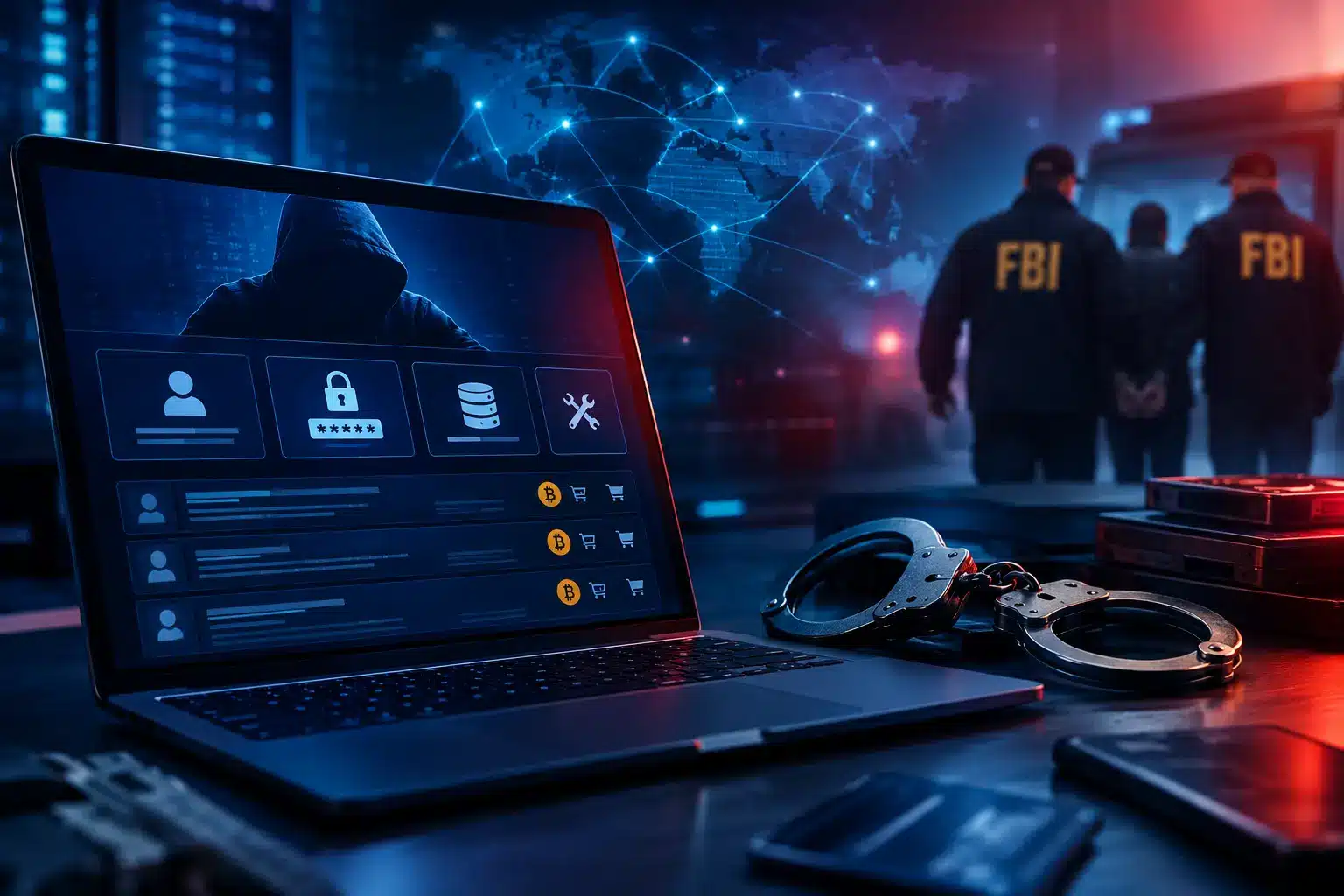
    The OLVX marketplace, an illicit online platform used to sell stolen personal data, login credentials and cybercrime tools, has been dismantled following a coordinated investigation by North Macedonia’s Ministry of Interior and the US Federal Bureau of Investigation (FBI). Authorities have filed criminal charges against a 20-year-old suspect from the Tetovo area, alleging involvement in computer fraud, misuse of personal data and the production and distribution of child sexual abuse material.
     

OLVX Marketplace Dismantled After Joint FBI-North Macedonia Probe

15 de Outubro de 2026, 02:31

OLVX marketplace

The OLVX marketplace, an illicit online platform used to sell stolen personal data, login credentials and cybercrime tools, has been dismantled following a coordinated investigation by North Macedonia’s Ministry of Interior and the US Federal Bureau of Investigation (FBI). Authorities have filed criminal charges against a 20-year-old suspect from the Tetovo area, alleging involvement in computer fraud, misuse of personal data and the production and distribution of child sexual abuse material. According to North Macedonia’s Ministry of Interior, the Cybercrime and Digital Forensics Sector submitted the charges against E.A., from the village of Golema Rečica, to the Basic Public Prosecutor’s Office in Tetovo. The investigation focused on the suspect’s alleged administration of the OLVX marketplace, which operated between 2023 and 2025. The operation began after the FBI provided intelligence that prompted a joint investigation into the platform and its associated criminal activities.

OLVX Marketplace Offered More Than 1,500 Stolen Login Credentials

Evidence gathered during the investigation indicated that the suspect administered domains and websites associated with OLVX between 2023 and 2025. The platform functioned as a cybercrime marketplace, where users could buy and sell stolen digital information, software tools and services intended to facilitate criminal activity. The marketplace primarily served cybercriminals seeking personal information and stolen login credentials that could provide access to victims’ online accounts and computer networks. During its operation, more than 1,500 sets of stolen login credentials were offered for sale, according to the authorities. The platform also used a cryptocurrency-based payment arrangement. Rather than operating an escrow service, as many underground marketplaces do, OLVX allowed users to load funds onto the site and use those funds to pay one another. The arrangement provided an alternative payment mechanism for transactions conducted through the platform.

Telegram Group Allegedly Offered Cybercrime Tools

The investigation also examined the suspect’s alleged activities on Telegram. Authorities said that between 2025 and 2026, the suspect administered an illicit online group called ONEMILI, which offered software tools and services designed to facilitate cybercrime. These included fraudulent refund schemes, according to the Ministry of Interior. Investigators also obtained evidence indicating that the suspect had acquired and possessed child sexual abuse material (CSAM) for personal use through Telegram. The allegations form part of the criminal charges filed with the prosecutor’s office. The available information does not specify whether the suspect has been arrested or whether court proceedings have begun.

FBI Investigation Highlights Cross-Border Cybercrime Enforcement

The operation marks the first jointly coordinated cybercrime operation between North Macedonia’s Ministry of Interior and the FBI, according to the ministry. The case demonstrates how intelligence sharing between law enforcement agencies can support investigations into online platforms operating across jurisdictions. Authorities have increasingly targeted illicit online marketplaces that facilitate the exchange of stolen information, cybercrime tools and tactics. Over the past five years, law enforcement agencies have taken down dozens of such marketplaces, which have become focal points for cybercriminals trading data and services. In a separate development, Microsoft announced the takedown of three popular Chinese phishing sites used by cybercriminals to send hundreds of millions of malicious messages impersonating more than 75,000 organizations worldwide. Although the cases involve different platforms and activities, both illustrate law enforcement and technology companies’ efforts to disrupt online infrastructure used for cybercrime. The North Macedonia investigation highlights the role of international cooperation in identifying platform administrators and disrupting services linked to the trade in stolen data. The Ministry of Interior said its Cybercrime and Digital Forensics Sector would continue working to combat cybercrime, protect personal data and improve digital safety.
❌
❌