A new AiTM phishing campaign targets healthcare. Learn how this healthcare AiTM phishing campaign chains compromised accounts to bypass MFA.
Related Posts:
US Offers $10M for IRGC Cyber Leader
Coder Registry Attack: Hijacked Cloudflare Pool Served Malicious Terraform Modules
Toy Ghouls Backdoor Uses HiveMQ and Element for C2
The post AiTM Phishing Campaign Targets Healthcare via Account Takeovers appeared first on Daily CyberSecurity.
France's data protection authority (CNIL) has fined Hôpital privé de la Loire €500,000 ($580,000) for failing to adequately protect patients' and their relatives' data. [...]
France's data protection authority (CNIL) has fined Hôpital privé de la Loire €500,000 ($580,000) for failing to adequately protect patients' and their relatives' data. [...]
Aesto Health suffered a breach exposing personal and health data of more than 9.5 million people after attackers accessed its AWS infrastructure.
Aesto Health, a U.S. healthcare technology company, disclosed a data breach that exposed personal and health information belonging to more than 9.5 million people. The company discovered the incident on December 18, 2025, after attackers gained access to part of its Amazon Web Services infrastructure.
Aesto Health is a U.S. healthcare technolog
Aesto Health suffered a breach exposing personal and health data of more than 9.5 million people after attackers accessed its AWS infrastructure.
Aesto Health, a U.S. healthcare technology company, disclosed a data breach that exposed personal and health information belonging to more than 9.5 million people. The company discovered the incident on December 18, 2025, after attackers gained access to part of its Amazon Web Services infrastructure.
Aesto Health is a U.S. healthcare technology company based in Birmingham, Alabama. It helps healthcare providers manage and protect electronic health records and other legacy medical data. Its services include secure data migration, electronic health record (EHR) exchanges and long-term data archiving. Aesto works with medical practices and healthcare organizations that need to move, store or access patient information securely.
“On or about December 18, 2025, Aesto experienced a network security incident that impacted a limited portion of our Amazon Web Services infrastructure.” reads the Notice of Data Security Incident. “After an extensive forensic investigation and manual document review, on May 26, 2026, we confirmed that between on or about December 2, 2025, and December 18, 2025, certain protected health information belonging to patients of various Covered Entity clients stored within Aesto’s network may have been accessed and/or acquired by an unauthorized actor.”
The company launched an investigation into the incident with external leading cybersecurity experts.
The network security incident affected part of its Amazon Web Services infrastructure between December 2 and 18, 2025. On May 26, 2026, Aesto confirmed that an unauthorized actor may have accessed or acquired protected health information stored in its network. Exposed data may include names, birth dates, medical and insurance information, driver’s license and government ID numbers, financial account details, taxpayer IDs and, for a limited number of people, Social Security numbers.
Aesto says it found no evidence of identity theft or financial fraud linked to the breach. Starting June 26, 2026, it notified affected healthcare clients whose patients’ data may have been accessed.
The company announced it has already implemented measures to strengthen security and set up a dedicated helpline for questions.
The healthcare firm also notified the US Department of Health and Human Services (HHS), reporting that the incident impacted 9540683 individuals.
Healthtech company Novocure says the data of an undisclosed number of employees and more than 1,400 U.S. cancer patients has been exposed in a mid-August cyberattack. [...]
Healthtech company Novocure says the data of an undisclosed number of employees and more than 1,400 U.S. cancer patients has been exposed in a mid-August cyberattack. [...]
Healthcare and pharmaceutical-distribution giant McKesson has disclosed a cybersecurity incident involving unauthorized access to third-party applications and the theft of data.
McKesson Corporation is an American healthcare company that distributes pharmaceuticals and provides medical supplies, health information technology, and care management tools.
McKesson says it discovered the cybersecurity incident on August 25, 2026, and that its investigation is still in early stages.
“Based
Healthcare and pharmaceutical-distribution giant McKesson has disclosed a cybersecurity incident involving unauthorized access to third-party applications and the theft of data.
McKesson Corporation is an American healthcare company that distributes pharmaceuticals and provides medical supplies, health information technology, and care management tools.
McKesson says it discovered the cybersecurity incident on August 25, 2026, and that its investigation is still in early stages.
“Based on our investigation thus far, including assessments by leading cybersecurity industry experts supporting our response, we’ve confirmed that the unauthorized access to certain third-party applications and the exfiltration of certain data was associated with a subset of customers within our Oncology & Multispecialty and Medical-Surgical business units.”
For now, McKesson provides no information about the amount or nature of the stolen data.
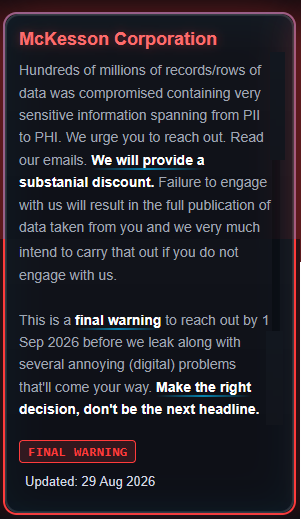
The attack has been claimed by ransomware/extortion group Shiny Hunters. On their leak site the group claims to have stolen hundreds of millions of records containing very sensitive information spanning from Personally Identifiable Information (PII) to Protected Health Information (PHI).
ShinyHunters listing for McKesson Corporation
The ShinyHunters extortion group told BleepingComputer that it was behind the attack, claiming it gained access after conducting voice phishing (or vishing) attacks—a form of social engineering—against multiple McKesson employees. Subsequently, the group said it used compromised Okta single-sign-on accounts to access Salesforce and Snowflake environments. It further claimed to have removed approximately 1 TB of data between August 21 and 25.
The group also said the data includes roughly 284 million records, which does not necessarily mean they belong to 284 million unique patients.
A combination of identity information and healthcare-related details could make affected people targets for convincing scams. Criminals could impersonate a pharmacy, insurer, medical provider, debt collector, or patient-support service and use personal details to make the approach appear legitimate.
Healthcare data is especially useful in social-engineering attacks because it can be used to create a sense of urgency: Criminals could scare a target by sending a supposed prescription problem, unpaid claim, delivery issue, appointment change, or request to “verify” insurance details. At this stage, however, McKesson has not confirmed that any particular category of patient data was accessed.
What to do if you’re affected
While waiting for more information about the nature of the breach and how you might be affected, there are a few things you can do:
Check the company’s advice. Every breach is different, so check with the company to find out what’s happened and follow any specific advice it offers.
Change your password. You can make a stolen password useless to thieves by changing it. Choose a strong password that you don’t use for anything else. Better yet, let a password manager choose one for you.
Enable two-factor authentication (2FA). If you can, use a FIDO2-compliant hardware key, laptop, or phone as your second factor. Some forms of 2FA can be phished just as easily as a password, but 2FA that relies on a FIDO2 device can’t be phished.
Watch out for impersonators. Cybercriminals may contact you posing as the breached company. Check its official website to see if it’s contacting victims, and verify the identity of anyone who contacts you using a different communication channel.
Take your time. Phishing attacks often impersonate people or brands you know and use themes that require urgent attention, such as missed deliveries, account suspensions, and security alerts.
Consider not storing your card details. It’s definitely more convenient to let sites remember your card details, but it increases the risk if a company suffers a breach.
Let’s face it, an incognito window can only do so much.
Breaches, dark web trading, credit fraud. Malwarebytes Identity Theft Protection monitors for all of it, alerts you fast, and comes with identity theft insurance.
Healthcare and pharmaceutical distribution giant McKesson has disclosed a cybersecurity incident involving unauthorized access to third-party applications and data theft, with the ShinyHunters extortion group claiming it stole 284 million patient data records. [...]
Healthcare and pharmaceutical distribution giant McKesson has disclosed a cybersecurity incident involving unauthorized access to third-party applications and data theft, with the ShinyHunters extortion group claiming it stole 284 million patient data records. [...]
The New York Times has a long article (alt link) on surveillance systems aimed at babies. They are increasingly using AI.
Nanit and its rivals want to own 24/7 health tracking for the sub-four-foot set. And their already astonishing levels of baby data collection are just the beginning. Nanit recently raised $50 million from investors to expand its use of A.I. and use its camera to track speech and language development, motor skills and more, while extending its presence in children’s bedrooms i
The New York Times has a long article (alt link) on surveillance systems aimed at babies. They are increasingly using AI.
Nanit and its rivals want to own 24/7 health tracking for the sub-four-foot set. And their already astonishing levels of baby data collection are just the beginning. Nanit recently raised $50 million from investors to expand its use of A.I. and use its camera to track speech and language development, motor skills and more, while extending its presence in children’s bedrooms into early adolescence.
Healthcare and services provider Nutex is investigating a data breach incident where an unauthorized third party exfiltrated information from company servers. [...]
Healthcare and services provider Nutex is investigating a data breach incident where an unauthorized third party exfiltrated information from company servers. [...]
U.S. healthcare IT company CareCloud disclosed that the data breach incident it suffered earlier this year has impacted more than 3.7 million individuals. [...]
U.S. healthcare IT company CareCloud disclosed that the data breach incident it suffered earlier this year has impacted more than 3.7 million individuals. [...]
Note The July 2026 Dark Web Breach Incident Trend Report was compiled based on data breach cases posted on deep web and dark web forums. Due to the nature of some posts, it is difficult to fully verify their accuracy; some posts related to South Korea included AI-generated false data or cases where it could […]
Note The July 2026 Dark Web Breach Incident Trend Report was compiled based on data breach cases posted on deep web and dark web forums. Due to the nature of some posts, it is difficult to fully verify their accuracy; some posts related to South Korea included AI-generated false data or cases where it could […]
Note The July 2026 Dark Web Threat Actor Trend Report focuses on trends among threat actors—including hacktivists—active on the deep web and dark web. It is explicitly noted that the factual accuracy of some content could not be verified. Major Issues Handala claimed to have compromised the core infrastructure of an Internet service provider in […]
Note The July 2026 Dark Web Threat Actor Trend Report focuses on trends among threat actors—including hacktivists—active on the deep web and dark web. It is explicitly noted that the factual accuracy of some content could not be verified. Major Issues Handala claimed to have compromised the core infrastructure of an Internet service provider in […]
Healthcare software company Unlimited Technology Systems reported that more than 3.8 million people were impacted by a data breach incident that occurred in October 2025. [...]
Healthcare software company Unlimited Technology Systems reported that more than 3.8 million people were impacted by a data breach incident that occurred in October 2025. [...]
Brazil's SISVISA health surveillance system left 102,215 files totaling 79GB open online, including tax IDs and identity documents, without password protection.
Brazil's SISVISA health surveillance system left 102,215 files totaling 79GB open online, including tax IDs and identity documents, without password protection.
LeakNet claims it stole 11TB of NYC Health + Hospitals data containing sensitive medical, financial and biometric records linked to more than 12 million people.
LeakNet claims it stole 11TB of NYC Health + Hospitals data containing sensitive medical, financial and biometric records linked to more than 12 million people.
Phishing played a part in more than half of all incident response engagements undertaken by Talos, Cisco's threat research organization, during the second quarter of 2026, with healthcare organizations and manufacturing firms among the top targets.
The post Talos: Attackers Refine Phishing Playbook To Target Critical Infrastructure appeared first on The Security Ledger with Paul F. Roberts.
Phishing played a part in more than half of all incident response engagements undertaken by Talos, Cisco's threat research organization, during the second quarter of 2026, with healthcare organizations and manufacturing firms among the top targets.
Healthcare billing company Medical Computer Business Services (MCBS) has disclosed that a 2025 network breach exposed the sensitive information of more than 1.2 million people. [...]
Healthcare billing company Medical Computer Business Services (MCBS) has disclosed that a 2025 network breach exposed the sensitive information of more than 1.2 million people. [...]
Healthcare software vendor Craneware confirmed attackers stole data during a cyberattack, underscoring growing cybersecurity risks facing healthcare suppliers.
The post Craneware Confirms Data Theft After Cyberattack, Investigations Underway appeared first on TechRepublic.
Note The June 2026 Dark Web Breach Incident Trend Report is based on major data breach cases posted on the deep web and dark web forums. Due to the nature of some sources, it was difficult to fully verify the accuracy of certain information, so the report includes content that requires further verification. Major Issue […]
Note The June 2026 Dark Web Breach Incident Trend Report is based on major data breach cases posted on the deep web and dark web forums. Due to the nature of some sources, it was difficult to fully verify the accuracy of certain information, so the report includes content that requires further verification. Major Issue […]
iRhythm disclosed a cyberattack via third-party apps where patient and proprietary data was stolen, followed by a ransom demand.
iRhythm Technologies is a U.S.-based digital healthcare company specializing in remote cardiac monitoring and arrhythmia detection. Its best-known product is the Zio, a wearable patch that continuously records a patient’s heart rhythm for up to several weeks. The data is then analyzed using proprietary algorithms and reviewed by clinicians to help diagnose conditio
iRhythm disclosed a cyberattack via third-party apps where patient and proprietary data was stolen, followed by a ransom demand.
iRhythm Technologies is a U.S.-based digital healthcare company specializing in remote cardiac monitoring and arrhythmia detection. Its best-known product is the Zio, a wearable patch that continuously records a patient’s heart rhythm for up to several weeks. The data is then analyzed using proprietary algorithms and reviewed by clinicians to help diagnose conditions such as Atrial Fibrillation and other heart rhythm disorders.
iRhythm disclosed a cyberattack in an SEC Form 8-K filed on June 10. Someone got into third-party-hosted business applications, grabbed data, and then asked to be paid to keep quiet about it.
“On June 8, 2026, iRhythm Holdings, Inc. identified unauthorized activity involving data maintained on certain third-party-hosted business applications.” reads the SEC Form 8-K report. “The Company promptly activated its cybersecurity response plan and launched an investigation with the support of external advisors and cybersecurity experts to assess and contain the threat.”
On June 9, 2026, iRhythm received an extortion demand from a threat actor claiming to have stolen proprietary data, protected health information, and other personal data. The company later confirmed the data breach from third-party-hosted business applications via a social engineering attack and deemed the incident material.
The digital healthcare firm stated that clinical and medical device systems, patient safety, operations, and customer connections were not affected, and no payment card or financial account data was involved.
The company did not reveal which specific application was compromised and did not disclose technical details about the attack.
“On June 9, 2026, the Company received communications from a threat actor claiming to have obtained sensitive information, including proprietary data, patient protected health information and other personal information.” continues the report. “The communications from the threat actor demanded payment in exchange for not publicly disclosing this information.”
The company is investigating the scope of the incident.
No ransomware group has publicly claimed the attack, and it’s not known whether iRhythm has engaged in negotiations with the attacker.

 Entrar