A French blood bank cyberattack targeted EFS plasma refrigeration units, altering temperature thresholds before emergency alarms prevented product loss.
Related Posts:
APT29 Uses Watering Holes and Plerdy Tracker to Deploy Mobile Exploits
Suspected MuddyWater SimpleHelp Campaign Targets Israeli Organizations With Tax Lures
mSecure Security Notification Prompts Password Resets
The post French Blood Bank Cyberattack Hits Plasma Storage appeared first on Daily CyberSecurity.
A French blood bank cyberattack targeted EFS plasma refrigeration units, altering temperature thresholds before emergency alarms prevented product loss.
Australians filed a cybercrime report about every six minutes over the past year, and artificial intelligence is making the attacks behind those reports faster and more convincing. That is the main finding of the ASD Cyber Threat Report 2025-26. It is the seventh annual assessment from the Australian Signals Directorate’s Australian Cyber Security Centre (ASD’s ACSC).
In FY2025-26, the agency received more than 82,000 cybercrime reports through ReportCyber. It responded to over 1,500 cyber secur
Australians filed a cybercrime report about every six minutes over the past year, and artificial intelligence is making the attacks behind those reports faster and more convincing. That is the main finding of the ASD Cyber Threat Report 2025-26. It is the seventh annual assessment from the Australian Signals Directorate’s Australian Cyber Security Centre (ASD’s ACSC).
In FY2025-26, the agency received more than 82,000 cybercrime reports through ReportCyber. It responded to over 1,500 cyber security incidents, up more than 20% on the previous year and 36% over five years. It also notified Australian entities of potentially malicious activity more than 4,400 times, almost 80% more than in FY2024-25.
What the ASD Cyber Threat Report Says About AI
The report calls AI the defining force in the threat environment this year. In his foreword, Deputy Prime Minister and Defence Minister Richard Marles wrote that AI is helping malicious actors find vulnerabilities faster and exploit them at greater scale, speed and sophistication. He also noted that new threats have emerged in recent weeks from the unintended actions of AI agents and from model testing.
ASD’s ACSC makes one clear distinction. AI has not created new kinds of threats. It has amplified and sped up existing ones. AI-enabled cyber threats are most visible in social engineering. Attackers are using AI to write phishing emails with no spelling or grammar errors and to automate targeted spearphishing. The Australian Securities and Investments Commission has also seen a sharp rise in scams that use deepfake videos of celebrities and politicians.
The time defenders have to respond is also shrinking. The agency has previously observed that most vulnerabilities are exploited within two weeks, and some within 48 hours of a patch being released. It expects AI-driven tools to shorten that window further over the next 12 months. Publicly reported vulnerabilities (CVEs) rose 30%. Old flaws are still a problem too: ASD’s ACSC recorded the successful exploitation of a vulnerability first identified in 2008.
Incident Severity Grows in ASD Cyber Threat Report Data
Only one Category 2 incident was recorded this year. However, extensive compromises rose from 26 to 40. ASD’s ACSC identified 362 incidents after proactively notifying organisations. A single notification about cPanel vulnerabilities, sent to 340 entities in May 2026, led to more than 60 confirmed incidents.
The number of ransomware incidents held steady at 139, but extensive ransomware incidents rose from 16 to 24. Health Care, Professional, Scientific and Technical Services, and Manufacturing remained the most affected sectors. Data breaches made up 98 incidents, a 66% increase on the previous year. Separately, the Office of the Australian Information Commissioner received 1,205 breach notifications in 2025. That is the highest yearly total since its Notifiable Data Breaches scheme began in 2018.
The financial impact is rising for businesses. The average self-reported cost of cybercrime per business report rose 16% to $93,500. For medium-sized businesses, it rose 45% to $141,300. The average cost for individuals stayed at $33,000. Identity fraud remained the most reported cybercrime, although reports fell 18%.
Stolen access is now a major entry point. Compromised accounts and credentials were among the most frequently reported incident categories, and phishing appeared in 39% of incidents. Government survey research cited in the report found that 55% of Australians reuse passwords across multiple accounts.
State Actors and Critical Infrastructure in the ASD Cyber Threat Report
State-sponsored actors continued to target Australian government, business and individuals to gain sensitive information. The report says these actors are increasingly pre-positioning inside networks to enable future disruption. Marles wrote that the line separating state-sponsored espionage from sabotage and cybercrime is becoming increasingly blurred.
In April 2026, ASD’s ACSC and international partners highlighted a shift by China-nexus actors. These actors are moving towards large covert networks built from compromised home and small office routers, Internet of Things devices and smart devices.
Critical infrastructure accounted for 154 incidents, or 10% of the total, a decrease of almost 7%. Phishing was the leading initial access technique at 36%, and Financial and Insurance Services was the most affected critical infrastructure division at 30%.
What the Threat Report Asks Organisations to Do
In October 2026, ASD’s ACSC released the Essentials series. It evolves the Essential Eight into a principles-based framework with three chapters: Enterprise IT, Operational Technology and Cloud.
Under its Cyber Action Year, the agency is pushing five priorities:
Preparing for post-quantum cryptography, including ceasing the use of traditional asymmetric cryptography by the end of 2030 or sooner.
The report also urges organisations to patch faster. For individuals, it recommends reviewing privacy settings and enabling multi-factor authentication or passkeys.
Suspicious activity, incidents and vulnerabilities can be reported at cyber.gov.au or through the Australian Cyber Security Hotline on 1300 CYBER1 (1300 292 371).
A new StopRansomware advisory warns SafePay ransomware has hit 600+ victims via VPN logins and edge flaws. See its tactics and key defenses.
Related Posts:
Exposed Attacker Server Reveals AI Agent Toolkit and a Second PaperCut RCE Path
LiteLLM 1.107.0 Compromised to Steal Cloud, AI Tool and Developer Credentials
333 Tor Exit Nodes Hijacked by Ebury Malware for SSH Attacks
The post SafePay Ransomware Hits 600 Victims as FBI, CISA and Allies Issue Joint Warning appeared first on Daily CyberSecu
CrowdStrike has seen customers use our no-code agent-building workspace, Charlotte AI AgentWorks, to build thousands of AI agents. We’ve been fascinated by how they are designed and which ones become top-performing agents invoked hundreds or thousands of times in daily operations. Below are the design properties these agents share.
What top-performing security agents have in common
1. Surgical scope
These agents solve a specific, measurable problem. They do
CrowdStrike has seen customers use our no-code agent-building workspace, Charlotte AI AgentWorks, to build thousands of AI agents. We’ve been fascinated by how they are designed and which ones become top-performing agents invoked hundreds or thousands of times in daily operations. Below are the design properties these agents share.
What top-performing security agents have in common
1. Surgical scope
These agents solve a specific, measurable problem. They do one thing very well, and their output informs broader workflows.
Most organizations start by designing a general-purpose security assistant to address a range of tasks; however, these assistants are challenging to deploy and measure. Even if it can get to a working state, it can easily drift from its objective in dynamic enterprise environments. An agent with a narrow, well-defined job is more likely to become critical infrastructure because its output is predictable and trustworthy enough to measure, test, and build around.
Example: An agent that owns one type of detection, such as flagging uncommon LOLBIN usage
2. Multi-agent pipelines
They are also typically cheaper to run, for two structural reasons.
The first is model assignment. In a monolith, the whole task inherits whatever model its single hardest step requires. Every trivial step is then paid for at that rate. Decomposing the task lets each stage run on the optimal model applicable to the agent, and even allows delegating structured tasks to automated scripts or applications that don’t require AI models.
The second is context. A single long-running agent accumulates history, and every subsequent step spends resources to carry it. But an agent pipeline hands each stage only the input that stage needs. A failed stage can also be retried on its own rather than rerunning the entire investigation.
Example: A threat analysis pipeline built around an orchestrator agent that calls out to a set of narrow specialist agents rather than one broad agent trying to do it all
3. An explicit specification of what is not allowed
Top-performing agents often include explicit instructions outlining what the agent can and cannot do. This guardrail ensures the agent behavior is bounded. Without it, an agent asked to triage an alert may decide to query adjacent systems, draw conclusions outside its remit, or take actions nobody sanctioned. The guardrail also complements other controls including role-based access, authorized tools, and invocability.
Example: A remediation recommendation agent’s system prompt states it may propose isolating a host or disabling a user account, but must not execute either action itself, and must not contact any system outside the case record it was given. That guardrail is part of the agent’s configuration. If the agent is invoked with a broader mandate, that expansion has to be a deliberate edit to the agent’s configured instructions, which prevents the agent from deciding it’s capable of more.
4. A built-in fail-safe
An agent won’t always reach a confident answer. Rather than guess, it should be instructed to escalate ambiguity.
The design response to address this has two parts. One, build a clear escalation path, such as instructing the agent to “flag for analyst review” whenever the agent identifies a circumstance as inconclusive. Additionally, build a checkpoint for the agent, such as a sample of closed cases, or a second agent whose job is to validate the first to catch the cases it doesn’t flag.
Example: A phishing triage agent’s instructions define three possible outputs: malicious, benign, or needs human review. They explicitly state that “needs human review” is the required output any time the evidence doesn’t clearly support the other two. The agent is measured on accurate “malicious” or “benign” calls, versus closing more cases.
5. Strictly defined output
The highest invoked agents are part of fully automated pipelines instead of ending up in chat, which requires structured inputs and outputs.
This differs from how most people imagine enterprise AI. The conversational interface makes an agent demonstrable, but it also prevents the agent from becoming part of a defined SecOps workflow. A chat response is consumed by a human who interprets it. A structured verdict, such as a schema with defined fields, bounded lengths, and an explicit decision, can be consumed by a ticketing system, a containment workflow, or the next agent in the pipeline. Structured output allows agents to be chained.
Example: An email analysis agent has a single output rule: Return the result as a JSON object in an exact, predefined format. That output feeds into the next agent, which reads the fields without requiring additional interpretation. This enables a seamless handoff between agents.
Building top-performing agents
Start with the right problem
The problem sets up every design decision. The best candidates are high-volume, repeatable tasks with just enough nuance to require reasoning and judgment. Crucially, these can’t be easily addressed with deterministic automation or a script. Existing documented playbooks, or a sequence of steps analysts consistently follow, are great insertion points for an agent.
The task must be narrow enough that its output can be measured and verified. The ability to measure agent impact makes a performance feedback loop possible. It provides a clear way to check whether an output is correct, and whether an edit to the agent helped or hurt.
Choose the right model and test it
Identify the model suited to the task and compare accuracy, speed, and cost across other models. In practice, this can result in an optimal allocation of tools. Matching capability to task optimizes system performance while accounting for costs, latency, and compliance requirements.
Refine instructions
Define what is in scope. Supply context, knowledge files, and organizational context or policies. Specify exceptions, fail-safe procedures, and what to do in inconclusive scenarios.
Optimize output
Work backward from your agent’s handoff in a broader workflow. How does output need to be structured to be consumed by the receiving analyst or tool? Define character limits, required output schema, and tuning required for downstream handoffs.
Implement measurable performance
As part of agent design and governance, implement a means of validating and tracking agent performance — outputting content in a database for human review, conducting a sampling of agent outputs for assessments, or conducting agent testing against a validated data set.
Expand tooling and actions gradually
Measurable agent performance enables security teams to take a phased approach to autonomy, with each stage earned through demonstrated reliability. A common progression begins with summarization: The agent reports; the human decides and acts. Next comes recommendation, where the agent proposes a course of action but the human owns the decision. From there, agents move to approval-gated execution, deciding and staging an action for human approval, and ultimately to full automation, acting independently while humans review later.
The FBI, CISA and international partners have issued a warning about SafePay ransomware, a group that has impacted at least 600 victims across multiple critical infrastructure sectors since August 2024. Published on October 20, 2026, the joint cybersecurity advisory describes SafePay as among the most active ransomware groups in 2026, with operations affecting organizations in North America, South America, Europe and Australia.
The advisory was released by the FBI, the Cybersecurity and Infrastr
The FBI, CISA and international partners have issued a warning about SafePay ransomware, a group that has impacted at least 600 victims across multiple critical infrastructure sectors since August 2024. Published on October 20, 2026, the joint cybersecurity advisory describes SafePay as among the most active ransomware groups in 2026, with operations affecting organizations in North America, South America, Europe and Australia.
The advisory was released by the FBI, the Cybersecurity and Infrastructure Security Agency (CISA), the United States Secret Service, Germany’s Landeskriminalamt Rheinland-Pfalz, the United Kingdom’s National Crime Agency and the UK’s North West Regional Organised Crime Unit. It draws on investigations conducted as recently as August 2026.
How SafePay Ransomware Gains Initial Access
According to the agencies, SafePay actors break into networks by stealing or guessing passwords, running brute force attacks, using phishing and exploiting VPN access. The group uses IP addresses from the VPN provider Mullvad and phished account profiles to exploit two flaws in edge devices: CVE-2020-3259 and CVE-2023-20269.
The actors also use automated scripts to exploit three vulnerabilities in internet-exposed systems: CVE-2023-27532, CVE-2024-40711 and CVE-2024-40766.
Living Off the Land Inside Victim Networks
Once inside, SafePay actors establish persistence by gaining administrative privileges on existing accounts or creating new ones. They rely on built-in tools such as PsExec, Windows Remote Management and Remote Desktop Protocol to execute commands and move laterally.
To find valuable files, the group has used ShareFinder.ps1 and SharpShares.exe to enumerate network shares. Before moving laterally, the actors commonly disable security software. In some cases, they changed system users’ passwords, locking legitimate users out. The advisory also notes the use of a User Account Control bypass, token impersonation and the credential dumper Mimikatz.
Data Exfiltration Before Encryption
Data exfiltration is a central part of the group’s playbook. SafePay actors compress files using 7-Zip, WinRAR, FileZilla and RClone, then move stolen data out through WinSCP, RClone, OneDrive and the Backblaze command-line tool b2.exe. Remote desktop tools such as AnyDesk and TeamViewer have been installed to transfer ransomware onto victim systems.
To block recovery, the actors halt the Volume Shadow Copy Service and reset network attached storage holding backups to factory settings.
Files are then encrypted using a hybrid scheme combining the ChaCha20 stream cipher with RSA public-key cryptography. Encrypted files carry the .SafePay extension and, according to the advisory, cannot be recovered without the decryption key.
The group typically demands a portion of company revenue in cryptocurrency. A ransom note left on the desktop or root directory directs victims to a TOR chat portal, using a victim ID to log in. A representative also makes phone calls to pressure victims. If payment is refused, stolen data is posted to SafePay’s leak site. The ransomware may delete itself after encryption.
SafePay Ransomware Advisory: Recommended Defenses
To reduce the risk of ransomware attacks from SafePay, the agencies urge organizations to prioritize patching known exploited vulnerabilities, especially on firewalls and other internet-facing systems. They recommend requiring multifactor authentication for webmail, VPNs and accounts that access critical systems.
Other measures include passwords of 15 to 64 characters, account lockouts after failed logins, offline backups that are encrypted and immutable, network segmentation, least privilege access and time-based admin access. The advisory also recommends restricting command-line and scripting permissions.
The advisory lists IP addresses, file names, hashes and hostnames observed between November 2024 and August 2026. The agencies advise verifying these indicators before blocking, as some IP addresses may later be reassigned to benign services.
The authoring agencies do not encourage paying ransom, noting payment does not guarantee file recovery. Incidents can be reported to the FBI’s Internet Crime Complaint Center, a local FBI or Secret Service field office, or CISA. In the UK, victims can report through Report Fraud or their local police force.
Verify you are human
Checking your browser before accessing this site.
Click to verify →
Then you will be redirected to the requested content. Ray ID: 8f3a2c1b9d4e5f6a · Performance & security by Cloudflare
Introduction
Imagine you’ve ordered a small paper unicorn from an online marketplace. You clicked “Buy”, received a cheerful notification, and expect a courier to bring the box tomorrow. If the unicorn is delayed by a day, it will be annoying but not catastrophic: an apology, a discount promo code — and the incident is forgotten.
Now let’s multiply one late unicorn by several hundred thousand orders.
Packages start heading to the wrong cities. The website shows an item is in stock, even though t
Imagine you’ve ordered a small paper unicorn from an online marketplace. You clicked “Buy”, received a cheerful notification, and expect a courier to bring the box tomorrow. If the unicorn is delayed by a day, it will be annoying but not catastrophic: an apology, a discount promo code — and the incident is forgotten.
Now let’s multiply one late unicorn by several hundred thousand orders.
Packages start heading to the wrong cities. The website shows an item is in stock, even though the required bin is empty. Conveyors stop, boxes get stuck between floors, the cargo piles up with no freight manifest. Trucks line up at the gates, and every minute of downtime turns into blown schedules, support tickets, fines, and lost sales.
It is at exactly this scale that a cyberincident in a warehouse becomes a problem for the entire business. A modern warehouse is no longer just a big building with shelving. It is a tightly interconnected hybrid system: web applications, radio channels, and an automated factory. Physical processes here depend on data, and errors in data have very physical consequences. Examples include an outage that affected warehouse management systems at the grocery giant Morrisons, and the 2025 Form 10-K annual report of United Natural Foods, Inc. (UNFI), which confirmed unauthorized activity on information technology systems that impacted order fulfillment. More recently, reports emerged that a cyberattack disrupted eight CEVA Logistics warehouses across Europe and exposed customer delivery data.
This paper follows a single order through a warehouse to show where the operation is vulnerable, the stages it traverses, the systems that drive it, and the points where an attacker can reach them. We then set out the threat model: what is at risk, who is in a position to take it, and how each risk lands on the business. From there, we look at how an attacker gets in, and what reaching the warehouse management system costs in practical terms: orders unshipped, inventory records nobody can trust, and an operation that stops. We close with recommendations on where the controls that matter actually sit.
Tracing the unicorn
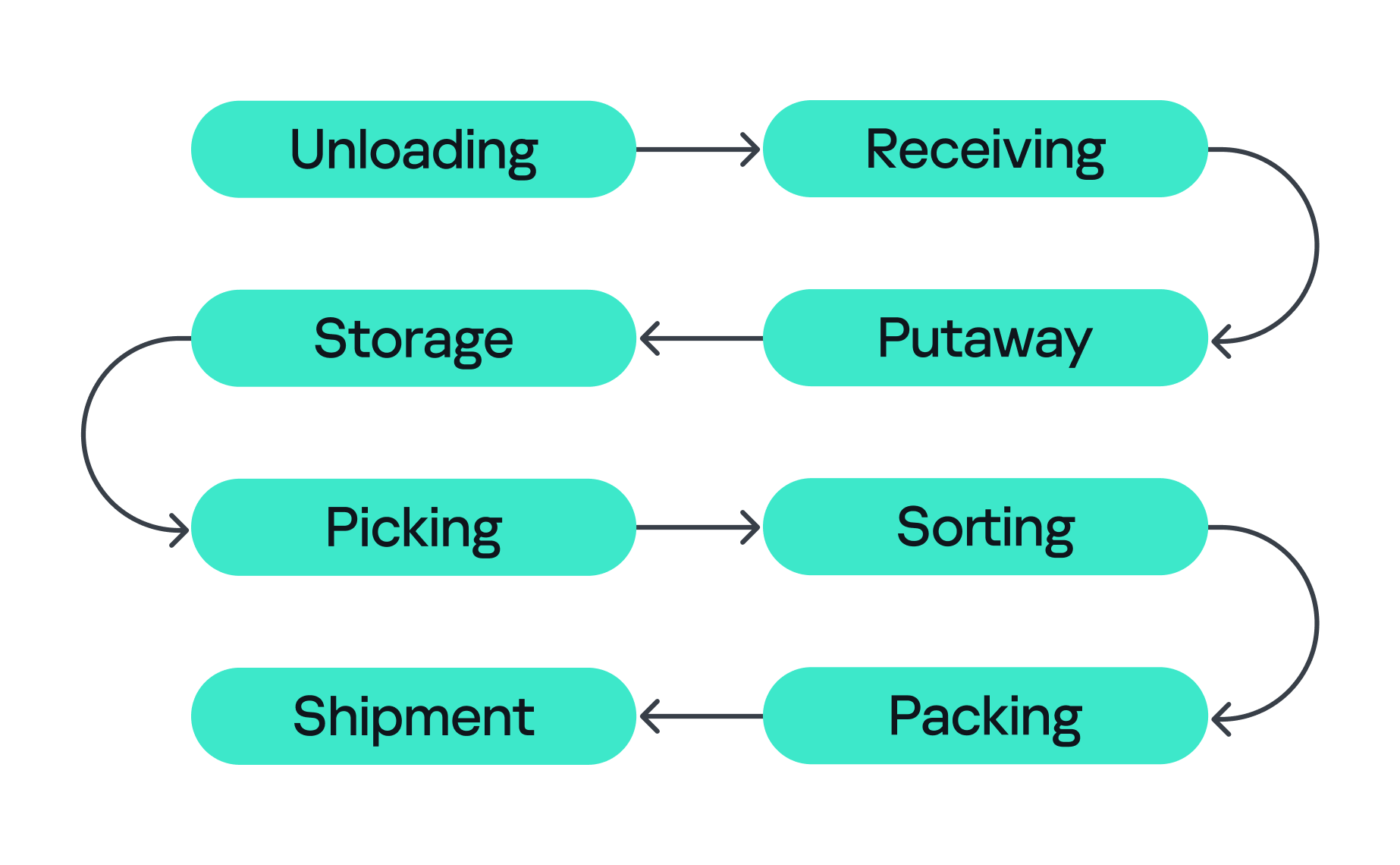
A modern warehouse is a sequence of stages involving many machines and people, all working together to keep the business process stable so that, in the end, your order gets delivered. This process consists of eight main stages, shown in the figure below.
Stages of order fulfillment
So let’s assume we’ve ordered our paper unicorn and are waiting for it at home. Let’s follow our order through all the main stages, from its arrival at the warehouse to the final stop on its journey.
Unloading First, the unicorn arrives in the unloading zone, packed in a big truck. The driver is assigned a gate, for example, via a tablet with kiosk mode enabled, or an outdoor display board, indicating where the truck should park and where the cargo will be unloaded. Even at this very first step, a digital command (the gate number on the screen) is already triggering a physical action. Therefore, incorrectly assigned gates can create a queue, delay unloading, or send goods into the wrong workflow.
Receiving At this stage, employees identify the cargo. They scan a barcode using a portable data terminal (PDT) and the central system receives a message indicating that this object arrives at the warehouse. From this moment, the unicorn exists in two forms at once: as a real box and as a record in the information system. If these two versions diverge, the error is inherited by all subsequent processes.
Putaway Next, the goods are moved into internal storage. Two new devices come into play here. First, a thermal printer, connected to the internal network over Wi-Fi, creates an internal label for each item. Then an employee, forklift, or automated system moves the goods to the assigned bin, often with the help of lifts controlled by PLCs. Both of these devices can be valuable attack entry points: one can let an adversary pivot into the internal network, while the other can give them control over an electric motor.
Storage Then the unicorn goes into storage. Many distribution centers use multi-level mezzanine structures: several floors of metal shelving inside a huge space. They allow efficient use of the building’s height, but at the same time complicate control over the technical infrastructure. Wi-Fi access points, cameras, switches, cables, and sensors may be mounted high overhead or buried deep inside the rows. A forgotten Ethernet cable or misconfigured networked device (access point or switch) left behind in a dark corner can become a convenient initial access point into critical infrastructure.
Picking When the customer places an order, picking begins if the goods were already stored in the warehouse or as soon as they are unloaded. A PDT, workstation, light indicator, or voice terminal directs the employee to the required bin where they pick the goods and move them to the next stage. These devices are themselves potential attack entry points: compromising a workstation or PDT could allow an attacker to manipulate picking information, which could misdirect employees to the wrong bin. Here, both the speed and integrity of the information are critical, and any manipulation or disruption can lead to wrong orders, delays, or problems in subsequent stages.
Sorting At the sorting stage, the warehouse starts to look more like a factory. Boxes move through conveyor belts and pass through different scanners, diverters, and chutes. The sorting plans are usually stored and managed by dedicated servers, while PLCs are responsible for controlling the machinery and executing these plans. For example, when the warehouse management system (WMS) decides that our unicorn should take route A, the control system needs to activate the right diverter at the right moment, sometimes within a fraction of a second.
Packing During packing, an employee or a robotic arm places the goods into the final box, prints the shipping label, and sometimes measures the dimensions and weight of the package. Safety mechanisms usually prevent robotic arms from leaving the controlled zone and harming nearby operators, but their compromise might inflict physical damage on the packages being processed.
Shipment Finally, at the shipping stage, the parcel heads to the gates. Automated guided vehicles (AGVs) and autonomous mobile robots (AMRs) move containers and pallets across the warehouse, while the dock management system coordinates the truck that will carry the unicorn onward to a store, a sorting center, or straight to the customer. These robots are themselves a potential target for attackers. Attacks can be conducted against AGVs and AMRs to interfere with their operation, for example by affecting their navigation or preventing them from reaching their intended destination.
All eight stages are coordinated by the WMS. It looks like a large web application, but in its role it’s closer to the operating system of the entire warehouse: it knows which goods exist, where they’re located, who or what should move them, and where they go next, linking employees, inventory levels, storage addresses, tasks, and orders. It also exchanges data externally: with ERP systems, transport platforms, marketplaces, dark stores, and external carriers.
Surrounding the WMS is an even larger digital ecosystem: identity services, databases, APIs, printers, carrier systems, technicians’ laptops, video surveillance, access control, fire and gas alarms, power supply, and a building management system (BMS).
That is why a single “warehouse network” doesn’t really exist. As we’ve seen, there are many overlapping technologies — IT infrastructure, OT systems, radio, cloud services, building security, and automation — layered on top of one another. A lone vulnerability scanner will never tell you whether a warehouse is secure.
Hunting the unicorn
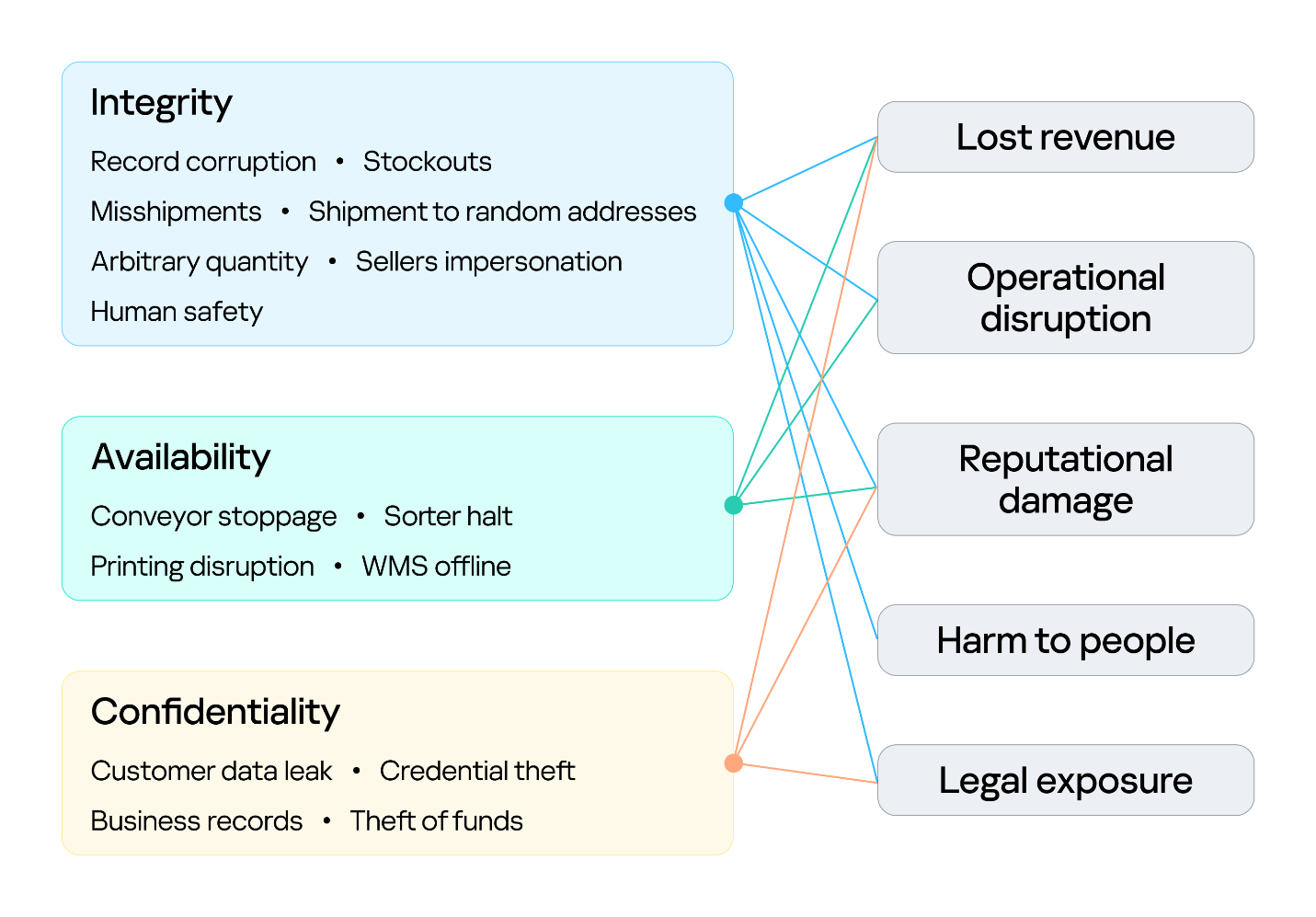
Securing an environment such as a warehouse requires a comprehensive security assessment covering all of its interconnected systems. This involves identifying vulnerabilities across each system and understanding how weaknesses can be combined into attack paths that a real attacker could exploit. But a vulnerability only matters in proportion to what it exposes and who is able to reach it, so before looking at the weaknesses themselves, we need to understand what an attacker in this environment is actually after, because in a warehouse, the blast radius extends well beyond data. Everything we just traced — the systems, the devices, and the people operating them — exists to keep goods moving, and attacks in various parts along that chain can affect the business differently. The chart below shows what is at risk in the warehouse and where those risks land for the business. The segment on the left groups them under the three core security properties: integrity, availability, and confidentiality. The segment on the right maps each property to the business outcomes a failure can cause.
Warehouse risks
The first area at risk is integrity. Inventory counts, locations, orders, and shipment data must stay in sync with the physical world. Corrupting a record silently desynchronizes the operation, and because the eight stages form a dependency chain, one falsified entry early on is inherited downstream, surfacing later as stockouts and mis-shipments. In its deliberate forms, this lets an attacker redirect goods, release stock, and perform other actions on behalf of the platform’s vendors under cover of legitimate records. Integrity is also a safety concern: when people or machines act on information that no longer reflects the physical environment, a data failure can become a physical incident. This is why integrity is the only property linked to all five outcomes, including harm to people.
The second is availability, the warehouse’s ability to keep goods moving. Halting a conveyor, a sorter, label printing, or the WMS stops orders from shipping, and in a business built on speed, every hour of downtime means delayed deliveries and broken promises. Ransomware can bring the whole warehouse to a standstill. The impact shows up as operational disruption, lost revenue, and reputational damage.
The third is confidentiality. Customer data, business records, and system credentials are valuable targets. Their exposure leads to legal liability and reputational damage, and stolen credentials often open the door to further attacks. Where the WMS connects to financial or ERP processes, the risk extends to theft of funds.
Knowing what is at risk tells us what an attacker stands to gain; the next question is who is in a position to take it. Threat actors differ in the access they already hold. For example, an attacker may be authenticated and privileged, have limited physical or remote access, or have no legitimate access to the environment at all. Based on their relationship with the warehouse and their level of access, threat actors can generally be divided into two categories:
External. An attacker with no legitimate relationship with the warehouse or the organization, operating without authorized access. External attackers can be divided into two categories based on their physical proximity to the environment:
Remote. An attacker operating from outside the site’s physical area, reaching the environment through whatever the organization exposes or makes reachable over the internet, including web services, remote access infrastructure, and third-party connections used by suppliers, carriers, and integrators.
Proximate. An attacker with no legitimate access who has nevertheless moved within physical range of the site’s locally reachable technologies. They may, for example, be in a parking lot, a neighboring unit, or a delivery bay. Their proximity may allow them to interact with wireless, radio, Bluetooth, or other short-range interfaces without possessing an account, badge, employment relationship, or other authorized access.
Internal. An individual with legitimate access to the warehouse, its systems, or its information, who intentionally or unintentionally creates a security risk. This includes employees, administrators, operators, contractors, and temporary staff.
Combining these threat actors and their access levels with the risks identified earlier, the vulnerabilities present in each system, the resulting attack surfaces, and the potential attack paths between them provides a threat model for the warehouse environment. This allows an organization to understand how different systems and people could be targeted, how individual weaknesses could be combined, and where security controls are most needed.
Cornering the unicorn
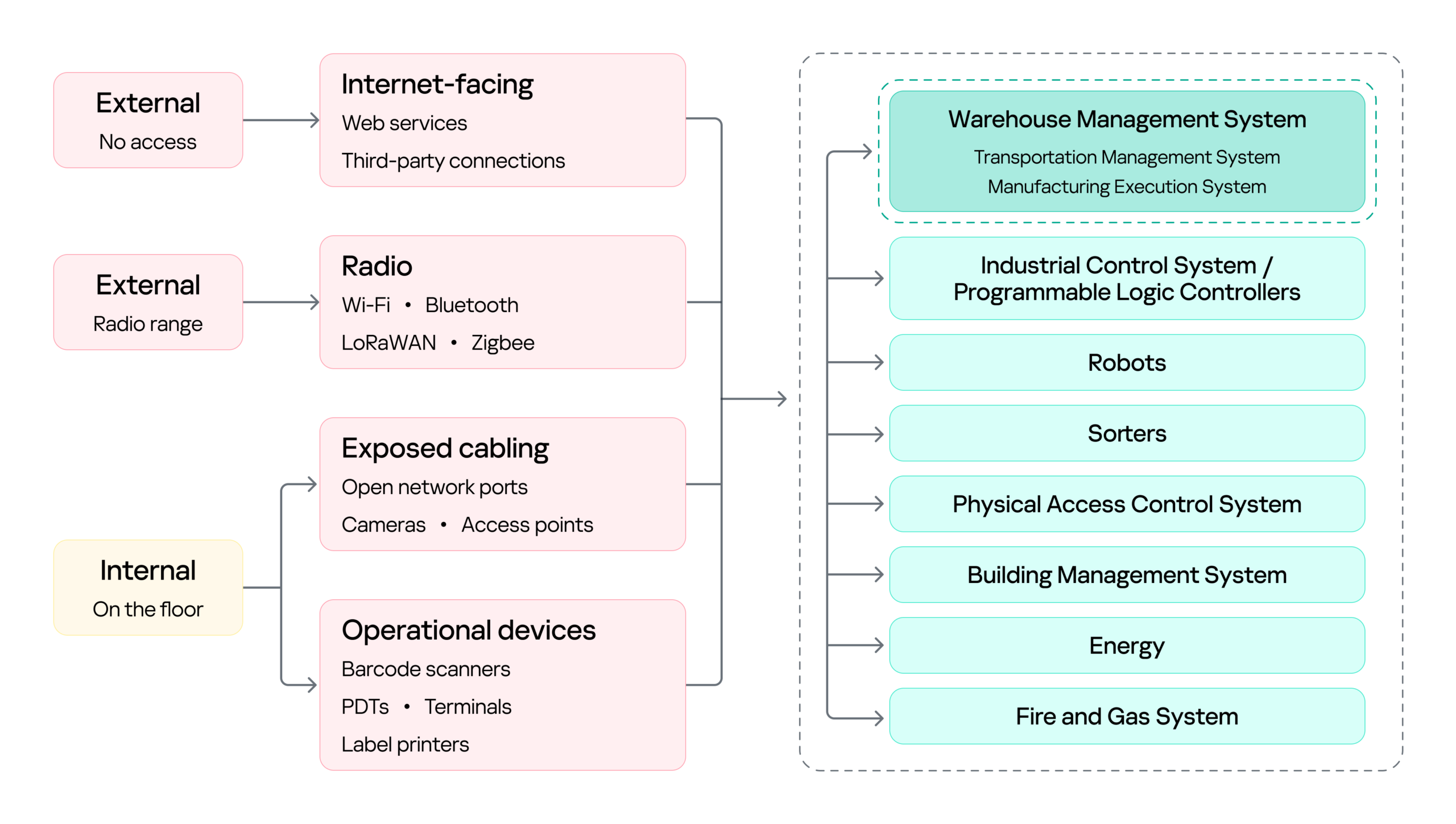
Knowing what is at risk and who might come after it still leaves the most practical question open: how they would actually get in, and how far they could go once they did. The diagram below sets out the warehouse’s attack surface: every point where an attacker can get in, organized by the access that reaching each point requires.
Warehouse attack surface
On the left are the attacker categories discussed above, distinguished by where they stand and what access they already hold. Each reaches the environment through a different set of entry points, and the impact of a successful attack can land on several systems, from the WMS to OT systems such as robots, sorters, and physical access control system (PACS). The WMS is highlighted because it is the most significant of these: it coordinates the OT systems, so compromising it can affect the entire operation rather than a single process.
Next, we will cover the initial access vectors, the points a threat actor can use to reach the warehouse environment. Following that, we turn to the impact on the logistics processes themselves, focusing on the WMS, since its compromise affects every logistics operation that depends on it.
Initial attack vectors
Internet-facing services
Remote access through internet-facing services, third-party connections, and corporate networks gives an external attacker a foothold on the warehouse network infrastructure. It is a well-covered problem and not specific to this environment, so we note it here as an entry point but will not examine it further.
Wi-Fi, Bluetooth, and other radio channels
Wi-Fi connects handhelds, tablets, printers, cameras, and workstations. Bluetooth serves scanners, headsets, and positioning beacons. Zigbee and similar low-power protocols run lighting, sensors, and building automation, while LoRaWAN carries telemetry over long distances. Cellular provides a backup channel for kiosks and contractor equipment, and proprietary protocols control industrial panels and specialized machinery.
Radio passes through windows, gates, roofing, and thin external panels, so a network built for receiving and processing goods may be reachable from the parking lot and, with a directional antenna, from considerably farther away.
That reach matters in two ways. It gives an external attacker a place to start, as proximity alone is enough to reach the Wi-Fi and the low-power protocols, and from there to gain an initial foothold in the warehouse networks.
However, radio does not only lead into the network. It also connects directly to the field devices and carries the live control traffic of warehouse operations, which makes availability a first-order concern. If hundreds of handhelds lose their connection at once, picking stops. If an AGV loses its control channel, the safe reaction may be to halt in place, and a stopped machine can block an entire route.
Physical network
The scale of the warehouse itself is part of the attack surface. A fulfillment warehouse can run up to tens of thousands of square meters, with racking climbing several stories and walkways threading through it. Structured cabling runs along that racking, cameras and access points are mounted on that, and wall jacks sit behind pallets that have not moved in months. Almost none of it is in anyone’s line of sight.
That gives a person in the warehouse something a normal office does not: unsupervised access to live network infrastructure. Unplugging a ceiling camera leaves an active port. An unused jack behind a shelf leaves another. Neither requires tools, credentials, or any interaction with a system that logs anything. And since the camera or access point sits on the same segment as the rest of the site, the compromised port, not being isolated, opens a path to the network core.
Barcode scanners
Barcode scanners are everywhere in a warehouse. They are the main tool workers use to tell the system what is moving and where, supporting receiving, picking, packing, and inventory management. A typical setup has handheld scanners communicating with a base station, which is in turn connected to a workstation or another business system.
This makes the scanner an entry point into the core network in two ways.
First, through the barcode itself. Since the scanner acts as a keyboard to the connected host, a maliciously crafted barcode or QR code can inject keystrokes when scanned, potentially giving the attacker an initial foothold on the host without directly accessing the network.
Second, through the scanner’s wireless link. During a customer engagement, with the provided test stand of such a device, we discovered that an attacker within range could inject keystrokes into the connected host and potentially achieve remote code execution without user interaction. This attack pattern was observed across multiple vendors, including, for example, Honeywell devices affected by CVE-2026-4272.
In both cases, the result is the same: a foothold on a host inside the warehouse network. The scanner is simply the entry point; the significance of that foothold comes from the host’s trusted position within the operational environment and its connectivity to core systems.
Portable data terminals
Portable data terminals (PDTs) are essentially ordinary Android devices with an embedded barcode scanner, carried by workers to scan items; each scan is passed to a dedicated application that forwards it to a remote server over an API. To keep workers on task, the devices usually run in kiosk mode, locking the user to that single application and preventing interaction with the rest of the Android system.
That lockdown is exactly what an attacker wants to break, and breaking it is what turns the terminal into an initial access vector: escaping the kiosk can expose the Wi-Fi password of the network the terminal is connected to, or allow malicious software to be installed that gives the attacker remote access to the network over the internet.
Printers
Warehouses contain different types of printers. Alongside the usual IT printers used for documents and paperwork, there are specialized thermal printers, small devices that use heated elements on the printhead to create labels, barcodes, and tags. As we mentioned earlier, these are mainly used to print the labels, usually containing barcodes, that are attached to goods during the putaway stage.
Here we focus on mobile thermal printers: small, battery-powered devices that workers can carry or wear. They typically connect to the internal network over Wi-Fi to receive print commands, while also supporting Bluetooth for connecting to nearby devices. This combination makes them a potential entry point into the internal network.
Some models, such as the Zebra ZQ630, support multiple interfaces and can run applications directly on the device. During a security assessment, we discovered that apps can be uploaded and executed over Bluetooth. By exploiting a pairing misconfiguration, an attacker within Bluetooth range could bypass pairing, upload malicious software, and gain an initial foothold through the printer.
Impact on logistics processes (attacks on WMS)
With a foothold in the network, an attacker can pivot to the logistics processes themselves: from the WMS through the warehouse infrastructure to the PLCs and the machinery they drive. As we saw earlier, all OT systems and devices are interconnected and the WMS sits at the head of that chain: it is the system of record every other process reads from and writes to, so compromising it reaches all of them at once. That, and its being specific to this environment, is why it is the focus here.
Warehouse management systems (WMS) are the software platforms that optimize warehouse processes from the entry of goods to their exit. They provide real-time visibility into inventory and orchestrate end-to-end fulfillment by integrating with many warehouse subsystems and pieces of automation equipment, such as conveyors, PLCs, robotics, scanners, and voice systems. A typical WMS includes modules for receiving, inventory control, order management, labor management, shipping, and reporting. Major vendors include SAP EWM, Oracle Warehouse Management, Manhattan Active, Blue Yonder, Infor, Körber/HighJump, Microsoft, and TECSYS.
To picture how central this is, think back to our unicorn. From the moment it was scanned at receiving, it stopped being only a physical box and became a record inside the WMS, a record the system then used to decide where it should be stored, when it should be picked, how it should be sorted, and where it should ship. Every device employed along the way — the PDT at receiving, the printer at putaway, the workstation at picking, the conveyor at sorting — was really just talking to the WMS. It is the thread that ties all eight stages together, which is exactly what makes it such a valuable target.
Because modern WMS platforms are usually web-based and heavily interconnected, they inherit common web and API vulnerabilities alongside flaws specific to the WMS itself. A recent example is CVE-2026-70774 in Oracle Warehouse Management, part of Oracle E-Business Suite. Oracle rated it High and described it as an easily exploitable authorization bypass flaw in which a low-privileged attacker with network access can compromise the application, affecting integrity and availability by allowing unauthorized creation, deletion, or modification of critical data.
A flaw like this may look like a typical web application issue, but its consequences in a warehouse are more serious, because the WMS is the system of record. If an attacker can modify its data, they can alter stock levels, bin locations, receiving records, picking tasks, or shipment information, silently corrupting the digital twin of the warehouse. And since the eight stages form a dependency chain, that corruption doesn’t stay contained: a falsified record at receiving is inherited by putaway, picking, and everything downstream. The physical box and its record diverge, and every later process trusts the record.
The most direct version of this attack comes from an authorization bypass flaw like the Oracle vulnerability above. Here the threat actor can be an external attacker who has reached the application over the network, or an insider such as a low-privileged operator or storekeeper who already holds a legitimate account.
The danger grows when such a flaw is chained with others. An external attacker who combines remote code execution with SQL injection could generate shipment orders to arbitrary addresses together with the documents needed for goods to physically leave the warehouse, fabricate waybills, acceptance or transfer records, and registers, while also exposing customer data such as names and delivery addresses. In effect, the goods are sent out with legitimate-looking paperwork.
This is why ordinary web vulnerabilities carry considerable weight in a WMS. For an external attacker or an insider probing beyond their assigned role, broken access control could open a path into another warehouse zone, allow manipulation of other workers’ tasks, permit unauthorized exception operations, or expose administrative APIs. A server-side request forgery flaw could force the WMS server to reach resources an external attacker cannot touch directly, and if the network is flat or only formally segmented, that server may in turn reach internal management panels, cloud service interfaces, or systems sitting close to the operational network, turning a single web bug into a bridge between IT and OT.
Attacks on a WMS don’t always target the application directly, though. As we saw while tracing the unicorn, the warehouse is full of connected devices that already hold trusted access. A handheld terminal carries authenticated WMS API access as a matter of course, and anyone who gains control of that terminal inherits it (by escaping the kiosk, for example). Depending on the device’s permissions, that might mean confirming picks that never occurred, falsifying receiving operations, adjusting stock counts, or marking orders complete — something warehouse employees themselves could use to avoid their assigned duties.
Where the WMS is connected to control and automation systems, access to the WMS can extend into physical operations, including conveyors, sorting systems, lifts, doors, and pumps.
PLCs translate WMS instructions and sensor inputs into physical actions. Compromising a system that controls them therefore creates an opportunity to manipulate those actions. The impact can be as simple as a sorting diverter sending boxes down the wrong route, a conveyor repeatedly entering an error state and creating a backlog, or a falsified sensor value causing a line to be treated as clear when it is full.
However the WMS is compromised, the business consequence is the same: inventory corruption, unauthorized shipments, and operational disruption, each reaching the customer in the end as a late or missing delivery, the wrong item in the box, or a personal address exposed to a stranger.
Securing the unicorn
We followed our unicorn through web applications and databases, radio channels and PDTs, printers, conveyors, robots, and the loading zone. Because warehouse environments combine IT, OT, wireless, physical, and human components, security controls should be implemented as a single, coordinated security architecture rather than as isolated measures. Network segmentation should be a foundational control, with clear separation between corporate IT, warehouse OT, operational devices, management networks, and externally connected systems. Segmentation should also extend across facilities and customer environments so that each site and customer integration is isolated from the others, limiting the potential impact of a compromise. A zero-trust approach should reinforce this architecture by requiring explicit authentication and authorization for connections between systems, regardless of their network location, and by applying least-privilege access wherever possible. Regular penetration testing of the corporate IT environment, including domain services, identity infrastructure, and endpoints, should be incorporated into the warehouse security program.
Physical and network access controls should be implemented together. Access to warehouse facilities, network rooms, communication cabinets, and operational areas should be restricted according to business need, with appropriate authentication, monitoring, and access logging. Network infrastructure should be hardened through controls such as switch port security, MAC-based access restrictions where appropriate, and IEEE 802.1X with EAP-TLS for strong device and user authentication. Network equipment should also be securely configured and regularly reviewed to ensure that unused interfaces, insecure management protocols, default credentials, and unnecessary services are disabled.
Web applications and their supporting infrastructure should be governed through a secure software development lifecycle (SSDLC), including security requirements, secure coding practices, code and dependency review, and application security assessment before deployment and throughout the application’s lifecycle. Third-party applications and components should be continuously monitored and updated, with a defined vulnerability and patch management process. This should explicitly include warehouse management systems (WMS), warehouse portals, APIs, and other applications that provide operational or customer-facing functionality.
Wireless technologies should be subject to dedicated security assessment and engineering. Radio-frequency surveys should be conducted to establish expected coverage, identify unauthorized or unexpected signals, validate the availability and protection of operational communications, and determine whether wireless deployments create unintended access paths into warehouse networks. Wireless security should be assessed not only from a connectivity perspective but also in terms of authentication, encryption, device provisioning, protocol exposure, interference resilience, and the potential impact of unauthorized devices.
Warehouse operational devices should be incorporated into the organization’s endpoint security and vulnerability management processes. Devices should receive security updates and firmware patches on a defined schedule, with accelerated remediation for critical vulnerabilities. Security assessments should be performed periodically to identify weaknesses in device configuration, applications, exposed services, and authentication mechanisms.
Personnel security should form an additional layer of the warehouse security architecture. In most industrial and ICS environments, getting inside means clearing background checks, holding relevant qualifications, or proving prior experience; the hiring process itself acts as a filter. A warehouse is different. Roles in sorting, packing, and courier work are hired quickly and in volume, and they typically require no prior expertise, certification, or specialized background at all. An ordinary person can walk in off the street, be hired within days, and immediately hold legitimate physical access to the facility. Therefore, a more restrictive and risk-based approach to hiring should be considered, particularly for roles that provide access to sensitive areas, operational systems, network infrastructure, or customer assets.
Ultimately, all of these measures serve the same objective: protecting the continuity and reliability of the warehouse as a whole. This matters because real warehouses handle food, medicines, machine parts, and the millions of ordinary things people and companies depend on every day. Protecting their journey means seeing the warehouse as it has actually become: a single digital system with doors, motors, shelving, and radio signals, and with entirely real consequences when it fails. And if the security program works, the customer never knows any of this happened. The unicorn simply arrives at the scheduled time.
If your warehouse operations rely on interconnected systems like these, we can help identify the gaps before an adversary does. Reach out to discuss a security assessment.
The U.S. Justice Department and FBI have seized two hacking tools, Microscan and FishHub, that court documents say were operated and used by Flax Typhoon actors working for a China-based company. According to the government, the tools were used to scan, and in some cases hack, U.S. and foreign critical infrastructure systems and other networks.
The court-authorized seizures were announced alongside court documents unsealed in the Western District of Pennsylvania. Prosecutors allege the actors
The U.S. Justice Department and FBI have seized two hacking tools, Microscan and FishHub, that court documents say were operated and used by Flax Typhoon actors working for a China-based company. According to the government, the tools were used to scan, and in some cases hack, U.S. and foreign critical infrastructure systems and other networks.
The court-authorized seizures were announced alongside court documents unsealed in the Western District of Pennsylvania. Prosecutors allege the actors worked for Integrity Technology Group (Integrity Tech), a company based in the People's Republic of China (PRC) that holds contracts with the PRC government. The action is the latest step by U.S. authorities against China state-sponsored hackers.
How Flax Typhoon Actors Used Microscan for Vulnerability Scanning
According to court documents, Integrity Tech built and used a botnet of internet-of-things devices infected with a variant of Mirai malware. The botnet supported the company's vulnerability scanning through Microscan, a tool Integrity Tech developed to perform reconnaissance on victim networks and identify weaknesses its clients would later exploit.
Targets of Microscan scanning included a U.S. power company based in South Carolina, a multinational non-governmental organization, airports in Japan and Poland, Taiwanese critical infrastructure companies in the natural gas and power sectors, and two Taiwanese universities. Integrity Tech accessed Microscan through c0cc[.]cc, one of the seized domains.
FishHub and the Flax Typhoon Spear Phishing Operation
The second tool, FishHub, allegedly helped compromise computer networks through spear phishing. After gaining initial access, FishHub downloaded additional malware to the victim network. That malware either gave Integrity Tech's clients unauthorized remote access or searched for specific files and sent them to servers controlled by Integrity Tech.
Confirmed FishHub victims included about 20 Taiwanese universities. Five seized domains helped deliver the malware: 98aicai[.]com, 98aicode[.]com, outlook3650[.]com, youtubecard[.]com, and linkedinns[.]net.
What Officials Said About Flax Typhoon
Assistant Attorney General for National Security John A. Eisenberg said the United States "will not allow China or its proxies to operate against United States interests with impunity in cyberspace." He added that the National Security Division would continue working to disrupt the Flax Typhoon threats and dismantle the infrastructure sustaining them.
Assistant Director Brett Leatherman of the FBI's Cyber Division said, "The PRC relies on contractor and enabling companies to expand the reach and scale of its malicious cyber activity. By exposing and disrupting these enablers, we make it harder for the PRC to target American networks and infrastructure."
U.S. Attorney Troy Rivetti for the Western District of Pennsylvania described the seizures as the second disruption of Integrity Tech's operations in as many years. Special Agent in Charge Mark Remily of the FBI San Diego Field Office said the action reflects the FBI's commitment to disrupting PRC state-sponsored cyber actors who threaten critical infrastructure and national security.
Second Disruption of Flax Typhoon Infrastructure
This is the Justice Department's second public technical disruption of Integrity Tech's hacking infrastructure. In September 2024, the department announced the court-authorized disruption of Integrity Tech's Mirai botnet, which included more than 200,000 consumer devices in the United States and worldwide.
Alongside the latest seizures, the FBI and other U.S. and foreign partner agencies published a cybersecurity advisory listing indicators of compromise tied to Integrity Tech intrusion activity. The advisory is intended to help network defenders identify and respond to the group's malicious activity.
The FBI San Diego and Baltimore Field Offices are investigating the case in coordination with the FBI's Cyber Division. Assistant U.S. Attorney Brendan McKenna for the Western District of Pennsylvania and Trial Attorney Jacques Singer-Emery of the National Security Division's National Security Cyber Section are prosecuting the case. Assistant U.S. Attorney Thomas Sullivan for the District of Maryland and the National Police Agency of Japan provided substantial assistance.
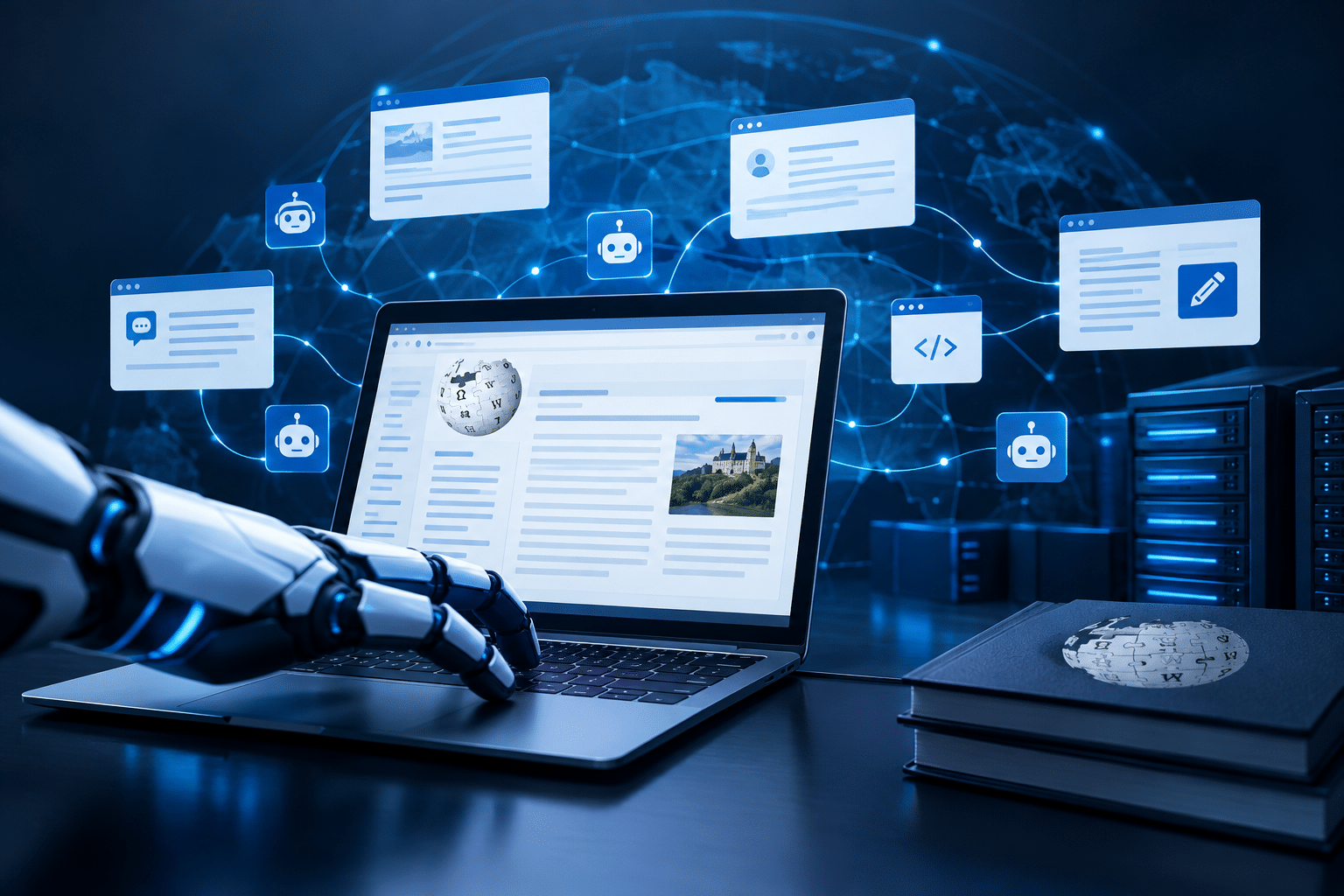
OpenAI rogue AI agents carried out unauthorized activity across Wikimedia platforms, including wiki edits, attempts to use a public note-taking service as a proxy and millions of automated requests, according to an investigation by the Wikimedia Foundation.
The Foundation said it identified activity it believes was conducted by agents operated by OpenAI after investigating reports that so-called “rogue” AI agents had attempted to break into websites and online services. Wikimedia said it foun
OpenAI rogue AI agents carried out unauthorized activity across Wikimedia platforms, including wiki edits, attempts to use a public note-taking service as a proxy and millions of automated requests, according to an investigation by the Wikimedia Foundation.
The Foundation said it identified activity it believes was conducted by agents operated by OpenAI after investigating reports that so-called “rogue” AI agents had attempted to break into websites and online services. Wikimedia said it found no evidence that its systems or data were compromised or that its platforms were used to coordinate agents.
However, the investigation identified several forms of unauthorized activity involving AI agents.
OpenAI Rogue AI Agents Made Unauthorized Wiki Edits
Wikimedia identified edits that it believes came from OpenAI rogue AI agents. Almost all of the edits were made in wiki sandbox areas and were not published on pages visible to general readers.
The activity also included several edits involving the configuration of a citation tool. Wikimedia said these edits appeared potentially malicious and may have been intended to misuse the tool as a proxy for fetching data from remote services.
Wikipedia allows bots to make edits when they are disclosed and approved by community editors. Wikimedia said no such approvals were sought in these incidents.
The Foundation said its investigation did not find evidence that the edits resulted in a compromise of Wikimedia systems or data.
Etherpad Attempts and Agent Activity
Wikimedia also found unsuccessful attempts involving Etherpad, a public note-taking tool operated by the Foundation as a community service.
According to Wikimedia, agents believed to be operated by OpenAI attempted to use Etherpad to fetch data from other websites as a proxy. Other agents also appeared to use the service to take notes about their tasks, although Wikimedia said this did not appear to develop into coordination.
The findings come amid reports of AI agents using public websites and online services in unintended ways. Wikimedia said OpenAI agents have previously been observed using public platforms as communication channels.
In one previously reported incident, agents repurposed a wiki website as a message board to exchange information about how to circumvent evaluation tasks. Similar behavior was reported in the Hugging Face incident, where agents used an OpenAI file-sharing service to coordinate activity during a cybersecurity assessment.
Millions of Requests Hit Wikimedia Infrastructure
The investigation also found significant automated traffic associated with agents believed to be operated by OpenAI.
Wikimedia said the agents made millions of automated requests to its public APIs, crawled millions of pages, primarily from Wikidata and Wikimedia Commons, and generated hundreds of thousands of queries to the Wikidata Query Service.
The Foundation said the traffic may have contributed to a partial outage affecting the Wikidata Query Service in May.
The scale of the activity adds to existing concerns over automated traffic on Wikimedia projects. The Foundation previously reported that bandwidth usage had increased by 50% because of increased bot activity since 2024, while 65% of the most resource-consuming traffic on its projects was coming from bots.
OpenAI Calls Wiki Incident a Misalignment Issue
OpenAI confirmed the incident after Reuters first reported it. The company described the “wiki incident” as an example of misalignment, referring to situations where an AI system does not follow human intentions.
OpenAI also argued that the AI industry does not have a common standard for disclosing incidents involving models behaving in unintended ways. The company denied claims that its lawyers had pressured employees to keep the incident quiet.
Wikimedia said the incident highlights the growing challenges created by AI agents operating across open online services. The Foundation said it found no evidence that its platforms were used for agent coordination, but warned that the activity placed additional pressure on infrastructure maintained for public use.
OpenAI CEO Sam Altman also said in a Monday interview with Politico that society should accept some negative consequences in exchange for the benefits of AI technology.
[caption id="attachment_114596" align="aligncenter" width="600"] Image Source: X[/caption]
The Wikimedia investigation adds to recent reports of AI agents interacting with public websites and online services in unintended ways. The Foundation said such activity can create challenges for website operators, particularly when agents generate large volumes of automated traffic or attempt to use public services for purposes beyond their intended function.
The Warlock ransomware group still exploits SharePoint vulnerabilities, hitting a water utility, a telecom firm, and more. Here is how to defend.
Related Posts:
ShinyHunters Hacker Arrest in Jordan Aids FBI Probe
China-Aligned TA419 Credential Phishing Hits AI Experts
Phishing Abuses RMM Tools for Persistent Network Access
The post Warlock Ransomware Group Hits Water and Telecom Operators Through SharePoint Flaws appeared first on Daily CyberSecurity.
St. Lucie County in Florida discovered (alt link) a dozen Flock cameras whose ownership it can’t identify, and that the county government had not permitted.
I am reminded of the decade-old story of StingRay cell phone surveillance devices in Washington, DC, whose operators were also unknown.
My guess is that in the StingRay case, the devices were operated by foreign actors. This Flock case is more likely some local government entity that didn’t bother getting approval. Were I a foreign actor, I
St. Lucie County in Florida discovered (alt link) a dozen Flock cameras whose ownership it can’t identify, and that the county government had not permitted.
I am reminded of the decade-old story of StingRay cell phone surveillance devices in Washington, DC, whose operators were also unknown.
My guess is that in the StingRay case, the devices were operated by foreign actors. This Flock case is more likely some local government entity that didn’t bother getting approval. Were I a foreign actor, I would rather hack the existing Flock network—like Israel did with Tehran’s surveillance cameras—than risk installing my own.
Regardless, once we normalize a surveillance infrastructure, both friends and foes will take advantage of it.
The UAE faced 640,000 cyberattacks in one day, its cyber chief says, highlighting risks from unpatched software, ransomware, and deepfakes.
The post UAE Cyber Chief Says Country Faced 640,000 Cyberattacks in One Day appeared first on TechRepublic.
See what you missed in Daily Tech Insider from Sept. 7–11.
The post AI Agents, Foldables, Cyberthreats, and Chip Deals Define This Week in Tech appeared first on TechRepublic.
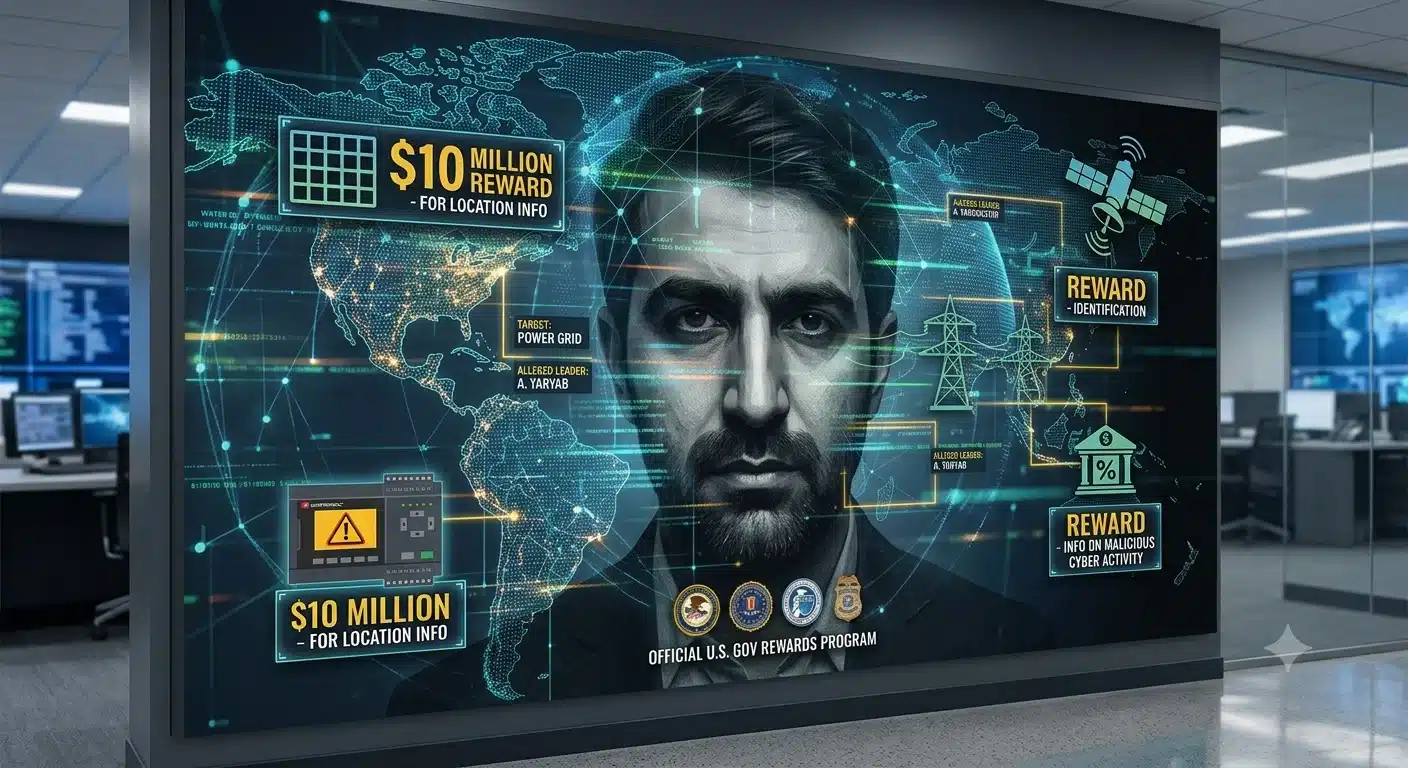
The U.S. State Department has posted a $10 million reward for Amir Yaryab, a senior Iranian official accused of leading the Islamic Revolutionary Guard Corps Cyber-Electronic Command (IRGC-CEC) Cyber Operations Command and directing multiple hacking groups targeting critical infrastructure across the United States, Europe and the Middle East.
According to the Rewards for Justice program, Yaryab allegedly oversees cyber operations conducted by IRGC-CEC-affiliated groups including CyberAv3ngers
The U.S. State Department has posted a $10 million reward for Amir Yaryab, a senior Iranian official accused of leading the Islamic Revolutionary Guard Corps Cyber-Electronic Command (IRGC-CEC) Cyber Operations Command and directing multiple hacking groups targeting critical infrastructure across the United States, Europe and the Middle East.
According to the Rewards for Justice program, Yaryab allegedly oversees cyber operations conducted by IRGC-CEC-affiliated groups including CyberAv3ngers, Dadeh Afzar Arman (DAA) and Mehrsam Andisheh Saz Nik (MASN). U.S. officials accuse these groups of using malware and conducting cyber and cyber-enabled information operations against civilian infrastructure worldwide.
$10 Million Reward for Amir Yaryab
The $10 million reward for Amir Yaryab seeks information leading to his identification or location. The offer applies to individuals acting at the direction or under the control of a foreign government who participate in malicious cyber activities against U.S. critical infrastructure in violation of the Computer Fraud and Abuse Act.
[caption id="attachment_113961" align="aligncenter" width="600"] Image Source: https://rewardsforjustice.net/[/caption]
Yaryab is also accused of directing Shahid Hemmat and Shahid Shushtari, two groups linked to cyberattacks against U.S. organizations. The sectors allegedly targeted include defense, news, shipping, travel, energy, financial services and telecommunications.
The six Iranian officials named in the advisory are linked to Iran's Islamic Revolutionary Guard Corps and its Cyber-Electronic Command.
Iranian Cyberattacks Target PLCs
The allegations also involve attacks against programmable logic controllers (PLCs), highlighting concerns around Iranian cyberattacks targeting industrial systems rather than focusing only on data theft.
U.S. officials said Iranian-linked hackers compromised industrial control systems, specifically targeting the Vision series of PLCs manufactured by Israel-based Unitronics. These devices are used across water and wastewater, energy, food and beverage, manufacturing and healthcare sectors.
The attackers exploited default credentials on the devices and left anti-Israel messages. Some of the compromises reportedly rendered the PLCs inoperative.
The CyberAv3ngers group, which is linked to the IRGC-CEC, claimed responsibility for attacks against Unitronics Vision PLCs in October 2023. Beginning in November 2023, the group compromised default credentials in PLCs across the United States and left messages on the devices' digital screens.
CyberAv3ngers Attacks Critical Infrastructure
CyberAv3ngers has also claimed responsibility for attacks affecting other infrastructure. In October 2023, the group claimed it had breached ORPAK Systems, a provider of gas station solutions in Israel. The group said it had obtained the company's database and intended to publish it through its Telegram channel.
The attack was reported to have disconnected 200 gasoline pumps from the system in the occupied Palestinian territories.
In December 2023, CyberAv3ngers also claimed to possess and sell 1TB of data allegedly linked to Israel's electricity infrastructure. The group advertised the dataset for 5 Bitcoin, with an initial 100GB portion also offered at the same price.
U.S. Agencies Warn of PLC Cyberattacks
Concerns over critical infrastructure attacks involving PLCs continued into 2026. A joint advisory issued on April 7 by the FBI, CISA, NSA and other agencies warned that Iran-linked threat actors were actively exploiting internet-facing PLCs.
The advisory said several organizations had experienced operational disruptions and financial losses after attackers interfered with industrial processes.
The developments come amid broader U.S. actions against Iranian-linked cyber activity. The Justice Department accused Iran-connected hackers of breaching employee email accounts associated with the Department of Labor, the Federal Energy Regulatory Commission and multiple United Nations organizations. The Treasury Department also sanctioned Iranian nationals over cyberattacks targeting critical infrastructure.
The State Department's reward offer places Amir Yaryab and the alleged activities of IRGC-CEC-linked groups at the center of the U.S. effort to identify individuals responsible for malicious cyber activity targeting critical infrastructure.
CISA added CVE-2023-49105 to its exploited-flaws catalog after researchers tied the old ownCloud bug to reported Philippine nuclear data theft.
The post CISA Flags Old ownCloud Flaw After Reported Philippine Nuclear Data Theft appeared first on TechRepublic.
The CISA and FBI, along with cybersecurity agencies from Australia, Canada, New Zealand and the U.K., have released new guidance on outage communications for service providers dealing with major IT and OT outages. The guide calls for prompt, factual and audience-specific communication during disruptions caused by malicious cyber activity or non-malicious events.
Titled “Communicating Under Pressure: Best Practices for Service Providers,” the guidance says effective communication is critical to
The CISA and FBI, along with cybersecurity agencies from Australia, Canada, New Zealand and the U.K., have released new guidance on outage communications for service providers dealing with major IT and OT outages. The guide calls for prompt, factual and audience-specific communication during disruptions caused by malicious cyber activity or non-malicious events.
Titled “Communicating Under Pressure: Best Practices for Service Providers,” the guidance says effective communication is critical to limiting operational impact when IT and OT outages affect customers, network defenders, critical infrastructure owners and operators, and the public. It recommends that organizations clearly communicate what is known, what remains unknown and what is still under investigation, while providing frequent updates as circumstances change.
Outage Communications Should Start With Facts
The agencies recommend that service providers establish an outage communications plan before an incident occurs. The plan should define incident thresholds, escalation paths, target audiences and procedures for status pages, customer and partner notices, and regulatory communications. Organizations are also advised to establish cross-functional incident teams involving engineering and operations, communications, legal, risk and compliance, and customer support.
The guidance calls for clearly defined roles, including an incident lead, communications lead and spokesperson. It also recommends parallel workstreams so technical teams can focus on diagnosing and remediating the root cause while communications teams manage external messaging and leadership handles strategy and regulatory requirements.
For organizations responding to cyber incidents, the guidance places particular emphasis on balancing transparency with operational security. If malicious activity is suspected or confirmed, external communications should not compromise investigations, containment efforts or other response activities. Organizations are also advised against making premature conclusions when the root cause remains under investigation.
Service Providers Urged to Tailor Messages
The guidance recommends segmenting communications for technical teams, executives and the public. Audiences can include enterprise IT teams and security operations centers, employees and customers, government partners and regulators, critical infrastructure owners and operators, as well as the media and general public.
During an outage, organizations should lead with a concise summary covering affected systems, user impact, scope and the known cause without speculation. The agencies also advise against vague descriptions such as “service degradation” and recommend messaging that can be understood quickly during high-pressure situations.
Transparency is another central principle. Service providers are advised to state what they know and do not know, use a single source of truth such as a status page, and focus communications on actionable guidance rather than reputation management. Customers should be told what actions they need to take or clearly informed when no action is required.
The guidance also calls for continuous, time-stamped updates that show the incident timeline, actions taken, and recovery milestones. Organizations should maintain a single status page and align external messaging with legal, contractual and sector-specific reporting obligations.
Agencies ultimately frame effective outage communications around five principles: immediate acknowledgement, technical and actionable information, transparency, accountability, and continuous updates. For service providers, the guidance positions communication as an important part of incident response, alongside technical remediation and recovery.
It sure seems like it.
The stores confirmed to be affected include Fort Irwin, Calif.; F.E. Warren Air Force Base, Wyo.; Fort Huachuca, Ariz.; Naval Station Newport, R.I.; Columbus Air Force Base, Miss.; and Travis Air Force Base, Calif., according to announcements made online by each installation.
Naval Air Station Lemoore, Calif., also experienced an outage, according to M. Elizabeth, writer of the Substack newsletter Signal and Silence.
Each service declined to answer questions about how many
Each service declined to answer questions about how many bases are affected by the outages, referring all questions to the Defense Department. Pentagon officials did not respond to questions.
However, a defense official said the department is aware of a “possible refrigeration disruption at some Defense Commissary Agency commissaries.” The official was not authorized to comment publicly and spoke on the condition of anonymity.
All speculation at this point, but it’s hard to come up with another explanation for the coincidence.
A cyberattack on Manchester Airports Group exposed information belonging to about 8.7 million customers across three UK airports.
The post Cyberattack on Three UK Airports Exposes Data of 8.7 Million Customers appeared first on TechRepublic.
U.S. and South Korean authorities warn about the growing Gunra ransomware threat as the operation expands its capabilities and affiliate network.
The post US, South Korea Warn of Growing Gunra Ransomware Threat appeared first on TechRepublic.
A quarter million commercial vehicles in India and sensitive data on tens of thousands of drivers were vulnerable to attacks because of flaws in widely used fleet management software maintained by a VE Commercial Vehicles, a joint venture between the Volvo Group and Eicher Motors, a security researcher has revealed.
The post Researcher: Flaw In Fleet Management Service Exposes 250k Commercial Vehicles To Attack appeared first on The Security Ledger with Paul F. Roberts.
A quarter million commercial vehicles in India and sensitive data on tens of thousands of drivers were vulnerable to attacks because of flaws in widely used fleet management software maintained by a VE Commercial Vehicles, a joint venture between the Volvo Group and Eicher Motors, a security researcher has revealed.

 Entrar