❌

Visualização normal

Antes de ontemStream principal

From Exposure to Lockdown: How AWS Neutralizes Compromised IAM Credentials through Managed Policies

21 de Setembro de 2026, 07:00

We explore how AWS neutralizes exposed IAM credentials using managed policies, detailing GitHub secret scanning and CloudTrail monitoring strategies.

The post From Exposure to Lockdown: How AWS Neutralizes Compromised IAM Credentials through Managed Policies appeared first on Unit 42.


The Machine With Many Faces: Post-Exploitation Identity Misuse in SPIFFE/SPIRE

10 de Setembro de 2026, 07:00

Learn how root access on a compromised K8s node allows attackers to utilize SPIFFE/SPIRE metadata to spoof and harvest co-located workload identities.

The post The Machine With Many Faces: Post-Exploitation Identity Misuse in SPIFFE/SPIRE appeared first on Unit 42.

  • ✇Firewall Daily – The Cyber Express
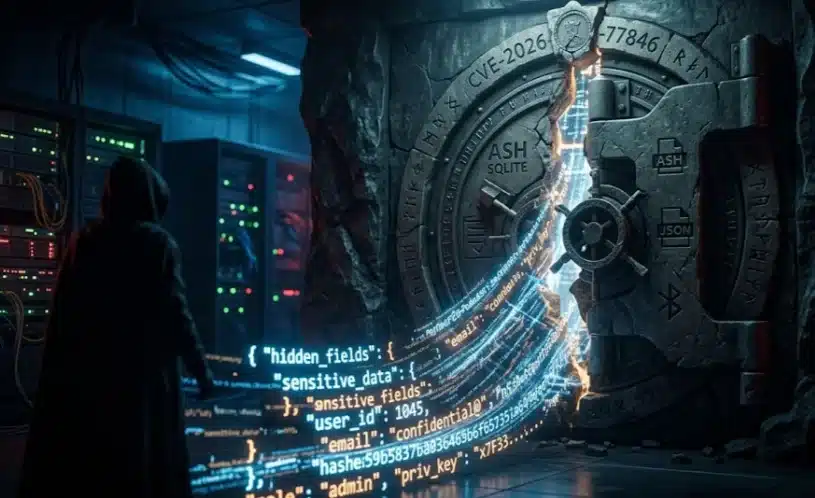
  • AshSqlite Vulnerability (CVE-2026-77846) Exposes Hidden JSON Fields Ashish Khaitan
    CVE-2026-77846, a newly disclosed AshSqlite vulnerability, can allow attackers to access hidden or sensitive fields stored inside JSON and map columns when applications pass untrusted input to AshSqlite's get_path/2 functionality.  The Erlang Ecosystem Foundation's CNA issued the vulnerability entry on August 30, 2026. The issue affects AshSqlite, the SQLite data layer used by the Ash Framework. Although it involves database queries, CVE-2026-77846 is not SQL injection.   Instead, the AshS
     

AshSqlite Vulnerability (CVE-2026-77846) Exposes Hidden JSON Fields

31 de Agosto de 2026, 06:14

CVE-2026-77846

CVE-2026-77846, a newly disclosed AshSqlite vulnerability, can allow attackers to access hidden or sensitive fields stored inside JSON and map columns when applications pass untrusted input to AshSqlite's get_path/2 functionality.  The Erlang Ecosystem Foundation's CNA issued the vulnerability entry on August 30, 2026. The issue affects AshSqlite, the SQLite data layer used by the Ash Framework. Although it involves database queries, CVE-2026-77846 is not SQL injection.   Instead, the AshSqlite vulnerability results from unsafe construction of JSON paths and the way SQLite interprets special characters in those paths. 

How the CVE-2026-77846 AshSqlite Vulnerability Works 

In affected releases, AshSqlite generated JSON paths using $."-style path construction through the expression: 
path = "$." <> Enum.join(right, ".") 
The individual path segments were neither escaped nor quoted. Consequently, a key intended to represent the literal name private.secret could instead be interpreted as two JSON levels. Characters such as ., [, ], and $ could similarly alter JSONPath interpretation.  The GitHub advisory describes the flaw as “JSONPath injection in AshSqlite.SqlImplementation get_path”, stating that an attacker controlling a get_path/2 segment can traverse nested JSON and disclose private fields. The affected package is ash_sqlite, with versions 0.1.2-rc.0 through before 0.2.18 affected and 0.2.18 listed as the patched release.  The flaw remains separate from SQL injection because the generated JSON path is supplied to SQLite's json_extract as a bound expression parameter. The attacker manipulates the JSONPath grammar, rather than injecting SQL commands. 

What CVE-2026-77846 Can Expose? 

The AshSqlite vulnerability becomes relevant when an application permits untrusted input to reach get_path/2, such as through a public calculation, filter, or API that lets callers select JSON fields.  A normal endpoint might permit a caller to request a top-level title field. However, supplying private.secret can cause AshSqlite to generate $.private.secret, allowing traversal into a nested object that the API was never intended to expose. Malformed input, such as an unbalanced bracket or bare $, can also produce SQLite JSON path errors that reveal information about the underlying structure.  The published proof of concept used AshSqlite 0.2.17, Bandit, and Req. It created a JSON record containing {"title":"hello","private":{"secret":"s3cr3t-api-key-9f2c"}}. A benign key=title request returned hello, while key=private.secret returned s3cr3t-api-key-9f2c. Captured SQL showed json_extract(p0."data", ?) with the parameter $.private.secret, confirming the traversal. The PoC concluded that a single attacker-controlled path segment could leak a nested value through an endpoint designed to expose only top-level keys. 

Fixes and Administrator Actions for CVE-2026-77846 

The fix replaces the unsafe path joining with encoding that represents keys safely, escapes backslashes and quotes, and handles numeric array indexes separately. Administrators should upgrade to AshSqlite 0.2.18 or later and audit applications that accept network-controlled field-selection input.  Until upgrades are completed, applications should restrict dynamic get_path/2 calls to predefined names, reject dangerous path characters such as periods and brackets, and avoid exposing arbitrary JSON paths.  After upgrading, dependency locks and deployment images should be checked for older ash_sqlite versions. Logs should also be reviewed for unusual dots, brackets, or JSONPath symbols in field-selection requests. Such requests do not prove exploitation, but can help identify systems requiring investigation.  The practical risk of CVE-2026-77846 depends on application architecture. Internal applications without untrusted callers face lower exposure, while public search, filtering, and field-selection APIs require careful validation and access controls. 

The Permanent Threat: Analyzing Aeternum’s Blockchain-Based C2 Operations and Communications

10 de Agosto de 2026, 19:00

Analysis of the Aeternum botnet loader, a threat leveraging Polygon blockchain smart contracts for decentralized C2 infrastructure and payload execution.

The post The Permanent Threat: Analyzing Aeternum’s Blockchain-Based C2 Operations and Communications appeared first on Unit 42.

❌
❌