Visualização normal

Antes de ontemStream principal
  • ✇Security Affairs
  • Dark Web Service Nexus Sells 153M+ Driver’s Licenses Pierluigi Paganini
    FBI probes suspected breach at IDScan.net after dark web service Nexus offered 153M+ US and Canadian driver’s license scans. A dark web identity theft service called Nexus appeared on September 1, 2026, offering searchable access to more than 153 million scanned driver’s licenses belonging to people in the United States and Canada. The FBI’s New Orleans field office opened a formal investigation the same day. Brian Krebs at KrebsOnSecurity, who broke the story, traced the source to idsca
     

Dark Web Service Nexus Sells 153M+ Driver’s Licenses

4 de Setembro de 2026, 04:02

FBI probes suspected breach at IDScan.net after dark web service Nexus offered 153M+ US and Canadian driver’s license scans.

A dark web identity theft service called Nexus appeared on September 1, 2026, offering searchable access to more than 153 million scanned driver’s licenses belonging to people in the United States and Canada.

The FBI’s New Orleans field office opened a formal investigation the same day. Brian Krebs at KrebsOnSecurity, who broke the story, traced the source to idscan.net, a New Orleans-based identity verification company whose clients include Hertz, Target, FedEx, Motorola Solutions, Caesars Entertainment, and the financial services firm Jack Henry.

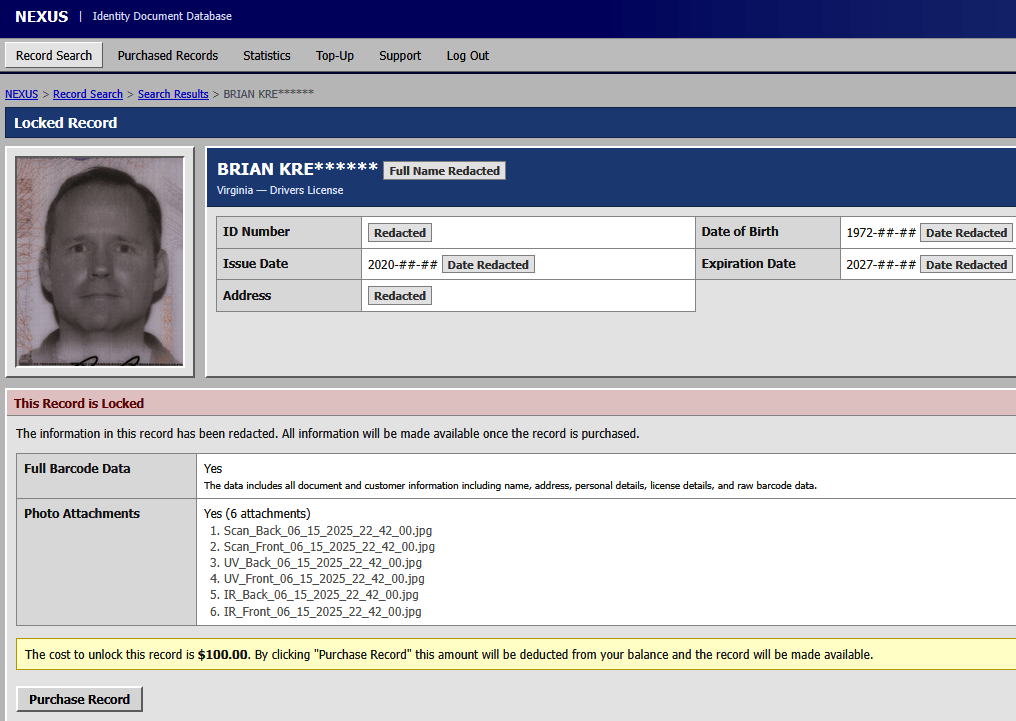
“On Monday, Aug. 31, a source alerted KrebsOnSecurity to a service advertised by a new user on the Russian cybercrime forum Exploit, offering access to digital scans of identity documents on more than 170 million people in North America. The source brought it to my attention because the proprietor of this identity theft service offered my Virginia drivers license as a free sample in their initial sales thread on Exploit.” wrote Krebs. “The service, dubbed Nexus, claims to have more than 153 million drivers licenses for people in the United States and Canada, as well as more than 10 million identification cards; more than three million travel documents and/or international IDs; and at least 579,000 medical cards.”

The record total was also increasing by roughly 400,000 per day at the time of publication, which the operators attributed to ongoing active exfiltration from a live breach they claim has been running for over a year.

Krebs found his own driver’s license in the database after a source alerted him to the service. The operators had posted his Virginia license as a free sample on the Russian cybercrime forum Exploit. Each record contains six images of the license, showing the front and back in visible, infrared, and ultraviolet light, with a timestamp. Krebs’ timestamp matched a June 2025 flight and car rental.

He then checked nine friends and relatives, and everyone who found their license confirmed traveling or renting a car around the same date. His license and his mother’s, who rented a Hertz car with him that day, had timestamps just seconds apart.

Security researcher Zach Edwards, whose license also appeared in Nexus, narrowed the source further. His timestamp matched a trip to Las Vegas for DEF CON in August. He hadn’t rented a car, but he had shown his license at a marijuana dispensary: Planet13, a multi-state chain. In 2022, idscan.net published a press release announcing an exclusive identity verification partnership with Planet13’s dispensaries nationally. The company now serves more than 1,000 marijuana dispensaries in 19 states, and its own documentation confirms that its technology scans IDs with both infrared and ultraviolet light, precisely the format of the images appearing in Nexus.

Idscan.net performs more than 21 million verifications per month at more than 20,000 locations globally. Its client list spans car rentals, retailers, hotels, financial services, and dispensaries, which explains both the volume and the geographic spread of the records. The dataset also includes marijuana dispensary cards and records marked with the notation “CAC,” which may refer to Common Access Cards, the government-issued credentials used to enter federal buildings and secure facilities. If confirmed, that would significantly expand the security implications beyond consumer identity theft.

The database reportedly contained the driver’s licenses of U.S. Defense Secretary Pete Hegseth and the FBI’s assistant director, but not FBI Director Kash Patel’s.

Idscan.net said Krebs’ findings would help its internal investigation but gave no further details. The company later said it was working with law enforcement and forensic experts. Soon after the story became public, the Nexus service went offline.

Identity verification systems that require driver’s licenses are spreading sensitive data across an expanding network of third-party vendors, and oversight mechanisms haven’t kept pace. Every bar, hotel, car rental counter, dispensary, and age-verification system that scans an ID is creating a copy of that image in a system whose security posture the cardholder has no way to assess.

The idscan.net incident, if confirmed at the reported scale, would be among the largest exposures of government-issued identity document images ever recorded.

Krebs reports that Nexus shut down after his article, while the FBI opened an investigation after learning that stolen IDs may include licenses belonging to FBI agents.

Follow me on Twitter: @securityaffairs and Facebook and Mastodon

Pierluigi Paganini

(SecurityAffairs – hacking, Nexus)

  • ✇Malwarebytes
  • 153M+ driver’s licenses for sale on new dark web platform
    A new dark web platform called Nexus claimed to be selling 153 million driver’s license scans and millions of other identity and medical cards. The collection included more than 153 million driver’s licenses, 10 million ID cards, 3 million travel documents, and 579,000 medical cards, including marijuana dispensary cards, according to reports. The trove of driver’s license scans reported by KrebsOnSecurity is a sharp reminder that identity verification is not a harmless box-ticking exercise
     

153M+ driver’s licenses for sale on new dark web platform

2 de Setembro de 2026, 07:03

A new dark web platform called Nexus claimed to be selling 153 million driver’s license scans and millions of other identity and medical cards.

The collection included more than 153 million driver’s licenses, 10 million ID cards, 3 million travel documents, and 579,000 medical cards, including marijuana dispensary cards, according to reports.

The trove of driver’s license scans reported by KrebsOnSecurity is a sharp reminder that identity verification is not a harmless box-ticking exercise.

The FBI’s New Orleans field office has opened an investigation into an apparent breach involving identity verification provider IDScan.net. The company said it was investigating.

IDScan.net advertises as follows:

“We provide simple, secure solutions to help dispensaries reduce liability and protect their licenses by validating IDs, including a customer’s age, in a matter of seconds.”

The allegedly exposed records were especially concerning because some included more than a basic photo of an ID. KrebsOnSecurity found records containing front-and-back images, as well as infrared and ultraviolet scans, with timestamps that appeared to align with the holders’ travel or car-rental activity.

That matters because a driver’s license is far more useful to an identity thief than a password. You can reset a password. You cannot easily replace your face, date of birth, address, or license number, particularly when they’re accompanied by high-resolution images of your government-issued ID.

The age-verification problem

Age verification has become a common justification for asking people to upload an ID, take a selfie, or submit both to a third-party identity verification provider.

We have previously warned about the privacy and security trade-offs in age-verification systems, particularly those that require people to submit copies of government-issued ID. Such systems can turn a request to access a website into a decision to share an enduring identity document with a company the user may never have heard of.

In our opinion, that is a disproportionate risk. Once someone uploads an ID, the service or its vendor can potentially link the visit to their identity. If the provider is breached, the consequences can extend well beyond unwanted marketing or an exposed email address.

The reported Nexus dataset illustrates a broader concern: Identity documents are collected in many places that people may not connect with one another. Each individual collection may be presented as routine, but together they create an ever-expanding ecosystem of organizations, contractors, software platforms, cloud services, and privacy policies.

Facial images and ID copies can be reused. Criminals may use them to make scams more convincing, pass weak identity checks, or assemble detailed victim profiles from records obtained from separate breaches. An attacker who knows your name, address, date of birth, email address, and license details has a useful foundation for fraud.

This is why “we only need to verify your age” should not automatically mean “please upload your driver’s license” or another form of ID.

How to stay safe

When an ID check is required to use an online service, ask a basic question: Why does this company need a copy of my identity document, and what happens to it afterward? The scale of the data reportedly offered through Nexus shows why the answer matters.

Consumers cannot always refuse an ID check, particularly where it is legally required or necessary for a regulated service. But you can reduce unnecessary exposure:

  • Ask whether an ID image is stored and, if so, for how long.
  • Check whether the company uses a third-party identity verification provider.
  • Prefer services that offer a privacy-preserving age check rather than requiring a full ID upload.
  • Avoid submitting identity documents to sites you do not trust or did not intend to use.
  • Do not email copies of IDs unless there is no safer alternative and you have independently verified the recipient.
  • Be alert for phishing, account-recovery scams, and fraudulent credit applications if you believe your ID may have been exposed.
  • Consider a credit freeze where available.

Let’s face it, an incognito window can only do so much. 
 
Breaches, dark web trading, credit fraud. Malwarebytes Identity Theft Protection monitors for all of it, alerts you fast, and comes with identity theft insurance. 

  • ✇Krebs on Security
  • FBI Probes Service Selling 153M+ Drivers Licenses BrianKrebs
    A new identity theft service launched on the dark web this week is selling digital scans of more than 153 million drivers licenses from people in the United States and Canada. Based on interviews with individuals whose licenses are available for purchase on this service, it appears to be siphoning images collected by a widely-used identity verification company based in Louisiana. KrebsOnSecurity also has learned that the New Orleans field office of the Federal Bureau of Investigation (FBI) today
     

FBI Probes Service Selling 153M+ Drivers Licenses

1 de Setembro de 2026, 19:40

A new identity theft service launched on the dark web this week is selling digital scans of more than 153 million drivers licenses from people in the United States and Canada. Based on interviews with individuals whose licenses are available for purchase on this service, it appears to be siphoning images collected by a widely-used identity verification company based in Louisiana. KrebsOnSecurity also has learned that the New Orleans field office of the Federal Bureau of Investigation (FBI) today launched an official inquiry into the source of the images.

A record available at this identity theft service that includes the drivers license for U.S. Defense Secretary Pete Hegseth, one of several high-ranking U.S. government officials whose drivers licenses can be found for sale.

On Monday, Aug. 31, a source alerted KrebsOnSecurity to a service advertised by a new user on the Russian cybercrime forum Exploit, offering access to digital scans of identity documents on more than 170 million people in North America. The source brought it to my attention because the proprietor of this identity theft service offered my Virginia drivers license as a free sample in their initial sales thread on Exploit.

The service, dubbed Nexus, claims to have more than 153 million drivers licenses for people in the United States and Canada, as well as more than 10 million identification cards; more than three million travel documents and/or international IDs; and at least 579,000 medical cards.

A quick look around Nexus finds they are likely not exaggerating about that 153 million number: Running a blank search in Nexus (with no search parameters entered) returns approximately 11.5 million pages of results, with roughly 15 results displayed per page. It includes documents from people in both Canada and the United States, but the bulk of these records are on Americans: searching for just Canadian drivers licenses returns approximately 1.1 million results, with the largest concentration from Ontario (473,673 records).

Curiously, the identity records include not only drivers licenses but also marijuana dispensary cards. Some of the records list their “source” as “CDL,” presumably short for “commercial drivers license.” Other records carry the source notation of “CAC,” which may refer to Common Access Cards, government issued identity cards that grant physical access to government buildings and secure rooms.

The people behind Nexus claim the license images are coming from an active breach at “a major identity verification company” whose customers include multiple Fortune 500 companies.

The record totals listed by the Nexus identity theft service. The number of drivers license records increased by nearly 400,000 in the span of just 24 hours.

“We have been continuously exfiltrating new data for over a year into our private database,” the service enthused in its introductory post on Exploit. “Records are available to preview before purchase with pertinent information redacted. Customer photos are displayed if available.”

Indeed, over the past 24 hours, the number of drivers license records listed as available in Nexus has increased by nearly 400,000, suggesting that freshly stolen license data is being harvested and uploaded to this service on a semi-regular basis.

The record featuring my drivers license includes six image files: three pairs of photos of the license’s front and back, a basic image scan, as well as infrared and ultraviolet versions of the same images. A date and timestamp is appended to each image file, and the timestamp on my license scan corresponds to a date in June 2025 when I took a flight to the midwest United States to attend a family funeral.

Some of the 153 million+ license scans — including mine — feature six image files with date and timestamps appended to the filenames. Not all records include photos, and some that do feature photos do not display the associated filenames.

Intent on discovering the source of this data, KrebsOnSecurity asked more than a dozen friends and family members for permission to search for their licenses in this service. Each person whose license could be found (nine of them) confirmed having traveled on or very close to the dates in the timestamps attached to their images. It is unclear what timezone these timestamps are in, but from reviewing car rental records shared by several people who helped with this research, it appears the timezone is set to Greenwich Mean Time (GMT).

At first, I thought the source of the data might have something to do with airports. However, that theory went out the window when it became apparent there were no passports in this data set. Also, only some of those who helped with this research said they showed their drivers license at the airport on the day of their travel. One person whose license was in Nexus hadn’t flown at all recently, but was renting a car from Hertz for several months around the date of their timestamp.

Two of those who agreed to help are federal employees who said they shared other forms of government identification when passing through airport security. However, those individuals each said they shared their state-issued drivers licenses later that day when renting vehicles at their respective destinations, and that both rented their cars from Hertz.

After finding a note in my calendar for the day of my June 2025 flight reminding me to bring my passport, I remembered that I also never actually shared my drivers license when I went through security at Reagan National Airport on that day because I did not yet have a Real ID, a security-enhanced drivers license that is now required by the Transportation Security Administration (TSA) for all domestic travel. Instead, I showed the TSA agent my government-issued U.S. passport.

Here’s where it gets interesting: I was able to find my mother’s drivers license in this service as well, and the timestamps for her images are just a few seconds apart from mine. That’s notable because we both handed our licenses to the Hertz rental car representative at the same time.

According to my mom, the only place she gave her drivers license to that day was the rental car company, and if memory serves that is also true for me. I don’t recall if the rental car representative inserted our licenses into any kind of machine, but I remember they held onto them for several minutes behind the counter while we were signing various forms. KrebsOnSecurity sought comment from Hertz and will update this story in the event they reply.

Zach Edwards is a well-known security and privacy researcher who recently launched a service called DecryptAds to help people better understand how online advertisers are tracking them. A scan of Edwards’s drivers license is available for purchase on this identity theft service, and Edwards said the timestamp on his record corresponds to the middle of a trip last month to Las Vegas for the annual DEFCON security conference.

Edwards told KrebsOnSecurity that although he did not rent a car in Vegas, he did hand over his license at the TSA checkpoint, at a marijuana dispensary in Vegas, and at his hotel (the Aria). But he said the only one of those three that for sure scanned his ID in some kind of device was the dispensary.

To enter Planet13’s weed dispensary in Las Vegas, one must pass through a red telephone booth. Image: Zach Edwards.

Edwards said the dispensary he visited that day was Planet13, a multi-state chain with stores in California, Florida, Illinois and Nevada. In 2022, the New Orleans-based identity provider idscan.net published a press release announcing an exclusive identity verification agreement with Planet13’s dispensaries nationally. IDScan says it processes ID verification for more than 1,000 marijuana dispensaries in 19 U.S. states.

The “trust” page of idscan.net states that the company provides identity verification services for numerous big brands, including Hertz, Target, Fedex, Motorola Solutions, the financial services giant Jack Henry, and Caesars Entertainment. And as idscan.net’s own documentation states, the technology scans IDs with both infrared and ultraviolet light. Idscan.net says the company’s systems and technology perform more than 21 million verifications monthly, at more than 20,000 locations around the world.

Image: idscan.net.

Contacted by KrebsOnSecurity, idscan.net said it was investigating the matter, but the company has not yet shared an official statement or a substantive reply to specific questions sent via email.

“At this point I’m not able to share any additional information, but the updates you have provided have been welcome, and helpful to our team’s investigation,” wrote Jillian Kossman, a marketing and operations leader at idscan.net.

During the course of my research for this story, word got around to the FBI that I was poking at the apparent source of this new identity theft service’s data. Probably they were tipped off when I shared with a trusted source that Nexus also is selling the drivers license information for the assistant director of the FBI (I did not find FBI Director Kash Patel’s license in Nexus).

Earlier this afternoon, I was added to a conference call with a half-dozen FBI agents, including senior leaders from the agency’s cyber division. During that call, the FBI shared that earlier today their New Orleans field office opened an official investigation into an apparent breach involving idscan.net.

Edwards said that as more in-person and online experiences require sharing drivers licenses, vendors who collect this sensitive data need to be held to a higher standard.

“This episode should further strengthen the resolve for people who are fighting back against online ID schemes which are requiring countless providers to ask for drivers licenses in order to access services under the guise of protecting kids,” Edwards told KrebsOnSecurity. “These systems are putting sensitive data into more and more 3rd party vendors, and we don’t have nearly the oversight to ensure they are safe.”

Larry Baldwin is principal intelligence researcher at the cybersecurity firm Cybera. Baldwin said a front and back scan of his drivers license available at Nexus contains timestamps that correspond to the date of a car rental from Hertz on a recent vacation.

Baldwin said the Nexus identity theft service presents multiple serious security and privacy threats, noting that state-issued drivers licenses are commonly used as proof of one’s identity when opening new lines of credit. Baldwin said the service could also dangerously expose many people who do not wish to be found but who cannot meaningfully change their appearance (or at least not enough to fool today’s AI-based image matching tools).

This category of people, he said, includes those fleeing domestic violence, and even people who have been assigned a whole new life and identity as part of the federal government’s witness protection program, which is generally reserved for criminal defendants in racketeering and conspiracy investigations who agree to cooperate with federal authorities.

“Just when it seems like we’re making some headway in improving authentication controls through drivers license verification systems, this happens and the very thing those improvements are dependent on are compromised,” Baldwin said.

Update, Sept. 2, 6:05 p.m. ET: A spokesperson for Caesars Entertainment said Caesars has not been a client of IDScan.net and has not used VeriScan since February 2025, despite IDScan.net listing them as a client on their website. That person said Caesars had no active VeriScan accounts at the time of the incident and did not authorize IDScan.net to retain data from its accounts, and that IDScan.net said the incident should have no impact on Caesars Entertainment.

Update, 8:56 p.m. ET: Shortly after this story was published, the Nexus identity theft service website vanished from the darkweb, replacing its login page with a plain text message that reads, “This service is no longer available.”

This is a potentially fast-moving story. Any changes or updates will be noted here along with a timestamp.

  • ✇Cybersecurity News
  • SilkParasite APT Hits Central Asian Governments With 7 RATs Do Son
    SilkParasite APT ran China-nexus cyberespionage across Central Asia, using 7 custom RATs, DLL sideloading, and AI-assisted malware. Related Posts: FBI Seizes QScan and QTRouter Platforms Run by China State Hackers Operation CameraSwarm: 14,500 Dahua Cameras Compromised Across Ukraine and Russia Core Werewolf Deploys New CoreRAT Malware Against Russian Targets The post SilkParasite APT Hits Central Asian Governments With 7 RATs appeared first on Daily CyberSecurity.
     
  • ✇Cybersecurity News
  • Operation QUICSILVER Targets Myanmar Government With Go Backdoor Do Son
    Seqrite links Operation QUICSILVER to a China-nexus actor deploying the QUICAgent Go backdoor against Myanmar government targets via a VHD lure. Related Posts: Cisco Talos Exposes UAT-10147 Agentic AI Attacks Operation ASTERIX: Crypto Scam Used AI and Fake Wallets arrayref Rust Crate Hijacked in Supply Chain Attack With DPRK Infrastructure Overlap The post Operation QUICSILVER Targets Myanmar Government With Go Backdoor appeared first on Daily CyberSecurity.
     
  • ✇Firewall Daily – The Cyber Express
  • China-Linked Cyber Actors Turn to Massive Covert Botnets to Evade Detection Ashish Khaitan
    A newly issued cybersecurity advisory highlights an evolution in the tactics, techniques and procedures (TTPs) employed by China-Nexus threat actors. The report, released with support from the UK Cyber League and coordinated by the National Cyber Security Centre (NCSC-UK) alongside international partners, sheds light on how Chinese threat actors are relying on large-scale covert networks of compromised devices to conduct malicious cyber operations. A Strategic Shift in China-Nexus TTPs  In rec
     

China-Linked Cyber Actors Turn to Massive Covert Botnets to Evade Detection

China-Nexus

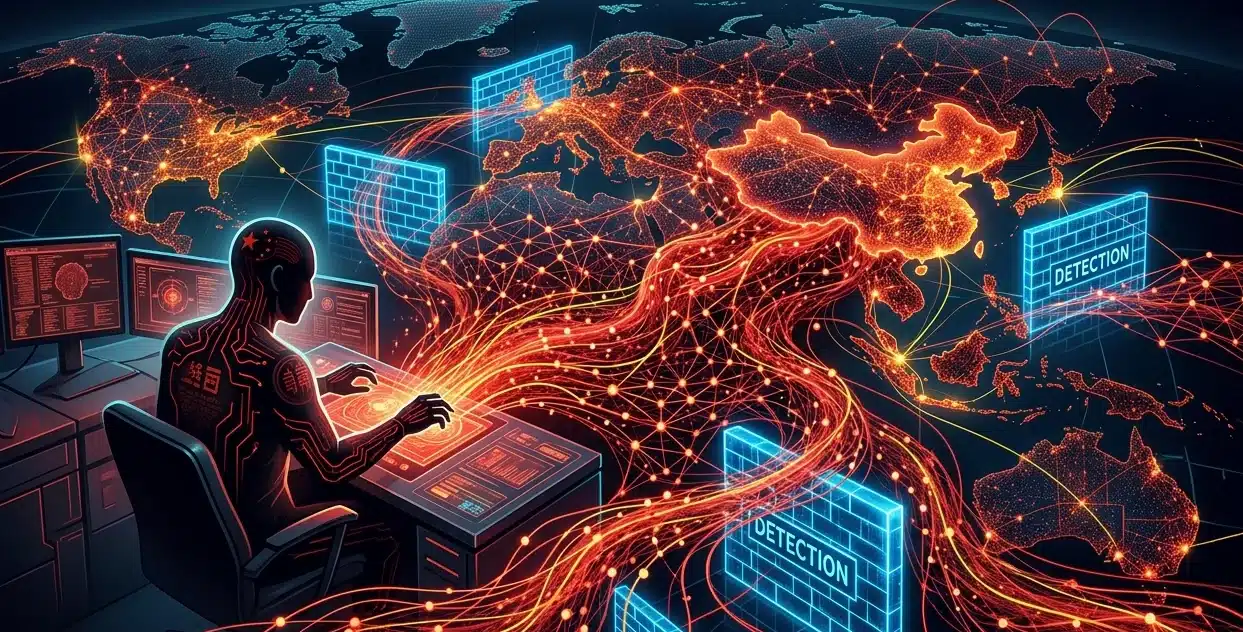
A newly issued cybersecurity advisory highlights an evolution in the tactics, techniques and procedures (TTPs) employed by China-Nexus threat actors. The report, released with support from the UK Cyber League and coordinated by the National Cyber Security Centre (NCSC-UK) alongside international partners, sheds light on how Chinese threat actors are relying on large-scale covert networks of compromised devices to conduct malicious cyber operations.

A Strategic Shift in China-Nexus TTPs 

In recent years, cybersecurity experts have observed a clear transition in China-Nexus TTPs. Rather than relying on dedicated, individually controlled infrastructure, Chinese threat actors are now leveraging expansive networks of compromised devices, commonly referred to as covert networks or botnets. These networks are primarily composed of Small Office/Home Office (SOHO) routers, Internet of Things (IoT) devices, and other internet-connected hardware. According to the advisory, the majority of China-Nexus actors are believed to be using such covert networks, with multiple networks operating simultaneously and often shared among different groups. These networks are continuously updated, making them highly adaptable and difficult to track. Any organization targeted by Chinese threat actors could be affected. For example, the group known as Volt Typhoon has used these covert networks to pre-position cyber capabilities within critical infrastructure, while Flax Typhoon leveraged similar methods for espionage operations.

How Covert Networks Operate 

Although botnets are not new, China-Nexus actors are now deploying them at an unprecedented scale and with strategic intent. These covert networks allow attackers to mask their identity, route malicious traffic through multiple nodes, and reduce the risk of attribution. Typically, an attacker accesses the network via an entry point, or “on-ramp,” and routes activity through numerous compromised devices—called traversal nodes—before exiting near the target. This multi-hop approach obscures the origin of the attack. These networks support every stage of a cyber operation, from reconnaissance and scanning to malware delivery, command-and-control communication, and data exfiltration. They are also used for general browsing, enabling threat actors to research vulnerabilities and refine TTPs without revealing their identity. The presence of legitimate users on some networks further complicates attribution. 

Real-World Examples and Scale 

Evidence suggests that some covert networks used by China-Nexus actors are developed and maintained by Chinese cybersecurity firms. One notable example is the “Raptor Train” network, which infected over 200,000 devices globally in 2024. It was reportedly managed by Integrity Technology Group, a company also linked by the FBI to activities associated with Flax Typhoon. Another example includes the KV Botnet used by Volt Typhoon, which primarily exploited outdated Cisco and NetGear routers. These devices were particularly vulnerable because they had reached “end-of-life” status, meaning they no longer received security updates. The scale and adaptability of these networks present a major challenge. As Paul Chichester, NCSC Director of Operations, stated: “Botnet operations represent a significant hreat to the UK by exploiting vulnerabilities in everyday internet-connected devices with the potential to carry out large-scale cyberattacks.”

Challenges for Network Defenders 

Cybersecurity researchers have long been aware of such threats, but the evolving nature of China-Nexus TTPs introduces new difficulties. A key issue identified by Mandiant Intelligence in May 2024 is “indicator of compromise (IOC) extinction.” Traditional defenses, such as static IP blocklists, are becoming less effective because attackers can operate from vast, constantly changing pools of devices.  As compromised nodes are patched or removed, new ones are quickly added, making these networks highly dynamic. This fluidity undermines conventional detection and mitigation strategies. 

Defensive Measures and Best Practices 

The advisory outlines several steps organizations can take to defend against China-Nexus covert networks: 

For all organizations: 

  • Maintain a clear inventory of network edge devices. 
  • Establish baselines for normal network activity, particularly VPN access. 
  • Monitor for unusual connections, including those from consumer broadband ranges. 

For higher-risk organizations: 

  • Use IP allow lists instead of blocklists for VPN access. 
  • Apply geographic and behavioral profiling of incoming connections. 
  • Adopt zero-trust security models. 
  • Enforce SSL machine certificates. 
  • Reduce exposure of internet-facing systems. 
  • Explore machine learning tools to detect anomalies. 

For the most at-risk entities: 

  • Treat China-Nexus covert networks as advanced persistent threats (APTs). 
  • Map and monitor known covert networks using threat intelligence. 
❌
❌